NUCLEIC ACID MICROARRAY
BY: PRIYA SHUKLA
INDEX:
 INTRODUCTION
 HISTORY
 PRINCIPLE
 SCANNER
 Type of DNA microarray
 Application
INTRODUCTION:
 WHAT IS MICROARRAY?
 A microarray is a laboratory tool used to detect the
expression of thousands of genes at the same time.
 Microarray helps in analyzing large amount of
samples which have either been recorded previously
or new samples.
The microarray technique is been sub-classified based
on the sample to be analyte:
 DNA microarray
 Protein microarray
 Transfection microarray
 Antibody microarray
 Tissue microarray
 Chemical compound microarray
 A DNA microarray also commonly known as DNA
chip or biochip is a collection of microscopic DNA
spots attached to solid support surface.
 Each DNA spot contain picomoles ( 10-12 moles) of
specific DNA sequence known as probe or oligos.
 Each known gene or probe occupied a specific site
on the chip and varying level of fluorescent activity
show varing level of gene activity of introduced
genetic material.
 (1) cDNA microarrays: to enable large-scale analysis
of mRNA abundance as an indicator of gene
expression.
 (2) Single nucleotide polymorphism (SNP)
microarrays and mutation arrays: to detect
polymorphisms or mutations within a population
using SNP arrays or arrays designed to detect
known mutations.
 (3) Comparative genomic hybridization (CGH)
microarrays: to look for genomic gains and losses, or
for a change in the number of copies of a particular
gene involved in a disease
HISTORY:
 Southern blotting was developed in 1975.
 The concept of DNA microarray was considered at
mid 1980s.
 Quantitative monitoring of gene expression with
complement DNA microarray reported by PETRICK
BROWN, MARK SECHENA and colleagues
 Mark Sechena was proclaimed as ‘THE FARTHER
OF MICROARRAY TECHNIQUE’.
PRINCIPLE:
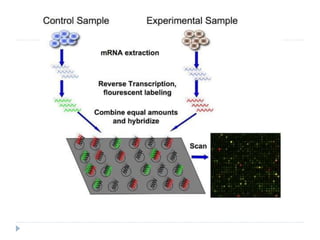
 The core principle of microarray is HYBRIDIZATION.
 Samples are labelled using fluorescent dyes.
 Complementary nucleic acid get bind via hydrogen
bonds.
 Washing of non specific bonding DNA.
Sample
preparation and
labelling
HYBRIDIZATION WASHING
Image acquisition
and data analysis
 Fluorescently labelled target sequence that bind to
the probe sequence generate a signal.
 The signal depend on :
 1. hybridization condition ( eg: temperature)
 2. washing after hybridization
 The total strength of signal depend on the amount of
target bond to probe.
SCANNING THE ARRAY:
 1. Laser Scanner:
 Excellent resolution
 Good fluorescent but may bleach the fluorochromes
 Speed: slow
 2. CCD Laser( charge coupled device)
 Less resolution
 Sensitive and easily adjustable
 Faster and cheaper as compared to laser scanner
TYPE OF DNA MICROARRAY:
 SPOTTED DNA ARRAYS ( cDNA):
 Develpoed by Pat Brown
 PCR product from known genes spotted on support
 Customizable
 GENE CHIPS:
 1. OLIGONUCLEOTIDE ARRAYS ( AFFYMETRIX):
 Small number of 20-25mer/ gene
 Enable by photolithography from computer industry
 2. INK- JET MICROARRAYS ( AGILENT);
 Large number of 25-60mer “printed” directly on glass
 Four cartridges: A,C,G and T
 Flexible, rapid, but expensive
SPOTTED DNA ARRAYS
 The probes are oligonucleotides, cDNA, or small
fragments of PCR products that correspond to
mRNAs, there probes are synthesized prior to
deposition or the array surface and are then ‘
spotted’ onto glass.
 A common approach utiliizers an array of fine pins or
needles controlled by a robotic arm that is dipped
into wells containing DNA probes and then
depositing each probe at designated locations on the
array surface.
 The resulting ‘grid’ of probe represents the nucleic
acid profiles of the prepared probes and is ready to
receive c DNA derived from experimental or clinical
1. OLIGONUCLEOTIDE ARRAYS:
 Here, probes are short sequences designed to
match parts of the sequence of known or predicted
open reading frames.
 Oligonucleotide array are produced by printing short
oligonucleotide sequences designed to represent a
single gene by synthesizing this sequence directly
onto the array surface instead of depositing intact
sequences.
 Sequences may be longer or shorter depending on
desired purpose; longer probes are more specific to
individual target genes, shorter probes may be
spotted in higher density across the array and are
cheaper to manufacture.
 One technique used to produce oligonucleotide
arrays include photolithographic synthesis (Agilent
and Affymetrix) on a silica substrate where light and
light- sensitive masking agents are used to ‘ build’ a
sequence one nucleotide at a time across the entire
array.
APPLICATION
 1. gene expression analysis:
 The process of measuring gene expression via c
DNA is called expression analysis.
 Study the effect of certain treatments, diseases, and
developmental stage on gene expression.
 eg: identify genes expression changes due to
pathogens or other organisms by compairing with
uninfected cells or tissue
2. Disease diagnosis:
 Earlier cancer classification on the basis of the organ
in which tumours develop.
 Earlier stage of genetic mutation in pateint.
3. Drug discovery
 Applicable in pharmacogenomics
 Comparative analysis of gene
 Help the identification of specific proteins produce by
diseased cells.
 Help to produce effective drugs
4.Toxicological research
 A rapid platform for the research of the impact of
toxin on the cells and their passing on to the
progeny.
 Important for toxicogenomic studies.

Nucleic acid microarray

  • 1.
  • 2.
    INDEX:  INTRODUCTION  HISTORY PRINCIPLE  SCANNER  Type of DNA microarray  Application
  • 4.
    INTRODUCTION:  WHAT ISMICROARRAY?  A microarray is a laboratory tool used to detect the expression of thousands of genes at the same time.  Microarray helps in analyzing large amount of samples which have either been recorded previously or new samples.
  • 5.
    The microarray techniqueis been sub-classified based on the sample to be analyte:  DNA microarray  Protein microarray  Transfection microarray  Antibody microarray  Tissue microarray  Chemical compound microarray
  • 6.
     A DNAmicroarray also commonly known as DNA chip or biochip is a collection of microscopic DNA spots attached to solid support surface.  Each DNA spot contain picomoles ( 10-12 moles) of specific DNA sequence known as probe or oligos.  Each known gene or probe occupied a specific site on the chip and varying level of fluorescent activity show varing level of gene activity of introduced genetic material.
  • 7.
     (1) cDNAmicroarrays: to enable large-scale analysis of mRNA abundance as an indicator of gene expression.  (2) Single nucleotide polymorphism (SNP) microarrays and mutation arrays: to detect polymorphisms or mutations within a population using SNP arrays or arrays designed to detect known mutations.  (3) Comparative genomic hybridization (CGH) microarrays: to look for genomic gains and losses, or for a change in the number of copies of a particular gene involved in a disease
  • 8.
    HISTORY:  Southern blottingwas developed in 1975.  The concept of DNA microarray was considered at mid 1980s.  Quantitative monitoring of gene expression with complement DNA microarray reported by PETRICK BROWN, MARK SECHENA and colleagues  Mark Sechena was proclaimed as ‘THE FARTHER OF MICROARRAY TECHNIQUE’.
  • 9.
    PRINCIPLE:  The coreprinciple of microarray is HYBRIDIZATION.  Samples are labelled using fluorescent dyes.  Complementary nucleic acid get bind via hydrogen bonds.  Washing of non specific bonding DNA.
  • 10.
  • 12.
     Fluorescently labelledtarget sequence that bind to the probe sequence generate a signal.  The signal depend on :  1. hybridization condition ( eg: temperature)  2. washing after hybridization  The total strength of signal depend on the amount of target bond to probe.
  • 13.
    SCANNING THE ARRAY: 1. Laser Scanner:  Excellent resolution  Good fluorescent but may bleach the fluorochromes  Speed: slow  2. CCD Laser( charge coupled device)  Less resolution  Sensitive and easily adjustable  Faster and cheaper as compared to laser scanner
  • 14.
    TYPE OF DNAMICROARRAY:  SPOTTED DNA ARRAYS ( cDNA):  Develpoed by Pat Brown  PCR product from known genes spotted on support  Customizable  GENE CHIPS:  1. OLIGONUCLEOTIDE ARRAYS ( AFFYMETRIX):  Small number of 20-25mer/ gene  Enable by photolithography from computer industry
  • 15.
     2. INK-JET MICROARRAYS ( AGILENT);  Large number of 25-60mer “printed” directly on glass  Four cartridges: A,C,G and T  Flexible, rapid, but expensive
  • 16.
    SPOTTED DNA ARRAYS The probes are oligonucleotides, cDNA, or small fragments of PCR products that correspond to mRNAs, there probes are synthesized prior to deposition or the array surface and are then ‘ spotted’ onto glass.  A common approach utiliizers an array of fine pins or needles controlled by a robotic arm that is dipped into wells containing DNA probes and then depositing each probe at designated locations on the array surface.  The resulting ‘grid’ of probe represents the nucleic acid profiles of the prepared probes and is ready to receive c DNA derived from experimental or clinical
  • 18.
    1. OLIGONUCLEOTIDE ARRAYS: Here, probes are short sequences designed to match parts of the sequence of known or predicted open reading frames.  Oligonucleotide array are produced by printing short oligonucleotide sequences designed to represent a single gene by synthesizing this sequence directly onto the array surface instead of depositing intact sequences.
  • 19.
     Sequences maybe longer or shorter depending on desired purpose; longer probes are more specific to individual target genes, shorter probes may be spotted in higher density across the array and are cheaper to manufacture.  One technique used to produce oligonucleotide arrays include photolithographic synthesis (Agilent and Affymetrix) on a silica substrate where light and light- sensitive masking agents are used to ‘ build’ a sequence one nucleotide at a time across the entire array.
  • 21.
    APPLICATION  1. geneexpression analysis:  The process of measuring gene expression via c DNA is called expression analysis.  Study the effect of certain treatments, diseases, and developmental stage on gene expression.  eg: identify genes expression changes due to pathogens or other organisms by compairing with uninfected cells or tissue
  • 22.
    2. Disease diagnosis: Earlier cancer classification on the basis of the organ in which tumours develop.  Earlier stage of genetic mutation in pateint.
  • 23.
    3. Drug discovery Applicable in pharmacogenomics  Comparative analysis of gene  Help the identification of specific proteins produce by diseased cells.  Help to produce effective drugs
  • 24.
    4.Toxicological research  Arapid platform for the research of the impact of toxin on the cells and their passing on to the progeny.  Important for toxicogenomic studies.