BY
MOHAMED ABUSALIH
1.INTRODUCTION
2.PROCESS OF DRUG DISCOVERY
3.MICRO ARRAY TECHNIQUES
4.MICRO ARRAY ANALYSIS IN DRUG DISCOVERY
5.STEPS INVOLVED IN MICRO ARRAY TECHNIQUES
MOHAMED ABUSALI
DEPARTMENT OF PHARMACOLOGY2
1.INTRODUCTION
A. Target selection is one of the drug discovery Process, In which genomics is one of the
B. target selection.
C. Genomics are explained as the study of genomes(group of gene sequences are called
genome). Genomics is used to study about genes and their functions.
D. Drugs can make by gene bases, it’s otherwise called personalized medicine.
E. Microarray techniques(DNA chips) is undergone the genomics studies.
F. Microarray techniques is one of the gene sequencing technique, which is used to
identifying the expression of the gene on to the matrix.
G. Samples or probes are immobilized on to the matrix.
H. Microarray technique can be divided into two types
• Nuclicacid micro array
• Tissue micro array
MOHAMED ABUSALI
DEPARTMENT OF PHARMACOLOGY3
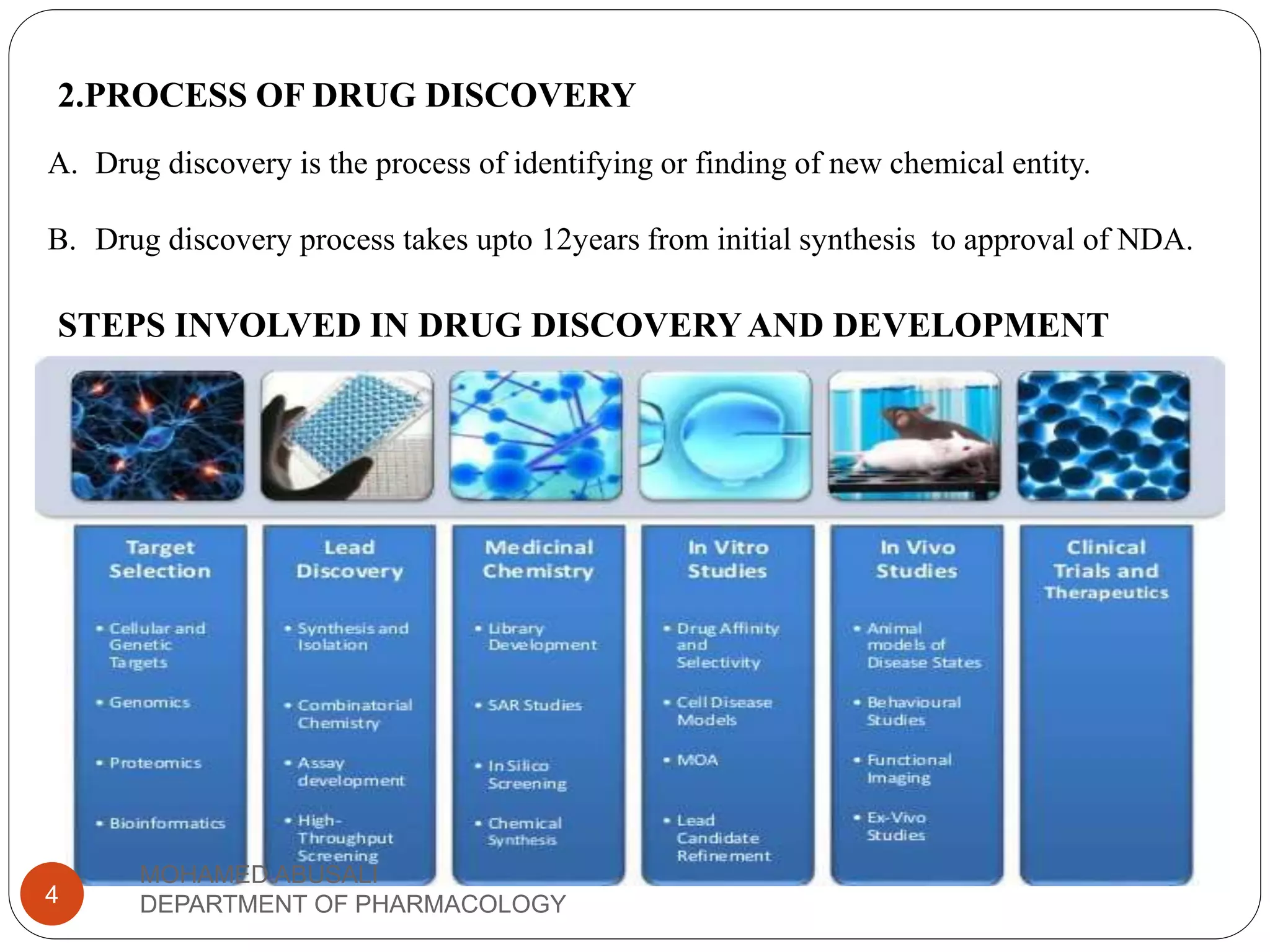
2.PROCESS OF DRUG DISCOVERY
A. Drug discovery is the process of identifying or finding of new chemical entity.
B. Drug discovery process takes upto 12years from initial synthesis to approval of NDA.
STEPS INVOLVED IN DRUG DISCOVERYAND DEVELOPMENT
MOHAMED ABUSALI
DEPARTMENT OF PHARMACOLOGY4
3.MICRO ARRAY TECHNIQUES
A. Microarray techniques(DNA chips) is undergone the genomics studies.
B. Microarray techniques is one of the gene sequencing technique, which is used to
identifying the expression of the gene on to the matrix.
C. Samples or probes are immobilized on to the matrix.
D. Microarray technique can be divided into two types
• Nuclicacid micro array
• Tissue micro array
I.IDENTIFYING COMPARISON FOR NEW NUCLICACID SEQUENCES
•Blast (basic local allignment search tool)
•Which, one of the site having all DNA data bases(gene liberary),we can compare the
Gene sequence with known data base sequence.
MOHAMED ABUSALI
DEPARTMENT OF PHARMACOLOGY5
NUCLICACID MICROARRAY
A. Nucleic acid microarrays (genome chips) are generated by arraying nucleotide
‘probes’ onto a support matrix.
B. Various technologies are used to generate themicroarrays.The supporting matrix is
usually a glass microscope slide but nylon, silicon and nitrocellulose membranes
have also been used.
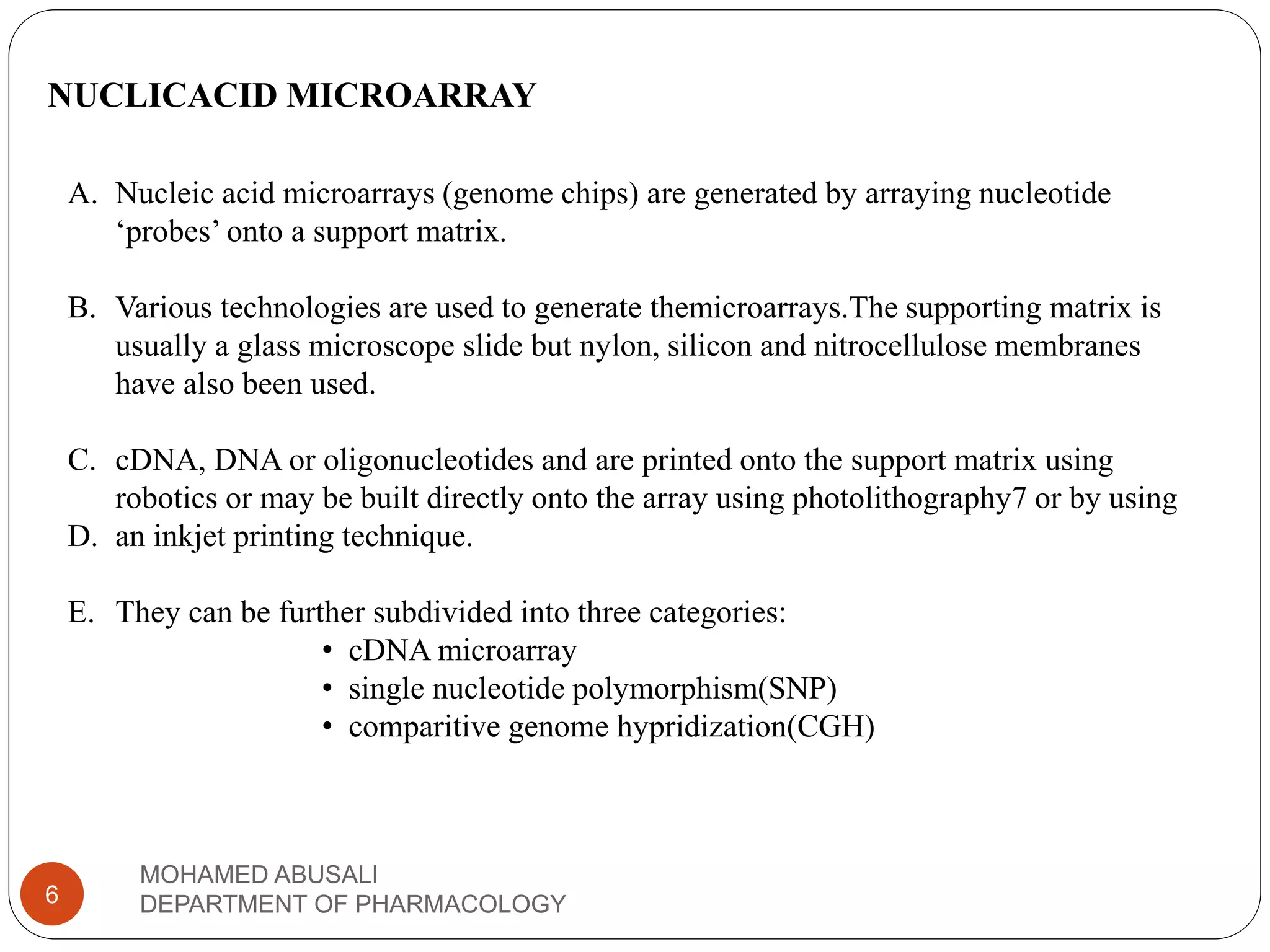
C. cDNA, DNA or oligonucleotides and are printed onto the support matrix using
robotics or may be built directly onto the array using photolithography7 or by using
D. an inkjet printing technique.
E. They can be further subdivided into three categories:
• cDNA microarray
• single nucleotide polymorphism(SNP)
• comparitive genome hypridization(CGH)
MOHAMED ABUSALI
DEPARTMENT OF PHARMACOLOGY6
 cDNA micro array
Large-scale parallel measurement of whole genome messenger RNA expression is
possible using high-density arrays of cDNA or oligonucleotides
MOHAMED ABUSALI
DEPARTMENT OF PHARMACOLOGY7
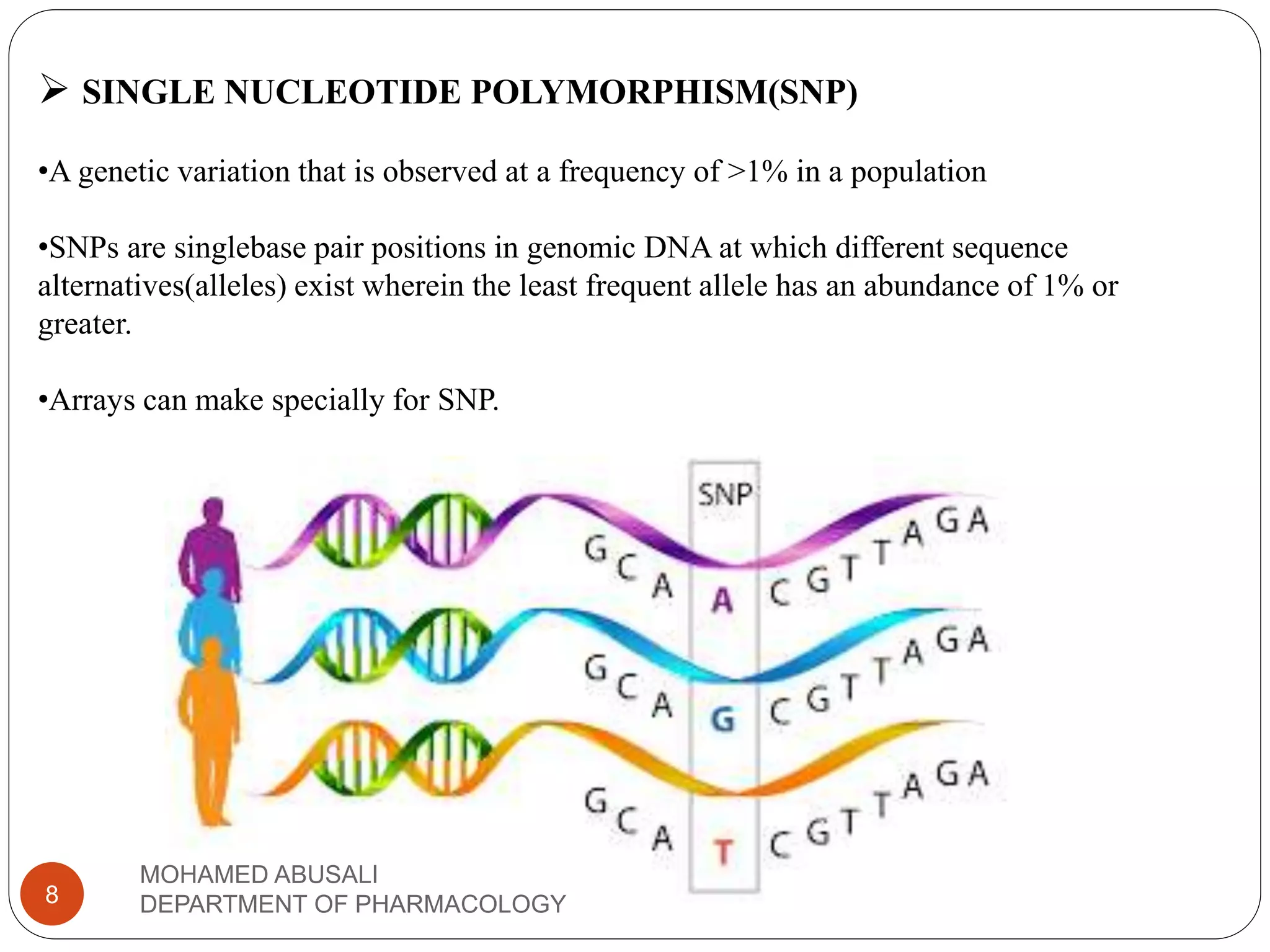
 SINGLE NUCLEOTIDE POLYMORPHISM(SNP)
•A genetic variation that is observed at a frequency of >1% in a population
•SNPs are singlebase pair positions in genomic DNA at which different sequence
alternatives(alleles) exist wherein the least frequent allele has an abundance of 1% or
greater.
•Arrays can make specially for SNP.
MOHAMED ABUSALI
DEPARTMENT OF PHARMACOLOGY8
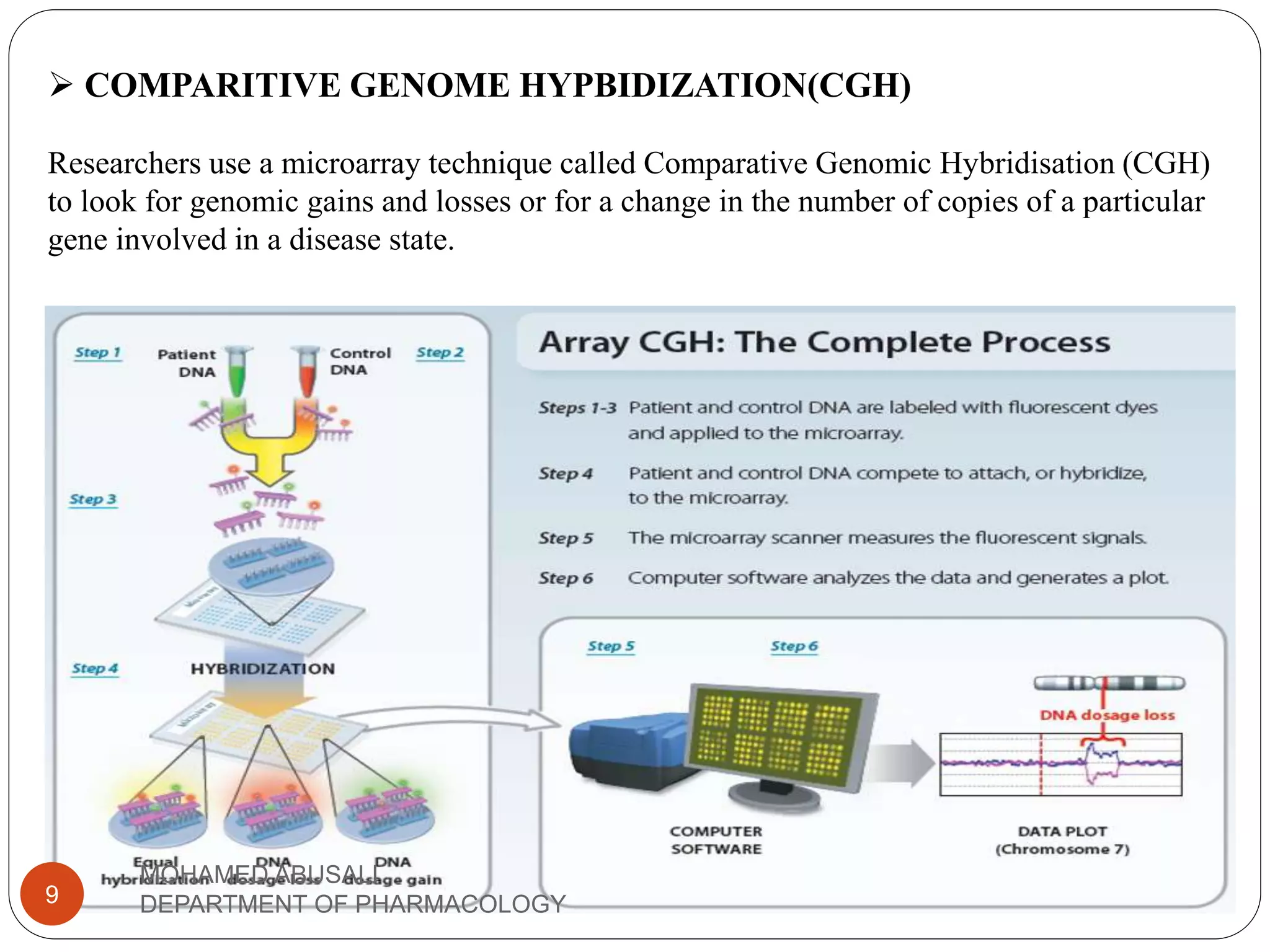
 COMPARITIVE GENOME HYPBIDIZATION(CGH)
Researchers use a microarray technique called Comparative Genomic Hybridisation (CGH)
to look for genomic gains and losses or for a change in the number of copies of a particular
gene involved in a disease state.
MOHAMED ABUSALI
DEPARTMENT OF PHARMACOLOGY9
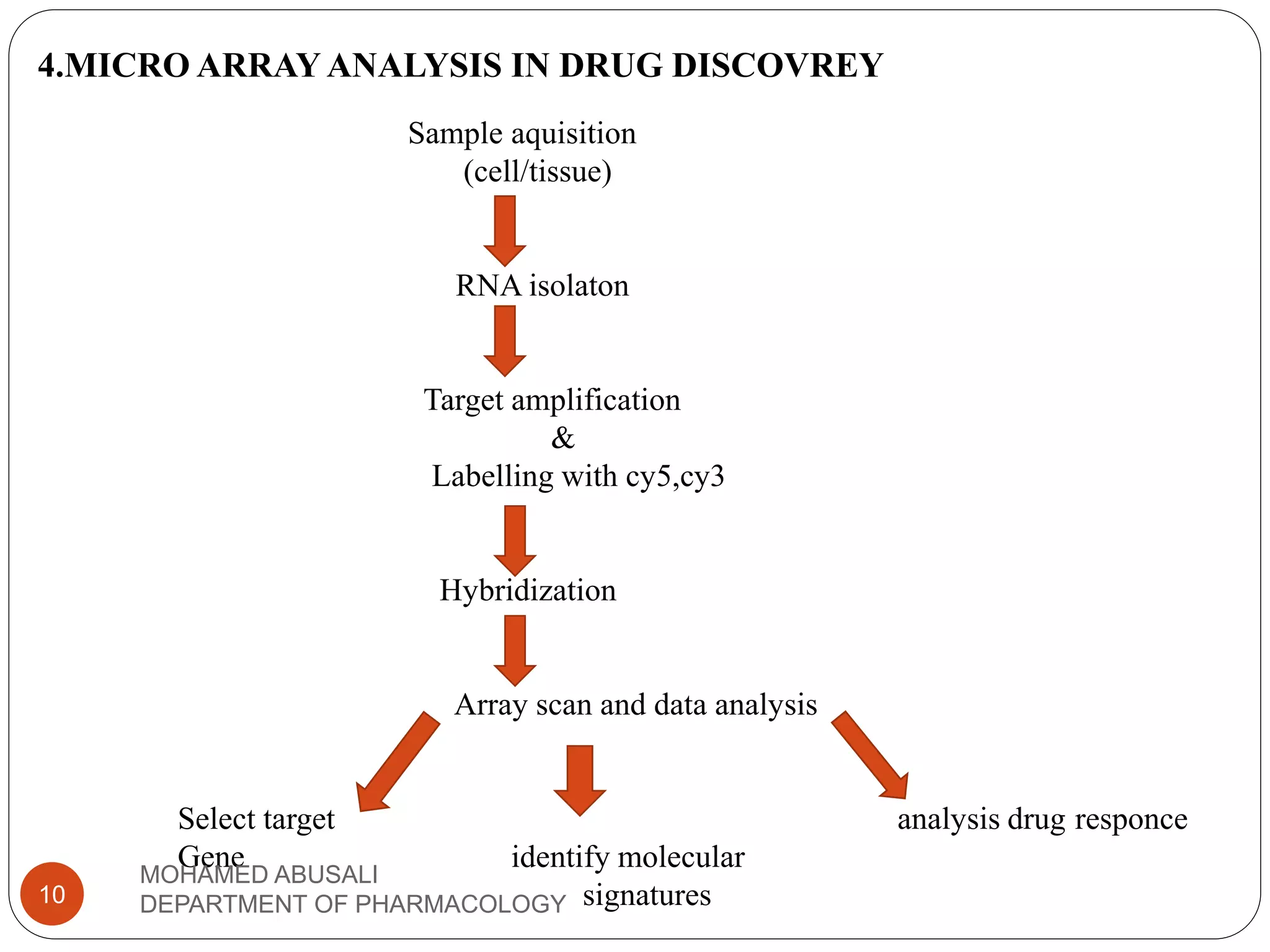
4.MICRO ARRAY ANALYSIS IN DRUG DISCOVREY
Sample aquisition
(cell/tissue)
RNA isolaton
Target amplification
&
Labelling with cy5,cy3
Hybridization
Array scan and data analysis
Select target analysis drug responce
Gene identify molecular
signatures
MOHAMED ABUSALI
DEPARTMENT OF PHARMACOLOGY10
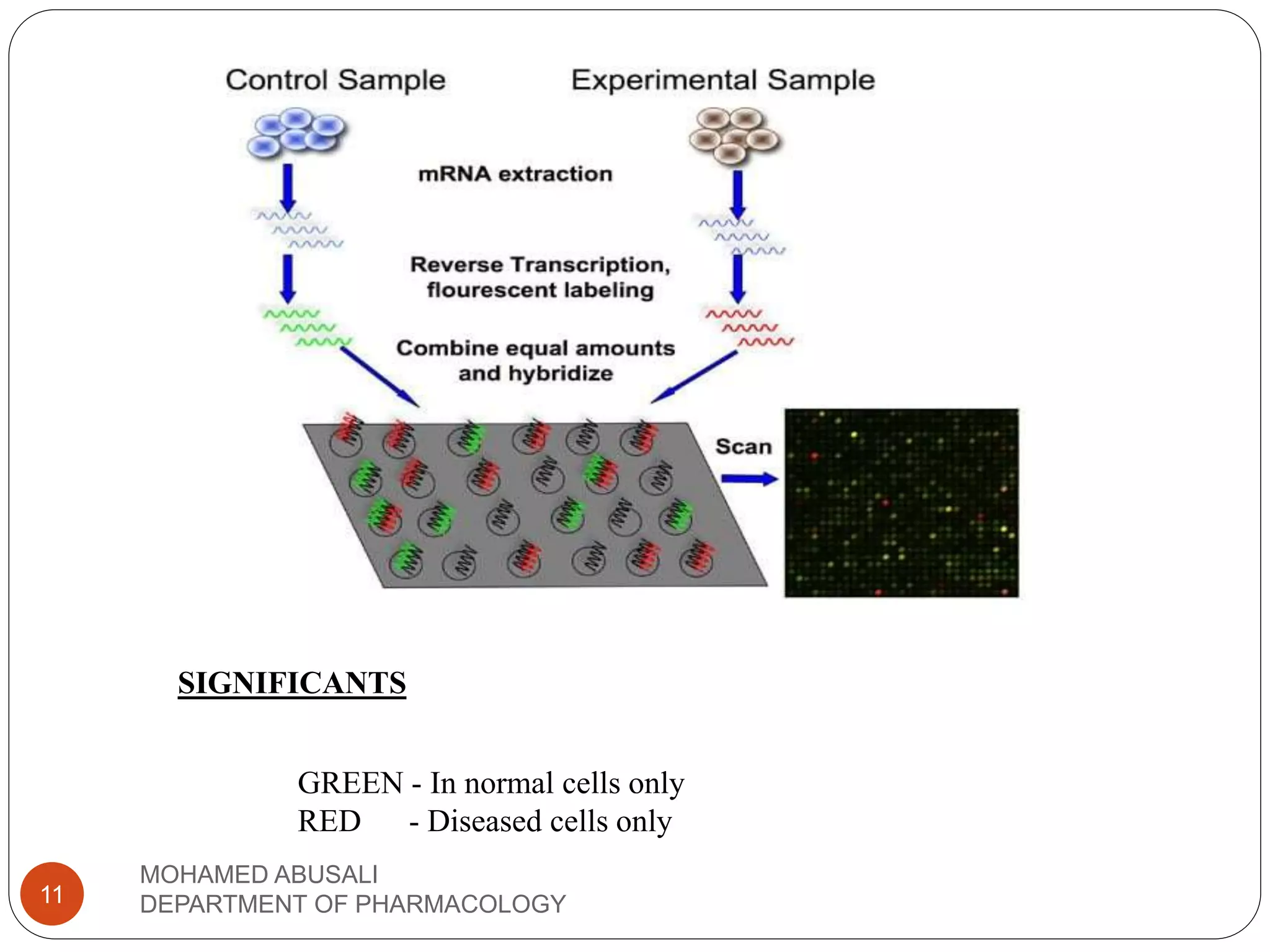
SIGNIFICANTS
GREEN - In normal cells only
RED - Diseased cells only
MOHAMED ABUSALI
DEPARTMENT OF PHARMACOLOGY11
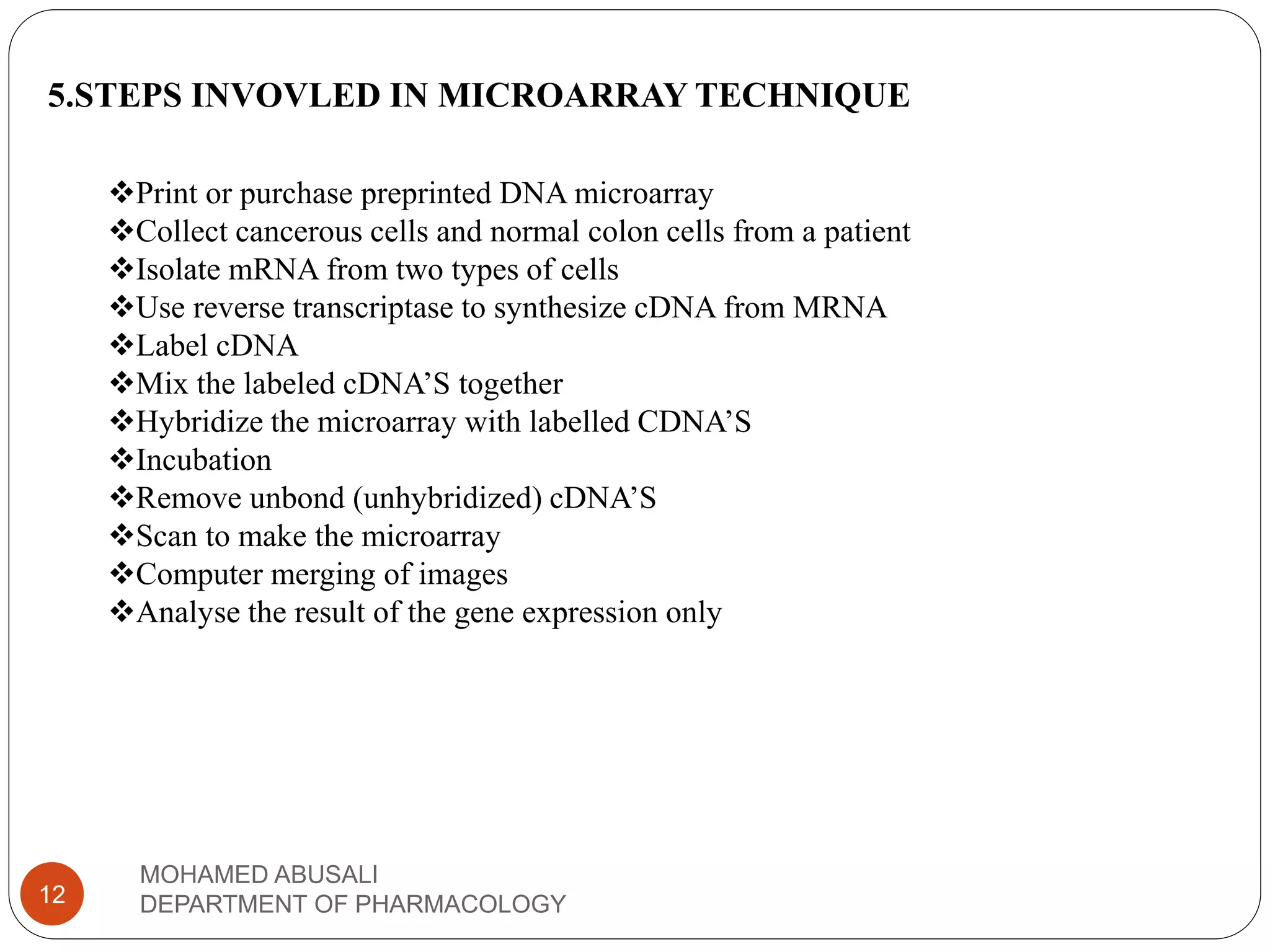
5.STEPS INVOVLED IN MICROARRAY TECHNIQUE
Print or purchase preprinted DNA microarray
Collect cancerous cells and normal colon cells from a patient
Isolate mRNA from two types of cells
Use reverse transcriptase to synthesize cDNA from MRNA
Label cDNA
Mix the labeled cDNA’S together
Hybridize the microarray with labelled CDNA’S
Incubation
Remove unbond (unhybridized) cDNA’S
Scan to make the microarray
Computer merging of images
Analyse the result of the gene expression only
MOHAMED ABUSALI
DEPARTMENT OF PHARMACOLOGY12
MOHAMED ABUSALI
DEPARTMENT OF PHARMACOLOGY13
REFERENCES
Drug discovery and evaluation : pharmacological assays by H.gerhard vogel (ed)-2 include
bibliographical References ISBN3540423966(alk.paper).
Handbook of experimental pharmacology by s.k.kulkarni mk jain for vallabh prakashan
C-5,sma cooperative industrial estate Gt karnal road.
Rajeshwar Govindarajan etal., Microarray and its applications, Dental Science - Review Article
Review completed : 02-01-12.
O. Sheils*, S. Finn* and etal., mini-symposium: advances in laboratory practice
Nucleic acid microarrays: an overview,Current Diagnostic Pathology (2003) 9, 155--158
c 2003 Elsevier Science Ltd. All righ.
Richard Fisler ,The Role of Microarray Technology in Pharmaceutical Development and
Diagnostics,Winter 2006/7.
Siqun Wang etal.,Microarray Analysis in Drug Discovery and Clinical Applications.

Role of nuclicacid microarray &protein micro array for drug discovery process

  • 1.
  • 2.
    1.INTRODUCTION 2.PROCESS OF DRUGDISCOVERY 3.MICRO ARRAY TECHNIQUES 4.MICRO ARRAY ANALYSIS IN DRUG DISCOVERY 5.STEPS INVOLVED IN MICRO ARRAY TECHNIQUES MOHAMED ABUSALI DEPARTMENT OF PHARMACOLOGY2
  • 3.
    1.INTRODUCTION A. Target selectionis one of the drug discovery Process, In which genomics is one of the B. target selection. C. Genomics are explained as the study of genomes(group of gene sequences are called genome). Genomics is used to study about genes and their functions. D. Drugs can make by gene bases, it’s otherwise called personalized medicine. E. Microarray techniques(DNA chips) is undergone the genomics studies. F. Microarray techniques is one of the gene sequencing technique, which is used to identifying the expression of the gene on to the matrix. G. Samples or probes are immobilized on to the matrix. H. Microarray technique can be divided into two types • Nuclicacid micro array • Tissue micro array MOHAMED ABUSALI DEPARTMENT OF PHARMACOLOGY3
  • 4.
    2.PROCESS OF DRUGDISCOVERY A. Drug discovery is the process of identifying or finding of new chemical entity. B. Drug discovery process takes upto 12years from initial synthesis to approval of NDA. STEPS INVOLVED IN DRUG DISCOVERYAND DEVELOPMENT MOHAMED ABUSALI DEPARTMENT OF PHARMACOLOGY4
  • 5.
    3.MICRO ARRAY TECHNIQUES A.Microarray techniques(DNA chips) is undergone the genomics studies. B. Microarray techniques is one of the gene sequencing technique, which is used to identifying the expression of the gene on to the matrix. C. Samples or probes are immobilized on to the matrix. D. Microarray technique can be divided into two types • Nuclicacid micro array • Tissue micro array I.IDENTIFYING COMPARISON FOR NEW NUCLICACID SEQUENCES •Blast (basic local allignment search tool) •Which, one of the site having all DNA data bases(gene liberary),we can compare the Gene sequence with known data base sequence. MOHAMED ABUSALI DEPARTMENT OF PHARMACOLOGY5
  • 6.
    NUCLICACID MICROARRAY A. Nucleicacid microarrays (genome chips) are generated by arraying nucleotide ‘probes’ onto a support matrix. B. Various technologies are used to generate themicroarrays.The supporting matrix is usually a glass microscope slide but nylon, silicon and nitrocellulose membranes have also been used. C. cDNA, DNA or oligonucleotides and are printed onto the support matrix using robotics or may be built directly onto the array using photolithography7 or by using D. an inkjet printing technique. E. They can be further subdivided into three categories: • cDNA microarray • single nucleotide polymorphism(SNP) • comparitive genome hypridization(CGH) MOHAMED ABUSALI DEPARTMENT OF PHARMACOLOGY6
  • 7.
     cDNA microarray Large-scale parallel measurement of whole genome messenger RNA expression is possible using high-density arrays of cDNA or oligonucleotides MOHAMED ABUSALI DEPARTMENT OF PHARMACOLOGY7
  • 8.
     SINGLE NUCLEOTIDEPOLYMORPHISM(SNP) •A genetic variation that is observed at a frequency of >1% in a population •SNPs are singlebase pair positions in genomic DNA at which different sequence alternatives(alleles) exist wherein the least frequent allele has an abundance of 1% or greater. •Arrays can make specially for SNP. MOHAMED ABUSALI DEPARTMENT OF PHARMACOLOGY8
  • 9.
     COMPARITIVE GENOMEHYPBIDIZATION(CGH) Researchers use a microarray technique called Comparative Genomic Hybridisation (CGH) to look for genomic gains and losses or for a change in the number of copies of a particular gene involved in a disease state. MOHAMED ABUSALI DEPARTMENT OF PHARMACOLOGY9
  • 10.
    4.MICRO ARRAY ANALYSISIN DRUG DISCOVREY Sample aquisition (cell/tissue) RNA isolaton Target amplification & Labelling with cy5,cy3 Hybridization Array scan and data analysis Select target analysis drug responce Gene identify molecular signatures MOHAMED ABUSALI DEPARTMENT OF PHARMACOLOGY10
  • 11.
    SIGNIFICANTS GREEN - Innormal cells only RED - Diseased cells only MOHAMED ABUSALI DEPARTMENT OF PHARMACOLOGY11
  • 12.
    5.STEPS INVOVLED INMICROARRAY TECHNIQUE Print or purchase preprinted DNA microarray Collect cancerous cells and normal colon cells from a patient Isolate mRNA from two types of cells Use reverse transcriptase to synthesize cDNA from MRNA Label cDNA Mix the labeled cDNA’S together Hybridize the microarray with labelled CDNA’S Incubation Remove unbond (unhybridized) cDNA’S Scan to make the microarray Computer merging of images Analyse the result of the gene expression only MOHAMED ABUSALI DEPARTMENT OF PHARMACOLOGY12
  • 13.
    MOHAMED ABUSALI DEPARTMENT OFPHARMACOLOGY13 REFERENCES Drug discovery and evaluation : pharmacological assays by H.gerhard vogel (ed)-2 include bibliographical References ISBN3540423966(alk.paper). Handbook of experimental pharmacology by s.k.kulkarni mk jain for vallabh prakashan C-5,sma cooperative industrial estate Gt karnal road. Rajeshwar Govindarajan etal., Microarray and its applications, Dental Science - Review Article Review completed : 02-01-12. O. Sheils*, S. Finn* and etal., mini-symposium: advances in laboratory practice Nucleic acid microarrays: an overview,Current Diagnostic Pathology (2003) 9, 155--158 c 2003 Elsevier Science Ltd. All righ. Richard Fisler ,The Role of Microarray Technology in Pharmaceutical Development and Diagnostics,Winter 2006/7. Siqun Wang etal.,Microarray Analysis in Drug Discovery and Clinical Applications.