NUCLEAR PHYSICS
NUCLEAR RADIATION
• the release of radiation is a
phenomenon unique to
nuclear explosion.
KINDS OF RADIATIONS
EMITTED
 Gamma
 Neutron
 Ionizing radiation
Are only not emitted at the time of denotation
(INITIAL RADIATION) but also for long period
of time afterward (RESIDUAL RADIATION)
INITIAL RADIATION
• Defined as the radiation that arrives
during the first minute after explosion
and it mostly the GAMMA RADIATION
and NEUTRON RADIATION
RESIDUAL RADIATION
• The residual radiation from a nuclear
explosion is mostly from the fall out.
• This radiation comes from the
weapon debris, fission products and in
case of ground burst, radiated soil.
RADIATIONS EFFECT ON HUMANS
• Certain body parts are more specifically
affected by exposure to the different types of
radiation sources. Several factors involved
in determining the potential of health of
exposure to radiation. These include:
-the size of the dose (amount of energy
deposited in the body)
-the ability of the radiation to harm
human tissue.
WHICH ORGANS ARE AFFECTED
• HAIR- the losing of hair quickly and in clumps
occur with radiation exposure at 200 rems or
higher.
• BRAIN- Since brain cells do not reproduce, they
won’t be damaged directly unless the exposure is
5000 rems or greater.
• THYROID- the certain body parts are more
specifically affected by exposure to the different
types of radiation sources.
• BLOOD SYSTEM- when a person exposed to around
100 rems, the bloods lymphocyte cell count will be
reduced, leaving the victim more susceptible to
radioactive iodine.
• HEART- intense exposure to radioactive
material at 1000 to 5000 rems would be
immediate damage to small blood vessels and
probably cause heart failure and death
directly.
• GASTROENTESTINAL TRACT- Radiation
damage to the intestinal tract lining will
cause nausea, bloody vomiting and diarrhea.
• REPRODUCTIVE TRACT- because
reproductive tract divide rapidly, these areas
of the body can be damaged at rem levels as
low as 200. Long-term sickness victims will
become sterile.
DOSE-REM EFFECTS
5-20 Possible late effects; possible chromosomal damage.
20-100 Temporary reduction in white blood cells
100-200 Mild radiation sickness within a few hours; vomiting, diarrhea,
fatigue, reduction resistance to infections.
200-300 Serious radiation sickness affects as in 100-200 rem and hemorrhage;
exposure is LETHAL DOSE to 10-35% of population after 30 days (LD
10-35l30).
300-400 Serious radiation sickness; also marrow and intestine destruction; LD
50-70l30.
400-1000 Acute illness, early death; LD 60-95l30
1000-5000 Acute illness, early death in days; LD 100l10.
LONG TERM EFFECTS TO
HUMAN
• BLOOD DISORDERS- according to Japanese data,
there was an increase in anemia among persons
exposed to the bomb. In some cases, the decrease
in white and red blood cells lasted for up to ten
years after the bombing.
• CATARACTS- there was an increase in cataract
rate of the survivors at Hiroshima and Nagaski,
who were partly shielded and suffered partial hair
loss.
• MALIGNANT TUMORS- all ionizing
radiation is carcinogenic, but some tumor
types are more readily generated than
others. A prevalent type is LEUKEMIA.
• KELOIDS- is mounds of raised and twisted
flesh.
FALL OUT PARTICLES
• Many fallout particles are especially hazardous
biologically. Some or the principal radioactive
elements are as follows:
– STRONTIUM 90- is very long lived with a
half life of 28 years.
– IODINE 131- has a half life 8.1 days
– TRITIUM- has a half life of 12.3 years and
can be easily ingested.
– CESIUM 137- has a half life of 30 years.
– PLUTONIUM 239- has a half life of 24,400
years.
RADIOACTIVE FALLOUT
• FALLOUT
Is the radioactive particles that fall
to earth as a result of nuclear explosion.
It consists of weapon debris, fission
products , and the case of ground
burst, radiated soil.
FALLOUT PATTERNS
• The details of the actual fall out pattern
depend on wind speed and direction and on
the terrain. The fallout will contain about
60% of total radioactivity. The largest
particles will fall within a short distance of
ground zero.
• Smaller particles will require many hours to
return to earth and may be carried hundreds
of miles. This means that the surface burst
can produce serious contamination far from
the point of denotation.
THE OTA STUDY
• The OFFICE OF TECHNOLOGY
ASSESSMENT 1979(OTA)
- estimated the effects of a large scale
attack on U.S Military and economic targets.
ELECTROMAGNETIC PULSE
• ELECTROMAGNETIC PULSE (EMP) Is an
electromagnetic wave similar to radio waves, which
results from secondary reactions occurring when
nuclear gamma radiation is absorbed in the air
ground. It differs from the usual radio waves in two
important ways:
– First, it creates much higher electric field
strengths.
– Secondly, it is a single pulse of energy
disappears completely in a small fraction of a
second.
– There is no evidence that EMP is a physical
threat to humans.
Ionizing Radiation
• is radiation with enough energy so that during an
interaction with an atom, it can remove tightly bound
electrons from the orbit of an atom, causing the atom to
become charged or ionized.
• is made up of energetic subatomic
particles, ions or atoms moving at relativistic speeds,
and electromagnetic waves on the high-energy end of
the electromagnetic spectrum.
Two forms of Ionizing Radiation
Waves
&
Particles
WAVES
• Most of the more familiar types of electromagnetic
radiation (e.g. visible light, radio waves) exhibit
“wave-like” behavior in their interaction with matter
(e.g. diffraction patterns, transmission and
detection of radio signals). The best way to think
of electromagnetic radiation is a wave packet
called a photon. Photons are charge less bundles
of energy that travel in a vacuum at the velocity of
light, which is 300 000 km/sec.
Kinds of Particles
ALPHA PARTICLES
• these are fast moving helium atoms. They
have high energy, typically in the MeV
range, but due to their large mass, they
are stopped by just a few inches of air, or
a piece of paper.
Beta particles
• these are fast moving electrons. They
typically have energies in the range of a
few hundred keV to several MeV. Since
electrons are might lighter than helium
atoms, they are able to penetrate further,
through several feet of air, or several
millimeters of plastic or less of very light
metals.
Gamma Particles
• these are photons, just like light, except of
much higher energy, typically from several
keV to several MeV. X-Rays and gamma
rays are really the same thing, the
difference is how they were produced.
Depending on their energy, they can be
stopped by a thin piece of aluminum foil,
or they can penetrate several inches of
lead.
Isotopes
• Is a atoms with the same number of
protons and different number of neutrons.
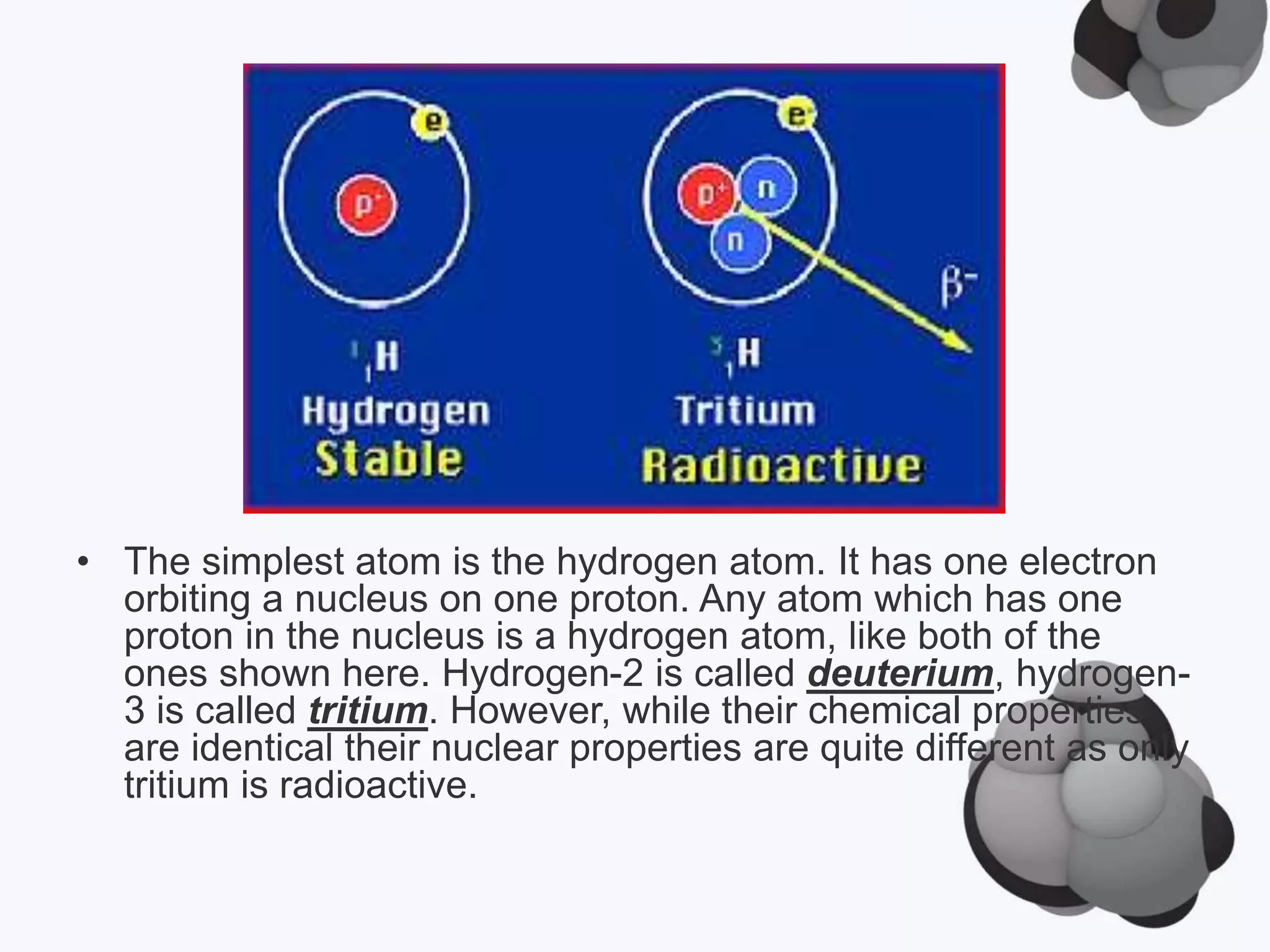
• The simplest atom is the hydrogen atom. It has one electron
orbiting a nucleus on one proton. Any atom which has one
proton in the nucleus is a hydrogen atom, like both of the
ones shown here. Hydrogen-2 is called deuterium, hydrogen-
3 is called tritium. However, while their chemical properties
are identical their nuclear properties are quite different as only
tritium is radioactive.
RADIATION THERAPY
RADIATION THERAPY
• Radiation therapy or radiotherapy, often
abbreviated RT, RTx, or XRT, is therapy using
ionizing radiation, generally as part of cancer
treatment to control or kill malignant cells.
• The subspecialty of oncology that focuses on
radiotherapy is called radiation oncology.
• The subspecialty of oncology that focuses
on radiotherapy is called radiation
oncology.
• Radiation oncology is the medical
specialty concerned with prescribing
radiation, and is distinct from radiology, the
use of radiation in medical imaging and
diagnosis.
• Radiation oncologist - Radiation may be
prescribed by a radiation oncologist with
intent to cure ("curative") or for adjuvant
therapy.
• It is also common to combine radiation
therapy with surgery, chemotherapy,
hormone therapy, immunotherapy or some
mixture of the four.
• Total body irradiation (TBI) - is a radiation
therapy technique used to prepare the body to
receive a bone marrow transplant.
• Brachytherapy - is another form of radiation
therapy that minimizes exposure to healthy tissue
during procedures to treat cancers of the breast,
prostate and other organs.
• Radiation therapy has several applications in non-
malignant conditions, such as the treatment of
trigeminal neuralgia,acoustic neuromas, severe
thyroid eye disease, pterygium, pigmented
villonodular synovitis, and prevention of keloid
scar growth, vascular restenosis, and heterotopic
ossification.
• MEDICAL USES Different cancers
respond to radiation therapy in different
ways. The response of a cancer to
radiation is described by its
radiosensitivity. Highly radiosensitive
cancer cells are rapidly killed by modest
doses of radiation. These include
leukemias, most lymphomas and germ cell
tumors.
• SIDE EFFECTS
 ACUTE SIDE EFFECTS
 Nausea and vomiting
 Mouth, throat, and stomach sores
 Intestinal discomfort
 Swelling
 Infertility
 LATER SIDE EFFECTS
 Fibrosis
 Cognitive decline
 Heart disease
 Dryness
 Lymphedema
 Cancer
What is Nuclear Medicine
• Nuclear medicine is a medical specialty
involving the application of radioactive
substances in the diagnosis and treatment of
disease.
• Nuclear medicine scans are usually
conducted by radiographers. Nuclear
medicine, in a sense, is "radiology done
inside out" or "endoradiology" because it
records radiation emitting from within the
body rather than radiation that is generated
by external sources like X-rays.
Diagnosis
• Nuclear medicine imaging procedures are
noninvasive and, with the exception of intravenous
injections, are usually painless medical tests that
help physicians diagnose and evaluate medical
conditions. These imaging scans use radioactive
materials called radiopharmaceuticals or
radiotracers.
• Depending on the type of nuclear medicine exam,
the radiotracer is either injected into the body,
swallowed or inhaled as a gas and eventually
accumulates in the organ or area of the body being
examined. Radioactive emissions from the
radiotracer are detected by a special camera or
imaging device that produces pictures and provides
molecular information.
• In many centers, nuclear medicine images can be
superimposed with computed tomography (CT) or
magnetic resonance imaging (MRI) to produce
special views, a practice known as image fusion or
co-registration. These views allow the information
from two different exams to be correlated and
interpreted on one image, leading to more precise
information and accurate diagnoses. In addition,
manufacturers are now making single photon
emission computed tomography/computed
tomography (SPECT/CT) and positron emission
tomography/computed tomography (PET/CT) units
that are able to perform both imaging exams at the
same time. An emerging imaging technology, but
not readily available at this time is PET/MRI.
Therapy
• Nuclear medicine also offers therapeutic
procedures, such as radioactive iodine (I-
131) therapy that use small amounts of
radioactive material to treat cancer and
other medical conditions affecting the
thyroid gland, as well as treatments for
other cancers and medical conditions.
• Non-Hodgkin's lymphoma patients who do
not respond to chemotherapy may undergo
radioimmunotherapy (RIT).
• Radioimmunotherapy (RIT) is a personalized
cancer treatment that combines radiation
therapy with the targeting ability of
immunotherapy, a treatment that mimics
cellular activity in the body's immune
system.
Nuclear Medicine
 There are a number of processes involved in
health care that make use of the properties
of the nucleus. Nuclear medicine is a broad
term encompassing both diagnostic and
therapeutic processes. To some extent this is
unfortunate, since in the cases where
nuclear radiation is involved the doses
involved in diagnostic procedures are very
small and those in therapeutic applications
are very large.
• It is therefore important to make clear
distinctions between the risks involved in
diagnostic and therapeutic applications.
Still another class of processes include
diagnostic procedures such as magnetic
resonance imaging which involve nuclear
properties but do not involve any exposure
to ionizing radiation.
Nuclear Diagnostic Procedures with
No Ionizing Radiation
• Magnetic Resonance Imaging
Proton nuclear magnetic resonance (NMR) detects the
presence of hydrogens (protons) by subjecting them to a large
magnetic field to partially polarize the nuclear spins, then
exciting the spins with properly tuned radio frequency (RF)
radiation, and then detecting weak radio frequency radiation
from them as they "relax" from this magnetic interaction. The
frequency of this proton "signal" is proportional to the magnetic
field to which they are subjected during this relaxation process.
In the medical application known as Magnetic Resonance
Imaging (MRI), an image of a cross-section of tissue can be made
by producing a well-calibrated magnetic field gradient across the
tissue so that a certain value of magnetic field can be associated
with a given location in the tissue.
Since the proton signal frequency is proportional
to that magnetic field, a given proton signal frequency
can be assigned to a location in the tissue. This provides
the information to map the tissue in terms of the protons
present there. Since the proton density varies with the
type of tissue, a certain amount of contrast is achieved
to image the organs and other tissue variations in the
subject tissue.
Since the MRI uses proton
NMR, it images the
concentration of protons.
Many of those protons are
the protons in water, so MRI
is particularly well suited for
the imaging of soft tissue,
like the brain, eyes, and
other soft tissue structures
in the head as shown at left.
The bone of the skull doesn't
have many protons, so it
shows up dark. Also the
sinus cavities image as a
dark region.
• Bushong's assessment is that about 80% of
the body's atoms are hydrogen atoms, so
most parts of the body have an abundance
of sources for the hydrogen NMR signals
which make up the magnetic resonance
image.
Nuclear Diagnostic Procedures
with Low Dose Radiation
• Myocardial Infusion Imaging
A widely used diagnostic procedure for heart
health is the imaging of the blood infusion to the heart
using a low dose of a radioactive tracer in the blood. A
large radiation detector rotates about the chest of the
patient, detecting gamma radiation from the tracer
element which has been injected into the patient's vein.
The image shows the perfusion of the blood into the
heart muscle.
The detection of the gamma rays
produces images of the blood flow
in the heart muscle from various
angles to provide an assessment
of the infusion of blood.
Early tests of this type used an
isotope of thallium with a gamma
ray of energy about 70 keV. This
kind of image came to be known
as a "thallium scan", but now an
isotope of technetium is the
isotope of choice for the scans,
having a shorter halflife and
producing a gamma of energy
about 140 keV.
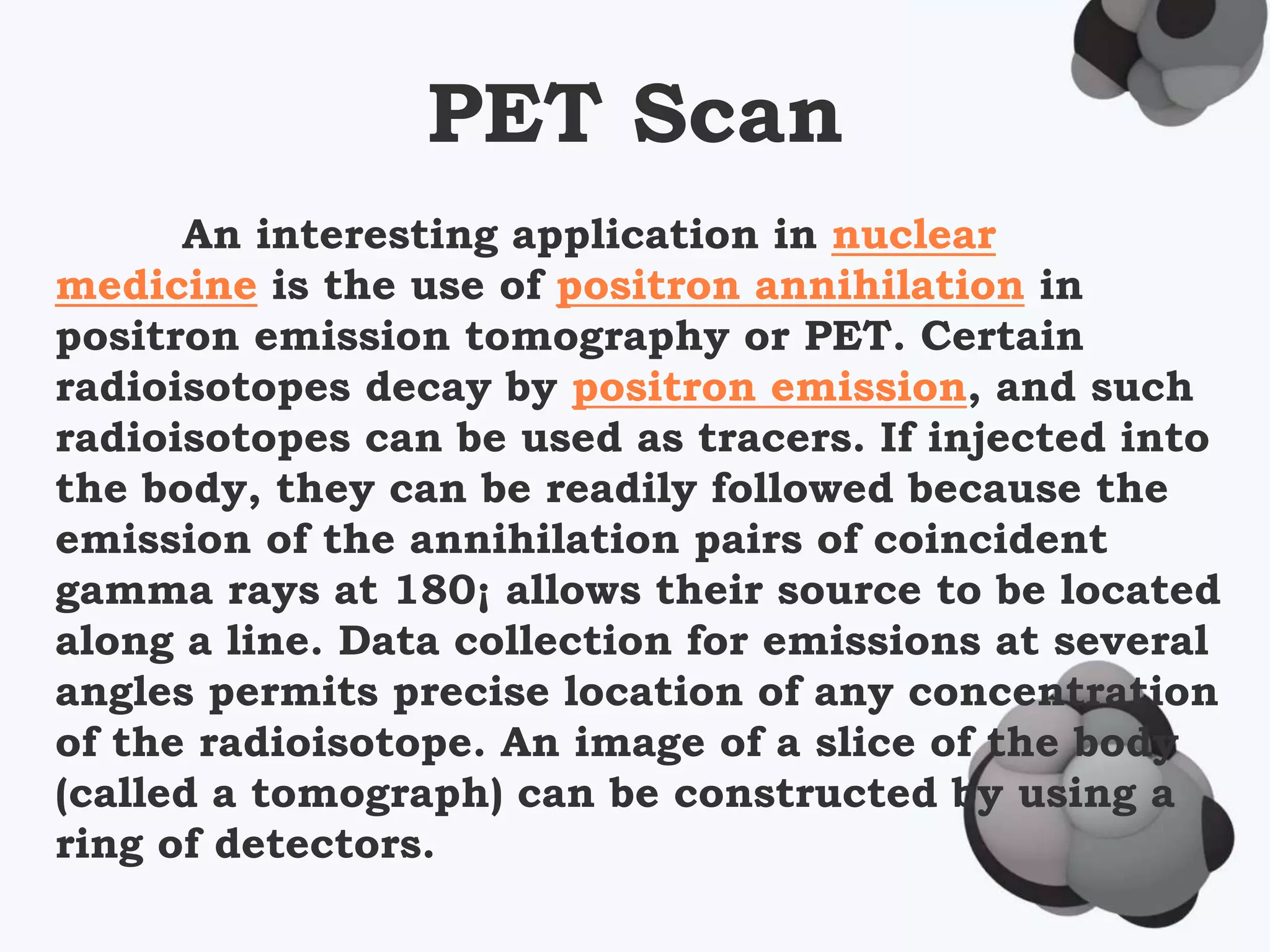
The large detector uses an ionization detection
in a manner similar to a Geiger counter and
collects a series of exposures as it sequences
around the body trunk. A collection of images is
illustrated below, taken before and after exercise
on a treadmill for comparison of the infusion of
the blood under those two conditions.
PET Scan
An interesting application in nuclear
medicine is the use of positron annihilation in
positron emission tomography or PET. Certain
radioisotopes decay by positron emission, and such
radioisotopes can be used as tracers. If injected into
the body, they can be readily followed because the
emission of the annihilation pairs of coincident
gamma rays at 180¡ allows their source to be located
along a line. Data collection for emissions at several
angles permits precise location of any concentration
of the radioisotope. An image of a slice of the body
(called a tomograph) can be constructed by using a
ring of detectors.
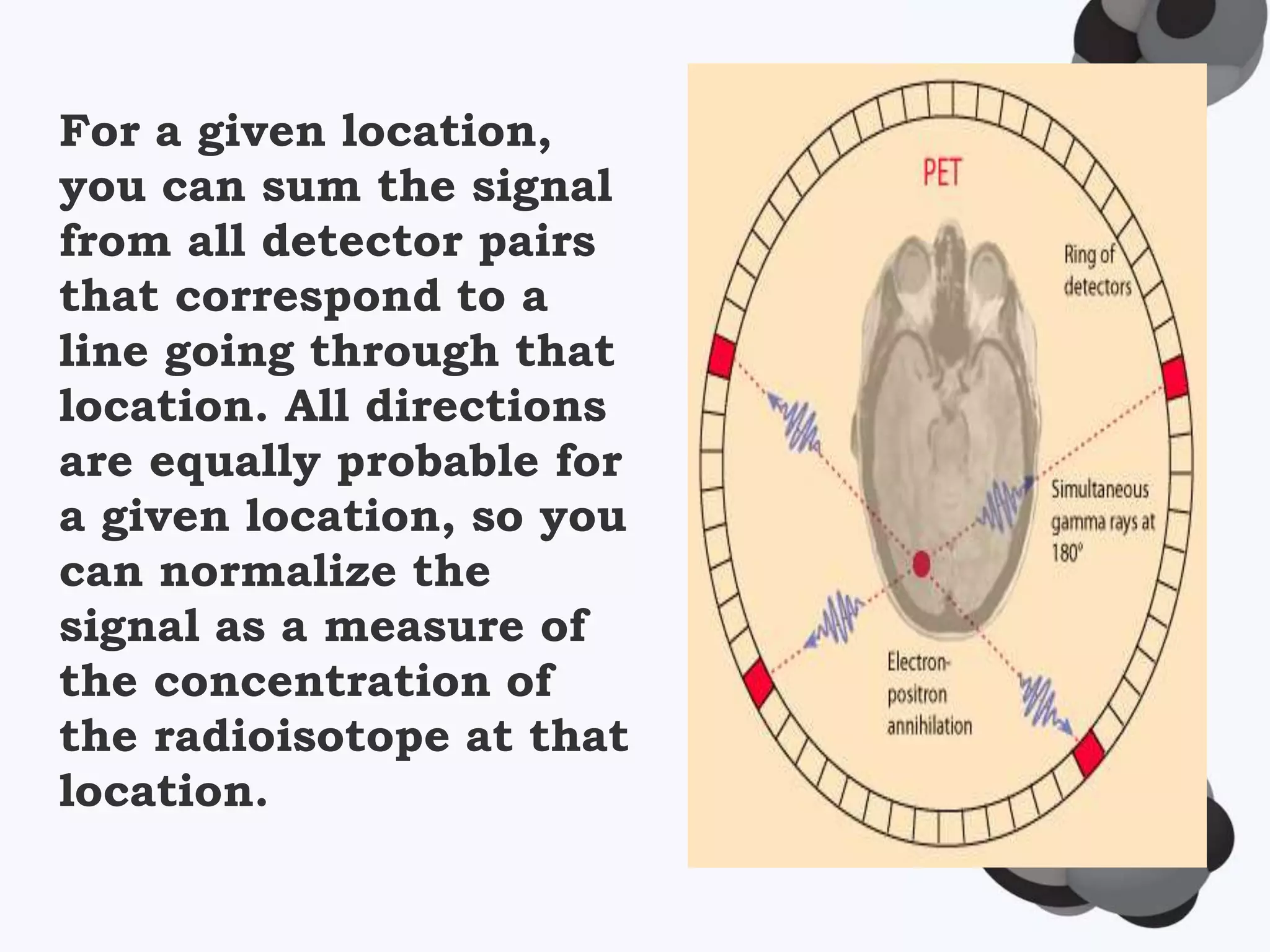
• When a positron is emitted by a nucleus, it
almost instantly finds an electron and the pair
annihilates, converting all the mass energy of
the two particles into two gamma rays. The
two gamma ray photons possess momentum,
and the conservation of momentum requires
that they travel if opposite directions. A
simultaneous detection of gamma ray photons
in two detectors places the source on a line
between those detectors.
For a given location,
you can sum the signal
from all detector pairs
that correspond to a
line going through that
location. All directions
are equally probable for
a given location, so you
can normalize the
signal as a measure of
the concentration of
the radioisotope at that
location.
• PET scans are increasing in use for all parts of the
body, but have been of particular value for imaging of
the brain. Getting a radioisotope into the brain for
measurement is challenging because the protection of
the blood-brain barrier makes it difficult to get most
substances into the brain. A positron emitter that can
be inserted into a glucose molecule is the fluorine
isotope 18F. Not only does the glucose pass the blood-
brain barrier and enter the brain easily, the
concentration of the radioactively tagged glucose is a
measure of the level of metabolic activity at that
location in the brain.
• Another major benefit of the PET scan is in the
diagnosis and treatment of cancer. An area of
abnormally high activity might be suspected to
be a fast-growing malignancy. If the cancer is
treated with radiation or chemotherapy, the PET
scan is again valuable because it is the only
practical way to determine whether the location
of a tumor is now metablolically inactive as a
result of the therapy, or is still consuming
glucose as an indication of continued activity
and failure of the therapy.
What are some common uses of
the procedure?
• Physicians use radionuclide imaging
procedures to visualize the structure
and function of an organ, tissue, bone
or system within the body.
In adults, nuclear medicine is used to:
• Heart
– visualize heart blood flow and function (such as a
myocardial perfusion scan)
– detect coronary artery disease and the extent of
coronary stenosis
– assess damage to the heart following a heart
attack
– evaluate treatment options such as bypass heart
surgery and angioplasty
– evaluate the results of revascularization
procedures
– detect heart transplant rejection
– evaluate heart function before and after
chemotherapy (MUGA)
• Lungs
– scan lungs for respiratory and blood flow
problems
– assess differential lung function for lung
reduction or transplant surgery
– detect lung transplant rejection
• Bones
– evaluate bones for fractures, infection
and arthritis
– evaluate for metastatic bone disease
– evaluate painful prosthetic joints
– evaluate bone tumors
– identify sites for biopsy
• Brain
– investigate abnormalities in the brain, such as
seizures, memory loss and abnormalities in
blood flow
– detect the early onset of neurological disorders
such as Alzheimer disease
– plan surgery and localize seizure foci
– evaluate for abnormalities in a chemical in the
brain involved in controlling movement in
patients with suspected Parkinson's disease
– evaluation of brain tumor recurrence, surgical or
radiation planning or localization for biopsy
In adults and children, nuclear
medicine is also used to
• Cancer
– stage cancer by determining the presence or spread
of cancer in various parts of the body
– localize sentinel lymph nodes before surgery in
patients with breast cancer or skin and soft tissue
tumors.
– plan treatment
– evaluate response to therapy
– detect the recurrence of cancer
– detect rare tumors of the pancreas and adrenal
glands
• Renal
– analyze native and transplant kidney function
– detect urinary tract obstruction
– evaluate for hypertension related to the kidney
arteries
– evaluate kidneys for infection versus scar
– detect and follow-up urinary reflux
Nuclear physics report

Nuclear physics report

  • 1.
  • 2.
    NUCLEAR RADIATION • therelease of radiation is a phenomenon unique to nuclear explosion.
  • 3.
    KINDS OF RADIATIONS EMITTED Gamma  Neutron  Ionizing radiation Are only not emitted at the time of denotation (INITIAL RADIATION) but also for long period of time afterward (RESIDUAL RADIATION)
  • 4.
    INITIAL RADIATION • Definedas the radiation that arrives during the first minute after explosion and it mostly the GAMMA RADIATION and NEUTRON RADIATION
  • 5.
    RESIDUAL RADIATION • Theresidual radiation from a nuclear explosion is mostly from the fall out. • This radiation comes from the weapon debris, fission products and in case of ground burst, radiated soil.
  • 6.
    RADIATIONS EFFECT ONHUMANS • Certain body parts are more specifically affected by exposure to the different types of radiation sources. Several factors involved in determining the potential of health of exposure to radiation. These include: -the size of the dose (amount of energy deposited in the body) -the ability of the radiation to harm human tissue.
  • 7.
    WHICH ORGANS AREAFFECTED • HAIR- the losing of hair quickly and in clumps occur with radiation exposure at 200 rems or higher. • BRAIN- Since brain cells do not reproduce, they won’t be damaged directly unless the exposure is 5000 rems or greater. • THYROID- the certain body parts are more specifically affected by exposure to the different types of radiation sources. • BLOOD SYSTEM- when a person exposed to around 100 rems, the bloods lymphocyte cell count will be reduced, leaving the victim more susceptible to radioactive iodine.
  • 8.
    • HEART- intenseexposure to radioactive material at 1000 to 5000 rems would be immediate damage to small blood vessels and probably cause heart failure and death directly. • GASTROENTESTINAL TRACT- Radiation damage to the intestinal tract lining will cause nausea, bloody vomiting and diarrhea. • REPRODUCTIVE TRACT- because reproductive tract divide rapidly, these areas of the body can be damaged at rem levels as low as 200. Long-term sickness victims will become sterile.
  • 9.
    DOSE-REM EFFECTS 5-20 Possiblelate effects; possible chromosomal damage. 20-100 Temporary reduction in white blood cells 100-200 Mild radiation sickness within a few hours; vomiting, diarrhea, fatigue, reduction resistance to infections. 200-300 Serious radiation sickness affects as in 100-200 rem and hemorrhage; exposure is LETHAL DOSE to 10-35% of population after 30 days (LD 10-35l30). 300-400 Serious radiation sickness; also marrow and intestine destruction; LD 50-70l30. 400-1000 Acute illness, early death; LD 60-95l30 1000-5000 Acute illness, early death in days; LD 100l10.
  • 10.
    LONG TERM EFFECTSTO HUMAN • BLOOD DISORDERS- according to Japanese data, there was an increase in anemia among persons exposed to the bomb. In some cases, the decrease in white and red blood cells lasted for up to ten years after the bombing. • CATARACTS- there was an increase in cataract rate of the survivors at Hiroshima and Nagaski, who were partly shielded and suffered partial hair loss.
  • 11.
    • MALIGNANT TUMORS-all ionizing radiation is carcinogenic, but some tumor types are more readily generated than others. A prevalent type is LEUKEMIA. • KELOIDS- is mounds of raised and twisted flesh.
  • 12.
    FALL OUT PARTICLES •Many fallout particles are especially hazardous biologically. Some or the principal radioactive elements are as follows: – STRONTIUM 90- is very long lived with a half life of 28 years. – IODINE 131- has a half life 8.1 days – TRITIUM- has a half life of 12.3 years and can be easily ingested. – CESIUM 137- has a half life of 30 years. – PLUTONIUM 239- has a half life of 24,400 years.
  • 13.
    RADIOACTIVE FALLOUT • FALLOUT Isthe radioactive particles that fall to earth as a result of nuclear explosion. It consists of weapon debris, fission products , and the case of ground burst, radiated soil.
  • 14.
    FALLOUT PATTERNS • Thedetails of the actual fall out pattern depend on wind speed and direction and on the terrain. The fallout will contain about 60% of total radioactivity. The largest particles will fall within a short distance of ground zero. • Smaller particles will require many hours to return to earth and may be carried hundreds of miles. This means that the surface burst can produce serious contamination far from the point of denotation.
  • 15.
    THE OTA STUDY •The OFFICE OF TECHNOLOGY ASSESSMENT 1979(OTA) - estimated the effects of a large scale attack on U.S Military and economic targets.
  • 16.
    ELECTROMAGNETIC PULSE • ELECTROMAGNETICPULSE (EMP) Is an electromagnetic wave similar to radio waves, which results from secondary reactions occurring when nuclear gamma radiation is absorbed in the air ground. It differs from the usual radio waves in two important ways: – First, it creates much higher electric field strengths. – Secondly, it is a single pulse of energy disappears completely in a small fraction of a second. – There is no evidence that EMP is a physical threat to humans.
  • 17.
    Ionizing Radiation • isradiation with enough energy so that during an interaction with an atom, it can remove tightly bound electrons from the orbit of an atom, causing the atom to become charged or ionized. • is made up of energetic subatomic particles, ions or atoms moving at relativistic speeds, and electromagnetic waves on the high-energy end of the electromagnetic spectrum.
  • 18.
    Two forms ofIonizing Radiation Waves & Particles
  • 19.
    WAVES • Most ofthe more familiar types of electromagnetic radiation (e.g. visible light, radio waves) exhibit “wave-like” behavior in their interaction with matter (e.g. diffraction patterns, transmission and detection of radio signals). The best way to think of electromagnetic radiation is a wave packet called a photon. Photons are charge less bundles of energy that travel in a vacuum at the velocity of light, which is 300 000 km/sec.
  • 21.
    Kinds of Particles ALPHAPARTICLES • these are fast moving helium atoms. They have high energy, typically in the MeV range, but due to their large mass, they are stopped by just a few inches of air, or a piece of paper.
  • 22.
    Beta particles • theseare fast moving electrons. They typically have energies in the range of a few hundred keV to several MeV. Since electrons are might lighter than helium atoms, they are able to penetrate further, through several feet of air, or several millimeters of plastic or less of very light metals.
  • 23.
    Gamma Particles • theseare photons, just like light, except of much higher energy, typically from several keV to several MeV. X-Rays and gamma rays are really the same thing, the difference is how they were produced. Depending on their energy, they can be stopped by a thin piece of aluminum foil, or they can penetrate several inches of lead.
  • 25.
    Isotopes • Is aatoms with the same number of protons and different number of neutrons.
  • 26.
    • The simplestatom is the hydrogen atom. It has one electron orbiting a nucleus on one proton. Any atom which has one proton in the nucleus is a hydrogen atom, like both of the ones shown here. Hydrogen-2 is called deuterium, hydrogen- 3 is called tritium. However, while their chemical properties are identical their nuclear properties are quite different as only tritium is radioactive.
  • 27.
  • 28.
    RADIATION THERAPY • Radiationtherapy or radiotherapy, often abbreviated RT, RTx, or XRT, is therapy using ionizing radiation, generally as part of cancer treatment to control or kill malignant cells. • The subspecialty of oncology that focuses on radiotherapy is called radiation oncology.
  • 29.
    • The subspecialtyof oncology that focuses on radiotherapy is called radiation oncology. • Radiation oncology is the medical specialty concerned with prescribing radiation, and is distinct from radiology, the use of radiation in medical imaging and diagnosis.
  • 30.
    • Radiation oncologist- Radiation may be prescribed by a radiation oncologist with intent to cure ("curative") or for adjuvant therapy. • It is also common to combine radiation therapy with surgery, chemotherapy, hormone therapy, immunotherapy or some mixture of the four.
  • 31.
    • Total bodyirradiation (TBI) - is a radiation therapy technique used to prepare the body to receive a bone marrow transplant. • Brachytherapy - is another form of radiation therapy that minimizes exposure to healthy tissue during procedures to treat cancers of the breast, prostate and other organs. • Radiation therapy has several applications in non- malignant conditions, such as the treatment of trigeminal neuralgia,acoustic neuromas, severe thyroid eye disease, pterygium, pigmented villonodular synovitis, and prevention of keloid scar growth, vascular restenosis, and heterotopic ossification.
  • 32.
    • MEDICAL USESDifferent cancers respond to radiation therapy in different ways. The response of a cancer to radiation is described by its radiosensitivity. Highly radiosensitive cancer cells are rapidly killed by modest doses of radiation. These include leukemias, most lymphomas and germ cell tumors.
  • 33.
    • SIDE EFFECTS ACUTE SIDE EFFECTS  Nausea and vomiting  Mouth, throat, and stomach sores  Intestinal discomfort  Swelling  Infertility  LATER SIDE EFFECTS  Fibrosis  Cognitive decline  Heart disease  Dryness  Lymphedema  Cancer
  • 34.
    What is NuclearMedicine • Nuclear medicine is a medical specialty involving the application of radioactive substances in the diagnosis and treatment of disease. • Nuclear medicine scans are usually conducted by radiographers. Nuclear medicine, in a sense, is "radiology done inside out" or "endoradiology" because it records radiation emitting from within the body rather than radiation that is generated by external sources like X-rays.
  • 35.
    Diagnosis • Nuclear medicineimaging procedures are noninvasive and, with the exception of intravenous injections, are usually painless medical tests that help physicians diagnose and evaluate medical conditions. These imaging scans use radioactive materials called radiopharmaceuticals or radiotracers. • Depending on the type of nuclear medicine exam, the radiotracer is either injected into the body, swallowed or inhaled as a gas and eventually accumulates in the organ or area of the body being examined. Radioactive emissions from the radiotracer are detected by a special camera or imaging device that produces pictures and provides molecular information.
  • 36.
    • In manycenters, nuclear medicine images can be superimposed with computed tomography (CT) or magnetic resonance imaging (MRI) to produce special views, a practice known as image fusion or co-registration. These views allow the information from two different exams to be correlated and interpreted on one image, leading to more precise information and accurate diagnoses. In addition, manufacturers are now making single photon emission computed tomography/computed tomography (SPECT/CT) and positron emission tomography/computed tomography (PET/CT) units that are able to perform both imaging exams at the same time. An emerging imaging technology, but not readily available at this time is PET/MRI.
  • 37.
    Therapy • Nuclear medicinealso offers therapeutic procedures, such as radioactive iodine (I- 131) therapy that use small amounts of radioactive material to treat cancer and other medical conditions affecting the thyroid gland, as well as treatments for other cancers and medical conditions. • Non-Hodgkin's lymphoma patients who do not respond to chemotherapy may undergo radioimmunotherapy (RIT).
  • 38.
    • Radioimmunotherapy (RIT)is a personalized cancer treatment that combines radiation therapy with the targeting ability of immunotherapy, a treatment that mimics cellular activity in the body's immune system.
  • 39.
    Nuclear Medicine  Thereare a number of processes involved in health care that make use of the properties of the nucleus. Nuclear medicine is a broad term encompassing both diagnostic and therapeutic processes. To some extent this is unfortunate, since in the cases where nuclear radiation is involved the doses involved in diagnostic procedures are very small and those in therapeutic applications are very large.
  • 40.
    • It istherefore important to make clear distinctions between the risks involved in diagnostic and therapeutic applications. Still another class of processes include diagnostic procedures such as magnetic resonance imaging which involve nuclear properties but do not involve any exposure to ionizing radiation.
  • 41.
    Nuclear Diagnostic Procedureswith No Ionizing Radiation • Magnetic Resonance Imaging Proton nuclear magnetic resonance (NMR) detects the presence of hydrogens (protons) by subjecting them to a large magnetic field to partially polarize the nuclear spins, then exciting the spins with properly tuned radio frequency (RF) radiation, and then detecting weak radio frequency radiation from them as they "relax" from this magnetic interaction. The frequency of this proton "signal" is proportional to the magnetic field to which they are subjected during this relaxation process. In the medical application known as Magnetic Resonance Imaging (MRI), an image of a cross-section of tissue can be made by producing a well-calibrated magnetic field gradient across the tissue so that a certain value of magnetic field can be associated with a given location in the tissue.
  • 42.
    Since the protonsignal frequency is proportional to that magnetic field, a given proton signal frequency can be assigned to a location in the tissue. This provides the information to map the tissue in terms of the protons present there. Since the proton density varies with the type of tissue, a certain amount of contrast is achieved to image the organs and other tissue variations in the subject tissue.
  • 43.
    Since the MRIuses proton NMR, it images the concentration of protons. Many of those protons are the protons in water, so MRI is particularly well suited for the imaging of soft tissue, like the brain, eyes, and other soft tissue structures in the head as shown at left. The bone of the skull doesn't have many protons, so it shows up dark. Also the sinus cavities image as a dark region.
  • 44.
    • Bushong's assessmentis that about 80% of the body's atoms are hydrogen atoms, so most parts of the body have an abundance of sources for the hydrogen NMR signals which make up the magnetic resonance image.
  • 45.
    Nuclear Diagnostic Procedures withLow Dose Radiation • Myocardial Infusion Imaging A widely used diagnostic procedure for heart health is the imaging of the blood infusion to the heart using a low dose of a radioactive tracer in the blood. A large radiation detector rotates about the chest of the patient, detecting gamma radiation from the tracer element which has been injected into the patient's vein. The image shows the perfusion of the blood into the heart muscle.
  • 46.
    The detection ofthe gamma rays produces images of the blood flow in the heart muscle from various angles to provide an assessment of the infusion of blood. Early tests of this type used an isotope of thallium with a gamma ray of energy about 70 keV. This kind of image came to be known as a "thallium scan", but now an isotope of technetium is the isotope of choice for the scans, having a shorter halflife and producing a gamma of energy about 140 keV.
  • 47.
    The large detectoruses an ionization detection in a manner similar to a Geiger counter and collects a series of exposures as it sequences around the body trunk. A collection of images is illustrated below, taken before and after exercise on a treadmill for comparison of the infusion of the blood under those two conditions.
  • 48.
    PET Scan An interestingapplication in nuclear medicine is the use of positron annihilation in positron emission tomography or PET. Certain radioisotopes decay by positron emission, and such radioisotopes can be used as tracers. If injected into the body, they can be readily followed because the emission of the annihilation pairs of coincident gamma rays at 180¡ allows their source to be located along a line. Data collection for emissions at several angles permits precise location of any concentration of the radioisotope. An image of a slice of the body (called a tomograph) can be constructed by using a ring of detectors.
  • 49.
    • When apositron is emitted by a nucleus, it almost instantly finds an electron and the pair annihilates, converting all the mass energy of the two particles into two gamma rays. The two gamma ray photons possess momentum, and the conservation of momentum requires that they travel if opposite directions. A simultaneous detection of gamma ray photons in two detectors places the source on a line between those detectors.
  • 50.
    For a givenlocation, you can sum the signal from all detector pairs that correspond to a line going through that location. All directions are equally probable for a given location, so you can normalize the signal as a measure of the concentration of the radioisotope at that location.
  • 51.
    • PET scansare increasing in use for all parts of the body, but have been of particular value for imaging of the brain. Getting a radioisotope into the brain for measurement is challenging because the protection of the blood-brain barrier makes it difficult to get most substances into the brain. A positron emitter that can be inserted into a glucose molecule is the fluorine isotope 18F. Not only does the glucose pass the blood- brain barrier and enter the brain easily, the concentration of the radioactively tagged glucose is a measure of the level of metabolic activity at that location in the brain.
  • 52.
    • Another majorbenefit of the PET scan is in the diagnosis and treatment of cancer. An area of abnormally high activity might be suspected to be a fast-growing malignancy. If the cancer is treated with radiation or chemotherapy, the PET scan is again valuable because it is the only practical way to determine whether the location of a tumor is now metablolically inactive as a result of the therapy, or is still consuming glucose as an indication of continued activity and failure of the therapy.
  • 53.
    What are somecommon uses of the procedure? • Physicians use radionuclide imaging procedures to visualize the structure and function of an organ, tissue, bone or system within the body. In adults, nuclear medicine is used to:
  • 54.
    • Heart – visualizeheart blood flow and function (such as a myocardial perfusion scan) – detect coronary artery disease and the extent of coronary stenosis – assess damage to the heart following a heart attack – evaluate treatment options such as bypass heart surgery and angioplasty – evaluate the results of revascularization procedures – detect heart transplant rejection – evaluate heart function before and after chemotherapy (MUGA)
  • 55.
    • Lungs – scanlungs for respiratory and blood flow problems – assess differential lung function for lung reduction or transplant surgery – detect lung transplant rejection
  • 56.
    • Bones – evaluatebones for fractures, infection and arthritis – evaluate for metastatic bone disease – evaluate painful prosthetic joints – evaluate bone tumors – identify sites for biopsy
  • 57.
    • Brain – investigateabnormalities in the brain, such as seizures, memory loss and abnormalities in blood flow – detect the early onset of neurological disorders such as Alzheimer disease – plan surgery and localize seizure foci – evaluate for abnormalities in a chemical in the brain involved in controlling movement in patients with suspected Parkinson's disease – evaluation of brain tumor recurrence, surgical or radiation planning or localization for biopsy
  • 58.
    In adults andchildren, nuclear medicine is also used to • Cancer – stage cancer by determining the presence or spread of cancer in various parts of the body – localize sentinel lymph nodes before surgery in patients with breast cancer or skin and soft tissue tumors. – plan treatment – evaluate response to therapy – detect the recurrence of cancer – detect rare tumors of the pancreas and adrenal glands
  • 59.
    • Renal – analyzenative and transplant kidney function – detect urinary tract obstruction – evaluate for hypertension related to the kidney arteries – evaluate kidneys for infection versus scar – detect and follow-up urinary reflux