RADIATION HAZARDS & SHIELDING IN NUCLEAR POWER PLANT
Presented By :
ABDUL AWAL
H.T.-14H11A0301
CLASS-B.TECH[IV-I]
BRANCH-MECHANICAL
SECTION-A
JAWAHARLAL NEHRU TECHNOLOGICAL UNIVERSITY HYDERABAD
WHAT IS RADIATION ?
C O N C L U S I O N
RADIATION REGULATIONS
RADIATION HAZARDS
REDUCING RADIATION EXPOSURE
NUCLEAR ACCIDENT
There are 6 sections that will cover:
What Is Radiation? –Definition? What are its biological effects?
Radiation Hazards – Sources of radiation and contamination hazards
Radiation Regulations – Safety Purpose regulations regarding radiation
doses and operating procedures
Reducing Radiation Exposure – ALARA principle and its application
Nuclear Accidents – Accidents of radiation exposure and lessons
learned
Conclusion – Need to generate positive public opinion about harnessing
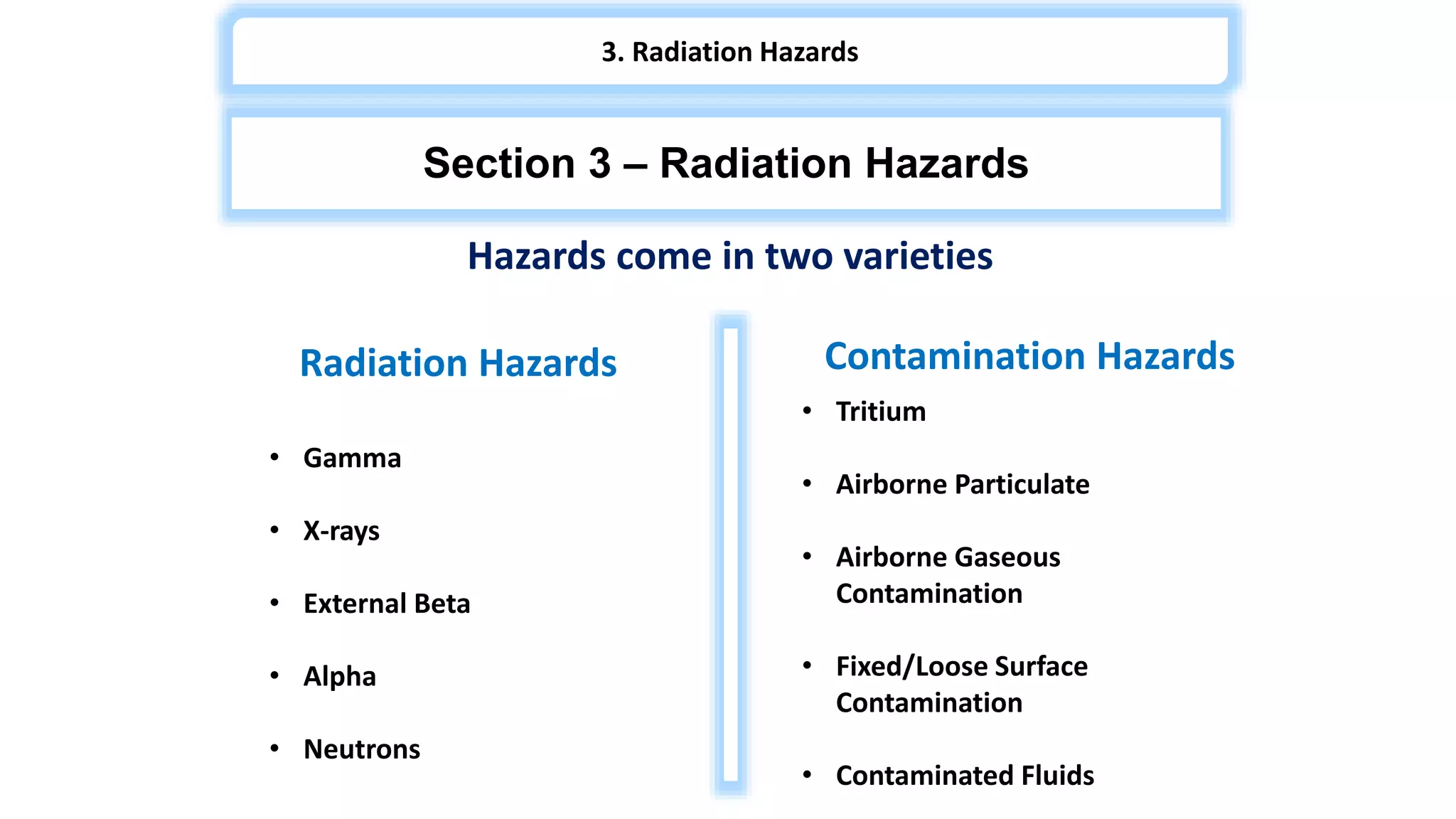
of clean nuclear energy.
Radiation: Introduction
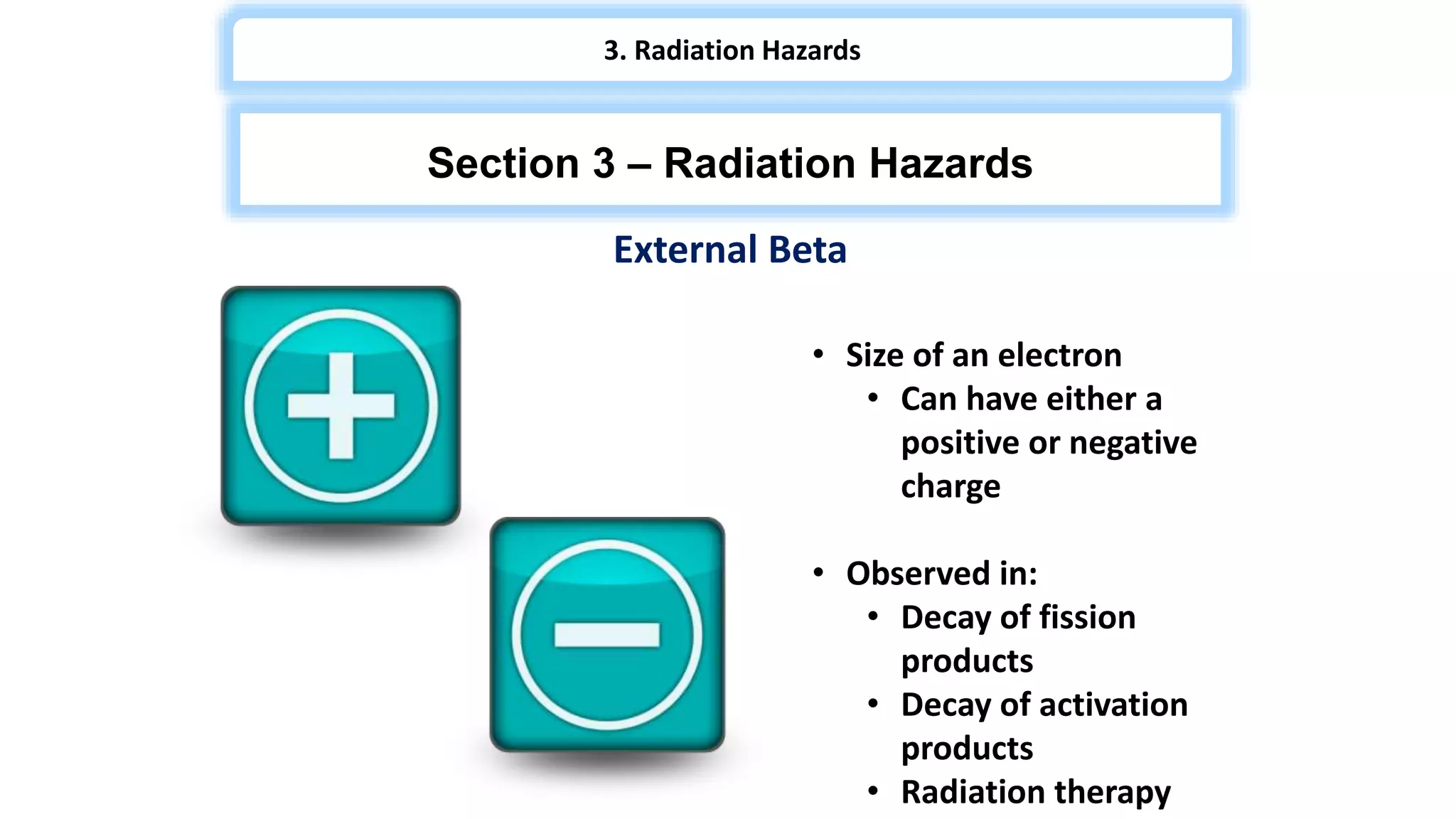
In this section Contents are:
 What is radiation?
 The two categories of radiation.
 The four types of ionizing radiation.
 How damaging different types of radiation are &
the biological impact of radiation.
 Relative strength of exposure compared to other
activities.
1. What Is Radiation?/Biological effects
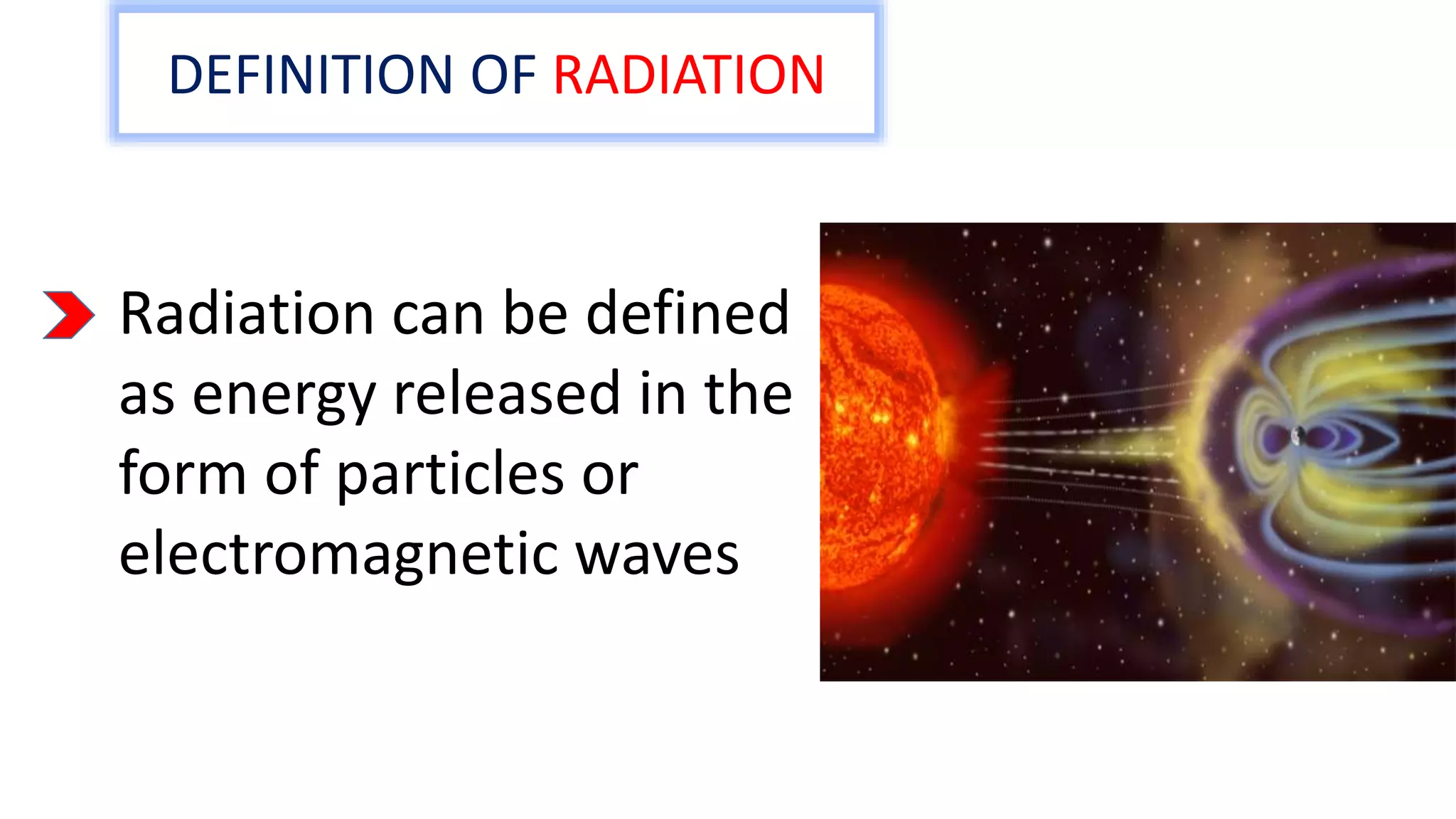
DEFINITION OF RADIATION
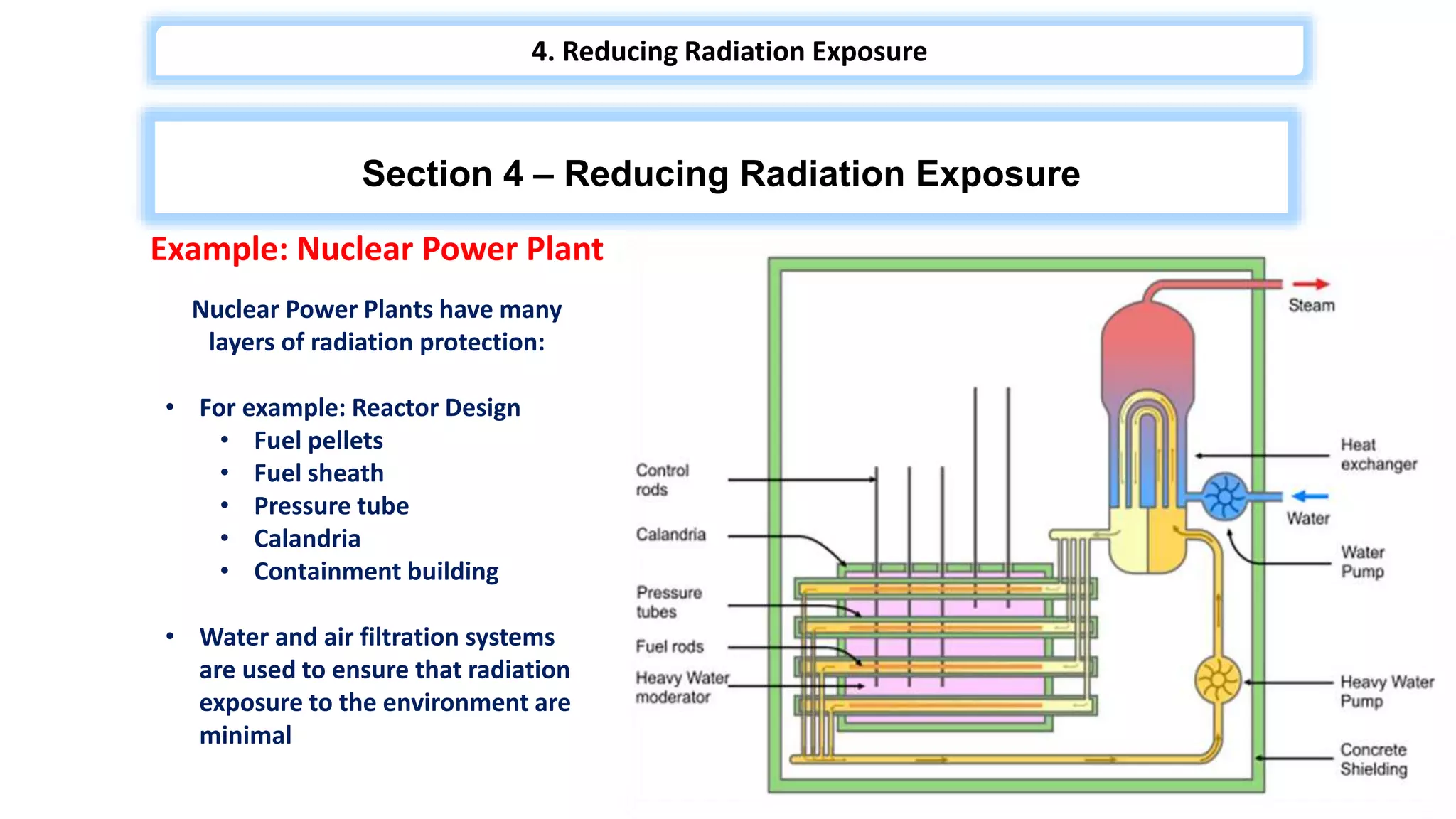
Radiation can be defined
as energy released in the
form of particles or
electromagnetic waves
Radiation comes in two types:
1. Ionizing
• Capable of knocking an election
out of orbit
2. Non-Ionizing
• Not capable of knocking an
electron out of orbit
Ionizing radiation is the focus
of this module
1. What Is Radiation?/Biological effects
Section 1 – What is Radiation?
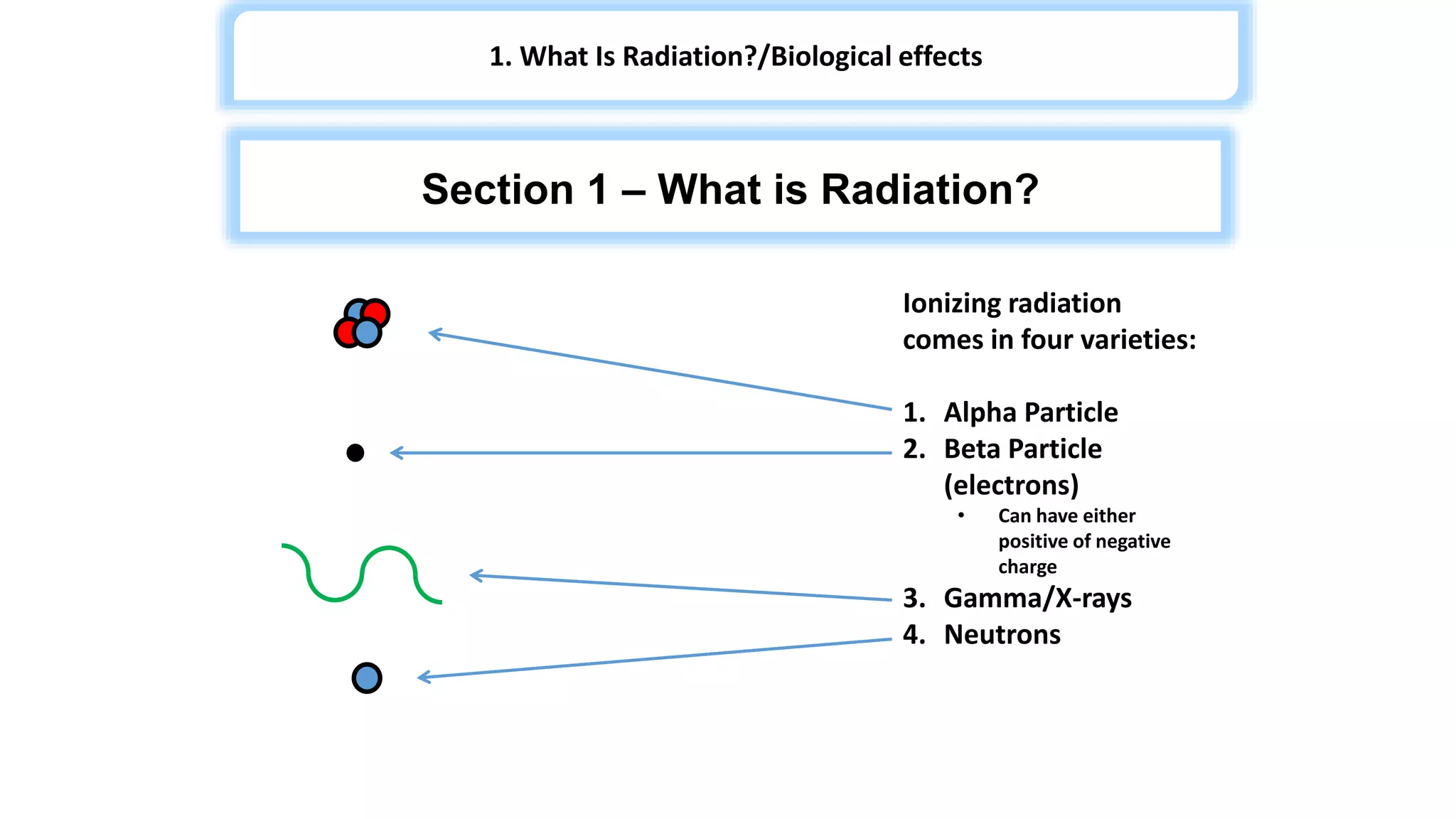
Ionizing radiation
comes in four varieties:
1. Alpha Particle
2. Beta Particle
(electrons)
• Can have either
positive of negative
charge
3. Gamma/X-rays
4. Neutrons
1. What Is Radiation?/Biological effects
Section 1 – What is Radiation?
Different materials can block different forms of radiation
1. What Is Radiation?/Biological effects
Section 1 – What is Radiation?
Alpha Beta Gamma/X-ray Neutrons
Paper
Aluminum Steel/Lead
Water
Radioactivity is a measure of the rate of radioactive decay
The unit used in Canada and
internationally for radioactivity
is the Becquerel (Bq)
• 1 Bq = 1 disintegration
/second
The United States uses the Curie
• 1 Curie = 37 billion Bq
1. What Is Radiation?/Biological effects
Section 1 – What is Radiation?
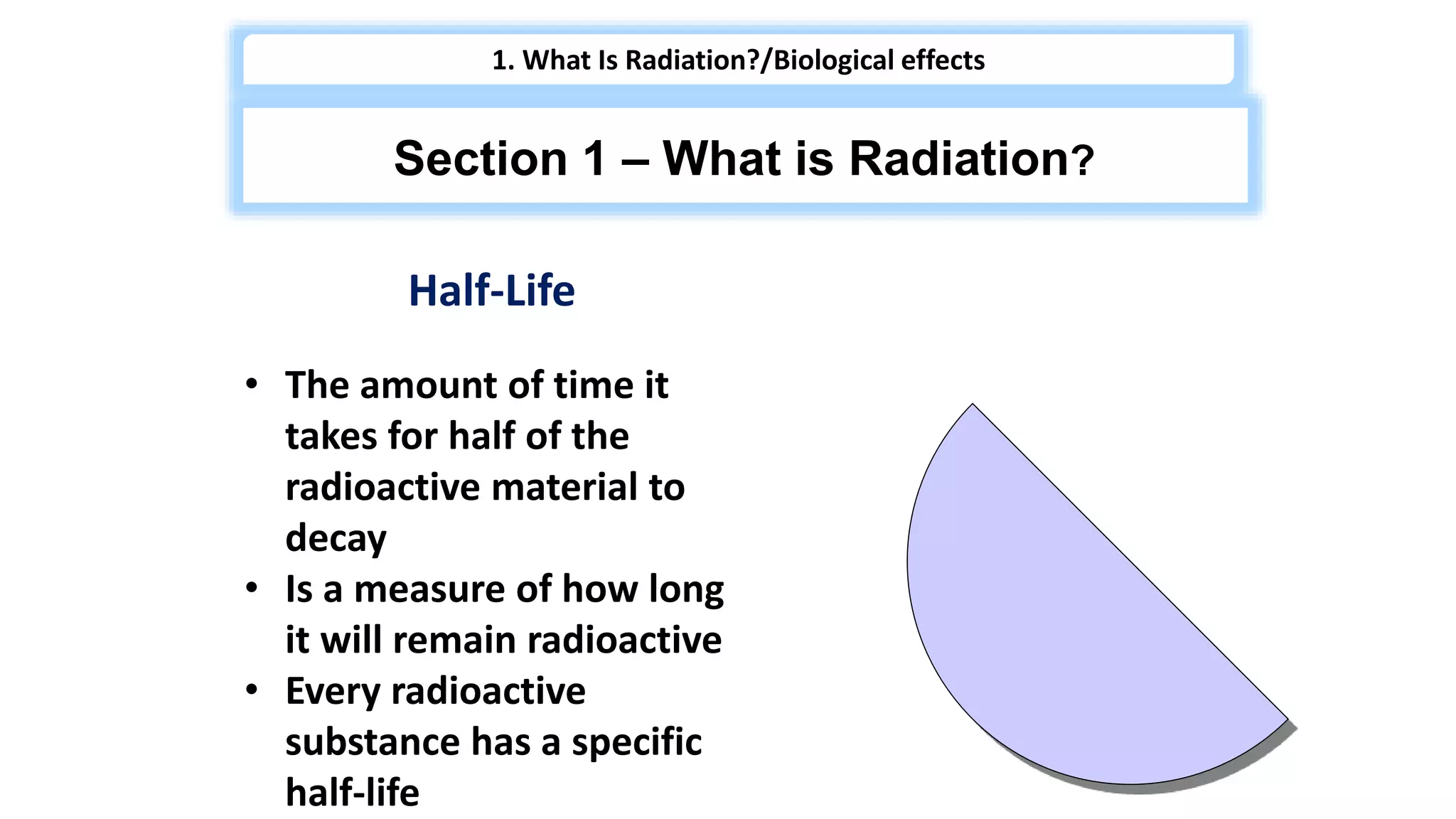
Half-Life
• The amount of time it
takes for half of the
radioactive material to
decay
• Is a measure of how long
it will remain radioactive
• Every radioactive
substance has a specific
half-life
1. What Is Radiation?/Biological effects
Section 1 – What is Radiation?
Biological effects of high radiation doses
Typical symptoms
include:
• Nausea
• Diarrhea
• Malaise
• Feeling out or sorts
1. What Is Radiation?/Biological effects
Section 1 – What is Radiation?
• Established in 1946 as the
Atomic Energy Control Board
• Changed to CNSC in 2000
• CNSC regulates not only power
plants but also
production/storage/use of
medical isotopes
• Protects public and
environment
• Including anti nuclear
proliferation
Canadian Nuclear Safety Commission (CNSC)
Section 2 – Radiation Regulations
2. Radiation Regulations
• Following materials qualify:
• Uranium & thorium ores
of over 0.05% by mass
• Special materials:
• Plutonium
• U-233
• Enriched U-233 & 235
• By products
Nuclear Safety Control Act
Section 2 – Radiation Regulations
2. Radiation Regulations
Radiation Protection Requirements
• Keep effective and equivalent
doses as low as reasonably
achievable (ALARA) by:
• Management control of
work
• Personnel training
• Control of exposure levels
• Worker and public
• Planning for the unexpected
• Record the radioactive material
concentration released by:
• Direct measurement
• Estimation if direct methods
are not available
Section 2 – Radiation Regulations
2. Radiation Regulations
Actions taken
The following must be done if radiation limits are exceeded
• Investigate why it happened
• Take any appropriate action
to return radiation levels to
below limits
• Notify the Canadian Nuclear
Safety Commission within
the time specified on the
licence
Section 2 – Radiation Regulations
2. Radiation Regulations
Information required to be given by employer
• Notify he/she they are a nuclear worker
• The risks associated with radiation
• Effective dose limits
• Their dose level received from the job
• The rights & obligations of a pregnant nuclear
worker:
• A pregnant worker must inform their employer
in writing when a pregnancy is confirmed
• The employer shall make accommodations to
reduce the exposure sustained
The employee is responsible for giving written confirmation that they have received this information
Section 2 – Radiation Regulations
2. Radiation Regulations
When a worker has exceeded the dose limits
• The employer has to tell the worker and the CNSC of
the incident
• The worker is required to leave any work that will
increase the radiation dose
• The employer shall investigate why this happened
and how much radiation the worker was exposed to
• The employer will solve the problem and take
precautions so the incident won`t happen again
• The employer must report their findings or progress
to the CNSC within 21 days
Section 2 – Radiation Regulations
2. Radiation Regulations
ALARA Principal
• A
• As
• L
• Low
• A
• As
• R
• Reasonably
• A
• Achievable
• Works on the theory that cancer incidence at high
exposure levels will be proportionally less at lower
levels
Section 2 – Radiation Regulations
2. Radiation Regulations
Areas where ALARA can be implemented
Physical Workplace
• Reducing the radioactive source
• Removal of source from area
• Radioactive decay
• Minimizing exposure time
• Maximizing distance from the
source
• Using appropriate shielding
• Planning work in advance
• Briefings for workers
• Decontamination
• Protective clothing including
respirators
• Alarm dosimeters
Section 2 – Radiation Regulations
2. Radiation Regulations
Time, Distance, Shielding
• Maximize the distance
between the person and
the radiation source or
area
• Analogy of a campfire:
• The closer you are to
the campfire the
hotter you feel
Section 2 – Radiation Regulations
2. Radiation Regulations
Time, Distance, Shielding
• Shielding materials used to
protect personnel from the
radiation
• Different types of radiation
require different types of
shielding
• Type of radiation must be
known
• Appropriate amount of
material must be known
Section 2 – Radiation Regulations
2. Radiation Regulations
In this section:
 What radiation hazards exist
 Sources for each type of radiation hazard
 What contamination hazards exist
 Sources for each type of contamination hazard
1 of 12
3. Radiation Hazards
Section 3 – Radiation Hazards
Hazards come in two varieties
Contamination HazardsRadiation Hazards
• Gamma
• X-rays
• External Beta
• Alpha
• Neutrons
• Tritium
• Airborne Particulate
• Airborne Gaseous
Contamination
• Fixed/Loose Surface
Contamination
• Contaminated Fluids
3. Radiation Hazards
Gamma Radiation
• High energy
• Observed in:
• Fission
• Decay of fission products
• Neutron capture
(activation)
• Decay of activation
products
• Radiotracers in oil and
mining industries
• Used in mining and
metallurgy
• Gamma ray therapy
Section 3 – Radiation Hazards
3. Radiation Hazards
External Beta
• Size of an electron
• Can have either a
positive or negative
charge
• Observed in:
• Decay of fission
products
• Decay of activation
products
• Radiation therapy
Section 3 – Radiation Hazards
3. Radiation Hazards
Neutrons
• Highly penetrating
• Ionizes indirectly
• Observed in:
• Fission
• Released from a photon
bombarded atom as a
photo neutron
• Radiation therapy
• Used to activate materials
to determine material
composition
Section 3 – Radiation Hazards
3. Radiation Hazards
Alpha Particles
• Very heavy compared to other
forms of radiation
• Ionizes very quickly
• Observed in:
• Defective nuclear fuel
• Uranium mine wastes
• Mining and processing of
phosphate ore for
fertilizers
Section 3 – Radiation Hazards
3. Radiation Hazards
4. Reducing Radiation Exposure
In this section :
 Source geometries
 How to calculate radiation intensities
 Principles to reduce exposure from different source types
Source Geometry
• Point source geometry
• Intensity decreases as the
square of the distance
increases (inverse square
law)
• Intensity relationship:
• 𝑰 𝟏 𝑫 𝟏
𝟐
= 𝑰 𝟐 𝑫 𝟐
𝟐
Section 4 – Reducing Radiation Exposure
4. Reducing Radiation Exposure
Section 4 – Reducing Radiation Exposure
Source Geometry
Three types of source geometry
4. Reducing Radiation Exposure
Point Line Plane
Gamma Radiation
• Primary concern for external
absorption
• Time:
• Limit exposure time so as not
to exceed dose limits set by
government
• Distance
• Use of intensity formulas
depending on source type
• Requires a lot of shielding
• Large amounts of material
• Use materials containing
large numbers of electrons
Section 4 – Reducing Radiation Exposure
4. Reducing Radiation Exposure
External Beta
Section 4 – Reducing Radiation Exposure
4. Reducing Radiation Exposure
• Along with alpha are primary concerns
for internal exposure
• Time:
• Limit exposure time so as not to
exceed dose limits set by
government
• If beta particles are taken
internally then biological half life
is the determining factor
• Distance
• Use of intensity formulas
depending on source type
• Requires little shielding
• Can be stopped by 1 cm of
material
Neutrons
Section 4 – Reducing Radiation Exposure
4. Reducing Radiation Exposure
• Time:
• Limit exposure time so as
not to exceed dose limits
set by government
• Distance
• Use of intensity formulas
depending on source type
• Requires lost of shielding
• Requires materials with
few protons and lots of
hydrogen (water) Zscout370/ Wikimedia Commons/ Public
Domain
Alpha Particles
Section 4 – Reducing Radiation Exposure
4. Reducing Radiation Exposure
• Along with beta particles are the
primary concern for internal
exposure
• Time:
• Limit exposure time so as not
to exceed dose limits set by
government
• If alpha particles are taken
internally the effective half-
life is the determining factor
• Effective half-life is a
combination of the
radioactive half life and the
biological half-life
Section 4 – Reducing Radiation Exposure
4. Reducing Radiation Exposure
Example: Nuclear Power Plant
Nuclear Power Plants have many
layers of radiation protection:
• For example: Reactor Design
• Fuel pellets
• Fuel sheath
• Pressure tube
• Calandria
• Containment building
• Water and air filtration systems
are used to ensure that radiation
exposure to the environment are
minimal
Section 4 – Reducing Radiation Exposure
4. Reducing Radiation Exposure
Example: Nuclear Power Plant
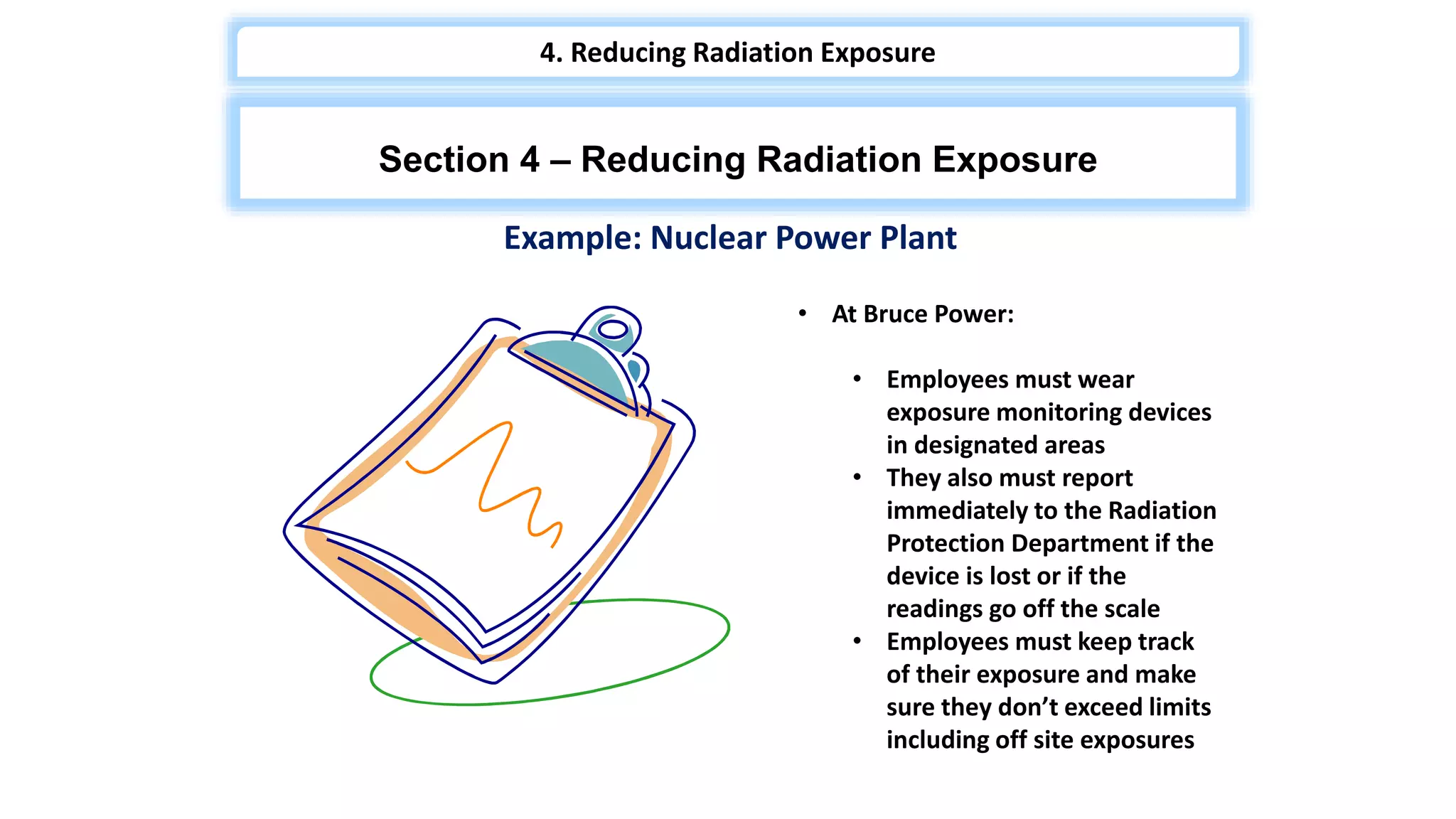
• At Bruce Power:
• Employees must wear
exposure monitoring devices
in designated areas
• They also must report
immediately to the Radiation
Protection Department if the
device is lost or if the
readings go off the scale
• Employees must keep track
of their exposure and make
sure they don’t exceed limits
including off site exposures
Section 4 – Reducing Radiation Exposure
4. Reducing Radiation Exposure
Example: Nuclear Power Plant
• Radiation dose records must be:
• Readily available
• Protected from extreme
conditions as well as theft
and vandalism
• Record keeping standards can be
set by the company but can
include things like:
• Station where the employee
works including location and
function
• Signature or employee
number
• Supervisors signature
5. Nuclear Accidents
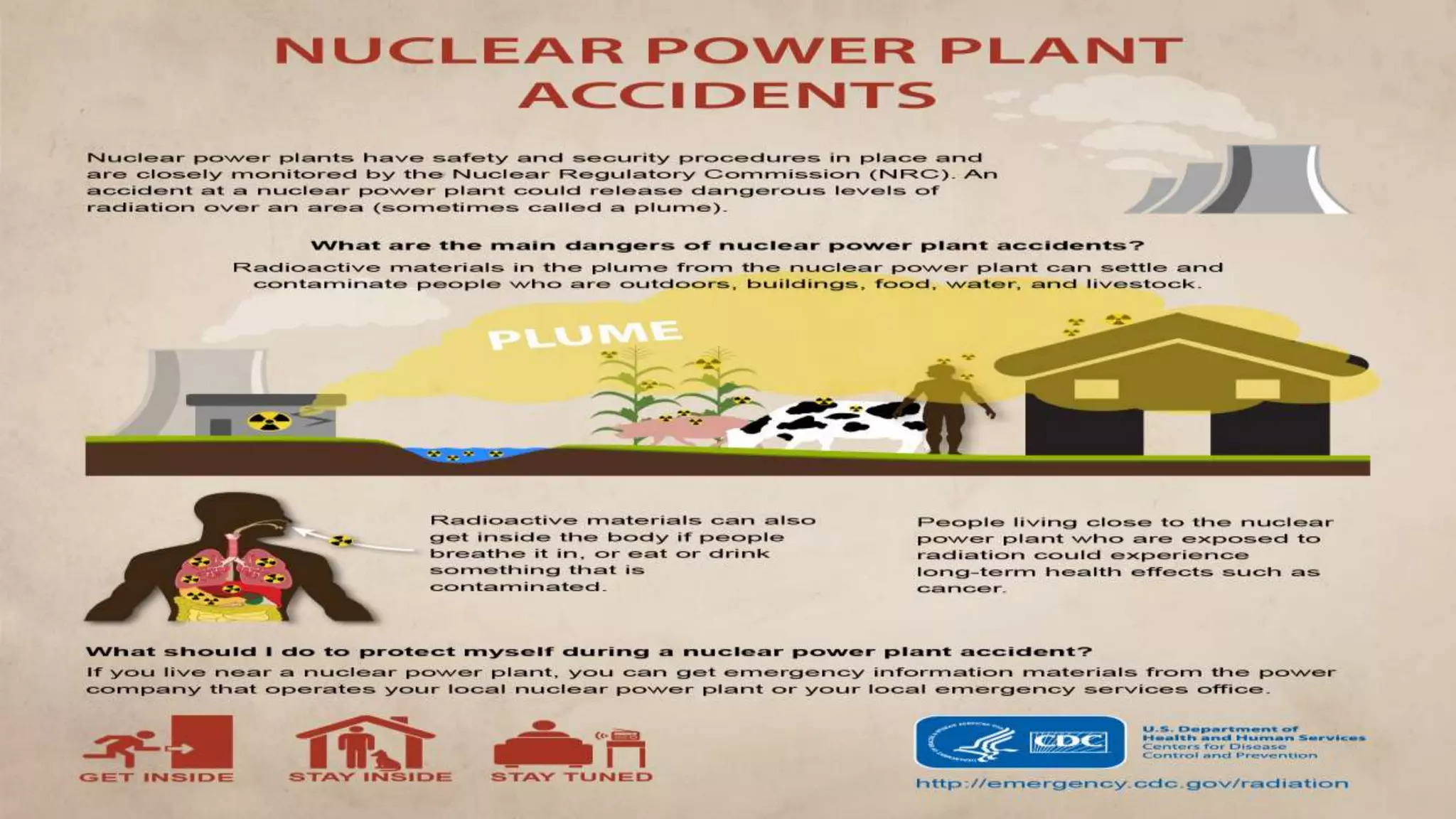
In this section:
 One Area of Accident taken Place
 Cause of Accident
 Main Dangers In Nuclear Accident
 What should to do in Nuclear Accident
Fukushima Daiichi Nuclear Power Plant Accident nuclear
A destructive deleterious nuclear accident was met
in Fukushima also known as Fukushima Dai-ichi.
Which is located on a 3.5 –square kilometre (860-
acre) between the towns of Futaba and Okuma of
Fukushima Prefecture
,Japan.The plant consists of six boiling water
reactors (BWR).These light water reactors drove
electrical generators with a combined power of 4.7
GW , making Fukushima Daiichi one of the 15
largest nuclear power plant was designed , built,
and was run in conjunction with General Electric ,
Boise, and Tokyo Electric Power Company(TEPCO)
Cause Of Accident
The Great East Japan Earthquake of
magnitude 9.0 at 2.46 pm on Friday
11 March 2011 did considerable
Damage in the region ,and the 15 metre
large Tsunami these created caused of
Nuclear Accident.
This 15 metre massive Tsunami
disable the power supply and
Cooling of three Fukushima Dai-
ichi reactors , causing a nuclear
Accident . By this;There have been
no deaths but over 1,00,000
people
Were diverged/ homeless from
Their homes.
CONCLUSION
Radiation hazards & shielding in nuclear power plant

Radiation hazards & shielding in nuclear power plant

  • 1.
    RADIATION HAZARDS &SHIELDING IN NUCLEAR POWER PLANT Presented By : ABDUL AWAL H.T.-14H11A0301 CLASS-B.TECH[IV-I] BRANCH-MECHANICAL SECTION-A JAWAHARLAL NEHRU TECHNOLOGICAL UNIVERSITY HYDERABAD
  • 2.
    WHAT IS RADIATION? C O N C L U S I O N RADIATION REGULATIONS RADIATION HAZARDS REDUCING RADIATION EXPOSURE NUCLEAR ACCIDENT
  • 3.
    There are 6sections that will cover: What Is Radiation? –Definition? What are its biological effects? Radiation Hazards – Sources of radiation and contamination hazards Radiation Regulations – Safety Purpose regulations regarding radiation doses and operating procedures Reducing Radiation Exposure – ALARA principle and its application Nuclear Accidents – Accidents of radiation exposure and lessons learned Conclusion – Need to generate positive public opinion about harnessing of clean nuclear energy. Radiation: Introduction
  • 4.
    In this sectionContents are:  What is radiation?  The two categories of radiation.  The four types of ionizing radiation.  How damaging different types of radiation are & the biological impact of radiation.  Relative strength of exposure compared to other activities. 1. What Is Radiation?/Biological effects
  • 5.
    DEFINITION OF RADIATION Radiationcan be defined as energy released in the form of particles or electromagnetic waves
  • 6.
    Radiation comes intwo types: 1. Ionizing • Capable of knocking an election out of orbit 2. Non-Ionizing • Not capable of knocking an electron out of orbit Ionizing radiation is the focus of this module 1. What Is Radiation?/Biological effects Section 1 – What is Radiation?
  • 7.
    Ionizing radiation comes infour varieties: 1. Alpha Particle 2. Beta Particle (electrons) • Can have either positive of negative charge 3. Gamma/X-rays 4. Neutrons 1. What Is Radiation?/Biological effects Section 1 – What is Radiation?
  • 8.
    Different materials canblock different forms of radiation 1. What Is Radiation?/Biological effects Section 1 – What is Radiation? Alpha Beta Gamma/X-ray Neutrons Paper Aluminum Steel/Lead Water
  • 9.
    Radioactivity is ameasure of the rate of radioactive decay The unit used in Canada and internationally for radioactivity is the Becquerel (Bq) • 1 Bq = 1 disintegration /second The United States uses the Curie • 1 Curie = 37 billion Bq 1. What Is Radiation?/Biological effects Section 1 – What is Radiation?
  • 10.
    Half-Life • The amountof time it takes for half of the radioactive material to decay • Is a measure of how long it will remain radioactive • Every radioactive substance has a specific half-life 1. What Is Radiation?/Biological effects Section 1 – What is Radiation?
  • 11.
    Biological effects ofhigh radiation doses Typical symptoms include: • Nausea • Diarrhea • Malaise • Feeling out or sorts 1. What Is Radiation?/Biological effects Section 1 – What is Radiation?
  • 12.
    • Established in1946 as the Atomic Energy Control Board • Changed to CNSC in 2000 • CNSC regulates not only power plants but also production/storage/use of medical isotopes • Protects public and environment • Including anti nuclear proliferation Canadian Nuclear Safety Commission (CNSC) Section 2 – Radiation Regulations 2. Radiation Regulations
  • 13.
    • Following materialsqualify: • Uranium & thorium ores of over 0.05% by mass • Special materials: • Plutonium • U-233 • Enriched U-233 & 235 • By products Nuclear Safety Control Act Section 2 – Radiation Regulations 2. Radiation Regulations
  • 14.
    Radiation Protection Requirements •Keep effective and equivalent doses as low as reasonably achievable (ALARA) by: • Management control of work • Personnel training • Control of exposure levels • Worker and public • Planning for the unexpected • Record the radioactive material concentration released by: • Direct measurement • Estimation if direct methods are not available Section 2 – Radiation Regulations 2. Radiation Regulations
  • 15.
    Actions taken The followingmust be done if radiation limits are exceeded • Investigate why it happened • Take any appropriate action to return radiation levels to below limits • Notify the Canadian Nuclear Safety Commission within the time specified on the licence Section 2 – Radiation Regulations 2. Radiation Regulations
  • 16.
    Information required tobe given by employer • Notify he/she they are a nuclear worker • The risks associated with radiation • Effective dose limits • Their dose level received from the job • The rights & obligations of a pregnant nuclear worker: • A pregnant worker must inform their employer in writing when a pregnancy is confirmed • The employer shall make accommodations to reduce the exposure sustained The employee is responsible for giving written confirmation that they have received this information Section 2 – Radiation Regulations 2. Radiation Regulations
  • 17.
    When a workerhas exceeded the dose limits • The employer has to tell the worker and the CNSC of the incident • The worker is required to leave any work that will increase the radiation dose • The employer shall investigate why this happened and how much radiation the worker was exposed to • The employer will solve the problem and take precautions so the incident won`t happen again • The employer must report their findings or progress to the CNSC within 21 days Section 2 – Radiation Regulations 2. Radiation Regulations
  • 18.
    ALARA Principal • A •As • L • Low • A • As • R • Reasonably • A • Achievable • Works on the theory that cancer incidence at high exposure levels will be proportionally less at lower levels Section 2 – Radiation Regulations 2. Radiation Regulations
  • 19.
    Areas where ALARAcan be implemented Physical Workplace • Reducing the radioactive source • Removal of source from area • Radioactive decay • Minimizing exposure time • Maximizing distance from the source • Using appropriate shielding • Planning work in advance • Briefings for workers • Decontamination • Protective clothing including respirators • Alarm dosimeters Section 2 – Radiation Regulations 2. Radiation Regulations
  • 20.
    Time, Distance, Shielding •Maximize the distance between the person and the radiation source or area • Analogy of a campfire: • The closer you are to the campfire the hotter you feel Section 2 – Radiation Regulations 2. Radiation Regulations
  • 21.
    Time, Distance, Shielding •Shielding materials used to protect personnel from the radiation • Different types of radiation require different types of shielding • Type of radiation must be known • Appropriate amount of material must be known Section 2 – Radiation Regulations 2. Radiation Regulations
  • 22.
    In this section: What radiation hazards exist  Sources for each type of radiation hazard  What contamination hazards exist  Sources for each type of contamination hazard 1 of 12 3. Radiation Hazards
  • 23.
    Section 3 –Radiation Hazards Hazards come in two varieties Contamination HazardsRadiation Hazards • Gamma • X-rays • External Beta • Alpha • Neutrons • Tritium • Airborne Particulate • Airborne Gaseous Contamination • Fixed/Loose Surface Contamination • Contaminated Fluids 3. Radiation Hazards
  • 24.
    Gamma Radiation • Highenergy • Observed in: • Fission • Decay of fission products • Neutron capture (activation) • Decay of activation products • Radiotracers in oil and mining industries • Used in mining and metallurgy • Gamma ray therapy Section 3 – Radiation Hazards 3. Radiation Hazards
  • 25.
    External Beta • Sizeof an electron • Can have either a positive or negative charge • Observed in: • Decay of fission products • Decay of activation products • Radiation therapy Section 3 – Radiation Hazards 3. Radiation Hazards
  • 26.
    Neutrons • Highly penetrating •Ionizes indirectly • Observed in: • Fission • Released from a photon bombarded atom as a photo neutron • Radiation therapy • Used to activate materials to determine material composition Section 3 – Radiation Hazards 3. Radiation Hazards
  • 27.
    Alpha Particles • Veryheavy compared to other forms of radiation • Ionizes very quickly • Observed in: • Defective nuclear fuel • Uranium mine wastes • Mining and processing of phosphate ore for fertilizers Section 3 – Radiation Hazards 3. Radiation Hazards
  • 28.
    4. Reducing RadiationExposure In this section :  Source geometries  How to calculate radiation intensities  Principles to reduce exposure from different source types
  • 29.
    Source Geometry • Pointsource geometry • Intensity decreases as the square of the distance increases (inverse square law) • Intensity relationship: • 𝑰 𝟏 𝑫 𝟏 𝟐 = 𝑰 𝟐 𝑫 𝟐 𝟐 Section 4 – Reducing Radiation Exposure 4. Reducing Radiation Exposure
  • 30.
    Section 4 –Reducing Radiation Exposure Source Geometry Three types of source geometry 4. Reducing Radiation Exposure Point Line Plane
  • 31.
    Gamma Radiation • Primaryconcern for external absorption • Time: • Limit exposure time so as not to exceed dose limits set by government • Distance • Use of intensity formulas depending on source type • Requires a lot of shielding • Large amounts of material • Use materials containing large numbers of electrons Section 4 – Reducing Radiation Exposure 4. Reducing Radiation Exposure
  • 32.
    External Beta Section 4– Reducing Radiation Exposure 4. Reducing Radiation Exposure • Along with alpha are primary concerns for internal exposure • Time: • Limit exposure time so as not to exceed dose limits set by government • If beta particles are taken internally then biological half life is the determining factor • Distance • Use of intensity formulas depending on source type • Requires little shielding • Can be stopped by 1 cm of material
  • 33.
    Neutrons Section 4 –Reducing Radiation Exposure 4. Reducing Radiation Exposure • Time: • Limit exposure time so as not to exceed dose limits set by government • Distance • Use of intensity formulas depending on source type • Requires lost of shielding • Requires materials with few protons and lots of hydrogen (water) Zscout370/ Wikimedia Commons/ Public Domain
  • 34.
    Alpha Particles Section 4– Reducing Radiation Exposure 4. Reducing Radiation Exposure • Along with beta particles are the primary concern for internal exposure • Time: • Limit exposure time so as not to exceed dose limits set by government • If alpha particles are taken internally the effective half- life is the determining factor • Effective half-life is a combination of the radioactive half life and the biological half-life
  • 35.
    Section 4 –Reducing Radiation Exposure 4. Reducing Radiation Exposure Example: Nuclear Power Plant Nuclear Power Plants have many layers of radiation protection: • For example: Reactor Design • Fuel pellets • Fuel sheath • Pressure tube • Calandria • Containment building • Water and air filtration systems are used to ensure that radiation exposure to the environment are minimal
  • 36.
    Section 4 –Reducing Radiation Exposure 4. Reducing Radiation Exposure Example: Nuclear Power Plant • At Bruce Power: • Employees must wear exposure monitoring devices in designated areas • They also must report immediately to the Radiation Protection Department if the device is lost or if the readings go off the scale • Employees must keep track of their exposure and make sure they don’t exceed limits including off site exposures
  • 37.
    Section 4 –Reducing Radiation Exposure 4. Reducing Radiation Exposure Example: Nuclear Power Plant • Radiation dose records must be: • Readily available • Protected from extreme conditions as well as theft and vandalism • Record keeping standards can be set by the company but can include things like: • Station where the employee works including location and function • Signature or employee number • Supervisors signature
  • 38.
    5. Nuclear Accidents Inthis section:  One Area of Accident taken Place  Cause of Accident  Main Dangers In Nuclear Accident  What should to do in Nuclear Accident
  • 39.
    Fukushima Daiichi NuclearPower Plant Accident nuclear A destructive deleterious nuclear accident was met in Fukushima also known as Fukushima Dai-ichi. Which is located on a 3.5 –square kilometre (860- acre) between the towns of Futaba and Okuma of Fukushima Prefecture ,Japan.The plant consists of six boiling water reactors (BWR).These light water reactors drove electrical generators with a combined power of 4.7 GW , making Fukushima Daiichi one of the 15 largest nuclear power plant was designed , built, and was run in conjunction with General Electric , Boise, and Tokyo Electric Power Company(TEPCO)
  • 40.
    Cause Of Accident TheGreat East Japan Earthquake of magnitude 9.0 at 2.46 pm on Friday 11 March 2011 did considerable Damage in the region ,and the 15 metre large Tsunami these created caused of Nuclear Accident. This 15 metre massive Tsunami disable the power supply and Cooling of three Fukushima Dai- ichi reactors , causing a nuclear Accident . By this;There have been no deaths but over 1,00,000 people Were diverged/ homeless from Their homes.
  • 43.