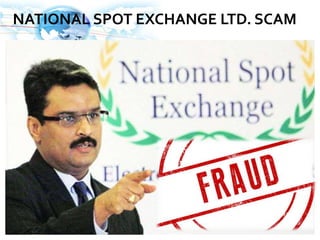
NATIONAL SPOT EXCHANGE LTD. SCAM
WHAT IS SPOT EXCHANGE
• National spot exchange
ltd is trading or a buying
and selling a commodity,
paying cash for and
receiving your goods on
the ‘spot’. Which
signifies that the buyer
and seller agree on a
price and ‘deliver’ their
side of the contract
immediately.
INTRODUCTION
• National Spot Exchange (NSEL) is a
Commodities exchange in India, and is a joint
venture of Financial Technologies (India) Ltd.
(FTIL) and National Agricultural Cooperative
Marketing Federation of India (NAFED).
National Spot Exchange commenced its live
trading operations in different commodities on 15
October 2008.
• Jignesh shah is the Vice Chairman of NSEL.
• The NSEL scam is estimated to be a Rs. 5600
crore.
E- SERIES PRODUCT
• For the first time in India,
National Spot Exchange has
introduced MCX (Multi-
Commodities Exchange) Retail
investors can now trade and
invest in commodities like they
invest in equities.
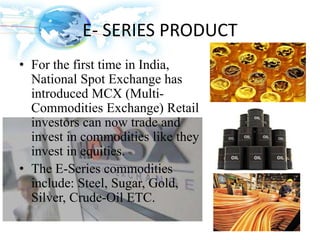
• The E-Series commodities
include: Steel, Sugar, Gold,
Silver, Crude-Oil ETC.
WHO IS JIGNESH SHAH
• Jignesh shah is the
founder and former
CEO of the Multi-
Commodity Exchange
of India LTD. And co-
founder , chairman and
managing director of
Financial Technology
India LTD.
WHAT REALLY NSEL DID?
• The NSEL scam is estimated to be a Rs. 5600
crore (around US$ 0.9 billion) fraud that came
out to light after the National Spot
Exchange failed to pay its investors in
commodity pair contracts after 31 July 2013. .
DAY 1
• Sugar price = 100 +10%(+10)
DAY 2
• Sugar price = 80 -20%(-20rs)
DAY 3
• Sugar price = 81 +1%(+1rs)
DAY 4
• Sugar price = 85 +5%(+5rs)
1 MONTH LATER
THE ROLE OF BROKER
• The economic offence wing (EOW) of Mumbai
police found evidence of some irregularities
on the part of the broker in NSEL scam.
• The report mentions evidence of illegal of
unauthorized changes at the back end of
NSEL, where broker didn’t have any control.
• The EOW wing of Mumbai police arrested the
top 3 brokers namely amit rathi, Chintan
Modi, cp Krishnan on 3rd march 2015
ACTION
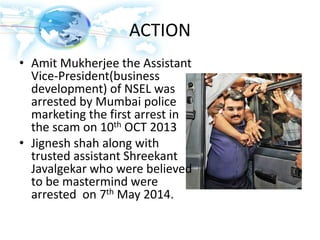
• Amit Mukherjee the Assistant
Vice-President(business
development) of NSEL was
arrested by Mumbai police
marketing the first arrest in
the scam on 10th OCT 2013
• Jignesh shah along with
trusted assistant Shreekant
Javalgekar who were believed
to be mastermind were
arrested on 7th May 2014.
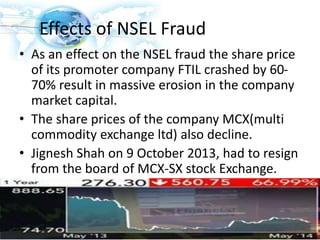
Effects of NSEL Fraud
• As an effect on the NSEL fraud the share price
of its promoter company FTIL crashed by 60-
70% result in massive erosion in the company
market capital.
• The share prices of the company MCX(multi
commodity exchange ltd) also decline.
• Jignesh Shah on 9 October 2013, had to resign
from the board of MCX-SX stock Exchange.
The End of NSEL Scam
• First, on 16th July the contracts were cut to
T+10. But that would involve too many pair
trades – from one a month to three a month,
each of which had higher transaction costs.
• On July 31, NSEL issued a circular saying all
future contracts would be stopped.
• But because it didn’t get paid from the
borrowers, it didn’t have the capacity to pay.
CONCLUSION
• The first lesson from the NSEL crisis is that if
someone promises easy money, there must be
something wrong somewhere.
• Investors must seek complete clarity when any
product promises to give high returns for very
long periods.
• There is nothing called a risk-free return if
someone claims that he is giving more than
bank fixed deposits.
THANK YOU

Nsel scam ppt

  • 2.
  • 3.
    WHAT IS SPOTEXCHANGE • National spot exchange ltd is trading or a buying and selling a commodity, paying cash for and receiving your goods on the ‘spot’. Which signifies that the buyer and seller agree on a price and ‘deliver’ their side of the contract immediately.
  • 4.
    INTRODUCTION • National SpotExchange (NSEL) is a Commodities exchange in India, and is a joint venture of Financial Technologies (India) Ltd. (FTIL) and National Agricultural Cooperative Marketing Federation of India (NAFED). National Spot Exchange commenced its live trading operations in different commodities on 15 October 2008. • Jignesh shah is the Vice Chairman of NSEL. • The NSEL scam is estimated to be a Rs. 5600 crore.
  • 5.
    E- SERIES PRODUCT •For the first time in India, National Spot Exchange has introduced MCX (Multi- Commodities Exchange) Retail investors can now trade and invest in commodities like they invest in equities. • The E-Series commodities include: Steel, Sugar, Gold, Silver, Crude-Oil ETC.
  • 6.
    WHO IS JIGNESHSHAH • Jignesh shah is the founder and former CEO of the Multi- Commodity Exchange of India LTD. And co- founder , chairman and managing director of Financial Technology India LTD.
  • 7.
    WHAT REALLY NSELDID? • The NSEL scam is estimated to be a Rs. 5600 crore (around US$ 0.9 billion) fraud that came out to light after the National Spot Exchange failed to pay its investors in commodity pair contracts after 31 July 2013. .
  • 8.
    DAY 1 • Sugarprice = 100 +10%(+10)
  • 9.
    DAY 2 • Sugarprice = 80 -20%(-20rs)
  • 10.
    DAY 3 • Sugarprice = 81 +1%(+1rs)
  • 11.
    DAY 4 • Sugarprice = 85 +5%(+5rs)
  • 12.
  • 13.
    THE ROLE OFBROKER • The economic offence wing (EOW) of Mumbai police found evidence of some irregularities on the part of the broker in NSEL scam. • The report mentions evidence of illegal of unauthorized changes at the back end of NSEL, where broker didn’t have any control. • The EOW wing of Mumbai police arrested the top 3 brokers namely amit rathi, Chintan Modi, cp Krishnan on 3rd march 2015
  • 14.
    ACTION • Amit Mukherjeethe Assistant Vice-President(business development) of NSEL was arrested by Mumbai police marketing the first arrest in the scam on 10th OCT 2013 • Jignesh shah along with trusted assistant Shreekant Javalgekar who were believed to be mastermind were arrested on 7th May 2014.
  • 15.
    Effects of NSELFraud • As an effect on the NSEL fraud the share price of its promoter company FTIL crashed by 60- 70% result in massive erosion in the company market capital. • The share prices of the company MCX(multi commodity exchange ltd) also decline. • Jignesh Shah on 9 October 2013, had to resign from the board of MCX-SX stock Exchange.
  • 16.
    The End ofNSEL Scam • First, on 16th July the contracts were cut to T+10. But that would involve too many pair trades – from one a month to three a month, each of which had higher transaction costs. • On July 31, NSEL issued a circular saying all future contracts would be stopped. • But because it didn’t get paid from the borrowers, it didn’t have the capacity to pay.
  • 17.
    CONCLUSION • The firstlesson from the NSEL crisis is that if someone promises easy money, there must be something wrong somewhere. • Investors must seek complete clarity when any product promises to give high returns for very long periods. • There is nothing called a risk-free return if someone claims that he is giving more than bank fixed deposits.
  • 18.