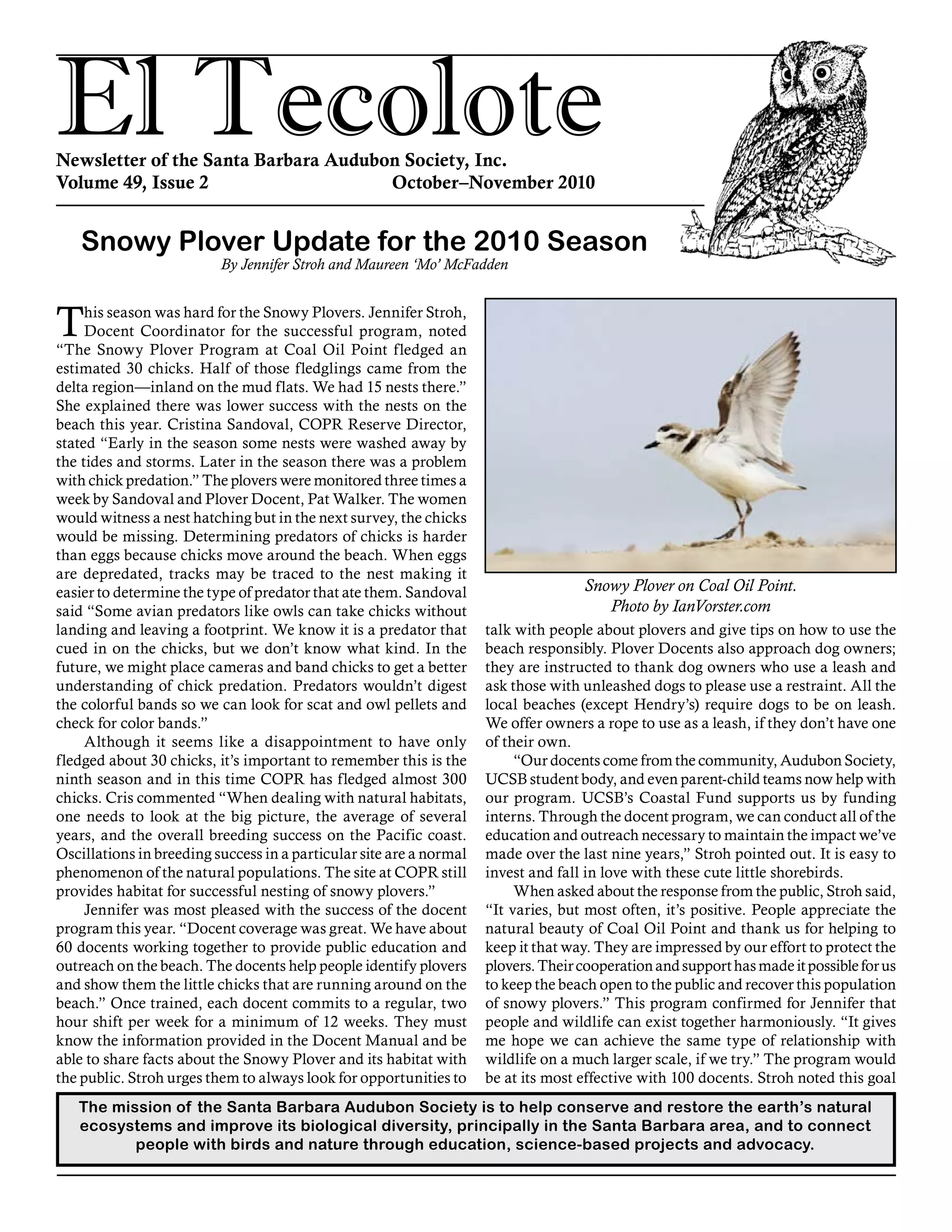
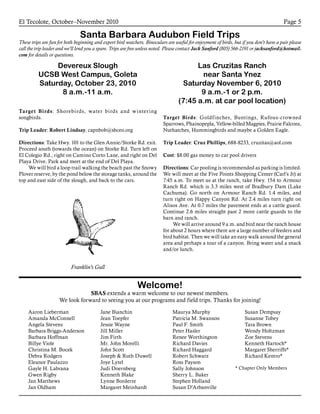
Snowy Plover on Coal Oil Point.
Photo by IanVorster.com
El TecoloteNewsletter of the Santa Barbara Audubon Society, Inc.
Volume 49, Issue 2				 October–November 2010
The mission of the Santa Barbara Audubon Society is to help conserve and restore the earth’s natural
ecosystems and improve its biological diversity, principally in the Santa Barbara area, and to connect
people with birds and nature through education, science-based projects and advocacy.
This season was hard for the Snowy Plovers. Jennifer Stroh,
Docent Coordinator for the successful program, noted
“The Snowy Plover Program at Coal Oil Point fledged an
estimated 30 chicks. Half of those fledglings came from the
delta region—inland on the mud flats. We had 15 nests there.”
She explained there was lower success with the nests on the
beach this year. Cristina Sandoval, COPR Reserve Director,
stated “Early in the season some nests were washed away by
the tides and storms. Later in the season there was a problem
with chick predation.” The plovers were monitored three times a
week by Sandoval and Plover Docent, Pat Walker. The women
would witness a nest hatching but in the next survey, the chicks
would be missing. Determining predators of chicks is harder
than eggs because chicks move around the beach. When eggs
are depredated, tracks may be traced to the nest making it
easier to determine the type of predator that ate them. Sandoval
said “Some avian predators like owls can take chicks without
landing and leaving a footprint. We know it is a predator that
cued in on the chicks, but we don’t know what kind. In the
future, we might place cameras and band chicks to get a better
understanding of chick predation. Predators wouldn’t digest
the colorful bands so we can look for scat and owl pellets and
check for color bands.”
Although it seems like a disappointment to have only
fledged about 30 chicks, it’s important to remember this is the
ninth season and in this time COPR has fledged almost 300
chicks. Cris commented “When dealing with natural habitats,
one needs to look at the big picture, the average of several
years, and the overall breeding success on the Pacific coast.
Oscillations in breeding success in a particular site are a normal
phenomenon of the natural populations. The site at COPR still
provides habitat for successful nesting of snowy plovers.”
Jennifer was most pleased with the success of the docent
program this year. “Docent coverage was great. We have about
60 docents working together to provide public education and
outreach on the beach. The docents help people identify plovers
and show them the little chicks that are running around on the
beach.” Once trained, each docent commits to a regular, two
hour shift per week for a minimum of 12 weeks. They must
know the information provided in the Docent Manual and be
able to share facts about the Snowy Plover and its habitat with
the public. Stroh urges them to always look for opportunities to
talk with people about plovers and give tips on how to use the
beach responsibly. Plover Docents also approach dog owners;
they are instructed to thank dog owners who use a leash and
ask those with unleashed dogs to please use a restraint. All the
local beaches (except Hendry’s) require dogs to be on leash.
We offer owners a rope to use as a leash, if they don’t have one
of their own.
“Our docents come from the community, Audubon Society,
UCSB student body, and even parent-child teams now help with
our program. UCSB’s Coastal Fund supports us by funding
interns. Through the docent program, we can conduct all of the
education and outreach necessary to maintain the impact we’ve
made over the last nine years,” Stroh pointed out. It is easy to
invest and fall in love with these cute little shorebirds.
When asked about the response from the public, Stroh said,
“It varies, but most often, it’s positive. People appreciate the
natural beauty of Coal Oil Point and thank us for helping to
keep it that way. They are impressed by our effort to protect the
plovers.Theircooperationandsupporthasmadeitpossibleforus
to keep the beach open to the public and recover this population
of snowy plovers.” This program confirmed for Jennifer that
people and wildlife can exist together harmoniously. “It gives
me hope we can achieve the same type of relationship with
wildlife on a much larger scale, if we try.” The program would
be at its most effective with 100 docents. Stroh noted this goal
Snowy Plover Update for the 2010 Season
By Jennifer Stroh and Maureen ‘Mo’ McFadden
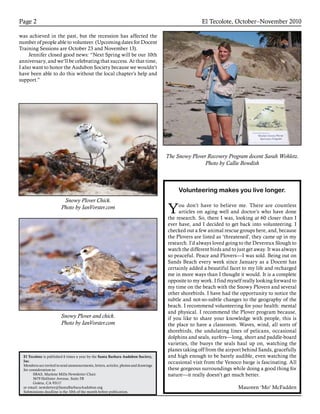
Snowy Plover Chick.
Photo by IanVorster.com
Snowy Plover and chick.
Photo by IanVorster.com
The Snowy Plover Recovery Program docent Sarah Wohletz.
Photo by Callie Bowdish
El Tecolote, October–November 2010Page 2
El Tecolote is published 6 times a year by the Santa Barbara Audubon Society,
Inc.
Members are invited to send announcements, letters, articles, photos and drawings
for consideration to:
SBAS, Marlene Mills Newsletter Chair
5679 Hollister Avenue, Suite 5B
Goleta, CA 93117
or email: newsletter@SantaBarbaraAudubon.org
Submissions deadline is the 10th of the month before publication.
was achieved in the past, but the recession has affected the
number of people able to volunteer. (Upcoming dates for Docent
Training Sessions are October 23 and November 13).
Jennifer closed good news: “Next Spring will be our 10th
anniversary, and we’ll be celebrating that success. At that time,
I also want to honor the Audubon Society because we wouldn’t
have been able to do this without the local chapter’s help and
support.”
Volunteering makes you live longer.
You don’t have to believe me. There are countless
articles on aging well and doctor’s who have done
the research. So, there I was, looking at 60 closer than I
ever have, and I decided to get back into volunteering. I
checked out a few animal rescue groups here, and, because
the Plovers are listed as ‘threatened’, they came up in my
research. I’d always loved going to the Devereux Slough to
watch the different birds and to just get away. It was always
so peaceful. Peace and Plovers—I was sold. Being out on
Sands Beach every week since January as a Docent has
certainly added a beautiful facet to my life and recharged
me in more ways than I thought it would. It is a complete
opposite to my work. I find myself really looking forward to
my time on the beach with the Snowy Plovers and several
other shorebirds. I have had the opportunity to notice the
subtle and not-so-subtle changes to the geography of the
beach. I recommend volunteering for your health: mental
and physical. I recommend the Plover program because,
if you like to share your knowledge with people, this is
the place to have a classroom. Waves, wind, all sorts of
shorebirds, the undulating lines of pelicans, occasional
dolphins and seals, surfers—long, short and paddle-board
varieties, the buoys the seals haul up on, watching the
planes taking off from the airport behind Sands, gracefully
and high enough to be barely audible, even watching the
occasional visit from the Venoco barge is fascinating. All
these gorgeous surroundings while doing a good thing for
nature—it really doesn’t get much better.
Maureen ‘Mo’ McFadden
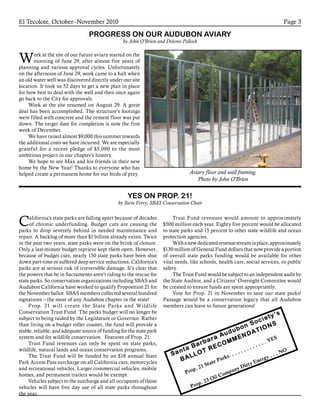
Aviary floor and wall framing.
Photo by John O’Brien
El Tecolote, October–November 2010 Page 3
PROGRESS ON OUR AUDUBON AVIARY
by John O’Brien and Dolores Pollock
California’s state parks are falling apart because of decades
of chronic underfunding. Budget cuts are causing the
parks to drop severely behind in needed maintenance and
repair. A backlog of more than $1 billion already exists. Twice
in the past two years, state parks were on the brink of closure.
Only a last-minute budget reprieve kept them open. However,
because of budget cuts, nearly 150 state parks have been shut
down part-time or suffered deep service reductions. California’s
parks are at serious risk of irreversible damage. It’s clear that
the powers that be in Sacramento aren’t riding to the rescue for
state parks. So conservation organizations including SBAS and
Audubon California have worked to qualify Proposition 21 for
the November ballot. SBAS members collected several hundred
signatures – the most of any Audubon chapter in the state!
Prop. 21 will create the State Parks and Wildlife
Conservation Trust Fund. The parks budget will no longer be
subject to being raided by the Legislature or Governor. Rather
than living on a budget roller coaster, the fund will provide a
stable, reliable, and adequate source of funding for the state park
system and for wildlife conservation. Features of Prop. 21:
Trust Fund revenues can only be spent on state parks,
wildlife, natural lands and ocean conservation programs.
The Trust Fund will be funded by an $18 annual State
Park Access Pass surcharge on all California cars, motorcycles
and recreational vehicles. Larger commercial vehicles, mobile
homes, and permanent trailers would be exempt.
Vehicles subject to the surcharge and all occupants of those
vehicles will have free day use of all state parks throughout
the year.
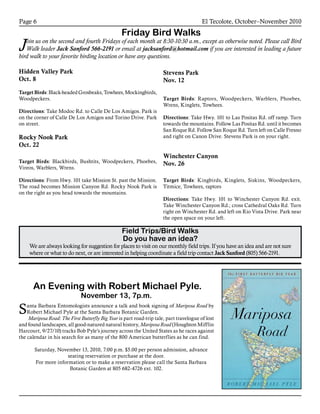
Work at the site of our future aviary started on the
morning of June 29, after almost five years of
planning and various approval cycles. Unfortunately
on the afternoon of June 29, work came to a halt when
an old water well was discovered directly under our site
location. It took us 52 days to get a new plan in place
for how best to deal with the well and then once again
go back to the City for approvals.
Work at the site resumed on August 29. A great
deal has been accomplished. The structure’s footings
were filled with concrete and the cement floor was put
down. The target date for completion is now the first
week of December.
We have raised almost $9,000 this summer towards
the additional costs we have incurred. We are especially
grateful for a recent pledge of $5,000 to the most
ambitious project in our chapter’s history.
We hope to see Max and his friends in their new
home by the New Year! Thanks to everyone who has
helped create a permanent home for our birds of prey.
Trust Fund revenues would amount to approximately
$500 million each year. Eighty five percent would be allocated
to state parks and 15 percent to other state wildlife and ocean
protection agencies.
Withanewdedicatedrevenuestreaminplace,approximately
$130 million of General Fund dollars that now provide a portion
of overall state parks funding would be available for other
vital needs, like schools, health care, social services, or public
safety.
The Trust Fund would be subject to an independent audit by
the State Auditor, and a Citizens’ Oversight Committee would
be created to ensure funds are spent appropriately.
Vote for Prop. 21 in November to save our state parks!
Passage would be a conservation legacy that all Audubon
members can leave to future generations!
YES ON PROP. 21!
by Steve Ferry, SBAS Conservation Chair
El Tecolote, October–November 2010Page 4
Santa Barbara Audubon Programs
All programs will take place at Farrand Hall, Santa Barbara Museum of Natural History, Mission Canyon, Santa Barbara. Free on-site parking.
All programs will begin at 7:30 p.m. and are free to the public. Doors open at 7:00 p.m. SBAS members are encouraged to bring guests.
 
Bats—What Hollywood
Doesn’t Want You to Know
Mary Wenzel
Wednesday, October 27, 2010
Bats by popular demand! By day Mary Wenzel is a
programmer at UCSB, but by night she is a bat aficionado.
Mary has had a lifelong fascination with all animals and a
special interest in bats ever since encountering spectacled flying
foxes on a bird-watching trip to Queensland, Australia. Mary
has been taking bat classes, going on bat vacations, and caring
for local injured and orphaned bats with the Santa Barbara
Wildlife Care Network since 1998. She will share with us
pictures and video of bats from around the world to introduce
us to these intriguing animals.
 
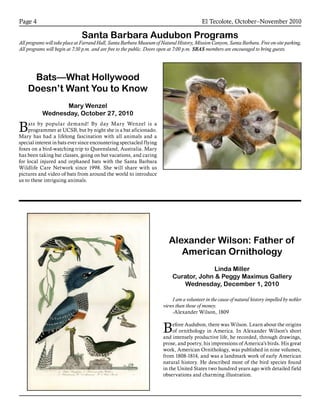
Alexander Wilson: Father of
American Ornithology
Linda Miller
Curator, John & Peggy Maximus Gallery 
Wednesday, December 1, 2010
I am a volunteer in the cause of natural history impelled by nobler
views than those of money.
-Alexander Wilson, 1809
 
Before Audubon, there was Wilson. Learn about the origins
of ornithology in America. In Alexander Wilson’s short
and intensely productive life, he recorded, through drawings,
prose, and poetry, his impressions of America’s birds. His great
work, American Ornithology, was published in nine volumes,
from 1808-1814, and was a landmark work of early American
natural history. He described most of the bird species found
in the United States two hundred years ago with detailed field
observations and charming illustration.
El Tecolote, October–November 2010 Page 5
Santa Barbara Audubon Field Trips
These trips are fun for both beginning and expert bird watchers. Binoculars are useful for enjoyment of birds, but if you don’t have a pair please
call the trip leader and we’ll lend you a spare. Trips are free unless noted. Please contact Jack Sanford (805) 566-2191 or jacksanford@hotmail.
com for details or questions.
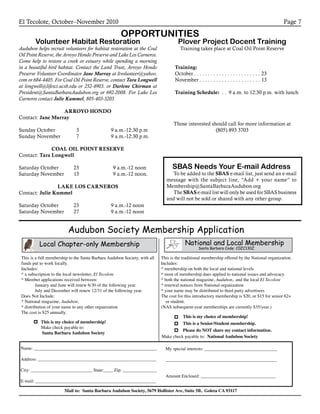
Devereux Slough
UCSB West Campus, Goleta
Saturday, October 23, 2010
8 a.m.-11 a.m.
Target Birds: Shorebirds, water birds and wintering
songbirds.
Trip Leader: Robert Lindsay, capnbob@sbceo.org
Directions: Take Hwy. 101 to the Glen Annie/Storke Rd. exit.
Proceed south (towards the ocean) on Storke Rd. Turn left on
El Colegio Rd., right on Camino Corto Lane, and right on Del
Playa Drive. Park and meet at the end of Del Playa.
	 We will bird a loop trail walking the beach past the Snowy
Plover reserve, by the pond below the storage tanks, around the
top and east side of the slough, and back to the cars.
Las Cruzitas Ranch
near Santa Ynez
Saturday November 6, 2010
9 a.m.-1 or 2 p.m.
(7:45 a.m. at car pool location)
Target Birds: Goldfinches, Buntings, Rufous-crowned
Sparrows, Phainopepla, Yellow-billed Magpies, Prairie Falcons,
Nuthatches, Hummingbirds and maybe a Golden Eagle.
Trip Leader: Cruz Phillips, 688-8233, cruzitas@aol.com
Cost: $8.00 gas money to car pool drivers
Directions: Car pooling is recommended as parking is limited.
We will meet at the Five Points Shopping Center (Carl’s Jr) at
7:45 a.m. To meet us at the ranch, take Hwy. 154 to Armour
Ranch Rd. which is 3.3 miles west of Bradbury Dam (Lake
Cachuma). Go north on Armour Ranch Rd. 1.4 miles, and
turn right on Happy Canyon Rd. At 2.4 miles turn right on
Alisos Ave. At 0.7 miles the pavement ends at a cattle guard.
Continue 2.6 miles straight past 2 more cattle guards to the
barn and ranch.
	 We will arrive around 9 a.m. and bird near the ranch house
for about 2 hours where there are a large number of feeders and
bird habitat. Then we will take an easy walk around the general
area and perhaps a tour of a canyon. Bring water and a snack
and/or lunch.
Welcome!
SBAS extends a warm welcome to our newest members.
We look forward to seeing you at our programs and field trips. Thanks for joining!
Franklin’s Gull
Aaron Lieberman
Amanda McConnell
Angela Stevens
Barbara Briggs-Anderson
Barbara Hoffman
Billye Viole
Christina M. Bocek
Debra Rodgers
Eleanor Paulazzo
Gayle H. Labrana
Gwen Rigby
Jan Matthews
Jan Oldham
Jane Bianchin
Jean Toepfer
Jessie Wayne
Jill Miller
Jim Firth
Mr. John Morelli
John Scott
Joseph & Ruth Duwell
Joye Lytel
Judi Doernberg
Kenneth Blake
Lynne Borderre
Margaret Meinhardt
Maurya Murphy
Patricia M. Swanson
Paul F. Smith
Peter Hasler
Renee Worthington
Richard Davies
Richard Haggard
Robert Schwarz
Ross Payson
Sally Johnson
Sherry L. Baker
Stephen Holland
Susan D’Arbanville
Susan Dempsay
Susanne Tobey
Tara Brown
Wendy Holtzman
Zoe Stevens
Kenneth Hartoch*
Margaret Sherriffs*
Richard Kentro*
* Chapter Only Members
El Tecolote, October–November 2010Page 6
Friday Bird Walks
Join us on the second and fourth Fridays of each month at 8:30-10:30 a.m., except as otherwise noted. Please call Bird
Walk leader Jack Sanford 566-2191 or email at jacksanford@hotmail.com if you are interested in leading a future
bird walk to your favorite birding location or have any questions.
Field Trips/Bird Walks
Do you have an idea?
We are always looking for suggestion for places to visit on our monthly field trips. If you have an idea and are not sure
where or what to do next, or are interested in helping coordinate a field trip contact Jack Sanford (805) 566-2191.
Hidden Valley Park
Oct. 8
TargetBirds:Black-headedGrosbeaks,Towhees,Mockingbirds,
Woodpeckers.
Directions: Take Modoc Rd. to Calle De Los Amigos. Park is
on the corner of Calle De Los Amigos and Torino Drive. Park
on street.
Rocky Nook Park
Oct. 22
Target Birds: Blackbirds, Bushtits, Woodpeckers, Phoebes,
Vireos, Warblers, Wrens.
Directions: From Hwy. 101 take Mission St. past the Mission.
The road becomes Mission Canyon Rd. Rocky Nook Park is
on the right as you head towards the mountains.
Stevens Park
Nov. 12
Target Birds: Raptors, Woodpeckers, Warblers, Phoebes,
Wrens, Kinglets, Towhees.
Directions: Take Hwy. 101 to Las Positas Rd. off ramp. Turn
towards the mountains. Follow Las Positas Rd. until it becomes
San Roque Rd. Follow San Roque Rd. Turn left on Calle Fresno
and right on Canon Drive. Stevens Park is on your right.
Winchester Canyon
Nov. 26
Target Birds: Kingbirds, Kinglets, Siskins, Woodpeckers,
Titmice, Towhees, raptors
Directions: Take Hwy. 101 to Winchester Canyon Rd. exit.
Take Winchester Canyon Rd.; cross Cathedral Oaks Rd. Turn
right on Winchester Rd. and left on Rio Vista Drive. Park near
the open space on your left.
An Evening with Robert Michael Pyle.
November 13, 7p.m.
Santa Barbara Entomologists announce a talk and book signing of Mariposa Road by
Robert Michael Pyle at the Santa Barbara Botanic Garden.
Mariposa Road: The First Butterfly Big Year is part road-trip tale, part travelogue of lost
and found landscapes, all good-natured natural history, Mariposa Road (Houghton Mifflin
Harcourt, 9/27/10) tracks Bob Pyle’s journey across the United States as he races against
the calendar in his search for as many of the 800 American butterflies as he can find.
Saturday, November 13, 2010, 7:00 p.m. $5.00 per person admission, advance
seating reservation or purchase at the door.
For more information or to make a reservation please call the Santa Barbara
Botanic Garden at 805 682-4726 ext. 102.
El Tecolote, October–November 2010 Page 7
OPPORTUNITIES
Volunteer Habitat Restoration
Audubon helps recruit volunteers for habitat restoration at the Coal
Oil Point Reserve, the Arroyo Hondo Preserve and Lake Los Carneros.
Come help to restore a creek or estuary while spending a morning
in a beautiful bird habitat. Contact the Land Trust, Arroyo Hondo
Preserve Volunteer Coordinator Jane Murray at ltvolunteer@yahoo.
com or 684-4405. For Coal Oil Point Reserve, contact Tara Longwell
at longwell@lifesci.ucsb.edu or 252-4903. or Darlene Chirman at
President@SantaBarbaraAudubon.org or 692-2008. For Lake Los
Carneros contact Julie Kummel, 805-403-3203
ARROYO HONDO
Contact: Jane Murray
Sunday October 	 3	 9 a.m.-12:30 p.m
Sunday November 	 7	 9 a.m.-12:30 p.m.
COAL OIL POINT RESERVE
Contact: Tara Longwell
Saturday October 	 23		9 a.m.-12 noon
Saturday November 	 13		9 a.m.-12 noon.
LAKE LOS CARNEROS
Contact: Julie Kummel
Saturday October	 23	 9 a.m.-12 noon
Saturday November	 27	 9 a.m.-12 noon
Plover Project Docent Training
Training takes place at Coal Oil Point Reserve
Training:
October. . . . . . . . . . . . . . . . . . . . . . . . . 23
November. . . . . . . . . . . . . . . . . . . . . . . 13
Training Schedule: . . . 9 a.m. to 12:30 p.m. with lunch
SBAS Needs Your E-mail Address
To be added to the SBAS e-mail list, just send an e-mail
message with the subject line, “Add + your name” to
Membership@SantaBarbaraAudubon.org
The SBAS e-mail list will only be used for SBAS business
and will not be sold or shared with any other group.
Audubon Society Membership Application
National and Local Membership
Santa Barbara Code: C0ZC130Z
This is a full membership to the Santa Barbara Audubon Society, with all
funds put to work locally.
Includes:
* a subscription to the local newsletter, El Tecolote
* Member applications received between:
January and June will renew 6/30 of the following year.
July and December will renew 12/31 of the following year.
Does Not Include:
* National magazine, Audubon,
* distribution of your name to any other organization
The cost is $25 annually.
This is the traditional membership offered by the National organization.
Includes:
* membership on both the local and national levels
* most of membership dues applied to national issues and advocacy
* both the national magazine, Audubon, and the local El Tecolote
* renewal notices from National organization
* your name may be distributed to third party advertisers
The cost for this introductory membership is $20, or $15 for senior 62+
or student.
(NAS subsequent-year memberships are currently $35/year.)
This is my choice of membership!
Make check payable to:
Santa Barbara Audubon Society
Name: ______________________________________________________
Address: ____________________________________________________
City: ___________________________ State:____ Zip: _______________
E-mail: _____________________________________________________
My special interests: ________________________________
_________________________________________________
Amount Enclosed: _________________________________
Mail to: Santa Barbara Audubon Society, 5679 Hollister Ave, Suite 5B, Goleta CA 93117
Local Chapter-only Membership
Make check payable to: National Audubon Society
This is my choice of membership!
This is a Senior/Student membership.
Please do NOT share my contact information.
Those interested should call for more information at
(805) 893 3703
El Tecolote							
Santa Barbara Audubon Society, Inc.						
5679 Hollister Avenue, Suite 5B							
Goleta, CA 93117											
						
					
or current resident
NON PROFIT ORG.
U.S. POSTAGE PAID
SANTA BARBARA, CA.
PERMIT NO. 125
DATED MATERIAL
PLEASE EXPEDITE
Santa Barbara Audubon Society
(805) 964-1468,Info@SantaBarbaraAudubon.org
http://www.SantaBarbaraAudubon.org
OFFICERS
President 	 Darlene Chirman	 692-2008	 President@SantaBarbaraAudubon.org
Vice-President	 Lee Moldaver	 964-1468	 VP@SantaBarbaraAudubon.org
Secretary	 Liz Muraoka	 743-3314	 Secretary@SantaBarbaraAudubon.org
Secretary	 Lisa Ostendorf	 683-1225	 Secretary@SantaBarbaraAudubon.org
Treasurer	 Bobbie Offen	 220-6522	 Treasurer@SantaBarbaraAudubon.org
BOARD MEMBERS & COMMITTEE CHAIRS
Field Trips 	 Jack Sanford	 566-2191	 FieldTrips@SantaBarbaraAudubon.org
Programs 	 Elliot Chasin	 253-2473	 Programs@SantaBarbaraAudubon.org
Conservation 	Steve Ferry	 967-5162	 Conservation@SantaBarbaraAudubon.org
Education 	 Ann Steinmetz 	 680-2638	 Education@SantaBarbaraAudubon.org
Science 	 Niels Johnson-Lameijer	617-3513	 Science@SantaBarbaraAudubon.org
Membership 	 Julia Kosowitz	 450-5392	 Membership@SantaBarbaraAudubon.org
Newsletter 	 Marlene Mills	 964-8525	 Newsletter@SantaBarbaraAudubon.org
Publicity 	 Adam Lewis	 967-7213	 Publicity@SantaBarbaraAudubon.org
Development 	 Julie Kummel 	 403-3203	 Development-2@SantaBarbaraAudubon.org
Development 	 Dolores Pollock 	 681-8661	 Development-1@SantaBarbaraAudubon.org
Development	 Margo Kenney 	 963-3011	 Development-3@SantaBarbaraAudubon.org
APPOINTED POSITIONS
Webmaster: 	 Bobbie Offen	 684‑0160	 Treasurer@SantaBarbaraAudubon.org
Eyes In The Sky: 	
	 Gabriele Drozdowski	 898-0347	 EITS@SantaBarbaraAudubon.org
Snowy Plover Docent
	 Prog: Jennifer Stroh	 893-3703	 Plovers@SantaBarbaraAudubon.org
Hospitality: 	 Nancy Rohrer	 687-7587 	 Hospitality-2@SantaBarbaraAudubon.org
Science Advisor	 Don Schroeder	 403-2090	 ScienceAdvisor@SantaBarbaraAudubon.org
For Rare Bird information go to sbcobirding online directly or through the SBAS chapter
website at SantaBarbaraAudubon.org.
Officers and Chairs meet the 2nd Wednesday of the month. Members are welcomed to attend.
Call the SBAS office to verify dates and times. FAX: 967-7718. Cover art by Daryl Harrison. Printed on recycled paper.
Calendar of Events
Check our website for any changes or late additions
to our Bird Walks, Field Trips or Programs:
http://www.SantaBarbaraAudubon.org
August
Oct.	 3	 Restore Arroyo Hondo
Oct.	 8	 Hidden Valley Park Bird Walk
Oct.	 22	 Rocky Nook Park Bird Walk
Oct.	 23	 Devereus Slough Field Trip
Oct.	 23	 Restore Coal Oil Point Reserve
Oct.	 23	 Plover Training
Oct.	 23	 Restore Lake Los Carneros
Oct.	 27	 Program: Bats
Nov.mber
Nov.	 6	 Las Cruzitas Ranch Field Trip
Nov.	 7	 Restore Arroyo Hondo
Nov.	 12	 Stevens Park Bird Walk
Nov.	 13	 Restore Coal Oil Point Reserve
Nov.	 13	 Robert Michael Pyle talk
Nov.	 13	 Plover Training
Nov.	 26	 Winchester Canyon Bird Walk
Nov.	 27	 Restore Lake Los Carneros
December
Dec.	 1	 Program: Alexander Wilson

Nov 2010 Santa Barbara Audubon

  • 1.
    Snowy Plover onCoal Oil Point. Photo by IanVorster.com El TecoloteNewsletter of the Santa Barbara Audubon Society, Inc. Volume 49, Issue 2 October–November 2010 The mission of the Santa Barbara Audubon Society is to help conserve and restore the earth’s natural ecosystems and improve its biological diversity, principally in the Santa Barbara area, and to connect people with birds and nature through education, science-based projects and advocacy. This season was hard for the Snowy Plovers. Jennifer Stroh, Docent Coordinator for the successful program, noted “The Snowy Plover Program at Coal Oil Point fledged an estimated 30 chicks. Half of those fledglings came from the delta region—inland on the mud flats. We had 15 nests there.” She explained there was lower success with the nests on the beach this year. Cristina Sandoval, COPR Reserve Director, stated “Early in the season some nests were washed away by the tides and storms. Later in the season there was a problem with chick predation.” The plovers were monitored three times a week by Sandoval and Plover Docent, Pat Walker. The women would witness a nest hatching but in the next survey, the chicks would be missing. Determining predators of chicks is harder than eggs because chicks move around the beach. When eggs are depredated, tracks may be traced to the nest making it easier to determine the type of predator that ate them. Sandoval said “Some avian predators like owls can take chicks without landing and leaving a footprint. We know it is a predator that cued in on the chicks, but we don’t know what kind. In the future, we might place cameras and band chicks to get a better understanding of chick predation. Predators wouldn’t digest the colorful bands so we can look for scat and owl pellets and check for color bands.” Although it seems like a disappointment to have only fledged about 30 chicks, it’s important to remember this is the ninth season and in this time COPR has fledged almost 300 chicks. Cris commented “When dealing with natural habitats, one needs to look at the big picture, the average of several years, and the overall breeding success on the Pacific coast. Oscillations in breeding success in a particular site are a normal phenomenon of the natural populations. The site at COPR still provides habitat for successful nesting of snowy plovers.” Jennifer was most pleased with the success of the docent program this year. “Docent coverage was great. We have about 60 docents working together to provide public education and outreach on the beach. The docents help people identify plovers and show them the little chicks that are running around on the beach.” Once trained, each docent commits to a regular, two hour shift per week for a minimum of 12 weeks. They must know the information provided in the Docent Manual and be able to share facts about the Snowy Plover and its habitat with the public. Stroh urges them to always look for opportunities to talk with people about plovers and give tips on how to use the beach responsibly. Plover Docents also approach dog owners; they are instructed to thank dog owners who use a leash and ask those with unleashed dogs to please use a restraint. All the local beaches (except Hendry’s) require dogs to be on leash. We offer owners a rope to use as a leash, if they don’t have one of their own. “Our docents come from the community, Audubon Society, UCSB student body, and even parent-child teams now help with our program. UCSB’s Coastal Fund supports us by funding interns. Through the docent program, we can conduct all of the education and outreach necessary to maintain the impact we’ve made over the last nine years,” Stroh pointed out. It is easy to invest and fall in love with these cute little shorebirds. When asked about the response from the public, Stroh said, “It varies, but most often, it’s positive. People appreciate the natural beauty of Coal Oil Point and thank us for helping to keep it that way. They are impressed by our effort to protect the plovers.Theircooperationandsupporthasmadeitpossibleforus to keep the beach open to the public and recover this population of snowy plovers.” This program confirmed for Jennifer that people and wildlife can exist together harmoniously. “It gives me hope we can achieve the same type of relationship with wildlife on a much larger scale, if we try.” The program would be at its most effective with 100 docents. Stroh noted this goal Snowy Plover Update for the 2010 Season By Jennifer Stroh and Maureen ‘Mo’ McFadden
  • 2.
    Snowy Plover Chick. Photoby IanVorster.com Snowy Plover and chick. Photo by IanVorster.com The Snowy Plover Recovery Program docent Sarah Wohletz. Photo by Callie Bowdish El Tecolote, October–November 2010Page 2 El Tecolote is published 6 times a year by the Santa Barbara Audubon Society, Inc. Members are invited to send announcements, letters, articles, photos and drawings for consideration to: SBAS, Marlene Mills Newsletter Chair 5679 Hollister Avenue, Suite 5B Goleta, CA 93117 or email: newsletter@SantaBarbaraAudubon.org Submissions deadline is the 10th of the month before publication. was achieved in the past, but the recession has affected the number of people able to volunteer. (Upcoming dates for Docent Training Sessions are October 23 and November 13). Jennifer closed good news: “Next Spring will be our 10th anniversary, and we’ll be celebrating that success. At that time, I also want to honor the Audubon Society because we wouldn’t have been able to do this without the local chapter’s help and support.” Volunteering makes you live longer. You don’t have to believe me. There are countless articles on aging well and doctor’s who have done the research. So, there I was, looking at 60 closer than I ever have, and I decided to get back into volunteering. I checked out a few animal rescue groups here, and, because the Plovers are listed as ‘threatened’, they came up in my research. I’d always loved going to the Devereux Slough to watch the different birds and to just get away. It was always so peaceful. Peace and Plovers—I was sold. Being out on Sands Beach every week since January as a Docent has certainly added a beautiful facet to my life and recharged me in more ways than I thought it would. It is a complete opposite to my work. I find myself really looking forward to my time on the beach with the Snowy Plovers and several other shorebirds. I have had the opportunity to notice the subtle and not-so-subtle changes to the geography of the beach. I recommend volunteering for your health: mental and physical. I recommend the Plover program because, if you like to share your knowledge with people, this is the place to have a classroom. Waves, wind, all sorts of shorebirds, the undulating lines of pelicans, occasional dolphins and seals, surfers—long, short and paddle-board varieties, the buoys the seals haul up on, watching the planes taking off from the airport behind Sands, gracefully and high enough to be barely audible, even watching the occasional visit from the Venoco barge is fascinating. All these gorgeous surroundings while doing a good thing for nature—it really doesn’t get much better. Maureen ‘Mo’ McFadden
  • 3.
    Aviary floor andwall framing. Photo by John O’Brien El Tecolote, October–November 2010 Page 3 PROGRESS ON OUR AUDUBON AVIARY by John O’Brien and Dolores Pollock California’s state parks are falling apart because of decades of chronic underfunding. Budget cuts are causing the parks to drop severely behind in needed maintenance and repair. A backlog of more than $1 billion already exists. Twice in the past two years, state parks were on the brink of closure. Only a last-minute budget reprieve kept them open. However, because of budget cuts, nearly 150 state parks have been shut down part-time or suffered deep service reductions. California’s parks are at serious risk of irreversible damage. It’s clear that the powers that be in Sacramento aren’t riding to the rescue for state parks. So conservation organizations including SBAS and Audubon California have worked to qualify Proposition 21 for the November ballot. SBAS members collected several hundred signatures – the most of any Audubon chapter in the state! Prop. 21 will create the State Parks and Wildlife Conservation Trust Fund. The parks budget will no longer be subject to being raided by the Legislature or Governor. Rather than living on a budget roller coaster, the fund will provide a stable, reliable, and adequate source of funding for the state park system and for wildlife conservation. Features of Prop. 21: Trust Fund revenues can only be spent on state parks, wildlife, natural lands and ocean conservation programs. The Trust Fund will be funded by an $18 annual State Park Access Pass surcharge on all California cars, motorcycles and recreational vehicles. Larger commercial vehicles, mobile homes, and permanent trailers would be exempt. Vehicles subject to the surcharge and all occupants of those vehicles will have free day use of all state parks throughout the year. Work at the site of our future aviary started on the morning of June 29, after almost five years of planning and various approval cycles. Unfortunately on the afternoon of June 29, work came to a halt when an old water well was discovered directly under our site location. It took us 52 days to get a new plan in place for how best to deal with the well and then once again go back to the City for approvals. Work at the site resumed on August 29. A great deal has been accomplished. The structure’s footings were filled with concrete and the cement floor was put down. The target date for completion is now the first week of December. We have raised almost $9,000 this summer towards the additional costs we have incurred. We are especially grateful for a recent pledge of $5,000 to the most ambitious project in our chapter’s history. We hope to see Max and his friends in their new home by the New Year! Thanks to everyone who has helped create a permanent home for our birds of prey. Trust Fund revenues would amount to approximately $500 million each year. Eighty five percent would be allocated to state parks and 15 percent to other state wildlife and ocean protection agencies. Withanewdedicatedrevenuestreaminplace,approximately $130 million of General Fund dollars that now provide a portion of overall state parks funding would be available for other vital needs, like schools, health care, social services, or public safety. The Trust Fund would be subject to an independent audit by the State Auditor, and a Citizens’ Oversight Committee would be created to ensure funds are spent appropriately. Vote for Prop. 21 in November to save our state parks! Passage would be a conservation legacy that all Audubon members can leave to future generations! YES ON PROP. 21! by Steve Ferry, SBAS Conservation Chair
  • 4.
    El Tecolote, October–November2010Page 4 Santa Barbara Audubon Programs All programs will take place at Farrand Hall, Santa Barbara Museum of Natural History, Mission Canyon, Santa Barbara. Free on-site parking. All programs will begin at 7:30 p.m. and are free to the public. Doors open at 7:00 p.m. SBAS members are encouraged to bring guests.   Bats—What Hollywood Doesn’t Want You to Know Mary Wenzel Wednesday, October 27, 2010 Bats by popular demand! By day Mary Wenzel is a programmer at UCSB, but by night she is a bat aficionado. Mary has had a lifelong fascination with all animals and a special interest in bats ever since encountering spectacled flying foxes on a bird-watching trip to Queensland, Australia. Mary has been taking bat classes, going on bat vacations, and caring for local injured and orphaned bats with the Santa Barbara Wildlife Care Network since 1998. She will share with us pictures and video of bats from around the world to introduce us to these intriguing animals.   Alexander Wilson: Father of American Ornithology Linda Miller Curator, John & Peggy Maximus Gallery  Wednesday, December 1, 2010 I am a volunteer in the cause of natural history impelled by nobler views than those of money. -Alexander Wilson, 1809   Before Audubon, there was Wilson. Learn about the origins of ornithology in America. In Alexander Wilson’s short and intensely productive life, he recorded, through drawings, prose, and poetry, his impressions of America’s birds. His great work, American Ornithology, was published in nine volumes, from 1808-1814, and was a landmark work of early American natural history. He described most of the bird species found in the United States two hundred years ago with detailed field observations and charming illustration.
  • 5.
    El Tecolote, October–November2010 Page 5 Santa Barbara Audubon Field Trips These trips are fun for both beginning and expert bird watchers. Binoculars are useful for enjoyment of birds, but if you don’t have a pair please call the trip leader and we’ll lend you a spare. Trips are free unless noted. Please contact Jack Sanford (805) 566-2191 or jacksanford@hotmail. com for details or questions. Devereux Slough UCSB West Campus, Goleta Saturday, October 23, 2010 8 a.m.-11 a.m. Target Birds: Shorebirds, water birds and wintering songbirds. Trip Leader: Robert Lindsay, capnbob@sbceo.org Directions: Take Hwy. 101 to the Glen Annie/Storke Rd. exit. Proceed south (towards the ocean) on Storke Rd. Turn left on El Colegio Rd., right on Camino Corto Lane, and right on Del Playa Drive. Park and meet at the end of Del Playa. We will bird a loop trail walking the beach past the Snowy Plover reserve, by the pond below the storage tanks, around the top and east side of the slough, and back to the cars. Las Cruzitas Ranch near Santa Ynez Saturday November 6, 2010 9 a.m.-1 or 2 p.m. (7:45 a.m. at car pool location) Target Birds: Goldfinches, Buntings, Rufous-crowned Sparrows, Phainopepla, Yellow-billed Magpies, Prairie Falcons, Nuthatches, Hummingbirds and maybe a Golden Eagle. Trip Leader: Cruz Phillips, 688-8233, cruzitas@aol.com Cost: $8.00 gas money to car pool drivers Directions: Car pooling is recommended as parking is limited. We will meet at the Five Points Shopping Center (Carl’s Jr) at 7:45 a.m. To meet us at the ranch, take Hwy. 154 to Armour Ranch Rd. which is 3.3 miles west of Bradbury Dam (Lake Cachuma). Go north on Armour Ranch Rd. 1.4 miles, and turn right on Happy Canyon Rd. At 2.4 miles turn right on Alisos Ave. At 0.7 miles the pavement ends at a cattle guard. Continue 2.6 miles straight past 2 more cattle guards to the barn and ranch. We will arrive around 9 a.m. and bird near the ranch house for about 2 hours where there are a large number of feeders and bird habitat. Then we will take an easy walk around the general area and perhaps a tour of a canyon. Bring water and a snack and/or lunch. Welcome! SBAS extends a warm welcome to our newest members. We look forward to seeing you at our programs and field trips. Thanks for joining! Franklin’s Gull Aaron Lieberman Amanda McConnell Angela Stevens Barbara Briggs-Anderson Barbara Hoffman Billye Viole Christina M. Bocek Debra Rodgers Eleanor Paulazzo Gayle H. Labrana Gwen Rigby Jan Matthews Jan Oldham Jane Bianchin Jean Toepfer Jessie Wayne Jill Miller Jim Firth Mr. John Morelli John Scott Joseph & Ruth Duwell Joye Lytel Judi Doernberg Kenneth Blake Lynne Borderre Margaret Meinhardt Maurya Murphy Patricia M. Swanson Paul F. Smith Peter Hasler Renee Worthington Richard Davies Richard Haggard Robert Schwarz Ross Payson Sally Johnson Sherry L. Baker Stephen Holland Susan D’Arbanville Susan Dempsay Susanne Tobey Tara Brown Wendy Holtzman Zoe Stevens Kenneth Hartoch* Margaret Sherriffs* Richard Kentro* * Chapter Only Members
  • 6.
    El Tecolote, October–November2010Page 6 Friday Bird Walks Join us on the second and fourth Fridays of each month at 8:30-10:30 a.m., except as otherwise noted. Please call Bird Walk leader Jack Sanford 566-2191 or email at jacksanford@hotmail.com if you are interested in leading a future bird walk to your favorite birding location or have any questions. Field Trips/Bird Walks Do you have an idea? We are always looking for suggestion for places to visit on our monthly field trips. If you have an idea and are not sure where or what to do next, or are interested in helping coordinate a field trip contact Jack Sanford (805) 566-2191. Hidden Valley Park Oct. 8 TargetBirds:Black-headedGrosbeaks,Towhees,Mockingbirds, Woodpeckers. Directions: Take Modoc Rd. to Calle De Los Amigos. Park is on the corner of Calle De Los Amigos and Torino Drive. Park on street. Rocky Nook Park Oct. 22 Target Birds: Blackbirds, Bushtits, Woodpeckers, Phoebes, Vireos, Warblers, Wrens. Directions: From Hwy. 101 take Mission St. past the Mission. The road becomes Mission Canyon Rd. Rocky Nook Park is on the right as you head towards the mountains. Stevens Park Nov. 12 Target Birds: Raptors, Woodpeckers, Warblers, Phoebes, Wrens, Kinglets, Towhees. Directions: Take Hwy. 101 to Las Positas Rd. off ramp. Turn towards the mountains. Follow Las Positas Rd. until it becomes San Roque Rd. Follow San Roque Rd. Turn left on Calle Fresno and right on Canon Drive. Stevens Park is on your right. Winchester Canyon Nov. 26 Target Birds: Kingbirds, Kinglets, Siskins, Woodpeckers, Titmice, Towhees, raptors Directions: Take Hwy. 101 to Winchester Canyon Rd. exit. Take Winchester Canyon Rd.; cross Cathedral Oaks Rd. Turn right on Winchester Rd. and left on Rio Vista Drive. Park near the open space on your left. An Evening with Robert Michael Pyle. November 13, 7p.m. Santa Barbara Entomologists announce a talk and book signing of Mariposa Road by Robert Michael Pyle at the Santa Barbara Botanic Garden. Mariposa Road: The First Butterfly Big Year is part road-trip tale, part travelogue of lost and found landscapes, all good-natured natural history, Mariposa Road (Houghton Mifflin Harcourt, 9/27/10) tracks Bob Pyle’s journey across the United States as he races against the calendar in his search for as many of the 800 American butterflies as he can find. Saturday, November 13, 2010, 7:00 p.m. $5.00 per person admission, advance seating reservation or purchase at the door. For more information or to make a reservation please call the Santa Barbara Botanic Garden at 805 682-4726 ext. 102.
  • 7.
    El Tecolote, October–November2010 Page 7 OPPORTUNITIES Volunteer Habitat Restoration Audubon helps recruit volunteers for habitat restoration at the Coal Oil Point Reserve, the Arroyo Hondo Preserve and Lake Los Carneros. Come help to restore a creek or estuary while spending a morning in a beautiful bird habitat. Contact the Land Trust, Arroyo Hondo Preserve Volunteer Coordinator Jane Murray at ltvolunteer@yahoo. com or 684-4405. For Coal Oil Point Reserve, contact Tara Longwell at longwell@lifesci.ucsb.edu or 252-4903. or Darlene Chirman at President@SantaBarbaraAudubon.org or 692-2008. For Lake Los Carneros contact Julie Kummel, 805-403-3203 ARROYO HONDO Contact: Jane Murray Sunday October 3 9 a.m.-12:30 p.m Sunday November 7 9 a.m.-12:30 p.m. COAL OIL POINT RESERVE Contact: Tara Longwell Saturday October 23 9 a.m.-12 noon Saturday November 13 9 a.m.-12 noon. LAKE LOS CARNEROS Contact: Julie Kummel Saturday October 23 9 a.m.-12 noon Saturday November 27 9 a.m.-12 noon Plover Project Docent Training Training takes place at Coal Oil Point Reserve Training: October. . . . . . . . . . . . . . . . . . . . . . . . . 23 November. . . . . . . . . . . . . . . . . . . . . . . 13 Training Schedule: . . . 9 a.m. to 12:30 p.m. with lunch SBAS Needs Your E-mail Address To be added to the SBAS e-mail list, just send an e-mail message with the subject line, “Add + your name” to Membership@SantaBarbaraAudubon.org The SBAS e-mail list will only be used for SBAS business and will not be sold or shared with any other group. Audubon Society Membership Application National and Local Membership Santa Barbara Code: C0ZC130Z This is a full membership to the Santa Barbara Audubon Society, with all funds put to work locally. Includes: * a subscription to the local newsletter, El Tecolote * Member applications received between: January and June will renew 6/30 of the following year. July and December will renew 12/31 of the following year. Does Not Include: * National magazine, Audubon, * distribution of your name to any other organization The cost is $25 annually. This is the traditional membership offered by the National organization. Includes: * membership on both the local and national levels * most of membership dues applied to national issues and advocacy * both the national magazine, Audubon, and the local El Tecolote * renewal notices from National organization * your name may be distributed to third party advertisers The cost for this introductory membership is $20, or $15 for senior 62+ or student. (NAS subsequent-year memberships are currently $35/year.) This is my choice of membership! Make check payable to: Santa Barbara Audubon Society Name: ______________________________________________________ Address: ____________________________________________________ City: ___________________________ State:____ Zip: _______________ E-mail: _____________________________________________________ My special interests: ________________________________ _________________________________________________ Amount Enclosed: _________________________________ Mail to: Santa Barbara Audubon Society, 5679 Hollister Ave, Suite 5B, Goleta CA 93117 Local Chapter-only Membership Make check payable to: National Audubon Society This is my choice of membership! This is a Senior/Student membership. Please do NOT share my contact information. Those interested should call for more information at (805) 893 3703
  • 8.
    El Tecolote Santa BarbaraAudubon Society, Inc. 5679 Hollister Avenue, Suite 5B Goleta, CA 93117 or current resident NON PROFIT ORG. U.S. POSTAGE PAID SANTA BARBARA, CA. PERMIT NO. 125 DATED MATERIAL PLEASE EXPEDITE Santa Barbara Audubon Society (805) 964-1468,Info@SantaBarbaraAudubon.org http://www.SantaBarbaraAudubon.org OFFICERS President Darlene Chirman 692-2008 President@SantaBarbaraAudubon.org Vice-President Lee Moldaver 964-1468 VP@SantaBarbaraAudubon.org Secretary Liz Muraoka 743-3314 Secretary@SantaBarbaraAudubon.org Secretary Lisa Ostendorf 683-1225 Secretary@SantaBarbaraAudubon.org Treasurer Bobbie Offen 220-6522 Treasurer@SantaBarbaraAudubon.org BOARD MEMBERS & COMMITTEE CHAIRS Field Trips Jack Sanford 566-2191 FieldTrips@SantaBarbaraAudubon.org Programs Elliot Chasin 253-2473 Programs@SantaBarbaraAudubon.org Conservation Steve Ferry 967-5162 Conservation@SantaBarbaraAudubon.org Education Ann Steinmetz 680-2638 Education@SantaBarbaraAudubon.org Science Niels Johnson-Lameijer 617-3513 Science@SantaBarbaraAudubon.org Membership Julia Kosowitz 450-5392 Membership@SantaBarbaraAudubon.org Newsletter Marlene Mills 964-8525 Newsletter@SantaBarbaraAudubon.org Publicity Adam Lewis 967-7213 Publicity@SantaBarbaraAudubon.org Development Julie Kummel 403-3203 Development-2@SantaBarbaraAudubon.org Development Dolores Pollock 681-8661 Development-1@SantaBarbaraAudubon.org Development Margo Kenney 963-3011 Development-3@SantaBarbaraAudubon.org APPOINTED POSITIONS Webmaster: Bobbie Offen 684‑0160 Treasurer@SantaBarbaraAudubon.org Eyes In The Sky: Gabriele Drozdowski 898-0347 EITS@SantaBarbaraAudubon.org Snowy Plover Docent Prog: Jennifer Stroh 893-3703 Plovers@SantaBarbaraAudubon.org Hospitality: Nancy Rohrer 687-7587 Hospitality-2@SantaBarbaraAudubon.org Science Advisor Don Schroeder 403-2090 ScienceAdvisor@SantaBarbaraAudubon.org For Rare Bird information go to sbcobirding online directly or through the SBAS chapter website at SantaBarbaraAudubon.org. Officers and Chairs meet the 2nd Wednesday of the month. Members are welcomed to attend. Call the SBAS office to verify dates and times. FAX: 967-7718. Cover art by Daryl Harrison. Printed on recycled paper. Calendar of Events Check our website for any changes or late additions to our Bird Walks, Field Trips or Programs: http://www.SantaBarbaraAudubon.org August Oct. 3 Restore Arroyo Hondo Oct. 8 Hidden Valley Park Bird Walk Oct. 22 Rocky Nook Park Bird Walk Oct. 23 Devereus Slough Field Trip Oct. 23 Restore Coal Oil Point Reserve Oct. 23 Plover Training Oct. 23 Restore Lake Los Carneros Oct. 27 Program: Bats Nov.mber Nov. 6 Las Cruzitas Ranch Field Trip Nov. 7 Restore Arroyo Hondo Nov. 12 Stevens Park Bird Walk Nov. 13 Restore Coal Oil Point Reserve Nov. 13 Robert Michael Pyle talk Nov. 13 Plover Training Nov. 26 Winchester Canyon Bird Walk Nov. 27 Restore Lake Los Carneros December Dec. 1 Program: Alexander Wilson