Avijit Kumar Roy (Process Consultant) | +919836976920 | avijitkumarroy@gmail.com
Page
1
Below is the comprehensive Note on AI Prompt Engineering, simplified to a 12th-
grade level, to enhance understanding of the reader.
AI Prompt Engineering : A Comprehensive Guide
(Simplified for easy understanding)
Authors: Avijit Kumar Roy (Process Consultant)
Contact: +91 983 697 6920 | avijitkumarroy@gmail.com
Dedication: To the curious minds shaping the future of AI and small to medium-sized
businesses (MSMEs).
Foreword:
Imagine AI as a brilliant but literal student. You need to give
this student very clear, precise instructions to get the best
results. That's what Prompt Engineering is! It's the art of
crafting effective instructions (prompts) for AI, especially for
Large Language Models (LLMs). This book will teach you how
to master this skill, preparing you for the exciting AI world,
whether you're heading to college or boosting your business.
Part 1: Getting Started with AI (Beginner Level)
Chapter 1: What is Artificial Intelligence?
 1.1 What's the Big Idea Behind AI?
o Artificial Intelligence (AI) is about making computers think and learn like
humans. Think of it as giving machines a "brain" to solve problems.
o Machine Learning (ML) is a key part of AI. Instead of giving a computer specific
step-by-step rules for every task, we give it lots of data, and it learns the rules itself.
It's like teaching a child by showing them many examples, rather than writing down
every instruction.
o Deep Learning (DL) is a more advanced type of ML. It uses special computer
networks called "neural networks" that are inspired by how our brains work. This
helps AI tackle really complex tasks like recognizing faces or understanding speech.
o Historical Milestones: AI isn't new! From early calculating machines to AI that can
beat chess masters, it's been evolving for decades.
Avijit Kumar Roy (Process Consultant) | +919836976920 | avijitkumarroy@gmail.com
Page
2
o Types of AI (Like Different Kinds of Students):
 ANI (Artificial Narrow Intelligence): This AI is a specialist. It's really
good at one specific thing, like recommending songs on Spotify or powering
your phone's voice assistant. Most AI we use today is ANI.
 AGI (Artificial General Intelligence): This is the dream AI. It could do
any intellectual task a human can, like learn a new language, write a novel,
or solve complex science problems. We're still working on this!
 ASI (Artificial Super Intelligence): Imagine an AI that's smarter than the
smartest humans in every way. This is still just a concept from science
fiction.
 1.2 Why AI is a Big Deal: Impact on Our Lives
o AI is changing everything!
 Daily Life: Think about recommendation systems (Netflix, Amazon
suggesting what you might like) or virtual assistants (Siri, Google
Assistant).
 Industries:
 Healthcare: Helping doctors find diseases earlier.
 Finance: Spotting fraud in bank transactions.
 Education: Creating personalized learning experiences.
 Entertainment: Generating special effects in movies or even
creating music.
o Ethical Concerns (Playing Fair): As AI gets more powerful, we need to think
about important questions: Is it fair? Is it biased? How do we protect people's
privacy?
 1.3 How Computers Understand Our Talk: Natural Language Processing (NLP)
o NLP is the field of AI that teaches computers to understand, interpret, and generate
human languages. It's how AI "reads" what you type and "writes" responses.
o Key NLP Tasks (What NLP Can Do):
 Text Classification: Sorting text into categories, like labeling emails as
"spam" or "important."
 Sentiment Analysis: Figuring out the emotion in text – is a customer
review positive, negative, or neutral?
 Machine Translation: Automatically translating text from one language to
another, like Google Translate.
o Role of Language: NLP makes computers much easier to use because they can
understand our everyday language, not just complex code.
Avijit Kumar Roy (Process Consultant) | +919836976920 | avijitkumarroy@gmail.com
Page
3
Chapter 2: Understanding Your AI Brain: Large Language Models (LLMs)
 2.1 What are Language Models?
o At their core, language models are really good at predicting the next word in a
sentence.
o Old vs. New (Briefly):
 Statistical Language Models: These were simpler, predicting words based
on how often they appeared together. (Like if "hot" comes, "dog" usually
follows).
 Neural Language Models: These use advanced "neural networks" (like
mini-brains) to understand deeper patterns in language, making much
smarter predictions.
o The "Transformer" Breakthrough: This is a special type of neural network
structure that made language models super powerful. It helps them understand long
sentences and the relationships between words far apart.
 2.2 Meet the Giants: Large Language Models (LLMs)
o LLMs are simply "Language Models" that are incredibly massive.
 Scale: They've seen and learned from an enormous amount of text data –
think almost the entire internet!
 Data: Billions and billions of words, sentences, and documents.
 Parameters: They have billions of internal "knobs" that they adjust during
training to learn complex language rules.
o Famous LLMs: You've probably heard of GPT series (like ChatGPT), BERT, and
LLaMA. They're used for everything from writing stories to answering tricky
questions.
o How LLMs "Write" (Simplified):
1. Tokenization: First, your words are broken down into small pieces called
"tokens." (Like breaking "hello world" into "hello" and "world").
2. Next-Word Prediction: Based on all the text it's learned, the LLM predicts
the most likely next token, then the next, building up its response. It's like
it's trying to complete your sentence perfectly.
 2.3 The Core Idea: What is a "Prompt"?
o A "Prompt" is simply the instruction, question, or input you give to the LLM. It's how
you "talk" to the AI.
Avijit Kumar Roy (Process Consultant) | +919836976920 | avijitkumarroy@gmail.com
Page
4
o Why Prompts are Super Important: LLMs don't magically know what you want.
They need clear instructions. A well-written prompt is like a precise GPS for the AI,
guiding it to the right answer.
o Basic Examples:
 Bad Prompt: "Tell me stuff about space." (Too vague, the AI could say
anything!)
 Good Prompt: "Explain the Big Bang theory in simple terms for a 12-year-
old." (Specific, clear, and sets the audience!)
Chapter 3: Setting Up Your AI Playground
 3.1 Where to Find LLMs (Free & Paid)
o Many LLMs are easily accessible online. You can try them out for free to start!
 ChatGPT: A very popular conversational AI.
 Google Gemini: Google's powerful AI.
 Hugging Face Demos: A website with many different AI models to
experiment with.
o You'll usually need to create an account. Be aware that free versions might have
usage limits (like how many questions you can ask per hour or day).
 3.2 Your First Chats: Just Try It!
o Don't be shy! Just start typing your questions or instructions.
o Analyze the AI's responses: Did it answer your question? Was it helpful? Did it
make sense? Did it miss anything?
o LLMs are conversational. This means you can have a back-and-forth chat. If the
first answer isn't perfect, ask follow-up questions or rephrase your original prompt.
 3.3 Using AI Responsibly and Safely
o Bias in AI (Unfairness): LLMs learn from huge amounts of data. If that data
contains stereotypes or unfair views from the real world, the AI might accidentally
show those biases in its answers. For example, if its training data mostly shows male
engineers, it might assume all engineers are male.
o Harmful Content: LLMs can sometimes create inappropriate, offensive, or untrue
content if not guided carefully. Always think about what you're asking and evaluate
the AI's output.
o Data Privacy and Security: When you type into an AI tool, your input might be
used to improve the AI. Be careful about sharing very sensitive personal information.
Always check the platform's privacy policy.
Avijit Kumar Roy (Process Consultant) | +919836976920 | avijitkumarroy@gmail.com
Page
5
Part 2: Essential Prompt Engineering Skills (Intermediate Level)
Chapter 4: How to Design Awesome Prompts
 4.1 Clarity and Specificity: Be Crystal Clear!
o This is the #1 rule: Don't be vague!
o Use clear, simple language and direct instructions. Don't make the AI guess.
o Tell it the output format: Do you want bullet points? A short paragraph? A table?
Be specific!
o Example:
 Bad Prompt: "Write about phones."
 Good Prompt: "Write a 50-word description of the key features of a
smartphone released in 2024, formatted as a bulleted list."
 4.2 Contextualization: Give it the Background Story!
o Why context matters: If you ask "What's the capital?", the AI won't know which
country you mean. Giving context (background information) helps the AI
understand your request much better.
o Example:
 Without Context: "What happened in 1947?" (Could be anything!)
 With Context: "Considering India's history, what significant event happened
in 1947?" (Now it's clear you mean India's independence!)
 4.3 Persona and Role-Playing: Make AI a Character!
o You can tell the AI to "act as" a specific person or role. This makes its responses
more targeted and useful.
o Benefits: If you want medical advice (for learning, not real life!), tell it to "Act as a
doctor explaining diabetes." If you need marketing ideas, tell it "You are a marketing
expert for a new mobile game." This guides the AI's tone, style, and knowledge base.
o Practical Exercise: Try prompting an LLM with:
1. "Act as a friendly tour guide for Kolkata. Tell me about the Victoria
Memorial."
2. "Act as a historian specializing in British colonial architecture. Describe the
Victoria Memorial."
See how the answers change!
Avijit Kumar Roy (Process Consultant) | +919836976920 | avijitkumarroy@gmail.com
Page
6
 4.4 Output Constraints and Formatting: Be a Control Freak!
o You can control:
 Length: "Summarize in 3 sentences."
 Tone: "Use a formal tone," or "Write it in a casual, friendly tone."
 Style: "Write it like a poem," or "Explain it like a newspaper article."
o Specific Formats: Ask for:
 Bullet points
 JSON: A specific format for data, often used in programming.
 Tables
 Numbered lists
o Delimiters: Use special symbols (like """ or --- or <tags>) to clearly separate
different parts of your prompt. This helps the AI understand which part is the
instruction and which is the text to process.
 Example:
Summarize the following text in exactly 50 words:
---
[Your long article text goes here.]
---
Chapter 5: Basic Prompting Styles: How to Ask!
 5.1 Zero-Shot Prompting: No Examples, Just Ask!
o What it is: You give the LLM an instruction, and it figures out the answer without
you giving it any examples. It uses its vast general knowledge.
o When to use: For simple, direct questions or tasks where the AI already has plenty
of knowledge (e.g., "What is the capital of Japan?").
o Limitations: It might not work well for very specific, unusual, or complex tasks that
need a particular way of thinking or formatting.
 5.2 Few-Shot Prompting: Show, Don't Just Tell!
o What it is: You provide a few examples of how you want the AI to respond, right
inside your prompt.
o How it works: The AI learns the pattern from your examples and then applies that
pattern to your new request. It's like showing a student a few solved problems before
giving them a new one to solve.
Avijit Kumar Roy (Process Consultant) | +919836976920 | avijitkumarroy@gmail.com
Page
7
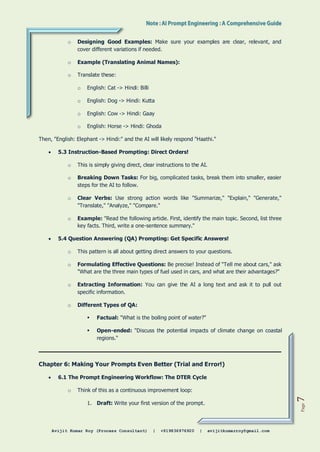
o Designing Good Examples: Make sure your examples are clear, relevant, and
cover different variations if needed.
o Example (Translating Animal Names):
o Translate these:
o English: Cat -> Hindi: Billi
o English: Dog -> Hindi: Kutta
o English: Cow -> Hindi: Gaay
o English: Horse -> Hindi: Ghoda
Then, "English: Elephant -> Hindi:" and the AI will likely respond "Haathi."
 5.3 Instruction-Based Prompting: Direct Orders!
o This is simply giving direct, clear instructions to the AI.
o Breaking Down Tasks: For big, complicated tasks, break them into smaller, easier
steps for the AI to follow.
o Clear Verbs: Use strong action words like "Summarize," "Explain," "Generate,"
"Translate," "Analyze," "Compare."
o Example: "Read the following article. First, identify the main topic. Second, list three
key facts. Third, write a one-sentence summary."
 5.4 Question Answering (QA) Prompting: Get Specific Answers!
o This pattern is all about getting direct answers to your questions.
o Formulating Effective Questions: Be precise! Instead of "Tell me about cars," ask
"What are the three main types of fuel used in cars, and what are their advantages?"
o Extracting Information: You can give the AI a long text and ask it to pull out
specific information.
o Different Types of QA:
 Factual: "What is the boiling point of water?"
 Open-ended: "Discuss the potential impacts of climate change on coastal
regions."
Chapter 6: Making Your Prompts Even Better (Trial and Error!)
 6.1 The Prompt Engineering Workflow: The DTER Cycle
o Think of this as a continuous improvement loop:
1. Draft: Write your first version of the prompt.
Avijit Kumar Roy (Process Consultant) | +919836976920 | avijitkumarroy@gmail.com
Page
8
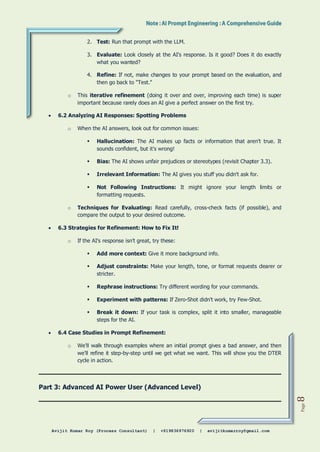
2. Test: Run that prompt with the LLM.
3. Evaluate: Look closely at the AI's response. Is it good? Does it do exactly
what you wanted?
4. Refine: If not, make changes to your prompt based on the evaluation, and
then go back to "Test."
o This iterative refinement (doing it over and over, improving each time) is super
important because rarely does an AI give a perfect answer on the first try.
 6.2 Analyzing AI Responses: Spotting Problems
o When the AI answers, look out for common issues:
 Hallucination: The AI makes up facts or information that aren't true. It
sounds confident, but it's wrong!
 Bias: The AI shows unfair prejudices or stereotypes (revisit Chapter 3.3).
 Irrelevant Information: The AI gives you stuff you didn't ask for.
 Not Following Instructions: It might ignore your length limits or
formatting requests.
o Techniques for Evaluating: Read carefully, cross-check facts (if possible), and
compare the output to your desired outcome.
 6.3 Strategies for Refinement: How to Fix It!
o If the AI's response isn't great, try these:
 Add more context: Give it more background info.
 Adjust constraints: Make your length, tone, or format requests clearer or
stricter.
 Rephrase instructions: Try different wording for your commands.
 Experiment with patterns: If Zero-Shot didn't work, try Few-Shot.
 Break it down: If your task is complex, split it into smaller, manageable
steps for the AI.
 6.4 Case Studies in Prompt Refinement:
o We'll walk through examples where an initial prompt gives a bad answer, and then
we'll refine it step-by-step until we get what we want. This will show you the DTER
cycle in action.
Part 3: Advanced AI Power User (Advanced Level)
Avijit Kumar Roy (Process Consultant) | +919836976920 | avijitkumarroy@gmail.com
Page
9
Chapter 7: Smart Prompting Tricks
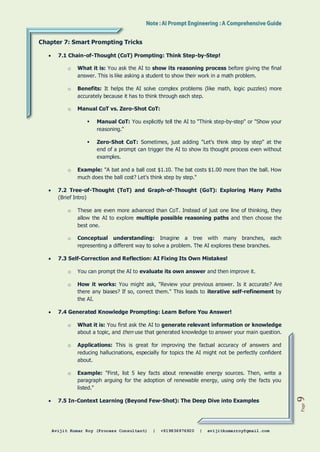
 7.1 Chain-of-Thought (CoT) Prompting: Think Step-by-Step!
o What it is: You ask the AI to show its reasoning process before giving the final
answer. This is like asking a student to show their work in a math problem.
o Benefits: It helps the AI solve complex problems (like math, logic puzzles) more
accurately because it has to think through each step.
o Manual CoT vs. Zero-Shot CoT:
 Manual CoT: You explicitly tell the AI to "Think step-by-step" or "Show your
reasoning."
 Zero-Shot CoT: Sometimes, just adding "Let's think step by step" at the
end of a prompt can trigger the AI to show its thought process even without
examples.
o Example: "A bat and a ball cost $1.10. The bat costs $1.00 more than the ball. How
much does the ball cost? Let's think step by step."
 7.2 Tree-of-Thought (ToT) and Graph-of-Thought (GoT): Exploring Many Paths
(Brief Intro)
o These are even more advanced than CoT. Instead of just one line of thinking, they
allow the AI to explore multiple possible reasoning paths and then choose the
best one.
o Conceptual understanding: Imagine a tree with many branches, each
representing a different way to solve a problem. The AI explores these branches.
 7.3 Self-Correction and Reflection: AI Fixing Its Own Mistakes!
o You can prompt the AI to evaluate its own answer and then improve it.
o How it works: You might ask, "Review your previous answer. Is it accurate? Are
there any biases? If so, correct them." This leads to iterative self-refinement by
the AI.
 7.4 Generated Knowledge Prompting: Learn Before You Answer!
o What it is: You first ask the AI to generate relevant information or knowledge
about a topic, and then use that generated knowledge to answer your main question.
o Applications: This is great for improving the factual accuracy of answers and
reducing hallucinations, especially for topics the AI might not be perfectly confident
about.
o Example: "First, list 5 key facts about renewable energy sources. Then, write a
paragraph arguing for the adoption of renewable energy, using only the facts you
listed."
 7.5 In-Context Learning (Beyond Few-Shot): The Deep Dive into Examples
Avijit Kumar Roy (Process Consultant) | +919836976920 | avijitkumarroy@gmail.com
Page
10
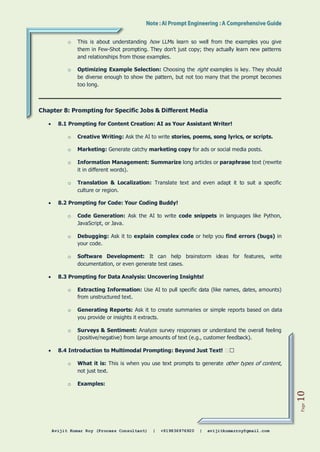
o This is about understanding how LLMs learn so well from the examples you give
them in Few-Shot prompting. They don't just copy; they actually learn new patterns
and relationships from those examples.
o Optimizing Example Selection: Choosing the right examples is key. They should
be diverse enough to show the pattern, but not too many that the prompt becomes
too long.
Chapter 8: Prompting for Specific Jobs & Different Media
 8.1 Prompting for Content Creation: AI as Your Assistant Writer!
o Creative Writing: Ask the AI to write stories, poems, song lyrics, or scripts.
o Marketing: Generate catchy marketing copy for ads or social media posts.
o Information Management: Summarize long articles or paraphrase text (rewrite
it in different words).
o Translation & Localization: Translate text and even adapt it to suit a specific
culture or region.
 8.2 Prompting for Code: Your Coding Buddy!
o Code Generation: Ask the AI to write code snippets in languages like Python,
JavaScript, or Java.
o Debugging: Ask it to explain complex code or help you find errors (bugs) in
your code.
o Software Development: It can help brainstorm ideas for features, write
documentation, or even generate test cases.
 8.3 Prompting for Data Analysis: Uncovering Insights!
o Extracting Information: Use AI to pull specific data (like names, dates, amounts)
from unstructured text.
o Generating Reports: Ask it to create summaries or simple reports based on data
you provide or insights it extracts.
o Surveys & Sentiment: Analyze survey responses or understand the overall feeling
(positive/negative) from large amounts of text (e.g., customer feedback).
 8.4 Introduction to Multimodal Prompting: Beyond Just Text! 🖼️�
o What it is: This is when you use text prompts to generate other types of content,
not just text.
o Examples:
Avijit Kumar Roy (Process Consultant) | +919836976920 | avijitkumarroy@gmail.com
Page
11
 Text-to-Image: Turn your words into pictures (e.g., "A futuristic city at
sunset, cyberpunk style"). Tools like Midjourney, DALL-E, and Stable
Diffusion do this.
 Text-to-Video: (Still developing!) Soon, you might generate short videos
from a text description.
o Challenges & Opportunities: It's exciting, but also has challenges like ensuring
accuracy and avoiding harmful content in visuals.
Chapter 9: Prompt Engineering in the Real World
 9.1 Prompting for Chatbots & Conversations: Making AI Talk Better!
o Designing Prompts: Craft prompts that help AI chatbots have natural and helpful
conversations with users.
o Maintaining Coherence: Make sure the AI stays on topic and remembers previous
parts of the conversation.
o Handling User Queries: Teach the AI to understand what users want and respond
appropriately.
 9.2 Prompting for Customer Service: AI for Helping People!
o Automating Responses: Use AI to answer common questions quickly (e.g.,
"What's your return policy?").
o Personalized Messages: Generate responses that sound like they're written just
for that customer.
o Escalation Protocols: Teach the AI when to involve a human agent for complex
issues.
 9.3 Prompt Engineering in Education & Research: AI as Your Study Buddy!
o Study Materials: Generate summaries, quizzes, or even practice questions.
o Research Assistance: Help draft research papers, summarize articles, or
brainstorm research questions.
o Ethical Considerations: It's important to use AI ethically in academics – don't use
it to cheat, but as a tool to learn and enhance your work.
 9.4 Prompt Engineering in Creative Industries: AI as Your Creative Partner!
o Brainstorming: Generate ideas for art, music, fashion, or game design.
o Creative Briefs: Help create initial concepts or outlines for projects.
o Copyright & Ownership: Who owns the content created by AI? This is a new and
evolving area of law and ethics.
Avijit Kumar Roy (Process Consultant) | +919836976920 | avijitkumarroy@gmail.com
Page
12
Part 4: The Future & Beyond (Expert Level)
Chapter 10: Advanced Ways to Interact with LLMs
 10.1 Retrieval Augmented Generation (RAG): AI with a Research Library!
o Concept: Imagine giving an LLM access to a huge digital library (like Wikipedia or
your company's documents) before it answers your question. RAG does this.
o Benefits: It helps LLMs give more accurate, factual answers and reduces
"hallucination" (making things up) because it's pulling information from reliable
sources.
o Basic Idea: Your prompt goes to a "retriever" that finds relevant documents, then
those documents are given to the LLM to generate the answer.
 10.2 Fine-Tuning vs. Prompt Engineering: When to Train vs. When to Instruct?
o Prompt Engineering: You're using a pre-trained LLM and guiding it with clever
instructions.
o Fine-Tuning: You take an existing LLM and train it further on a smaller, specific
dataset (like your company's unique documents or a specific style of writing). This
changes its core knowledge slightly.
o When to Use Which:
 Prompt Engineering: Good for general tasks, quick changes, and when
you don't have much specific data. It's like using a Swiss Army knife.
 Fine-Tuning: Better for highly specialized tasks, unique styles, or when you
need the AI to know very specific, internal company information. It's like
customizing a tool for a very specific job.
 10.3 Agentic AI Systems: AI That Can Do Multiple Steps!
o Introduction: These are AI systems that can break down a complex goal into
multiple steps, use different tools, and even correct themselves along the way.
o How they work: They combine an LLM (for thinking) with other tools (like search
engines, calculators, or other software).
o Future: This is leading towards more autonomous (self-operating) AI systems that
can handle complex projects with minimal human input.
 10.4 Prompt Security and Adversarial Prompting: Protecting Your AI!
o Prompt Injection Attacks: This is when someone tries to "hack" an LLM by
injecting malicious instructions into a prompt to make it do something it shouldn't
(e.g., reveal sensitive information or generate harmful content).
o Robust Prompt Design: Learning how to write prompts that are resilient to these
attacks.
Avijit Kumar Roy (Process Consultant) | +919836976920 | avijitkumarroy@gmail.com
Page
13
o Red Teaming & AI Safety: This involves intentionally trying to "break" AI systems
to find their weaknesses and make them safer.
Chapter 11: Tools & Platforms for Prompt Engineers
 11.1 Prompt Engineering Frameworks (Like Toolkits!)
o These are software tools that help you build complex AI applications more easily.
o Examples: LangChain and LlamaIndex are popular frameworks that help connect
LLMs with other data sources and tools.
o Conceptual Understanding: They provide pre-built "blocks" that you can combine
to create powerful AI workflows.
 11.2 Prompt Management and Version Control: Keeping Track!
o As you create many prompts, you need ways to:
 Organize and track: Keep your prompts neat and know which version
worked best.
 Collaborative work: If you're working in a team, how do you share and
manage prompts?
o This is like using version control (like Git) for code, but for your prompts.
 11.3 AI Development Platforms: Building AI in the Cloud!
o These are powerful online services that let you easily build, deploy, and manage AI
models.
o Examples: Google Cloud AI Platform, Azure AI, AWS AI/ML.
o Facilitating Deployment: They make it easier to put your LLM applications into
action for real-world use.
 11.4 Future Trends in Prompt Engineering: What's Next?
o Neuro-symbolic AI: Combining the pattern-learning of neural networks with the
logical reasoning of traditional symbols. This could lead to AIs that are both intuitive
and logical.
o Personalized Prompting: AIs that adapt their prompting style to your unique way
of asking questions.
o Human-in-the-Loop: Even with advanced AI, humans will still play a crucial role in
overseeing, correcting, and guiding AI systems.
Chapter 12: Careers & Ethical AI Leadership
 12.1 New Jobs in Prompt Engineering!
Avijit Kumar Roy (Process Consultant) | +919836976920 | avijitkumarroy@gmail.com
Page
14
o This field is creating exciting new roles:
 Prompt Engineer: Someone who specializes in writing and optimizing
prompts.
 AI Content Creator: Uses AI to generate text, images, or other content.
 AI Interaction Designer: Focuses on how humans and AI interact, making
it user-friendly.
o Skills Needed: Strong communication, problem-solving, creativity, and analytical
thinking are key.
 12.2 Responsible AI: Building Fair & Safe AI
o This is a deep dive into the ethical concerns we touched on earlier:
 Bias: Making sure AI doesn't discriminate.
 Fairness: Ensuring AI treats everyone equally.
 Accountability: Who is responsible when AI makes a mistake?
 Transparency: Understanding how AI makes decisions.
o Explainable AI (XAI): The goal is to make AI's decisions understandable to
humans, not just a "black box."
o Regulatory Landscape: Governments in India and globally are working on rules
and laws for AI to ensure it's used responsibly.
 12.3 AI for Good: Using AI to Solve Problems!
o Prompt engineering can be used to tackle big societal challenges, like:
 Creating educational materials for underserved communities.
 Assisting in disaster response.
 Developing tools for accessibility.
o We'll look at case studies where AI is making a positive difference.
 12.4 Always Keep Learning!
o The world of AI is changing super fast!
o Staying Updated: It's important to keep reading, experimenting, and learning new
techniques and models.
o Lifelong Learner: Having a mindset of continuous learning is essential for anyone
working with AI.
Glossary: (A mini-dictionary of all the technical terms used in the book)
Avijit Kumar Roy (Process Consultant) | +919836976920 | avijitkumarroy@gmail.com
Page
15
Index: (A list of topics and where to find them)
Appendices: (Extra helpful resources!)
 Appendix A: Python Basics for AI (Optional Refresh)
o Quick review of how to use variables, different data types, and basic programming
logic (control flow).
o How to write functions and use simple data structures like lists and dictionaries.
o How to install AI-related software libraries (like transformers or openai) using pip.
 Appendix B: Key LLM APIs & Their Documentation
o A guide on how to read and understand the instructions for using popular LLMs
through code.
o Simple examples of how to send prompts to an LLM using its API (Application
Programming Interface).
 Appendix C: Prompt Engineering Cheat Sheet
o A quick reference card with all the main rules and techniques for good prompting.
 Appendix D: Practice Exercises & Project Ideas
o Small tasks and bigger project ideas to help you practice what you've learned in each
chapter.
E N D
Professional Services Offered by Avijit Kumar Roy
1. MSME Consulting & Business Advisory
• Preparation of DPRs and feasibility studies
• Business plan creation and pitch-deck development
• Bank loan mentoring (NABARD, SIDBI, commercial banks, VCs)
• Project viability analysis and turnaround strategy
• Mentorship of Institutional Incubation Centre
2. Startup Mentorship & Incubation Support
• Idea validation and roadmap development
• Branding, go-to-market (GTM) strategy & digital visibility
• Investor-readiness preparation
• Capacity building through ILO-SIYB/SCORE models
3. Training & Capacity Building
• Entrepreneurship Development Programs (EDP, MDP, SIYB, SCORE, MCLS)
Avijit Kumar Roy (Process Consultant) | +919836976920 | avijitkumarroy@gmail.com
Page
16
• Industry 4.0 and Lean Manufacturing workshops
• Digital transformation, marketing, and branding skill-building
• Government-sponsored skill development & ToT programs
• MCLS and Lean, Kaizen, TQM, QC, 5S, 7QC Tools, ZED Guidance, MFCA (ISO 14051),
and ToC.
4. Digital Marketing & Branding Strategy
• SEO, content marketing, and Google Analytics consultation
• Personal and corporate branding through web and social media
• Training in digital marketing (based on your published book)
• Building brand identity and web presence for MSMEs
5. Sustainability & Circular Economy Advisory
• SDG alignment for MSMEs and clusters
• ESG and carbon footprint planning
• Circular economy roadmap development
• Waste management, resource optimization strategies
6. ERP & IT Systems Consulting
• ERP implementation (Tally, NAV, SAP)
• Payroll, inventory, and budgeting system setup
• Data migration and automation planning
• Training in ERP systems for SMEs
7. Project Leadership & Technical Consulting
• End-to-end execution and monitoring of civil/infrastructure/CSR projects
• Quality control (5S, TQM, Kaizen), documentation, ISO compliance
• Sub-contractor management, liaison with authorities
• Purchase to Payment Management
• Inventory Management
Hashtags
For MSME, Consulting, and Entrepreneurship:
#MSMEIndia
#EntrepreneurshipDevelopment
#StartupMentor
#BusinessStrategy
#ConsultingLife
#SMEGrowth
#BusinessMentorship
#ScaleUp
For Sustainability, Circular Economy, SDGs:
#SustainableDevelopment
#CircularEconomy
#GreenEconomy
#ClimateAction
#SDGs
#SustainabilityLeadership
#EcoInnovation
#NetZero
For Industry 4.0, Lean & Productivity:
#Industry40
#SmartManufacturing
#LeanManufacturing
Avijit Kumar Roy (Process Consultant) | +919836976920 | avijitkumarroy@gmail.com
Page
17
#DigitalTransformation
#OperationalExcellence
#ProductivityTools
#Automation
For Digital & Tech:
#DigitalMarketing
#DigitalInnovation
#TechForGood
#AIForBusiness
#GeospatialTechnology
#FutureOfWork
#DigitalIndia
For Learning, Training & Thought Leadership:
#LifelongLearning
#SkillDevelopment
#CapacityBuilding
#LeadershipDevelopment
#ThoughtLeadership
#ProfessionalDevelopment
#LearningNeverStops
https://www.linkedin.com/in/avijit-roy-2378b634/
Note :

Note Text book on AI Prompt Engineering ChatGPT

  • 1.
    Avijit Kumar Roy(Process Consultant) | +919836976920 | avijitkumarroy@gmail.com Page 1 Below is the comprehensive Note on AI Prompt Engineering, simplified to a 12th- grade level, to enhance understanding of the reader. AI Prompt Engineering : A Comprehensive Guide (Simplified for easy understanding) Authors: Avijit Kumar Roy (Process Consultant) Contact: +91 983 697 6920 | avijitkumarroy@gmail.com Dedication: To the curious minds shaping the future of AI and small to medium-sized businesses (MSMEs). Foreword: Imagine AI as a brilliant but literal student. You need to give this student very clear, precise instructions to get the best results. That's what Prompt Engineering is! It's the art of crafting effective instructions (prompts) for AI, especially for Large Language Models (LLMs). This book will teach you how to master this skill, preparing you for the exciting AI world, whether you're heading to college or boosting your business. Part 1: Getting Started with AI (Beginner Level) Chapter 1: What is Artificial Intelligence?  1.1 What's the Big Idea Behind AI? o Artificial Intelligence (AI) is about making computers think and learn like humans. Think of it as giving machines a "brain" to solve problems. o Machine Learning (ML) is a key part of AI. Instead of giving a computer specific step-by-step rules for every task, we give it lots of data, and it learns the rules itself. It's like teaching a child by showing them many examples, rather than writing down every instruction. o Deep Learning (DL) is a more advanced type of ML. It uses special computer networks called "neural networks" that are inspired by how our brains work. This helps AI tackle really complex tasks like recognizing faces or understanding speech. o Historical Milestones: AI isn't new! From early calculating machines to AI that can beat chess masters, it's been evolving for decades.
  • 2.
    Avijit Kumar Roy(Process Consultant) | +919836976920 | avijitkumarroy@gmail.com Page 2 o Types of AI (Like Different Kinds of Students):  ANI (Artificial Narrow Intelligence): This AI is a specialist. It's really good at one specific thing, like recommending songs on Spotify or powering your phone's voice assistant. Most AI we use today is ANI.  AGI (Artificial General Intelligence): This is the dream AI. It could do any intellectual task a human can, like learn a new language, write a novel, or solve complex science problems. We're still working on this!  ASI (Artificial Super Intelligence): Imagine an AI that's smarter than the smartest humans in every way. This is still just a concept from science fiction.  1.2 Why AI is a Big Deal: Impact on Our Lives o AI is changing everything!  Daily Life: Think about recommendation systems (Netflix, Amazon suggesting what you might like) or virtual assistants (Siri, Google Assistant).  Industries:  Healthcare: Helping doctors find diseases earlier.  Finance: Spotting fraud in bank transactions.  Education: Creating personalized learning experiences.  Entertainment: Generating special effects in movies or even creating music. o Ethical Concerns (Playing Fair): As AI gets more powerful, we need to think about important questions: Is it fair? Is it biased? How do we protect people's privacy?  1.3 How Computers Understand Our Talk: Natural Language Processing (NLP) o NLP is the field of AI that teaches computers to understand, interpret, and generate human languages. It's how AI "reads" what you type and "writes" responses. o Key NLP Tasks (What NLP Can Do):  Text Classification: Sorting text into categories, like labeling emails as "spam" or "important."  Sentiment Analysis: Figuring out the emotion in text – is a customer review positive, negative, or neutral?  Machine Translation: Automatically translating text from one language to another, like Google Translate. o Role of Language: NLP makes computers much easier to use because they can understand our everyday language, not just complex code.
  • 3.
    Avijit Kumar Roy(Process Consultant) | +919836976920 | avijitkumarroy@gmail.com Page 3 Chapter 2: Understanding Your AI Brain: Large Language Models (LLMs)  2.1 What are Language Models? o At their core, language models are really good at predicting the next word in a sentence. o Old vs. New (Briefly):  Statistical Language Models: These were simpler, predicting words based on how often they appeared together. (Like if "hot" comes, "dog" usually follows).  Neural Language Models: These use advanced "neural networks" (like mini-brains) to understand deeper patterns in language, making much smarter predictions. o The "Transformer" Breakthrough: This is a special type of neural network structure that made language models super powerful. It helps them understand long sentences and the relationships between words far apart.  2.2 Meet the Giants: Large Language Models (LLMs) o LLMs are simply "Language Models" that are incredibly massive.  Scale: They've seen and learned from an enormous amount of text data – think almost the entire internet!  Data: Billions and billions of words, sentences, and documents.  Parameters: They have billions of internal "knobs" that they adjust during training to learn complex language rules. o Famous LLMs: You've probably heard of GPT series (like ChatGPT), BERT, and LLaMA. They're used for everything from writing stories to answering tricky questions. o How LLMs "Write" (Simplified): 1. Tokenization: First, your words are broken down into small pieces called "tokens." (Like breaking "hello world" into "hello" and "world"). 2. Next-Word Prediction: Based on all the text it's learned, the LLM predicts the most likely next token, then the next, building up its response. It's like it's trying to complete your sentence perfectly.  2.3 The Core Idea: What is a "Prompt"? o A "Prompt" is simply the instruction, question, or input you give to the LLM. It's how you "talk" to the AI.
  • 4.
    Avijit Kumar Roy(Process Consultant) | +919836976920 | avijitkumarroy@gmail.com Page 4 o Why Prompts are Super Important: LLMs don't magically know what you want. They need clear instructions. A well-written prompt is like a precise GPS for the AI, guiding it to the right answer. o Basic Examples:  Bad Prompt: "Tell me stuff about space." (Too vague, the AI could say anything!)  Good Prompt: "Explain the Big Bang theory in simple terms for a 12-year- old." (Specific, clear, and sets the audience!) Chapter 3: Setting Up Your AI Playground  3.1 Where to Find LLMs (Free & Paid) o Many LLMs are easily accessible online. You can try them out for free to start!  ChatGPT: A very popular conversational AI.  Google Gemini: Google's powerful AI.  Hugging Face Demos: A website with many different AI models to experiment with. o You'll usually need to create an account. Be aware that free versions might have usage limits (like how many questions you can ask per hour or day).  3.2 Your First Chats: Just Try It! o Don't be shy! Just start typing your questions or instructions. o Analyze the AI's responses: Did it answer your question? Was it helpful? Did it make sense? Did it miss anything? o LLMs are conversational. This means you can have a back-and-forth chat. If the first answer isn't perfect, ask follow-up questions or rephrase your original prompt.  3.3 Using AI Responsibly and Safely o Bias in AI (Unfairness): LLMs learn from huge amounts of data. If that data contains stereotypes or unfair views from the real world, the AI might accidentally show those biases in its answers. For example, if its training data mostly shows male engineers, it might assume all engineers are male. o Harmful Content: LLMs can sometimes create inappropriate, offensive, or untrue content if not guided carefully. Always think about what you're asking and evaluate the AI's output. o Data Privacy and Security: When you type into an AI tool, your input might be used to improve the AI. Be careful about sharing very sensitive personal information. Always check the platform's privacy policy.
  • 5.
    Avijit Kumar Roy(Process Consultant) | +919836976920 | avijitkumarroy@gmail.com Page 5 Part 2: Essential Prompt Engineering Skills (Intermediate Level) Chapter 4: How to Design Awesome Prompts  4.1 Clarity and Specificity: Be Crystal Clear! o This is the #1 rule: Don't be vague! o Use clear, simple language and direct instructions. Don't make the AI guess. o Tell it the output format: Do you want bullet points? A short paragraph? A table? Be specific! o Example:  Bad Prompt: "Write about phones."  Good Prompt: "Write a 50-word description of the key features of a smartphone released in 2024, formatted as a bulleted list."  4.2 Contextualization: Give it the Background Story! o Why context matters: If you ask "What's the capital?", the AI won't know which country you mean. Giving context (background information) helps the AI understand your request much better. o Example:  Without Context: "What happened in 1947?" (Could be anything!)  With Context: "Considering India's history, what significant event happened in 1947?" (Now it's clear you mean India's independence!)  4.3 Persona and Role-Playing: Make AI a Character! o You can tell the AI to "act as" a specific person or role. This makes its responses more targeted and useful. o Benefits: If you want medical advice (for learning, not real life!), tell it to "Act as a doctor explaining diabetes." If you need marketing ideas, tell it "You are a marketing expert for a new mobile game." This guides the AI's tone, style, and knowledge base. o Practical Exercise: Try prompting an LLM with: 1. "Act as a friendly tour guide for Kolkata. Tell me about the Victoria Memorial." 2. "Act as a historian specializing in British colonial architecture. Describe the Victoria Memorial." See how the answers change!
  • 6.
    Avijit Kumar Roy(Process Consultant) | +919836976920 | avijitkumarroy@gmail.com Page 6  4.4 Output Constraints and Formatting: Be a Control Freak! o You can control:  Length: "Summarize in 3 sentences."  Tone: "Use a formal tone," or "Write it in a casual, friendly tone."  Style: "Write it like a poem," or "Explain it like a newspaper article." o Specific Formats: Ask for:  Bullet points  JSON: A specific format for data, often used in programming.  Tables  Numbered lists o Delimiters: Use special symbols (like """ or --- or <tags>) to clearly separate different parts of your prompt. This helps the AI understand which part is the instruction and which is the text to process.  Example: Summarize the following text in exactly 50 words: --- [Your long article text goes here.] --- Chapter 5: Basic Prompting Styles: How to Ask!  5.1 Zero-Shot Prompting: No Examples, Just Ask! o What it is: You give the LLM an instruction, and it figures out the answer without you giving it any examples. It uses its vast general knowledge. o When to use: For simple, direct questions or tasks where the AI already has plenty of knowledge (e.g., "What is the capital of Japan?"). o Limitations: It might not work well for very specific, unusual, or complex tasks that need a particular way of thinking or formatting.  5.2 Few-Shot Prompting: Show, Don't Just Tell! o What it is: You provide a few examples of how you want the AI to respond, right inside your prompt. o How it works: The AI learns the pattern from your examples and then applies that pattern to your new request. It's like showing a student a few solved problems before giving them a new one to solve.
  • 7.
    Avijit Kumar Roy(Process Consultant) | +919836976920 | avijitkumarroy@gmail.com Page 7 o Designing Good Examples: Make sure your examples are clear, relevant, and cover different variations if needed. o Example (Translating Animal Names): o Translate these: o English: Cat -> Hindi: Billi o English: Dog -> Hindi: Kutta o English: Cow -> Hindi: Gaay o English: Horse -> Hindi: Ghoda Then, "English: Elephant -> Hindi:" and the AI will likely respond "Haathi."  5.3 Instruction-Based Prompting: Direct Orders! o This is simply giving direct, clear instructions to the AI. o Breaking Down Tasks: For big, complicated tasks, break them into smaller, easier steps for the AI to follow. o Clear Verbs: Use strong action words like "Summarize," "Explain," "Generate," "Translate," "Analyze," "Compare." o Example: "Read the following article. First, identify the main topic. Second, list three key facts. Third, write a one-sentence summary."  5.4 Question Answering (QA) Prompting: Get Specific Answers! o This pattern is all about getting direct answers to your questions. o Formulating Effective Questions: Be precise! Instead of "Tell me about cars," ask "What are the three main types of fuel used in cars, and what are their advantages?" o Extracting Information: You can give the AI a long text and ask it to pull out specific information. o Different Types of QA:  Factual: "What is the boiling point of water?"  Open-ended: "Discuss the potential impacts of climate change on coastal regions." Chapter 6: Making Your Prompts Even Better (Trial and Error!)  6.1 The Prompt Engineering Workflow: The DTER Cycle o Think of this as a continuous improvement loop: 1. Draft: Write your first version of the prompt.
  • 8.
    Avijit Kumar Roy(Process Consultant) | +919836976920 | avijitkumarroy@gmail.com Page 8 2. Test: Run that prompt with the LLM. 3. Evaluate: Look closely at the AI's response. Is it good? Does it do exactly what you wanted? 4. Refine: If not, make changes to your prompt based on the evaluation, and then go back to "Test." o This iterative refinement (doing it over and over, improving each time) is super important because rarely does an AI give a perfect answer on the first try.  6.2 Analyzing AI Responses: Spotting Problems o When the AI answers, look out for common issues:  Hallucination: The AI makes up facts or information that aren't true. It sounds confident, but it's wrong!  Bias: The AI shows unfair prejudices or stereotypes (revisit Chapter 3.3).  Irrelevant Information: The AI gives you stuff you didn't ask for.  Not Following Instructions: It might ignore your length limits or formatting requests. o Techniques for Evaluating: Read carefully, cross-check facts (if possible), and compare the output to your desired outcome.  6.3 Strategies for Refinement: How to Fix It! o If the AI's response isn't great, try these:  Add more context: Give it more background info.  Adjust constraints: Make your length, tone, or format requests clearer or stricter.  Rephrase instructions: Try different wording for your commands.  Experiment with patterns: If Zero-Shot didn't work, try Few-Shot.  Break it down: If your task is complex, split it into smaller, manageable steps for the AI.  6.4 Case Studies in Prompt Refinement: o We'll walk through examples where an initial prompt gives a bad answer, and then we'll refine it step-by-step until we get what we want. This will show you the DTER cycle in action. Part 3: Advanced AI Power User (Advanced Level)
  • 9.
    Avijit Kumar Roy(Process Consultant) | +919836976920 | avijitkumarroy@gmail.com Page 9 Chapter 7: Smart Prompting Tricks  7.1 Chain-of-Thought (CoT) Prompting: Think Step-by-Step! o What it is: You ask the AI to show its reasoning process before giving the final answer. This is like asking a student to show their work in a math problem. o Benefits: It helps the AI solve complex problems (like math, logic puzzles) more accurately because it has to think through each step. o Manual CoT vs. Zero-Shot CoT:  Manual CoT: You explicitly tell the AI to "Think step-by-step" or "Show your reasoning."  Zero-Shot CoT: Sometimes, just adding "Let's think step by step" at the end of a prompt can trigger the AI to show its thought process even without examples. o Example: "A bat and a ball cost $1.10. The bat costs $1.00 more than the ball. How much does the ball cost? Let's think step by step."  7.2 Tree-of-Thought (ToT) and Graph-of-Thought (GoT): Exploring Many Paths (Brief Intro) o These are even more advanced than CoT. Instead of just one line of thinking, they allow the AI to explore multiple possible reasoning paths and then choose the best one. o Conceptual understanding: Imagine a tree with many branches, each representing a different way to solve a problem. The AI explores these branches.  7.3 Self-Correction and Reflection: AI Fixing Its Own Mistakes! o You can prompt the AI to evaluate its own answer and then improve it. o How it works: You might ask, "Review your previous answer. Is it accurate? Are there any biases? If so, correct them." This leads to iterative self-refinement by the AI.  7.4 Generated Knowledge Prompting: Learn Before You Answer! o What it is: You first ask the AI to generate relevant information or knowledge about a topic, and then use that generated knowledge to answer your main question. o Applications: This is great for improving the factual accuracy of answers and reducing hallucinations, especially for topics the AI might not be perfectly confident about. o Example: "First, list 5 key facts about renewable energy sources. Then, write a paragraph arguing for the adoption of renewable energy, using only the facts you listed."  7.5 In-Context Learning (Beyond Few-Shot): The Deep Dive into Examples
  • 10.
    Avijit Kumar Roy(Process Consultant) | +919836976920 | avijitkumarroy@gmail.com Page 10 o This is about understanding how LLMs learn so well from the examples you give them in Few-Shot prompting. They don't just copy; they actually learn new patterns and relationships from those examples. o Optimizing Example Selection: Choosing the right examples is key. They should be diverse enough to show the pattern, but not too many that the prompt becomes too long. Chapter 8: Prompting for Specific Jobs & Different Media  8.1 Prompting for Content Creation: AI as Your Assistant Writer! o Creative Writing: Ask the AI to write stories, poems, song lyrics, or scripts. o Marketing: Generate catchy marketing copy for ads or social media posts. o Information Management: Summarize long articles or paraphrase text (rewrite it in different words). o Translation & Localization: Translate text and even adapt it to suit a specific culture or region.  8.2 Prompting for Code: Your Coding Buddy! o Code Generation: Ask the AI to write code snippets in languages like Python, JavaScript, or Java. o Debugging: Ask it to explain complex code or help you find errors (bugs) in your code. o Software Development: It can help brainstorm ideas for features, write documentation, or even generate test cases.  8.3 Prompting for Data Analysis: Uncovering Insights! o Extracting Information: Use AI to pull specific data (like names, dates, amounts) from unstructured text. o Generating Reports: Ask it to create summaries or simple reports based on data you provide or insights it extracts. o Surveys & Sentiment: Analyze survey responses or understand the overall feeling (positive/negative) from large amounts of text (e.g., customer feedback).  8.4 Introduction to Multimodal Prompting: Beyond Just Text! 🖼️� o What it is: This is when you use text prompts to generate other types of content, not just text. o Examples:
  • 11.
    Avijit Kumar Roy(Process Consultant) | +919836976920 | avijitkumarroy@gmail.com Page 11  Text-to-Image: Turn your words into pictures (e.g., "A futuristic city at sunset, cyberpunk style"). Tools like Midjourney, DALL-E, and Stable Diffusion do this.  Text-to-Video: (Still developing!) Soon, you might generate short videos from a text description. o Challenges & Opportunities: It's exciting, but also has challenges like ensuring accuracy and avoiding harmful content in visuals. Chapter 9: Prompt Engineering in the Real World  9.1 Prompting for Chatbots & Conversations: Making AI Talk Better! o Designing Prompts: Craft prompts that help AI chatbots have natural and helpful conversations with users. o Maintaining Coherence: Make sure the AI stays on topic and remembers previous parts of the conversation. o Handling User Queries: Teach the AI to understand what users want and respond appropriately.  9.2 Prompting for Customer Service: AI for Helping People! o Automating Responses: Use AI to answer common questions quickly (e.g., "What's your return policy?"). o Personalized Messages: Generate responses that sound like they're written just for that customer. o Escalation Protocols: Teach the AI when to involve a human agent for complex issues.  9.3 Prompt Engineering in Education & Research: AI as Your Study Buddy! o Study Materials: Generate summaries, quizzes, or even practice questions. o Research Assistance: Help draft research papers, summarize articles, or brainstorm research questions. o Ethical Considerations: It's important to use AI ethically in academics – don't use it to cheat, but as a tool to learn and enhance your work.  9.4 Prompt Engineering in Creative Industries: AI as Your Creative Partner! o Brainstorming: Generate ideas for art, music, fashion, or game design. o Creative Briefs: Help create initial concepts or outlines for projects. o Copyright & Ownership: Who owns the content created by AI? This is a new and evolving area of law and ethics.
  • 12.
    Avijit Kumar Roy(Process Consultant) | +919836976920 | avijitkumarroy@gmail.com Page 12 Part 4: The Future & Beyond (Expert Level) Chapter 10: Advanced Ways to Interact with LLMs  10.1 Retrieval Augmented Generation (RAG): AI with a Research Library! o Concept: Imagine giving an LLM access to a huge digital library (like Wikipedia or your company's documents) before it answers your question. RAG does this. o Benefits: It helps LLMs give more accurate, factual answers and reduces "hallucination" (making things up) because it's pulling information from reliable sources. o Basic Idea: Your prompt goes to a "retriever" that finds relevant documents, then those documents are given to the LLM to generate the answer.  10.2 Fine-Tuning vs. Prompt Engineering: When to Train vs. When to Instruct? o Prompt Engineering: You're using a pre-trained LLM and guiding it with clever instructions. o Fine-Tuning: You take an existing LLM and train it further on a smaller, specific dataset (like your company's unique documents or a specific style of writing). This changes its core knowledge slightly. o When to Use Which:  Prompt Engineering: Good for general tasks, quick changes, and when you don't have much specific data. It's like using a Swiss Army knife.  Fine-Tuning: Better for highly specialized tasks, unique styles, or when you need the AI to know very specific, internal company information. It's like customizing a tool for a very specific job.  10.3 Agentic AI Systems: AI That Can Do Multiple Steps! o Introduction: These are AI systems that can break down a complex goal into multiple steps, use different tools, and even correct themselves along the way. o How they work: They combine an LLM (for thinking) with other tools (like search engines, calculators, or other software). o Future: This is leading towards more autonomous (self-operating) AI systems that can handle complex projects with minimal human input.  10.4 Prompt Security and Adversarial Prompting: Protecting Your AI! o Prompt Injection Attacks: This is when someone tries to "hack" an LLM by injecting malicious instructions into a prompt to make it do something it shouldn't (e.g., reveal sensitive information or generate harmful content). o Robust Prompt Design: Learning how to write prompts that are resilient to these attacks.
  • 13.
    Avijit Kumar Roy(Process Consultant) | +919836976920 | avijitkumarroy@gmail.com Page 13 o Red Teaming & AI Safety: This involves intentionally trying to "break" AI systems to find their weaknesses and make them safer. Chapter 11: Tools & Platforms for Prompt Engineers  11.1 Prompt Engineering Frameworks (Like Toolkits!) o These are software tools that help you build complex AI applications more easily. o Examples: LangChain and LlamaIndex are popular frameworks that help connect LLMs with other data sources and tools. o Conceptual Understanding: They provide pre-built "blocks" that you can combine to create powerful AI workflows.  11.2 Prompt Management and Version Control: Keeping Track! o As you create many prompts, you need ways to:  Organize and track: Keep your prompts neat and know which version worked best.  Collaborative work: If you're working in a team, how do you share and manage prompts? o This is like using version control (like Git) for code, but for your prompts.  11.3 AI Development Platforms: Building AI in the Cloud! o These are powerful online services that let you easily build, deploy, and manage AI models. o Examples: Google Cloud AI Platform, Azure AI, AWS AI/ML. o Facilitating Deployment: They make it easier to put your LLM applications into action for real-world use.  11.4 Future Trends in Prompt Engineering: What's Next? o Neuro-symbolic AI: Combining the pattern-learning of neural networks with the logical reasoning of traditional symbols. This could lead to AIs that are both intuitive and logical. o Personalized Prompting: AIs that adapt their prompting style to your unique way of asking questions. o Human-in-the-Loop: Even with advanced AI, humans will still play a crucial role in overseeing, correcting, and guiding AI systems. Chapter 12: Careers & Ethical AI Leadership  12.1 New Jobs in Prompt Engineering!
  • 14.
    Avijit Kumar Roy(Process Consultant) | +919836976920 | avijitkumarroy@gmail.com Page 14 o This field is creating exciting new roles:  Prompt Engineer: Someone who specializes in writing and optimizing prompts.  AI Content Creator: Uses AI to generate text, images, or other content.  AI Interaction Designer: Focuses on how humans and AI interact, making it user-friendly. o Skills Needed: Strong communication, problem-solving, creativity, and analytical thinking are key.  12.2 Responsible AI: Building Fair & Safe AI o This is a deep dive into the ethical concerns we touched on earlier:  Bias: Making sure AI doesn't discriminate.  Fairness: Ensuring AI treats everyone equally.  Accountability: Who is responsible when AI makes a mistake?  Transparency: Understanding how AI makes decisions. o Explainable AI (XAI): The goal is to make AI's decisions understandable to humans, not just a "black box." o Regulatory Landscape: Governments in India and globally are working on rules and laws for AI to ensure it's used responsibly.  12.3 AI for Good: Using AI to Solve Problems! o Prompt engineering can be used to tackle big societal challenges, like:  Creating educational materials for underserved communities.  Assisting in disaster response.  Developing tools for accessibility. o We'll look at case studies where AI is making a positive difference.  12.4 Always Keep Learning! o The world of AI is changing super fast! o Staying Updated: It's important to keep reading, experimenting, and learning new techniques and models. o Lifelong Learner: Having a mindset of continuous learning is essential for anyone working with AI. Glossary: (A mini-dictionary of all the technical terms used in the book)
  • 15.
    Avijit Kumar Roy(Process Consultant) | +919836976920 | avijitkumarroy@gmail.com Page 15 Index: (A list of topics and where to find them) Appendices: (Extra helpful resources!)  Appendix A: Python Basics for AI (Optional Refresh) o Quick review of how to use variables, different data types, and basic programming logic (control flow). o How to write functions and use simple data structures like lists and dictionaries. o How to install AI-related software libraries (like transformers or openai) using pip.  Appendix B: Key LLM APIs & Their Documentation o A guide on how to read and understand the instructions for using popular LLMs through code. o Simple examples of how to send prompts to an LLM using its API (Application Programming Interface).  Appendix C: Prompt Engineering Cheat Sheet o A quick reference card with all the main rules and techniques for good prompting.  Appendix D: Practice Exercises & Project Ideas o Small tasks and bigger project ideas to help you practice what you've learned in each chapter. E N D Professional Services Offered by Avijit Kumar Roy 1. MSME Consulting & Business Advisory • Preparation of DPRs and feasibility studies • Business plan creation and pitch-deck development • Bank loan mentoring (NABARD, SIDBI, commercial banks, VCs) • Project viability analysis and turnaround strategy • Mentorship of Institutional Incubation Centre 2. Startup Mentorship & Incubation Support • Idea validation and roadmap development • Branding, go-to-market (GTM) strategy & digital visibility • Investor-readiness preparation • Capacity building through ILO-SIYB/SCORE models 3. Training & Capacity Building • Entrepreneurship Development Programs (EDP, MDP, SIYB, SCORE, MCLS)
  • 16.
    Avijit Kumar Roy(Process Consultant) | +919836976920 | avijitkumarroy@gmail.com Page 16 • Industry 4.0 and Lean Manufacturing workshops • Digital transformation, marketing, and branding skill-building • Government-sponsored skill development & ToT programs • MCLS and Lean, Kaizen, TQM, QC, 5S, 7QC Tools, ZED Guidance, MFCA (ISO 14051), and ToC. 4. Digital Marketing & Branding Strategy • SEO, content marketing, and Google Analytics consultation • Personal and corporate branding through web and social media • Training in digital marketing (based on your published book) • Building brand identity and web presence for MSMEs 5. Sustainability & Circular Economy Advisory • SDG alignment for MSMEs and clusters • ESG and carbon footprint planning • Circular economy roadmap development • Waste management, resource optimization strategies 6. ERP & IT Systems Consulting • ERP implementation (Tally, NAV, SAP) • Payroll, inventory, and budgeting system setup • Data migration and automation planning • Training in ERP systems for SMEs 7. Project Leadership & Technical Consulting • End-to-end execution and monitoring of civil/infrastructure/CSR projects • Quality control (5S, TQM, Kaizen), documentation, ISO compliance • Sub-contractor management, liaison with authorities • Purchase to Payment Management • Inventory Management Hashtags For MSME, Consulting, and Entrepreneurship: #MSMEIndia #EntrepreneurshipDevelopment #StartupMentor #BusinessStrategy #ConsultingLife #SMEGrowth #BusinessMentorship #ScaleUp For Sustainability, Circular Economy, SDGs: #SustainableDevelopment #CircularEconomy #GreenEconomy #ClimateAction #SDGs #SustainabilityLeadership #EcoInnovation #NetZero For Industry 4.0, Lean & Productivity: #Industry40 #SmartManufacturing #LeanManufacturing
  • 17.
    Avijit Kumar Roy(Process Consultant) | +919836976920 | avijitkumarroy@gmail.com Page 17 #DigitalTransformation #OperationalExcellence #ProductivityTools #Automation For Digital & Tech: #DigitalMarketing #DigitalInnovation #TechForGood #AIForBusiness #GeospatialTechnology #FutureOfWork #DigitalIndia For Learning, Training & Thought Leadership: #LifelongLearning #SkillDevelopment #CapacityBuilding #LeadershipDevelopment #ThoughtLeadership #ProfessionalDevelopment #LearningNeverStops https://www.linkedin.com/in/avijit-roy-2378b634/ Note :