Not so obvious an introduction to patent law and strategy 3rd Edition Schox
Not so obvious an introduction to patent law and strategy 3rd Edition Schox
Not so obvious an introduction to patent law and strategy 3rd Edition Schox
Not so obvious an introduction to patent law and strategy 3rd Edition Schox
Not so obvious an introduction to patent law and strategy 3rd Edition Schox
1.
Not so obviousan introduction to patent law and
strategy 3rd Edition Schox - PDF Download (2025)
https://ebookultra.com/download/not-so-obvious-an-introduction-
to-patent-law-and-strategy-3rd-edition-schox/
Visit ebookultra.com today to download the complete set of
ebooks or textbooks
2.
We have selectedsome products that you may be interested in
Click the link to download now or visit ebookultra.com
for more options!.
Strategy An Introduction to Game Theory Third Edition Joel
Watson
https://ebookultra.com/download/strategy-an-introduction-to-game-
theory-third-edition-joel-watson/
An Introduction to Law 1st Edition Agustín Gordillo
https://ebookultra.com/download/an-introduction-to-law-1st-edition-
agustin-gordillo/
Constitutional Law Principles And Policies Introduction to
Law Series 3rd Edition Erwin Chemerinsky
https://ebookultra.com/download/constitutional-law-principles-and-
policies-introduction-to-law-series-3rd-edition-erwin-chemerinsky/
An Introduction to International Criminal Law and
Procedure Robert Cryer
https://ebookultra.com/download/an-introduction-to-international-
criminal-law-and-procedure-robert-cryer/
3.
An introduction tolaw 7th ed Edition Phil Harris
https://ebookultra.com/download/an-introduction-to-law-7th-ed-edition-
phil-harris/
Strategy An Introduction to Game Theory solution manual
Third Edition Joel Watson
https://ebookultra.com/download/strategy-an-introduction-to-game-
theory-solution-manual-third-edition-joel-watson/
An Introduction to Orthodontics 3rd Edition Laura Mitchell
https://ebookultra.com/download/an-introduction-to-orthodontics-3rd-
edition-laura-mitchell/
Invitation to Law and Society An Introduction to the Study
of Real Law 1st Edition Kitty Calavita
https://ebookultra.com/download/invitation-to-law-and-society-an-
introduction-to-the-study-of-real-law-1st-edition-kitty-calavita/
So you want to be an interpreter an introduction to sign
language interpreting study guide 4th edition Edition
Janice H. Humphrey
https://ebookultra.com/download/so-you-want-to-be-an-interpreter-an-
introduction-to-sign-language-interpreting-study-guide-4th-edition-
edition-janice-h-humphrey/
5.
Not so obviousan introduction to patent law and strategy
3rd Edition Schox Digital Instant Download
Author(s): Schox, Jeffrey
ISBN(s): 9781492741794, 1492741795
Edition: 3rd
File Details: PDF, 24.51 MB
Year: 2013
Language: english
7.
Not So Obvious
AnIntroduction to Patent Law and Strategy
Third Edition
By Jeffrey Schox, Esq.
Chapter Contents
1. Introductionto Intellectual Property
• What Is Intellectual Property?
• Why Do Societies Provide Intellectual Property Rights?
• How Can You Leverage Intellectual Property?
2. How Does the Patent System Work?
• Types of Patent Protection
• Steps of the Patent Process
• Sections of a Utility Patent
3· What Is the Invention?
• Subject Matter Requirement
• Utility Requirement
• Written Description Requirement
4 . Is the Invention Patentable?
• Novelty Requirement
• Non-Obviousness Requirement
• How to Conduct a Patentability Search
5· When Should the Patent Application Be Filed?
Introduction
• Timing Requirement
• How to Prepare and File a Provisional Application
3
10.
6. Does theInvention Infringe Any Patents?
• Introduction
• Infringement Analysis
• Infringement Under the Doctrine of Equivalents
• Infringement Through Other Actions
• Defenses
• Remedies
• Hmvto Design Around Problematic Patents
7, Who Owns the Patent Application?
• Who Is an Inventor?
• Who Is the Owner?
• Comparison ofAssignments and Licenses
Appendix
• Glossary
4
11.
Special Thanks to
CoreyIvlurphey and Jessica Hudak for their contributions,
Lauren Koueiter for the cover design, and J ennifer Paine for her
edits.
Additional Thanks to
My wife, Kate Schox, my friends John Manoogian III, Sam
Valenti IV, and Reilly Brennan, and to all of my past students for
their encouragement and support.
5
12.
Chapter One
Introduction toIntellectual Property
"Before [the adoption of the U.S. Constitution], any man might
instantly use what another had invented; so that the inventor
had no special advantage from his own invention. The patent
system changed this ... and thereby added the fuel of interest to
the fire of genius, in the discovery and production of new and
useful things."- Abraham Lincoln
6
13.
Chapter Contents
• WhatIs Intellectual Property?
o Introduction
o Patent Law
o Trade Secret Law
o Copyright Law
o Trademark La'"'
o Comparison of the IP Rights
• Why Do Societies Provide IP Rights?
o A Brief History of Intellectual Property
o Economic Incentive Theory
o U.S. History of Patent Law
o Letter from Thomas Jefferson Regarding Ideas
o Contract Theory
• How Can You Leverage Intellectual Property?
o Introduction
o Protecting a Competitive Advantage
o Generating Licensing Revenue from a Non-
Competitor
o Accessing the Channels or Assets of a Competitor
o Deterring a Patent Infringement Lawsuit
o Stimulating an Acquisition or Investment
o Providing Leverage in a Negotiation with a Partner
o Preventing Others from Patenting the Technology
o Advertising Technical and Creative Ability and
Increasing Credibility
7
14.
What Is IntellectualProperty?
Introduction
Intellectual property (also known as "IP") is an umbrella term
for the legal rights that attach to inventions, confidential
information, artistic expressions, and brands. The IP umbrella
covers patent law, trade secret law, copyright Jaw, and b·ademark
law. The term "property" in intellectual property designates
ownership and legal protection, like that of regular property
(e.g., a house or a car). However, IP focuses on the products of
the mind rather than physical objects.
Although nearly every country in the world has enacted IP laws,
"worldwide" rights, such as a worldwide patent, do not exist.
Intellectual property laws are territorial; other than a few
exceptions, IP laws do not extend beyond the border of an
individual country or region. The discussion of this book will
focus on the IP laws of the United States. In some sections, the
discussion contrasts the IP laws of the United States ·vith the IP
laws of other countries.
Patent Law
In the United States, the patent laws are provided by the
Constitution and are enacted by the federal government. A
patent grants the right to exclude others from making, using, or
selling a particular invention. According to the United States
Patent Statutes, any "process, machine, manufacture, or
composition of matter" may be the subject matter of a patentable
8
15.
invention. Essentially anythingbut nebulous concepts and
natural laws may be the subject matter of a patentable invention.
The actual test for patentability imposes the following
requirements: (1) the invention must be useful; (2) the invention
must be novel; and (3) the invention must not be obvious to a
person having ordinary skill in the art. Patents are not limited to
pioneering advances that introduce new technologies;
incremental steps that improve an existing technology may also
be patentable.
There are three main kinds of patents:
• Utility patents, which are the most common, cover any
"process, machine, manufacture, or composition of matter";
• Design patents cover the ornamental or aesthetic features of
a product (e.g., an article of clothing or the exterior of a
vehicle); and
• Plant patents cover asexually reproduced plants; such plants
are reproduced by means other than from seeds (e.g., by the
rooting of cuttings, by layering, or by grafting).
Patents are granted for a limited term. After this term expires,
the subject matter of the patent enters the public domain and can
be freely made, used, and sold. A utility patent filed on or after
June 8, 1995, expires 20 years after the earliest priority date.
This date could be the filing date of the patent application, a
"parent" patent application filed in the United States, or a
"worldwide" PCT patent application. A utility patent that was
filed before June 8, 1995, expires either 17 years after the
9
16.
issuance date or20 years after the filing date, whichever
provides the longer term.
Patents, like all other intellectual property laws, are territorial.
Suppose an applicant files a United States patent application on
an invention, but files no foreign patent applications. Making,
using, or selling the invention in foreign countries would not
infringe the United States patent unless the product is imported
into the United States. Thus, to prevent the making, using, and
selling of an invention in a particular country, a patent must be
pursued in that country. To simplify the process, the inventor or
applicant may file a so-called "worldwide" patent application
under the rules of the Patent Cooperation Treaty (PCT). The
PCT is an international process that facilitates filing patent
applications in multiple countries; however, the PCT does not
result in a single issued international patent. There are plans to
establish an international patent in the future, but such a patent
does not currently exist.
Comment on Patent Rights
Although a patent includes the right to exclude others from
making, using, selling, and importing an invention, the patent
does not include the right for the patent owner to actually make,
use, or sell the invention. This concept will be explored in great
detail in subsequent chapters; it is the most misunderstood
concept in patent law. For now, imagine a first inventor who
holds an early patent on a pioneering invention (e.g., Edison's
light bulb), and a second inventor who holds a later patent on an
10
17.
improvement of thepioneering invention (e.g., Pipkin's frosted
light bulb). The first inventor can prevent the second inventor
from making, using, and selling the pioneering invention. On the
other hand, the second inventor can prevent the first inventor
from making, using, and selling the pioneering invention with
the improvement. In fact, during an overlapping portion of the
terms of the two patents, neither of the two inventors can make,
use, or sell the pioneering invention with the improvement. In
this situation, one of the inventors will typically license or sell his
patent to the other (or the two inventors might cross-license
their patent to each other).
Trade Secret Law
Trade secret laws are enacted by individual states-not by the
federal government. While the laws of each state are fairly
similar, the exact nature and protection of trade secret law varies
from state to state. In most states, a tr·ade secret is the right to
prevent others from sharing confidential information that: (1) is
economically valuable; (2) is neither known to others nor readily
ascertainable; and (3) is maintained as a secret. Trade secrets do
not have to satisfy the strict requirements of a patent. Therefore,
they can include both technical and business information.
Examples of information that may be protected by trade secrets
include databases, customer lists, and manufacturing techniques.
To obtain legal protection, trade secrets should be identified and
documented. Holders of trade secrets should be vigilantly policed
for any violations of the trade secret. There is no "Trade Secret
Office" or requirement to register a trade secret. (After all, the
II
18.
main requirement ofa trade secret is that the information
remains secret.) A holder of a trade secret must, however,
indicate that the information is a trade secret; for example, the
holder of the trade secret could mark the items
"CONFIDENTIAL."
If a trade secret is properly maintained, it "fill endure forever
(e.g., the Coca-Cola formula). If the trade secret is disclosed to
the public, or if another person or company independently
creates the same information, the protection on the trade secret
is lost. Strangely, the person or company that independently
created the same information may be able to subsequently
protect their independent creation through patents, trade
secrets, and/or copyrights. This quirk encourages the
dissemination of the information through the patent system, but,
after the patent term expires, it releases the invention into the
public domain.
Copyright Law
Like Patent law, Copyright law is provided by the Constitution
and enacted by the federal government. A copyright is the right
to prevent the reproduction, distribution, and creation of
derivative works of any original artistic expression fixed in a
tangible medium (e.g., a piece of paper, a vinyl record, or a
memory chip). Copyrights do not protect the underlying idea-
only the e)rpression of the idea. For example, a copyright on a
system manual offers the right to prevent others from
photocopying and distributing copies of the manual. However, it
does not offer the right to prevent others from making or using
12
Trademark Law
Although notprovided by the Constitution, trademark law is
enacted by the federal government. Unlike the Patent and
Copyright laws, however, Trademark law is also enacted by the
states. One could receive a state trademark registration that
provides protection within that state, as we11 as a federal
trademark registration that provides protection throughout the
United States.
A trademark is a word, symbol, color, musical phrase, or other
indicator of the origin of particular goods or services. A
trademark registered with the U.S. Patent and Trademark Office
offers the right to exclude others in the United States from
adopting and using a confusingly similar mark for similar goods
or services. A trademark does not offer the right to exclude
others from selling the same goods under an unrelated mark; in
many situations, a trademark does not offer the right to exclude
others fro m selling completely unrelated goods under the same
mark. For example, there is no confusion regarding the
independent use of Cadillac for automobiles and Caclillac for cat
food.
Trademarks function to associate a particular product or service
with a particular reputation or quality. In this manner,
trademarks focus consumers' time and money on the goods and
services that have proven their quality and/or value. The
consumer may not know the actual manufacturer of the goods
and services. Regardless of the actual source, trademarks identify
1
4
21.
and indicate toa consumer products or services originating from
a trusted source.
Comparison of Intellectual Property Rights
Paten ts
Trade
Copyt·ights Tt·ade marks
Sec•·c ts
"Everything
Business-rclnted Art, in an all-
Marks that
Subject Matte•·
under the sun
information encompassing
idenUfy the
produced by
(techniques) sense
source of goods
man"' or sc1-viccs
Commercial Originality,
Use in commerce
Utility, novelty, value, generally
authorship, and
and either
Requirements and not known, and
fixation in a
distinctiveness
unob~ousness reasonable tangible medium
or sec01u.lary
efforts of secrecy meaning
Protection
Making, selling, Copies, Use ofa mark
Against
using, offering
Stealing
performances, that causes a
for sale, and d.isplays, and likelihood of
UnatltOrizcd...
importing derivative works confusion
EndUJ·es
20 years from
Publici)•
The life of tht!
Until•..
the eaJ·Iiest
disclosed author + 70 Abandoned
priority date years
Rights of
Independe n t None r un r ull None
Creators
Estimated
Security and
Cos ts
-$25,000 confidentiality -$250 -$2,500
procedures
Why Do Societies Provide IP Rights?
A BriefHistory of Intellectual Property Rights
Although intellectual property has become an increasingly
important business asset, the actual concept of intellectual
property is thousands of years old. Sybaris, a Greek colony in
15
22.
Southern Italy aboutBoo BCE, may have enacted the first patent
system. Many centuries later, the Greek writer Athenaeus stated,
"The Sybarites ... made a law that ... if any confectioner or cook
invented any peculiar and excellent dish, no other artist was
allowed to make this for a year; ... in order that others might be
induced to labour at excelling in such pursuits...." Athenaeus:
The Deipnosophists - Book 12, Page 521 Translated by C.D.
Yonge (1854).
In 1474, Venice enacted a law that "[E]very person who shall
build any new and ingenious device ... not previously made in
this Commonwealth, shall give notice of it to the office ... when it
has been reduced to perfection so that it can be used and
operated. It being forbidden to eve1
y other person in any of our
territories ... to make any further device conforming with and
similar to said [device]... for the term of 10 years" Venetian
Patent Statute of 1474. Venice issued 1,600 patents in the no
years between 1490 and 1600 AD. Venice issued one of these
1,600 patents to Galileo in 1594 for his "machine for raising
water and irrigating land with small expense and great
convenience."
During the mid 16th century, rulers in England attempted to
attract artisans from other cities (e.g., Venice) by creating
England's own patent system. Patents were called Literae Pate1
·e,
which means "open letters" and refers to an open letter of
privilege from the government. The English patent system
formed the basis of the United States patent system.
16
23.
Economic Incentive Theory
Theoriginal concept of a patent system appears to have been
based on the Economic Incentive Theory, which postulates that
remunerative incentives motivate individuals to act in a
particular manner to protect their economic interests. As the
costs of researching, developing and marketing an invention are
frequently high, the Economic Incentive Theory predicts that
inventors have a tendency to avoid these costs at the expense of
continued innovation. The patent system provides a legal
mechanism to exclude others from making and selling a patented
invention for a limited time and, in theory, provides an incentive
to spend resources to research, develop, and market new
inventions. The benefits of the patent system include the creation
of more inventions, while the costs include the limited diffusion
and distribution of such inventions. Ideally, the costs and
benefits are carefully balanced by carefully choosing the scope
and duration of the intellectual property rights. (For example,
patent rights, which have a larger scope, have a much shorter
duration than copyrights.)
Economists generally define a public good as both non-rivalrous
and non-excludable, which means that consumption of the good
by one individual does not reduce the availability of the good fo r
consumption by another individual. Moreover, no individual can
be effectively excluded from using the good. The exchange of
music and movies files on the Internet is an example of the
exchange of a public good; the use of these files by someone does
not restrict the use by anyone else, and there is little effective
control over the exchange of these files. Non-rivalrousness and
17
24.
non-excludability can causeproblems for the production of
public goods, especially in capital-intensive areas such as the
pharmaceutical industry. One could easily imagine the
disincentives of researching, developing, and marketing a
particular product, if a competitor could simply make and sell
the exact product. In this manner, the patent system incentivizes
continued research, development, and marketing of public goods
in particular by allowing inventors to make their previously non-
excludable inventions exclusive.
The Economic Incentive Theory also appears to be the basis of IP
rights in the U.S. Constitution, which is explored in the next
section.
U.S. History
The U.S. Constitution (Art. 1, Sec. 8, Cl. 8) states, "Congress shall
have power... to promote the progress of ... useful arts, by
securing for limited times to ... Inventors the exclusive rights to
their ... Discoveries." The FiTst Congress enacted the Patent Act
of 1790, which created the U.S. Patent System and the U.S.
Patent Commission. The Secretary of State (Thomas Jefferson),
the Secretary of War (Henry Knox), and the Attorney General
(Edmund Randolph) were the original three members of the
Patent Commission. The first patent was granted on July 30,
1790 to Samuel Hopkins of Philadelphia for a method of
producing potash (potassium carbonate), an essential ingredient
used in making soap, glass, and gunpowder.
18
25.
Letter from ThomasJefferson to Isaac McPherson
(August 13, 1813)
If nature has made any one thing less susceptible than all others
of exclusive property, it is the action ofthe thinking power called
an idea, ·which an individual may exclusively possess as long as
he keeps it to himself; but the moment it is divulged, it forces
itself into the possession of every one, and the receiver cannot
dispossess himself of it. Its peculiar character, too, is that no one
possesses the less, because every other possesses the whole of it.
He who receives an idea from me, receives instruction himself
without lessening mine; as he who lights his taper at mine,
receives light without darkening me. That ideas should freely
spread from one to another over the globe, for the moral and
mutual instruction of man, and improvement of his condition,
seems to have been peculiarly and benevolently designed by
nature, when she made them, like fire, expansible over all space,
without lessening their density in any point, and like the air in
which we breathe, move, and have our physical being, incapable
of confinement or exclusive appropriation. Inventions then
cannot, in nature, be a subject of property. Society may [,
however,] give an exclusive right to the profits arising from them,
as an encouragement to men to pursue ideas which may produce
utility....
Contract Theory
In the Contract Theory, the inventors agree to provide full
disclosure of their invention to the public (i.e. described in a
patent application), while the public (i.e. through a government
agency) agrees to provide exclusive rights to the invention (i.e.
19
into the roomafter them, Keith rose with graceful courtesy to serve
them and to draw them into the conversation. But all the while Keith
had a sense that he was turning against himself the sharpest
weapons which could have been found, nothing being so instinctively
dreaded by him as to put himself in an absurd situation, to awaken
ridicule, even his own.
Just below the surface of his thought there lay two formidable
facts, like sunk, threatening rocks seen darkly under smooth water.
He knew that Anna would propose to him that they should throw
themselves into Gregory’s enterprise, and become disciples of the
new school; and he knew that having cut off hitherto, involuntarily
or otherwise, each deepest desire of her soul for the service of
others, he should not dare to thwart her in this. If she wished to do
this thing, he must join her in it.
Keith had himself been deeply moved by Gregory. The old passion
for sacrifice and self-devotion had stirred again within him. He felt
the high courage, the generosity, the strong initiative of Gregory; he
was thrilled at the sight of a man who could throw himself
unreservedly into a difficult and dangerous crusade, simply for an
ideal, with all to lose and nothing to gain. He too had once marched
to that same music; his blood was stirred, and he felt something of
the enthusiasm of his student years, rising warm within him. He
perfectly understood the motions of Anna’s spirit, and shared in
them, up to a certain point. This point was reached when he
touched the limit set by his inborn and inherited conservatism, his
constitutional preference for things as they were, and his quick
dread of making himself absurd. And now, Gertrude Ingraham with
her pretty mocking had suddenly put the whole thing before him in
the light he dreaded most.
Anna was not thus divided in her mind, and could not have been.
Something of the steadfast simplicity of her ancient German ancestry
preserved her from this characteristically American form of
sensitiveness. She could have adopted without hesitation, any
outward forms, however out of conformity to usage, however
grotesque in the eyes of others, if she had felt the inward call.
28.
Gregory’s stern andlofty utterances had come to her with full
prophetic weight, and had left nothing in her to rise up in doubt or
gainsaying.
In this mood Keith found her. She was standing, still fully dressed,
before the chimney-piece, where he had sat one night and dreamed
at once of her and Gertrude Ingraham. Her hands were clasped and
hanging before her; her face was slightly pale, and her eyes
strangely large and luminous. Standing before her, Keith took her
clasped hands between his, and looked at her with a questioning
smile.
“Well, dear,” he said, “what is it?”
“You know,” she answered softly. “Was it not to you what it was to
me? Is it not the very chance we wish, to redeem our poor lost
hopes of service?—to leave all the luxuries and privileges and
advantages, and share the world’s sorrows? to become poor and
humble as our Master was? to give what we have received? Oh,
Keith, is it to be, or must another hope go by?”
As Anna thus cried out, the solemn appeal of her nature, austere,
and yet full-charged with noble passion, breaking at last through the
barriers which had long held it back, gave her an extraordinary
spiritual grandeur. There was something of awe in the look with
which her husband regarded her. Weapons of fear and doubt and
cavil fell before that celestial sternness in her eyes,—a look we see
sometimes in the innocent eyes of young children.
“It is to be, Anna. You shall have your way this time, my wife.”
The words were spoken reverently, with grave gentleness, and
Keith’s own sweet courtesy. Was it Anna’s fault that she failed, in the
exaltation of her mood, to catch the sadness in them?
Keith was hardly conscious of it himself. He was thinking, on an
unspoken parallel, that he would rather be privileged to adore Anna
Mallison in a moment like this, even though she led him in a rough
and lonely path, than to dally with another woman in smoothness
and ease.
30.
CHAPTER XXVIII
I tookthe power in my hand
And went against the world;
’Twas not so much as David had,
But I was twice as bold.
I aimed my pebble, but myself
Was all the one that fell.
Was it Goliath was too large,
Or only I too small?
—Emily Dickinson.
We all have need of that prayer of the Breton mariner, “Save us, O God! Thine
ocean is so large and our little boats are so small.”—Farrar.
“Trunks checked for Utopia! Direct passenger route without
change of cars! Ye gods, it doth amaze me!”
Thus Professor Ward, with a sardonic and yet discomfited smile,
standing in the studio of his friend Pierce Everett, in Fulham. The
room was in the disorder of a radical breaking up; packing boxes
standing about and litter strewn everywhere.
Everett in his shirt sleeves was piling on a table a mass of
draperies which he had taken from the wall. He was covered with
dust, but his face was full of joyous excitement.
“Yes, my good friend—straight for Utopia now!
“‘Get on board, chil’en,
Get on board, chil’en,
For there’s room for many a more.’”
Everett trolled out the old negro chorus with hilarious enjoyment.
“Quos Deus vult perdere—” began Ward, grimly.
31.
“Oh, we’re allmad, you know. We are simply not so mad as the
rest of you,” interrupted Everett, gayly. “We have intervals of sanity,
and are taking advantage of one of them to get out of the mad-
house, leaving you other fellows to keep up your unprofitable strife
with phantoms by yourselves, while we actually—yes, we even dare
to believe it—live. Think of that, Ward, if you have the imagination!”
Ward shook his head. “No, you haven’t; that is so. If you had, you
could not have listened to Gregory unmoved.”
“Confound Gregory,” muttered Ward. “What did you ever get the
man here for, turning our world upside down!”
“That has been the occupation of seers and prophets from the
beginning, I believe,” retorted Everett, carelessly.
“Seers and prophets!” cried Ward, angrily, “that is what I can
stand least of all. This posing as a kind of nineteenth century John
the Baptist strikes me as exquisitely ridiculous.”
Everett’s eyes flashed dangerously, but he made no rejoinder.
“I saw your John the Baptist this morning in the Central Station
buying his railway ticket and morning paper like any other average
man. The locusts and wild honey were not in evidence.”
“No, he doesn’t take nourishment habitually in railway stations,”
put in Everett, coolly.
“I didn’t see any leathern girdle about his loins, either, although of
course he may wear it next the skin for penitential purposes. His
clothing appeared to be a species of camel’s hair—”
“Falsely so called,” put in Everett; “it is really English tweed. Very
good quality.”
“Yes, I’ll venture to say that is true. Your prophet of the wilderness
strikes me as knowing a good thing when he sees it. Plague take the
fellow! He has just that sort of brute force and sheer overbearing
personal dominance, which you idealists and credulous take for
spiritual authority.”
“Come now, Ward, we may as well keep our tempers and treat
this matter decently. Nothing is gained by calling names. You are
32.
naturally prejudiced againsta man who attacks the existing social
order, and suggests that even the rulers of the synagogue and the
great teachers of the schools have something yet to learn. Gregory
is radical, revolutionary perhaps, but not a whit more so than the
New Testament makes him. He is an absolutely conscientious man;
he has given up every personal ambition, wealth, position, all that
most men cling to—”
“In order to become a Dictator, in a field where there is very little
competition.”
Everett suppressed the irritation which this interposition aroused,
and continued in a lighter tone,—
“You are enough of a dictator yourself to see this point, which had
escaped the rest of us. I can see that it is a little bitter to you to
have Mrs. Burgess seeking another spiritual and intellectual adviser,
—going after other gods, as it were.”
“Yes,” said Ward, gravely; “it makes me sick at heart to see a
woman like Mrs. Burgess, with all that glorious power of self-
devotion of hers, throwing herself blindly into this wild, Quixotic
experiment—sure to end in disappointment and defeat. It is
mournful, most mournful,” and Ward shook his head in melancholy
fashion. “And when it comes to Keith,” he resumed, “alas! our
brother! Poor Keith, with his lifelong habits of luxurious ease, his
conventional views of duty, his yardstick imagination, and his
wretched health—to think of such a man being torn from all the
amenities of a refined Christian home, and carted across lots,
Government bonds and all, to be set down in some malarial swamp
to dig ditches with a set of ploughmen, to prove, forsooth! that all
men are created free and equal,” and Ward groaned and bent his
head as if overcome by the picture he had called up.
Lifting his head suddenly, he added in a tone of pensive
rumination.
“He is one of those men Thoreau tells of, who would not go a-
huckleberrying without a medicine chest; and he would perish, I am
convinced, if deprived of improved sanitary plumbing.”
33.
“All very clever,”said Everett, “but I will take the liberty of
mentioning the fact that the Burgess’s physician hails the North
Carolina project as the very best thing which could happen for
Keith’s health.”
Hardly had he finished the sentence when a light knock was heard
on the half-open door of the studio, and Anna Burgess, at Everett’s
word, stepped into the room.
She wore a thin black gown, for the day was warm, and a broad-
brimmed hat of some transparent black substance threw the fine
shape of her head and the pure tints of her face into striking relief. A
handful of white jonquils was fastened into the front of her gown,
and the freshness of the June day seemed to enter the dusty,
despoiled studio with her.
Both men stood at gaze before her with deference and admiration
in every line and look. With a delicate flush rising in her cheeks,
Anna gave her hand to each, and spoke a word of greeting in which
her natural shyness and her acquired social grace were mingled to a
manner of peculiar charm.
“I ran up to hand you these papers for Mr. Gregory,” she said to
Everett, a vibration of suppressed joy in her full, low voice which he
had never heard before. “You know he said he would like it if you
would bring them,” and she placed a long envelope in his hand. “No,
I cannot stop a moment, Keith is waiting for me in the carriage. I did
not give the papers to the maid because I wanted to say to you, Mr.
Everett, that Keith does not see it any differently,—about the estate,
you know. He pledges the income, freely, altogether, but he feels
that the estate itself should be kept intact.”
“Thank Heaven, he has a spark of reason left!” exclaimed Ward
under his breath, adding quickly,—
“Pardon me, Mrs. Burgess, but you know I am not a Gregorian
psalm myself, yet.”
Anna turned to him with her rare smile, less brilliant than clear
and luminous.
34.
“But I wasso glad you came to the house, Professor Ward, and
heard Mr. Gregory,” she said with gracious courtesy; “we cannot
expect every one to follow out these new theories practically as we
hope to do, but at least we want every one we care about to know
really what they are.”
“Do you think that many of those present at your house that
afternoon were inclined to accept Mr. Gregory’s gospel, if I may so
call it?” asked Ward, respectfully.
“Of course not,” interjected Everett, “there was no one there but
cranks and critics.”
Anna’s face clouded a little. “No,” she said simply. “Fulham is not a
good field for such a message; it was quite different in Burlington.
Most of them went away saying it would be very fine if it were not
wholly impossible.”
“And it does not occur to you, does it, Mrs. Burgess,” Ward
pressed the question with undisguised earnestness, “that perhaps
they were right? that there is something to be said for the old order,
as old as the race? that possibly certain distinctions are inherent in
the nature of things? Such distinctions, for instance, as separate
you,” and Ward gave the pronoun a freight of significance to carry,
“from that man,” and he indicated a labourer who had just left the
room with an immense box of merchandise on his broad, bent
shoulders, and whose slow, heavy steps could now be heard on the
stairs below.
He had struck the wrong chord.
“Professor Ward,” cried Anna, her voice even lower than its wont,
but her emphasis the more intense, “did that man choose to be
reduced to the life and little more than the faculties of a beast of
burden, to be a brother to the ox, to live a blind, brutalized, animal
existence, with neither joy nor star?”
She paused a moment, and then added, with indescribable pathos
dimming the kindling light in her eyes:—
“It is that man, Professor Ward, and what he stands for, that
sends me to Fraternia, if perhaps I can yet atone. It is I that have
35.
made that manwhat he is, and you, and all of us who have clung
gladly to our powers and privileges, and dared to believe that we
were made for the heights of life, and men like him for the abyss. If
we could read our New Testament once as if it were not an old
story! If we, for one moment, could lay our social cruelties beside
that pattern shown us in the mount!”
The deep heart of her and the innermost motive power broke
forth from Anna’s usual quiet and reserve in these last words with
thrilling influence upon both men. She was beautiful as she spoke,
but with the beauty of some Miriam or Cassandra,—a woman, as
had been said of her long before, “to die for, not to play games
with.”
Professor Ward, the irritation of his earlier mood quite gone, stood
regarding Anna as she spoke with a sadness as profound as it was
wholly unaffected. Having spoken, she turned to go.
“Let me say one word, Mrs. Burgess,” he said, extending his hand
to detain her a moment. “I sympathize deeply with your purposes,
and I am not wholly incapable of appreciating your motives. From
my heart I shall bid you God-speed on your way when your time
comes to go out into this new spiritual adventure. It will be none the
less noble because it is impossible.”
“Good-by,” she said, and smiled.
36.
CHAPTER XXIX
Canst drinkthe waters of the crispèd spring?
O sweet Content!
Swim’st thou in wealth, yet sink’st in thine own tears?
O Punishment!
Then he that patiently Want’s burden bears
No burden bears, but is a king, a king.
O sweet Content, O sweet, O sweet Content!
Work apace, apace, apace, apace,
Honest labour bears a lovely face.
—Thomas Dekker, 1600.
A valley, two thousand feet above the sea level, narrowing at its
upper or northern end to a ravine piercing thickly wooded hills, but
widening gradually southward, until, a mile lower down the
mountain stream which issues from the gorge, it becomes a broad
sunny meadow land.
On a day in the middle of March, when the sun shone warm and a
turquoise sky arched smiling over this valley, signs of human activity
and energy prevailed on every side. In the bottom lands men were
ploughing the broad level fields; here the river had been dammed,
forming a pond, on the bank of which stood a large picturesque
building sheathed with dark-green shingles. From the wide and open
windows of this building the sound of whirring spindles and the
joyous laughter of girls and men issued.
Higher up the valley men were at work building a light bridge of
plank across the creek, while others were carting newly sawed
lumber, with its strong pungent smell, from the sawmill below. On
the eastern side of the valley, between this bridge and the mills half
a mile south, were scattered or grouped at irregular intervals, forty
or fifty small cabins, some of log, others of unplaned boards;
37.
thatched, or coveredin red tile. Men and women were at work in the
damp mould of the gardens by which these cabins were surrounded,
and fresh green things were shooting up. On the opposite side of
the stream, on a wooded knoll, stood a large, low, barrack-like
building with a red roof, and near it a few cabins. It was opposite
this group of buildings that the foot-bridge was in process of
making, to supersede a single plank and rail which had hitherto
connected the banks of the stream. Down the valley from this small
and separate settlement stretched fields already under cultivation,
for corn, potatoes, and cotton.
There were no streets in this rustic settlement. Footpaths led to
the cottage doors through the thin, coarse grass, and along the
eastern side of the little river; and between its bank and the houses
ran a rough wagon road, deeply rutted now by the wheels of the
lumber wagons in the soft, red soil. To the north and east the hills
rose abruptly, covered with oak and pine, and the aromatic fragrance
of the latter was in the air, mingling with the scent of the soil.
Beyond the lower hills to the west loomed the shoulders of dim, blue
mountains, while looking south, down the shining river, beyond a
belt of woodland, the valley broadened out to the sunny plain
stretching to the horizon line.
The limpid clearness of the air, the fragrance of the forest and the
earth, the musical flow of the little river, the wonderful brilliancy of
the sky, with the vast uplift of the mountains, gave a sense of wild
perfection to the ensemble. Such was Fraternia in the morning of its
second spring.
It was during that decade which saw the sudden springing into life
of so large a number of communistic organizations and settlements
throughout the country, mainly in the south and west. Many of these
experiments were crude and obscure; most of them were shortlived.
They were founded on widely different social conceptions, ranging
from those of unlimited license and rank anarchism up to the high
ideals of the life of Christian brotherhood set forth in the early
church.
38.
The latter wasthe foundation of John Gregory’s colony in
Fraternia. Inflexible morality and blamelessness of Christian living
were his cardinal laws. Built upon them was the superstructure of
economic and social equality, of labour sharing, and of domestic
simplicity.
Thus far unusual promise attended the adventure, and peace and
good will reigned in the little community.
Toward the upper end of the village half a dozen men were at
work around a circular excavation not more than five or six feet in
diameter, which had been lined with irregular slabs and blocks of
stone patched together with clay. In blue overalls thickly bespattered
with red mud and the sticky clay, a man was working on his knees at
the edge of this basin. It was Keith Burgess. Near him, measuring
with rule and line and marking out the width of the coping, stood
the artist, Pierce Everett. Their fellow-workmen were two Irishmen—
big, active fellows, with honest eyes—and a wiry little black-a-vised
Jew, a quondam foreman in a New York sweat-shop. He was mixing
clay and laying the stone of the coping, while the Irishmen were at
work in an open trench through which ran the pipe which was to
conduct the water from a spring in the ravine above into the new
reservoir.
Emerging from the woods below the dam a little crowd of children
came straying up the valley, laughing and shouting, and jumping
gayly over the pools of red mud in the road. Their hands were full of
wild flowers,—bloodroot, and anemones, and arbutus; their hair was
blown about in the wind; their eyes were shining. Among them,
giving her hand to a little girl who walked with a crutch, walked
Anna Burgess, her face as joyous as theirs, and a free, unhampered
vigour and grace in every line of her figure. She was the head
teacher in the village school, and was known to her scholars, and,
indeed, quite generally in the little community, as “Sister Benigna.”
This name, “Benigna,” which had come down in Anna’s family for
generations, and had been given her as a second name, had not
been used for many years, save by her mother, who still clung loyally
to the full “Anna Benigna.” Who it was in Fraternia who had revived
39.
the beautiful oldMoravian name was not known, but the use of it
had been quickly established, especially among the children and the
foreign folk.
The habit of using “Brother” and “Sister” with the given name in
ordinary social intercourse was common, although not universal, in
Fraternia. Anna’s assistants in the school—a pale, little English
governess, who had apparently never known stronger food than tea
and bread until she came to Fraternia, and a rosy-cheeked German
kindergartner—were among the little flock, their hands overflowing
with wild flowers, and their faces with the high delight the spring
day brought them. It was Saturday morning, and a holiday.
Suddenly there was a shout from some boys who were foremost
in the company, and they came scampering back to Anna exclaiming
that the “fountain” was almost finished, and, perhaps, the water
would soon be turned into it. By common consent the whole party
hastened on and soon encircled the workmen at the basin with noisy
questions and merry chatter. It was to be so fine not to have to go
up to the spring in the ravine with pails and pitchers any more.
Could they surely have the water here for Sunday? Then Fräulein
Frieda told them how the girls in her country came to such fountains
with their jugs, and carried them away full on their heads. She
showed them with a tin pail, found lying in the clay, just how it was
done, walking away with firm, balanced step, the pail unsupported
on her pretty flaxen-haired head, on which the sun shone dazzlingly.
The little girls were greatly delighted, and all declared they should
learn to carry their water pots home on their heads from the Quelle,
as Fräulein Frieda called it.
Anna stood at the edge of the basin, Keith at her feet, on his
knees, with the trowel in his hands, smiling up at her, the little lame
girl still at her side, a trace of wistfulness in her eyes as she watched
the others.
“We will not carry our water pails on our heads, you and I, will
we, little Judith?” Anna asked, kind and motherly. “We want our
brains to grow, and it might crowd them down; don’t you think so?”
40.
The swarthy Jewlooked up from the clay he was mixing with
quick, instinctive gratitude. Judith was his child. He grinned a broad
and rather hideous grin, and exclaimed in a broken dialect:—
“Das ist so, Kleine; shust listen to our lady! She knows. She says it
right.”
Pierce Everett’s dark eyes flashed with sudden enthusiasm.
Turning to Anna he bowed profoundly and said low to Keith, as well
as to her:—
“There you have it! Barnabas has found your title—‘our lady’!”
Anna looked into Everett’s dark eager eyes with her quiet smile,
and was about to speak, when a sudden noise of grating and rattling
and horses’ hoofs behind them caused them all three to turn and
look down the river. A horse and stone drag were approaching
rapidly, driven by John Gregory, who stood on the drag, which was
loaded with big clean pebbles from the river-bed. He wore a coarse
grey flannel shirt, the collar turned off a little at the throat, and
rough grey trousers tucked into high rubber boots, which reached to
the thighs. The cloth cap on his head with its vizor bore a certain
resemblance to a helmet, and altogether the likeness of the whole
appearance to that of a Roman warrior in his chariot did not escape
the three friends who watched its approach in the motley crowd
around the basin.
Gregory drove his drag close up to the edge of the coping, now
nearly laid, greeted the company with a courteous removal of his hat
and a cordial Good-morning, then discharged the load of pebbles in
a glinting heap on the soft red earth.
There was no conscious assumption of mastery or direction in
Gregory’s manner, nothing could have been simpler or more
democratic than the impartial comradery with which he joined the
others, nevertheless the sense that the master was among them was
instantly communicated throughout the little group. Up in the trench,
nearly to the base of the cliffs which marked the entrance to the
ravine, one Irishman said to the other, in a tone of satisfaction not
unmixed with good-natured sarcasm:—
41.
“Himsilf’s come now.The gintlemin masons will git to rights or
they’ll lose their job, d’ye mind, Patrick?”
“Oh, ay,” said the other, “an’ the same to yersilf, if ye ivir noticed
it.”
There was a little silence even among the chattering children as
Gregory stooped by Everett’s side, pulled up with the ease of mighty
muscle two or three stones, took the trowel from Keith’s hand and a
hod of mortar from the waiting Barnabas, and set the stones over on
a truer line, laughing the while with the men and turning aside the
edge of criticism with frank self-disparagement, as being himself but
a tyro.
A curious consequence of Gregory’s appearance on the scene after
this sort, was the dwarfed effect of the men around him, who
suddenly seemed to have shrunk in stature and proportions, and
whose motions, beside the virile force and confident freedom of his,
appeared incompetent and weak.
Anna had drawn back from her place near the basin’s edge.
Gregory had not looked at her nor she at him directly. In fact, they
habitually, for some reason they themselves could not define,
avoided each other, and yet could not avoid a piercing
consciousness, when together, of every look and word of the other. A
sudden shyness and subduing had fallen instantly upon Anna’s bright
mood, and, while the others watched every look and motion of
Gregory with almost breathless interest, she stood apart and
arranged little Judith’s flowers with apparent preoccupation.
Tossing the trowel back to Keith, with whom he exchanged a few
words of question, Gregory next hastened with long strides up the
line of the trench to the place where the Irishmen were at work.
Here was a primitive moss-grown trough, into which the water of the
spring had hitherto been conducted, and to which all the people had
been obliged to come for their supply of drinking water. The new
iron pipe already replaced the rude wooden conduit which had done
duty until now, but the water still flowed into the trough, and would
42.
do so until,the basin completed, the connection might be made
between the two sections of pipe.
Under Gregory’s direction this was now effected, and the water of
the spring, if there was no flaw, should now flow unimpeded into the
basin below. To test the basin, it was Gregory’s purpose to make the
experiment at once.
Presently there was a shout, exulting and joyous, from the
company below.
“The water is here! The water! The water!” rose the cry into the
stillness of the valley. The men at work upon the bridge left their
work, and hastened to join the little crowd.
With strides even longer than before, Gregory came down again,
the Irishmen following him in a scramble to keep up. Joy was in all
their faces, and the deepest joy of all in that of Gregory. They stood
together and watched the jet of water as it sprang from the mouth
of the pipe, turbid at first, but gradually becoming clear and
sparkling, and fell with a gentle, musical plashing into the stone
fountain. There was complete silence for a little space, as they
looked intently at the increasing depth of the gathering pool, and
then, bringing down his hands with a will on the shoulders of Keith
and Everett, Gregory exclaimed:—
“Men, you have done well, all of you! It holds, do you see? It is
tight as a ship. Hurrah!”
They all joined in a great cheer, and then, swiftly finding where
she stood, or knowing, as he always seemed to know, instinctively,
Gregory’s eyes sought Anna Burgess.
“Will Sister Benigna come up here?” he asked quietly, with the
unhesitating steadiness of the man who knows just what he means
to do.
Anna came slowly forward, and stood on the new-laid coping, by
the side of Gregory, greatly wondering. Just beyond her was Keith,
side by side with Barnabas Rosenblatt. Meanwhile, Gregory had
taken from his pocket a small folding drinking cup of shining metal,
which he had held in the flow of the spring water until it was
43.
thoroughly purified. Turningnow to look at all those who stood
round about, he said:—
“Brothers, sisters, little children, this water is the good gift of God.
Let this fountain be now consecrated to all pure and holy uses. By
the wish which I believe to be in every one of you, let the first who
shall drink of this living water from the new fountain be our Sister
Benigna.”
With these words Gregory filled the cup from the sparkling
outgush of the spring, the water so cold that the polished cup was
covered with frosty dimness, and with simple seriousness handed it
to Anna. Affection and reverence were in the eyes of all the people
as they watched her while with uncovered head, calm brow, and the
fine simplicity of unconsciousness she took the cup and drank. But
with the first touch of her lips to the cup the hand in which she held
it trembled; and when she drained the last drop, it trembled still. As
Anna stepped back, having drunk, into the ranks, Gregory lifted his
hand, and with the gesture which commands devotion repeated the
ancient words,—
“‘O most high, almighty, good Lord God, to thee belong praise,
glory, honour, and all blessing!
“‘Praised be my Lord for our brother the wind, and for air and
cloud, calms and all weather, by the which thou upholdest in life all
creatures.
“‘Praised be my Lord for our sister, water, who is very serviceable
unto us, and humble, and precious, and clear.’”
Then with a deeper solemnity and significance in face and voice,
he continued:—
“‘If thou knewest the gift of God and who it is that saith to thee,
Give me to drink; thou wouldest have asked of him and he would
have given thee living water.’
“‘Jesus said, If any man thirst, let him come to me and drink.’”
It was noon, and turning they all dispersed, each to his own place,
a deepened gladness in their faces. But as for Anna Burgess, a
dimness was upon her joy, a thrilling undercurrent of dread and
44.
wonder which shecould not understand; for she had drunk of the
Cup of Trembling—and knew it not.
45.
CHAPTER XXX
We’ve toiledand failed; we spake the word;
None hearkened; dumb we lie;
Our Hope is dead, the seed we spread
Fell o’er the earth to die.
What’s this? For joy our hearts stand still,
And life is loved and dear,
The lost and found the cause hath crowned,
The Day of Days is here.
—William Morris.
The Burgesses had come to Fraternia in the preceding December,
although Keith had soon left again, having still many business
concerns to recall him to Fulham. The house there was now closed,
and the life there for them presumably ended, and, late in February,
Keith had returned to Fraternia.
Anna had employed the months between their decision to join the
coöperative colony and their actual journey to the South, in taking a
short course in nursing in a Fulham hospital, reviving her old
knowledge of the subject, gained in her girlhood in Burlington. She
had it in mind to fit herself thus as thoroughly as the brief interval
allowed, for the duties of a trained nurse to the little community, this
being an occupation at once congenial to herself and important for
the general good. For uniformity of service was by no means
according to John Gregory’s plan, and Gertrude Ingraham might not
have found herself shut up to the cotton mill even if she had done so
incredible a thing as to throw in her fortunes with Fraternia. All must
labour, and all must labour for the general good,—one of Gregory’s
prime maxims being, If a man will not work, neither shall he eat; but
as far as practicable that labour was to be on the line of each
46.
person’s best capacity,choice, and development. Thus Keith
Burgess’s feat of stonelaying had not been enforced, but self-chosen,
as an expression of his good will in the sharing the coarser labours
of the people. The work to which he had been assigned by Gregory
was clerical, not manual, being that of secretary to the colony.
Anna, thus far, had had no opportunity for any especial use of her
vocation as nurse, the families of Fraternia being remarkably healthy
under the simple and wholesome conditions of their life, and serious
illness unknown during that winter. Her trained and well-equipped
mind obviously fitted her for a work of intellectual rather than
industrial character, and the duties of teaching the children of the
colony five hours a day—the required time of service for the women
—were given to her by common consent.
Neither at the time when she was chosen to this service, nor at
any other, had John Gregory directly communicated his wishes to
Anna or discussed his plans with her; and yet, from the day of her
arrival in Fraternia he had perhaps never formed a plan which was
not in some subtle manner shaped by unconscious reference to her.
In her own way, Anna’s personality was hardly less conspicuous than
his; and these two invisibly and involuntarily modified each the
other’s action and deliberation as the orbits of two stars are
influenced by their mutual attraction and repulsion.
By the whole habit and choice of his life John Gregory was a purist
in morals and in his personal practice of simplicity. The most frugal
fare and the simplest domestic appliances served his turn by
preference, although he had been born and bred in comparative
luxury. He was free and fraternal with men; gently respectful to
women, whom he yet never treated as if they were superior to men
by force of their weakness, but rather as being on a basis of
accepted equality; while to little children he always showed winning
tenderness. Socially, however, he scrupulously avoided intercourse
with women, with a curious, undeviating persistency which almost
suggested ascetic withdrawal. The other men of the colony, several
of whom were men of some social rank and mental culture, found it
pleasant to stop on the woodland paths or by the stream, all the
47.
more in thesesoft spring days, and exchange thought and word,
light or grave, with the girls and women, but never once had
Gregory been seen to do this, or to visit the households presided
over by women on any errand whatever. Whether a line of action
which thus inevitably separated him more and more from the
domestic life of the people, was pursued by deliberate purpose or by
the accident of personal inclination was not clear, but certain it was
that the fact contributed to the distinction and separation which
seemed inevitably to belong to Gregory. With all his simplicity of life
and democratic brotherliness of conversation, he lived and moved in
Fraternia with an effect of one on a wholly different plane from the
others, and with the full practical exercise of a dictatorship which no
one resented because all regarded him with a species of hero-
worship as manifestly the master of the situation.
His residence was in one of the small cabins on the western side
of the river, to which the bridge gave convenient access. The other
cabins served, one as a rude, temporary library, the other as
storehouse, while the large barrack-like building furnished bachelor
quarters for the unmarried men. Gregory, since Everett’s arrival, had
shared his house with the artist. Their meals were taken in common
with the other men. No one was in the habit of entering the house,
Gregory having a kind of office, agreeably furnished, at the cotton
mill, where he was usually to be found when not at work in field or
wood. This was, however, often the case, for he never failed to
discharge the daily quota of manual labour which he had assigned
himself; and it was noticeable to all that if any task were of an
offensive or difficult nature, he was the one to assume it first and as
a matter of course. It was owing to this characteristic, perhaps more
than to any other, save his singular personal ascendency, that the
silent dictatorship of Gregory in the little community was so
cheerfully accepted. Nominally the government of the village was in
the hands of a board of directors, with an inner executive
committee, and of which Gregory was chairman. Several women
served on the larger board. Keith Burgess was a director; Anna’s
name had not been proposed for the office. There had been but one
48.
vacancy in theboard on their arrival, which was sufficient reason.
The councils of the directors were held weekly in Gregory’s office,
and thus far a good degree of harmony prevailed.
Again it was Saturday morning. A week had passed which had
brought many days of heavy rain. The river, swollen and yellow,
dashed noisily down from the gorge and filled its channel below with
deep and urgent current. On its turbid flood appeared from time to
time newly felled logs, floated down from the regions above, where
Fraternia men were at work, taking advantage of the swollen river
for conveying their lumber to the sawmill. A west wind, the night
before, had blown the clouds before it, and this morning the sun
shone from an effulgent sky; the wind had died to a soft breeze
laden with manifold fragrance; and in place of the chill of the north,
the air possessed the indescribable softness and balm of the
southern spring.
It was again a busy morning in Fraternia, and everywhere, and in
all the homely tasks, thrilled the unchecked joy in simple existence
of innocent hearts living out their normal bent for mutual help and
burden-sharing. In the garden ground around their house, which
was high up the valley in a group of three others, one of which
contained the common kitchen and dining room for the inmates of
all, Anna Burgess was at work in her garden, sowing and planting in
the damp soil. Glancing down the valley, she could see Everett hard
at work with another man, who had been an architect in Burlington,
erecting a little thatched pavilion, of original design, graceful and
rustic, to protect the new and precious fountain from the sun, and
keep its water clean and serviceable. Across the river, in the library,
Keith, she knew, was at work at his bookkeeping, and also at the
task of collecting excerpts from the writings of social economists for
use in an address which he was preparing. A new mental activity
had been stimulated in Keith by the change of climate and
conditions, and the influx of new ideas; and the ease and
cheerfulness with which he had adapted himself to the primitive
habits of pioneer life, would have amazed his friend Ward.
49.
Barnabas had beengathering one or two sizable slabs of stone
which had been left from the lining and coping of the fountain, and
Anna watched him a moment as, having loaded them into a
wheelbarrow, he proceeded to carry them down to the new bridge,
and so across to the west side of the river. She hardly cared to
wonder what he was about to do, being otherwise absorbed, and
her eyes did not follow him as he wheeled his burden on up the
knoll on which were the library and the house of Gregory, set in their
bit of pine wood.
The door of Gregory’s cabin stood open, as was customary in
Fraternia in mild weather. Barnabas dropped the burden from his
barrow just before the open door, stood to wipe the sweat from his
forehead, and then, kneeling, began the self-imposed effort of
placing the stones together for a low step, which was yet lacking to
the rudely finished house. As he worked, he now and then lifted his
eyes and glanced into the interior of the house which he had never
entered. It had the walls and ceiling of unplaned, uncovered boards
of all the Fraternia houses; the floor was absolutely bare and
absolutely clean, damp in spots and redolent of soap from recent
scrubbing. The open windows let in the sun-warmed, piney air, but
the light was obscured, the trees growing close to the house, and a
dim gold-green twilight reigned in the silent room. A door stood
open into the second room where two narrow iron beds came within
the field of vision. There was the ordinary chimney, built of brick, of
ample proportions, with a pine shelf running across, and in the
fireplace logs of fat pine laid for a blaze in the evening, which was
still sure to be cool. Plain wooden arm-chairs stood near the hearth;
an uncovered table of home manufacture, clumsy and heavy, in the
middle of the room, was thickly strewn with books and papers and
writing materials. It was the typical Fraternia interior,—bare, and yet
not comfortless, and with its own effect of simple distinction,
conveyed by absolute cleanness, order, and the absence of the
superfluous.
But it was none of these details which caught the eye of Barnabas.
Above the chimney there was fastened by hidden screws close
50.
against the wall,so that it had the effect of a panel, a picture,
unframed, showing the figure of a slender girl with uplifted head and
solemn eyes, set against an Oriental background. It was Everett’s
study of the Girlhood of the Virgin, and besides it there was no
picture nor decoration of any sort in the place.
Each time he lifted his eyes from the stones before him to the
picture whose high lights gleamed strangely through the dimness of
the room within, Barnabas was more impressed with some elusive
resemblance in the face; and at last, striking the stone with his
hand, he murmured to himself in his native tongue, “Now I have it!
The damsel there is like our lady when she prays.”
Meanwhile the river ran between and thundered over the dam
below; the red roofs gleamed warm in the sun, and Anna, down on
her knees like Barnabas, on a bit of board, was tending her bulbs
with loving hands, while within her was springing a very rapture of
poetic joy. Almost for the first time in her life she was conscious of
unalloyed happiness. Was it because the sky was blue? or because
the vital flood of spring beat and surged about her in the river, in the
forest, in the air? Not wholly; nor even because under these kindly
influences all the dormant poetic and creative instincts of her nature
were stirring into luxuriant blossoming, although all these things
filled her with throbbing delight. The deeper root of her joy was in
the satisfaction, so long delayed, of her passion for brotherhood with
lowly men and poor; the release from the constraint of artificial
conventions, and from the painful sense, which she could never
escape in the years of her Fulham life, that she owed to every weary
toiler who passed her on the street an apology for her own leisure,
her luxury and ease.
Suddenly Anna rose, and stood facing the west, her eyes full of
light. A voice within her had called and said:—
“I can write poetry now, and I will!” The fulness of energy of joy
and fulfilment in her spirit sought expression as naturally as the
mountain spring sought its outlet in the fountain below.
51.
Just then herneighbour, in the house on the left,—it was the
dining-house,—put her head out of the window and said,
reflectively:—
“Say, Sister Benigna, I wish I knew how to get the dinner up into
the woods to the men-folks. It’s half-past eleven and time it went
this minute, and Charley has gone down to Spalding after the mail;
but I suppose it’s late or something. Anyway he ain’t here, and I’ve
got the rest to wait on.”
“Why, I could take the dinner pails up to them, Sister Amanda,”
answered Anna, obligingly. The “men-folks” alluded to were of her
own group of families and were felling lumber in the woods north of
the valley.
“You couldn’t do it alone, but Fräulein Frieda, she’d be tickled to
death to go with you. There she is now,” and Sister Amanda flew to
the cabin door through which a neatly ordered dinner table could be
seen, and shouted down the slope to the young German teacher
who had just come over the bridge with some books on her arm
from the library.
A few moments later Anna sallied out from the house with Frieda,
both carrying well-stored dinner pails.
“No matter,” said Anna, smiling at the sudden diversion from her
poetic inspiration; “it is better to live brotherhood than to sing
brotherhood. But some day, maybe, yet, I shall sing.”
52.
CHAPTER XXXI
Heaven’s gifttakes earth’s abatement!
He who smites the rock and spreads the water,
Bidding drink and live a crowd beneath him,
Even he, the minute makes immortal,
Proves, perchance, but mortal in the minute,
Desecrates, belike, the deed in doing.
—Robert Browning.
Relays of men had been at work in the woods clothing the steep
banks of the ravine above Fraternia for three days, even while the
rain was falling in torrents. It was absolutely necessary to secure the
lumber while the river was of a depth to carry it down stream, and
for a time all other work was in abeyance.
Gregory had worked steadily with the rest at the wood cutting, but
Keith had told Anna the night before that on Saturday morning he
would be obliged to go down to Spalding, the small town in the plain
below the valley, on urgent business concerning notes which were
coming due and must be extended if possible.
It was therefore with great surprise that Anna, as they
approached the spot where the men were at work, heard Frieda
exclaim:—
“There is the master himself; see, Sister Benigna!”
They had had a merry scramble up the gorge, but a hard one. The
swollen stream had submerged the narrow path by which the ascent
was commonly made, and it was only by finding the footholds cut
out by the men with their axes in the earth of the dripping, slippery
bank above, that Anna and her companion had been able to make
their way on. Holding their pails with one hand and clinging to
overhanging branches or roots of ferns and laurel with the other,
53.
shaking the splashesof rain from the dripping leaves as they struck
their faces, the two had scrambled breathlessly forward; and now, at
length, the welcome sound of the axe greeted their ears, and they
saw a little beyond, strewing the underbrush, the new chips and
shining splinters of stripped bark which told that trees had recently
been felled.
Anna had just stopped to exclaim:—
“How good it smells, Frieda,—such a wild, pure smell!” and was
laughing at her own choice of adjectives, when Frieda had called her
attention to John Gregory. He was standing at no great distance
from them in the midst of the rapid, roaring creek where the water
reached nearly to the tops of his high boots, and, with a strong pole
in both hands, was directing the course of the logs, which were
eddying wildly about him on the surface of the torrent, into the
proper channel which should carry them down stream.
Frieda’s voice attracted his attention to their approach, and
without pause he strode through the water, leaped up the bank and
was promptly in the path, if it could be called such, before them,
holding out both hands to relieve them of their burdens, and smiling
a cordial greeting.
Anna’s cheeks wore a vivid flush.
“Then you did not go to Spalding?” she asked, seeking to quiet
the confusion of her surprise and the immoderate beating of her
heart. Frieda, she saw gratefully, was quite as excited; it was so
unusual for Mr. Gregory to bestow attentions of this sort upon them;
it was not strange that one should be a little stirred.
“No,” he said, leading on in the now broadening path, “I found I
could send a letter by Charley, and the men rather needed a long-
legged fellow like myself up here this morning. But I see that my
doing this has reacted unexpectedly upon you. Charley not being on
hand to bring the dinner, our ladies have had to take his place,” and
Gregory turned toward them as he spoke with regret and apology
which were evidently sincere.
54.
“Are you verytired?” he asked simply, looking at Frieda but
speaking to Anna.
They both declared that it had been great fun and they were not
in the least tired; and indeed the bright bloom of their cheeks, and
the laughter in their eyes, and the elastic firmness of their steps
were sufficient reassurance.
“I think, Mr. Gregory,” said Anna, quite at her ease now, “that
Fraternia women can never know anything of that disease of
civilization, nervous prostration. It will become extinct in one spot at
least.”
“‘More honoured in the breach than the observance,’” quoted
Gregory, “we shall hail its loss.”
Soon they reached a little clearing, where, the underbrush
trampled down, the rugged steepness of the bank declining to a
gentler slope, and the sun having found full entrance by reason of
the removal of the larger trees, there was a possibility of finding a
dry place to rest. Here they were soon joined by half a dozen men,
several of whom had brought their dinner with them, and
preparations were made for a fire to heat the coffee which filled one
of the pails brought by Anna and Frieda. The other was solidly
packed with sweet, wholesome brown bread and butter and thick
slices of meat.
The fat pine chips and splinters burned readily in spite of the all-
pervading dampness, and the coffee-pail, suspended over this small
camp-fire from a hastily improvised tripod, was soon sending up a
deliciously fragrant steam.
The men treated the two women as if they had been foreign
princesses, covering a great tree-trunk with their coats for a kind of
throne for them, and serving them with coffee in tin cups with much
flourish of mock ceremony. This part of the proceedings John
Gregory watched from a little distance, leaning against a tree, a
smile of quiet pleasure in his eyes. He refused the coffee for himself,
drinking always and only water, but ate the bread and meat they
handed him with hearty relish and a vast appetite.
55.
By a sortof inevitable gravitation, almost before the meal was
concluded, Frieda had strayed off into the woods with Matt Taylor,
son of Anna’s neighbour, whose devotion to her was one of the
especial interests for Fraternia folk that spring. A certain view from
the crest of the hill beyond the little clearing was by no means to be
missed. Then, one after the other, the men took up their axes and
returned to their work; but John Gregory kept his place, and still
stood leaning against the tree, facing Anna, the smouldering embers
of the fire between.
He had been speaking on a subject in which all had been
interested,—the prayer test advocated by Mr. Tyndall, which had
attracted the attention of the scientific and religious world of that
time. The men had gone away reluctantly, leaving the conversation
to these two. Heretofore Anna had hardly spoken, but now with
deepening seriousness she said:—
“I feel the crude, incredible impertinence of such a test as this
which Mr. Tyndall has proposed, and yet it brings up very keenly to
me my own attitude for many years.”
Gregory looked a question, but did not speak, and Anna went on:
—
“A good woman whom I once heard speak at Mrs. Ingraham’s in
Burlington gave me an idea of prayer, quite new to me then, but
which I at least partially accepted, and which has had its effect on
my inner life ever since.”
“It was—?”
“That we were to pray to God for every small material interest of
life, and were to expect definite, concrete, physical return. That if
such was not our experience it was because we were not dwelling
near God, and were out of harmony with him. This life of answered
prayer and perfect demonstrable union which she described was
called the ‘higher life.’”
“What was your own experience?”
“It has been a long experience of spiritual defeat. I prayed for
years for every temporal need, asked for whatever I deeply desired,
56.
and—never—perhaps there wasone exception, but hardly more—
received an answer to my praying which I could fairly assume to be
such.”
Anna’s face was profoundly sad, as she spoke, with the sense of
the baffling disappointments of years.
“In the end what has been the effect on you?”
“I have ceased to pray at all, Mr. Gregory. I know that sounds very
harsh, perhaps very wrong, but I lost the expectation of a response,
and the constant defeat and failure made me bitter and unbelieving.
God seemed only to mock my prayers, not to fulfil. It seemed to me
at last that I was dishonouring him by praying, and that waiting in
silence and patience was shown to be my portion. Do you think that
was sinful?”
Anna raised her eyes timidly to Gregory’s face with this question,
and met the repose and steady confidence of it with a swift
presentiment of comfort.
“No,” he answered; “I think you were simply struggling to release
yourself from the meshes of the net which a mercenary conception
of prayer cannot fail to throw over the soul. It was said of John
Woolman, and a holier man never lived, that he offered no prayers
for special personal favours. I believe the theory of prayer of your
Burlington friend not only mistaken, but dangerous and misleading.
Instead of such a habit of mind as she described being a ‘higher life,’
I should call it a lower one. The nearer the man comes to God, the
less he prays, not the more, for definite objective things and
externals; the more he rests on the great good will of God. Prayer
was not designed for man to use to conform a reluctant God to his
will, to get things given him, but to conform the man’s own blind
and erring will to the divine. By this I do not mean to say that no
prayers for temporal objects are granted. Many have been, but the
soul that feeds itself on this conception of prayer as a system of
practical demand and supply lives on husks.”
“But there are many promises?” Anna said with hesitation.
57.
“Yes,” said Gregory,with the emphasis of sure conviction, crossing
the space between them to stand directly before her, forgetting all
his usual scruples; “but you must interpret Scripture by Scripture, by
the whole tendency and purpose, not by isolated mottoes which men
like to drag out for spiritual decoration, breaking off short all their
roots which reach down into the solid rock of universal Truth! Look
at our Lord himself—did he ask for ‘ease and rest and joys’? It is
only as we enter into his spirit that our prayers are answered, and
that almost means that we shall cease to pray at all for personal
benefits. He prayed, often, whole nights together, but was it that he
might win his own cause with the people about him? Was it not
rather for the multitudes upon whom he had compassion, and that
God the Father should be made manifest in himself? Ah, Sister
Benigna, few of us have sounded the depths of this great subject of
prayer. It is one of the deepest things of God; and, believe me, it is
not until we have cast out utterly the last shred of the notion of
childish coaxing of God to do what will please us, that we can catch
some small perception of its meaning. But let me say just one thing
more: you are too young to count any prayer unanswered. At
present you see in part and interpret God’s dealings only in part. At
the end of life your interpretation will be larger, calmer than it is
now. We ‘change the cruel prayers we made,’ and even here live to
praise God that they are broken away ‘in his broad, loving will.’”
Anna sat in silence, her eyes downcast, slowly passing in review
the nature of her own most ardent prayers and the deep anguish
and doubt of their non-fulfilment. Not one, she saw, could bear the
high test of likeness to the mind of Christ, not one but had its
admixture of selfishness, not one but seemed poor and vain in this
new light. A nobler conception of the relation of her soul to God
seemed to dawn within her. She looked up then, and saw upon
Gregory’s face that inner illumination which belongs to the religious
genius. The look of it smote her eyes as if with white and dazzling
light, and they fell as if it were impossible to bear it. Then she rose,
and they stood for a moment alone and in silence, while a sense of
measureless content overflowed Anna’s spirit, and for an instant
58.
made time andspace and human relations as if they were not. So
strong upon her was the sense of uplift from the contact with the
spirit of Gregory. She hardly knew at first that the incredible had
happened. John Gregory had taken her hand in his, with reverent
gentleness, for some seconds. He was asking her if he had been
able to help her in any wise, and asking it as if he cared very much.
She said “yes,” quite simply, and turned to go. Frieda was coming
back, and they were lingering over long. Slowly they descended the
rugged path before them, for a strange trepidation had come over
Anna,—a vague, new, disturbing joy.
59.
CHAPTER XXXII
What wentye out into the wilderness for to see?... A man clothed in soft
raiment? Behold, they which are gorgeously apparelled, and live delicately, are in
kings’ courts.—St. Luke’s Gospel.
Instead of the masterly good humour, and sense of power, and fertility of
resource in himself; instead of those strong and learned hands, those piercing and
learned eyes, that supple body, and that mighty and prevailing heart, which the
father had, whom nature loved and feared, whom snow and rain, water and land,
beast and fish, seemed all to know and to serve, we have now a puny, protected
person, guarded by walls and curtains, stoves and down-beds, coaches, and
menservants and women-servants from the earth and the sky.—R. W. Emerson.
The spring passed in Fraternia, and the summer. Not again did
John Gregory and Anna come into direct personal communication.
They went indeed their several ways with a steadier avoidance of
this than before, from an undefined, but instinctive, sense of danger.
Nevertheless, the fact that they breathed the same air and shared
the same lot in life sufficed to yield in the heart of each an unfailing
spring of contentment; while now and again it would happen that
Anna, in her schoolroom or cottage, and Gregory, at his work, lifting
their eyes at a footstep or a shadow, would be aware that the other
had drawn near and passed by, and contentment would give place to
nameless joy.
The poetic impulse which Anna had inherited from both parents,
but the expression of which had been stifled by the deadening of her
high desires which life in Fulham had brought, now developed
unchecked. Many influences promoted this development: her clear
child-delight in the rich life of nature about her, the release of her
long-cabined spiritual energy, and the stimulation of her powers of
discernment and interpretation by contact with the strong
intellectual power of Gregory.
60.
Gregory was, inthe simple system of life in Fraternia, at once
prophet, priest, and king; and his most potent influence over the
people was manifest in the Sunday services and in the evening
lectures which, for lack of a church, were held in a large empty room
on the upper floor of the cotton mill. Anna found in these sermons
and lectures the strongest intellectual and spiritual food upon which
she had ever fared, and throve apace, having good faculty of
assimilation. The verses which she wrote at intervals from a sudden
and almost irresistible impulsion were always, when completed,
turned over to her husband. Proud and pleased at this new gift of
Anna’s, it was Keith’s habit to take them straightway to Gregory.
Anna never knew this. She knew, however, that her poetry found its
way into print, and now and then, she found, into the hearts of
sincere people. This was new food for unaffected gladness, and she
was glad.
The summer, although its fierce continuous heat had been hard to
bear, was yet the season par excellence for Fraternia, and peace and
plenty reigned in the valley. But with the autumn came a change,
gradual at first, but later strongly accented. The wholesome
occupations of the spring and summer came, of necessity, to a
standstill. There was now little vent for the energy and working force
of the people, while the scant resources of the narrow valley offered
nothing to counteract a dull ennui which settled like a palpable cloud
upon them. It had been a bad year for all their crops; the cotton
crop had been a total failure, and the mill was shut down. This threw
nearly fifty of the little community into enforced idleness, and a
smouldering resentment was bred by the discovery that there had
never been a profit, but rather a sustained loss, on the output of the
mill by reason of Gregory’s scruple against selling at any advance
beyond the bare cost of production. This principle might have a fine
and lofty sound from the lips of an orator, speaking on broad,
general lines; but the hard business sense of average men and
women rebelled against the concrete results of its application to
their own isolated case.
61.
Welcome to ourwebsite – the ideal destination for book lovers and
knowledge seekers. With a mission to inspire endlessly, we offer a
vast collection of books, ranging from classic literary works to
specialized publications, self-development books, and children's
literature. Each book is a new journey of discovery, expanding
knowledge and enriching the soul of the reade
Our website is not just a platform for buying books, but a bridge
connecting readers to the timeless values of culture and wisdom. With
an elegant, user-friendly interface and an intelligent search system,
we are committed to providing a quick and convenient shopping
experience. Additionally, our special promotions and home delivery
services ensure that you save time and fully enjoy the joy of reading.
Let us accompany you on the journey of exploring knowledge and
personal growth!
ebookultra.com





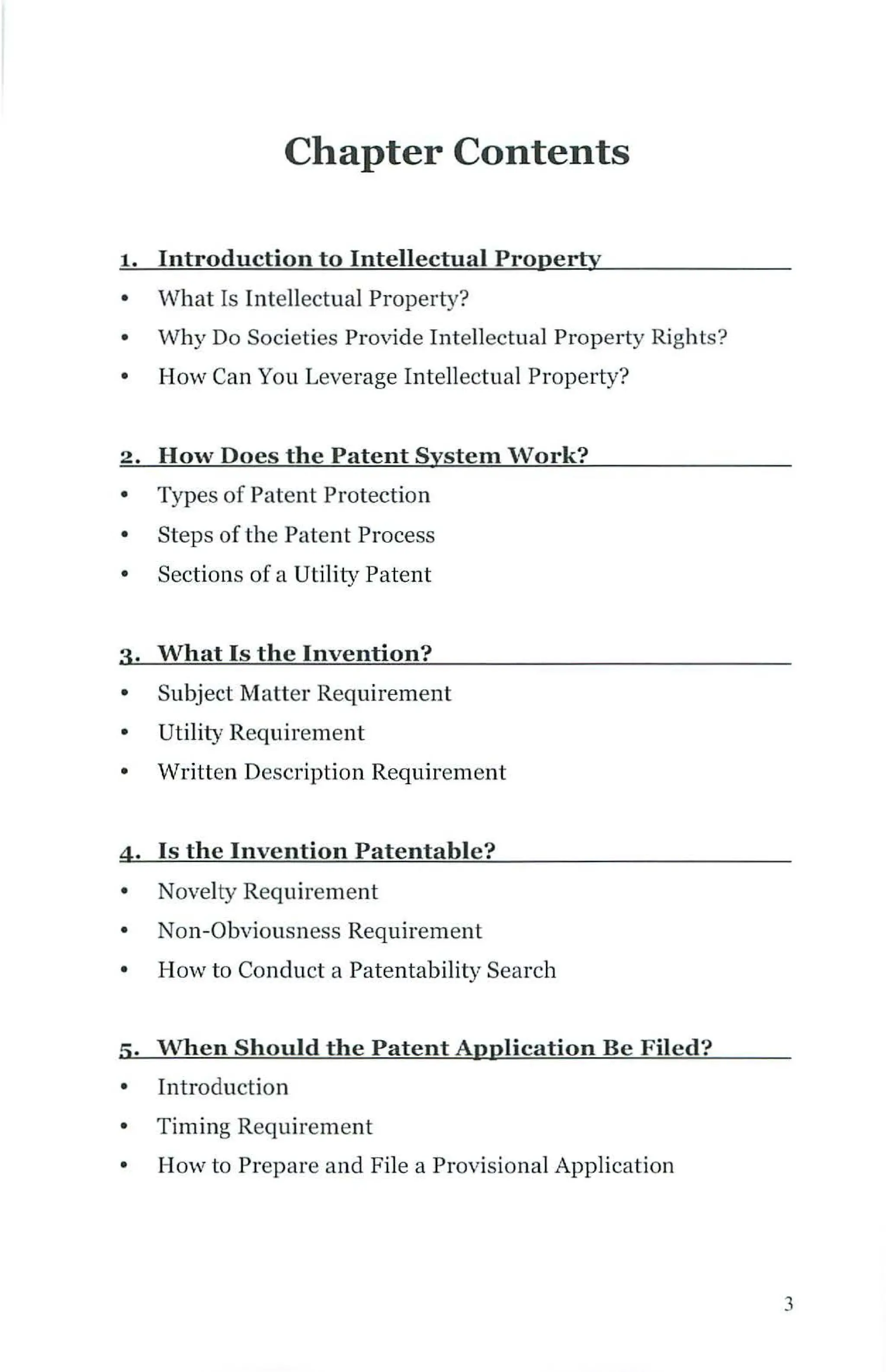


![Chapter One
Introduction to Intellectual Property
"Before [the adoption of the U.S. Constitution], any man might
instantly use what another had invented; so that the inventor
had no special advantage from his own invention. The patent
system changed this ... and thereby added the fuel of interest to
the fire of genius, in the discovery and production of new and
useful things."- Abraham Lincoln
6](https://image.slidesharecdn.com/12041-250722035007-e303ff6b/75/Not-so-obvious-an-introduction-to-patent-law-and-strategy-3rd-Edition-Schox-12-2048.jpg)
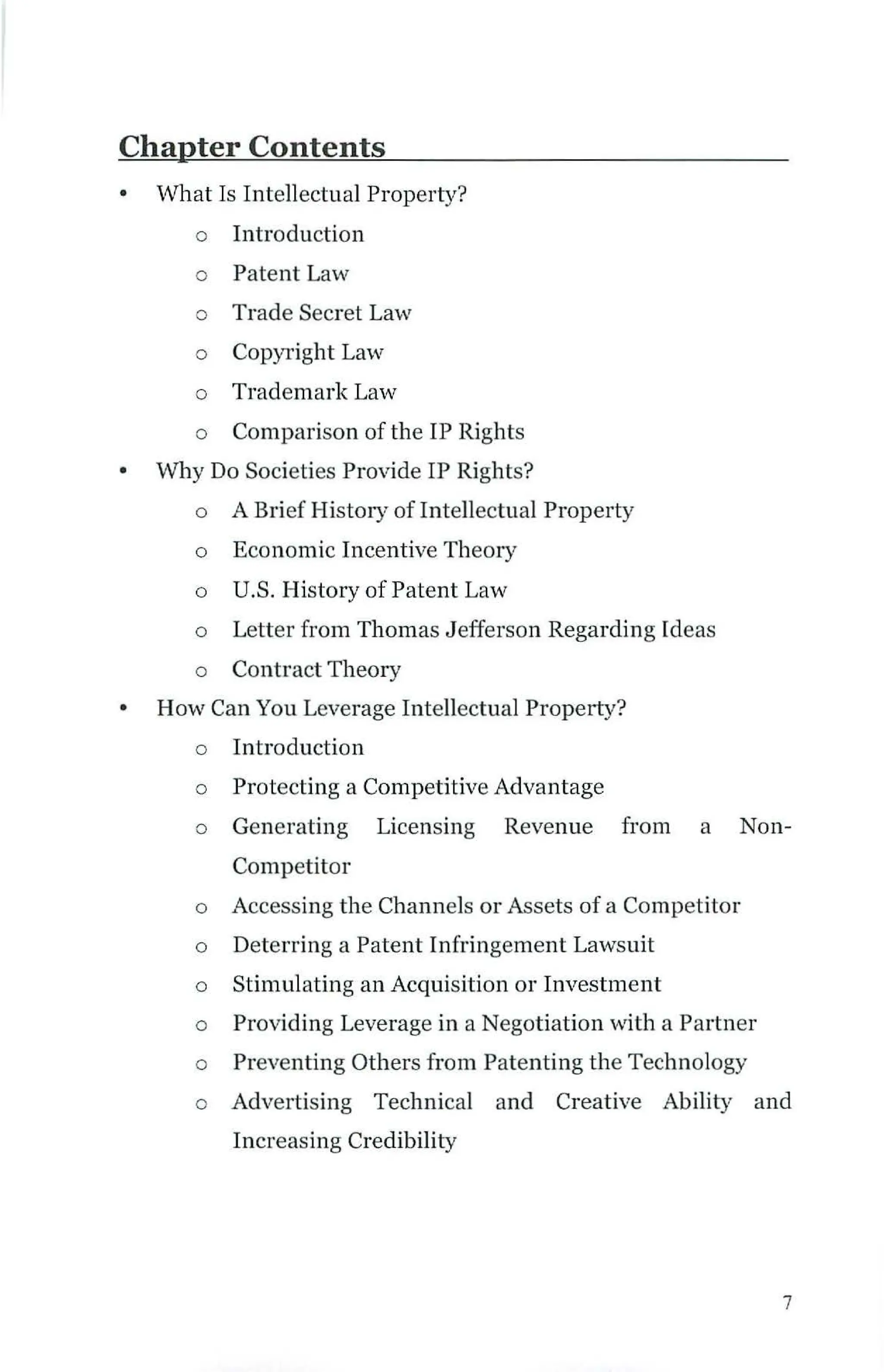

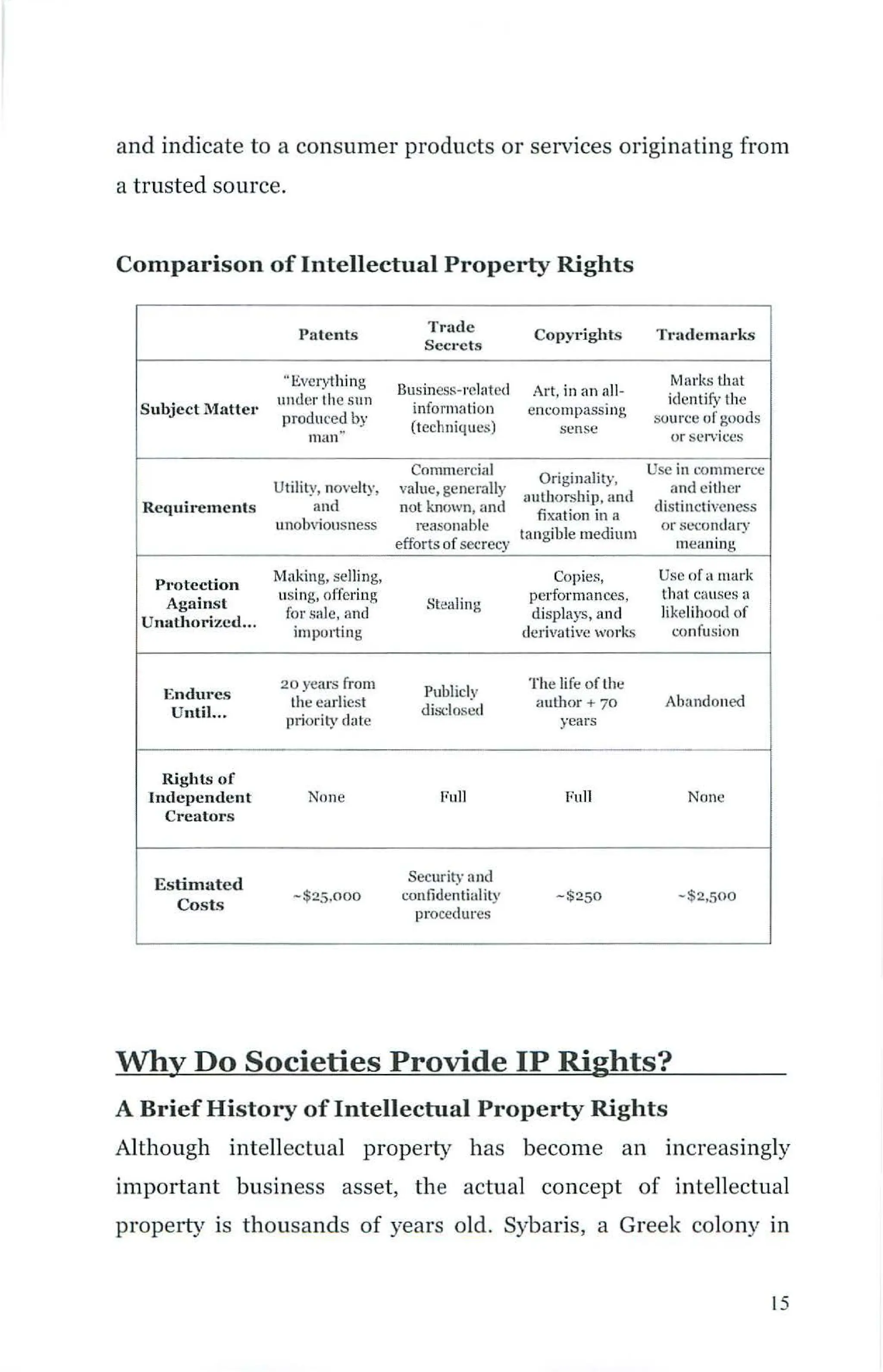
![Southern Italy about Boo BCE, may have enacted the first patent
system. Many centuries later, the Greek writer Athenaeus stated,
"The Sybarites ... made a law that ... if any confectioner or cook
invented any peculiar and excellent dish, no other artist was
allowed to make this for a year; ... in order that others might be
induced to labour at excelling in such pursuits...." Athenaeus:
The Deipnosophists - Book 12, Page 521 Translated by C.D.
Yonge (1854).
In 1474, Venice enacted a law that "[E]very person who shall
build any new and ingenious device ... not previously made in
this Commonwealth, shall give notice of it to the office ... when it
has been reduced to perfection so that it can be used and
operated. It being forbidden to eve1
y other person in any of our
territories ... to make any further device conforming with and
similar to said [device]... for the term of 10 years" Venetian
Patent Statute of 1474. Venice issued 1,600 patents in the no
years between 1490 and 1600 AD. Venice issued one of these
1,600 patents to Galileo in 1594 for his "machine for raising
water and irrigating land with small expense and great
convenience."
During the mid 16th century, rulers in England attempted to
attract artisans from other cities (e.g., Venice) by creating
England's own patent system. Patents were called Literae Pate1
·e,
which means "open letters" and refers to an open letter of
privilege from the government. The English patent system
formed the basis of the United States patent system.
16](https://image.slidesharecdn.com/12041-250722035007-e303ff6b/75/Not-so-obvious-an-introduction-to-patent-law-and-strategy-3rd-Edition-Schox-22-2048.jpg)
![Letter from Thomas Jefferson to Isaac McPherson
(August 13, 1813)
If nature has made any one thing less susceptible than all others
of exclusive property, it is the action ofthe thinking power called
an idea, ·which an individual may exclusively possess as long as
he keeps it to himself; but the moment it is divulged, it forces
itself into the possession of every one, and the receiver cannot
dispossess himself of it. Its peculiar character, too, is that no one
possesses the less, because every other possesses the whole of it.
He who receives an idea from me, receives instruction himself
without lessening mine; as he who lights his taper at mine,
receives light without darkening me. That ideas should freely
spread from one to another over the globe, for the moral and
mutual instruction of man, and improvement of his condition,
seems to have been peculiarly and benevolently designed by
nature, when she made them, like fire, expansible over all space,
without lessening their density in any point, and like the air in
which we breathe, move, and have our physical being, incapable
of confinement or exclusive appropriation. Inventions then
cannot, in nature, be a subject of property. Society may [,
however,] give an exclusive right to the profits arising from them,
as an encouragement to men to pursue ideas which may produce
utility....
Contract Theory
In the Contract Theory, the inventors agree to provide full
disclosure of their invention to the public (i.e. described in a
patent application), while the public (i.e. through a government
agency) agrees to provide exclusive rights to the invention (i.e.
19](https://image.slidesharecdn.com/12041-250722035007-e303ff6b/75/Not-so-obvious-an-introduction-to-patent-law-and-strategy-3rd-Edition-Schox-25-2048.jpg)