Amna  Dhabiya  Sara
Definition of nonverbal communication Encoding – Decoding process The communicators physical characteristics  Body movement Introduction to face expiration Types of facial expirations  The Social Impact of Facial expiration Summery Reference list
It refers to communication effected by mean other than words.
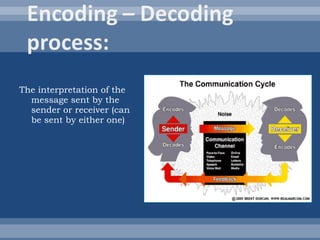
The interpretation of the message sent by the sender or receiver (can be sent by either one)
 
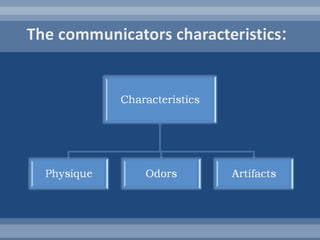
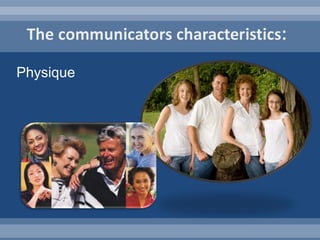
Physique
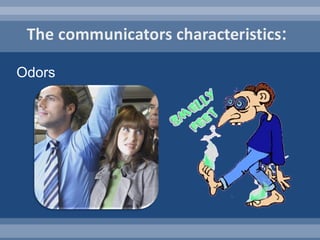
Odors
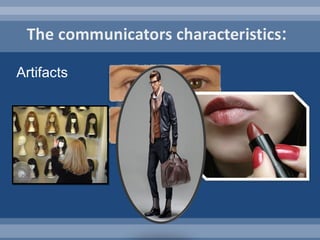
Artifacts
 
 
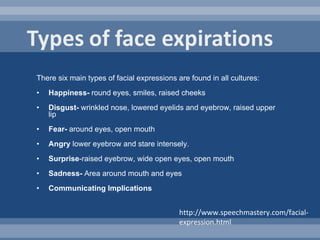
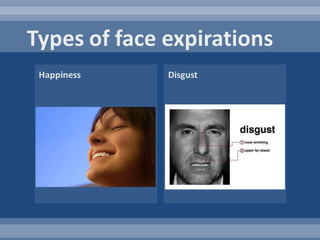
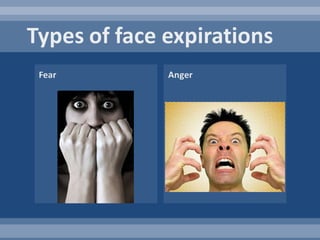
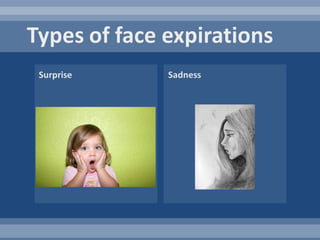
There six main types of facial expressions are found in all cultures: Happiness-  round eyes, smiles, raised cheeks Disgust-  wrinkled nose, lowered eyelids and eyebrow, raised upper lip Fear-  around eyes, open mouth Angry  lower eyebrow and stare intensely. Surprise -raised eyebrow, wide open eyes, open mouth Sadness-  Area around mouth and eyes Communicating Implications http://www.speechmastery.com/facial-expression.html


Pictures time  Questions time Discussion time

Nonverbal communication

  • 1.
  • 2.
    Definition of nonverbalcommunication Encoding – Decoding process The communicators physical characteristics Body movement Introduction to face expiration Types of facial expirations The Social Impact of Facial expiration Summery Reference list
  • 3.
    It refers tocommunication effected by mean other than words.
  • 4.
    The interpretation ofthe message sent by the sender or receiver (can be sent by either one)
  • 5.
  • 6.
  • 7.
  • 8.
  • 9.
  • 10.
  • 11.
    There six maintypes of facial expressions are found in all cultures: Happiness- round eyes, smiles, raised cheeks Disgust- wrinkled nose, lowered eyelids and eyebrow, raised upper lip Fear- around eyes, open mouth Angry lower eyebrow and stare intensely. Surprise -raised eyebrow, wide open eyes, open mouth Sadness- Area around mouth and eyes Communicating Implications http://www.speechmastery.com/facial-expression.html
  • 12.
  • 13.
  • 14.
  • 15.
  • 16.
  • 17.
  • 18.
    Pictures time Questions time Discussion time

Editor's Notes

  • #4 Nonverbal communication (NVC) is usually understood as the process of communication through sending and receiving wordless messages. Such messages can be communicated through gesture; body language or posture; facial expression and eye contact; object communication such as clothing, hairstyles or even architecture; symbols and infographics. Speech may also contain nonverbal elements known as paralanguage, including voice quality, emotion and speaking style, as well as prosodic features such as rhythm, intonation and stress. Likewise, written texts have nonverbal elements such as handwriting style, spatial arrangement of words, or the use of emoticons. However, much of the study of nonverbal communication has focused on face-to-face interaction, where it can be classified into three principal areas: environmental conditions where communication takes place, the physical characteristics of the communicators, and behaviors of communicators during interaction. http://www.andrews.edu/~tidwell/bsad560/NonVerbal.html http://www.selfgrowth.com/articles/Articles_Nonverbal.html