Medication
Non-Compliance
(Non-Adherence)
1
2
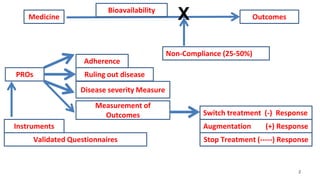
Medicine Outcomes
Bioavailability
Non-Compliance (25-50%)
PROs
Disease severity Measure
Ruling out disease
Adherence
Measurement of
Outcomes Switch treatment (-) Response
Augmentation (+) Response
Stop Treatment (-----) Response
Instruments
Validated Questionnaires
X
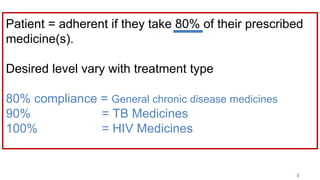
Patient = adherent if they take 80% of their prescribed
medicine(s).
Desired level vary with treatment type
80% compliance = General chronic disease medicines
90% = TB Medicines
100% = HIV Medicines
3
4
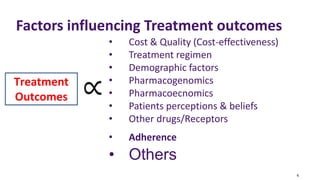
Factors influencing Treatment outcomes
• Cost & Quality (Cost-effectiveness)
• Treatment regimen
• Demographic factors
• Pharmacogenomics
• Pharmacoecnomics
• Patients perceptions & beliefs
• Other drugs/Receptors
• Adherence
• Others
Treatment
Outcomes
5
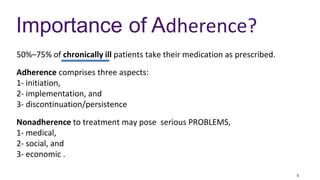
Importance of Adherence?
50%–75% of chronically ill patients take their medication as prescribed.
Adherence comprises three aspects:
1- initiation,
2- implementation, and
3- discontinuation/persistence
Nonadherence to treatment may pose serious PROBLEMS,
1- medical,
2- social, and
3- economic .
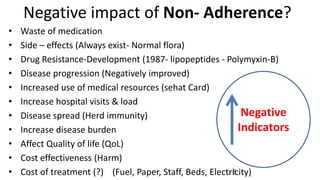
Negative impact of Non- Adherence?
6
• Waste of medication
• Side – effects (Always exist- Normal flora)
• Drug Resistance-Development (1987- lipopeptides - Polymyxin-B)
• Disease progression (Negatively improved)
• Increased use of medical resources (sehat Card)
• Increase hospital visits & load
• Disease spread (Herd immunity)
• Increase disease burden
• Affect Quality of life (QoL)
• Cost effectiveness (Harm)
• Cost of treatment (?) (Fuel, Paper, Staff, Beds, Electricity)
Negative
Indicators
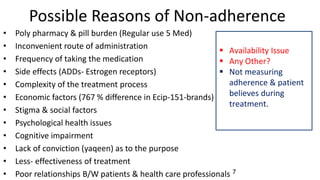
Possible Reasons of Non-adherence
• Poly pharmacy & pill burden (Regular use 5 Med)
• Inconvenient route of administration
• Frequency of taking the medication
• Side effects (ADDs- Estrogen receptors)
• Complexity of the treatment process
• Economic factors (767 % difference in Ecip-151-brands)
• Stigma & social factors
• Psychological health issues
• Cognitive impairment
• Lack of conviction (yaqeen) as to the purpose
• Less- effectiveness of treatment
• Poor relationships B/W patients & health care professionals 7
 Availability Issue
 Any Other?
 Not measuring
adherence & patient
believes during
treatment.
8
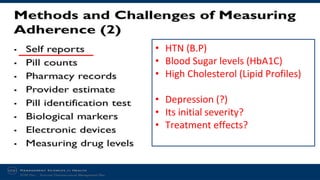
• HTN (B.P)
• Blood Sugar levels (HbA1C)
• High Cholesterol (Lipid Profiles)
• Depression (?)
• Its initial severity?
• Treatment effects?
9
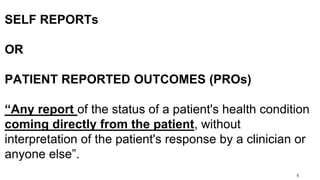
SELF REPORTs
OR
PATIENT REPORTED OUTCOMES (PROs)
“Any report of the status of a patient's health condition
coming directly from the patient, without
interpretation of the patient's response by a clinician or
anyone else”.
10
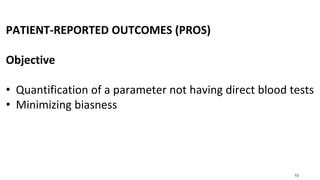
PATIENT-REPORTED OUTCOMES (PROS)
Objective
• Quantification of a parameter not having direct blood tests
• Minimizing biasness
11
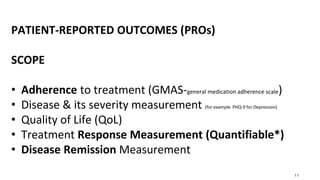
PATIENT-REPORTED OUTCOMES (PROs)
SCOPE
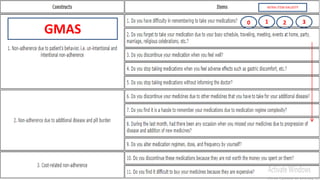
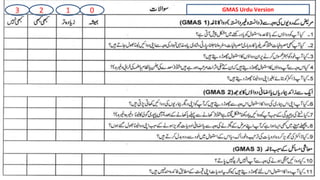
• Adherence to treatment (GMAS-general medication adherence scale)
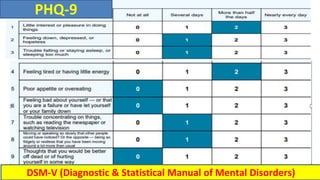
• Disease & its severity measurement (for example PHQ-9 for Depression)
• Quality of Life (QoL)
• Treatment Response Measurement (Quantifiable*)
• Disease Remission Measurement
12
Various adherence measurement instruments
available.
Deciding which tools to use depends on,
• Healthcare setting (1,2 or Tertiary?)
• Budget
• Type of disease
• Staffing &
• Patient population.
A combination of tools will ensure the best results.
13
Ideal measurement instruments.
• Easy to understand
• Short (PHQ-2)
• Native language (translation-available)
• Free
• Statistically valid
• Cover scope of disease under observation
• Likert scale
• Can Rule-out disease & measure its severity
14
GMAS
INTRA-ITEM VALIDITY
0 1 2 3
15
0
1
2
3 GMAS Urdu Version
16
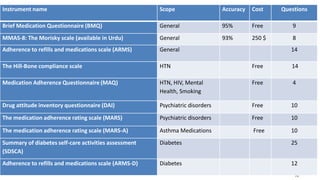
Instrument name Scope Accuracy Cost Questions
Brief Medication Questionnaire (BMQ) General 95% Free 9
MMAS-8: The Morisky scale (available in Urdu) General 93% 250 $ 8
Adherence to refills and medications scale (ARMS) General 14
The Hill-Bone compliance scale HTN Free 14
Medication Adherence Questionnaire (MAQ) HTN, HIV, Mental
Health, Smoking
Free 4
Drug attitude inventory questionnaire (DAI) Psychiatric disorders Free 10
The medication adherence rating scale (MARS) Psychiatric disorders Free 10
The medication adherence rating scale (MARS-A) Asthma Medications Free 10
Summary of diabetes self-care activities assessment
(SDSCA)
Diabetes 25
Adherence to refills and medications scale (ARMS-D) Diabetes 12
17
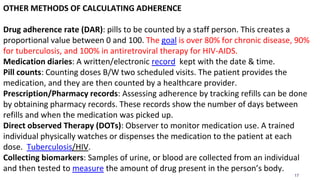
OTHER METHODS OF CALCULATING ADHERENCE
Drug adherence rate (DAR): pills to be counted by a staff person. This creates a
proportional value between 0 and 100. The goal is over 80% for chronic disease, 90%
for tuberculosis, and 100% in antiretroviral therapy for HIV-AIDS.
Medication diaries: A written/electronic record kept with the date & time.
Pill counts: Counting doses B/W two scheduled visits. The patient provides the
medication, and they are then counted by a healthcare provider.
Prescription/Pharmacy records: Assessing adherence by tracking refills can be done
by obtaining pharmacy records. These records show the number of days between
refills and when the medication was picked up.
Direct observed Therapy (DOTs): Observer to monitor medication use. A trained
individual physically watches or dispenses the medication to the patient at each
dose. Tuberculosis/HIV.
Collecting biomarkers: Samples of urine, or blood are collected from an individual
and then tested to measure the amount of drug present in the person’s body.
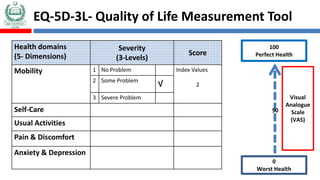
EQ-5D-3L- Quality of Life Measurement Tool
Health domains
(5- Dimensions)
Severity
(3-Levels)
Score
Mobility 1 No Problem Index Values
2
2 Some Problem
√
3 Severe Problem
Self-Care
Usual Activities
Pain & Discomfort
Anxiety & Depression
100
Perfect Health
0
Worst Health
50
Visual
Analogue
Scale
(VAS)
19
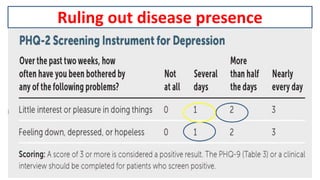
Ruling out disease presence
20
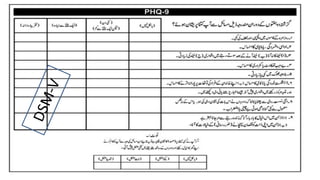
DSM-V (Diagnostic & Statistical Manual of Mental Disorders)
PHQ-9
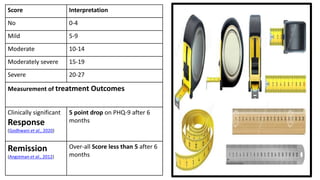
Score Interpretation
No 0-4
Mild 5-9
Moderate 10-14
Moderately severe 15-19
Severe 20-27
Measurement of treatment Outcomes
Clinically significant
Response
(Godhwani et al., 2020)
5 point drop on PHQ-9 after 6
months
Remission
(Angstman et al., 2012)
Over-all Score less than 5 after 6
months
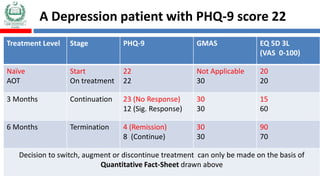
A Depression patient with PHQ-9 score 22
Treatment Level Stage PHQ-9 GMAS EQ 5D 3L
(VAS 0-100)
Naïve
AOT
Start
On treatment
22
22
Not Applicable
30
20
20
3 Months Continuation 23 (No Response)
12 (Sig. Response)
30
30
15
60
6 Months Termination 4 (Remission)
8 (Continue)
30
30
90
70
Decision to switch, augment or discontinue treatment can only be made on the basis of
Quantitative Fact-Sheet drawn above
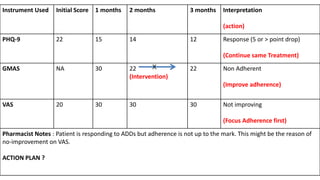
Instrument Used Initial Score 1 months 2 months 3 months Interpretation
(action)
PHQ-9 22 15 14 12 Response (5 or > point drop)
(Continue same Treatment)
GMAS NA 30 22
(Intervention)
22 Non Adherent
(Improve adherence)
VAS 20 30 30 30 Not improving
(Focus Adherence first)
Pharmacist Notes : Patient is responding to ADDs but adherence is not up to the mark. This might be the reason of
no-improvement on VAS.
ACTION PLAN ?
X
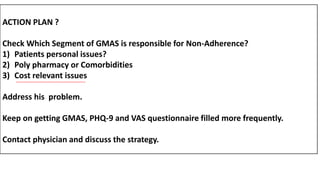
ACTION PLAN ?
Check Which Segment of GMAS is responsible for Non-Adherence?
1) Patients personal issues?
2) Poly pharmacy or Comorbidities
3) Cost relevant issues
Address his problem.
Keep on getting GMAS, PHQ-9 and VAS questionnaire filled more frequently.
Contact physician and discuss the strategy.
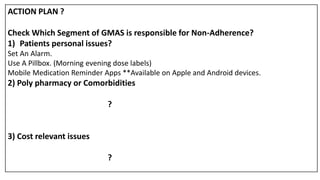
ACTION PLAN ?
Check Which Segment of GMAS is responsible for Non-Adherence?
1) Patients personal issues?
Set An Alarm.
Use A Pillbox. (Morning evening dose labels)
Mobile Medication Reminder Apps **Available on Apple and Android devices.
2) Poly pharmacy or Comorbidities
?
3) Cost relevant issues
?
© 2015 American Medical Association. All rights reserved. 27
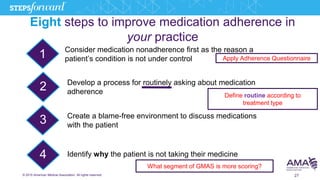
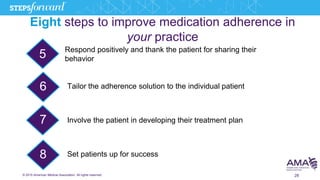
Eight steps to improve medication adherence in
your practice
1
2
3
4
Consider medication nonadherence first as the reason a
patient’s condition is not under control
Develop a process for routinely asking about medication
adherence
Create a blame-free environment to discuss medications
with the patient
Identify why the patient is not taking their medicine
Apply Adherence Questionnaire
Define routine according to
treatment type
What segment of GMAS is more scoring?
© 2015 American Medical Association. All rights reserved. 28
Eight steps to improve medication adherence in
your practice
5
6
8
Respond positively and thank the patient for sharing their
behavior
Tailor the adherence solution to the individual patient
Involve the patient in developing their treatment plan
Set patients up for success
7
29
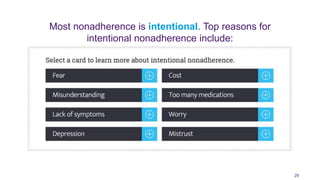
Most nonadherence is intentional. Top reasons for
intentional nonadherence include:

Non-Compliance.pptxaaaaaaaaaaaaaaaaaaaaaaaaaaaaa

  • 1.
  • 2.
    2 Medicine Outcomes Bioavailability Non-Compliance (25-50%) PROs Diseaseseverity Measure Ruling out disease Adherence Measurement of Outcomes Switch treatment (-) Response Augmentation (+) Response Stop Treatment (-----) Response Instruments Validated Questionnaires X
  • 3.
    Patient = adherentif they take 80% of their prescribed medicine(s). Desired level vary with treatment type 80% compliance = General chronic disease medicines 90% = TB Medicines 100% = HIV Medicines 3
  • 4.
    4 Factors influencing Treatmentoutcomes • Cost & Quality (Cost-effectiveness) • Treatment regimen • Demographic factors • Pharmacogenomics • Pharmacoecnomics • Patients perceptions & beliefs • Other drugs/Receptors • Adherence • Others Treatment Outcomes
  • 5.
    5 Importance of Adherence? 50%–75%of chronically ill patients take their medication as prescribed. Adherence comprises three aspects: 1- initiation, 2- implementation, and 3- discontinuation/persistence Nonadherence to treatment may pose serious PROBLEMS, 1- medical, 2- social, and 3- economic .
  • 6.
    Negative impact ofNon- Adherence? 6 • Waste of medication • Side – effects (Always exist- Normal flora) • Drug Resistance-Development (1987- lipopeptides - Polymyxin-B) • Disease progression (Negatively improved) • Increased use of medical resources (sehat Card) • Increase hospital visits & load • Disease spread (Herd immunity) • Increase disease burden • Affect Quality of life (QoL) • Cost effectiveness (Harm) • Cost of treatment (?) (Fuel, Paper, Staff, Beds, Electricity) Negative Indicators
  • 7.
    Possible Reasons ofNon-adherence • Poly pharmacy & pill burden (Regular use 5 Med) • Inconvenient route of administration • Frequency of taking the medication • Side effects (ADDs- Estrogen receptors) • Complexity of the treatment process • Economic factors (767 % difference in Ecip-151-brands) • Stigma & social factors • Psychological health issues • Cognitive impairment • Lack of conviction (yaqeen) as to the purpose • Less- effectiveness of treatment • Poor relationships B/W patients & health care professionals 7  Availability Issue  Any Other?  Not measuring adherence & patient believes during treatment.
  • 8.
    8 • HTN (B.P) •Blood Sugar levels (HbA1C) • High Cholesterol (Lipid Profiles) • Depression (?) • Its initial severity? • Treatment effects?
  • 9.
    9 SELF REPORTs OR PATIENT REPORTEDOUTCOMES (PROs) “Any report of the status of a patient's health condition coming directly from the patient, without interpretation of the patient's response by a clinician or anyone else”.
  • 10.
    10 PATIENT-REPORTED OUTCOMES (PROS) Objective •Quantification of a parameter not having direct blood tests • Minimizing biasness
  • 11.
    11 PATIENT-REPORTED OUTCOMES (PROs) SCOPE •Adherence to treatment (GMAS-general medication adherence scale) • Disease & its severity measurement (for example PHQ-9 for Depression) • Quality of Life (QoL) • Treatment Response Measurement (Quantifiable*) • Disease Remission Measurement
  • 12.
    12 Various adherence measurementinstruments available. Deciding which tools to use depends on, • Healthcare setting (1,2 or Tertiary?) • Budget • Type of disease • Staffing & • Patient population. A combination of tools will ensure the best results.
  • 13.
    13 Ideal measurement instruments. •Easy to understand • Short (PHQ-2) • Native language (translation-available) • Free • Statistically valid • Cover scope of disease under observation • Likert scale • Can Rule-out disease & measure its severity
  • 14.
  • 15.
  • 16.
    16 Instrument name ScopeAccuracy Cost Questions Brief Medication Questionnaire (BMQ) General 95% Free 9 MMAS-8: The Morisky scale (available in Urdu) General 93% 250 $ 8 Adherence to refills and medications scale (ARMS) General 14 The Hill-Bone compliance scale HTN Free 14 Medication Adherence Questionnaire (MAQ) HTN, HIV, Mental Health, Smoking Free 4 Drug attitude inventory questionnaire (DAI) Psychiatric disorders Free 10 The medication adherence rating scale (MARS) Psychiatric disorders Free 10 The medication adherence rating scale (MARS-A) Asthma Medications Free 10 Summary of diabetes self-care activities assessment (SDSCA) Diabetes 25 Adherence to refills and medications scale (ARMS-D) Diabetes 12
  • 17.
    17 OTHER METHODS OFCALCULATING ADHERENCE Drug adherence rate (DAR): pills to be counted by a staff person. This creates a proportional value between 0 and 100. The goal is over 80% for chronic disease, 90% for tuberculosis, and 100% in antiretroviral therapy for HIV-AIDS. Medication diaries: A written/electronic record kept with the date & time. Pill counts: Counting doses B/W two scheduled visits. The patient provides the medication, and they are then counted by a healthcare provider. Prescription/Pharmacy records: Assessing adherence by tracking refills can be done by obtaining pharmacy records. These records show the number of days between refills and when the medication was picked up. Direct observed Therapy (DOTs): Observer to monitor medication use. A trained individual physically watches or dispenses the medication to the patient at each dose. Tuberculosis/HIV. Collecting biomarkers: Samples of urine, or blood are collected from an individual and then tested to measure the amount of drug present in the person’s body.
  • 18.
    EQ-5D-3L- Quality ofLife Measurement Tool Health domains (5- Dimensions) Severity (3-Levels) Score Mobility 1 No Problem Index Values 2 2 Some Problem √ 3 Severe Problem Self-Care Usual Activities Pain & Discomfort Anxiety & Depression 100 Perfect Health 0 Worst Health 50 Visual Analogue Scale (VAS)
  • 19.
  • 20.
    20 DSM-V (Diagnostic &Statistical Manual of Mental Disorders) PHQ-9
  • 22.
    Score Interpretation No 0-4 Mild5-9 Moderate 10-14 Moderately severe 15-19 Severe 20-27 Measurement of treatment Outcomes Clinically significant Response (Godhwani et al., 2020) 5 point drop on PHQ-9 after 6 months Remission (Angstman et al., 2012) Over-all Score less than 5 after 6 months
  • 23.
    A Depression patientwith PHQ-9 score 22 Treatment Level Stage PHQ-9 GMAS EQ 5D 3L (VAS 0-100) Naïve AOT Start On treatment 22 22 Not Applicable 30 20 20 3 Months Continuation 23 (No Response) 12 (Sig. Response) 30 30 15 60 6 Months Termination 4 (Remission) 8 (Continue) 30 30 90 70 Decision to switch, augment or discontinue treatment can only be made on the basis of Quantitative Fact-Sheet drawn above
  • 24.
    Instrument Used InitialScore 1 months 2 months 3 months Interpretation (action) PHQ-9 22 15 14 12 Response (5 or > point drop) (Continue same Treatment) GMAS NA 30 22 (Intervention) 22 Non Adherent (Improve adherence) VAS 20 30 30 30 Not improving (Focus Adherence first) Pharmacist Notes : Patient is responding to ADDs but adherence is not up to the mark. This might be the reason of no-improvement on VAS. ACTION PLAN ? X
  • 25.
    ACTION PLAN ? CheckWhich Segment of GMAS is responsible for Non-Adherence? 1) Patients personal issues? 2) Poly pharmacy or Comorbidities 3) Cost relevant issues Address his problem. Keep on getting GMAS, PHQ-9 and VAS questionnaire filled more frequently. Contact physician and discuss the strategy.
  • 26.
    ACTION PLAN ? CheckWhich Segment of GMAS is responsible for Non-Adherence? 1) Patients personal issues? Set An Alarm. Use A Pillbox. (Morning evening dose labels) Mobile Medication Reminder Apps **Available on Apple and Android devices. 2) Poly pharmacy or Comorbidities ? 3) Cost relevant issues ?
  • 27.
    © 2015 AmericanMedical Association. All rights reserved. 27 Eight steps to improve medication adherence in your practice 1 2 3 4 Consider medication nonadherence first as the reason a patient’s condition is not under control Develop a process for routinely asking about medication adherence Create a blame-free environment to discuss medications with the patient Identify why the patient is not taking their medicine Apply Adherence Questionnaire Define routine according to treatment type What segment of GMAS is more scoring?
  • 28.
    © 2015 AmericanMedical Association. All rights reserved. 28 Eight steps to improve medication adherence in your practice 5 6 8 Respond positively and thank the patient for sharing their behavior Tailor the adherence solution to the individual patient Involve the patient in developing their treatment plan Set patients up for success 7
  • 29.
    29 Most nonadherence isintentional. Top reasons for intentional nonadherence include: