NO HEALTH CARE, NO PROBLEM?
Arizona’s law enforcement leaders warn that when it comes to
children’s health care, we can pay now or pay later.
A report by FIGHT CRIME: INVEST IN KIDS
AcknowledgementsAcknowledgements
WHO WE ARE
FIGHT CRIME: INVEST IN KIDS is a national, bipartisan, nonprofit, anti-crime organization. The organization has a
membership of nearly 5,000 police chiefs, sheriffs, district attorneys, other law enforcement leaders and violence
survivors nationwide, including 45 in Arizona. The members take a hard-nosed look at what approaches work—
and what don’t—to prevent crime and violence. They then recommend effective strategies to state and national
policymakers. It operates under the umbrella of the Council for a Strong America.
OUR SUPPORT
FIGHT CRIME: INVEST IN KIDS is supported by tax-deductible contributions from foundations, individuals, and
corporations. FIGHT CRIME: INVEST IN KIDS accepts no funds from federal, state, or local governments.
Major funding for FIGHT CRIME: INVEST IN KIDS is provided by: Alliance for Early Success • The California Education
Policy Fund • The California Endowment • The California Wellness Foundation • Annie E. Casey Foundation • Robert
Sterling Clark Foundation • The Sam L. Cohen Foundation • The Ford Foundation • Bill & Melinda Gates Foundation
• The Grable Foundation • Grand Victoria Foundation • The George Gund Foundation • Hagedorn Foundation •
Irving Harris Foundation • The Heinz Endowments • Leona M. and Harry B. Helmsley Charitable Trust • The William
and Flora Hewlett Foundation • W.K. Kellogg Foundation • The Kresge Foundation • The Oscar G. and Elsa S. Mayer
Foundation • McCormick Foundation • Ohio Children’s Foundation • The David and Lucile Packard Foundation •
William Penn Foundation • Pritzker Early Childhood Foundation • Rauch Foundation • Dr. Scholl Foundation • W.
Clement and Jessie V. Stone Foundation.
Report authored by William Christeson, Kara Clifford, Natasha O’Dell Archer and Joshua Spaulding.
Publication layout and design by Soren Messner-Zidell.
SUMMARY
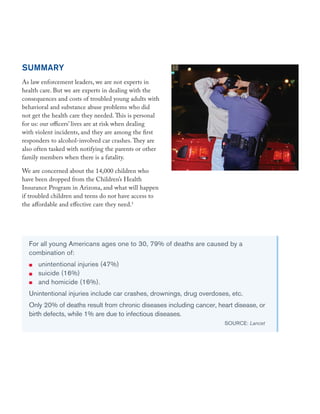
As law enforcement leaders, we are not experts in
health care. But we are experts in dealing with the
consequences and costs of troubled young adults with
behavioral and substance abuse problems who did
not get the health care they needed. This is personal
for us: our officers’ lives are at risk when dealing
with violent incidents, and they are among the first
responders to alcohol-involved car crashes. They are
also often tasked with notifying the parents or other
family members when there is a fatality.
We are concerned about the 14,000 children who
have been dropped from the Children’s Health
Insurance Program in Arizona, and what will happen
if troubled children and teens do not have access to
the affordable and effective care they need.1
For all young Americans ages one to 30, 79% of deaths are caused by a
combination of:
unintentional injuries (47%)
suicide (16%)
and homicide (16%).
Unintentional injuries include car crashes, drownings, drug overdoses, etc.
Only 20% of deaths result from chronic diseases including cancer, heart disease, or
birth defects, while 1% are due to infectious diseases.
SOURCE: Lancet
CHILDREN ARE BEING PUT AT RISK
A recent report from Georgetown University’s Health
Policy Institute, Dismantling CHIP in Arizona: How Losing
KidsCare Impacts a Child’s Health Care Costs, came to
alarming conclusions:
•	 14,000 Arizona children lost their health coverage
on January 31, 2014 when our state froze Children’s
Health Insurance Program (CHIP) enrollment – a
program that “provided stable, affordable coverage
for uninsured children.”
•	 Arizona fell from 47th
to 49th
in children’s health
coverage, and is the only state to phase out its
CHIP program and reduce eligibility.
•	 Children with serious health problems and chronic
health conditions will incur “substantially higher
out-of-pocket costs in the marketplace [compared
to CHIP], as well as limits on benefits.”This is
especially troubling for low-income families, who
often can’t afford the high cost of services that are
not covered.
•	 More than half of the children who lost coverage
“could be locked out of financial assistance in the
marketplace, and either remain uninsured or face
unaffordable premiums if CHIP is not available.”2
PAY NOW OR PAY MUCH MORE LATER
Children and teenagers who have serious behavioral or
substance abuse problems too often become criminal adults.
One study found that having a mental illness in addition
to alcohol and drug abuse disorders increased the odds
of engaging in violence by 26 times compared to people
without these disorders.3
Our state can ensure that children and teens get the timely
and effective care they need to avoid becoming adults
entangled in drug abuse and violence, or we can all pay a
much higher price later in higher taxes and more violence
in our communities.
...OR MUCH MORE LATER.
PAY NOW.
4
A few facts put this in perspective:
•	 Arizona taxpayers spend over $1 billion every year
on the state’s correctional budget.4
•	 The cost to society of letting a baby grow up to
become a troubled youth who drops out of school,
uses drugs and becomes a career criminal averages
$2.5 million per person.5
•	 More than one in ten youths aged 12 to 17 in
Arizona report recently using illicit drugs.6
•	 Arizona law enforcement arrested 29,000 people
for Driving Under the Influence in 2013, including
over 1,300 people under the age of 21.7
•	 There were over 28,000 violent crimes committed
by Arizona adults in 2012, and 358 murders.8
WHAT CAN HEALTH CARE SERVICES DO?
There is a wealth of evidence from randomized trials –
the gold standard in medical research – that effective
treatments can lessen serious behavior and substance abuse
problems among our youth.
For example, there are three family therapies to help
troubled teens that have each been shown to reduce
re-arrests by more than half while saving an average of
$25,000 to $30,000 per child served.9
These proven medical
interventions can and should be covered for children who
need help.
Multisystemic Therapy (MST), one of these programs, has
been provided to CHIP teens in Arizona in the past through
the Touchstone Institute.10
It trains parents on how to more
effectively set limits and guide their children’s behaviors in
positive directions, while coaching the child to find more
effective strategies for avoiding drugs or violence. It has
produced dramatic results. One randomized MST study
followed juvenile delinquents until they were 29 years old.
Individuals who had not received MST were 62 percent
more likely to have been arrested for any offense (81 percent
vs. 50 percent), and more than twice as likely to have been
arrested for a violent offense (30 percent vs. 14 percent).11
And, because many troubled youth live in families with
other troubled siblings, it is especially encouraging that their
closest siblings were also protected. Siblings who were not in
families randomly assigned to MST, and were followed until
they were nearly 40 years old, were about three times as likely
to be convicted of a felony and more than twice as likely to
be sentenced to incarceration and probation.12
WE CANNOT AFFORD TO IGNORE
CHILDREN’S NEEDS FOR EFFECTIVE
HEALTH CARE
Our citizens in Arizona should not continue to suffer the
tragic consequences of drug abuse and violence in their
communities or continue to shoulder the fiscal costs of
children and teens not receiving the health care they need.
We urge state policymakers to act wisely now to find
solutions for these children.
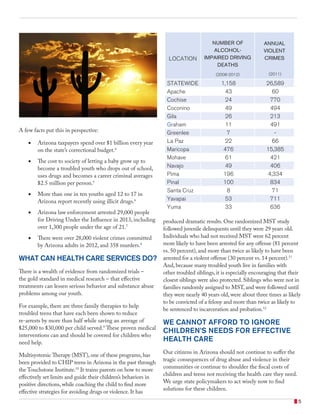
LOCATION
NUMBER OF
ALCOHOL-
IMPAIRED DRIVING
DEATHS
(2008-2012)
ANNUAL
VIOLENT
CRIMES
(2011)
STATEWIDE 1,158 26,589
Apache 43 60
Cochise 24 770
Coconino 49 494
Gila 26 213
Graham 11 491
Greenlee 7 -
La Paz 22 66
Maricopa 476 15,385
Mohave 61 421
Navajo 49 406
Pima 196 4,334
Pinal 100 834
Santa Cruz 8 71
Yavapai 53 711
Yuma 33 636
5
1 According to the Georgetown University Health Policy
Institute, approximately 23,000 of the 37,000 Arizona children
covered through KidsCare II were able to transition to Medicaid
coverage as a result of the Affordable Care Act because their
parents were at or below 138% of the federal poverty level.The
Institute estimates that there are 14,000 Arizona children left
with family incomes between 138-200% of the federal poverty
level that were dropped from KidsCare II as of February
1st. Alker, J. (2013, January 30). Arizona Risks Falling Even
Further Behind in Children’s Coverage by Rolling Back CHIP.
Georgetown University Health Policy Institute, Center for
Children and Families. Retrieved from: http://ccf.georgetown.
edu/all/arizona-risks-falling-even-further-behind-in-childrens-
coverage-by-rolling-back-chip/
2 http://ccf.georgetown.edu/wp-content/uploads/2014/05/
Dismantling-CHIP-in-Arizona.pdf
3 Van Dorn, R., Volavka, J., & Johnson, N. (2012). Mental
disorder and violence: Is there a relationship beyond substance
use? Social Psychiatry Psychiatric Epidemiology, 47(3),487-503.
Retrieved from http://www.ncbi.nlm.nih.gov/pubmed/21359532
4 Arizona Department of Corrections (2014). Fiscal Year 2014
Appropriations Report. Retrieved from: ttp://www.azcorrections.
gov/adc/reports/2014_Appropriations.pdf
5 ohen, M.A., & Piquero, A.R. (2009). New evidence on
the monetary value of saving a high risk youth. Journal of
Quantitative Criminology, 25, 25-49.
6 Substance Abuse and Mental Health Services Administration
(2013, December). Behavioral Health Barometer: Arizona, 2013.
U.S. Department of Health and Human Services. Retrieved from:
http://store.samhsa.gov/shin/content//SMA13-4796/SMA13-
4796AZ.pdf
7 Arizona Governor’s Office of Highway Safety (2014). DUI
Agency Reporting: DUI Enforcement Statistics. Retrieved from:
http://www.azgohs.gov/dui-dre-reporting/
8 FBI Uniform Crime Reports (2012). Crime in the United
States 2012.Table 5: Crime in the United States by State, 2012.
U.S. Department of Justice. Retrieved from: http://www.fbi.gov/
about-us/cjis/ucr/crime-in-the-u.s/2012/crime-in-the-u.s.-2012/
tables/5tabledatadecpdf
9 These therapies are called Functional Family Therapy (FFT),
Multisystemic Therapy (MST) and Multidimensional Treament
Foster Care (MTFC). For the cost savings analysis, see: Lee,
S., Aos, S., Drake, E., Pennucci, A., Miller, M., & Anderson, L.
(2012). Return on investment : Evidence to improve statewide
outcomes. Olympia, WA: Washington State Institute for Public
Policy. For more information on studies of the therapies, see:
Alexander J., Pugh, C., Parsons, B., & Sexton,T. (2001). Book
three: Functional Family Therapy. Blueprints for Violence
Prevention. Boulder, CO: Center for the Study and Prevention
of Violence; Sawyer, A.M., & Borduin, C.M. (2011). Effects of
Multisystemic Therapy through midlife: A 21.9 year follow-up
to a randomized clinical trial with serious and violent juvenile
offenders. Journal of Consulting and Clinical Psychology, 79(5),
643-652; Rowland, M.D., Halliday-Boykins, C.A., Henggler,
S.W., Cunningham, P.B., Lee,T.G., Kruesi, M.J., et al. (2005). A
randomized trial of Multisystemic Therapy with Hawaii’s Felix
Class Youths. Journal of Emotional and Behavioral Disorders,
13(1), 13-23; Eddy, J.M., Whaley, R.B., & Chamberlain, P.
(2004).The prevention of violent behavior by chronic and serious
male juvenile offenders: A 2-year follow-up of a randomized
clinical trial. Journal of Emotional and Behavioral Disorders,
12(1), 2-8.
10 Personal communication on June 5, 2014 with Kimberly
Egan of the Touchstone Institute.Touchstone provides both
Multisystemic Therapy, and Functional Family Therapy in
Arizona.
11 Schaeffer, C.M., & Borduin, C.M. (2005). Long-term follow-
up to a randomized clinical trial of Multisystemic Therapy with
serious and violent juvenile offenders. Journal of Consulting and
Clinical Psychology, 73(3), 445-453.
12 Wagner, D. V., Borduin, C. M., Sawyer, A. M., & Dopp, A.
R. (2014). Long-term prevention of criminality in siblings of
serious and violent juvenile offenders: A 25-year follow-up to
a randomized clinical trial of multisystemic therapy. Journal of
consulting and clinical psychology, 82(3), 492.
ENDNOTES
6
7
NATIONAL OFFICE
1212 NEW YORK AVE NW
SUITE 300
WASHINGTON, DC 20005
P: (202) 776-0027
F: (415) 762-0110
WWW.FIGHTCRIME.ORG

Sample report

  • 1.
    NO HEALTH CARE,NO PROBLEM? Arizona’s law enforcement leaders warn that when it comes to children’s health care, we can pay now or pay later. A report by FIGHT CRIME: INVEST IN KIDS
  • 2.
    AcknowledgementsAcknowledgements WHO WE ARE FIGHTCRIME: INVEST IN KIDS is a national, bipartisan, nonprofit, anti-crime organization. The organization has a membership of nearly 5,000 police chiefs, sheriffs, district attorneys, other law enforcement leaders and violence survivors nationwide, including 45 in Arizona. The members take a hard-nosed look at what approaches work— and what don’t—to prevent crime and violence. They then recommend effective strategies to state and national policymakers. It operates under the umbrella of the Council for a Strong America. OUR SUPPORT FIGHT CRIME: INVEST IN KIDS is supported by tax-deductible contributions from foundations, individuals, and corporations. FIGHT CRIME: INVEST IN KIDS accepts no funds from federal, state, or local governments. Major funding for FIGHT CRIME: INVEST IN KIDS is provided by: Alliance for Early Success • The California Education Policy Fund • The California Endowment • The California Wellness Foundation • Annie E. Casey Foundation • Robert Sterling Clark Foundation • The Sam L. Cohen Foundation • The Ford Foundation • Bill & Melinda Gates Foundation • The Grable Foundation • Grand Victoria Foundation • The George Gund Foundation • Hagedorn Foundation • Irving Harris Foundation • The Heinz Endowments • Leona M. and Harry B. Helmsley Charitable Trust • The William and Flora Hewlett Foundation • W.K. Kellogg Foundation • The Kresge Foundation • The Oscar G. and Elsa S. Mayer Foundation • McCormick Foundation • Ohio Children’s Foundation • The David and Lucile Packard Foundation • William Penn Foundation • Pritzker Early Childhood Foundation • Rauch Foundation • Dr. Scholl Foundation • W. Clement and Jessie V. Stone Foundation. Report authored by William Christeson, Kara Clifford, Natasha O’Dell Archer and Joshua Spaulding. Publication layout and design by Soren Messner-Zidell.
  • 3.
    SUMMARY As law enforcementleaders, we are not experts in health care. But we are experts in dealing with the consequences and costs of troubled young adults with behavioral and substance abuse problems who did not get the health care they needed. This is personal for us: our officers’ lives are at risk when dealing with violent incidents, and they are among the first responders to alcohol-involved car crashes. They are also often tasked with notifying the parents or other family members when there is a fatality. We are concerned about the 14,000 children who have been dropped from the Children’s Health Insurance Program in Arizona, and what will happen if troubled children and teens do not have access to the affordable and effective care they need.1 For all young Americans ages one to 30, 79% of deaths are caused by a combination of: unintentional injuries (47%) suicide (16%) and homicide (16%). Unintentional injuries include car crashes, drownings, drug overdoses, etc. Only 20% of deaths result from chronic diseases including cancer, heart disease, or birth defects, while 1% are due to infectious diseases. SOURCE: Lancet
  • 4.
    CHILDREN ARE BEINGPUT AT RISK A recent report from Georgetown University’s Health Policy Institute, Dismantling CHIP in Arizona: How Losing KidsCare Impacts a Child’s Health Care Costs, came to alarming conclusions: • 14,000 Arizona children lost their health coverage on January 31, 2014 when our state froze Children’s Health Insurance Program (CHIP) enrollment – a program that “provided stable, affordable coverage for uninsured children.” • Arizona fell from 47th to 49th in children’s health coverage, and is the only state to phase out its CHIP program and reduce eligibility. • Children with serious health problems and chronic health conditions will incur “substantially higher out-of-pocket costs in the marketplace [compared to CHIP], as well as limits on benefits.”This is especially troubling for low-income families, who often can’t afford the high cost of services that are not covered. • More than half of the children who lost coverage “could be locked out of financial assistance in the marketplace, and either remain uninsured or face unaffordable premiums if CHIP is not available.”2 PAY NOW OR PAY MUCH MORE LATER Children and teenagers who have serious behavioral or substance abuse problems too often become criminal adults. One study found that having a mental illness in addition to alcohol and drug abuse disorders increased the odds of engaging in violence by 26 times compared to people without these disorders.3 Our state can ensure that children and teens get the timely and effective care they need to avoid becoming adults entangled in drug abuse and violence, or we can all pay a much higher price later in higher taxes and more violence in our communities. ...OR MUCH MORE LATER. PAY NOW. 4
  • 5.
    A few factsput this in perspective: • Arizona taxpayers spend over $1 billion every year on the state’s correctional budget.4 • The cost to society of letting a baby grow up to become a troubled youth who drops out of school, uses drugs and becomes a career criminal averages $2.5 million per person.5 • More than one in ten youths aged 12 to 17 in Arizona report recently using illicit drugs.6 • Arizona law enforcement arrested 29,000 people for Driving Under the Influence in 2013, including over 1,300 people under the age of 21.7 • There were over 28,000 violent crimes committed by Arizona adults in 2012, and 358 murders.8 WHAT CAN HEALTH CARE SERVICES DO? There is a wealth of evidence from randomized trials – the gold standard in medical research – that effective treatments can lessen serious behavior and substance abuse problems among our youth. For example, there are three family therapies to help troubled teens that have each been shown to reduce re-arrests by more than half while saving an average of $25,000 to $30,000 per child served.9 These proven medical interventions can and should be covered for children who need help. Multisystemic Therapy (MST), one of these programs, has been provided to CHIP teens in Arizona in the past through the Touchstone Institute.10 It trains parents on how to more effectively set limits and guide their children’s behaviors in positive directions, while coaching the child to find more effective strategies for avoiding drugs or violence. It has produced dramatic results. One randomized MST study followed juvenile delinquents until they were 29 years old. Individuals who had not received MST were 62 percent more likely to have been arrested for any offense (81 percent vs. 50 percent), and more than twice as likely to have been arrested for a violent offense (30 percent vs. 14 percent).11 And, because many troubled youth live in families with other troubled siblings, it is especially encouraging that their closest siblings were also protected. Siblings who were not in families randomly assigned to MST, and were followed until they were nearly 40 years old, were about three times as likely to be convicted of a felony and more than twice as likely to be sentenced to incarceration and probation.12 WE CANNOT AFFORD TO IGNORE CHILDREN’S NEEDS FOR EFFECTIVE HEALTH CARE Our citizens in Arizona should not continue to suffer the tragic consequences of drug abuse and violence in their communities or continue to shoulder the fiscal costs of children and teens not receiving the health care they need. We urge state policymakers to act wisely now to find solutions for these children. LOCATION NUMBER OF ALCOHOL- IMPAIRED DRIVING DEATHS (2008-2012) ANNUAL VIOLENT CRIMES (2011) STATEWIDE 1,158 26,589 Apache 43 60 Cochise 24 770 Coconino 49 494 Gila 26 213 Graham 11 491 Greenlee 7 - La Paz 22 66 Maricopa 476 15,385 Mohave 61 421 Navajo 49 406 Pima 196 4,334 Pinal 100 834 Santa Cruz 8 71 Yavapai 53 711 Yuma 33 636 5
  • 6.
    1 According tothe Georgetown University Health Policy Institute, approximately 23,000 of the 37,000 Arizona children covered through KidsCare II were able to transition to Medicaid coverage as a result of the Affordable Care Act because their parents were at or below 138% of the federal poverty level.The Institute estimates that there are 14,000 Arizona children left with family incomes between 138-200% of the federal poverty level that were dropped from KidsCare II as of February 1st. Alker, J. (2013, January 30). Arizona Risks Falling Even Further Behind in Children’s Coverage by Rolling Back CHIP. Georgetown University Health Policy Institute, Center for Children and Families. Retrieved from: http://ccf.georgetown. edu/all/arizona-risks-falling-even-further-behind-in-childrens- coverage-by-rolling-back-chip/ 2 http://ccf.georgetown.edu/wp-content/uploads/2014/05/ Dismantling-CHIP-in-Arizona.pdf 3 Van Dorn, R., Volavka, J., & Johnson, N. (2012). Mental disorder and violence: Is there a relationship beyond substance use? Social Psychiatry Psychiatric Epidemiology, 47(3),487-503. Retrieved from http://www.ncbi.nlm.nih.gov/pubmed/21359532 4 Arizona Department of Corrections (2014). Fiscal Year 2014 Appropriations Report. Retrieved from: ttp://www.azcorrections. gov/adc/reports/2014_Appropriations.pdf 5 ohen, M.A., & Piquero, A.R. (2009). New evidence on the monetary value of saving a high risk youth. Journal of Quantitative Criminology, 25, 25-49. 6 Substance Abuse and Mental Health Services Administration (2013, December). Behavioral Health Barometer: Arizona, 2013. U.S. Department of Health and Human Services. Retrieved from: http://store.samhsa.gov/shin/content//SMA13-4796/SMA13- 4796AZ.pdf 7 Arizona Governor’s Office of Highway Safety (2014). DUI Agency Reporting: DUI Enforcement Statistics. Retrieved from: http://www.azgohs.gov/dui-dre-reporting/ 8 FBI Uniform Crime Reports (2012). Crime in the United States 2012.Table 5: Crime in the United States by State, 2012. U.S. Department of Justice. Retrieved from: http://www.fbi.gov/ about-us/cjis/ucr/crime-in-the-u.s/2012/crime-in-the-u.s.-2012/ tables/5tabledatadecpdf 9 These therapies are called Functional Family Therapy (FFT), Multisystemic Therapy (MST) and Multidimensional Treament Foster Care (MTFC). For the cost savings analysis, see: Lee, S., Aos, S., Drake, E., Pennucci, A., Miller, M., & Anderson, L. (2012). Return on investment : Evidence to improve statewide outcomes. Olympia, WA: Washington State Institute for Public Policy. For more information on studies of the therapies, see: Alexander J., Pugh, C., Parsons, B., & Sexton,T. (2001). Book three: Functional Family Therapy. Blueprints for Violence Prevention. Boulder, CO: Center for the Study and Prevention of Violence; Sawyer, A.M., & Borduin, C.M. (2011). Effects of Multisystemic Therapy through midlife: A 21.9 year follow-up to a randomized clinical trial with serious and violent juvenile offenders. Journal of Consulting and Clinical Psychology, 79(5), 643-652; Rowland, M.D., Halliday-Boykins, C.A., Henggler, S.W., Cunningham, P.B., Lee,T.G., Kruesi, M.J., et al. (2005). A randomized trial of Multisystemic Therapy with Hawaii’s Felix Class Youths. Journal of Emotional and Behavioral Disorders, 13(1), 13-23; Eddy, J.M., Whaley, R.B., & Chamberlain, P. (2004).The prevention of violent behavior by chronic and serious male juvenile offenders: A 2-year follow-up of a randomized clinical trial. Journal of Emotional and Behavioral Disorders, 12(1), 2-8. 10 Personal communication on June 5, 2014 with Kimberly Egan of the Touchstone Institute.Touchstone provides both Multisystemic Therapy, and Functional Family Therapy in Arizona. 11 Schaeffer, C.M., & Borduin, C.M. (2005). Long-term follow- up to a randomized clinical trial of Multisystemic Therapy with serious and violent juvenile offenders. Journal of Consulting and Clinical Psychology, 73(3), 445-453. 12 Wagner, D. V., Borduin, C. M., Sawyer, A. M., & Dopp, A. R. (2014). Long-term prevention of criminality in siblings of serious and violent juvenile offenders: A 25-year follow-up to a randomized clinical trial of multisystemic therapy. Journal of consulting and clinical psychology, 82(3), 492. ENDNOTES 6
  • 7.
  • 8.
    NATIONAL OFFICE 1212 NEWYORK AVE NW SUITE 300 WASHINGTON, DC 20005 P: (202) 776-0027 F: (415) 762-0110 WWW.FIGHTCRIME.ORG