The advantages of
dolphin,dog,elephant,crowfor
humans
Bekturdiyeva Ruxshona
Ergashboyeva Mahliyo
Habibullayeva Gulsanam
Abdumalikov Muhammadqodir
The advantages of dolphin,dog,elephant,crow for
humans
Bekturdiyeva Ruxshona
Ergashboyeva Mahliyo
Habibullayeva Gulsanam
Abdumalikov Muhammadqodir
2.
The advantages of
dolphin,dog,elephant,crowfor
humans
Bekturdiyeva Ruxshona
Ergashboyeva Mahliyo
Habibullayeva Gulsanam
Abdumalikov Muhammadqodir
Plan:
1. Dolphin-assisted therapy and emotional rehabilitation for
humans
2. Dolphins in search and rescue and maritime safety
3. Dolphins' echolocation research inspiring human sonar and
navigation technologies
3.
...
t.me/slaydai_bot
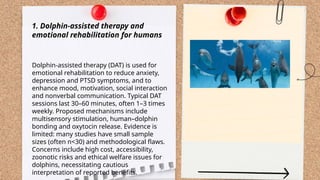
1. Dolphin-assisted therapyand
emotional rehabilitation for humans
Dolphin-assisted therapy (DAT) is used for
emotional rehabilitation to reduce anxiety,
depression and PTSD symptoms, and to
enhance mood, motivation, social interaction
and nonverbal communication. Typical DAT
sessions last 30–60 minutes, often 1–3 times
weekly. Proposed mechanisms include
multisensory stimulation, human–dolphin
bonding and oxytocin release. Evidence is
limited: many studies have small sample
sizes (often n<30) and methodological flaws.
Concerns include high cost, accessibility,
zoonotic risks and ethical welfare issues for
dolphins, necessitating cautious
interpretation of reported benefits.
4.
...
t.me/slaydai_bot
Dolphins support searchand rescue and maritime
safety by using echolocation (approximately 40–150
kHz) to detect submerged objects, wreckage and
trapped people, guiding survivors toward vessels or
shore, alerting crews to hazards, herding individuals
to safer areas, deterring shark approaches, and
assisting naval teams with mine and object detection.
Their social coordination expands search coverage,
speeds locating targets, reduces search areas, and
provides non-invasive monitoring of coastal
conditions for safety operations.
5.
...
t.me/slaydai_bot
Dolphin echolocation researchrevealed broadband,
high-frequency clicks ( 40–150 kHz), tight
≈
directionality and millisecond-scale echo timing.
These findings inspired human sonar advances:
broadband waveform design, adaptive beamforming,
high-resolution time-delay estimation, clutter
rejection and Doppler processing. Applications
include improved military and civilian sonar,
autonomous underwater vehicle navigation and
obstacle avoidance, and enhanced signal-processing
algorithms for acoustical imaging and underwater
target classification. Biomimetic sensor arrays and
neural-inspired processing architectures derive
directly from dolphin biosonar studies.
6.
...
t.me/slaydai_bot
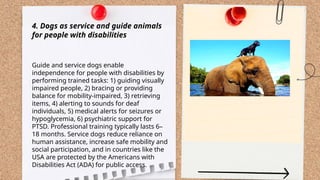
4. Dogs asservice and guide animals
for people with disabilities
Guide and service dogs enable
independence for people with disabilities by
performing trained tasks: 1) guiding visually
impaired people, 2) bracing or providing
balance for mobility-impaired, 3) retrieving
items, 4) alerting to sounds for deaf
individuals, 5) medical alerts for seizures or
hypoglycemia, 6) psychiatric support for
PTSD. Professional training typically lasts 6–
18 months. Service dogs reduce reliance on
human assistance, increase safe mobility and
social participation, and in countries like the
USA are protected by the Americans with
Disabilities Act (ADA) for public access.
7.
...
t.me/slaydai_bot
Medical detection dogscan identify cancers (prostate,
lung, ovarian) by sensing tumor-related volatile
organic compounds (VOCs) at parts-per-trillion
concentrations. Reported cancer detection
sensitivities range approximately 71%–99%
depending on cancer type and study. Diabetes alert
dogs detect hypoglycemia with reported accuracies of
about 70%–90%, warning several minutes to hours
before blood glucose nadir. Seizure-alert dogs can
anticipate seizures in 67%–85% of cases, sometimes
minutes to hours beforehand. Typical specialized
training requires 6–12 months using positive
reinforcement, improving patient safety,
independence, and reducing emergency
interventions.
8.
...
t.me/slaydai_bot
Search-and-rescue dogs locatetrapped or missing
people after earthquakes, avalanches, floods and
building collapses. Their olfactory sensitivity enables
detection of human scent through meters of rubble
and underwater, at concentrations as low as parts per
trillion. Trained for air-scenting, area search and
cadaver detection, they reduce search times and
increase survivor recovery rates, especially within the
first 72 hours. Dogs navigate unstable terrain, signal
finds to handlers and lower risks to human rescuers.
Typical deployment includes handlers, medical kits,
GPS and radio; effective search radius often 10–300
meters.
9.
...
t.me/slaydai_bot
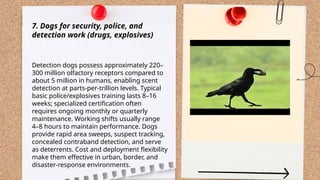
7. Dogs forsecurity, police, and
detection work (drugs, explosives)
Detection dogs possess approximately 220–
300 million olfactory receptors compared to
about 5 million in humans, enabling scent
detection at parts-per-trillion levels. Typical
basic police/explosives training lasts 8–16
weeks; specialized certification often
requires ongoing monthly or quarterly
maintenance. Working shifts usually range
4–8 hours to maintain performance. Dogs
provide rapid area sweeps, suspect tracking,
concealed contraband detection, and serve
as deterrents. Cost and deployment flexibility
make them effective in urban, border, and
disaster-response environments.
10.
...
t.me/slaydai_bot
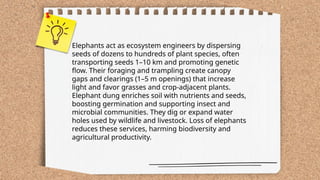
Elephants act asecosystem engineers by dispersing
seeds of dozens to hundreds of plant species, often
transporting seeds 1–10 km and promoting genetic
flow. Their foraging and trampling create canopy
gaps and clearings (1–5 m openings) that increase
light and favor grasses and crop-adjacent plants.
Elephant dung enriches soil with nutrients and seeds,
boosting germination and supporting insect and
microbial communities. They dig or expand water
holes used by wildlife and livestock. Loss of elephants
reduces these services, harming biodiversity and
agricultural productivity.
11.
The advantages of
dolphin,dog,elephant,crowfor
humans
Bekturdiyeva Ruxshona
Ergashboyeva Mahliyo
Habibullayeva Gulsanam
Abdumalikov Muhammadqodir
Thank you for your attention!