Sigmoid Hackathon
Idea Submission Phase
—Sherlock Holmes in “A study in Scarlet”
“It is a capital mistake to theorize before one has data.”
Meet the team :Young_Monks
Soumyo Bhattacharjee
Fourth Year Undergraduate Students
Indian Institute of Technology, Kharagpur
Shrinivas Khiste Shivam Pandey
Vishal Kumar Harsh Sharma
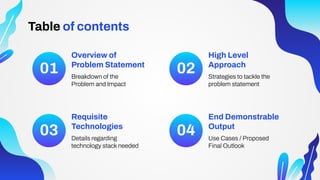
Breakdown of the
Problem and Impact
Strategies to tackle the
problem statement
01 02
Overview of
Problem Statement
High Level
Approach
Details regarding
technology stack needed
Use Cases / Proposed
Final Outlook
03 04
Requisite
Technologies
End Demonstrable
Output
Table of contents
Overview of Problem
Statement
01
Emotion Detection
Emotion Detection , is the synergistic association of emotions also
and technology. Emotion detection seeks to extract ner-grained
emotions such as happy, sad, angry, and so on, from human
languages rather than coarse-grained and general polarity
assignments in Sentiment Analysis, in order to provide ne-grained
decision-making.
Emotions play a very vital role in decisions that people make. To
understand these emotions can open new opportunities for any
business including the consumer goods industry.
Emotions can form the basis to provide recommendations and
improve customer experience at every touchpoint, in-turn
maximizing revenue for the company.
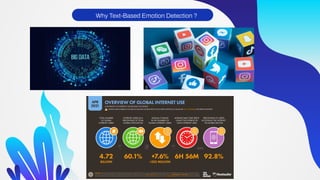
Why Text-Based Emotion Detection ?
$32.95 Billion
Expected to Grow at 16.7% CAGR , 2022 - 2030
Global Emotion Detection and Recognition Market Size
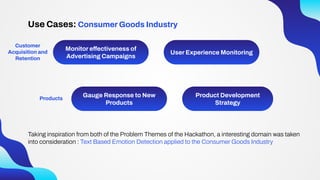
Use Cases: Consumer Goods Industry
Monitor effectiveness of
Advertising Campaigns
User Experience Monitoring
Product Development
Strategy
Products
Customer
Acquisition and
Retention
Taking inspiration from both of the Problem Themes of the Hackathon, a interesting domain was taken
into consideration : Text Based Emotion Detection applied to the Consumer Goods Industry
Gauge Response to New
Products
High Level Approach
You can enter a subtitle here if you need it
02
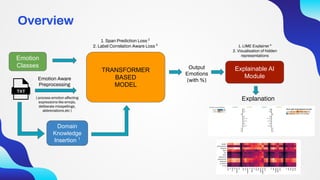
Overview
TRANSFORMER
BASED
MODEL
Domain
Knowledge
Insertion 1
Emotion
Classes
Explainable AI
Module
Output
Emotions
(with %)
Explanation
Emotion Aware
Preprocessing
1. Span Prediction Loss 2
2. Label Correlation Aware Loss 3
( process emotion affecting
expressions like emojis,
deliberate misspellings,
abbreviations,etc )
1. LIME Explainer 4
2. Visualisation of hidden
representations
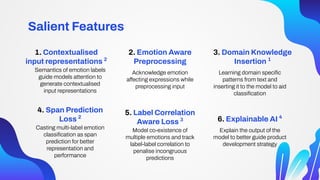
Salient Features
Semantics of emotion labels
guide models attention to
generate contextualised
input representations
Acknowledge emotion
affecting expressions while
preprocessing input
1. Contextualised
input representations 2
2. Emotion Aware
Preprocessing
Casting multi-label emotion
classication as span
prediction for better
representation and
performance
Model co-existence of
multiple emotions and track
label-label correlation to
penalise incongruous
predictions
4. Span Prediction
Loss 2
5. Label Correlation
Aware Loss 3
Learning domain specic
patterns from text and
inserting it to the model to aid
classication
3. Domain Knowledge
Insertion 1
Explain the output of the
model to better guide product
development strategy
6. Explainable AI 4
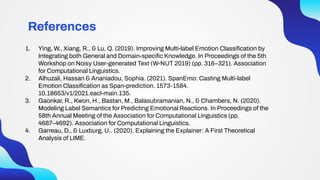
References
1. Ying, W., Xiang, R., & Lu, Q. (2019). Improving Multi-label Emotion Classication by
Integrating both General and Domain-specic Knowledge. In Proceedings of the 5th
Workshop on Noisy User-generated Text (W-NUT 2019) (pp. 316–321). Association
for Computational Linguistics.
2. Alhuzali, Hassan & Ananiadou, Sophia. (2021). SpanEmo: Casting Multi-label
Emotion Classication as Span-prediction. 1573-1584.
10.18653/v1/2021.eacl-main.135.
3. Gaonkar, R., Kwon, H., Bastan, M., Balasubramanian, N., & Chambers, N. (2020).
Modeling Label Semantics for Predicting Emotional Reactions. In Proceedings of the
58th Annual Meeting of the Association for Computational Linguistics (pp.
4687–4692). Association for Computational Linguistics.
4. Garreau, D., & Luxburg, U.. (2020). Explaining the Explainer: A First Theoretical
Analysis of LIME.
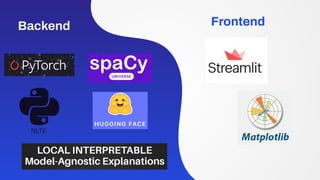
Requisite Technologies
03
Backend Frontend
End Demonstrable Output
04
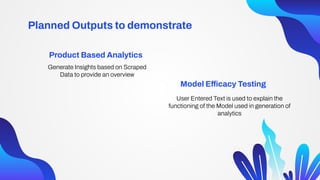
Generate Insights based on Scraped
Data to provide an overview
User Entered Text is used to explain the
functioning of the Model used in generation of
analytics
Product Based Analytics
Model Efficacy Testing
Planned Outputs to demonstrate
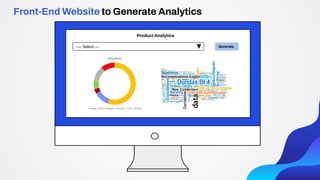
Front-End Website to Generate Analytics
—- Select — Generate
Product Analytics
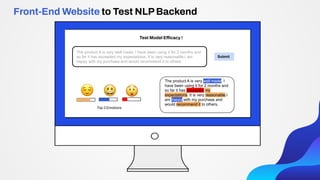
Front-End Website to Test NLPBackend
The product A is very well made. I have been using it for 2 months and
so far it has exceeded my expectations. It is very reasonable.I am
happy with my purchase and would recommend it to others.
Submit
Test Model Efficacy !
The product A is very well made. I
have been using it for 2 months and
so far it has exceeded my
expectations. It is very reasonable.I
am happy with my purchase and
would recommend it to others.
Top 3 Emotions
ThankYou!

NLP Hackathon ppt.pptx.pdf

  • 1.
  • 2.
    —Sherlock Holmes in“A study in Scarlet” “It is a capital mistake to theorize before one has data.”
  • 3.
    Meet the team:Young_Monks Soumyo Bhattacharjee Fourth Year Undergraduate Students Indian Institute of Technology, Kharagpur Shrinivas Khiste Shivam Pandey Vishal Kumar Harsh Sharma
  • 4.
    Breakdown of the Problemand Impact Strategies to tackle the problem statement 01 02 Overview of Problem Statement High Level Approach Details regarding technology stack needed Use Cases / Proposed Final Outlook 03 04 Requisite Technologies End Demonstrable Output Table of contents
  • 5.
  • 6.
    Emotion Detection Emotion Detection, is the synergistic association of emotions also and technology. Emotion detection seeks to extract ner-grained emotions such as happy, sad, angry, and so on, from human languages rather than coarse-grained and general polarity assignments in Sentiment Analysis, in order to provide ne-grained decision-making. Emotions play a very vital role in decisions that people make. To understand these emotions can open new opportunities for any business including the consumer goods industry. Emotions can form the basis to provide recommendations and improve customer experience at every touchpoint, in-turn maximizing revenue for the company.
  • 7.
  • 8.
    $32.95 Billion Expected toGrow at 16.7% CAGR , 2022 - 2030 Global Emotion Detection and Recognition Market Size
  • 9.
    Use Cases: ConsumerGoods Industry Monitor effectiveness of Advertising Campaigns User Experience Monitoring Product Development Strategy Products Customer Acquisition and Retention Taking inspiration from both of the Problem Themes of the Hackathon, a interesting domain was taken into consideration : Text Based Emotion Detection applied to the Consumer Goods Industry Gauge Response to New Products
  • 10.
    High Level Approach Youcan enter a subtitle here if you need it 02
  • 11.
    Overview TRANSFORMER BASED MODEL Domain Knowledge Insertion 1 Emotion Classes Explainable AI Module Output Emotions (with%) Explanation Emotion Aware Preprocessing 1. Span Prediction Loss 2 2. Label Correlation Aware Loss 3 ( process emotion affecting expressions like emojis, deliberate misspellings, abbreviations,etc ) 1. LIME Explainer 4 2. Visualisation of hidden representations
  • 12.
    Salient Features Semantics ofemotion labels guide models attention to generate contextualised input representations Acknowledge emotion affecting expressions while preprocessing input 1. Contextualised input representations 2 2. Emotion Aware Preprocessing Casting multi-label emotion classication as span prediction for better representation and performance Model co-existence of multiple emotions and track label-label correlation to penalise incongruous predictions 4. Span Prediction Loss 2 5. Label Correlation Aware Loss 3 Learning domain specic patterns from text and inserting it to the model to aid classication 3. Domain Knowledge Insertion 1 Explain the output of the model to better guide product development strategy 6. Explainable AI 4
  • 13.
    References 1. Ying, W.,Xiang, R., & Lu, Q. (2019). Improving Multi-label Emotion Classification by Integrating both General and Domain-specific Knowledge. In Proceedings of the 5th Workshop on Noisy User-generated Text (W-NUT 2019) (pp. 316–321). Association for Computational Linguistics. 2. Alhuzali, Hassan & Ananiadou, Sophia. (2021). SpanEmo: Casting Multi-label Emotion Classification as Span-prediction. 1573-1584. 10.18653/v1/2021.eacl-main.135. 3. Gaonkar, R., Kwon, H., Bastan, M., Balasubramanian, N., & Chambers, N. (2020). Modeling Label Semantics for Predicting Emotional Reactions. In Proceedings of the 58th Annual Meeting of the Association for Computational Linguistics (pp. 4687–4692). Association for Computational Linguistics. 4. Garreau, D., & Luxburg, U.. (2020). Explaining the Explainer: A First Theoretical Analysis of LIME.
  • 14.
  • 15.
  • 16.
  • 17.
    Generate Insights basedon Scraped Data to provide an overview User Entered Text is used to explain the functioning of the Model used in generation of analytics Product Based Analytics Model Efficacy Testing Planned Outputs to demonstrate
  • 18.
    Front-End Website toGenerate Analytics —- Select — Generate Product Analytics
  • 19.
    Front-End Website toTest NLPBackend The product A is very well made. I have been using it for 2 months and so far it has exceeded my expectations. It is very reasonable.I am happy with my purchase and would recommend it to others. Submit Test Model Efficacy ! The product A is very well made. I have been using it for 2 months and so far it has exceeded my expectations. It is very reasonable.I am happy with my purchase and would recommend it to others. Top 3 Emotions
  • 20.