INTRODUCTION TO NIKE Est. in 1960 in Oregon. Phil Knight and Bowerman - Founder Nike has gone through many changes Started small and now has covered the U.S. and International market
INTRODUCTION contd… Nike = Winged Goddess of Victory. “ Greeks say when we go to battle and win, we say it is NIKE!”
ANALYSIS OF CASE STUDY Limited resources and unlimited confidence. Persuasion of top athletes. Endorsement contracts effective.  Use of tactics such as guerilla warfare.
ANALYSIS contd…. Failure to recognise aerobics boom. Women -A major customer. Ignorance of  market trends. Timberland – brown shoes. Not satisfying customer needs. Child labour. Late in getting onboard with extreme sports.
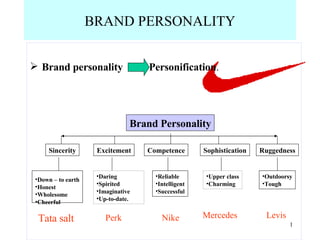
BRAND PERSONALITY  Brand personality  Personification . 1 Brand Personality Sincerity Excitement Competence Sophistication Ruggedness Daring Spirited Imaginative Up-to-date. Reliable Intelligent Successful Upper class Charming Outdoorsy Tough Perk Nike Mercedes Levis Down – to earth Honest Wholesome Cheerful Tata salt
Michael Jordan Put Nike on the map 1984-1985 Nike saw a decrease in their earnings for the first time ever Influenced them to make their first specialty basketball shoe Since then, Michael and Nike together have generated billions of dollars in revenue “ World Sports Hero No. 1” Jumpman logo is one of the most easily recognized symbols throughout the world
Tiger Woods The newest Nike sensation Estimated that Nike paid him $40 million More attention than Michael Jordan and Bo Jackson 3 pg. ad in Wall Street Journal 30- and 60- second TV spots Aired during college football, major league baseball, the U.S. Open, SportsCenter and Monday Night Football
Branding: powerful marketing mechanism used by Nike Leads to higher and more consistent  product quality . Increases innovation  by giving producers an incentive to look for more new features that can be safeguarded by the patent. Branding results in more  product variety  and  choice  for consumers. Branding provides  consumer information  about products and where to find them.
Brand equity Brand equity  is defined as the positive differential effect that knowing the brand name has on customer response to the product or service. Philip Kotler
Brand equity Brands represent the consumers’ perceptions and feelings about products and their performance.  The real value of branding is the ability to capture consumer preference and loyalty. Brands vary in power and value and have varying degrees of  brand awareness ,  brand preference  and  brand loyalty .
Nike’s Market Expansion Strategies Economies of  Scale .  Shared distribution channels among varied product lines lower costs. Large size provides opportunity for more leverage against competition. Efficient use of production facilities lowers costs.
Global sourcing: the Nike case Nike has relocated production of its footwear and clothing to 51 countries where its third party production units employ more than 500,000 people (as against approximately 14,000 people directly employed by the multinational).  From its headquarters in Beaverton, Oregon, Nike manages a worldwide virtual company combining internal R&D functions with a low cost manufacturing strategy. They control their activity from Oregon and Tennessee and developed jointly by American and Asian technicians in the USA, Taiwan and South Korea. Sneakers are then assembled in South Korea and Indonesia from dozens of components supplied by firms in Japan, South Korea, Taiwan, Indonesia and the United States. Similarly, Nike outsources distribution to firms that specialise in logistics services.
Brand/Image  Ability to charge premium price by establishing an “image”  • Access to new/different markets  • Premium product placement in retail leading to higher sales  • Image and celebrity endorsements create hopes/dreams/emotional attachment to product
Innovation Innovation may be difficult for competitors to imitate. Difficult for competitors to compete with rate of innovation/production. Ability to capture market for different attitudes/values across cultures with product variety.  Strong emphasis on R&D leads to continuous improvement in products.
Geographical  Outreach  Ability to reinforce brand and create loyalty across cultures leading to a broad customer base.  • Increased company growth potential.  • Cross-subsidization of weaker markets.
Product Diversification New products introduced by Nike will be more readily accepted by customers due to strong brand image
Other strategies adopted by Nike Sponsorship for sporting events Advertisements. Rebates and Discounts. Conducting fashion shows.
PRODUCT MIX Product Mix A product mix is the set of all products and items that a particular seller offers for sale to buyers also known as product assortment. Product Width It refers to how many product lines the company carries.
PRODUCT Mix contd…. Product line  A product line is a group of products that are closely related because they perform similar functions  Product length It refers to the total number of items in its product mix Product depth It refers to how many products are offered of each product line.
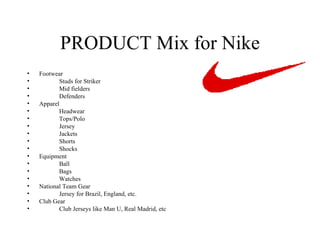
PRODUCT Mix for Nike Footwear  Studs for Striker Mid fielders  Defenders Apparel Headwear Tops/Polo Jersey Jackets Shorts  Shocks Equipment Ball  Bags Watches National Team Gear Jersey for Brazil, England, etc. Club Gear  Club Jerseys like Man U, Real Madrid, etc
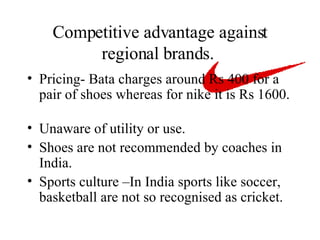
Competitive advantage against regional brands.  Pricing- Bata charges around Rs 400 for a pair of shoes whereas for nike it is Rs 1600.  Unaware of utility or use. Shoes are not recommended by coaches in India. Sports culture –In India sports like soccer, basketball are not so recognised as cricket.
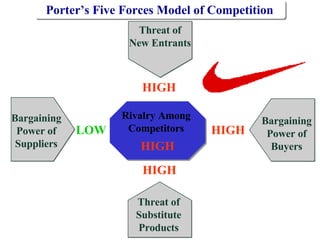
Threat of Substitute Products Threat of New Entrants Porter’s Five Forces Model of Competition Rivalry Among Competitors Bargaining Power of Buyers Bargaining Power of Suppliers HIGH HIGH HIGH LOW HIGH
FUNCTION AND FASHION Now, Nike concentrates on two aspects function and fashion. In 1960’s Nike entered the market with function due to which they Failed in early times. Nike believes if you have a body, you are an athlete.
JUST IT DO

Nike Ppt[1]

  • 1.
    INTRODUCTION TO NIKEEst. in 1960 in Oregon. Phil Knight and Bowerman - Founder Nike has gone through many changes Started small and now has covered the U.S. and International market
  • 2.
    INTRODUCTION contd… Nike= Winged Goddess of Victory. “ Greeks say when we go to battle and win, we say it is NIKE!”
  • 3.
    ANALYSIS OF CASESTUDY Limited resources and unlimited confidence. Persuasion of top athletes. Endorsement contracts effective. Use of tactics such as guerilla warfare.
  • 4.
    ANALYSIS contd…. Failureto recognise aerobics boom. Women -A major customer. Ignorance of market trends. Timberland – brown shoes. Not satisfying customer needs. Child labour. Late in getting onboard with extreme sports.
  • 5.
    BRAND PERSONALITY Brand personality Personification . 1 Brand Personality Sincerity Excitement Competence Sophistication Ruggedness Daring Spirited Imaginative Up-to-date. Reliable Intelligent Successful Upper class Charming Outdoorsy Tough Perk Nike Mercedes Levis Down – to earth Honest Wholesome Cheerful Tata salt
  • 6.
    Michael Jordan PutNike on the map 1984-1985 Nike saw a decrease in their earnings for the first time ever Influenced them to make their first specialty basketball shoe Since then, Michael and Nike together have generated billions of dollars in revenue “ World Sports Hero No. 1” Jumpman logo is one of the most easily recognized symbols throughout the world
  • 7.
    Tiger Woods Thenewest Nike sensation Estimated that Nike paid him $40 million More attention than Michael Jordan and Bo Jackson 3 pg. ad in Wall Street Journal 30- and 60- second TV spots Aired during college football, major league baseball, the U.S. Open, SportsCenter and Monday Night Football
  • 8.
    Branding: powerful marketingmechanism used by Nike Leads to higher and more consistent product quality . Increases innovation by giving producers an incentive to look for more new features that can be safeguarded by the patent. Branding results in more product variety and choice for consumers. Branding provides consumer information about products and where to find them.
  • 9.
    Brand equity Brandequity is defined as the positive differential effect that knowing the brand name has on customer response to the product or service. Philip Kotler
  • 10.
    Brand equity Brandsrepresent the consumers’ perceptions and feelings about products and their performance. The real value of branding is the ability to capture consumer preference and loyalty. Brands vary in power and value and have varying degrees of brand awareness , brand preference and brand loyalty .
  • 11.
    Nike’s Market ExpansionStrategies Economies of Scale . Shared distribution channels among varied product lines lower costs. Large size provides opportunity for more leverage against competition. Efficient use of production facilities lowers costs.
  • 12.
    Global sourcing: theNike case Nike has relocated production of its footwear and clothing to 51 countries where its third party production units employ more than 500,000 people (as against approximately 14,000 people directly employed by the multinational). From its headquarters in Beaverton, Oregon, Nike manages a worldwide virtual company combining internal R&D functions with a low cost manufacturing strategy. They control their activity from Oregon and Tennessee and developed jointly by American and Asian technicians in the USA, Taiwan and South Korea. Sneakers are then assembled in South Korea and Indonesia from dozens of components supplied by firms in Japan, South Korea, Taiwan, Indonesia and the United States. Similarly, Nike outsources distribution to firms that specialise in logistics services.
  • 13.
    Brand/Image Abilityto charge premium price by establishing an “image” • Access to new/different markets • Premium product placement in retail leading to higher sales • Image and celebrity endorsements create hopes/dreams/emotional attachment to product
  • 14.
    Innovation Innovation maybe difficult for competitors to imitate. Difficult for competitors to compete with rate of innovation/production. Ability to capture market for different attitudes/values across cultures with product variety. Strong emphasis on R&D leads to continuous improvement in products.
  • 15.
    Geographical Outreach Ability to reinforce brand and create loyalty across cultures leading to a broad customer base. • Increased company growth potential. • Cross-subsidization of weaker markets.
  • 16.
    Product Diversification Newproducts introduced by Nike will be more readily accepted by customers due to strong brand image
  • 17.
    Other strategies adoptedby Nike Sponsorship for sporting events Advertisements. Rebates and Discounts. Conducting fashion shows.
  • 18.
    PRODUCT MIX ProductMix A product mix is the set of all products and items that a particular seller offers for sale to buyers also known as product assortment. Product Width It refers to how many product lines the company carries.
  • 19.
    PRODUCT Mix contd….Product line A product line is a group of products that are closely related because they perform similar functions Product length It refers to the total number of items in its product mix Product depth It refers to how many products are offered of each product line.
  • 20.
    PRODUCT Mix forNike Footwear Studs for Striker Mid fielders Defenders Apparel Headwear Tops/Polo Jersey Jackets Shorts Shocks Equipment Ball Bags Watches National Team Gear Jersey for Brazil, England, etc. Club Gear Club Jerseys like Man U, Real Madrid, etc
  • 21.
    Competitive advantage againstregional brands. Pricing- Bata charges around Rs 400 for a pair of shoes whereas for nike it is Rs 1600. Unaware of utility or use. Shoes are not recommended by coaches in India. Sports culture –In India sports like soccer, basketball are not so recognised as cricket.
  • 22.
    Threat of SubstituteProducts Threat of New Entrants Porter’s Five Forces Model of Competition Rivalry Among Competitors Bargaining Power of Buyers Bargaining Power of Suppliers HIGH HIGH HIGH LOW HIGH
  • 23.
    FUNCTION AND FASHIONNow, Nike concentrates on two aspects function and fashion. In 1960’s Nike entered the market with function due to which they Failed in early times. Nike believes if you have a body, you are an athlete.
  • 24.