Names and nicknames
of places and things
PREPARED
BY TANIA PIDKOVA
Introduction
The nicknames are
of great interest from
many different points
of view. People of
various professions are
interested in them. For
example, the linguist
studies them because
he is concerned with
all kinds of word
creation.
The sociologist is concerned with reasons for nicknaming; theThe sociologist is concerned with reasons for nicknaming; the
psychologist with personal reactions to them. As for the journalist, hepsychologist with personal reactions to them. As for the journalist, he
finds nicknames interesting because of the anecdotes that are oftenfinds nicknames interesting because of the anecdotes that are often
associated with them.associated with them.
 No doubt the students who are fond of English should get more
knowledge about the language, the culture and the regional
geography of English-speaking countries.
Problem
The program of learning English language does not
include the theme of nicknames in details. So it is difficult
to understand English nicknames well.
ActualityActuality
 In this respect, the
actuality of the research
work determines the
necessity of examination
of names and nicknames
of places and things in the
aspect of culture-oriented
linguistics.
 More than that, we hope
this knowledge will be
useful for students in future
because of their intention
to enter academies.
The Weimaraner’s coat colour led
to its nickname “Silver Ghost”
The London is nicknamed
“The Tube”
Object of the research
Thus, the object of the research work is American names and
nicknames of places and things for the purpose of culture-oriented
linguistics. American English was chosen because nowadays it is
considered to be widespread in the world.
The Objective
to give the general characteristics of the most popular names and
nicknames of places and things in modern English
California is nicknamed
El Dorado State or Golden State.
Hirakata-shi, Osaka, Japan is called
“Ginkgo Street”.
To achieve the objective we will
have to cope with the following tasks
 to determine the main term of the work “nickname”;
to examine the place of nicknames in everyday life of
society;
to study subdivisions of nicknames;
to view the examples that prove the importance of
nicknames;
to analyze Linguistic and Cultural Guide (LCG) (Student’s
book, author Virginia Evans.) and the dictionary
of names and nicknames;
to conclude the results of a survey;
to systematize findings.
Practical Application
 The research paper helps to analyze the typical nicknames used
by people who use English as a foreign language;
 Helps to better understand these nicknames and use them in
everyday speech;
 The found information can be used for farther scientific researches.
Methods used in the research
 a method of conceptual analysis,
 synthesis,
 problematic method,
 comparative method,
 and statistical calculations.
Alabama’s nickname is
Yellowhammer State
Virginia State is called “Mother of Presidents”
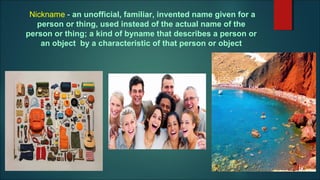
Nickname - an unofficial, familiar, invented name given for a
person or thing, used instead of the actual name of the
person or thing; a kind of byname that describes a person or
an object by a characteristic of that person or object
The Usage of Nicknames
 The nicknames take a
really important part of
everyday life of
society.
 Pupils at most schools,
for instance, can refer
to classmates and
teachers among
themselves by using
nicknames that would
be meaningless to an
outsider.
The Usage of Nicknames
 Nicknames, along with certain slang expressions, often help to create a private
language that excludes strangers.
 The most extreme example of such a private language is that used between lovers. The
partners are likely to have nicknames for each other that are uttered only in moments of
intimacy, and that otherwise remain a closely guarded secret.
E.g.: kittie; baby; sunny; sweetie; honey; sweetheart; angel;
darling.
Significance of Nicknames
As the social group
widens, so the
significance of a
nickname and the
reason for it become less
intense. The nickname
may merely be a shared
joke, or a reflection of
what H.L. Mencken once
called “linguistic
exuberance, an excess
of word-making energy.”
Henry Luis Mencken
Importance of Nicknames
 For some kinds of people it is very important to have nicknames. For example,
politicians who depend on public support, often encourage the media to use
nicknames when referring to them, usually those nicknames are friendly or flattering.
The wrong nickname could easily ruin a public reputation, just as it can cause great
problems in private life.
 E.g. George Washington had a nickname The Father of His Country; Bill Clinton - Slick
Willie; The First Black President; Barack Obama- No Drama Obama.
Bill Clinton Barack Obama George Washington
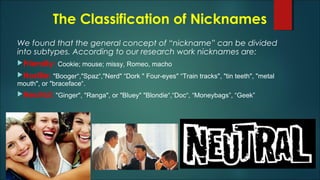
The Classification of Nicknames
We found that the general concept of “nickname” can be divided
into subtypes. According to our research work nicknames are:
Friendly: Cookie; mouse; missy, Romeo, macho
Hostile: "Booger“,"Spaz“,"Nerd" “Dork " Four-eyes" “Train tracks", "tin teeth", "metal
mouth", or "braceface“.
Neutral: "Ginger", "Ranga", or "Bluey" "Blondie“,“Doc“, “Moneybags”, “Geek”
The Usage of Nicknames
 They can also be classed as individual or generic.
 There also exists a special kind of nickname that is more widely used than a real name
of a person. This is because the real name of the person concerned is unknown. A
typical example occurs when a criminal’s deeds attract the attention of the public
although his identity remains hidden.
Nicknames in crime
Some criminals, like London’s Jack the Ripper,
retain the nickname as their only certain
identification. Others may later be known by their
real names, yet the nickname may well remain
and better known.
Nicknames in crime
There are many people, for instance, to whom the
name Albert De Salvo would mean nothing, though
they would know of his activities as The Boston
Strangler.
Neutral Nicknames
Nevertheless,
countless nicknames are
far less personal, being
inherited by certain
categories of people. A
man with red hair
automatically becomes
Red; someone from
Indiana is a Hoosier;
someone who is bald - is
Curly.
To get good knowledge of the nicknames widely used in
every day speech we studied a dictionary of names and
nicknames
Analysis of a dictionary of names and
nicknames
PRACTICAL WORK
Pupils of grades 9-11 of our Gymnasium were asked the following
questions:
1.What/Who is called “Dog
Star”?
a) A nickname of area in
London;
b) A name for the star
Sirius;
c) A nickname of a dog.
3.How do the French call the
Channel which connects
Great Britain and France?
a) A Great Way
b) La-Manche
c) The Channel of Love
2.A world-known nickname of New York is..
a) A Big Apple
b) A City of Dreams
c) A Wonderland
4.What is a nickname for Great Britain?
a) A Foggy Albion
b) A Country of Seven Hills
c) The Country of Three Seas
5.A nickname given to the Planet Mars is..
a) Yellow Planet
b) Red Planet
c) Brown Planet
6.Have you ever heard about City
of Lilies? What is it?
a) Amsterdam
b) Paris
c) Florence
7.Do you know what nickname was given to
London, when it was the world’s leading port?
a) The City of Ships
b) The City of Masts
c) The Queen of Seas
8.Have you ever heard about “Great White Way”?
a) Khreshchatyk Street;
b) Broadway Street ;
c) Baker Street. 9.What is Black Diamond?
a) A nickname of petroleum;
b) Jewel;
c) A nickname for coal.
10.What is The City of the Seven Hills?
a) A nickname of Syracuse;
b) A nickname for Rome;
c) A nickname of Broadway.
According to our survey
Conclusion
 The nicknames are of great interest from many different points of view. People of
various professions are interested in them.
 During our work we: determined the main term of the work “nickname”; examined
the place of nicknames in everyday life of society; studied subdivisions of
nicknames; viewed the examples that prove the importance of nicknames.
 In practical part we: conducted a survey, analyzed Linguistic and Cultural Guide
and the dictionary of names and nicknames.
 In this respect we worked out some tasks that can be very useful for learning
nicknames.
 We consider that the findings of this research work can be used in further scientific
studies on the given theme.
Thank You For Your
Attention

Nicknames

  • 1.
    Names and nicknames ofplaces and things PREPARED BY TANIA PIDKOVA
  • 2.
    Introduction The nicknames are ofgreat interest from many different points of view. People of various professions are interested in them. For example, the linguist studies them because he is concerned with all kinds of word creation.
  • 3.
    The sociologist isconcerned with reasons for nicknaming; theThe sociologist is concerned with reasons for nicknaming; the psychologist with personal reactions to them. As for the journalist, hepsychologist with personal reactions to them. As for the journalist, he finds nicknames interesting because of the anecdotes that are oftenfinds nicknames interesting because of the anecdotes that are often associated with them.associated with them.  No doubt the students who are fond of English should get more knowledge about the language, the culture and the regional geography of English-speaking countries.
  • 4.
    Problem The program oflearning English language does not include the theme of nicknames in details. So it is difficult to understand English nicknames well.
  • 5.
    ActualityActuality  In thisrespect, the actuality of the research work determines the necessity of examination of names and nicknames of places and things in the aspect of culture-oriented linguistics.  More than that, we hope this knowledge will be useful for students in future because of their intention to enter academies. The Weimaraner’s coat colour led to its nickname “Silver Ghost” The London is nicknamed “The Tube”
  • 6.
    Object of theresearch Thus, the object of the research work is American names and nicknames of places and things for the purpose of culture-oriented linguistics. American English was chosen because nowadays it is considered to be widespread in the world.
  • 7.
    The Objective to givethe general characteristics of the most popular names and nicknames of places and things in modern English California is nicknamed El Dorado State or Golden State. Hirakata-shi, Osaka, Japan is called “Ginkgo Street”.
  • 8.
    To achieve theobjective we will have to cope with the following tasks  to determine the main term of the work “nickname”; to examine the place of nicknames in everyday life of society; to study subdivisions of nicknames; to view the examples that prove the importance of nicknames; to analyze Linguistic and Cultural Guide (LCG) (Student’s book, author Virginia Evans.) and the dictionary of names and nicknames; to conclude the results of a survey; to systematize findings.
  • 9.
    Practical Application  Theresearch paper helps to analyze the typical nicknames used by people who use English as a foreign language;  Helps to better understand these nicknames and use them in everyday speech;  The found information can be used for farther scientific researches.
  • 10.
    Methods used inthe research  a method of conceptual analysis,  synthesis,  problematic method,  comparative method,  and statistical calculations. Alabama’s nickname is Yellowhammer State Virginia State is called “Mother of Presidents”
  • 11.
    Nickname - anunofficial, familiar, invented name given for a person or thing, used instead of the actual name of the person or thing; a kind of byname that describes a person or an object by a characteristic of that person or object
  • 12.
    The Usage ofNicknames  The nicknames take a really important part of everyday life of society.  Pupils at most schools, for instance, can refer to classmates and teachers among themselves by using nicknames that would be meaningless to an outsider.
  • 13.
    The Usage ofNicknames  Nicknames, along with certain slang expressions, often help to create a private language that excludes strangers.  The most extreme example of such a private language is that used between lovers. The partners are likely to have nicknames for each other that are uttered only in moments of intimacy, and that otherwise remain a closely guarded secret. E.g.: kittie; baby; sunny; sweetie; honey; sweetheart; angel; darling.
  • 14.
    Significance of Nicknames Asthe social group widens, so the significance of a nickname and the reason for it become less intense. The nickname may merely be a shared joke, or a reflection of what H.L. Mencken once called “linguistic exuberance, an excess of word-making energy.” Henry Luis Mencken
  • 15.
    Importance of Nicknames For some kinds of people it is very important to have nicknames. For example, politicians who depend on public support, often encourage the media to use nicknames when referring to them, usually those nicknames are friendly or flattering. The wrong nickname could easily ruin a public reputation, just as it can cause great problems in private life.  E.g. George Washington had a nickname The Father of His Country; Bill Clinton - Slick Willie; The First Black President; Barack Obama- No Drama Obama. Bill Clinton Barack Obama George Washington
  • 16.
    The Classification ofNicknames We found that the general concept of “nickname” can be divided into subtypes. According to our research work nicknames are: Friendly: Cookie; mouse; missy, Romeo, macho Hostile: "Booger“,"Spaz“,"Nerd" “Dork " Four-eyes" “Train tracks", "tin teeth", "metal mouth", or "braceface“. Neutral: "Ginger", "Ranga", or "Bluey" "Blondie“,“Doc“, “Moneybags”, “Geek”
  • 17.
    The Usage ofNicknames  They can also be classed as individual or generic.  There also exists a special kind of nickname that is more widely used than a real name of a person. This is because the real name of the person concerned is unknown. A typical example occurs when a criminal’s deeds attract the attention of the public although his identity remains hidden.
  • 18.
    Nicknames in crime Somecriminals, like London’s Jack the Ripper, retain the nickname as their only certain identification. Others may later be known by their real names, yet the nickname may well remain and better known.
  • 19.
    Nicknames in crime Thereare many people, for instance, to whom the name Albert De Salvo would mean nothing, though they would know of his activities as The Boston Strangler.
  • 20.
    Neutral Nicknames Nevertheless, countless nicknamesare far less personal, being inherited by certain categories of people. A man with red hair automatically becomes Red; someone from Indiana is a Hoosier; someone who is bald - is Curly.
  • 21.
    To get goodknowledge of the nicknames widely used in every day speech we studied a dictionary of names and nicknames Analysis of a dictionary of names and nicknames
  • 22.
    PRACTICAL WORK Pupils ofgrades 9-11 of our Gymnasium were asked the following questions: 1.What/Who is called “Dog Star”? a) A nickname of area in London; b) A name for the star Sirius; c) A nickname of a dog. 3.How do the French call the Channel which connects Great Britain and France? a) A Great Way b) La-Manche c) The Channel of Love 2.A world-known nickname of New York is.. a) A Big Apple b) A City of Dreams c) A Wonderland 4.What is a nickname for Great Britain? a) A Foggy Albion b) A Country of Seven Hills c) The Country of Three Seas
  • 23.
    5.A nickname givento the Planet Mars is.. a) Yellow Planet b) Red Planet c) Brown Planet 6.Have you ever heard about City of Lilies? What is it? a) Amsterdam b) Paris c) Florence 7.Do you know what nickname was given to London, when it was the world’s leading port? a) The City of Ships b) The City of Masts c) The Queen of Seas
  • 24.
    8.Have you everheard about “Great White Way”? a) Khreshchatyk Street; b) Broadway Street ; c) Baker Street. 9.What is Black Diamond? a) A nickname of petroleum; b) Jewel; c) A nickname for coal. 10.What is The City of the Seven Hills? a) A nickname of Syracuse; b) A nickname for Rome; c) A nickname of Broadway.
  • 25.
  • 26.
    Conclusion  The nicknamesare of great interest from many different points of view. People of various professions are interested in them.  During our work we: determined the main term of the work “nickname”; examined the place of nicknames in everyday life of society; studied subdivisions of nicknames; viewed the examples that prove the importance of nicknames.  In practical part we: conducted a survey, analyzed Linguistic and Cultural Guide and the dictionary of names and nicknames.  In this respect we worked out some tasks that can be very useful for learning nicknames.  We consider that the findings of this research work can be used in further scientific studies on the given theme.
  • 27.
    Thank You ForYour Attention