Теребовлянська гімназія
спецшкола-інтернат
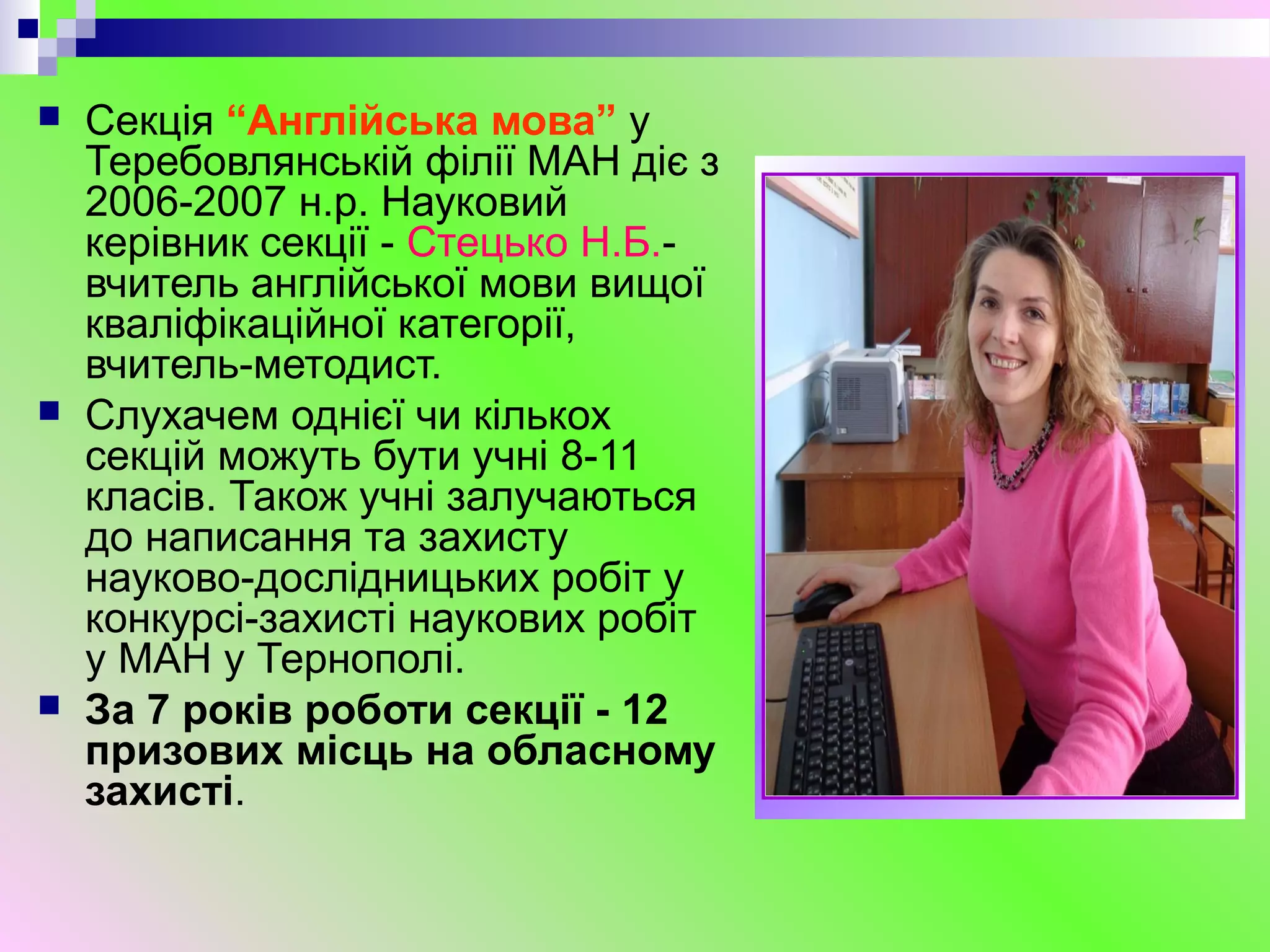
 Секція “Англійська мова” у
Теребовлянській філії МАН діє з
2006-2007 н.р. Науковий
керівник секції - Стецько Н.Б.-
вчитель англійської мови вищої
кваліфікаційної категорії,
вчитель-методист.
 Слухачем однієї чи кількох
секцій можуть бути учні 8-11
класів. Також учні залучаються
до написання та захисту
науково-дослідницьких робіт у
конкурсі-захисті наукових робіт
у МАН у Тернополі.
 За 7 років роботи секції - 12
призових місць на обласному
захисті.
?Що дає учать в МАН?Що дає учать в МАН
Обдаровані діти характеризуються високим розвитком мислення,
добрими навичками самоконтролю, великою працездатністю, їм
притаманна багата уява, неординарність, швидкість реакції, вміння
науково осмислювати деякі явища, стереотипи, догми. Завдання для
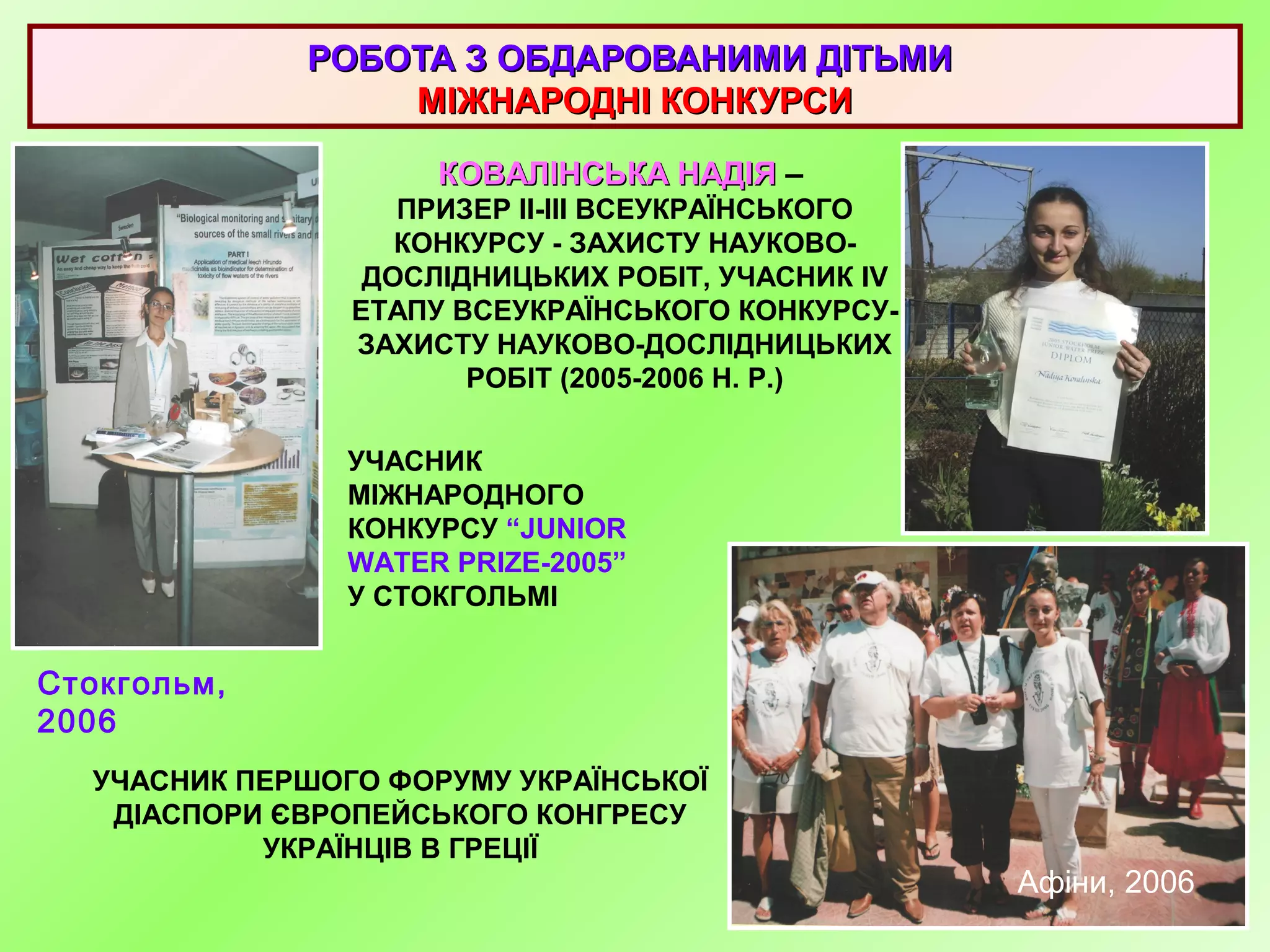
таких учнів повинні бути творчими. Додаткові навантаження необхідні,
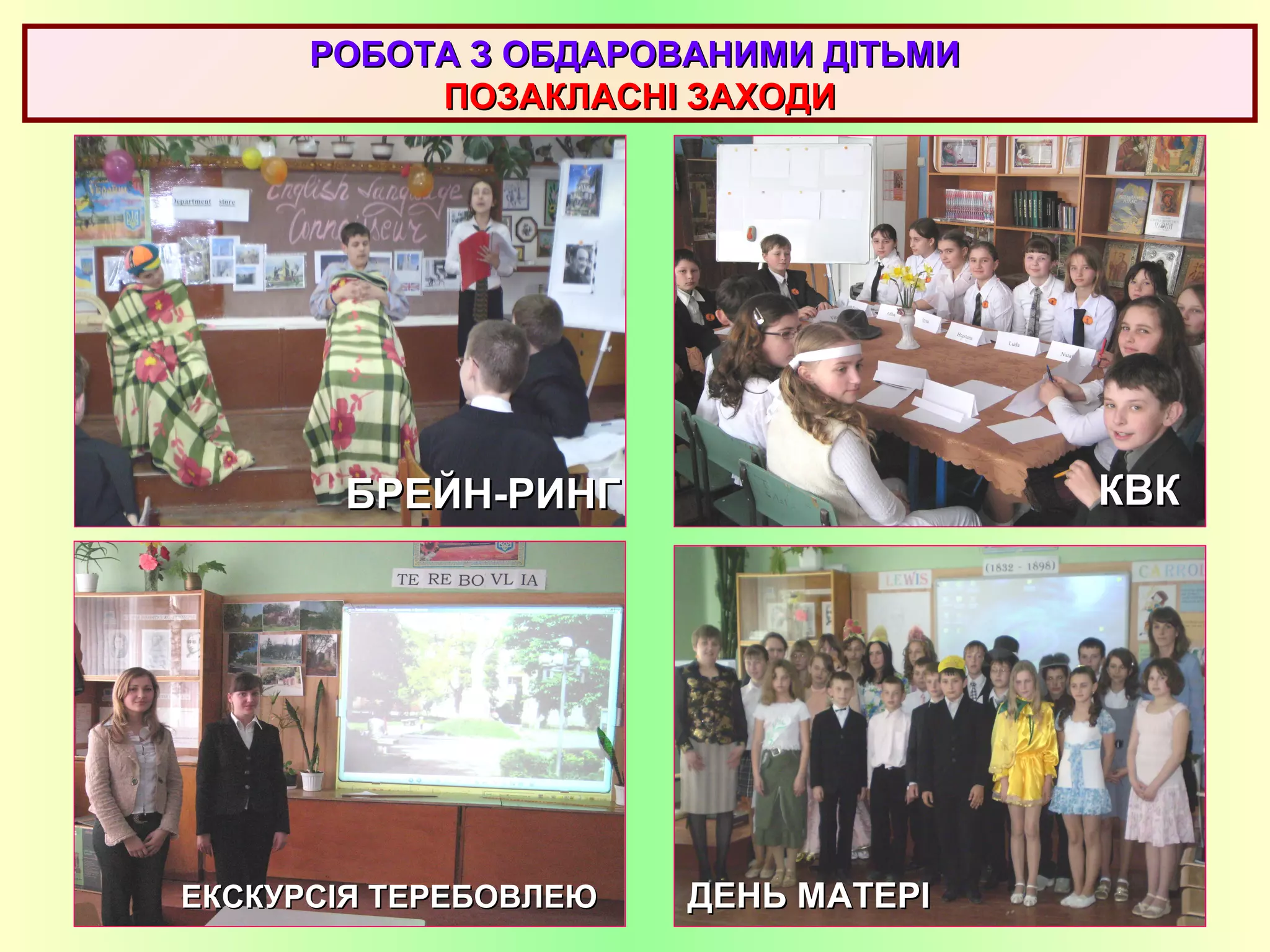
вони сприяють розвитку здібностей, створюють умови для задоволення їх
різнобічних пізнавальних інтересів.
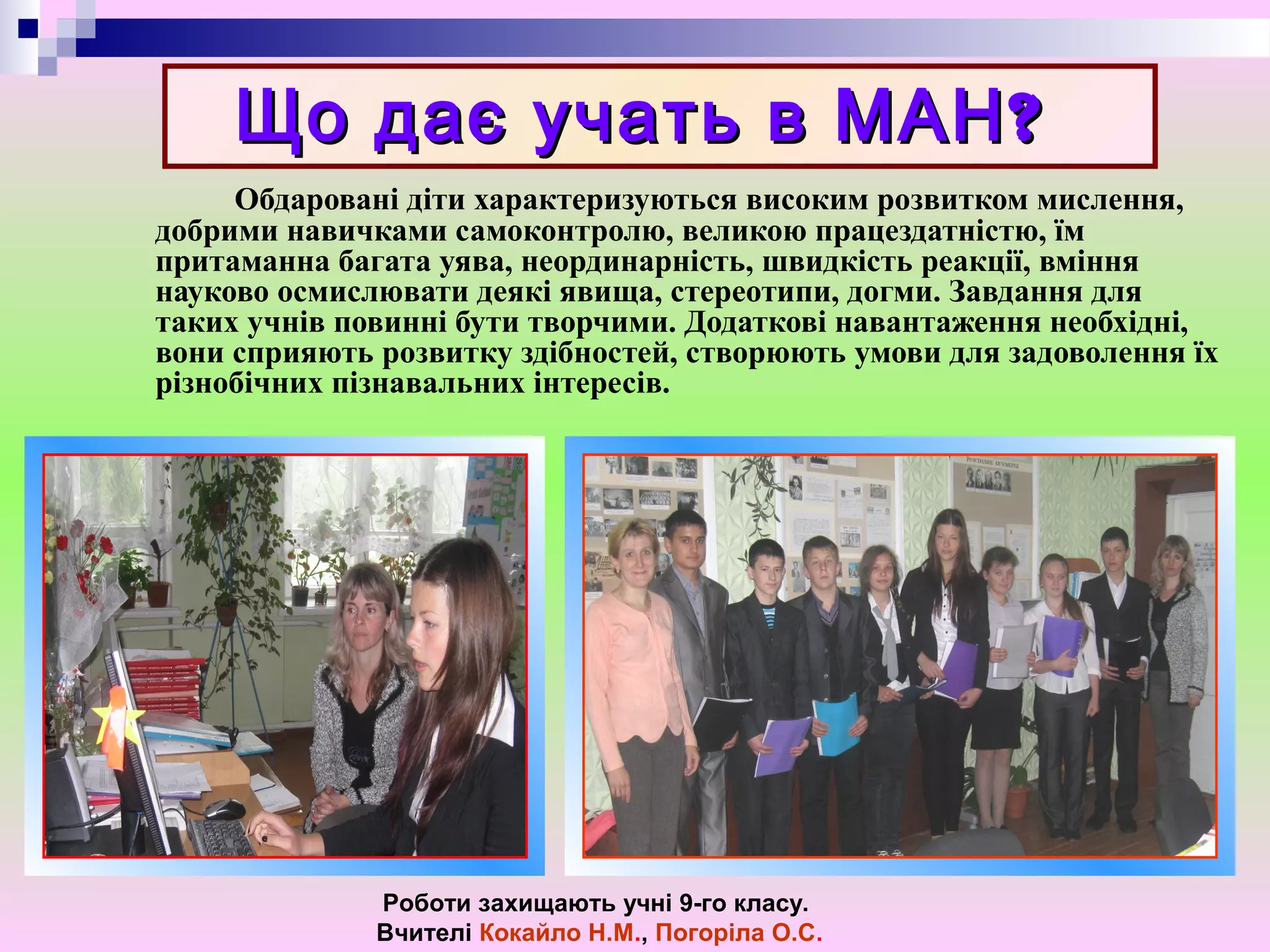
Роботи захищають учні 9-го класу.
Вчителі Кокайло Н.М., Погоріла О.С.
Організація роботи з обдарованими
дітьмиУ методах навчання
обдарованих учнів мають
переважати самостійна
робота, частково пошуковий
та дослідницький підходи до
засвоєння знань, вмінь,
навичок. З цієї точки зору
наукові роботи є актуальними
і мають велику цінність.
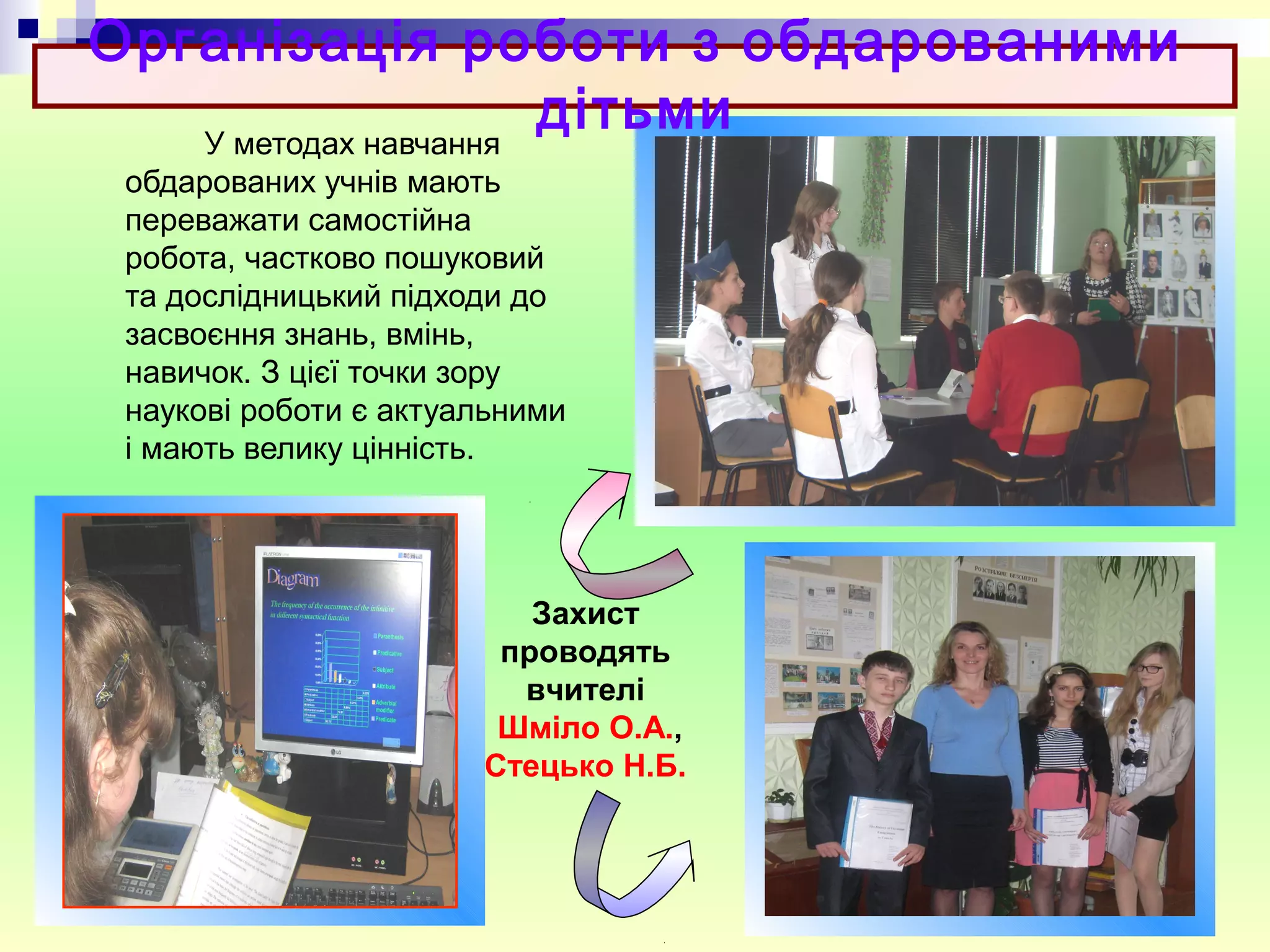
Захист
проводять
вчителі
Шміло О.А.,
Стецько Н.Б.
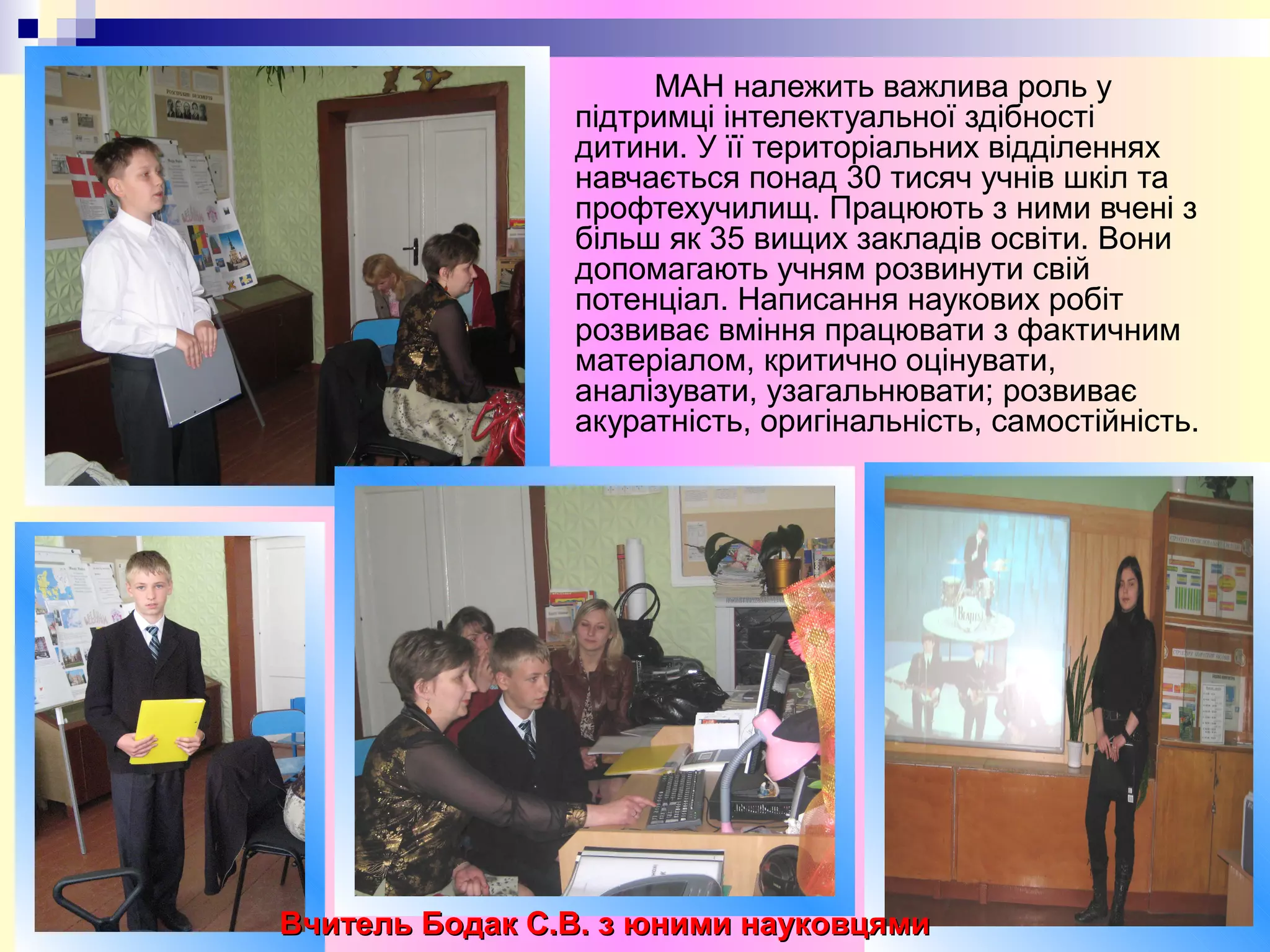
МАН належить важлива роль у
підтримці інтелектуальної здібності
дитини. У її територіальних відділеннях
навчається понад 30 тисяч учнів шкіл та
профтехучилищ. Працюють з ними вчені з
більш як 35 вищих закладів освіти. Вони
допомагають учням розвинути свій
потенціал. Написання наукових робіт
розвиває вміння працювати з фактичним
матеріалом, критично оцінувати,
аналізувати, узагальнювати; розвиває
акуратність, оригінальність, самостійність.
Вчитель Бодак С.В. з юними науковцямиВчитель Бодак С.В. з юними науковцями
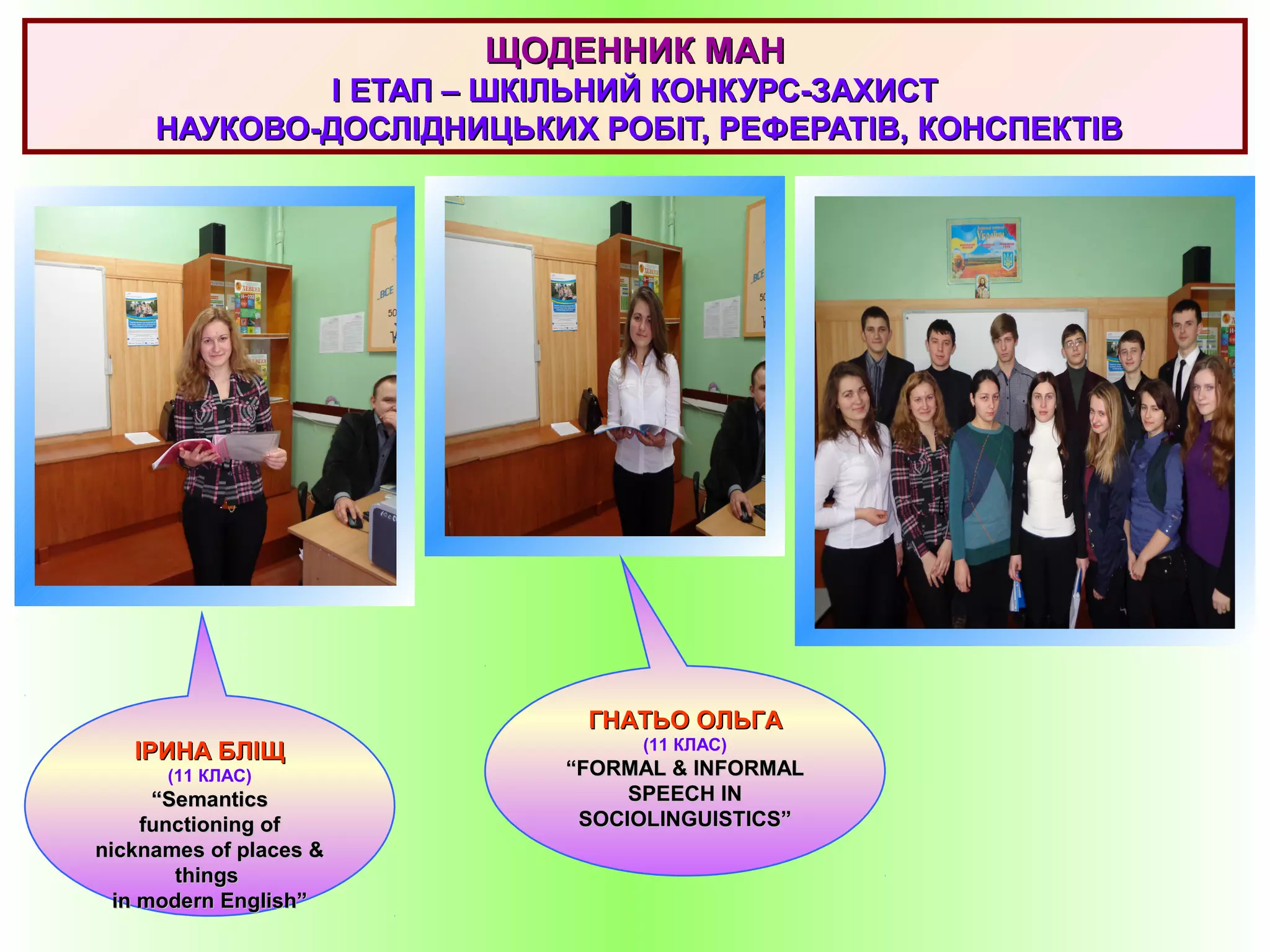
ІРИНА БЛІЩІРИНА БЛІЩ
(11 КЛАС)
““SemanticSemanticss
functioning offunctioning of
nicknames of places &nicknames of places &
thingsthings
in modern English”in modern English”
ЩОДЕННИК МАНЩОДЕННИК МАН
II ЕТАП – ШКІЛЬНИЙ КОНКУРС-ЗАХИСТЕТАП – ШКІЛЬНИЙ КОНКУРС-ЗАХИСТ
НАУКОВО-ДОСЛІДНИЦЬКИХ РОБІТ, РЕФЕРАТІВ, КОНСПЕКТІВНАУКОВО-ДОСЛІДНИЦЬКИХ РОБІТ, РЕФЕРАТІВ, КОНСПЕКТІВ
ГНАТЬО ОЛЬГАГНАТЬО ОЛЬГА
(11 КЛАС)
““FORMAL & INFORMALFORMAL & INFORMAL
SPEECH INSPEECH IN
SOCIOLINGUISTICS”SOCIOLINGUISTICS”
Semantics
functioning of
nicknames of places
&things in modern
English
Prepared by
Iryna Blishch
A student of Grade 11
Terebovlia Gymnasium
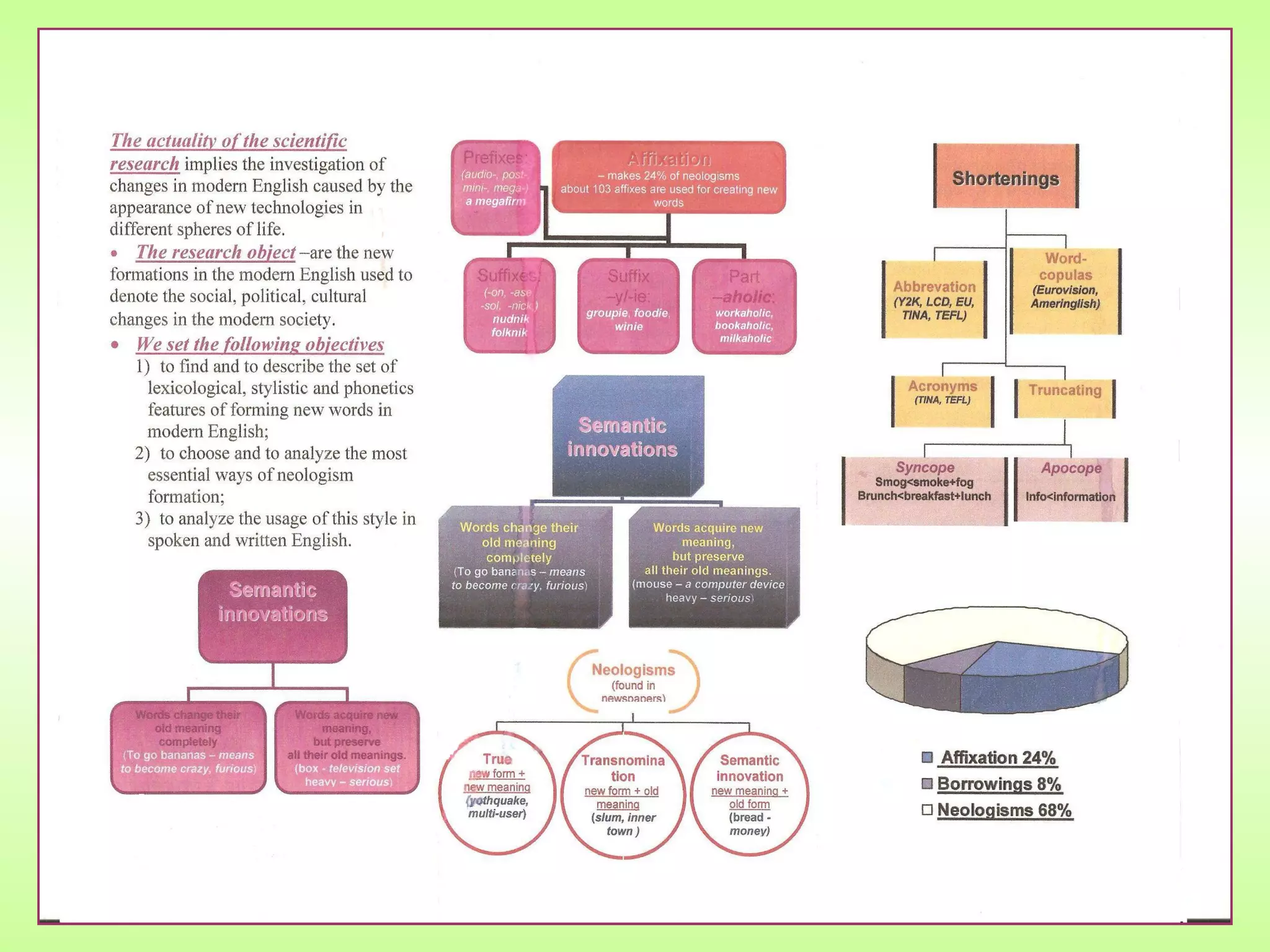
The actuality of the scientific
research determines the necessity of
examination of names and
nicknames of people, places and things in
the aspect of culture-oriented linguistics.
The research object – personal
nicknames, also nicknames of places and
things for the purpose of culture-oriented
linguistics. American English was chosen
because nowadays it is considered to be
widespread in the world.
Realization of the set objective
foresees the fulfillment of the following
tasks: 1) to analyze educational and
scientific literature on the research problem;
2) to determine the main term of the work
“nickname”;3) to elicit the significance of
nicknames in everyday life of society; 4) to
study classification of nicknames; 5) to view
the examples that prove the importance of
nicknames; 6) to conclude and analyze the
results of a survey; 7) to systematize
findings.
In the course of our research we
have tried to find out about where the
nicknames come from, not just personal
nicknames, but the nicknames of cities,
streets, different objects and more.
Nickname - a familiar, invented
given name for a person or thing used
instead of the actual name of the person or
thing; a kind of byname that describes a
person by his characteristic.
In our research we indicated that the
problem of our work is that the programme
of learning of English language for Ukrainian
secondary schools does not touch upon the
subject “Names and nicknames of English
speaking countries”
in greater detail. To make sure that
the problem exists, we conducted a survey.
Pupils of Grades 10A and 10B (29 pupils)
were asked to choose the correct answer
(a, b, c) to ten questions.
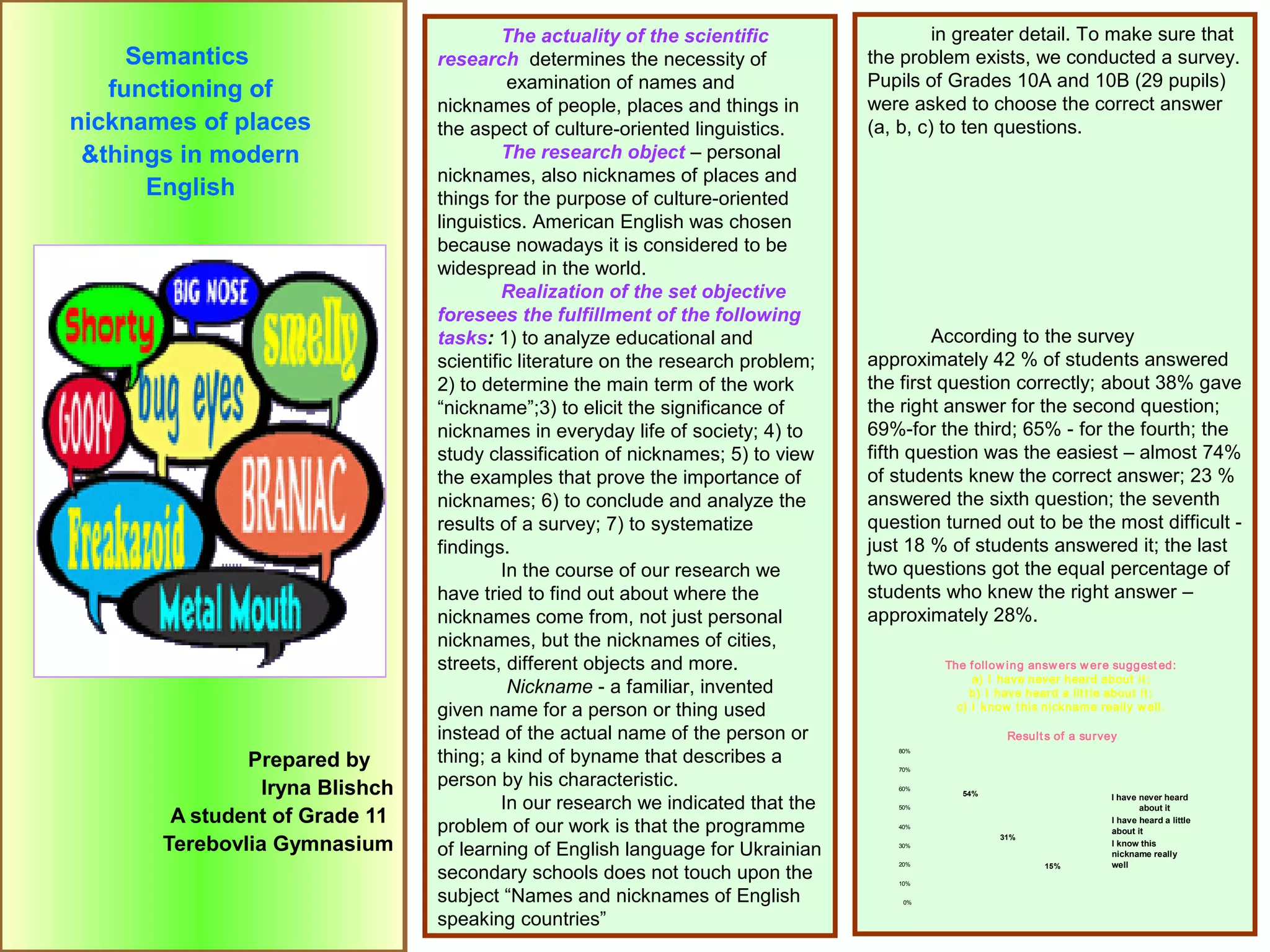
According to the survey
approximately 42 % of students answered
the first question correctly; about 38% gave
the right answer for the second question;
69%-for the third; 65% - for the fourth; the
fifth question was the easiest – almost 74%
of students knew the correct answer; 23 %
answered the sixth question; the seventh
question turned out to be the most difficult -
just 18 % of students answered it; the last
two questions got the equal percentage of
students who knew the right answer –
approximately 28%.
Results of a survey
54%
31%
15%
0%
10%
20%
30%
40%
50%
60%
70%
80%
I have never heard
about it
I have heard a little
about it
I know this
nickname really
well
The follow ing answers w ere suggest ed:
a) I have never heard about it;
b) I have heard a lit t le about it;
c) I know t his nickname really well.
•According to the survey the
percentage of pupils who know the
meaning
•of the nicknames is 15%, the
percentage of pupils who heard
• a little about American and British
nicknames is 31% and the percentage
• of pupils who have never heard
about the following nicknames is the
highest - 54%.
•The results of this survey confirm
the existence of the problem
•and necessity of learning names
and nicknames at school.
•In this respect we worked out some
tasks
•that can be very useful for learning
nicknames.
•1.What/Who is called “Dog
Star”?
•a) A nickname of area in London;
•b) A name for the star Sirius;
•c) A nickname of a dog.
•2. A world-known nickname of
New York:
•a) A Big Apple
•b) A City of Dreams
•c) A Wonderland
•3. How do the French call the
Channel which connects Great
Britain and France?
•a) A Great Way b) La-Manche
•c) The Channel of Love
•4. What is a nickname for Great
Britain ?
•a) A Foggy Albion
•b) A Country of Seven Hills
•c) The Country of Three Seas
•5. A nickname of the Planet Mars
is..
•a) Yellow Planet b) Red Planet
•c) Brown Planet
6. Have you ever heard about City of
Lilies?
a) Amsterdam
b) Paris
c) Florence
7. A nickname given to London,
when it was the world’s leading port?
a) The City of Ships
b) The City of Masts
c) The Queen of Seas
8. Have you heard about “Great White
Way”?
a) Khreshchatyk Street;
b) Broadway Street ;
c) Baker Street.
9. What is Black Diamond?
a) A nickname of petroleum;
b) Jewel;
c) A nickname for coal.
10. What is The City of the Seven
Hills?
a) A nickname of Syracuse;
b) A nickname for Rome;
c) A nickname of Broadway.
To become a broad-minded person and
have no problems with communicating in
English-speaking countries students should
study linguistics and foreign culture. There is
a question: “Is it possible to learn about
American names and nicknames at school?”
With this purpose we analyzed the school
text books.
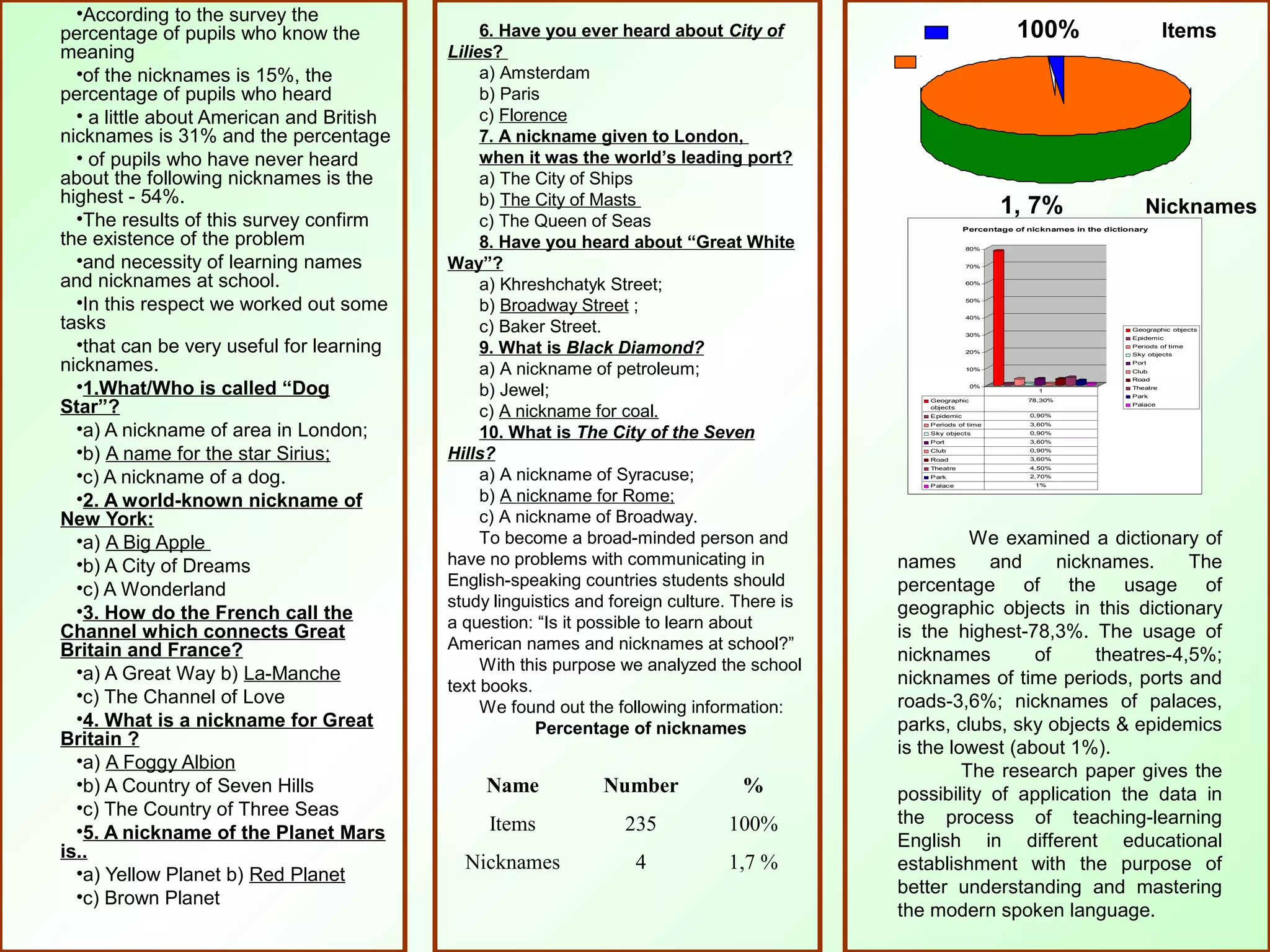
We found out the following information:
Percentage of nicknames
Name Number %
Items 235 100%
Nicknames 4 1,7 %
0%
10%
20%
30%
40%
50%
60%
70%
80%
Percentage of nicknames in the dictionary
Geographic objects
Epidemic
Periods of time
Sky objects
Port
Club
Road
Theatre
Park
Palace
Geographic
objects
78,30%
Epidemic 0,90%
Periods of time 3,60%
Sky objects 0,90%
Port 3,60%
Club 0,90%
Road 3,60%
Theatre 4,50%
Park 2,70%
Palace 1%
1
1, 7% Nicknames
100% Items
We examined a dictionary of
names and nicknames. The
percentage of the usage of
geographic objects in this dictionary
is the highest-78,3%. The usage of
nicknames of theatres-4,5%;
nicknames of time periods, ports and
roads-3,6%; nicknames of palaces,
parks, clubs, sky objects & epidemics
is the lowest (about 1%).
The research paper gives the
possibility of application the data in
the process of teaching-learning
English in different educational
establishment with the purpose of
better understanding and mastering
the modern spoken language.
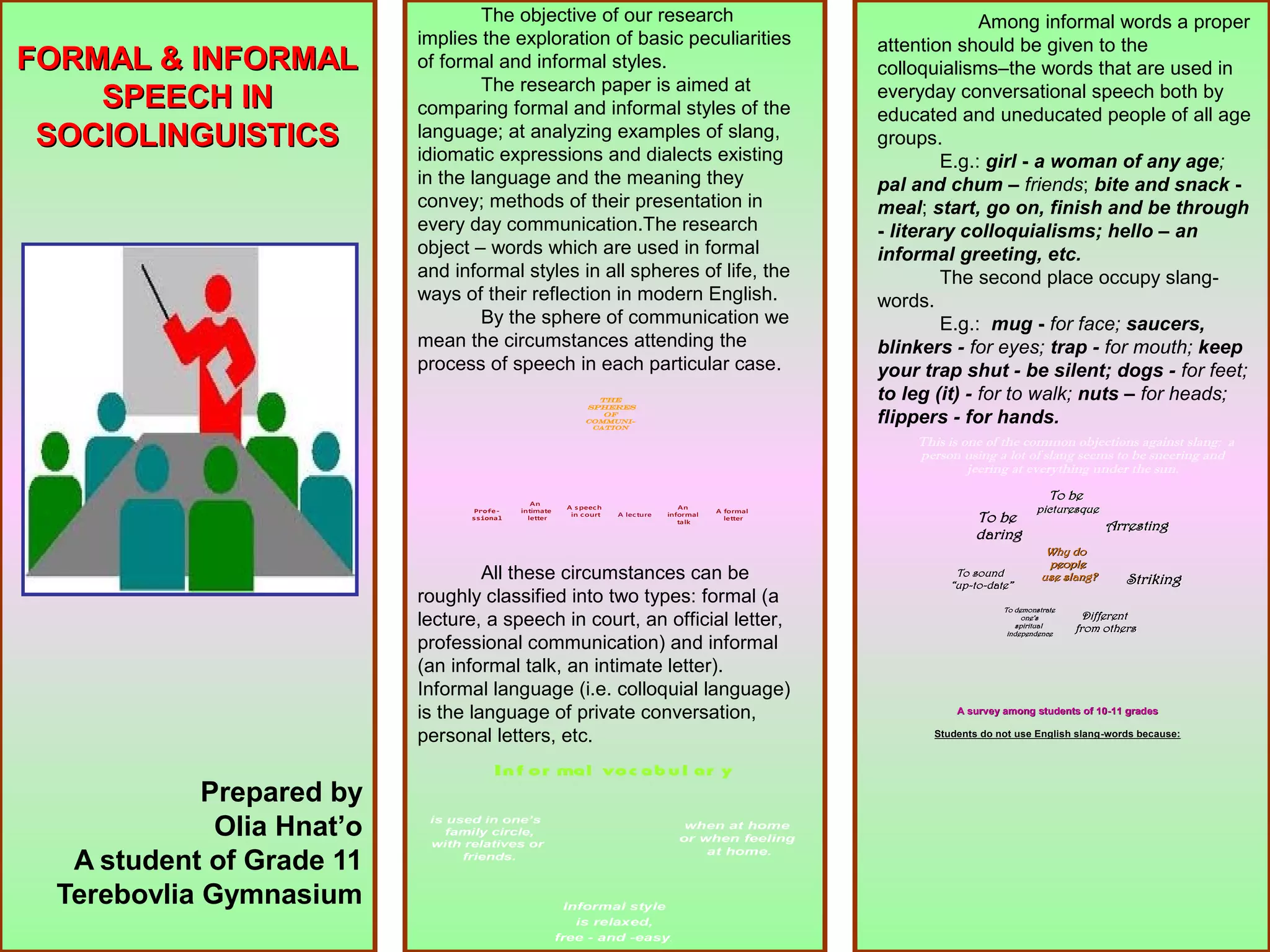
FORMAL & INFORMALFORMAL & INFORMAL
SPEECH INSPEECH IN
SOCIOLINGUISTICSSOCIOLINGUISTICS
Prepared by
Olia Hnat’o
A student of Grade 11
Terebovlia Gymnasium
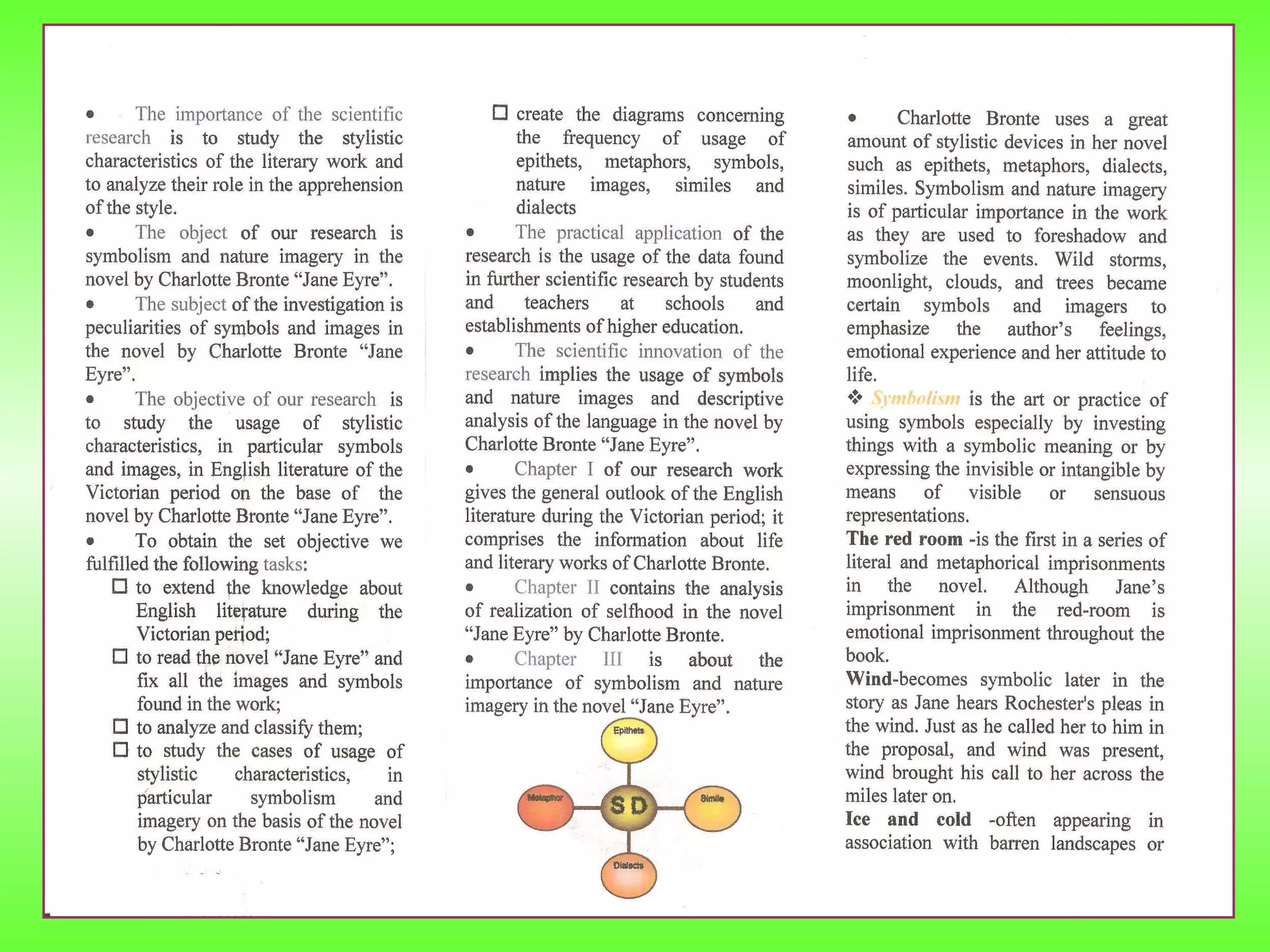
The objective of our research
implies the exploration of basic peculiarities
of formal and informal styles.
The research paper is aimed at
comparing formal and informal styles of the
language; at analyzing examples of slang,
idiomatic expressions and dialects existing
in the language and the meaning they
convey; methods of their presentation in
every day communication.The research
object – words which are used in formal
and informal styles in all spheres of life, the
ways of their reflection in modern English.
By the sphere of communication we
mean the circumstances attending the
process of speech in each particular case.
All these circumstances can be
roughly classified into two types: formal (a
lecture, a speech in court, an official letter,
professional communication) and informal
(an informal talk, an intimate letter).
Informal language (i.e. colloquial language)
is the language of private conversation,
personal letters, etc.
Among informal words a proper
attention should be given to the
colloquialisms–the words that are used in
everyday conversational speech both by
educated and uneducated people of all age
groups.
E.g.: girl - a woman of any age;
pal and chum – friends; bite and snack -
meal; start, go on, finish and be through
- literary colloquialisms; hello – an
informal greeting, etc.
The second place occupy slang-
words.
E.g.: mug - for face; saucers,
blinkers - for eyes; trap - for mouth; keep
your trap shut - be silent; dogs - for feet;
to leg (it) - for to walk; nuts – for heads;
flippers - for hands.
The
spheres
of
Communi-
cation
Profe-
ssional
A lecture
An
informal
talk
A formal
letter
A s peech
in court
An
intimate
letter
In f or mal voc ab u l ar y
when at home
or when feeling
at home.
Informal style
is relaxed,
free - and -easy.
is used in one’s
family circle,
with relatives or
friends.
This is one of the common objections against slang: a
person using a lot of slang seems to be sneering and
jeering at everything under the sun.
To beTo be
picturesquepicturesque
ArrestingArresting
StrikingStriking
DifferentDifferent
from othersfrom others
To demonstrateTo demonstrate
oneone’’ss
spiritualspiritual
independenceindependence
To soundTo sound
““upup--toto--datedate””
To be
daring
Why doWhy do
peoplepeople
use slang?use slang?
AA survey among students of 10survey among students of 10--11 grades11 grades
Students do not use English slangStudents do not use English slang--words because:words because:
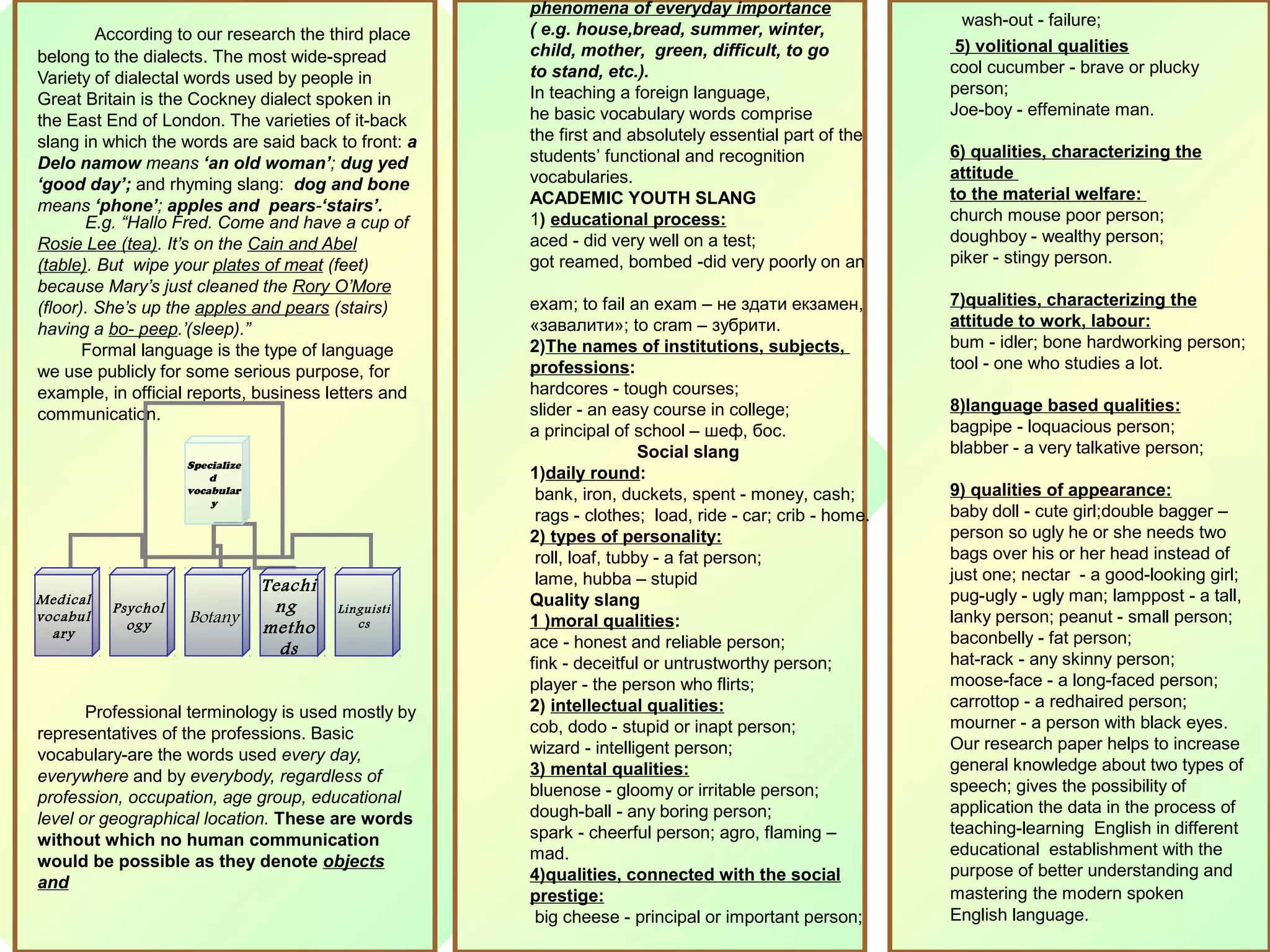
According to our research the third place
belong to the dialects. The most wide-spread
Variety of dialectal words used by people in
Great Britain is the Cockney dialect spoken in
the East End of London. The varieties of it-back
slang in which the words are said back to front: a
Delo namow means ‘an old woman’; dug yed
‘good day’; and rhyming slang: dog and bone
means ‘phone’; apples and pears-‘stairs’.
E.g. “Hallo Fred. Come and have a cup of
Rosie Lee (tea). It’s on the Cain and Abel
(table). But wipe your plates of meat (feet)
because Mary’s just cleaned the Rory O’More
(floor). She’s up the apples and pears (stairs)
having a bo- peep.’(sleep).”
Formal language is the type of language
we use publicly for some serious purpose, for
example, in official reports, business letters and
communication.
Professional terminology is used mostly by
representatives of the professions. Basic
vocabulary-are the words used every day,
everywhere and by everybody, regardless of
profession, occupation, age group, educational
level or geographical location. These are words
without which no human communication
would be possible as they denote objects
and
phenomena of everyday importance
( e.g. house,bread, summer, winter,
child, mother, green, difficult, to go
to stand, etc.).
In teaching a foreign language,
he basic vocabulary words comprise
the first and absolutely essential part of the
students’ functional and recognition
vocabularies.
ACADEMIC YOUTH SLANG
1) educational process:
aced - did very well on a test;
got reamed, bombed -did very poorly on an
exam; to fail an exam – не здати екзамен,
«завалити»; to cram – зубрити.
2)The names of institutions, subjects,
professions:
hardcores - tough courses;
slider - an easy course in college;
a principal of school – шеф, бос.
Social slang
1)daily round:
bank, iron, duckets, spent - money, cash;
rags - clothes; load, ride - car; crib - home.
2) types of personality:
roll, loaf, tubby - a fat person;
lame, hubba – stupid
Quality slang
1 )moral qualities:
ace - honest and reliable person;
fink - deceitful or untrustworthy person;
player - the person who flirts;
2) intellectual qualities:
cob, dodo - stupid or inapt person;
wizard - intelligent person;
3) mental qualities:
bluenose - gloomy or irritable person;
dough-ball - any boring person;
spark - cheerful person; agro, flaming –
mad.
4)qualities, connected with the social
prestige:
big cheese - principal or important person;
wash-out - failure;
5) volitional qualities
cool cucumber - brave or plucky
person;
Joe-boy - effeminate man.
6) qualities, characterizing the
attitude
to the material welfare:
church mouse poor person;
doughboy - wealthy person;
piker - stingy person.
7)qualities, characterizing the
attitude to work, labour:
bum - idler; bone hardworking person;
tool - one who studies a lot.
8)language based qualities:
bagpipe - loquacious person;
blabber - a very talkative person;
9) qualities of appearance:
baby doll - cute girl;double bagger –
person so ugly he or she needs two
bags over his or her head instead of
just one; nectar - a good-looking girl;
pug-ugly - ugly man; lamppost - a tall,
lanky person; peanut - small person;
baconbelly - fat person;
hat-rack - any skinny person;
moose-face - a long-faced person;
carrottop - a redhaired person;
mourner - a person with black eyes.
Our research paper helps to increase
general knowledge about two types of
speech; gives the possibility of
application the data in the process of
teaching-learning English in different
educational establishment with the
purpose of better understanding and
mastering the modern spoken
English language.
Specialize
d
vocabular
y
Medical
vocabul
ary
Psychol
ogy Botany
Linguisti
cs
Teachi
ng
metho
ds
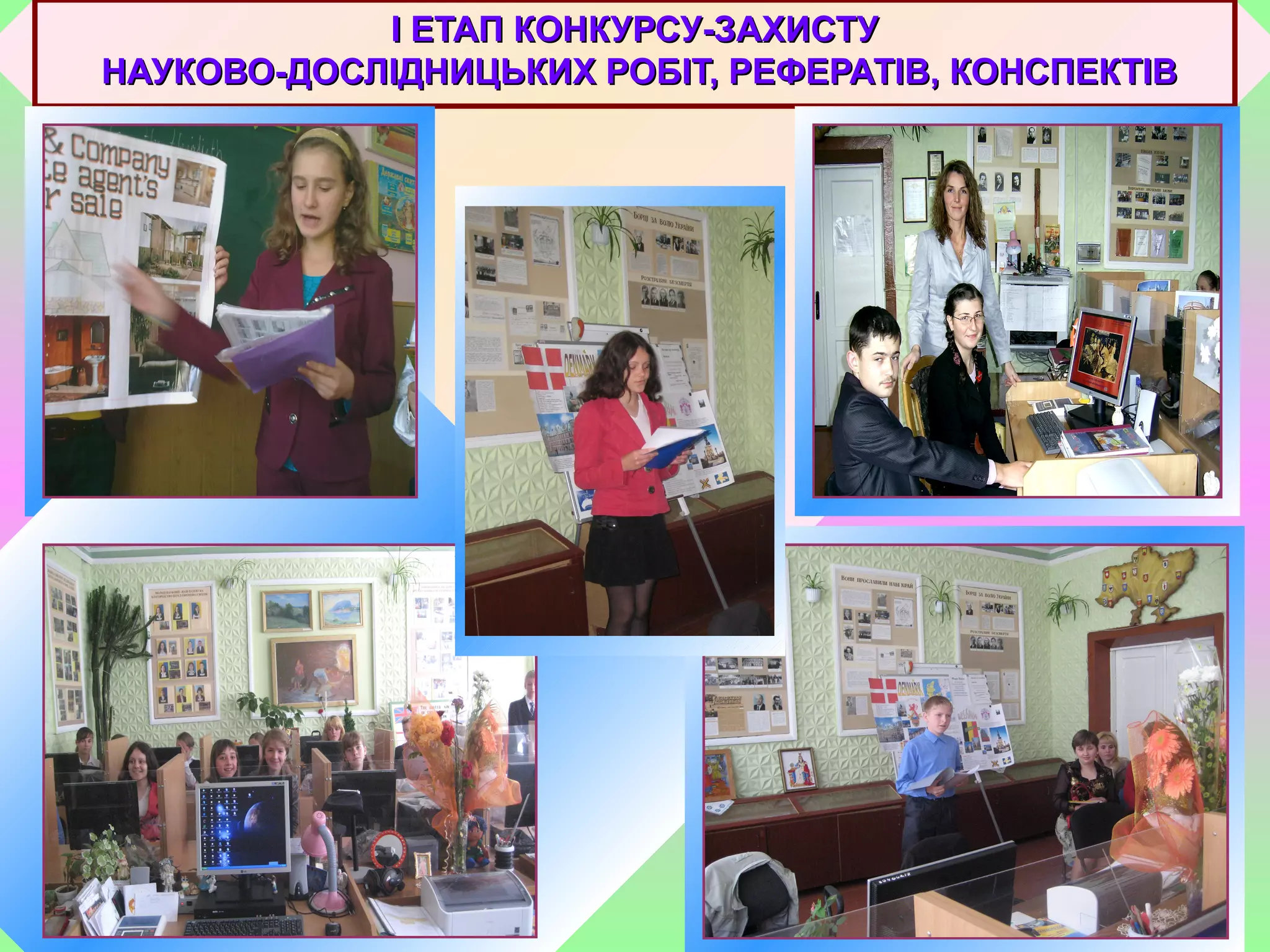
II ЕТАП КОНКУРСУ-ЗАХИСТУЕТАП КОНКУРСУ-ЗАХИСТУ
НАУКОВО-ДОСЛІДНИЦЬКИХ РОБІТ, РЕФЕРАТІВ, КОНСПЕКТІВНАУКОВО-ДОСЛІДНИЦЬКИХ РОБІТ, РЕФЕРАТІВ, КОНСПЕКТІВ
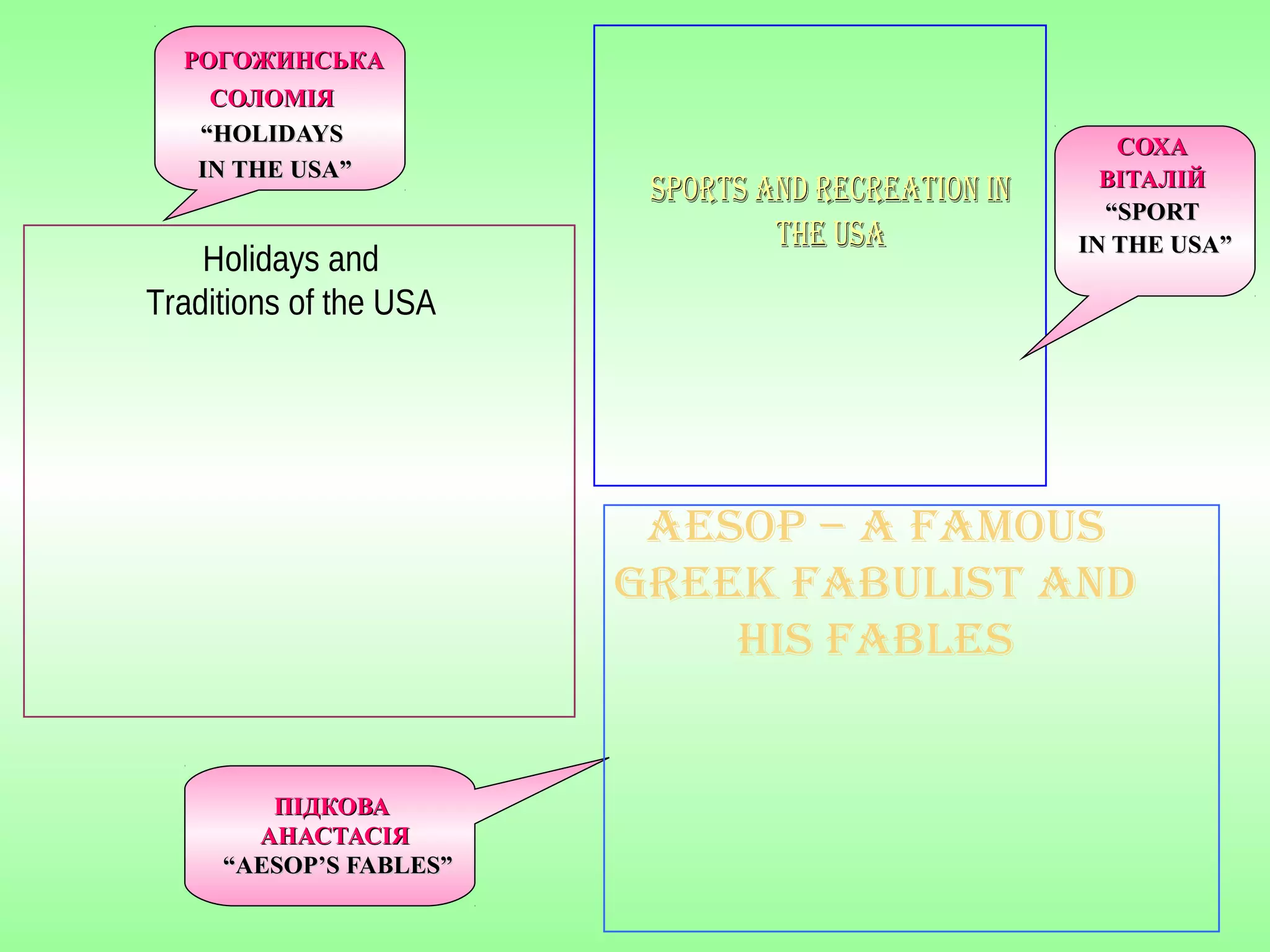
SportS and recreation inSportS and recreation in
the USathe USa
ПІДКОВАПІДКОВА
АНАСТАСІЯАНАСТАСІЯ
“AESOP’S FABLES”“AESOP’S FABLES”
РОГОЖИНСЬКАРОГОЖИНСЬКА
СОЛОМІЯСОЛОМІЯ
““HOLIDAYSHOLIDAYS
IN THE USA”IN THE USA”
aeSop – a FamoUS
Greek FabUliSt and
hiS FableS
Holidays and
Traditions of the USA
СОХАСОХА
ВІТАЛІЙВІТАЛІЙ
““SPORTSPORT
IN THE USA”IN THE USA”
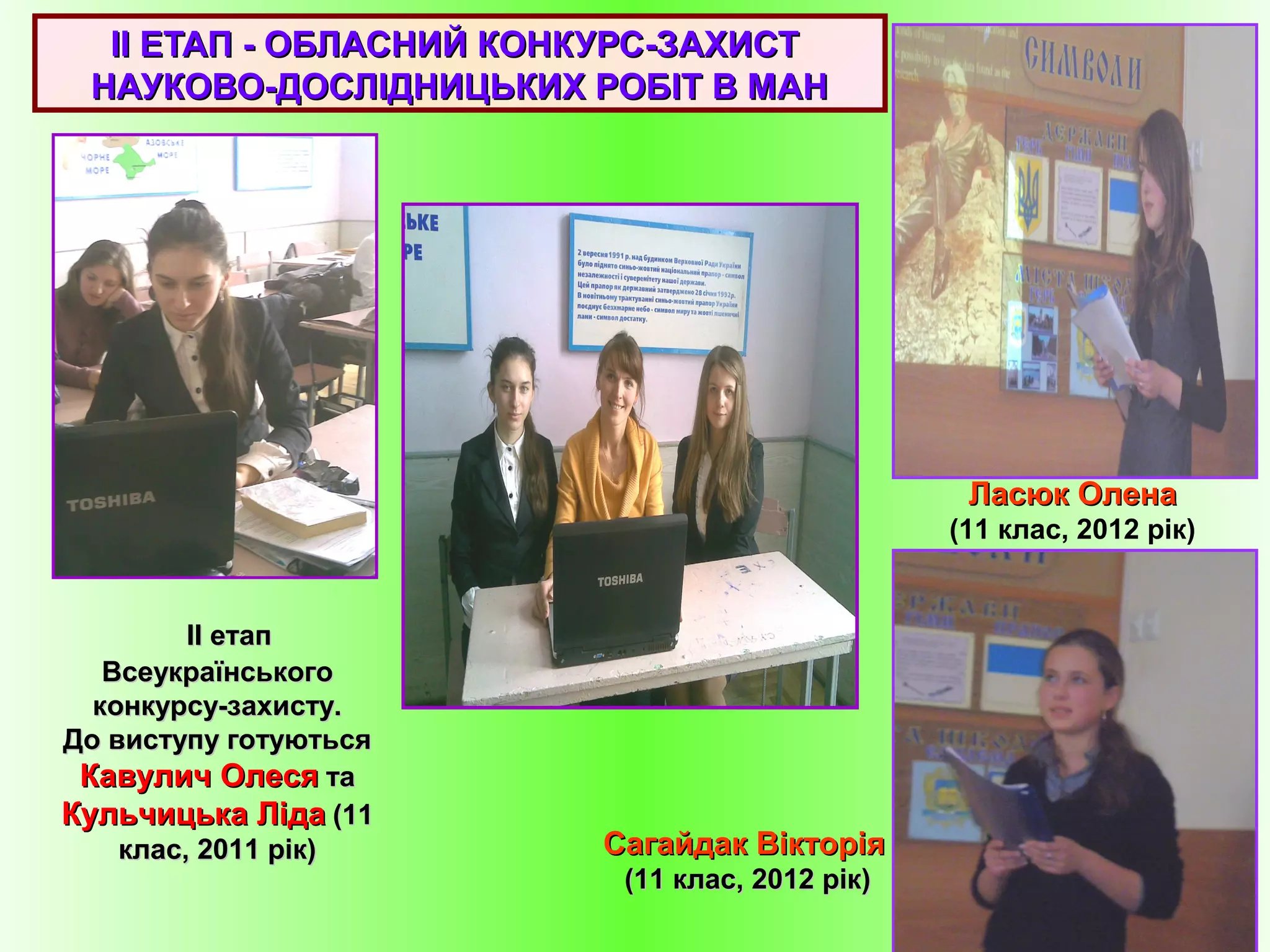
IIII ЕТАП - ОБЛАСНИЙ КОНКУРС-ЗАХИСТЕТАП - ОБЛАСНИЙ КОНКУРС-ЗАХИСТ
НАУКОВО-ДОСЛІДНИЦЬКИХ РОБІТ В МАННАУКОВО-ДОСЛІДНИЦЬКИХ РОБІТ В МАН
IIII етапетап
ВсеукраїнськогоВсеукраїнського
конкурсу-захисту.конкурсу-захисту.
До виступу готуютьсяДо виступу готуються
Кавулич ОлесяКавулич Олеся тата
Кульчицька ЛідаКульчицька Ліда (11(11
клас, 2011 рік)клас, 2011 рік)
Ласюк ОленаЛасюк Олена
(11 клас, 2012 рік)
Сагайдак ВікторіяСагайдак Вікторія
(11 клас, 2012 рік)(11 клас, 2012 рік)
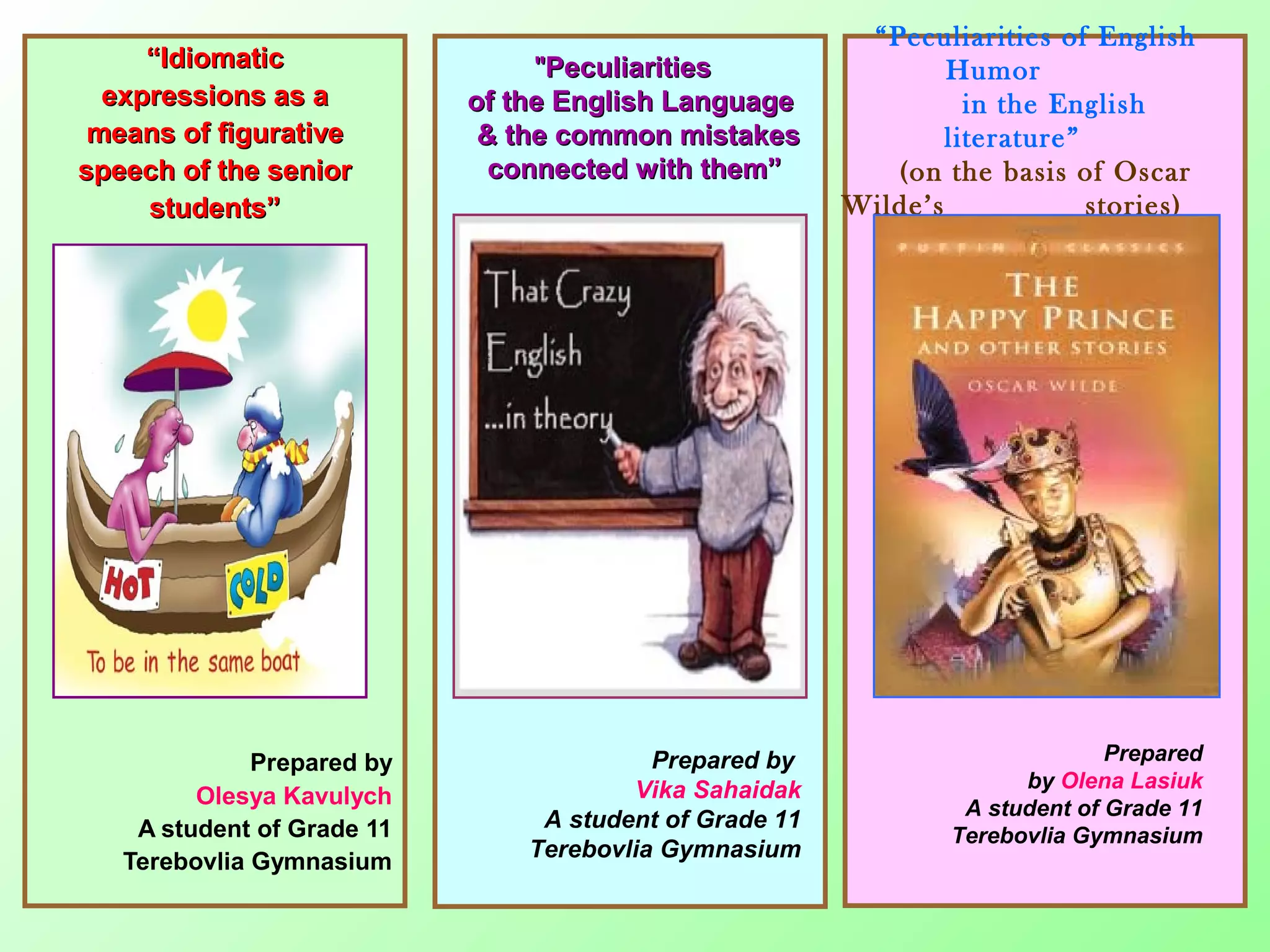
““IdiomaticIdiomatic
expressions as aexpressions as a
means of figurativemeans of figurative
speech of the seniorspeech of the senior
students”students”
Prepared by
Olesya Kavulych
A student of Grade 11
Terebovlia Gymnasium
""PeculiaritiesPeculiarities
of the English Languageof the English Language
& the common mistakes& the common mistakes
connected with them”connected with them”
Prepared by
Vika Sahaidak
A student of Grade 11
Terebovlia Gymnasium
“Peculiarities of English
Humor
in the English
literature”
(on the basis of Oscar
Wilde’s stories)
Prepared
by Olena Lasiuk
A student of Grade 11
Terebovlia Gymnasium
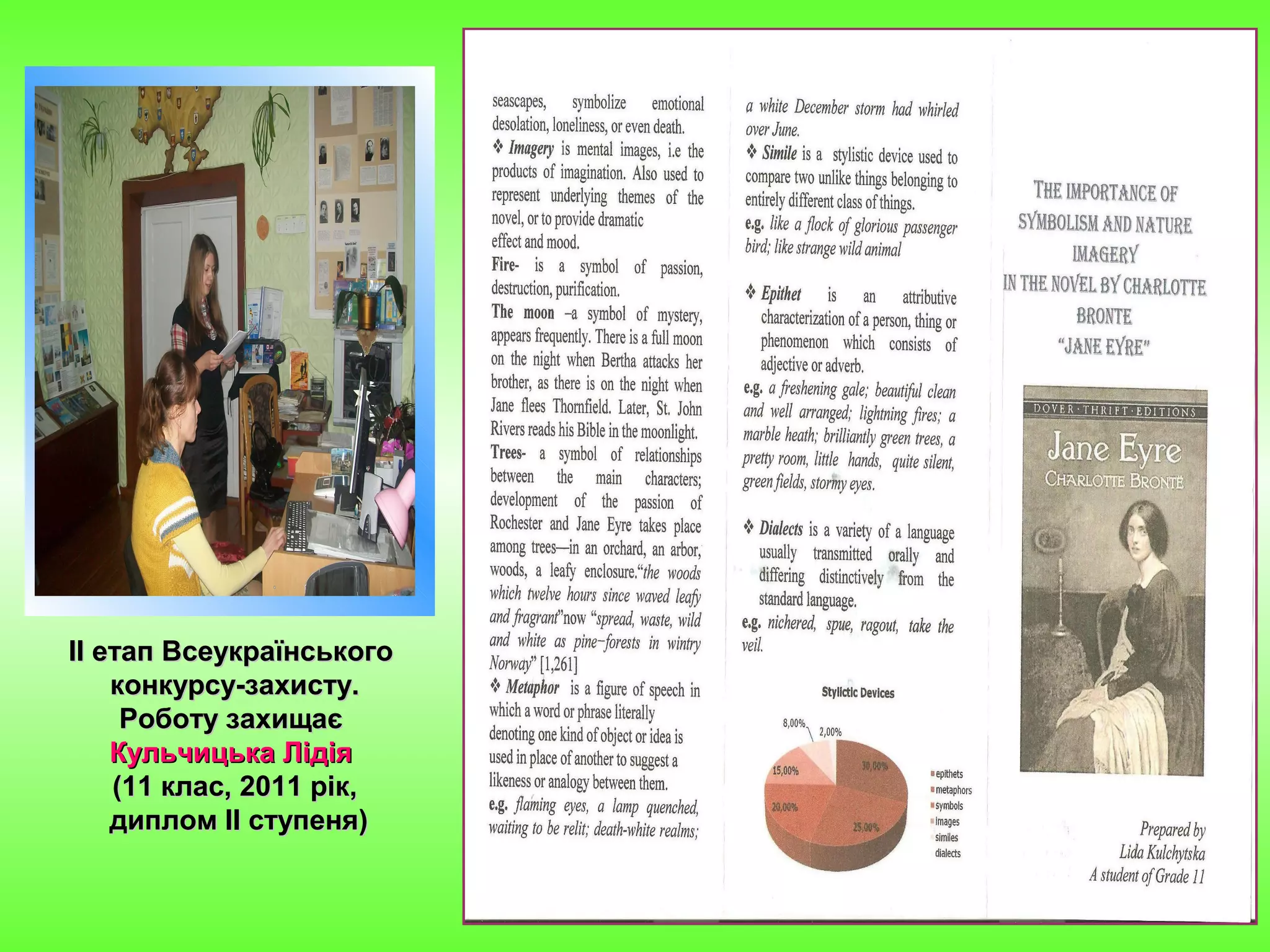
IIII етап Всеукраїнськогоетап Всеукраїнського
конкурсу-захисту.конкурсу-захисту.
Роботу захищаєРоботу захищає
Кульчицька ЛідіяКульчицька Лідія
(11 клас, 2011 рік(11 клас, 2011 рік,,
дипломдиплом IIII ступеня)ступеня)
IIII етап Всеукраїнськогоетап Всеукраїнського
конкурсу-захисту.конкурсу-захисту.
Роботу захищаєРоботу захищає
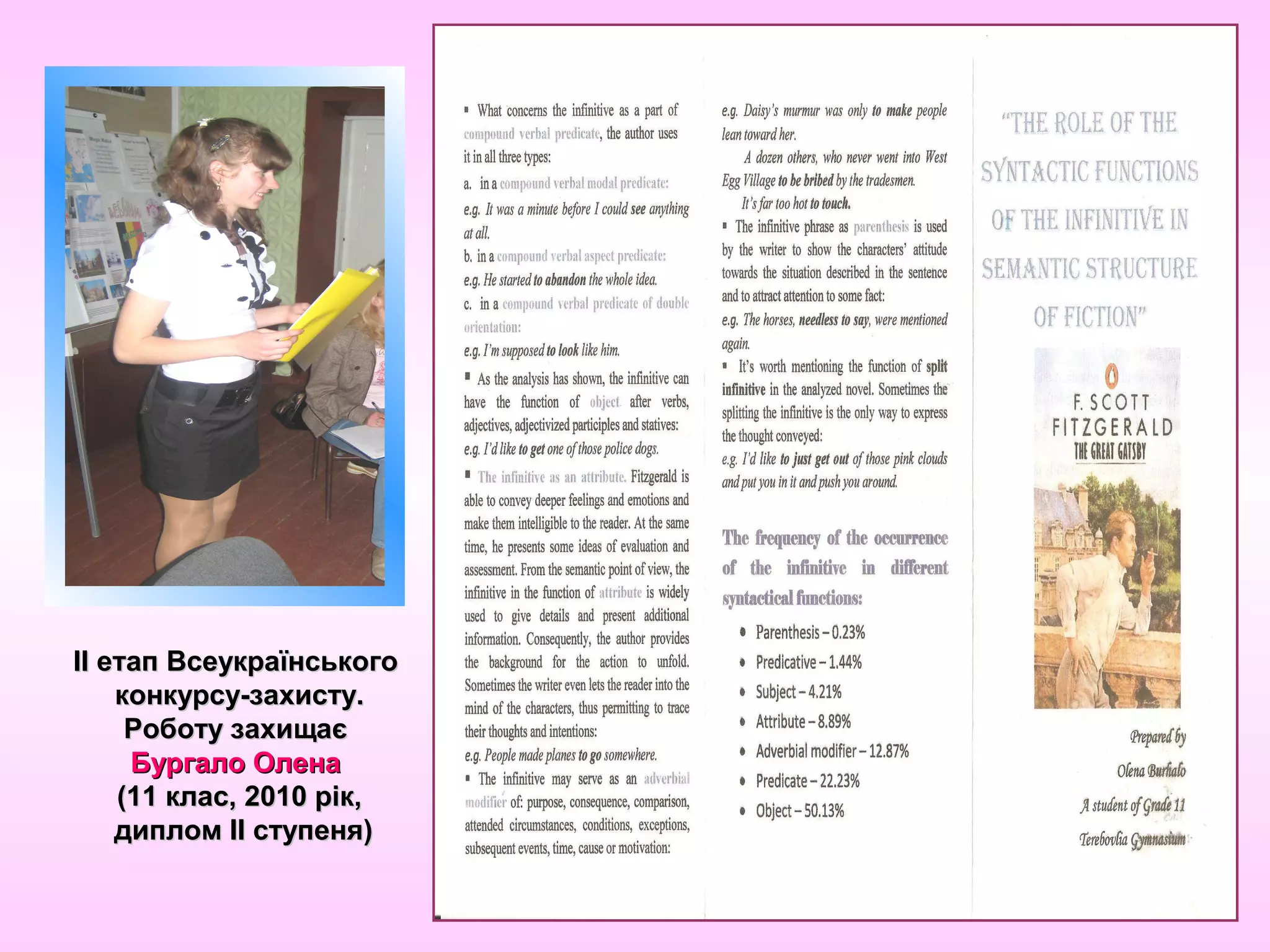
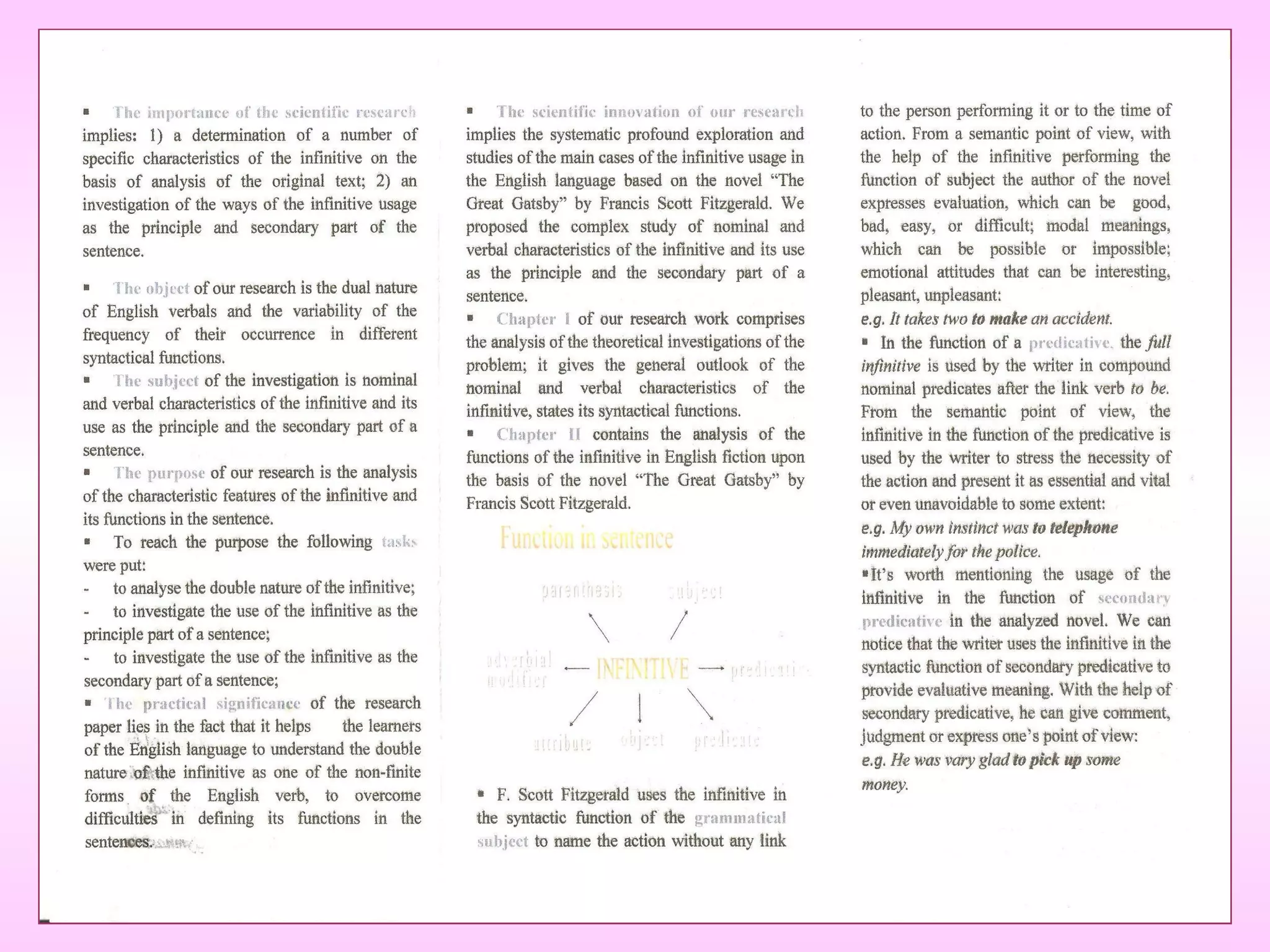
Бургало ОленаБургало Олена
(11 клас, 2010 рік(11 клас, 2010 рік,,
дипломдиплом IIII ступеня)ступеня)
IIII етап Всеукраїнськогоетап Всеукраїнського
конкурсу-захисту.конкурсу-захисту.
ВиступаєВиступає
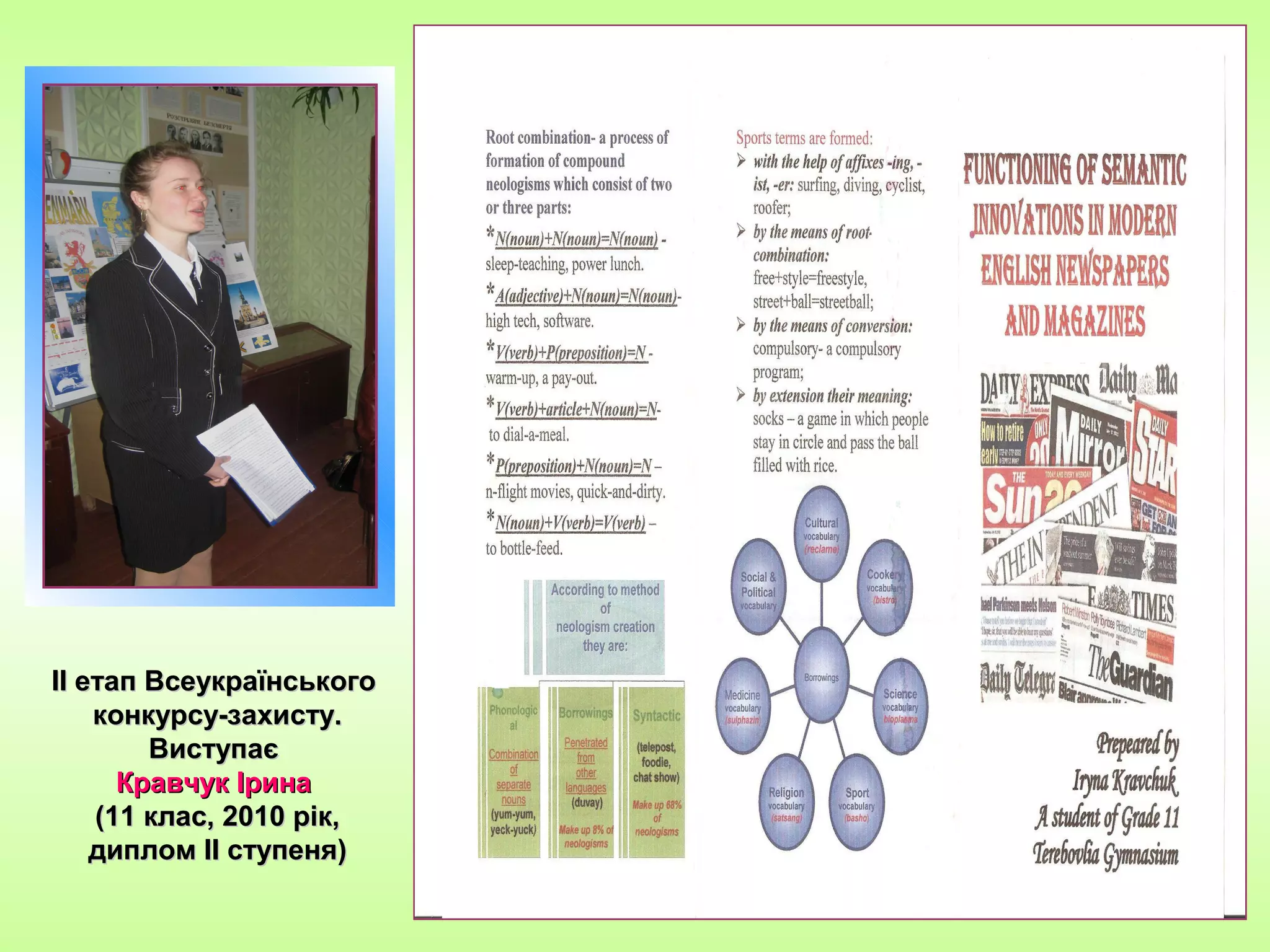
Кравчук ІринаКравчук Ірина
(11 клас, 2010 рік,(11 клас, 2010 рік,
дипломдиплом IIII ступеня)ступеня)
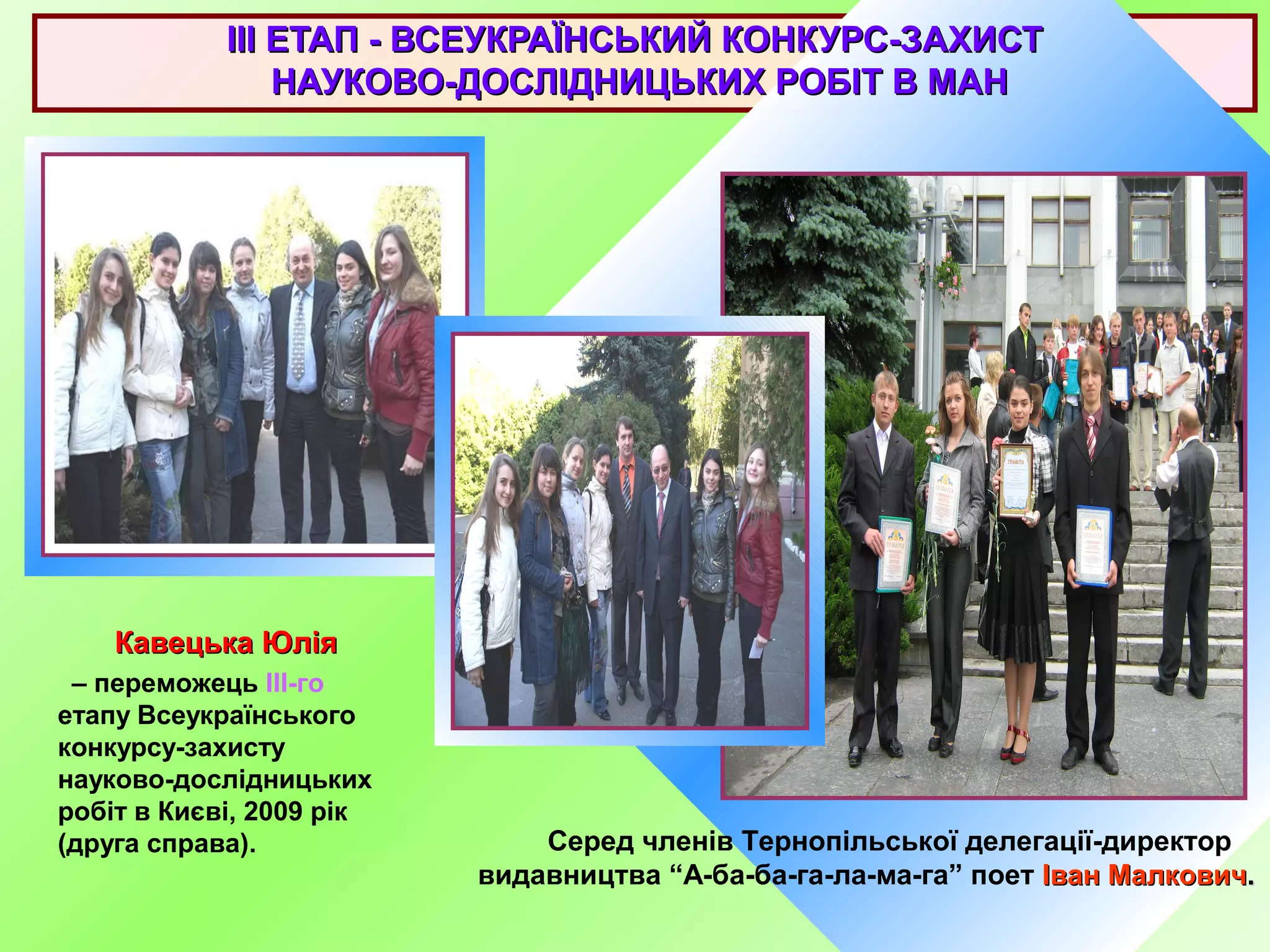
IIIIII ЕТАП - ВСЕУКРАЇНСЬКИЙ КОНКУРС-ЗАХИСТЕТАП - ВСЕУКРАЇНСЬКИЙ КОНКУРС-ЗАХИСТ
НАУКОВО-ДОСЛІДНИЦЬКИХ РОБІТ В МАННАУКОВО-ДОСЛІДНИЦЬКИХ РОБІТ В МАН
Кавецька ЮліяКавецька Юлія
– переможець III-го
етапу Всеукраїнського
конкурсу-захисту
науково-дослідницьких
робіт в Києві, 2009 рік
(друга справа). Серед членів Тернопільської делегації-директор
видавництва “А-ба-ба-га-ла-ма-га” поет Іван МалковичІван Малкович..
Управління освіти і науки Тернопільської облдержадміністрації
Тернопільське обласне комунальне територіальне відділення
Малої академії наук України
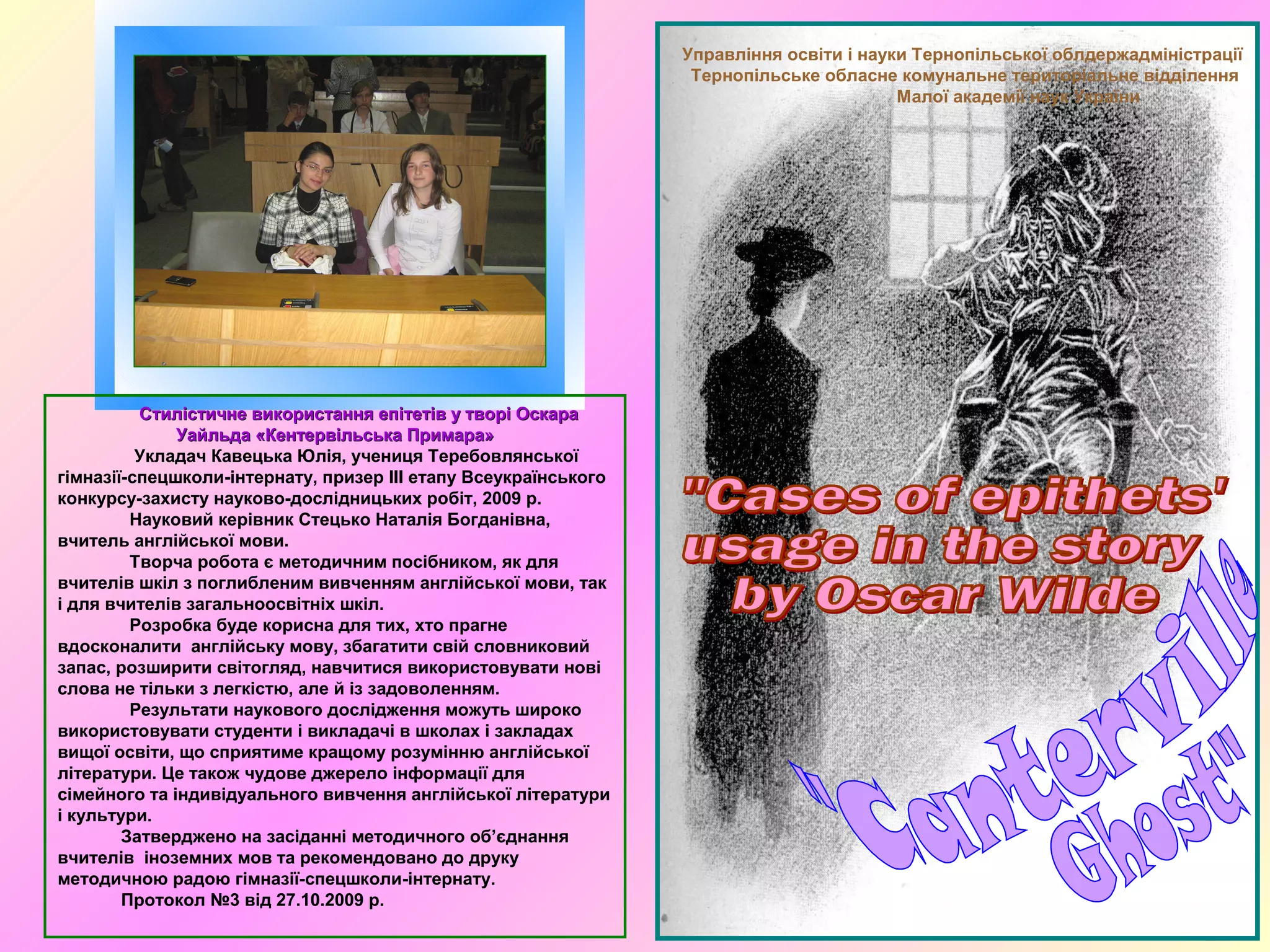
Стилістичне використання епітетів у творі ОскараСтилістичне використання епітетів у творі Оскара
Уайльда «Кентервільська Примара»Уайльда «Кентервільська Примара»
Укладач Кавецька Юлія, учениця Теребовлянської
гімназії-спецшколи-інтернату, призер ІІІ етапу Всеукраїнського
конкурсу-захисту науково-дослідницьких робіт, 2009 р.
Науковий керівник Стецько Наталія Богданівна,
вчитель англійської мови.
Творча робота є методичним посібником, як для
вчителів шкіл з поглибленим вивченням англійської мови, так
і для вчителів загальноосвітніх шкіл.
Розробка буде корисна для тих, хто прагне
вдосконалити англійську мову, збагатити свій словниковий
запас, розширити світогляд, навчитися використовувати нові
слова не тільки з легкістю, але й із задоволенням.
Результати наукового дослідження можуть широко
використовувати студенти і викладачі в школах і закладах
вищої освіти, що сприятиме кращому розумінню англійської
літератури. Це також чудове джерело інформації для
сімейного та індивідуального вивчення англійської літератури
і культури.
Затверджено на засіданні методичного об’єднання
вчителів іноземних мов та рекомендовано до друку
методичною радою гімназії-спецшколи-інтернату.
Протокол №3 від 27.10.2009 р.
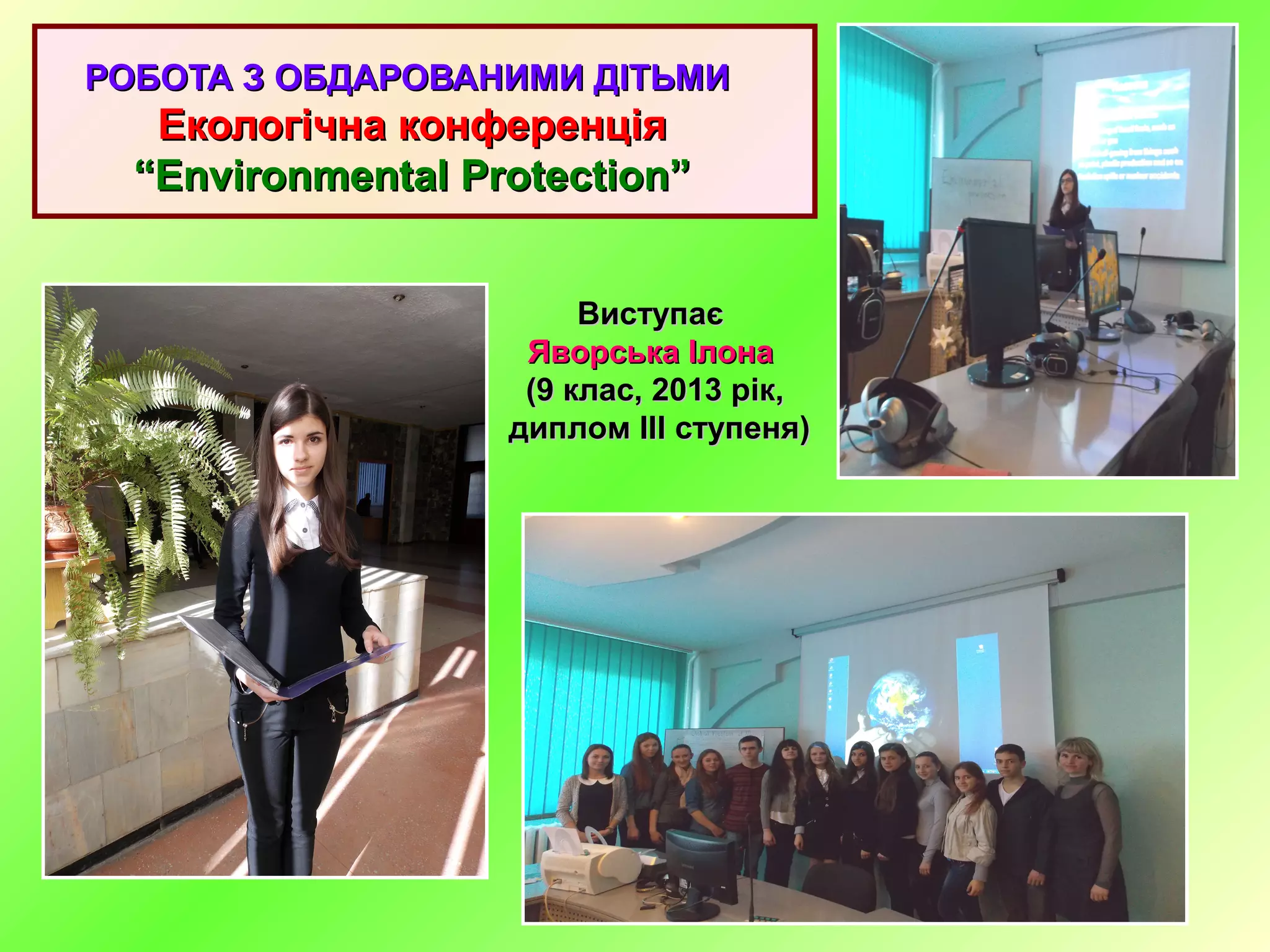
РОБОТА З ОБДАРОВАНИМИ ДІТЬМИРОБОТА З ОБДАРОВАНИМИ ДІТЬМИ
Екологічна конференціяЕкологічна конференція
“Environmental Protection”“Environmental Protection”
ВиступаєВиступає
Яворська ІлонаЯворська Ілона
(9 клас, 2013 рік(9 клас, 2013 рік,,
дипломдиплом IIIIII ступеня)ступеня)
РОБОТА З ОБДАРОВАНИМИ ДІТЬМИРОБОТА З ОБДАРОВАНИМИ ДІТЬМИ
МІЖНАРОДНІ КОНКУРСИМІЖНАРОДНІ КОНКУРСИ
КОВАЛІНСЬКА НАДІЯКОВАЛІНСЬКА НАДІЯ –
ПРИЗЕР ІІ-ІІІ ВСЕУКРАЇНСЬКОГО
КОНКУРСУ - ЗАХИСТУ НАУКОВО-
ДОСЛІДНИЦЬКИХ РОБІТ, УЧАСНИК IV
ЕТАПУ ВСЕУКРАЇНСЬКОГО КОНКУРСУ-
ЗАХИСТУ НАУКОВО-ДОСЛІДНИЦЬКИХ
РОБІТ (2005-2006 Н. Р.)
УЧАСНИК
МІЖНАРОДНОГО
КОНКУРСУ “JUNIOR
WATER PRIZE-2005”
У СТОКГОЛЬМІ
УЧАСНИК ПЕРШОГО ФОРУМУ УКРАЇНСЬКОЇ
ДІАСПОРИ ЄВРОПЕЙСЬКОГО КОНГРЕСУ
УКРАЇНЦІВ В ГРЕЦІЇ
Стокгольм,
2006
Афіни, 2006
РОБОТА З ОБДАРОВАНИМИ ДІТЬМИРОБОТА З ОБДАРОВАНИМИ ДІТЬМИ
ПОЗАКЛАСНІ ЗАХОДИПОЗАКЛАСНІ ЗАХОДИ
ЕКСКУРСІЯ ТЕРЕБОВЛЕЮЕКСКУРСІЯ ТЕРЕБОВЛЕЮ
КВККВКБРЕЙН-РИНГБРЕЙН-РИНГ
ДЕНЬ МАТЕРІДЕНЬ МАТЕРІ
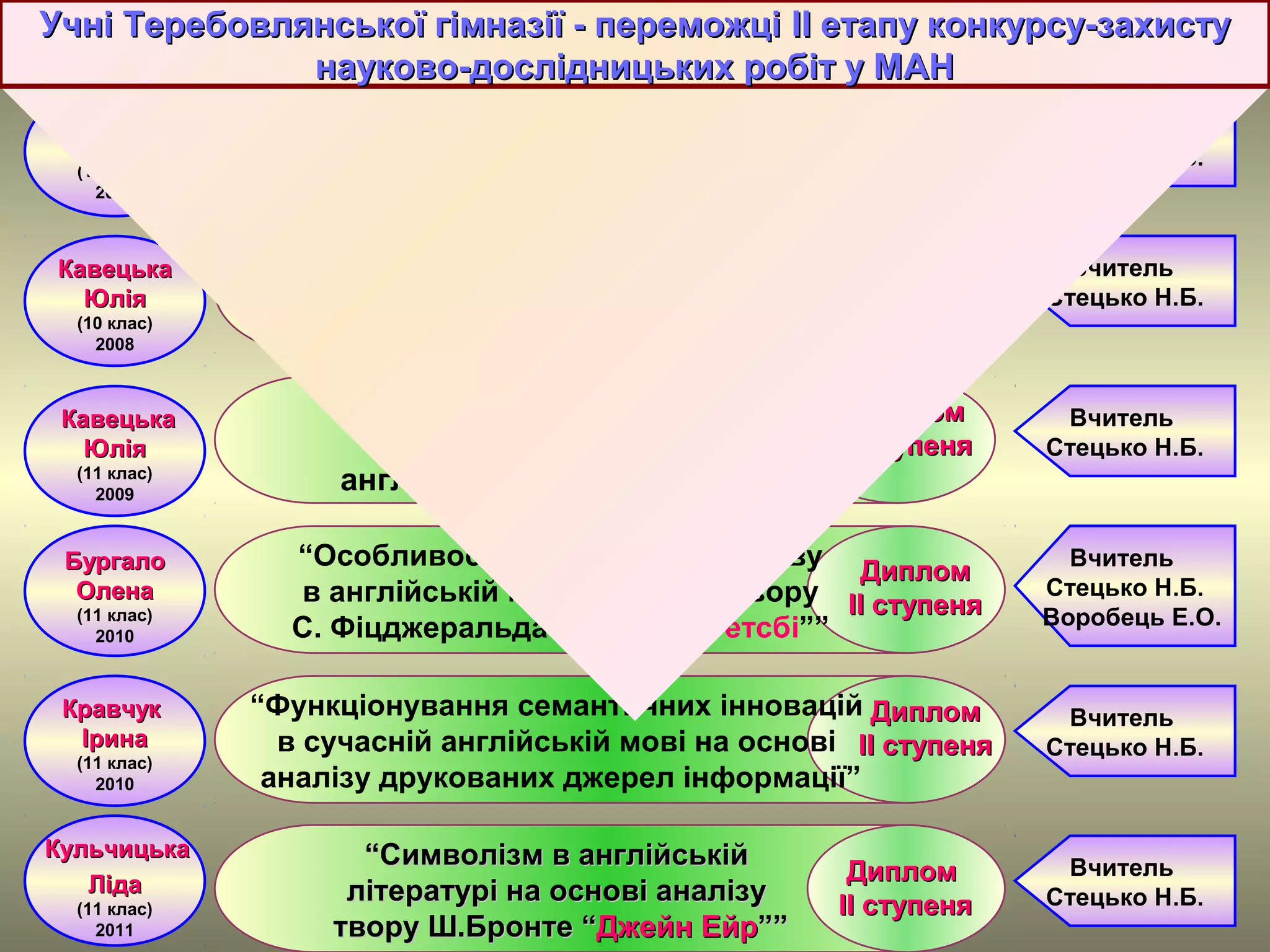
КовалінськаКовалінська
НадіяНадія
(11 клас)
2006
“Неологізми в сучасній
англійській мові”
ДипломДиплом
II ступеняступеня
Вчитель
Стецько Н.Б.
КавецькаКавецька
ЮліяЮлія
(10 клас)
2008
КавецькаКавецька
ЮліяЮлія
(11 клас)
2009
БургалоБургало
ОленаОлена
(11 клас)
2010
КульчицькаКульчицька
ЛідаЛіда
(11 клас)
2011
“Різновиди епітетів в англійській
мові на основі твору Оскара
Уайльда “Кентервільський Привид””
“Використання стилістичних
засобів в творах
англійських письменників”
“Особливості вживання інфінітиву
в англійській мові на основі твору
С. Фіцджеральда “Великий Гетсбі””
“Функціонування семантичних інновацій
в сучасній англійській мові на основі
аналізу друкованих джерел інформації”
Вчитель
Стецько Н.Б.
ДипломДиплом
IIIIII ступеняступеня
ДипломДиплом
II ступеняступеня
ДипломДиплом
IIII ступеняступеня
КравчукКравчук
ІринаІрина
(11 клас)
2010
““Символізм в англійськійСимволізм в англійській
літературі на основі аналізулітературі на основі аналізу
твору Ш.Бронте “твору Ш.Бронте “Джейн ЕйрДжейн Ейр””””
ДипломДиплом
IIII ступеняступеня
ДипломДиплом
IIII ступеняступеня
Вчитель
Стецько Н.Б.
Вчитель
Стецько Н.Б.
Воробець Е.О.
Вчитель
Стецько Н.Б.
Вчитель
Стецько Н.Б.
Учні Теребовлянської гімназії - переможціУчні Теребовлянської гімназії - переможці IIII етапу конкурсу-захистуетапу конкурсу-захисту
науково-дослідницьких робіт у МАНнауково-дослідницьких робіт у МАН
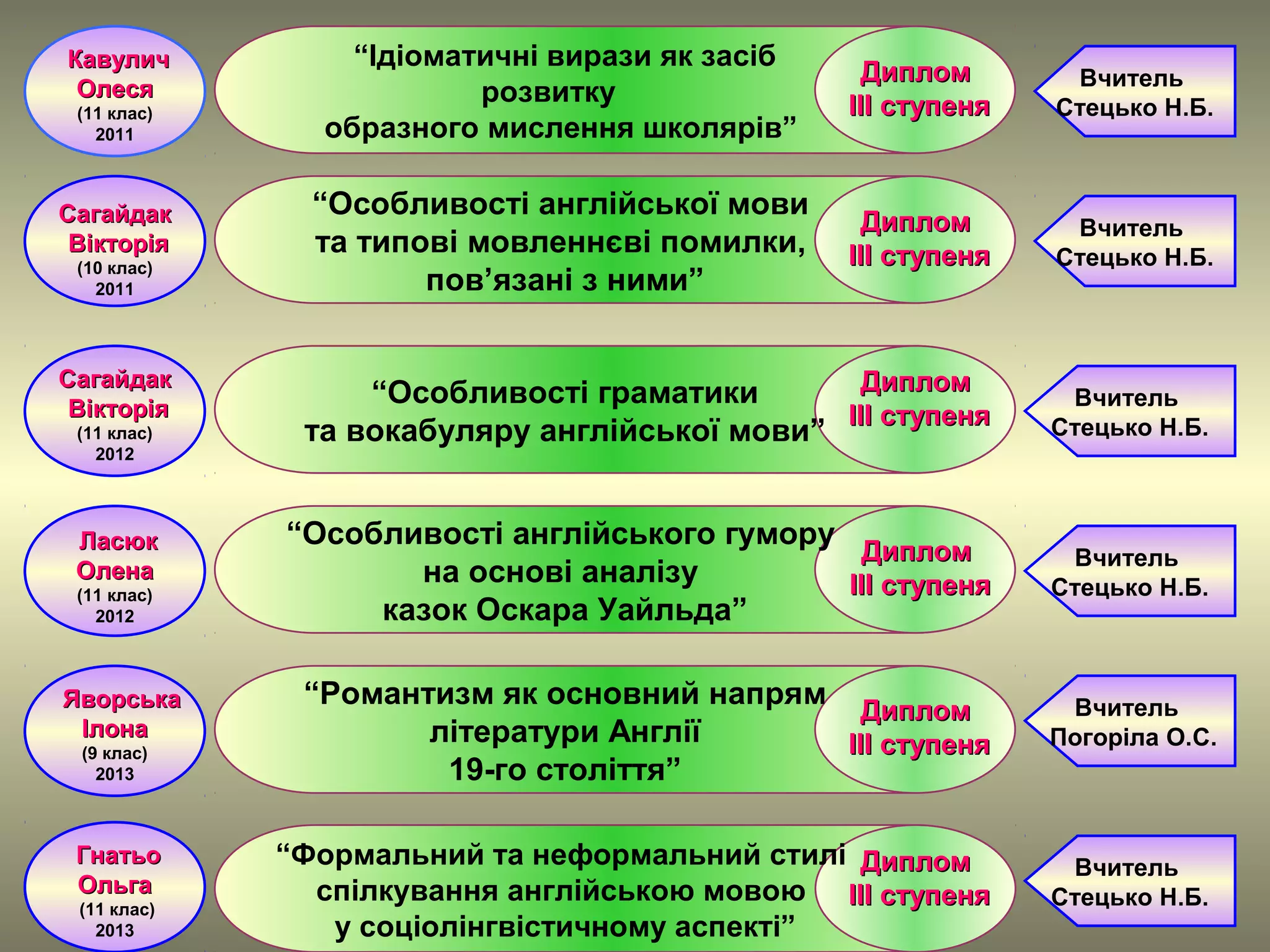
КавуличКавулич
ОлесяОлеся
(11 клас)
2011
“Ідіоматичні вирази як засіб
розвитку
образного мислення школярів”
ДипломДиплом
IIIIII ступеняступеня
Вчитель
Стецько Н.Б.
СагайдакСагайдак
ВікторіяВікторія
(10 клас)
2011
СагайдакСагайдак
ВікторіяВікторія
(11 клас)
2012
ЛасюкЛасюк
ОленаОлена
(11 клас)
2012
ГнатьоГнатьо
ОльгаОльга
(11 клас)
2013
“Особливості англійської мови
та типові мовленнєві помилки,
пов’язані з ними”
“Особливості граматики
та вокабуляру англійської мови”
“Особливості англійського гумору
на основі аналізу
казок Оскара Уайльда”
“Романтизм як основний напрям
літератури Англії
19-го століття”
ДипломДиплом
IIIIII ступеняступеня
ДипломДиплом
IIIIII ступеняступеня
ДипломДиплом
IIIIII ступеняступеня
ЯворськаЯворська
ІлонаІлона
(9 клас)
2013
“Формальний та неформальний стилі
спілкування англійською мовою
у соціолінгвістичному аспекті”
ДипломДиплом
IIIIII ступеняступеня
ДипломДиплом
IIIIII ступеняступеня
Вчитель
Стецько Н.Б.
Вчитель
Стецько Н.Б.
Вчитель
Стецько Н.Б.
Вчитель
Погоріла О.С.
Вчитель
Стецько Н.Б.
мала академія наук

мала академія наук

  • 1.
  • 2.
     Секція “Англійськамова” у Теребовлянській філії МАН діє з 2006-2007 н.р. Науковий керівник секції - Стецько Н.Б.- вчитель англійської мови вищої кваліфікаційної категорії, вчитель-методист.  Слухачем однієї чи кількох секцій можуть бути учні 8-11 класів. Також учні залучаються до написання та захисту науково-дослідницьких робіт у конкурсі-захисті наукових робіт у МАН у Тернополі.  За 7 років роботи секції - 12 призових місць на обласному захисті.
  • 3.
    ?Що дає учатьв МАН?Що дає учать в МАН Обдаровані діти характеризуються високим розвитком мислення, добрими навичками самоконтролю, великою працездатністю, їм притаманна багата уява, неординарність, швидкість реакції, вміння науково осмислювати деякі явища, стереотипи, догми. Завдання для таких учнів повинні бути творчими. Додаткові навантаження необхідні, вони сприяють розвитку здібностей, створюють умови для задоволення їх різнобічних пізнавальних інтересів. Роботи захищають учні 9-го класу. Вчителі Кокайло Н.М., Погоріла О.С.
  • 4.
    Організація роботи зобдарованими дітьмиУ методах навчання обдарованих учнів мають переважати самостійна робота, частково пошуковий та дослідницький підходи до засвоєння знань, вмінь, навичок. З цієї точки зору наукові роботи є актуальними і мають велику цінність. Захист проводять вчителі Шміло О.А., Стецько Н.Б.
  • 5.
    МАН належить важливароль у підтримці інтелектуальної здібності дитини. У її територіальних відділеннях навчається понад 30 тисяч учнів шкіл та профтехучилищ. Працюють з ними вчені з більш як 35 вищих закладів освіти. Вони допомагають учням розвинути свій потенціал. Написання наукових робіт розвиває вміння працювати з фактичним матеріалом, критично оцінувати, аналізувати, узагальнювати; розвиває акуратність, оригінальність, самостійність. Вчитель Бодак С.В. з юними науковцямиВчитель Бодак С.В. з юними науковцями
  • 6.
    ІРИНА БЛІЩІРИНА БЛІЩ (11КЛАС) ““SemanticSemanticss functioning offunctioning of nicknames of places &nicknames of places & thingsthings in modern English”in modern English” ЩОДЕННИК МАНЩОДЕННИК МАН II ЕТАП – ШКІЛЬНИЙ КОНКУРС-ЗАХИСТЕТАП – ШКІЛЬНИЙ КОНКУРС-ЗАХИСТ НАУКОВО-ДОСЛІДНИЦЬКИХ РОБІТ, РЕФЕРАТІВ, КОНСПЕКТІВНАУКОВО-ДОСЛІДНИЦЬКИХ РОБІТ, РЕФЕРАТІВ, КОНСПЕКТІВ ГНАТЬО ОЛЬГАГНАТЬО ОЛЬГА (11 КЛАС) ““FORMAL & INFORMALFORMAL & INFORMAL SPEECH INSPEECH IN SOCIOLINGUISTICS”SOCIOLINGUISTICS”
  • 7.
    Semantics functioning of nicknames ofplaces &things in modern English Prepared by Iryna Blishch A student of Grade 11 Terebovlia Gymnasium The actuality of the scientific research determines the necessity of examination of names and nicknames of people, places and things in the aspect of culture-oriented linguistics. The research object – personal nicknames, also nicknames of places and things for the purpose of culture-oriented linguistics. American English was chosen because nowadays it is considered to be widespread in the world. Realization of the set objective foresees the fulfillment of the following tasks: 1) to analyze educational and scientific literature on the research problem; 2) to determine the main term of the work “nickname”;3) to elicit the significance of nicknames in everyday life of society; 4) to study classification of nicknames; 5) to view the examples that prove the importance of nicknames; 6) to conclude and analyze the results of a survey; 7) to systematize findings. In the course of our research we have tried to find out about where the nicknames come from, not just personal nicknames, but the nicknames of cities, streets, different objects and more. Nickname - a familiar, invented given name for a person or thing used instead of the actual name of the person or thing; a kind of byname that describes a person by his characteristic. In our research we indicated that the problem of our work is that the programme of learning of English language for Ukrainian secondary schools does not touch upon the subject “Names and nicknames of English speaking countries” in greater detail. To make sure that the problem exists, we conducted a survey. Pupils of Grades 10A and 10B (29 pupils) were asked to choose the correct answer (a, b, c) to ten questions. According to the survey approximately 42 % of students answered the first question correctly; about 38% gave the right answer for the second question; 69%-for the third; 65% - for the fourth; the fifth question was the easiest – almost 74% of students knew the correct answer; 23 % answered the sixth question; the seventh question turned out to be the most difficult - just 18 % of students answered it; the last two questions got the equal percentage of students who knew the right answer – approximately 28%. Results of a survey 54% 31% 15% 0% 10% 20% 30% 40% 50% 60% 70% 80% I have never heard about it I have heard a little about it I know this nickname really well The follow ing answers w ere suggest ed: a) I have never heard about it; b) I have heard a lit t le about it; c) I know t his nickname really well.
  • 8.
    •According to thesurvey the percentage of pupils who know the meaning •of the nicknames is 15%, the percentage of pupils who heard • a little about American and British nicknames is 31% and the percentage • of pupils who have never heard about the following nicknames is the highest - 54%. •The results of this survey confirm the existence of the problem •and necessity of learning names and nicknames at school. •In this respect we worked out some tasks •that can be very useful for learning nicknames. •1.What/Who is called “Dog Star”? •a) A nickname of area in London; •b) A name for the star Sirius; •c) A nickname of a dog. •2. A world-known nickname of New York: •a) A Big Apple •b) A City of Dreams •c) A Wonderland •3. How do the French call the Channel which connects Great Britain and France? •a) A Great Way b) La-Manche •c) The Channel of Love •4. What is a nickname for Great Britain ? •a) A Foggy Albion •b) A Country of Seven Hills •c) The Country of Three Seas •5. A nickname of the Planet Mars is.. •a) Yellow Planet b) Red Planet •c) Brown Planet 6. Have you ever heard about City of Lilies? a) Amsterdam b) Paris c) Florence 7. A nickname given to London, when it was the world’s leading port? a) The City of Ships b) The City of Masts c) The Queen of Seas 8. Have you heard about “Great White Way”? a) Khreshchatyk Street; b) Broadway Street ; c) Baker Street. 9. What is Black Diamond? a) A nickname of petroleum; b) Jewel; c) A nickname for coal. 10. What is The City of the Seven Hills? a) A nickname of Syracuse; b) A nickname for Rome; c) A nickname of Broadway. To become a broad-minded person and have no problems with communicating in English-speaking countries students should study linguistics and foreign culture. There is a question: “Is it possible to learn about American names and nicknames at school?” With this purpose we analyzed the school text books. We found out the following information: Percentage of nicknames Name Number % Items 235 100% Nicknames 4 1,7 % 0% 10% 20% 30% 40% 50% 60% 70% 80% Percentage of nicknames in the dictionary Geographic objects Epidemic Periods of time Sky objects Port Club Road Theatre Park Palace Geographic objects 78,30% Epidemic 0,90% Periods of time 3,60% Sky objects 0,90% Port 3,60% Club 0,90% Road 3,60% Theatre 4,50% Park 2,70% Palace 1% 1 1, 7% Nicknames 100% Items We examined a dictionary of names and nicknames. The percentage of the usage of geographic objects in this dictionary is the highest-78,3%. The usage of nicknames of theatres-4,5%; nicknames of time periods, ports and roads-3,6%; nicknames of palaces, parks, clubs, sky objects & epidemics is the lowest (about 1%). The research paper gives the possibility of application the data in the process of teaching-learning English in different educational establishment with the purpose of better understanding and mastering the modern spoken language.
  • 9.
    FORMAL & INFORMALFORMAL& INFORMAL SPEECH INSPEECH IN SOCIOLINGUISTICSSOCIOLINGUISTICS Prepared by Olia Hnat’o A student of Grade 11 Terebovlia Gymnasium The objective of our research implies the exploration of basic peculiarities of formal and informal styles. The research paper is aimed at comparing formal and informal styles of the language; at analyzing examples of slang, idiomatic expressions and dialects existing in the language and the meaning they convey; methods of their presentation in every day communication.The research object – words which are used in formal and informal styles in all spheres of life, the ways of their reflection in modern English. By the sphere of communication we mean the circumstances attending the process of speech in each particular case. All these circumstances can be roughly classified into two types: formal (a lecture, a speech in court, an official letter, professional communication) and informal (an informal talk, an intimate letter). Informal language (i.e. colloquial language) is the language of private conversation, personal letters, etc. Among informal words a proper attention should be given to the colloquialisms–the words that are used in everyday conversational speech both by educated and uneducated people of all age groups. E.g.: girl - a woman of any age; pal and chum – friends; bite and snack - meal; start, go on, finish and be through - literary colloquialisms; hello – an informal greeting, etc. The second place occupy slang- words. E.g.: mug - for face; saucers, blinkers - for eyes; trap - for mouth; keep your trap shut - be silent; dogs - for feet; to leg (it) - for to walk; nuts – for heads; flippers - for hands. The spheres of Communi- cation Profe- ssional A lecture An informal talk A formal letter A s peech in court An intimate letter In f or mal voc ab u l ar y when at home or when feeling at home. Informal style is relaxed, free - and -easy. is used in one’s family circle, with relatives or friends. This is one of the common objections against slang: a person using a lot of slang seems to be sneering and jeering at everything under the sun. To beTo be picturesquepicturesque ArrestingArresting StrikingStriking DifferentDifferent from othersfrom others To demonstrateTo demonstrate oneone’’ss spiritualspiritual independenceindependence To soundTo sound ““upup--toto--datedate”” To be daring Why doWhy do peoplepeople use slang?use slang? AA survey among students of 10survey among students of 10--11 grades11 grades Students do not use English slangStudents do not use English slang--words because:words because:
  • 10.
    According to ourresearch the third place belong to the dialects. The most wide-spread Variety of dialectal words used by people in Great Britain is the Cockney dialect spoken in the East End of London. The varieties of it-back slang in which the words are said back to front: a Delo namow means ‘an old woman’; dug yed ‘good day’; and rhyming slang: dog and bone means ‘phone’; apples and pears-‘stairs’. E.g. “Hallo Fred. Come and have a cup of Rosie Lee (tea). It’s on the Cain and Abel (table). But wipe your plates of meat (feet) because Mary’s just cleaned the Rory O’More (floor). She’s up the apples and pears (stairs) having a bo- peep.’(sleep).” Formal language is the type of language we use publicly for some serious purpose, for example, in official reports, business letters and communication. Professional terminology is used mostly by representatives of the professions. Basic vocabulary-are the words used every day, everywhere and by everybody, regardless of profession, occupation, age group, educational level or geographical location. These are words without which no human communication would be possible as they denote objects and phenomena of everyday importance ( e.g. house,bread, summer, winter, child, mother, green, difficult, to go to stand, etc.). In teaching a foreign language, he basic vocabulary words comprise the first and absolutely essential part of the students’ functional and recognition vocabularies. ACADEMIC YOUTH SLANG 1) educational process: aced - did very well on a test; got reamed, bombed -did very poorly on an exam; to fail an exam – не здати екзамен, «завалити»; to cram – зубрити. 2)The names of institutions, subjects, professions: hardcores - tough courses; slider - an easy course in college; a principal of school – шеф, бос. Social slang 1)daily round: bank, iron, duckets, spent - money, cash; rags - clothes; load, ride - car; crib - home. 2) types of personality: roll, loaf, tubby - a fat person; lame, hubba – stupid Quality slang 1 )moral qualities: ace - honest and reliable person; fink - deceitful or untrustworthy person; player - the person who flirts; 2) intellectual qualities: cob, dodo - stupid or inapt person; wizard - intelligent person; 3) mental qualities: bluenose - gloomy or irritable person; dough-ball - any boring person; spark - cheerful person; agro, flaming – mad. 4)qualities, connected with the social prestige: big cheese - principal or important person; wash-out - failure; 5) volitional qualities cool cucumber - brave or plucky person; Joe-boy - effeminate man. 6) qualities, characterizing the attitude to the material welfare: church mouse poor person; doughboy - wealthy person; piker - stingy person. 7)qualities, characterizing the attitude to work, labour: bum - idler; bone hardworking person; tool - one who studies a lot. 8)language based qualities: bagpipe - loquacious person; blabber - a very talkative person; 9) qualities of appearance: baby doll - cute girl;double bagger – person so ugly he or she needs two bags over his or her head instead of just one; nectar - a good-looking girl; pug-ugly - ugly man; lamppost - a tall, lanky person; peanut - small person; baconbelly - fat person; hat-rack - any skinny person; moose-face - a long-faced person; carrottop - a redhaired person; mourner - a person with black eyes. Our research paper helps to increase general knowledge about two types of speech; gives the possibility of application the data in the process of teaching-learning English in different educational establishment with the purpose of better understanding and mastering the modern spoken English language. Specialize d vocabular y Medical vocabul ary Psychol ogy Botany Linguisti cs Teachi ng metho ds
  • 11.
    II ЕТАП КОНКУРСУ-ЗАХИСТУЕТАПКОНКУРСУ-ЗАХИСТУ НАУКОВО-ДОСЛІДНИЦЬКИХ РОБІТ, РЕФЕРАТІВ, КОНСПЕКТІВНАУКОВО-ДОСЛІДНИЦЬКИХ РОБІТ, РЕФЕРАТІВ, КОНСПЕКТІВ
  • 12.
    SportS and recreationinSportS and recreation in the USathe USa ПІДКОВАПІДКОВА АНАСТАСІЯАНАСТАСІЯ “AESOP’S FABLES”“AESOP’S FABLES” РОГОЖИНСЬКАРОГОЖИНСЬКА СОЛОМІЯСОЛОМІЯ ““HOLIDAYSHOLIDAYS IN THE USA”IN THE USA” aeSop – a FamoUS Greek FabUliSt and hiS FableS Holidays and Traditions of the USA СОХАСОХА ВІТАЛІЙВІТАЛІЙ ““SPORTSPORT IN THE USA”IN THE USA”
  • 13.
    IIII ЕТАП -ОБЛАСНИЙ КОНКУРС-ЗАХИСТЕТАП - ОБЛАСНИЙ КОНКУРС-ЗАХИСТ НАУКОВО-ДОСЛІДНИЦЬКИХ РОБІТ В МАННАУКОВО-ДОСЛІДНИЦЬКИХ РОБІТ В МАН IIII етапетап ВсеукраїнськогоВсеукраїнського конкурсу-захисту.конкурсу-захисту. До виступу готуютьсяДо виступу готуються Кавулич ОлесяКавулич Олеся тата Кульчицька ЛідаКульчицька Ліда (11(11 клас, 2011 рік)клас, 2011 рік) Ласюк ОленаЛасюк Олена (11 клас, 2012 рік) Сагайдак ВікторіяСагайдак Вікторія (11 клас, 2012 рік)(11 клас, 2012 рік)
  • 14.
    ““IdiomaticIdiomatic expressions as aexpressionsas a means of figurativemeans of figurative speech of the seniorspeech of the senior students”students” Prepared by Olesya Kavulych A student of Grade 11 Terebovlia Gymnasium ""PeculiaritiesPeculiarities of the English Languageof the English Language & the common mistakes& the common mistakes connected with them”connected with them” Prepared by Vika Sahaidak A student of Grade 11 Terebovlia Gymnasium “Peculiarities of English Humor in the English literature” (on the basis of Oscar Wilde’s stories) Prepared by Olena Lasiuk A student of Grade 11 Terebovlia Gymnasium
  • 15.
    IIII етап ВсеукраїнськогоетапВсеукраїнського конкурсу-захисту.конкурсу-захисту. Роботу захищаєРоботу захищає Кульчицька ЛідіяКульчицька Лідія (11 клас, 2011 рік(11 клас, 2011 рік,, дипломдиплом IIII ступеня)ступеня)
  • 17.
    IIII етап ВсеукраїнськогоетапВсеукраїнського конкурсу-захисту.конкурсу-захисту. Роботу захищаєРоботу захищає Бургало ОленаБургало Олена (11 клас, 2010 рік(11 клас, 2010 рік,, дипломдиплом IIII ступеня)ступеня)
  • 19.
    IIII етап ВсеукраїнськогоетапВсеукраїнського конкурсу-захисту.конкурсу-захисту. ВиступаєВиступає Кравчук ІринаКравчук Ірина (11 клас, 2010 рік,(11 клас, 2010 рік, дипломдиплом IIII ступеня)ступеня)
  • 21.
    IIIIII ЕТАП -ВСЕУКРАЇНСЬКИЙ КОНКУРС-ЗАХИСТЕТАП - ВСЕУКРАЇНСЬКИЙ КОНКУРС-ЗАХИСТ НАУКОВО-ДОСЛІДНИЦЬКИХ РОБІТ В МАННАУКОВО-ДОСЛІДНИЦЬКИХ РОБІТ В МАН Кавецька ЮліяКавецька Юлія – переможець III-го етапу Всеукраїнського конкурсу-захисту науково-дослідницьких робіт в Києві, 2009 рік (друга справа). Серед членів Тернопільської делегації-директор видавництва “А-ба-ба-га-ла-ма-га” поет Іван МалковичІван Малкович..
  • 22.
    Управління освіти інауки Тернопільської облдержадміністрації Тернопільське обласне комунальне територіальне відділення Малої академії наук України Стилістичне використання епітетів у творі ОскараСтилістичне використання епітетів у творі Оскара Уайльда «Кентервільська Примара»Уайльда «Кентервільська Примара» Укладач Кавецька Юлія, учениця Теребовлянської гімназії-спецшколи-інтернату, призер ІІІ етапу Всеукраїнського конкурсу-захисту науково-дослідницьких робіт, 2009 р. Науковий керівник Стецько Наталія Богданівна, вчитель англійської мови. Творча робота є методичним посібником, як для вчителів шкіл з поглибленим вивченням англійської мови, так і для вчителів загальноосвітніх шкіл. Розробка буде корисна для тих, хто прагне вдосконалити англійську мову, збагатити свій словниковий запас, розширити світогляд, навчитися використовувати нові слова не тільки з легкістю, але й із задоволенням. Результати наукового дослідження можуть широко використовувати студенти і викладачі в школах і закладах вищої освіти, що сприятиме кращому розумінню англійської літератури. Це також чудове джерело інформації для сімейного та індивідуального вивчення англійської літератури і культури. Затверджено на засіданні методичного об’єднання вчителів іноземних мов та рекомендовано до друку методичною радою гімназії-спецшколи-інтернату. Протокол №3 від 27.10.2009 р.
  • 23.
    РОБОТА З ОБДАРОВАНИМИДІТЬМИРОБОТА З ОБДАРОВАНИМИ ДІТЬМИ Екологічна конференціяЕкологічна конференція “Environmental Protection”“Environmental Protection” ВиступаєВиступає Яворська ІлонаЯворська Ілона (9 клас, 2013 рік(9 клас, 2013 рік,, дипломдиплом IIIIII ступеня)ступеня)
  • 24.
    РОБОТА З ОБДАРОВАНИМИДІТЬМИРОБОТА З ОБДАРОВАНИМИ ДІТЬМИ МІЖНАРОДНІ КОНКУРСИМІЖНАРОДНІ КОНКУРСИ КОВАЛІНСЬКА НАДІЯКОВАЛІНСЬКА НАДІЯ – ПРИЗЕР ІІ-ІІІ ВСЕУКРАЇНСЬКОГО КОНКУРСУ - ЗАХИСТУ НАУКОВО- ДОСЛІДНИЦЬКИХ РОБІТ, УЧАСНИК IV ЕТАПУ ВСЕУКРАЇНСЬКОГО КОНКУРСУ- ЗАХИСТУ НАУКОВО-ДОСЛІДНИЦЬКИХ РОБІТ (2005-2006 Н. Р.) УЧАСНИК МІЖНАРОДНОГО КОНКУРСУ “JUNIOR WATER PRIZE-2005” У СТОКГОЛЬМІ УЧАСНИК ПЕРШОГО ФОРУМУ УКРАЇНСЬКОЇ ДІАСПОРИ ЄВРОПЕЙСЬКОГО КОНГРЕСУ УКРАЇНЦІВ В ГРЕЦІЇ Стокгольм, 2006 Афіни, 2006
  • 25.
    РОБОТА З ОБДАРОВАНИМИДІТЬМИРОБОТА З ОБДАРОВАНИМИ ДІТЬМИ ПОЗАКЛАСНІ ЗАХОДИПОЗАКЛАСНІ ЗАХОДИ ЕКСКУРСІЯ ТЕРЕБОВЛЕЮЕКСКУРСІЯ ТЕРЕБОВЛЕЮ КВККВКБРЕЙН-РИНГБРЕЙН-РИНГ ДЕНЬ МАТЕРІДЕНЬ МАТЕРІ
  • 26.
    КовалінськаКовалінська НадіяНадія (11 клас) 2006 “Неологізми всучасній англійській мові” ДипломДиплом II ступеняступеня Вчитель Стецько Н.Б. КавецькаКавецька ЮліяЮлія (10 клас) 2008 КавецькаКавецька ЮліяЮлія (11 клас) 2009 БургалоБургало ОленаОлена (11 клас) 2010 КульчицькаКульчицька ЛідаЛіда (11 клас) 2011 “Різновиди епітетів в англійській мові на основі твору Оскара Уайльда “Кентервільський Привид”” “Використання стилістичних засобів в творах англійських письменників” “Особливості вживання інфінітиву в англійській мові на основі твору С. Фіцджеральда “Великий Гетсбі”” “Функціонування семантичних інновацій в сучасній англійській мові на основі аналізу друкованих джерел інформації” Вчитель Стецько Н.Б. ДипломДиплом IIIIII ступеняступеня ДипломДиплом II ступеняступеня ДипломДиплом IIII ступеняступеня КравчукКравчук ІринаІрина (11 клас) 2010 ““Символізм в англійськійСимволізм в англійській літературі на основі аналізулітературі на основі аналізу твору Ш.Бронте “твору Ш.Бронте “Джейн ЕйрДжейн Ейр”””” ДипломДиплом IIII ступеняступеня ДипломДиплом IIII ступеняступеня Вчитель Стецько Н.Б. Вчитель Стецько Н.Б. Воробець Е.О. Вчитель Стецько Н.Б. Вчитель Стецько Н.Б. Учні Теребовлянської гімназії - переможціУчні Теребовлянської гімназії - переможці IIII етапу конкурсу-захистуетапу конкурсу-захисту науково-дослідницьких робіт у МАНнауково-дослідницьких робіт у МАН
  • 27.
    КавуличКавулич ОлесяОлеся (11 клас) 2011 “Ідіоматичні виразияк засіб розвитку образного мислення школярів” ДипломДиплом IIIIII ступеняступеня Вчитель Стецько Н.Б. СагайдакСагайдак ВікторіяВікторія (10 клас) 2011 СагайдакСагайдак ВікторіяВікторія (11 клас) 2012 ЛасюкЛасюк ОленаОлена (11 клас) 2012 ГнатьоГнатьо ОльгаОльга (11 клас) 2013 “Особливості англійської мови та типові мовленнєві помилки, пов’язані з ними” “Особливості граматики та вокабуляру англійської мови” “Особливості англійського гумору на основі аналізу казок Оскара Уайльда” “Романтизм як основний напрям літератури Англії 19-го століття” ДипломДиплом IIIIII ступеняступеня ДипломДиплом IIIIII ступеняступеня ДипломДиплом IIIIII ступеняступеня ЯворськаЯворська ІлонаІлона (9 клас) 2013 “Формальний та неформальний стилі спілкування англійською мовою у соціолінгвістичному аспекті” ДипломДиплом IIIIII ступеняступеня ДипломДиплом IIIIII ступеняступеня Вчитель Стецько Н.Б. Вчитель Стецько Н.Б. Вчитель Стецько Н.Б. Вчитель Погоріла О.С. Вчитель Стецько Н.Б.