Open Source in Healthcare : The Birth of Evidence
Based Software?
Joseph Dal Molin
Open Source Health Care Alliance
October 24, 2000
A Provocation…a la Edward de Bono
“The propagation of the Open Source business
model in healthcare is inevitable.”
Agenda
• A Quick Course on open source
• How and why it works
• Open source in Healthcare
• Where open source in Healthcare is heading
• Closing
A Quick Course on Open Source
Open Source Defined
““The basic idea behind open source is very simpleThe basic idea behind open source is very simple. When. When
programmers on the Internet can read, redistribute, andprogrammers on the Internet can read, redistribute, and
modify the source for a piece of software, itmodify the source for a piece of software, it evolvesevolves..
People improve it, people adapt it,People improve it, people adapt it, people fix bugs. Andpeople fix bugs. And
this can happen atthis can happen at astonishing speedastonishing speed …..”…..”
FromFrom www.opensource.orgwww.opensource.org
Basic Characteristics of Open Source
Software
• Source code free
• Any party can sell or give away copies.
• Derived works can or must be distributed under same terms.
• Anyone can participate.
• License must be complete and compatible.
Full details at www.opensource.orgwww.opensource.org
Open Source vs. Free Software
• Free Software
– a concept developed by Richard Stallman,
– is social movement motivated by the belief that software
licensing impacts personal freedom
– primarily involves GPL license
• open source
– a pragmatic definition of software that can be exchanged
freely
– is primarily a business model
– deliberately coined to attract broader participation including
commercial interests
Not All Free Software is Open Source
• NOT shareware.
• NOT demoware.
• NOT an evaluation copy.
• NOT personal-use-only software.
• NOT usually in the public domain.
• Can be used with proprietary software.
How and Why Open Source Works
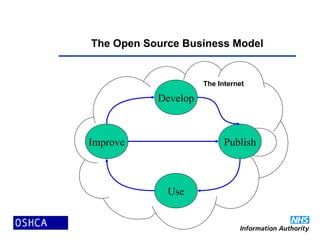
The Open Source Business Model
Develop
Publish
Use
Improve
The Internet
Open Source & Software Economics
• Market forces drive price to the marginal cost of production
C. Shapiro and H. Varian, Information Rules, Harvard Business
School Press, 1999
Bill Gates, Microsoft Internal Meeting
• The cost of producing a second copy of software, like
information, is close to £0
• The network effect of the internet accelerates this trend
• Open Source is the next step in software business models
• As revolutionary as the microprocessor
The Mysteries of Open Source
• Where's the money?
• What happened to software engineering?
Understanding the Mysteries
Open source Software is Customer Constructed Software
Why is it written?
• "Have an itch, scratch it".
• You can achieve more by modifying an existing product.
• You can achieve more by reusing existing source code.
• You can achieve more by working together.
Why is it released?
• Released changes will be present in future versions.
• To comply with open source licenses used.
• To gain future benefits from other users.
• To establish a standard.
• To sell associated services and products.
• For the benefit of all
How Open Source Vendors Make Money
• Development
• Distribution
• Implementation
• Support
• Associated products and services
• Consulting
Benefits of the Open Source Approach
• Zero license cost
• Extensive peer review = security and reliability
• Rapid development via component sharing
• Rapid innovation - through global collaboration
• Survival of the fittest - only what works survives
• Risk and R&D costs shared on a global basis
• Customers directly set priority of new features.
• Vendor survival no longer critical
Open Source in Healthcare
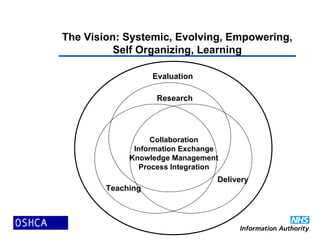
The Vision: Systemic, Evolving, Empowering,
Self Organizing, Learning
Delivery
Research
Teaching
Collaboration
Information Exchange
Knowledge Management
Process Integration
Evaluation
Why Vision Has Been Difficult to Achieve:
Healthcare is an Ecosystem
• Complex and fluid relationships
• No two customers are identical
• Unpredictable
• Does not respond well to command and control models
• Looks chaotic on the surface
• New management thinking emerging
– Complex Adaptive Systems Theory - VHA
– Emergent behaviour
– Agent-Based Models of Competition and Collaboration
Traditional Software Business Models Have
Not Been Effective
• Cost Surprises - Batteries are not included
• Evolution - have you got the genes for it?
• Effectiveness - evidence based solutions?
• Migration - you can have any colour you want as long as its
purple
• Re-inventing wheels: basic requirements are the same
• Systemic solutions have evaded us - Lego, Duplo, Meccano
Are We Suffering From Paradigm Paralysis?
"The significant problems we face cannot be solved
at the same level of thinking we were at when we
created them."
Albert Einstein
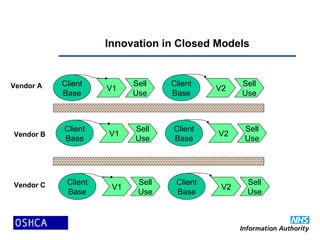
Innovation in Closed Models
V1
Sell
Use
Client
Base
V2
Sell
Use
Client
Base
V1
Sell
Use
Client
Base
V2
Sell
Use
Client
Base
V1
Sell
Use
Client
Base
V2
Sell
Use
Client
Base
Vendor A
Vendor B
Vendor C
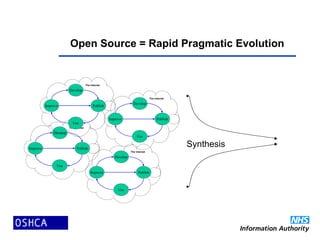
Open Source = Rapid Pragmatic Evolution
Develop
Publish
Use
Improve
The Internet
Develop
Publish
Use
Improve
The Internet
Develop
Publish
Use
Improve
The Internet
Develop
Publish
Use
Improve
The Internet
Synthesis
The Virtuous Spiral
• Costs minimized
• Collective learning, sharing and support encouraged
• Standards driven
• No hype just reality
• Survival of the fittest
• Powered by a paradox: entrepreneurial altruism
The Virtuous Spiral Cont’d
• Innovation is not hampered by the need to recover R&D costs or
maintain profit margins
• User driven
– can modify to suit specific needs
– functionality that has a broad appeal thrives and expands
• Any improvements are added to the public “gene pool”
• Commercial participants fill in the gaps and are incented to
continuously improve applications
• A Self Reinforcing “Virtuous Spiral”
Basic Ingredients for Virtuous Spirals
• A collaborative community
• Software base
• Meeting place
• Commercial exploitation
Elements of Collaboration
• You have to be able to find each other
• You have to be able to recognize each other
• There has to be a strong probability you will encounter each
other again
• Practice “Tit for Tat”
• Be the first to collaborate
• Be inclusive
Robert Axelrod
Evolution of Cooperation
Open Source: A Natural Fit for Healthcare
• Resonates with the culture of healthcare
• Medical information and processes are too important for proprietary
formats and tools
• Accelerating shared learning and improvement is of strategic value
to all
• Leverages public funding
• Large teaching centres are an untapped resource
• Competition in healthcare is minimal
• We can’t afford to reinvent wheels
• Not really a new idea
• A Strategic and Contagious Global Paradigm Shift
Where Open Source is Going in Healthcare
The Open Source Health Care Alliance
OSHCA
• Initiated on openhealthtm
listserver in Nov 1999
• Inaugural non-virtual meeting Rome, June 2000
• Supporters from
– National Library of Medicine (USA)
– Los Alamos National Research Labs
– United Nations FAO/IAEA
– Department of Family Medicine, McMaster University
– Minoru,
– Conecta
– Sistema
International Healthcare Projects
DHCP/VISTA project: VA Hospitals in the USA.
• complete HIS suite developed for military hospitals worldwide.
• made available through Freedom of Information Act.
• now available on CD or Internet download.
• Los Alamos National Labs - Telemed
• FreeMed and other practice management systems
• MUFFIN - Dept. of Family Medicine, McMaster University
– passed conformance testing by Ministry of Health for Primary Care
Reform
Projects Cont’d
• Circare - patient index (GPI) homepage
• LabInfo - UN FAO/IAEA early stages Lab Information
Management System
• SPIRIT (European Commission) to be announced
– Community
– Code base
– Meeting place
– Commercialization
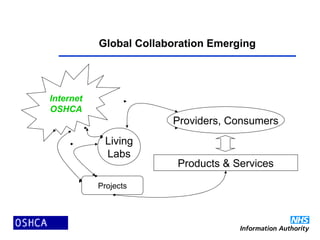
Global Collaboration Emerging
Products & Services
Living
Labs
Providers, Consumers
Internet
OSHCA
Projects
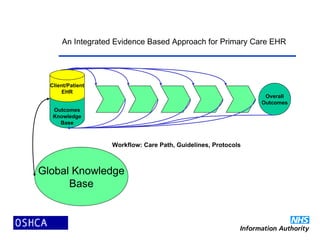
Overall
Outcomes
Outcomes
Knowledge
Base
Workflow: Care Path, Guidelines, Protocols
Global Knowledge
Base
Client/Patient
EHR
An Integrated Evidence Based Approach for Primary Care EHR
In Closing
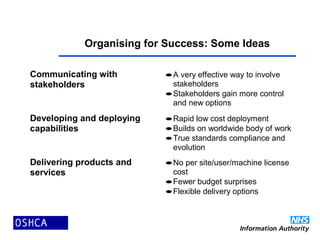
Organising for Success: Some Ideas
Communicating with
stakeholders
•A very effective way to involve
stakeholders
•Stakeholders gain more control
and new options
Developing and deploying
capabilities
•Rapid low cost deployment
•Builds on worldwide body of work
•True standards compliance and
evolution
Delivering products and
services
•No per site/user/machine license
cost
•Fewer budget surprises
•Flexible delivery options
How to Take Advantage of Open Source
• Start small and grow into it
• Join and help build the global community
• Consider releasing existing in-house software as open source
• Adapt procurement / certification process to accommodate the
alternative
Threats of Not Participating
• Blindsided by grassroots adoption
• Spending money on things that will be free
• Existing vendors will not be given enough opportunity to adapt
• Your voice will not be heard in the OS community
• Delaying benefits to the citizen
Open Source Is Inevitable
• It is positively viral
• Some one will, somewhere on the planet - and it only takes one
good application to get things started
• No one has to ask permission to “buy” an OS application
• It mimics the traditional approach to medical innovation
• It is the only way some countries can afford health information
systems
• It is the next step in software business evolution
Contact Information
Joseph Dal Molin
President, e-cology Corp.
Director, WorldVistA
Email: dalmolin@e-cology.ca
Skype: dalmolin

NHS IA Exec Open Source Briefing Oct 2000

  • 1.
    Open Source inHealthcare : The Birth of Evidence Based Software? Joseph Dal Molin Open Source Health Care Alliance October 24, 2000
  • 2.
    A Provocation…a laEdward de Bono “The propagation of the Open Source business model in healthcare is inevitable.”
  • 3.
    Agenda • A QuickCourse on open source • How and why it works • Open source in Healthcare • Where open source in Healthcare is heading • Closing
  • 4.
    A Quick Courseon Open Source
  • 5.
    Open Source Defined ““Thebasic idea behind open source is very simpleThe basic idea behind open source is very simple. When. When programmers on the Internet can read, redistribute, andprogrammers on the Internet can read, redistribute, and modify the source for a piece of software, itmodify the source for a piece of software, it evolvesevolves.. People improve it, people adapt it,People improve it, people adapt it, people fix bugs. Andpeople fix bugs. And this can happen atthis can happen at astonishing speedastonishing speed …..”…..” FromFrom www.opensource.orgwww.opensource.org
  • 6.
    Basic Characteristics ofOpen Source Software • Source code free • Any party can sell or give away copies. • Derived works can or must be distributed under same terms. • Anyone can participate. • License must be complete and compatible. Full details at www.opensource.orgwww.opensource.org
  • 7.
    Open Source vs.Free Software • Free Software – a concept developed by Richard Stallman, – is social movement motivated by the belief that software licensing impacts personal freedom – primarily involves GPL license • open source – a pragmatic definition of software that can be exchanged freely – is primarily a business model – deliberately coined to attract broader participation including commercial interests
  • 8.
    Not All FreeSoftware is Open Source • NOT shareware. • NOT demoware. • NOT an evaluation copy. • NOT personal-use-only software. • NOT usually in the public domain. • Can be used with proprietary software.
  • 9.
    How and WhyOpen Source Works
  • 10.
    The Open SourceBusiness Model Develop Publish Use Improve The Internet
  • 11.
    Open Source &Software Economics • Market forces drive price to the marginal cost of production C. Shapiro and H. Varian, Information Rules, Harvard Business School Press, 1999 Bill Gates, Microsoft Internal Meeting • The cost of producing a second copy of software, like information, is close to £0 • The network effect of the internet accelerates this trend • Open Source is the next step in software business models • As revolutionary as the microprocessor
  • 12.
    The Mysteries ofOpen Source • Where's the money? • What happened to software engineering?
  • 13.
    Understanding the Mysteries Opensource Software is Customer Constructed Software Why is it written? • "Have an itch, scratch it". • You can achieve more by modifying an existing product. • You can achieve more by reusing existing source code. • You can achieve more by working together. Why is it released? • Released changes will be present in future versions. • To comply with open source licenses used. • To gain future benefits from other users. • To establish a standard. • To sell associated services and products. • For the benefit of all
  • 14.
    How Open SourceVendors Make Money • Development • Distribution • Implementation • Support • Associated products and services • Consulting
  • 15.
    Benefits of theOpen Source Approach • Zero license cost • Extensive peer review = security and reliability • Rapid development via component sharing • Rapid innovation - through global collaboration • Survival of the fittest - only what works survives • Risk and R&D costs shared on a global basis • Customers directly set priority of new features. • Vendor survival no longer critical
  • 16.
    Open Source inHealthcare
  • 17.
    The Vision: Systemic,Evolving, Empowering, Self Organizing, Learning Delivery Research Teaching Collaboration Information Exchange Knowledge Management Process Integration Evaluation
  • 18.
    Why Vision HasBeen Difficult to Achieve: Healthcare is an Ecosystem • Complex and fluid relationships • No two customers are identical • Unpredictable • Does not respond well to command and control models • Looks chaotic on the surface • New management thinking emerging – Complex Adaptive Systems Theory - VHA – Emergent behaviour – Agent-Based Models of Competition and Collaboration
  • 19.
    Traditional Software BusinessModels Have Not Been Effective • Cost Surprises - Batteries are not included • Evolution - have you got the genes for it? • Effectiveness - evidence based solutions? • Migration - you can have any colour you want as long as its purple • Re-inventing wheels: basic requirements are the same • Systemic solutions have evaded us - Lego, Duplo, Meccano
  • 20.
    Are We SufferingFrom Paradigm Paralysis? "The significant problems we face cannot be solved at the same level of thinking we were at when we created them." Albert Einstein
  • 21.
    Innovation in ClosedModels V1 Sell Use Client Base V2 Sell Use Client Base V1 Sell Use Client Base V2 Sell Use Client Base V1 Sell Use Client Base V2 Sell Use Client Base Vendor A Vendor B Vendor C
  • 22.
    Open Source =Rapid Pragmatic Evolution Develop Publish Use Improve The Internet Develop Publish Use Improve The Internet Develop Publish Use Improve The Internet Develop Publish Use Improve The Internet Synthesis
  • 23.
    The Virtuous Spiral •Costs minimized • Collective learning, sharing and support encouraged • Standards driven • No hype just reality • Survival of the fittest • Powered by a paradox: entrepreneurial altruism
  • 24.
    The Virtuous SpiralCont’d • Innovation is not hampered by the need to recover R&D costs or maintain profit margins • User driven – can modify to suit specific needs – functionality that has a broad appeal thrives and expands • Any improvements are added to the public “gene pool” • Commercial participants fill in the gaps and are incented to continuously improve applications • A Self Reinforcing “Virtuous Spiral”
  • 25.
    Basic Ingredients forVirtuous Spirals • A collaborative community • Software base • Meeting place • Commercial exploitation
  • 26.
    Elements of Collaboration •You have to be able to find each other • You have to be able to recognize each other • There has to be a strong probability you will encounter each other again • Practice “Tit for Tat” • Be the first to collaborate • Be inclusive Robert Axelrod Evolution of Cooperation
  • 27.
    Open Source: ANatural Fit for Healthcare • Resonates with the culture of healthcare • Medical information and processes are too important for proprietary formats and tools • Accelerating shared learning and improvement is of strategic value to all • Leverages public funding • Large teaching centres are an untapped resource • Competition in healthcare is minimal • We can’t afford to reinvent wheels • Not really a new idea • A Strategic and Contagious Global Paradigm Shift
  • 28.
    Where Open Sourceis Going in Healthcare
  • 29.
    The Open SourceHealth Care Alliance OSHCA • Initiated on openhealthtm listserver in Nov 1999 • Inaugural non-virtual meeting Rome, June 2000 • Supporters from – National Library of Medicine (USA) – Los Alamos National Research Labs – United Nations FAO/IAEA – Department of Family Medicine, McMaster University – Minoru, – Conecta – Sistema
  • 30.
    International Healthcare Projects DHCP/VISTAproject: VA Hospitals in the USA. • complete HIS suite developed for military hospitals worldwide. • made available through Freedom of Information Act. • now available on CD or Internet download. • Los Alamos National Labs - Telemed • FreeMed and other practice management systems • MUFFIN - Dept. of Family Medicine, McMaster University – passed conformance testing by Ministry of Health for Primary Care Reform
  • 31.
    Projects Cont’d • Circare- patient index (GPI) homepage • LabInfo - UN FAO/IAEA early stages Lab Information Management System • SPIRIT (European Commission) to be announced – Community – Code base – Meeting place – Commercialization
  • 32.
    Global Collaboration Emerging Products& Services Living Labs Providers, Consumers Internet OSHCA Projects
  • 33.
    Overall Outcomes Outcomes Knowledge Base Workflow: Care Path,Guidelines, Protocols Global Knowledge Base Client/Patient EHR An Integrated Evidence Based Approach for Primary Care EHR
  • 34.
  • 35.
    Organising for Success:Some Ideas Communicating with stakeholders •A very effective way to involve stakeholders •Stakeholders gain more control and new options Developing and deploying capabilities •Rapid low cost deployment •Builds on worldwide body of work •True standards compliance and evolution Delivering products and services •No per site/user/machine license cost •Fewer budget surprises •Flexible delivery options
  • 36.
    How to TakeAdvantage of Open Source • Start small and grow into it • Join and help build the global community • Consider releasing existing in-house software as open source • Adapt procurement / certification process to accommodate the alternative
  • 37.
    Threats of NotParticipating • Blindsided by grassroots adoption • Spending money on things that will be free • Existing vendors will not be given enough opportunity to adapt • Your voice will not be heard in the OS community • Delaying benefits to the citizen
  • 38.
    Open Source IsInevitable • It is positively viral • Some one will, somewhere on the planet - and it only takes one good application to get things started • No one has to ask permission to “buy” an OS application • It mimics the traditional approach to medical innovation • It is the only way some countries can afford health information systems • It is the next step in software business evolution
  • 39.
    Contact Information Joseph DalMolin President, e-cology Corp. Director, WorldVistA Email: dalmolin@e-cology.ca Skype: dalmolin