NGSS_Physics Topics Mapping for teaching physics in Highschool
1.
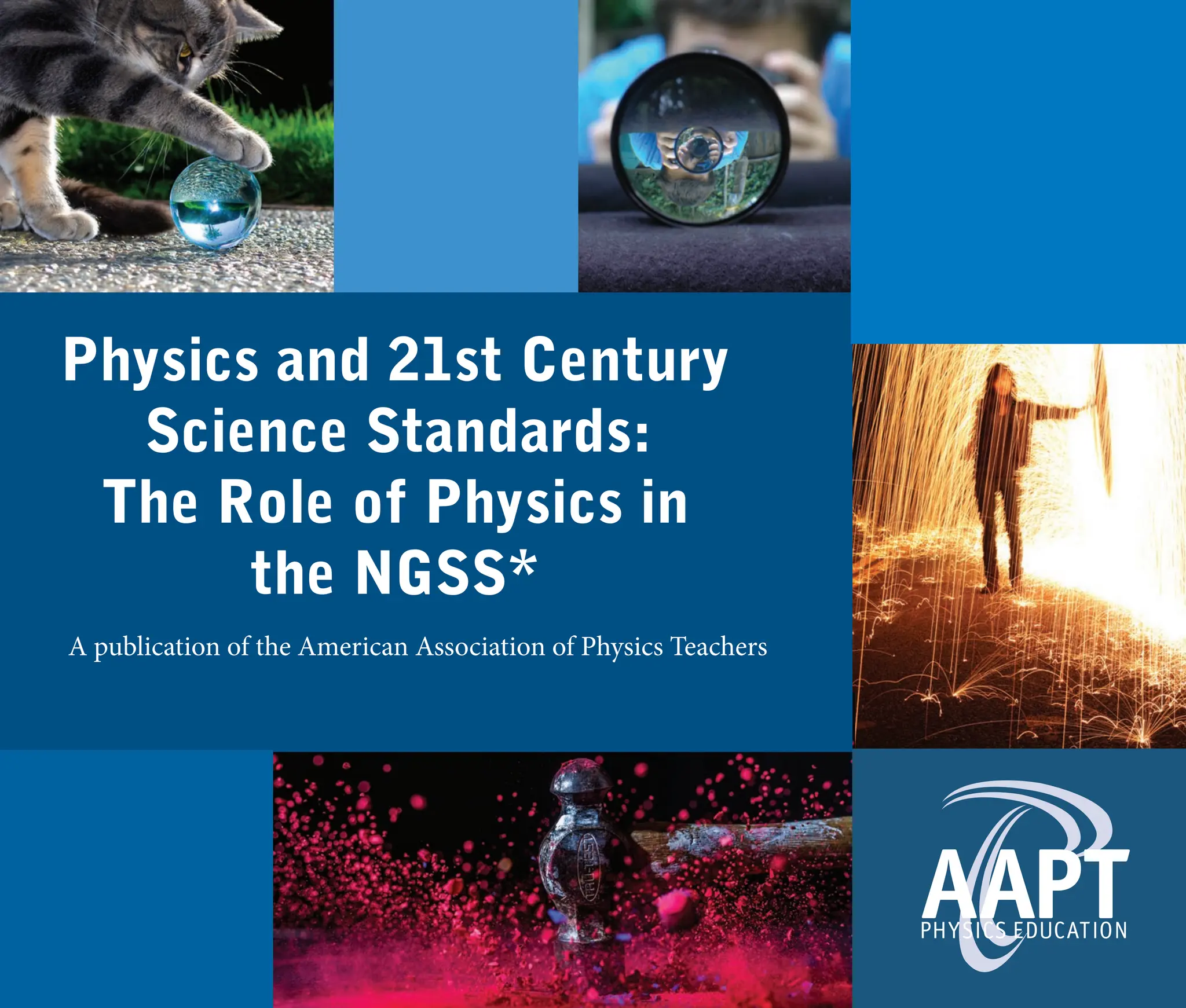
Physics and 21stCentury
Science Standards:
The Role of Physics in
the NGSS*
A publication of the American Association of Physics Teachers
3.
Table of Contents
Editor’sIntroduction....................................................................................................................................................4
Quick FAQ’s about the NGSS for Physics Teachers.................................................................................................6
Overview and History of the NGSS...........................................................................................................................8
Reading the NGSS........................................................................................................................................................9
Physics and the NGSS..................................................................................................................................................15
Resources for Implementing the NGSS.....................................................................................................................25
AAPT’s Role in the NGSS...........................................................................................................................................25
4.
AAPT
4
Editor’s Introduction
In 2012,Achieve, Inc. and the Lead States released the first draft of the Next Generation Science Standards (NGSS Lead States, 2013), commonly known
as the NGSS, for public comment. These standards were meant to provide a coherent set of internationally-benchmarked guidelines for K-12 science
teachers across the nation. In response, the American Association of Physics Teachers (AAPT), the American Physical Society, the American Chemical
Society, the American Institute of Physics, the American Society for Engineering Education, and the Department of Energy compiled feedback on the
first draft of the standards. A summary of the group’s May 29, 2012 response can be found in the 1st Draft Summary Response: http://goo.gl/nJlFSk.
Upon release of a revised version of the NGSS, the AAPT created an additional focus group comprised of persons involved in high school physics
education. The AAPT responded again in their 2nd Draft Summary Response: http://goo.gl/qrxldf. This response, from February 1, 2013, described
both their support for standards based upon the National Research Council and National Academy of Science’s Framework for K-12 Science Education:
Practices, Crosscutting Concepts, and Core Ideas, while also identifying some weaknesses and omissions in the standards with recommendations for
improvement.
The AAPT supports the spirit and purpose of NGSS as implemented in the context of the Framework, but does not endorse any set of standards. Please
refer to the AAPT’s physics focus group’s final response to Achieve about the NGSS for details: http://goo.gl/tlvdVW.
It is my hope that this document will help K-12 teachers of physics to better understand how their classroom practice is aligned with the NGSS or how it
can be effectively aligned if your state or your school adopt the NGSS.
~ Rebecca E. Vieyra, K-12 Program Manager, AAPT
Approved by the AAPT Board of Directors, 9 January 2016
Acknowledgement
Gratitude is expressed to Patrick Mangan, AAPT/Society of Physics Students summer 2015 intern, for his work in organizing the outline of the physics-
related standards for this document. Additional reviewers included Robert Hilborn, Caroline Hall, and Jon Gaffney, in addition to the AAPT Board of
Directors.
•.......................................................NGSS is
a registered trademark of Achieve. Neither
Achieve nor the lead states and partners
that developed the Next Generation Science
Standards was involved in the production of,
and does not endorse, this document.
6.
AAPT
6
Quick FAQ’s aboutthe NGSS for
Physics Teachers
• The NGSS are best understood in the context of the National Academy’s
Framework for K-12 Science Education. It is highly suggested that teachers and
administrators read the Framework first before attempting to implement the
standards.
• What are the Next Generation Science Standards (NGSS)? The NGSS are
a set of performance expectations that describe what students should know and
be able to do at various stages in their K-12 development, and were written with
wide-scale student assessment in mind. The NGSS are not written as curriculum:
they do not provide details about what students need in order to master a big
idea. The NGSS do not provide explicit guidelines to teachers about instructional
approaches; educators are expected to use their discretion when making decisions
about pacing, order, and teaching method.
• Why should I care about the NGSS? The NGSS is a result of a nationwide attempt
to increase science literacy for all. Physics is fundamental to this effort. The writing
of the NGSS was based upon work by the National Academies and the American
Association for the Advancement of Science, and was written by 41 science
educators and leaders from 26 Lead States. Even if your school district or state
has not adopted the NGSS, understanding them is key to engaging in the national
discussion about science education.
• What do the NGSS look like? Below is a sample standard related to physics.
The NGSS are performance objectives (defining a student action for assessment)
that include both depth of content (Disciplinary Core Ideas), skills (Science
and Engineering Practices), and interconnections with other science disciplines
(Crosscutting Concepts). The NGSS are also aligned with Common Core State
Standards for English Language Arts / Literacy and Mathematics. See “Reading the
NGSS” in this guide for a much more detailed explanation of how these facets of
each standard are related to one another.
• Ex.: HS-PS3-5. Develop and use a model of two objects interacting through
electrical or magnetic fields to illustrate the forces between objects and
the changes in energy of the objects due to the interaction. [Clarification
Statement: Examples of models could include drawings, diagrams, and texts,
such as drawings of what happens when two charges of opposite polarity are
near each other.] [Assessment Boundary: Assessment is limited to systems
containing two objects.]
• Where do I find physics content in the NGSS? Because the NGSS place heavy
emphasis on the interdisciplinary nature of science and engineering, the standards
are not explicitly organized by subject. Although physics can be found (alongside
chemistry) in the Physical Science grouping of standards, physics concepts can
also be found in the study of Earth and Space Science (i.e. gravity), Life Sciences
(i.e. energy flow), and Engineering standards.
• How would adoption of the NGSS affect the physics courses that I teach?
The answer to this is dependent upon both your existing teaching style and
course content. While most standard high school physics courses will include
the “big topics” addressed by the NGSS (Motion, Forces, Energy, and Waves),
the NGSS also places a heavy emphasis on interdisciplinary understandings and
engineering. Teachers might find that they need to make more room for teaching
these additional skills, shift their instructional approach, and/or to take more
professional development themselves in order to help students address these
standards.
• What is the AAPT’s position on the NGSS? The AAPT supports the spirit and
purpose of NGSS as implemented in the context of the Framework, but does not
endorse any set of standards.
• Where can I learn more about the NGSS? Get new resources that align with
and support the use of the NGSS at http://aapt.org/k12. Visit http://www.
nextgenscience.org to read and learn more about each of the NGSS performance
expectations. See “Resources for Implementing the NGSS” near the end of this
booklet.
7.
7
Physics and 21stCentury Science Standards: The Role of Physics in the NGSS
8.
AAPT
8
Achieve, Inc., andpublished by the National Academies Press.
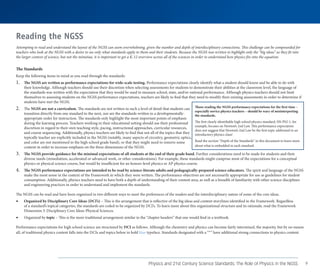
As of early 2016, nearly a third of U.S. states and the District of Columbia have adopted
the NGSS. Many states already had their own standards in advance of the development
of the NGSS, and did not opt to adopt the new standards. Some states feel that the NGSS
are insufficient to provide curricular or instructional guidance to teachers, and that their
standards are superior to the NGSS. However, many school districts are adopting the
standards in advance of their states – in some cases, with the NGSS being adopted in
tandem with different state standards.
Adoption of the standards is slow, but progressing. There are a number of speculations
about the factors that have influenced the slow adoption of the NGSS in comparison to
the relatively quick adoption of the Common Core State Standards (CCSS). Because the
CCSS were used by many states as “college and career-ready” standards to comply with
incentives for the Race to the Top program, it is possible that many states are waiting
before adopting yet another set of new standards. Additionally, states have put significant
efforts into improving student achievement in mathematics and English/language arts (the
content associated with the CCSS) through the development of assessments following the
implementation of No Child Left Behind. No nationwide assessment has yet be developed
for science education aligned with the NGSS, and the results of student achievement in
science have significantly less political clout than mathematics of English/language arts. In
some cases, states have opposed any national standards.
Even so, teachers who work in districts or states where the NGSS have not been adopted
should still be aware of the standards both because many professional organizations
have endorsed them and so that they can effectively engage in national discussions about
science education.
Overview and History of the NGSS
The Next Generation Science Standards (NGSS) were written as a response to the
growing need for a STEM-ready U.S. workforce with critical thinking and inquiry-
based problem solving skills. The NGSS addresses science understanding and
skills at the K-12 level and includes performance expectations for students to have
accomplished by the end of Kindergarten, grades 1, 2, 3, 4, and 5, and at the end of
Middle School (MS) and High School (HS).
Many physics teachers across the country have found themselves impacted by statewide,
local, or even personal adoption of the NGSS. As a result, physics teachers might find
that they need to make shifts in the type of content that they teach and the instructional
practices that they use. To fully understand the NGSS, it is important to understand the
origin of the NGSS, as well as the full K-12 spectrum that it spans.
The NGSS were based on A Framework for K-12 Science Education (2012), produced
by the National Research Council. In order to understand the content and organization
of the NGSS, this document is a “must read” for educators.
What sets the NGSS apart from previous standards are the three dimensions of the
Framework that are interwoven into each standard:
• Disciplinary Core Ideas
• Science and Engineering Practices
• Crosscutting Concepts
In addition to these three dimensions, standards are also connected to:
• Understanding the Scientific Enterprise: The Nature of Science
• Engineering Design
• Science, Technology, Society, and the Environment
• Common Core State Standards for Mathematics
• Common Core State Standards for Literacy in Science and Technical Subjects
The NGSS were released for adoption by states in April 2013. Reviewing the nationwide
progression of the NGSS can be very helpful to comprehending the fairly complex
nature of the document. Refer to Resources for Implementing the NGSS near the back
of this pamphlet for more information. All of the listed documents are available for
free download and serve as an introduction to the evolution of STEM education in the
United States over the past 20 years.
Using the Framework and its three dimensions (Disciplinary Core Ideas, Science and
Engineering Practices, and Crosscutting Concepts), the Next Generation Science
Standards were developed by a coalition of 26 lead states under the guidance of
Saved from:
https://www.amcharts.com/visited_states/#
9.
9
Physics and 21stCentury Science Standards: The Role of Physics in the NGSS
Reading the NGSS
Attempting to read and understand the layout of the NGSS can seem overwhelming, given the number and depth of interdisciplinary connections. This challenge can be compounded for
teachers who look at the NGSS with a desire to see only what standards apply to them and their students. Because the NGSS was written to highlight only the “big ideas” as they fit into
the larger context of science, but not the minutiae, it is important to get a K-12 overview across all of the sciences in order to understand how physics fits into the equation.
The Standards
Keep the following items in mind as you read through the standards:
1. The NGSS are written as performance expectations for wide-scale testing. Performance expectations clearly identify what a student should know and be able to do with
their knowledge. Although teachers should use their discretion when selecting assessments for students to demonstrate their abilities at the classroom level, the language of
the standards was written with the expectation that they would be used to measure school, state, and/or national performance. Although physics teachers should not limit
themselves to assessing students on the NGSS performance expectations, teachers are likely to find that they need to modify their existing assessments in order to determine if
students have met the NGSS.
2. The NGSS are not a curriculum. The standards are not written in such a level of detail that students can
transition directly from one standard to the next, nor are the standards written in a developmentally-
appropriate order for instruction. The standards only highlight the most important points of emphasis
during the learning process. Teachers working in their educational setting should use their professional
discretion in regard to their own teaching style, pacing, instructional approaches, curricular resources,
and course sequencing. Additionally, physics teachers are likely to find that not all of the topics that they
typically teacher are explicitly included in the NGSS (notably, many aspects of circuitry, geometric optics,
and color are not mentioned in the high school grade band), or that they might need to remove some
content in order to increase emphasis on the three dimensions of the NGSS.
3. The NGSS provide guidance for the minimal expectations of all students at the end of their grade band. Further considerations need to be made for students and their
diverse needs (remediation, accelerated or advanced work, or other considerations). For example, these standards might comprise most of the expectations for a conceptual
physics or physical science course, but would be insufficient for an honors-level physics or AP physics course.
4. The NGSS performance expectations are intended to be read by science-literate adults and pedagogically-prepared science educators. The spirit and language of the NGSS
make the most sense in the context of the Framework in which they were written. The performance objectives are not necessarily appropriate for use as guidelines for student
consumption. Additionally, physics teachers need to have both a depth of understanding of their content area, as well as a breadth of familiarity with other science disciplines
and engineering practices in order to understand and implement the standards.
The NGSS can be read and have been organized in two different ways to meet the preferences of the readers and the interdisciplinary nature of some of the core ideas.
• Organized by Disciplinary Core Ideas (DCI’s) – This is the arrangement that is reflective of the big ideas and content storylines identified in the Framework. Regardless
of a standard’s topical categories, the standards are coded to be organized by DCI’s. To learn more about this organizational structure and its rationale, read the Framework
Dimension 3: Disciplinary Core Ideas-Physical Sciences.
• Organized by topic – This is the more traditional arrangement similar to the “chapter headers” that one would find in a textbook.
Performance expectations for high school science are structured by DCI as follows. Although the chemistry and physics can become fairly intermixed, the majority, but by no means
all, of traditional physics content falls into the DCIs and topics below in bold blue typeface. Standards designated with a “*” have additional strong connections to physics content.
Those reading the NGSS performance expectations for the first time –
especially novice physics teachers – should be wary of misinterpreting
the standards.
The first clearly identifiable high school physics standard, HS-PS2-1, for
example, focuses on Newton’s 2nd Law. This performance expectation
does not suggest that Newton’s 2nd Law be the first topic addressed in an
introductory physics class!
Read the section “Depth of the Standards” in this document to learn more
about what is embedded in each standard.
11
Physics and 21stCentury Science Standards: The Role of Physics in the NGSS
The Dimensions
The key elements of the NGSS are the three dimensions (Figure 5) that are interwoven
into each standard.
• Disciplinary Core Ideas (DCIs) These are the key pieces of discipline-focused
knowledge (i.e. content) that students should know.
• Earth Science
• Life Science
• Physical Science
• Engineering
• Science and Engineering Practices (SEPs) These practices describe specific skills and
actions that can be performed by students that parallel the activities of scientists to
build models and theories and by engineers to design and build systems.
• Asking questions (for science) and defining problems (for engineering)
• Developing and using models
• Planning and carrying out investigations
• Analyzing and interpreting data
• Using mathematics and computational thinking
• Constructive explanations (for science) and designing solutions (for
engineering)
• Engaging in argument from evidence
• Obtaining, evaluating, and communicating information.
• Crosscutting Concepts (CCs) These are the unifying ideas that span all science
disciplines that students with a broad science literacy should understand.
Organized by DCI Organized by Topic
Physical Sciences • Matter and Its Interactions
• Motion and Stability: Force & Motion
• Energy
• Waves and Their Applications in Technologies
for Information Transfer
• Structure and Properties of Matter
• Chemical Reactions*
• Forces and Interactions
• Energy
• Waves and Electromagnetic Radiation
Life Sciences • From Molecules to Organisms: Structures and
Processes *
• Ecosystems: Interactions, Energy, and
Dynamics *
• Heredity: Inheritance and Variation of Traits
• Biological Evolution: Unity and Diversity*
• Structure and Function
• Matter and Energy in Organisms and
Ecosystems *
• Interdependent Relationships in
Ecosystems
• Inheritance and Variation of Traits
• Natural Selection and Evolution
Earth and Space
Sciences
• Earth’s Place in the Universe *
• Earth’s Systems *
• Earth and Human Activity *
• Space Systems *
• History of Earth
• Earth’s Systems *
• Weather and Climate *
• Human Sustainability *
Engineering Design • Engineering Design • Engineering Design
Table 1: NGSS organized by DCI and Topic
12.
AAPT
12
• Patterns
• Causeand effect: Mechanism and explanation
• Scale, proportion, and quantity
• Systems and system models
• Energy and matter: Flows, cycles, and conservation
• Structure and function
• Stability and change
Other NGSS Connections
In addition to these three dimensions, standards are also connected to:
• Understanding the Scientific Enterprise: The Nature of Science Surrounding the
context of NGSS is the expectation that students will learn about the development
of scientific knowledge, with its many historical and social implications. The nature
of science is not an additional dimension to the three dimensions above, but is
interwoven with the SEPs and CCs. The first four are closely related to the SEPs, and
the last four are closely related to CCs.
• Scientific investigations use a variety of methods.
• Scientific knowledge is based on empirical evidence.
• Scientific knowledge is open to revision in light of new evidence.
• Scientific models, laws, mechanisms, and theories explain natural
phenomena.
• Science is a way of knowing.
• Science knowledge assumes an order and consistency in natural systems.
• Science is a human endeavor.
• Science addresses questions about the natural and material world.
• Engineering Design
In the NGSS documents, engineering is defined as “any engagement in a systematic
practice of design to achieve solutions to particular human problems.” Although many
models of engineering design exist, the NGSS focus on a three-part approach (Figure 6)
that include the following components, with modified descriptors for each component
dependent upon the grade band.
• Defining and delimiting engineering problems
• Designing solutions to engineering problems
• Optimizing the design solution
• Science, Technology, Society, and the Environment
Science, technology, society, and environment are interdependent upon one another.
Likewise, teachers must encourage their students to make connections between the
classroom, their home lives, and their community.
• Common Core State Standards for Mathematics and Literacy in Science and
Technical Subjects
Where appropriate, the NGSS connects to Common Core State Standards (CCSS).
However, adoption of the NGSS does not mandate adoption of the CCSS or have
any impact on the incorporation of the NGSS alone. The hyperlinked appendixes to
the NGSS provide examples of how teachers can incorporate the CCSS with specific
scenarios, including the use of qualitative skills (ex: proportional reasoning) and
quantitative skills (ex: mathematical modeling with algebra).
NGSS Format
The NGSS standards are presented in a table in the Achieve, Inc. documentation. Within
a single table, all of the standards will be listed for a given DCI or topic area, with
associated Science and Engineering Practices, Disciplinary Core Ideas, and Crosscutting
Concepts, as well as connections within NGSS within and across grade bands, and
Common Core State Standards.
It is important to note that because the NGSS are written as performance expectations,
each standard is closely linked to one or more DCIs, SEPs, and/or CCs. These standards
are written with an assessment in mind, and therefore have a very narrow focus. In
contrast, teachers can and should use instructional practices and curriculum designs
that help students to see that a single DCI can have connections to many or even
all of the SEPs and CCs, not only those that are explicitly linked to the performance
expectation.
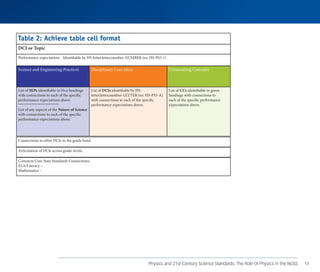
The structure of a table entry is shown below in Table 2
13.
13
Physics and 21stCentury Science Standards: The Role of Physics in the NGSS
Science and Engineering Practices Disciplinary Core Ideas Crosscutting Concepts
List of SEPs identifiable in blue headings
with connections to each of the specific
performance expectations above.
*************************
List of any aspects of the Nature of Science
with connections to each of the specific
performance expectations above.
List of DCIs identifiable by HS-
letter,letter,number-LETTER (ex: HS-PS3-A)
with connections to each of the specific
performance expectations above.
List of CCs identifiable in green
headings with connections to
each of the specific performance
expectations above.
Performance expectations - Identifiable by HS-letter,letter,number-NUMBER (ex: HS-PS3-1)
DCI or Topic
Table 2: Achieve table cell format
Connections to other DCIs in the grade band.
Articulation of DCIs across grade-levels.
Common Core State Standards Connections:
ELA/Literacy –
Mathematics –
15.
15
Physics and 21stCentury Science Standards: The Role of Physics in the NGSS
Physics is not explicitly differentiated from
chemistry within physical science topics
or DCIs. As a result, there is some overlap.
Schools and teachers are expected to use
their professional discretion to determine
who teaches these concepts and in what
order, although Achieve has released a set
of suggested course maps for middle and
high school. In some cases, fundamental
physics concepts are not mentioned at
all, and teachers are expected to use good
judgment when making decisions about
detailed curriculum, using the NGSS only
as guideposts for student achievement
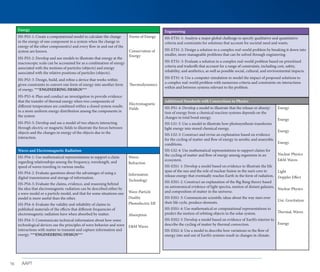
along the way. Table 3 shows high school
physics-related NGSS, organized by topic.
TOPIC KEY PHYSICS
Structure and Properties of Matter
Table 3: High school physics-related standards
HS-PS1-3: Plan and conduct an investigation to gather evidence to compare the
structure of substances at the bulk scale to infer the strength of electrical forces
between particles.
HS-PS1-8: Develop models to illustrate the changes in the composition of the
nucleus of the atom and the energy released during the processes of fission, fusion,
and radioactive decay.
HS-PS2-6: Communicate scientific and technical information about why the
molecular-level structure is important in the functioning of designed materials.
***ENGINEERING DESIGN***
Coulomb’s Law
Nuclear Physics
Materials Science
HS-PS2-1: Analyze data to support the claim that Newton’s second law of motion
describes the mathematical relationship among the net force on a macroscopic
object, its mass, and its acceleration.
HS-PS2-2: Use mathematical representations to support the claim that the total
momentum of a system of objects is conserved when there is no net force on the
system.
HS-PS2-3: Apply scientific and engineering ideas to design, evaluate, and refine
a device that minimizes the force on a macroscopic object during a collision.
***ENGINEERING DESIGN***
HS-PS2-4: Use mathematical representations of Newton’s Law of Gravitation and
Coulomb’s Law to describe and predict the gravitational and electrostatic forces
between objects.
HS-PS2-5: Plan and conduct an investigation to provide evidence that an electric
current can produce a magnetic field and that a changing magnetic field can
produce an electric current.
Newton’s Laws
Kinematics
Impulse = ΔMomentum
Conservation of Energy
Uni. Gravitation
Coulomb’s Law
Current
Magnetism
Induction
Forces and Interactions
Physics in
the NGSS
16.
AAPT
16
Energy
HS-PS3-1: Create acomputational model to calculate the change
in the energy of one component in a system when the change in
energy of the other component(s) and every flow in and out of the
system are known.
HS-PS3-2: Develop and use models to illustrate that energy at the
macroscopic scale can be accounted for as a combination of energy
associated with the motions of particles (objects) and energy
associated with the relative positions of particles (objects).
HS-PS3-3: Design, build, and refine a device that works within
given constraints to convert one form of energy into another form
of energy. ***ENGINEERING DESIGN***
HS-PS3-4: Plan and conduct an investigation to provide evidence
that the transfer of thermal energy when two components of
different temperature are combined within a closed system results
in a more uniform energy distribution among the components in
the system
HS-PS3-5: Develop and use a model of two objects interacting
through electric or magnetic fields to illustrate the forces between
objects and the changes in energy of the objects due to the
interaction.
Forms of Energy
Conservation of
Energy
Thermodynamics
Electromagnetic
Fields
Waves and Electromagnetic Radiation
HS-PS4-1: Use mathematical representations to support a claim
regarding relationships among the frequency, wavelength, and
speed of waves traveling in various media.
HS-PS4-2: Evaluate questions about the advantages of using a
digital transmission and storage of information.
HS-PS4-3: Evaluate the claims, evidence, and reasoning behind
the idea that electromagnetic radiation can be described either by
a wave model or a particle model, and that for some situations one
model is more useful than the other.
HS-PS4-4: Evaluate the validity and reliability of claims in
published materials of the effects that different frequencies of
electromagnetic radiation have when absorbed by matter.
HS-PS4-5: Communicate technical information about how some
technological devices use the principles of wave behavior and wave
interactions with matter to transmit and capture information and
energy. ***ENGINEERING DESIGN***
Waves
Refraction
Information
Technology
Wave-Particle
Duality
Photoelectric Eff.
Absorption
E&M Waves
HS-ETS1-1: Analyze a major global challenge to specify qualitative and quantitative
criteria and constraints for solutions that account for societal need and wants.
HS-ETS1-2: Design a solution to a complex real-world problem by breaking it down into
smaller, more manageable problems that can be solved through engineering.
HS-ETS1-3: Evaluate a solution to a complex real-world problem based on prioritized
criteria and tradeoffs that account for a range of constraints, including cost, safety,
reliability, and aesthetics, as well as possible social, cultural, and environmental impacts.
HS-ETS1-4: Use a computer simulation to model the impact of proposed solutions to
a complex real-world problem with numerous criteria and constraints on interactions
within and between systems relevant to the problem.
HS-PS1-4: Develop a model to illustrate that the release or absorp-
tion of energy from a chemical reaction systems depends on the
changes in total bond energy.
HS-LS1-5: Use a model to illustrate how photosynthesis transforms
light energy into stored chemical energy.
HS-LS2-3: Construct and revise an explanation based on evidence
for the cycling of matter and flow of energy in aerobic and anaerobic
conditions.
HS-LS2-4: Use mathematical representations to support claims for
the cycling of matter and flow of energy among organisms in an
ecosystem.
HS-ESS1-1: Develop a model based on evidence to illustrate the life
span of the sun and the role of nuclear fusion in the sun’s core to
release energy that eventually reaches Earth in the form of radiation.
HS-ESS1-2: Construct an explanation of the Big Bang theory based
on astronomical evidence of light spectra, motion of distant galaxies,
and composition of matter in the universe.
HS-ESS1-3: Communicate scientific ideas about the way stars over
their life cycle, produce elements.
HS-ESS1-4: Use mathematical or computational representations to
predict the motion of orbiting objects in the solar system.
HS-ESS2-3: Develop a model based on evidence of Earth’s interior to
describe the cycling of matter by thermal convection.
HS-ESS2-4: Use a model to describe how variations in the flow of
energy into and out of Earth’s systems result in changes in climate.
Energy
Energy
Energy
Energy
Nuclear Physics
E&M Waves
Light
Doppler Effect
Nuclear Physics
Uni. Gravitation
Thermal, Waves
Energy
Additional Standards with Connections to Physics
Engineering
17.
17
Physics and 21stCentury Science Standards: The Role of Physics in the NGSS
18.
AAPT
18
From the abovediscussion alone, it might seem to teachers that achieving all of the physics-related high school standards during one
or two physics courses might be impossible. However, it is important to keep in mind that all of the standards are embedded within a
K-12 framework that anticipates that students will progress toward these ideas from their earliest years in school.
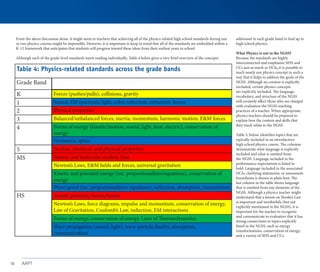
Although each of the grade-level standards merit reading individually, Table 4 below gives a very brief overview of the concepts
Grade Band
K
1
2
3
4
5
MS
HS
Forces (pushes/pulls), collisions, gravity
Sound, EM spectrum, light, color, reflection, refraction, lenses
Physical properties
Balanced/unbalanced forces, inertia, momentum, harmonic motion, E&M forces
Forms of energy (kinetic/motion, sound, light, heat, electric), conservation of
energy
Geometric optics
Nuclear, chemical, and physical properties
Atomic and molecular models, heat
Newton’s Laws, E&M fields and forces, universal gravitation
Kinetic and potential energy (inc. proportionalities/equations), conservation of
energy
Wave speed (inc. proportionalities/ equations), reflection, absorption, transmission
Atomic particles, fission/fusion
Newton’s Laws, force diagrams, impulse and momentum, conservation of energy,
Law of Gravitation, Coulomb’s Law, induction, EM interactions
Forms of energy, conservation of energy, Laws of Thermodynamics
Wave propagation (sound, light), wave-particle duality, absorption,
communication
Table 4: Physics-related standards across the grade bands
addressed in each grade band to lead up to
high school physics.
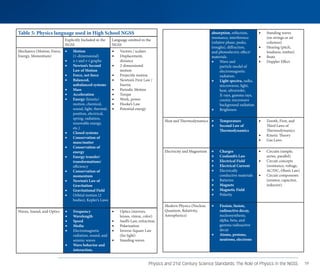
What Physics is not in the NGSS?
Because the standards are highly
interconnected and emphasize SEPs and
CCs just as much as DCIs, it is possible to
teach nearly any physics concept in such a
way that it helps to address the goals of the
NGSS. Although no content is explicitly
excluded, certain physics concepts
are explicitly included. The language,
vocabulary, and structure of the NGSS
will certainly affect those who are charged
with evaluation the NGSS teaching
practices of a teacher. When appropriate,
physics teachers should be prepared to
explain how the content and skills that
they teach relate to the NGSS.
Table 5, below, identifies topics that are
typically included in an introductory
high school physics course. The columns
demonstrate what language is explicitly
included and what is omitted from
the NGSS. Language included in the
performance expectations is listed in
bold. Language included in the associated
DCIs, clarifying statements, or assessment
boundaries is shown in plain font. The
last column in the table shows language
that is omitted from any elements of the
NGSS. Although a physics teacher might
understand that a lesson on Hooke’s Law
is important and worthwhile (but not
explicitly mentioned in the NGSS), it is
important for the teacher to recognize
and communicate to evaluators that it has
strong connections to topics explicitly
listed in the NGSS, such as energy
transformations, conservation of energy,
and a variety of SEPs and CCs.
19.
19
Physics and 21stCentury Science Standards: The Role of Physics in the NGSS
Explicitly Included in the
NGSS
Language omitted in the
NGSS
Mechanics (Motion, Force,
Energy, Momentum)
• Motion
(1-dimensional)
• x-t and v-t graphs
• Newton’s Second
Law of Motion
• Force, net force
• Balanced,
unbalanced systems
• Mass
• Acceleration
• Energy (kinetic/
motion, chemical,
sound, light, thermal,
position, electrical,
spring, radiation,
renewable energy,
etc.)
• Closed systems
• Conservation of
mass/matter
• Conservation of
energy
• Energy transfer/
transformations/
efficiency
• Conservation of
momentum
• Newton’s Law of
Gravitation
• Gravitational Field
• Orbital motion (2
bodies), Kepler’s Laws
• Vectors / scalars
• Displacement,
distance
• 2-dimensional
motion
• Projectile motion
• Newton’s First Law /
Inertia
• Periodic Motion
• Torque
• Work, power
• Hooke’s Law
• Potential energy
absorption, reflection,
resonance, interference
(relative phase, peaks,
troughs), diffraction,
and photoelectric effect/
materials.
• Wave and
particle model of
electromagnetic
radiation.
• Light spectra, radio,
microwaves, light,
heat, ultraviolet,
X-rays, gamma rays,
cosmic microwave
background radiation
• Brightness
• Standing waves
(on strings or air
columns)
• Hearing (pitch,
loudness, timbre)
• Beats
• Doppler Effect
Heat and Thermodynamics • Temperature
• Second Law of
Thermodynamics
• Zeroth, First, and
Third Laws of
Thermodynamics
• Kinetic Theory
• Gas Laws
Electricity and Magnetism • Charges
• Coulomb’s Law
• Electrical Field
• Electrical Current
• Electrically
conductive materials
• Batteries
• Magnets
• Magnetic Field
• Polarity
• Circuits (simple,
series, parallel)
• Circuit concepts
(resistance, voltage,
AC/DC, Ohm’s Law)
• Circuit components
(resistor, capacitor,
inductor).
Modern Physics (Nuclear,
Quantum, Relativity,
Astrophysics)
• Fission, fusion,
radioactive decay,
nucleosynthesis,
alpha, beta, and
gamma radioactive
decay
• Atoms, protons,
neutrons, electrons
Waves, Sound, and Optics • Frequency
• Wavelength
• Speed
• Media
• Electromagnetic
radiation, sound, and
seismic waves
• Wave behavior and
interaction,
• Optics (mirrors,
lenses, vision, color)
• Snell’s Law, refraction,
• Polarization
• Inverse-Square Law
(for light)
• Standing waves
Table 5: Physics language used in High School NGSS
21
Physics and 21stCentury Science Standards: The Role of Physics in the NGSS
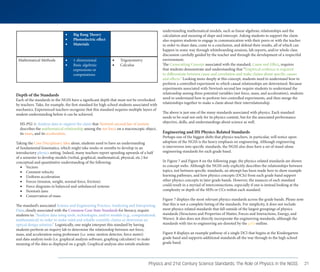
Mathematical Methods • 1-dimensional
• Basic algebraic
expressions or
computations
• Trigonometry
• Calculus
• Big Bang Theory
• Photoelectric effect
• Materials
Depth of the Standards
Each of the standards in the NGSS have a significant depth that must not be overlooked
by teachers. Take, for example, the first standard for high school students associated with
mechanics. Experienced teachers recognize that this standard requires multiple layers of
student understanding before it can be achieved.
HS-PS2-1: Analyze data to support the claim that Newton’s second law of motion
describes the mathematical relationship among the net force on a macroscopic object,
its mass, and its acceleration.
Taking the Core Disciplinary Idea alone, students need to have an understanding
of fundamental kinematics, which might take weeks or months to develop in an
introductory physics setting. Indeed, many teachers report spending upwards of a half
of a semester to develop models (verbal, graphical, mathematical, physical, etc.) for
conceptual and quantitative understanding of the following:
• Vectors
• Constant velocity
• Uniform acceleration
• Forces (tension, weight, normal force, friction)
• Force diagrams in balanced and unbalanced systems
• Newton’s laws
• Conservation of mass
The standard’s associated Science and Engineering Practice, Analyzing and Interpreting
Data, closely associated with the Common Core State Standards for literacy, require
students to: “Analyze data using tools, technologies, and/or models (e.g., computational,
mathematical) in order to make valid and reliable scientific claims or determine an
optical design solution.” Logistically, one might interpret this standard by having
students perform an inquiry lab to determine the relationship between net force,
mass, and acceleration using probeware (i.e. sonic motion detector, force meter)
and data analysis tools (i.e. graphical analysis software, graphing calculator) to make
meaning of the data as displayed on a graph. Graphical analysis also entails students
understanding mathematical models, such as linear algebraic relationships and the
calculation and meaning of slope and intercept. Asking students to support the claim
also requires students to engage in communication with their peers or with the teacher
in order to share data, come to a conclusion, and defend their results, all of which can
happen in some way through whiteboarding sessions, lab reports, and/or whole class
discussion carefully guided by the teacher and through the development of a respectful
environment.
The Crosscutting Concept associated with the standard, Cause and Effect, requires
that students demonstrate and understanding that “Empirical evidence is required
to differentiate between cause and correlation and make claims about specific causes
and effects.” Looking more deeply at this concept, students need to understand how to
perform a controlled experiment in which causal relationships are determined. Because
experiments associated with Newton’s second law require students to understand the
relationship among three potential variables (net force, mass, and acceleration), students
need to understand how to perform two controlled experiments, and then merge the
relationships together to make a claim about their interrelationship.
The above is just one of the many standards associated with physics. Each standard
needs to be read not only for its physics content, but for the associated performance
objective, skills, and understandings about science as well.
Engineering and HS Physics-Related Standards
Perhaps one of the biggest shifts that physics teachers, in particular, will notice upon
adoption of the NGSS is the heavy emphasis on engineering. Although engineering
is interwoven into specific standards, the NGSS also does have a set of stand-alone
engineering standards for each grade band.
In Figure 7 and Figure 8 on the following page, the physics-related standards are shown
in concept webs. Although the NGSS only explicitly describes the relationships between
topics, not between specific standards, an attempt has been made here to show example
learning pathways, and how physics concepts (DCIs) from each grade band support
other physics concepts in later grade bands. However, the nuances of each standard
could result in a myriad of interconnections, especially if one is instead looking at the
complexity or depth of the SEPs or CCs within each standard.
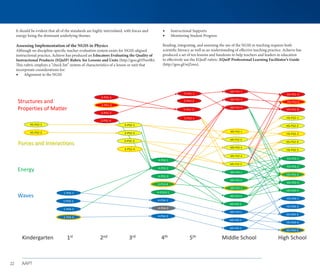
Figure 7 displays the most relevant physics standards across the grade bands. Please note
that this is not a complete listing of the standards. For simplicity, it does not include
most physics-related standards that fall outside of the largest groupings of physics
standards (Structures and Properties of Matter, Forces and Interactions, Energy, and
Waves). It also does not directly incorporate the engineering standards, although the
standards with ties to engineering are denoted by the gold outline.
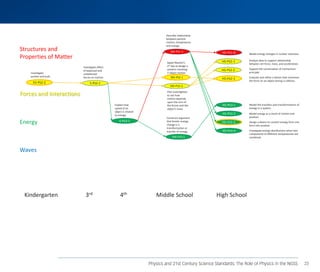
Figure 8 displays an example pathway of a single DCI that begins at the Kindergarten
grade band and supports additional standards all the way through to the high school
grade band.
22.
AAPT
22
It should beevident that all of the standards are highly interrelated, with forces and
energy being the dominant underlying themes.
Assessing Implementation of the NGSS in Physics
Although no discipline-specific teacher evaluation system exists for NGSS-aligned
instructional practice, Achieve has produced an Educators Evaluating the Quality of
Instructional Products (EQuIP) Rubric for Lessons and Units (http://goo.gl/fYwr0b).
This rubric employs a “check list” system of characteristics of a lesson or unit that
incorporate considerations for:
• Alignment to the NGSS
KS-PS2-1
2-PS1-1
5-PS1-1
HS-PS1-8
HS-PS2-1
HS-PS1-3
MS-PS1-1
HS-PS2-2
HS-PS2-3
HS-PS2-5
HS-PS2-4
HS-PS3-1
HS-PS3-2
HS-PS2-6
HS-PS3-3
HS-PS3-4
HS-PS4-1
HS-PS3-5
MS-PS1-4
MS-PS1-3
MS-PS2-1
MS-PS2-3
MS-PS2-2
HS-PS4-2
HS-PS4-4
HS-PS4-3
MS-PS2-4
MS-PS2-5
MS-PS3-1
MS-PS3-3
MS-PS3-2
MS-PS3-4
MS-PS4-1
MS-PS3-5
KS-PS2-2
1-PS4-1
1-PS4-2
1-PS4-3
2-PS1-4
2-PS1-3
3-PS2-1
3-PS2-2
3-PS2-3
3-PS2-4
4-PS3-2
4-PS3-3
4-PS3-1
4-PS3-4
4-PS4-2
4-PS4-1
4-PS4-3
5-PS2-1
5-PS1-3
HS-PS4-5
MS-PS4-2
MS-PS4-3
Structures and
Properties of Matter
Forces and Interactions
Energy
Waves
Kindergarten 1st 2nd 3rd 4th 5th Middle School High School
1-PS4-4
2-PS1-2
5-PS1-2
4-ESS3-1
• Instructional Supports
• Monitoring Student Progress
Reading, integrating, and assessing the use of the NGSS in teaching requires both
scientific literacy as well as an understanding of effective teaching practice. Achieve has
produced a set of ten lessons and handouts to help teachers and leaders in education
to effectively use the EQuiP rubric: EQuiP Professional Learning Facilitator’s Guide
(http://goo.gl/wjZsws).
23.
23
Physics and 21stCentury Science Standards: The Role of Physics in the NGSS
HS-PS1-8
HS-PS2-1
HS-PS2-2
HS-PS2-3
HS-PS3-1
HS-PS3-2
HS-PS3-3
HS-PS3-4
MS-PS1-4
MS-PS2-1
MS-PS2-2
MS-PS3-5
KS-PS2-2 3-PS2-1
4-PS3-1
Structures and
Properties of Matter
Forces and Interactions
Energy
Waves
Kindergarten 3rd 4th Middle School High School
Investigate
pushes and pulls.
Investigate effect
of balanced and
unbalanced
forces on motion.
Explain how
speed of an
object is related
to energy.
Describe relationship
between particle
motion, temperature,
and energy.
Apply Newton’s
3rd law to design a
solution involving
2-object motion
Plan investigation
to see how
motion depends
upon the sum of
the forces and the
object’s mass.
Construct argument
that kinetic energy
change is a
transformation or
transfer of energy.
Model energy changes in nuclear reactions.
Analyze data to support relationship
between net force, mass, and acceleration.
Support the conservation of momentum
principle.
Evaluate and refine a device that minimizes
the force on an object during a collision.
Model the transfers and transformations of
energy in a system.
Model energy as a result of motion and
position.
Design a device to convert energy from one
form into another.
Investigate energy distributions when two
components of different temperatures are
combined.
25
Physics and 21stCentury Science Standards: The Role of Physics in the NGSS
Resources for Implementing the NGSS
Historical Overview of the Development of the NGSS
The following documents from the American Association for the Advancement of Science (AAAS) spearheaded the Project 2061 initiative to improve science literacy for
all by providing broad descriptive and unifying themes of natural, mathematical, and social sciences, goals for student achievement, and atlases that displayed the deep
interconnectedness of the sciences.
• Science for All Americans (AAAS & Rutherford, Science for all Americans, 1991)
• Benchmarks for Science Literacy (AAAS, 1994)
• Atlas of Science Literacy, Vols. 1 & 2 (AAAS, 2001)
The National Research Council (NRC) of the National Academies took inspiration from some of the above documents to formalize the first set of National Science Education
Standards (NSES), with guidelines for how to teach science inquiry. Although the NSES were used as a guiding document for many states, most states still retained their own
standards. The Framework for K-12 Science Education was an attempt to more closely describe the practices of inquiry, while more explicitly mapping the interconnections between
the sciences.
• National Science Education Standards (National Academies, 1996)
• Inquiry and the National Science Education Standards (National Academies, 2000)
• A Framework for K-12 Science Education (National Academies, 2012)
General Resources
To facilitate the implementation of the NGSS in classrooms, the National Academies continue to support the publication of a variety of guides, such as those below:
• Developing Assessments for the Next Generation Science Standards (National Academies, 2014)
• Literacy for Science: Exploring the Intersection of the Next Generation Science Standards and Common Core for ELA Standards - a Workshop Summary (National Academies,
2014)
• A Guide to Implementing the Next Generation Science Standards (National Academies, 2015)
Physics Education Resources
AAPT’s ComPADRE supports implementation of the NGSS through the creation of curated collections of resources aligned with NGSS. Visit http://www.aapt.org/k12 to learn
more.
AAPT’s Role in the NGSS
The AAPT aims to support all teachers of physics, regardless of adoption of the NGSS. The AAPT works to make curricular and instructional resources available to its members and
to the general public through online sharing as well as through face-to-face professional gatherings, including annual conferences, workshops, and institutes.
Please visit aapt.org to learn more.
26.
AAPT
26
References
AAAS. (1994). Benchmarksfor science literacy. Oxford University Press.
AAAS. (2001). Atlas of Science Literacy. Washington, DC: AAAS.
AAAS, & Rutherford, F. J. (1991). Science for all Americans. Oxford University Press.
National Academies. (1996). National science education standards. Washington, DC: National Academy Press.
National Academies. (2000). Inquiry and the science education standards. Washington, DC: National Academy Press.
National Academies. (2012). A Framework for K-12 Science Education. Washington, DC: National Academies Press.
National Academies. (2014). Developing assessments for the next generation science standards. Washington, DC: National Academies Press.
National Academies. (2014). Literacy for science: Exploring the intersection of the next generation science standards and common core for
ELA standards: A workshop summary. Washington, DC: National Academies Press.
National Academies. (2015). A guide to implementing the next generation science standards. Washington, DC: National Academies Press.
NGSS Lead States. (2013). Next generation science standards: For states, by states. Washington, DC: The National Academies Press.



![AAPT
6
Quick FAQ’s about the NGSS for
Physics Teachers
• The NGSS are best understood in the context of the National Academy’s
Framework for K-12 Science Education. It is highly suggested that teachers and
administrators read the Framework first before attempting to implement the
standards.
• What are the Next Generation Science Standards (NGSS)? The NGSS are
a set of performance expectations that describe what students should know and
be able to do at various stages in their K-12 development, and were written with
wide-scale student assessment in mind. The NGSS are not written as curriculum:
they do not provide details about what students need in order to master a big
idea. The NGSS do not provide explicit guidelines to teachers about instructional
approaches; educators are expected to use their discretion when making decisions
about pacing, order, and teaching method.
• Why should I care about the NGSS? The NGSS is a result of a nationwide attempt
to increase science literacy for all. Physics is fundamental to this effort. The writing
of the NGSS was based upon work by the National Academies and the American
Association for the Advancement of Science, and was written by 41 science
educators and leaders from 26 Lead States. Even if your school district or state
has not adopted the NGSS, understanding them is key to engaging in the national
discussion about science education.
• What do the NGSS look like? Below is a sample standard related to physics.
The NGSS are performance objectives (defining a student action for assessment)
that include both depth of content (Disciplinary Core Ideas), skills (Science
and Engineering Practices), and interconnections with other science disciplines
(Crosscutting Concepts). The NGSS are also aligned with Common Core State
Standards for English Language Arts / Literacy and Mathematics. See “Reading the
NGSS” in this guide for a much more detailed explanation of how these facets of
each standard are related to one another.
• Ex.: HS-PS3-5. Develop and use a model of two objects interacting through
electrical or magnetic fields to illustrate the forces between objects and
the changes in energy of the objects due to the interaction. [Clarification
Statement: Examples of models could include drawings, diagrams, and texts,
such as drawings of what happens when two charges of opposite polarity are
near each other.] [Assessment Boundary: Assessment is limited to systems
containing two objects.]
• Where do I find physics content in the NGSS? Because the NGSS place heavy
emphasis on the interdisciplinary nature of science and engineering, the standards
are not explicitly organized by subject. Although physics can be found (alongside
chemistry) in the Physical Science grouping of standards, physics concepts can
also be found in the study of Earth and Space Science (i.e. gravity), Life Sciences
(i.e. energy flow), and Engineering standards.
• How would adoption of the NGSS affect the physics courses that I teach?
The answer to this is dependent upon both your existing teaching style and
course content. While most standard high school physics courses will include
the “big topics” addressed by the NGSS (Motion, Forces, Energy, and Waves),
the NGSS also places a heavy emphasis on interdisciplinary understandings and
engineering. Teachers might find that they need to make more room for teaching
these additional skills, shift their instructional approach, and/or to take more
professional development themselves in order to help students address these
standards.
• What is the AAPT’s position on the NGSS? The AAPT supports the spirit and
purpose of NGSS as implemented in the context of the Framework, but does not
endorse any set of standards.
• Where can I learn more about the NGSS? Get new resources that align with
and support the use of the NGSS at http://aapt.org/k12. Visit http://www.
nextgenscience.org to read and learn more about each of the NGSS performance
expectations. See “Resources for Implementing the NGSS” near the end of this
booklet.](https://image.slidesharecdn.com/ngssphysicstopicsmapping-250505020051-1bed7362/85/NGSS_Physics-Topics-Mapping-for-teaching-physics-in-Highschool-6-320.jpg)