Non-Governmental
Organisation
Acknowledgement
• We would like to express special thanks to our Prof. RushinVadhani sir who gave
us the golden opportunity to do this wonderful project under the subject
Marketing of NGO, which also helped us in doing a lot of research and we came to
know about so many important information and learning about NGO and their
efforts towards society.
We are really thankful to him.
Our thanks and appreciations also go to our colleague in developing the project
and people who have willingly helped us out with their abilities.
Group Members
• Sanket Jog
• Sachin Chavan
• Avish Sute
• Vrushal Sangvekar
• Varun Shah
• SushantAbhyankar
• SamratTawade
Non Government Organisation
• Meaning
• Types
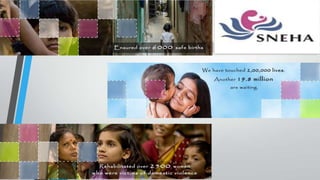
• SNEHA
• Programs
Definition –World Bank
• “The diversity of NGOs strains any simple definition. They include many groups and
institutions that are entirely or largely independent of government and that have
primarily humanitarian or cooperative rather than commercial objectives. They are
private agencies in industrial countries that support international development;
indigenous groups organized regionally or nationally; and member-groups in villages.
NGOs include charitable and religious associations that mobilize private funds for
development, distribute food and family planning services and promote community
organization. They also include independent cooperatives, community associations,
water-user societies, women’s groups and pastoral associations. Citizen groups that
raise awareness and influence policy are also NGOs”
Types of NGO
• Charitable Orientation
• Service Orientation
• Participatory Orientation
• Empowering Orientation
• National NGOs
• International NGOs
The SNEHA Ideology
Vision
• HealthyWomen and Children for a Healthy Urban World
OurMission
• We work in partnership with communities and health systems building effective and replicable
solutions, empowering women and their families in urban slums to improve their health.
OurValues
• Nurture
• Valuing every person
• Commitment
• Trust
• Excellence
Introduction
• Started in 1990
• By Dr. Armida Fernandez and her team
• Today SNEHA is 135 person organisation
• Project site
Programs
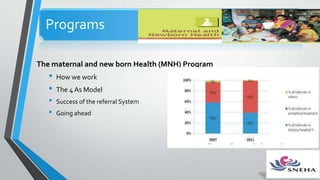
The maternal and new born Health (MNH) Program
• How we work
• The 4 As Model
• Success of the referral System
• Going ahead
Programs
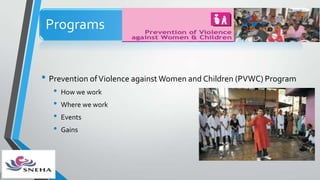
• Prevention ofViolence againstWomen and Children (PVWC) Program
• How we work
• Where we work
• Events
• Gains
Programs
The Child Health and Nutrition (CHN) Program
• How we work
• Where we work
• Gains
• Going forward
Programs
The Sexual and Reproductive Health (SRH) Program
• How we work
• Where we work
• Family planning
• Gains
• Going forward
SNEHA Centres - M/EastWard
• SNEHA Centre is an integrated model
• It works with service providers
• SNEHA Centre functions at the community level
Livelihood Program- QuintessentiallyYours
• Aim to teach women
• To focus on skills
• Product sales through sites
At SNEHA, we have a dream
A dream that every mother delivers safely
That every child is born healthy
That every child has the opportunity to thrive
That no woman tolerates abuse in silence
That every girl has the right to a future of her own choosing
And that every individual, irrespective of social status, has access to quality
health care
Thank you….

NGO SNEHA

  • 1.
  • 2.
    Acknowledgement • We wouldlike to express special thanks to our Prof. RushinVadhani sir who gave us the golden opportunity to do this wonderful project under the subject Marketing of NGO, which also helped us in doing a lot of research and we came to know about so many important information and learning about NGO and their efforts towards society. We are really thankful to him. Our thanks and appreciations also go to our colleague in developing the project and people who have willingly helped us out with their abilities.
  • 3.
    Group Members • SanketJog • Sachin Chavan • Avish Sute • Vrushal Sangvekar • Varun Shah • SushantAbhyankar • SamratTawade
  • 4.
    Non Government Organisation •Meaning • Types • SNEHA • Programs
  • 5.
    Definition –World Bank •“The diversity of NGOs strains any simple definition. They include many groups and institutions that are entirely or largely independent of government and that have primarily humanitarian or cooperative rather than commercial objectives. They are private agencies in industrial countries that support international development; indigenous groups organized regionally or nationally; and member-groups in villages. NGOs include charitable and religious associations that mobilize private funds for development, distribute food and family planning services and promote community organization. They also include independent cooperatives, community associations, water-user societies, women’s groups and pastoral associations. Citizen groups that raise awareness and influence policy are also NGOs”
  • 6.
    Types of NGO •Charitable Orientation • Service Orientation • Participatory Orientation • Empowering Orientation • National NGOs • International NGOs
  • 8.
    The SNEHA Ideology Vision •HealthyWomen and Children for a Healthy Urban World OurMission • We work in partnership with communities and health systems building effective and replicable solutions, empowering women and their families in urban slums to improve their health. OurValues • Nurture • Valuing every person • Commitment • Trust • Excellence
  • 9.
    Introduction • Started in1990 • By Dr. Armida Fernandez and her team • Today SNEHA is 135 person organisation • Project site
  • 10.
    Programs The maternal andnew born Health (MNH) Program • How we work • The 4 As Model • Success of the referral System • Going ahead
  • 11.
    Programs • Prevention ofViolenceagainstWomen and Children (PVWC) Program • How we work • Where we work • Events • Gains
  • 12.
    Programs The Child Healthand Nutrition (CHN) Program • How we work • Where we work • Gains • Going forward
  • 13.
    Programs The Sexual andReproductive Health (SRH) Program • How we work • Where we work • Family planning • Gains • Going forward
  • 14.
    SNEHA Centres -M/EastWard • SNEHA Centre is an integrated model • It works with service providers • SNEHA Centre functions at the community level
  • 15.
    Livelihood Program- QuintessentiallyYours •Aim to teach women • To focus on skills • Product sales through sites
  • 16.
    At SNEHA, wehave a dream A dream that every mother delivers safely That every child is born healthy That every child has the opportunity to thrive That no woman tolerates abuse in silence That every girl has the right to a future of her own choosing And that every individual, irrespective of social status, has access to quality health care
  • 17.

Editor's Notes

  • #11 The Maternal and Newborn Health (MNH) ProgramMaternal and Newborn Health is a program designed to influence the government to provide better services for mothers and babies in slum communities. This program also works with women in the community to ensure they access health care.It partners with the public health system to strengthen primary health care and to establish a city wide referral system for pregnant mothers across health posts, maternity homes, small and large hospitals, in order to ensure survival of both mother and baby.  
  • #12 The Maternal and Newborn Health (MNH) ProgramMaternal and Newborn Health is a program designed to influence the government to provide better services for mothers and babies in slum communities. This program also works with women in the community to ensure they access health care.It partners with the public health system to strengthen primary health care and to establish a city wide referral system for pregnant mothers across health posts, maternity homes, small and large hospitals, in order to ensure survival of both mother and baby.  Prevention of Violence against Women and Children (PVWC) ProgramPrevention of Violence against Women and Children aims to provide services through crisis intervention and counselling to women and children facing violence in their immediate environment. This program also works with those who face problems due to their sexual orientation, their disability and their occupation.The Program achieves this by working with slum communities forming empowered women’s groups. We also collaborate and network with the police and the legal system to prevent, report and address violence  The Child Health and Nutrition (CHN) ProgramThe Program aims to reduce malnutrition in children in Mumbai’s slums. This model follows the cycle of prevention, early identification and treatment by improving feeding practices of young children amongst mothers and establishing Day Care Centres where severely malnourished children are treated.It partners with the existing Govt Integrated Child Development Scheme (ICDS) that runs Anganwadis which addresses malnutrition in children under 6 years.  The Sexual and Reproductive Health (SRH) ProgramThe Sexual and Reproductive Health program aims to empower adolescent girls and married women in urban slums with the right information and skills that enable them to make informed decisions about their health and in particular their sexual and reproductive health and their family size.The Adolescents Gaining Ground project works to orient adolescents to become self-confident, well-informed and responsible decision makers of their general health especially their sexual and reproductive health and to create advocates in the community.The Family Planning Program works with married women to help reduce unplanned pregnancies and also works to increase the uptake of modern methods of contraception. This is done through peer educators in the community.
  • #13 The Maternal and Newborn Health (MNH) ProgramMaternal and Newborn Health is a program designed to influence the government to provide better services for mothers and babies in slum communities. This program also works with women in the community to ensure they access health care.It partners with the public health system to strengthen primary health care and to establish a city wide referral system for pregnant mothers across health posts, maternity homes, small and large hospitals, in order to ensure survival of both mother and baby.  Prevention of Violence against Women and Children (PVWC) ProgramPrevention of Violence against Women and Children aims to provide services through crisis intervention and counselling to women and children facing violence in their immediate environment. This program also works with those who face problems due to their sexual orientation, their disability and their occupation.The Program achieves this by working with slum communities forming empowered women’s groups. We also collaborate and network with the police and the legal system to prevent, report and address violence  The Child Health and Nutrition (CHN) ProgramThe Program aims to reduce malnutrition in children in Mumbai’s slums. This model follows the cycle of prevention, early identification and treatment by improving feeding practices of young children amongst mothers and establishing Day Care Centres where severely malnourished children are treated.It partners with the existing Govt Integrated Child Development Scheme (ICDS) that runs Anganwadis which addresses malnutrition in children under 6 years.  The Sexual and Reproductive Health (SRH) ProgramThe Sexual and Reproductive Health program aims to empower adolescent girls and married women in urban slums with the right information and skills that enable them to make informed decisions about their health and in particular their sexual and reproductive health and their family size.The Adolescents Gaining Ground project works to orient adolescents to become self-confident, well-informed and responsible decision makers of their general health especially their sexual and reproductive health and to create advocates in the community.The Family Planning Program works with married women to help reduce unplanned pregnancies and also works to increase the uptake of modern methods of contraception. This is done through peer educators in the community.
  • #14 The Maternal and Newborn Health (MNH) ProgramMaternal and Newborn Health is a program designed to influence the government to provide better services for mothers and babies in slum communities. This program also works with women in the community to ensure they access health care.It partners with the public health system to strengthen primary health care and to establish a city wide referral system for pregnant mothers across health posts, maternity homes, small and large hospitals, in order to ensure survival of both mother and baby.  Prevention of Violence against Women and Children (PVWC) ProgramPrevention of Violence against Women and Children aims to provide services through crisis intervention and counselling to women and children facing violence in their immediate environment. This program also works with those who face problems due to their sexual orientation, their disability and their occupation.The Program achieves this by working with slum communities forming empowered women’s groups. We also collaborate and network with the police and the legal system to prevent, report and address violence  The Child Health and Nutrition (CHN) ProgramThe Program aims to reduce malnutrition in children in Mumbai’s slums. This model follows the cycle of prevention, early identification and treatment by improving feeding practices of young children amongst mothers and establishing Day Care Centres where severely malnourished children are treated.It partners with the existing Govt Integrated Child Development Scheme (ICDS) that runs Anganwadis which addresses malnutrition in children under 6 years.  The Sexual and Reproductive Health (SRH) ProgramThe Sexual and Reproductive Health program aims to empower adolescent girls and married women in urban slums with the right information and skills that enable them to make informed decisions about their health and in particular their sexual and reproductive health and their family size.The Adolescents Gaining Ground project works to orient adolescents to become self-confident, well-informed and responsible decision makers of their general health especially their sexual and reproductive health and to create advocates in the community.The Family Planning Program works with married women to help reduce unplanned pregnancies and also works to increase the uptake of modern methods of contraception. This is done through peer educators in the community.
  • #15 SNEHA Centre is an integrated model of all the four programs, i.e. MNH, PVWC, SRH, and CHN to address the health of family especially women and children in vulnerable slum communities in Mumbai starting with the M/East ward of Mumbai city.It networks with NGOs and liaises with service providers such as Municipal Corporation of Greater Mumbai, Mumbai Police, and Integrated Child Development Scheme.SNEHA Centre functions at the community level through group meetings with various target groups, events and campaigns, and at individual level through home visits.
  • #16 The project aims to teach women from the adjoining slums a variety of skills and also provide them with gainful employment.It involves educating the women in the basics of stitching and use of sewing machines.The flagship products are silk and cotton patchwork quilts and we have further expanded into bags, table linen, cushion covers, curtains so that the wastage is minimized and use of fabric optimized. The products are sold from the site as well as through sales at corporate houses.