New Words & Meanings,  New Toys & Tools Changes in the English language and in English language-teaching technologies  Paul Heacock
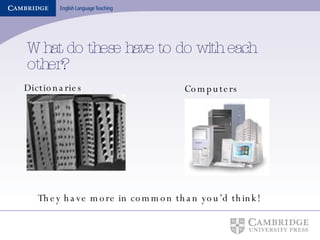
What do these have to do with each other? Dictionaries Computers They have more in common than you’d think!
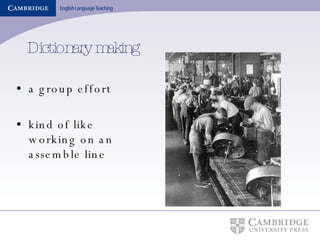
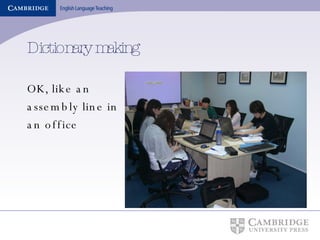
Dictionary making a group effort  kind of like working on an assemble line
Dictionary making OK, like an  assembly line in an office
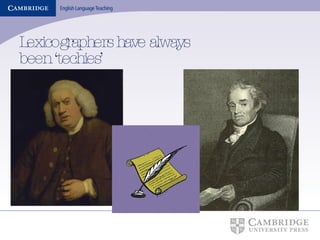
Lexicographers have always  been ‘techies’
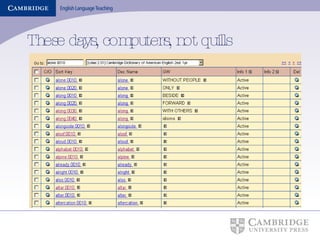
These days, computers, not quills
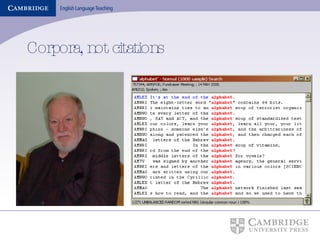
Corpora, not citations
What is a corpus? A corpus is a large, principled collection of real language examples stored in a database on a computer. How large is large? 1 million words? 100 million? 500 million? Why a principled collection? What is “real language”? What would “fake language” be?
What can we get from corpora? frequency how often does a word or phrase occur? contexts grammatical, semantic, position in sentence domain what kinds of texts does it appear in? collocation the company a word keeps
What “real language” is in a corpus? Written Material Newspapers Magazines Academic Books General Books Literature Correspondence Spoken Material Transcripts of TV and radio programs Telephone conversations Face-to-face conversations Service encounters Other Material Advertisements, catalogs, etc. Web pages, E-mail, etc.
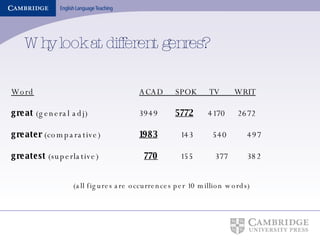
Why look at different genres? Word ACAD  SPOK  TV  WRIT great  (general adj) 3949  5772   4170  2672 greater  (comparative)  1983   143  540   497 greatest  (superlative)   770   155   377   382 (all figures are occurrences per 10 million words)
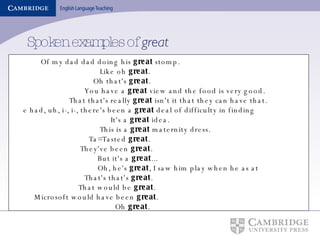
Spoken examples of  great Of my dad dad doing his  great  stomp. Like oh  great . Oh that's  great . You have a  great  view and the food is very good. That that's really  great  isn't it that they can have that. e had, uh, i-, i-, there's been a  great  deal of difficulty in finding  It's a  great  idea. This is a  great  maternity dress. Ta=Tasted  great . They've been  great . But it's a  great ... Oh, he's  great , I saw him play when he as at  That's that's  great . That would be  great . Microsoft would have been  great . Oh  great .
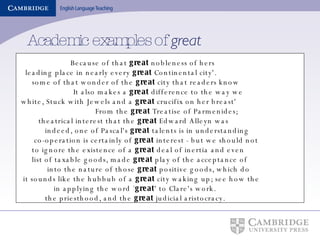
Academic examples of  great   Because of that  great  nobleness of hers leading place in nearly every  great  Continental city'. some of that wonder of the  great  city that readers know  It also makes a  great  difference to the way we  white, Stuck with Jewels and a  great  crucifix on her breast'  From the  great  Treatise of Parmenides; theatrical interest that the  great  Edward Alleyn was indeed, one of Pascal's  great  talents is in understanding  co-operation is certainly of  great  interest - but we should not to ignore the existence of a  great  deal of inertia and even  list of taxable goods, made  great  play of the acceptance of  into the nature of those  great  positive goods, which do it sounds like the hubbub of a  great  city waking up; see how the in applying the word ` great ' to Clare's work. the priesthood, and the  great  judicial aristocracy.
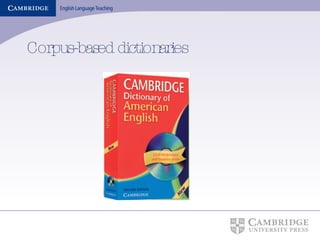
Corpus-based dictionaries
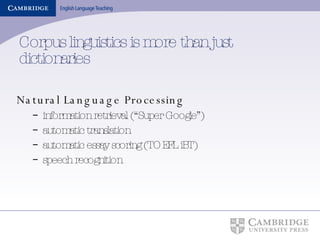
Corpus linguistics is more than just dictionaries Natural Language Processing  information retrieval (“Super Google”) automatic translation  automatic essay scoring (TOEFL iBT) speech recognition
So what’s new in English? New words blog, podcast, wiki New uses of old words web, site, stream
New words for new things DVD  appeared in 1994 similar in form to names of other media (CD, LP) – initials make snappy words blog  came to the fore c. 2002 shortening of full form, like Net, bike  playful, irreverent podcasts  started in 2004 joining of existing terms, like webcam, photocopy generic use of brand name
What happened to  web ? Merriam-Webster’s 10 th  Collegiate (1993) fabric on a loom * cobweb * animal or plant membrane * thin metal sheet, plate or strip * snare or entanglement <web of intrigue> * network <web of relationships> * the series of barbs implanted on each side of the shaft of a feather * a continuous sheet of paper being manufactured or used for printing * the part between the ribs in a vault
The Web happened using a corpus of American English from 2000 or later: > 55% of occurrences are for web site(s) < 4% of cites are for  spider’s web(s) < 2% of cites are for  web of  (lies, revenge, etc) M-W meanings aren’t outdated, just less common.
And  site ? M-W 10 (’93) gets closest with “the place, scene or point of something” Corpus shows 25%+ of cites are for Web or web site(s) 5%+ are for  the site of...   Small numbers for each, but corpus has evidence of  construction ~, presidential ~, historic ~, job ~, crash ~ , and more
And  stream ? M-W 10 (’93) has nothing related to data corpus shows little use for data under  stream , but 20% of occurrences for  streaming  are coupled with  audio, video, media , etc
We’ve all become a little techie computers & technology are part of who we are cell phones, DVDs, PCs weren’t much in evidence 15 years ago language reflects who we are, what we care about
We care about other stuff, too bandwidth counterterrorism E. colil firepower Jihad morph retro soy initials, too BTW EU IT  NAFTA PC URL
And some things have changed Soviet  was a much more frequent word in 1990 than it is in 2008 former  is now an important collocate Iraq  was a high-frequency item in 1991, not so much in 1998, now once again in 2008
Words come, words go . . . . . . and some come back again Core vocabulary in English does not change very much. What learners need to learn stays mostly the same. Good news for English teachers!
What  has  changed The tools used for teaching English  The expectations of students Materials on offer from publishers
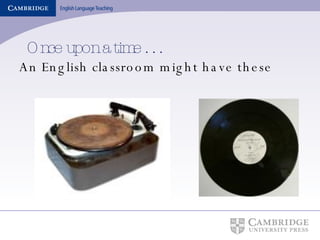
Once upon a time . . . An English classroom might have these
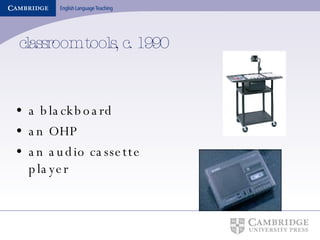
classroom tools, c. 1990 a blackboard an OHP an audio cassette player
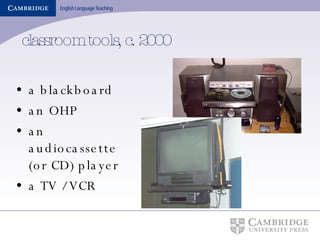
classroom tools, c. 2000 a blackboard an OHP an audiocassette (or CD) player  a TV / VCR
classroom tools, c. 2008 a blackboard an OHP? an audio CD player? a DVD player a computer? Internet access? an Interactive Whiteboard? wikis? LMSs? interactive workbooks?
Computers in the classroom for CD-ROMs for materials created by the teacher for Internet access to integrate different materials in one place
What’s on CD-ROMs? Reference materials (dictionaries) Listening/Speaking activities Interactive games Test prep material Some is more suited to independent study/ language lab, some excellent for class use
What’s online? resources for teachers resources for students interactive learning www.cambridge.org/TouchstoneArcade
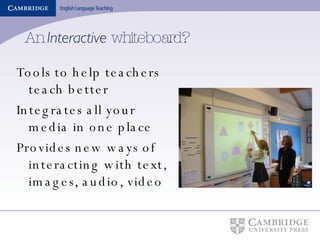
An  Interactive  whiteboard? Tools to help teachers teach better Integrates all your media in one place Provides new ways of interacting with text, images, audio, video
Podcasting for listening & speaking Students record reports on a topic in class Teacher posts recordings to a website Students access these podcasts and do follow-up activities Free software ( www.Wordpress.com ), a computer with microphone, and free or cheap web space are all that’s needed
Collaborative online writing Assign writing tasks that need to be done jointly (research paper, continue-the-story) Assign writing tasks that require feedback from other students Google Docs ( http://docs.google.com ) and other sites provide free space to house documents, share them with others, comment on writing, etc.
What’s next? very soon / already here cell phones iPods  Interactive whiteboards not all that long iMovies corpus in the classroom Automatic Speech Recognition ??????????????
Does technology matter? Some technologies are suited to some types of learning in the classroom in the language lab at home  in transit Some types of learning are not at all suited to technological solutions
What  really  matters What do you want to achieve? better spoken communication? better written communication? improved vocabulary, grammar, pronunciation, listening?   Which modes will achieve the goals? teacher-learner interactions learner-learner interactions learner-computer interactions
Some keys to evaluation Language learning potential Learner fit Meaning focus Relevance Authenticity Positive impact Practicality from Carol A. Chapelle,  Computer Applications in Second Language Acquisition
Bridging the gap from techies to teachers Techies believe in the gadgets and gizmos they develop Teachers need to examine new tools and apply perspectives based on their backgrounds as teachers: What will this new thing do to make teaching and learning English easier, better, or more fulfilling?
Don’t be afraid new tools = new opportunities Ask questions! of your colleagues of your students of publishers of yourselves of me

New Words New Toys

  • 1.
    New Words &Meanings, New Toys & Tools Changes in the English language and in English language-teaching technologies Paul Heacock
  • 2.
    What do thesehave to do with each other? Dictionaries Computers They have more in common than you’d think!
  • 3.
    Dictionary making agroup effort kind of like working on an assemble line
  • 4.
    Dictionary making OK,like an assembly line in an office
  • 5.
    Lexicographers have always been ‘techies’
  • 6.
  • 7.
  • 8.
    What is acorpus? A corpus is a large, principled collection of real language examples stored in a database on a computer. How large is large? 1 million words? 100 million? 500 million? Why a principled collection? What is “real language”? What would “fake language” be?
  • 9.
    What can weget from corpora? frequency how often does a word or phrase occur? contexts grammatical, semantic, position in sentence domain what kinds of texts does it appear in? collocation the company a word keeps
  • 10.
    What “real language”is in a corpus? Written Material Newspapers Magazines Academic Books General Books Literature Correspondence Spoken Material Transcripts of TV and radio programs Telephone conversations Face-to-face conversations Service encounters Other Material Advertisements, catalogs, etc. Web pages, E-mail, etc.
  • 11.
    Why look atdifferent genres? Word ACAD SPOK TV WRIT great (general adj) 3949 5772 4170 2672 greater (comparative) 1983 143 540 497 greatest (superlative) 770 155 377 382 (all figures are occurrences per 10 million words)
  • 12.
    Spoken examples of great Of my dad dad doing his great stomp. Like oh great . Oh that's great . You have a great view and the food is very good. That that's really great isn't it that they can have that. e had, uh, i-, i-, there's been a great deal of difficulty in finding It's a great idea. This is a great maternity dress. Ta=Tasted great . They've been great . But it's a great ... Oh, he's great , I saw him play when he as at That's that's great . That would be great . Microsoft would have been great . Oh great .
  • 13.
    Academic examples of great Because of that great nobleness of hers leading place in nearly every great Continental city'. some of that wonder of the great city that readers know It also makes a great difference to the way we white, Stuck with Jewels and a great crucifix on her breast' From the great Treatise of Parmenides; theatrical interest that the great Edward Alleyn was indeed, one of Pascal's great talents is in understanding co-operation is certainly of great interest - but we should not to ignore the existence of a great deal of inertia and even list of taxable goods, made great play of the acceptance of into the nature of those great positive goods, which do it sounds like the hubbub of a great city waking up; see how the in applying the word ` great ' to Clare's work. the priesthood, and the great judicial aristocracy.
  • 14.
  • 15.
    Corpus linguistics ismore than just dictionaries Natural Language Processing information retrieval (“Super Google”) automatic translation automatic essay scoring (TOEFL iBT) speech recognition
  • 16.
    So what’s newin English? New words blog, podcast, wiki New uses of old words web, site, stream
  • 17.
    New words fornew things DVD appeared in 1994 similar in form to names of other media (CD, LP) – initials make snappy words blog came to the fore c. 2002 shortening of full form, like Net, bike playful, irreverent podcasts started in 2004 joining of existing terms, like webcam, photocopy generic use of brand name
  • 18.
    What happened to web ? Merriam-Webster’s 10 th Collegiate (1993) fabric on a loom * cobweb * animal or plant membrane * thin metal sheet, plate or strip * snare or entanglement <web of intrigue> * network <web of relationships> * the series of barbs implanted on each side of the shaft of a feather * a continuous sheet of paper being manufactured or used for printing * the part between the ribs in a vault
  • 19.
    The Web happenedusing a corpus of American English from 2000 or later: > 55% of occurrences are for web site(s) < 4% of cites are for spider’s web(s) < 2% of cites are for web of (lies, revenge, etc) M-W meanings aren’t outdated, just less common.
  • 20.
    And site? M-W 10 (’93) gets closest with “the place, scene or point of something” Corpus shows 25%+ of cites are for Web or web site(s) 5%+ are for the site of... Small numbers for each, but corpus has evidence of construction ~, presidential ~, historic ~, job ~, crash ~ , and more
  • 21.
    And stream? M-W 10 (’93) has nothing related to data corpus shows little use for data under stream , but 20% of occurrences for streaming are coupled with audio, video, media , etc
  • 22.
    We’ve all becomea little techie computers & technology are part of who we are cell phones, DVDs, PCs weren’t much in evidence 15 years ago language reflects who we are, what we care about
  • 23.
    We care aboutother stuff, too bandwidth counterterrorism E. colil firepower Jihad morph retro soy initials, too BTW EU IT NAFTA PC URL
  • 24.
    And some thingshave changed Soviet was a much more frequent word in 1990 than it is in 2008 former is now an important collocate Iraq was a high-frequency item in 1991, not so much in 1998, now once again in 2008
  • 25.
    Words come, wordsgo . . . . . . and some come back again Core vocabulary in English does not change very much. What learners need to learn stays mostly the same. Good news for English teachers!
  • 26.
    What has changed The tools used for teaching English The expectations of students Materials on offer from publishers
  • 27.
    Once upon atime . . . An English classroom might have these
  • 28.
    classroom tools, c.1990 a blackboard an OHP an audio cassette player
  • 29.
    classroom tools, c.2000 a blackboard an OHP an audiocassette (or CD) player a TV / VCR
  • 30.
    classroom tools, c.2008 a blackboard an OHP? an audio CD player? a DVD player a computer? Internet access? an Interactive Whiteboard? wikis? LMSs? interactive workbooks?
  • 31.
    Computers in theclassroom for CD-ROMs for materials created by the teacher for Internet access to integrate different materials in one place
  • 32.
    What’s on CD-ROMs?Reference materials (dictionaries) Listening/Speaking activities Interactive games Test prep material Some is more suited to independent study/ language lab, some excellent for class use
  • 33.
    What’s online? resourcesfor teachers resources for students interactive learning www.cambridge.org/TouchstoneArcade
  • 34.
    An Interactive whiteboard? Tools to help teachers teach better Integrates all your media in one place Provides new ways of interacting with text, images, audio, video
  • 35.
    Podcasting for listening& speaking Students record reports on a topic in class Teacher posts recordings to a website Students access these podcasts and do follow-up activities Free software ( www.Wordpress.com ), a computer with microphone, and free or cheap web space are all that’s needed
  • 36.
    Collaborative online writingAssign writing tasks that need to be done jointly (research paper, continue-the-story) Assign writing tasks that require feedback from other students Google Docs ( http://docs.google.com ) and other sites provide free space to house documents, share them with others, comment on writing, etc.
  • 37.
    What’s next? verysoon / already here cell phones iPods Interactive whiteboards not all that long iMovies corpus in the classroom Automatic Speech Recognition ??????????????
  • 38.
    Does technology matter?Some technologies are suited to some types of learning in the classroom in the language lab at home in transit Some types of learning are not at all suited to technological solutions
  • 39.
    What really matters What do you want to achieve? better spoken communication? better written communication? improved vocabulary, grammar, pronunciation, listening? Which modes will achieve the goals? teacher-learner interactions learner-learner interactions learner-computer interactions
  • 40.
    Some keys toevaluation Language learning potential Learner fit Meaning focus Relevance Authenticity Positive impact Practicality from Carol A. Chapelle, Computer Applications in Second Language Acquisition
  • 41.
    Bridging the gapfrom techies to teachers Techies believe in the gadgets and gizmos they develop Teachers need to examine new tools and apply perspectives based on their backgrounds as teachers: What will this new thing do to make teaching and learning English easier, better, or more fulfilling?
  • 42.
    Don’t be afraidnew tools = new opportunities Ask questions! of your colleagues of your students of publishers of yourselves of me