New Perspectives on HTML5 CSS3 JavaScript 6th
Edition Carey Solutions Manual download pdf
https://testbankdeal.com/product/new-perspectives-on-
html5-css3-javascript-6th-edition-carey-solutions-manual/
Visit testbankdeal.com today to download the complete set of
test banks or solution manuals!
We have selected some products that you may be interested in
Click the link to download now or visit testbankdeal.com
for more options!.
New Perspectives on HTML5 CSS3 JavaScript 6th Edition
Carey Test Bank
https://testbankdeal.com/product/new-perspectives-on-
html5-css3-javascript-6th-edition-carey-test-bank/
New Perspectives HTML5 and CSS3 Comprehensive 7th Edition
Carey Solutions Manual
https://testbankdeal.com/product/new-perspectives-html5-and-
css3-comprehensive-7th-edition-carey-solutions-manual/
New Perspectives HTML5 and CSS3 Comprehensive 7th Edition
Carey Test Bank
https://testbankdeal.com/product/new-perspectives-html5-and-
css3-comprehensive-7th-edition-carey-test-bank/
Financial Accounting 12th Edition Thomas Test Bank
https://testbankdeal.com/product/financial-accounting-12th-edition-
thomas-test-bank/
Campbell Essential Biology with Physiology 5th Edition
Simon Test Bank
https://testbankdeal.com/product/campbell-essential-biology-with-
physiology-5th-edition-simon-test-bank/
Automotive Technology A Systems Approach Canadian 3rd
Edition Erjavec Test Bank
https://testbankdeal.com/product/automotive-technology-a-systems-
approach-canadian-3rd-edition-erjavec-test-bank/
Database Systems Design Implementation and Management 12th
Edition Coronel Solutions Manual
https://testbankdeal.com/product/database-systems-design-
implementation-and-management-12th-edition-coronel-solutions-manual/
Human Anatomy Physiology 11th Edition Marieb Test Bank
https://testbankdeal.com/product/human-anatomy-physiology-11th-
edition-marieb-test-bank/
Ethics in Information Technology 5th Edition Reynolds
Solutions Manual
https://testbankdeal.com/product/ethics-in-information-technology-5th-
edition-reynolds-solutions-manual/
Agriscience Fundamentals and Applications 6th Edition
Burton Solutions Manual
https://testbankdeal.com/product/agriscience-fundamentals-and-
applications-6th-edition-burton-solutions-manual/
New Perspectives on HTML5, CSS3, and JavaScript, 6th
edition Instructor’s Manual Page 1 of 12
New Perspectives on HTML5, CSS3, and
JavaScript
Tutorial Eight: Enhancing a Website with Multimedia
A Guide to this Instructor’s Manual:
We have designed this Instructor’s Manual to supplement and enhance your teaching
experience through classroom activities and through a cohesive chapter summary.
This document is organized chronologically and uses the same headings in blue that you see
in the textbook. Under each heading, you will find (in order): Lecture Notes that summarize
the section, Figures and Boxes found in the section (if any), Teacher Tips, Classroom
Activities, and Lab Activities. Pay special attention to teaching tips and activities, which are
geared toward quizzing your students, enhancing their critical thinking skills, and
encouraging experimentation within the software.
In addition to this Instructor’s Manual, our Instructor Companion Site also contains
PowerPoint Presentations, Test Banks, and other supplements to aid in your teaching
experience.
Table of Contents
Tutorial Objectives 2
Introducing Multimedia on the Web 2
Working with the audio Element 3
Exploring Embedded Objects 4
Exploring Digital Video 4
Using the HTML5 video Element 5
Adding a Text Track to Video 6
Using Third-Party Video Players 7
Creating Transitions with CSS 8
Animating Objects with CSS
End of Tutorial Material
Glossary
9
11
12
Tutorial Objectives
Students will have mastered the material in Tutorial Eight when they can:
Session 8.1
• Understand audio and video formats
• Insert an HTML audio clip
• Support multiple audio formats
Session 8.2
Session 8.3
• Create a CSS transition
• Explore transition attributes
• Create a CSS key frame animation
• Apply a CSS animation
New Perspectives on HTML5, CSS3, and JavaScript, 6th
edition Instructor’s Manual Page 2 of 12
• Insert an HTML video clip
• Write a video caption track
• Format video captions
Introducing Multimedia on the Web
LECTURE NOTES
• Discuss the purpose of introducing multimedia on the web.
• Explain the concept of a codec.
• Explain lossy compression.
• Discuss lossless compression.
• Point out the disadvantage of lossless compression.
• Discuss the role of a container with respect to codecs.
• Point out the usage of a media player.
• Explain the usage of a plug-in.
• Point out that a plug-in can run within the web page as an embedded object.
• List the problems associated with the plug-in approach.
BOXES
• None
FIGURES
• Figure 8-1
TEACHER TIP
Prepare a few examples of lossy and lossless compression. Mention to the students the disadvantage of
lossless compression.
CLASSROOM ACTIVITIES
• Internet Activity: Ask the students to research the advantages and disadvantages of
multimedia.
• Quick Quiz:
o True/False: In lossless compression, data is compressed by removing redundant
information. (Answer: True)
o Fill in the blank: _____ is a computer program that encodes and decodes streams of
data. (Answer: Codec)
LAB ACTIVITY
• None
Working with the audio Element
LECTURE NOTES
• Discuss the syntax to embed an audio element within a web page.
• Using figure 8-2, discuss the different attributes associated with HTML audio and video
elements.
• Using figure 8-3, discuss the most popular audio formats in HTML.
New Perspectives on HTML5, CSS3, and JavaScript, 6th
edition Instructor’s Manual Page 3 of 12
• Using figure 8-4, discuss the different browser support audio formats.
• Discuss the syntax to nest several source elements within a single audio element.
• Explain the process of applying styles to a native media player.
• Using figure 8-6, show the default audio player for different browsers.
• Explain the concept of a fallback option.
BOXES
• Tip: Because XHTML requires values for every attribute, enter the controls attribute as
controls="controls" to display media player controls on a page written in XHTML
(HTML 591).
• Tip: If no type attribute is provided, the browser will download a section of the file to
determine whether it corresponds to a recognized format (HTML 593).
• Insight: Exploring MIME Types (HTML 593)
• Tip: By default, audio and video elements are displayed in-line with the surrounding page
content (HTML 595).
• Proskills: Verbal Communication: Tips for Effective Web Audio (HTML 598)
FIGURES
• Figure 8-2, Figure 8-3, Figure 8-4, Figure 8-5, Figure 8-6, Figure 8-7, Figure 8-8, Figure 8-9,
Figure 8-10
TEACHER TIP
Remind the students that CSS can be applied to modify the media player’s appearance. Use figure 8-10
to show how a fallback text is displayed within a web page. Gather a few images to show the latest
audio players for different browsers.
CLASSROOM ACTIVITIES
• Class Discussion:
Ask the students to make a list of any four attributes of the HTML audio element.
• Quick Quiz:
o True/False: The mobile version of the Firefox browser supports the AAC audio format.
(Answer: False)
o True/False: Apple devices support all audio formats except AAC. (Answer: False)
LAB ACTIVITY
• Have the students open an editor of their choice and create a new file with the extension
.html or take up any file from their previous lab activities. Follow the instructions from the
following section:
o HTML 593 “To add an audio clip”
o HTML 595 “To apply styles to the Media Player”
o HTML 595 “To play the audio clip”
o HTML 597 “To provide alternate text to the audio clip”
Exploring Embedded Objects
LECTURE NOTES
New Perspectives on HTML5, CSS3, and JavaScript, 6th
edition Instructor’s Manual Page 4 of 12
• Define the syntax of several plug-in attributes applied to an embed element.
• Point out the challenges faced in installing plug-ins.
• Explain how to use plug-ins as fallback options.
BOXES
• Tip: Browsers that don’t support HTML5 ignore the audio and source elements but apply
the embed element to insert the media player via a plug-in (HTML 599).
FIGURES
• None
TEACHER TIP
Have a discussion with the students on the challenges faced with plug-ins. Remind students that plug-
ins use the attributes designed for them and ignore the others. Also, tell them that plug-ins can act as
fallback options for browsers that do not support HTML5.
CLASSROOM ACTIVITIES
• Quick Quiz:
o True/False: Older browsers relied on plug-ins to play audio and video files. (Answer:
True)
o True/False: Plug-ins cannot act as a fallback option for browsers that do not support
the HTML5 multimedia elements. (Answer: False)
LAB ACTIVITY
• None
Exploring Digital Video
LECTURE NOTES
• Point out the codecs for a video file.
• Using figure 8-11, discuss the most commonly used video codecs on the web.
• Using figure 8-12, discuss the several video formats used on the web.
• Using figure 8-13, list the browser support for several video formats.
BOXES
• None
FIGURES
• Figure 8-11, Figure 8-12, Figure 8-13
TEACHER TIP
Remind the students to supply multiple versions of the same video to achieve widest cross-browser
support.
Have a discussion with the students on the advantages of embedding a video in a web page.
New Perspectives on HTML5, CSS3, and JavaScript, 6th
edition Instructor’s Manual Page 5 of 12
CLASSROOM ACTIVITIES
• Quick Quiz
o True/False: The most popular video codec is H.264. (Answer: True)
o True/False: The desktop version of Internet Explorer only supports MPEG-4 video
format. (Answer: True)
LAB ACTIVITY
• None
Using the HTML5 video Element
LECTURE NOTES
• Define the syntax to embed videos into a web page using the video element.
• Discuss the fallback option with respect to videos in HTML5.
• Explain the attribute and syntax used to define the video’s preview image.
BOXES
• None
FIGURES
• Figure 8-14, Figure 8-15, Figure 8-16, Figure 8-17, Figure 8-18
TEACHER TIP
Mention to the students that a browser uses the first source it finds in a format it supports.
Remind the students that by default, media players show the first video frame as a preview of the
video’s content when the player initially loads a video file.
CLASSROOM ACTIVITIES
Quick Quiz:
• True/False: The poster attribute is used to define the video’s preview image. (Answer: True)
• True/ False: The media player shows the last video frames as a preview of the video’s content
when the player initially loads a video file. (Answer: False)
LAB ACTIVITY
• Have the students use an editor of their choice to modify the file they created in the last lab.
Follow the instructions from the following section:
o HTML 604 “To embed a video file into the web page”
o HTML 606 “To set the video’s poster image”
Adding a Text Track to Video
LECTURE NOTES
• Discuss the syntax to add text tracks to an audio or video clip using the track element.
• Use Figure 8-19 to list the different kinds of tracks that can be associated with an audio or a
video file.
New Perspectives on HTML5, CSS3, and JavaScript, 6th
edition Instructor’s Manual Page 6 of 12
• Explain the format of a WebVTT file.
• Discuss the general form of a cue in a WebVTT file.
• Using Figure 8-23, explain the different cue attributes that are used to set the size and
position of the cue text.
• Define the syntax of the cue pseudo-element to format the appearance of the cues.
• Discuss the different styles for the cue pseudo-element.
• Discuss the several markup tags used to identify sections of the cue text.
BOXES
• Tip: A WebVTT file has the file extension .vtt (HTML 608).
• Tip: Cue text entered on multiple lines in the WebVTT file will also be displayed on multiple
lines when played back (HTML 608).
• Tip: To center the cue in the video window, set the line and position values to 50% and the
align value to middle (HTML 611).
• Tip: Ruby text refers to annotative characters placed above or to the right of other characters
and is often used with Chinese or Japanese symbols (HTML 613).
FIGURES
• Figure 8-19, Figure 8-20, Figure 8-21, Figure 8-22, Figure 8-23, Figure 8-13, Figure 8-24,
Figure 8-25, Figure 8-26, Figure 8-27, Figure 8-28
TEACHER TIP
Remind the students that the default attribute is required even if the track list contains only one
track. Also, stress that the list of cues is separated by a single blank line after the cue text.
Inform the students that the cue pseudo-element formats all of the cue text in the media clip by
default.
CLASSROOM ACTIVITIES
• Class Discussion:
Ask the students to express their views on the necessity of adding a text track to a
video/image.
• Quick Quiz:
o Fill in the blank: Tracks are stored as simple text files written in the _____ language.
(Answer: Web Video Text Tracks or WebVTT)
o True/False: By default, a cue is placed at the top-right corner of a video window.
(Answer: False)
LAB ACTIVITY
• Have the students use an editor of their choice to modify the file they created in the last lab.
Follow the instructions from the following section:
o HTML 608 “To create a track file”
o HTML 609 “To add captions to a video clip”
o HTML 611 “To position the track cues”
New Perspectives on HTML5, CSS3, and JavaScript, 6th
edition Instructor’s Manual Page 7 of 12
o HTML 613 “To format the cue text”
o HTML 614 “To apply styles to the cue text”
Using Third-Party Video Players
LECTURE NOTES
• Discuss the object element with reference to the earlier browsers.
• Explain the syntax used to embed the Adobe Flash player using the object element.
• Discuss the process of embedding videos from YouTube.
• Discuss the use of an iframe element.
• Define inline frames.
• Discuss the various HTML5 video players.
BOXES
• Tip: To hide the Flash player, set the width and height values to 0 (HTML 618).
• Proskills: Problem Solving: Tips for Effective Web Video (HTML 620)
FIGURES
• Figure 8-29, Figure 8-30
TEACHER TIP
Inform the students that the most-used plug-in for video playback is the Adobe Flash player. Use
figure 8-29 to discuss about the various parameters recognized by the Adobe Flash player.
CLASSROOM ACTIVITIES
• Class Discussion:
Ask the students to list and describe any three parameters recognized by the Adobe Flash
player.
• Quick Quiz:
o True/False: The most-used plug-in for video playback was the Adobe Flash player.
(Answer: True)
o True/False: The inline-frame element is used to mark iframes. (Answer:
False)
LAB ACTIVITY
• None
Creating Transitions with CSS
LECTURE NOTES
• Define the term transition.
• Use figure 8-31 to discuss the difference between the hover and transition properties.
• Explain the syntax of the transition style.
• Discuss the syntax to apply transition to more than one property.
• Discuss the syntax to define the varying speed of a transition.
• Discuss the several keywords used for timing-function.
New Perspectives on HTML5, CSS3, and JavaScript, 6th
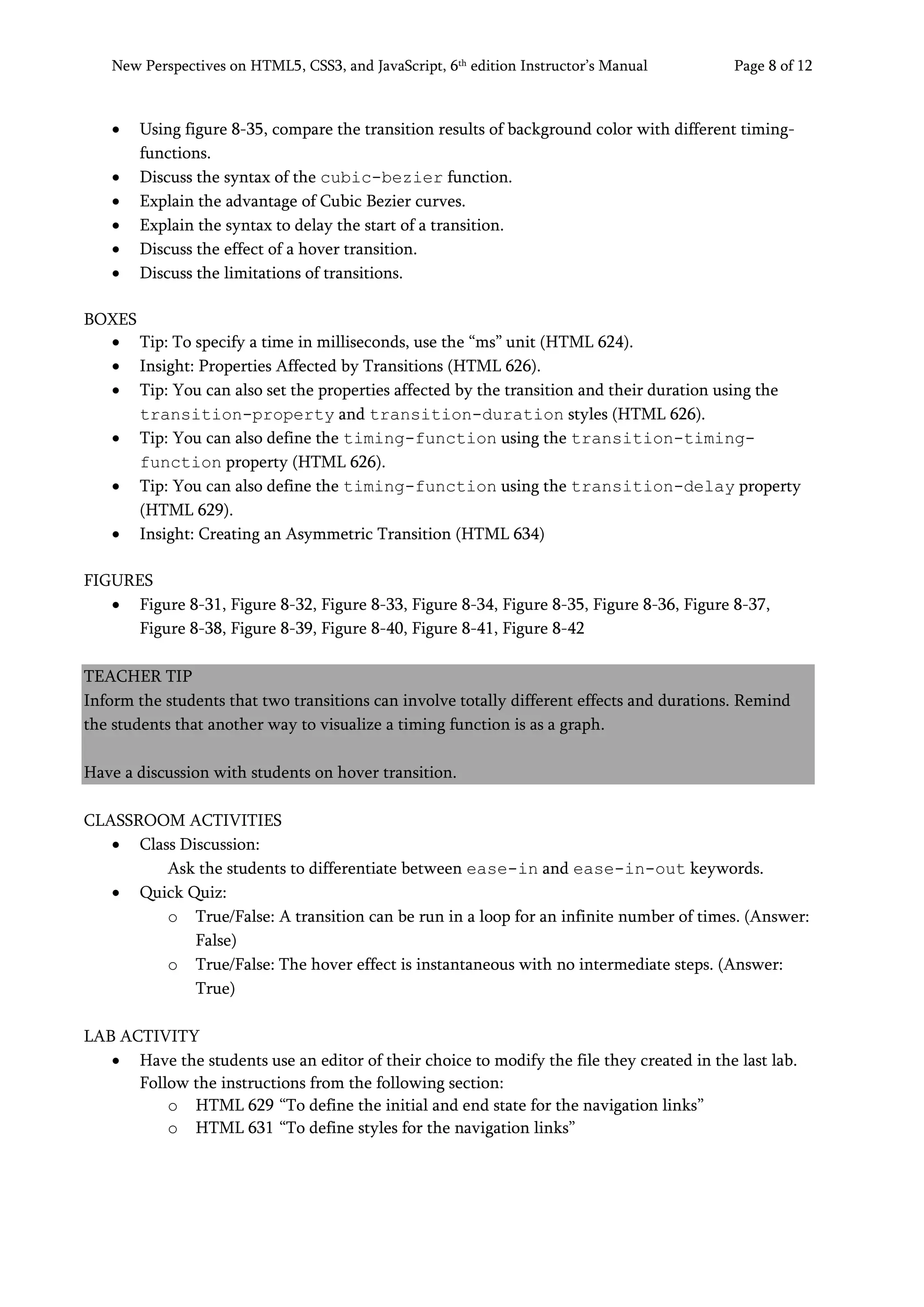
edition Instructor’s Manual Page 8 of 12
• Using figure 8-35, compare the transition results of background color with different timing-
functions.
• Discuss the syntax of the cubic-bezier function.
• Explain the advantage of Cubic Bezier curves.
• Explain the syntax to delay the start of a transition.
• Discuss the effect of a hover transition.
• Discuss the limitations of transitions.
BOXES
• Tip: To specify a time in milliseconds, use the “ms” unit (HTML 624).
• Insight: Properties Affected by Transitions (HTML 626).
• Tip: You can also set the properties affected by the transition and their duration using the
transition-property and transition-duration styles (HTML 626).
• Tip: You can also define the timing-function using the transition-timing-
function property (HTML 626).
• Tip: You can also define the timing-function using the transition-delay property
(HTML 629).
• Insight: Creating an Asymmetric Transition (HTML 634)
FIGURES
• Figure 8-31, Figure 8-32, Figure 8-33, Figure 8-34, Figure 8-35, Figure 8-36, Figure 8-37,
Figure 8-38, Figure 8-39, Figure 8-40, Figure 8-41, Figure 8-42
TEACHER TIP
Inform the students that two transitions can involve totally different effects and durations. Remind
the students that another way to visualize a timing function is as a graph.
Have a discussion with students on hover transition.
CLASSROOM ACTIVITIES
• Class Discussion:
Ask the students to differentiate between ease-in and ease-in-out keywords.
• Quick Quiz:
o True/False: A transition can be run in a loop for an infinite number of times. (Answer:
False)
o True/False: The hover effect is instantaneous with no intermediate steps. (Answer:
True)
LAB ACTIVITY
• Have the students use an editor of their choice to modify the file they created in the last lab.
Follow the instructions from the following section:
o HTML 629 “To define the initial and end state for the navigation links”
o HTML 631 “To define styles for the navigation links”
New Perspectives on HTML5, CSS3, and JavaScript, 6th
edition Instructor’s Manual Page 9 of 12
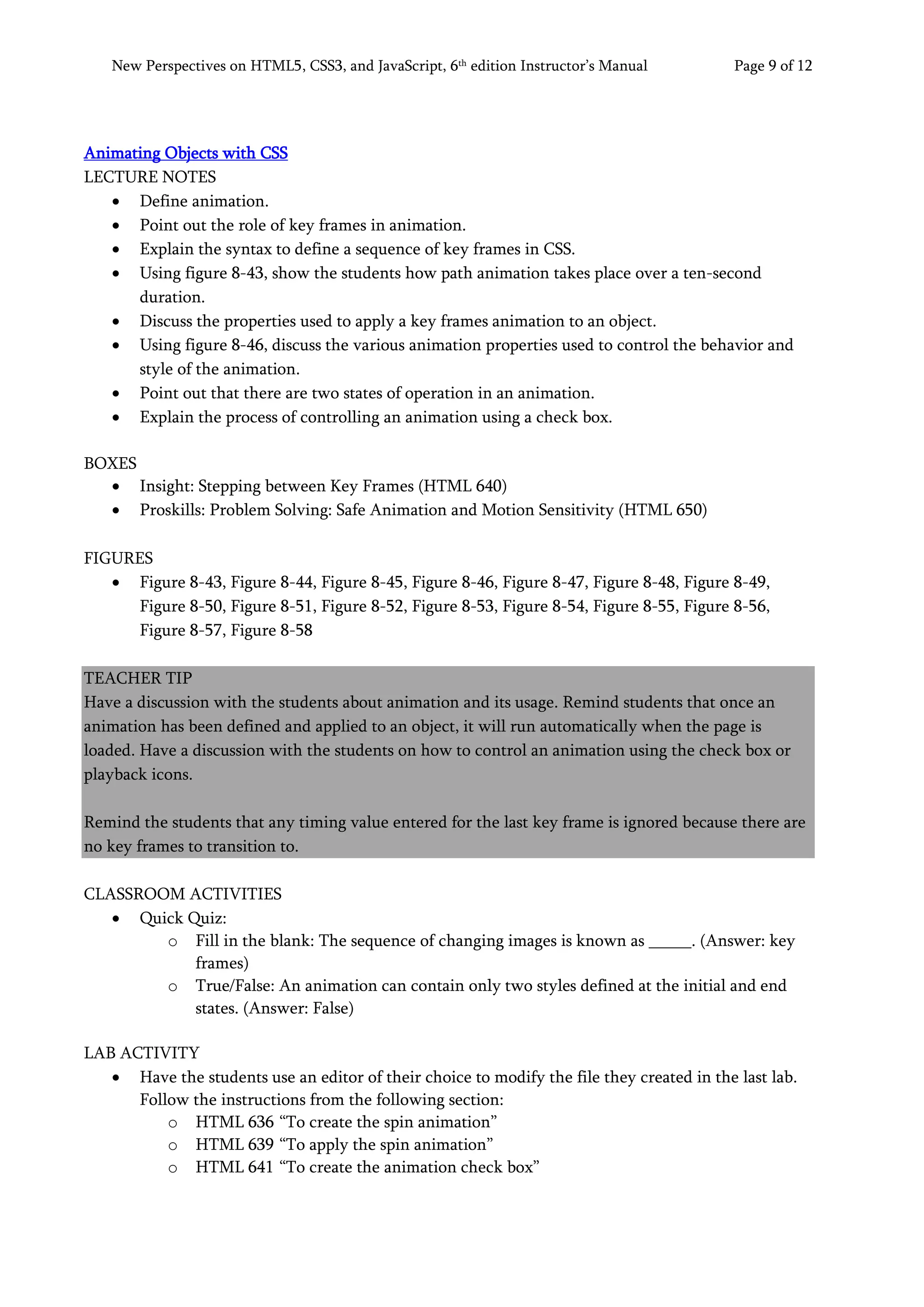
Animating Objects with CSS
LECTURE NOTES
• Define animation.
• Point out the role of key frames in animation.
• Explain the syntax to define a sequence of key frames in CSS.
• Using figure 8-43, show the students how path animation takes place over a ten-second
duration.
• Discuss the properties used to apply a key frames animation to an object.
• Using figure 8-46, discuss the various animation properties used to control the behavior and
style of the animation.
• Point out that there are two states of operation in an animation.
• Explain the process of controlling an animation using a check box.
BOXES
• Insight: Stepping between Key Frames (HTML 640)
• Proskills: Problem Solving: Safe Animation and Motion Sensitivity (HTML 650)
FIGURES
• Figure 8-43, Figure 8-44, Figure 8-45, Figure 8-46, Figure 8-47, Figure 8-48, Figure 8-49,
Figure 8-50, Figure 8-51, Figure 8-52, Figure 8-53, Figure 8-54, Figure 8-55, Figure 8-56,
Figure 8-57, Figure 8-58
TEACHER TIP
Have a discussion with the students about animation and its usage. Remind students that once an
animation has been defined and applied to an object, it will run automatically when the page is
loaded. Have a discussion with the students on how to control an animation using the check box or
playback icons.
Remind the students that any timing value entered for the last key frame is ignored because there are
no key frames to transition to.
CLASSROOM ACTIVITIES
• Quick Quiz:
o Fill in the blank: The sequence of changing images is known as _____. (Answer: key
frames)
o True/False: An animation can contain only two styles defined at the initial and end
states. (Answer: False)
LAB ACTIVITY
• Have the students use an editor of their choice to modify the file they created in the last lab.
Follow the instructions from the following section:
o HTML 636 “To create the spin animation”
o HTML 639 “To apply the spin animation”
o HTML 641 “To create the animation check box”
New Perspectives on HTML5, CSS3, and JavaScript, 6th
edition Instructor’s Manual Page 10 of 12
o HTML 643 “To create styles for animation playback”
o HTML 644 “To format the play and pause icons”
o HTML 646 “To revise the spin sequence”
New Perspectives on HTML5, CSS3, and JavaScript, 6th
edition Instructor’s Manual Page 11 of 12
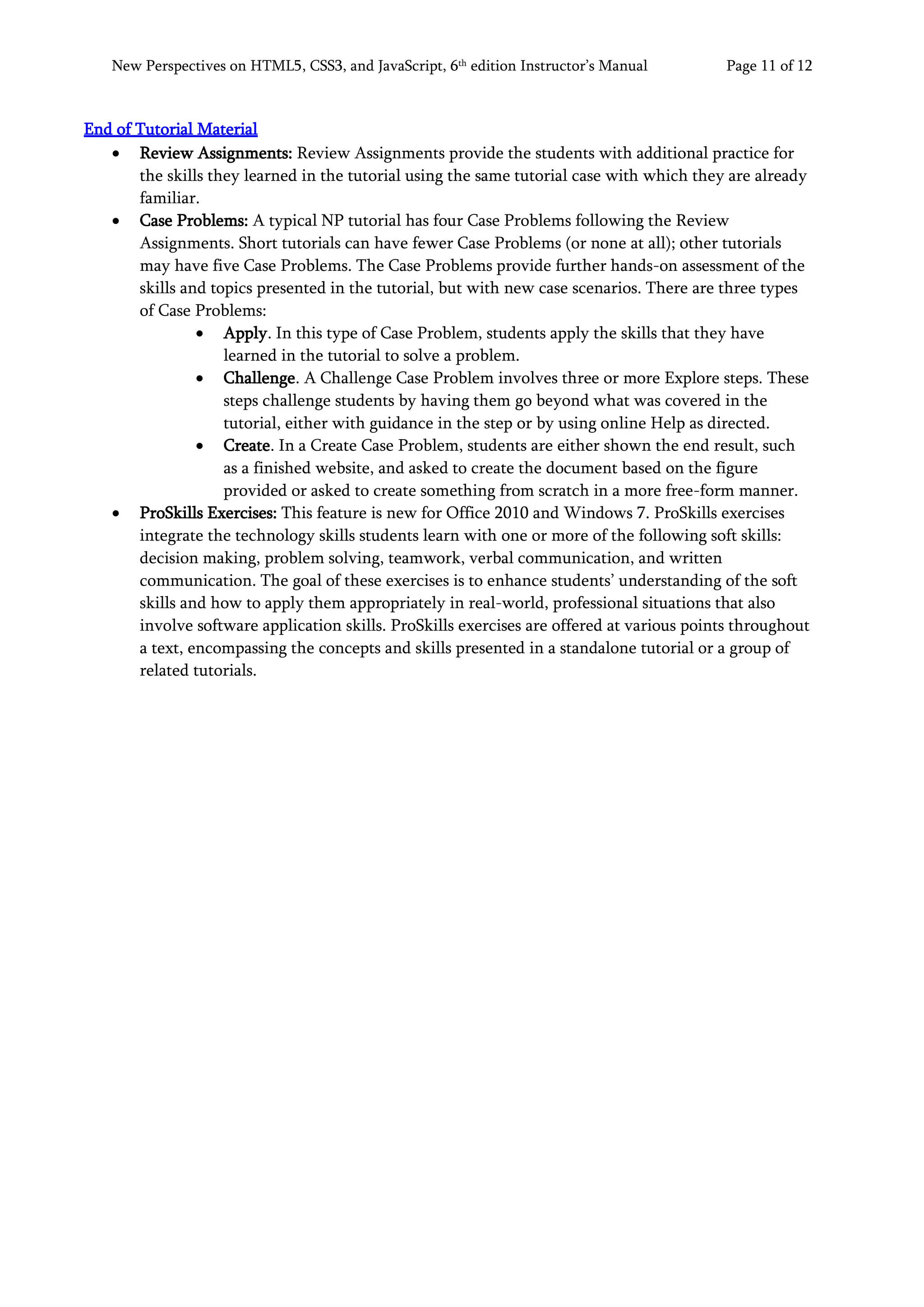
End of Tutorial Material
• Review Assignments: Review Assignments provide the students with additional practice for
the skills they learned in the tutorial using the same tutorial case with which they are already
familiar.
• Case Problems: A typical NP tutorial has four Case Problems following the Review
Assignments. Short tutorials can have fewer Case Problems (or none at all); other tutorials
may have five Case Problems. The Case Problems provide further hands-on assessment of the
skills and topics presented in the tutorial, but with new case scenarios. There are three types
of Case Problems:
• Apply. In this type of Case Problem, students apply the skills that they have
learned in the tutorial to solve a problem.
• Challenge. A Challenge Case Problem involves three or more Explore steps. These
steps challenge students by having them go beyond what was covered in the
tutorial, either with guidance in the step or by using online Help as directed.
• Create. In a Create Case Problem, students are either shown the end result, such
as a finished website, and asked to create the document based on the figure
provided or asked to create something from scratch in a more free-form manner.
• ProSkills Exercises: This feature is new for Office 2010 and Windows 7. ProSkills exercises
integrate the technology skills students learn with one or more of the following soft skills:
decision making, problem solving, teamwork, verbal communication, and written
communication. The goal of these exercises is to enhance students’ understanding of the soft
skills and how to apply them appropriately in real-world, professional situations that also
involve software application skills. ProSkills exercises are offered at various points throughout
a text, encompassing the concepts and skills presented in a standalone tutorial or a group of
related tutorials.
New Perspectives on HTML5, CSS3, and JavaScript, 6th
edition Instructor’s Manual Page 12 of 12
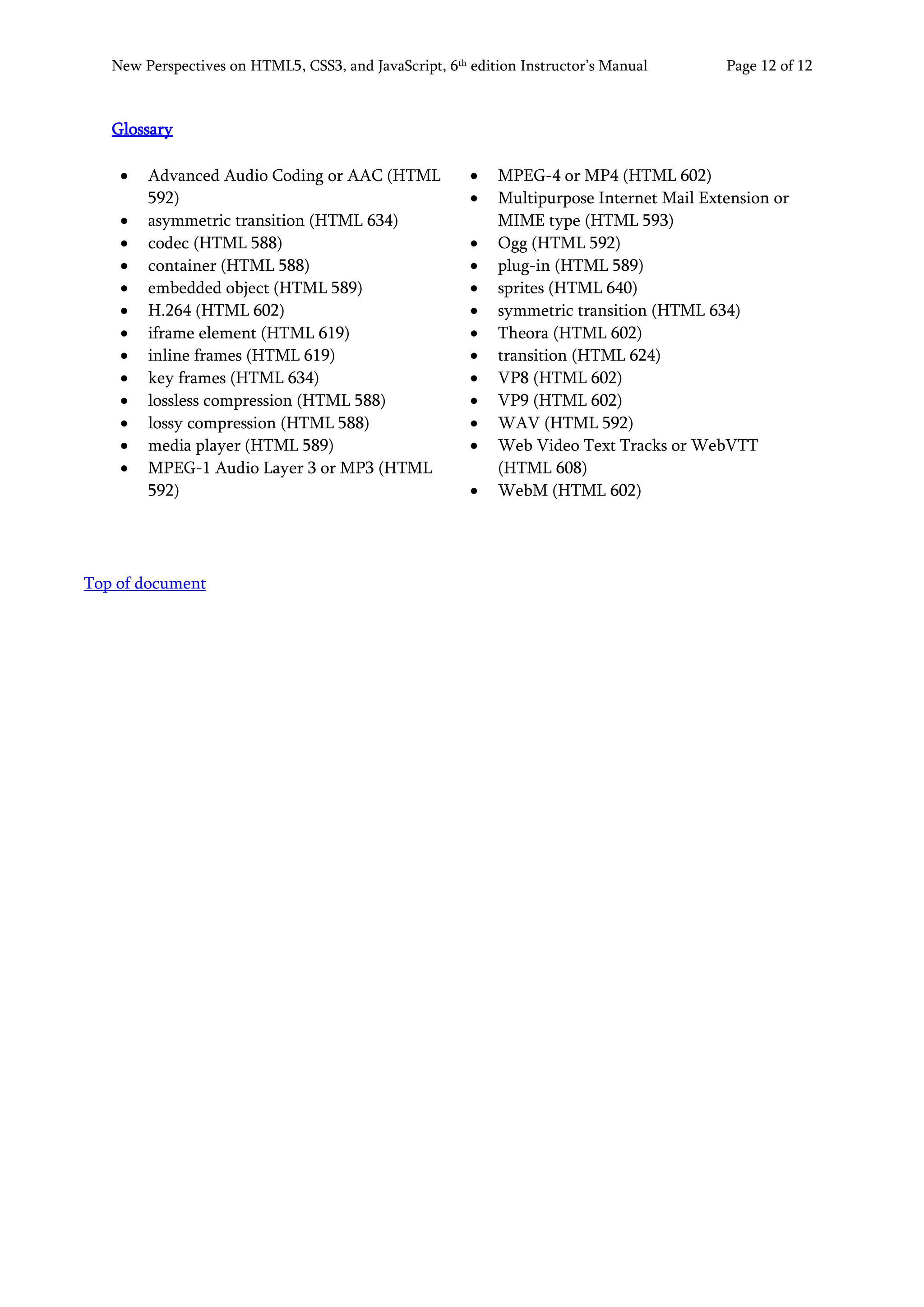
Glossary
• Advanced Audio Coding or AAC (HTML
592)
• asymmetric transition (HTML 634)
• codec (HTML 588)
• container (HTML 588)
• embedded object (HTML 589)
• H.264 (HTML 602)
• iframe element (HTML 619)
• inline frames (HTML 619)
• key frames (HTML 634)
• lossless compression (HTML 588)
• lossy compression (HTML 588)
• media player (HTML 589)
• MPEG-1 Audio Layer 3 or MP3 (HTML
592)
• MPEG-4 or MP4 (HTML 602)
• Multipurpose Internet Mail Extension or
MIME type (HTML 593)
• Ogg (HTML 592)
• plug-in (HTML 589)
• sprites (HTML 640)
• symmetric transition (HTML 634)
• Theora (HTML 602)
• transition (HTML 624)
• VP8 (HTML 602)
• VP9 (HTML 602)
• WAV (HTML 592)
• Web Video Text Tracks or WebVTT
(HTML 608)
• WebM (HTML 602)
Top of document
Random documents with unrelated
content Scribd suggests to you:
Gutenberg” appears, or with which the phrase “Project
Gutenberg” is associated) is accessed, displayed, performed,
viewed, copied or distributed:
This eBook is for the use of anyone anywhere in the United
States and most other parts of the world at no cost and
with almost no restrictions whatsoever. You may copy it,
give it away or re-use it under the terms of the Project
Gutenberg License included with this eBook or online at
www.gutenberg.org. If you are not located in the United
States, you will have to check the laws of the country
where you are located before using this eBook.
1.E.2. If an individual Project Gutenberg™ electronic work is
derived from texts not protected by U.S. copyright law (does not
contain a notice indicating that it is posted with permission of
the copyright holder), the work can be copied and distributed to
anyone in the United States without paying any fees or charges.
If you are redistributing or providing access to a work with the
phrase “Project Gutenberg” associated with or appearing on the
work, you must comply either with the requirements of
paragraphs 1.E.1 through 1.E.7 or obtain permission for the use
of the work and the Project Gutenberg™ trademark as set forth
in paragraphs 1.E.8 or 1.E.9.
1.E.3. If an individual Project Gutenberg™ electronic work is
posted with the permission of the copyright holder, your use and
distribution must comply with both paragraphs 1.E.1 through
1.E.7 and any additional terms imposed by the copyright holder.
Additional terms will be linked to the Project Gutenberg™
License for all works posted with the permission of the copyright
holder found at the beginning of this work.
1.E.4. Do not unlink or detach or remove the full Project
Gutenberg™ License terms from this work, or any files
containing a part of this work or any other work associated with
Project Gutenberg™.
1.E.5. Do not copy, display, perform, distribute or redistribute
this electronic work, or any part of this electronic work, without
prominently displaying the sentence set forth in paragraph 1.E.1
with active links or immediate access to the full terms of the
Project Gutenberg™ License.
1.E.6. You may convert to and distribute this work in any binary,
compressed, marked up, nonproprietary or proprietary form,
including any word processing or hypertext form. However, if
you provide access to or distribute copies of a Project
Gutenberg™ work in a format other than “Plain Vanilla ASCII” or
other format used in the official version posted on the official
Project Gutenberg™ website (www.gutenberg.org), you must,
at no additional cost, fee or expense to the user, provide a copy,
a means of exporting a copy, or a means of obtaining a copy
upon request, of the work in its original “Plain Vanilla ASCII” or
other form. Any alternate format must include the full Project
Gutenberg™ License as specified in paragraph 1.E.1.
1.E.7. Do not charge a fee for access to, viewing, displaying,
performing, copying or distributing any Project Gutenberg™
works unless you comply with paragraph 1.E.8 or 1.E.9.
1.E.8. You may charge a reasonable fee for copies of or
providing access to or distributing Project Gutenberg™
electronic works provided that:
• You pay a royalty fee of 20% of the gross profits you derive
from the use of Project Gutenberg™ works calculated using the
method you already use to calculate your applicable taxes. The
fee is owed to the owner of the Project Gutenberg™ trademark,
but he has agreed to donate royalties under this paragraph to
the Project Gutenberg Literary Archive Foundation. Royalty
payments must be paid within 60 days following each date on
which you prepare (or are legally required to prepare) your
periodic tax returns. Royalty payments should be clearly marked
as such and sent to the Project Gutenberg Literary Archive
Foundation at the address specified in Section 4, “Information
about donations to the Project Gutenberg Literary Archive
Foundation.”
• You provide a full refund of any money paid by a user who
notifies you in writing (or by e-mail) within 30 days of receipt
that s/he does not agree to the terms of the full Project
Gutenberg™ License. You must require such a user to return or
destroy all copies of the works possessed in a physical medium
and discontinue all use of and all access to other copies of
Project Gutenberg™ works.
• You provide, in accordance with paragraph 1.F.3, a full refund of
any money paid for a work or a replacement copy, if a defect in
the electronic work is discovered and reported to you within 90
days of receipt of the work.
• You comply with all other terms of this agreement for free
distribution of Project Gutenberg™ works.
1.E.9. If you wish to charge a fee or distribute a Project
Gutenberg™ electronic work or group of works on different
terms than are set forth in this agreement, you must obtain
permission in writing from the Project Gutenberg Literary
Archive Foundation, the manager of the Project Gutenberg™
trademark. Contact the Foundation as set forth in Section 3
below.
1.F.
1.F.1. Project Gutenberg volunteers and employees expend
considerable effort to identify, do copyright research on,
transcribe and proofread works not protected by U.S. copyright
law in creating the Project Gutenberg™ collection. Despite these
efforts, Project Gutenberg™ electronic works, and the medium
on which they may be stored, may contain “Defects,” such as,
but not limited to, incomplete, inaccurate or corrupt data,
transcription errors, a copyright or other intellectual property
infringement, a defective or damaged disk or other medium, a
computer virus, or computer codes that damage or cannot be
read by your equipment.
1.F.2. LIMITED WARRANTY, DISCLAIMER OF DAMAGES - Except
for the “Right of Replacement or Refund” described in
paragraph 1.F.3, the Project Gutenberg Literary Archive
Foundation, the owner of the Project Gutenberg™ trademark,
and any other party distributing a Project Gutenberg™ electronic
work under this agreement, disclaim all liability to you for
damages, costs and expenses, including legal fees. YOU AGREE
THAT YOU HAVE NO REMEDIES FOR NEGLIGENCE, STRICT
LIABILITY, BREACH OF WARRANTY OR BREACH OF CONTRACT
EXCEPT THOSE PROVIDED IN PARAGRAPH 1.F.3. YOU AGREE
THAT THE FOUNDATION, THE TRADEMARK OWNER, AND ANY
DISTRIBUTOR UNDER THIS AGREEMENT WILL NOT BE LIABLE
TO YOU FOR ACTUAL, DIRECT, INDIRECT, CONSEQUENTIAL,
PUNITIVE OR INCIDENTAL DAMAGES EVEN IF YOU GIVE
NOTICE OF THE POSSIBILITY OF SUCH DAMAGE.
1.F.3. LIMITED RIGHT OF REPLACEMENT OR REFUND - If you
discover a defect in this electronic work within 90 days of
receiving it, you can receive a refund of the money (if any) you
paid for it by sending a written explanation to the person you
received the work from. If you received the work on a physical
medium, you must return the medium with your written
explanation. The person or entity that provided you with the
defective work may elect to provide a replacement copy in lieu
of a refund. If you received the work electronically, the person
or entity providing it to you may choose to give you a second
opportunity to receive the work electronically in lieu of a refund.
If the second copy is also defective, you may demand a refund
in writing without further opportunities to fix the problem.
1.F.4. Except for the limited right of replacement or refund set
forth in paragraph 1.F.3, this work is provided to you ‘AS-IS’,
WITH NO OTHER WARRANTIES OF ANY KIND, EXPRESS OR
IMPLIED, INCLUDING BUT NOT LIMITED TO WARRANTIES OF
MERCHANTABILITY OR FITNESS FOR ANY PURPOSE.
1.F.5. Some states do not allow disclaimers of certain implied
warranties or the exclusion or limitation of certain types of
damages. If any disclaimer or limitation set forth in this
agreement violates the law of the state applicable to this
agreement, the agreement shall be interpreted to make the
maximum disclaimer or limitation permitted by the applicable
state law. The invalidity or unenforceability of any provision of
this agreement shall not void the remaining provisions.
1.F.6. INDEMNITY - You agree to indemnify and hold the
Foundation, the trademark owner, any agent or employee of the
Foundation, anyone providing copies of Project Gutenberg™
electronic works in accordance with this agreement, and any
volunteers associated with the production, promotion and
distribution of Project Gutenberg™ electronic works, harmless
from all liability, costs and expenses, including legal fees, that
arise directly or indirectly from any of the following which you
do or cause to occur: (a) distribution of this or any Project
Gutenberg™ work, (b) alteration, modification, or additions or
deletions to any Project Gutenberg™ work, and (c) any Defect
you cause.
Section 2. Information about the Mission
of Project Gutenberg™
Project Gutenberg™ is synonymous with the free distribution of
electronic works in formats readable by the widest variety of
computers including obsolete, old, middle-aged and new
computers. It exists because of the efforts of hundreds of
volunteers and donations from people in all walks of life.
Volunteers and financial support to provide volunteers with the
assistance they need are critical to reaching Project
Gutenberg™’s goals and ensuring that the Project Gutenberg™
collection will remain freely available for generations to come. In
2001, the Project Gutenberg Literary Archive Foundation was
created to provide a secure and permanent future for Project
Gutenberg™ and future generations. To learn more about the
Project Gutenberg Literary Archive Foundation and how your
efforts and donations can help, see Sections 3 and 4 and the
Foundation information page at www.gutenberg.org.
Section 3. Information about the Project
Gutenberg Literary Archive Foundation
The Project Gutenberg Literary Archive Foundation is a non-
profit 501(c)(3) educational corporation organized under the
laws of the state of Mississippi and granted tax exempt status
by the Internal Revenue Service. The Foundation’s EIN or
federal tax identification number is 64-6221541. Contributions
to the Project Gutenberg Literary Archive Foundation are tax
deductible to the full extent permitted by U.S. federal laws and
your state’s laws.
The Foundation’s business office is located at 809 North 1500
West, Salt Lake City, UT 84116, (801) 596-1887. Email contact
links and up to date contact information can be found at the
Foundation’s website and official page at
www.gutenberg.org/contact
Section 4. Information about Donations to
the Project Gutenberg Literary Archive
Foundation
Project Gutenberg™ depends upon and cannot survive without
widespread public support and donations to carry out its mission
of increasing the number of public domain and licensed works
that can be freely distributed in machine-readable form
accessible by the widest array of equipment including outdated
equipment. Many small donations ($1 to $5,000) are particularly
important to maintaining tax exempt status with the IRS.
The Foundation is committed to complying with the laws
regulating charities and charitable donations in all 50 states of
the United States. Compliance requirements are not uniform
and it takes a considerable effort, much paperwork and many
fees to meet and keep up with these requirements. We do not
solicit donations in locations where we have not received written
confirmation of compliance. To SEND DONATIONS or determine
the status of compliance for any particular state visit
www.gutenberg.org/donate.
While we cannot and do not solicit contributions from states
where we have not met the solicitation requirements, we know
of no prohibition against accepting unsolicited donations from
donors in such states who approach us with offers to donate.
International donations are gratefully accepted, but we cannot
make any statements concerning tax treatment of donations
received from outside the United States. U.S. laws alone swamp
our small staff.
Please check the Project Gutenberg web pages for current
donation methods and addresses. Donations are accepted in a
number of other ways including checks, online payments and
credit card donations. To donate, please visit:
www.gutenberg.org/donate.
Section 5. General Information About
Project Gutenberg™ electronic works
Professor Michael S. Hart was the originator of the Project
Gutenberg™ concept of a library of electronic works that could
be freely shared with anyone. For forty years, he produced and
distributed Project Gutenberg™ eBooks with only a loose
network of volunteer support.
Project Gutenberg™ eBooks are often created from several
printed editions, all of which are confirmed as not protected by
copyright in the U.S. unless a copyright notice is included. Thus,
we do not necessarily keep eBooks in compliance with any
particular paper edition.
Most people start at our website which has the main PG search
facility: www.gutenberg.org.
This website includes information about Project Gutenberg™,
including how to make donations to the Project Gutenberg
Literary Archive Foundation, how to help produce our new
eBooks, and how to subscribe to our email newsletter to hear
about new eBooks.
Welcome to our website – the perfect destination for book lovers and
knowledge seekers. We believe that every book holds a new world,
offering opportunities for learning, discovery, and personal growth.
That’s why we are dedicated to bringing you a diverse collection of
books, ranging from classic literature and specialized publications to
self-development guides and children's books.
More than just a book-buying platform, we strive to be a bridge
connecting you with timeless cultural and intellectual values. With an
elegant, user-friendly interface and a smart search system, you can
quickly find the books that best suit your interests. Additionally,
our special promotions and home delivery services help you save time
and fully enjoy the joy of reading.
Join us on a journey of knowledge exploration, passion nurturing, and
personal growth every day!
testbankdeal.com
New Perspectives on HTML5 CSS3 JavaScript 6th Edition Carey Solutions Manual

  • 1.
    New Perspectives onHTML5 CSS3 JavaScript 6th Edition Carey Solutions Manual download pdf https://testbankdeal.com/product/new-perspectives-on- html5-css3-javascript-6th-edition-carey-solutions-manual/ Visit testbankdeal.com today to download the complete set of test banks or solution manuals!

  • 2.
    We have selectedsome products that you may be interested in Click the link to download now or visit testbankdeal.com for more options!. New Perspectives on HTML5 CSS3 JavaScript 6th Edition Carey Test Bank https://testbankdeal.com/product/new-perspectives-on- html5-css3-javascript-6th-edition-carey-test-bank/ New Perspectives HTML5 and CSS3 Comprehensive 7th Edition Carey Solutions Manual https://testbankdeal.com/product/new-perspectives-html5-and- css3-comprehensive-7th-edition-carey-solutions-manual/ New Perspectives HTML5 and CSS3 Comprehensive 7th Edition Carey Test Bank https://testbankdeal.com/product/new-perspectives-html5-and- css3-comprehensive-7th-edition-carey-test-bank/ Financial Accounting 12th Edition Thomas Test Bank https://testbankdeal.com/product/financial-accounting-12th-edition- thomas-test-bank/
  • 3.
    Campbell Essential Biologywith Physiology 5th Edition Simon Test Bank https://testbankdeal.com/product/campbell-essential-biology-with- physiology-5th-edition-simon-test-bank/ Automotive Technology A Systems Approach Canadian 3rd Edition Erjavec Test Bank https://testbankdeal.com/product/automotive-technology-a-systems- approach-canadian-3rd-edition-erjavec-test-bank/ Database Systems Design Implementation and Management 12th Edition Coronel Solutions Manual https://testbankdeal.com/product/database-systems-design- implementation-and-management-12th-edition-coronel-solutions-manual/ Human Anatomy Physiology 11th Edition Marieb Test Bank https://testbankdeal.com/product/human-anatomy-physiology-11th- edition-marieb-test-bank/ Ethics in Information Technology 5th Edition Reynolds Solutions Manual https://testbankdeal.com/product/ethics-in-information-technology-5th- edition-reynolds-solutions-manual/
  • 4.
    Agriscience Fundamentals andApplications 6th Edition Burton Solutions Manual https://testbankdeal.com/product/agriscience-fundamentals-and- applications-6th-edition-burton-solutions-manual/
  • 5.
    New Perspectives onHTML5, CSS3, and JavaScript, 6th edition Instructor’s Manual Page 1 of 12 New Perspectives on HTML5, CSS3, and JavaScript Tutorial Eight: Enhancing a Website with Multimedia A Guide to this Instructor’s Manual: We have designed this Instructor’s Manual to supplement and enhance your teaching experience through classroom activities and through a cohesive chapter summary. This document is organized chronologically and uses the same headings in blue that you see in the textbook. Under each heading, you will find (in order): Lecture Notes that summarize the section, Figures and Boxes found in the section (if any), Teacher Tips, Classroom Activities, and Lab Activities. Pay special attention to teaching tips and activities, which are geared toward quizzing your students, enhancing their critical thinking skills, and encouraging experimentation within the software. In addition to this Instructor’s Manual, our Instructor Companion Site also contains PowerPoint Presentations, Test Banks, and other supplements to aid in your teaching experience. Table of Contents Tutorial Objectives 2 Introducing Multimedia on the Web 2 Working with the audio Element 3 Exploring Embedded Objects 4 Exploring Digital Video 4 Using the HTML5 video Element 5 Adding a Text Track to Video 6 Using Third-Party Video Players 7 Creating Transitions with CSS 8 Animating Objects with CSS End of Tutorial Material Glossary 9 11 12 Tutorial Objectives Students will have mastered the material in Tutorial Eight when they can: Session 8.1 • Understand audio and video formats • Insert an HTML audio clip • Support multiple audio formats Session 8.2 Session 8.3 • Create a CSS transition • Explore transition attributes • Create a CSS key frame animation • Apply a CSS animation
  • 6.
    New Perspectives onHTML5, CSS3, and JavaScript, 6th edition Instructor’s Manual Page 2 of 12 • Insert an HTML video clip • Write a video caption track • Format video captions Introducing Multimedia on the Web LECTURE NOTES • Discuss the purpose of introducing multimedia on the web. • Explain the concept of a codec. • Explain lossy compression. • Discuss lossless compression. • Point out the disadvantage of lossless compression. • Discuss the role of a container with respect to codecs. • Point out the usage of a media player. • Explain the usage of a plug-in. • Point out that a plug-in can run within the web page as an embedded object. • List the problems associated with the plug-in approach. BOXES • None FIGURES • Figure 8-1 TEACHER TIP Prepare a few examples of lossy and lossless compression. Mention to the students the disadvantage of lossless compression. CLASSROOM ACTIVITIES • Internet Activity: Ask the students to research the advantages and disadvantages of multimedia. • Quick Quiz: o True/False: In lossless compression, data is compressed by removing redundant information. (Answer: True) o Fill in the blank: _____ is a computer program that encodes and decodes streams of data. (Answer: Codec) LAB ACTIVITY • None Working with the audio Element LECTURE NOTES • Discuss the syntax to embed an audio element within a web page. • Using figure 8-2, discuss the different attributes associated with HTML audio and video elements. • Using figure 8-3, discuss the most popular audio formats in HTML.
  • 7.
    New Perspectives onHTML5, CSS3, and JavaScript, 6th edition Instructor’s Manual Page 3 of 12 • Using figure 8-4, discuss the different browser support audio formats. • Discuss the syntax to nest several source elements within a single audio element. • Explain the process of applying styles to a native media player. • Using figure 8-6, show the default audio player for different browsers. • Explain the concept of a fallback option. BOXES • Tip: Because XHTML requires values for every attribute, enter the controls attribute as controls="controls" to display media player controls on a page written in XHTML (HTML 591). • Tip: If no type attribute is provided, the browser will download a section of the file to determine whether it corresponds to a recognized format (HTML 593). • Insight: Exploring MIME Types (HTML 593) • Tip: By default, audio and video elements are displayed in-line with the surrounding page content (HTML 595). • Proskills: Verbal Communication: Tips for Effective Web Audio (HTML 598) FIGURES • Figure 8-2, Figure 8-3, Figure 8-4, Figure 8-5, Figure 8-6, Figure 8-7, Figure 8-8, Figure 8-9, Figure 8-10 TEACHER TIP Remind the students that CSS can be applied to modify the media player’s appearance. Use figure 8-10 to show how a fallback text is displayed within a web page. Gather a few images to show the latest audio players for different browsers. CLASSROOM ACTIVITIES • Class Discussion: Ask the students to make a list of any four attributes of the HTML audio element. • Quick Quiz: o True/False: The mobile version of the Firefox browser supports the AAC audio format. (Answer: False) o True/False: Apple devices support all audio formats except AAC. (Answer: False) LAB ACTIVITY • Have the students open an editor of their choice and create a new file with the extension .html or take up any file from their previous lab activities. Follow the instructions from the following section: o HTML 593 “To add an audio clip” o HTML 595 “To apply styles to the Media Player” o HTML 595 “To play the audio clip” o HTML 597 “To provide alternate text to the audio clip” Exploring Embedded Objects LECTURE NOTES
  • 8.
    New Perspectives onHTML5, CSS3, and JavaScript, 6th edition Instructor’s Manual Page 4 of 12 • Define the syntax of several plug-in attributes applied to an embed element. • Point out the challenges faced in installing plug-ins. • Explain how to use plug-ins as fallback options. BOXES • Tip: Browsers that don’t support HTML5 ignore the audio and source elements but apply the embed element to insert the media player via a plug-in (HTML 599). FIGURES • None TEACHER TIP Have a discussion with the students on the challenges faced with plug-ins. Remind students that plug- ins use the attributes designed for them and ignore the others. Also, tell them that plug-ins can act as fallback options for browsers that do not support HTML5. CLASSROOM ACTIVITIES • Quick Quiz: o True/False: Older browsers relied on plug-ins to play audio and video files. (Answer: True) o True/False: Plug-ins cannot act as a fallback option for browsers that do not support the HTML5 multimedia elements. (Answer: False) LAB ACTIVITY • None Exploring Digital Video LECTURE NOTES • Point out the codecs for a video file. • Using figure 8-11, discuss the most commonly used video codecs on the web. • Using figure 8-12, discuss the several video formats used on the web. • Using figure 8-13, list the browser support for several video formats. BOXES • None FIGURES • Figure 8-11, Figure 8-12, Figure 8-13 TEACHER TIP Remind the students to supply multiple versions of the same video to achieve widest cross-browser support. Have a discussion with the students on the advantages of embedding a video in a web page.
  • 9.
    New Perspectives onHTML5, CSS3, and JavaScript, 6th edition Instructor’s Manual Page 5 of 12 CLASSROOM ACTIVITIES • Quick Quiz o True/False: The most popular video codec is H.264. (Answer: True) o True/False: The desktop version of Internet Explorer only supports MPEG-4 video format. (Answer: True) LAB ACTIVITY • None Using the HTML5 video Element LECTURE NOTES • Define the syntax to embed videos into a web page using the video element. • Discuss the fallback option with respect to videos in HTML5. • Explain the attribute and syntax used to define the video’s preview image. BOXES • None FIGURES • Figure 8-14, Figure 8-15, Figure 8-16, Figure 8-17, Figure 8-18 TEACHER TIP Mention to the students that a browser uses the first source it finds in a format it supports. Remind the students that by default, media players show the first video frame as a preview of the video’s content when the player initially loads a video file. CLASSROOM ACTIVITIES Quick Quiz: • True/False: The poster attribute is used to define the video’s preview image. (Answer: True) • True/ False: The media player shows the last video frames as a preview of the video’s content when the player initially loads a video file. (Answer: False) LAB ACTIVITY • Have the students use an editor of their choice to modify the file they created in the last lab. Follow the instructions from the following section: o HTML 604 “To embed a video file into the web page” o HTML 606 “To set the video’s poster image” Adding a Text Track to Video LECTURE NOTES • Discuss the syntax to add text tracks to an audio or video clip using the track element. • Use Figure 8-19 to list the different kinds of tracks that can be associated with an audio or a video file.
  • 10.
    New Perspectives onHTML5, CSS3, and JavaScript, 6th edition Instructor’s Manual Page 6 of 12 • Explain the format of a WebVTT file. • Discuss the general form of a cue in a WebVTT file. • Using Figure 8-23, explain the different cue attributes that are used to set the size and position of the cue text. • Define the syntax of the cue pseudo-element to format the appearance of the cues. • Discuss the different styles for the cue pseudo-element. • Discuss the several markup tags used to identify sections of the cue text. BOXES • Tip: A WebVTT file has the file extension .vtt (HTML 608). • Tip: Cue text entered on multiple lines in the WebVTT file will also be displayed on multiple lines when played back (HTML 608). • Tip: To center the cue in the video window, set the line and position values to 50% and the align value to middle (HTML 611). • Tip: Ruby text refers to annotative characters placed above or to the right of other characters and is often used with Chinese or Japanese symbols (HTML 613). FIGURES • Figure 8-19, Figure 8-20, Figure 8-21, Figure 8-22, Figure 8-23, Figure 8-13, Figure 8-24, Figure 8-25, Figure 8-26, Figure 8-27, Figure 8-28 TEACHER TIP Remind the students that the default attribute is required even if the track list contains only one track. Also, stress that the list of cues is separated by a single blank line after the cue text. Inform the students that the cue pseudo-element formats all of the cue text in the media clip by default. CLASSROOM ACTIVITIES • Class Discussion: Ask the students to express their views on the necessity of adding a text track to a video/image. • Quick Quiz: o Fill in the blank: Tracks are stored as simple text files written in the _____ language. (Answer: Web Video Text Tracks or WebVTT) o True/False: By default, a cue is placed at the top-right corner of a video window. (Answer: False) LAB ACTIVITY • Have the students use an editor of their choice to modify the file they created in the last lab. Follow the instructions from the following section: o HTML 608 “To create a track file” o HTML 609 “To add captions to a video clip” o HTML 611 “To position the track cues”
  • 11.
    New Perspectives onHTML5, CSS3, and JavaScript, 6th edition Instructor’s Manual Page 7 of 12 o HTML 613 “To format the cue text” o HTML 614 “To apply styles to the cue text” Using Third-Party Video Players LECTURE NOTES • Discuss the object element with reference to the earlier browsers. • Explain the syntax used to embed the Adobe Flash player using the object element. • Discuss the process of embedding videos from YouTube. • Discuss the use of an iframe element. • Define inline frames. • Discuss the various HTML5 video players. BOXES • Tip: To hide the Flash player, set the width and height values to 0 (HTML 618). • Proskills: Problem Solving: Tips for Effective Web Video (HTML 620) FIGURES • Figure 8-29, Figure 8-30 TEACHER TIP Inform the students that the most-used plug-in for video playback is the Adobe Flash player. Use figure 8-29 to discuss about the various parameters recognized by the Adobe Flash player. CLASSROOM ACTIVITIES • Class Discussion: Ask the students to list and describe any three parameters recognized by the Adobe Flash player. • Quick Quiz: o True/False: The most-used plug-in for video playback was the Adobe Flash player. (Answer: True) o True/False: The inline-frame element is used to mark iframes. (Answer: False) LAB ACTIVITY • None Creating Transitions with CSS LECTURE NOTES • Define the term transition. • Use figure 8-31 to discuss the difference between the hover and transition properties. • Explain the syntax of the transition style. • Discuss the syntax to apply transition to more than one property. • Discuss the syntax to define the varying speed of a transition. • Discuss the several keywords used for timing-function.
  • 12.
    New Perspectives onHTML5, CSS3, and JavaScript, 6th edition Instructor’s Manual Page 8 of 12 • Using figure 8-35, compare the transition results of background color with different timing- functions. • Discuss the syntax of the cubic-bezier function. • Explain the advantage of Cubic Bezier curves. • Explain the syntax to delay the start of a transition. • Discuss the effect of a hover transition. • Discuss the limitations of transitions. BOXES • Tip: To specify a time in milliseconds, use the “ms” unit (HTML 624). • Insight: Properties Affected by Transitions (HTML 626). • Tip: You can also set the properties affected by the transition and their duration using the transition-property and transition-duration styles (HTML 626). • Tip: You can also define the timing-function using the transition-timing- function property (HTML 626). • Tip: You can also define the timing-function using the transition-delay property (HTML 629). • Insight: Creating an Asymmetric Transition (HTML 634) FIGURES • Figure 8-31, Figure 8-32, Figure 8-33, Figure 8-34, Figure 8-35, Figure 8-36, Figure 8-37, Figure 8-38, Figure 8-39, Figure 8-40, Figure 8-41, Figure 8-42 TEACHER TIP Inform the students that two transitions can involve totally different effects and durations. Remind the students that another way to visualize a timing function is as a graph. Have a discussion with students on hover transition. CLASSROOM ACTIVITIES • Class Discussion: Ask the students to differentiate between ease-in and ease-in-out keywords. • Quick Quiz: o True/False: A transition can be run in a loop for an infinite number of times. (Answer: False) o True/False: The hover effect is instantaneous with no intermediate steps. (Answer: True) LAB ACTIVITY • Have the students use an editor of their choice to modify the file they created in the last lab. Follow the instructions from the following section: o HTML 629 “To define the initial and end state for the navigation links” o HTML 631 “To define styles for the navigation links”
  • 13.
    New Perspectives onHTML5, CSS3, and JavaScript, 6th edition Instructor’s Manual Page 9 of 12 Animating Objects with CSS LECTURE NOTES • Define animation. • Point out the role of key frames in animation. • Explain the syntax to define a sequence of key frames in CSS. • Using figure 8-43, show the students how path animation takes place over a ten-second duration. • Discuss the properties used to apply a key frames animation to an object. • Using figure 8-46, discuss the various animation properties used to control the behavior and style of the animation. • Point out that there are two states of operation in an animation. • Explain the process of controlling an animation using a check box. BOXES • Insight: Stepping between Key Frames (HTML 640) • Proskills: Problem Solving: Safe Animation and Motion Sensitivity (HTML 650) FIGURES • Figure 8-43, Figure 8-44, Figure 8-45, Figure 8-46, Figure 8-47, Figure 8-48, Figure 8-49, Figure 8-50, Figure 8-51, Figure 8-52, Figure 8-53, Figure 8-54, Figure 8-55, Figure 8-56, Figure 8-57, Figure 8-58 TEACHER TIP Have a discussion with the students about animation and its usage. Remind students that once an animation has been defined and applied to an object, it will run automatically when the page is loaded. Have a discussion with the students on how to control an animation using the check box or playback icons. Remind the students that any timing value entered for the last key frame is ignored because there are no key frames to transition to. CLASSROOM ACTIVITIES • Quick Quiz: o Fill in the blank: The sequence of changing images is known as _____. (Answer: key frames) o True/False: An animation can contain only two styles defined at the initial and end states. (Answer: False) LAB ACTIVITY • Have the students use an editor of their choice to modify the file they created in the last lab. Follow the instructions from the following section: o HTML 636 “To create the spin animation” o HTML 639 “To apply the spin animation” o HTML 641 “To create the animation check box”
  • 14.
    New Perspectives onHTML5, CSS3, and JavaScript, 6th edition Instructor’s Manual Page 10 of 12 o HTML 643 “To create styles for animation playback” o HTML 644 “To format the play and pause icons” o HTML 646 “To revise the spin sequence”
  • 15.
    New Perspectives onHTML5, CSS3, and JavaScript, 6th edition Instructor’s Manual Page 11 of 12 End of Tutorial Material • Review Assignments: Review Assignments provide the students with additional practice for the skills they learned in the tutorial using the same tutorial case with which they are already familiar. • Case Problems: A typical NP tutorial has four Case Problems following the Review Assignments. Short tutorials can have fewer Case Problems (or none at all); other tutorials may have five Case Problems. The Case Problems provide further hands-on assessment of the skills and topics presented in the tutorial, but with new case scenarios. There are three types of Case Problems: • Apply. In this type of Case Problem, students apply the skills that they have learned in the tutorial to solve a problem. • Challenge. A Challenge Case Problem involves three or more Explore steps. These steps challenge students by having them go beyond what was covered in the tutorial, either with guidance in the step or by using online Help as directed. • Create. In a Create Case Problem, students are either shown the end result, such as a finished website, and asked to create the document based on the figure provided or asked to create something from scratch in a more free-form manner. • ProSkills Exercises: This feature is new for Office 2010 and Windows 7. ProSkills exercises integrate the technology skills students learn with one or more of the following soft skills: decision making, problem solving, teamwork, verbal communication, and written communication. The goal of these exercises is to enhance students’ understanding of the soft skills and how to apply them appropriately in real-world, professional situations that also involve software application skills. ProSkills exercises are offered at various points throughout a text, encompassing the concepts and skills presented in a standalone tutorial or a group of related tutorials.
  • 16.
    New Perspectives onHTML5, CSS3, and JavaScript, 6th edition Instructor’s Manual Page 12 of 12 Glossary • Advanced Audio Coding or AAC (HTML 592) • asymmetric transition (HTML 634) • codec (HTML 588) • container (HTML 588) • embedded object (HTML 589) • H.264 (HTML 602) • iframe element (HTML 619) • inline frames (HTML 619) • key frames (HTML 634) • lossless compression (HTML 588) • lossy compression (HTML 588) • media player (HTML 589) • MPEG-1 Audio Layer 3 or MP3 (HTML 592) • MPEG-4 or MP4 (HTML 602) • Multipurpose Internet Mail Extension or MIME type (HTML 593) • Ogg (HTML 592) • plug-in (HTML 589) • sprites (HTML 640) • symmetric transition (HTML 634) • Theora (HTML 602) • transition (HTML 624) • VP8 (HTML 602) • VP9 (HTML 602) • WAV (HTML 592) • Web Video Text Tracks or WebVTT (HTML 608) • WebM (HTML 602) Top of document
  • 17.
    Random documents withunrelated content Scribd suggests to you:
  • 18.
    Gutenberg” appears, orwith which the phrase “Project Gutenberg” is associated) is accessed, displayed, performed, viewed, copied or distributed: This eBook is for the use of anyone anywhere in the United States and most other parts of the world at no cost and with almost no restrictions whatsoever. You may copy it, give it away or re-use it under the terms of the Project Gutenberg License included with this eBook or online at www.gutenberg.org. If you are not located in the United States, you will have to check the laws of the country where you are located before using this eBook. 1.E.2. If an individual Project Gutenberg™ electronic work is derived from texts not protected by U.S. copyright law (does not contain a notice indicating that it is posted with permission of the copyright holder), the work can be copied and distributed to anyone in the United States without paying any fees or charges. If you are redistributing or providing access to a work with the phrase “Project Gutenberg” associated with or appearing on the work, you must comply either with the requirements of paragraphs 1.E.1 through 1.E.7 or obtain permission for the use of the work and the Project Gutenberg™ trademark as set forth in paragraphs 1.E.8 or 1.E.9. 1.E.3. If an individual Project Gutenberg™ electronic work is posted with the permission of the copyright holder, your use and distribution must comply with both paragraphs 1.E.1 through 1.E.7 and any additional terms imposed by the copyright holder. Additional terms will be linked to the Project Gutenberg™ License for all works posted with the permission of the copyright holder found at the beginning of this work. 1.E.4. Do not unlink or detach or remove the full Project Gutenberg™ License terms from this work, or any files
  • 19.
    containing a partof this work or any other work associated with Project Gutenberg™. 1.E.5. Do not copy, display, perform, distribute or redistribute this electronic work, or any part of this electronic work, without prominently displaying the sentence set forth in paragraph 1.E.1 with active links or immediate access to the full terms of the Project Gutenberg™ License. 1.E.6. You may convert to and distribute this work in any binary, compressed, marked up, nonproprietary or proprietary form, including any word processing or hypertext form. However, if you provide access to or distribute copies of a Project Gutenberg™ work in a format other than “Plain Vanilla ASCII” or other format used in the official version posted on the official Project Gutenberg™ website (www.gutenberg.org), you must, at no additional cost, fee or expense to the user, provide a copy, a means of exporting a copy, or a means of obtaining a copy upon request, of the work in its original “Plain Vanilla ASCII” or other form. Any alternate format must include the full Project Gutenberg™ License as specified in paragraph 1.E.1. 1.E.7. Do not charge a fee for access to, viewing, displaying, performing, copying or distributing any Project Gutenberg™ works unless you comply with paragraph 1.E.8 or 1.E.9. 1.E.8. You may charge a reasonable fee for copies of or providing access to or distributing Project Gutenberg™ electronic works provided that: • You pay a royalty fee of 20% of the gross profits you derive from the use of Project Gutenberg™ works calculated using the method you already use to calculate your applicable taxes. The fee is owed to the owner of the Project Gutenberg™ trademark, but he has agreed to donate royalties under this paragraph to the Project Gutenberg Literary Archive Foundation. Royalty
  • 20.
    payments must bepaid within 60 days following each date on which you prepare (or are legally required to prepare) your periodic tax returns. Royalty payments should be clearly marked as such and sent to the Project Gutenberg Literary Archive Foundation at the address specified in Section 4, “Information about donations to the Project Gutenberg Literary Archive Foundation.” • You provide a full refund of any money paid by a user who notifies you in writing (or by e-mail) within 30 days of receipt that s/he does not agree to the terms of the full Project Gutenberg™ License. You must require such a user to return or destroy all copies of the works possessed in a physical medium and discontinue all use of and all access to other copies of Project Gutenberg™ works. • You provide, in accordance with paragraph 1.F.3, a full refund of any money paid for a work or a replacement copy, if a defect in the electronic work is discovered and reported to you within 90 days of receipt of the work. • You comply with all other terms of this agreement for free distribution of Project Gutenberg™ works. 1.E.9. If you wish to charge a fee or distribute a Project Gutenberg™ electronic work or group of works on different terms than are set forth in this agreement, you must obtain permission in writing from the Project Gutenberg Literary Archive Foundation, the manager of the Project Gutenberg™ trademark. Contact the Foundation as set forth in Section 3 below. 1.F. 1.F.1. Project Gutenberg volunteers and employees expend considerable effort to identify, do copyright research on, transcribe and proofread works not protected by U.S. copyright
  • 21.
    law in creatingthe Project Gutenberg™ collection. Despite these efforts, Project Gutenberg™ electronic works, and the medium on which they may be stored, may contain “Defects,” such as, but not limited to, incomplete, inaccurate or corrupt data, transcription errors, a copyright or other intellectual property infringement, a defective or damaged disk or other medium, a computer virus, or computer codes that damage or cannot be read by your equipment. 1.F.2. LIMITED WARRANTY, DISCLAIMER OF DAMAGES - Except for the “Right of Replacement or Refund” described in paragraph 1.F.3, the Project Gutenberg Literary Archive Foundation, the owner of the Project Gutenberg™ trademark, and any other party distributing a Project Gutenberg™ electronic work under this agreement, disclaim all liability to you for damages, costs and expenses, including legal fees. YOU AGREE THAT YOU HAVE NO REMEDIES FOR NEGLIGENCE, STRICT LIABILITY, BREACH OF WARRANTY OR BREACH OF CONTRACT EXCEPT THOSE PROVIDED IN PARAGRAPH 1.F.3. YOU AGREE THAT THE FOUNDATION, THE TRADEMARK OWNER, AND ANY DISTRIBUTOR UNDER THIS AGREEMENT WILL NOT BE LIABLE TO YOU FOR ACTUAL, DIRECT, INDIRECT, CONSEQUENTIAL, PUNITIVE OR INCIDENTAL DAMAGES EVEN IF YOU GIVE NOTICE OF THE POSSIBILITY OF SUCH DAMAGE. 1.F.3. LIMITED RIGHT OF REPLACEMENT OR REFUND - If you discover a defect in this electronic work within 90 days of receiving it, you can receive a refund of the money (if any) you paid for it by sending a written explanation to the person you received the work from. If you received the work on a physical medium, you must return the medium with your written explanation. The person or entity that provided you with the defective work may elect to provide a replacement copy in lieu of a refund. If you received the work electronically, the person or entity providing it to you may choose to give you a second opportunity to receive the work electronically in lieu of a refund.
  • 22.
    If the secondcopy is also defective, you may demand a refund in writing without further opportunities to fix the problem. 1.F.4. Except for the limited right of replacement or refund set forth in paragraph 1.F.3, this work is provided to you ‘AS-IS’, WITH NO OTHER WARRANTIES OF ANY KIND, EXPRESS OR IMPLIED, INCLUDING BUT NOT LIMITED TO WARRANTIES OF MERCHANTABILITY OR FITNESS FOR ANY PURPOSE. 1.F.5. Some states do not allow disclaimers of certain implied warranties or the exclusion or limitation of certain types of damages. If any disclaimer or limitation set forth in this agreement violates the law of the state applicable to this agreement, the agreement shall be interpreted to make the maximum disclaimer or limitation permitted by the applicable state law. The invalidity or unenforceability of any provision of this agreement shall not void the remaining provisions. 1.F.6. INDEMNITY - You agree to indemnify and hold the Foundation, the trademark owner, any agent or employee of the Foundation, anyone providing copies of Project Gutenberg™ electronic works in accordance with this agreement, and any volunteers associated with the production, promotion and distribution of Project Gutenberg™ electronic works, harmless from all liability, costs and expenses, including legal fees, that arise directly or indirectly from any of the following which you do or cause to occur: (a) distribution of this or any Project Gutenberg™ work, (b) alteration, modification, or additions or deletions to any Project Gutenberg™ work, and (c) any Defect you cause. Section 2. Information about the Mission of Project Gutenberg™
  • 23.
    Project Gutenberg™ issynonymous with the free distribution of electronic works in formats readable by the widest variety of computers including obsolete, old, middle-aged and new computers. It exists because of the efforts of hundreds of volunteers and donations from people in all walks of life. Volunteers and financial support to provide volunteers with the assistance they need are critical to reaching Project Gutenberg™’s goals and ensuring that the Project Gutenberg™ collection will remain freely available for generations to come. In 2001, the Project Gutenberg Literary Archive Foundation was created to provide a secure and permanent future for Project Gutenberg™ and future generations. To learn more about the Project Gutenberg Literary Archive Foundation and how your efforts and donations can help, see Sections 3 and 4 and the Foundation information page at www.gutenberg.org. Section 3. Information about the Project Gutenberg Literary Archive Foundation The Project Gutenberg Literary Archive Foundation is a non- profit 501(c)(3) educational corporation organized under the laws of the state of Mississippi and granted tax exempt status by the Internal Revenue Service. The Foundation’s EIN or federal tax identification number is 64-6221541. Contributions to the Project Gutenberg Literary Archive Foundation are tax deductible to the full extent permitted by U.S. federal laws and your state’s laws. The Foundation’s business office is located at 809 North 1500 West, Salt Lake City, UT 84116, (801) 596-1887. Email contact links and up to date contact information can be found at the Foundation’s website and official page at www.gutenberg.org/contact
  • 24.
    Section 4. Informationabout Donations to the Project Gutenberg Literary Archive Foundation Project Gutenberg™ depends upon and cannot survive without widespread public support and donations to carry out its mission of increasing the number of public domain and licensed works that can be freely distributed in machine-readable form accessible by the widest array of equipment including outdated equipment. Many small donations ($1 to $5,000) are particularly important to maintaining tax exempt status with the IRS. The Foundation is committed to complying with the laws regulating charities and charitable donations in all 50 states of the United States. Compliance requirements are not uniform and it takes a considerable effort, much paperwork and many fees to meet and keep up with these requirements. We do not solicit donations in locations where we have not received written confirmation of compliance. To SEND DONATIONS or determine the status of compliance for any particular state visit www.gutenberg.org/donate. While we cannot and do not solicit contributions from states where we have not met the solicitation requirements, we know of no prohibition against accepting unsolicited donations from donors in such states who approach us with offers to donate. International donations are gratefully accepted, but we cannot make any statements concerning tax treatment of donations received from outside the United States. U.S. laws alone swamp our small staff. Please check the Project Gutenberg web pages for current donation methods and addresses. Donations are accepted in a number of other ways including checks, online payments and
  • 25.
    credit card donations.To donate, please visit: www.gutenberg.org/donate. Section 5. General Information About Project Gutenberg™ electronic works Professor Michael S. Hart was the originator of the Project Gutenberg™ concept of a library of electronic works that could be freely shared with anyone. For forty years, he produced and distributed Project Gutenberg™ eBooks with only a loose network of volunteer support. Project Gutenberg™ eBooks are often created from several printed editions, all of which are confirmed as not protected by copyright in the U.S. unless a copyright notice is included. Thus, we do not necessarily keep eBooks in compliance with any particular paper edition. Most people start at our website which has the main PG search facility: www.gutenberg.org. This website includes information about Project Gutenberg™, including how to make donations to the Project Gutenberg Literary Archive Foundation, how to help produce our new eBooks, and how to subscribe to our email newsletter to hear about new eBooks.
  • 26.
    Welcome to ourwebsite – the perfect destination for book lovers and knowledge seekers. We believe that every book holds a new world, offering opportunities for learning, discovery, and personal growth. That’s why we are dedicated to bringing you a diverse collection of books, ranging from classic literature and specialized publications to self-development guides and children's books. More than just a book-buying platform, we strive to be a bridge connecting you with timeless cultural and intellectual values. With an elegant, user-friendly interface and a smart search system, you can quickly find the books that best suit your interests. Additionally, our special promotions and home delivery services help you save time and fully enjoy the joy of reading. Join us on a journey of knowledge exploration, passion nurturing, and personal growth every day! testbankdeal.com