Chapter 3
PROBABILITY
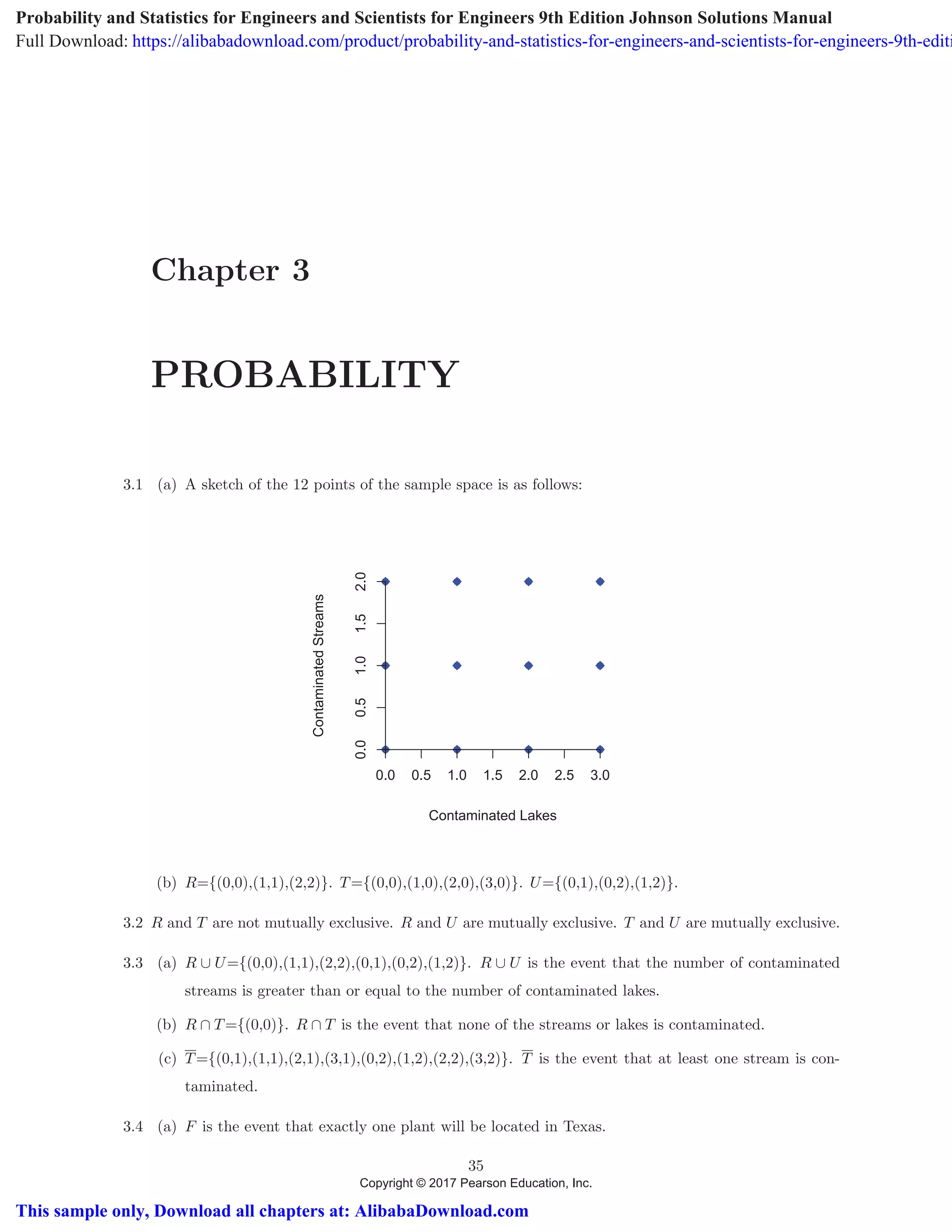
3.1 (a) A sketch of the 12 points of the sample space is as follows:
● ● ● ●
● ● ● ●
● ● ● ●
Contaminated Lakes
ContaminatedStreams
0.0 0.5 1.0 1.5 2.0 2.5 3.0
0.00.51.01.52.0
(b) R={(0,0),(1,1),(2,2)}. T={(0,0),(1,0),(2,0),(3,0)}. U={(0,1),(0,2),(1,2)}.
3.2 R and T are not mutually exclusive. R and U are mutually exclusive. T and U are mutually exclusive.
3.3 (a) R ∪ U={(0,0),(1,1),(2,2),(0,1),(0,2),(1,2)}. R ∪ U is the event that the number of contaminated
streams is greater than or equal to the number of contaminated lakes.
(b) R ∩ T={(0,0)}. R ∩ T is the event that none of the streams or lakes is contaminated.
(c) T={(0,1),(1,1),(2,1),(3,1),(0,2),(1,2),(2,2),(3,2)}. T is the event that at least one stream is con-
taminated.
3.4 (a) F is the event that exactly one plant will be located in Texas.
35
Copyright © 2017 Pearson Education, Inc.
Probability and Statistics for Engineers and Scientists for Engineers 9th Edition Johnson Solutions Manual
Full Download: https://alibabadownload.com/product/probability-and-statistics-for-engineers-and-scientists-for-engineers-9th-editi
This sample only, Download all chapters at: AlibabaDownload.com
36 CHAPTER 3 PROBABILITY
(b) G is the event that there will be exactly 2 new plants in Texas and California.
(c) F ∩ G={(1,1)}. F ∩ G is the event that exactly one plant will be in California and exactly one
plant will be in Texas.
3.5 A={3,4}, B={2,3}, C={4,5}.
(a) A ∪ B={2,3,4}. Work is easy, average or difficult on this model.
(b) A ∩ B={3}. Work is average on this model.
(c) B={1,4,5}. Thus A ∪ B={1,3,4,5}. Work is not easy on this model.
(d) C={1,2,3}. Work is very easy, easy or average on this model.
3.6 A and B are not mutually exclusive. A and C are not mutually exclusive. B and C are mutually
exclusive.
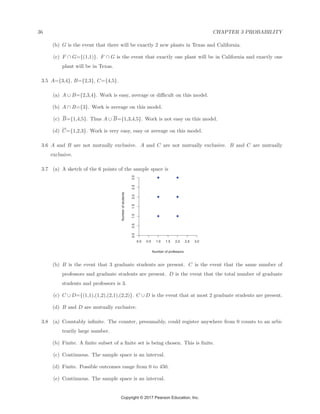
3.7 (a) A sketch of the 6 points of the sample space is
Number of professors
Numberofstudents
0.0 0.5 1.0 1.5 2.0 2.5 3.0
0.00.51.01.52.02.53.0
(b) B is the event that 3 graduate students are present. C is the event that the same number of
professors and graduate students are present. D is the event that the total number of graduate
students and professors is 3.
(c) C ∪ D={(1,1),(1,2),(2,1),(2,2)}. C ∪ D is the event that at most 2 graduate students are present.
(d) B and D are mutually exclusive.
3.8 (a) Countably infinite. The counter, presumably, could register anywhere from 0 counts to an arbi-
trarily large number.
(b) Finite. A finite subset of a finite set is being chosen. This is finite.
(c) Continuous. The sample space is an interval.
(d) Finite. Possible outcomes range from 0 to 450.
(e) Continuous. The sample space is an interval.
Copyright © 2017 Pearson Education, Inc.
CHAPTER 3 PROBABILITY 37
(f) Countably infinite. If it is a tough watch it could, presumably, be dropped an arbitrarily large
number of times without stopping.
3.9 Region 1 is the event that the ore contains both uranium and copper. Region 2 is the event that the
ore contains copper but not uranium. Region 3 is the event that the ore contains uranium but not
copper. Region 4 is the event that the ore contains neither uranium nor copper.
3.10 (a) Regions 1 and 3 together represent the event that the ore contains uranium.
(b) Regions 3 and 4 together represent the event that the ore does not contain copper.
(c) Regions 1, 2 and 3 together represent the event that the ore contains either copper or uranium or
both.
3.11 (a) Region 5 represents the event that the windings are improper, but the shaft size is not too large
and the electrical connections are satisfactory.
(b) Regions 4 and 6 together represent the event that the electrical connections are unsatisfactory,
but the windings are proper.
(c) Regions 7 and 8 together represent the event that the windings are proper and the electrical
connections are satisfactory.
(d) Regions 1, 2, 3, and 5 together represent the event that the windings are improper.
3.12 (a) Region 8.
(b) Regions 1 and 2 together.
(c) Regions 2, 5, and 7 together.
(d) Regions 1, 2, 3, 4, and 6 together.
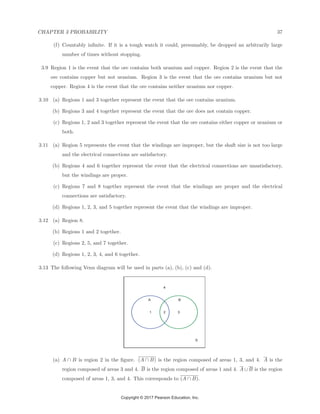
3.13 The following Venn diagram will be used in parts (a), (b), (c) and (d).
1 2 3
4
A B
S
(a) A ∩ B is region 2 in the figure. (A ∩ B) is the region composed of areas 1, 3, and 4. A is the
region composed of areas 3 and 4. B is the region composed of areas 1 and 4. A ∪ B is the region
composed of areas 1, 3, and 4. This corresponds to (A ∩ B).
Copyright © 2017 Pearson Education, Inc.
38 CHAPTER 3 PROBABILITY
(b) A ∩ B is the region 2 in the figure. A is the region composed of areas 1 and 2. Since A ∩ B is
entirely contained in A, A ∪ (A ∩ B) = A.
(c) A ∩ B is region 2. A ∩ B is region 1. Thus, (A ∩ B) ∪ (A ∩ B) is the region composed of areas 1
and 2 which is A.
(d) From part (c), we have (A∩B)∪(A∩B) = A. Thus, we must show that (A∩B)∪(A∩B)∪(A∩B) =
A ∪ (A ∩ B) = A ∪ B. A is the region composed of areas 1 and 2 and A ∩ B is region 3. Thus,
A ∪ (A ∩ B) is the region composed of areas 1, 2, and 3.
1
4
5
2
3
6
7
A B
C
S
8
(e) In the figure above, A ∪ B is the region composed of areas 1, 2, 3, 4, 5, and 6. A ∪ C is the region
composed of areas 1, 2, 3, 4, 6, and 7, so (A ∪ B) ∩ (A ∪ C) is the region composed of areas 1,
2, 3, 4, and 6. B ∩ C is the region composed of areas 3, and 6, and A is the region composed of
areas 1, 2, 3, and 4. Thus, A ∪ (B ∩ C) is the region composed of areas 1, 2, 3, 4, and 6. Thus
A ∪ (B ∩ C) = (A ∪ B) ∩ (A ∪ C).
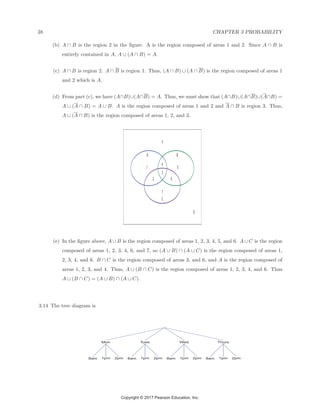
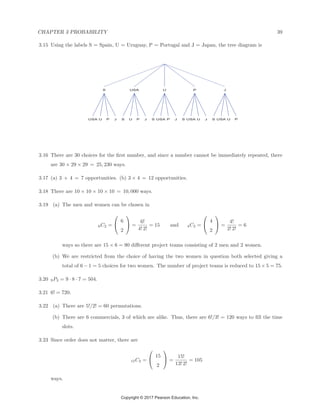
3.14 The tree diagram is
Mon Tues Wed Thurs
8am 1pm 2pm 8am 1pm 2pm 8am 1pm 2pm 8am 1pm 2pm
Copyright © 2017 Pearson Education, Inc.
CHAPTER 3 PROBABILITY 39
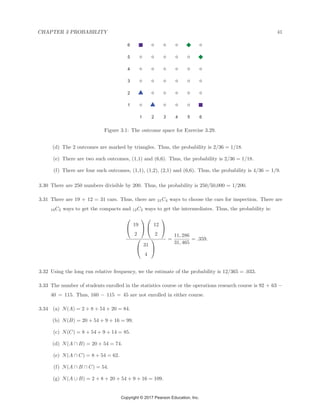
3.15 Using the labels S = Spain, U = Uruguay, P = Portugal and J = Japan, the tree diagram is
S USA U P J
USA U P J S U P J S USA P J S USA U J S USA U P
3.16 There are 30 choices for the first number, and since a number cannot be immediately repeated, there
are 30 × 29 × 29 = 25, 230 ways.
3.17 (a) 3 + 4 = 7 opportunities. (b) 3 × 4 = 12 opportunities.
3.18 There are 10 × 10 × 10 × 10 = 10, 000 ways.
3.19 (a) The men and women can be chosen in
6C2 =
⎛
⎝
6
2
⎞
⎠ =
6!
4! 2!
= 15 and 4C2 =
⎛
⎝
4
2
⎞
⎠ =
4!
2! 2!
= 6
ways so there are 15 × 6 = 90 different project teams consisting of 2 men and 2 women.
(b) We are restricted from the choice of having the two women in question both selected giving a
total of 6 − 1 = 5 choices for two women. The number of project teams is reduced to 15 × 5 = 75.
3.20 9P3 = 9 · 8 · 7 = 504.
3.21 6! = 720.
3.22 (a) There are 5!/2! = 60 permutations.
(b) There are 6 commercials, 3 of which are alike. Thus, there are 6!/3! = 120 ways to fill the time
slots.
3.23 Since order does not matter, there are
15C2 =
⎛
⎝
15
2
⎞
⎠ =
15!
13! 2!
= 105
ways.
Copyright © 2017 Pearson Education, Inc.
40 CHAPTER 3 PROBABILITY
3.24 There are
12C4 =
⎛
⎝
12
4
⎞
⎠ =
12!
4! 8!
= 495 ways
to select the 4 candidates to interview.
3.25 There are 12C3 = 220 ways to draw the three rechargeable batteries.
There are 11C3 = 165 ways to draw none are defective.
(a) The number of ways to get the one that is defective is 220 − 165 = 55.
(b) There are 165 ways not to get the one that is defective.
3.26 (a) There are 10C3 = 120 ways to get no defective batteries.
(b) There are 2 · 10C2 = 90 ways to get 1 defective battery.
(c) There are 10C1 = 10 ways to get both defective batteries.
3.27 There are 8C2 ways to choose the electric motors and 5C2 ways to choose the switches. Thus, there
are
8C2 · 5C2 = 28 · 10 = 280
ways to choose the motors and switches for the experiment.
3.28 (a) Using the long run relative frequency approximation to probability, we estimate the probability
of a required warranty repair by
P [ Warranty repair required ] =
72
880
= 0.0818
The number of trials 880 is quite large so the relative frequency should be close to the probability.
(b) Using the data from last year, the long run relative frequency approximation to probability gives
the estimate
P [ Receive season ticket ] =
6000
8400
= 0.714
One factor is the expected quality of the team next year. If the team is expected to be much
better next year more students will apply for tickets.
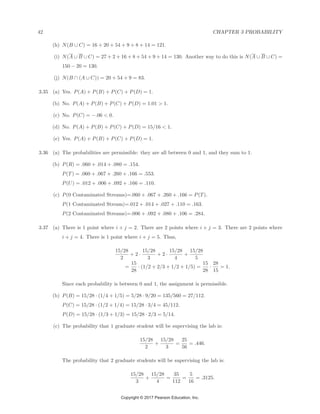
3.29 The outcome space is given in Figure 3.1.
(a) The 6 outcomes summing to 7 are marked by squares. Thus, the probability is 6/36 = 1/6.
(b) There are 2 outcomes summing to 11, which are marked by diamonds. Thus, the probability is
2/36 = 1/18.
(c) These events are mutually exclusive. Thus, the probability is 6/36 + 2/36 = 2/9.
Copyright © 2017 Pearson Education, Inc.
CHAPTER 3 PROBABILITY 41
● ● ● ● ● ●
● ● ● ● ● ●
● ● ● ● ● ●
● ● ● ● ● ●
● ● ● ● ● ●
● ● ● ● ● ●
1 2 3 4 5 6
1
2
3
4
5
6
Figure 3.1: The outcome space for Exercise 3.29.
(d) The 2 outcomes are marked by triangles. Thus, the probability is 2/36 = 1/18.
(e) There are two such outcomes, (1,1) and (6,6). Thus, the probability is 2/36 = 1/18.
(f) There are four such outcomes, (1,1), (1,2), (2,1) and (6,6). Thus, the probability is 4/36 = 1/9.
3.30 There are 250 numbers divisible by 200. Thus, the probability is 250/50,000 = 1/200.
3.31 There are 19 + 12 = 31 cars. Thus, there are 31C4 ways to choose the cars for inspection. There are
19C2 ways to get the compacts and 12C2 ways to get the intermediates. Thus, the probability is:
⎛
⎝
19
2
⎞
⎠
⎛
⎝
12
2
⎞
⎠
⎛
⎝
31
4
⎞
⎠
=
11, 286
31, 465
= .359.
3.32 Using the long run relative frequency, we the estimate of the probability is 12/365 = .033.
3.33 The number of students enrolled in the statistics course or the operations research course is 92 + 63 −
40 = 115. Thus, 160 − 115 = 45 are not enrolled in either course.
3.34 (a) N(A) = 2 + 8 + 54 + 20 = 84.
(b) N(B) = 20 + 54 + 9 + 16 = 99.
(c) N(C) = 8 + 54 + 9 + 14 = 85.
(d) N(A ∩ B) = 20 + 54 = 74.
(e) N(A ∩ C) = 8 + 54 = 62.
(f) N(A ∩ B ∩ C) = 54.
(g) N(A ∪ B) = 2 + 8 + 20 + 54 + 9 + 16 = 109.
Copyright © 2017 Pearson Education, Inc.
42 CHAPTER 3 PROBABILITY
(h) N(B ∪ C) = 16 + 20 + 54 + 9 + 8 + 14 = 121.
(i) N(A ∪ B ∪ C) = 27 + 2 + 16 + 8 + 54 + 9 + 14 = 130. Another way to do this is N(A ∪ B ∪ C) =
150 − 20 = 130.
(j) N(B ∩ (A ∪ C)) = 20 + 54 + 9 = 83.
3.35 (a) Yes. P(A) + P(B) + P(C) + P(D) = 1.
(b) No. P(A) + P(B) + P(C) + P(D) = 1.01 > 1.
(c) No. P(C) = −.06 < 0.
(d) No. P(A) + P(B) + P(C) + P(D) = 15/16 < 1.
(e) Yes. P(A) + P(B) + P(C) + P(D) = 1.
3.36 (a) The probabilities are permissible: they are all between 0 and 1, and they sum to 1.
(b) P(R) = .060 + .014 + .080 = .154.
P(T) = .060 + .067 + .260 + .166 = .553.
P(U) = .012 + .006 + .092 + .166 = .110.
(c) P(0 Contaminated Streams)=.060 + .067 + .260 + .166 = P(T).
P(1 Contaminated Stream)=.012 + .014 + .027 + .110 = .163.
P(2 Contaminated Streams)=.006 + .092 + .080 + .106 = .284.
3.37 (a) There is 1 point where i + j = 2. There are 2 points where i + j = 3. There are 2 points where
i + j = 4. There is 1 point where i + j = 5. Thus,
15/28
2
+ 2 ·
15/28
3
+ 2 ·
15/28
4
+
15/28
5
=
15
28
· (1/2 + 2/3 + 1/2 + 1/5) =
15
28
·
28
15
= 1.
Since each probability is between 0 and 1, the assignment is permissible.
(b) P(B) = 15/28 · (1/4 + 1/5) = 5/28 · 9/20 = 135/560 = 27/112.
P(C) = 15/28 · (1/2 + 1/4) = 15/28 · 3/4 = 45/112.
P(D) = 15/28 · (1/3 + 1/3) = 15/28 · 2/3 = 5/14.
(c) The probability that 1 graduate student will be supervising the lab is:
15/28
2
+
15/28
3
=
25
56
= .446.
The probability that 2 graduate students will be supervising the lab is:
15/28
3
+
15/28
4
=
35
112
=
5
16
= .3125.
Copyright © 2017 Pearson Education, Inc.
CHAPTER 3 PROBABILITY 43
The probability that 3 graduate students will be supervising the lab is:
15/28
4
+
15/28
5
=
27
112
= .241.
3.38 (a) .38 and .53 do not sum to 1.
(b) Probability can not be negative.
(c) The probability that the compressor or the fan motor is all right would be .82 + .64 − .41 = 1.05
which is greater than 1.
3.39 (a) (A ∩ B) ∪ (A ∩ B) = A, and A ∩ B and A ∩ B are disjoint. Thus
P((A ∩ B) ∪ (A ∩ B)) = P(A ∩ B) + P(A ∩ B) = P(A).
Since P(A ∩ B) ≥ 0, we have proved that P(A ∪ B) ≤ P(A).
(b) Combining (d) and (c) of Exercise 3.13 gives us
A ∪ B = (A ∩ B) ∪ (A ∩ B) ∪ (A ∩ B) = A ∪ (A ∩ B).
But A and A ∩ B are disjoint. Thus,
P(A ∪ B) = P(A) + P(A ∩ B).
Since P(A ∩ B) ≥ 0, we have proved that P(A ∪ B) ≥ P(A).
3.40 (a) Let A be the event that the student gets an A , and B be the event that the student gets a B.
Then, P(A ∪ B) ≥ P(A). But .27 < .32.
(b) The probability that both are completed on time is the intersection of the events that the larger
is completed on time and the smaller is completed on time. Thus, the probability that both are
completed on time must be no greater than the probability that the larger is completed on time.
But .42 > .35.
3.41 (a) P(A) = 1 − P(A) = 1 − .45 = .55.
(b) P(A ∪ B) = P(A) + P(B) = .45 + .30 = .75, since A and B are mutually exclusive.
(c) P(A ∩ B) = P(A) = .45, since A and B are mutually exclusive.
(d) P(A ∩ B) = P((A ∪ B)) = 1 − P(A ∪ B) = 1 − .45 − .30 = .25.
3.42 (a) P(A) = N(A)/150 = 84/150 = .56.
(b) P(B) = N(B)/150 = 99/150 = .66.
(c) P(A ∩ C) = P((A ∪ C)) = (16 + 27)/150 = .287.
(d) P(B ∩ C) = (54 + 9)/150 = .42.
Copyright © 2017 Pearson Education, Inc.
44 CHAPTER 3 PROBABILITY
3.43 (a) This probability is given by .22 + .21 = .43.
(b) .17 + .29 + .21 = .67.
(c) .03 + .21 = .24.
(d) .22 + .29 + .08 = .59.
3.44 (a) P(at most 4 complaints)=.01 + .03 + .07 + .15 + .19 = .45.
(b) P(at least 6 complaints)=.14 + .12 + .09 + .02 = .37.
(c) P(from 5 to 8 complaints)=.18 + .14 + .12 + .09 = .53.
3.45 (a) 15/32 (b) 13/32 (c) 5/32 (d) 23/32 (e) 8/32 (f) 9/32.
3.46 (a) The probability that a chip will have either defective etching or a crack defect is .06+.03−.02 = .07.
(b) The probability is 1 − .07 = .93.
3.47 (a) “At least one award” is the same as “design or efficiency award”. Thus, the probability is .16 +
.24 − .11 = .29.
(b) This the probability of “at least one award” minus the probability of both awards or .29−.11 = .18.
3.48 (a) P(A ∪ B) = P(A) + P(B) − P(A ∩ B) = .30 + .62 − .12 = .80.
(b) P(A ∩ B) = P(B) − P(A ∩ B) = .62 − .12 = .50.
(c) P(A ∩ B) = P(A) − P(A ∩ B) = .30 − .12 = .18.
(d) P(A ∪ B) = P(A ∩ B) = 1 − P(A ∩ B) = 1 − .12 = .88.
3.49
P(A ∪ B ∪ C) = 1 − .11 = .89, P(A) = .24 + .06 + .04 + .16 = .5,
P(B) = .19 + .06 + .04 + .11 = .4, P(C) = .09 + .16 + .04 + .11 = .4,
P(A ∩ B) = .06 + .04 = .1, P(A ∩ C) = .16 + .04 = .2,
P(B ∩ C) = .04 + .11 = .15, P(A ∩ B ∩ C) = .04.
The formula is verified since
.5 + .4 + .4 − .1 − .2 − .15 + .04 = .89.
3.50 These probabilities are shown in Figure 3.2.
The probability of at least one of these errors is:
.0006 + .0001 + .0001 + .0002 + .0002 + .0005 + .0007 = .0024.
We can also use the formula given in Exercise 3.49 to calculate the probability:
P(P ∪ F ∪ R) = .001 + .0009 + .0012 − .0002 − .0003 − .0003 + .0001 = .0024.
Copyright © 2017 Pearson Education, Inc.
CHAPTER 3 PROBABILITY 45
.0006
.0001
.0005
.0002
.0001
.0002
.0007
P F
R
S
Figure 3.2: Diagram for Exercise 3.50: P = Processing, F = Filing and R = Retrieving.
3.51 (a) The odds for are (4/7)/(3/7) = 4 to 3.
(b) The odds against are .95/.05 = 19 to 1 against.
(c) The odds for are .80/.20 = 4 to 1.
3.52 If the probability of A is p and the odds for A are a to b, then p/(1 − p) = a/b. Solving for p gives
p = a/(a + b).
3.53 (a) p = 3/(3+2) = 3/5.
(b) 30/(30+10) = 3/4 ≤ p < 40/(10+40) = 4/5.
3.54 (a) The supplier feels that:
P(arrives late) = 5/(5 + 7) = 5/12,
P(doesn’t arrive) = 1/(1 + 11) = 1/12,
P(arrives late or doesn’t arrive at all) = 50/(50 + 50) = 1/2.
These subjective probabilities are consistent, because
P(arrives late) + P(doesn’t arrive)
= P(arrives late or doesn’t arrive at all).
(b) P(first wins) = 1/(2+1) = 1/3, P(second wins) = 1/(3+1) = 1/4,
P(either wins) < 50/(50+50) =1/2.
It must be true that
P(A wins) + P(B wins) = P(either wins).
Copyright © 2017 Pearson Education, Inc.
46 CHAPTER 3 PROBABILITY
But 1/3 + 1/4 = 7/12 > 1/2 which is a contradiction.
3.55 P(I ∩ D) = 10/500, P(D) = 15/500, P(I ∩ D) = 20/500, P(D) = 485/500.
P(I|D) =
P(I ∩ D)
P(D)
=
10
15
=
2
3
,
P(I|D) =
P(I ∩ D)
P(D)
=
20
485
=
4
97
.
3.56 (a) The probability of major repairs would increase. High mileage causes many major parts to wear
out.
(b) The probability of knowing the second law of thermo-
dynamics would increase. The typical college senior would not know the law but most mechanical
engineers would learn the laws of thermodynamics.
(c) Let A = [ major repairs required ] and B = [ high mileage ]. The question concerns the relation
of the conditional probability P( A | B ) to the unconditional probability P( A ).
3.57 (a) The sample space is C. Thus the probability is given by:
N(A ∩ C)
N(C)
=
8 + 15
8 + 54 + 9 + 14
=
62
85
= .73.
(b) This is given by:
N(A ∩ B)
N(A)
=
20 + 54
20 + 54 + 8 + 2
=
74
84
= .881.
(c) This is given by:
N(C ∩ B)
N(B)
=
N((C ∪ B))
N(B)
=
150 − 121
105 − 99
=
29
51
= .569.
3.58 (a)
P(A|B) =
P(A ∩ B)
P(B)
=
.06 + .04
.06 + .04 + .19 + .11
= .25.
(b)
P(B|C) =
P(B ∩ C)
P(C)
=
.19 + .06
1 − .4
= .417.
(c)
P(A ∩ B|C) =
P(A ∩ B ∩ C)
P(C)
=
.04
.4
= .1.
(d)
P(B ∪ C|A) =
P((B ∪ C) ∩ A)
P(A)
=
.09 + .11. + .19
1 − .5
= .78.
(e)
P(A|B ∪ C) =
P(A ∩ (B ∪ C))
P(B ∪ C)
=
.06 + .04 + .16
.06 + .04 + .16 + .19 + .11 + .09
=
.26
.65
= .4
Copyright © 2017 Pearson Education, Inc.
CHAPTER 3 PROBABILITY 47
(f)
P(A|B ∩ C) =
P(A ∩ B ∩ C)
P(B ∩ C)
=
.04
.04 + .11
= .267.
(g)
P(A ∩ B ∩ C|B ∩ C) =
P(A ∩ B ∩ C)
P(B ∩ C)
= .267.
(h)
P(A ∩ B ∩ C|B ∪ C) =
P(A ∩ B ∩ C)
P(B ∪ C)
=
.04
.65
= .062.
3.59 From the used car example, we know that P(M1) = 0.20, P(P1) = 0.75, P(M1 ∩ P1) = 0.16, and
P(C3) = 0.40
(a)
P(M1|P1) =
0.16
0.75
= .213 which is different from P(M1)
(b) We first obtain P(C3 ∩ P2) = 0.01 + 0.06 + 0.02 = 0.09 and
P(P2) = 0.02 + 0.01 + 0.01 + 0.02 + 0.07 + 0.06 + 0.01 + 0.03 + 0.02 = 0.25
Hence, P(C3|P2) = 0.09/0.25 = .36 which is different from P(C3).
(c) We first obtain P(M1 ∩ P1 ∩ C3) = 0.07 and P(P1 ∩ C3) = .07 + .10 + .14 = .31 so that
P(M1|P1 ∩ C3) =
.07
.31
= .2258 which is different from P(M1)
3.60 (a) P(both awards) = .11, and P(efficiency award) = .24. Thus,
P(design award given efficiency award) = .11/.24 = .458.
(b) P(design award and no efficiency award) = .16 − .11 = .05, and
P(no efficiency award) = 1 − .24 = .76. Thus,
P(design award given no efficiency award) = .05/.76 = .066.
3.61 P(A|B) = P(A ∩ B)/P(B) by definition. Thus, P(A|B) = P(A) implies that
P(A ∩ B)/P(B)= P(A), which implies P(A ∩ B)/P(A) = P(B), since both P(A) and P(B) are not
zero. Thus P(B|A) = P(B).
3.62 Let A be the event that a car is stopped for speeding and and B be the event that it is red. Then,
P(A|B) = .06, P(A|B) = .02 and P(A) = .09.
(a)
P(A) = P(A|B)P(B) + P(A|B)P(B) = .06 × .09 + .02 × .91 = .0236
Copyright © 2017 Pearson Education, Inc.
48 CHAPTER 3 PROBABILITY
(b)
P(B|A) =
P(A|B)P(B)
P(A|B)P(B) + P(A|B)P(B)
=
.0054
.0236
= .229
3.63 (a) P(A|B) = P(A ∩ B)/P(B) = .24/.40 = .6 = P(A).
(b) P(A|B) = P(A ∩ B)/P(B) = (P(A) − P(A ∩ B))/(1 − P(B))
= (.60 − .24)/(1 − .40) = .6 = P(A).
(c) P(B|A) = P(B ∩ A)/P(A) = .24/.60 = .4 = P(B).
(d) P(B|A) = P(B ∩ A)/P(A) = (P(B) − P(B ∩ A))/(1 − P(A))
= (.40 − .24)/(1 − .60) = .4 = P(B).
3.64 (a) The probability of getting an error on the first draw is 4/24. The probability of getting an error
on the second draw given that there was an error on the first draw is 3/23. Thus, the probability
that both will contain errors is:
4
24
·
3
23
=
1
46
= .0217.
(b) The probability that neither will contain errors is :
20
24
·
19
23
=
95
138
= .688.
3.65 (a) The probability of drawing a Seattle-bound part on the first draw is 45/60. The probability of
drawing a Seattle-bound part on the second draw given that a Seattle-bound part was drawn on
the first draw is 44/59. Thus, the probability that both parts should have gone to Seattle is:
45
60
·
44
59
= .559.
(b) Using an approach similar to (a), the probability that both parts should have gone to Vancouver
is:
15
60
·
14
59
= .059.
(c) The probability that one should have gone to Seattle and one to Vancouver is 1 minus the sum
of the probability in parts (a) and (b) or .381.
3.66 Let A be the event that the service call results in a complaint and B be the event that the call was
made by the contractor. Then, P(A|B) = .1, P(A|B) = .05 and P(B) = .85.
(a)
P(A) = P(A|B)P(B) + P(A|B)P(B) = .10 × .85 + .05 × .15 = .0925
Copyright © 2017 Pearson Education, Inc.
CHAPTER 3 PROBABILITY 49
(b)
P(B|A) =
P(A|B)P(B)
P(A|B)P(B) + P(A|B)P(B)
=
.085
.0925
= .919
3.67 A and B are independent if and only if P(A)P(B) = P(A ∩ B). Since (0.60)(0.45)= 0.27, they are
independent.
3.68 By the definition of odds, P(M) = 3/8, P(N) = 2/3, and P(M ∩ N) =1/5. Since
P(M)P(N) = (3/8)(2/3) = 1/4 = 1/5 the events M and N are not independent.
3.69 (a) Each head has probability 1/2, and each toss is independent. Thus, the probability of 8 heads is
(1/2)8
= 1/256.
(b) P(three 3’s and then a 4 or 5) = (1/6)3
(1/3) = 1/648.
(c) P(five questions answered correctly) = (1/3)5
= 1/243.
3.70 (a) P(first three are blanks) = (3/6)(2/5)(1/4) = 1/20.
(b) P(R2R3S4R5|R1) = (.8)(.8)(1−.8)(.6) = .0768, where Ri means it rained on day i, and Si means
it was sunny on day i.
(c) P(not promptly next 3 months | promptly this month) = (1−.90)(.50)(.50) = .025.
(d) P(4 picked do not meet standards) = (5/12)(4/11)(3/10)(2/9) = .0101.
3.71 (a) P(A) = (.4)(.3) + (.6)(.8) = .60.
(b) P(B|A) = P(B ∩ A)/P(A) = (.4)(.3)/(.60) =.20.
(c) P(B|A) = P(B ∩ A)/P(A) = (.4)(.7)/(.4) =.70.
3.72 We have P(A) = .25 and P(B | A ) = .0002.
(a) Since P( B | A ) = 0, P(B) = P(B|A) P(A) = .0002 × .25 = .00005
(b) Here P(B) = P(B|A) P(A) = .0004 × .25 = .0001.
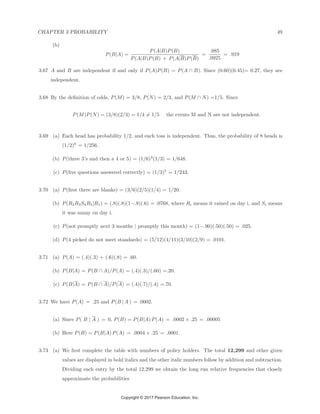
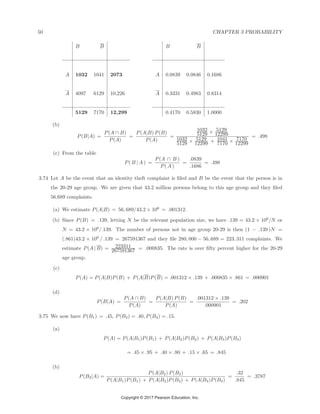
3.73 (a) We first complete the table with numbers of policy holders. The total 12,299 and other given
values are displayed in bold italics and the other italic numbers follow by addition and subtraction.
Dividing each entry by the total 12,299 we obtain the long run relative frequencies that closely
approximate the probabilities
Copyright © 2017 Pearson Education, Inc.
50 CHAPTER 3 PROBABILITY
B B
A 1032 1041 2073
A 4097 6129 10,226
5129 7170 12,299
B B
A 0.0839 0.0846 0.1686
A 0.3331 0.4983 0.8314
0.4170 0.5830 1.0000
(b)
P(B|A) =
P(A ∩ B)
P(A)
=
P(A|B) P(B)
P(A)
=
1032
5129 × 5129
12299
1032
5129 × 5129
12299 + 1041
7170 × 7170
12299
= .498
(c) From the table
P( B | A ) =
P(A ∩ B )
P( A )
=
.0839
.1686
= .498
3.74 Let A be the event that an identity theft complaint is filed and B be the event that the person is in
the 20-29 age group. We are given that 43.2 million persons belong to this age group and they filed
56,689 complaints.
(a) We estimate P(A|B) = 56, 689/43.2 × 106
= .001312.
(b) Since P(B) = .139, letting N be the relevant population size, we have .139 = 43.2 × 10⁶
/N or
N = 43.2 × 10⁶
/.139. The number of persons not in age group 20-29 is then (1 − .139 )N =
(.861)43.2 × 10⁶
/ .139 = 267591367 and they file 280, 000 − 56, 689 = 223, 311 complaints. We
estimate P(A | B) = 223311
267591367 = .000835. The rate is over fifty percent higher for the 20-29
age group.
(c)
P(A) = P(A|B)P(B) + P(A|B)P(B) = .001312 × .139 + .000835 × .861 = .000901
(d)
P(B|A) =
P(A ∩ B)
P(A)
=
P(A|B) P(B)
P(A)
=
.001312 × .139
.000901
= .202
3.75 We now have P(B1) = .45, P(B2) = .40, P(B3) = .15.
(a)
P(A) = P(A|B1)P(B1) + P(A|B2)P(B2) + P(A|B3)P(B3)
= .45 × .95 + .40 × .80 + .15 × .65 = .845
(b)
P(B2|A) =
P(A|B2) P(B2)
P(A|B1)P(B1) + P(A|B2)P(B2) + P(A|B3)P(B3)
=
.32
.845
= .3787
Copyright © 2017 Pearson Education, Inc.
CHAPTER 3 PROBABILITY 51
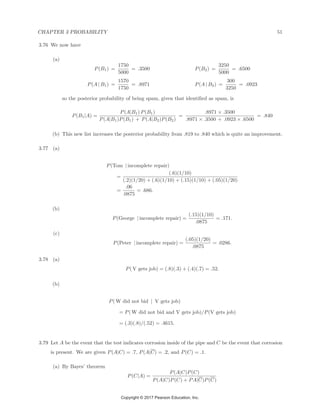
3.76 We now have
(a)
P(B1) =
1750
5000
= .3500 P(B2) =
3250
5000
= .6500
P(A | B1) =
1570
1750
= .8971 P(A | B2) =
300
3250
= .0923
so the posterior probability of being spam, given that identified as spam, is
P(B1|A) =
P(A|B1) P(B1)
P(A|B1)P(B1) + P(A|B2)P(B2)
=
.8971 × .3500
.8971 × .3500 + .0923 × .6500
= .840
(b) This new list increases the posterior probability from .819 to .840 which is quite an improvement.
3.77 (a)
P(Tom | incomplete repair)
=
(.6)(1/10)
(.2)(1/20) + (.6)(1/10) + (.15)(1/10) + (.05)(1/20)
=
.06
.0875
= .686.
(b)
P(George | incomplete repair) =
(.15)(1/10)
.0875
= .171.
(c)
P(Peter | incomplete repair) =
(.05)(1/20)
.0875
= .0286.
3.78 (a)
P( V gets job) = (.8)(.3) + (.4)(.7) = .52.
(b)
P( W did not bid | V gets job)
= P( W did not bid and V gets job)/P(V gets job)
= (.3)(.8)/(.52) = .4615.
3.79 Let A be the event that the test indicates corrosion inside of the pipe and C be the event that corrosion
is present. We are given P(A|C) = .7, P(A|C) = .2, and P(C) = .1.
(a) By Bayes’ theorem
P(C|A) =
P(A|C)P(C)
P(A|C)P(C) + PA|C)P(C)
Copyright © 2017 Pearson Education, Inc.
52 CHAPTER 3 PROBABILITY
=
.7 × .1
.7 × .1 + .2 × .9
=
.07
.07 + .18
= .28
(b)
P(C|A) =
P(A|C)P(C)
P(A|C)P(C) + P(A|C)P(C)
=
(1 − .7) × .1
(1 − .7) × .1 + (1 − .2) × .9
=
.03
.03 + .72
= .04
3.80 Let A be the event that a circuit board passes the automated test and D be the event that the board
is defective. We approximate P(A|D) = 25/30 and P(A) = 890/900
(a) We then approximate P( Pass test | board has defects ) = P(A | D) using the relation
25
30
= P(A | D) = 1 − P(A | D)
or P(A | D) = 5/30.
(b) The approximation P(A | D) = 5/30 may be too small because the boards were intentionally made
to have noticeable defects. Likely, many defects are not very noticeable.
(c) To proceed, we assume that P(A | D) = 0 or P(A | D) = 1. By the law of total probability
P(A) = P(A | D)P(D) + P(A | D ) P(D)
so
890
900
=
5
30
× P(D) + 1 × (1 − P(D)
or
25
30
P(D) =
10
900
so P(D) =
1
75
= .013
(d)
P(D | A) =
P(A | D)P(D)
P(A | D)P(D) + P(A | D)P(D)
=
5
30 × 1
75
5
30 × 1
75 + 1 × 74
75
=
5
2225
= .00225
3.81 (a) Using the long run relative frequency approximation to probability, we estimate the probability
P [ Checked out ] =
27
300
= 0.09
(b) Using the data from last year, the long run relative frequency approximation to probability gives
the estimate
P [ Get internship ] =
28
380
= 0.074
One factor might be the quality of permanent jobs that interns received last year or even how
enthusiastic they were about the internship. Both would likely increase the number of applicants.
Copyright © 2017 Pearson Education, Inc.
CHAPTER 3 PROBABILITY 53
Bad experiences may decrease the number of applicants.
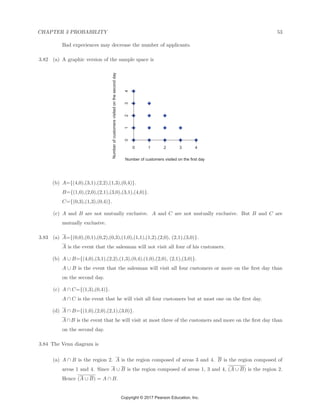
3.82 (a) A graphic version of the sample space is
● ● ● ● ●
● ● ● ●
● ● ●
● ●
●
Number of customers visited on the first day
Numberofcustomersvisitedonthesecondday
0 1 2 3 4
01234
(b) A={(4,0),(3,1),(2,2),(1,3),(0,4)}.
B={(1,0),(2,0),(2,1),(3,0),(3,1),(4,0)}.
C={(0,3),(1,3),(0,4)}.
(c) A and B are not mutually exclusive. A and C are not mutually exclusive. But B and C are
mutually exclusive.
3.83 (a) A={(0,0),(0,1),(0,2),(0,3),(1,0),(1,1),(1,2),(2,0), (2,1),(3,0)}.
A is the event that the salesman will not visit all four of his customers.
(b) A ∪ B={(4,0),(3,1),(2,2),(1,3),(0,4),(1,0),(2,0), (2,1),(3,0)}.
A ∪ B is the event that the salesman will visit all four customers or more on the first day than
on the second day.
(c) A ∩ C={(1,3),(0,4)}.
A ∩ C is the event that he will visit all four customers but at most one on the first day.
(d) A ∩ B={(1,0),(2,0),(2,1),(3,0)}.
A∩B is the event that he will visit at most three of the customers and more on the first day than
on the second day.
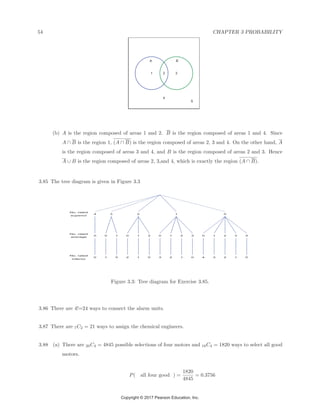
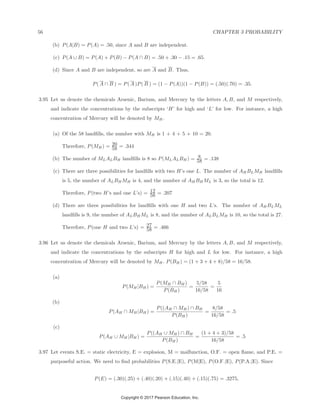
3.84 The Venn diagram is
(a) A ∩ B is the region 2. A is the region composed of areas 3 and 4. B is the region composed of
areas 1 and 4. Since A ∪ B is the region composed of areas 1, 3 and 4, (A ∪ B) is the region 2.
Hence (A ∪ B) = A ∩ B.
Copyright © 2017 Pearson Education, Inc.
54 CHAPTER 3 PROBABILITY
1 2 3
4
A B
S
(b) A is the region composed of areas 1 and 2. B is the region composed of areas 1 and 4. Since
A ∩ B is the region 1, (A ∩ B) is the region composed of areas 2, 3 and 4. On the other hand, A
is the region composed of areas 3 and 4, and B is the region composed of areas 2 and 3. Hence
A ∪ B is the region composed of areas 2, 3,and 4, which is exactly the region (A ∩ B).
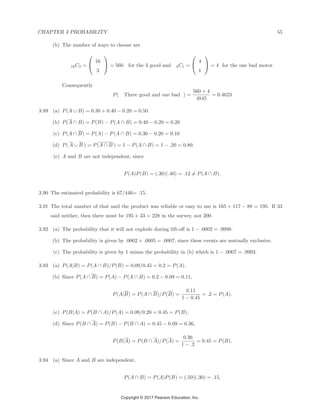
3.85 The tree diagram is given in Figure 3.3
No. rated
superior
No. rated
average
No. rated
inferior
4 3 2 1 0
0 0 1 0 1 2 0 1 2 3 0 1 2 3 4
0 1 0 2 1 0 3 2 1 0 4 3 2 1 0
Figure 3.3: Tree diagram for Exercise 3.85.
3.86 There are 4!=24 ways to connect the alarm units.
3.87 There are 7C2 = 21 ways to assign the chemical engineers.
3.88 (a) There are 20C4 = 4845 possible selections of four motors and 16C4 = 1820 ways to select all good
motors.
P( all four good ) =
1820
4845
= 0.3756
Copyright © 2017 Pearson Education, Inc.
CHAPTER 3 PROBABILITY 55
(b) The number of ways to choose are
16C3 =
⎛
⎝
16
3
⎞
⎠ = 560 for the 3 good and 4C1 =
⎛
⎝
4
1
⎞
⎠ = 4 for the one bad motor.
Consequently
P( Three good and one bad ) =
560 × 4
4845
= 0.4623
3.89 (a) P(A ∪ B) = 0.30 + 0.40 − 0.20 = 0.50.
(b) P(A ∩ B) = P(B) − P(A ∩ B) = 0.40 − 0.20 = 0.20
(c) P(A ∩ B) = P(A) − P(A ∩ B) = 0.30 − 0.20 = 0.10
(d) P( A ∪ B ) = P(A ∩ B ) = 1 − P(A ∩ B) = 1 − .20 = 0.80.
(e) A and B are not independent, since
P(A)P(B) = (.30)(.40) = .12 = P(A ∩ B).
3.90 The estimated probability is 67/446= .15.
3.91 The total number of that said the product was reliable or easy to use is 165 + 117 − 88 = 195. If 33
said neither, then there must be 195 + 33 = 228 in the survey, not 200.
3.92 (a) The probability that it will not explode during lift-off is 1 − .0002 = .9998.
(b) The probability is given by .0002 + .0005 = .0007, since these events are mutually exclusive.
(c) The probability is given by 1 minus the probability in (b) which is 1 − .0007 = .9993.
3.93 (a) P(A|B) = P(A ∩ B)/P(B) = 0.09/0.45 = 0.2 = P(A).
(b) Since P(A ∩ B) = P(A) − P(A ∩ B) = 0.2 − 0.09 = 0.11,
P(A|B) = P(A ∩ B)/P(B) =
0.11
1 − 0.45
= .2 = P(A).
(c) P(B|A) = P(B ∩ A)/P(A) = 0.09/0.20 = 0.45 = P(B).
(d) Since P(B ∩ A) = P(B) − P(B ∩ A) = 0.45 − 0.09 = 0.36,
P(B|A) = P(B ∩ A)/P(A) =
0.36
1 − .2
= 0.45 = P(B).
3.94 (a) Since A and B are independent,
P(A ∩ B) = P(A)P(B) = (.50)(.30) = .15.
Copyright © 2017 Pearson Education, Inc.
56 CHAPTER 3 PROBABILITY
(b) P(A|B) = P(A) = .50, since A and B are independent.
(c) P(A ∪ B) = P(A) + P(B) − P(A ∩ B) = .50 + .30 − .15 = .65.
(d) Since A and B are independent, so are A and B. Thus,
P( A ∩ B ) = P( A )P( B ) = (1 − P(A))(1 − P(B)) = (.50)(.70) = .35.
3.95 Let us denote the chemicals Arsenic, Barium, and Mercury by the letters A, B, and M respectively,
and indicate the concentrations by the subscripts ‘H’ for high and ‘L’ for low. For instance, a high
concentration of Mercury will be denoted by MH.
(a) Of the 58 landfills, the number with MH is 1 + 4 + 5 + 10 = 20.
Therefore, P(MH) = 20
58 = .344
(b) The number of MLALBH landfills is 8 so P(MLALBH) = 8
58 = .138
(c) There are three possibilities for landfills with two H’s one L. The number of AHBLMH landfills
is 5, the number of ALBHMH is 4, and the number of AHBHML is 3, so the total is 12.
Therefore, P(two H’s and one L’s) = 12
58 = .207
(d) There are three possibilities for landfills with one H and two L’s. The number of AHBLML
landfills is 9, the number of ALBHML is 8, and the number of ALBLMH is 10, so the total is 27.
Therefore, P(one H and two L’s) = 27
58 = .466
3.96 Let us denote the chemicals Arsenic, Barium, and Mercury by the letters A, B, and M respectively,
and indicate the concentrations by the subscripts H for high and L for low. For instance, a high
concentration of Mercury will be denoted by MH. P(BH) = (1 + 3 + 4 + 8)/58 = 16/58.
(a)
P(MH|BH) =
P(MH ∩ BH)
P(BH)
=
5/58
16/58
=
5
16
(b)
P(AH ∩ MH|BH) =
P((AH ∩ MH) ∩ BH
P(BH)
=
8/58
16/58
= .5
(c)
P(AH ∪ MH|BH) =
P((AH ∪ MH) ∩ BH
P(BH)
=
(1 + 4 + 3)/58
16/58
= .5
3.97 Let events S.E. = static electricity, E = explosion, M = malfunction, O.F. = open flame, and P.E. =
purposeful action. We need to find probabilities P(S.E.|E), P(M|E), P(O.F.|E), P(P.A.|E). Since
P(E) = (.30)(.25) + (.40)(.20) + (.15)(.40) + (.15)(.75) = .3275,
Copyright © 2017 Pearson Education, Inc.
CHAPTER 3 PROBABILITY 57
we have
P(S.E.|E) = (.30)(.25)/.3275 = .229, P(M|E) = (.40)(.20)/.3275 = .244,
P(O.F.|E) = (.15)(.40)/.3275 = .183, P(P.A.|E) = (.15)(.75)/.3275 = .344.
Thus, purposeful action is most likely.
3.98 Let A = [ Laptop ] and B = [ Tablet ]. We are given P( A ) = .9, P( B ) = .3 and P( A ∩ B ) = .2.
(a) First, .9 = P( A ) = P( A ∩ B ) + P( A ∩ B ) so that P( A ∩ B ) = .9 − .2 = .7. Then, since
P( B ) = 1 − P( B ) = .7, we have
P( A | B ) =
P( A ∩ B )
P( B )
=
.7
.7
= 1.0
(b) Since .3 = P( B ) = P( A ∩ B ) + P( A ∩ B ), we have P( A ∩ B ) = .3 − .2 = .1 and
P( A ∩ B ) + P( A ∩ B ) = .7 + .1 = .8
(c) Because ( A ∪ B ) ∩ A = A and P( A ∪ B ) = .9 + .3 − .2 = 1.0
P( A | A ∪ B ) =
P( A )
P( A ∪ B )
=
.9
1.0
= .9
3.99 We let A be the event route A is selected, B be the event route B is selected and C the event Amy
arrives home at or before 6 p.m. We are given P(A) = .4 so P(B) = 1 − .4 = .6.
(a) By the law of total probability
P(C) = P(C|A)P(A) + P(C|B)P(B) = .8 × .4 + .7 × .6 = .74
(b) Using Bayes’ rule
P(B|C) =
P(C|B)P(B)
P(C|A)P(A) + P(C|B)P(B)
=
.3 × .6
.2 × .4 + .3 × .6
= .692
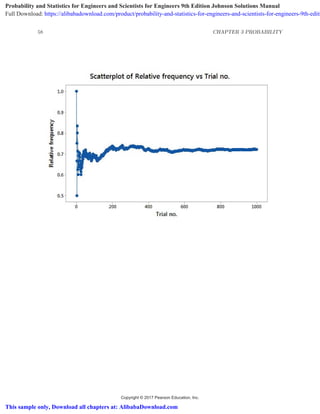
3.100 As the number of trials increases to a few hundred and beyond, the relative frequencies becomes much
less variable from trial to trail. It approaches the probability of the event 0.7.
Copyright © 2017 Pearson Education, Inc.
58 CHAPTER 3 PROBABILITY
Copyright © 2017 Pearson Education, Inc.
Probability and Statistics for Engineers and Scientists for Engineers 9th Edition Johnson Solutions Manual
Full Download: https://alibabadownload.com/product/probability-and-statistics-for-engineers-and-scientists-for-engineers-9th-editi
This sample only, Download all chapters at: AlibabaDownload.com

New Perspectives on HTML5 CSS3 JavaScript 6th Edition Carey Solutions Manual

  • 1.
    Chapter 3 PROBABILITY 3.1 (a)A sketch of the 12 points of the sample space is as follows: ● ● ● ● ● ● ● ● ● ● ● ● Contaminated Lakes ContaminatedStreams 0.0 0.5 1.0 1.5 2.0 2.5 3.0 0.00.51.01.52.0 (b) R={(0,0),(1,1),(2,2)}. T={(0,0),(1,0),(2,0),(3,0)}. U={(0,1),(0,2),(1,2)}. 3.2 R and T are not mutually exclusive. R and U are mutually exclusive. T and U are mutually exclusive. 3.3 (a) R ∪ U={(0,0),(1,1),(2,2),(0,1),(0,2),(1,2)}. R ∪ U is the event that the number of contaminated streams is greater than or equal to the number of contaminated lakes. (b) R ∩ T={(0,0)}. R ∩ T is the event that none of the streams or lakes is contaminated. (c) T={(0,1),(1,1),(2,1),(3,1),(0,2),(1,2),(2,2),(3,2)}. T is the event that at least one stream is con- taminated. 3.4 (a) F is the event that exactly one plant will be located in Texas. 35 Copyright © 2017 Pearson Education, Inc. Probability and Statistics for Engineers and Scientists for Engineers 9th Edition Johnson Solutions Manual Full Download: https://alibabadownload.com/product/probability-and-statistics-for-engineers-and-scientists-for-engineers-9th-editi This sample only, Download all chapters at: AlibabaDownload.com
  • 2.
    36 CHAPTER 3PROBABILITY (b) G is the event that there will be exactly 2 new plants in Texas and California. (c) F ∩ G={(1,1)}. F ∩ G is the event that exactly one plant will be in California and exactly one plant will be in Texas. 3.5 A={3,4}, B={2,3}, C={4,5}. (a) A ∪ B={2,3,4}. Work is easy, average or difficult on this model. (b) A ∩ B={3}. Work is average on this model. (c) B={1,4,5}. Thus A ∪ B={1,3,4,5}. Work is not easy on this model. (d) C={1,2,3}. Work is very easy, easy or average on this model. 3.6 A and B are not mutually exclusive. A and C are not mutually exclusive. B and C are mutually exclusive. 3.7 (a) A sketch of the 6 points of the sample space is Number of professors Numberofstudents 0.0 0.5 1.0 1.5 2.0 2.5 3.0 0.00.51.01.52.02.53.0 (b) B is the event that 3 graduate students are present. C is the event that the same number of professors and graduate students are present. D is the event that the total number of graduate students and professors is 3. (c) C ∪ D={(1,1),(1,2),(2,1),(2,2)}. C ∪ D is the event that at most 2 graduate students are present. (d) B and D are mutually exclusive. 3.8 (a) Countably infinite. The counter, presumably, could register anywhere from 0 counts to an arbi- trarily large number. (b) Finite. A finite subset of a finite set is being chosen. This is finite. (c) Continuous. The sample space is an interval. (d) Finite. Possible outcomes range from 0 to 450. (e) Continuous. The sample space is an interval. Copyright © 2017 Pearson Education, Inc.
  • 3.
    CHAPTER 3 PROBABILITY37 (f) Countably infinite. If it is a tough watch it could, presumably, be dropped an arbitrarily large number of times without stopping. 3.9 Region 1 is the event that the ore contains both uranium and copper. Region 2 is the event that the ore contains copper but not uranium. Region 3 is the event that the ore contains uranium but not copper. Region 4 is the event that the ore contains neither uranium nor copper. 3.10 (a) Regions 1 and 3 together represent the event that the ore contains uranium. (b) Regions 3 and 4 together represent the event that the ore does not contain copper. (c) Regions 1, 2 and 3 together represent the event that the ore contains either copper or uranium or both. 3.11 (a) Region 5 represents the event that the windings are improper, but the shaft size is not too large and the electrical connections are satisfactory. (b) Regions 4 and 6 together represent the event that the electrical connections are unsatisfactory, but the windings are proper. (c) Regions 7 and 8 together represent the event that the windings are proper and the electrical connections are satisfactory. (d) Regions 1, 2, 3, and 5 together represent the event that the windings are improper. 3.12 (a) Region 8. (b) Regions 1 and 2 together. (c) Regions 2, 5, and 7 together. (d) Regions 1, 2, 3, 4, and 6 together. 3.13 The following Venn diagram will be used in parts (a), (b), (c) and (d). 1 2 3 4 A B S (a) A ∩ B is region 2 in the figure. (A ∩ B) is the region composed of areas 1, 3, and 4. A is the region composed of areas 3 and 4. B is the region composed of areas 1 and 4. A ∪ B is the region composed of areas 1, 3, and 4. This corresponds to (A ∩ B). Copyright © 2017 Pearson Education, Inc.
  • 4.
    38 CHAPTER 3PROBABILITY (b) A ∩ B is the region 2 in the figure. A is the region composed of areas 1 and 2. Since A ∩ B is entirely contained in A, A ∪ (A ∩ B) = A. (c) A ∩ B is region 2. A ∩ B is region 1. Thus, (A ∩ B) ∪ (A ∩ B) is the region composed of areas 1 and 2 which is A. (d) From part (c), we have (A∩B)∪(A∩B) = A. Thus, we must show that (A∩B)∪(A∩B)∪(A∩B) = A ∪ (A ∩ B) = A ∪ B. A is the region composed of areas 1 and 2 and A ∩ B is region 3. Thus, A ∪ (A ∩ B) is the region composed of areas 1, 2, and 3. 1 4 5 2 3 6 7 A B C S 8 (e) In the figure above, A ∪ B is the region composed of areas 1, 2, 3, 4, 5, and 6. A ∪ C is the region composed of areas 1, 2, 3, 4, 6, and 7, so (A ∪ B) ∩ (A ∪ C) is the region composed of areas 1, 2, 3, 4, and 6. B ∩ C is the region composed of areas 3, and 6, and A is the region composed of areas 1, 2, 3, and 4. Thus, A ∪ (B ∩ C) is the region composed of areas 1, 2, 3, 4, and 6. Thus A ∪ (B ∩ C) = (A ∪ B) ∩ (A ∪ C). 3.14 The tree diagram is Mon Tues Wed Thurs 8am 1pm 2pm 8am 1pm 2pm 8am 1pm 2pm 8am 1pm 2pm Copyright © 2017 Pearson Education, Inc.
  • 5.
    CHAPTER 3 PROBABILITY39 3.15 Using the labels S = Spain, U = Uruguay, P = Portugal and J = Japan, the tree diagram is S USA U P J USA U P J S U P J S USA P J S USA U J S USA U P 3.16 There are 30 choices for the first number, and since a number cannot be immediately repeated, there are 30 × 29 × 29 = 25, 230 ways. 3.17 (a) 3 + 4 = 7 opportunities. (b) 3 × 4 = 12 opportunities. 3.18 There are 10 × 10 × 10 × 10 = 10, 000 ways. 3.19 (a) The men and women can be chosen in 6C2 = ⎛ ⎝ 6 2 ⎞ ⎠ = 6! 4! 2! = 15 and 4C2 = ⎛ ⎝ 4 2 ⎞ ⎠ = 4! 2! 2! = 6 ways so there are 15 × 6 = 90 different project teams consisting of 2 men and 2 women. (b) We are restricted from the choice of having the two women in question both selected giving a total of 6 − 1 = 5 choices for two women. The number of project teams is reduced to 15 × 5 = 75. 3.20 9P3 = 9 · 8 · 7 = 504. 3.21 6! = 720. 3.22 (a) There are 5!/2! = 60 permutations. (b) There are 6 commercials, 3 of which are alike. Thus, there are 6!/3! = 120 ways to fill the time slots. 3.23 Since order does not matter, there are 15C2 = ⎛ ⎝ 15 2 ⎞ ⎠ = 15! 13! 2! = 105 ways. Copyright © 2017 Pearson Education, Inc.
  • 6.
    40 CHAPTER 3PROBABILITY 3.24 There are 12C4 = ⎛ ⎝ 12 4 ⎞ ⎠ = 12! 4! 8! = 495 ways to select the 4 candidates to interview. 3.25 There are 12C3 = 220 ways to draw the three rechargeable batteries. There are 11C3 = 165 ways to draw none are defective. (a) The number of ways to get the one that is defective is 220 − 165 = 55. (b) There are 165 ways not to get the one that is defective. 3.26 (a) There are 10C3 = 120 ways to get no defective batteries. (b) There are 2 · 10C2 = 90 ways to get 1 defective battery. (c) There are 10C1 = 10 ways to get both defective batteries. 3.27 There are 8C2 ways to choose the electric motors and 5C2 ways to choose the switches. Thus, there are 8C2 · 5C2 = 28 · 10 = 280 ways to choose the motors and switches for the experiment. 3.28 (a) Using the long run relative frequency approximation to probability, we estimate the probability of a required warranty repair by P [ Warranty repair required ] = 72 880 = 0.0818 The number of trials 880 is quite large so the relative frequency should be close to the probability. (b) Using the data from last year, the long run relative frequency approximation to probability gives the estimate P [ Receive season ticket ] = 6000 8400 = 0.714 One factor is the expected quality of the team next year. If the team is expected to be much better next year more students will apply for tickets. 3.29 The outcome space is given in Figure 3.1. (a) The 6 outcomes summing to 7 are marked by squares. Thus, the probability is 6/36 = 1/6. (b) There are 2 outcomes summing to 11, which are marked by diamonds. Thus, the probability is 2/36 = 1/18. (c) These events are mutually exclusive. Thus, the probability is 6/36 + 2/36 = 2/9. Copyright © 2017 Pearson Education, Inc.
  • 7.
    CHAPTER 3 PROBABILITY41 ● ● ● ● ● ● ● ● ● ● ● ● ● ● ● ● ● ● ● ● ● ● ● ● ● ● ● ● ● ● ● ● ● ● ● ● 1 2 3 4 5 6 1 2 3 4 5 6 Figure 3.1: The outcome space for Exercise 3.29. (d) The 2 outcomes are marked by triangles. Thus, the probability is 2/36 = 1/18. (e) There are two such outcomes, (1,1) and (6,6). Thus, the probability is 2/36 = 1/18. (f) There are four such outcomes, (1,1), (1,2), (2,1) and (6,6). Thus, the probability is 4/36 = 1/9. 3.30 There are 250 numbers divisible by 200. Thus, the probability is 250/50,000 = 1/200. 3.31 There are 19 + 12 = 31 cars. Thus, there are 31C4 ways to choose the cars for inspection. There are 19C2 ways to get the compacts and 12C2 ways to get the intermediates. Thus, the probability is: ⎛ ⎝ 19 2 ⎞ ⎠ ⎛ ⎝ 12 2 ⎞ ⎠ ⎛ ⎝ 31 4 ⎞ ⎠ = 11, 286 31, 465 = .359. 3.32 Using the long run relative frequency, we the estimate of the probability is 12/365 = .033. 3.33 The number of students enrolled in the statistics course or the operations research course is 92 + 63 − 40 = 115. Thus, 160 − 115 = 45 are not enrolled in either course. 3.34 (a) N(A) = 2 + 8 + 54 + 20 = 84. (b) N(B) = 20 + 54 + 9 + 16 = 99. (c) N(C) = 8 + 54 + 9 + 14 = 85. (d) N(A ∩ B) = 20 + 54 = 74. (e) N(A ∩ C) = 8 + 54 = 62. (f) N(A ∩ B ∩ C) = 54. (g) N(A ∪ B) = 2 + 8 + 20 + 54 + 9 + 16 = 109. Copyright © 2017 Pearson Education, Inc.
  • 8.
    42 CHAPTER 3PROBABILITY (h) N(B ∪ C) = 16 + 20 + 54 + 9 + 8 + 14 = 121. (i) N(A ∪ B ∪ C) = 27 + 2 + 16 + 8 + 54 + 9 + 14 = 130. Another way to do this is N(A ∪ B ∪ C) = 150 − 20 = 130. (j) N(B ∩ (A ∪ C)) = 20 + 54 + 9 = 83. 3.35 (a) Yes. P(A) + P(B) + P(C) + P(D) = 1. (b) No. P(A) + P(B) + P(C) + P(D) = 1.01 > 1. (c) No. P(C) = −.06 < 0. (d) No. P(A) + P(B) + P(C) + P(D) = 15/16 < 1. (e) Yes. P(A) + P(B) + P(C) + P(D) = 1. 3.36 (a) The probabilities are permissible: they are all between 0 and 1, and they sum to 1. (b) P(R) = .060 + .014 + .080 = .154. P(T) = .060 + .067 + .260 + .166 = .553. P(U) = .012 + .006 + .092 + .166 = .110. (c) P(0 Contaminated Streams)=.060 + .067 + .260 + .166 = P(T). P(1 Contaminated Stream)=.012 + .014 + .027 + .110 = .163. P(2 Contaminated Streams)=.006 + .092 + .080 + .106 = .284. 3.37 (a) There is 1 point where i + j = 2. There are 2 points where i + j = 3. There are 2 points where i + j = 4. There is 1 point where i + j = 5. Thus, 15/28 2 + 2 · 15/28 3 + 2 · 15/28 4 + 15/28 5 = 15 28 · (1/2 + 2/3 + 1/2 + 1/5) = 15 28 · 28 15 = 1. Since each probability is between 0 and 1, the assignment is permissible. (b) P(B) = 15/28 · (1/4 + 1/5) = 5/28 · 9/20 = 135/560 = 27/112. P(C) = 15/28 · (1/2 + 1/4) = 15/28 · 3/4 = 45/112. P(D) = 15/28 · (1/3 + 1/3) = 15/28 · 2/3 = 5/14. (c) The probability that 1 graduate student will be supervising the lab is: 15/28 2 + 15/28 3 = 25 56 = .446. The probability that 2 graduate students will be supervising the lab is: 15/28 3 + 15/28 4 = 35 112 = 5 16 = .3125. Copyright © 2017 Pearson Education, Inc.
  • 9.
    CHAPTER 3 PROBABILITY43 The probability that 3 graduate students will be supervising the lab is: 15/28 4 + 15/28 5 = 27 112 = .241. 3.38 (a) .38 and .53 do not sum to 1. (b) Probability can not be negative. (c) The probability that the compressor or the fan motor is all right would be .82 + .64 − .41 = 1.05 which is greater than 1. 3.39 (a) (A ∩ B) ∪ (A ∩ B) = A, and A ∩ B and A ∩ B are disjoint. Thus P((A ∩ B) ∪ (A ∩ B)) = P(A ∩ B) + P(A ∩ B) = P(A). Since P(A ∩ B) ≥ 0, we have proved that P(A ∪ B) ≤ P(A). (b) Combining (d) and (c) of Exercise 3.13 gives us A ∪ B = (A ∩ B) ∪ (A ∩ B) ∪ (A ∩ B) = A ∪ (A ∩ B). But A and A ∩ B are disjoint. Thus, P(A ∪ B) = P(A) + P(A ∩ B). Since P(A ∩ B) ≥ 0, we have proved that P(A ∪ B) ≥ P(A). 3.40 (a) Let A be the event that the student gets an A , and B be the event that the student gets a B. Then, P(A ∪ B) ≥ P(A). But .27 < .32. (b) The probability that both are completed on time is the intersection of the events that the larger is completed on time and the smaller is completed on time. Thus, the probability that both are completed on time must be no greater than the probability that the larger is completed on time. But .42 > .35. 3.41 (a) P(A) = 1 − P(A) = 1 − .45 = .55. (b) P(A ∪ B) = P(A) + P(B) = .45 + .30 = .75, since A and B are mutually exclusive. (c) P(A ∩ B) = P(A) = .45, since A and B are mutually exclusive. (d) P(A ∩ B) = P((A ∪ B)) = 1 − P(A ∪ B) = 1 − .45 − .30 = .25. 3.42 (a) P(A) = N(A)/150 = 84/150 = .56. (b) P(B) = N(B)/150 = 99/150 = .66. (c) P(A ∩ C) = P((A ∪ C)) = (16 + 27)/150 = .287. (d) P(B ∩ C) = (54 + 9)/150 = .42. Copyright © 2017 Pearson Education, Inc.
  • 10.
    44 CHAPTER 3PROBABILITY 3.43 (a) This probability is given by .22 + .21 = .43. (b) .17 + .29 + .21 = .67. (c) .03 + .21 = .24. (d) .22 + .29 + .08 = .59. 3.44 (a) P(at most 4 complaints)=.01 + .03 + .07 + .15 + .19 = .45. (b) P(at least 6 complaints)=.14 + .12 + .09 + .02 = .37. (c) P(from 5 to 8 complaints)=.18 + .14 + .12 + .09 = .53. 3.45 (a) 15/32 (b) 13/32 (c) 5/32 (d) 23/32 (e) 8/32 (f) 9/32. 3.46 (a) The probability that a chip will have either defective etching or a crack defect is .06+.03−.02 = .07. (b) The probability is 1 − .07 = .93. 3.47 (a) “At least one award” is the same as “design or efficiency award”. Thus, the probability is .16 + .24 − .11 = .29. (b) This the probability of “at least one award” minus the probability of both awards or .29−.11 = .18. 3.48 (a) P(A ∪ B) = P(A) + P(B) − P(A ∩ B) = .30 + .62 − .12 = .80. (b) P(A ∩ B) = P(B) − P(A ∩ B) = .62 − .12 = .50. (c) P(A ∩ B) = P(A) − P(A ∩ B) = .30 − .12 = .18. (d) P(A ∪ B) = P(A ∩ B) = 1 − P(A ∩ B) = 1 − .12 = .88. 3.49 P(A ∪ B ∪ C) = 1 − .11 = .89, P(A) = .24 + .06 + .04 + .16 = .5, P(B) = .19 + .06 + .04 + .11 = .4, P(C) = .09 + .16 + .04 + .11 = .4, P(A ∩ B) = .06 + .04 = .1, P(A ∩ C) = .16 + .04 = .2, P(B ∩ C) = .04 + .11 = .15, P(A ∩ B ∩ C) = .04. The formula is verified since .5 + .4 + .4 − .1 − .2 − .15 + .04 = .89. 3.50 These probabilities are shown in Figure 3.2. The probability of at least one of these errors is: .0006 + .0001 + .0001 + .0002 + .0002 + .0005 + .0007 = .0024. We can also use the formula given in Exercise 3.49 to calculate the probability: P(P ∪ F ∪ R) = .001 + .0009 + .0012 − .0002 − .0003 − .0003 + .0001 = .0024. Copyright © 2017 Pearson Education, Inc.
  • 11.
    CHAPTER 3 PROBABILITY45 .0006 .0001 .0005 .0002 .0001 .0002 .0007 P F R S Figure 3.2: Diagram for Exercise 3.50: P = Processing, F = Filing and R = Retrieving. 3.51 (a) The odds for are (4/7)/(3/7) = 4 to 3. (b) The odds against are .95/.05 = 19 to 1 against. (c) The odds for are .80/.20 = 4 to 1. 3.52 If the probability of A is p and the odds for A are a to b, then p/(1 − p) = a/b. Solving for p gives p = a/(a + b). 3.53 (a) p = 3/(3+2) = 3/5. (b) 30/(30+10) = 3/4 ≤ p < 40/(10+40) = 4/5. 3.54 (a) The supplier feels that: P(arrives late) = 5/(5 + 7) = 5/12, P(doesn’t arrive) = 1/(1 + 11) = 1/12, P(arrives late or doesn’t arrive at all) = 50/(50 + 50) = 1/2. These subjective probabilities are consistent, because P(arrives late) + P(doesn’t arrive) = P(arrives late or doesn’t arrive at all). (b) P(first wins) = 1/(2+1) = 1/3, P(second wins) = 1/(3+1) = 1/4, P(either wins) < 50/(50+50) =1/2. It must be true that P(A wins) + P(B wins) = P(either wins). Copyright © 2017 Pearson Education, Inc.
  • 12.
    46 CHAPTER 3PROBABILITY But 1/3 + 1/4 = 7/12 > 1/2 which is a contradiction. 3.55 P(I ∩ D) = 10/500, P(D) = 15/500, P(I ∩ D) = 20/500, P(D) = 485/500. P(I|D) = P(I ∩ D) P(D) = 10 15 = 2 3 , P(I|D) = P(I ∩ D) P(D) = 20 485 = 4 97 . 3.56 (a) The probability of major repairs would increase. High mileage causes many major parts to wear out. (b) The probability of knowing the second law of thermo- dynamics would increase. The typical college senior would not know the law but most mechanical engineers would learn the laws of thermodynamics. (c) Let A = [ major repairs required ] and B = [ high mileage ]. The question concerns the relation of the conditional probability P( A | B ) to the unconditional probability P( A ). 3.57 (a) The sample space is C. Thus the probability is given by: N(A ∩ C) N(C) = 8 + 15 8 + 54 + 9 + 14 = 62 85 = .73. (b) This is given by: N(A ∩ B) N(A) = 20 + 54 20 + 54 + 8 + 2 = 74 84 = .881. (c) This is given by: N(C ∩ B) N(B) = N((C ∪ B)) N(B) = 150 − 121 105 − 99 = 29 51 = .569. 3.58 (a) P(A|B) = P(A ∩ B) P(B) = .06 + .04 .06 + .04 + .19 + .11 = .25. (b) P(B|C) = P(B ∩ C) P(C) = .19 + .06 1 − .4 = .417. (c) P(A ∩ B|C) = P(A ∩ B ∩ C) P(C) = .04 .4 = .1. (d) P(B ∪ C|A) = P((B ∪ C) ∩ A) P(A) = .09 + .11. + .19 1 − .5 = .78. (e) P(A|B ∪ C) = P(A ∩ (B ∪ C)) P(B ∪ C) = .06 + .04 + .16 .06 + .04 + .16 + .19 + .11 + .09 = .26 .65 = .4 Copyright © 2017 Pearson Education, Inc.
  • 13.
    CHAPTER 3 PROBABILITY47 (f) P(A|B ∩ C) = P(A ∩ B ∩ C) P(B ∩ C) = .04 .04 + .11 = .267. (g) P(A ∩ B ∩ C|B ∩ C) = P(A ∩ B ∩ C) P(B ∩ C) = .267. (h) P(A ∩ B ∩ C|B ∪ C) = P(A ∩ B ∩ C) P(B ∪ C) = .04 .65 = .062. 3.59 From the used car example, we know that P(M1) = 0.20, P(P1) = 0.75, P(M1 ∩ P1) = 0.16, and P(C3) = 0.40 (a) P(M1|P1) = 0.16 0.75 = .213 which is different from P(M1) (b) We first obtain P(C3 ∩ P2) = 0.01 + 0.06 + 0.02 = 0.09 and P(P2) = 0.02 + 0.01 + 0.01 + 0.02 + 0.07 + 0.06 + 0.01 + 0.03 + 0.02 = 0.25 Hence, P(C3|P2) = 0.09/0.25 = .36 which is different from P(C3). (c) We first obtain P(M1 ∩ P1 ∩ C3) = 0.07 and P(P1 ∩ C3) = .07 + .10 + .14 = .31 so that P(M1|P1 ∩ C3) = .07 .31 = .2258 which is different from P(M1) 3.60 (a) P(both awards) = .11, and P(efficiency award) = .24. Thus, P(design award given efficiency award) = .11/.24 = .458. (b) P(design award and no efficiency award) = .16 − .11 = .05, and P(no efficiency award) = 1 − .24 = .76. Thus, P(design award given no efficiency award) = .05/.76 = .066. 3.61 P(A|B) = P(A ∩ B)/P(B) by definition. Thus, P(A|B) = P(A) implies that P(A ∩ B)/P(B)= P(A), which implies P(A ∩ B)/P(A) = P(B), since both P(A) and P(B) are not zero. Thus P(B|A) = P(B). 3.62 Let A be the event that a car is stopped for speeding and and B be the event that it is red. Then, P(A|B) = .06, P(A|B) = .02 and P(A) = .09. (a) P(A) = P(A|B)P(B) + P(A|B)P(B) = .06 × .09 + .02 × .91 = .0236 Copyright © 2017 Pearson Education, Inc.
  • 14.
    48 CHAPTER 3PROBABILITY (b) P(B|A) = P(A|B)P(B) P(A|B)P(B) + P(A|B)P(B) = .0054 .0236 = .229 3.63 (a) P(A|B) = P(A ∩ B)/P(B) = .24/.40 = .6 = P(A). (b) P(A|B) = P(A ∩ B)/P(B) = (P(A) − P(A ∩ B))/(1 − P(B)) = (.60 − .24)/(1 − .40) = .6 = P(A). (c) P(B|A) = P(B ∩ A)/P(A) = .24/.60 = .4 = P(B). (d) P(B|A) = P(B ∩ A)/P(A) = (P(B) − P(B ∩ A))/(1 − P(A)) = (.40 − .24)/(1 − .60) = .4 = P(B). 3.64 (a) The probability of getting an error on the first draw is 4/24. The probability of getting an error on the second draw given that there was an error on the first draw is 3/23. Thus, the probability that both will contain errors is: 4 24 · 3 23 = 1 46 = .0217. (b) The probability that neither will contain errors is : 20 24 · 19 23 = 95 138 = .688. 3.65 (a) The probability of drawing a Seattle-bound part on the first draw is 45/60. The probability of drawing a Seattle-bound part on the second draw given that a Seattle-bound part was drawn on the first draw is 44/59. Thus, the probability that both parts should have gone to Seattle is: 45 60 · 44 59 = .559. (b) Using an approach similar to (a), the probability that both parts should have gone to Vancouver is: 15 60 · 14 59 = .059. (c) The probability that one should have gone to Seattle and one to Vancouver is 1 minus the sum of the probability in parts (a) and (b) or .381. 3.66 Let A be the event that the service call results in a complaint and B be the event that the call was made by the contractor. Then, P(A|B) = .1, P(A|B) = .05 and P(B) = .85. (a) P(A) = P(A|B)P(B) + P(A|B)P(B) = .10 × .85 + .05 × .15 = .0925 Copyright © 2017 Pearson Education, Inc.
  • 15.
    CHAPTER 3 PROBABILITY49 (b) P(B|A) = P(A|B)P(B) P(A|B)P(B) + P(A|B)P(B) = .085 .0925 = .919 3.67 A and B are independent if and only if P(A)P(B) = P(A ∩ B). Since (0.60)(0.45)= 0.27, they are independent. 3.68 By the definition of odds, P(M) = 3/8, P(N) = 2/3, and P(M ∩ N) =1/5. Since P(M)P(N) = (3/8)(2/3) = 1/4 = 1/5 the events M and N are not independent. 3.69 (a) Each head has probability 1/2, and each toss is independent. Thus, the probability of 8 heads is (1/2)8 = 1/256. (b) P(three 3’s and then a 4 or 5) = (1/6)3 (1/3) = 1/648. (c) P(five questions answered correctly) = (1/3)5 = 1/243. 3.70 (a) P(first three are blanks) = (3/6)(2/5)(1/4) = 1/20. (b) P(R2R3S4R5|R1) = (.8)(.8)(1−.8)(.6) = .0768, where Ri means it rained on day i, and Si means it was sunny on day i. (c) P(not promptly next 3 months | promptly this month) = (1−.90)(.50)(.50) = .025. (d) P(4 picked do not meet standards) = (5/12)(4/11)(3/10)(2/9) = .0101. 3.71 (a) P(A) = (.4)(.3) + (.6)(.8) = .60. (b) P(B|A) = P(B ∩ A)/P(A) = (.4)(.3)/(.60) =.20. (c) P(B|A) = P(B ∩ A)/P(A) = (.4)(.7)/(.4) =.70. 3.72 We have P(A) = .25 and P(B | A ) = .0002. (a) Since P( B | A ) = 0, P(B) = P(B|A) P(A) = .0002 × .25 = .00005 (b) Here P(B) = P(B|A) P(A) = .0004 × .25 = .0001. 3.73 (a) We first complete the table with numbers of policy holders. The total 12,299 and other given values are displayed in bold italics and the other italic numbers follow by addition and subtraction. Dividing each entry by the total 12,299 we obtain the long run relative frequencies that closely approximate the probabilities Copyright © 2017 Pearson Education, Inc.
  • 16.
    50 CHAPTER 3PROBABILITY B B A 1032 1041 2073 A 4097 6129 10,226 5129 7170 12,299 B B A 0.0839 0.0846 0.1686 A 0.3331 0.4983 0.8314 0.4170 0.5830 1.0000 (b) P(B|A) = P(A ∩ B) P(A) = P(A|B) P(B) P(A) = 1032 5129 × 5129 12299 1032 5129 × 5129 12299 + 1041 7170 × 7170 12299 = .498 (c) From the table P( B | A ) = P(A ∩ B ) P( A ) = .0839 .1686 = .498 3.74 Let A be the event that an identity theft complaint is filed and B be the event that the person is in the 20-29 age group. We are given that 43.2 million persons belong to this age group and they filed 56,689 complaints. (a) We estimate P(A|B) = 56, 689/43.2 × 106 = .001312. (b) Since P(B) = .139, letting N be the relevant population size, we have .139 = 43.2 × 10⁶ /N or N = 43.2 × 10⁶ /.139. The number of persons not in age group 20-29 is then (1 − .139 )N = (.861)43.2 × 10⁶ / .139 = 267591367 and they file 280, 000 − 56, 689 = 223, 311 complaints. We estimate P(A | B) = 223311 267591367 = .000835. The rate is over fifty percent higher for the 20-29 age group. (c) P(A) = P(A|B)P(B) + P(A|B)P(B) = .001312 × .139 + .000835 × .861 = .000901 (d) P(B|A) = P(A ∩ B) P(A) = P(A|B) P(B) P(A) = .001312 × .139 .000901 = .202 3.75 We now have P(B1) = .45, P(B2) = .40, P(B3) = .15. (a) P(A) = P(A|B1)P(B1) + P(A|B2)P(B2) + P(A|B3)P(B3) = .45 × .95 + .40 × .80 + .15 × .65 = .845 (b) P(B2|A) = P(A|B2) P(B2) P(A|B1)P(B1) + P(A|B2)P(B2) + P(A|B3)P(B3) = .32 .845 = .3787 Copyright © 2017 Pearson Education, Inc.
  • 17.
    CHAPTER 3 PROBABILITY51 3.76 We now have (a) P(B1) = 1750 5000 = .3500 P(B2) = 3250 5000 = .6500 P(A | B1) = 1570 1750 = .8971 P(A | B2) = 300 3250 = .0923 so the posterior probability of being spam, given that identified as spam, is P(B1|A) = P(A|B1) P(B1) P(A|B1)P(B1) + P(A|B2)P(B2) = .8971 × .3500 .8971 × .3500 + .0923 × .6500 = .840 (b) This new list increases the posterior probability from .819 to .840 which is quite an improvement. 3.77 (a) P(Tom | incomplete repair) = (.6)(1/10) (.2)(1/20) + (.6)(1/10) + (.15)(1/10) + (.05)(1/20) = .06 .0875 = .686. (b) P(George | incomplete repair) = (.15)(1/10) .0875 = .171. (c) P(Peter | incomplete repair) = (.05)(1/20) .0875 = .0286. 3.78 (a) P( V gets job) = (.8)(.3) + (.4)(.7) = .52. (b) P( W did not bid | V gets job) = P( W did not bid and V gets job)/P(V gets job) = (.3)(.8)/(.52) = .4615. 3.79 Let A be the event that the test indicates corrosion inside of the pipe and C be the event that corrosion is present. We are given P(A|C) = .7, P(A|C) = .2, and P(C) = .1. (a) By Bayes’ theorem P(C|A) = P(A|C)P(C) P(A|C)P(C) + PA|C)P(C) Copyright © 2017 Pearson Education, Inc.
  • 18.
    52 CHAPTER 3PROBABILITY = .7 × .1 .7 × .1 + .2 × .9 = .07 .07 + .18 = .28 (b) P(C|A) = P(A|C)P(C) P(A|C)P(C) + P(A|C)P(C) = (1 − .7) × .1 (1 − .7) × .1 + (1 − .2) × .9 = .03 .03 + .72 = .04 3.80 Let A be the event that a circuit board passes the automated test and D be the event that the board is defective. We approximate P(A|D) = 25/30 and P(A) = 890/900 (a) We then approximate P( Pass test | board has defects ) = P(A | D) using the relation 25 30 = P(A | D) = 1 − P(A | D) or P(A | D) = 5/30. (b) The approximation P(A | D) = 5/30 may be too small because the boards were intentionally made to have noticeable defects. Likely, many defects are not very noticeable. (c) To proceed, we assume that P(A | D) = 0 or P(A | D) = 1. By the law of total probability P(A) = P(A | D)P(D) + P(A | D ) P(D) so 890 900 = 5 30 × P(D) + 1 × (1 − P(D) or 25 30 P(D) = 10 900 so P(D) = 1 75 = .013 (d) P(D | A) = P(A | D)P(D) P(A | D)P(D) + P(A | D)P(D) = 5 30 × 1 75 5 30 × 1 75 + 1 × 74 75 = 5 2225 = .00225 3.81 (a) Using the long run relative frequency approximation to probability, we estimate the probability P [ Checked out ] = 27 300 = 0.09 (b) Using the data from last year, the long run relative frequency approximation to probability gives the estimate P [ Get internship ] = 28 380 = 0.074 One factor might be the quality of permanent jobs that interns received last year or even how enthusiastic they were about the internship. Both would likely increase the number of applicants. Copyright © 2017 Pearson Education, Inc.
  • 19.
    CHAPTER 3 PROBABILITY53 Bad experiences may decrease the number of applicants. 3.82 (a) A graphic version of the sample space is ● ● ● ● ● ● ● ● ● ● ● ● ● ● ● Number of customers visited on the first day Numberofcustomersvisitedonthesecondday 0 1 2 3 4 01234 (b) A={(4,0),(3,1),(2,2),(1,3),(0,4)}. B={(1,0),(2,0),(2,1),(3,0),(3,1),(4,0)}. C={(0,3),(1,3),(0,4)}. (c) A and B are not mutually exclusive. A and C are not mutually exclusive. But B and C are mutually exclusive. 3.83 (a) A={(0,0),(0,1),(0,2),(0,3),(1,0),(1,1),(1,2),(2,0), (2,1),(3,0)}. A is the event that the salesman will not visit all four of his customers. (b) A ∪ B={(4,0),(3,1),(2,2),(1,3),(0,4),(1,0),(2,0), (2,1),(3,0)}. A ∪ B is the event that the salesman will visit all four customers or more on the first day than on the second day. (c) A ∩ C={(1,3),(0,4)}. A ∩ C is the event that he will visit all four customers but at most one on the first day. (d) A ∩ B={(1,0),(2,0),(2,1),(3,0)}. A∩B is the event that he will visit at most three of the customers and more on the first day than on the second day. 3.84 The Venn diagram is (a) A ∩ B is the region 2. A is the region composed of areas 3 and 4. B is the region composed of areas 1 and 4. Since A ∪ B is the region composed of areas 1, 3 and 4, (A ∪ B) is the region 2. Hence (A ∪ B) = A ∩ B. Copyright © 2017 Pearson Education, Inc.
  • 20.
    54 CHAPTER 3PROBABILITY 1 2 3 4 A B S (b) A is the region composed of areas 1 and 2. B is the region composed of areas 1 and 4. Since A ∩ B is the region 1, (A ∩ B) is the region composed of areas 2, 3 and 4. On the other hand, A is the region composed of areas 3 and 4, and B is the region composed of areas 2 and 3. Hence A ∪ B is the region composed of areas 2, 3,and 4, which is exactly the region (A ∩ B). 3.85 The tree diagram is given in Figure 3.3 No. rated superior No. rated average No. rated inferior 4 3 2 1 0 0 0 1 0 1 2 0 1 2 3 0 1 2 3 4 0 1 0 2 1 0 3 2 1 0 4 3 2 1 0 Figure 3.3: Tree diagram for Exercise 3.85. 3.86 There are 4!=24 ways to connect the alarm units. 3.87 There are 7C2 = 21 ways to assign the chemical engineers. 3.88 (a) There are 20C4 = 4845 possible selections of four motors and 16C4 = 1820 ways to select all good motors. P( all four good ) = 1820 4845 = 0.3756 Copyright © 2017 Pearson Education, Inc.
  • 21.
    CHAPTER 3 PROBABILITY55 (b) The number of ways to choose are 16C3 = ⎛ ⎝ 16 3 ⎞ ⎠ = 560 for the 3 good and 4C1 = ⎛ ⎝ 4 1 ⎞ ⎠ = 4 for the one bad motor. Consequently P( Three good and one bad ) = 560 × 4 4845 = 0.4623 3.89 (a) P(A ∪ B) = 0.30 + 0.40 − 0.20 = 0.50. (b) P(A ∩ B) = P(B) − P(A ∩ B) = 0.40 − 0.20 = 0.20 (c) P(A ∩ B) = P(A) − P(A ∩ B) = 0.30 − 0.20 = 0.10 (d) P( A ∪ B ) = P(A ∩ B ) = 1 − P(A ∩ B) = 1 − .20 = 0.80. (e) A and B are not independent, since P(A)P(B) = (.30)(.40) = .12 = P(A ∩ B). 3.90 The estimated probability is 67/446= .15. 3.91 The total number of that said the product was reliable or easy to use is 165 + 117 − 88 = 195. If 33 said neither, then there must be 195 + 33 = 228 in the survey, not 200. 3.92 (a) The probability that it will not explode during lift-off is 1 − .0002 = .9998. (b) The probability is given by .0002 + .0005 = .0007, since these events are mutually exclusive. (c) The probability is given by 1 minus the probability in (b) which is 1 − .0007 = .9993. 3.93 (a) P(A|B) = P(A ∩ B)/P(B) = 0.09/0.45 = 0.2 = P(A). (b) Since P(A ∩ B) = P(A) − P(A ∩ B) = 0.2 − 0.09 = 0.11, P(A|B) = P(A ∩ B)/P(B) = 0.11 1 − 0.45 = .2 = P(A). (c) P(B|A) = P(B ∩ A)/P(A) = 0.09/0.20 = 0.45 = P(B). (d) Since P(B ∩ A) = P(B) − P(B ∩ A) = 0.45 − 0.09 = 0.36, P(B|A) = P(B ∩ A)/P(A) = 0.36 1 − .2 = 0.45 = P(B). 3.94 (a) Since A and B are independent, P(A ∩ B) = P(A)P(B) = (.50)(.30) = .15. Copyright © 2017 Pearson Education, Inc.
  • 22.
    56 CHAPTER 3PROBABILITY (b) P(A|B) = P(A) = .50, since A and B are independent. (c) P(A ∪ B) = P(A) + P(B) − P(A ∩ B) = .50 + .30 − .15 = .65. (d) Since A and B are independent, so are A and B. Thus, P( A ∩ B ) = P( A )P( B ) = (1 − P(A))(1 − P(B)) = (.50)(.70) = .35. 3.95 Let us denote the chemicals Arsenic, Barium, and Mercury by the letters A, B, and M respectively, and indicate the concentrations by the subscripts ‘H’ for high and ‘L’ for low. For instance, a high concentration of Mercury will be denoted by MH. (a) Of the 58 landfills, the number with MH is 1 + 4 + 5 + 10 = 20. Therefore, P(MH) = 20 58 = .344 (b) The number of MLALBH landfills is 8 so P(MLALBH) = 8 58 = .138 (c) There are three possibilities for landfills with two H’s one L. The number of AHBLMH landfills is 5, the number of ALBHMH is 4, and the number of AHBHML is 3, so the total is 12. Therefore, P(two H’s and one L’s) = 12 58 = .207 (d) There are three possibilities for landfills with one H and two L’s. The number of AHBLML landfills is 9, the number of ALBHML is 8, and the number of ALBLMH is 10, so the total is 27. Therefore, P(one H and two L’s) = 27 58 = .466 3.96 Let us denote the chemicals Arsenic, Barium, and Mercury by the letters A, B, and M respectively, and indicate the concentrations by the subscripts H for high and L for low. For instance, a high concentration of Mercury will be denoted by MH. P(BH) = (1 + 3 + 4 + 8)/58 = 16/58. (a) P(MH|BH) = P(MH ∩ BH) P(BH) = 5/58 16/58 = 5 16 (b) P(AH ∩ MH|BH) = P((AH ∩ MH) ∩ BH P(BH) = 8/58 16/58 = .5 (c) P(AH ∪ MH|BH) = P((AH ∪ MH) ∩ BH P(BH) = (1 + 4 + 3)/58 16/58 = .5 3.97 Let events S.E. = static electricity, E = explosion, M = malfunction, O.F. = open flame, and P.E. = purposeful action. We need to find probabilities P(S.E.|E), P(M|E), P(O.F.|E), P(P.A.|E). Since P(E) = (.30)(.25) + (.40)(.20) + (.15)(.40) + (.15)(.75) = .3275, Copyright © 2017 Pearson Education, Inc.
  • 23.
    CHAPTER 3 PROBABILITY57 we have P(S.E.|E) = (.30)(.25)/.3275 = .229, P(M|E) = (.40)(.20)/.3275 = .244, P(O.F.|E) = (.15)(.40)/.3275 = .183, P(P.A.|E) = (.15)(.75)/.3275 = .344. Thus, purposeful action is most likely. 3.98 Let A = [ Laptop ] and B = [ Tablet ]. We are given P( A ) = .9, P( B ) = .3 and P( A ∩ B ) = .2. (a) First, .9 = P( A ) = P( A ∩ B ) + P( A ∩ B ) so that P( A ∩ B ) = .9 − .2 = .7. Then, since P( B ) = 1 − P( B ) = .7, we have P( A | B ) = P( A ∩ B ) P( B ) = .7 .7 = 1.0 (b) Since .3 = P( B ) = P( A ∩ B ) + P( A ∩ B ), we have P( A ∩ B ) = .3 − .2 = .1 and P( A ∩ B ) + P( A ∩ B ) = .7 + .1 = .8 (c) Because ( A ∪ B ) ∩ A = A and P( A ∪ B ) = .9 + .3 − .2 = 1.0 P( A | A ∪ B ) = P( A ) P( A ∪ B ) = .9 1.0 = .9 3.99 We let A be the event route A is selected, B be the event route B is selected and C the event Amy arrives home at or before 6 p.m. We are given P(A) = .4 so P(B) = 1 − .4 = .6. (a) By the law of total probability P(C) = P(C|A)P(A) + P(C|B)P(B) = .8 × .4 + .7 × .6 = .74 (b) Using Bayes’ rule P(B|C) = P(C|B)P(B) P(C|A)P(A) + P(C|B)P(B) = .3 × .6 .2 × .4 + .3 × .6 = .692 3.100 As the number of trials increases to a few hundred and beyond, the relative frequencies becomes much less variable from trial to trail. It approaches the probability of the event 0.7. Copyright © 2017 Pearson Education, Inc.
  • 24.
    58 CHAPTER 3PROBABILITY Copyright © 2017 Pearson Education, Inc. Probability and Statistics for Engineers and Scientists for Engineers 9th Edition Johnson Solutions Manual Full Download: https://alibabadownload.com/product/probability-and-statistics-for-engineers-and-scientists-for-engineers-9th-editi This sample only, Download all chapters at: AlibabaDownload.com