VARICOSE VEINS- PENALTY
FOR VERTICALITY AGAINST
GRAVITY
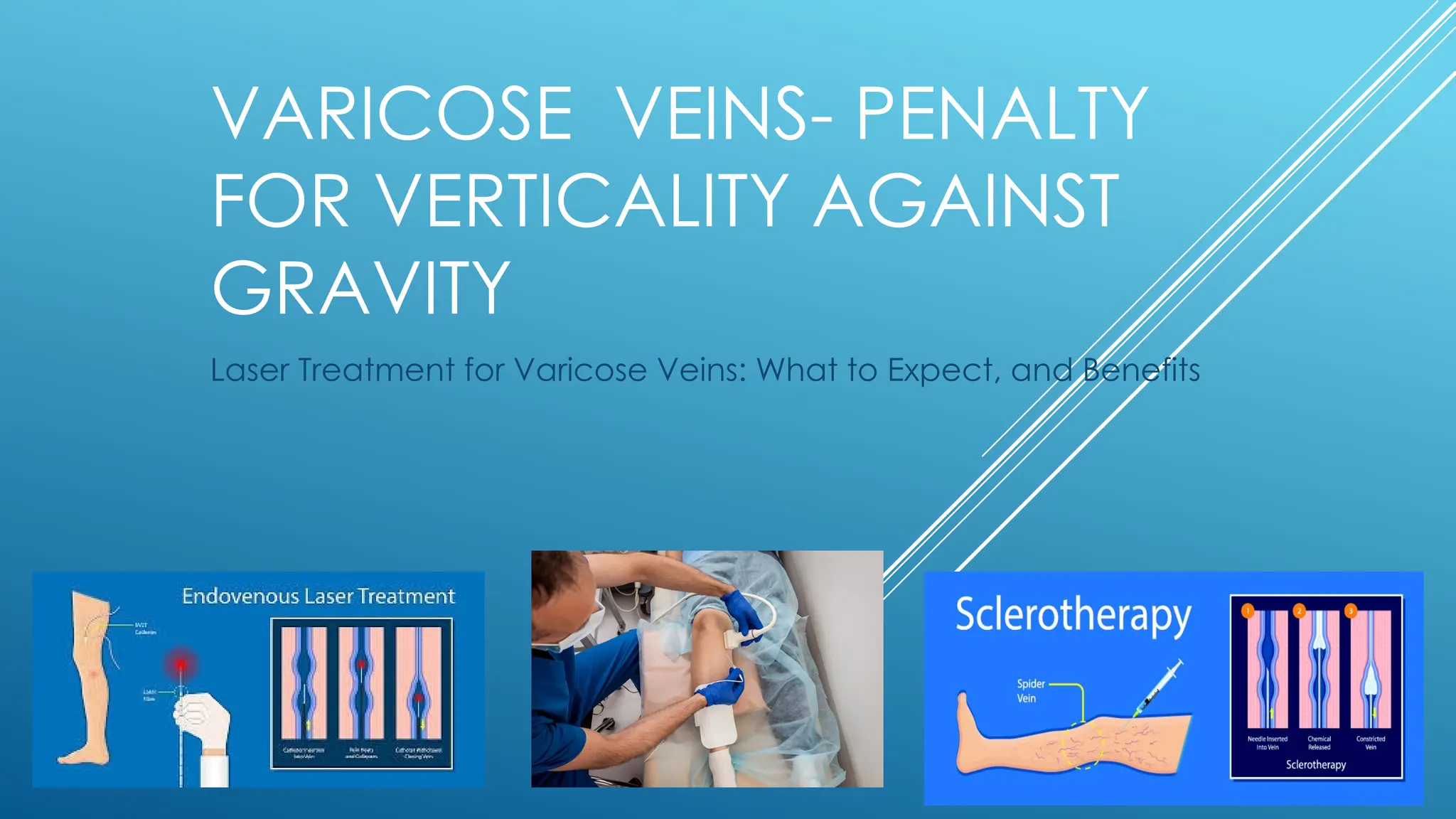
Laser Treatment for Varicose Veins: What to Expect, and Benefits
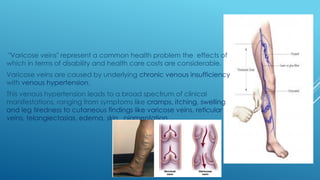
"Varicose veins" represent a common health problem the effects of
which in terms of disability and health care costs are considerable.
Varicose veins are caused by underlying chronic venous insufficiency
with venous hypertension.
This venous hypertension leads to a broad spectrum of clinical
manifestations, ranging from symptoms like cramps, itching, swelling
and leg tiredness to cutaneous findings like varicose veins, reticular
veins, telangiectasias, edema, skin pigmentation
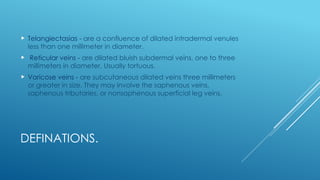
DEFINATIONS.
 Telangiectasias - are a confluence of dilated intradermal venules
less than one millimeter in diameter.
 Reticular veins - are dilated bluish subdermal veins, one to three
millimeters in diameter. Usually tortuous.
 Varicose veins - are subcutaneous dilated veins three millimeters
or greater in size. They may involve the saphenous veins,
saphenous tributaries, or nonsaphenous superficial leg veins.
AMERICAN VENOUS FORUM
FEBRUARY OF 1994 AND THE CREATION OF CEAP
Somewhere in Maui, Hawaii
THE VENOUS CLINICAL SEVERITY
SCORE
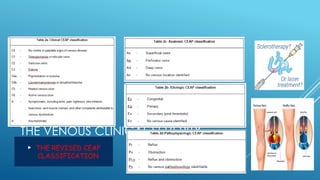
 THE REVISED CEAP
CLASSIFICATION
RISK
FACTORS
SYMPTOMS OF VARICOSE VEINS.
 Leg pain, aching, or cramping
 Burning or itching of the skin
 Leg or ankle swelling
 Heavy" feeling in legs
 Skin discoloration or texture changes
 Open wounds or sores
 Restless legs Varicose Veins
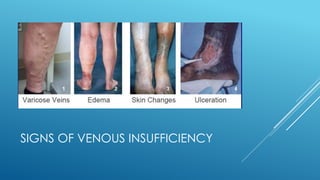
SIGNS OF VENOUS INSUFFICIENCY
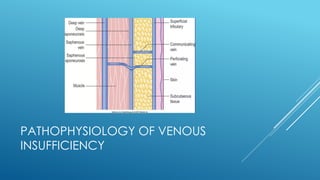
PATHOPHYSIOLOGY OF VENOUS
INSUFFICIENCY
TREATMENT OPTIONS
 COMPRESSION THERAPY
 VENOUS WOUND CARE
 ENDOVENOUS LASER TREATMENT (EVLT) /RADIOFREQUENCY
ABLATION (RFA)RAPY
 SCLEROTHERAPY
 VENASEAL
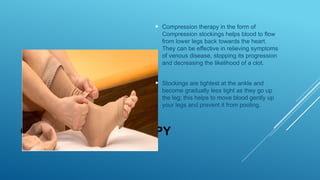
COMPRESSION THERAPY
 Compression therapy in the form of
Compression stockings helps blood to flow
from lower legs back towards the heart.
They can be effective in relieving symptoms
of venous disease, stopping its progression
and decreasing the likelihood of a clot.
 Stockings are tightest at the ankle and
become gradually less tight as they go up
the leg; this helps to move blood gently up
your legs and prevent it from pooling.
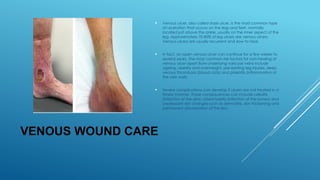
VENOUS WOUND CARE
 Venous ulcer, also called stasis ulcer, is the most common type
of ulceration that occurs on the legs and feet, normally
located just above the ankle, usually on the inner aspect of the
leg. Approximately 70-80% of leg ulcers are venous ulcers.
Venous ulcers are usually recurrent and slow to heal.
 In fact, an open venous ulcer can continue for a few weeks to
several years. The most common risk factors for non-healing of
venous ulcer apart from underlying varicose veins include
ageing, obesity and overweight, pre-existing leg injuries, deep
venous thrombosis (blood clots) and phlebitis (inflammation of
the vein wall).
 Severe complications can develop if ulcers are not treated in a
timely manner. These consequences can include cellulitis
(infection of the skin), osteomyelitis (infection of the bones) and
unpleasant skin changes such as dermatitis, skin thickening and
permanent discoloration of the skin.
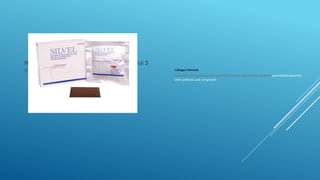
Nanocrystalline silver coated anti-microbial 3
dressing Collagen Particles
Prevents the synthesis of essential proteins required by bacteria and inhibits bacterial
DNA synthesis and cell growth
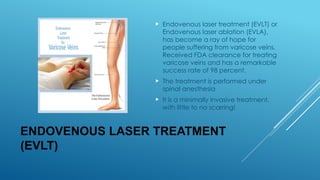
ENDOVENOUS LASER TREATMENT
(EVLT)
 Endovenous laser treatment (EVLT) or
Endovenous laser ablation (EVLA),
has become a ray of hope for
people suffering from varicose veins.
Received FDA clearance for treating
varicose veins and has a remarkable
success rate of 98 percent.
 The treatment is performed under
spinal anesthesia
 It is a minimally invasive treatment,
with little to no scarring!
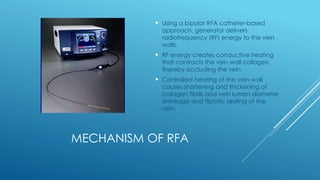
MECHANISM OF RFA
 Using a bipolar RFA catheter-based
approach, generator delivers
radiofrequency (RF) energy to the vein
walls.
 RF energy creates conductive heating
that contracts the vein wall collagen,
thereby occluding the vein
 Controlled heating of the vein wall
causes shortening and thickening of
collagen fibrils and vein lumen diameter
shrinkage and fibrotic sealing of the
vein.
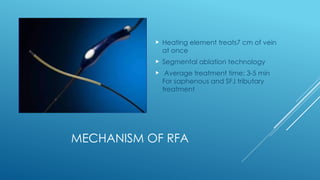
MECHANISM OF RFA
 Heating element treats7 cm of vein
at once
 Segmental ablation technology
 Average treatment time: 3-5 min
For saphenous and SFJ tributary
treatment
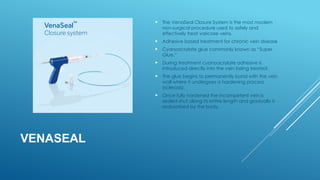
VENASEAL
 The VenaSeal Closure System is the most modern
non-surgical procedure used to safely and
effectively treat varicose veins.
 Adhesive based treatment for chronic vein disease
 Cyanoacrylate glue commonly known as “Super
Glue.”
 During treatment cyanoacrylate adhesive is
introduced directly into the vein being treated.
 The glue begins to permanently bond with the vein
wall where it undergoes a hardening process
(sclerosis).
 Once fully hardened the incompetent vein is
sealed shut along its entire length and gradually is
reabsorbed by the body.
BENEFITS OF THE VENASEAL CLOSURE SYSTEM
 No general anesthetic required
 No medications must be taken to prepare the patient for the procedure
 Immediately alleviates symptoms and improves appearance
 It’s nearly 100% effective
 It’s minimally invasive
 It’s as permanent and safe as other competing techniques
 Most people report only mild discomfort during the procedure
 The procedure can be performed within 20-30 minutes – no need to miss a whole
day of work!
 Recovery time is minimal, most people can return to work and resume normal
immediately, including exercise.
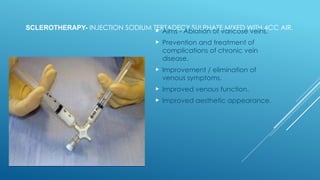
SCLEROTHERAPY- INJECTION SODIUM TERTADECY SULPHATE MIXED WITH 4CC AIR.
 Aims - Ablation of varicose veins.
 Prevention and treatment of
complications of chronic vein
disease.
 Improvement / elimination of
venous symptoms.
 Improved venous function.
 Improved aesthetic appearance.
INDICATION'S FOR SCLEROTHERAPY.
 Incompetent saphenous veins.
 Varicose tributaries.
 Incompetent perforator veins.
 Reticular varices.
 Spider veins (telangiectasia) .
 New, remaining and recurrent varicose veins after previous
operation.
 Varicose veins (veins with reflux) around a leg ulcer.
 Venous malformations.
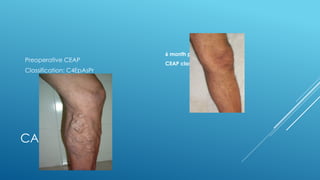
CASE-1
Preoperative CEAP
Classification: C4EpAsPr
6 month postoperative clinical
CEAP classification C0
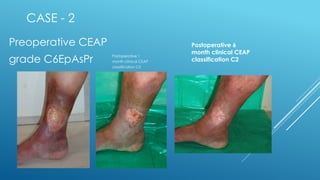
CASE - 2
Preoperative CEAP
grade C6EpAsPr Postoperative 1
month clinical CEAP
classification C5
Postoperative 6
month clinical CEAP
classification C2
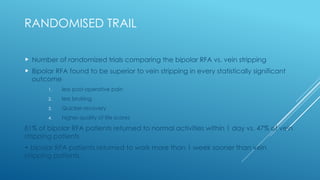
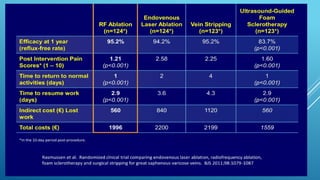
RANDOMISED TRAIL
 Number of randomized trials comparing the bipolar RFA vs. vein stripping
 Bipolar RFA found to be superior to vein stripping in every statistically significant
outcome
1. less post-operative pain
2. less bruising
3. Quicker recovery
4. higher quality of life scores
81% of bipolar RFA patients returned to normal activities within 1 day vs. 47% of vein
stripping patients
• bipolar RFA patients returned to work more than 1 week sooner than vein
stripping patients.
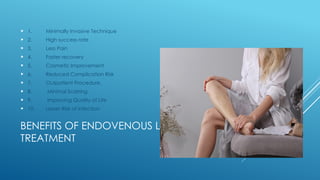
BENEFITS OF ENDOVENOUS LASER
TREATMENT
 1. Minimally Invasive Technique
 2. High success rate
 3. Less Pain
 4. Faster recovery
 5. Cosmetic Improvement
 6. Reduced Complication Risk
 7. Outpatient Procedure.
 8. Minimal Scarring
 9. Improving Quality of Life
 10. Lesser Risk of Infection
TAKE HOME MESSAGE
 Endovenous RFA is safe and effective method and an alternative to surgical
procedures in the treatment of varicose veins.
 It is well tolerated by patients
 Has only insignificant side effects.
 Can be performed on day care basis.
 Highly effective and minimally invasive treatment
 Provides relief from varicose-vein symptoms
 Cosmetic improvements.
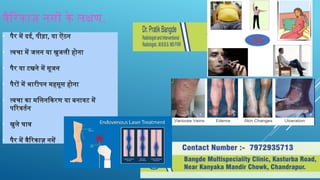
वैरिकाज़ नसों के लक्षण.
• पैर में दर्द, पीड़ा, या ऐंठन
• त्वचा में जलन या खुजली होना
• पैर या टखने में सूजन
• पैरों में भारीपन महसूस होना
• त्वचा का मलिनकिरण या बनावट में
परिवर्तन
• खुले घाव
• पैर में वैरिकाज़ नसें

New Microsoft PowerPoint Presentation.pptx

  • 1.
    VARICOSE VEINS- PENALTY FORVERTICALITY AGAINST GRAVITY Laser Treatment for Varicose Veins: What to Expect, and Benefits
  • 2.
    "Varicose veins" representa common health problem the effects of which in terms of disability and health care costs are considerable. Varicose veins are caused by underlying chronic venous insufficiency with venous hypertension. This venous hypertension leads to a broad spectrum of clinical manifestations, ranging from symptoms like cramps, itching, swelling and leg tiredness to cutaneous findings like varicose veins, reticular veins, telangiectasias, edema, skin pigmentation
  • 3.
    DEFINATIONS.  Telangiectasias -are a confluence of dilated intradermal venules less than one millimeter in diameter.  Reticular veins - are dilated bluish subdermal veins, one to three millimeters in diameter. Usually tortuous.  Varicose veins - are subcutaneous dilated veins three millimeters or greater in size. They may involve the saphenous veins, saphenous tributaries, or nonsaphenous superficial leg veins.
  • 4.
    AMERICAN VENOUS FORUM FEBRUARYOF 1994 AND THE CREATION OF CEAP Somewhere in Maui, Hawaii
  • 5.
    THE VENOUS CLINICALSEVERITY SCORE  THE REVISED CEAP CLASSIFICATION
  • 6.
  • 7.
    SYMPTOMS OF VARICOSEVEINS.  Leg pain, aching, or cramping  Burning or itching of the skin  Leg or ankle swelling  Heavy" feeling in legs  Skin discoloration or texture changes  Open wounds or sores  Restless legs Varicose Veins
  • 8.
    SIGNS OF VENOUSINSUFFICIENCY
  • 9.
  • 10.
    TREATMENT OPTIONS  COMPRESSIONTHERAPY  VENOUS WOUND CARE  ENDOVENOUS LASER TREATMENT (EVLT) /RADIOFREQUENCY ABLATION (RFA)RAPY  SCLEROTHERAPY  VENASEAL
  • 11.
    COMPRESSION THERAPY  Compressiontherapy in the form of Compression stockings helps blood to flow from lower legs back towards the heart. They can be effective in relieving symptoms of venous disease, stopping its progression and decreasing the likelihood of a clot.  Stockings are tightest at the ankle and become gradually less tight as they go up the leg; this helps to move blood gently up your legs and prevent it from pooling.
  • 12.
    VENOUS WOUND CARE Venous ulcer, also called stasis ulcer, is the most common type of ulceration that occurs on the legs and feet, normally located just above the ankle, usually on the inner aspect of the leg. Approximately 70-80% of leg ulcers are venous ulcers. Venous ulcers are usually recurrent and slow to heal.  In fact, an open venous ulcer can continue for a few weeks to several years. The most common risk factors for non-healing of venous ulcer apart from underlying varicose veins include ageing, obesity and overweight, pre-existing leg injuries, deep venous thrombosis (blood clots) and phlebitis (inflammation of the vein wall).  Severe complications can develop if ulcers are not treated in a timely manner. These consequences can include cellulitis (infection of the skin), osteomyelitis (infection of the bones) and unpleasant skin changes such as dermatitis, skin thickening and permanent discoloration of the skin.
  • 13.
    Nanocrystalline silver coatedanti-microbial 3 dressing Collagen Particles Prevents the synthesis of essential proteins required by bacteria and inhibits bacterial DNA synthesis and cell growth
  • 14.
    ENDOVENOUS LASER TREATMENT (EVLT) Endovenous laser treatment (EVLT) or Endovenous laser ablation (EVLA), has become a ray of hope for people suffering from varicose veins. Received FDA clearance for treating varicose veins and has a remarkable success rate of 98 percent.  The treatment is performed under spinal anesthesia  It is a minimally invasive treatment, with little to no scarring!
  • 15.
    MECHANISM OF RFA Using a bipolar RFA catheter-based approach, generator delivers radiofrequency (RF) energy to the vein walls.  RF energy creates conductive heating that contracts the vein wall collagen, thereby occluding the vein  Controlled heating of the vein wall causes shortening and thickening of collagen fibrils and vein lumen diameter shrinkage and fibrotic sealing of the vein.
  • 16.
    MECHANISM OF RFA Heating element treats7 cm of vein at once  Segmental ablation technology  Average treatment time: 3-5 min For saphenous and SFJ tributary treatment
  • 17.
    VENASEAL  The VenaSealClosure System is the most modern non-surgical procedure used to safely and effectively treat varicose veins.  Adhesive based treatment for chronic vein disease  Cyanoacrylate glue commonly known as “Super Glue.”  During treatment cyanoacrylate adhesive is introduced directly into the vein being treated.  The glue begins to permanently bond with the vein wall where it undergoes a hardening process (sclerosis).  Once fully hardened the incompetent vein is sealed shut along its entire length and gradually is reabsorbed by the body.
  • 18.
    BENEFITS OF THEVENASEAL CLOSURE SYSTEM  No general anesthetic required  No medications must be taken to prepare the patient for the procedure  Immediately alleviates symptoms and improves appearance  It’s nearly 100% effective  It’s minimally invasive  It’s as permanent and safe as other competing techniques  Most people report only mild discomfort during the procedure  The procedure can be performed within 20-30 minutes – no need to miss a whole day of work!  Recovery time is minimal, most people can return to work and resume normal immediately, including exercise.
  • 19.
    SCLEROTHERAPY- INJECTION SODIUMTERTADECY SULPHATE MIXED WITH 4CC AIR.  Aims - Ablation of varicose veins.  Prevention and treatment of complications of chronic vein disease.  Improvement / elimination of venous symptoms.  Improved venous function.  Improved aesthetic appearance.
  • 20.
    INDICATION'S FOR SCLEROTHERAPY. Incompetent saphenous veins.  Varicose tributaries.  Incompetent perforator veins.  Reticular varices.  Spider veins (telangiectasia) .  New, remaining and recurrent varicose veins after previous operation.  Varicose veins (veins with reflux) around a leg ulcer.  Venous malformations.
  • 21.
    CASE-1 Preoperative CEAP Classification: C4EpAsPr 6month postoperative clinical CEAP classification C0
  • 22.
    CASE - 2 PreoperativeCEAP grade C6EpAsPr Postoperative 1 month clinical CEAP classification C5 Postoperative 6 month clinical CEAP classification C2
  • 23.
    RANDOMISED TRAIL  Numberof randomized trials comparing the bipolar RFA vs. vein stripping  Bipolar RFA found to be superior to vein stripping in every statistically significant outcome 1. less post-operative pain 2. less bruising 3. Quicker recovery 4. higher quality of life scores 81% of bipolar RFA patients returned to normal activities within 1 day vs. 47% of vein stripping patients • bipolar RFA patients returned to work more than 1 week sooner than vein stripping patients.
  • 25.
    BENEFITS OF ENDOVENOUSLASER TREATMENT  1. Minimally Invasive Technique  2. High success rate  3. Less Pain  4. Faster recovery  5. Cosmetic Improvement  6. Reduced Complication Risk  7. Outpatient Procedure.  8. Minimal Scarring  9. Improving Quality of Life  10. Lesser Risk of Infection
  • 26.
    TAKE HOME MESSAGE Endovenous RFA is safe and effective method and an alternative to surgical procedures in the treatment of varicose veins.  It is well tolerated by patients  Has only insignificant side effects.  Can be performed on day care basis.  Highly effective and minimally invasive treatment  Provides relief from varicose-vein symptoms  Cosmetic improvements.
  • 27.
    वैरिकाज़ नसों केलक्षण. • पैर में दर्द, पीड़ा, या ऐंठन • त्वचा में जलन या खुजली होना • पैर या टखने में सूजन • पैरों में भारीपन महसूस होना • त्वचा का मलिनकिरण या बनावट में परिवर्तन • खुले घाव • पैर में वैरिकाज़ नसें