Nepal's Changing
Landscape: The Role,
Challenges, and Future
of Trade Unions in BFIs
- Youb Raj Basnet, Labour & Employment Expert
Presentation Structure
01
Economic and Labor Context
Understanding Nepal's changing situation.
02
Global Trends in Trade Unionism
What's happening with trade unions in important
service industries around the world.
03
New Changes in Nepal BFI Sector
Important changes and what they mean.
04
Role and Achievements of Trade Unions in Nepal BFI
How trade unions help employees and keep Nepal BFI stable.
05
Legal Framework
Understanding labor laws and NRB rules.
06
Expectation and Conclusion
Key Expectation from Regulatory Authority, Future of Trade union in BFIs
Nepal’s Socioeconomic Shift: A Changing Landscape
Nepal is going through a major social and economic change. Here are
some key trends:
• Economic growth is slowing down. More young people are leaving
the country. This creates problems for local job markets and
economic stability.
• Digital technology is changing financial services. This means
Nepal BFI needs new skills and ways of working.
• The Nepal Rastra Bank (NRB) is adding more rules. This helps keep
Nepal BFI stable and protects its customers.
• People expect much better financial services. This pushes Nepal
BFI to find new ideas and improve.
• Around the world, fewer people are joining traditional unions. This is
noted by the ILO (2022) and shows big changes in how people work.
• Even with more skilled workers, jobs are still uncertain. This means
we need smarter ways to manage work.
References: ILO (2022). World Employment and Social Outlook. Geneva: ILO.
World Bank (2023). Nepal Development Update.
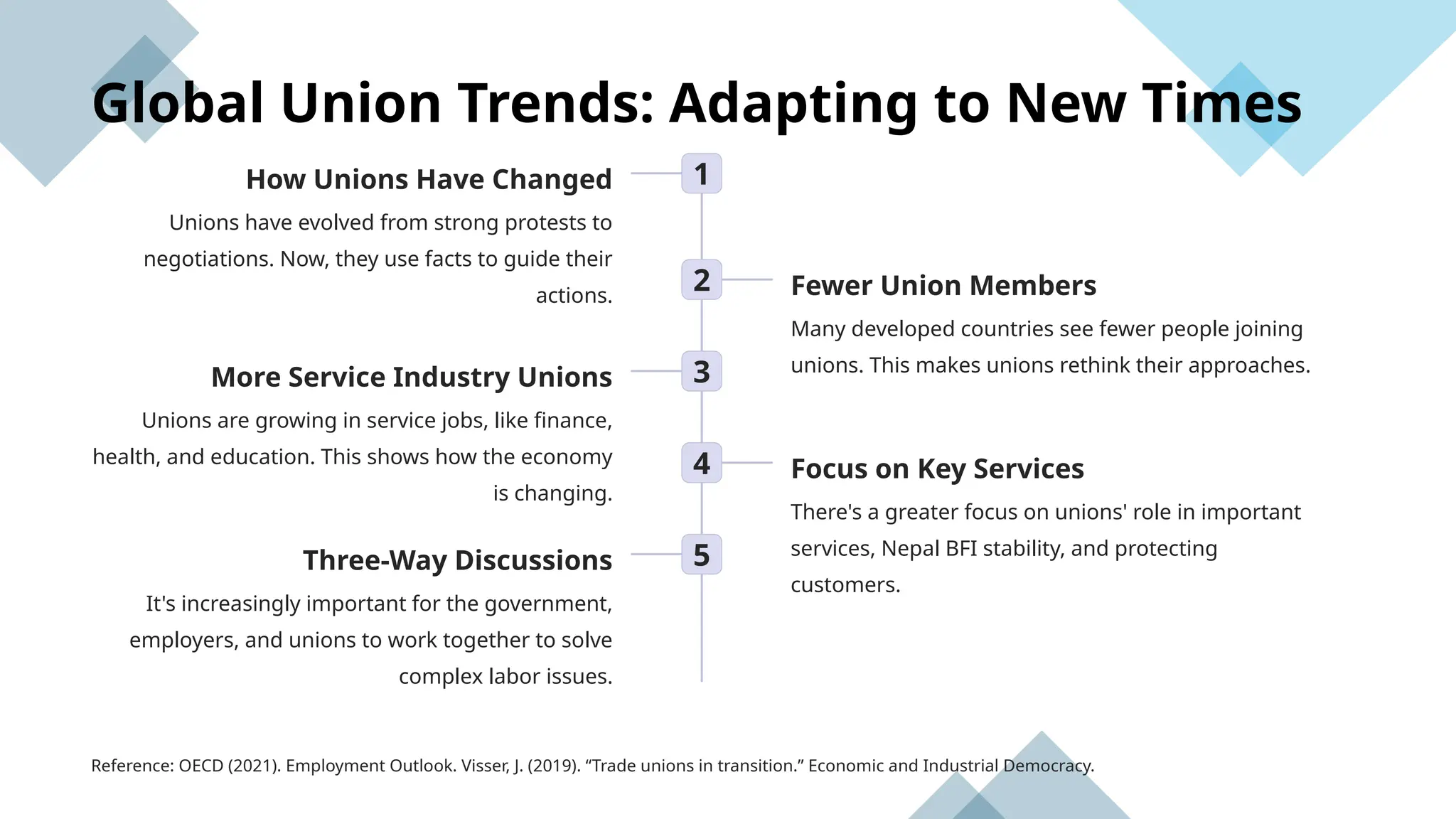
Global Union Trends: Adapting to New Times
1
How Unions Have Changed
Unions have evolved from strong protests to
negotiations. Now, they use facts to guide their
actions.
2 Fewer Union Members
Many developed countries see fewer people joining
unions. This makes unions rethink their approaches.
3
More Service Industry Unions
Unions are growing in service jobs, like finance,
health, and education. This shows how the economy
is changing.
4 Focus on Key Services
There's a greater focus on unions' role in important
services, Nepal BFI stability, and protecting
customers.
5
Three-Way Discussions
It's increasingly important for the government,
employers, and unions to work together to solve
complex labor issues.
Reference: OECD (2021). Employment Outlook. Visser, J. (2019). “Trade unions in transition.” Economic and Industrial Democracy.
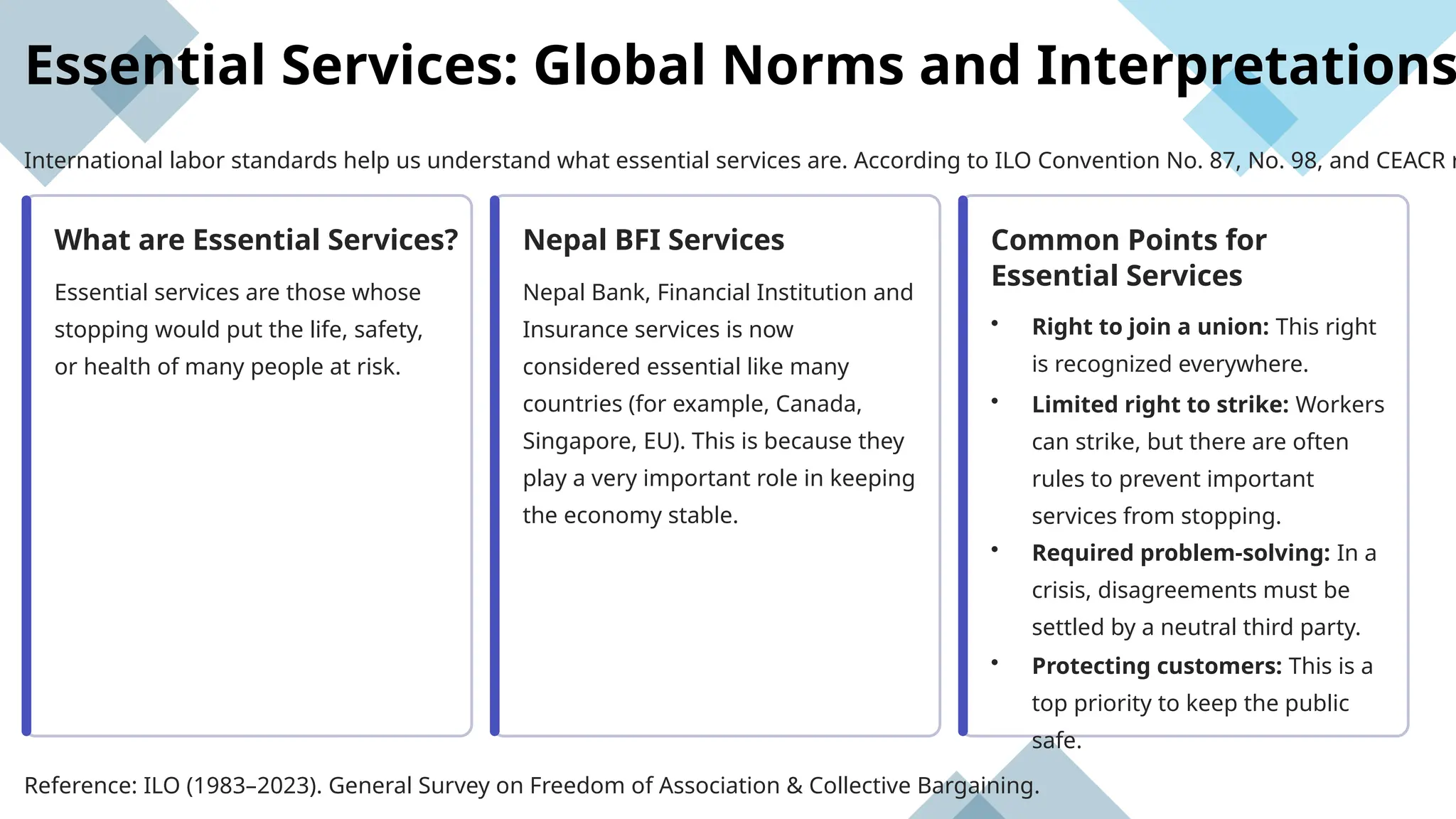
Essential Services: Global Norms and Interpretations
International labor standards help us understand what essential services are. According to ILO Convention No. 87, No. 98, and CEACR r
What are Essential Services?
Essential services are those whose
stopping would put the life, safety,
or health of many people at risk.
Nepal BFI Services
Nepal Bank, Financial Institution and
Insurance services is now
considered essential like many
countries (for example, Canada,
Singapore, EU). This is because they
play a very important role in keeping
the economy stable.
Common Points for
Essential Services
• Right to join a union: This right
is recognized everywhere.
• Limited right to strike: Workers
can strike, but there are often
rules to prevent important
services from stopping.
• Required problem-solving: In a
crisis, disagreements must be
settled by a neutral third party.
• Protecting customers: This is a
top priority to keep the public
safe.
Reference: ILO (1983–2023). General Survey on Freedom of Association & Collective Bargaining.
Banking as an Essential Service: International Examples
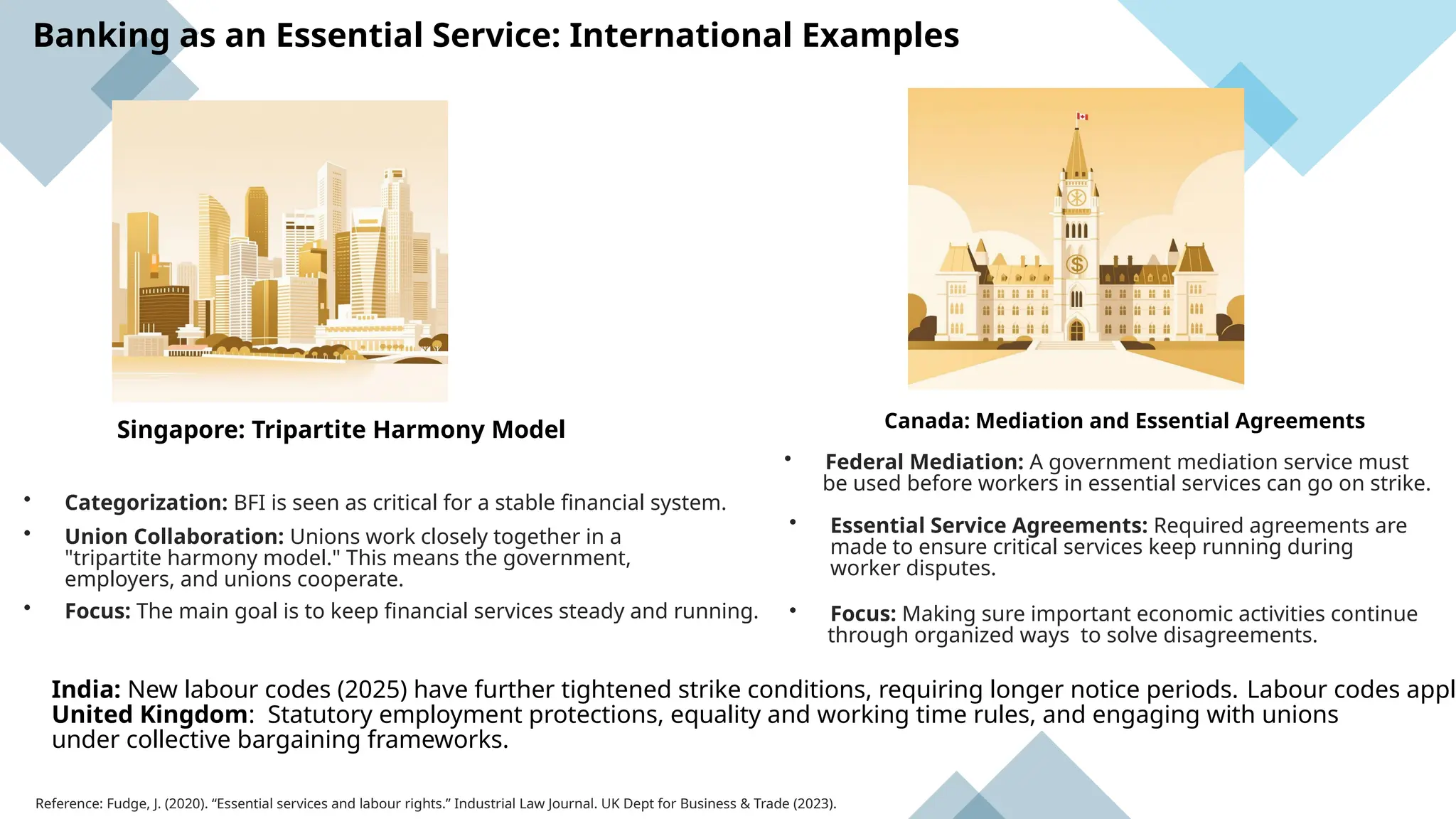
Singapore: Tripartite Harmony Model
• Categorization: BFI is seen as critical for a stable financial system.
• Union Collaboration: Unions work closely together in a
"tripartite harmony model." This means the government,
employers, and unions cooperate.
• Focus: The main goal is to keep financial services steady and running.
Canada: Mediation and Essential Agreements
• Federal Mediation: A government mediation service must
be used before workers in essential services can go on strike.
• Essential Service Agreements: Required agreements are
made to ensure critical services keep running during
worker disputes.
• Focus: Making sure important economic activities continue
through organized ways to solve disagreements.
Reference: Fudge, J. (2020). “Essential services and labour rights.” Industrial Law Journal. UK Dept for Business & Trade (2023).
India: New labour codes (2025) have further tightened strike conditions, requiring longer notice periods. Labour codes appl
United Kingdom: Statutory employment protections, equality and working time rules, and engaging with unions
under collective bargaining frameworks.
Trade Unions in Nepal BFI
Well-Organized Unions
Trade unions in Nepal BFI are well-
structured and often linked to political
groups. They play an important role in
how workers and management
interact.
Widespread Presence
Unions are found in almost all
commercial banks and large financial
institutions that make up Nepal BFI,
giving many employees a voice.
Collective Agreements
**Collective bargaining agreements
(CBAs)** are common. These
agreements cover key job rules and
working conditions for employees.
Key Victories
Unions have achieved important things for employees,
including **job security, better benefits, and clear ways to
handle complaints.**
Main Challenges
Problems come from unions being too involved in politics
and being divided into many groups. This can make it hard
for them to speak up together effectively.
Reference: Adhikari & Ghosh (2021). “Labour Relations in Nepal Bank.” South Asian Journal of Human Resource Management.
Key Roles of Trade Unions in Nepal BFI
Trade unions in Nepal Bank, Financial Institution and Insurance play many important roles. They help employees, promote discussions
between workers and management, and support economic stability.
Protecting Employee Rights
• Making sure pay is fair and competitive.
• Fighting for good benefits like health insurance and retirement plans.
• Setting rules for work hours and leave so employees have a
good work-life balance.
Encouraging Communication
• Working with management to create fair employee contracts.
• Making sure the workplace is fair, with clear ways to solve problems.
Keeping the Economy Stable
• Stopping big problems in important financial services.
• Helping financial services keep running, even when things are
tough.
Helping Employees Grow
• Supporting training and development for employees.
• Promoting a work culture that rewards good performance and
growth.
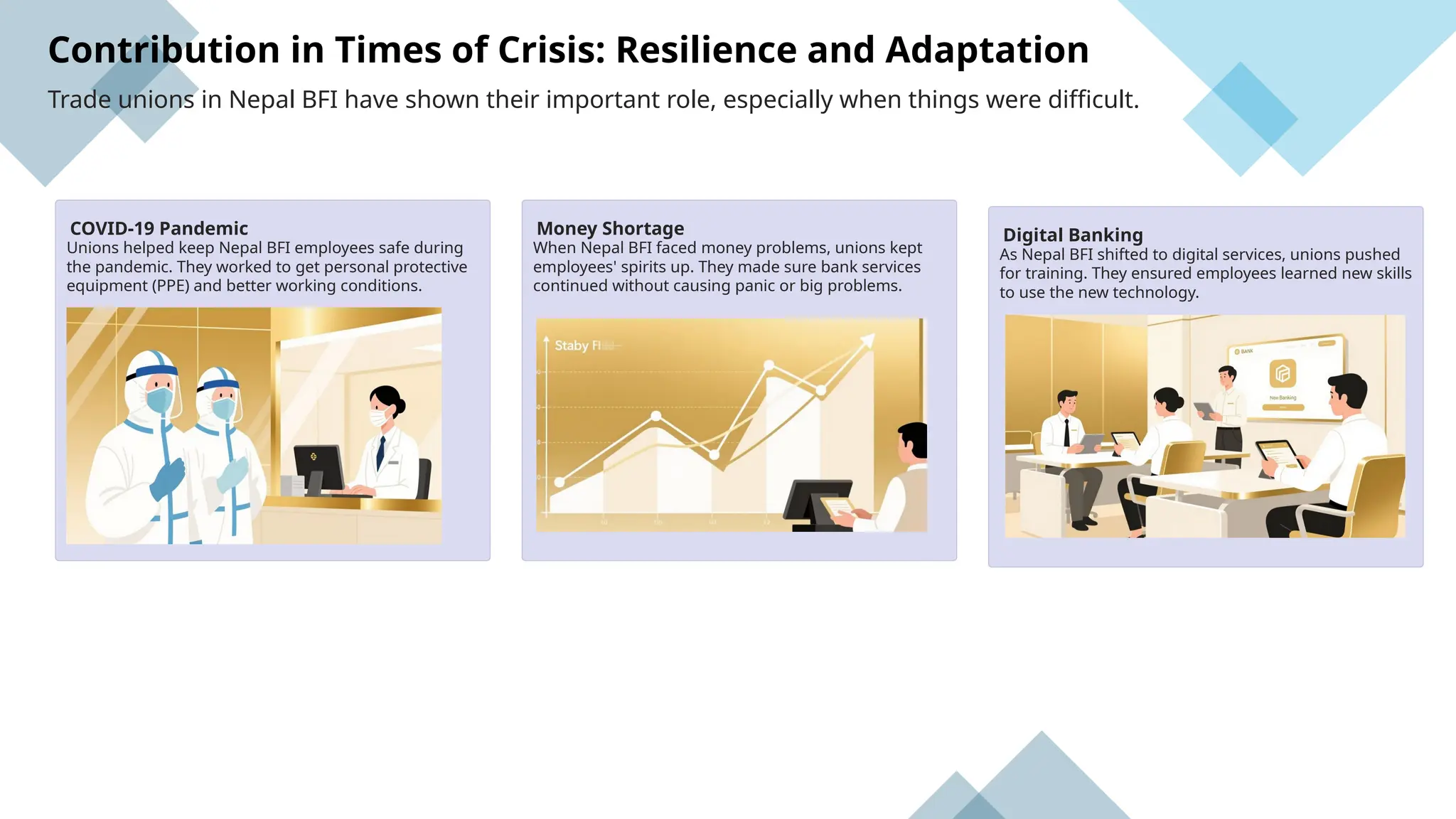
Contribution in Times of Crisis: Resilience and Adaptation
Trade unions in Nepal BFI have shown their important role, especially when things were difficult.
Money Shortage
When Nepal BFI faced money problems, unions kept
employees' spirits up. They made sure bank services
continued without causing panic or big problems.
COVID-19 Pandemic
Unions helped keep Nepal BFI employees safe during
the pandemic. They worked to get personal protective
equipment (PPE) and better working conditions.
Digital Banking
As Nepal BFI shifted to digital services, unions pushed
for training. They ensured employees learned new skills
to use the new technology.
1.
Challenges
Facing
Trade
Unions in
Nepal’s BFIs
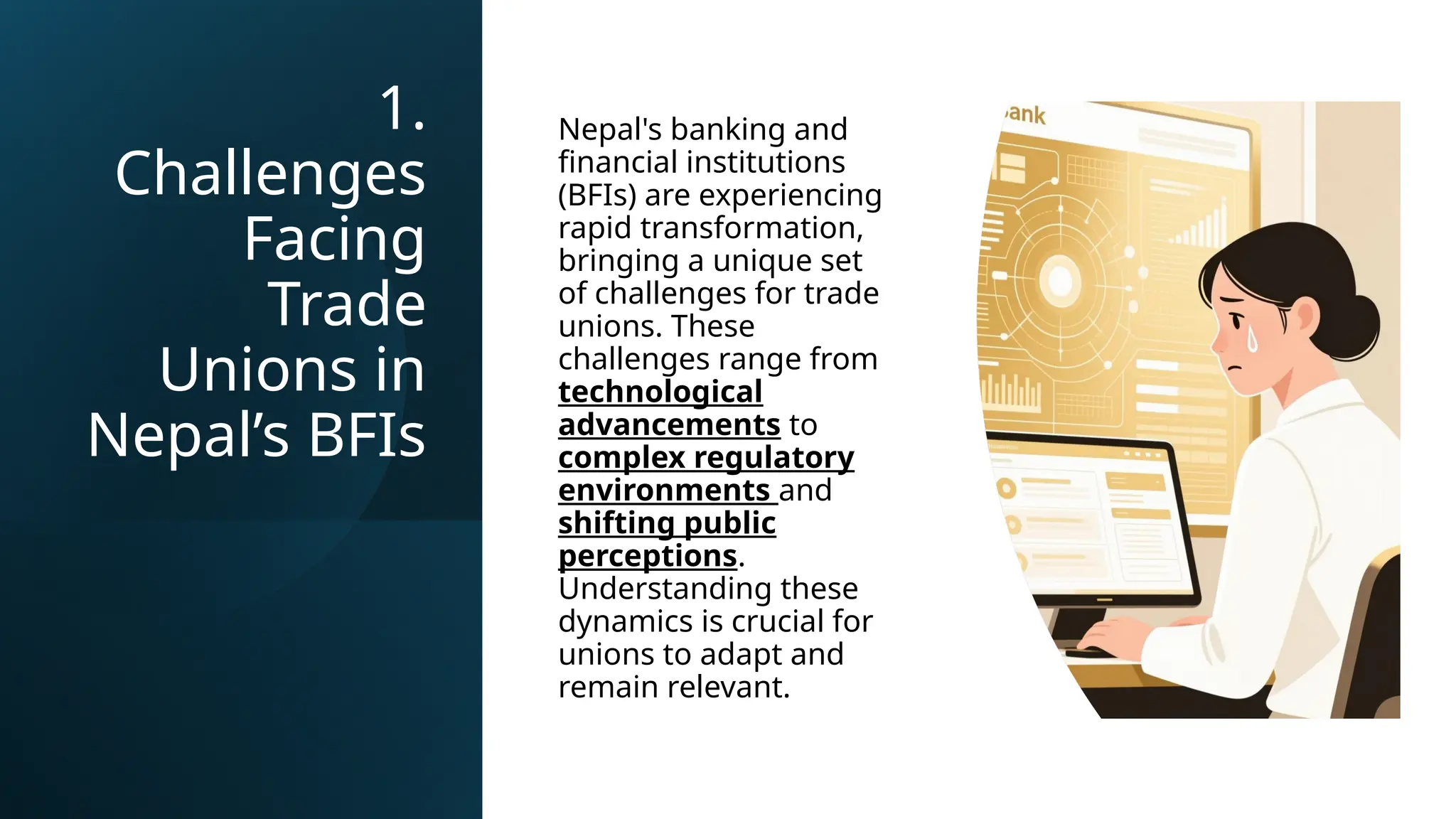
Nepal's banking and
financial institutions
(BFIs) are experiencing
rapid transformation,
bringing a unique set
of challenges for trade
unions. These
challenges range from
technological
advancements to
complex regulatory
environments and
shifting public
perceptions.
Understanding these
dynamics is crucial for
unions to adapt and
remain relevant.
Digital Disruption & Skill Gaps
The rapid integration of digital technologies and
automation in banking is creating significant skill
gaps among the workforce. Unions face the
challenge of ensuring members are equipped for
the future of work, advocating for training, and
managing the impact of job displacement.
Work Intensification & Mental Stress
Increased pressure for efficiency, longer working
hours, and the demands of a fast-paced digital
environment contribute to work intensification and
mental stress among BFI employees. Unions must
address these well-being concerns through
advocacy for healthier work-life balances and
support systems.
Political Interference
Political interference in union activities and
appointments can compromise their independence
and effectiveness, diverting focus from genuine
labor issues to partisan agendas. Focus on the core
mission of trade unions.
Declining Public Trust
A decline in public trust and perception of trade
unions can weaken their bargaining power and
legitimacy, making it harder to rally support for their
causes and influence policy decisions. Union to
work closely with pubic to obtain trust.
Opportunities of Trade Unions in Nepal’s BFIs
Win-Win with Bank Boards
Unions often find themselves in
conflict with bank boards over the
implementation of performance-
based cultures, which can be
perceived as detrimental to job
security and fair compensation if
not managed transparently and
equitably.
Regulatory Restrictions
Regulatory restrictions! Work
closely with regulatory authority
on labour rights.
Weak Evidence-Based Advocacy
Create robust data and research to support Union’s advocacy efforts -
presenting compelling arguments to management and policymakers.
2. Key
provisions
of Labour
Act and
Regulation
Nepal
01
Right to Unionize
Employees in BFIs have the fundamental right to
form or join trade unions of their choice, enabling
collective representation and advocacy.
02
Collective Bargaining Processes
The Act outlines clear procedures for collective
bargaining agreements (CBAs), facilitating
negotiations between unions and management on
terms and conditions of employment.
03
Compulsory Mediation
Before any strike action can be initiated, the Act
mandates compulsory mediation, emphasizing
peaceful resolution of disputes through dialogue
and negotiation.
04
Essential Services Categorization
The government, through official gazette, has the
power to categorize certain services as "essential,"
which may impose restrictions on strikes to ensure
uninterrupted public services.
05
Health & Safety Obligations (OSH)
Employers are legally bound to ensure
occupational safety and health (OSH) standards,
protecting employees from workplace hazards.
06
HR Policy Compliance
All human resource policies within BFIs must
comply with established labor standards, ensuring
fair treatment and adherence to legal provisions.
Reference: Labour Act (2074).
Labour Regulations 2018
• Collective bargaining
• Grievance handling
• Social Security Fund
• Coe of Conducts
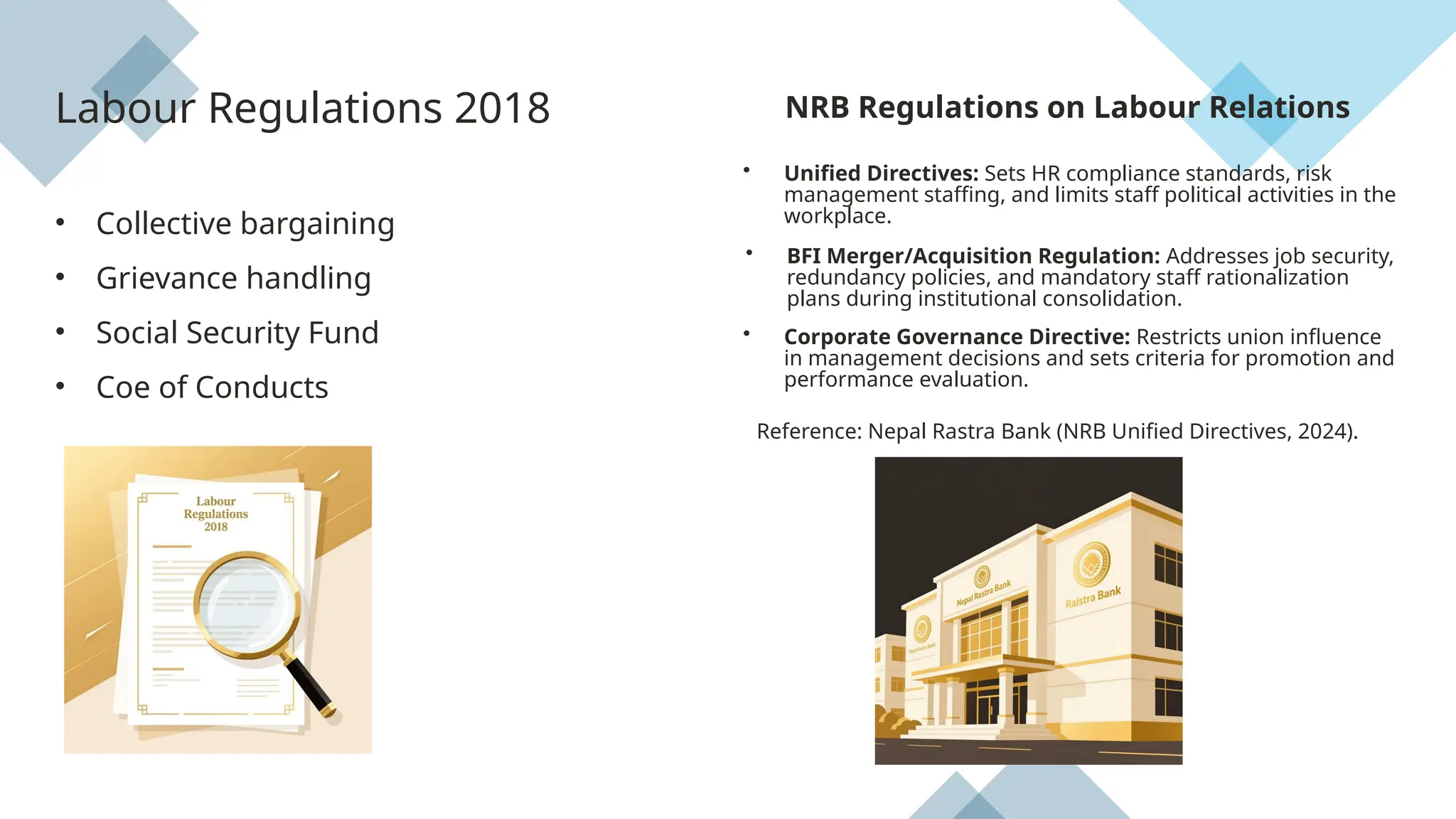
NRB Regulations on Labour Relations
• Unified Directives: Sets HR compliance standards, risk
management staffing, and limits staff political activities in the
workplace.
• BFI Merger/Acquisition Regulation: Addresses job security,
redundancy policies, and mandatory staff rationalization
plans during institutional consolidation.
• Corporate Governance Directive: Restricts union influence
in management decisions and sets criteria for promotion and
performance evaluation.
Reference: Nepal Rastra Bank (NRB Unified Directives, 2024).
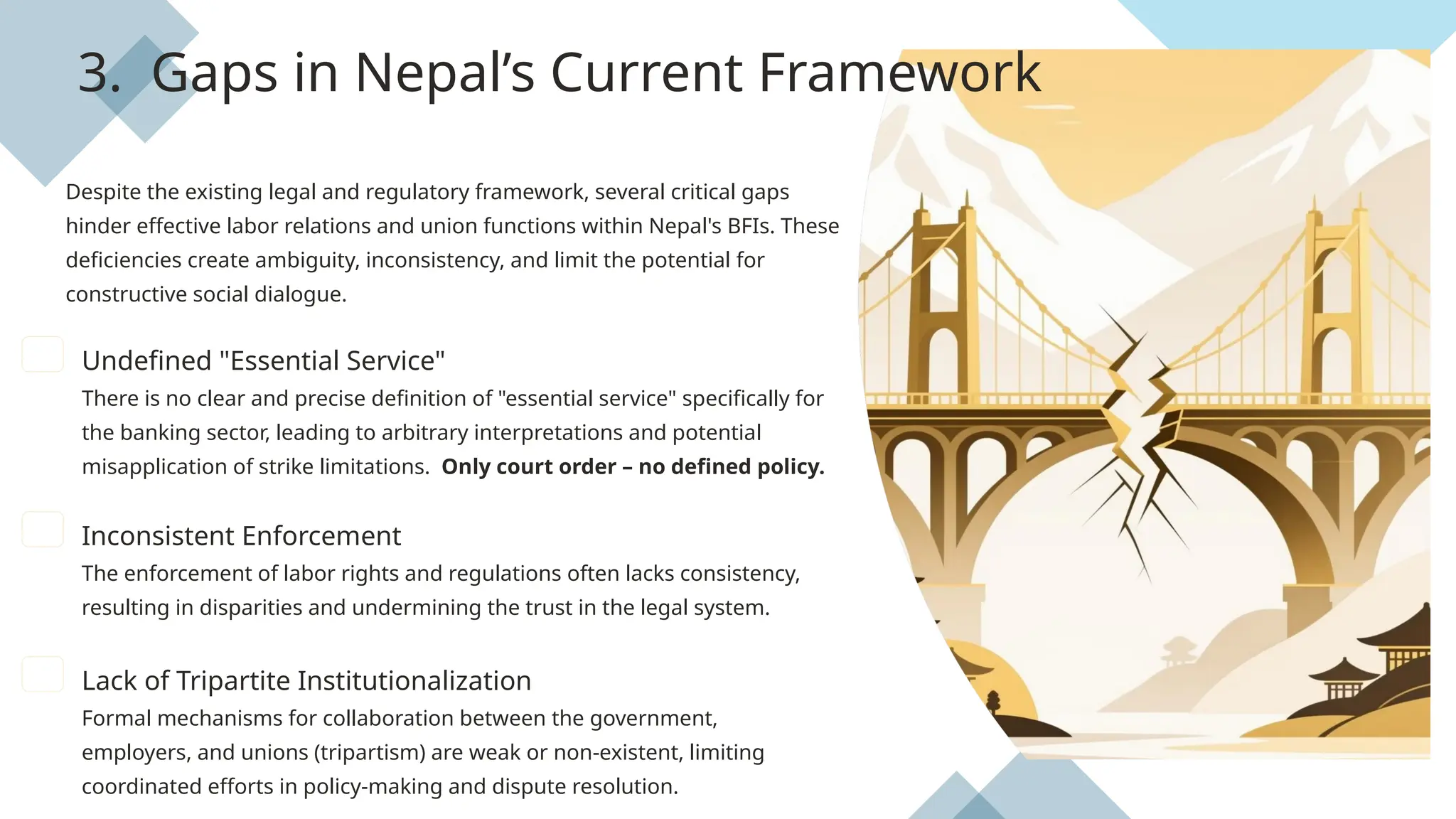
3. Gaps in Nepal’s Current Framework
Despite the existing legal and regulatory framework, several critical gaps
hinder effective labor relations and union functions within Nepal's BFIs. These
deficiencies create ambiguity, inconsistency, and limit the potential for
constructive social dialogue.
Undefined "Essential Service"
There is no clear and precise definition of "essential service" specifically for
the banking sector, leading to arbitrary interpretations and potential
misapplication of strike limitations. Only court order – no defined policy.
Inconsistent Enforcement
The enforcement of labor rights and regulations often lacks consistency,
resulting in disparities and undermining the trust in the legal system.
Lack of Tripartite Institutionalization
Formal mechanisms for collaboration between the government,
employers, and unions (tripartism) are weak or non-existent, limiting
coordinated efforts in policy-making and dispute resolution.
Expectation and Conclusions
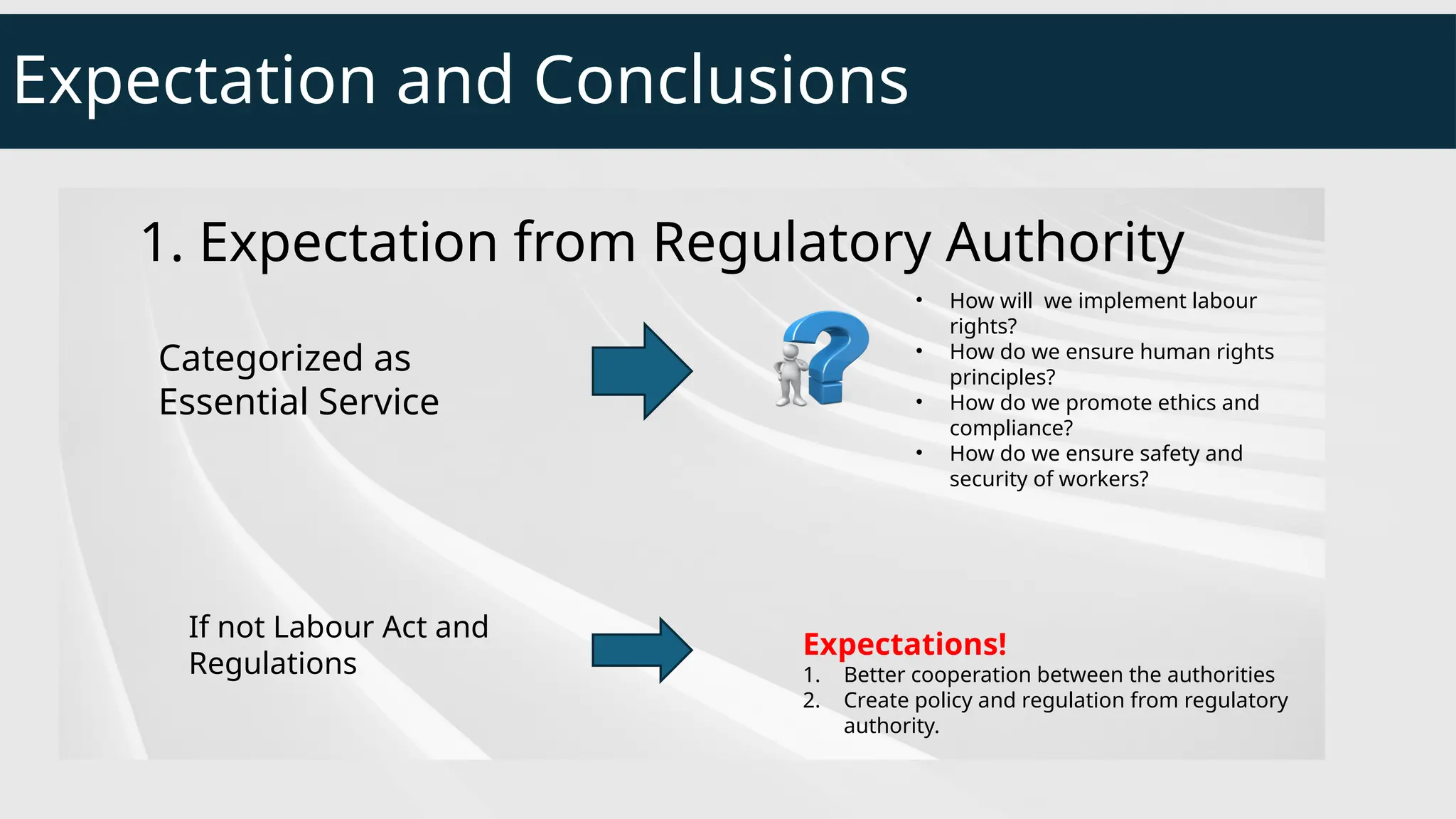
1. Expectation from Regulatory Authority
Categorized as
Essential Service
• How will we implement labour
rights?
• How do we ensure human rights
principles?
• How do we promote ethics and
compliance?
• How do we ensure safety and
security of workers?
If not Labour Act and
Regulations
Expectations!
1. Better cooperation between the authorities
2. Create policy and regulation from regulatory
authority.
Expectation and Conclusions
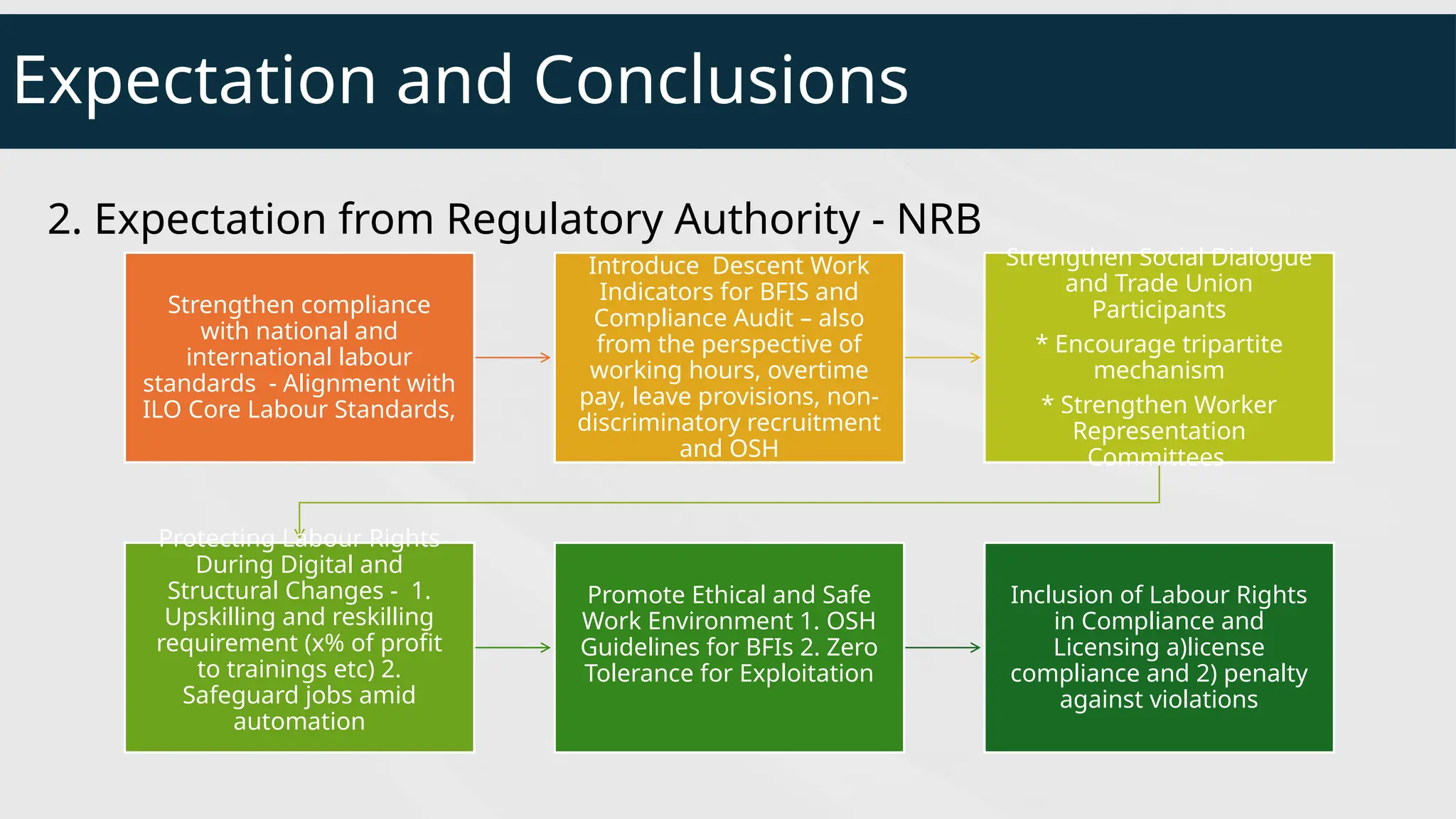
2. Expectation from Regulatory Authority - NRB
Strengthen compliance
with national and
international labour
standards - Alignment with
ILO Core Labour Standards,
Introduce Descent Work
Indicators for BFIS and
Compliance Audit – also
from the perspective of
working hours, overtime
pay, leave provisions, non-
discriminatory recruitment
and OSH
Strengthen Social Dialogue
and Trade Union
Participants
* Encourage tripartite
mechanism
* Strengthen Worker
Representation
Committees
Protecting Labour Rights
During Digital and
Structural Changes - 1.
Upskilling and reskilling
requirement (x% of profit
to trainings etc) 2.
Safeguard jobs amid
automation
Promote Ethical and Safe
Work Environment 1. OSH
Guidelines for BFIs 2. Zero
Tolerance for Exploitation
Inclusion of Labour Rights
in Compliance and
Licensing a)license
compliance and 2) penalty
against violations
Expectation and Conclusions
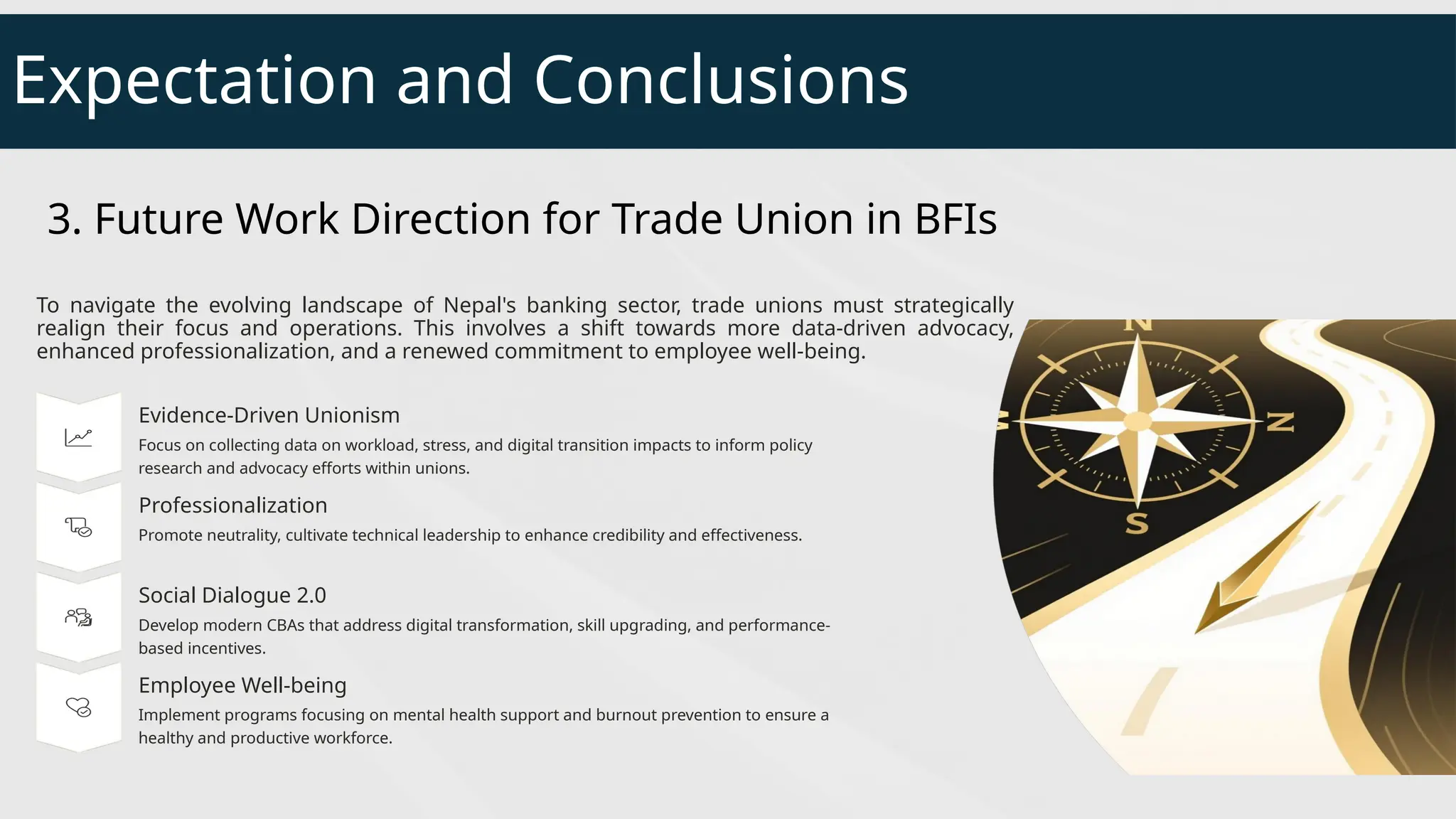
3. Future Work Direction for Trade Union in BFIs
To navigate the evolving landscape of Nepal's banking sector, trade unions must strategically
realign their focus and operations. This involves a shift towards more data-driven advocacy,
enhanced professionalization, and a renewed commitment to employee well-being.
Evidence-Driven Unionism
Focus on collecting data on workload, stress, and digital transition impacts to inform policy
research and advocacy efforts within unions.
Professionalization
Promote neutrality, cultivate technical leadership to enhance credibility and effectiveness.
Social Dialogue 2.0
Develop modern CBAs that address digital transformation, skill upgrading, and performance-
based incentives.
Employee Well-being
Implement programs focusing on mental health support and burnout prevention to ensure a
healthy and productive workforce.
Thank you
- Youb Raj Basnet

Nepal's Changing Landscape: The Role, Challenges & Future of Trade Unions in BFIs

  • 1.
    Nepal's Changing Landscape: TheRole, Challenges, and Future of Trade Unions in BFIs - Youb Raj Basnet, Labour & Employment Expert
  • 2.
    Presentation Structure 01 Economic andLabor Context Understanding Nepal's changing situation. 02 Global Trends in Trade Unionism What's happening with trade unions in important service industries around the world. 03 New Changes in Nepal BFI Sector Important changes and what they mean. 04 Role and Achievements of Trade Unions in Nepal BFI How trade unions help employees and keep Nepal BFI stable. 05 Legal Framework Understanding labor laws and NRB rules. 06 Expectation and Conclusion Key Expectation from Regulatory Authority, Future of Trade union in BFIs
  • 3.
    Nepal’s Socioeconomic Shift:A Changing Landscape Nepal is going through a major social and economic change. Here are some key trends: • Economic growth is slowing down. More young people are leaving the country. This creates problems for local job markets and economic stability. • Digital technology is changing financial services. This means Nepal BFI needs new skills and ways of working. • The Nepal Rastra Bank (NRB) is adding more rules. This helps keep Nepal BFI stable and protects its customers. • People expect much better financial services. This pushes Nepal BFI to find new ideas and improve. • Around the world, fewer people are joining traditional unions. This is noted by the ILO (2022) and shows big changes in how people work. • Even with more skilled workers, jobs are still uncertain. This means we need smarter ways to manage work. References: ILO (2022). World Employment and Social Outlook. Geneva: ILO. World Bank (2023). Nepal Development Update.
  • 4.
    Global Union Trends:Adapting to New Times 1 How Unions Have Changed Unions have evolved from strong protests to negotiations. Now, they use facts to guide their actions. 2 Fewer Union Members Many developed countries see fewer people joining unions. This makes unions rethink their approaches. 3 More Service Industry Unions Unions are growing in service jobs, like finance, health, and education. This shows how the economy is changing. 4 Focus on Key Services There's a greater focus on unions' role in important services, Nepal BFI stability, and protecting customers. 5 Three-Way Discussions It's increasingly important for the government, employers, and unions to work together to solve complex labor issues. Reference: OECD (2021). Employment Outlook. Visser, J. (2019). “Trade unions in transition.” Economic and Industrial Democracy.
  • 5.
    Essential Services: GlobalNorms and Interpretations International labor standards help us understand what essential services are. According to ILO Convention No. 87, No. 98, and CEACR r What are Essential Services? Essential services are those whose stopping would put the life, safety, or health of many people at risk. Nepal BFI Services Nepal Bank, Financial Institution and Insurance services is now considered essential like many countries (for example, Canada, Singapore, EU). This is because they play a very important role in keeping the economy stable. Common Points for Essential Services • Right to join a union: This right is recognized everywhere. • Limited right to strike: Workers can strike, but there are often rules to prevent important services from stopping. • Required problem-solving: In a crisis, disagreements must be settled by a neutral third party. • Protecting customers: This is a top priority to keep the public safe. Reference: ILO (1983–2023). General Survey on Freedom of Association & Collective Bargaining.
  • 6.
    Banking as anEssential Service: International Examples Singapore: Tripartite Harmony Model • Categorization: BFI is seen as critical for a stable financial system. • Union Collaboration: Unions work closely together in a "tripartite harmony model." This means the government, employers, and unions cooperate. • Focus: The main goal is to keep financial services steady and running. Canada: Mediation and Essential Agreements • Federal Mediation: A government mediation service must be used before workers in essential services can go on strike. • Essential Service Agreements: Required agreements are made to ensure critical services keep running during worker disputes. • Focus: Making sure important economic activities continue through organized ways to solve disagreements. Reference: Fudge, J. (2020). “Essential services and labour rights.” Industrial Law Journal. UK Dept for Business & Trade (2023). India: New labour codes (2025) have further tightened strike conditions, requiring longer notice periods. Labour codes appl United Kingdom: Statutory employment protections, equality and working time rules, and engaging with unions under collective bargaining frameworks.
  • 7.
    Trade Unions inNepal BFI Well-Organized Unions Trade unions in Nepal BFI are well- structured and often linked to political groups. They play an important role in how workers and management interact. Widespread Presence Unions are found in almost all commercial banks and large financial institutions that make up Nepal BFI, giving many employees a voice. Collective Agreements **Collective bargaining agreements (CBAs)** are common. These agreements cover key job rules and working conditions for employees. Key Victories Unions have achieved important things for employees, including **job security, better benefits, and clear ways to handle complaints.** Main Challenges Problems come from unions being too involved in politics and being divided into many groups. This can make it hard for them to speak up together effectively. Reference: Adhikari & Ghosh (2021). “Labour Relations in Nepal Bank.” South Asian Journal of Human Resource Management.
  • 8.
    Key Roles ofTrade Unions in Nepal BFI Trade unions in Nepal Bank, Financial Institution and Insurance play many important roles. They help employees, promote discussions between workers and management, and support economic stability. Protecting Employee Rights • Making sure pay is fair and competitive. • Fighting for good benefits like health insurance and retirement plans. • Setting rules for work hours and leave so employees have a good work-life balance. Encouraging Communication • Working with management to create fair employee contracts. • Making sure the workplace is fair, with clear ways to solve problems. Keeping the Economy Stable • Stopping big problems in important financial services. • Helping financial services keep running, even when things are tough. Helping Employees Grow • Supporting training and development for employees. • Promoting a work culture that rewards good performance and growth.
  • 9.
    Contribution in Timesof Crisis: Resilience and Adaptation Trade unions in Nepal BFI have shown their important role, especially when things were difficult. Money Shortage When Nepal BFI faced money problems, unions kept employees' spirits up. They made sure bank services continued without causing panic or big problems. COVID-19 Pandemic Unions helped keep Nepal BFI employees safe during the pandemic. They worked to get personal protective equipment (PPE) and better working conditions. Digital Banking As Nepal BFI shifted to digital services, unions pushed for training. They ensured employees learned new skills to use the new technology.
  • 10.
    1. Challenges Facing Trade Unions in Nepal’s BFIs Nepal'sbanking and financial institutions (BFIs) are experiencing rapid transformation, bringing a unique set of challenges for trade unions. These challenges range from technological advancements to complex regulatory environments and shifting public perceptions. Understanding these dynamics is crucial for unions to adapt and remain relevant.
  • 11.
    Digital Disruption &Skill Gaps The rapid integration of digital technologies and automation in banking is creating significant skill gaps among the workforce. Unions face the challenge of ensuring members are equipped for the future of work, advocating for training, and managing the impact of job displacement. Work Intensification & Mental Stress Increased pressure for efficiency, longer working hours, and the demands of a fast-paced digital environment contribute to work intensification and mental stress among BFI employees. Unions must address these well-being concerns through advocacy for healthier work-life balances and support systems. Political Interference Political interference in union activities and appointments can compromise their independence and effectiveness, diverting focus from genuine labor issues to partisan agendas. Focus on the core mission of trade unions. Declining Public Trust A decline in public trust and perception of trade unions can weaken their bargaining power and legitimacy, making it harder to rally support for their causes and influence policy decisions. Union to work closely with pubic to obtain trust. Opportunities of Trade Unions in Nepal’s BFIs
  • 12.
    Opportunities of TradeUnions in Nepal’s BFIs Win-Win with Bank Boards Unions often find themselves in conflict with bank boards over the implementation of performance- based cultures, which can be perceived as detrimental to job security and fair compensation if not managed transparently and equitably. Regulatory Restrictions Regulatory restrictions! Work closely with regulatory authority on labour rights. Weak Evidence-Based Advocacy Create robust data and research to support Union’s advocacy efforts - presenting compelling arguments to management and policymakers.
  • 13.
    2. Key provisions of Labour Actand Regulation Nepal 01 Right to Unionize Employees in BFIs have the fundamental right to form or join trade unions of their choice, enabling collective representation and advocacy. 02 Collective Bargaining Processes The Act outlines clear procedures for collective bargaining agreements (CBAs), facilitating negotiations between unions and management on terms and conditions of employment. 03 Compulsory Mediation Before any strike action can be initiated, the Act mandates compulsory mediation, emphasizing peaceful resolution of disputes through dialogue and negotiation. 04 Essential Services Categorization The government, through official gazette, has the power to categorize certain services as "essential," which may impose restrictions on strikes to ensure uninterrupted public services. 05 Health & Safety Obligations (OSH) Employers are legally bound to ensure occupational safety and health (OSH) standards, protecting employees from workplace hazards. 06 HR Policy Compliance All human resource policies within BFIs must comply with established labor standards, ensuring fair treatment and adherence to legal provisions. Reference: Labour Act (2074).
  • 14.
    Labour Regulations 2018 •Collective bargaining • Grievance handling • Social Security Fund • Coe of Conducts NRB Regulations on Labour Relations • Unified Directives: Sets HR compliance standards, risk management staffing, and limits staff political activities in the workplace. • BFI Merger/Acquisition Regulation: Addresses job security, redundancy policies, and mandatory staff rationalization plans during institutional consolidation. • Corporate Governance Directive: Restricts union influence in management decisions and sets criteria for promotion and performance evaluation. Reference: Nepal Rastra Bank (NRB Unified Directives, 2024).
  • 15.
    3. Gaps inNepal’s Current Framework Despite the existing legal and regulatory framework, several critical gaps hinder effective labor relations and union functions within Nepal's BFIs. These deficiencies create ambiguity, inconsistency, and limit the potential for constructive social dialogue. Undefined "Essential Service" There is no clear and precise definition of "essential service" specifically for the banking sector, leading to arbitrary interpretations and potential misapplication of strike limitations. Only court order – no defined policy. Inconsistent Enforcement The enforcement of labor rights and regulations often lacks consistency, resulting in disparities and undermining the trust in the legal system. Lack of Tripartite Institutionalization Formal mechanisms for collaboration between the government, employers, and unions (tripartism) are weak or non-existent, limiting coordinated efforts in policy-making and dispute resolution.
  • 16.
    Expectation and Conclusions 1.Expectation from Regulatory Authority Categorized as Essential Service • How will we implement labour rights? • How do we ensure human rights principles? • How do we promote ethics and compliance? • How do we ensure safety and security of workers? If not Labour Act and Regulations Expectations! 1. Better cooperation between the authorities 2. Create policy and regulation from regulatory authority.
  • 17.
    Expectation and Conclusions 2.Expectation from Regulatory Authority - NRB Strengthen compliance with national and international labour standards - Alignment with ILO Core Labour Standards, Introduce Descent Work Indicators for BFIS and Compliance Audit – also from the perspective of working hours, overtime pay, leave provisions, non- discriminatory recruitment and OSH Strengthen Social Dialogue and Trade Union Participants * Encourage tripartite mechanism * Strengthen Worker Representation Committees Protecting Labour Rights During Digital and Structural Changes - 1. Upskilling and reskilling requirement (x% of profit to trainings etc) 2. Safeguard jobs amid automation Promote Ethical and Safe Work Environment 1. OSH Guidelines for BFIs 2. Zero Tolerance for Exploitation Inclusion of Labour Rights in Compliance and Licensing a)license compliance and 2) penalty against violations
  • 18.
    Expectation and Conclusions 3.Future Work Direction for Trade Union in BFIs To navigate the evolving landscape of Nepal's banking sector, trade unions must strategically realign their focus and operations. This involves a shift towards more data-driven advocacy, enhanced professionalization, and a renewed commitment to employee well-being. Evidence-Driven Unionism Focus on collecting data on workload, stress, and digital transition impacts to inform policy research and advocacy efforts within unions. Professionalization Promote neutrality, cultivate technical leadership to enhance credibility and effectiveness. Social Dialogue 2.0 Develop modern CBAs that address digital transformation, skill upgrading, and performance- based incentives. Employee Well-being Implement programs focusing on mental health support and burnout prevention to ensure a healthy and productive workforce.
  • 19.
    Thank you - YoubRaj Basnet