INDUSTRIAL DISPUTE ACT 1947
OBJECT & SCOPE OF ACT
• The first enactment dealing with the settlement of industrial disputes was the Employers’ and
Workmen’s Disputes Act, 1860.
• This Act weighed much against the workers and was therefore replaced by the Trade Disputes
Act, 1929.
• The Whitely Commission made in this regard the perceptive observation that the attempt to
deal with unrest must begin rather with the creation of an atmosphere unfavourable to disputes
than with machinery for their settlement.
• Then followed the Industrial Disputes Act, 1947.
• The Industrial Disputes Act, 1947 makes provision for the investigation and settlement of
industrial disputes and for certain other purposes.
• It ensures progress of industry by bringing about harmony and cordial relationship between the
employers and employees.
• This Act extends to whole of India.
• The Act was designed to provide a self-contained code to compel the
parties to resort to industrial arbitration for the resolution of existing or
apprehended disputes without prescribing statutory norms for varied
and variegated industrial relating norms so that the forums created for
resolution of disputes may remain unhampered by any statutory control
and devise rational norms keeping pace with improved industrial
relations reflecting and imbibing socio-economic justice.
• The Act applies to an existing and not to a dead industry.
• It is to ensure fair wages and to prevent disputes so that production
might not be adversely affected.
Dimakuchi Tea Estate v. Dimakuchi Tea Estate
• The Supreme Court laid down following objectives of the
Act:
• Promotion of measures of securing and preserving amity
and good relations between the employer and workmen.
• Investigation and settlement of industrial disputes
between employers and employers, employers and
workmen, or workmen and workmen with a right of
representation by registered trade union or federation of
trade unions or an association of employers or a
federation of associations of employers.
• Prevention of illegal strikes and lock-outs.
• Relief to workmen in the matter of lay-off and
retrenchment.
• Promotion of collective bargaining.
Industry [Section 2(j)]
Means
• Any business, trade, undertaking, manufacture or calling of
employers and includes
• Any calling service, employment, handicraft, or industrial
occupation or avocation of workmen.
Bangalore Water Supply and Sewerage Board v. A Rajiappa
• After discussing the definition from various angles, in the
above case, the Supreme Court, laid down the following tests
to determine whether an activity is covered by the definition
of “industry” or not. It is also referred to as the triple test.
I
• Where there is systematic activity,
• organized by co-operation between employer and employee,
• for the production and/or distribution of goods and services
calculated to satisfy human wants and wishes (not spiritual or
religious but inclusive of material things or services geared to
celestial bliss e.g., making, on a large scale, prasad or food) prima
facie, there is an “industry” in that enterprise.
• Absence of profit motive or gainful objective is irrelevant wherever
the undertaking is whether in the public, joint, private or other
sector.
• The true focus is functional and the decisive test is the nature of the
activity with special emphasis on the employer-employee relations.
• If the organization is a trade or business, it does not cease to be one
because of philanthropy animating the undertaking.
II
• All organised activity possessing the triple elements in
(i) although not trade or business, may still be
“industry”, provided the nature of the activity, viz.,
the employer - employee basis, bears resemblance to
what we find in trade or business. This takes into the
fold of “industry”, undertaking, callings and services,
adventures analogous to the carrying on of trade or
business. All features, other than the methodology of
carrying on the activity, viz., in organising the co-
operation between employer and employee, may be
dissimilar. It does not matter, if on the employment
terms, there is analogy.
III
• Application of these guidelines should not stop short of
their logical reach by invocation of creeds, cults or inner
sense of incongruity or outer sense of motivation for or
resultant of the economic operations.
• The ideology of the Act being industrial disputes
between employer and workmen, the range of this
statutory ideology must inform the reach of the statutory
definition, nothing less, nothing more.
• Hence, the Supreme Court observed that professions,
clubs, educational institutions. co-operatives, research
institutes, charitable projects and other kindred
adventures, if they fulfill the triple tests listed in (1),
cannot be exempted from the scope of Section 2(j).
The Supreme Court, in Bangalore Water Supply case laid down the
following guidelines for deciding the dominant nature of an undertaking:
• Where a complex of activities, some of which qualify for exemption,
others not, involves the employees on the total undertaking. Some of
whom are not “workmen” or some departments are not productive of
goods and services if isolated, nature of the department will be the true
test. The whole undertaking will be “industry” although those who are
not “workmen” definition may not be benefit by the status.
• Notwithstanding with previous clause, sovereign functions strictly
understood alone qualify for exemption and not the welfare activities or
economic adventures undertaken by Government or statutory bodies.
• Even in departments discharging sovereign functions, if there are units
which are industries and they are substantially severable, then they can
be considered to come within Section 2(j).
• Constitutional and competently enacted legislative provisions may well
remove an undertaking from the scope of the Act.
Whether the following activities would fall under
industry or not?
1. Sovereign functions:
Case:- Bangalore Water Supply Sovereign functions
strictly understood alone qualify for exemption, not
the welfare activities or economic adventures
undertaken by Government or statutory bodies. Even
in departments discharging sovereign functions, if
there are units which are industries and they are
substantially severable then they can be considered to
come within Section 2(j).
Corpn. of City of Nagpur v. Employees
If a department of a municipality discharged many
functions, some pertaining to “industry” and other
non-industrial activities, the predominant function of
the department shall be the criterion for the purposes
of the Act.
2. Municipalities
• Following Departments of the municipality were held, to be “industry”
• Tax
• Public Conveyance
• Fire Brigade
• Lighting
• Water Works
• City Engineers
• Enforcement (Encroachment)
• Sewerage
• Health
• Market
• Public Gardens
• Education
• Printing Press
• Building and
• General administration.
• If a department of a municipality discharges many functions some pertaining to
industry and others non-industrial, the predominant function of the department shall
be the criterion for the purpose of the Act.
3. Hospitals and Charitable Institutions:
FICCI v. Workmen
• Exemptions to charitable institutions under Section
32(5) of Payment of Bonus Act is not relevant to the
construction of Section 2(j), there is an industry in the
enterprise, provided the nature of the activity, namely
the employer-employee basis bears resemblance to
what is found in trade or business. The true focus is
functional and the decisive test is the nature of the
activity with special emphasis on the employer-
employee relations.
The following institutions are held to be “industry”:
• Case:- State of Bombay v. Hospital Mazdoor Sabha;
State Hospital
• Case:- Lalit Hari Ayurvedic College Pharmacy
v.Workers Union Ayurvedic Pharmacy and Hospital
• Case: - Bombay Panjrapole v. Workmen Activities of
Panjrapole
• Case: - Bangalore Water Supply Clubs, Larger clubs are
“industry”
• Universities, Research Institutions etc.: However Physical
Research Laboratory, Ahmedabad was held not to be an
Industry by the Supreme Court. Since it is carrying on
research not for the benefit of others and moreover, it is
not engaged in commercial or industrial activity
• Case:- Bangalore Water Supply Professional Firms: A solicitors establishment can be
an “industry”. Regarding liberal professions like lawyers, doctors, etc., the test of
direct cooperation between capital and labour in the production of goods or in the
rendering of service or that cooperation between employer and employee is essential
for carrying out the work of the enterprise.
• Case:- .C.K. Union v. Rajkumar College Management of a private educational
institution
• Voluntary services, Co-operative Societies, Federation of Indian Chamber of
Commerce, Company carrying on agricultural operations, Bihar Khadi Gramodyog
Sangh, Indian Navy Sailors Home, Panchayat Samiti, Public Health Department of
the State Government, Forest Department of Govt., Zoo; Primary Health Centres,
and Indian Institute of Petroleum. Some other instances of ‘Industry are: Rajasthan
Co-operative Credit Institutions Cadre Authority, A trust for promoting religious,
social and educational life but also undertaking commercial activities, M.P. Khadi and
Village Industries Board, Housing Board, Dock Labour Board,
But the following are held to be not “Industry”:
• Case:- Union of India v. Labour Court Posts and
Telegraphs Department
• Case:- Bombay Telephones Canteen Employees
Association v. Union of India Telecom Deptt.
• Case:- P. Bose v. Director, C.I.F. Central Institute of
Fisherie
• Case:- State of Punjab v. Kuldip Singh and another
Construction and maintenance of National and State
Highways
• Case:- RMS v. K.B. Wagh Trade Unions
Industrial Dispute [Section 2(k)]
Means
• Any dispute or difference
• between employers and employers,
• or between employers and workmen,
• or between workmen and workmen,
• Which is connected with
• the employment or
• non-employment or
• the terms of employment or
• with the conditions of labour,
• of any person related to an industry as defined in Section 2(j)
• Ordinarily a dispute or difference exists when workmen make demand and
the same is rejected by the employer.
• However, the demand should be such which the employer is in a position to
fulfill.
• The dispute or difference should be fairly defined and of real substance and
not a mere personal quarrel or a grumbling or an agitation.
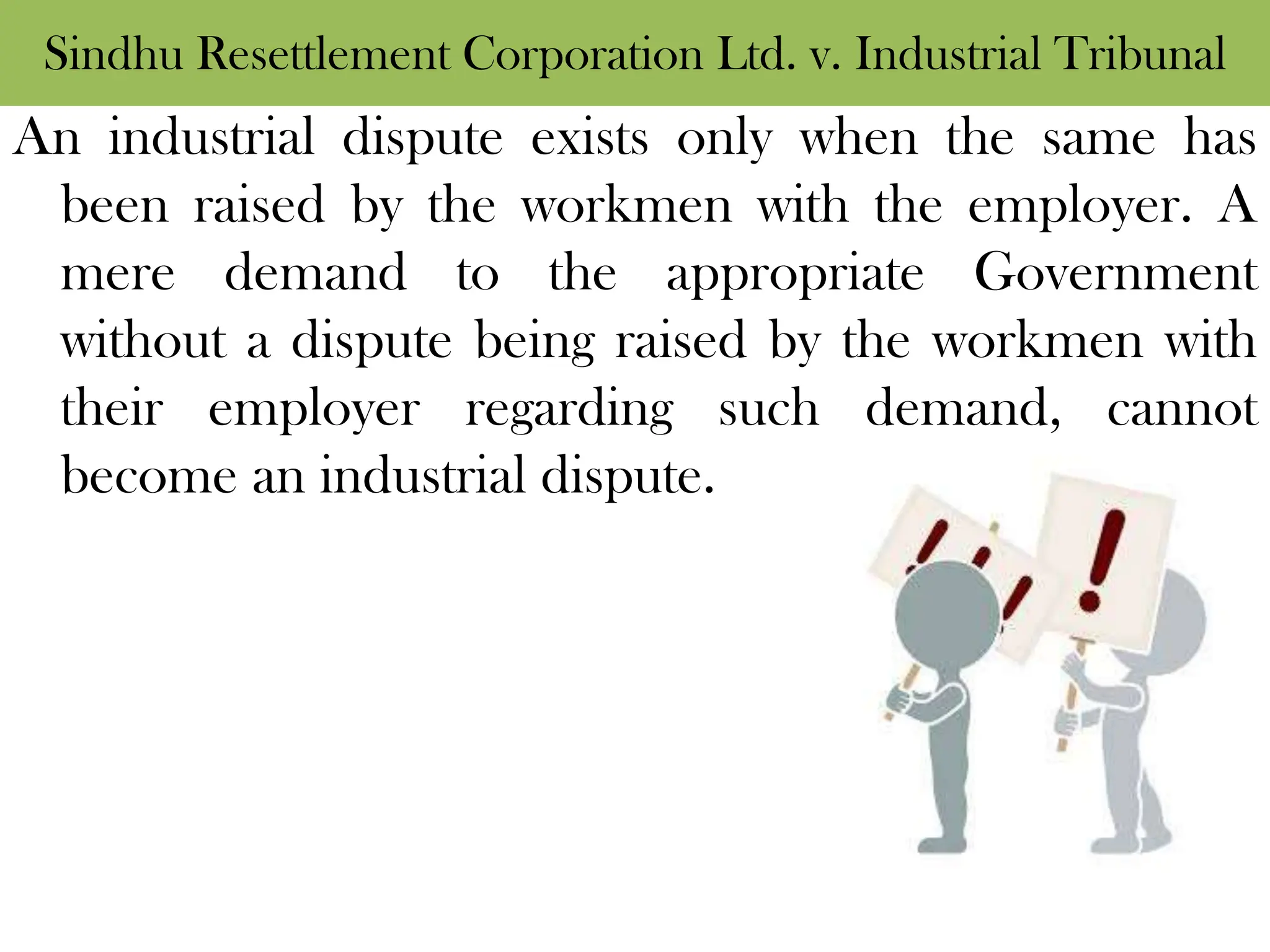
Sindhu Resettlement Corporation Ltd. v. Industrial Tribunal
An industrial dispute exists only when the same has
been raised by the workmen with the employer. A
mere demand to the appropriate Government
without a dispute being raised by the workmen with
their employer regarding such demand, cannot
become an industrial dispute.
Bombay Union of Journalists v. The Hindu
• The Supreme Court observed that for making
reference under Section 10 PANKAJ KUMAR, FCS,
Chartered S I ( CISI - London ), MBA ( Finance )
10, it is enough if industrial dispute exists or is
apprehended on the date of reference. Therefore,
even when no formal demands have been made by
the employer, industrial dispute exists if the demands
were raised during the conciliation proceedings.
Workmen v. Hindustan Lever Ltd.
• When an industrial dispute is referred for
adjudication the presumption is that, there is an
industrial dispute.
W.S. Insulators of India Ltd. v. Industrial Tribunal,
Madras
• Unless there is a demand by the workmen and that
demand is not complied with by the management,
there cannot be any industrial dispute within the
meaning of Section 2(k). Mere participation by the
employer in the conciliation proceedings will not be
sufficient
Workman [Section 2(s)]
• Means
• Any person (including an apprentice) employed in any industry to do any manual,
unskilled, skilled, technical, operational, clerical or supervisory work for hire or
reward, whether the terms of employment be expressed or implied and for the
purposes of any proceeding under this Act in relation to an industrial dispute,
• includes:
• any such person who has been dismissed, discharged or retrenched in connection
with, or as a consequence of that dispute,
• or any person whose dismissal, discharge or retrenchment has led to that dispute,
• but does not include any such person:
• who is subject to the Army Act, 1950, or the Air Force Act, 1950 or the Navy Act,
1957; or
• who is employed in the police service or as an officer or other employee of a prison;
or
• who is employed mainly in a managerial or administrative capacity; or
• who is employed in a supervisory capacity drawing more than Rs. 1,600 per month as
wages;
• or who is exercising either by the nature of the duties attached to the office or by
reason of the powers vested in him, functions mainly of a managerial nature.
J.K. Cotton Spinning and Weaving Mills Co. Ltd. v.
L.A.T.
• The Supreme Court held that ‘malis’ looking after the garden
attached to bungalows provided by the company to its officers
and directors, are engaged in operations incidentally connected
with the main industry carried on by the employer. It observed
that in this connection it is hardly necessary to emphasize that
in the modern world, industrial operations have become
complex and complicated and for the efficient and successful
functioning of any industry, several incidental operations are
called in aid and it is the totality of all these operations that
ultimately constitutes the industry as a whole. Wherever it is
shown that the industry has employed an employee to assist
one or the other operation incidental to the main industrial
operation, it would be unreasonable to deny such an employee
the status of a workman on the ground that his work is not
directly concerned with the main work or operation of the
industry
Dharangadhara Chemical Works Ltd. v.
State of Saurashtra
• The employee agrees to work under the supervision and
control of his employer. Here one must distinguish
between contract for employment or service and contract
of employment or service. In the former, the employer
can require what is to be done but in the latter, he can
not only order what is to be done, but also how it shall be
done. In the case of contract for employment, the person
will not be held as a ‘workman’ but only an ‘independent
contractor’. There should be due control and
supervision by the employer for a master and servant
relationship. Payment on piece rate by itself does not
disprove the relationship of master and servant
G.Yeddi Reddi v. Brooke Bond India Ltd.
• Since he is under an obligation to work for fixed
hours every day, jural relationship of master and
servant would exist. A casual worker is nonetheless a
workman.
• Only those persons who are engaged in the following
types of work are covered by the definition of
“workman”:
• Skilled or unskilled manual work;
• Supervisory work;
• Technical work;
• Clerical work.
Strike [Section 2(q)]
• Means
• Cessation of work by a body of persons employed in any industry acting in
combination, or a concerted refusal, or a refusal under a common
understanding of any number of persons who are or have been so employed
to continue to work or to accept employment.
• Strike is a weapon of collective bargaining in the armour of workers.
• Strike can take place only when there is a cessation of work or refusal to work
by the workmen acting in combination or in a concerted manner. Time factor
or duration of the strike is immaterial. The purpose behind the cessation of
work is irrelevant in determining whether there is a strike or not. It is enough
if the cessation of work is in defiance of the employer’s authority.
• Proof of formal consultations is not required. However, mere presence in the
striking crowd would not amount to strike unless it can be shown that there
was cessation of work.
• A concerted refusal or a refusal under a common understanding of any
number of persons to continue to work or to accept employment will amount
to a strike. A general strike is one when there is a concert of combination of
workers stopping or refusing to resume work. Going on mass casual leave
under a common understanding amounts to a strike.
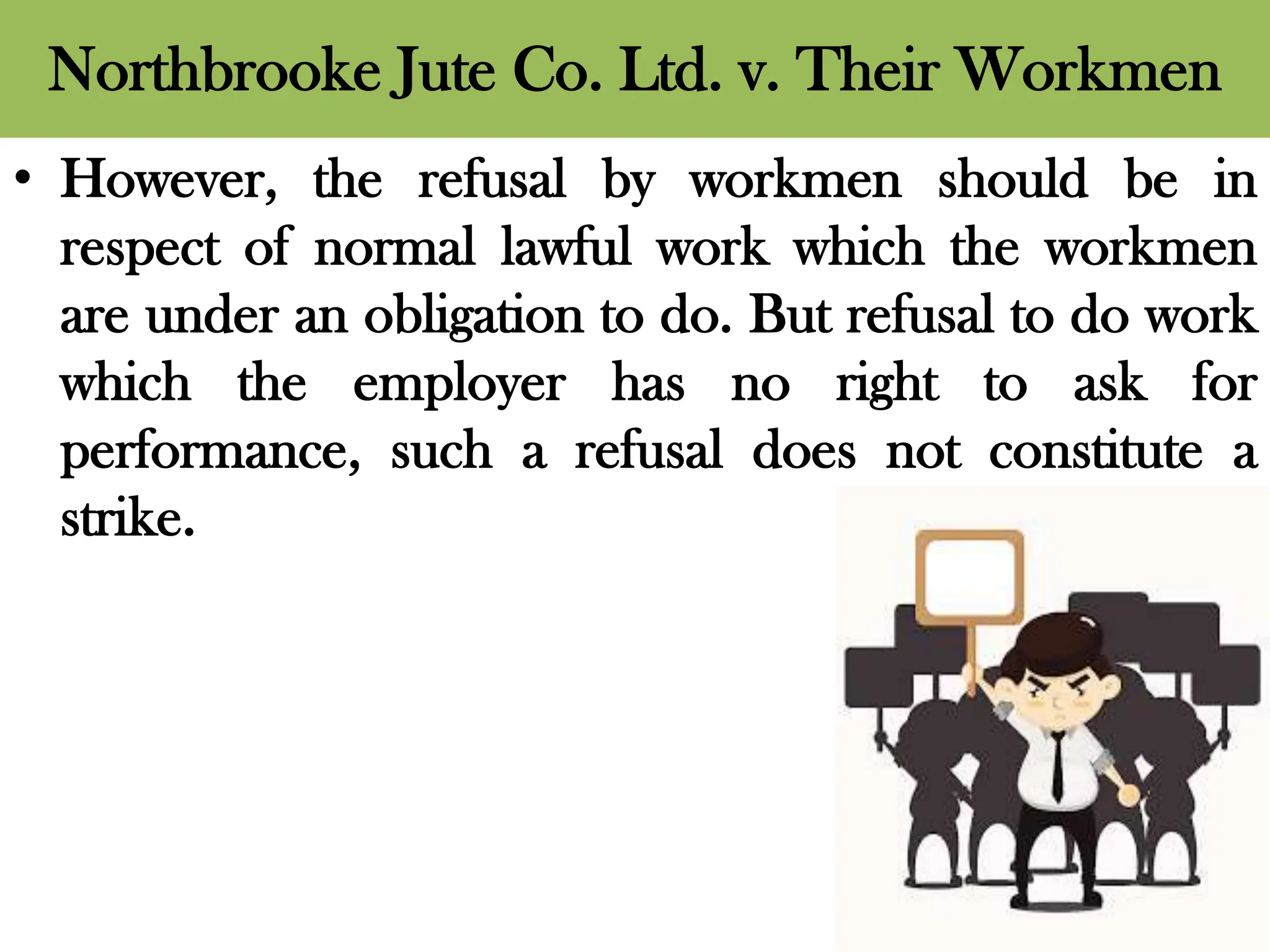
Northbrooke Jute Co. Ltd. v. Their Workmen
• However, the refusal by workmen should be in
respect of normal lawful work which the workmen
are under an obligation to do. But refusal to do work
which the employer has no right to ask for
performance, such a refusal does not constitute a
strike.
National Textile Workers’ Union v. Shree
Meenakshi Mills
• If on the sudden death of a fellow-worker, the
workmen acting in concert refuse to resume work, it
amounts to a strike The striking workman must be
employed in an “industry” which has not been closed
down. Even when workmen cease to work, the
relationship of employer and employee is deemed to
continue albeit in a state of belligerent suspension.
Types of Strike
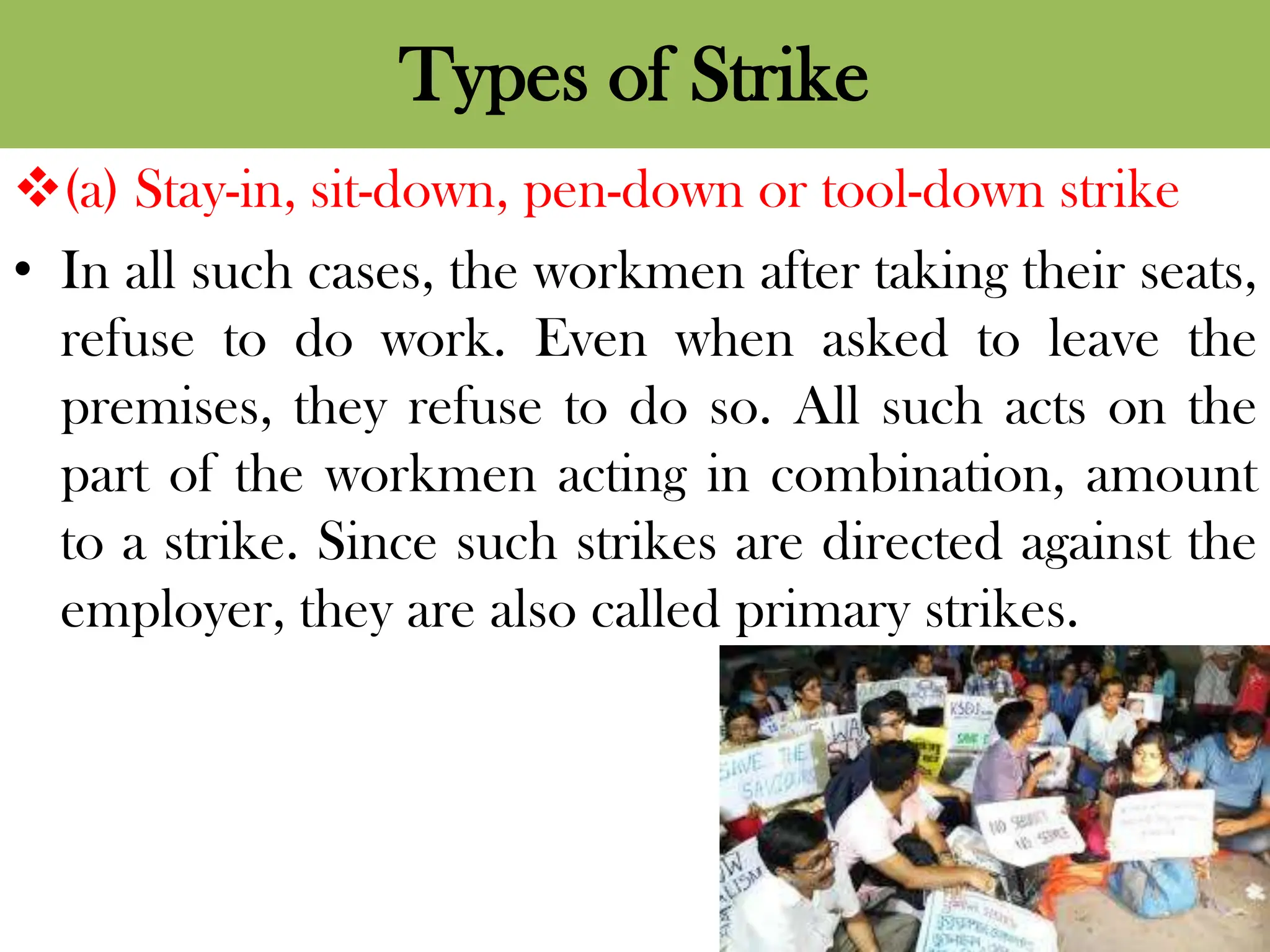
(a) Stay-in, sit-down, pen-down or tool-down strike
• In all such cases, the workmen after taking their seats,
refuse to do work. Even when asked to leave the
premises, they refuse to do so. All such acts on the
part of the workmen acting in combination, amount
to a strike. Since such strikes are directed against the
employer, they are also called primary strikes.
Punjab National Bank Ltd. v. All India Punjab National
Bank Employees’ Federation
• The Supreme Court observed that on a plain and
grammatical construction of this definition it would
be difficult to exclude a strike where workmen enter
the premises of their employment and refuse to take
their tools in hand and start their usual work. Refusal
under common understanding not to work is a strike.
If in pursuance of such common understanding the
employees enter the premises of the Bank and refuse
to take their pens in their hands that would no doubt
be a strike under Section 2(q)
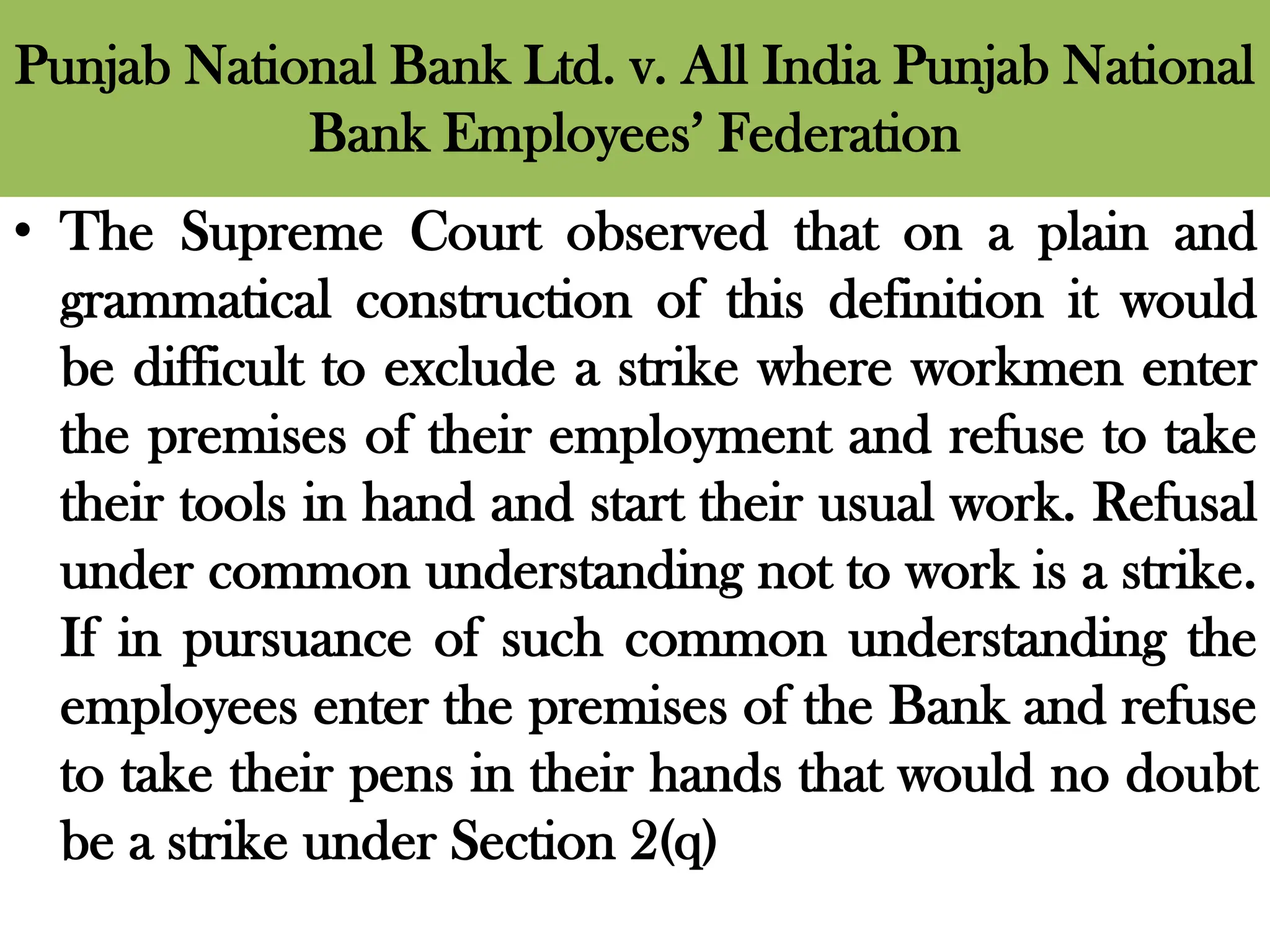
• (b) Go-slow
• Go-slow does not amount to strike, but it is a serious case of
misconduct.
• Bharat Sugar Mills Ltd. v. Jai Singh
• The Supreme Court explained the legality of go-slow in the
following words: “Go-slow which is a picturesque description of
deliberate delaying of production by workmen pretending to be
engaged in the factory is one of the most prenicious practices that
discontented and disgruntled workmen sometimes resort to. Thus,
while delaying production and thereby reducing the output, the
workmen claim to have remained employed and entitled to full
wages. Apart from this, ‘go-slow’ is likely to be much more harmful
than total cessation of work by strike. During a go-slow much of the
machinery is kept going on at a reduced speed which is often
extremely damaging to the machinery parts. For all these reasons,
‘go-slow’ has always been considered a serious type of misconduct.”
• (c) Sympathetic strike
• Cessation of work in the support of the demands of
workmen belonging to other employer is called a
sympathetic strike. This is an unjustifiable invasion of
the right of employer who is not at all involved in the
dispute. The management can take disciplinary
action for the absence of workmen.
• Ramalingam v. Indian Metallurgical Corporation,
Madras It was held that such cessation of work will
not amount to a strike since there is no intention to
use the strike against the management.
• (d) Hunger strike
• Some workers may resort to fast on or near the place
of work or residence of the employer.
• Case:- Pepariach Sugar Mills Ltd. v. Their
Workmen
• If it is peaceful and does not result in cessation of
work, it will not constitute a strike. But if due to such
an act, even those present for work, could not be
given work, it will amount to strike.
• (e) Work-to-rule Since there is no cessation of work,
it does not constitute a strike.
Legality of Strike
• The legality of strike is determined with reference to
the legal provisions enumerated in the Act and the
purpose for which the strike was declared is not
relevant in directing the legality. Section 10(3),
10A(4A), 22 and 23 of the Act deals with strike.
Sections 22 and 23 impose restrictions on the
commencement of strike while Sections 10(3) and
10A(4A) prohibit its continuance.
• The justifiability of strike has no direct relation to the
question of its legality and illegality.
Matchwell Electricals of India v. Chief
Commissioner
• The Punjab & Haryana High Court held that the
justification of strike is entirely unrelated to its legality
or illegality. The justification of strikes has to be
viewed from the stand point of fairness and
reasonableness of demands made by workmen and
not merely from stand point of their exhausting all
other legitimate means open to them for getting their
demands fulfilled
Gujarat Steel Tubes Ltd. v. Gujarat Steel Tubes
Majdoor Sabha
• The Supreme Court held that justifiability of a strike
is purely a question of fact. Therefore, if the strike
was resorted to by the workers in support of their
reasonable, fair and bona fide demands in peaceful
manner, then the strike will be justified. Where it was
resorted to by using violence or acts of sabotage or
for any ulterior purpose, then the strike will be
unjustified.
Lock-out [Section 2(l)]
• Means
• The temporary closing of a place of employment, or the suspension
of work, or the refusal by an employer to continue to employ any
number of persons employed by him.
• Lock out is an antithesis to strike.
• In lock out, the employer refuses to continue to employ the
workman employed by him even though there is no intention to
close down the unit.
• The essence of lock out is the refusal of the employer to continue to
employ workman.
• Even if suspension of work is ordered, it would constitute lock out.
• But mere suspension of work, unless it is accompanied by an
intention on the part of employer as a retaliation, will not amount to
lock out.
• Locking out workmen does not contemplate severance of the
relationship of employer and the workmen.
Express Newspapers (P) Ltd v. Their Workers
• Just as “strike” is a weapon available to the employees
for enforcing their industrial demands, a “lock out” is
a weapon available to the employer to persuade by a
coercive process the employees to see his point of
view and to accept his demands.
Lord Krishna Sugar Mills Ltd. v. State of U.P.
• A closure of a place of business for a short duration
of 30 days in retaliation to certain acts of workmen
(i.e. to teach them a lesson) was held to be a lock out.
But closure is not a lock out.
Lay-off
• Means
• The failure, refusal or inability of an employer to give employment due to following reasons, to a workman
whose name appears on the muster-rolls of his industrial establishment and who has not been retrenched:
• shortage of coal, power or raw materials, or
• accumulation of stocks, or break-down of machinery, or
• natural calamity, or
• for any other connected reason.
• Every workman whose name is borne on the muster rolls of the industrial establishment and who presents
himself for work at the establishment at the time appointed for the purpose during normal working hours
on any day and is not given employment by the employer within two hours of his so presenting himself
shall be deemed to have been laid-off for that day within the meaning of this clause.
• If the workman, instead of being given employment at the commencement of any shift for any day is asked
to present himself for the purpose during this second half of the shift for the day and is given employment,
then, he shall be deemed to have been laid-off only for one-half of that day.
• If he is not given any such employment even after so presenting himself, he shall not be deemed to have
been laid-off for the second half of the shift for the day and shall be entitled to full basic wages and
dearness allowance for that part of the day.
• Lay-off is a temporary stoppage and within a reasonable period of time, the employer expects that his
business would continue and his employees who have been laid-off, the contract of employment is not
broken but is suspended for the time being.
• There cannot be lay-off in an industrial undertaking which has been closed down. Lay-off and closure
cannot stand together.
M.A. Veirya v. C.P. Fernandez
It was observed that it is not open to the employer,
under the cloak of “lay-off”, to keep his employees in
a state of suspended animation and not to make up
his mind whether the industry or business would
ultimately continue or there would be a permanent
stoppage and there by deprive his employees of full
wages.
Tatanagar Foundry v. Their Workmen
• The lay-off should not be mala fide in which case it
will not be lay-off. Tribunal can adjudicate upon it
and find out whether the employer has deliberately
and maliciously brought about a situation where lay-
off becomes necessary. But, apart from the question
of mala fide, the Tribunal cannot sit in judgments
over the acts of management and investigate whether
a more prudent management could have avoided the
situation which led to lay-off
• In lay-off, the employer refuses to give employment
due to certain specified reasons, but in lock-out, there
is deliberate closure of the business and employer
locks out the workers not due to any such reasons. In
lay-off, the business continues, but in lock-out, the
place of business is closed down for the time being. In
a lock-out, there is no question of any wages or
compensation being paid unless the lock-out is held to
be unjustified. Lay-off is the result of trade reasons but
lock-out is a weapon of collective bargaining. Lock-out
is subject to certain restrictions and penalties but it is
not so in case of lay-off.
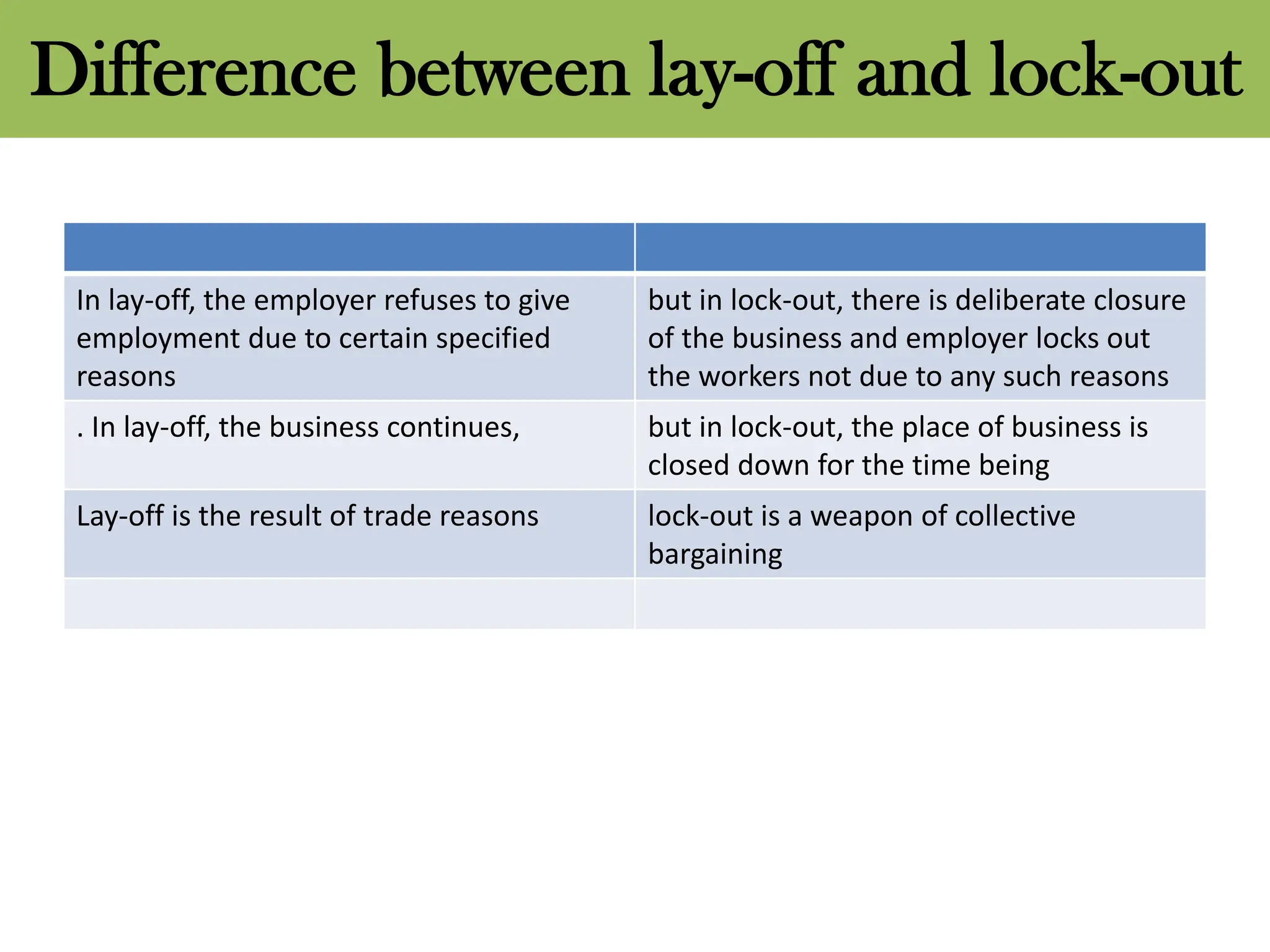
Difference between lay-off and lock-out
In lay-off, the employer refuses to give
employment due to certain specified
reasons
but in lock-out, there is deliberate closure
of the business and employer locks out
the workers not due to any such reasons
. In lay-off, the business continues, but in lock-out, the place of business is
closed down for the time being
Lay-off is the result of trade reasons lock-out is a weapon of collective
bargaining
Retrenchment [Section 2(oo)]
• Means
• The termination by the employer of the service of a workman for
any reason whatsoever, otherwise than as a punishment inflicted by
way of disciplinary action,
• but does not include:
• voluntary retirement of the workman; or retirement of the workman
or
• reaching the age of superannuation if the contract of employment
between the employer and the workman concerned contains a
stipulation in that behalf; or
• Termination of the service of the workman as a result of the
nonrenewal of the contract of employment between the employer
and the workman concerned on its expiry or of such contract being
terminated under a stipulation in that behalf contained therein.
• Termination of the service of workman on the ground of continued
ill-health.
Requirements for retrenchment
• There should be termination of the service of the
workman.
• The termination should be by the employer.
• The termination is not the result of punishment
inflicted by way of disciplinary action.
• The definition excludes termination of service on the
specified grounds or instances mentioned in it.
Santosh Gupta v. State Bank of Patiala
• It was held that if the definition of retrenchment is
looked at unaided and unhampered by precedent,
one is at once struck by the remarkably wide
language employed and particularly the use of the
word ‘termination for any reason whatsoever’. If due
weight is given to these words, i.e. they are to be
understood as to mean what they plainly say, it is
difficult to escape the conclusion that retrenchment
must include every termination of service of a
workman by an act of the employer.
Hariprasad Shivshankar Shukla v. A.D.Divakar
• The Hariprasad case and some other decisions, lead
to the unintended meaning of the term
“retrenchment”that it operates only when there is
surplus of workman in the industry which should be
an existing one. Thus, in effect either on account of
transfer of undertaking or an account of the closure
of the undertaking, there can be no question of
retrenchment within the meaning of the definition
contained in Section 2(oo).
Award [Section 2(b)]
• Means An interim or a final determination of any
industrial dispute or of any question relating thereto
by any Labour Court, Industrial Tribunal or National
Industrial Tribunal and includes an arbitration award
made under Section 10-A.
Cox & Kings (Agents) Ltd. v. Their Workmen
• This definition was analysed in this case as follows:
• The definition of “award” is in two parts.
• The first part covers a determination, final or interim, of
any industrial dispute.
• The second part takes in a determination of any question
relating to an industrial dispute.
• However, basic thing to both the parts is the existence of
an industrial dispute, actual or apprehended.
• The ‘determination contemplated is of the industrial
dispute or a question relating thereto on merits.
• The word ‘determination’ implies that the Labour Court
or the Tribunal should adjudicate the dispute upon
relevant materials and exercise its own judgment.
Settlement [Section 2(p)]
• Means
• A settlement arrived at in the course of conciliation
proceeding and includes a written agreement between
the employer and workmen arrived at otherwise than in
the course of conciliation proceeding where such
agreement has been signed by the parties thereto in such
manner as may be prescribed and a copy thereof has
been sent to an officer authorised in this behalf by the
appropriate Government and the conciliation officer.
• Two categories of settlements
• a settlement arrived at in the course of conciliation
proceedings, and
• a written agreement between employer arrived at
otherwise in the course of conciliation proceedings.
Tata Engineering and Locomotive Co. Ltd. v.
Workmen
• A settlement cannot be weighed in any golden scale
and the question whether it is just and fair has to be
answered on the basis of principles different from
those which came into play where an industrial
dispute is under adjudication. If the settlement has
been arrived at by a vast majority of workmen with
their eyes open and was also accepted by them in its
totality, it must be presumed to be fair and just and
not liable to be ignored merely because a small
number of workers were not parties to it or refused
to accept it.
Authorities under the Act and their duties
Authorities for Investigation and settlement of industrial
disputes:
i. Works Committee.
ii. Conciliation Officers.
iii. Boards of Conciliation.
iv. Court of Inquiry.
v. Labour Tribunals.
vi. Industrial Tribunals.
vii. National Tribunal.
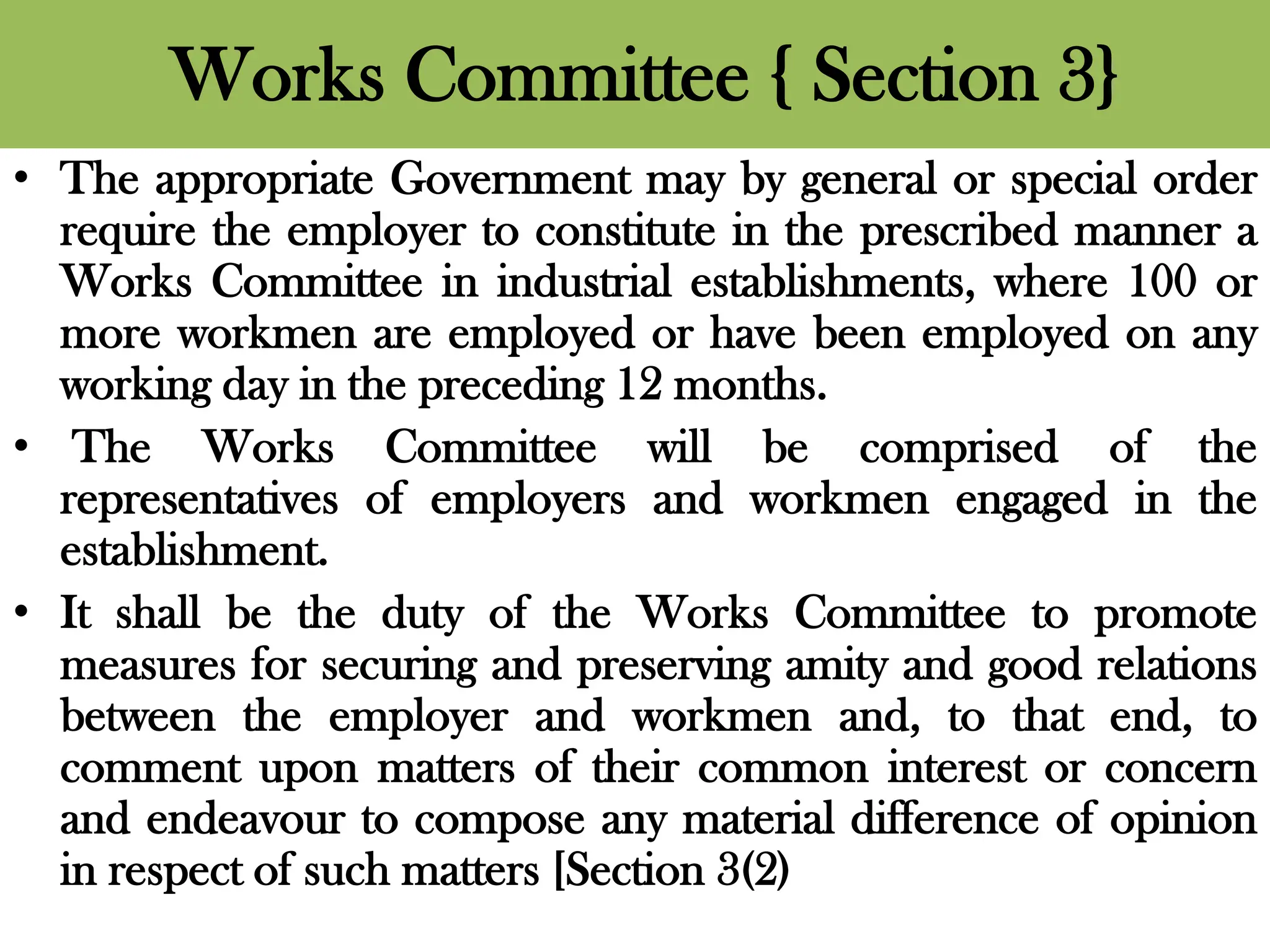
Works Committee { Section 3}
• The appropriate Government may by general or special order
require the employer to constitute in the prescribed manner a
Works Committee in industrial establishments, where 100 or
more workmen are employed or have been employed on any
working day in the preceding 12 months.
• The Works Committee will be comprised of the
representatives of employers and workmen engaged in the
establishment.
• It shall be the duty of the Works Committee to promote
measures for securing and preserving amity and good relations
between the employer and workmen and, to that end, to
comment upon matters of their common interest or concern
and endeavour to compose any material difference of opinion
in respect of such matters [Section 3(2)
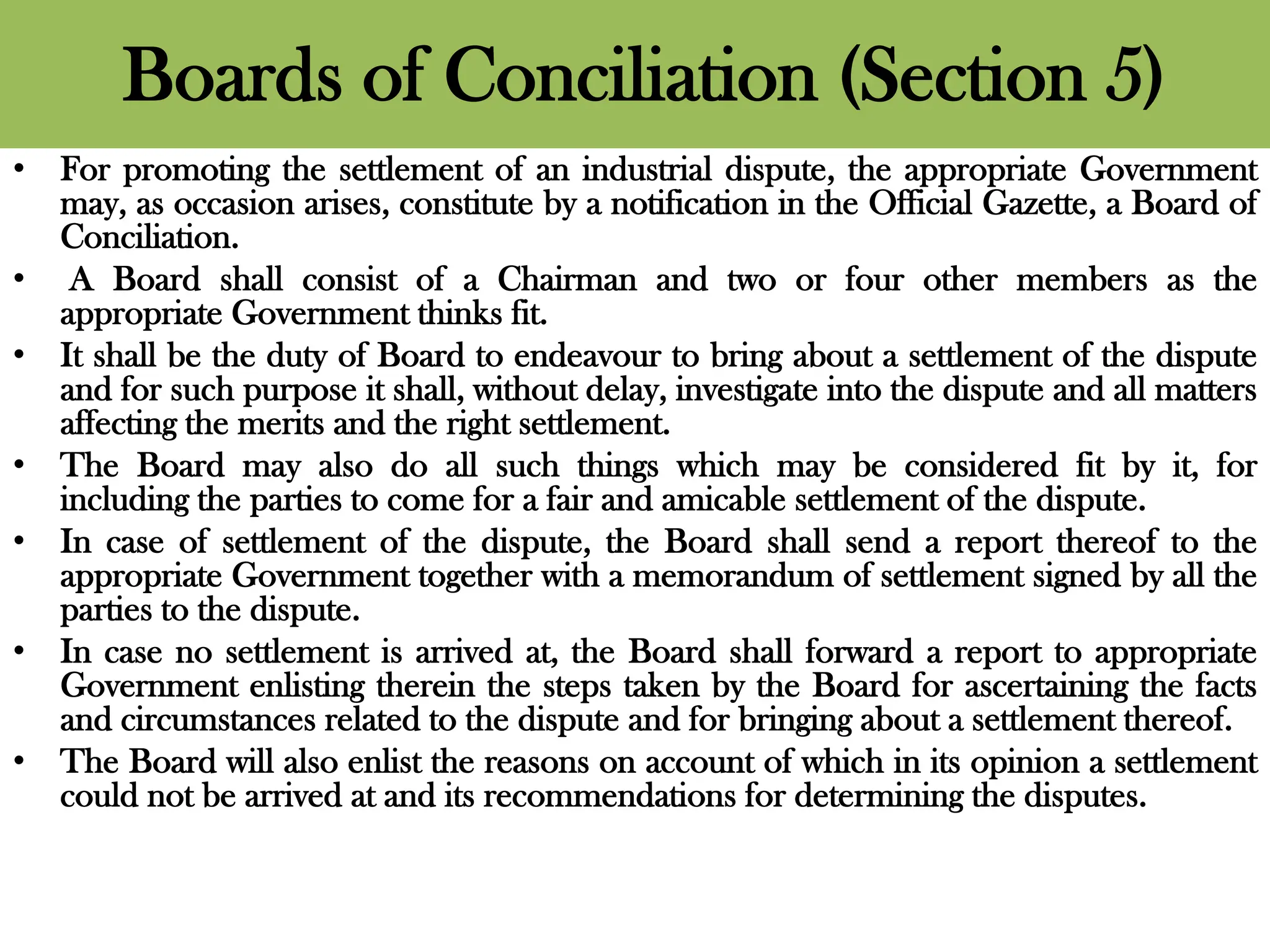
Boards of Conciliation (Section 5)
• For promoting the settlement of an industrial dispute, the appropriate Government
may, as occasion arises, constitute by a notification in the Official Gazette, a Board of
Conciliation.
• A Board shall consist of a Chairman and two or four other members as the
appropriate Government thinks fit.
• It shall be the duty of Board to endeavour to bring about a settlement of the dispute
and for such purpose it shall, without delay, investigate into the dispute and all matters
affecting the merits and the right settlement.
• The Board may also do all such things which may be considered fit by it, for
including the parties to come for a fair and amicable settlement of the dispute.
• In case of settlement of the dispute, the Board shall send a report thereof to the
appropriate Government together with a memorandum of settlement signed by all the
parties to the dispute.
• In case no settlement is arrived at, the Board shall forward a report to appropriate
Government enlisting therein the steps taken by the Board for ascertaining the facts
and circumstances related to the dispute and for bringing about a settlement thereof.
• The Board will also enlist the reasons on account of which in its opinion a settlement
could not be arrived at and its recommendations for determining the disputes.
(iv) Courts of Inquiry { Section 6}
• The Appropriate Government may as occasion arises, by
notification in the Official Gazette constitute a Court of
Inquiry into any matter appearing to be connected with or
relevant to an industrial dispute.
• A Court may consist of one independent person or of such
number of independent persons as the appropriate
Goverment may think fit and where a Court consists of two or
more members, one of them shall be appointed as the
Chairman.
• It is the duty of such a Court to inquire into matters referred
to it and submit its report to the appropriate Government
ordinarily within a period of 6 months from the
commencement of the inquiry. The period within which the
report is to be submitted is not mandatory and the report
may be submitted even beyond the period of six months
without affecting the legality of the inquiry
(ii) Conciliation Officers (Section 4)
• With the duty of mediating in and promoting the settlement
of industrial disputes, the appropriate Government may, by
notification in the Official Gazette, appoint such number of
Conciliation Officers as it thinks fit.
• The Conciliation Officer may be appointed for a specified
area or for specified industries in a specified area or for one
or more specified industries and either permanently or for a
limited period.
• The main objective of appointing the Conciliation Officers,
by the appropriate Government, is to create congenial
atmosphere within the establishment where workers and
employers can reconcile on their disputes through the
mediation of the Conciliation Officers.
• Thus, they help in promoting the settlement of the disputes.
(v) Labour Courts { Section 7}
• The Appropriate Goverment is empowered to constitute one or
more Labour Courts for adjudication of industrial disputes relating
to any matter specified in the Second Schedule and for performing
such other functions as may be assigned to them under the Act.
• A Labour Court shall consist of one person only to be appointed by
the appropriate Government.
• A person shall not be qualified for appointment as the presiding
officer of a Labour Court unless –
• he is, or has been, a judge of a High Court: or
• he has, for a period not less than three years, been a district Judge
or an Additional District Judge; or
• he has held any judicial office in India for not less than seven years;
• or he has been the presiding officer of a Labour Court constituted
under any provincial Act or State Act for not less than five years.
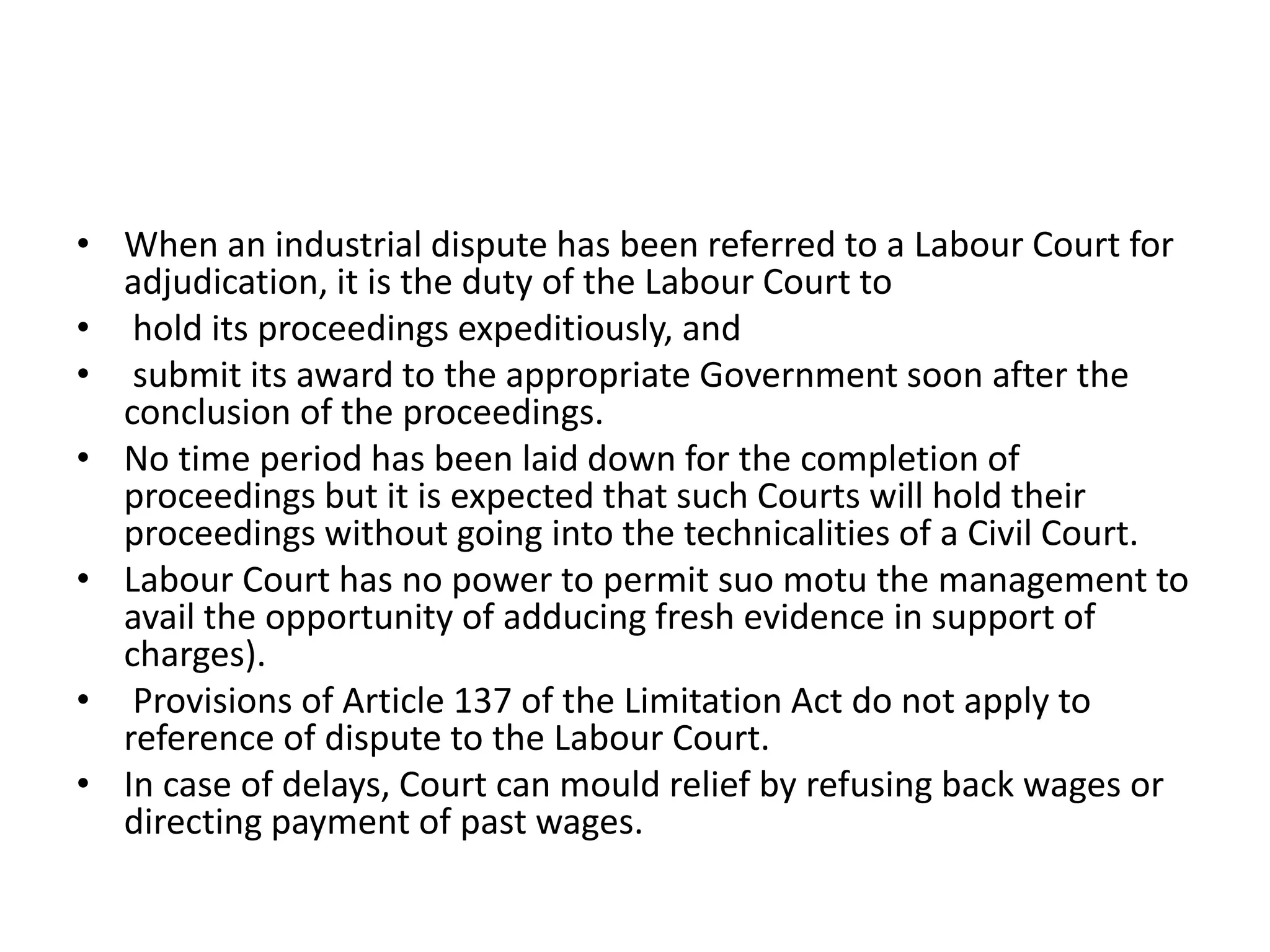
• When an industrial dispute has been referred to a Labour Court for
adjudication, it is the duty of the Labour Court to
• hold its proceedings expeditiously, and
• submit its award to the appropriate Government soon after the
conclusion of the proceedings.
• No time period has been laid down for the completion of
proceedings but it is expected that such Courts will hold their
proceedings without going into the technicalities of a Civil Court.
• Labour Court has no power to permit suo motu the management to
avail the opportunity of adducing fresh evidence in support of
charges).
• Provisions of Article 137 of the Limitation Act do not apply to
reference of dispute to the Labour Court.
• In case of delays, Court can mould relief by refusing back wages or
directing payment of past wages.
(vi) Tribunals (Section 7-A)
• The appropriate Government may by notification in the Official Gazette, constitute
one or more Industrial Tribunals for the adjudication of industrial disputes relating
to any matter whether specified in the Second Schedule or the Third Schedule and
for performing such other functions as may be assigned to them under this Act.
• A Tribunal shall consist of one person only to be appointed by the appropriate
Government.
• A person shall not be qualified for appointment as the presiding officer of a
Tribunal unless:
• he is, or has been, a Judge of High Court; or
• he has, for a period of not less than three years, been a District Judges or an
Additional District Judge.
• The appropriate Government may, if it so thinks fit, appoint two persons as
assessors to advise the Tribunal in the proceedings before it.
• The person appointed as a Presiding Officer should be an independent person and
must not have attained the age of 65 years.
• The Industrial Tribunal gets its jurisdiction on a reference by the appropriate
Government under Section 10.
• The Government can nominate a person to constitute a Tribunal for adjudication of
industrial disputes as and when they arise and refer them to it.
• The Tribunal may be constituted for any limited or for a particular case or area.
(vii) National Tribunals { Section 7-B}
• The Central Government alone has been empowered to constitute one or
more National Tribunals for the adjudication of industrial disputes which
• involve questions of national importance or
• are of such a nature that industrial establishments situated in more than
one State are likely to be interested in or affected by such disputes.
• A National Tribunal shall consist of one person only to be appointed by
the Central Government.
• A person shall not be qualified for appointment as the Presiding Officer of
a National Tribunal unless: he is, or has been, a Judge of a High Court; or
• The Central Government may, if it so thinks fit, appoint two persons as
assessors to advise the National Tribunal in the proceeding before it.
• Section 7-C further provides that such a presiding officer should be an
independent person and must not have attained the age of 65 years.
Labour law pdf on different theory under

Labour law pdf on different theory under

  • 1.
  • 2.
    INDUSTRIAL DISPUTE ACT1947 OBJECT & SCOPE OF ACT • The first enactment dealing with the settlement of industrial disputes was the Employers’ and Workmen’s Disputes Act, 1860. • This Act weighed much against the workers and was therefore replaced by the Trade Disputes Act, 1929. • The Whitely Commission made in this regard the perceptive observation that the attempt to deal with unrest must begin rather with the creation of an atmosphere unfavourable to disputes than with machinery for their settlement. • Then followed the Industrial Disputes Act, 1947. • The Industrial Disputes Act, 1947 makes provision for the investigation and settlement of industrial disputes and for certain other purposes. • It ensures progress of industry by bringing about harmony and cordial relationship between the employers and employees. • This Act extends to whole of India.
  • 3.
    • The Actwas designed to provide a self-contained code to compel the parties to resort to industrial arbitration for the resolution of existing or apprehended disputes without prescribing statutory norms for varied and variegated industrial relating norms so that the forums created for resolution of disputes may remain unhampered by any statutory control and devise rational norms keeping pace with improved industrial relations reflecting and imbibing socio-economic justice. • The Act applies to an existing and not to a dead industry. • It is to ensure fair wages and to prevent disputes so that production might not be adversely affected.
  • 4.
    Dimakuchi Tea Estatev. Dimakuchi Tea Estate • The Supreme Court laid down following objectives of the Act: • Promotion of measures of securing and preserving amity and good relations between the employer and workmen. • Investigation and settlement of industrial disputes between employers and employers, employers and workmen, or workmen and workmen with a right of representation by registered trade union or federation of trade unions or an association of employers or a federation of associations of employers. • Prevention of illegal strikes and lock-outs. • Relief to workmen in the matter of lay-off and retrenchment. • Promotion of collective bargaining.
  • 5.
    Industry [Section 2(j)] Means •Any business, trade, undertaking, manufacture or calling of employers and includes • Any calling service, employment, handicraft, or industrial occupation or avocation of workmen. Bangalore Water Supply and Sewerage Board v. A Rajiappa • After discussing the definition from various angles, in the above case, the Supreme Court, laid down the following tests to determine whether an activity is covered by the definition of “industry” or not. It is also referred to as the triple test.
  • 6.
    I • Where thereis systematic activity, • organized by co-operation between employer and employee, • for the production and/or distribution of goods and services calculated to satisfy human wants and wishes (not spiritual or religious but inclusive of material things or services geared to celestial bliss e.g., making, on a large scale, prasad or food) prima facie, there is an “industry” in that enterprise. • Absence of profit motive or gainful objective is irrelevant wherever the undertaking is whether in the public, joint, private or other sector. • The true focus is functional and the decisive test is the nature of the activity with special emphasis on the employer-employee relations. • If the organization is a trade or business, it does not cease to be one because of philanthropy animating the undertaking.
  • 7.
    II • All organisedactivity possessing the triple elements in (i) although not trade or business, may still be “industry”, provided the nature of the activity, viz., the employer - employee basis, bears resemblance to what we find in trade or business. This takes into the fold of “industry”, undertaking, callings and services, adventures analogous to the carrying on of trade or business. All features, other than the methodology of carrying on the activity, viz., in organising the co- operation between employer and employee, may be dissimilar. It does not matter, if on the employment terms, there is analogy.
  • 8.
    III • Application ofthese guidelines should not stop short of their logical reach by invocation of creeds, cults or inner sense of incongruity or outer sense of motivation for or resultant of the economic operations. • The ideology of the Act being industrial disputes between employer and workmen, the range of this statutory ideology must inform the reach of the statutory definition, nothing less, nothing more. • Hence, the Supreme Court observed that professions, clubs, educational institutions. co-operatives, research institutes, charitable projects and other kindred adventures, if they fulfill the triple tests listed in (1), cannot be exempted from the scope of Section 2(j).
  • 9.
    The Supreme Court,in Bangalore Water Supply case laid down the following guidelines for deciding the dominant nature of an undertaking: • Where a complex of activities, some of which qualify for exemption, others not, involves the employees on the total undertaking. Some of whom are not “workmen” or some departments are not productive of goods and services if isolated, nature of the department will be the true test. The whole undertaking will be “industry” although those who are not “workmen” definition may not be benefit by the status. • Notwithstanding with previous clause, sovereign functions strictly understood alone qualify for exemption and not the welfare activities or economic adventures undertaken by Government or statutory bodies. • Even in departments discharging sovereign functions, if there are units which are industries and they are substantially severable, then they can be considered to come within Section 2(j). • Constitutional and competently enacted legislative provisions may well remove an undertaking from the scope of the Act.
  • 10.
    Whether the followingactivities would fall under industry or not? 1. Sovereign functions: Case:- Bangalore Water Supply Sovereign functions strictly understood alone qualify for exemption, not the welfare activities or economic adventures undertaken by Government or statutory bodies. Even in departments discharging sovereign functions, if there are units which are industries and they are substantially severable then they can be considered to come within Section 2(j).
  • 11.
    Corpn. of Cityof Nagpur v. Employees If a department of a municipality discharged many functions, some pertaining to “industry” and other non-industrial activities, the predominant function of the department shall be the criterion for the purposes of the Act.
  • 12.
    2. Municipalities • FollowingDepartments of the municipality were held, to be “industry” • Tax • Public Conveyance • Fire Brigade • Lighting • Water Works • City Engineers • Enforcement (Encroachment) • Sewerage • Health • Market • Public Gardens • Education • Printing Press • Building and • General administration. • If a department of a municipality discharges many functions some pertaining to industry and others non-industrial, the predominant function of the department shall be the criterion for the purpose of the Act.
  • 13.
    3. Hospitals andCharitable Institutions: FICCI v. Workmen • Exemptions to charitable institutions under Section 32(5) of Payment of Bonus Act is not relevant to the construction of Section 2(j), there is an industry in the enterprise, provided the nature of the activity, namely the employer-employee basis bears resemblance to what is found in trade or business. The true focus is functional and the decisive test is the nature of the activity with special emphasis on the employer- employee relations.
  • 14.
    The following institutionsare held to be “industry”: • Case:- State of Bombay v. Hospital Mazdoor Sabha; State Hospital • Case:- Lalit Hari Ayurvedic College Pharmacy v.Workers Union Ayurvedic Pharmacy and Hospital • Case: - Bombay Panjrapole v. Workmen Activities of Panjrapole • Case: - Bangalore Water Supply Clubs, Larger clubs are “industry” • Universities, Research Institutions etc.: However Physical Research Laboratory, Ahmedabad was held not to be an Industry by the Supreme Court. Since it is carrying on research not for the benefit of others and moreover, it is not engaged in commercial or industrial activity
  • 15.
    • Case:- BangaloreWater Supply Professional Firms: A solicitors establishment can be an “industry”. Regarding liberal professions like lawyers, doctors, etc., the test of direct cooperation between capital and labour in the production of goods or in the rendering of service or that cooperation between employer and employee is essential for carrying out the work of the enterprise. • Case:- .C.K. Union v. Rajkumar College Management of a private educational institution • Voluntary services, Co-operative Societies, Federation of Indian Chamber of Commerce, Company carrying on agricultural operations, Bihar Khadi Gramodyog Sangh, Indian Navy Sailors Home, Panchayat Samiti, Public Health Department of the State Government, Forest Department of Govt., Zoo; Primary Health Centres, and Indian Institute of Petroleum. Some other instances of ‘Industry are: Rajasthan Co-operative Credit Institutions Cadre Authority, A trust for promoting religious, social and educational life but also undertaking commercial activities, M.P. Khadi and Village Industries Board, Housing Board, Dock Labour Board,
  • 16.
    But the followingare held to be not “Industry”: • Case:- Union of India v. Labour Court Posts and Telegraphs Department • Case:- Bombay Telephones Canteen Employees Association v. Union of India Telecom Deptt. • Case:- P. Bose v. Director, C.I.F. Central Institute of Fisherie • Case:- State of Punjab v. Kuldip Singh and another Construction and maintenance of National and State Highways • Case:- RMS v. K.B. Wagh Trade Unions
  • 17.
    Industrial Dispute [Section2(k)] Means • Any dispute or difference • between employers and employers, • or between employers and workmen, • or between workmen and workmen, • Which is connected with • the employment or • non-employment or • the terms of employment or • with the conditions of labour, • of any person related to an industry as defined in Section 2(j) • Ordinarily a dispute or difference exists when workmen make demand and the same is rejected by the employer. • However, the demand should be such which the employer is in a position to fulfill. • The dispute or difference should be fairly defined and of real substance and not a mere personal quarrel or a grumbling or an agitation.
  • 18.
    Sindhu Resettlement CorporationLtd. v. Industrial Tribunal An industrial dispute exists only when the same has been raised by the workmen with the employer. A mere demand to the appropriate Government without a dispute being raised by the workmen with their employer regarding such demand, cannot become an industrial dispute.
  • 19.
    Bombay Union ofJournalists v. The Hindu • The Supreme Court observed that for making reference under Section 10 PANKAJ KUMAR, FCS, Chartered S I ( CISI - London ), MBA ( Finance ) 10, it is enough if industrial dispute exists or is apprehended on the date of reference. Therefore, even when no formal demands have been made by the employer, industrial dispute exists if the demands were raised during the conciliation proceedings.
  • 20.
    Workmen v. HindustanLever Ltd. • When an industrial dispute is referred for adjudication the presumption is that, there is an industrial dispute.
  • 21.
    W.S. Insulators ofIndia Ltd. v. Industrial Tribunal, Madras • Unless there is a demand by the workmen and that demand is not complied with by the management, there cannot be any industrial dispute within the meaning of Section 2(k). Mere participation by the employer in the conciliation proceedings will not be sufficient
  • 22.
    Workman [Section 2(s)] •Means • Any person (including an apprentice) employed in any industry to do any manual, unskilled, skilled, technical, operational, clerical or supervisory work for hire or reward, whether the terms of employment be expressed or implied and for the purposes of any proceeding under this Act in relation to an industrial dispute, • includes: • any such person who has been dismissed, discharged or retrenched in connection with, or as a consequence of that dispute, • or any person whose dismissal, discharge or retrenchment has led to that dispute, • but does not include any such person: • who is subject to the Army Act, 1950, or the Air Force Act, 1950 or the Navy Act, 1957; or • who is employed in the police service or as an officer or other employee of a prison; or • who is employed mainly in a managerial or administrative capacity; or • who is employed in a supervisory capacity drawing more than Rs. 1,600 per month as wages; • or who is exercising either by the nature of the duties attached to the office or by reason of the powers vested in him, functions mainly of a managerial nature.
  • 23.
    J.K. Cotton Spinningand Weaving Mills Co. Ltd. v. L.A.T. • The Supreme Court held that ‘malis’ looking after the garden attached to bungalows provided by the company to its officers and directors, are engaged in operations incidentally connected with the main industry carried on by the employer. It observed that in this connection it is hardly necessary to emphasize that in the modern world, industrial operations have become complex and complicated and for the efficient and successful functioning of any industry, several incidental operations are called in aid and it is the totality of all these operations that ultimately constitutes the industry as a whole. Wherever it is shown that the industry has employed an employee to assist one or the other operation incidental to the main industrial operation, it would be unreasonable to deny such an employee the status of a workman on the ground that his work is not directly concerned with the main work or operation of the industry
  • 24.
    Dharangadhara Chemical WorksLtd. v. State of Saurashtra • The employee agrees to work under the supervision and control of his employer. Here one must distinguish between contract for employment or service and contract of employment or service. In the former, the employer can require what is to be done but in the latter, he can not only order what is to be done, but also how it shall be done. In the case of contract for employment, the person will not be held as a ‘workman’ but only an ‘independent contractor’. There should be due control and supervision by the employer for a master and servant relationship. Payment on piece rate by itself does not disprove the relationship of master and servant
  • 25.
    G.Yeddi Reddi v.Brooke Bond India Ltd. • Since he is under an obligation to work for fixed hours every day, jural relationship of master and servant would exist. A casual worker is nonetheless a workman. • Only those persons who are engaged in the following types of work are covered by the definition of “workman”: • Skilled or unskilled manual work; • Supervisory work; • Technical work; • Clerical work.
  • 26.
    Strike [Section 2(q)] •Means • Cessation of work by a body of persons employed in any industry acting in combination, or a concerted refusal, or a refusal under a common understanding of any number of persons who are or have been so employed to continue to work or to accept employment. • Strike is a weapon of collective bargaining in the armour of workers. • Strike can take place only when there is a cessation of work or refusal to work by the workmen acting in combination or in a concerted manner. Time factor or duration of the strike is immaterial. The purpose behind the cessation of work is irrelevant in determining whether there is a strike or not. It is enough if the cessation of work is in defiance of the employer’s authority. • Proof of formal consultations is not required. However, mere presence in the striking crowd would not amount to strike unless it can be shown that there was cessation of work. • A concerted refusal or a refusal under a common understanding of any number of persons to continue to work or to accept employment will amount to a strike. A general strike is one when there is a concert of combination of workers stopping or refusing to resume work. Going on mass casual leave under a common understanding amounts to a strike.
  • 27.
    Northbrooke Jute Co.Ltd. v. Their Workmen • However, the refusal by workmen should be in respect of normal lawful work which the workmen are under an obligation to do. But refusal to do work which the employer has no right to ask for performance, such a refusal does not constitute a strike.
  • 28.
    National Textile Workers’Union v. Shree Meenakshi Mills • If on the sudden death of a fellow-worker, the workmen acting in concert refuse to resume work, it amounts to a strike The striking workman must be employed in an “industry” which has not been closed down. Even when workmen cease to work, the relationship of employer and employee is deemed to continue albeit in a state of belligerent suspension.
  • 29.
    Types of Strike (a)Stay-in, sit-down, pen-down or tool-down strike • In all such cases, the workmen after taking their seats, refuse to do work. Even when asked to leave the premises, they refuse to do so. All such acts on the part of the workmen acting in combination, amount to a strike. Since such strikes are directed against the employer, they are also called primary strikes.
  • 30.
    Punjab National BankLtd. v. All India Punjab National Bank Employees’ Federation • The Supreme Court observed that on a plain and grammatical construction of this definition it would be difficult to exclude a strike where workmen enter the premises of their employment and refuse to take their tools in hand and start their usual work. Refusal under common understanding not to work is a strike. If in pursuance of such common understanding the employees enter the premises of the Bank and refuse to take their pens in their hands that would no doubt be a strike under Section 2(q)
  • 31.
    • (b) Go-slow •Go-slow does not amount to strike, but it is a serious case of misconduct. • Bharat Sugar Mills Ltd. v. Jai Singh • The Supreme Court explained the legality of go-slow in the following words: “Go-slow which is a picturesque description of deliberate delaying of production by workmen pretending to be engaged in the factory is one of the most prenicious practices that discontented and disgruntled workmen sometimes resort to. Thus, while delaying production and thereby reducing the output, the workmen claim to have remained employed and entitled to full wages. Apart from this, ‘go-slow’ is likely to be much more harmful than total cessation of work by strike. During a go-slow much of the machinery is kept going on at a reduced speed which is often extremely damaging to the machinery parts. For all these reasons, ‘go-slow’ has always been considered a serious type of misconduct.”
  • 32.
    • (c) Sympatheticstrike • Cessation of work in the support of the demands of workmen belonging to other employer is called a sympathetic strike. This is an unjustifiable invasion of the right of employer who is not at all involved in the dispute. The management can take disciplinary action for the absence of workmen. • Ramalingam v. Indian Metallurgical Corporation, Madras It was held that such cessation of work will not amount to a strike since there is no intention to use the strike against the management.
  • 33.
    • (d) Hungerstrike • Some workers may resort to fast on or near the place of work or residence of the employer. • Case:- Pepariach Sugar Mills Ltd. v. Their Workmen • If it is peaceful and does not result in cessation of work, it will not constitute a strike. But if due to such an act, even those present for work, could not be given work, it will amount to strike. • (e) Work-to-rule Since there is no cessation of work, it does not constitute a strike.
  • 34.
    Legality of Strike •The legality of strike is determined with reference to the legal provisions enumerated in the Act and the purpose for which the strike was declared is not relevant in directing the legality. Section 10(3), 10A(4A), 22 and 23 of the Act deals with strike. Sections 22 and 23 impose restrictions on the commencement of strike while Sections 10(3) and 10A(4A) prohibit its continuance. • The justifiability of strike has no direct relation to the question of its legality and illegality.
  • 35.
    Matchwell Electricals ofIndia v. Chief Commissioner • The Punjab & Haryana High Court held that the justification of strike is entirely unrelated to its legality or illegality. The justification of strikes has to be viewed from the stand point of fairness and reasonableness of demands made by workmen and not merely from stand point of their exhausting all other legitimate means open to them for getting their demands fulfilled
  • 36.
    Gujarat Steel TubesLtd. v. Gujarat Steel Tubes Majdoor Sabha • The Supreme Court held that justifiability of a strike is purely a question of fact. Therefore, if the strike was resorted to by the workers in support of their reasonable, fair and bona fide demands in peaceful manner, then the strike will be justified. Where it was resorted to by using violence or acts of sabotage or for any ulterior purpose, then the strike will be unjustified.
  • 37.
    Lock-out [Section 2(l)] •Means • The temporary closing of a place of employment, or the suspension of work, or the refusal by an employer to continue to employ any number of persons employed by him. • Lock out is an antithesis to strike. • In lock out, the employer refuses to continue to employ the workman employed by him even though there is no intention to close down the unit. • The essence of lock out is the refusal of the employer to continue to employ workman. • Even if suspension of work is ordered, it would constitute lock out. • But mere suspension of work, unless it is accompanied by an intention on the part of employer as a retaliation, will not amount to lock out. • Locking out workmen does not contemplate severance of the relationship of employer and the workmen.
  • 38.
    Express Newspapers (P)Ltd v. Their Workers • Just as “strike” is a weapon available to the employees for enforcing their industrial demands, a “lock out” is a weapon available to the employer to persuade by a coercive process the employees to see his point of view and to accept his demands.
  • 39.
    Lord Krishna SugarMills Ltd. v. State of U.P. • A closure of a place of business for a short duration of 30 days in retaliation to certain acts of workmen (i.e. to teach them a lesson) was held to be a lock out. But closure is not a lock out.
  • 40.
    Lay-off • Means • Thefailure, refusal or inability of an employer to give employment due to following reasons, to a workman whose name appears on the muster-rolls of his industrial establishment and who has not been retrenched: • shortage of coal, power or raw materials, or • accumulation of stocks, or break-down of machinery, or • natural calamity, or • for any other connected reason. • Every workman whose name is borne on the muster rolls of the industrial establishment and who presents himself for work at the establishment at the time appointed for the purpose during normal working hours on any day and is not given employment by the employer within two hours of his so presenting himself shall be deemed to have been laid-off for that day within the meaning of this clause. • If the workman, instead of being given employment at the commencement of any shift for any day is asked to present himself for the purpose during this second half of the shift for the day and is given employment, then, he shall be deemed to have been laid-off only for one-half of that day. • If he is not given any such employment even after so presenting himself, he shall not be deemed to have been laid-off for the second half of the shift for the day and shall be entitled to full basic wages and dearness allowance for that part of the day. • Lay-off is a temporary stoppage and within a reasonable period of time, the employer expects that his business would continue and his employees who have been laid-off, the contract of employment is not broken but is suspended for the time being. • There cannot be lay-off in an industrial undertaking which has been closed down. Lay-off and closure cannot stand together.
  • 41.
    M.A. Veirya v.C.P. Fernandez It was observed that it is not open to the employer, under the cloak of “lay-off”, to keep his employees in a state of suspended animation and not to make up his mind whether the industry or business would ultimately continue or there would be a permanent stoppage and there by deprive his employees of full wages.
  • 42.
    Tatanagar Foundry v.Their Workmen • The lay-off should not be mala fide in which case it will not be lay-off. Tribunal can adjudicate upon it and find out whether the employer has deliberately and maliciously brought about a situation where lay- off becomes necessary. But, apart from the question of mala fide, the Tribunal cannot sit in judgments over the acts of management and investigate whether a more prudent management could have avoided the situation which led to lay-off
  • 43.
    • In lay-off,the employer refuses to give employment due to certain specified reasons, but in lock-out, there is deliberate closure of the business and employer locks out the workers not due to any such reasons. In lay-off, the business continues, but in lock-out, the place of business is closed down for the time being. In a lock-out, there is no question of any wages or compensation being paid unless the lock-out is held to be unjustified. Lay-off is the result of trade reasons but lock-out is a weapon of collective bargaining. Lock-out is subject to certain restrictions and penalties but it is not so in case of lay-off.
  • 44.
    Difference between lay-offand lock-out In lay-off, the employer refuses to give employment due to certain specified reasons but in lock-out, there is deliberate closure of the business and employer locks out the workers not due to any such reasons . In lay-off, the business continues, but in lock-out, the place of business is closed down for the time being Lay-off is the result of trade reasons lock-out is a weapon of collective bargaining
  • 45.
    Retrenchment [Section 2(oo)] •Means • The termination by the employer of the service of a workman for any reason whatsoever, otherwise than as a punishment inflicted by way of disciplinary action, • but does not include: • voluntary retirement of the workman; or retirement of the workman or • reaching the age of superannuation if the contract of employment between the employer and the workman concerned contains a stipulation in that behalf; or • Termination of the service of the workman as a result of the nonrenewal of the contract of employment between the employer and the workman concerned on its expiry or of such contract being terminated under a stipulation in that behalf contained therein. • Termination of the service of workman on the ground of continued ill-health.
  • 46.
    Requirements for retrenchment •There should be termination of the service of the workman. • The termination should be by the employer. • The termination is not the result of punishment inflicted by way of disciplinary action. • The definition excludes termination of service on the specified grounds or instances mentioned in it.
  • 47.
    Santosh Gupta v.State Bank of Patiala • It was held that if the definition of retrenchment is looked at unaided and unhampered by precedent, one is at once struck by the remarkably wide language employed and particularly the use of the word ‘termination for any reason whatsoever’. If due weight is given to these words, i.e. they are to be understood as to mean what they plainly say, it is difficult to escape the conclusion that retrenchment must include every termination of service of a workman by an act of the employer.
  • 48.
    Hariprasad Shivshankar Shuklav. A.D.Divakar • The Hariprasad case and some other decisions, lead to the unintended meaning of the term “retrenchment”that it operates only when there is surplus of workman in the industry which should be an existing one. Thus, in effect either on account of transfer of undertaking or an account of the closure of the undertaking, there can be no question of retrenchment within the meaning of the definition contained in Section 2(oo).
  • 49.
    Award [Section 2(b)] •Means An interim or a final determination of any industrial dispute or of any question relating thereto by any Labour Court, Industrial Tribunal or National Industrial Tribunal and includes an arbitration award made under Section 10-A.
  • 50.
    Cox & Kings(Agents) Ltd. v. Their Workmen • This definition was analysed in this case as follows: • The definition of “award” is in two parts. • The first part covers a determination, final or interim, of any industrial dispute. • The second part takes in a determination of any question relating to an industrial dispute. • However, basic thing to both the parts is the existence of an industrial dispute, actual or apprehended. • The ‘determination contemplated is of the industrial dispute or a question relating thereto on merits. • The word ‘determination’ implies that the Labour Court or the Tribunal should adjudicate the dispute upon relevant materials and exercise its own judgment.
  • 51.
    Settlement [Section 2(p)] •Means • A settlement arrived at in the course of conciliation proceeding and includes a written agreement between the employer and workmen arrived at otherwise than in the course of conciliation proceeding where such agreement has been signed by the parties thereto in such manner as may be prescribed and a copy thereof has been sent to an officer authorised in this behalf by the appropriate Government and the conciliation officer. • Two categories of settlements • a settlement arrived at in the course of conciliation proceedings, and • a written agreement between employer arrived at otherwise in the course of conciliation proceedings.
  • 52.
    Tata Engineering andLocomotive Co. Ltd. v. Workmen • A settlement cannot be weighed in any golden scale and the question whether it is just and fair has to be answered on the basis of principles different from those which came into play where an industrial dispute is under adjudication. If the settlement has been arrived at by a vast majority of workmen with their eyes open and was also accepted by them in its totality, it must be presumed to be fair and just and not liable to be ignored merely because a small number of workers were not parties to it or refused to accept it.
  • 53.
    Authorities under theAct and their duties Authorities for Investigation and settlement of industrial disputes: i. Works Committee. ii. Conciliation Officers. iii. Boards of Conciliation. iv. Court of Inquiry. v. Labour Tribunals. vi. Industrial Tribunals. vii. National Tribunal.
  • 54.
    Works Committee {Section 3} • The appropriate Government may by general or special order require the employer to constitute in the prescribed manner a Works Committee in industrial establishments, where 100 or more workmen are employed or have been employed on any working day in the preceding 12 months. • The Works Committee will be comprised of the representatives of employers and workmen engaged in the establishment. • It shall be the duty of the Works Committee to promote measures for securing and preserving amity and good relations between the employer and workmen and, to that end, to comment upon matters of their common interest or concern and endeavour to compose any material difference of opinion in respect of such matters [Section 3(2)
  • 55.
    Boards of Conciliation(Section 5) • For promoting the settlement of an industrial dispute, the appropriate Government may, as occasion arises, constitute by a notification in the Official Gazette, a Board of Conciliation. • A Board shall consist of a Chairman and two or four other members as the appropriate Government thinks fit. • It shall be the duty of Board to endeavour to bring about a settlement of the dispute and for such purpose it shall, without delay, investigate into the dispute and all matters affecting the merits and the right settlement. • The Board may also do all such things which may be considered fit by it, for including the parties to come for a fair and amicable settlement of the dispute. • In case of settlement of the dispute, the Board shall send a report thereof to the appropriate Government together with a memorandum of settlement signed by all the parties to the dispute. • In case no settlement is arrived at, the Board shall forward a report to appropriate Government enlisting therein the steps taken by the Board for ascertaining the facts and circumstances related to the dispute and for bringing about a settlement thereof. • The Board will also enlist the reasons on account of which in its opinion a settlement could not be arrived at and its recommendations for determining the disputes.
  • 56.
    (iv) Courts ofInquiry { Section 6} • The Appropriate Government may as occasion arises, by notification in the Official Gazette constitute a Court of Inquiry into any matter appearing to be connected with or relevant to an industrial dispute. • A Court may consist of one independent person or of such number of independent persons as the appropriate Goverment may think fit and where a Court consists of two or more members, one of them shall be appointed as the Chairman. • It is the duty of such a Court to inquire into matters referred to it and submit its report to the appropriate Government ordinarily within a period of 6 months from the commencement of the inquiry. The period within which the report is to be submitted is not mandatory and the report may be submitted even beyond the period of six months without affecting the legality of the inquiry
  • 57.
    (ii) Conciliation Officers(Section 4) • With the duty of mediating in and promoting the settlement of industrial disputes, the appropriate Government may, by notification in the Official Gazette, appoint such number of Conciliation Officers as it thinks fit. • The Conciliation Officer may be appointed for a specified area or for specified industries in a specified area or for one or more specified industries and either permanently or for a limited period. • The main objective of appointing the Conciliation Officers, by the appropriate Government, is to create congenial atmosphere within the establishment where workers and employers can reconcile on their disputes through the mediation of the Conciliation Officers. • Thus, they help in promoting the settlement of the disputes.
  • 58.
    (v) Labour Courts{ Section 7} • The Appropriate Goverment is empowered to constitute one or more Labour Courts for adjudication of industrial disputes relating to any matter specified in the Second Schedule and for performing such other functions as may be assigned to them under the Act. • A Labour Court shall consist of one person only to be appointed by the appropriate Government. • A person shall not be qualified for appointment as the presiding officer of a Labour Court unless – • he is, or has been, a judge of a High Court: or • he has, for a period not less than three years, been a district Judge or an Additional District Judge; or • he has held any judicial office in India for not less than seven years; • or he has been the presiding officer of a Labour Court constituted under any provincial Act or State Act for not less than five years.
  • 59.
    • When anindustrial dispute has been referred to a Labour Court for adjudication, it is the duty of the Labour Court to • hold its proceedings expeditiously, and • submit its award to the appropriate Government soon after the conclusion of the proceedings. • No time period has been laid down for the completion of proceedings but it is expected that such Courts will hold their proceedings without going into the technicalities of a Civil Court. • Labour Court has no power to permit suo motu the management to avail the opportunity of adducing fresh evidence in support of charges). • Provisions of Article 137 of the Limitation Act do not apply to reference of dispute to the Labour Court. • In case of delays, Court can mould relief by refusing back wages or directing payment of past wages.
  • 60.
    (vi) Tribunals (Section7-A) • The appropriate Government may by notification in the Official Gazette, constitute one or more Industrial Tribunals for the adjudication of industrial disputes relating to any matter whether specified in the Second Schedule or the Third Schedule and for performing such other functions as may be assigned to them under this Act. • A Tribunal shall consist of one person only to be appointed by the appropriate Government. • A person shall not be qualified for appointment as the presiding officer of a Tribunal unless: • he is, or has been, a Judge of High Court; or • he has, for a period of not less than three years, been a District Judges or an Additional District Judge. • The appropriate Government may, if it so thinks fit, appoint two persons as assessors to advise the Tribunal in the proceedings before it. • The person appointed as a Presiding Officer should be an independent person and must not have attained the age of 65 years. • The Industrial Tribunal gets its jurisdiction on a reference by the appropriate Government under Section 10. • The Government can nominate a person to constitute a Tribunal for adjudication of industrial disputes as and when they arise and refer them to it. • The Tribunal may be constituted for any limited or for a particular case or area.
  • 61.
    (vii) National Tribunals{ Section 7-B} • The Central Government alone has been empowered to constitute one or more National Tribunals for the adjudication of industrial disputes which • involve questions of national importance or • are of such a nature that industrial establishments situated in more than one State are likely to be interested in or affected by such disputes. • A National Tribunal shall consist of one person only to be appointed by the Central Government. • A person shall not be qualified for appointment as the Presiding Officer of a National Tribunal unless: he is, or has been, a Judge of a High Court; or • The Central Government may, if it so thinks fit, appoint two persons as assessors to advise the National Tribunal in the proceeding before it. • Section 7-C further provides that such a presiding officer should be an independent person and must not have attained the age of 65 years.