SALIENT PTS OF NEW EDN POLICY
By: Bhupendra Sarswat
The National Education Policy (NEP) 2020 is a
comprehensive framework for revamping India's
education system. It is a landmark policy that has
the potential to transform India's education
system. The policy aims to make education more
holistic, inclusive, and equitable, while also
promoting critical thinking and creativity , hence
can prepare students for the challenges and
opportunities of the 21st century
 NEP 2020
Vision and Key Principles
Universal Access and Early Childhood Education
How children will Learn - Curricular and Pedagogic structures
Curriculum - Learning Outcomes - Competencies
Schools - Complex - Accreditation
Teachers - Education and Development
Goals and Implementation Plan
Impact on Schools
PREVIEW
Vision of the National Education Policy 2020
1
Develops a deep sense of respect towards the fundamental rights, duties
and Constitutional values, bonding with one’s country, and a conscious
awareness of one’s role and responsibilities in a changing world.
2
3
An education system that contributes to an equitable and vibrant
knowledge society, by providing high-quality education to all.
Instil skills, values and dispositions that support responsible commitment to
human rights, sustainable development and living, and global well-being,
thereby reflecting a truly global citizen.
Vision of the National Education Policy 2020
Nurturing well-rounded
individuals: Develops the
unique capabilities of each
student, fostering their
intellectual, social,
emotional, and physical
growth.
Inclusive and Equitable
Education: Ensures
inclusive and equitable
education for all,
regardless of their
background, gender, or
social status.
Holistic Learning:
Encourages holistic
learning, focusing on the
overall development of the
child, including their
cognitive, affective, and
psychomotor domains.
Critical Thinking and
Creativity: Promotes
critical thinking, creativity,
and problem-solving skills
among students.
Ethical Values and Good
Citizens: Develops ethical
values, social responsibility,
and global citizenship
among students.
Key Principles of NEP
Access, Equity, and
Quality and affordability
Multilingualism:
Promoting multilingualism
and preserving India's
diverse cultural heritage.
Teacher Empowerment:
Empowering teachers
through professional
development and creating
a conducive work
environment. Foundational Literacy
and Numeracy:
Prioritizing foundational
literacy and numeracy
skills by Grade 3.
Flexibility and
Multidisciplinarity:
Providing flexible and
multidisciplinary
education options that
allow students to pursue
their interests and talents.
Accountability:
Establishing a robust
accountability framework
to ensure the quality and
effectiveness of education
Innovation and
Experimentation:
Encouraging innovation
and experimentation in
education.
Key Principles of NEP
Emphasize Conceptual Understanding Rather
than rote learning and learning-for-exams
Unique Capabilities Recognizing, identifying
them in each student.
Critical Thinking and Creativity To encourage
logical decision- making and innovation
Continuous Review
Based on sustained research and regular
assessment by educational experts.
Respect for Diversity & Local Context In
all curriculum, pedagogy, and policy.
Equity & Inclusion As the cornerstone of
all educational decisions.
Community Participation Encouragement
and facilitation for philanthropic, private
and community participation.
Technological Integration: Leveraging
technology to enhance teaching-learning
processes and access to education
In teaching and learning, removing
language barriers, for Divyang students,
and in educational planning and
management.
Universal Access to Early Childhood Care & Education (ECCE)
Foundational Learning Curriculum
For age group of 3-8 divided in two parts:
(i) Age 3-6 in ECCE and
(ii) Age 6-8 in class I and II in primary
school
Universal Access
For children of 3-6 years: access
to free, safe, high quality ECCE at
Anganwadis/Pre-school/Balvatika
Multifaceted
Flexible, multi-level, play-based,
activity-based, and inquiry-
based learning
Preparatory Class
Prior to the age of 6 every child will
move to a “Preparatory Class” or
“Balvatika” (that is, before Class 1)
Implementation to be jointly carried out by Ministries of HRD, Women and Child
Development (WCD), Health and Family Welfare (HFW), and Tribal Affairs
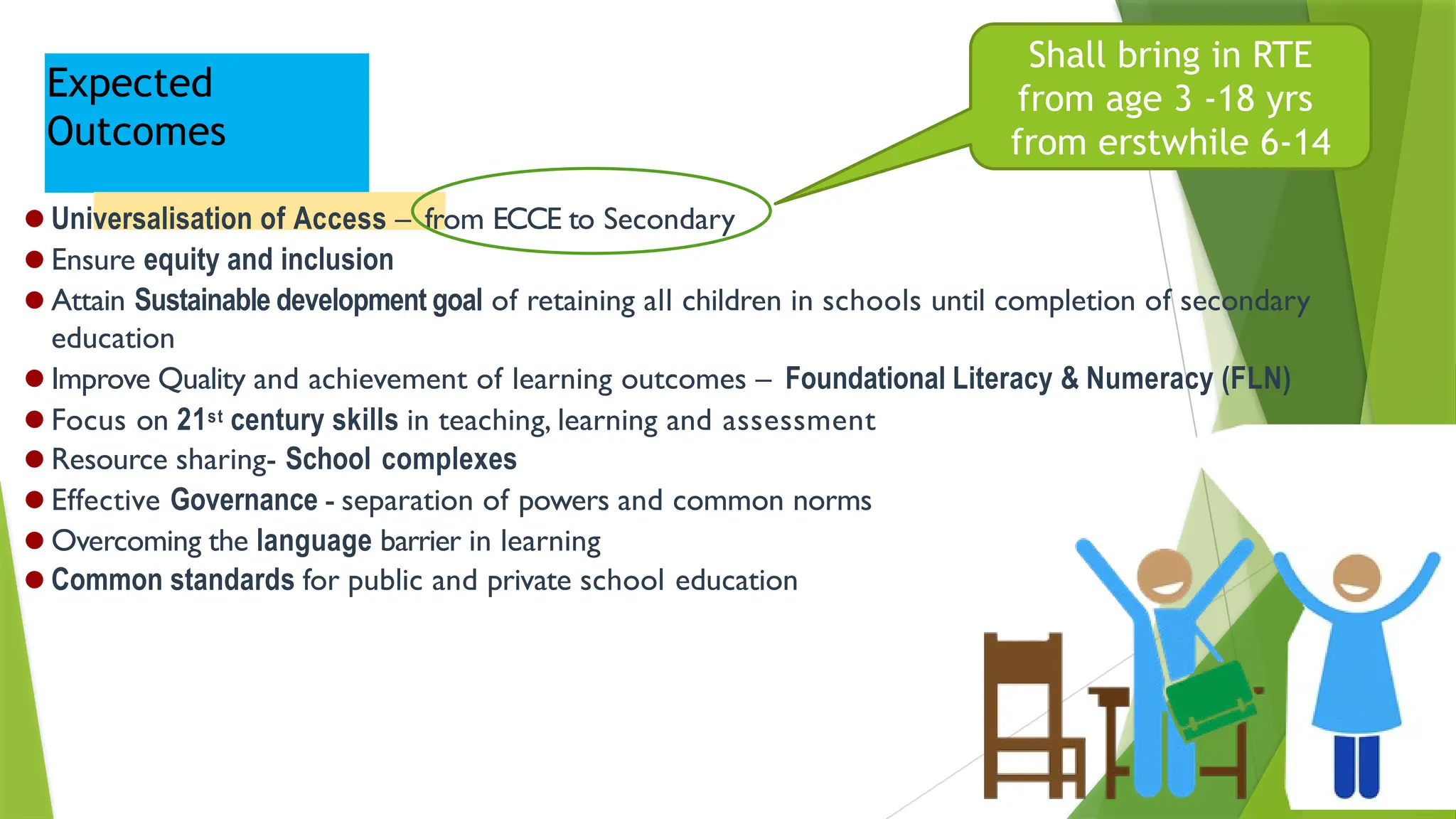
Expected
Outcomes
●Universalisation of Access – from ECCE to Secondary
●Ensure equity and inclusion
●Attain Sustainable development goal of retaining all children in schools until completion of secondary
education
●Improve Quality and achievement of learning outcomes – Foundational Literacy & Numeracy (FLN)
●Focus on 21st century skills in teaching, learning and assessment
●Resource sharing- School complexes
●Effective Governance - separation of powers and common norms
●Overcoming the language barrier in learning
●Common standards for public and private school education
Shall bring in RTE
from age 3 -18 yrs
from erstwhile 6-14
How children will learn ?
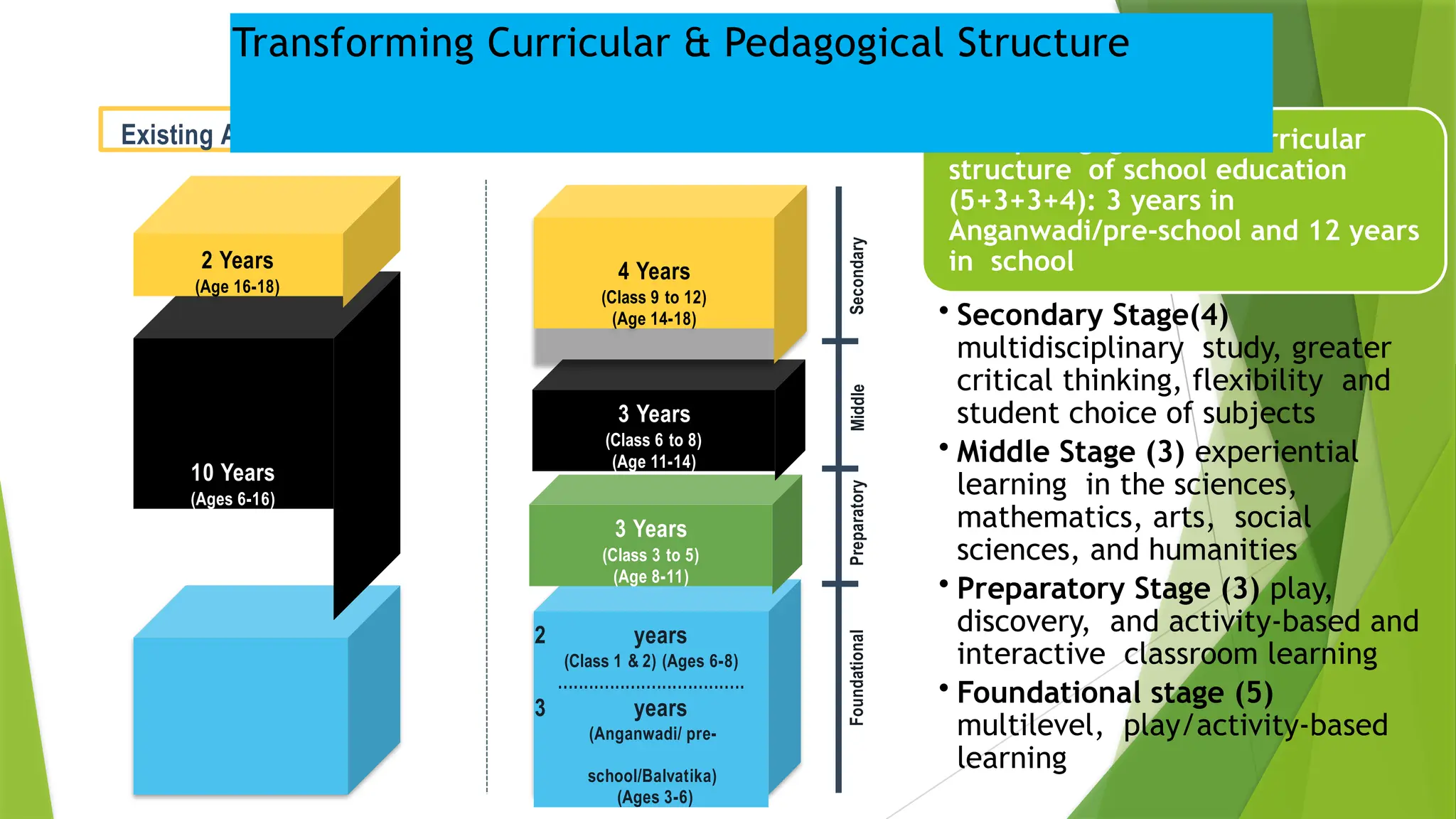
New pedagogical and curricular
structure of school education
(5+3+3+4): 3 years in
Anganwadi/pre-school and 12 years
in school
• Secondary Stage(4)
multidisciplinary study, greater
critical thinking, flexibility and
student choice of subjects
• Middle Stage (3) experiential
learning in the sciences,
mathematics, arts, social
sciences, and humanities
• Preparatory Stage (3) play,
discovery, and activity-based and
interactive classroom learning
• Foundational stage (5)
multilevel, play/activity-based
learning
Middle
10 Years
(Ages 6-16)
2 Years
(Age 16-18)
2 years
(Class 1 & 2) (Ages 6-8)
....................................
3 years
(Anganwadi/ pre-
school/Balvatika)
(Ages 3-6)
3 Years
(Class 3 to 5)
(Age 8-11)
3 Years
(Class 6 to 8)
(Age 11-14)
4 Years
(Class 9 to 12)
(Age 14-18)
Existing Academic Structure New Academic Structure
Foundational
Preparatory
Secondary
Transforming Curricular & Pedagogical Structure
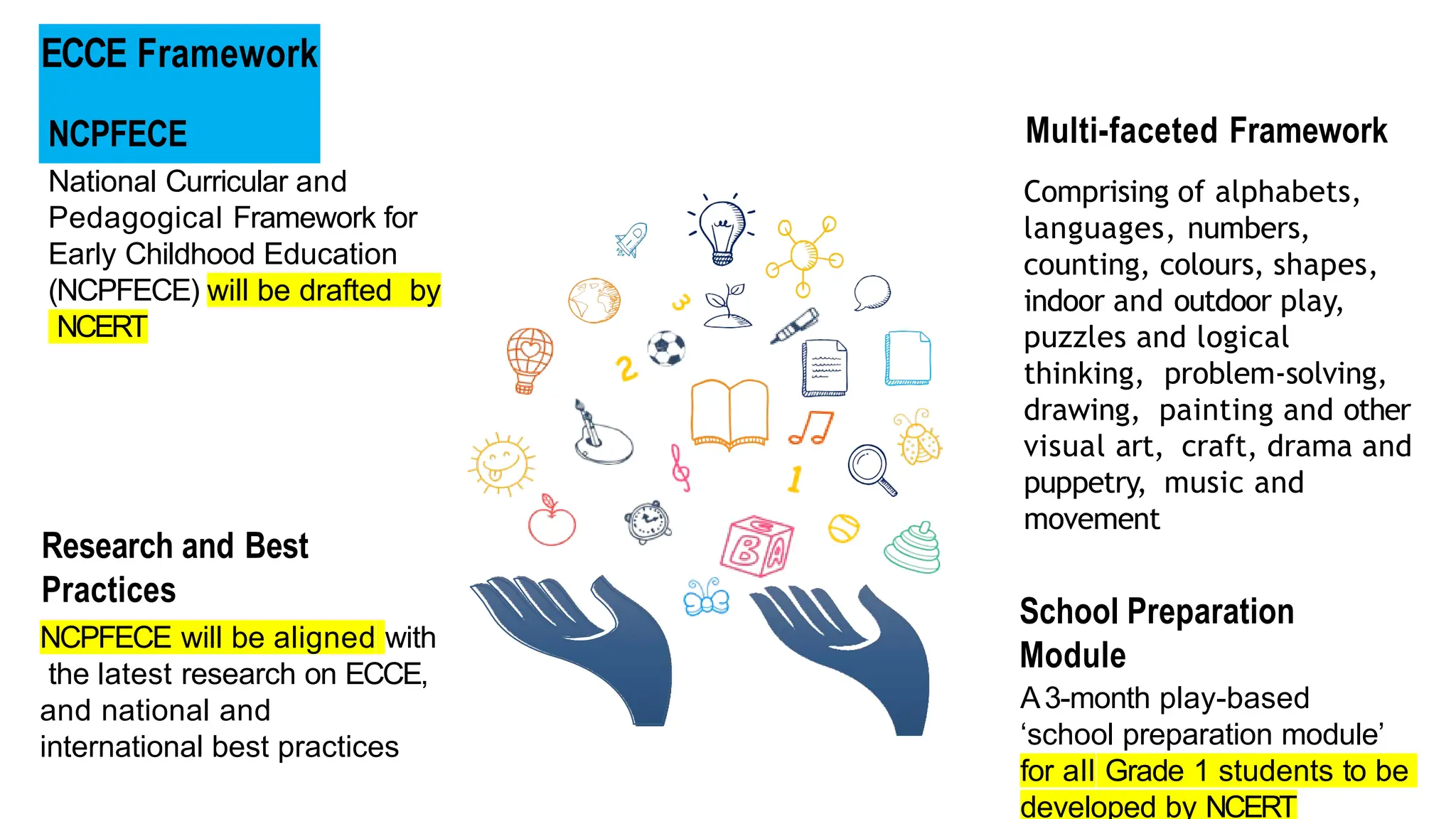
ECCE Framework
Research and Best
Practices
NCPFECE will be aligned with
the latest research on ECCE,
and national and
international best practices
Multi-faceted Framework
Comprising of alphabets,
languages, numbers,
counting, colours, shapes,
indoor and outdoor play,
puzzles and logical
thinking, problem-solving,
drawing, painting and other
visual art, craft, drama and
puppetry, music and
movement
School Preparation
Module
A3-month play-based
‘school preparation module’
for all Grade 1 students to be
developed by NCERT
NCPFECE
National Curricular and
Pedagogical Framework for
Early Childhood Education
(NCPFECE) will be drafted by
NCERT
Curriculum
Experiential Learning
Fun, creative, collaborative,
and exploratory activities in
classroom for experiential
learning and deeper student
learning
Reduction in Curriculum
Core Essentials
Curriculum in all
subjects to be reduced
to its core essentials
Critical Thinking
Focus on critical
thinking, inquiry,
discovery, discussion
and analysis- based
teaching and learning
methods for holistic
education
Interactive Classes
Interactive teaching
with reduced
dependency on
textbook learning;
Questions from
students will be
promoted
● Curriculum and pedagogy to be transformed by 2022 to promote skill based and minimize rote based
learning
● Revision of NCF 2005 for school education and NCF for teacher education 2009 by 2021
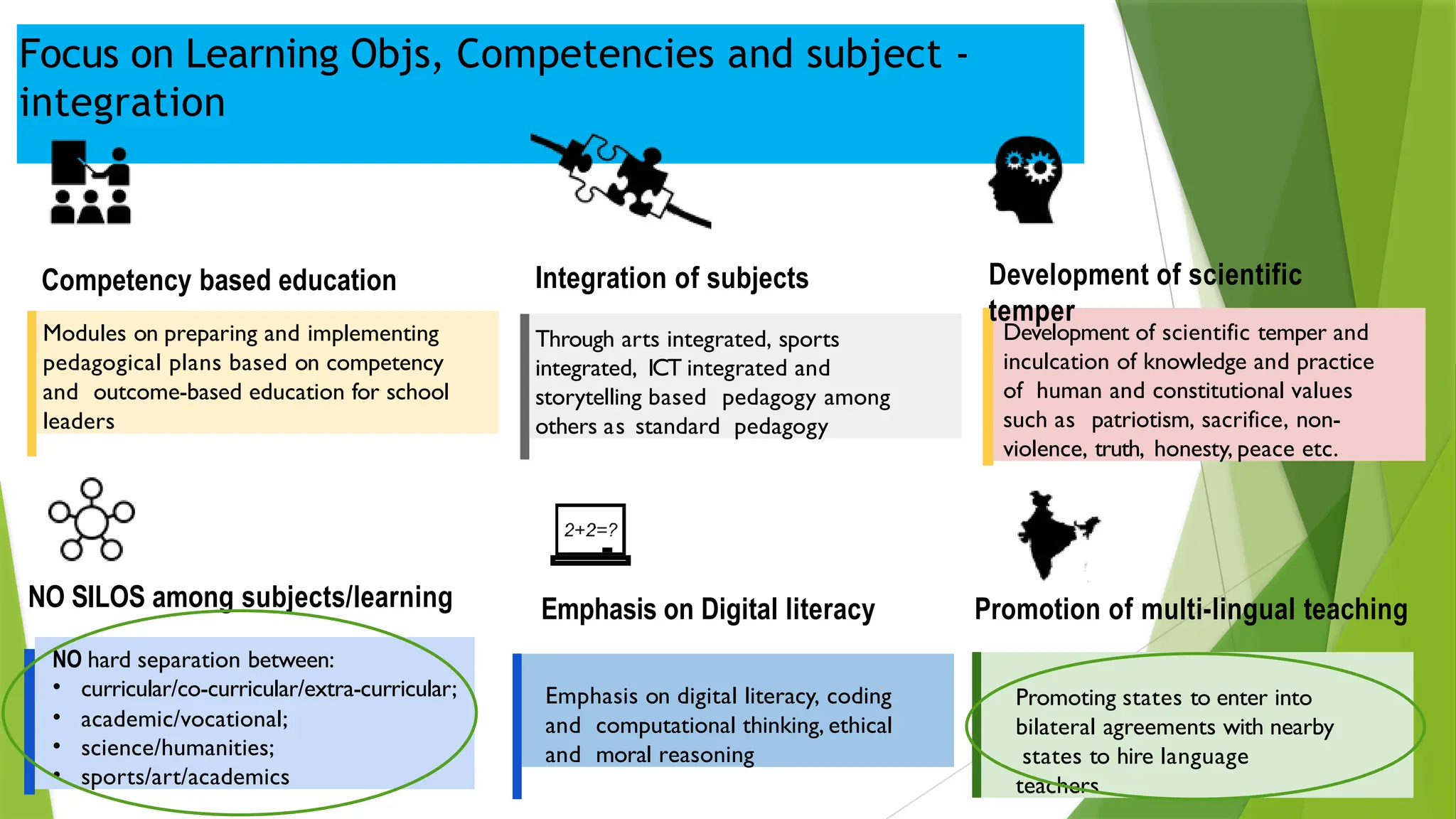
Focus on Learning Objs, Competencies and subject -
integration
Modules on preparing and implementing
pedagogical plans based on competency
and outcome-based education for school
leaders
NO hard separation between:
• curricular/co-curricular/extra-curricular;
• academic/vocational;
• science/humanities;
• sports/art/academics
Through arts integrated, sports
integrated, ICT integrated and
storytelling based pedagogy among
others as standard pedagogy
Emphasis on digital literacy, coding
and computational thinking, ethical
and moral reasoning
Development of scientific temper and
inculcation of knowledge and practice
of human and constitutional values
such as patriotism, sacrifice, non-
violence, truth, honesty, peace etc.
Competency based education Integration of subjects Development of scientific
temper
NO SILOS among subjects/learning Emphasis on Digital literacy Promotion of multi-lingual teaching
Promoting states to enter into
bilateral agreements with nearby
states to hire language
teachers
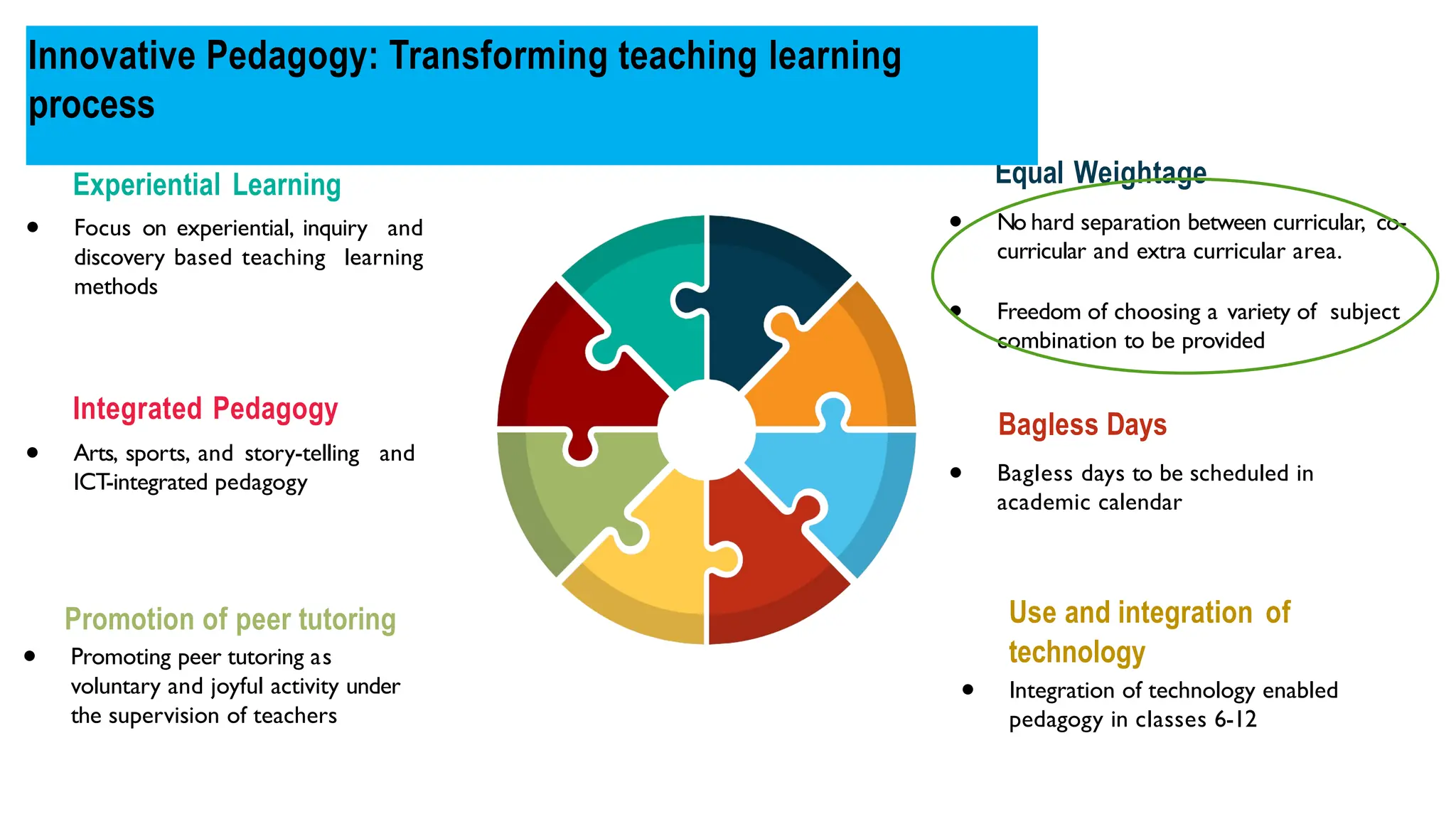
Experiential Learning
● Focus on experiential, inquiry and
discovery based teaching learning
methods
Integrated Pedagogy
● Arts, sports, and story-telling and
ICT-integrated pedagogy
Equal Weightage
● No hard separation between curricular, co-
curricular and extra curricular area.
● Freedom of choosing a variety of subject
combination to be provided
Bagless Days
● Bagless days to be scheduled in
academic calendar
Innovative Pedagogy: Transforming teaching learning
process
Promotion of peer tutoring
● Promoting peer tutoring as
voluntary and joyful activity under
the supervision of teachers
Use and integration of
technology
● Integration of technology enabled
pedagogy in classes 6-12
All textbooks to contain only
essential core material while
capturing any desired nuances
and supplementary material
as per local contexts and
needs
Affordable, high-quality and
energised textbooks to be
provided along with free
digital version on DIKSHA
Platform
States to prepare their own
curricula and textbooks based
on NCERT curriculum and
textbooks, incorporating State
flavour and material as
needed
Concerted efforts, through
suitable changes in
curriculum and pedagogy to
significantly reduce the
weight of school bags and
textbooks
Textbook with local content and flavour
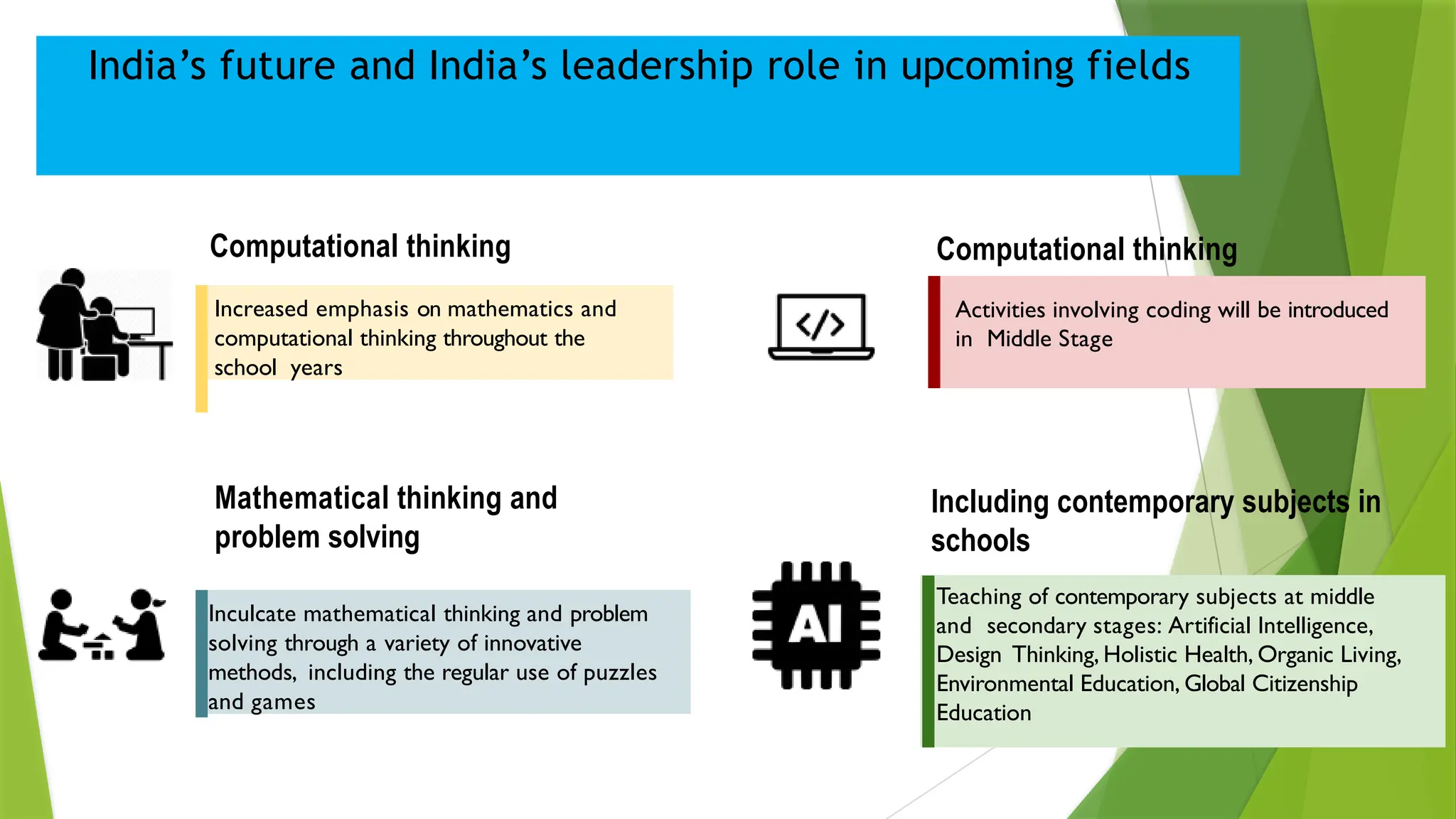
India’s future and India’s leadership role in upcoming fields
Increased emphasis on mathematics and
computational thinking throughout the
school years
Inculcate mathematical thinking and problem
solving through a variety of innovative
methods, including the regular use of puzzles
and games
Activities involving coding will be introduced
in Middle Stage
Teaching of contemporary subjects at middle
and secondary stages: Artificial Intelligence,
Design Thinking, Holistic Health, Organic Living,
Environmental Education, Global Citizenship
Education
Mathematical thinking and
problem solving
Computational thinking
Including contemporary subjects in
schools
Computational thinking
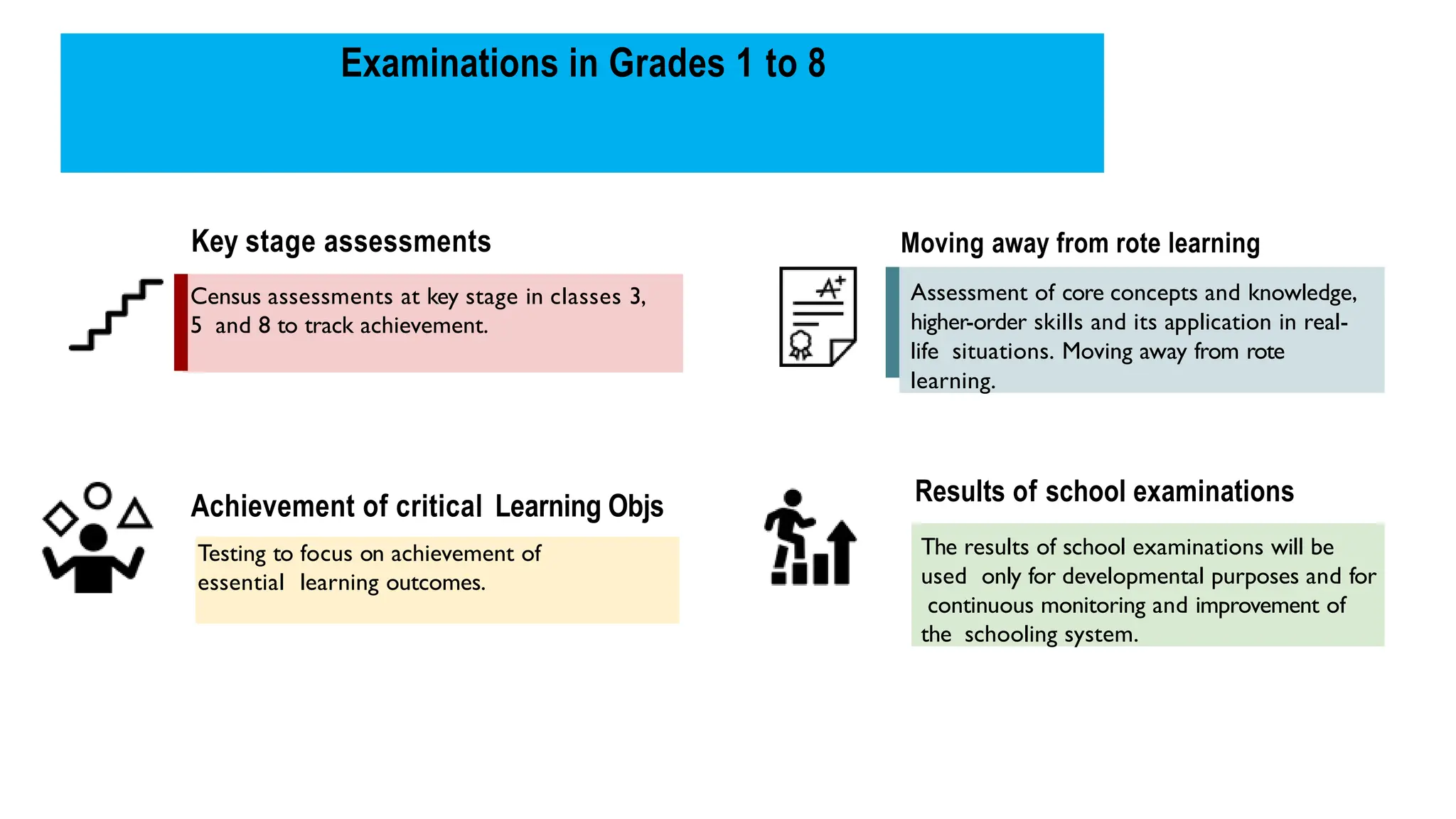
Examinations in Grades 1 to 8
Census assessments at key stage in classes 3,
5 and 8 to track achievement.
Testing to focus on achievement of
essential learning outcomes.
Assessment of core concepts and knowledge,
higher-order skills and its application in real-
life situations. Moving away from rote
learning.
The results of school examinations will be
used only for developmental purposes and for
continuous monitoring and improvement of
the schooling system.
Key stage assessments
Achievement of critical Learning Objs
Moving away from rote learning
Results of school examinations
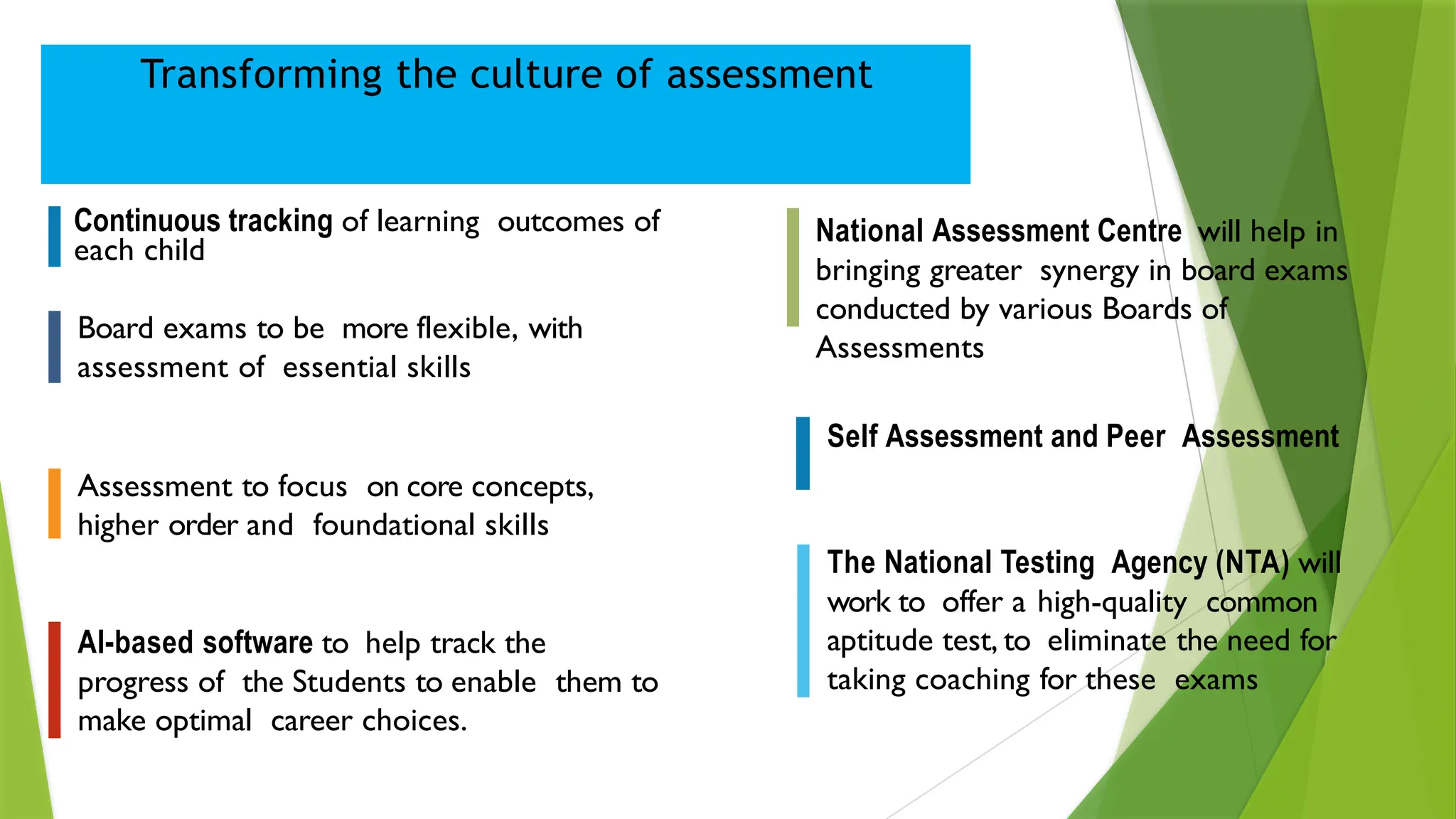
Transforming the culture of assessment
Assessment to focus on core concepts,
higher order and foundational skills
Board exams to be more flexible, with
assessment of essential skills
Continuous tracking of learning outcomes of
each child
The National Testing Agency (NTA) will
work to offer a high-quality common
aptitude test, to eliminate the need for
taking coaching for these exams
AI-based software to help track the
progress of the Students to enable them to
make optimal career choices.
Self Assessment and Peer Assessment
National Assessment Centre will help in
bringing greater synergy in board exams
conducted by various Boards of
Assessments
● Medium of instruction uptil grade 5, and
preferably till Grade 8 and beyond, will
be home language/ mother-tongue/
local language
● ‘The Languages of India’ a fun
project/ activity on to be taken by
every student
● Three languages to be taught will be
decided by state/UT
● All classical languages will be
Multilingualism and the Power of Language Learning
Schools
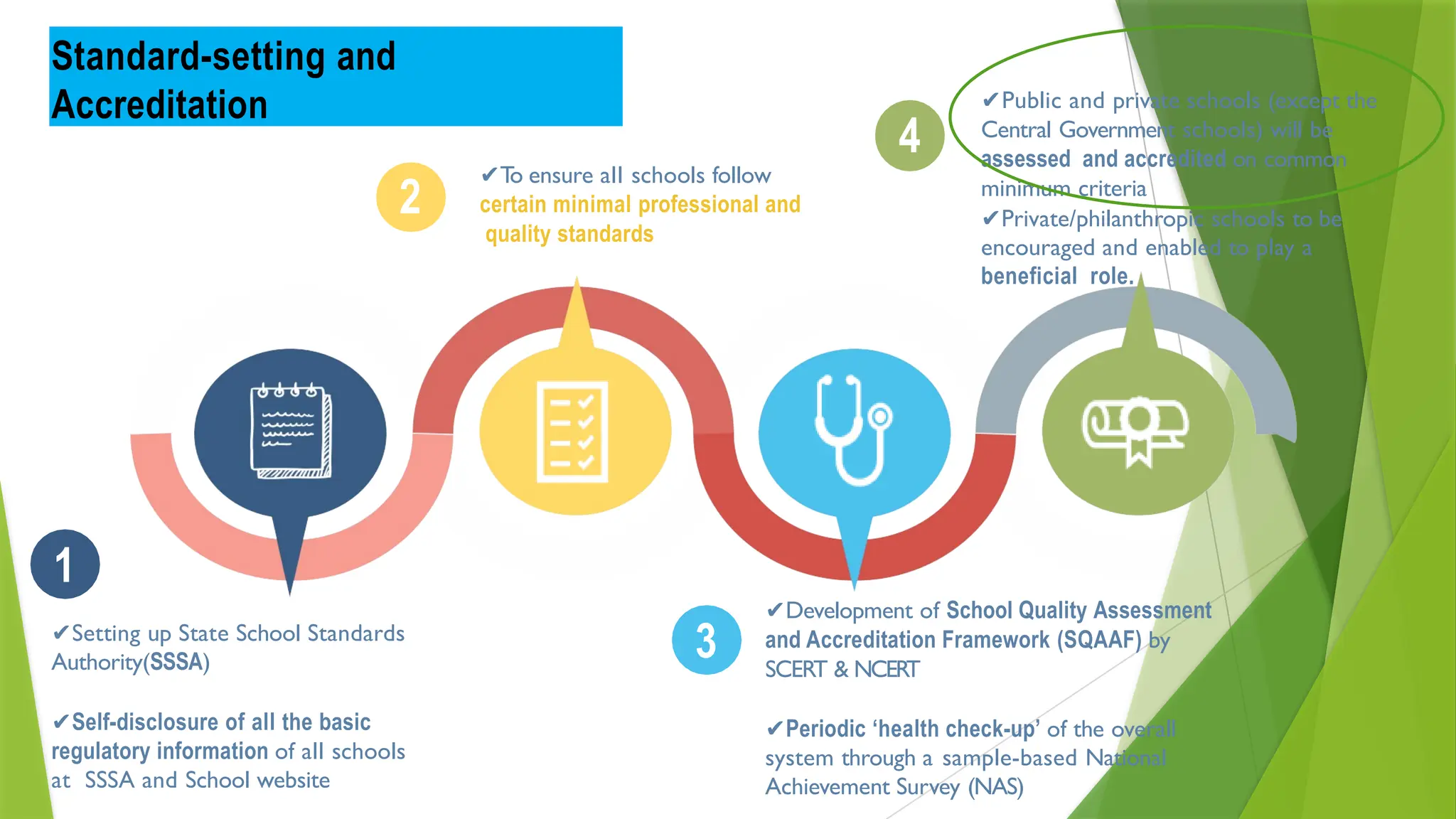
Standard-setting and
Accreditation
2
3
4
1
✔Setting up State School Standards
Authority(SSSA)
✔Self-disclosure of all the basic
regulatory information of all schools
at SSSA and School website
✔T
o ensure all schools follow
certain minimal professional and
quality standards
✔Development of School Quality Assessment
and Accreditation Framework (SQAAF) by
SCERT & NCERT
✔Periodic ‘health check-up’ of the overall
system through a sample-based National
Achievement Survey (NAS)
✔Public and private schools (except the
Central Government schools) will be
assessed and accredited on common
minimum criteria
✔Private/philanthropic schools to be
encouraged and enabled to play a
beneficial role.
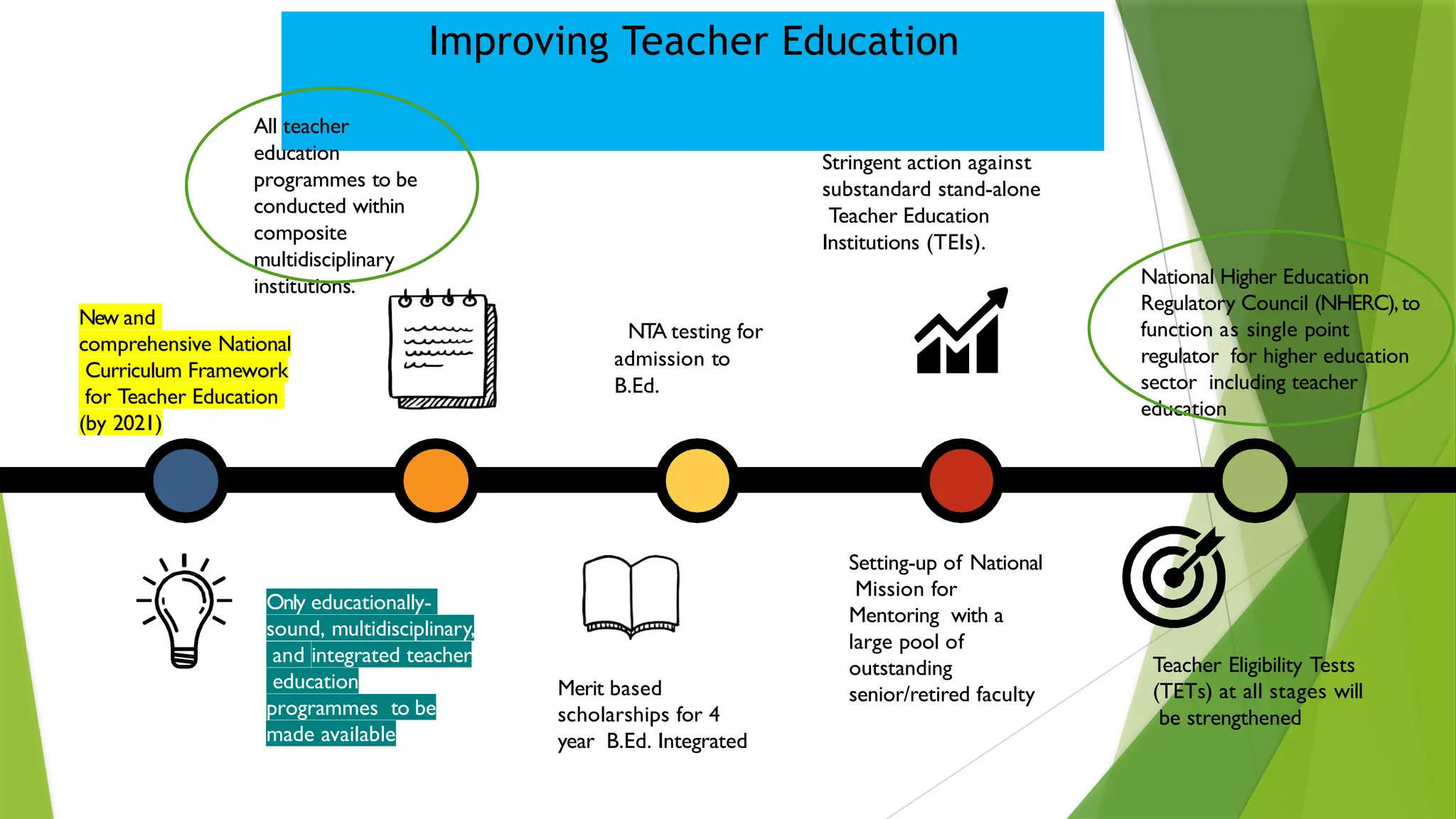
Teachers
Only educationally-
sound, multidisciplinary,
and integrated teacher
education
programmes to be
made available
NTA testing for
admission to
B.Ed.
National Higher Education
Regulatory Council (NHERC),to
function as single point
regulator for higher education
sector including teacher
education
Improving Teacher Education
All teacher
education
programmes to be
conducted within
composite
multidisciplinary
institutions.
New and
comprehensive National
Curriculum Framework
for Teacher Education
(by 2021)
Merit based
scholarships for 4
year B.Ed. Integrated
Setting-up of National
Mission for
Mentoring with a
large pool of
outstanding
senior/retired faculty
Stringent action against
substandard stand-alone
Teacher Education
Institutions (TEIs).
Teacher Eligibility Tests
(TETs) at all stages will
be strengthened
Empowering Teachers
Improving Service Environment through better
infrastructure at school
A technology-based comprehensive teacher-requirement
planning forecasting exercise to be conducted by each
State.
National Professional Standards for Teachers (NPST) by
2022
Career growth to be available for teachers within a
single school stage i.e., Foundational, Preparatory,
Middle, or
Secondary
Teachers to have more autonomy in choosing aspects
of pedagogy in classroom teaching
Teacher Professional Development
● Merit based tenure track system
● Min. 50 hours of Continuous
Professional Development (CPD)
Academic leadership positions to be made available
for teachers.
Necessary facilities for the
initial professional preparation
of these educators and their
Continuous Professional
Development (CPD)
At least 50 hours of CPD
for teachers based on
their own interest and
professional areas
CPD opportunities will, in
particular, systematically cover the
latest pedagogies
School Leadership
Ample opportunity to get upskilled on latest pedagogy
related to foundational literacy and numeracy, formative
and adaptive assessment of learning outcomes,
individualised and competency-based learning and related
pedagogies
Timelines for Implementation in NEP 2020
2021-22 2022-23 2023-24 2024-25 2025-26 2026-27 2027-28 2028-29 2029-30 2040
Formulation National
Curricular Framework for
School Education (NCFSE)
National
Curriculum
Framewor
k for
Teacher
Education
A common guiding set
of National
Professional Standards
for Teachers (NPST)
Attaining universal foundational
literacy and numeracy in all
primary schools for all learners
by grade 3
Universal provisioning of
quality early childhood
development, care
Teachers prepared for
a transformation in
the assessment
system
State/UT governments to
optimize resources through
mechanisms to group or
rationalize schools, such
as, school complexes
At least 50% of learners
exposed to vocational
education in the school
and higher education
system
Teacher education will
gradually be moved into
multidisciplinary colleges and
universities, with minimum
deg. qualification 4-year
B.Ed.
Only educationally sound, multidisciplinary,
and integrated teacher education
programmes shall be in force and all TEIs will
be converted into multi-disciplinary institutes
Policy is fully
operational following
this a
comprehensive
review will be
undertaken
Thank You

NEP 2020 UPDATED presentation for bleachers

  • 1.
    SALIENT PTS OFNEW EDN POLICY By: Bhupendra Sarswat
  • 2.
    The National EducationPolicy (NEP) 2020 is a comprehensive framework for revamping India's education system. It is a landmark policy that has the potential to transform India's education system. The policy aims to make education more holistic, inclusive, and equitable, while also promoting critical thinking and creativity , hence can prepare students for the challenges and opportunities of the 21st century  NEP 2020
  • 3.
    Vision and KeyPrinciples Universal Access and Early Childhood Education How children will Learn - Curricular and Pedagogic structures Curriculum - Learning Outcomes - Competencies Schools - Complex - Accreditation Teachers - Education and Development Goals and Implementation Plan Impact on Schools PREVIEW
  • 4.
    Vision of theNational Education Policy 2020 1 Develops a deep sense of respect towards the fundamental rights, duties and Constitutional values, bonding with one’s country, and a conscious awareness of one’s role and responsibilities in a changing world. 2 3 An education system that contributes to an equitable and vibrant knowledge society, by providing high-quality education to all. Instil skills, values and dispositions that support responsible commitment to human rights, sustainable development and living, and global well-being, thereby reflecting a truly global citizen.
  • 5.
    Vision of theNational Education Policy 2020 Nurturing well-rounded individuals: Develops the unique capabilities of each student, fostering their intellectual, social, emotional, and physical growth. Inclusive and Equitable Education: Ensures inclusive and equitable education for all, regardless of their background, gender, or social status. Holistic Learning: Encourages holistic learning, focusing on the overall development of the child, including their cognitive, affective, and psychomotor domains. Critical Thinking and Creativity: Promotes critical thinking, creativity, and problem-solving skills among students. Ethical Values and Good Citizens: Develops ethical values, social responsibility, and global citizenship among students.
  • 6.
    Key Principles ofNEP Access, Equity, and Quality and affordability Multilingualism: Promoting multilingualism and preserving India's diverse cultural heritage. Teacher Empowerment: Empowering teachers through professional development and creating a conducive work environment. Foundational Literacy and Numeracy: Prioritizing foundational literacy and numeracy skills by Grade 3. Flexibility and Multidisciplinarity: Providing flexible and multidisciplinary education options that allow students to pursue their interests and talents. Accountability: Establishing a robust accountability framework to ensure the quality and effectiveness of education Innovation and Experimentation: Encouraging innovation and experimentation in education.
  • 7.
    Key Principles ofNEP Emphasize Conceptual Understanding Rather than rote learning and learning-for-exams Unique Capabilities Recognizing, identifying them in each student. Critical Thinking and Creativity To encourage logical decision- making and innovation Continuous Review Based on sustained research and regular assessment by educational experts. Respect for Diversity & Local Context In all curriculum, pedagogy, and policy. Equity & Inclusion As the cornerstone of all educational decisions. Community Participation Encouragement and facilitation for philanthropic, private and community participation. Technological Integration: Leveraging technology to enhance teaching-learning processes and access to education In teaching and learning, removing language barriers, for Divyang students, and in educational planning and management.
  • 8.
    Universal Access toEarly Childhood Care & Education (ECCE) Foundational Learning Curriculum For age group of 3-8 divided in two parts: (i) Age 3-6 in ECCE and (ii) Age 6-8 in class I and II in primary school Universal Access For children of 3-6 years: access to free, safe, high quality ECCE at Anganwadis/Pre-school/Balvatika Multifaceted Flexible, multi-level, play-based, activity-based, and inquiry- based learning Preparatory Class Prior to the age of 6 every child will move to a “Preparatory Class” or “Balvatika” (that is, before Class 1) Implementation to be jointly carried out by Ministries of HRD, Women and Child Development (WCD), Health and Family Welfare (HFW), and Tribal Affairs
  • 9.
    Expected Outcomes ●Universalisation of Access– from ECCE to Secondary ●Ensure equity and inclusion ●Attain Sustainable development goal of retaining all children in schools until completion of secondary education ●Improve Quality and achievement of learning outcomes – Foundational Literacy & Numeracy (FLN) ●Focus on 21st century skills in teaching, learning and assessment ●Resource sharing- School complexes ●Effective Governance - separation of powers and common norms ●Overcoming the language barrier in learning ●Common standards for public and private school education Shall bring in RTE from age 3 -18 yrs from erstwhile 6-14
  • 10.
  • 11.
    New pedagogical andcurricular structure of school education (5+3+3+4): 3 years in Anganwadi/pre-school and 12 years in school • Secondary Stage(4) multidisciplinary study, greater critical thinking, flexibility and student choice of subjects • Middle Stage (3) experiential learning in the sciences, mathematics, arts, social sciences, and humanities • Preparatory Stage (3) play, discovery, and activity-based and interactive classroom learning • Foundational stage (5) multilevel, play/activity-based learning Middle 10 Years (Ages 6-16) 2 Years (Age 16-18) 2 years (Class 1 & 2) (Ages 6-8) .................................... 3 years (Anganwadi/ pre- school/Balvatika) (Ages 3-6) 3 Years (Class 3 to 5) (Age 8-11) 3 Years (Class 6 to 8) (Age 11-14) 4 Years (Class 9 to 12) (Age 14-18) Existing Academic Structure New Academic Structure Foundational Preparatory Secondary Transforming Curricular & Pedagogical Structure
  • 12.
    ECCE Framework Research andBest Practices NCPFECE will be aligned with the latest research on ECCE, and national and international best practices Multi-faceted Framework Comprising of alphabets, languages, numbers, counting, colours, shapes, indoor and outdoor play, puzzles and logical thinking, problem-solving, drawing, painting and other visual art, craft, drama and puppetry, music and movement School Preparation Module A3-month play-based ‘school preparation module’ for all Grade 1 students to be developed by NCERT NCPFECE National Curricular and Pedagogical Framework for Early Childhood Education (NCPFECE) will be drafted by NCERT
  • 13.
  • 14.
    Experiential Learning Fun, creative,collaborative, and exploratory activities in classroom for experiential learning and deeper student learning Reduction in Curriculum Core Essentials Curriculum in all subjects to be reduced to its core essentials Critical Thinking Focus on critical thinking, inquiry, discovery, discussion and analysis- based teaching and learning methods for holistic education Interactive Classes Interactive teaching with reduced dependency on textbook learning; Questions from students will be promoted ● Curriculum and pedagogy to be transformed by 2022 to promote skill based and minimize rote based learning ● Revision of NCF 2005 for school education and NCF for teacher education 2009 by 2021
  • 15.
    Focus on LearningObjs, Competencies and subject - integration Modules on preparing and implementing pedagogical plans based on competency and outcome-based education for school leaders NO hard separation between: • curricular/co-curricular/extra-curricular; • academic/vocational; • science/humanities; • sports/art/academics Through arts integrated, sports integrated, ICT integrated and storytelling based pedagogy among others as standard pedagogy Emphasis on digital literacy, coding and computational thinking, ethical and moral reasoning Development of scientific temper and inculcation of knowledge and practice of human and constitutional values such as patriotism, sacrifice, non- violence, truth, honesty, peace etc. Competency based education Integration of subjects Development of scientific temper NO SILOS among subjects/learning Emphasis on Digital literacy Promotion of multi-lingual teaching Promoting states to enter into bilateral agreements with nearby states to hire language teachers
  • 16.
    Experiential Learning ● Focuson experiential, inquiry and discovery based teaching learning methods Integrated Pedagogy ● Arts, sports, and story-telling and ICT-integrated pedagogy Equal Weightage ● No hard separation between curricular, co- curricular and extra curricular area. ● Freedom of choosing a variety of subject combination to be provided Bagless Days ● Bagless days to be scheduled in academic calendar Innovative Pedagogy: Transforming teaching learning process Promotion of peer tutoring ● Promoting peer tutoring as voluntary and joyful activity under the supervision of teachers Use and integration of technology ● Integration of technology enabled pedagogy in classes 6-12
  • 17.
    All textbooks tocontain only essential core material while capturing any desired nuances and supplementary material as per local contexts and needs Affordable, high-quality and energised textbooks to be provided along with free digital version on DIKSHA Platform States to prepare their own curricula and textbooks based on NCERT curriculum and textbooks, incorporating State flavour and material as needed Concerted efforts, through suitable changes in curriculum and pedagogy to significantly reduce the weight of school bags and textbooks Textbook with local content and flavour
  • 18.
    India’s future andIndia’s leadership role in upcoming fields Increased emphasis on mathematics and computational thinking throughout the school years Inculcate mathematical thinking and problem solving through a variety of innovative methods, including the regular use of puzzles and games Activities involving coding will be introduced in Middle Stage Teaching of contemporary subjects at middle and secondary stages: Artificial Intelligence, Design Thinking, Holistic Health, Organic Living, Environmental Education, Global Citizenship Education Mathematical thinking and problem solving Computational thinking Including contemporary subjects in schools Computational thinking
  • 19.
    Examinations in Grades1 to 8 Census assessments at key stage in classes 3, 5 and 8 to track achievement. Testing to focus on achievement of essential learning outcomes. Assessment of core concepts and knowledge, higher-order skills and its application in real- life situations. Moving away from rote learning. The results of school examinations will be used only for developmental purposes and for continuous monitoring and improvement of the schooling system. Key stage assessments Achievement of critical Learning Objs Moving away from rote learning Results of school examinations
  • 20.
    Transforming the cultureof assessment Assessment to focus on core concepts, higher order and foundational skills Board exams to be more flexible, with assessment of essential skills Continuous tracking of learning outcomes of each child The National Testing Agency (NTA) will work to offer a high-quality common aptitude test, to eliminate the need for taking coaching for these exams AI-based software to help track the progress of the Students to enable them to make optimal career choices. Self Assessment and Peer Assessment National Assessment Centre will help in bringing greater synergy in board exams conducted by various Boards of Assessments
  • 21.
    ● Medium ofinstruction uptil grade 5, and preferably till Grade 8 and beyond, will be home language/ mother-tongue/ local language ● ‘The Languages of India’ a fun project/ activity on to be taken by every student ● Three languages to be taught will be decided by state/UT ● All classical languages will be Multilingualism and the Power of Language Learning
  • 22.
  • 23.
    Standard-setting and Accreditation 2 3 4 1 ✔Setting upState School Standards Authority(SSSA) ✔Self-disclosure of all the basic regulatory information of all schools at SSSA and School website ✔T o ensure all schools follow certain minimal professional and quality standards ✔Development of School Quality Assessment and Accreditation Framework (SQAAF) by SCERT & NCERT ✔Periodic ‘health check-up’ of the overall system through a sample-based National Achievement Survey (NAS) ✔Public and private schools (except the Central Government schools) will be assessed and accredited on common minimum criteria ✔Private/philanthropic schools to be encouraged and enabled to play a beneficial role.
  • 24.
  • 25.
    Only educationally- sound, multidisciplinary, andintegrated teacher education programmes to be made available NTA testing for admission to B.Ed. National Higher Education Regulatory Council (NHERC),to function as single point regulator for higher education sector including teacher education Improving Teacher Education All teacher education programmes to be conducted within composite multidisciplinary institutions. New and comprehensive National Curriculum Framework for Teacher Education (by 2021) Merit based scholarships for 4 year B.Ed. Integrated Setting-up of National Mission for Mentoring with a large pool of outstanding senior/retired faculty Stringent action against substandard stand-alone Teacher Education Institutions (TEIs). Teacher Eligibility Tests (TETs) at all stages will be strengthened
  • 26.
    Empowering Teachers Improving ServiceEnvironment through better infrastructure at school A technology-based comprehensive teacher-requirement planning forecasting exercise to be conducted by each State. National Professional Standards for Teachers (NPST) by 2022 Career growth to be available for teachers within a single school stage i.e., Foundational, Preparatory, Middle, or Secondary Teachers to have more autonomy in choosing aspects of pedagogy in classroom teaching Teacher Professional Development ● Merit based tenure track system ● Min. 50 hours of Continuous Professional Development (CPD) Academic leadership positions to be made available for teachers.
  • 27.
    Necessary facilities forthe initial professional preparation of these educators and their Continuous Professional Development (CPD) At least 50 hours of CPD for teachers based on their own interest and professional areas CPD opportunities will, in particular, systematically cover the latest pedagogies School Leadership Ample opportunity to get upskilled on latest pedagogy related to foundational literacy and numeracy, formative and adaptive assessment of learning outcomes, individualised and competency-based learning and related pedagogies
  • 28.
    Timelines for Implementationin NEP 2020 2021-22 2022-23 2023-24 2024-25 2025-26 2026-27 2027-28 2028-29 2029-30 2040 Formulation National Curricular Framework for School Education (NCFSE) National Curriculum Framewor k for Teacher Education A common guiding set of National Professional Standards for Teachers (NPST) Attaining universal foundational literacy and numeracy in all primary schools for all learners by grade 3 Universal provisioning of quality early childhood development, care Teachers prepared for a transformation in the assessment system State/UT governments to optimize resources through mechanisms to group or rationalize schools, such as, school complexes At least 50% of learners exposed to vocational education in the school and higher education system Teacher education will gradually be moved into multidisciplinary colleges and universities, with minimum deg. qualification 4-year B.Ed. Only educationally sound, multidisciplinary, and integrated teacher education programmes shall be in force and all TEIs will be converted into multi-disciplinary institutes Policy is fully operational following this a comprehensive review will be undertaken
  • 29.