IRS Circular 230 Disclosure: To ensure compliance with the requirements imposed by the IRS, we inform you that any tax advice contained in this communication,
including any attachment to this communication, is not intended or written to be used, and cannot be used, by any taxpayer for the purpose of (1) avoiding penalties
under the Internal Revenue Code or (2) promoting, marketing or recommending to any other person any transaction or matter addressed herein.
Roger Royse
Royse Law Firm, PC
Palo Alto, San Francisco, Los Angeles
rroyse@rroyselaw.com
www.rogerroyse.com
www.rroyselaw.com
Skype: roger.royse
Twitter @rroyse00
Negotiating Reverse and Forward
Triangular Mergers
OVERVIEW
(1) What is a forward/reverse triangular merger?
(2) Legal steps to follow
(3) Anti-assignment clauses
(4) Benefits of triangular mergers
(5) Forward vs. reverse
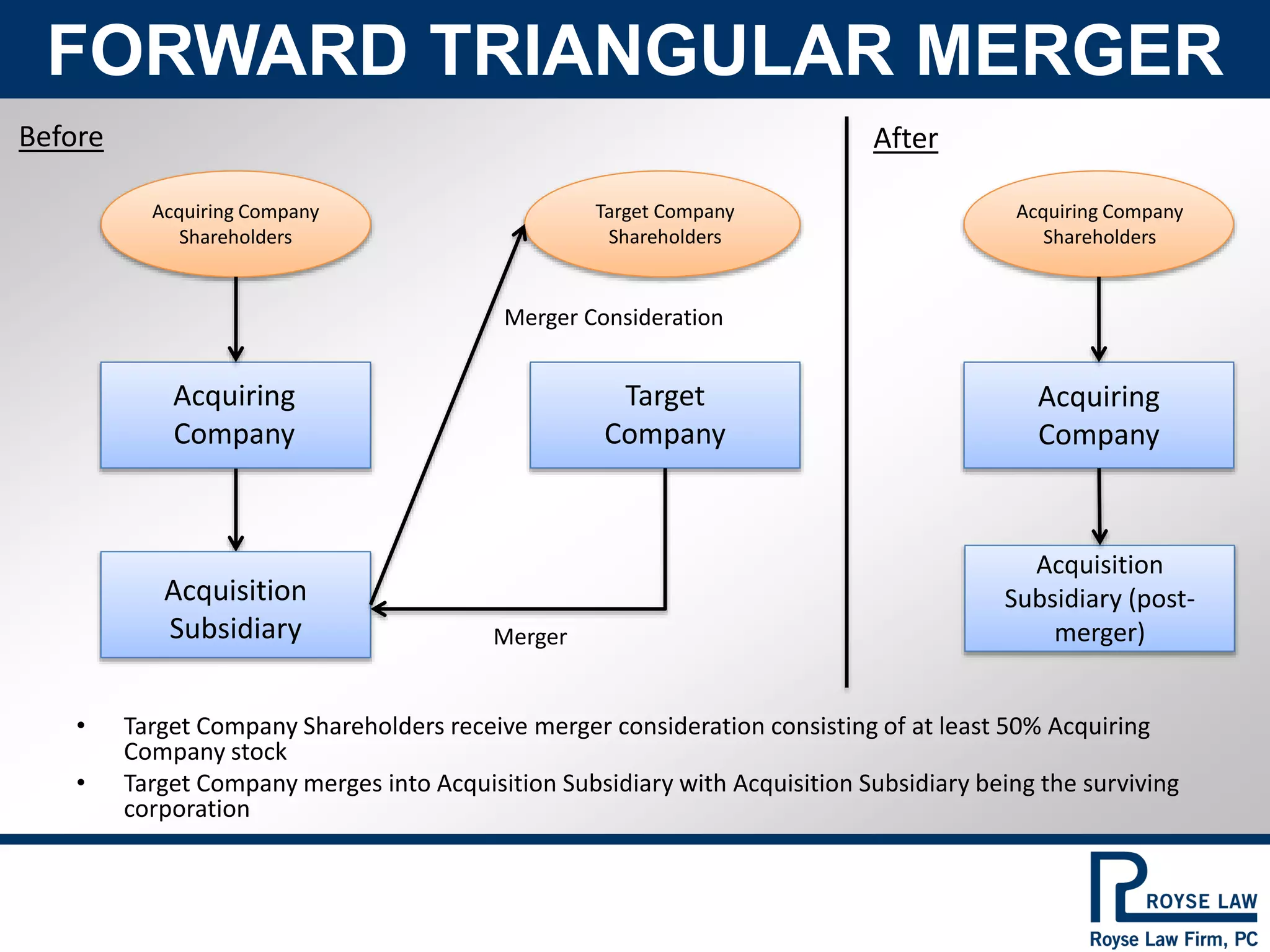
FORWARD TRIANGULAR MERGER
• Target Company Shareholders receive merger consideration consisting of at least 50% Acquiring
Company stock
• Target Company merges into Acquisition Subsidiary with Acquisition Subsidiary being the surviving
corporation
Acquiring Company
Shareholders
Acquiring
Company
Acquisition
Subsidiary
Target Company
Shareholders
Target
Company
Acquisition
Subsidiary (post-
merger)Merger
Merger Consideration
Acquiring Company
Shareholders
Acquiring
Company
Before After
REVERSE TRIANGULAR MERGER
• Target Company Shareholders receive merger consideration consisting of at least 80% voting stock
of Acquiring Company
• Acquisition Subsidiary merges into Target Company with Target Company being the surviving
corporation
Acquiring Company
Shareholders
Acquiring
Company
Acquisition
Subsidiary
Target Company
Shareholders
Target
Company
Target Company
(post-merger)
Merger
Merger Consideration
Acquiring Company
Shareholders
Acquiring
Company
Before After
LEGAL STEPS
• Form Acquisition Subsidiary
– Capitalize Acquisition Subsidiary with merger
consideration
• Agreement and plan of merger
• Board of Directors approvals
– Acquisition Subsidiary
– Acquiring Company
– Target Company
• Target Company shareholder vote
ANTI-ASSIGNMENT CLAUSES
• Beware “anti-assignment” provisions in Target Company’s
contracts
– Look for anti-assignment or anti-transfer provisions
– Are there any IP license grants to Target Company that will
require consent for transfer?
• Consider the state law merger statute
– Generally, forward triangular mergers trigger anti-assignment
provisions, but reverse triangular mergers do not
– Exception: Under California law, reverse triangular mergers may
trigger anti-assignment clauses
• Review any “change of control” provisions in Target
Company’s contracts
WHY ADOPT A TRIANGULAR
MERGER?
• Acquiring Company remains separate from Target
Company liabilities
– However, Acquisition Subsidiary needs to assume
“substantially all” of Target Company’s business and
therefore it cannot leave behind the liabilities
• No approval from Acquiring Company
shareholders
– There is a shareholder vote of Acquisition Subsidiary,
however Acquiring Company is usually the sole
shareholder of Acquisition Subsidiary
FORWARD VS. REVERSE
• Forward triangular mergers
– More likely to trigger anti-assignment provisions in Target
Company’s contracts
– Will need a new Taxpayer Identification Number (TIN) and
therefore new payroll
– However, only 50% of the merger consideration needs to
be stock of the Acquiring Company
• Stock does not need to be voting stock
• Reverse triangular mergers
– Less likely to trigger anti-assignment provisions in Target
Company’s contracts
– Retain TIN and continue existing payroll
– 80% of the merger consideration needs to be voting stock
of the Acquiring Company
FORWARD VS. REVERSE
• Failure to satisfy the respective stock consideration
requirements results in a “busted” merger
– Reverse triangular mergers are riskier due to the 80%
voting stock requirement
• Busted forward triangular merger = reclassification as
an asset sale followed by a liquidation
– Two levels of tax
• Busted reverse triangular merger = reclassification as a
stock sale
– One level of tax
• Therefore the forward triangular merger is the safest
option, but with the highest penalty (two levels of tax
vs. one level of tax) should the merger fail
RoyseLink: Connecting founders with investors and service
partners.
Royse University: Providing business, tax, and personal
finance ideas to founders and executives.
Royse Law Legal Wizard: Offering legal document
templates and more.
RoyseUniversity.com
RoyseLink.com
RoyseLaw Legal Wizard
Royse Law Incorporator: Designed to help you incorporate
and structure your company in Delaware or California.
RoyseLaw Incorporator.com
www.rroyselaw.com
@RoyseLaw
PALO ALTO
1717 Embarcadero Road
Palo Alto, CA 94303
LOS ANGELES
11150 Santa Monica Blvd.
Suite 1200
Los Angeles, CA 90025
SAN FRANCISCO
135 Main Street
12th Floor
San Francisco, CA 94105
Palo Alto Office: 650-813-9700
Contact Us

Negotiating Reverse and Forward Triangular Mergers

  • 1.
    IRS Circular 230Disclosure: To ensure compliance with the requirements imposed by the IRS, we inform you that any tax advice contained in this communication, including any attachment to this communication, is not intended or written to be used, and cannot be used, by any taxpayer for the purpose of (1) avoiding penalties under the Internal Revenue Code or (2) promoting, marketing or recommending to any other person any transaction or matter addressed herein. Roger Royse Royse Law Firm, PC Palo Alto, San Francisco, Los Angeles rroyse@rroyselaw.com www.rogerroyse.com www.rroyselaw.com Skype: roger.royse Twitter @rroyse00 Negotiating Reverse and Forward Triangular Mergers
  • 2.
    OVERVIEW (1) What isa forward/reverse triangular merger? (2) Legal steps to follow (3) Anti-assignment clauses (4) Benefits of triangular mergers (5) Forward vs. reverse
  • 3.
    FORWARD TRIANGULAR MERGER •Target Company Shareholders receive merger consideration consisting of at least 50% Acquiring Company stock • Target Company merges into Acquisition Subsidiary with Acquisition Subsidiary being the surviving corporation Acquiring Company Shareholders Acquiring Company Acquisition Subsidiary Target Company Shareholders Target Company Acquisition Subsidiary (post- merger)Merger Merger Consideration Acquiring Company Shareholders Acquiring Company Before After
  • 4.
    REVERSE TRIANGULAR MERGER •Target Company Shareholders receive merger consideration consisting of at least 80% voting stock of Acquiring Company • Acquisition Subsidiary merges into Target Company with Target Company being the surviving corporation Acquiring Company Shareholders Acquiring Company Acquisition Subsidiary Target Company Shareholders Target Company Target Company (post-merger) Merger Merger Consideration Acquiring Company Shareholders Acquiring Company Before After
  • 5.
    LEGAL STEPS • FormAcquisition Subsidiary – Capitalize Acquisition Subsidiary with merger consideration • Agreement and plan of merger • Board of Directors approvals – Acquisition Subsidiary – Acquiring Company – Target Company • Target Company shareholder vote
  • 6.
    ANTI-ASSIGNMENT CLAUSES • Beware“anti-assignment” provisions in Target Company’s contracts – Look for anti-assignment or anti-transfer provisions – Are there any IP license grants to Target Company that will require consent for transfer? • Consider the state law merger statute – Generally, forward triangular mergers trigger anti-assignment provisions, but reverse triangular mergers do not – Exception: Under California law, reverse triangular mergers may trigger anti-assignment clauses • Review any “change of control” provisions in Target Company’s contracts
  • 7.
    WHY ADOPT ATRIANGULAR MERGER? • Acquiring Company remains separate from Target Company liabilities – However, Acquisition Subsidiary needs to assume “substantially all” of Target Company’s business and therefore it cannot leave behind the liabilities • No approval from Acquiring Company shareholders – There is a shareholder vote of Acquisition Subsidiary, however Acquiring Company is usually the sole shareholder of Acquisition Subsidiary
  • 8.
    FORWARD VS. REVERSE •Forward triangular mergers – More likely to trigger anti-assignment provisions in Target Company’s contracts – Will need a new Taxpayer Identification Number (TIN) and therefore new payroll – However, only 50% of the merger consideration needs to be stock of the Acquiring Company • Stock does not need to be voting stock • Reverse triangular mergers – Less likely to trigger anti-assignment provisions in Target Company’s contracts – Retain TIN and continue existing payroll – 80% of the merger consideration needs to be voting stock of the Acquiring Company
  • 9.
    FORWARD VS. REVERSE •Failure to satisfy the respective stock consideration requirements results in a “busted” merger – Reverse triangular mergers are riskier due to the 80% voting stock requirement • Busted forward triangular merger = reclassification as an asset sale followed by a liquidation – Two levels of tax • Busted reverse triangular merger = reclassification as a stock sale – One level of tax • Therefore the forward triangular merger is the safest option, but with the highest penalty (two levels of tax vs. one level of tax) should the merger fail
  • 10.
    RoyseLink: Connecting founderswith investors and service partners. Royse University: Providing business, tax, and personal finance ideas to founders and executives. Royse Law Legal Wizard: Offering legal document templates and more. RoyseUniversity.com RoyseLink.com RoyseLaw Legal Wizard Royse Law Incorporator: Designed to help you incorporate and structure your company in Delaware or California. RoyseLaw Incorporator.com
  • 11.
    www.rroyselaw.com @RoyseLaw PALO ALTO 1717 EmbarcaderoRoad Palo Alto, CA 94303 LOS ANGELES 11150 Santa Monica Blvd. Suite 1200 Los Angeles, CA 90025 SAN FRANCISCO 135 Main Street 12th Floor San Francisco, CA 94105 Palo Alto Office: 650-813-9700 Contact Us