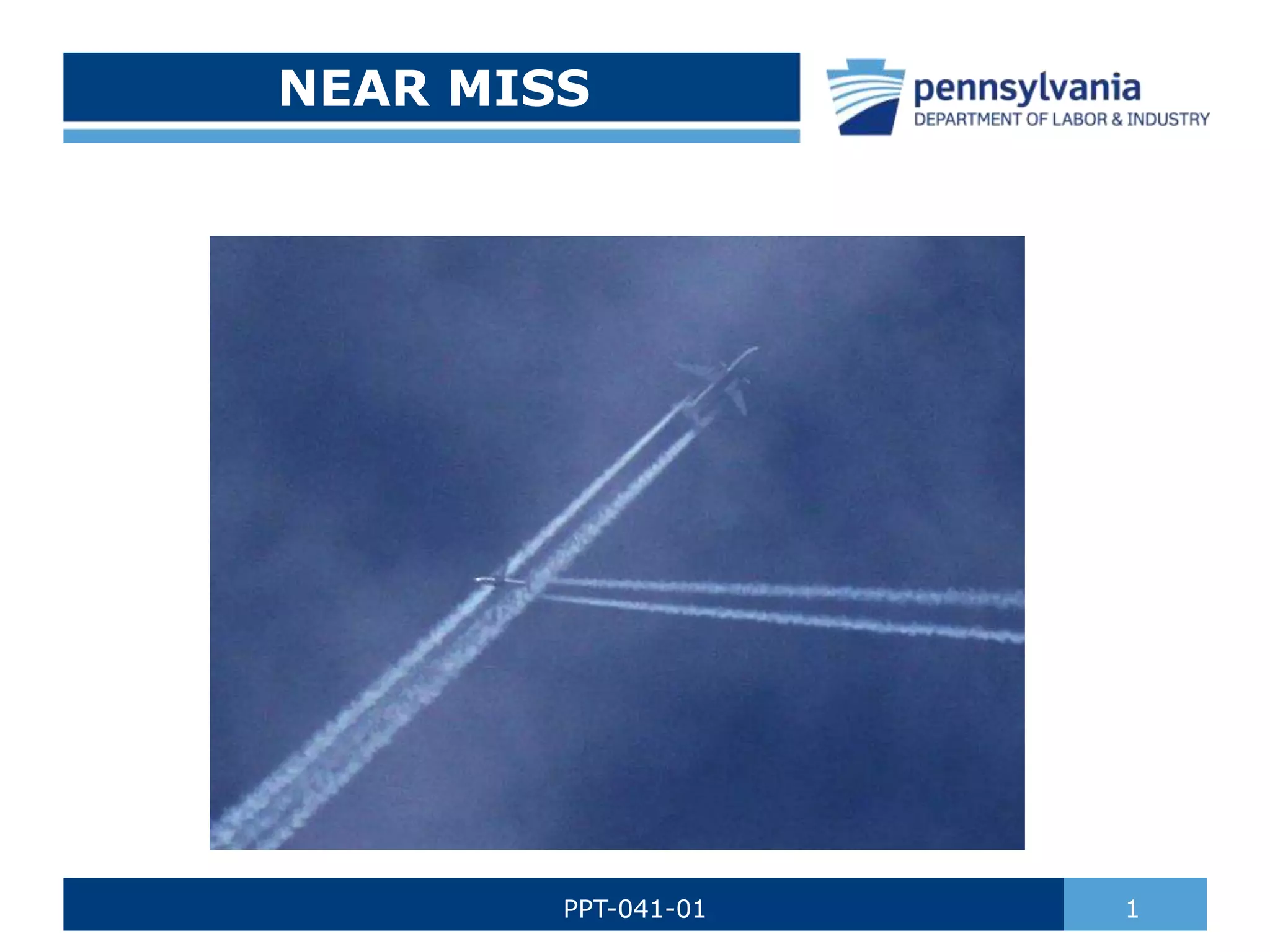
NEAR MISS
PPT-041-01 1
Topics
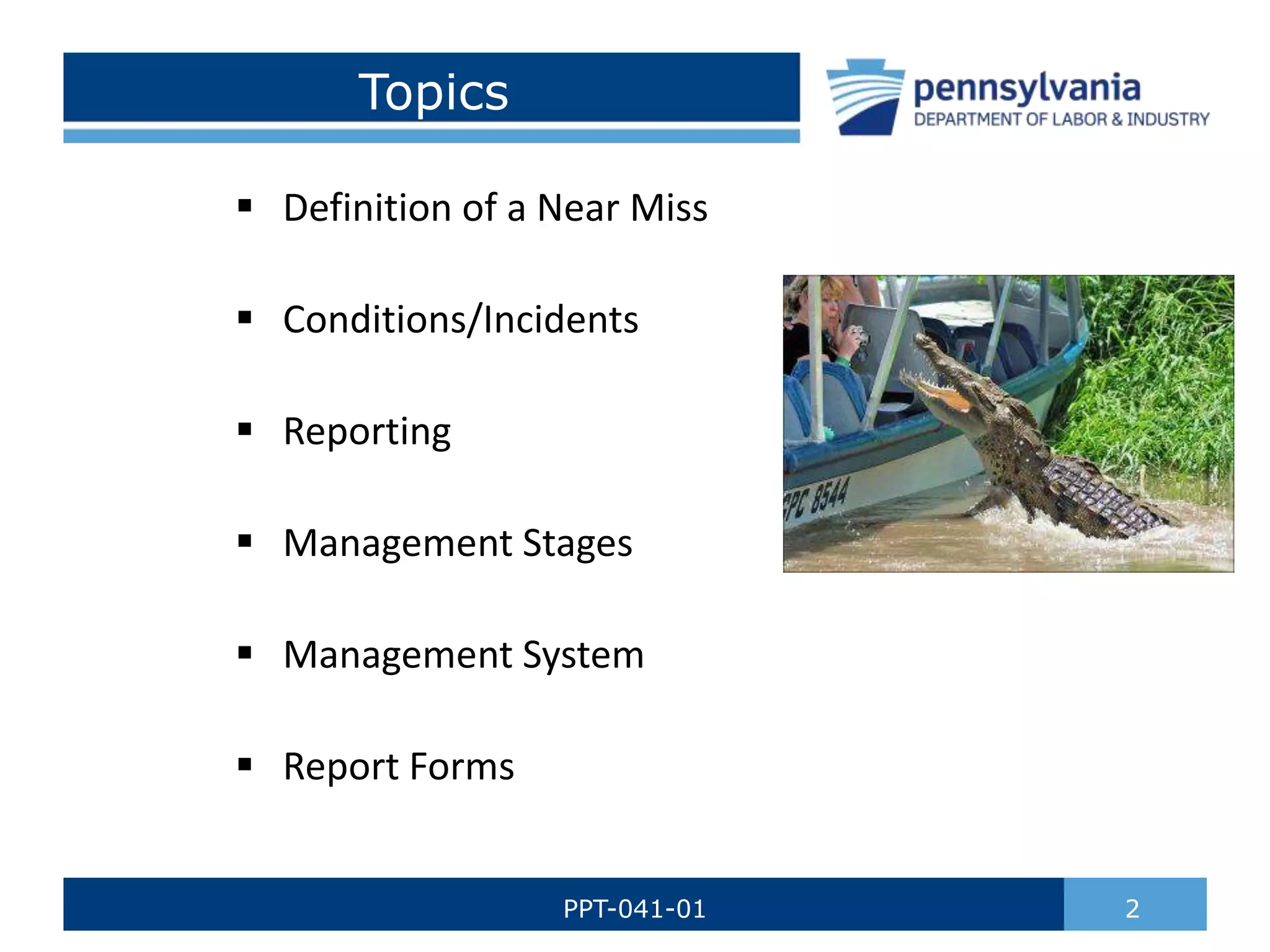
 Definition of a Near Miss
 Conditions/Incidents
 Reporting
 Management Stages
 Management System
 Report Forms
PPT-041-01 2
Definition
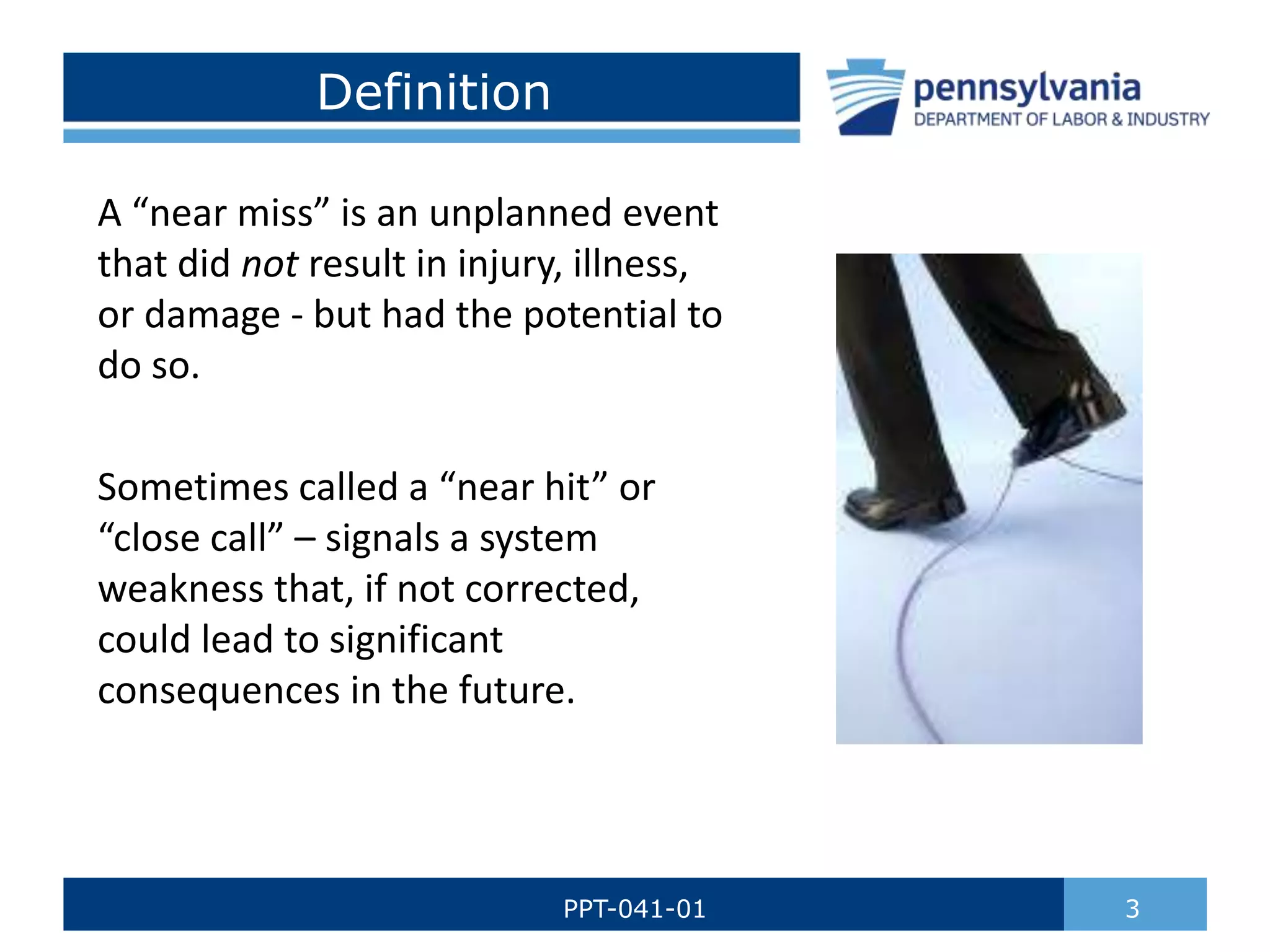
A “near miss” is an unplanned event
that did not result in injury, illness,
or damage - but had the potential to
do so.
Sometimes called a “near hit” or
“close call” – signals a system
weakness that, if not corrected,
could lead to significant
consequences in the future.
PPT-041-01 3
Another “Near Miss” Definition
 Opportunity to improve safety practice based on condition
or incident with potential for more serious consequence.
 In this definition “incident” or “condition” is anything that a
witness views worthy to address to eliminate potential to
cause harm.
PPT-041-01 4
Using Condition/Incident
Wide variety of occurrences can be near misses:
 Unsafe conditions
 Unsafe behavior
 Minor incidents/injuries with potential to be more serious
 Events where injury could have occurred but didn’t
 Events with property damage
 Events where safety barriers crossed
 Events with potential environmental damage
PPT-041-01 5
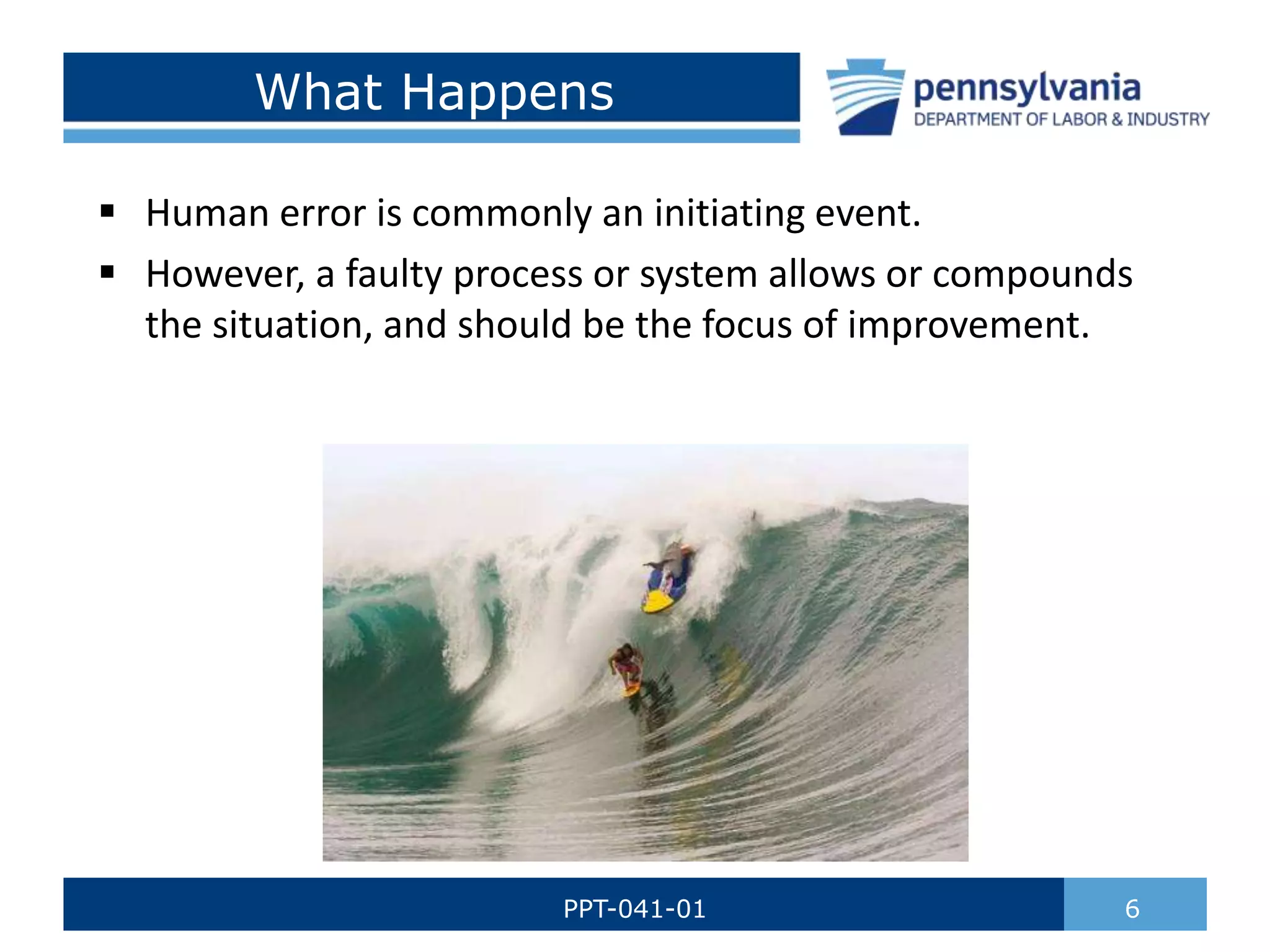
What Happens
 Human error is commonly an initiating event.
 However, a faulty process or system allows or compounds
the situation, and should be the focus of improvement.
PPT-041-01 6
Incident Ratio Model
Heinrich’s Theory
PPT-041-01 7
Serious Injury or Death
Minor Injury
1
29
300
3,000
Most Incident
Investigations
Conducted
Few Investigations
Conducted
Near Miss
Unsafe Acts, Behaviors or Conditions
1
Biggest
percentage
of injury
causing
potential!

Near Miss part 1.pptx

  • 1.
  • 2.
    Topics  Definition ofa Near Miss  Conditions/Incidents  Reporting  Management Stages  Management System  Report Forms PPT-041-01 2
  • 3.
    Definition A “near miss”is an unplanned event that did not result in injury, illness, or damage - but had the potential to do so. Sometimes called a “near hit” or “close call” – signals a system weakness that, if not corrected, could lead to significant consequences in the future. PPT-041-01 3
  • 4.
    Another “Near Miss”Definition  Opportunity to improve safety practice based on condition or incident with potential for more serious consequence.  In this definition “incident” or “condition” is anything that a witness views worthy to address to eliminate potential to cause harm. PPT-041-01 4
  • 5.
    Using Condition/Incident Wide varietyof occurrences can be near misses:  Unsafe conditions  Unsafe behavior  Minor incidents/injuries with potential to be more serious  Events where injury could have occurred but didn’t  Events with property damage  Events where safety barriers crossed  Events with potential environmental damage PPT-041-01 5
  • 6.
    What Happens  Humanerror is commonly an initiating event.  However, a faulty process or system allows or compounds the situation, and should be the focus of improvement. PPT-041-01 6
  • 7.
    Incident Ratio Model Heinrich’sTheory PPT-041-01 7 Serious Injury or Death Minor Injury 1 29 300 3,000 Most Incident Investigations Conducted Few Investigations Conducted Near Miss Unsafe Acts, Behaviors or Conditions 1 Biggest percentage of injury causing potential!

Editor's Notes

  • #2 Near-miss reporting and investigation identifies and controls safety or health hazards before they cause a more serious incident. One of the best ways to avoid further incidents is to understand how they occurred and how to avoid that type of incident in the future. The incident investigation is a tool. The goal of the investigation is not to lay blame but to find out what happened and determine immediate and underlying root causes.
  • #3 These are the topics we will discuss during this training session. It’s interesting to note that in a recent year, Pennsylvania employers reported 85,560 lost time accident and 111 fatalities. Many of these injuries and fatalities could have had previous unreported near miss incidents relating to the incident/fatality. Injuries and illnesses can be prevented and lives saved by reporting near miss incidents.
  • #4 NEAR MISS — A near miss is an unplanned event that did not result in injury, illness, or damage, but had the potential to do so. Only a fortunate break in the chain of events prevented an injury, fatality or damage; in other words, a miss that was nonetheless very near. A near miss describes incidents where, given a slight shift in time or distance, an injury, ill-health, or damage easily could have occurred but didn't this time.
  • #5 Although the label of “human error” is commonly applied to an initiating event, a faulty process or system invariably permits or compounds the harm and should be the focus of improvement in near miss situations.
  • #6 In terms of human lives and property damage, near misses are cheaper, zero-cost learning tools for safety than an actual injury or property loss would be. As you see in the slide, a near miss incident can result from many circumstances. Conditions, behavior, machinery failure and so on. No matter what the condition, the events that caused the near miss are subjected to a root cause. A “root cause analysis” must be conducted to identify the defect in the system that resulted in the error and also to determine the factors that may either amplify or mitigate the result.
  • #7 Most people involved with workplace safety are very aware of the iceberg theory.   It’s very simple. For every recorded incident sitting above the surface, there are many unrecorded near misses submerged below the surface. If you capture the near misses and act on the causes you can reduce or eliminate actual incidents from occurring. The process is simple but very effective.
  • #8 1931 – Heinrich’s Theory. This theory has been disputed over the years. Heinrich's often-stated belief that the predominant causes of no-injury incidents are identical with the predominant causes of incidents resulting in major injuries is not supported by convincing evidence and is questioned by several authors. Application of the premise results in misdirection since those who apply it may presume, inappropriately, that if they concentrate their efforts on the types of incidents that occur frequently, the potential for severe injury will be addressed. Investigation of numerous incidents resulting in fatality or serious injury by modern-day safety professionals leads to the conclusion that their causal factors are not linked to incidents that occur frequently and result in minor injury.