NDPS NARCOTIC DRUGS AND PSYCHOTROPIC
SUBSTANCE ACT
LL.M.I(CRIMINAL LAW)
HISTORY OF DRUG LAWS
• The cultivation of opium in India dates back to the 10th century.
• During the colonial era, the Opium Acts (1867 and 1878) were passed to control the cultivation and
manufacture (not consumption) of opium.
• During the 1920s, due to the pressure of the growing nationalist movements, many provincial
governments enacted laws to control the consumption of opium.
• The Dangerous Drugs Act was passed in 1930. This sought to control drug cultivation, manufacture,
sale, possession, trade, and transactions.
• The act primarily applied to the drugs derived from plants such as poppy, hemp, and coca and had
no offenses attached to cannabis/drug consumption. The control was primarily through licensing
and penalizing unlicensed activities.
• In 1940, the Drugs and Cosmetics Act (DCA) was enacted to regulate medicines, including those
developed from cannabis and opium.
• Article 47 of the Indian Constitution states, “The State shall endeavor to bring
about prohibition of the consumption except for medicinal purposes of
intoxicating drinks and drugs which are injurious to health,” thus further
entrenching the prohibitionist sentiment even during the post-independence era.
Besides this, India is also a party to three United Nations conventions on drug use
(the 1961 Single Convention on Narcotic Drugs, the 1971 Convention on
Psychotropic Substances, and the 1988 Convention Against Illicit Traffic in
NDPS).
• To give effect to its obligations under these conventions, India passed and
implemented the NDPS Act in 1985
WHAT IS THE NDPS ACT?
• The NDPS Act regulates two main categories of controlled substances that pose risks to public
health and safety. The Act prohibits
• unauthorized production,
• cultivation,
• possession,
• sale,
• purchase,
• transport,
• storage, and consumption of these substances, requiring proper authorization from appropriate
authorities.
OBJECTIVES
• To regulate narcotics drugs.
• To amend and consolidate the laws governing the use and possession of narcotic drugs.
• To establish stringent provisions for the control, regulation, and supervision of the illegal
possession, sale, transit, and consumption of narcotic drugs and psychotropic substances.
• To establish a mechanism for the implementation of the provisions of the International
Convention on Narcotic Drugs and Psychotropic Substances, as well as for other
purposes connected therewith.
• Under Section 2(xiv) of the NDPS Act, "narcotic drug" specifically means coca leaf, cannabis
(hemp), opium, poppy straw, and includes all manufactured drugs derived from these substances.
• Section 2(xxiii) defines "psychotropic substance" as any substance, natural or synthetic, or any
natural material or salt or preparation included in the scheduled list. This definition aligns with the
Psychotropic Substances Convention of 1971.
THE NARCOTIC DRUGS AND PSYCHOTROPIC SUBSTANCES CONSULTATIVE
COMMITTEE.
• The Committee shall consist of a Chairman and such other members, not exceeding
twenty, as may be appointed by the Central Government.
• The Committee shall meet when required to do so by the Central Government and shall
have power to regulate its own procedure
• The term of office of, the manner of filling casual vacancies in the offices of and the
allowances, if any, payable to, the Chairman and other members of the Committee, and
the conditions and restrictions subject to which the Committee may appoint a person
who is not a member of the Committee as a member.
NATIONAL FUND FOR CONTROL OF DRUG ABUSE.—
The Fund shall be applied by the Central Government to meet the expenditure incurred in
connection with the measures taken for—
(a) combating illicit traffic in narcotic drugs, psychotropic substances or controlled substances;
(b) controlling the abuse of narcotic drugs and psychotropic substances;
(c) identifying, treating, rehabilitating addicts;
(d) preventing drug abuse;
(e) educating public against drug abuse;
(f) supplying drugs to addicts where such supply is a medical necessity.
• CHAPTER I -PRELIMINARY
• CHAPTER II
AUTHORITIES AND OFFICERS
• CHAPTER IIA
NATIONAL FUND FOR CONTROL OF DRUG ABUSE
• CHAPTER III
PROHIBITION, CONTROL AND REGULATION
• CHAPTER IV
OFFENCES AND PENALTIES
• CHAPTERV
PROCEDURE
• CHAPTERVI
MISCELLANEOUS
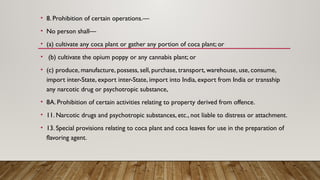
• 8. Prohibition of certain operations.—
• No person shall—
• (a) cultivate any coca plant or gather any portion of coca plant; or
• (b) cultivate the opium poppy or any cannabis plant; or
• (c) produce, manufacture, possess, sell, purchase, transport, warehouse, use, consume,
import inter-State, export inter-State, import into India, export from India or transship
any narcotic drug or psychotropic substance,
• 8A. Prohibition of certain activities relating to property derived from offence.
• 11. Narcotic drugs and psychotropic substances, etc., not liable to distress or attachment.
• 13. Special provisions relating to coca plant and coca leaves for use in the preparation of
flavoring agent.
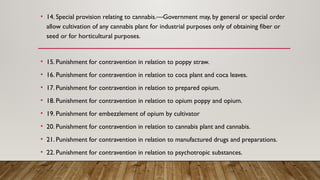
• 14. Special provision relating to cannabis.—Government may, by general or special order
allow cultivation of any cannabis plant for industrial purposes only of obtaining fiber or
seed or for horticultural purposes.
• 15. Punishment for contravention in relation to poppy straw.
• 16. Punishment for contravention in relation to coca plant and coca leaves.
• 17. Punishment for contravention in relation to prepared opium.
• 18. Punishment for contravention in relation to opium poppy and opium.
• 19. Punishment for embezzlement of opium by cultivator
• 20. Punishment for contravention in relation to cannabis plant and cannabis.
• 21. Punishment for contravention in relation to manufactured drugs and preparations.
• 22. Punishment for contravention in relation to psychotropic substances.
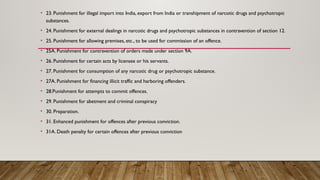
• 23. Punishment for illegal import into India, export from India or transhipment of narcotic drugs and psychotropic
substances.
• 24. Punishment for external dealings in narcotic drugs and psychotropic substances in contravention of section 12.
• 25. Punishment for allowing premises, etc., to be used for commission of an offence.
• 25A. Punishment for contravention of orders made under section 9A.
• 26. Punishment for certain acts by licensee or his servants.
• 27. Punishment for consumption of any narcotic drug or psychotropic substance.
• 27A. Punishment for financing illicit traffic and harboring offenders.
• 28.Punishment for attempts to commit offences.
• 29. Punishment for abetment and criminal conspiracy
• 30. Preparation.
• 31. Enhanced punishment for offences after previous conviction.
• 31A. Death penalty for certain offences after previous conviction
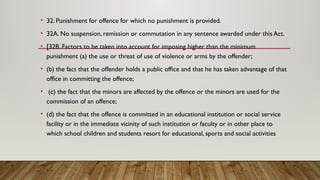
• 32. Punishment for offence for which no punishment is provided.
• 32A. No suspension, remission or commutation in any sentence awarded under this Act.
• [32B. Factors to be taken into account for imposing higher than the minimum
punishment (a) the use or threat of use of violence or arms by the offender;
• (b) the fact that the offender holds a public office and that he has taken advantage of that
office in committing the offence;
• (c) the fact that the minors are affected by the offence or the minors are used for the
commission of an offence;
• (d) the fact that the offence is committed in an educational institution or social service
facility or in the immediate vicinity of such institution or faculty or in other place to
which school children and students resort for educational, sports and social activities
• ; (e) the fact that the offender belongs to organized international or any other criminal
group which is involved in the commission of the offence; and
• (f) the fact that the offender is involved in other illegal activities facilitated by
commission of the offence.
• Application of section 360 of the Code of Criminal Procedure, 1973 and of the
Probation of Offenders Act, 1958.—
• under eighteen years of age of offender
• such person is convicted is punishable under section 26 or section 27.
• 36. Constitution of Special Court.
• 36B.Appeal and revision.
• 37. Offences to be cognizable and non-bailable.
• 39. Power of court to release certain offenders on probation
• 41. Power to issue warrant and authorization
• 42. Power of entry, search, seizure and arrest without warrant or authorization
• 43. Power of seizure and arrest in public place
• 44. Power of entry, search, seizure and arrest in offences relating to coca plant, opium
poppy and cannabis plant.
• 46. Duty of land holder to give information of illegal cultivation.
• 47. Duty of certain officers to give information of illegal cultivatio
• 48. Power of attachment of crop illegally cultivated.
• 49. Power to stop and search conveyance.
• 50. Conditions under which search of persons shall be conducted.
• 51. Provisions of the code of Criminal Procedure, 1973 to apply to warrants, arrests,
searches and seizures.
• 52A. Disposal of seized narcotic drugs and psychotropic substances.
• 53. Power to invest officers of certain departments with powers of an officer-in-charge of
a police station
• 53A. Relevancy of statements under certain circumstances
• 54. Presumption from possession of illicit articles
• 55. Police to take charge of articles seized and delivered
• Supply Reduction” aims to reduce the availability of illicit
drugs through various laws and policies and is primarily
enforced by the various central and state government
ministries and agencies. Central departments and agencies
such as the Department of Revenue under the Ministry of
Finance of the GoI, the Narcotics Control Bureau (NCB), the
Central Bureau of Narcotics (CBN), the Central Economic
Intelligence Bureau (CEIB), as well as state agencies such as
the state police and state
• The “Demand Reduction” sector works for the prevention, early identification, treatment, and
rehabilitation of those with drug use-related problems, thus reducing the “demand” for the same.
The Ministry of Social Justice and Empowerment (MoSJE) is the nodal ministry in India. In
addition, the Ministry of Health and Family Welfare (MoHFW) and state health departments play a
crucial role by providing treatment and rehabilitation services to PWUD through their health
facilities. Furthermore, the National Institute of Social Defence (NISD), an autonomous body
under MoSJE, works as a nodal institute for training and research. Under the NISD, a National
Center for Drug Abuse Prevention (NCDAP) is set up to provide technical support to the
government on various substance-related policy matters.
• The third and most recent addition is the “harm reduction” sector in India, which is primarily
aimed at HIV prevention in India among people who inject drugs (PWID). Harm reduction
strategies are implemented by the National AIDS Control Organization (NACO) under the
MoHFW. However, in India, harm reduction, far from being an essential pillar of drug policy, as is
the case in many countries worldwide, is restricted to a program in the limited context of HIV and
other infectious diseases prevention.
INITIATIVES UNDERTAKEN TO REGULATE DRUG TRAFFICKING IN INDIA
• National Policy on Nacrotic Drugs and Psychotropic Substances
• Narcotics Control Bureau (NCB)
• National Narcotics Coordination Portal
• Integrated Rehabilitation Centers for Addicts (IRCAs)
• National Action Plan for Drug Demand Reduction (NAPDDR)
• Nasha Mukt Bharat Abhiyaan/Drugs-Free India Campaign
REASONS BEHIND DRUGTRAFFICKING IN INDIA
• Lack of awareness about the consequences of drug abuse
• Corruption among law enforcement agencies and government officials
• High demand for drugs, both for recreational and medicinal purposes.
• Porous borders with several countries that are known for drug production and
trafficking
• Geographical location
INTERNATIONAL COLLABORATIONS AND TREATIES:
BILATERAL AGREEMENTS AND CONVENTIONS
• Bilateral Agreements and Conventions
-UN Single Convention on Narcotics Drugs 1961,
-The Convention on Psychotropic Substances, 1971 and
-Convention on Illicit Traffic in Narcotic Drugs and Psychotropic Substances, 1988.
• Mutual Legal Assistance Treaties (MLATs)
• Participation in international organizations
• Joint Operations and Information Sharing
CHALLENGES IN REGULATING DRUG TRAFFICKING IN INDIA
• Technological Advancements
• Insufficient Law Enforcement Apparatus
• Lack of Social Awareness
• Inadequate Rehabilitation Facilities
• Political interference often hampers the work of law enforcement agencies
NDPS Act-1.pptx presentation on narcotic

  • 1.
    NDPS NARCOTIC DRUGSAND PSYCHOTROPIC SUBSTANCE ACT LL.M.I(CRIMINAL LAW)
  • 2.
    HISTORY OF DRUGLAWS • The cultivation of opium in India dates back to the 10th century. • During the colonial era, the Opium Acts (1867 and 1878) were passed to control the cultivation and manufacture (not consumption) of opium. • During the 1920s, due to the pressure of the growing nationalist movements, many provincial governments enacted laws to control the consumption of opium. • The Dangerous Drugs Act was passed in 1930. This sought to control drug cultivation, manufacture, sale, possession, trade, and transactions. • The act primarily applied to the drugs derived from plants such as poppy, hemp, and coca and had no offenses attached to cannabis/drug consumption. The control was primarily through licensing and penalizing unlicensed activities. • In 1940, the Drugs and Cosmetics Act (DCA) was enacted to regulate medicines, including those developed from cannabis and opium.
  • 3.
    • Article 47of the Indian Constitution states, “The State shall endeavor to bring about prohibition of the consumption except for medicinal purposes of intoxicating drinks and drugs which are injurious to health,” thus further entrenching the prohibitionist sentiment even during the post-independence era. Besides this, India is also a party to three United Nations conventions on drug use (the 1961 Single Convention on Narcotic Drugs, the 1971 Convention on Psychotropic Substances, and the 1988 Convention Against Illicit Traffic in NDPS). • To give effect to its obligations under these conventions, India passed and implemented the NDPS Act in 1985
  • 5.
    WHAT IS THENDPS ACT? • The NDPS Act regulates two main categories of controlled substances that pose risks to public health and safety. The Act prohibits • unauthorized production, • cultivation, • possession, • sale, • purchase, • transport, • storage, and consumption of these substances, requiring proper authorization from appropriate authorities.
  • 6.
    OBJECTIVES • To regulatenarcotics drugs. • To amend and consolidate the laws governing the use and possession of narcotic drugs. • To establish stringent provisions for the control, regulation, and supervision of the illegal possession, sale, transit, and consumption of narcotic drugs and psychotropic substances. • To establish a mechanism for the implementation of the provisions of the International Convention on Narcotic Drugs and Psychotropic Substances, as well as for other purposes connected therewith.
  • 7.
    • Under Section2(xiv) of the NDPS Act, "narcotic drug" specifically means coca leaf, cannabis (hemp), opium, poppy straw, and includes all manufactured drugs derived from these substances. • Section 2(xxiii) defines "psychotropic substance" as any substance, natural or synthetic, or any natural material or salt or preparation included in the scheduled list. This definition aligns with the Psychotropic Substances Convention of 1971.
  • 8.
    THE NARCOTIC DRUGSAND PSYCHOTROPIC SUBSTANCES CONSULTATIVE COMMITTEE. • The Committee shall consist of a Chairman and such other members, not exceeding twenty, as may be appointed by the Central Government. • The Committee shall meet when required to do so by the Central Government and shall have power to regulate its own procedure • The term of office of, the manner of filling casual vacancies in the offices of and the allowances, if any, payable to, the Chairman and other members of the Committee, and the conditions and restrictions subject to which the Committee may appoint a person who is not a member of the Committee as a member.
  • 9.
    NATIONAL FUND FORCONTROL OF DRUG ABUSE.— The Fund shall be applied by the Central Government to meet the expenditure incurred in connection with the measures taken for— (a) combating illicit traffic in narcotic drugs, psychotropic substances or controlled substances; (b) controlling the abuse of narcotic drugs and psychotropic substances; (c) identifying, treating, rehabilitating addicts; (d) preventing drug abuse; (e) educating public against drug abuse; (f) supplying drugs to addicts where such supply is a medical necessity.
  • 10.
    • CHAPTER I-PRELIMINARY • CHAPTER II AUTHORITIES AND OFFICERS • CHAPTER IIA NATIONAL FUND FOR CONTROL OF DRUG ABUSE • CHAPTER III PROHIBITION, CONTROL AND REGULATION • CHAPTER IV OFFENCES AND PENALTIES • CHAPTERV PROCEDURE • CHAPTERVI MISCELLANEOUS
  • 11.
    • 8. Prohibitionof certain operations.— • No person shall— • (a) cultivate any coca plant or gather any portion of coca plant; or • (b) cultivate the opium poppy or any cannabis plant; or • (c) produce, manufacture, possess, sell, purchase, transport, warehouse, use, consume, import inter-State, export inter-State, import into India, export from India or transship any narcotic drug or psychotropic substance, • 8A. Prohibition of certain activities relating to property derived from offence. • 11. Narcotic drugs and psychotropic substances, etc., not liable to distress or attachment. • 13. Special provisions relating to coca plant and coca leaves for use in the preparation of flavoring agent.
  • 12.
    • 14. Specialprovision relating to cannabis.—Government may, by general or special order allow cultivation of any cannabis plant for industrial purposes only of obtaining fiber or seed or for horticultural purposes. • 15. Punishment for contravention in relation to poppy straw. • 16. Punishment for contravention in relation to coca plant and coca leaves. • 17. Punishment for contravention in relation to prepared opium. • 18. Punishment for contravention in relation to opium poppy and opium. • 19. Punishment for embezzlement of opium by cultivator • 20. Punishment for contravention in relation to cannabis plant and cannabis. • 21. Punishment for contravention in relation to manufactured drugs and preparations. • 22. Punishment for contravention in relation to psychotropic substances.
  • 13.
    • 23. Punishmentfor illegal import into India, export from India or transhipment of narcotic drugs and psychotropic substances. • 24. Punishment for external dealings in narcotic drugs and psychotropic substances in contravention of section 12. • 25. Punishment for allowing premises, etc., to be used for commission of an offence. • 25A. Punishment for contravention of orders made under section 9A. • 26. Punishment for certain acts by licensee or his servants. • 27. Punishment for consumption of any narcotic drug or psychotropic substance. • 27A. Punishment for financing illicit traffic and harboring offenders. • 28.Punishment for attempts to commit offences. • 29. Punishment for abetment and criminal conspiracy • 30. Preparation. • 31. Enhanced punishment for offences after previous conviction. • 31A. Death penalty for certain offences after previous conviction
  • 14.
    • 32. Punishmentfor offence for which no punishment is provided. • 32A. No suspension, remission or commutation in any sentence awarded under this Act. • [32B. Factors to be taken into account for imposing higher than the minimum punishment (a) the use or threat of use of violence or arms by the offender; • (b) the fact that the offender holds a public office and that he has taken advantage of that office in committing the offence; • (c) the fact that the minors are affected by the offence or the minors are used for the commission of an offence; • (d) the fact that the offence is committed in an educational institution or social service facility or in the immediate vicinity of such institution or faculty or in other place to which school children and students resort for educational, sports and social activities
  • 15.
    • ; (e)the fact that the offender belongs to organized international or any other criminal group which is involved in the commission of the offence; and • (f) the fact that the offender is involved in other illegal activities facilitated by commission of the offence. • Application of section 360 of the Code of Criminal Procedure, 1973 and of the Probation of Offenders Act, 1958.— • under eighteen years of age of offender • such person is convicted is punishable under section 26 or section 27. • 36. Constitution of Special Court.
  • 16.
    • 36. Constitutionof Special Court. • 36B.Appeal and revision. • 37. Offences to be cognizable and non-bailable. • 39. Power of court to release certain offenders on probation • 41. Power to issue warrant and authorization • 42. Power of entry, search, seizure and arrest without warrant or authorization • 43. Power of seizure and arrest in public place • 44. Power of entry, search, seizure and arrest in offences relating to coca plant, opium poppy and cannabis plant. • 46. Duty of land holder to give information of illegal cultivation. • 46. Duty of land holder to give information of illegal cultivation. • 47. Duty of certain officers to give information of illegal cultivatio
  • 17.
    • 48. Powerof attachment of crop illegally cultivated. • 49. Power to stop and search conveyance. • 50. Conditions under which search of persons shall be conducted. • 51. Provisions of the code of Criminal Procedure, 1973 to apply to warrants, arrests, searches and seizures. • 52A. Disposal of seized narcotic drugs and psychotropic substances. • 53. Power to invest officers of certain departments with powers of an officer-in-charge of a police station • 53A. Relevancy of statements under certain circumstances • 54. Presumption from possession of illicit articles • 55. Police to take charge of articles seized and delivered
  • 18.
    • Supply Reduction”aims to reduce the availability of illicit drugs through various laws and policies and is primarily enforced by the various central and state government ministries and agencies. Central departments and agencies such as the Department of Revenue under the Ministry of Finance of the GoI, the Narcotics Control Bureau (NCB), the Central Bureau of Narcotics (CBN), the Central Economic Intelligence Bureau (CEIB), as well as state agencies such as the state police and state
  • 19.
    • The “DemandReduction” sector works for the prevention, early identification, treatment, and rehabilitation of those with drug use-related problems, thus reducing the “demand” for the same. The Ministry of Social Justice and Empowerment (MoSJE) is the nodal ministry in India. In addition, the Ministry of Health and Family Welfare (MoHFW) and state health departments play a crucial role by providing treatment and rehabilitation services to PWUD through their health facilities. Furthermore, the National Institute of Social Defence (NISD), an autonomous body under MoSJE, works as a nodal institute for training and research. Under the NISD, a National Center for Drug Abuse Prevention (NCDAP) is set up to provide technical support to the government on various substance-related policy matters.
  • 20.
    • The thirdand most recent addition is the “harm reduction” sector in India, which is primarily aimed at HIV prevention in India among people who inject drugs (PWID). Harm reduction strategies are implemented by the National AIDS Control Organization (NACO) under the MoHFW. However, in India, harm reduction, far from being an essential pillar of drug policy, as is the case in many countries worldwide, is restricted to a program in the limited context of HIV and other infectious diseases prevention.
  • 21.
    INITIATIVES UNDERTAKEN TOREGULATE DRUG TRAFFICKING IN INDIA • National Policy on Nacrotic Drugs and Psychotropic Substances • Narcotics Control Bureau (NCB) • National Narcotics Coordination Portal • Integrated Rehabilitation Centers for Addicts (IRCAs) • National Action Plan for Drug Demand Reduction (NAPDDR) • Nasha Mukt Bharat Abhiyaan/Drugs-Free India Campaign
  • 22.
    REASONS BEHIND DRUGTRAFFICKINGIN INDIA • Lack of awareness about the consequences of drug abuse • Corruption among law enforcement agencies and government officials • High demand for drugs, both for recreational and medicinal purposes. • Porous borders with several countries that are known for drug production and trafficking • Geographical location
  • 23.
    INTERNATIONAL COLLABORATIONS ANDTREATIES: BILATERAL AGREEMENTS AND CONVENTIONS • Bilateral Agreements and Conventions -UN Single Convention on Narcotics Drugs 1961, -The Convention on Psychotropic Substances, 1971 and -Convention on Illicit Traffic in Narcotic Drugs and Psychotropic Substances, 1988. • Mutual Legal Assistance Treaties (MLATs) • Participation in international organizations • Joint Operations and Information Sharing
  • 24.
    CHALLENGES IN REGULATINGDRUG TRAFFICKING IN INDIA • Technological Advancements • Insufficient Law Enforcement Apparatus • Lack of Social Awareness • Inadequate Rehabilitation Facilities • Political interference often hampers the work of law enforcement agencies