Navigating Salesforce Implementation Challenges and How the Right Partner Helps You Drive Success
The right partner helps you overcome roadblocks—technical, organizational, or user-related.
What was your biggest challenge during implementation? Share your thoughts below 👇
Introduction to Salesforce
Implementation
Salesforceis a powerful CRM
platform.
But successful implementation isn’t
always straightforward.
Challenges often emerge that impact
time, budget, and outcomes.
Partnering with the right Salesforce
expert can mitigate these risks.
3.
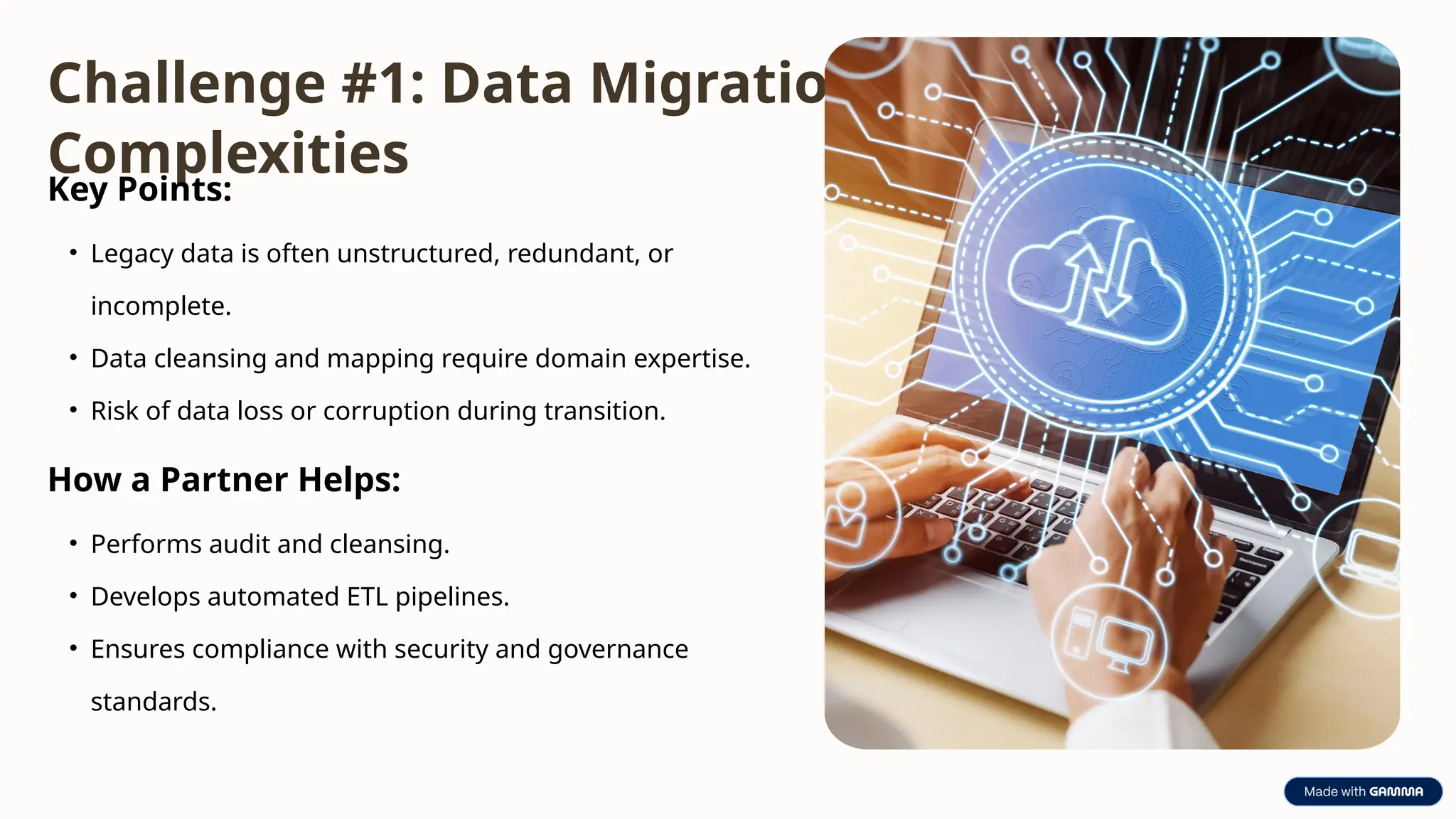
Challenge #1: DataMigration
Complexities
Key Points:
• Legacy data is often unstructured, redundant, or
incomplete.
• Data cleansing and mapping require domain expertise.
• Risk of data loss or corruption during transition.
How a Partner Helps:
• Performs audit and cleansing.
• Develops automated ETL pipelines.
• Ensures compliance with security and governance
standards.
4.
Challenge #2 –User Adoption
Resistance
Key Points:
• Employees resist change from familiar tools.
• Lack of understanding leads to underutilization.
• Poor user experience hinders productivity.
How a Partner
Helps:
• Conducts change management workshops.
• Designs user-friendly interfaces.
• Encourages feedback through pilot programs.
5.
Challenge #3 –Integration Challenges
Key Points: Solution
• Salesforce must connect with ERPs, CRMs, and
third-party tools.
• APIs vary and may be poorly documented.
• Data flow and sync issues can arise.
• Designs a unified integration architecture.
• Uses middleware (Mulesoft, Dell Boomi, etc.)
effectively.
• Performs end-to-end integration testing.
6.
Challenge #4 –Over-
Customization and Configuration
Key Points:
• Custom code can make upgrades harder.
• Maintenance becomes expensive and complex.
• Can deviate from Salesforce best practices.
How a Partner Helps:
• Strikes balance between customization and
standard features.
• Follows modular and scalable coding practices.
• Ensures compatibility with future Salesforce
releases.
7.
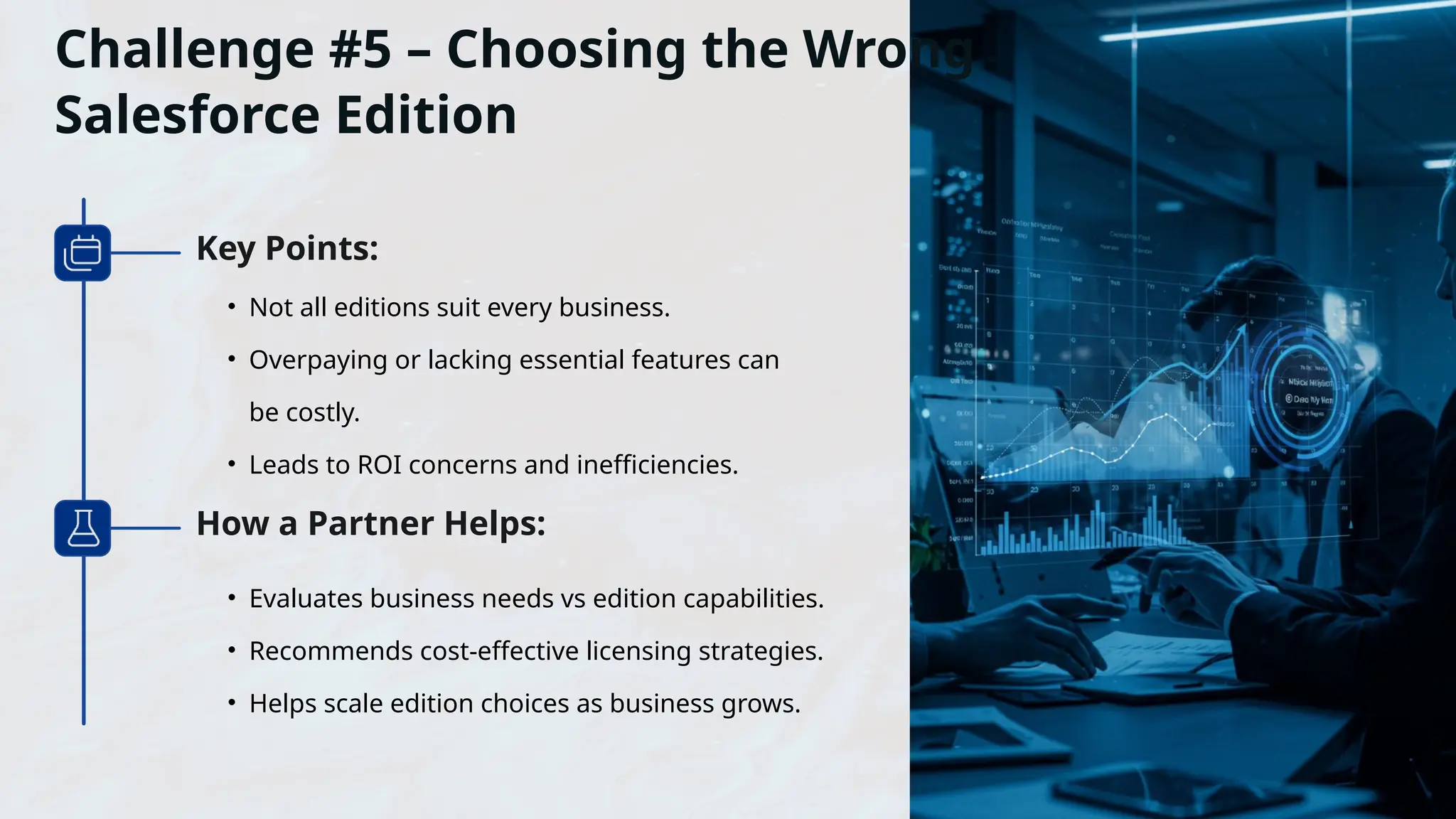
Challenge #5 –Choosing the Wrong
Salesforce Edition
• Not all editions suit every business.
• Overpaying or lacking essential features can
be costly.
• Leads to ROI concerns and inefficiencies.
Key Points:
How a Partner Helps:
• Evaluates business needs vs edition capabilities.
• Recommends cost-effective licensing strategies.
• Helps scale edition choices as business grows.
8.
Challenge #6 –Insufficient
Training
Key Points:
• Users struggle to fully utilize Salesforce features.
• Admins may lack ability to customize and maintain
the platform.
• Causes friction and reduces CRM efficiency.
How a Partner Helps:
• Provides role-based training and documentation.
• Enables continuous learning via Salesforce Trailhead
or LMS.
• Empowers teams with admin training.
9.
Challenge #7 –Lack of Support
from Salesforce
Key Points:
• Standard Salesforce support may not be sufficient.
• Response times can delay resolutions.
• Limited assistance in customization or integrations.
How a Partner Helps:
• Offers proactive support and SLA-based response.
• Monitors platform performance and security.
• Acts as an extended IT arm with deeper knowledge
10.
Implementation challenges arereal, but avoidable.
Choosing the right Salesforce partner is crucial.
Ready for expert Salesforce Partner guidance?
Email Us
info@damcogroup.com
Call Us
+1 609 632 0350
Visit Us
www.damcogroup.com


![Vibe Coding vs. Spec-Driven Development [Free Meetup]](https://cdn.slidesharecdn.com/ss_thumbnails/vibecodingvsspecdrivendevelopment-251209105622-43f455e7-thumbnail.jpg?width=640&height=640&fit=bounds)


