5 Steps for Salesforce
Implementation: A
Comprehensive Guide for Success
in 2024
www.qrsolutions.in
Introduction
In 2024, Salesforce continues to be the leading CRM platform, transforming business
operations, deepening customer relationships, and driving growth through the latest
technology trends. However, a successful Salesforce implementation can prove to be
a tricky job, with a 70% chance of not meeting customer expectations. The salesforce
implementation is challenging primarily due to a significant investment time to
master the technology. Nonetheless, when executed correctly, Salesforce can offer
substantial advantages.
Salesforce implementation is the process of integrating and customizing the Salesforce CRM platform within an
organization to meet business requirements. This process entails the deployment of various CRM modules, such
as sales, marketing, and customer service solutions, typically facilitated by Salesforce implementation partners.
What is Salesforce Implementation?
1. Salesforce Planning
A Salesforce consulting partner has to understand the business objectives, processes, and requirements. The
dedicated Salesforce team has to work closely with the organization, discerning key functionalities and
strategically mapping out the Salesforce implementation process.
2. Customization and Configuration
Specialize in configuring standard Salesforce features to align with business needs and crafting tailored
Salesforce implementation services. This includes the development of custom objects, fields, and workflows to
meet your specific needs.
5 Necessary steps for Salesforce Implementation
3. Data Migration
Transfer the organizational data from one system, storage or format to another. Mainly it involves moving
existing data from legacy systems or other databases into the salesforce platform.
4. Integration
The Salesforce implementation partners ensure that the Salesforce solutions work perfectly with other
applications. Maintaining a flawless data flow between the salesforce and other systems with a unified view of
customer information.
5. Testing and Deployment
A Salesforce implementation consultant systematically evaluates a system or its components to verify their
proper functioning. Once everything is tested and approved, the deployment is executed promptly for use by the
entire organization.
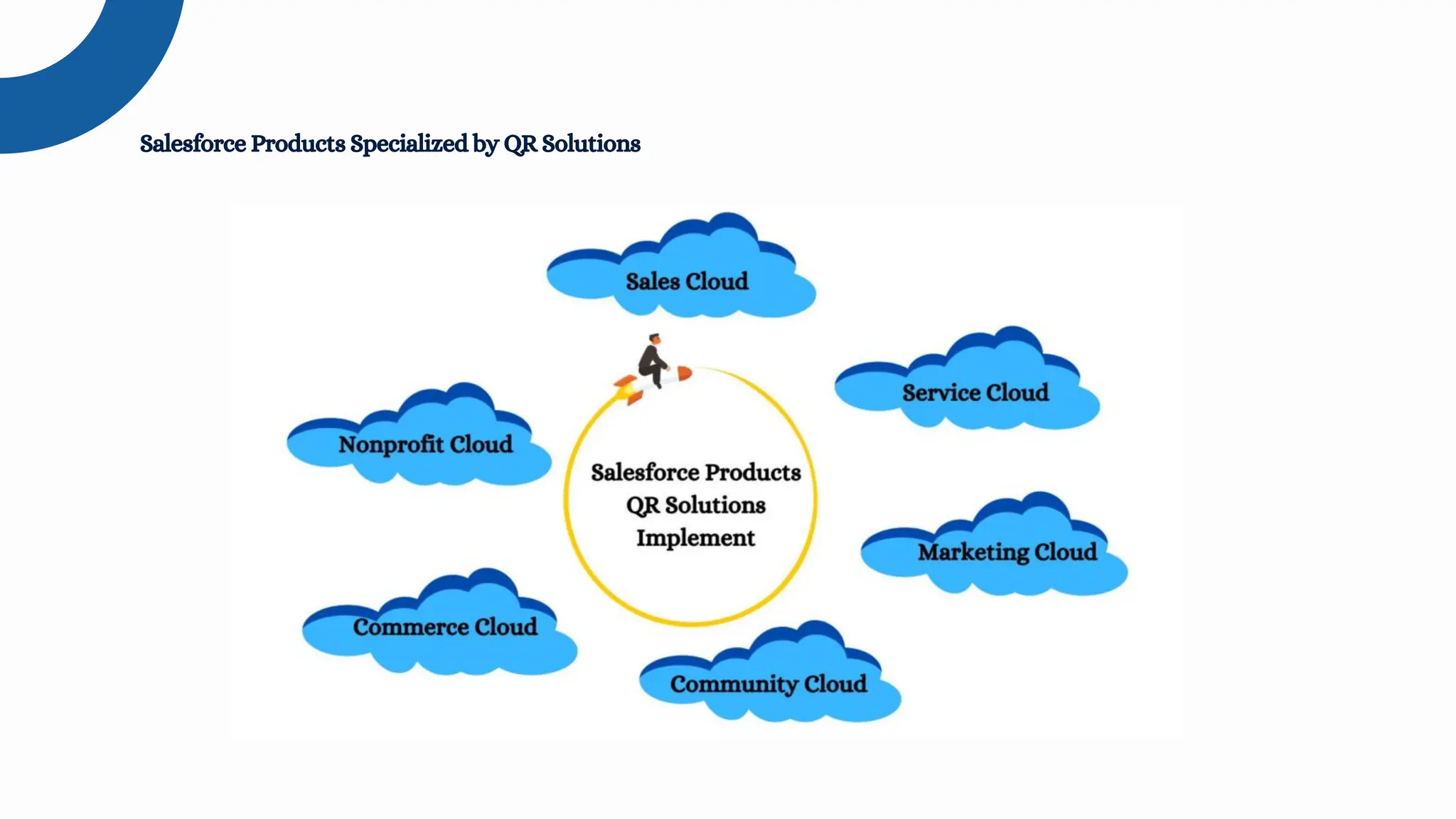
Salesforce Products Specialized by QR Solutions
Certified salesforce implementation partners are experts. They assist customers in innovative business
operations. Salesforce implementation Partners will save time by minimizing the manual efforts and providing
guidance on the latest industry trends.
There are three types of salesforce implementations
Inhouse Salesforce Implementation
In this approach, organizations deploy and customize salesforce by using their own internal resources,
granting direct control over the salesforce implementation process.
For a complete implementation, they will need a project manager, a Salesforce consultant, and (maybe)
Salesforce developers, but not all companies have the internal resources to do that– especially when they’re
just getting started.
Third-party Salesforce Implementation Partners
These implementation partners are external organizations or firms that specialize in deploying and
customizing Salesforce solutions for businesses. These partners offer full Salesforce implementation services.
Hybrid Salesforce Implementation Approach
This is a scenario where companies handle certain elements of salesforce implementation internally while
outsourcing others to external salesforce organizations. Some organizations opt for Salesforce implementation
partners for planning, building, and data migration.
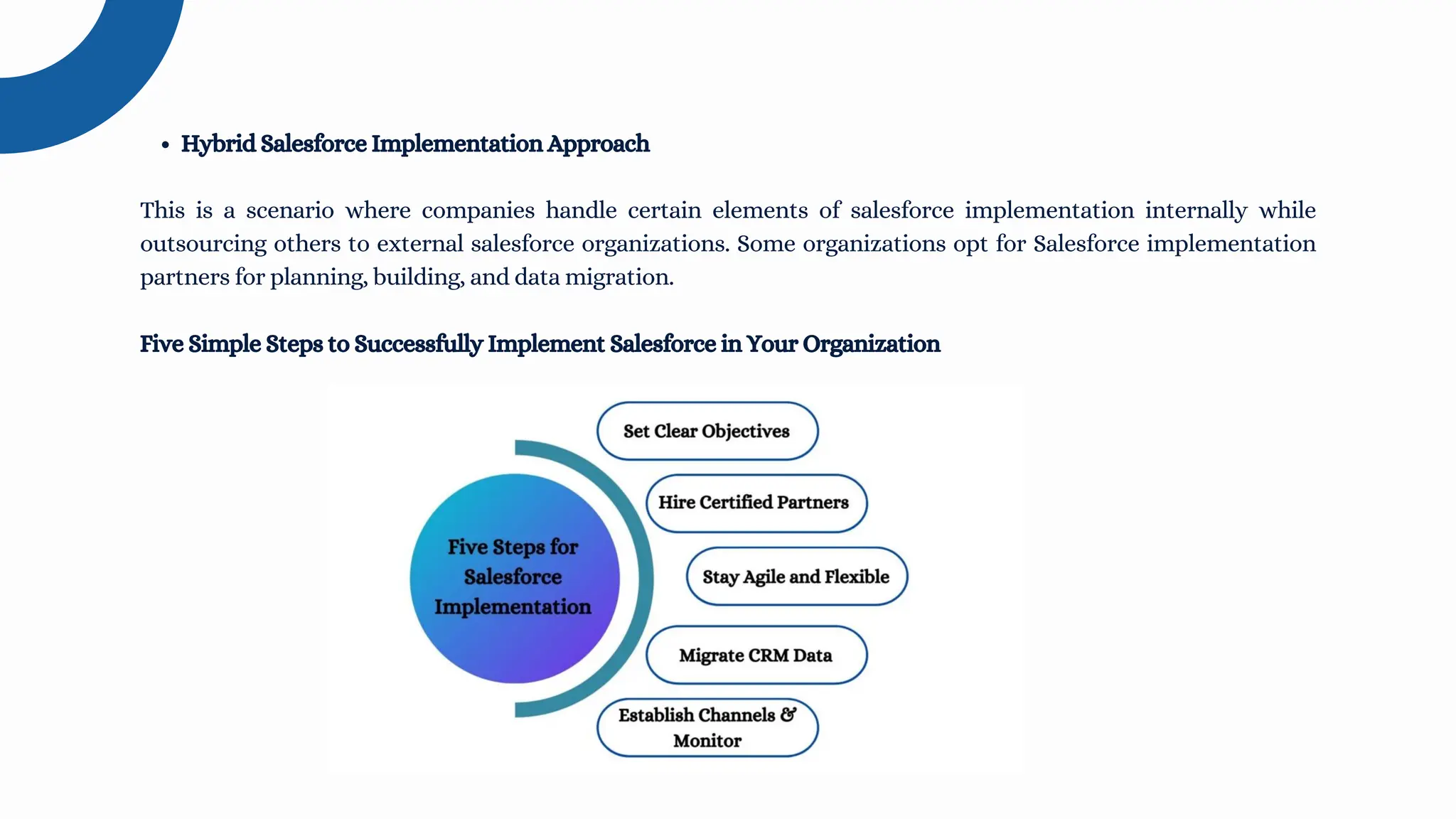
Five Simple Steps to Successfully Implement Salesforce in Your Organization
1. Set Clear Objectives and Metrics
Start by assessing organizational objectives and evaluating the needs of each department for CRM
implementation. Note down the areas experiencing issues that could be benefited from Salesforce
implementation, ensuring alignment with software solutions. This step helps in prioritizing teams and
establishing achievable system goals.
2. Stay Agile and Flexible
Involve employees across all departments and at every level in the planning process to mitigate surprises and
resistance to change. Identify and nurture champions to facilitate a smooth transition to a new CRM system,
providing adequate support to employees.
3. Migrate CRM Data
Efficiently transfer existing CRM data into Salesforce, with guidance from expert Salesforce implementation
consultants. This ensures a smooth transition into the new platform.
4. Establish Communication Channels and Monitor
Effective collaboration among team members is crucial for the successful deployment and adoption of Salesforce
CRM. Identify project stakeholders and their respective roles, and thoroughly examine source data to ensure a
precise and error-free import process.
Why an Organization Should Opt for Salesforce Implementation
Businesses nowadays are more customer-centric. As organizations need to meet evolving customer demands,
Salesforce emerges as the premier CRM platform capable of satisfying organizational requirements. Let’s see
why an organization should consider implementing salesforce, what the benefits are, and the potential impact on
organizational efficiency, customer engagement, and overall business success.
1. Centralized Customer Data
Salesforce implementation provides a centralized platform. Fostering a unified platform where it is easy to
manage customer information, interactions, and transactions This capability empowers businesses to deliver
personalized experiences.
4. Establish Communication Channels and Monitor
Effective collaboration among team members is crucial for the successful deployment and adoption of Salesforce
CRM. Identify project stakeholders and their respective roles, and thoroughly examine source data to ensure a
precise and error-free import process.
Why an Organization Should Opt for Salesforce Implementation
Businesses nowadays are more customer-centric. As organizations need to meet evolving customer demands,
Salesforce emerges as the premier CRM platform capable of satisfying organizational requirements. Let’s see
why an organization should consider implementing salesforce, what the benefits are, and the potential impact on
organizational efficiency, customer engagement, and overall business success.
1. Centralized Customer Data
Salesforce implementation provides a centralized platform. Fostering a unified platform where it is easy to
manage customer information, interactions, and transactions This capability empowers businesses to deliver
personalized experiences.
2.Enhanced Productivity
Implementing Salesforce leads to automation, reducing the need for manual effort and eliminating repetitive
tasks. This enables sales, marketing, and customer service teams to focus on high-value activities. resulting in
improved operational efficiency and productivity across the organization.
3. Scalability and Flexibility
The Salesforce implementation service is highly scalable. It allows organizations to adapt and expand their CRM
capabilities as needed. The platform offers a wide range of customizable features and integrations that can be
tailored to suit specific business requirements.
4. Insightful Analytics
Salesforce implementation partners provide analytics and reporting tools that offer valuable insights into sales
performance, customer behavior, and marketing effectiveness. Facilitating seamless collaboration and
communication among teams, departments, and external partners. These insights empower businesses to make
data-driven decisions and optimize their strategies.
5.Innovation and Future-Readiness
Salesforce consistently introduces new features, updates, and innovations. Salesforce implementation
consultants play a pivotal role in ensuring that businesses remain at the forefront of CRM technology, equipped
to adapt to changing market dynamics and customer expectations.
Conclusion
A successful Salesforce implementation offers a transformative opportunity for organizations to elevate their
operational efficiency, boost customer engagement, and achieve sustainable growth. By following a structured
approach that includes identifying needs, establishing a budget, finding the right expertise, planning change
management, and migrating CRM data, businesses can lay a strong foundation for a smooth Salesforce
implementation journey.
THANK YOU!
www.qrsolutions.in
+91 9884494840
+91 9884494840

Salesforce Implementation: 5 Steps for Success 2024 | QR Solutions

  • 1.
    5 Steps forSalesforce Implementation: A Comprehensive Guide for Success in 2024 www.qrsolutions.in
  • 2.
    Introduction In 2024, Salesforcecontinues to be the leading CRM platform, transforming business operations, deepening customer relationships, and driving growth through the latest technology trends. However, a successful Salesforce implementation can prove to be a tricky job, with a 70% chance of not meeting customer expectations. The salesforce implementation is challenging primarily due to a significant investment time to master the technology. Nonetheless, when executed correctly, Salesforce can offer substantial advantages.
  • 3.
    Salesforce implementation isthe process of integrating and customizing the Salesforce CRM platform within an organization to meet business requirements. This process entails the deployment of various CRM modules, such as sales, marketing, and customer service solutions, typically facilitated by Salesforce implementation partners. What is Salesforce Implementation? 1. Salesforce Planning A Salesforce consulting partner has to understand the business objectives, processes, and requirements. The dedicated Salesforce team has to work closely with the organization, discerning key functionalities and strategically mapping out the Salesforce implementation process. 2. Customization and Configuration Specialize in configuring standard Salesforce features to align with business needs and crafting tailored Salesforce implementation services. This includes the development of custom objects, fields, and workflows to meet your specific needs. 5 Necessary steps for Salesforce Implementation
  • 4.
    3. Data Migration Transferthe organizational data from one system, storage or format to another. Mainly it involves moving existing data from legacy systems or other databases into the salesforce platform. 4. Integration The Salesforce implementation partners ensure that the Salesforce solutions work perfectly with other applications. Maintaining a flawless data flow between the salesforce and other systems with a unified view of customer information. 5. Testing and Deployment A Salesforce implementation consultant systematically evaluates a system or its components to verify their proper functioning. Once everything is tested and approved, the deployment is executed promptly for use by the entire organization.
  • 5.
  • 6.
    Certified salesforce implementationpartners are experts. They assist customers in innovative business operations. Salesforce implementation Partners will save time by minimizing the manual efforts and providing guidance on the latest industry trends. There are three types of salesforce implementations Inhouse Salesforce Implementation In this approach, organizations deploy and customize salesforce by using their own internal resources, granting direct control over the salesforce implementation process. For a complete implementation, they will need a project manager, a Salesforce consultant, and (maybe) Salesforce developers, but not all companies have the internal resources to do that– especially when they’re just getting started. Third-party Salesforce Implementation Partners These implementation partners are external organizations or firms that specialize in deploying and customizing Salesforce solutions for businesses. These partners offer full Salesforce implementation services.
  • 7.
    Hybrid Salesforce ImplementationApproach This is a scenario where companies handle certain elements of salesforce implementation internally while outsourcing others to external salesforce organizations. Some organizations opt for Salesforce implementation partners for planning, building, and data migration. Five Simple Steps to Successfully Implement Salesforce in Your Organization
  • 8.
    1. Set ClearObjectives and Metrics Start by assessing organizational objectives and evaluating the needs of each department for CRM implementation. Note down the areas experiencing issues that could be benefited from Salesforce implementation, ensuring alignment with software solutions. This step helps in prioritizing teams and establishing achievable system goals. 2. Stay Agile and Flexible Involve employees across all departments and at every level in the planning process to mitigate surprises and resistance to change. Identify and nurture champions to facilitate a smooth transition to a new CRM system, providing adequate support to employees. 3. Migrate CRM Data Efficiently transfer existing CRM data into Salesforce, with guidance from expert Salesforce implementation consultants. This ensures a smooth transition into the new platform.
  • 9.
    4. Establish CommunicationChannels and Monitor Effective collaboration among team members is crucial for the successful deployment and adoption of Salesforce CRM. Identify project stakeholders and their respective roles, and thoroughly examine source data to ensure a precise and error-free import process. Why an Organization Should Opt for Salesforce Implementation Businesses nowadays are more customer-centric. As organizations need to meet evolving customer demands, Salesforce emerges as the premier CRM platform capable of satisfying organizational requirements. Let’s see why an organization should consider implementing salesforce, what the benefits are, and the potential impact on organizational efficiency, customer engagement, and overall business success. 1. Centralized Customer Data Salesforce implementation provides a centralized platform. Fostering a unified platform where it is easy to manage customer information, interactions, and transactions This capability empowers businesses to deliver personalized experiences.
  • 10.
    4. Establish CommunicationChannels and Monitor Effective collaboration among team members is crucial for the successful deployment and adoption of Salesforce CRM. Identify project stakeholders and their respective roles, and thoroughly examine source data to ensure a precise and error-free import process. Why an Organization Should Opt for Salesforce Implementation Businesses nowadays are more customer-centric. As organizations need to meet evolving customer demands, Salesforce emerges as the premier CRM platform capable of satisfying organizational requirements. Let’s see why an organization should consider implementing salesforce, what the benefits are, and the potential impact on organizational efficiency, customer engagement, and overall business success. 1. Centralized Customer Data Salesforce implementation provides a centralized platform. Fostering a unified platform where it is easy to manage customer information, interactions, and transactions This capability empowers businesses to deliver personalized experiences.
  • 11.
    2.Enhanced Productivity Implementing Salesforceleads to automation, reducing the need for manual effort and eliminating repetitive tasks. This enables sales, marketing, and customer service teams to focus on high-value activities. resulting in improved operational efficiency and productivity across the organization. 3. Scalability and Flexibility The Salesforce implementation service is highly scalable. It allows organizations to adapt and expand their CRM capabilities as needed. The platform offers a wide range of customizable features and integrations that can be tailored to suit specific business requirements. 4. Insightful Analytics Salesforce implementation partners provide analytics and reporting tools that offer valuable insights into sales performance, customer behavior, and marketing effectiveness. Facilitating seamless collaboration and communication among teams, departments, and external partners. These insights empower businesses to make data-driven decisions and optimize their strategies.
  • 12.
    5.Innovation and Future-Readiness Salesforceconsistently introduces new features, updates, and innovations. Salesforce implementation consultants play a pivotal role in ensuring that businesses remain at the forefront of CRM technology, equipped to adapt to changing market dynamics and customer expectations. Conclusion A successful Salesforce implementation offers a transformative opportunity for organizations to elevate their operational efficiency, boost customer engagement, and achieve sustainable growth. By following a structured approach that includes identifying needs, establishing a budget, finding the right expertise, planning change management, and migrating CRM data, businesses can lay a strong foundation for a smooth Salesforce implementation journey.
  • 13.