Open Source Systems in Justice

Dr. Matthias Stürmer, /ch/open and Ernst & Young
NATO Advanced Research Workshop „Creating Awareness for
Using Open Source Systems in the Public Sector in Afghanistan“
September 15th – 17th, 2012 in Kabul, Afghanistan
Short Bio of Matthias Stürmer


                                               Studied business administration and computer science at University
                                                of Bern until 2005, topic of licenciate thesis was open source
                                                community building
                                               Finished doctoral dissertation at the Chair of Strategic Management
                                                and Innovation at ETH Zürich in 2009 focused on open source
                                                communities and firm involvement
                                               Worked at Swiss software company Liip creating agile Internet
                                                solutions based on open source technologies
                                               Senior Consultant at Ernst & Young since 2010 specialised on open
                                                source, open government, and social media
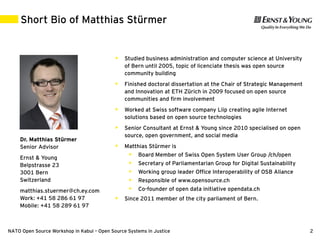
    Dr. Matthias Stürmer
    Senior Advisor                             Matthias Stürmer is
                                                     Board Member of Swiss Open System User Group /ch/open
    Ernst & Young
    Belpstrasse 23
                                                     Secretary of Parliamentarian Group for Digital Sustainability
    3001 Bern                                        Working group leader Office Interoperability of OSB Aliance
    Switzerland                                      Responsible of www.opensource.ch
    matthias.stuermer@ch.ey.com
                                                     Co-founder of open data initiative opendata.ch
    Work: +41 58 286 61 97                     Since 2011 member of the city parliament of Bern.
    Mobile: +41 58 289 61 97


NATO Open Source Workshop in Kabul – Open Source Systems in Justice                                                   2
Agenda


    Open Source Project OpenJustitia of the
    Federal Supreme Court
    of Switzerland

      1. About OpenJustitia
      2. Modules of OpenJustitia
      3. Community structure and governance


NATO Open Source Workshop in Kabul – Open Source Systems in Justice   3
The Federal Supreme Court of Switzerland


        Highest court in Switzerland based in Lausanne and Lucerne
        Around 7500 judgements annually in German, French, and Italian
        Follows open standards (2001) and open source (2009) strategy:
         Use, publish, and maintain open source software
        400 thin client users (judges, staff etc.) on Sun OpenSolaris
        Since 2002 StarOffice, since 2010 OpenOffice, everything on ODF
NATO Open Source Workshop in Kabul – Open Source Systems in Justice        4
About OpenJustitia


        Internal court decision administration system for
         management of all documents related to a court
         judgement
        Archive consists of 165'000 court decisions since 1954,
         332'000 stored documents, 55'000 documents
         semantically indexed
        OpenJustitia can be customized for other courts:
         Configuration of individual meta data in each of the
         modules
        Several other Swiss courts and legal software firms have
         joined the OpenJustitia community

NATO Open Source Workshop in Kabul – Open Source Systems in Justice   5
Open source stack of OpenJustitia


        All source code in Java J2EE, running on Apache Tomcat
        Open source DMS Alfresco for document management
        Apache Lucene for indexing and search engine
        PostgreSQL for data storage (index, legal norms etc.)
        Java macros for LibreOffice integration on the client
        External interfaces for Java/JDBC (for metadata) and XML
         (for import/export of judgements, legal norms,
         thesaurus...)


NATO Open Source Workshop in Kabul – Open Source Systems in Justice   6
History of OpenJustitia


     1. The Federal Supreme Court is the the final place for decisions. Thus a 100%
        precise and reliant search system of previous court decisions is necessary.
     2. In 2005 no court software met the Swiss Federal Court's requirements for
        managing court decisions
     3. Internal software development team programmed the Federal Court's
        individual administration system
     4. Federal Court decided to 'open source' its own software following its open
        source goals within the IT strategy
     5. Minor technical and governance preparations were necessary to initiate the
        open source project OpenJustitia
     6. Political troubles because of lobbyism of a private company
     7. Release of the source code on September 1, 2011 below GNU General Public
        License Version 3 (GPLv3)
     8. First meeting of the OpenJustitia community in October 2012


NATO Open Source Workshop in Kabul – Open Source Systems in Justice                   7
Reasons to release as open source


    Why did the Federal Court initiate OpenJustitia?

     1. Benefitting the most of tax payer's money
           ●
               Switzerland has dozens of national, cantonal, and regional
               courts that all have similar technical needs for administrating
               court judgements.
           ●
               Federal open source strategy as well as the Federal E-
               Government strategy both recommend collaborative software
               development at institutional level in order to save costs.

     2. Improve court management software
           ●
               On the long term and through a healthy community OpenJustitia
               will become more stable, secure and feature-rich.


NATO Open Source Workshop in Kabul – Open Source Systems in Justice              8
Agenda


    Open Source Project OpenJustitia of the
    Federal Supreme Court
    of Switzerland

      1. About OpenJustitia
      2. Modules of OpenJustitia
      3. Community structure and governance


NATO Open Source Workshop in Kabul – Open Source Systems in Justice   9
Modular structure of OpenJustitia


        OpenJustitia consists of six seperate modules:
              OpenJustitia Doc: management of documents incl. versioning and
               access restrictions, powerful search engine of legal documents
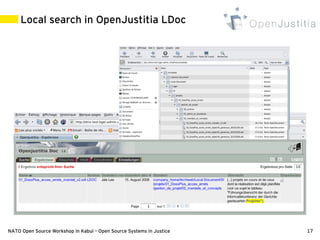
              OpenJustitia LDoc: local search of legal documents integrated in
               complete OpenJustitia system
              OpenJustitia Norm: automatic and semi-automatic recognition and
               linking of legal norms within court judgements
              OpenJustitia Anom: semi-automatic anonymisation of judgements
               integrated in OpenOffice/LibreOffice
              OpenJustitia Bib: powerful search engine for legal literature
              OpenJustitia Spider: integration of external legal data sources
               including extraction of meta data


NATO Open Source Workshop in Kabul – Open Source Systems in Justice               10
Text view with links in OpenJustitia Doc


NATO Open Source Workshop in Kabul – Open Source Systems in Justice   11
Search form OpenJustitia Doc


NATO Open Source Workshop in Kabul – Open Source Systems in Justice   12
Meta data in OpenJustitia Doc


NATO Open Source Workshop in Kabul – Open Source Systems in Justice   13
Anonymization in OpenJustitia Anom


NATO Open Source Workshop in Kabul – Open Source Systems in Justice   14
Indexing in OpenJustitia Norm


NATO Open Source Workshop in Kabul – Open Source Systems in Justice   15
Search in OpenJustitia Bib


NATO Open Source Workshop in Kabul – Open Source Systems in Justice   16
Local search in OpenJustitia LDoc


NATO Open Source Workshop in Kabul – Open Source Systems in Justice   17
Other sources with OpenJustitia Spider


NATO Open Source Workshop in Kabul – Open Source Systems in Justice   18
Agenda


    Open Source Project OpenJustitia of the
    Federal Supreme Court
    of Switzerland

      1. About OpenJustitia
      2. Modules of OpenJustitia
      3. Community structure and governance


NATO Open Source Workshop in Kabul – Open Source Systems in Justice   19
Website www.openjustitia.org


NATO Open Source Workshop in Kabul – Open Source Systems in Justice   20
Open source community guidelines


        From the Federal Court, only 6 pages
        Common understanding on what is
         OpenJustitia and who can how in
         which body participate.
        Content of the community guidelines:
              Introduction (background, goals etc.)
              Principles of the OpenJustitia community
              Intended members of the community
              Bodies of the OpenJustitia community
              Rules and procedures
        Source:
         http://www.openjustitia.org/DE/01_OpenJustitia_Regeln_V1.2_d.pdf

NATO Open Source Workshop in Kabul – Open Source Systems in Justice         21
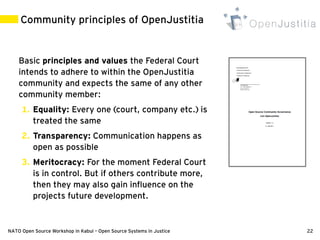
Community principles of OpenJustitia


    Basic principles and values the Federal Court
    intends to adhere to within the OpenJustitia
    community and expects the same of any other
    community member:
     1. Equality: Every one (court, company etc.) is
        treated the same
     2. Transparency: Communication happens as
        open as possible
     3. Meritocracy: For the moment Federal Court
        is in control. But if others contribute more,
        then they may also gain influence on the
        projects future development.


NATO Open Source Workshop in Kabul – Open Source Systems in Justice   22
Intended members of the community


        Federal Court: initiator and thus main
         knowledge carrier at the moment
        Courts: all Swiss courts, but also
         foreign courts feasible
        Other public institutions: using all or
         parts of OpenJustitia
        Open source providers: software firms
         that offer services for OpenJustitia
        Other firms: companies that may
         benefit of the software, e.g. legal firms
        Universities: law schools for indexing
         and researching legal texts

NATO Open Source Workshop in Kabul – Open Source Systems in Justice   23
Bodies of the OpenJustitia community


        Members: free membership for any
         legal entity (public institution,
         company, association etc.) that uses
         OpenJustitia or provides services for it
        Coordination committee: executives of
         entities that use OpenJustitia in
         mission-critical environment; Federal
         Court directs the committee and has
         two seats of a maximum of 5 seats
        Technology committee: software
         developers or architects with in-depth
         knowledge of the source code; is
         responsible for all technical aspects

NATO Open Source Workshop in Kabul – Open Source Systems in Justice   24
Rules and procedures


        Annual assembly: OpenJustitia
         community members meet at least
         once a year to receive annual report
         and to do elections.
        Exclusion: If a community member
         doesn't follow the guidelines, the
         coordination committee can exclude
         the member.
        Introductory support: Federal
         Court offers support of 5 days to
         the 5 five first members


NATO Open Source Workshop in Kabul – Open Source Systems in Justice   25
Community membership


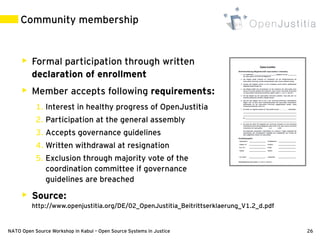
        Formal participation through written
         declaration of enrollment
        Member accepts following requirements:
           1. Interest in healthy progress of OpenJustitia
           2. Participation at the general assembly
           3. Accepts governance guidelines
           4. Written withdrawal at resignation
           5. Exclusion through majority vote of the
              coordination committee if governance
              guidelines are breached
        Source:
         http://www.openjustitia.org/DE/02_OpenJustitia_Beitrittserklaerung_V1.2_d.pdf


NATO Open Source Workshop in Kabul – Open Source Systems in Justice                      26
Outlook OpenJustitia


        Growing member base: today several firms and public
         institutions have become OpenJustitia members
        First member meeting in October 2012: initiation of
         technical and leading boards, decision on how to progress
        Technical improvements: integrate OpenJustitia in public
         website, optimization of automatic recognition, enhance
         documentation, integration of business process software
         for court decisions, possibly Italian and English translation


NATO Open Source Workshop in Kabul – Open Source Systems in Justice      27
Discussion


        What software do judges at Afghan courts use?
        What kind of improvements at the IT level are necessary?
        What text editing programs are in use?
        Is there a need to search for previous decisions?
        Is there a need to anonymize names in rulings?
        In what languages are court decisions written?


NATO Open Source Workshop in Kabul – Open Source Systems in Justice   28
Discussion


        Questions, comments, ideas, wishes?


                                                 Dr. Matthias Stürmer
                                              Senior Advisor Ernst & Young
                                              matthias.stuermer@ch.ey.com
                                                Work: +41 58 286 61 97
                                               Mobile: +41 58 289 61 97


NATO Open Source Workshop in Kabul – Open Source Systems in Justice          29
Ernst & Young open source brochure


        Open source has one major weakness: marketing and PR
        Top management vendor-neutral brochure from Ernst & Young:
         Why and how professionals use open source software
        Content:
          ●
              Benefits, risks and good practices
          ●
              Professional application of
              open source software
          ●
              Legal aspects of open source
          ●
              Background information on
              open source software
        Download as PDF on
         Ernst & Young website


NATO Open Source Workshop in Kabul – Open Source Systems in Justice   30

Open Source Systems in Justice

  • 1.
    Open Source Systemsin Justice Dr. Matthias Stürmer, /ch/open and Ernst & Young NATO Advanced Research Workshop „Creating Awareness for Using Open Source Systems in the Public Sector in Afghanistan“ September 15th – 17th, 2012 in Kabul, Afghanistan
  • 2.
    Short Bio ofMatthias Stürmer  Studied business administration and computer science at University of Bern until 2005, topic of licenciate thesis was open source community building  Finished doctoral dissertation at the Chair of Strategic Management and Innovation at ETH Zürich in 2009 focused on open source communities and firm involvement  Worked at Swiss software company Liip creating agile Internet solutions based on open source technologies  Senior Consultant at Ernst & Young since 2010 specialised on open source, open government, and social media Dr. Matthias Stürmer Senior Advisor  Matthias Stürmer is  Board Member of Swiss Open System User Group /ch/open Ernst & Young Belpstrasse 23  Secretary of Parliamentarian Group for Digital Sustainability 3001 Bern  Working group leader Office Interoperability of OSB Aliance Switzerland  Responsible of www.opensource.ch matthias.stuermer@ch.ey.com  Co-founder of open data initiative opendata.ch Work: +41 58 286 61 97  Since 2011 member of the city parliament of Bern. Mobile: +41 58 289 61 97 NATO Open Source Workshop in Kabul – Open Source Systems in Justice 2
  • 3.
    Agenda Open Source Project OpenJustitia of the Federal Supreme Court of Switzerland 1. About OpenJustitia 2. Modules of OpenJustitia 3. Community structure and governance NATO Open Source Workshop in Kabul – Open Source Systems in Justice 3
  • 4.
    The Federal SupremeCourt of Switzerland  Highest court in Switzerland based in Lausanne and Lucerne  Around 7500 judgements annually in German, French, and Italian  Follows open standards (2001) and open source (2009) strategy: Use, publish, and maintain open source software  400 thin client users (judges, staff etc.) on Sun OpenSolaris  Since 2002 StarOffice, since 2010 OpenOffice, everything on ODF NATO Open Source Workshop in Kabul – Open Source Systems in Justice 4
  • 5.
    About OpenJustitia  Internal court decision administration system for management of all documents related to a court judgement  Archive consists of 165'000 court decisions since 1954, 332'000 stored documents, 55'000 documents semantically indexed  OpenJustitia can be customized for other courts: Configuration of individual meta data in each of the modules  Several other Swiss courts and legal software firms have joined the OpenJustitia community NATO Open Source Workshop in Kabul – Open Source Systems in Justice 5
  • 6.
    Open source stackof OpenJustitia  All source code in Java J2EE, running on Apache Tomcat  Open source DMS Alfresco for document management  Apache Lucene for indexing and search engine  PostgreSQL for data storage (index, legal norms etc.)  Java macros for LibreOffice integration on the client  External interfaces for Java/JDBC (for metadata) and XML (for import/export of judgements, legal norms, thesaurus...) NATO Open Source Workshop in Kabul – Open Source Systems in Justice 6
  • 7.
    History of OpenJustitia 1. The Federal Supreme Court is the the final place for decisions. Thus a 100% precise and reliant search system of previous court decisions is necessary. 2. In 2005 no court software met the Swiss Federal Court's requirements for managing court decisions 3. Internal software development team programmed the Federal Court's individual administration system 4. Federal Court decided to 'open source' its own software following its open source goals within the IT strategy 5. Minor technical and governance preparations were necessary to initiate the open source project OpenJustitia 6. Political troubles because of lobbyism of a private company 7. Release of the source code on September 1, 2011 below GNU General Public License Version 3 (GPLv3) 8. First meeting of the OpenJustitia community in October 2012 NATO Open Source Workshop in Kabul – Open Source Systems in Justice 7
  • 8.
    Reasons to releaseas open source Why did the Federal Court initiate OpenJustitia? 1. Benefitting the most of tax payer's money ● Switzerland has dozens of national, cantonal, and regional courts that all have similar technical needs for administrating court judgements. ● Federal open source strategy as well as the Federal E- Government strategy both recommend collaborative software development at institutional level in order to save costs. 2. Improve court management software ● On the long term and through a healthy community OpenJustitia will become more stable, secure and feature-rich. NATO Open Source Workshop in Kabul – Open Source Systems in Justice 8
  • 9.
    Agenda Open Source Project OpenJustitia of the Federal Supreme Court of Switzerland 1. About OpenJustitia 2. Modules of OpenJustitia 3. Community structure and governance NATO Open Source Workshop in Kabul – Open Source Systems in Justice 9
  • 10.
    Modular structure ofOpenJustitia  OpenJustitia consists of six seperate modules:  OpenJustitia Doc: management of documents incl. versioning and access restrictions, powerful search engine of legal documents  OpenJustitia LDoc: local search of legal documents integrated in complete OpenJustitia system  OpenJustitia Norm: automatic and semi-automatic recognition and linking of legal norms within court judgements  OpenJustitia Anom: semi-automatic anonymisation of judgements integrated in OpenOffice/LibreOffice  OpenJustitia Bib: powerful search engine for legal literature  OpenJustitia Spider: integration of external legal data sources including extraction of meta data NATO Open Source Workshop in Kabul – Open Source Systems in Justice 10
  • 11.
    Text view withlinks in OpenJustitia Doc NATO Open Source Workshop in Kabul – Open Source Systems in Justice 11
  • 12.
    Search form OpenJustitiaDoc NATO Open Source Workshop in Kabul – Open Source Systems in Justice 12
  • 13.
    Meta data inOpenJustitia Doc NATO Open Source Workshop in Kabul – Open Source Systems in Justice 13
  • 14.
    Anonymization in OpenJustitiaAnom NATO Open Source Workshop in Kabul – Open Source Systems in Justice 14
  • 15.
    Indexing in OpenJustitiaNorm NATO Open Source Workshop in Kabul – Open Source Systems in Justice 15
  • 16.
    Search in OpenJustitiaBib NATO Open Source Workshop in Kabul – Open Source Systems in Justice 16
  • 17.
    Local search inOpenJustitia LDoc NATO Open Source Workshop in Kabul – Open Source Systems in Justice 17
  • 18.
    Other sources withOpenJustitia Spider NATO Open Source Workshop in Kabul – Open Source Systems in Justice 18
  • 19.
    Agenda Open Source Project OpenJustitia of the Federal Supreme Court of Switzerland 1. About OpenJustitia 2. Modules of OpenJustitia 3. Community structure and governance NATO Open Source Workshop in Kabul – Open Source Systems in Justice 19
  • 20.
    Website www.openjustitia.org NATO OpenSource Workshop in Kabul – Open Source Systems in Justice 20
  • 21.
    Open source communityguidelines  From the Federal Court, only 6 pages  Common understanding on what is OpenJustitia and who can how in which body participate.  Content of the community guidelines:  Introduction (background, goals etc.)  Principles of the OpenJustitia community  Intended members of the community  Bodies of the OpenJustitia community  Rules and procedures  Source: http://www.openjustitia.org/DE/01_OpenJustitia_Regeln_V1.2_d.pdf NATO Open Source Workshop in Kabul – Open Source Systems in Justice 21
  • 22.
    Community principles ofOpenJustitia Basic principles and values the Federal Court intends to adhere to within the OpenJustitia community and expects the same of any other community member: 1. Equality: Every one (court, company etc.) is treated the same 2. Transparency: Communication happens as open as possible 3. Meritocracy: For the moment Federal Court is in control. But if others contribute more, then they may also gain influence on the projects future development. NATO Open Source Workshop in Kabul – Open Source Systems in Justice 22
  • 23.
    Intended members ofthe community  Federal Court: initiator and thus main knowledge carrier at the moment  Courts: all Swiss courts, but also foreign courts feasible  Other public institutions: using all or parts of OpenJustitia  Open source providers: software firms that offer services for OpenJustitia  Other firms: companies that may benefit of the software, e.g. legal firms  Universities: law schools for indexing and researching legal texts NATO Open Source Workshop in Kabul – Open Source Systems in Justice 23
  • 24.
    Bodies of theOpenJustitia community  Members: free membership for any legal entity (public institution, company, association etc.) that uses OpenJustitia or provides services for it  Coordination committee: executives of entities that use OpenJustitia in mission-critical environment; Federal Court directs the committee and has two seats of a maximum of 5 seats  Technology committee: software developers or architects with in-depth knowledge of the source code; is responsible for all technical aspects NATO Open Source Workshop in Kabul – Open Source Systems in Justice 24
  • 25.
    Rules and procedures  Annual assembly: OpenJustitia community members meet at least once a year to receive annual report and to do elections.  Exclusion: If a community member doesn't follow the guidelines, the coordination committee can exclude the member.  Introductory support: Federal Court offers support of 5 days to the 5 five first members NATO Open Source Workshop in Kabul – Open Source Systems in Justice 25
  • 26.
    Community membership  Formal participation through written declaration of enrollment  Member accepts following requirements: 1. Interest in healthy progress of OpenJustitia 2. Participation at the general assembly 3. Accepts governance guidelines 4. Written withdrawal at resignation 5. Exclusion through majority vote of the coordination committee if governance guidelines are breached  Source: http://www.openjustitia.org/DE/02_OpenJustitia_Beitrittserklaerung_V1.2_d.pdf NATO Open Source Workshop in Kabul – Open Source Systems in Justice 26
  • 27.
    Outlook OpenJustitia  Growing member base: today several firms and public institutions have become OpenJustitia members  First member meeting in October 2012: initiation of technical and leading boards, decision on how to progress  Technical improvements: integrate OpenJustitia in public website, optimization of automatic recognition, enhance documentation, integration of business process software for court decisions, possibly Italian and English translation NATO Open Source Workshop in Kabul – Open Source Systems in Justice 27
  • 28.
    Discussion  What software do judges at Afghan courts use?  What kind of improvements at the IT level are necessary?  What text editing programs are in use?  Is there a need to search for previous decisions?  Is there a need to anonymize names in rulings?  In what languages are court decisions written? NATO Open Source Workshop in Kabul – Open Source Systems in Justice 28
  • 29.
    Discussion  Questions, comments, ideas, wishes? Dr. Matthias Stürmer Senior Advisor Ernst & Young matthias.stuermer@ch.ey.com Work: +41 58 286 61 97 Mobile: +41 58 289 61 97 NATO Open Source Workshop in Kabul – Open Source Systems in Justice 29
  • 30.
    Ernst & Youngopen source brochure  Open source has one major weakness: marketing and PR  Top management vendor-neutral brochure from Ernst & Young: Why and how professionals use open source software  Content: ● Benefits, risks and good practices ● Professional application of open source software ● Legal aspects of open source ● Background information on open source software  Download as PDF on Ernst & Young website NATO Open Source Workshop in Kabul – Open Source Systems in Justice 30