Presented by: Nasri Dalel
CMT Revisited
Critiques of CMT
Strengths &
Limitations
ISLT
Professor: Hamdi Sondes
Outline
-Introduction
-Strengths of CMT
-Limitations of CMT
-Conclusion
What is CMT
It consists of
understanding one
conceptual domain in
terms of another
conceptual domain.
By conceptual
domain ; we mean any
coherent organization
of experience
LO
VE
SA
D
LIG
HT
WA
R
ECONO
MY
Despite its huge
contribution
To the field of linguistics ,
and thirty years after its
introduction, CMT has
been widely
Criticized based on
several
assumptions
Strengths of CMT
Rejection of the traditional generative approach to linguistics which
embraces autonomy of language From mind. The creation of
connections between language and mind.
Rise of cognitive
linguistics: New ways of
thinking about Linguistic
structure and behavior
New theoretical
framework and
empirical method
New perception of the
relationship between
thought and Language
It helps us understanding the pervasiveness of metaphorical
language and thought. ( Gibbs 2008)
Metaphor is no longer a rare and purely linguistic phenomenon but it
rather serves social and cognitive functions .
Metaphorical mappings between diverse knowledge domains motivate
abstract thinking.
CMT provides a new way of thinking about how abstract concepts are
established and how they influence different domains of human
thought , as well as ordinary language use and understanding.
CMT or the
second
revolution
in
cognitive
science:
Interest in
embodied
cognition
Cognitive
linguistic
analysis of
language
And gesture
Metaphor
central
stage
Dynamic Link
between
bodily
experience,
thought ,cultu
re, behavior
and linguistic
The Impact of CMT
Metaphor as
evidence of
abstract
thinking and
action
‘I’m willing to argue that n
o single theoretical perspe
ctive in all of cognitive scie
nce has as much explanat
ory power as does CMT’.
Gibbs,’Why do
some people dislike CMT?
The Limitations of CMT
The data was only taken from the mental lexicons of
researchers and from dictionaries, the CMT researchers took
for granted which expressions are metaphorical and they did
not pay attention to actual expressions used. ( Cserep, 2014)
Issue of methodology
For example:
the verb ‘boil’ means ‘ to be very angry’
‘Explode’ means ‘ to lose control over anger’
Hotheaded means ‘ someone who loses control over ange
r
Seething is ‘ to lose control over anger at any moment
Then according to CMT, anger is a hot fluid container ( la
koff and kovecses , 1987)
The Limitations of CMT
Take the example of split hairs :
They don't have any serious differences. They are just s
plitting hairs.
How to explain this using CMT?
It is difficult to find global conceptual metaphor for this me
aning ‘ to pay to much attention to small and unimportant
differences in an argument’ (Kovecses ,2008)
Issue of the direction of analysis
The issue whether the analyses should be done top-down or bottom up
( Dobrovolskij and Piiraineen 2005). CMT rather followed the top down
direction, from conceptual metaphor to their internal structure (set up
mappings..) . However, Scholars advocate that the bottom up approach
studied large number of expressions, as well as their detailed behavior
( Pragglejaz Group, 2007)
The Limitations of CMT
Issue of schematicity
The level of schematcity at which CM are formulated,
Let’s take the example, THEORIES/ ARGUMENTS
ARE BUILDINGS , we can say : the theroy has a solid
foundation but we cannot say ‘ the theory has long
corridors’ .
Here each element of the source cannot be used to
talk about the target, hence, scholars suggest a less
schematic version (Clausner and Croft ;1997)
The Limitations of CMT
Scholars claim that a theory built on image schemas and on
universality of bodily experiences, cannot account for cultural
variations.
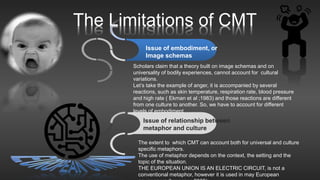
Let’s take the example of anger, it is accompanied by several
reactions, such as skin temperature, respiration rate, blood pressure
and high rate ( Ekman et al ;1983) and those reactions are different
from one culture to another. So, we have to account for different
levels of embodiment
The extent to which CMT can account both for universal and culture
specific metaphors.
The use of metaphor depends on the context, the setting and the
topic of the situation.
THE EUROPEAN UNION IS AN ELECTRIC CIRCUIT, is not a
conventional metaphor, however it is used in may European
Issue of embodiment, or
Image schemas
Issue of relationship between
metaphor and culture
Conclusion
CMT is a is promising approach that account for a number of aspects in figurative language
use. It was criticized based on five major deficiencies .However, it is considered as major
contribution in the field of linguistics
Schemacity of
metaphor
TEXT ERE!!
TEXT HERE!!
Methodology
Direction of
analysis
Embodiment
Relationship
between
metaphor and
culture
Nasri D
alel
ISLT

Nasridalelppt

  • 1.
    Presented by: NasriDalel CMT Revisited Critiques of CMT Strengths & Limitations ISLT Professor: Hamdi Sondes
  • 2.
  • 3.
    What is CMT Itconsists of understanding one conceptual domain in terms of another conceptual domain. By conceptual domain ; we mean any coherent organization of experience LO VE SA D LIG HT WA R ECONO MY
  • 4.
    Despite its huge contribution Tothe field of linguistics , and thirty years after its introduction, CMT has been widely Criticized based on several assumptions
  • 5.
    Strengths of CMT Rejectionof the traditional generative approach to linguistics which embraces autonomy of language From mind. The creation of connections between language and mind. Rise of cognitive linguistics: New ways of thinking about Linguistic structure and behavior New theoretical framework and empirical method New perception of the relationship between thought and Language It helps us understanding the pervasiveness of metaphorical language and thought. ( Gibbs 2008) Metaphor is no longer a rare and purely linguistic phenomenon but it rather serves social and cognitive functions . Metaphorical mappings between diverse knowledge domains motivate abstract thinking. CMT provides a new way of thinking about how abstract concepts are established and how they influence different domains of human thought , as well as ordinary language use and understanding.
  • 6.
    CMT or the second revolution in cognitive science: Interestin embodied cognition Cognitive linguistic analysis of language And gesture Metaphor central stage Dynamic Link between bodily experience, thought ,cultu re, behavior and linguistic The Impact of CMT Metaphor as evidence of abstract thinking and action
  • 7.
    ‘I’m willing toargue that n o single theoretical perspe ctive in all of cognitive scie nce has as much explanat ory power as does CMT’. Gibbs,’Why do some people dislike CMT?
  • 8.
    The Limitations ofCMT The data was only taken from the mental lexicons of researchers and from dictionaries, the CMT researchers took for granted which expressions are metaphorical and they did not pay attention to actual expressions used. ( Cserep, 2014) Issue of methodology For example: the verb ‘boil’ means ‘ to be very angry’ ‘Explode’ means ‘ to lose control over anger’ Hotheaded means ‘ someone who loses control over ange r Seething is ‘ to lose control over anger at any moment Then according to CMT, anger is a hot fluid container ( la koff and kovecses , 1987)
  • 9.
    The Limitations ofCMT Take the example of split hairs : They don't have any serious differences. They are just s plitting hairs. How to explain this using CMT? It is difficult to find global conceptual metaphor for this me aning ‘ to pay to much attention to small and unimportant differences in an argument’ (Kovecses ,2008) Issue of the direction of analysis The issue whether the analyses should be done top-down or bottom up ( Dobrovolskij and Piiraineen 2005). CMT rather followed the top down direction, from conceptual metaphor to their internal structure (set up mappings..) . However, Scholars advocate that the bottom up approach studied large number of expressions, as well as their detailed behavior ( Pragglejaz Group, 2007)
  • 10.
    The Limitations ofCMT Issue of schematicity The level of schematcity at which CM are formulated, Let’s take the example, THEORIES/ ARGUMENTS ARE BUILDINGS , we can say : the theroy has a solid foundation but we cannot say ‘ the theory has long corridors’ . Here each element of the source cannot be used to talk about the target, hence, scholars suggest a less schematic version (Clausner and Croft ;1997)
  • 11.
    The Limitations ofCMT Scholars claim that a theory built on image schemas and on universality of bodily experiences, cannot account for cultural variations. Let’s take the example of anger, it is accompanied by several reactions, such as skin temperature, respiration rate, blood pressure and high rate ( Ekman et al ;1983) and those reactions are different from one culture to another. So, we have to account for different levels of embodiment The extent to which CMT can account both for universal and culture specific metaphors. The use of metaphor depends on the context, the setting and the topic of the situation. THE EUROPEAN UNION IS AN ELECTRIC CIRCUIT, is not a conventional metaphor, however it is used in may European Issue of embodiment, or Image schemas Issue of relationship between metaphor and culture
  • 12.
    Conclusion CMT is ais promising approach that account for a number of aspects in figurative language use. It was criticized based on five major deficiencies .However, it is considered as major contribution in the field of linguistics Schemacity of metaphor TEXT ERE!! TEXT HERE!! Methodology Direction of analysis Embodiment Relationship between metaphor and culture
  • 13.