International Water Safety and Lifesaving Education by ILS Norman Farmer Chair, ILS Education Committee
Presentation Overview ILS International Lifesaving Certificates Guidelines ILS International Water Safety and Swimming  Education Guidelines International Example ILS Position Statement Swimming and Water Safety Education
ILS Guidelines
ILS Standards APPLICATION An international standard or reference, against which existing awards and qualifications can be accredited. Establishes an international set of criteria that can be used by Member organisations.
ILS Standards For ILS name to be associated with a program, ILS needs to be certain a minimum level is achieved and maintained Initial - Program complies with a minimum standard: E.g. Water safety, Personal survival, Swimming Maintenance of Standards Integrity of program to be maintained Continual improvement in all areas
ILS Standards STRUCTURE Minimum recommended competencies Learning outcomes and assessment criteria Assessment strategy Variables
Who is using ILS Certificate Scheme? Example: Germany Netherlands Ireland Malaysia Hong Kong Canada Denmark RLSS UK SLSA GB Brazil RLSS Australia Finland Poland SLSA Australia Egypt Croatia Argentina Italy Denmark Full scheme - Hungary
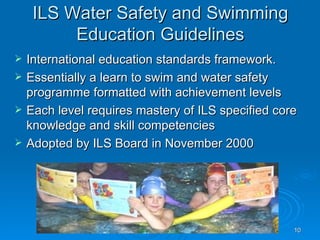
ILS Water Safety and Swimming Education Guidelines International education standards framework.  Essentially a learn to swim and water safety programme formatted with achievement levels Each level requires mastery of ILS specified core knowledge and skill competencies Adopted by ILS Board in November 2000
Skill and Knowledge Safe entry and exit Sculling and body orientation Movement in water Swimming strokes Survival skills Underwater skills Rescue skills Water safety knowledge Other skills
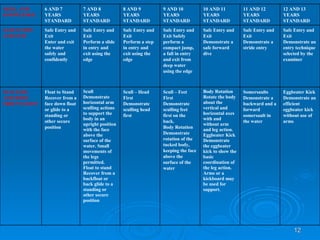
SKILL AND KNOWLEDGE 6 AND 7 YEARS STANDARD 7 AND 8 YEARS STANDARD 8 AND 9 YEARS STANDARD 9 AND 10 YEARS STANDARD 10 AND 11 YEARS STANDARD 11 AND 12 YEARS STANDARD 12 AND 13 YEARS STANDARD SAFE ENTRY AND EXIT Safe Entry and Exit Enter and exit the water safely and confidently Safe Entry and Exit Perform a slide in entry and exit using the edge Safe Entry and Exit Perform a step in entry and exit using the edge Safe Entry and Exit  Safely perform a compact jump, a fall in entry and exit from deep water using the edge Safe Entry and Exit  Demonstrate a safe forward dive Safe Entry and Exit  Demonstrate a stride entry Safe Entry and Exit  Demonstrate an entry technique selected by the examiner SCULLING AND BODY ORIENTATION Float to Stand Recover from a face down float or glide to a standing or other secure position Scull Demonstrate horizontal arm sculling actions to support the body in an upright position with the face above the surface of the water. Small movements of the legs permitted.  Float to stand Recover from a backfloat or back glide to a standing or other secure position Scull – Head First Demonstrate sculling head first Scull – Feet First Demonstrate sculling feet first on the back. Body Rotation Demonstrate rotation of the tucked body, keeping the face above the surface of the water Body Rotation Rotate the body about the vertical and horizontal axes with and without arm and leg action. Eggbeater Kick Demonstrate the eggbeater kick to show the basic coordination of the leg action. Arms or a kickboard may be used for support. Somersaults Demonstrate a backward and a forward somersault in the water Eggbeater Kick Demonstrate an efficient eggbeater kick without use of arms
Why Use ILS Programs? ILS membership ILS as the international standards setter ILS Minimum Standards ILS has the programs  Logo Gain added credibility in the minds of the consumer, “the parent who wants their child to be safe” Gain access to valued information and knowledge Increased promotional opportunities Increased recognition through Awards
International Example
RLSS Australia Swim and Survive Target: Children  5 Years + Parents and care givers Swimming Pools / Swim Schools Duration: Level System, 7 Levels, 3 Developing Levels Aim :  To provide a broad, balanced program of swimming, water safety and survival skills in preparation for a lifetime of safe activity in, on or near the water.
Aim: To provide students with the knowledge and skills to be able to make the right survival decisions, instinctive decisions that may help them or those around them survive an aquatic emergency.  Duration: 3 Rescue Awards, 3 Bronze Awards
Position Statement – Swimming and Water Safety Education Launch Background Two years to research and develop Peer review; internal and external to ILS Published in the November 2007 Issue 1 (4) of the International Journal of Aquatic Research and Education
Statement (1) Death by drowning is a leading public health problem in all countries. Prevention requires support. The vast majority of deaths by drowning can be prevented. Everyone should have access to training in water safety, personal survival, and water rescue.  Knowledge and understanding of water environments and their hazards should be taught to everyone. This awareness training should be accompanied by the provision of swimming teaching.
Statement (2)
Acknowledgements ILS Education Committee Previous Committees and Commissions since formation of ILS in 1994 ILS Member organisations Water safety practitioners around the world
Where to source more information ILS Member Federations International Life Saving Federation World Headquarters Regions www.ilsf.org

International Water Safety and Lifesaving Education by ILS

  • 1.
    International Water Safetyand Lifesaving Education by ILS Norman Farmer Chair, ILS Education Committee
  • 2.
    Presentation Overview ILSInternational Lifesaving Certificates Guidelines ILS International Water Safety and Swimming Education Guidelines International Example ILS Position Statement Swimming and Water Safety Education
  • 5.
  • 6.
    ILS Standards APPLICATIONAn international standard or reference, against which existing awards and qualifications can be accredited. Establishes an international set of criteria that can be used by Member organisations.
  • 7.
    ILS Standards ForILS name to be associated with a program, ILS needs to be certain a minimum level is achieved and maintained Initial - Program complies with a minimum standard: E.g. Water safety, Personal survival, Swimming Maintenance of Standards Integrity of program to be maintained Continual improvement in all areas
  • 8.
    ILS Standards STRUCTUREMinimum recommended competencies Learning outcomes and assessment criteria Assessment strategy Variables
  • 9.
    Who is usingILS Certificate Scheme? Example: Germany Netherlands Ireland Malaysia Hong Kong Canada Denmark RLSS UK SLSA GB Brazil RLSS Australia Finland Poland SLSA Australia Egypt Croatia Argentina Italy Denmark Full scheme - Hungary
  • 10.
    ILS Water Safetyand Swimming Education Guidelines International education standards framework. Essentially a learn to swim and water safety programme formatted with achievement levels Each level requires mastery of ILS specified core knowledge and skill competencies Adopted by ILS Board in November 2000
  • 11.
    Skill and KnowledgeSafe entry and exit Sculling and body orientation Movement in water Swimming strokes Survival skills Underwater skills Rescue skills Water safety knowledge Other skills
  • 12.
    SKILL AND KNOWLEDGE6 AND 7 YEARS STANDARD 7 AND 8 YEARS STANDARD 8 AND 9 YEARS STANDARD 9 AND 10 YEARS STANDARD 10 AND 11 YEARS STANDARD 11 AND 12 YEARS STANDARD 12 AND 13 YEARS STANDARD SAFE ENTRY AND EXIT Safe Entry and Exit Enter and exit the water safely and confidently Safe Entry and Exit Perform a slide in entry and exit using the edge Safe Entry and Exit Perform a step in entry and exit using the edge Safe Entry and Exit Safely perform a compact jump, a fall in entry and exit from deep water using the edge Safe Entry and Exit Demonstrate a safe forward dive Safe Entry and Exit Demonstrate a stride entry Safe Entry and Exit Demonstrate an entry technique selected by the examiner SCULLING AND BODY ORIENTATION Float to Stand Recover from a face down float or glide to a standing or other secure position Scull Demonstrate horizontal arm sculling actions to support the body in an upright position with the face above the surface of the water. Small movements of the legs permitted. Float to stand Recover from a backfloat or back glide to a standing or other secure position Scull – Head First Demonstrate sculling head first Scull – Feet First Demonstrate sculling feet first on the back. Body Rotation Demonstrate rotation of the tucked body, keeping the face above the surface of the water Body Rotation Rotate the body about the vertical and horizontal axes with and without arm and leg action. Eggbeater Kick Demonstrate the eggbeater kick to show the basic coordination of the leg action. Arms or a kickboard may be used for support. Somersaults Demonstrate a backward and a forward somersault in the water Eggbeater Kick Demonstrate an efficient eggbeater kick without use of arms
  • 13.
    Why Use ILSPrograms? ILS membership ILS as the international standards setter ILS Minimum Standards ILS has the programs Logo Gain added credibility in the minds of the consumer, “the parent who wants their child to be safe” Gain access to valued information and knowledge Increased promotional opportunities Increased recognition through Awards
  • 14.
  • 15.
    RLSS Australia Swimand Survive Target: Children 5 Years + Parents and care givers Swimming Pools / Swim Schools Duration: Level System, 7 Levels, 3 Developing Levels Aim : To provide a broad, balanced program of swimming, water safety and survival skills in preparation for a lifetime of safe activity in, on or near the water.
  • 16.
    Aim: To providestudents with the knowledge and skills to be able to make the right survival decisions, instinctive decisions that may help them or those around them survive an aquatic emergency. Duration: 3 Rescue Awards, 3 Bronze Awards
  • 17.
    Position Statement –Swimming and Water Safety Education Launch Background Two years to research and develop Peer review; internal and external to ILS Published in the November 2007 Issue 1 (4) of the International Journal of Aquatic Research and Education
  • 18.
    Statement (1) Deathby drowning is a leading public health problem in all countries. Prevention requires support. The vast majority of deaths by drowning can be prevented. Everyone should have access to training in water safety, personal survival, and water rescue. Knowledge and understanding of water environments and their hazards should be taught to everyone. This awareness training should be accompanied by the provision of swimming teaching.
  • 19.
  • 20.
    Acknowledgements ILS EducationCommittee Previous Committees and Commissions since formation of ILS in 1994 ILS Member organisations Water safety practitioners around the world
  • 21.
    Where to sourcemore information ILS Member Federations International Life Saving Federation World Headquarters Regions www.ilsf.org