bbby AAlaan BBBBaggnaalll
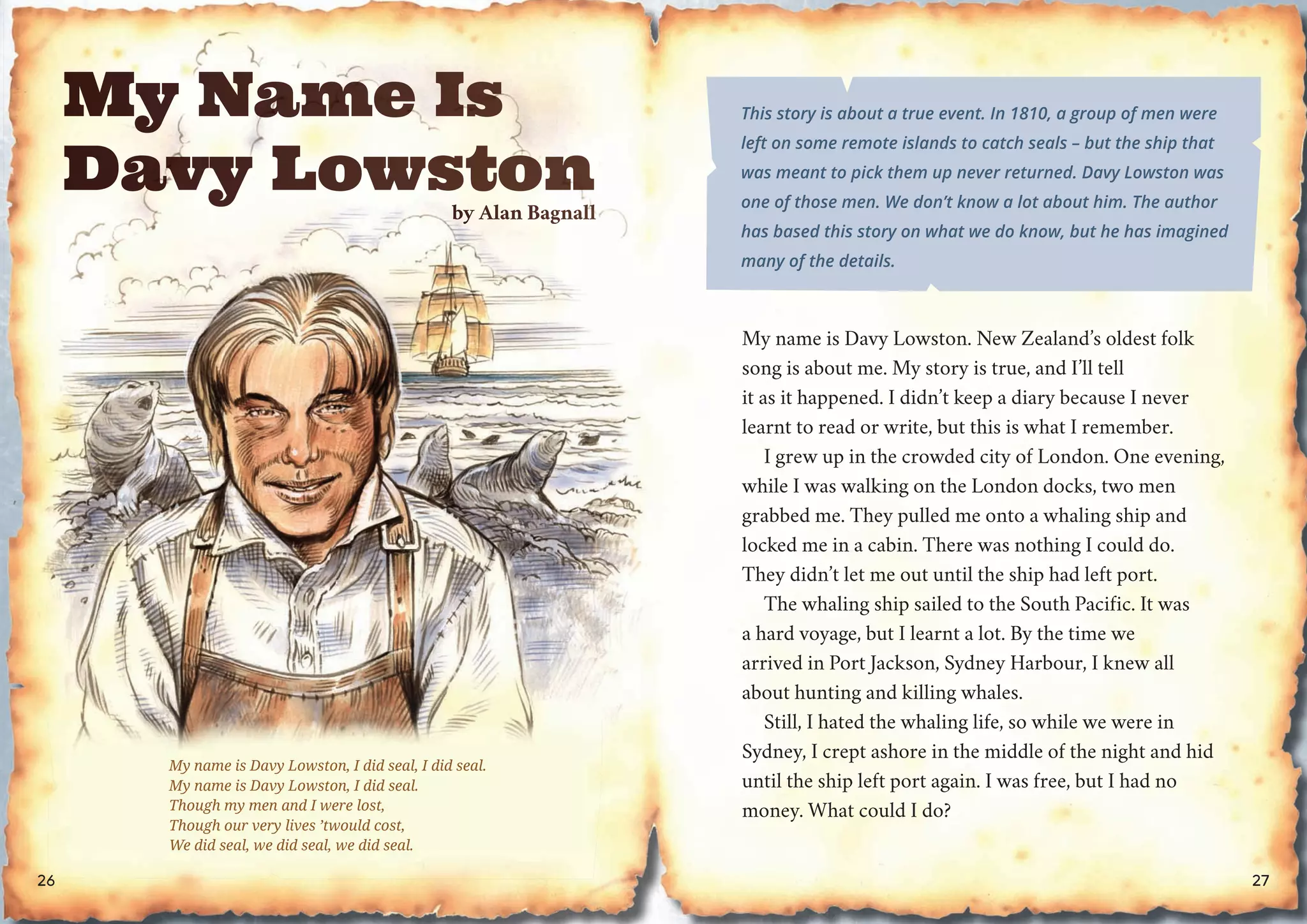
My name is Davy Lowston, I did seal, I did seal.
My name is Davy Lowston, I did seal.
Though my men and I were lost,
Though our very lives ’twould cost,
We did seal, we did seal, we did seal.
26
This story is about a true event. In 1810, a group of men were
left on some remote islands to catch seals – but the ship that
was meant to pick them up never returned. Davy Lowston was
one of those men. We don’t know a lot about him. The author
has based this story on what we do know, but he has imagined
many of the details.
My name is Davy Lowston. New Zealand’s oldest folk
song is about me. My story is true, and I’ll tell
it as it happened. I didn’t keep a diary because I never
learnt to read or write, but this is what I remember.
I grew up in the crowded city of London. One evening,
while I was walking on the London docks, two men
grabbed me. They pulled me onto a whaling ship and
locked me in a cabin. There was nothing I could do.
They didn’t let me out until the ship had left port.
The whaling ship sailed to the South Pacific. It was
a hard voyage, but I learnt a lot. By the time we
arrived in Port Jackson, Sydney Harbour, I knew all
about hunting and killing whales.
Still, I hated the whaling life, so while we were in
Sydney, I crept ashore in the middle of the night and hid
until the ship left port again. I was free, but I had no
money. What could I do?
27
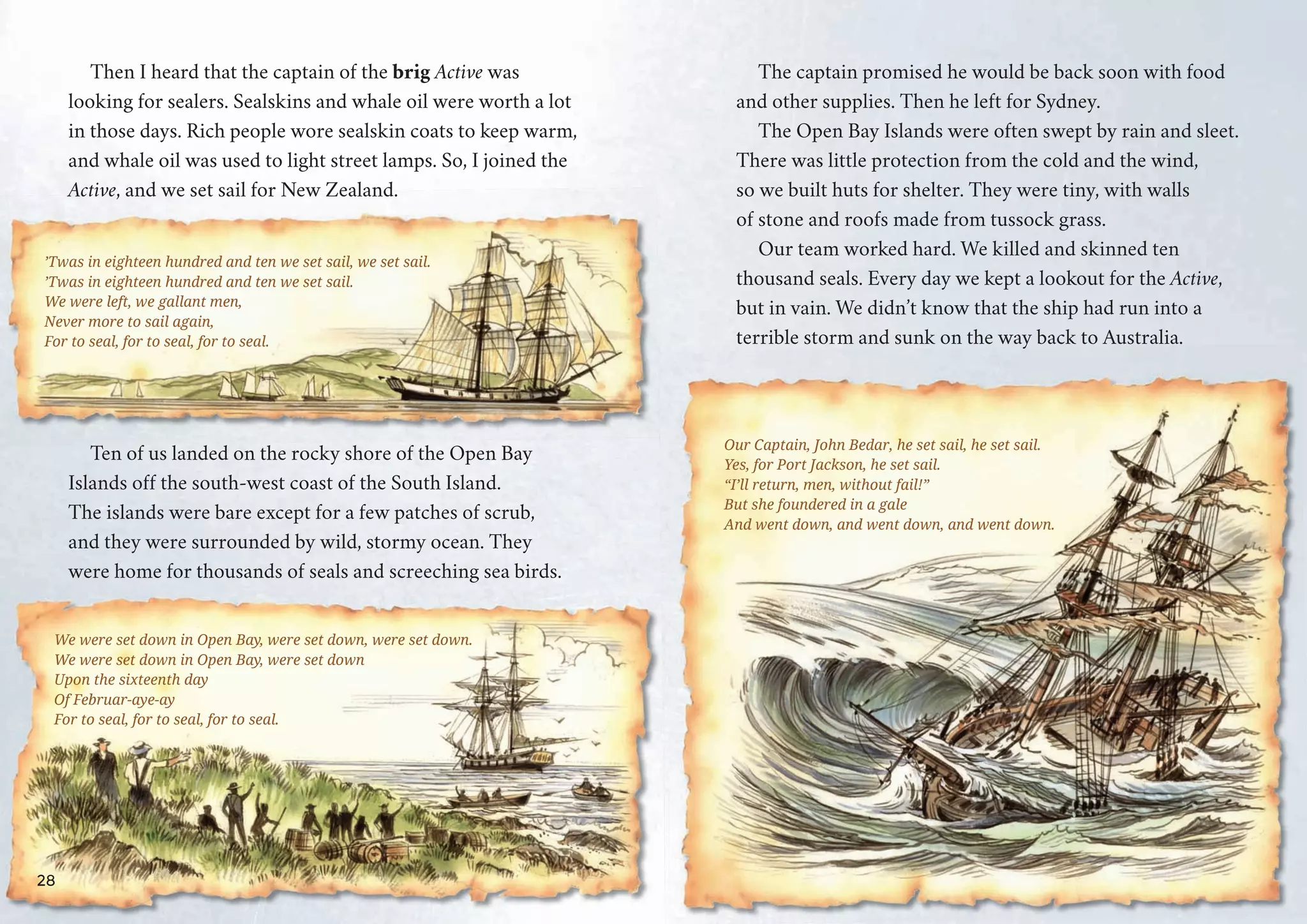
Then I heard that the captain of the brig Active was
looking for sealers. Sealskins and whale oil were worth a lot
in those days. Rich people wore sealskin coats to keep warm,
and whale oil was used to light street lamps. So, I joined the
Active, and we set sail for New Zealand.
’Twas in eightttteeee n hundred and ten we set sail, we set sail.
’TTwass in eighteen hundred and ten we set sail.
WeWW were left, we gallant men,
Never more to sail agag in,
Foor to seal, for to seal, for to seae l.
Ten of us landed on the rocky shore of the Open Bay
Islands off the south-west coast of the South Island.
The islands were bare except for a few patches of scrub,
and they were surrounded by wild, stormy ocean. They
were home for thousands of seals and screeching sea birds.
WeWe were set down in Open Bayy, were sett down, were set down.
We weree e seet dodd wn in OpOO en Bay, weere set down
Upono the sixteennth day
Of Februar-aye-ay
For to seal, foro to seal, for to seal.
28
The captain promised he would be back soon with food
and other supplies. Then he left for Sydney.
The Open Bay Islands were often swept by rain and sleet.
There was little protection from the cold and the wind,
so we built huts for shelter. They were tiny, with walls
of stone and roofs made from tussock grass.
Our team worked hard. We killed and skinned ten
thousand seals. Every day we kept a lookout for the Active,
but in vain. We didn’t know that the ship had run into a
terrible storm and sunk on the way back to Australia.
Our Captp ain, John Bedar, he set sailii , he set sail.
YeYes,s for Port Jacksos n, he set sail.
“I“I’l’ll return, men, without fail!”
BuButt she foundered in a gale
AnA dd wew nt down, and went down, and went down.
We were left on those bleak islands for three years and
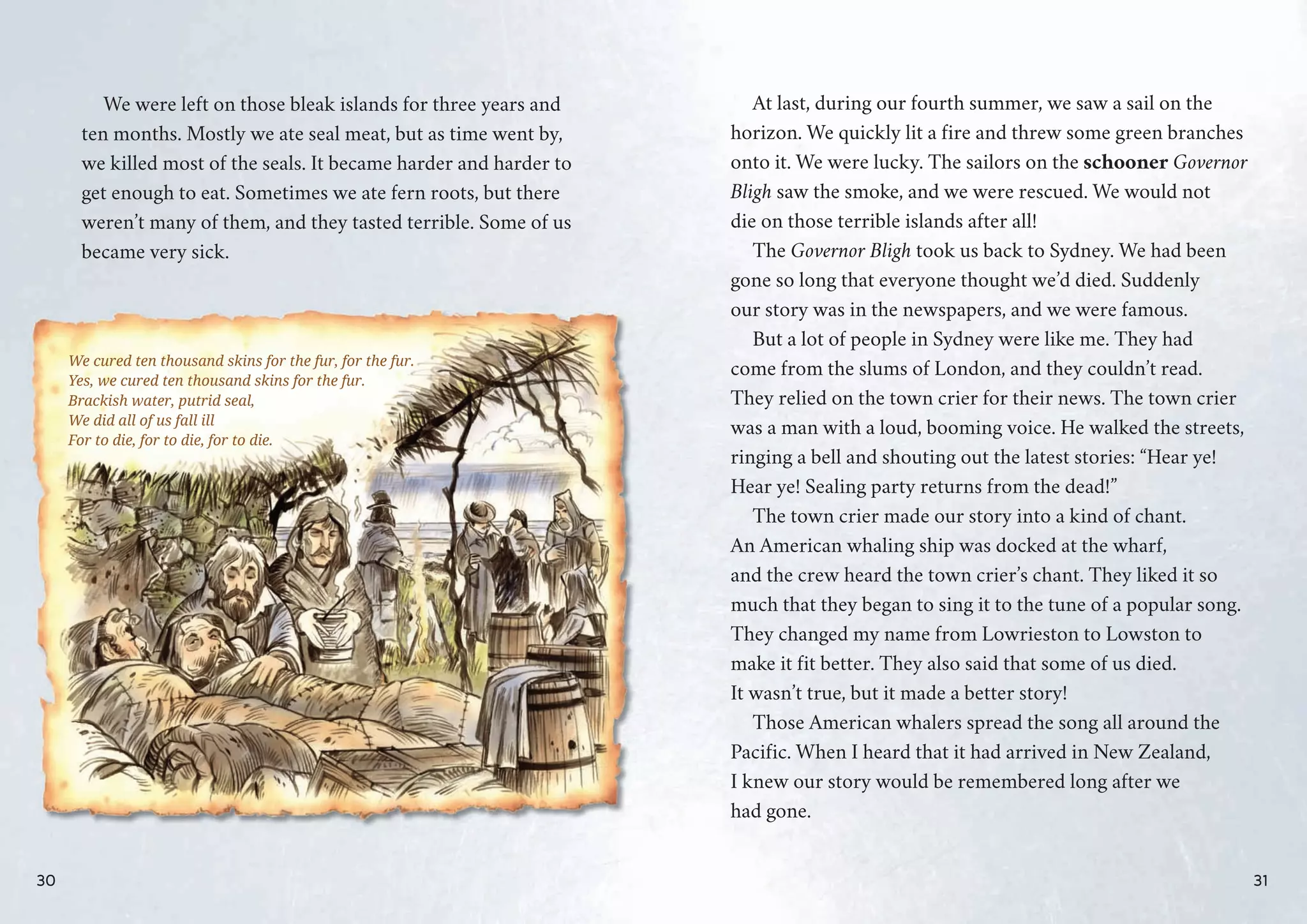
ten months. Mostly we ate seal meat, but as time went by,
we killed most of the seals. It became harder and harder to
get enough to eat. Sometimes we ate fern roots, but there
weren’t many of them, and they tasted terrible. Some of us
became very sick.
We cured ten thousand skins for the fur, for the fur.
Yes, wwe cured ten thousand skins ffor the fur.
Brackik sh water, putrid seal,
We did all of usu fall ill
For to die, for to die, for to die.
30
At last, during our fourth summer, we saw a sail on the
horizon. We quickly lit a fire and threw some green branches
onto it. We were lucky. The sailors on the schooner Governor
Bligh saw the smoke, and we were rescued. We would not
die on those terrible islands after all!
The Governor Bligh took us back to Sydney. We had been
gone so long that everyone thought we’d died. Suddenly
our story was in the newspapers, and we were famous.
But a lot of people in Sydney were like me. They had
come from the slums of London, and they couldn’t read.
They relied on the town crier for their news. The town crier
was a man with a loud, booming voice. He walked the streets,
ringing a bell and shouting out the latest stories: “Hear ye!
Hear ye! Sealing party returns from the dead!”
The town crier made our story into a kind of chant.
An American whaling ship was docked at the wharf,
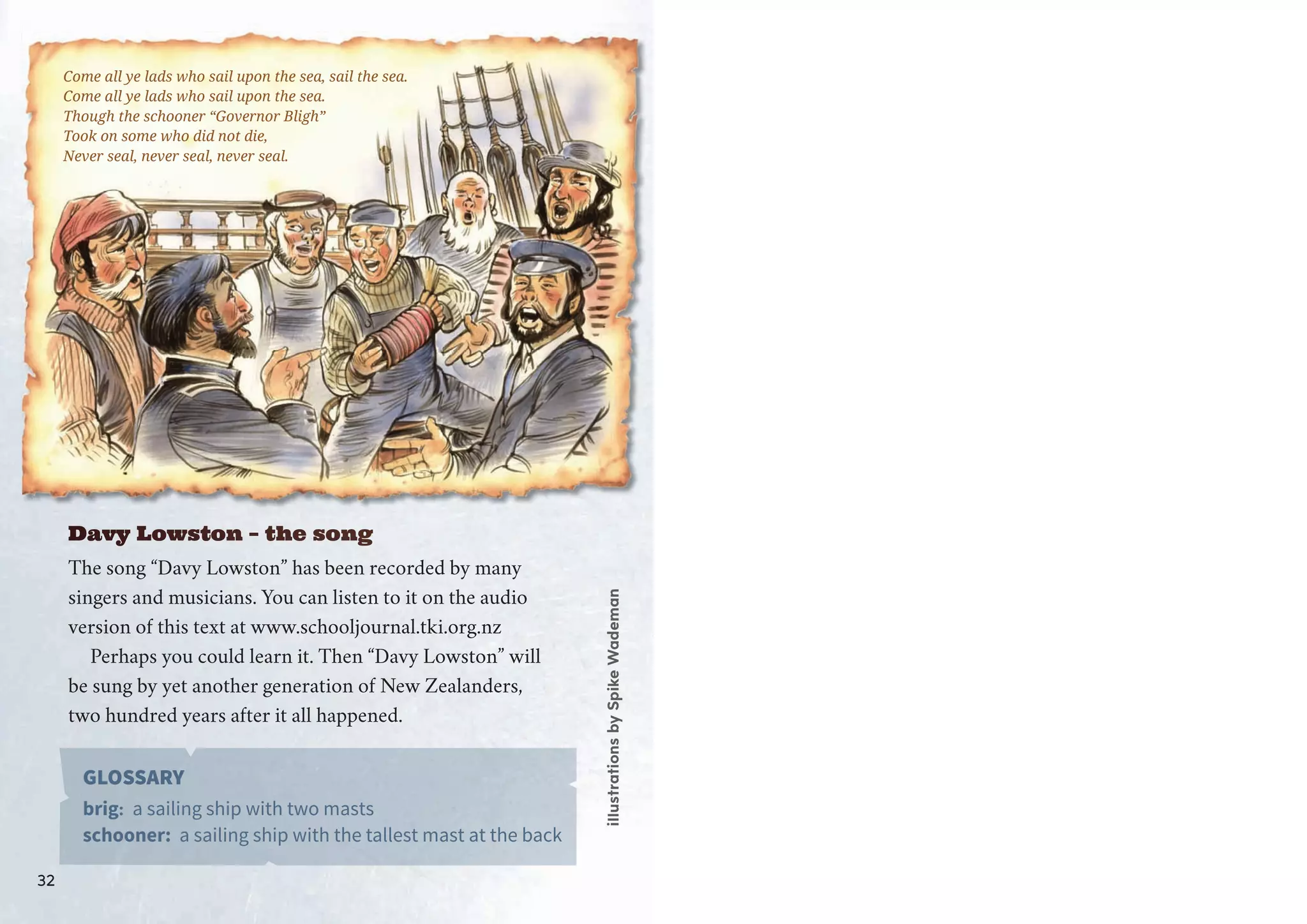
and the crew heard the town crier’s chant. They liked it so
much that they began to sing it to the tune of a popular song.
They changed my name from Lowrieston to Lowston to
make it fit better. They also said that some of us died.
It wasn’t true, but it made a better story!
Those American whalers spread the song all around the
Pacific. When I heard that it had arrived in New Zealand,
I knew our story would be remembered long after we
had gone.
31
Davy LLLowstonn – tthe ssong
The song “Davy Lowston” has been recorded by many
singers and musicians. You can listen to it on the audio
version of this text at www.schooljournal.tki.org.nz
Perhaps you could learn it. Then “Davy Lowston” will
be sung by yet another generation of New Zealanders,
two hundred years after it all happened.
GLOSSARY
brig: a sailing ship with two masts
schooner: a sailing ship with the tallest mast at the back
Come all ye lads who sail upon the sea, sail the sea.
Come all ye lads who sail upon the sea.
Thoughg tthe schooner “Governor Bligh”
ToT ok on some who did not ddie,
Never seal, neverr seal, never seal.
illustrationsbySpikeWademan
32
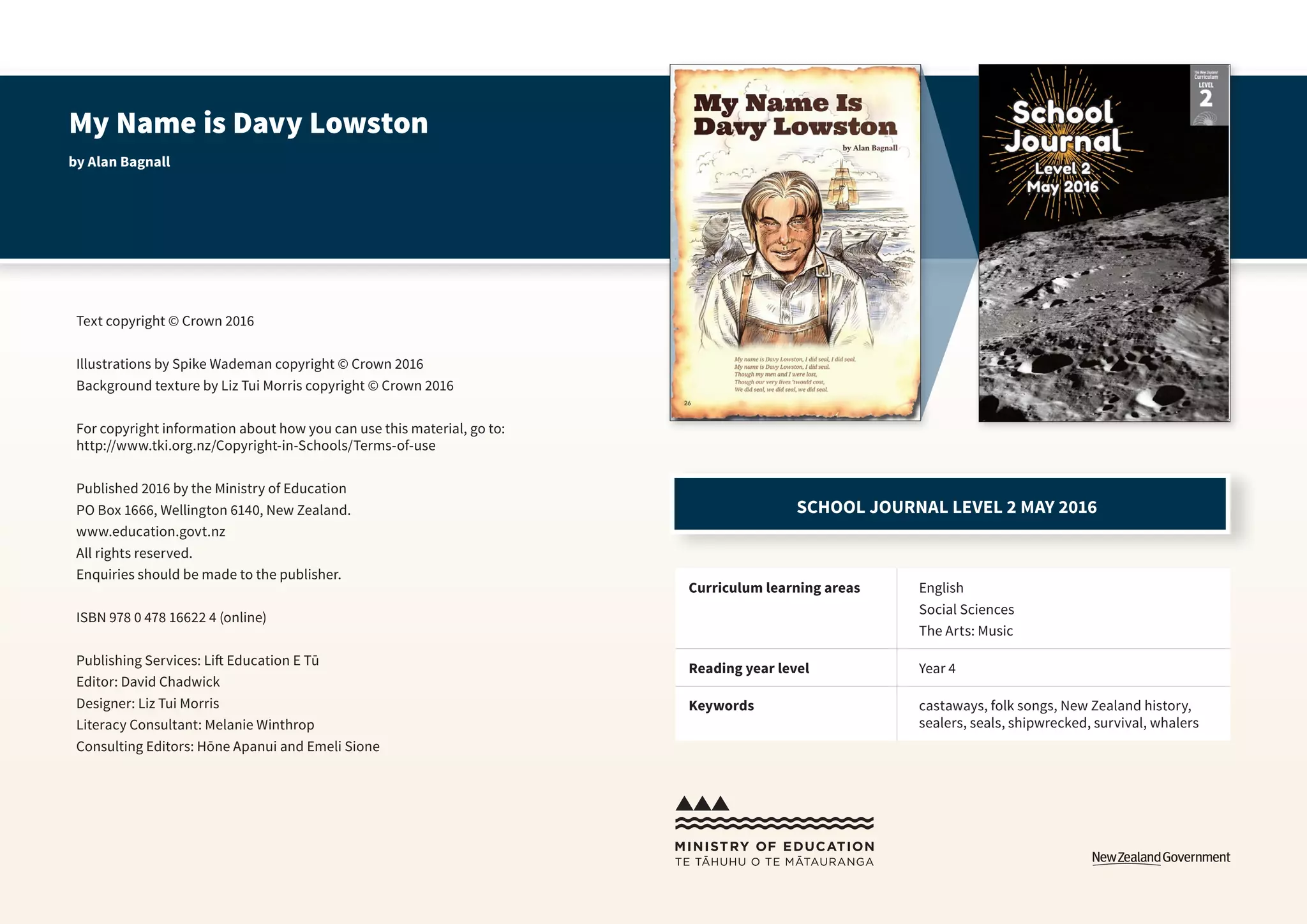
My Name is Davy Lowston
by Alan Bagnall
Text copyright © Crown 2016
Illustrations by Spike Wademan copyright © Crown 2016
Background texture by Liz Tui Morris copyright © Crown 2016
For copyright information about how you can use this material, go to:
http://www.tki.org.nz/Copyright-in-Schools/Terms-of-use
Published 2016 by the Ministry of Education
PO Box 1666, Wellington 6140, New Zealand.
www.education.govt.nz
All rights reserved.
Enquiries should be made to the publisher.
ISBN 978 0 478 16622 4 (online)
Publishing Services: Lift Education E Tū
Editor: David Chadwick
Designer: Liz Tui Morris
Literacy Consultant: Melanie Winthrop
Consulting Editors: Hōne Apanui and Emeli Sione
Curriculum learning areas English
Social Sciences
The Arts: Music
Reading year level Year 4
Keywords castaways, folk songs, New Zealand history,
sealers, seals, shipwrecked, survival, whalers
SCHOOL JOURNAL LEVEL 2 MAY 2016

My+name+is+davy+lowston sj+l2,+may+2016 (1)

  • 1.
    bbby AAlaan BBBBaggnaalll Myname is Davy Lowston, I did seal, I did seal. My name is Davy Lowston, I did seal. Though my men and I were lost, Though our very lives ’twould cost, We did seal, we did seal, we did seal. 26 This story is about a true event. In 1810, a group of men were left on some remote islands to catch seals – but the ship that was meant to pick them up never returned. Davy Lowston was one of those men. We don’t know a lot about him. The author has based this story on what we do know, but he has imagined many of the details. My name is Davy Lowston. New Zealand’s oldest folk song is about me. My story is true, and I’ll tell it as it happened. I didn’t keep a diary because I never learnt to read or write, but this is what I remember. I grew up in the crowded city of London. One evening, while I was walking on the London docks, two men grabbed me. They pulled me onto a whaling ship and locked me in a cabin. There was nothing I could do. They didn’t let me out until the ship had left port. The whaling ship sailed to the South Pacific. It was a hard voyage, but I learnt a lot. By the time we arrived in Port Jackson, Sydney Harbour, I knew all about hunting and killing whales. Still, I hated the whaling life, so while we were in Sydney, I crept ashore in the middle of the night and hid until the ship left port again. I was free, but I had no money. What could I do? 27
  • 2.
    Then I heardthat the captain of the brig Active was looking for sealers. Sealskins and whale oil were worth a lot in those days. Rich people wore sealskin coats to keep warm, and whale oil was used to light street lamps. So, I joined the Active, and we set sail for New Zealand. ’Twas in eightttteeee n hundred and ten we set sail, we set sail. ’TTwass in eighteen hundred and ten we set sail. WeWW were left, we gallant men, Never more to sail agag in, Foor to seal, for to seal, for to seae l. Ten of us landed on the rocky shore of the Open Bay Islands off the south-west coast of the South Island. The islands were bare except for a few patches of scrub, and they were surrounded by wild, stormy ocean. They were home for thousands of seals and screeching sea birds. WeWe were set down in Open Bayy, were sett down, were set down. We weree e seet dodd wn in OpOO en Bay, weere set down Upono the sixteennth day Of Februar-aye-ay For to seal, foro to seal, for to seal. 28 The captain promised he would be back soon with food and other supplies. Then he left for Sydney. The Open Bay Islands were often swept by rain and sleet. There was little protection from the cold and the wind, so we built huts for shelter. They were tiny, with walls of stone and roofs made from tussock grass. Our team worked hard. We killed and skinned ten thousand seals. Every day we kept a lookout for the Active, but in vain. We didn’t know that the ship had run into a terrible storm and sunk on the way back to Australia. Our Captp ain, John Bedar, he set sailii , he set sail. YeYes,s for Port Jacksos n, he set sail. “I“I’l’ll return, men, without fail!” BuButt she foundered in a gale AnA dd wew nt down, and went down, and went down.
  • 3.
    We were lefton those bleak islands for three years and ten months. Mostly we ate seal meat, but as time went by, we killed most of the seals. It became harder and harder to get enough to eat. Sometimes we ate fern roots, but there weren’t many of them, and they tasted terrible. Some of us became very sick. We cured ten thousand skins for the fur, for the fur. Yes, wwe cured ten thousand skins ffor the fur. Brackik sh water, putrid seal, We did all of usu fall ill For to die, for to die, for to die. 30 At last, during our fourth summer, we saw a sail on the horizon. We quickly lit a fire and threw some green branches onto it. We were lucky. The sailors on the schooner Governor Bligh saw the smoke, and we were rescued. We would not die on those terrible islands after all! The Governor Bligh took us back to Sydney. We had been gone so long that everyone thought we’d died. Suddenly our story was in the newspapers, and we were famous. But a lot of people in Sydney were like me. They had come from the slums of London, and they couldn’t read. They relied on the town crier for their news. The town crier was a man with a loud, booming voice. He walked the streets, ringing a bell and shouting out the latest stories: “Hear ye! Hear ye! Sealing party returns from the dead!” The town crier made our story into a kind of chant. An American whaling ship was docked at the wharf, and the crew heard the town crier’s chant. They liked it so much that they began to sing it to the tune of a popular song. They changed my name from Lowrieston to Lowston to make it fit better. They also said that some of us died. It wasn’t true, but it made a better story! Those American whalers spread the song all around the Pacific. When I heard that it had arrived in New Zealand, I knew our story would be remembered long after we had gone. 31
  • 4.
    Davy LLLowstonn –tthe ssong The song “Davy Lowston” has been recorded by many singers and musicians. You can listen to it on the audio version of this text at www.schooljournal.tki.org.nz Perhaps you could learn it. Then “Davy Lowston” will be sung by yet another generation of New Zealanders, two hundred years after it all happened. GLOSSARY brig: a sailing ship with two masts schooner: a sailing ship with the tallest mast at the back Come all ye lads who sail upon the sea, sail the sea. Come all ye lads who sail upon the sea. Thoughg tthe schooner “Governor Bligh” ToT ok on some who did not ddie, Never seal, neverr seal, never seal. illustrationsbySpikeWademan 32
  • 5.
    My Name isDavy Lowston by Alan Bagnall Text copyright © Crown 2016 Illustrations by Spike Wademan copyright © Crown 2016 Background texture by Liz Tui Morris copyright © Crown 2016 For copyright information about how you can use this material, go to: http://www.tki.org.nz/Copyright-in-Schools/Terms-of-use Published 2016 by the Ministry of Education PO Box 1666, Wellington 6140, New Zealand. www.education.govt.nz All rights reserved. Enquiries should be made to the publisher. ISBN 978 0 478 16622 4 (online) Publishing Services: Lift Education E Tū Editor: David Chadwick Designer: Liz Tui Morris Literacy Consultant: Melanie Winthrop Consulting Editors: Hōne Apanui and Emeli Sione Curriculum learning areas English Social Sciences The Arts: Music Reading year level Year 4 Keywords castaways, folk songs, New Zealand history, sealers, seals, shipwrecked, survival, whalers SCHOOL JOURNAL LEVEL 2 MAY 2016