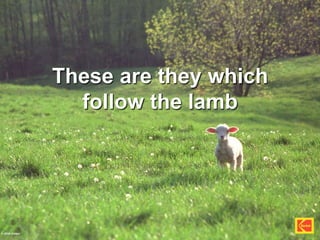
These are they which follow the lamb
Revelation 1414:1   And I looked, and, lo, a Lamb stood on the mount Sion, and with him an hundred forty [and] four thousand, having his Father's name written in their foreheads.    14:2   And I heard a voice from heaven, as the voice of many waters, and as the voice of a great thunder: and I heard the voice of harpers harping with their harps:    14:3   And they sung as it were a new song before the throne, and before the four beasts, and the elders: and no man could learn that song but the hundred [and] forty [and] four thousand, which were redeemed from the earth.    14:4   These are they which were not defiled with women; for they are virgins. These are they which follow the Lamb whithersoever he goeth. These were redeemed from among men, [being] the firstfruits unto God and to the Lamb.    14:5   And in their mouth was found no guile: for they are without fault before the throne of God.
LOOKING FOR A HEROTO FOLLOW
To Follow means:1: to go, proceed, or come after 2 to walk or proceed along 3 a: to be or act in accordance with  directions4 to accept as authority: obey 5. to copy after: imitate
The benefits of having the right  understanding Of the human nature of Christ, as taught by the Bible and the Spirit of Prophecy is crucial for the 144,000’s commitment to follow Christ in theselast days. To be able to Follow Christ means a lot for their preparation and survival during the most critical time of earth’s history.
The right understanding of the human nature of Christ helps me:to understand follow Christ’s example in how to unite my weak, feeble and sinful human nature to the infinite power of  divinity, the Holy Spirit.to understand the practical way to follow Christ’s example in  overcoming Satan’s deceptive power while I am in my sinful nature.To understand how to follow Christ’s example in having the transformation of my character by the Holy Spirit while in my sinful nature.To understand how to perfectly follow the example of Christ in exercising faith and implicit trust to God and obey God’s law perfectly even while still in my sinful nature.
Very important point1 John 4:3   And every spirit that confesseth not that Jesus Christ is come in the flesh (sarx) is not of God: and this is that [spirit] of antichrist, whereof ye have heard that it should come; and even now already is it in the world.
John1:14   And the Word was made flesh (Sarx), and dwelt among us, (and we beheld his glory, the glory as of the only begotten of the Father,) full of grace and truth.
Can Jesus really be followed?1 Peter 2:21   For even hereunto were ye called: because Christ also suffered for us, leaving us an example, that ye should follow his steps:    2:22   Who did no sin, neither was guile found in his mouth:    2:23   Who, when he was reviled, reviled not again; when he suffered, he threatened not; but committed [himself] to him that judgeth righteously:
Example means:1: one that serves as a pattern to be imitated or not to be imitated <a good ~> <a bad ~> 2: a parallel or closely similar cases. when serving as a precedent or model
What made Christ follow-able by a man who have a sinful or fallen nature?He put upon his sinless nature my sinful nature, that He may be able to relate with my infirmities in my sinful nature, and help me overcome them.He came not to our world to give the obedience of a lesser God to a greater, but as a man in –  fallen nature – to obey God's Holy Law, and in this way He is our example.  The Lord Jesus came to our world, not to reveal what a God could do, but what a man – in fallen nature – could do, through faith in God's power to help in every emergency.
Wait!!Didn’t Christ come in the nature before Adam fell? I have heard so many ministers teaching that Jesus came in the sinless nature.
Is that so? Watch this!!Adam had the advantage over Christ, in that when he was assailed by the tempter, none of the effects of sin were upon him. He stood in the strength of perfect manhood, possessing the full vigor of mind and body. He was surrounded with the glories of Eden, and was in daily communion with heavenly beings. It was not thus with Jesus when He entered the wilderness to cope with Satan. For four thousand years the race had been decreasing in physical strength, in mental power, in moral worth; and Christ took upon Him the infirmities of degenerate humanity. Only thus could He rescue man from the lowest depths of degradation.--Ms. 113, 1902, pp. 1, 2 (See DA 117).
Clad in the vestments of humanity, the Son of God came down to the level of those he wished to save. In him was no guile or sinfulness; he was ever pure and undefiled; yet he took upon him our sinful nature. Clothing his divinity with humanity, that he might associate with fallen humanity……………{RH, December 15, 1896 par. 7}
God becoming a man? How? What for?Christ had two natures, the nature of a man and the nature of God. In him divinity and humanity were combined. Upon his mediatorial work hangs the hope of the perishing world. No one but Christ has ever succeeded in living a perfect life, in living a pure, spotless character. He exhibited a perfect humanity, combined with deity; and by preserving each nature distinct, he has given to the world a representation of the character of God and the character of a perfect man. He shows us what God is, and what man may become--godlike in character.  {GCB, October 1, 1899 par. 20}
Mystery??????(Col. 1:26, 27.) An Unexplainable Blending.--Christ could have done nothing during His earthly ministry in saving fallen man if the divine had not been blended with the human. The limited capacity of man cannot define this wonderful mystery--the blending of the two natures, the divine and the human. It can never be explained. Man must wonder and be silent. And yet man is privileged to be a partaker of the divine nature, and in this way he can to some degree enter into the mystery (Letter 5, 1889).  {7BC 904.5}
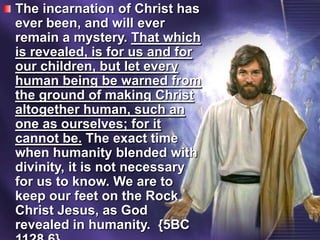
The incarnation of Christ has ever been, and will ever remain a mystery. That which is revealed, is for us and for our children, but let every human being be warned from the ground of making Christ altogether human, such an one as ourselves; for it cannot be. The exact time when humanity blended with divinity, it is not necessary for us to know. We are to keep our feet on the Rock Christ Jesus, as God revealed in humanity.  {5BC 1128.6}
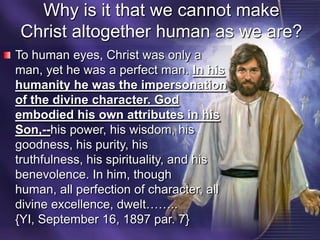
Why is it that we cannot make Christ altogether human as we are?To human eyes, Christ was only a man, yet he was a perfect man. In his humanity he was the impersonation of the divine character. God embodied his own attributes in his Son,--his power, his wisdom, his goodness, his purity, his truthfulness, his spirituality, and his benevolence. In him, though human, all perfection of character, all divine excellence, dwelt……..  {YI, September 16, 1897 par. 7}
What is impersonation and attributes mean?ImpersonationTo invest with personalityTo assume or act the person or character of.Attribute Quality, character or identity ascribed to.
What was the purpose for Christ coming to earth in our nature?
He came into our world to maintain a pure, sinless character, and to refute Satan's lie that it was not possible for human beings to keep the law of God.Christ came to live the law in His human character in just that way in which all may live the law in human nature if they will do as Christ was doing.He had inspired holy men of old to write for the benefit of man: "Let him take hold of my strength, that he may make peace with me; and he shall make peace with me." Isa. 27:5.  {6MR 111.2}
Christ’s example in the human nature      The Saviour took upon Himself the infirmities of humanity and lived a sinless life, that men might have no fear that because of the weakness of human nature they could not overcome.Christ came to make us "partakers of the divine nature," and His life declares that humanity, combined with divinity, does not commit sin.  {MH 180.5}
What does infirmity mean?It means:FeeblenessFrailtiesFoible Defect
	Christ is the ladder that Jacob saw, the base resting on the earth, and the topmost round reaching to the gate of heaven, to the very threshold of glory. If that ladder had failed by a single step of reaching the earth, we should have been lost. But Christ reaches us where we are. He took our nature and overcame, that we through taking His nature might overcome. Made "in the likeness of sinful flesh" (Rom. 8:3), He lived a sinless life. Now by His divinity He lays hold upon the throne of heaven, while by His humanity He reaches us. He bids us by faith in Him attain to the glory of the character of God. Therefore are we to be perfect, even as our "Father which is in heaven is perfect."  {DA 311.5}
In becoming man's substitute,and conquering where man had been vanquished, Christ was not to manifest his divine power to relieve his own suffering, for fallen man could work no miracles in order to save himself from pain, and Christ, as his representative, was to bear his trials as a man, leaving an example of perfect faith and trust in his Heavenly Father.  {2SP 92.4}Perfect example
How was it possible for Christ to set this example for us to follow?Hebrews 2:14 – 16 Romans 1:3Philippians 2:7 – 8; “likeness”Romans 8: 3 – 4; “likeness”
“Likeness”(Strongs concordance) 3667 omoiwma homoioma hom-oy’-o-mah(Comes from the root word)3666 omoiow homoioo hom-oy-o’-ofrom 3664; TDNT-5:188,684; v AV-liken 9, make like 2, be like 2, in the likeness of 1, resemble 1; 15 1) to be made like 2) to liken, compare
“Flesh”4561 sarx 1) flesh (the soft substance of the living body, which covers the bones and is permeated with blood) of both man and beasts 2) the flesh, denotes mere human nature, with its frailties and passions, the earthly nature of man apart from divine influence, and therefore prone to sin and opposed to God
What is EGW’s understanding of the concept of “likeness”?His human nature was created; it did not even possess the angelic powers. It was human, identical with our own.He was passing over the ground where Adam fell. He was now where, if He endured the test and trial in behalf of the fallen race, He would redeem Adam's disgraceful failure and fall, in our own humanity. ……. {3SM 129.3}
Can Jesus be tempted?The point you inquire of me is, In our Lord's great scene of conflict in the wilderness, apparently under the power of Satan and his angels, was He capable, in His human nature, of yielding to these temptations?I will try to answer this important question: As God He could not be tempted: but as a man He could be tempted, and that strongly, and could yield to the temptations. His human nature must pass through the same test and trial Adam and Eve passed through. His human nature was created; it did not even possess the angelic powers.  {MR 110-111.3}
The obedience of Christ to His Father was the same obedience that is required of man. Man cannot overcome Satan's temptations without divine power to combine with his instrumentality. So with Jesus Christ; He could lay hold of divine power. He came not to our world to give the obedience of a lesser God to a greater, but as a man to obey God's holy law, and in this way He is our example. The Lord Jesus came to our world, not to reveal what a God could do, but what a man could do, through faith in God's power to help in every emergency. Man is, through faith, to be a partaker in the divine nature, and to overcome every temptation wherewith he is beset.  {7BC 929.6}
But Jesus was different! He has His own power of omnipotence, omniscience, and  omnipresence in him?He was God!!! with these powers he rendered perfect abeyance; and overcame sinful lusts successfully.I therefore cannot fully follow Christ’s example.
{7BC 929.5}Christ's overcoming and obedience is that of a true human being. In our conclusions, we make many mistakes because of our erroneous views of the human nature of our Lord. When we give to His human nature a power that it is not possible for man to have in his conflicts with Satan, we destroy the completeness of His humanity. His imputed grace and power He gives to all who receive Him by faith.
	We need not place the obedience of Christ by itself, as something for which He was particularly adapted, by His particular divine nature, for He stood before God as man's representative and was tempted as man's substitute and surety. If Christ had a special power which it is not the privilege of man to have, Satan would have made capital of this matter. The work of Christ was to take from the claims of Satan his control of man, and He could do this only in the way that He came--a man, tempted as a man, rendering the obedience of a man (MS 1, 1892).  {7BC 930.3}
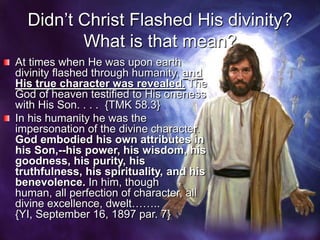
Didn’t Christ Flashed His divinity? What is that mean?At times when He was upon earth divinity flashed through humanity, and His true character was revealed. The God of heaven testified to His oneness with His Son. . . .  {TMK 58.3}In his humanity he was the impersonation of the divine character. God embodied his own attributes in his Son,--his power, his wisdom, his goodness, his purity, his truthfulness, his spirituality, and his benevolence. In him, though human, all perfection of character, all divine excellence, dwelt……..  {YI, September 16, 1897 par. 7}
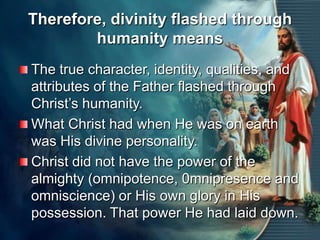
Therefore, divinity flashed through humanity meansThe true character, identity, qualities, and attributes of the Father flashed through Christ’s humanity.What Christ had when He was on earth was His divine personality.Christ did not have the power of the almighty (omnipotence, 0mnipresence and omniscience) or His own glory in His possession. That power He had laid down.
How dependent was Christ when He was on earth to His Father?
I can of mine own self do nothing	When Jesus was awakened to meet the storm, He was in perfect peace. There was no trace of fear in word or look, for no fear was in His heart. But He rested not in the possession of almighty power. It was not as the "Master of earth and sea and sky" that He reposed in quiet.That power He had laid down, and He says, "I can of Mine own self do nothing." John 5:30. He trusted in the Father's might. It was in faith--faith in God's love and care--that Jesus rested, and the power of that word which stilled the storm was the power of God.  {DA 336.1}
He laid aside His Glory Christ was the representative of humanity. He had laid aside his glory, stepped down from his throne, clothed his divinity with humanity, that with his human arm He might encircle the race, and with his divine arm reach the throne of the Infinite. He took upon Him the nature of man, and was tempted in all points like as we are. …..  {BEcho, February 1, 1893 par. 2}
I can of Mine own self do nothing	"I am the true Vine," He says. Instead of choosing the graceful palm, the lofty cedar, or the strong oak, Jesus takes the vine with its clinging tendrils to represent Himself. The palm tree, the cedar, and the oak stand alone. They require no support. But the vine entwines about the trellis, and thus climbs heavenward. So Christ in His humanity was dependent upon divine power. "I can of Mine own self do nothing," He declared. John 5:30.  {DA 674.3}
I can of mine own self do nothing	All His life, Jesus had lived in the presence of His Father. The Spirit of God had been His constant guide and support. He always gave God the glory for His works on earth, and said, "I can of Mine own self do nothing." John 5:30.  {SJ 101.3}     	We can do nothing of ourselves. It is only by relying on Christ for all our strength that we can overcome, and do His will on earth. We must have the same simple, childlike trust in Him that He had in His Father. Christ said, "Without Me ye can do nothing." John 15:5.  {Story of  Jesus 101.4}
The indwelling of the spirit 	"The prince of this world cometh," said Jesus, "and hath nothing in Me." There was nothing in Him that responded to Satan's sophistry. He did not consent to sin. Not even by a thought did He yield to temptation. So it may be with us. Christ's humanity was united with divinity; He was fitted for the conflict by the indwelling of the Holy Spirit. And He came to make us partakers of the divine nature. So long as we are united to Him by faith, sin has no more dominion over us. God reaches for the hand of faith in us to direct it to lay fast hold upon the divinity of Christ, that we may attain to perfection of character.--The Desire of Ages, page 123 (1898).
Whose power did Christ used to perform miracle? 	The angels of God are ever moving up and down from earth to Heaven, and from Heaven to earth. All the miracles of Christ performed for the afflicted and suffering were, by the power of God, through the ministration of angels. Christ condescended to take humanity, and thus he unites his interests with the fallen sons and daughters of Adam here below, while his divinity grasps the throne of God. And thus Christ opens the communication of man with God, and God with man. All the blessings from God to man are through the ministration of holy angels.  {2SP 67.2}
Abundant provision has been made that finite, fallen man may so connect with God that, through the same Source by which Christ overcame in His human nature, he may stand firmly against every temptation, as did Christ.He was subject to inconveniences that human nature is subjected to. He breathed the air of the same world we breathe. He stood and traveled in the same world we inhabit, which we have positive evidence was no more friendly to grace and righteousness than it is today.  {6MR 111.3}
What about the fact that Christ  not having the same propensities as ours? How can that be possible?What is propensity?
Propensity A definite but not decisive attraction or tendency--often used in plural.Synonym: leaning, proclivity, penchant mean a strong instinct or liking for something. leaning suggests a liking or attraction not strong enough to be decisive or uncontrollable. propensity implies a deeply ingrained and usually, irresistible inclination<a propensity to offer advice>. proclivity suggests a strong natural proneness usually to something objectionable or evil.penchant implies a strongly marked taste in the person or an irresistible attraction in the object.
Perfect exampleBut here we must not become in our ideas common and earthly, and in our perverted ideas we must not think that the liability of Christ to yield to Satan's temptations degraded His humanity and He possessed the same sinful, corrupt propensities as man.  {16MR 182.2}     The divine nature, combined with the human, made Him capable of yielding to Satan's temptations. Here the test to Christ was far greater than that of Adam and Eve, for Christ took our nature, fallen but not corrupted, and would not be corrupted unless He received the words of Satan in the place of the words of God. To suppose He was not capable of yielding to temptation places Him where He cannot be a perfect example for man, and the force and the power of this part of Christ's humiliation, which is the most eventful, is no instruction or help to human beings.  {16MR 182.3}
Be careful, exceedingly careful as to how you dwell upon the human nature of Christ. Do not set Him before the people as a man with the propensities of sin. He is the second Adam. The first Adam was created a pure, sinless being, without a taint of sin upon him; he was in the image of God. He could fall, and he did fall through transgressing. Because of sin, his posterity was born with inherent propensities of disobedience. But Jesus Christ was the only begotten Son of God.
He took upon Himself human nature, and was tempted in all points as human nature is tempted. He could have sinned; He could have fallen, but not for one moment was there in Him an evil propensity. He was assailed with temptations in the wilderness, as Adam was assailed with temptations in Eden.  {13MR 18.1}
Where is the origin of propensities?  Lustful Propensities Are Inherited.--Parents do not generally suspect that their children understand anything about this vice. In very many cases the parents are the real sinners. They have abused their marriage privileges and by indulgence have strengthened their animal passions. And as these have strengthened, the moral and intellectual faculties have become weak. The spiritual has been overborne by the brutish. Children are born with the animal propensities largely developed, the parents' own stamp of character having been given to them. . . . Children born to these parents will almost invariably take naturally to the disgusting habits of secret vice. . . . The sins of the parents will be visited upon their children, because the parents have given them the stamp of their own lustful propensities.{CG 442.1}
The issue of propensitiesChrist had a physical nature that was deteriorated, fallen, full of infirmities and weakened by the degeneration due to sin.But His character was pure, sinless, and righteous.How did he have such character?
Why didn’t Christ have propensities?Christ was born of the Spirit. He had had His new birth simultaneously with His natural birth.We too can be born of the Spirit at our new birth. Only, we have it years after our natural birth; Nicodemus’ experience, is a classic example.A baby in the womb can also have such experience. We only have to learn from Elizabeth, the mother of John the Baptist. Take note of the next slide.
He who said, "Suffer the little children to come unto Me, and forbid them not," still invites the mothers to lead up their little ones to be blessed by Him. Even the babe in its mother's arms may dwell as under the shadow of the Almighty through the faith of the praying mother. John the Baptist was filled with the Holy Spirit from his birth.If we will live in communion with God, we too may expect the divine Spirit to mold our little ones, even from their earliest moments.  {DA 512.3}
The Spirit helps get rid of propensitiesWhile we yield ourselves as instruments for the Holy Spirit's working, the grace of God works in us to deny old inclinations, to overcome powerful propensities, and to form new habits. As we cherish and obey the promptings of the Spirit, our hearts are enlarged to receive more and more of His power, and to do more and better work. Dormant energies are roused, and palsied faculties receive new life:  {ST, July 2, 1902 par. 16}
So what is the point of this study?Having the understanding that  Christ came in the fallen nature helps me to have the confidence that I can follow His examples?Having the understanding that Christ came in the fallen nature, encourages me, knowing that I have a saviour who understands my struggles and problems; He also understands the exact way to help me.
I WANT TO FOLLOWTHE FOOTSTEPSOF MY NEW HERO.HE IS FOLLOW-ABLE!
What  would happen if I choose to submit and follow my new hero?
He will give me His Spirit	Christ understands that for us to overcome the evil tendencies that we have inherited and cultivated, we need the Holy Spirit’s help. This is the same Holy Spirit that helped Him when He was on earth, while He was encompassed with the infirmities of the fallen nature and attacked by the temptations of Satan.
EZEKIEL36:26   A new heart also will I give you, and a new spirit will I put within you: and I will take away the stony heart out of your flesh, and I will give you an heart of flesh.    36:27   And I will put my spirit within you, and cause you to walk in my statutes, and ye shall keep my judgments, and do [them].
While we yield ourselves as instruments for the Holy Spirit's working, the grace of God works in us to deny old inclinations, to overcome powerful propensities, and to form new habits. As we cherish and obey the promptings of the Spirit, our hearts are enlarged to receive more and more of His power, and to do more and better work. Dormant energies are roused, and palsied faculties receive new life:  {ST, July 2, 1902 par. 16}
The work of the Holy SpiritThe Holy Spirit was the highest of all gifts that He could solicit from His Father for the exaltation of His people. The Spirit was to be given as a regenerating agent, and without this the sacrifice of Christ would have been of no avail. The power of evil had been strengthening for centuries, and the submission of men to this satanic captivity was amazing. Sin could be resisted and overcome only through the mighty agency of the Third Person of the Godhead, who would come with no modified energy, but in the fullness of divine power. It is the Spirit that makes effectual what has been wrought out by the world's Redeemer. It is by the Spirit that the heart is made pure. Through the Spirit the believer becomes a partaker of the divine nature. Christ has given His Spirit as a divine power to overcome all hereditary and cultivated tendencies to evil, and to impress His own character upon His church.  {DA 671.2}

My new hero

  • 1.
    These are theywhich follow the lamb
  • 2.
    Revelation 1414:1 And I looked, and, lo, a Lamb stood on the mount Sion, and with him an hundred forty [and] four thousand, having his Father's name written in their foreheads. 14:2 And I heard a voice from heaven, as the voice of many waters, and as the voice of a great thunder: and I heard the voice of harpers harping with their harps: 14:3 And they sung as it were a new song before the throne, and before the four beasts, and the elders: and no man could learn that song but the hundred [and] forty [and] four thousand, which were redeemed from the earth. 14:4 These are they which were not defiled with women; for they are virgins. These are they which follow the Lamb whithersoever he goeth. These were redeemed from among men, [being] the firstfruits unto God and to the Lamb. 14:5 And in their mouth was found no guile: for they are without fault before the throne of God.
  • 3.
    LOOKING FOR AHEROTO FOLLOW
  • 4.
    To Follow means:1:to go, proceed, or come after 2 to walk or proceed along 3 a: to be or act in accordance with directions4 to accept as authority: obey 5. to copy after: imitate
  • 13.
    The benefits ofhaving the right understanding Of the human nature of Christ, as taught by the Bible and the Spirit of Prophecy is crucial for the 144,000’s commitment to follow Christ in theselast days. To be able to Follow Christ means a lot for their preparation and survival during the most critical time of earth’s history.
  • 14.
    The right understandingof the human nature of Christ helps me:to understand follow Christ’s example in how to unite my weak, feeble and sinful human nature to the infinite power of divinity, the Holy Spirit.to understand the practical way to follow Christ’s example in overcoming Satan’s deceptive power while I am in my sinful nature.To understand how to follow Christ’s example in having the transformation of my character by the Holy Spirit while in my sinful nature.To understand how to perfectly follow the example of Christ in exercising faith and implicit trust to God and obey God’s law perfectly even while still in my sinful nature.
  • 15.
    Very important point1John 4:3 And every spirit that confesseth not that Jesus Christ is come in the flesh (sarx) is not of God: and this is that [spirit] of antichrist, whereof ye have heard that it should come; and even now already is it in the world.
  • 16.
    John1:14 And the Word was made flesh (Sarx), and dwelt among us, (and we beheld his glory, the glory as of the only begotten of the Father,) full of grace and truth.
  • 17.
    Can Jesus reallybe followed?1 Peter 2:21 For even hereunto were ye called: because Christ also suffered for us, leaving us an example, that ye should follow his steps: 2:22 Who did no sin, neither was guile found in his mouth: 2:23 Who, when he was reviled, reviled not again; when he suffered, he threatened not; but committed [himself] to him that judgeth righteously:
  • 18.
    Example means:1: onethat serves as a pattern to be imitated or not to be imitated <a good ~> <a bad ~> 2: a parallel or closely similar cases. when serving as a precedent or model
  • 19.
    What made Christfollow-able by a man who have a sinful or fallen nature?He put upon his sinless nature my sinful nature, that He may be able to relate with my infirmities in my sinful nature, and help me overcome them.He came not to our world to give the obedience of a lesser God to a greater, but as a man in – fallen nature – to obey God's Holy Law, and in this way He is our example. The Lord Jesus came to our world, not to reveal what a God could do, but what a man – in fallen nature – could do, through faith in God's power to help in every emergency.
  • 20.
    Wait!!Didn’t Christ comein the nature before Adam fell? I have heard so many ministers teaching that Jesus came in the sinless nature.
  • 21.
    Is that so?Watch this!!Adam had the advantage over Christ, in that when he was assailed by the tempter, none of the effects of sin were upon him. He stood in the strength of perfect manhood, possessing the full vigor of mind and body. He was surrounded with the glories of Eden, and was in daily communion with heavenly beings. It was not thus with Jesus when He entered the wilderness to cope with Satan. For four thousand years the race had been decreasing in physical strength, in mental power, in moral worth; and Christ took upon Him the infirmities of degenerate humanity. Only thus could He rescue man from the lowest depths of degradation.--Ms. 113, 1902, pp. 1, 2 (See DA 117).
  • 22.
    Clad in thevestments of humanity, the Son of God came down to the level of those he wished to save. In him was no guile or sinfulness; he was ever pure and undefiled; yet he took upon him our sinful nature. Clothing his divinity with humanity, that he might associate with fallen humanity……………{RH, December 15, 1896 par. 7}
  • 23.
    God becoming aman? How? What for?Christ had two natures, the nature of a man and the nature of God. In him divinity and humanity were combined. Upon his mediatorial work hangs the hope of the perishing world. No one but Christ has ever succeeded in living a perfect life, in living a pure, spotless character. He exhibited a perfect humanity, combined with deity; and by preserving each nature distinct, he has given to the world a representation of the character of God and the character of a perfect man. He shows us what God is, and what man may become--godlike in character. {GCB, October 1, 1899 par. 20}
  • 24.
    Mystery??????(Col. 1:26, 27.)An Unexplainable Blending.--Christ could have done nothing during His earthly ministry in saving fallen man if the divine had not been blended with the human. The limited capacity of man cannot define this wonderful mystery--the blending of the two natures, the divine and the human. It can never be explained. Man must wonder and be silent. And yet man is privileged to be a partaker of the divine nature, and in this way he can to some degree enter into the mystery (Letter 5, 1889). {7BC 904.5}
  • 25.
    The incarnation ofChrist has ever been, and will ever remain a mystery. That which is revealed, is for us and for our children, but let every human being be warned from the ground of making Christ altogether human, such an one as ourselves; for it cannot be. The exact time when humanity blended with divinity, it is not necessary for us to know. We are to keep our feet on the Rock Christ Jesus, as God revealed in humanity. {5BC 1128.6}
  • 26.
    Why is itthat we cannot make Christ altogether human as we are?To human eyes, Christ was only a man, yet he was a perfect man. In his humanity he was the impersonation of the divine character. God embodied his own attributes in his Son,--his power, his wisdom, his goodness, his purity, his truthfulness, his spirituality, and his benevolence. In him, though human, all perfection of character, all divine excellence, dwelt…….. {YI, September 16, 1897 par. 7}
  • 27.
    What is impersonationand attributes mean?ImpersonationTo invest with personalityTo assume or act the person or character of.Attribute Quality, character or identity ascribed to.
  • 28.
    What was thepurpose for Christ coming to earth in our nature?
  • 29.
    He came intoour world to maintain a pure, sinless character, and to refute Satan's lie that it was not possible for human beings to keep the law of God.Christ came to live the law in His human character in just that way in which all may live the law in human nature if they will do as Christ was doing.He had inspired holy men of old to write for the benefit of man: "Let him take hold of my strength, that he may make peace with me; and he shall make peace with me." Isa. 27:5. {6MR 111.2}
  • 30.
    Christ’s example inthe human nature The Saviour took upon Himself the infirmities of humanity and lived a sinless life, that men might have no fear that because of the weakness of human nature they could not overcome.Christ came to make us "partakers of the divine nature," and His life declares that humanity, combined with divinity, does not commit sin. {MH 180.5}
  • 31.
    What does infirmitymean?It means:FeeblenessFrailtiesFoible Defect
  • 32.
    Christ is theladder that Jacob saw, the base resting on the earth, and the topmost round reaching to the gate of heaven, to the very threshold of glory. If that ladder had failed by a single step of reaching the earth, we should have been lost. But Christ reaches us where we are. He took our nature and overcame, that we through taking His nature might overcome. Made "in the likeness of sinful flesh" (Rom. 8:3), He lived a sinless life. Now by His divinity He lays hold upon the throne of heaven, while by His humanity He reaches us. He bids us by faith in Him attain to the glory of the character of God. Therefore are we to be perfect, even as our "Father which is in heaven is perfect." {DA 311.5}
  • 33.
    In becoming man'ssubstitute,and conquering where man had been vanquished, Christ was not to manifest his divine power to relieve his own suffering, for fallen man could work no miracles in order to save himself from pain, and Christ, as his representative, was to bear his trials as a man, leaving an example of perfect faith and trust in his Heavenly Father. {2SP 92.4}Perfect example
  • 34.
    How was itpossible for Christ to set this example for us to follow?Hebrews 2:14 – 16 Romans 1:3Philippians 2:7 – 8; “likeness”Romans 8: 3 – 4; “likeness”
  • 35.
    “Likeness”(Strongs concordance) 3667omoiwma homoioma hom-oy’-o-mah(Comes from the root word)3666 omoiow homoioo hom-oy-o’-ofrom 3664; TDNT-5:188,684; v AV-liken 9, make like 2, be like 2, in the likeness of 1, resemble 1; 15 1) to be made like 2) to liken, compare
  • 36.
    “Flesh”4561 sarx 1)flesh (the soft substance of the living body, which covers the bones and is permeated with blood) of both man and beasts 2) the flesh, denotes mere human nature, with its frailties and passions, the earthly nature of man apart from divine influence, and therefore prone to sin and opposed to God
  • 37.
    What is EGW’sunderstanding of the concept of “likeness”?His human nature was created; it did not even possess the angelic powers. It was human, identical with our own.He was passing over the ground where Adam fell. He was now where, if He endured the test and trial in behalf of the fallen race, He would redeem Adam's disgraceful failure and fall, in our own humanity. ……. {3SM 129.3}
  • 38.
    Can Jesus betempted?The point you inquire of me is, In our Lord's great scene of conflict in the wilderness, apparently under the power of Satan and his angels, was He capable, in His human nature, of yielding to these temptations?I will try to answer this important question: As God He could not be tempted: but as a man He could be tempted, and that strongly, and could yield to the temptations. His human nature must pass through the same test and trial Adam and Eve passed through. His human nature was created; it did not even possess the angelic powers. {MR 110-111.3}
  • 39.
    The obedience ofChrist to His Father was the same obedience that is required of man. Man cannot overcome Satan's temptations without divine power to combine with his instrumentality. So with Jesus Christ; He could lay hold of divine power. He came not to our world to give the obedience of a lesser God to a greater, but as a man to obey God's holy law, and in this way He is our example. The Lord Jesus came to our world, not to reveal what a God could do, but what a man could do, through faith in God's power to help in every emergency. Man is, through faith, to be a partaker in the divine nature, and to overcome every temptation wherewith he is beset. {7BC 929.6}
  • 40.
    But Jesus wasdifferent! He has His own power of omnipotence, omniscience, and omnipresence in him?He was God!!! with these powers he rendered perfect abeyance; and overcame sinful lusts successfully.I therefore cannot fully follow Christ’s example.
  • 41.
    {7BC 929.5}Christ's overcomingand obedience is that of a true human being. In our conclusions, we make many mistakes because of our erroneous views of the human nature of our Lord. When we give to His human nature a power that it is not possible for man to have in his conflicts with Satan, we destroy the completeness of His humanity. His imputed grace and power He gives to all who receive Him by faith.
  • 42.
    We need notplace the obedience of Christ by itself, as something for which He was particularly adapted, by His particular divine nature, for He stood before God as man's representative and was tempted as man's substitute and surety. If Christ had a special power which it is not the privilege of man to have, Satan would have made capital of this matter. The work of Christ was to take from the claims of Satan his control of man, and He could do this only in the way that He came--a man, tempted as a man, rendering the obedience of a man (MS 1, 1892). {7BC 930.3}
  • 43.
    Didn’t Christ FlashedHis divinity? What is that mean?At times when He was upon earth divinity flashed through humanity, and His true character was revealed. The God of heaven testified to His oneness with His Son. . . . {TMK 58.3}In his humanity he was the impersonation of the divine character. God embodied his own attributes in his Son,--his power, his wisdom, his goodness, his purity, his truthfulness, his spirituality, and his benevolence. In him, though human, all perfection of character, all divine excellence, dwelt…….. {YI, September 16, 1897 par. 7}
  • 44.
    Therefore, divinity flashedthrough humanity meansThe true character, identity, qualities, and attributes of the Father flashed through Christ’s humanity.What Christ had when He was on earth was His divine personality.Christ did not have the power of the almighty (omnipotence, 0mnipresence and omniscience) or His own glory in His possession. That power He had laid down.
  • 45.
    How dependent wasChrist when He was on earth to His Father?
  • 46.
    I can ofmine own self do nothing When Jesus was awakened to meet the storm, He was in perfect peace. There was no trace of fear in word or look, for no fear was in His heart. But He rested not in the possession of almighty power. It was not as the "Master of earth and sea and sky" that He reposed in quiet.That power He had laid down, and He says, "I can of Mine own self do nothing." John 5:30. He trusted in the Father's might. It was in faith--faith in God's love and care--that Jesus rested, and the power of that word which stilled the storm was the power of God. {DA 336.1}
  • 47.
    He laid asideHis Glory Christ was the representative of humanity. He had laid aside his glory, stepped down from his throne, clothed his divinity with humanity, that with his human arm He might encircle the race, and with his divine arm reach the throne of the Infinite. He took upon Him the nature of man, and was tempted in all points like as we are. ….. {BEcho, February 1, 1893 par. 2}
  • 48.
    I can ofMine own self do nothing "I am the true Vine," He says. Instead of choosing the graceful palm, the lofty cedar, or the strong oak, Jesus takes the vine with its clinging tendrils to represent Himself. The palm tree, the cedar, and the oak stand alone. They require no support. But the vine entwines about the trellis, and thus climbs heavenward. So Christ in His humanity was dependent upon divine power. "I can of Mine own self do nothing," He declared. John 5:30. {DA 674.3}
  • 49.
    I can ofmine own self do nothing All His life, Jesus had lived in the presence of His Father. The Spirit of God had been His constant guide and support. He always gave God the glory for His works on earth, and said, "I can of Mine own self do nothing." John 5:30. {SJ 101.3} We can do nothing of ourselves. It is only by relying on Christ for all our strength that we can overcome, and do His will on earth. We must have the same simple, childlike trust in Him that He had in His Father. Christ said, "Without Me ye can do nothing." John 15:5. {Story of Jesus 101.4}
  • 50.
    The indwelling ofthe spirit "The prince of this world cometh," said Jesus, "and hath nothing in Me." There was nothing in Him that responded to Satan's sophistry. He did not consent to sin. Not even by a thought did He yield to temptation. So it may be with us. Christ's humanity was united with divinity; He was fitted for the conflict by the indwelling of the Holy Spirit. And He came to make us partakers of the divine nature. So long as we are united to Him by faith, sin has no more dominion over us. God reaches for the hand of faith in us to direct it to lay fast hold upon the divinity of Christ, that we may attain to perfection of character.--The Desire of Ages, page 123 (1898).
  • 51.
    Whose power didChrist used to perform miracle? The angels of God are ever moving up and down from earth to Heaven, and from Heaven to earth. All the miracles of Christ performed for the afflicted and suffering were, by the power of God, through the ministration of angels. Christ condescended to take humanity, and thus he unites his interests with the fallen sons and daughters of Adam here below, while his divinity grasps the throne of God. And thus Christ opens the communication of man with God, and God with man. All the blessings from God to man are through the ministration of holy angels. {2SP 67.2}
  • 52.
    Abundant provision hasbeen made that finite, fallen man may so connect with God that, through the same Source by which Christ overcame in His human nature, he may stand firmly against every temptation, as did Christ.He was subject to inconveniences that human nature is subjected to. He breathed the air of the same world we breathe. He stood and traveled in the same world we inhabit, which we have positive evidence was no more friendly to grace and righteousness than it is today. {6MR 111.3}
  • 53.
    What about thefact that Christ not having the same propensities as ours? How can that be possible?What is propensity?
  • 54.
    Propensity A definitebut not decisive attraction or tendency--often used in plural.Synonym: leaning, proclivity, penchant mean a strong instinct or liking for something. leaning suggests a liking or attraction not strong enough to be decisive or uncontrollable. propensity implies a deeply ingrained and usually, irresistible inclination<a propensity to offer advice>. proclivity suggests a strong natural proneness usually to something objectionable or evil.penchant implies a strongly marked taste in the person or an irresistible attraction in the object.
  • 55.
    Perfect exampleBut herewe must not become in our ideas common and earthly, and in our perverted ideas we must not think that the liability of Christ to yield to Satan's temptations degraded His humanity and He possessed the same sinful, corrupt propensities as man. {16MR 182.2} The divine nature, combined with the human, made Him capable of yielding to Satan's temptations. Here the test to Christ was far greater than that of Adam and Eve, for Christ took our nature, fallen but not corrupted, and would not be corrupted unless He received the words of Satan in the place of the words of God. To suppose He was not capable of yielding to temptation places Him where He cannot be a perfect example for man, and the force and the power of this part of Christ's humiliation, which is the most eventful, is no instruction or help to human beings. {16MR 182.3}
  • 56.
    Be careful, exceedinglycareful as to how you dwell upon the human nature of Christ. Do not set Him before the people as a man with the propensities of sin. He is the second Adam. The first Adam was created a pure, sinless being, without a taint of sin upon him; he was in the image of God. He could fall, and he did fall through transgressing. Because of sin, his posterity was born with inherent propensities of disobedience. But Jesus Christ was the only begotten Son of God.
  • 57.
    He took uponHimself human nature, and was tempted in all points as human nature is tempted. He could have sinned; He could have fallen, but not for one moment was there in Him an evil propensity. He was assailed with temptations in the wilderness, as Adam was assailed with temptations in Eden. {13MR 18.1}
  • 58.
    Where is theorigin of propensities?  Lustful Propensities Are Inherited.--Parents do not generally suspect that their children understand anything about this vice. In very many cases the parents are the real sinners. They have abused their marriage privileges and by indulgence have strengthened their animal passions. And as these have strengthened, the moral and intellectual faculties have become weak. The spiritual has been overborne by the brutish. Children are born with the animal propensities largely developed, the parents' own stamp of character having been given to them. . . . Children born to these parents will almost invariably take naturally to the disgusting habits of secret vice. . . . The sins of the parents will be visited upon their children, because the parents have given them the stamp of their own lustful propensities.{CG 442.1}
  • 59.
    The issue ofpropensitiesChrist had a physical nature that was deteriorated, fallen, full of infirmities and weakened by the degeneration due to sin.But His character was pure, sinless, and righteous.How did he have such character?
  • 60.
    Why didn’t Christhave propensities?Christ was born of the Spirit. He had had His new birth simultaneously with His natural birth.We too can be born of the Spirit at our new birth. Only, we have it years after our natural birth; Nicodemus’ experience, is a classic example.A baby in the womb can also have such experience. We only have to learn from Elizabeth, the mother of John the Baptist. Take note of the next slide.
  • 61.
    He who said,"Suffer the little children to come unto Me, and forbid them not," still invites the mothers to lead up their little ones to be blessed by Him. Even the babe in its mother's arms may dwell as under the shadow of the Almighty through the faith of the praying mother. John the Baptist was filled with the Holy Spirit from his birth.If we will live in communion with God, we too may expect the divine Spirit to mold our little ones, even from their earliest moments. {DA 512.3}
  • 62.
    The Spirit helpsget rid of propensitiesWhile we yield ourselves as instruments for the Holy Spirit's working, the grace of God works in us to deny old inclinations, to overcome powerful propensities, and to form new habits. As we cherish and obey the promptings of the Spirit, our hearts are enlarged to receive more and more of His power, and to do more and better work. Dormant energies are roused, and palsied faculties receive new life: {ST, July 2, 1902 par. 16}
  • 63.
    So what isthe point of this study?Having the understanding that Christ came in the fallen nature helps me to have the confidence that I can follow His examples?Having the understanding that Christ came in the fallen nature, encourages me, knowing that I have a saviour who understands my struggles and problems; He also understands the exact way to help me.
  • 64.
    I WANT TOFOLLOWTHE FOOTSTEPSOF MY NEW HERO.HE IS FOLLOW-ABLE!
  • 68.
    What wouldhappen if I choose to submit and follow my new hero?
  • 69.
    He will giveme His Spirit Christ understands that for us to overcome the evil tendencies that we have inherited and cultivated, we need the Holy Spirit’s help. This is the same Holy Spirit that helped Him when He was on earth, while He was encompassed with the infirmities of the fallen nature and attacked by the temptations of Satan.
  • 70.
    EZEKIEL36:26 A new heart also will I give you, and a new spirit will I put within you: and I will take away the stony heart out of your flesh, and I will give you an heart of flesh. 36:27 And I will put my spirit within you, and cause you to walk in my statutes, and ye shall keep my judgments, and do [them].
  • 71.
    While we yieldourselves as instruments for the Holy Spirit's working, the grace of God works in us to deny old inclinations, to overcome powerful propensities, and to form new habits. As we cherish and obey the promptings of the Spirit, our hearts are enlarged to receive more and more of His power, and to do more and better work. Dormant energies are roused, and palsied faculties receive new life: {ST, July 2, 1902 par. 16}
  • 72.
    The work ofthe Holy SpiritThe Holy Spirit was the highest of all gifts that He could solicit from His Father for the exaltation of His people. The Spirit was to be given as a regenerating agent, and without this the sacrifice of Christ would have been of no avail. The power of evil had been strengthening for centuries, and the submission of men to this satanic captivity was amazing. Sin could be resisted and overcome only through the mighty agency of the Third Person of the Godhead, who would come with no modified energy, but in the fullness of divine power. It is the Spirit that makes effectual what has been wrought out by the world's Redeemer. It is by the Spirit that the heart is made pure. Through the Spirit the believer becomes a partaker of the divine nature. Christ has given His Spirit as a divine power to overcome all hereditary and cultivated tendencies to evil, and to impress His own character upon His church. {DA 671.2}