*
*Value at Risk
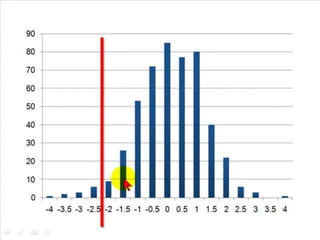
VAR summarizes the predicted maximum loss
(worst loss) over a target horizon within a given
confidence level.
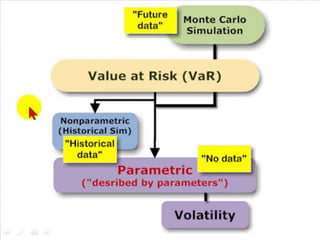
Three Approaches to VAR
* Parametric method
*Historical Simulation
* Monte Carlo method
*Substitutes of VAR
* Maturity Mismatches
* Sensitivity Analysis
*Risk Monitoring
* Evaluate the performance of bank’s risk strategies/policies
and procedures.
* Monitoring function should be independent of taking risk
units
* Information system to support compliance with board policy
* The board on regular basis should review reports
* Bank’s aggregate market risk exposure
* Market risk policies
* Findings of internal/external auditors
*Risk Control
*Enforcement of official lines of authority
* Segregation of duties
*Audit
*Review function can be performed by a number of
units in the organization including internal
audit/control department or ALCO support staff.
*
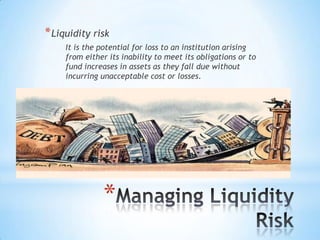
*Liquidity risk
It is the potential for loss to an institution arising
from either its inability to meet its obligations or to
fund increases in assets as they fall due without
incurring unacceptable cost or losses.
*Early Warning Indicators of Liquidity Risk
*A negative trend or significantly increased risk in
any area or product line.
*Concentrations in either assets or liabilities.
*Deterioration in quality of credit portfolio.
*A decline in earnings performance or projections.
*Rapid asset growth funded by volatile large deposit.
*Board and Senior Management Oversight
*To position bank’s strategic direction and tolerance
level for liquidity risk.
*To appoint senior managers who have ability to
manage liquidity risk and delegate them the
required authority to accomplish the job.
*To continuously monitors the bank's performance
and overall liquidity risk profile.
*To ensure that liquidity risk is identified, measured,
monitored, and controlled.
*Responsibilities of Senior Management
*Develop and implement procedures and practices
that translate the board's goals, objectives, and risk
tolerances into operating standards
* Adhere to the lines of authority and responsibility
that the board has established for managing
liquidity risk.
*Oversee the implementation and maintenance of
management information and other systems that
identify, measure, monitor, and control the bank's
liquidity risk..
*Liquidity Risk Strategy
*Composition of Assets and Liabilities.
*Diversification and Stability of Liabilities.
*Access to Inter-bank Market.
*ALCO/Investment Committee
*Responsible for managing the overall liquidity
*ALCO should meet monthly
*ALCO delegates day-to-day operating
responsibilities to the bank's treasury department
*Management Information System
*MIS is essential for sound liquidity management
decisions
*Data should be appropriately consolidated,
comprehensive yet succinct, focused, and available
in a timely manner
*Bank liquidity is primarily affected by large,
aggregate principal cash flows, detailed information
on every transaction may not improve analysis.

Muzafar's part

  • 1.
  • 2.
    *Value at Risk VARsummarizes the predicted maximum loss (worst loss) over a target horizon within a given confidence level. Three Approaches to VAR * Parametric method *Historical Simulation * Monte Carlo method
  • 5.
    *Substitutes of VAR *Maturity Mismatches * Sensitivity Analysis *Risk Monitoring * Evaluate the performance of bank’s risk strategies/policies and procedures. * Monitoring function should be independent of taking risk units * Information system to support compliance with board policy * The board on regular basis should review reports * Bank’s aggregate market risk exposure * Market risk policies * Findings of internal/external auditors
  • 6.
    *Risk Control *Enforcement ofofficial lines of authority * Segregation of duties *Audit *Review function can be performed by a number of units in the organization including internal audit/control department or ALCO support staff.
  • 7.
    * *Liquidity risk It isthe potential for loss to an institution arising from either its inability to meet its obligations or to fund increases in assets as they fall due without incurring unacceptable cost or losses.
  • 8.
    *Early Warning Indicatorsof Liquidity Risk *A negative trend or significantly increased risk in any area or product line. *Concentrations in either assets or liabilities. *Deterioration in quality of credit portfolio. *A decline in earnings performance or projections. *Rapid asset growth funded by volatile large deposit.
  • 9.
    *Board and SeniorManagement Oversight *To position bank’s strategic direction and tolerance level for liquidity risk. *To appoint senior managers who have ability to manage liquidity risk and delegate them the required authority to accomplish the job. *To continuously monitors the bank's performance and overall liquidity risk profile. *To ensure that liquidity risk is identified, measured, monitored, and controlled.
  • 10.
    *Responsibilities of SeniorManagement *Develop and implement procedures and practices that translate the board's goals, objectives, and risk tolerances into operating standards * Adhere to the lines of authority and responsibility that the board has established for managing liquidity risk. *Oversee the implementation and maintenance of management information and other systems that identify, measure, monitor, and control the bank's liquidity risk..
  • 11.
    *Liquidity Risk Strategy *Compositionof Assets and Liabilities. *Diversification and Stability of Liabilities. *Access to Inter-bank Market. *ALCO/Investment Committee *Responsible for managing the overall liquidity *ALCO should meet monthly *ALCO delegates day-to-day operating responsibilities to the bank's treasury department
  • 12.
    *Management Information System *MISis essential for sound liquidity management decisions *Data should be appropriately consolidated, comprehensive yet succinct, focused, and available in a timely manner *Bank liquidity is primarily affected by large, aggregate principal cash flows, detailed information on every transaction may not improve analysis.

Editor's Notes

  • #3 It follows the concept that reasonableexpectation of loss can be deduced by evaluating market rates, prices observedvolatility and correlation.
  • #6 Maturity MismatchOccurs when a business mismatches its balance sheet by having more short term liabilities than it has short term assets, as well as possessing more assets than it has liabilities for medium and long term obligations. Changes in the maturity profile of a company can also indicate its ability to borrow.Sentivity AnalysisIt shows how the model behavior responds to changes in parameter values, Interest rate risk sensitivity analysis helps a lender's top management understand how "sensitive" the company's loan portfolio may be with respect to market rates.