DEPARTMENT OF MICROBIOLOGY
MUSHROOM CULTIVATION
BY
B SREEHAR NAICK
P212034
1ST M.SC MICROBIOLOGY
INTRODUCTION
• Mushroom is fleshy fungi
• It’s a small umbrella like structure
• Cap- PILES & thread like structure- MYCELIA
• Mycelia absorbs nutrients from the soil
• No need of sunlight for mushroom growth
• They are low in fat content
• Monosodium glutamate is present . It is used as a flavor enhancer.
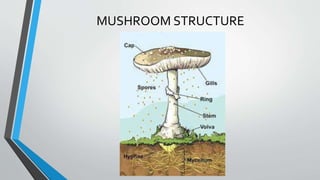
MUSHROOM STRUCTURE
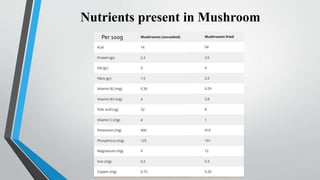
Nutrients present in Mushroom
Per 100g
MUSHROOM CULTIVATION
Mostly in cultivation of mushroom ‘‘Agaricus biosporus’’ is chosen
Because by the way of production , it comes the first place in the world.
The favorable season for mushroom cultivation is October - march in India
The cultivation Procedure has five main steps:
1. Mushroom Spawn
2. preparing of compost
3. Spawning
4. Casing
5. Cropping
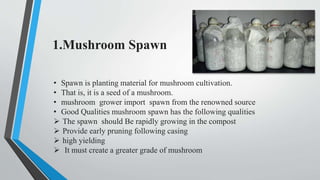
1.Mushroom Spawn
• Spawn is planting material for mushroom cultivation.
• That is, it is a seed of a mushroom.
• mushroom grower import spawn from the renowned source
• Good Qualities mushroom spawn has the following qualities
 The spawn should Be rapidly growing in the compost
 Provide early pruning following casing
 high yielding
 It must create a greater grade of mushroom
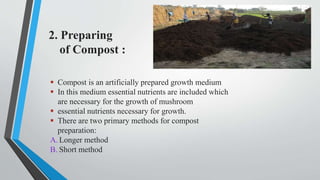
2. Preparing
of Compost :
 Compost is an artificially prepared growth medium
 In this medium essential nutrients are included which
are necessary for the growth of mushroom
 essential nutrients necessary for growth.
 There are two primary methods for compost
preparation:
A. Longer method
B. Short method
A. Longer method
• It takes around 28 days to complete.
• wheat straw or paddy straw is placed for 1-2 days (24-48 hours) on the floor
and spray water several times a day with a fixed time.
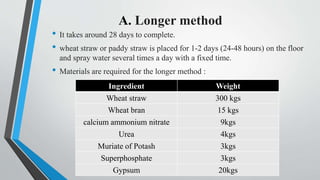
• Materials are required for the longer method :
Ingredient Weight
Wheat straw 300 kgs
Wheat bran 15 kgs
calcium ammonium nitrate 9kgs
Urea 4kgs
Muriate of Potash 3kgs
Superphosphate 3kgs
Gypsum 20kgs
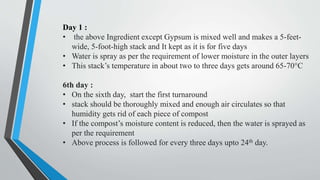
Day 1 :
• the above Ingredient except Gypsum is mixed well and makes a 5-feet-
wide, 5-foot-high stack and It kept as it is for five days
• Water is spray as per the requirement of lower moisture in the outer layers
• This stack’s temperature in about two to three days gets around 65-70°C
6th day :
• On the sixth day, start the first turnaround
• stack should be thoroughly mixed and enough air circulates so that
humidity gets rid of each piece of compost
• If the compost’s moisture content is reduced, then the water is sprayed as
per the requirement
• Above process is followed for every three days upto 24th day.
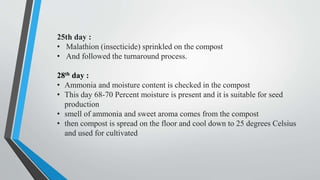
25th day :
• Malathion (insecticide) sprinkled on the compost
• And followed the turnaround process.
28th day :
• Ammonia and moisture content is checked in the compost
• This day 68-70 Percent moisture is present and it is suitable for seed
production
• smell of ammonia and sweet aroma comes from the compost
• then compost is spread on the floor and cool down to 25 degrees Celsius
and used for cultivated
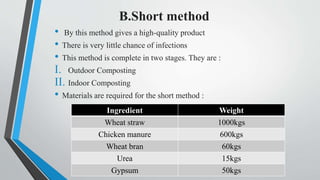
B.Short method
• By this method gives a high-quality product
• There is very little chance of infections
• This method is complete in two stages. They are :
I. Outdoor Composting
II. Indoor Composting
• Materials are required for the short method :
Ingredient Weight
Wheat straw 1000kgs
Chicken manure 600kgs
Wheat bran 60kgs
Urea 15kgs
Gypsum 50kgs
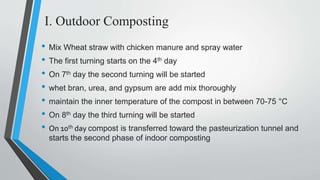
I. Outdoor Composting
• Mix Wheat straw with chicken manure and spray water
• The first turning starts on the 4th day
• On 7th day the second turning will be started
• whet bran, urea, and gypsum are add mix thoroughly
• maintain the inner temperature of the compost in between 70-75 °C
• On 8th day the third turning will be started
• On 10th day compost is transferred toward the pasteurization tunnel and
starts the second phase of indoor composting
II. Indoor Composting
• In this stage Compost filled in the pasteurization tunnel
• The blower is placed on for recirculation of air
• The stage II indoor composting procedure is complete in 3 phases:
a. Pre-Peak Heating Point
b. Peak Heat Point
c. Post-Peak Heat Point
A. Pre-Peak Heating Point:
• After about 12-15 hours of filling the compost the temperature of
compost slowly increases
• It needs to be kept for 36-40 hours
• It will be kept up to the stage of self production of heat.
B. Peak Heat Point
• The temperature of compost is increased by self production of heat.
• The temperature is maintained at 57-58°C.
• Steam is passed through the compost for sterilization for 8 hours.
• Fresh air is introduced to this compost
C. Post-Peak Heat Point
• Decrease the temperature slowly to 48-52°C and keep until no
indications of ammonia have been found in compost.
• Then cool the compost down to about 25°C
• This temperature is favourable for spawning.
3. Spawning
• In spawning the seeds are mixed with the compost
• Before seeding into the compost wash the instruments going to use and hands of
the person with 2% formalin.
• 1kg spawn is added to 600 lbs of compost and incubated .
• After 18 days it will be rready for casing.
4. Casing
• The pH of this casing soil should be 7.5-7.8 and have to be free of
diseases
• In this casing soil is treated with 4% formalin
• it’s covered with a polythene sheet for another 3-4 days.
• Then it will be gone for Pasteurization at 65°C for 6-8 hours and cooled
down
• 3-4 cm thick coating of casing soil has been spread thickly on the compost
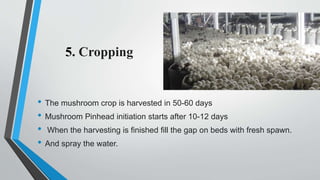
5. Cropping
• The mushroom crop is harvested in 50-60 days
• Mushroom Pinhead initiation starts after 10-12 days
• When the harvesting is finished fill the gap on beds with fresh spawn.
• And spray the water.
Packing & storing
• The mushrooms are taken in a container.
• Then it is washed with KMS solution.
• Then it is kept in a plastic container and packed with plastic cover.
• It is stored in 2-5ºC temperature.
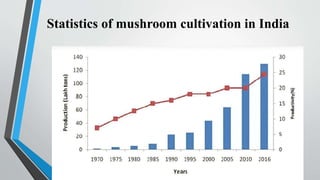
Statistics of mushroom cultivation in India
MUSHROOM CULTURE.pptx

MUSHROOM CULTURE.pptx

  • 1.
    DEPARTMENT OF MICROBIOLOGY MUSHROOMCULTIVATION BY B SREEHAR NAICK P212034 1ST M.SC MICROBIOLOGY
  • 2.
    INTRODUCTION • Mushroom isfleshy fungi • It’s a small umbrella like structure • Cap- PILES & thread like structure- MYCELIA • Mycelia absorbs nutrients from the soil • No need of sunlight for mushroom growth • They are low in fat content • Monosodium glutamate is present . It is used as a flavor enhancer.
  • 3.
  • 4.
    Nutrients present inMushroom Per 100g
  • 5.
    MUSHROOM CULTIVATION Mostly incultivation of mushroom ‘‘Agaricus biosporus’’ is chosen Because by the way of production , it comes the first place in the world. The favorable season for mushroom cultivation is October - march in India The cultivation Procedure has five main steps: 1. Mushroom Spawn 2. preparing of compost 3. Spawning 4. Casing 5. Cropping
  • 6.
    1.Mushroom Spawn • Spawnis planting material for mushroom cultivation. • That is, it is a seed of a mushroom. • mushroom grower import spawn from the renowned source • Good Qualities mushroom spawn has the following qualities  The spawn should Be rapidly growing in the compost  Provide early pruning following casing  high yielding  It must create a greater grade of mushroom
  • 7.
    2. Preparing of Compost:  Compost is an artificially prepared growth medium  In this medium essential nutrients are included which are necessary for the growth of mushroom  essential nutrients necessary for growth.  There are two primary methods for compost preparation: A. Longer method B. Short method
  • 8.
    A. Longer method •It takes around 28 days to complete. • wheat straw or paddy straw is placed for 1-2 days (24-48 hours) on the floor and spray water several times a day with a fixed time. • Materials are required for the longer method : Ingredient Weight Wheat straw 300 kgs Wheat bran 15 kgs calcium ammonium nitrate 9kgs Urea 4kgs Muriate of Potash 3kgs Superphosphate 3kgs Gypsum 20kgs
  • 9.
    Day 1 : •the above Ingredient except Gypsum is mixed well and makes a 5-feet- wide, 5-foot-high stack and It kept as it is for five days • Water is spray as per the requirement of lower moisture in the outer layers • This stack’s temperature in about two to three days gets around 65-70°C 6th day : • On the sixth day, start the first turnaround • stack should be thoroughly mixed and enough air circulates so that humidity gets rid of each piece of compost • If the compost’s moisture content is reduced, then the water is sprayed as per the requirement • Above process is followed for every three days upto 24th day.
  • 10.
    25th day : •Malathion (insecticide) sprinkled on the compost • And followed the turnaround process. 28th day : • Ammonia and moisture content is checked in the compost • This day 68-70 Percent moisture is present and it is suitable for seed production • smell of ammonia and sweet aroma comes from the compost • then compost is spread on the floor and cool down to 25 degrees Celsius and used for cultivated
  • 11.
    B.Short method • Bythis method gives a high-quality product • There is very little chance of infections • This method is complete in two stages. They are : I. Outdoor Composting II. Indoor Composting • Materials are required for the short method : Ingredient Weight Wheat straw 1000kgs Chicken manure 600kgs Wheat bran 60kgs Urea 15kgs Gypsum 50kgs
  • 12.
    I. Outdoor Composting •Mix Wheat straw with chicken manure and spray water • The first turning starts on the 4th day • On 7th day the second turning will be started • whet bran, urea, and gypsum are add mix thoroughly • maintain the inner temperature of the compost in between 70-75 °C • On 8th day the third turning will be started • On 10th day compost is transferred toward the pasteurization tunnel and starts the second phase of indoor composting
  • 13.
    II. Indoor Composting •In this stage Compost filled in the pasteurization tunnel • The blower is placed on for recirculation of air • The stage II indoor composting procedure is complete in 3 phases: a. Pre-Peak Heating Point b. Peak Heat Point c. Post-Peak Heat Point A. Pre-Peak Heating Point: • After about 12-15 hours of filling the compost the temperature of compost slowly increases • It needs to be kept for 36-40 hours • It will be kept up to the stage of self production of heat.
  • 14.
    B. Peak HeatPoint • The temperature of compost is increased by self production of heat. • The temperature is maintained at 57-58°C. • Steam is passed through the compost for sterilization for 8 hours. • Fresh air is introduced to this compost C. Post-Peak Heat Point • Decrease the temperature slowly to 48-52°C and keep until no indications of ammonia have been found in compost. • Then cool the compost down to about 25°C • This temperature is favourable for spawning.
  • 15.
    3. Spawning • Inspawning the seeds are mixed with the compost • Before seeding into the compost wash the instruments going to use and hands of the person with 2% formalin. • 1kg spawn is added to 600 lbs of compost and incubated . • After 18 days it will be rready for casing. 4. Casing • The pH of this casing soil should be 7.5-7.8 and have to be free of diseases • In this casing soil is treated with 4% formalin • it’s covered with a polythene sheet for another 3-4 days. • Then it will be gone for Pasteurization at 65°C for 6-8 hours and cooled down • 3-4 cm thick coating of casing soil has been spread thickly on the compost
  • 16.
    5. Cropping • Themushroom crop is harvested in 50-60 days • Mushroom Pinhead initiation starts after 10-12 days • When the harvesting is finished fill the gap on beds with fresh spawn. • And spray the water.
  • 17.
    Packing & storing •The mushrooms are taken in a container. • Then it is washed with KMS solution. • Then it is kept in a plastic container and packed with plastic cover. • It is stored in 2-5ºC temperature.
  • 18.
    Statistics of mushroomcultivation in India