Multidimensional Mining Of Massive Text Data Chao Zhang Jiawei Han
Multidimensional Mining Of Massive Text Data Chao Zhang Jiawei Han
Multidimensional Mining Of Massive Text Data Chao Zhang Jiawei Han
Multidimensional Mining Of Massive Text Data Chao Zhang Jiawei Han
Multidimensional Mining Of Massive Text Data Chao Zhang Jiawei Han
1.
Multidimensional Mining OfMassive Text Data
Chao Zhang Jiawei Han download
https://ebookbell.com/product/multidimensional-mining-of-massive-
text-data-chao-zhang-jiawei-han-9958864
Explore and download more ebooks at ebookbell.com
2.
Here are somerecommended products that we believe you will be
interested in. You can click the link to download.
Multidimensional Data Analysis And Data Mining Black Book Arijay
Chaudhry
https://ebookbell.com/product/multidimensional-data-analysis-and-data-
mining-black-book-arijay-chaudhry-231815740
Multidimensional Lithiumion Battery Status Monitoring Shunli Wang
https://ebookbell.com/product/multidimensional-lithiumion-battery-
status-monitoring-shunli-wang-47138184
Multidimensional And Strategic Outlook In Digital Business
Transformation Human Resource And Management Recommendations For
Performance Improvement Pelin Vardarler
https://ebookbell.com/product/multidimensional-and-strategic-outlook-
in-digital-business-transformation-human-resource-and-management-
recommendations-for-performance-improvement-pelin-vardarler-49420278
Multidimensional Item Response Theory 1st Edition Wes Bonifay
https://ebookbell.com/product/multidimensional-item-response-
theory-1st-edition-wes-bonifay-50488538
3.
Multidimensional Poverty MeasurementTheory And Methodology 2nd
Edition Xiaolin Wang
https://ebookbell.com/product/multidimensional-poverty-measurement-
theory-and-methodology-2nd-edition-xiaolin-wang-50615906
Multidimensional Change In Sudan 19892011 Reshaping Livelihoods
Conflict And Identities Barbara Casciarri
https://ebookbell.com/product/multidimensional-change-in-
sudan-19892011-reshaping-livelihoods-conflict-and-identities-barbara-
casciarri-50754548
Multidimensional Journal Evaluation Analyzing Scientific Periodicals
Beyond The Impact Factor Stefanie Haustein
https://ebookbell.com/product/multidimensional-journal-evaluation-
analyzing-scientific-periodicals-beyond-the-impact-factor-stefanie-
haustein-50963870
Multidimensional Signals And Systems Theory And Foundations 1st Ed
2023 Rudolf Rabenstein
https://ebookbell.com/product/multidimensional-signals-and-systems-
theory-and-foundations-1st-ed-2023-rudolf-rabenstein-51055822
Multidimensional Inverse And Illposed Problems For Differential
Equations Reprint 2014 Yu E Anikonov
https://ebookbell.com/product/multidimensional-inverse-and-illposed-
problems-for-differential-equations-reprint-2014-yu-e-
anikonov-51136990
Synthesis Lectures onData
Mining and Knowledge
Discovery
Editors
Jiawei Han, University of Illinois at Urbana-Champaign
Johannes Gehrke, Cornell University
Lise Getoor, University of California, Santa Cruz
Robert Grossman, University of Chicago
Wei Wang, University of California, Los Angeles
Synthesis Lectures on Data Mining and Knowledge Discovery is edited by Jiawei Han, Lise
Getoor, Wei Wang, Johannes Gehrke, and Robert Grossman. The series publishes 50- to 150-page
publications on topics pertaining to data mining, web mining, text mining, and knowledge
discovery, including tutorials and case studies. Potential topics include: data mining algorithms,
innovative data mining applications, data mining systems, mining text, web and semi-structured
data, high performance and parallel/distributed data mining, data mining standards, data mining
and knowledge discovery framework and process, data mining foundations, mining data streams
and sensor data, mining multi-media data, mining social networks and graph data, mining spatial
and temporal data, pre-processing and post-processing in data mining, robust and scalable
statistical methods, security, privacy, and adversarial data mining, visual data mining, visual
analytics, and data visualization.
Multidimensional Mining of Massive Text Data
Chao Zhang and Jiawei Han
2019
Exploiting the Power of Group Differences: Using Patterns to Solve Data Analysis
Problems
Guozhu Dong
2018
Mining Structures of Factual Knowledge from Text
Xiang Ren and Jiawei Han
2018
Individual and Collective Graph Mining: Principles, Algorithms, and Applications
Danai Koutra and Christos Faloutsos
2017
8.
iv
Phrase Mining fromMassive Text and Its Applications
Jialu Liu, Jingbo Shang, and Jiawei Han
2017
Exploratory Causal Analysis with Time Series Data
James M. McCracken
2016
Mining Human Mobility in Location-Based Social Networks
Huiji Gao and Huan Liu
2015
Mining Latent Entity Structures
Chi Wang and Jiawei Han
2015
Probabilistic Approaches to Recommendations
Nicola Barbieri, Giuseppe Manco, and Ettore Ritacco
2014
Outlier Detection for Temporal Data
Manish Gupta, Jing Gao, Charu Aggarwal, and Jiawei Han
2014
Provenance Data in Social Media
Geoffrey Barbier, Zhuo Feng, Pritam Gundecha, and Huan Liu
2013
Graph Mining: Laws, Tools, and Case Studies
D. Chakrabarti and C. Faloutsos
2012
Mining Heterogeneous Information Networks: Principles and Methodologies
Yizhou Sun and Jiawei Han
2012
Privacy in Social Networks
Elena Zheleva, Evimaria Terzi, and Lise Getoor
2012
Community Detection and Mining in Social Media
Lei Tang and Huan Liu
2010
9.
v
Ensemble Methods inData Mining: Improving Accuracy Through Combining
Predictions
Giovanni Seni and John F. Elder
2010
Modeling and Data Mining in Blogosphere
Nitin Agarwal and Huan Liu
2009
Multidimensional
Mining of MassiveText Data
Chao Zhang
Georgia Institute of Technology
Jiawei Han
University of Illinois at Urbana-Champaign
SYNTHESIS LECTURES ON DATA MINING AND KNOWLEDGE
DISCOVERY #17
C
M
& cLaypool
Morgan publishers
&
12.
ABSTRACT
Unstructured text, asone of the most important data forms, plays a crucial role in data-driven
decision making in domains ranging from social networking and information retrieval to scien-
tific research and healthcare informatics. In many emerging applications, people’s information
need from text data is becoming multidimensional—they demand useful insights along multiple
aspects from a text corpus. However, acquiring such multidimensional knowledge from massive
text data remains a challenging task.
This book presents data mining techniques that turn unstructured text data into multi-
dimensional knowledge. We investigate two core questions. (1) How does one identify task-
relevant text data with declarative queries in multiple dimensions? (2) How does one distill
knowledge from text data in a multidimensional space? To address the above questions, we
develop a text cube framework. First, we develop a cube construction module that organizes un-
structured data into a cube structure, by discovering latent multidimensional and multi-granular
structure from the unstructured text corpus and allocating documents into the structure. Sec-
ond, we develop a cube exploitation module that models multiple dimensions in the cube space,
thereby distilling from user-selected data multidimensional knowledge. Together, these two
modules constitute an integrated pipeline: leveraging the cube structure, users can perform mul-
tidimensional, multigranular data selection with declarative queries; and with cube exploitation
algorithms, users can extract multidimensional patterns from the selected data for decision mak-
ing.
The proposed framework has two distinctive advantages when turning text data into mul-
tidimensional knowledge: flexibility and label-efficiency. First, it enables acquiring multidimen-
sional knowledge flexibly, as the cube structure allows users to easily identify task-relevant data
along multiple dimensions at varied granularities and further distill multidimensional knowl-
edge. Second, the algorithms for cube construction and exploitation require little supervision;
this makes the framework appealing for many applications where labeled data are expensive to
obtain.
KEYWORDS
text mining, multidimensional analysis, data cube, limited supervision
1
C H AP T E R 1
Introduction
1.1 OVERVIEW
Text is one of the most important data forms with which humans record and communicate
information. In a wide spectrum of domains, hundreds of millions of textual contents are being
created, shared, and analyzed every single day—examples including tweets, news articles, web
pages, and medical notes. It is estimated that more than 80% of human knowledge is encoded
in the form of unstructured text [Gandomi and Haider, 2015]. With such ubiquity, extracting
useful insights from text data is crucial to decision making in various applications, ranging from
automated medical diagnosis [Byrd et al., 2014, Warrer et al., 2012] and disaster management
[Li et al., 2012b, Sakaki et al., 2010] to fraud detection [Li et al., 2017, Shu et al., 2017] and
personalized recommendation [Li et al., 2010a,b].
In many applications, people’s information need from text data is becoming multidimen-
sional. That is, people can demand useful insights for multiple aspects from the given text
corpus. Consider an analyst who wants to use news corpora for disaster analytics. Upon iden-
tifying all disaster-related news articles, she needs to understand what disaster each article is
about, where and when is the disaster, and who are involved. She may even need to explore the
multidimensional what-where-when-who space at varied granularities, so as to answer questions
like “what are all the hurricanes happened in the U.S. in 2018” or “what are all the disasters hap-
pened in California in June.” Disaster analytics is only one of the many applications where mul-
tidimensional knowledge is required. To name a few other examples: (1) analyzing a biomedical
research corpus often requires digging out what genes, proteins, and diseases each paper is about
and uncovering their inter-correlations; (2) leveraging the medical notes of diabetes patients for
automatic diagnosis requires correlating symptoms with genders, ages, and even geographical
regions; and (3) analyzing Twitter data for an presidential election event requires understanding
people’s sentiments about various political aspects in different geographical regions and time
periods.
Acquiring such multidimensional knowledge is made possible due to the rich context in-
formation in text data. Such context information can be either explicit—such as geographical
locations and timestamps associated with tweets, and patients’ meta-data linked with medi-
cal notes; or implicit—such as point-of-interest names mentioned in news articles, and typed
entities discussed in research papers. It is the availability of such rich context information that
enables understanding the text along multiple dimensions for task support and decision making.
21.
2 1. INTRODUCTION
Thisbook presents data mining algorithms that facilitate turning massive unstructured
text data into multidimensional knowledge. We investigate two core questions around this
goal.
1. How does one easily identify task-relevant text data with declarative queries along multiple
dimensions?
2. How does one distill knowledge from text data in a multidimensional space?
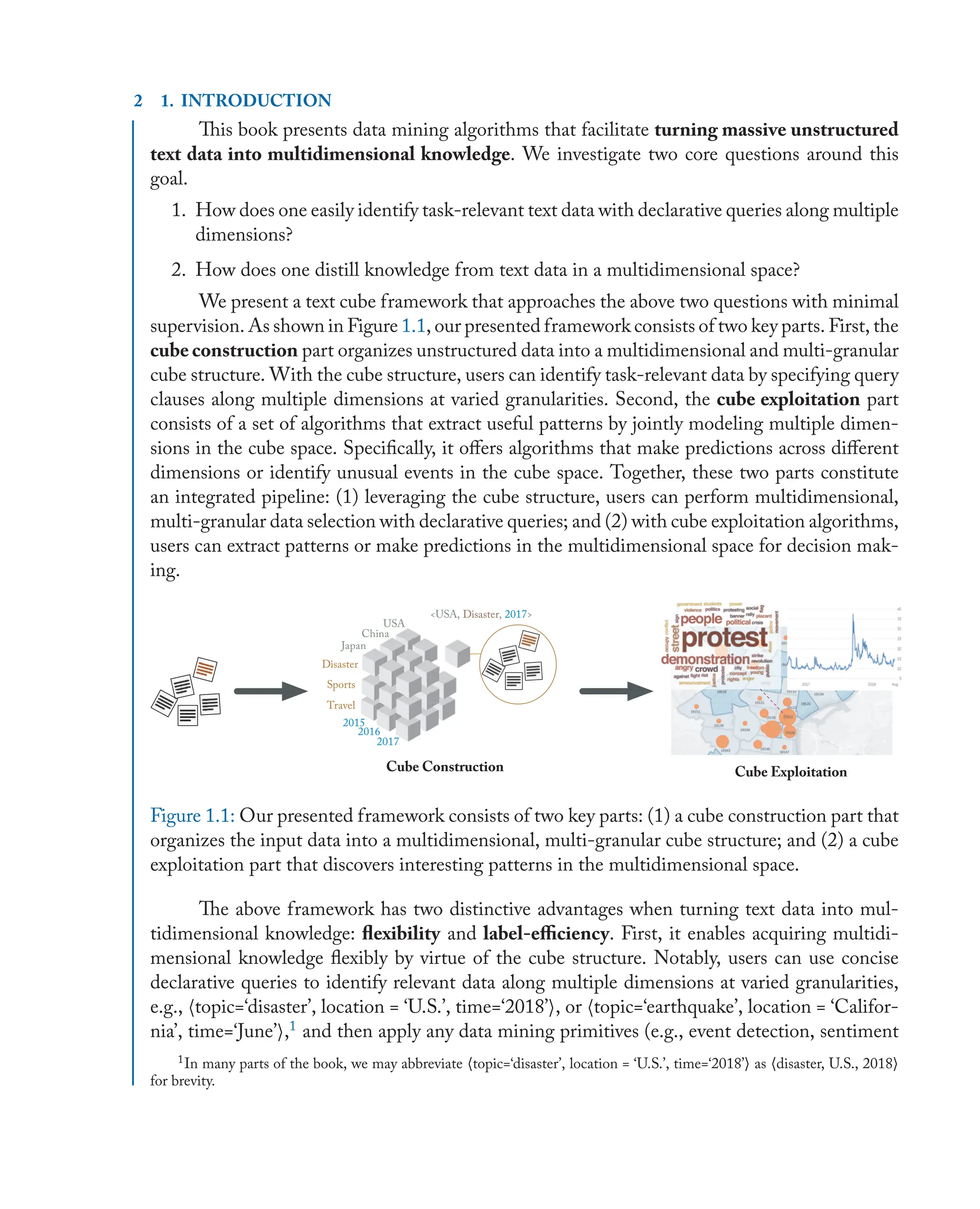
We present a text cube framework that approaches the above two questions with minimal
supervision. As shown in Figure 1.1, our presented framework consists of two key parts. First, the
cube construction part organizes unstructured data into a multidimensional and multi-granular
cube structure. With the cube structure, users can identify task-relevant data by specifying query
clauses along multiple dimensions at varied granularities. Second, the cube exploitation part
consists of a set of algorithms that extract useful patterns by jointly modeling multiple dimen-
sions in the cube space. Specifically, it offers algorithms that make predictions across different
dimensions or identify unusual events in the cube space. Together, these two parts constitute
an integrated pipeline: (1) leveraging the cube structure, users can perform multidimensional,
multi-granular data selection with declarative queries; and (2) with cube exploitation algorithms,
users can extract patterns or make predictions in the multidimensional space for decision mak-
ing.
China
USA
Japan
Disaster
Sports
Travel
2015
2016
2017
<USA, Disaster, 2017>
Cube Construction Cube Exploitation
Figure 1.1: Our presented framework consists of two key parts: (1) a cube construction part that
organizes the input data into a multidimensional, multi-granular cube structure; and (2) a cube
exploitation part that discovers interesting patterns in the multidimensional space.
The above framework has two distinctive advantages when turning text data into mul-
tidimensional knowledge: flexibility and label-efficiency. First, it enables acquiring multidi-
mensional knowledge flexibly by virtue of the cube structure. Notably, users can use concise
declarative queries to identify relevant data along multiple dimensions at varied granularities,
e.g., htopic=‘disaster’, location = ‘U.S.’, time=‘2018’i, or htopic=‘earthquake’, location = ‘Califor-
nia’, time=‘June’i,1 and then apply any data mining primitives (e.g., event detection, sentiment
1In many parts of the book, we may abbreviate htopic=‘disaster’, location = ‘U.S.’, time=‘2018’i as hdisaster, U.S., 2018i
for brevity.
22.
1.2. MAIN PARTS3
analysis, summarization, visualization) for subsequent analysis. Second, it is label-efficient. For
both cube construction and exploitation, our presented algorithms all require no or little super-
vision. This property breaks the bottleneck of lacking labeled data and makes the framework
attractive in applications where acquiring labeled data is expensive.
The text cube framework represents a departure from existing techniques for data ware-
housing and online analytical processing [Chaudhuri and Dayal, 1997, Han et al., 2011]. Such
techniques, which allow users to perform ad-hoc analysis of structured data along multiple di-
mensions, have been successful in multidimensional analysis of structured data. Unfortunately,
extracting multidimensional knowledge from text challenges conventional data warehousing
techniques—it is not only because the schema of the cube structure remains unknown, but also
allocating the text documents into the cube space is difficult. Thus, our presented algorithms
bridge the gap between data warehousing and multidimensional analysis of unstructured text
data.
Along with another line, the framework is closely related to text mining. Nevertheless,
the success stories of existing text mining techniques still largely rely on the supervised learning
paradigm. For instance, the problem of allocating documents into a text cube is related to text
classification, yet existing text classification models use massive amounts of labeled documents
to learn classification models. Event detection is another example: event extraction techniques
in the natural language processing community rely on human-curated sentences to train dis-
criminative models that determine whether a specific type of event has occurred; but if we are to
build an event alarm system, it is hardly possible to enumerate all event types and manually cu-
rate enough training data for each type. Our work complements existing text mining techniques
with unsupervised or weakly supervised algorithms, which distill knowledge from the given text
data with limited supervision.
1.2 MAIN PARTS
We present a text cube framework that turns unstructured data into multidimensional knowl-
edge with limited supervision. As aforementioned, there are two main parts in our presented
framework: (1) a cube construction part that organizes unstructured data a multidimensional,
multi-granular structure; and (2) a cube exploitation part that extracts multidimensional knowl-
edge in the cube space. In this section, we overview these two parts and illustrate several appli-
cations of the framework.
1.2.1 PART I: CUBE CONSTRUCTION
Extracting multidimensional knowledge from the unstructured text necessarily begins with
identifying task-relevant data. When an analyst exploits the Twitter stream for sentiment analy-
sis of the 2016 Presidential Election, she may want to retrieve all the tweets discussing this event
by California users in 2016. Such information needs are often structured and multidimensional,
23.
4 1. INTRODUCTION
yetthe input data are unstructured text. The first critical step is, can we use declarative queries
along multiple dimensions to identify task-relevant data for on-demand analytics?
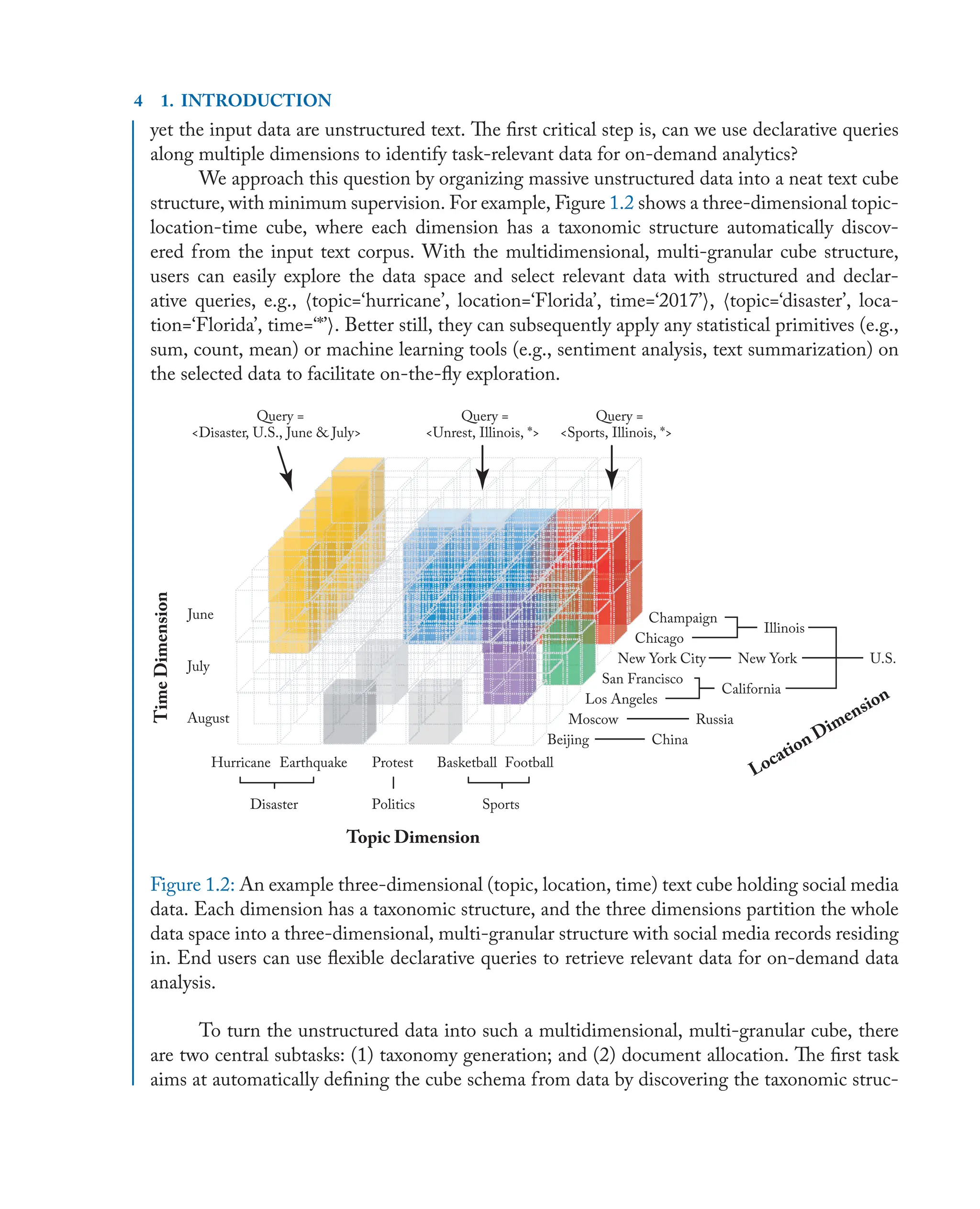
We approach this question by organizing massive unstructured data into a neat text cube
structure, with minimum supervision. For example, Figure 1.2 shows a three-dimensional topic-
location-time cube, where each dimension has a taxonomic structure automatically discov-
ered from the input text corpus. With the multidimensional, multi-granular cube structure,
users can easily explore the data space and select relevant data with structured and declar-
ative queries, e.g., htopic=‘hurricane’, location=‘Florida’, time=‘2017’i, htopic=‘disaster’, loca-
tion=‘Florida’, time=‘*’i. Better still, they can subsequently apply any statistical primitives (e.g.,
sum, count, mean) or machine learning tools (e.g., sentiment analysis, text summarization) on
the selected data to facilitate on-the-fly exploration.
June
July
August
Champaign
Chicago
New York City
San Francisco
Los Angeles
Moscow
Beijing
Illinois
New York
California
Russia
China
U.S.
Football
Basketball
Hurricane
Disaster
Earthquake Protest
Politics Sports
Time
Dimension
Topic Dimension
Location Dimension
Query =
<Disaster, U.S., June & July>
Query =
<Unrest, Illinois, *>
Query =
<Sports, Illinois, *>
Figure 1.2: An example three-dimensional (topic, location, time) text cube holding social media
data. Each dimension has a taxonomic structure, and the three dimensions partition the whole
data space into a three-dimensional, multi-granular structure with social media records residing
in. End users can use flexible declarative queries to retrieve relevant data for on-demand data
analysis.
To turn the unstructured data into such a multidimensional, multi-granular cube, there
are two central subtasks: (1) taxonomy generation; and (2) document allocation. The first task
aims at automatically defining the cube schema from data by discovering the taxonomic struc-
24.
1.2. MAIN PARTS5
ture for each dimension; the second aims at allocating documents into proper cells in the cube.
While there exist methods for taxonomy generation and text classification, most of them are
inapplicable because they rely on excessive training data. Later, we will present unsupervised or
weakly supervised methods for these two tasks.
1.2.2 PART II: CUBE EXPLOITATION
Raw unstructured text data (e.g., social media, SMS messages) are often noisy. Identifying rel-
evant data is merely the first step of the multidimensional analytics pipeline. Upon identifying
relevant data, next question is to distill interesting multidimensional patterns in the cube space.
Continue the example in Figure 1.2: can we detect abnormal activities happened in the New
York City in 2017—this translates to the task of finding abnormal patterns in the cube cell h*,
New York City, 2017i? Can we predict where traffic jams are most likely to take place in Los
Angeles around 5 PM—this translates to the task of making predictions with data residing in
the cube cell hTravel, Los Angeles, 5 PMi. Can we find out how the earthquake hotspots evolve
in the U.S.—this translates to the task of finding evolving patterns across a series of cube cells
matching the query hEarthquake, U.S., *i.
The cube exploitation part answers the above questions by offering a set of algorithms that
discover multidimensional knowledge in the cube space. The unique characteristic here is that
it is necessary to jointly model multiple factors and uncover their collective patterns in the mul-
tidimensional space. Under this principle, we investigate three important subtasks in the cube
exploitation part: (1) we first study the multidimensional text summarization problem, which
aims at summarizing the text documents residing in any user-selected cube cell. This is enabled
by a text summarization algorithm that generates a concise summary based on comparative text
analysis and the global cube space; (2) we then study the cross-dimension prediction problem,
which aims at modeling the correlations among multiple dimensions (e.g., topic, location, time)
for predictive analytics. This leads to the development of a cross-dimension prediction model
that can make predictions across different dimensions; and (3) we also study the anomaly de-
tection problem, which aims at detecting abnormal patterns in any cube cell. The discovered
patterns reflect abnormal behaviors with respect to the concrete contexts of the user-selected
cell.
1.2.3 EXAMPLE APPLICATIONS
Together, text cube construction and exploitation enable many applications where multidimen-
sional knowledge is demanded. The two parts can be either used by themselves or combined with
other existing data mining primitives. In the following, we provide several examples to illustrate
the applications of the framework.
matters relating toHungary, the ministers of Austria, responsible or
irresponsible, have no more right to interfere between the King and
his Hungarian ministers, or Hungarian diet, than these have to
interfere between the Emperor of Austria and his Austrian ministers,
in matters relating to the Hereditary States. The pretension to
submit the decisions of the Hungarian diet, sanctioned by the King,
to the approval or disapproval of the Austrian ministers, is too
absurd to have been resorted to in good faith. The truth appears to
be, that the successes of the gallant veteran Radetzki, and of the
Austrian army in Italy, which has so well sustained its ancient
reputation, had emboldened the Austrian government to retrace the
steps that had been taken by the emperor. Trusting to the
movements hitherto successful in Croatia and the Danubian
provinces of Hungary,—to the absence of the Hungarian army, and
of all efficient preparation for defence on the part of the Hungarian
government, and elated with military success in Italy,—the Austrian
ministers resumed their intention to subvert the constitution of
Hungary, and to fuse the various parts of the emperor's dominions
into one whole. Their avidity to accomplish this object prevented
their perceiving the stain they were affixing to the character of the
empire, and the honour of the emperor; or the injury they were
thereby inflicting on the cause of monarchy all over the world.
"Honour and good faith, if driven from every other asylum, ought to
find a refuge in the breasts of princes." And the ministers who sully
the honour of their confiding prince, do more to injure monarchy,
and therefore to endanger the peace and security of society, than
the rabble who shout for Socialism.
The Austrian ministry did not halt in their course. They made the
emperor-king recall, on the 4th September, the decree which
suspended Jellachich from all his dignities, as a person accused of
high treason. This was done on the pretext that the accusations
against the Ban were false, and that he had exhibited undeviating
fidelity to the house of Austria. He was reinstated in all his offices at
a moment when he was encamped with his army on the frontiers of
Hungary, preparing to invade that kingdom. In consequence of this
27.
proceeding, the Hungarianministry, which had been appointed in
March, gave in their resignation. The Palatine, by virtue of his full
powers, called upon Count Louis Bathianyi to form a new ministry.
All hope of a peaceful adjustment seemed to be at an end; but, as a
last resource, a deputation of the Hungarian deputies was sent to
propose to the representatives of Austria, that the two countries
should mutually guarantee to each other their constitutions and their
independence. The deputation was not received.
Count Louis Bathianyi undertook the direction of affairs, upon the
condition that Jellachich, whose troops had already invaded
Hungary, should be ordered to retire beyond the boundary. The king
replied, that this condition could not be accepted before the other
ministers were known.
But Jellachich had passed the Drave with an army of Croats and
Austrian regiments. His course was marked by plunder and
devastation; and so little was Hungary prepared for resistance, that
he advanced to the lake of Balaton without firing a shot. The
Archduke Palatine took the command of the Hungarian forces,
hastily collected to oppose the Ban; but, after an ineffectual attempt
at reconciliation, he set off for Vienna, whence he sent the
Hungarians his resignation.
The die was now cast, and the diet appealed to the nation. The
people rose en masse. The Hungarian regiments of the line declared
for their country. Count Lemberg had been appointed by the king to
the command of all the troops stationed in Hungary; but the diet
could no longer leave the country at the mercy of the sovereign who
had identified himself with the proceedings of its enemies, and they
declared the appointment illegal, on the ground that it was not
countersigned, as the laws required, by one of the ministers. They
called upon the authorities, the citizens, the army, and Count
Lemberg himself, to obey this decree under pain of high treason.
Regardless of this proceeding, Count Lemberg hastened to Pesth,
and arrived at a moment when the people were flocking from all
parts of the country to oppose the army of Jellachich. A cry was
28.
raised that thegates of Buda were about to be closed by order of
the count, who was at this time recognised by the populace as he
passed the bridge towards Buda, and brutally murdered. It was the
act of an infuriated mob, for which it is not difficult to account, but
which nothing can justify. The diet immediately ordered the
murderers to be brought to trial, but they had absconded. This was
the only act of popular violence committed in the capital of Hungary.
On the 29th of September, Jellachich was defeated in a battle fought
within twelve miles of Pesth. The Ban fled, abandoning to their fate
the detached corps of his army; and the Croat rearguard, ten
thousand strong, surrendered, with Generals Roth and Philipovits,
who commanded it.
In detailing the events subsequent to the 11th of April 1848, we
have followed the Hungarian manifesto, published in Paris by Count
Ladeslas Teleki, whose character is a sufficient security for the
fidelity of his statements; and the English translation of that
document by Mr Brown, which is understood to have been executed
under the Count's own eye. But we have not relied upon the Count
alone, nor even upon the official documents he has printed. We have
availed ourselves of other sources of information equally authentic.
One of the documents, which had previously been transmitted to us
from another quarter, and which, we perceive, has also been printed
by the Count, is so remarkable, both because of the persons from
whom it emanates, and the statements it contains, that, although
somewhat lengthy, we think it right to give it entire.
The Roman-Catholic Clergy of Hungary to his Apostolic Majesty,
Ferdinand V., King of Hungary.
Representation presented to the Emperor-King, in the name of
the Clergy, by the Archbishop of Gran, Primate of Hungary, and
by the Archbishop of Erlaw.
"Sire! Penetrated with feelings of the most profound sorrow at
the sight of the innumerable calamities and the internal evils
29.
which desolate ourunhappy country, we respectfully address
your Majesty, in the hope that you may listen with favour to the
voice of those, who, after having proved their inviolable fidelity
to your Majesty, believe it to be their duty, as heads of the
Hungarian Church, at last to break silence, and to bear to the
foot of the throne their just complaints, for the interests of the
church, of the country, and of the monarchy.
"Sire!—We refuse to believe that your Majesty is correctly
informed of the present state of Hungary. We are convinced that
your Majesty, in consequence of your being so far away from
our unfortunate country, knows neither the misfortunes which
overwhelm her, nor the evils which immediately threaten her,
and which place the throne itself in danger, unless your Majesty
applies a prompt and efficacious remedy, by attending to
nothing but the dictates of your own good heart.
"Hungary is actually in the saddest and most deplorable
situation. In the south, an entire race, although enjoying all the
civil and political rights recognised in Hungary, has been in open
insurrection for several months, excited and led astray by a
party which seems to have adopted the frightful mission of
exterminating the Majjar and German races, which have
constantly been the strongest and surest support of your
Majesty's throne. Numberless thriving towns and villages have
become a prey to the flames, and have been totally destroyed;
thousands of Majjar and German subjects are wandering about
without food or shelter, or have fallen victims to indescribable
cruelty—for it is revolting to repeat the frightful atrocities by
which the popular rage, let loose by diabolical excitement,
ventures to display itself.
"These horrors were, however, but the prelude to still greater
evils, which were about to fall upon our country. God forbid that
we should afflict your Majesty with the hideous picture of all our
misfortunes! Suffice it to say, that the different races who
inhabit your kingdom of Hungary, stirred up, excited one against
30.
the other byinfernal intrigues, only distinguish themselves by
pillage, incendiarism, and murder, perpetrated with the greatest
refinement of atrocity.
"Sire!—The Hungarian nation, heretofore the firmest bulwark of
Christianity and civilisation against the incessant attacks of
barbarism, often experienced rude shocks in that protracted
struggle for life and death; but at no period did there gather
over her head so many and so terrible tempests, never was she
entangled in the meshes of so perfidious an intrigue, never had
she to submit to treatment so cruel, and at the same time so
cowardly—and yet, oh! profound sorrow! all these horrors are
committed in the name, and, as they assure us, by the order of
your Majesty.
"Yes, Sire! it is under your government, and in the name of your
Majesty, that our flourishing towns are bombarded, sacked, and
destroyed. In the name of your Majesty, they butcher the
Majjars and Germans. Yes, sire! all this is done; and they
incessantly repeat it, in the name and by the order of your
Majesty, who nevertheless has proved, in a manner so authentic
and so recent, your benevolent and paternal intentions towards
Hungary. In the name of your Majesty, who in the last Diet of
Presburg, yielding to the wishes of the Hungarian nation, and to
the exigencies of the time, consented to sanction and confirm
by your royal word and oath, the foundation of a new
constitution, established on the still broader foundation of a
perfectly independent government.
"It is for this reason that the Hungarian nation, deeply grateful
to your Majesty, accustomed also to receive from her king
nothing but proofs of goodness really paternal, when he listens
only to the dictates of his own heart, refuses to believe, and we
her chief pastors also refuse to believe, that your Majesty either
knows, or sees with indifference, still less approves the
infamous manner in which the enemies of our country, and of
our liberties, compromise the kingly majesty, arming the
31.
populations against eachother, shaking the very foundations of
the constitution, frustrating legally established powers, seeking
even to destroy in the hearts of all the love of subjects for their
sovereign, by saying that your Majesty wishes to withdraw from
your faithful Hungarians the concessions solemnly sworn to and
sanctioned in the diet; and, finally, to wrest from the country
her character of a free and independent kingdom.
"Already, Sire! have these new laws and liberties, giving the
surest guarantees for the freedom of the people, struck root so
deeply in the hearts of the nation, that public opinion makes it
our duty to represent to your Majesty, that the Hungarian
people could not but lose that devotion and veneration,
consecrated and proved on so many occasions, up to the
present time, if it was attempted to make them believe that the
violation of the laws, and of the government sanctioned and
established by your majesty, is committed with the consent of
the king.
"But if, on the one hand, we are strongly convinced that your
majesty has taken no part in the intrigues so basely woven
against the Hungarian people, we are not the less persuaded,
that that people, taking arms to defend their liberty, have stood
on legal ground, and that in obeying instinctively the supreme
law of nations, which demands the safety of all, they have at
the same time saved the dignity of the throne and the
monarchy, greatly compromised by advisers as dangerous as
they are rash.
"Sire! We, the chief pastors of the greatest part of the
Hungarian people, know better than any others their noble
sentiments; and we venture to assert, in accordance with
history, that there does not exist a people more faithful to their
monarchs than the Hungarians, when they are governed
according to their laws.
32.
"We guarantee toyour majesty, that this people, such faithful
observers of order and of the civil laws in the midst of the
present turmoils, desire nothing but the peaceable enjoyment of
the liberties granted and sanctioned by the throne.
"In this deep conviction, moved also by the sacred interests of
the country and the good of the church, which sees in your
majesty her first and principal defender, we, the bishops of
Hungary, humbly entreat your majesty patiently to look upon
our country now in danger. Let your majesty deign to think a
moment upon the lamentable situation in which this wretched
country is at present, where thousands of your innocent
subjects, who formerly all lived together in peace and
brotherhood on all sides, notwithstanding difference of races,
now find themselves plunged into the most frightful misery by
their civil wars.
"The blood of the people is flowing in torrents—thousands of
your majesty's faithful subjects are, some massacred, others
wandering about without shelter, and reduced to beggary—our
towns, our villages, are nothing but heaps of ashes—the clash
of arms has driven the faithful people from our temples, which
have become deserted—the mourning church weeps over the
fall of religion, and the education of the people is interrupted
and abandoned.
"The frightful spectre of wretchedness increases, and develops
itself every day under a thousand hideous forms. The morality,
and with it the happiness of the people, disappear in the gulf of
civil war.
"But let your majesty also deign to reflect upon the terrible
consequences of these civil wars; not only as regards their
influence on the moral and substantial interests of the people,
but also as regards their influence upon the security and
stability of the monarchy. Let your majesty hasten to speak one
33.
of those powerfulwords which calm tempests!—the flood rises,
the waves are gathering, and threaten to engulf the throne!
"Let a barrier be speedily raised against those passions excited
and let loose with infernal art amongst populations hitherto so
peaceable. How is it possible to make people who have been
inspired with the most frightful thirst—that of blood—return
within the limits of order, justice, and moderation?
"Who will restore to the regal majesty the original purity of its
brilliancy, of its splendour, after having dragged that majesty in
the mire of the most evil passions? Who will restore faith and
confidence in the royal word and oath? Who will render an
account to the tribunal of the living God, of the thousands of
individuals who have fallen, and fall every day, innocent victims
to the fury of civil war?
"Sire! our duty as faithful subjects, the good of the country, and
the honour of our religion, have inspired us to make these
humble but sincere remonstrances, and have bid us raise our
voices! So, let us hope, that your majesty will not merely receive
our sentiments, but that, mindful of the solemn oath that you
took on the day of your coronation, in the face of heaven, not
only to defend the liberties of the people, but to extend them
still further—that, mindful of this oath, to which you appeal so
often and so solemnly, you will remove from your royal person
the terrible responsibility that these impious and bloody wars
heap upon the throne, and that you will tear off the tissue of
vile falsehoods with which pernicious advisers beset you, by
hastening, with prompt and strong resolution, to recall peace
and order to our country, which was always the firmest prop of
your throne, in order that, with Divine assistance, that country,
so severely tried, may again see prosperous days; in order that,
in the midst of profound peace, she may raise a monument of
eternal gratitude to the justice and paternal benevolence of her
king.
34.
"Signed at Pesth,the 28th Oct. 1848,
"The Bishops of the Catholic Church of
Hungary."
The Roman Catholic hierarchy of Hungary, it must be kept in mind,
have at all times been in close connexion with the Roman Catholic
court of Austria, and have almost uniformly supported its views. The
Archbishop of Gran, Primate of Hungary, possesses greater wealth
and higher privileges than perhaps any magnate in Hungary.
In this unhappy quarrel Hungary has never demanded more than
was voluntarily conceded to her by the Emperor-King on the 11th of
April 1848. All she has required has been that faith should be kept
with her; that the laws passed by her diet, and sanctioned by her
king, should be observed. On the other hand, she is required by
Austria to renounce the concessions then made to her by her
sovereign—to relinquish the independence she has enjoyed for nine
centuries, and to exchange the constitution she has cherished,
fought for, loved, and defended, during seven hundred years, for the
experimental constitution which is to be tried in Austria, and which
has already been rejected by several of the provinces. This contest is
but another form of the old quarrel—an attempt on the part of
Austria to enforce, at any price, uniformity of system; and a
determination on the part of Hungary, at any cost, to resist it.
We hope next month to resume the consideration of this subject, to
which, in the midst of so many stirring and important events in
countries nearer home and better known, it appears to us that too
little attention has been directed. We believe that a speedy
adjustment of the differences between Austria and Hungary, on
terms which shall cordially reunite them, is of the utmost importance
to the peace of Europe—and that the complications arising out of
those differences will increase the difficulty of arriving at such a
solution, the longer it is delayed. We believe that Austria, distracted
by a multiplicity of counsels, has committed a great error, which is
dangerous to the stability of her position as a first-rate power; and
Printed by WilliamBlackwood and Sons, Edinburgh.
FOOTNOTES:
[1] A View of the Art of Colonisation, with present reference to
the British Empire; in Letters between a Statesman and a
Colonist. Edited by (one of the writers) Edward Gibbon Wakefield.
[2] Ultramontanism; or the Roman Church and Modern Society.
By E. Quinet, of the College of France. Translated from the
French. Third edition, with the author's approbation, by C. Cocks,
B.L. London: John Chapman. 1845.
[3] He surely means Bernini, and is a ninny for not saying so. But
Mr Cocks' translation says Berni—p. 144.
[4] Literary Life of Frederick von Schlegel. By James Burton
Robertson, Esq.
[5] See Blackwood for August 1845.
[6] Mr Robertson says of de Bonald, "As long as this great writer
deals in general propositions, he seldom errs; but when he comes
to apply his principles to practice, then the political prejudices in
which he was bred lead him sometimes into exaggerations and
errors." For "political prejudices" substitute Ultramontanism, and
Mr Robertson has characterised the whole school of the Reaction.
[7] Philosophy of History.
[8] De l'Etat et des besoins Religieux et Moraux des Populations
en France: par M. l'Abbé J. Bonnetat. Paris. 1845.
[9] See Blackwood, October 1845.
[10] "Le Souverain Pontife est la base nécessaire, unique, et
exclusive du Christianisme.... Si les évènements contrarient ce
que j'avance, j'appelle sur ma mémoire le mépris et les risées de
la postérité."—Du Pape, chap. v. p. 268.
37.
[11] Remarks onthe Government Scheme of National Education
in Scotland, 1848.
[12] We observe, however, that by the Parliamentary Returns of
1834, the school accommodation was even then considerably
greater than is here stated. The greatest number attending the
parish school was 246, and non-parochial schools 443; which, to
the population there given of 3210, was nearly a proportion of 1
in 5 of the inhabitants—a larger proportion than in Prussia!
[13] They have taken care to sound the committee on the
subject, and have received an answer encouraging enough. The
following extract is from their report of a deputation to the Lord
President:—"2. In regard to applications for annual grants under
the minutes, it was asked—What evidence will ordinarily be
required to satisfy the Committee of the Privy Council that any
particular school is needed in the district in which it stands, and
that it ought to be recognised as entitled to its fair share of the
grant equally with others similarly situated? Supposing, in any
given school, all the other conditions, as to pecuniary resources,
the qualifications of teachers, &c., satisfactorily complied with,
will it be held enough to have the report of the Government
inspector or inspectors that a sufficient number of children (say
50 or 60 in the country, and 90 or 100 in towns) either are
actually in attendance upon the school, or engaged to attend,
without the question being raised as to the contiguity of other
schools of a different denomination, or the amount of vacant
accommodation in such schools? In reply, it was stated that the
Committee of Privy Council could not limit their discretion in
judging of the comparative urgency of applications; their
lordships were disposed to receive representations, and to inquire
as to the sufficiency of the existing school accommodation; and
they would also consider any other ground which might be urged
for the erection of a new school where a school or schools had
been previously established."—Minutes for 1847-8, vol. l, p. lxiv.
[14] Schoolmasters' Memorial, p. 3.
[15] In many parishes side schools are built and endowed, in
addition to the parish school, from the same funds: the salary in
these cases being fixed by the Act at about £17.
[16] Parliamentary Inquiry, 1837, Appendix.
38.
[17] That thepresbytery has the power of insisting upon
qualifications supplementary to those prescribed by the heritors,
was decided, we think about a dozen years ago, in the case of
Sprouston.
[18] The Church herself, to a considerable extent, supplements
deficiencies in the legal school provision by means of her
"Education Scheme," whose object and efficiency may be partly
gathered from the two first sentences of the last report of the
managing committee:—
"The schools under the charge of your committee (as has often
been stated) are intended to form auxiliaries to the parish
schools, not to compete or interfere with these admirable
institutions; and, accordingly, are never planted except where,
owing to local peculiarities, it is impossible that all the youth of
the district requiring instruction can be gathered into one place.
While much needed, your schools continue to be most useful;
and, indeed, by the divine blessing, they appear to have been
rendered eminently beneficial.
"The number of schools under the care of your committee may be
reported of thus:—Those situated in the Highlands and Islands,
125; those in the Lowlands, 64; and those planted at the expense
of the Church of Scotland's Ladies' Gaelic School Society, and
placed under your committee's charge, 20; in all, 209."
[19] Reise nach dem Ararat und dem Hochland Armenien, von Dr
Moritz Wagner. Mit einem Anhange: Beiträge zur Naturgeshichte
des Hochlandes Armenien. Stuttgart und Tübinger, 1848.
[20] Reise in der Regentschaft Algier in den Jahren 1836-8. 3
volumes. Leipzig, 1841.
[21] The Armenian Christians abound in traditions respecting
Noah and his ark. We have already mentioned the one relating to
Arguri, which he is said to have founded, and which should
therefore have been the oldest village in the world, up to its
destruction in 1840 by an earthquake and volcanic eruption, of
which Dr Wagner gives an interesting account. The simple and
credulous Christians of Armenia believe that fragments of the ark
are still to be found upon Ararat.
[22] This eccentric old soldier and author, who calls himself the
Hermit of Gauting, from the name of an estate he possesses, is
39.
not more remarkablefor the oddity of his dress and appearance,
than for the peculiarities and affected roughness of his literary
style, and for the overstrained originality of many of his views. In
his own country he is cited as a contrast to Prince Puckler
Muskau, the dilettante and silver-fork tourist par excellence,
whose affectation, by no means less remarkable than that of the
baron, is quite of the opposite description. Von Hallberg's works
are numerous, and of various merit. One of his most recent
publications is a "Journey through England," (Stuttgard, 1841.)
The chief motive of his travels is apparently a love of locomotion
and novelty. When travelling with Dr Wagner, he took little
interest in his companion's geological and botanical
investigations, and directed his attention to men rather than to
things. After passing the town of Pipis, three days' journey from
Tefflis, the country and climate assumed a very German aspect,
strongly reminding the travellers of the vicinity of the Hartz
Mountains. "It is folly," exclaimed old Baron Hallberg, almost
angrily, "perfect folly, to travel a couple of thousand miles to visit
a country as like Germany as one egg is to another." "I really
pitied the old man, who had daily to support the rude jolting of
the Russian telega, besides suffering greatly from the assaults of
vermin, and who found so little matter where with to fill his
journal."—Reise nach dem Ararat, &c., p. 15.
[23] Une Visite â Monsieur le Duc de Bordeaux. Par Charles
Didier. Paris: 1849. Dieu le Veut. Par Vicomte d'Arlincourt. Paris:
1848-9.
[24] Videlicet—the Dean's apartment; a visit to which frequently
concludes by the visitor's finding himself "gated," i. e., obliged to
be within the college walls by 10 o'clock at night; by this he is
prevented from partaking in suppers, or other nocturnal
festivities, in any other college or in lodgings.
[25] Be not indignant, ye broader waves of Thames and Isis! In
the number of contending barks, and the excitement of the
spectators of the strife, Cam may, with all due modesty, boast
herself unequalled. To the swiftness of her champion galleys ye
have yourselves often borne witness.
[26] The most fashionable promenade for the "spectantes" and
"spectandi" of Cambridge.
[27]
40.
"Narratur et prisciCatonis
Sæpe mero caluisse virtus."—Horace, Odes.
[28] Virgil, Æneid, i. 415.
[29] It was the fanciful opinion of Hume that the purer Divinities
of pagan worship, and the system of the Homeric Olympus, were
so lastingly beautiful, that somewhere or other they must, to this
hour, continue to exist.
[30] Chiefly by marriage with princesses who were heirs to these
kingdoms and principalities. It was thus that Hungary, Bohemia,
and the Tyrol were acquired. Hence the lines—
"Bella gerant alii; tu, felix Austria, nube:
Nam quæ Mars aliis, dat tibi regna Venus."
You, Austria, wed as others wage their wars;
And crowns to Venus owe, as they to Mars.
It was by marriage that the Saxon emperor, Otho the Great,
acquired Lombardy for the German empire.
[31] The acts passed by the diet are numbered by articles, as
those of our parliament are by chapters. Each of these articles,
when it has received the royal assent, becomes a statute of the
kingdom, in the same manner as with us, and of course equally
binds the sovereign and his subjects.
Transcriber's Notes:
Obvious typographical errors were repaired.
Hyphenation and accent variations retained as in original.
Footnotes on p.509, 577 (first footnote), and 590 were
unanchored in the original. They have been anchored to the
chapter headings on those pages.
41.
*** END OFTHE PROJECT GUTENBERG EBOOK BLACKWOOD'S
EDINBURGH MAGAZINE, VOLUME 65, NO. 403, MAY, 1849 ***
Updated editions will replace the previous one—the old editions
will be renamed.
Creating the works from print editions not protected by U.S.
copyright law means that no one owns a United States
copyright in these works, so the Foundation (and you!) can copy
and distribute it in the United States without permission and
without paying copyright royalties. Special rules, set forth in the
General Terms of Use part of this license, apply to copying and
distributing Project Gutenberg™ electronic works to protect the
PROJECT GUTENBERG™ concept and trademark. Project
Gutenberg is a registered trademark, and may not be used if
you charge for an eBook, except by following the terms of the
trademark license, including paying royalties for use of the
Project Gutenberg trademark. If you do not charge anything for
copies of this eBook, complying with the trademark license is
very easy. You may use this eBook for nearly any purpose such
as creation of derivative works, reports, performances and
research. Project Gutenberg eBooks may be modified and
printed and given away—you may do practically ANYTHING in
the United States with eBooks not protected by U.S. copyright
law. Redistribution is subject to the trademark license, especially
commercial redistribution.
START: FULL LICENSE
PLEASE READ THISBEFORE YOU DISTRIBUTE OR USE THIS WORK
To protect the Project Gutenberg™ mission of promoting the
free distribution of electronic works, by using or distributing this
work (or any other work associated in any way with the phrase
“Project Gutenberg”), you agree to comply with all the terms of
the Full Project Gutenberg™ License available with this file or
online at www.gutenberg.org/license.
Section 1. General Terms of Use and
Redistributing Project Gutenberg™
electronic works
1.A. By reading or using any part of this Project Gutenberg™
electronic work, you indicate that you have read, understand,
agree to and accept all the terms of this license and intellectual
property (trademark/copyright) agreement. If you do not agree
to abide by all the terms of this agreement, you must cease
using and return or destroy all copies of Project Gutenberg™
electronic works in your possession. If you paid a fee for
obtaining a copy of or access to a Project Gutenberg™
electronic work and you do not agree to be bound by the terms
of this agreement, you may obtain a refund from the person or
entity to whom you paid the fee as set forth in paragraph 1.E.8.
1.B. “Project Gutenberg” is a registered trademark. It may only
be used on or associated in any way with an electronic work by
people who agree to be bound by the terms of this agreement.
There are a few things that you can do with most Project
Gutenberg™ electronic works even without complying with the
full terms of this agreement. See paragraph 1.C below. There
are a lot of things you can do with Project Gutenberg™
electronic works if you follow the terms of this agreement and
help preserve free future access to Project Gutenberg™
electronic works. See paragraph 1.E below.
44.
1.C. The ProjectGutenberg Literary Archive Foundation (“the
Foundation” or PGLAF), owns a compilation copyright in the
collection of Project Gutenberg™ electronic works. Nearly all the
individual works in the collection are in the public domain in the
United States. If an individual work is unprotected by copyright
law in the United States and you are located in the United
States, we do not claim a right to prevent you from copying,
distributing, performing, displaying or creating derivative works
based on the work as long as all references to Project
Gutenberg are removed. Of course, we hope that you will
support the Project Gutenberg™ mission of promoting free
access to electronic works by freely sharing Project Gutenberg™
works in compliance with the terms of this agreement for
keeping the Project Gutenberg™ name associated with the
work. You can easily comply with the terms of this agreement
by keeping this work in the same format with its attached full
Project Gutenberg™ License when you share it without charge
with others.
1.D. The copyright laws of the place where you are located also
govern what you can do with this work. Copyright laws in most
countries are in a constant state of change. If you are outside
the United States, check the laws of your country in addition to
the terms of this agreement before downloading, copying,
displaying, performing, distributing or creating derivative works
based on this work or any other Project Gutenberg™ work. The
Foundation makes no representations concerning the copyright
status of any work in any country other than the United States.
1.E. Unless you have removed all references to Project
Gutenberg:
1.E.1. The following sentence, with active links to, or other
immediate access to, the full Project Gutenberg™ License must
appear prominently whenever any copy of a Project
Gutenberg™ work (any work on which the phrase “Project
45.
Gutenberg” appears, orwith which the phrase “Project
Gutenberg” is associated) is accessed, displayed, performed,
viewed, copied or distributed:
This eBook is for the use of anyone anywhere in the United
States and most other parts of the world at no cost and
with almost no restrictions whatsoever. You may copy it,
give it away or re-use it under the terms of the Project
Gutenberg License included with this eBook or online at
www.gutenberg.org. If you are not located in the United
States, you will have to check the laws of the country
where you are located before using this eBook.
1.E.2. If an individual Project Gutenberg™ electronic work is
derived from texts not protected by U.S. copyright law (does not
contain a notice indicating that it is posted with permission of
the copyright holder), the work can be copied and distributed to
anyone in the United States without paying any fees or charges.
If you are redistributing or providing access to a work with the
phrase “Project Gutenberg” associated with or appearing on the
work, you must comply either with the requirements of
paragraphs 1.E.1 through 1.E.7 or obtain permission for the use
of the work and the Project Gutenberg™ trademark as set forth
in paragraphs 1.E.8 or 1.E.9.
1.E.3. If an individual Project Gutenberg™ electronic work is
posted with the permission of the copyright holder, your use and
distribution must comply with both paragraphs 1.E.1 through
1.E.7 and any additional terms imposed by the copyright holder.
Additional terms will be linked to the Project Gutenberg™
License for all works posted with the permission of the copyright
holder found at the beginning of this work.
1.E.4. Do not unlink or detach or remove the full Project
Gutenberg™ License terms from this work, or any files
46.
Welcome to ourwebsite – the perfect destination for book lovers and
knowledge seekers. We believe that every book holds a new world,
offering opportunities for learning, discovery, and personal growth.
That’s why we are dedicated to bringing you a diverse collection of
books, ranging from classic literature and specialized publications to
self-development guides and children's books.
More than just a book-buying platform, we strive to be a bridge
connecting you with timeless cultural and intellectual values. With an
elegant, user-friendly interface and a smart search system, you can
quickly find the books that best suit your interests. Additionally,
our special promotions and home delivery services help you save time
and fully enjoy the joy of reading.
Join us on a journey of knowledge exploration, passion nurturing, and
personal growth every day!
ebookbell.com







![1
C H A P T E R 1
Introduction
1.1 OVERVIEW
Text is one of the most important data forms with which humans record and communicate
information. In a wide spectrum of domains, hundreds of millions of textual contents are being
created, shared, and analyzed every single day—examples including tweets, news articles, web
pages, and medical notes. It is estimated that more than 80% of human knowledge is encoded
in the form of unstructured text [Gandomi and Haider, 2015]. With such ubiquity, extracting
useful insights from text data is crucial to decision making in various applications, ranging from
automated medical diagnosis [Byrd et al., 2014, Warrer et al., 2012] and disaster management
[Li et al., 2012b, Sakaki et al., 2010] to fraud detection [Li et al., 2017, Shu et al., 2017] and
personalized recommendation [Li et al., 2010a,b].
In many applications, people’s information need from text data is becoming multidimen-
sional. That is, people can demand useful insights for multiple aspects from the given text
corpus. Consider an analyst who wants to use news corpora for disaster analytics. Upon iden-
tifying all disaster-related news articles, she needs to understand what disaster each article is
about, where and when is the disaster, and who are involved. She may even need to explore the
multidimensional what-where-when-who space at varied granularities, so as to answer questions
like “what are all the hurricanes happened in the U.S. in 2018” or “what are all the disasters hap-
pened in California in June.” Disaster analytics is only one of the many applications where mul-
tidimensional knowledge is required. To name a few other examples: (1) analyzing a biomedical
research corpus often requires digging out what genes, proteins, and diseases each paper is about
and uncovering their inter-correlations; (2) leveraging the medical notes of diabetes patients for
automatic diagnosis requires correlating symptoms with genders, ages, and even geographical
regions; and (3) analyzing Twitter data for an presidential election event requires understanding
people’s sentiments about various political aspects in different geographical regions and time
periods.
Acquiring such multidimensional knowledge is made possible due to the rich context in-
formation in text data. Such context information can be either explicit—such as geographical
locations and timestamps associated with tweets, and patients’ meta-data linked with medi-
cal notes; or implicit—such as point-of-interest names mentioned in news articles, and typed
entities discussed in research papers. It is the availability of such rich context information that
enables understanding the text along multiple dimensions for task support and decision making.](https://image.slidesharecdn.com/4979432-250524012539-027c966e/75/Multidimensional-Mining-Of-Massive-Text-Data-Chao-Zhang-Jiawei-Han-20-2048.jpg)
![1.2. MAIN PARTS 3
analysis, summarization, visualization) for subsequent analysis. Second, it is label-efficient. For
both cube construction and exploitation, our presented algorithms all require no or little super-
vision. This property breaks the bottleneck of lacking labeled data and makes the framework
attractive in applications where acquiring labeled data is expensive.
The text cube framework represents a departure from existing techniques for data ware-
housing and online analytical processing [Chaudhuri and Dayal, 1997, Han et al., 2011]. Such
techniques, which allow users to perform ad-hoc analysis of structured data along multiple di-
mensions, have been successful in multidimensional analysis of structured data. Unfortunately,
extracting multidimensional knowledge from text challenges conventional data warehousing
techniques—it is not only because the schema of the cube structure remains unknown, but also
allocating the text documents into the cube space is difficult. Thus, our presented algorithms
bridge the gap between data warehousing and multidimensional analysis of unstructured text
data.
Along with another line, the framework is closely related to text mining. Nevertheless,
the success stories of existing text mining techniques still largely rely on the supervised learning
paradigm. For instance, the problem of allocating documents into a text cube is related to text
classification, yet existing text classification models use massive amounts of labeled documents
to learn classification models. Event detection is another example: event extraction techniques
in the natural language processing community rely on human-curated sentences to train dis-
criminative models that determine whether a specific type of event has occurred; but if we are to
build an event alarm system, it is hardly possible to enumerate all event types and manually cu-
rate enough training data for each type. Our work complements existing text mining techniques
with unsupervised or weakly supervised algorithms, which distill knowledge from the given text
data with limited supervision.
1.2 MAIN PARTS
We present a text cube framework that turns unstructured data into multidimensional knowl-
edge with limited supervision. As aforementioned, there are two main parts in our presented
framework: (1) a cube construction part that organizes unstructured data a multidimensional,
multi-granular structure; and (2) a cube exploitation part that extracts multidimensional knowl-
edge in the cube space. In this section, we overview these two parts and illustrate several appli-
cations of the framework.
1.2.1 PART I: CUBE CONSTRUCTION
Extracting multidimensional knowledge from the unstructured text necessarily begins with
identifying task-relevant data. When an analyst exploits the Twitter stream for sentiment analy-
sis of the 2016 Presidential Election, she may want to retrieve all the tweets discussing this event
by California users in 2016. Such information needs are often structured and multidimensional,](https://image.slidesharecdn.com/4979432-250524012539-027c966e/75/Multidimensional-Mining-Of-Massive-Text-Data-Chao-Zhang-Jiawei-Han-22-2048.jpg)




![Printed by William Blackwood and Sons, Edinburgh.
FOOTNOTES:
[1] A View of the Art of Colonisation, with present reference to
the British Empire; in Letters between a Statesman and a
Colonist. Edited by (one of the writers) Edward Gibbon Wakefield.
[2] Ultramontanism; or the Roman Church and Modern Society.
By E. Quinet, of the College of France. Translated from the
French. Third edition, with the author's approbation, by C. Cocks,
B.L. London: John Chapman. 1845.
[3] He surely means Bernini, and is a ninny for not saying so. But
Mr Cocks' translation says Berni—p. 144.
[4] Literary Life of Frederick von Schlegel. By James Burton
Robertson, Esq.
[5] See Blackwood for August 1845.
[6] Mr Robertson says of de Bonald, "As long as this great writer
deals in general propositions, he seldom errs; but when he comes
to apply his principles to practice, then the political prejudices in
which he was bred lead him sometimes into exaggerations and
errors." For "political prejudices" substitute Ultramontanism, and
Mr Robertson has characterised the whole school of the Reaction.
[7] Philosophy of History.
[8] De l'Etat et des besoins Religieux et Moraux des Populations
en France: par M. l'Abbé J. Bonnetat. Paris. 1845.
[9] See Blackwood, October 1845.
[10] "Le Souverain Pontife est la base nécessaire, unique, et
exclusive du Christianisme.... Si les évènements contrarient ce
que j'avance, j'appelle sur ma mémoire le mépris et les risées de
la postérité."—Du Pape, chap. v. p. 268.](https://image.slidesharecdn.com/4979432-250524012539-027c966e/75/Multidimensional-Mining-Of-Massive-Text-Data-Chao-Zhang-Jiawei-Han-36-2048.jpg)
![[11] Remarks on the Government Scheme of National Education
in Scotland, 1848.
[12] We observe, however, that by the Parliamentary Returns of
1834, the school accommodation was even then considerably
greater than is here stated. The greatest number attending the
parish school was 246, and non-parochial schools 443; which, to
the population there given of 3210, was nearly a proportion of 1
in 5 of the inhabitants—a larger proportion than in Prussia!
[13] They have taken care to sound the committee on the
subject, and have received an answer encouraging enough. The
following extract is from their report of a deputation to the Lord
President:—"2. In regard to applications for annual grants under
the minutes, it was asked—What evidence will ordinarily be
required to satisfy the Committee of the Privy Council that any
particular school is needed in the district in which it stands, and
that it ought to be recognised as entitled to its fair share of the
grant equally with others similarly situated? Supposing, in any
given school, all the other conditions, as to pecuniary resources,
the qualifications of teachers, &c., satisfactorily complied with,
will it be held enough to have the report of the Government
inspector or inspectors that a sufficient number of children (say
50 or 60 in the country, and 90 or 100 in towns) either are
actually in attendance upon the school, or engaged to attend,
without the question being raised as to the contiguity of other
schools of a different denomination, or the amount of vacant
accommodation in such schools? In reply, it was stated that the
Committee of Privy Council could not limit their discretion in
judging of the comparative urgency of applications; their
lordships were disposed to receive representations, and to inquire
as to the sufficiency of the existing school accommodation; and
they would also consider any other ground which might be urged
for the erection of a new school where a school or schools had
been previously established."—Minutes for 1847-8, vol. l, p. lxiv.
[14] Schoolmasters' Memorial, p. 3.
[15] In many parishes side schools are built and endowed, in
addition to the parish school, from the same funds: the salary in
these cases being fixed by the Act at about £17.
[16] Parliamentary Inquiry, 1837, Appendix.](https://image.slidesharecdn.com/4979432-250524012539-027c966e/75/Multidimensional-Mining-Of-Massive-Text-Data-Chao-Zhang-Jiawei-Han-37-2048.jpg)
![[17] That the presbytery has the power of insisting upon
qualifications supplementary to those prescribed by the heritors,
was decided, we think about a dozen years ago, in the case of
Sprouston.
[18] The Church herself, to a considerable extent, supplements
deficiencies in the legal school provision by means of her
"Education Scheme," whose object and efficiency may be partly
gathered from the two first sentences of the last report of the
managing committee:—
"The schools under the charge of your committee (as has often
been stated) are intended to form auxiliaries to the parish
schools, not to compete or interfere with these admirable
institutions; and, accordingly, are never planted except where,
owing to local peculiarities, it is impossible that all the youth of
the district requiring instruction can be gathered into one place.
While much needed, your schools continue to be most useful;
and, indeed, by the divine blessing, they appear to have been
rendered eminently beneficial.
"The number of schools under the care of your committee may be
reported of thus:—Those situated in the Highlands and Islands,
125; those in the Lowlands, 64; and those planted at the expense
of the Church of Scotland's Ladies' Gaelic School Society, and
placed under your committee's charge, 20; in all, 209."
[19] Reise nach dem Ararat und dem Hochland Armenien, von Dr
Moritz Wagner. Mit einem Anhange: Beiträge zur Naturgeshichte
des Hochlandes Armenien. Stuttgart und Tübinger, 1848.
[20] Reise in der Regentschaft Algier in den Jahren 1836-8. 3
volumes. Leipzig, 1841.
[21] The Armenian Christians abound in traditions respecting
Noah and his ark. We have already mentioned the one relating to
Arguri, which he is said to have founded, and which should
therefore have been the oldest village in the world, up to its
destruction in 1840 by an earthquake and volcanic eruption, of
which Dr Wagner gives an interesting account. The simple and
credulous Christians of Armenia believe that fragments of the ark
are still to be found upon Ararat.
[22] This eccentric old soldier and author, who calls himself the
Hermit of Gauting, from the name of an estate he possesses, is](https://image.slidesharecdn.com/4979432-250524012539-027c966e/75/Multidimensional-Mining-Of-Massive-Text-Data-Chao-Zhang-Jiawei-Han-38-2048.jpg)
![not more remarkable for the oddity of his dress and appearance,
than for the peculiarities and affected roughness of his literary
style, and for the overstrained originality of many of his views. In
his own country he is cited as a contrast to Prince Puckler
Muskau, the dilettante and silver-fork tourist par excellence,
whose affectation, by no means less remarkable than that of the
baron, is quite of the opposite description. Von Hallberg's works
are numerous, and of various merit. One of his most recent
publications is a "Journey through England," (Stuttgard, 1841.)
The chief motive of his travels is apparently a love of locomotion
and novelty. When travelling with Dr Wagner, he took little
interest in his companion's geological and botanical
investigations, and directed his attention to men rather than to
things. After passing the town of Pipis, three days' journey from
Tefflis, the country and climate assumed a very German aspect,
strongly reminding the travellers of the vicinity of the Hartz
Mountains. "It is folly," exclaimed old Baron Hallberg, almost
angrily, "perfect folly, to travel a couple of thousand miles to visit
a country as like Germany as one egg is to another." "I really
pitied the old man, who had daily to support the rude jolting of
the Russian telega, besides suffering greatly from the assaults of
vermin, and who found so little matter where with to fill his
journal."—Reise nach dem Ararat, &c., p. 15.
[23] Une Visite â Monsieur le Duc de Bordeaux. Par Charles
Didier. Paris: 1849. Dieu le Veut. Par Vicomte d'Arlincourt. Paris:
1848-9.
[24] Videlicet—the Dean's apartment; a visit to which frequently
concludes by the visitor's finding himself "gated," i. e., obliged to
be within the college walls by 10 o'clock at night; by this he is
prevented from partaking in suppers, or other nocturnal
festivities, in any other college or in lodgings.
[25] Be not indignant, ye broader waves of Thames and Isis! In
the number of contending barks, and the excitement of the
spectators of the strife, Cam may, with all due modesty, boast
herself unequalled. To the swiftness of her champion galleys ye
have yourselves often borne witness.
[26] The most fashionable promenade for the "spectantes" and
"spectandi" of Cambridge.
[27]](https://image.slidesharecdn.com/4979432-250524012539-027c966e/75/Multidimensional-Mining-Of-Massive-Text-Data-Chao-Zhang-Jiawei-Han-39-2048.jpg)
!["Narratur et prisci Catonis
Sæpe mero caluisse virtus."—Horace, Odes.
[28] Virgil, Æneid, i. 415.
[29] It was the fanciful opinion of Hume that the purer Divinities
of pagan worship, and the system of the Homeric Olympus, were
so lastingly beautiful, that somewhere or other they must, to this
hour, continue to exist.
[30] Chiefly by marriage with princesses who were heirs to these
kingdoms and principalities. It was thus that Hungary, Bohemia,
and the Tyrol were acquired. Hence the lines—
"Bella gerant alii; tu, felix Austria, nube:
Nam quæ Mars aliis, dat tibi regna Venus."
You, Austria, wed as others wage their wars;
And crowns to Venus owe, as they to Mars.
It was by marriage that the Saxon emperor, Otho the Great,
acquired Lombardy for the German empire.
[31] The acts passed by the diet are numbered by articles, as
those of our parliament are by chapters. Each of these articles,
when it has received the royal assent, becomes a statute of the
kingdom, in the same manner as with us, and of course equally
binds the sovereign and his subjects.
Transcriber's Notes:
Obvious typographical errors were repaired.
Hyphenation and accent variations retained as in original.
Footnotes on p.509, 577 (first footnote), and 590 were
unanchored in the original. They have been anchored to the
chapter headings on those pages.](https://image.slidesharecdn.com/4979432-250524012539-027c966e/75/Multidimensional-Mining-Of-Massive-Text-Data-Chao-Zhang-Jiawei-Han-40-2048.jpg)