Multi-dialect Neural Machine
Translation and Dialectometry
Kaori Abe1
Yuichiroh Matsubayashi2, Naoaki Okazaki3, Kentaro Inui1,2
1. Graduate School of Information Sciences, Tohoku University
2. RIKEN Center for Advanced Intelligence Project (AIP)
3. School of Computing, Tokyo Institute of Technology
2018/12/1
1
Background
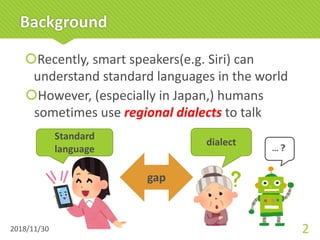
šRecently, smart speakers(e.g. Siri) can
understand standard languages in the world
2018/11/30 2
dialect
gap
šHowever, (especially in Japan,) humans
sometimes use regional dialects to talk
Standard
language …
Motivation
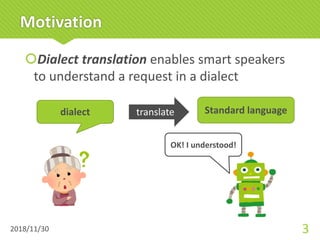
šDialect translation enables smart speakers
to understand a request in a dialect
2018/11/30 3
dialect translate Standard language
OK! I understood!
Problem: A variety of Japanese Dialects
2018/11/30 4
Kochi
hiyai
Yamagata
hyakkoi
Hokkaido
syakkoi
Okinawa
hijuru-
Standard Japanese
tsumetai
(It’s cold !!)
šJapanese has a large variety of dialects
→ We want smart speakers to
understand all the dialects
Problem: A variety of Japanese Dialects
2018/11/30 5
Kochi
hiyai
Yamagata
hyakkoi
Hokkaido
syakkoi
Okinawa
hijuru-
OK!
OK!
OK!
OK!
Problem: Lack of Dialect Corpus
šJapanese Dialect Corpus:
š48 dialects 30 minutes dialog
→ 34,117 sentence pairs of Transcript
(718 sentence pairs per dialect)
2018/12/1 6
It’s too small !!!
Dialects are spoken
rather than written
Problem: Lack of Dialect Corpus
šJapanese Dialect Corpus:
š48 dialects 30 minutes dialog
→ 34,117 sentence pairs of Transcript
(718 sentence pairs per dialect)
šWe should consider how to make the best use of
this small language resource
2018/12/1 7
It’s too small !!!
Dialects are spoken
rather than written
Relation between
a Japanese Dialect and Standard Japanese
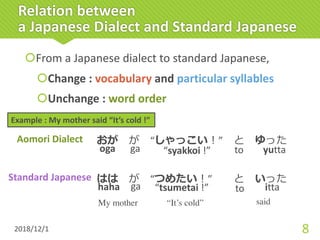
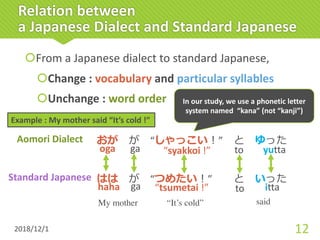
šFrom a Japanese dialect to standard Japanese,
šChange : vocabulary and particular syllables
šUnchange : word order
2018/12/1 8
Example : My mother said “It’s cold !”
Standard Japanese
Aomori Dialect
“ ”
“ ”
My mother said“It’s cold”
oga ga “syakkoi !” to yutta
haha ga “tsumetai !” to itta
Relation between
a Japanese Dialect and Standard Japanese
šFrom a Japanese dialect to standard Japanese,
šChange : vocabulary and particular syllables
šUnchange : word order
2018/12/1 9
Standard Japanese
Aomori Dialect
“ ”
“ ”
My mother said“It’s cold”
Example : My mother said “It’s cold !”
In our study, we use a phonetic letter
system named “kana” (not “kanji”)
oga ga “syakkoi !” to yutta
haha ga “tsumetai !” to itta
Relation between
a Japanese Dialect and Standard Japanese
šFrom a Japanese dialect to standard Japanese,
šChange : vocabulary and particular syllables
šUnchange : word order
2018/12/1 10
Example : My mother said “It’s cold !”
In our study, we use a phonetic letter
system named “kana” (not “kanji”)
Standard Japanese
Aomori Dialect
“ ”
“ ”
My mother said“It’s cold”
oga ga “syakkoi !” to yutta
haha ga “tsumetai !” to itta
Relation between
a Japanese Dialect and Standard Japanese
šFrom a Japanese dialect to standard Japanese,
šChange : vocabulary and particular syllables
šUnchange : word order
2018/12/1 11
Example : My mother said “It’s cold !”
In our study, we use a phonetic letter
system named “kana” (not “kanji”)
Standard Japanese
Aomori Dialect
“ ”
“ ”
My mother said“It’s cold”
oga ga “syakkoi !” to yutta
haha ga “tsumetai !” to itta
Relation between
a Japanese Dialect and Standard Japanese
šFrom a Japanese dialect to standard Japanese,
šChange : vocabulary and particular syllables
šUnchange : word order
2018/12/1 12
Example : My mother said “It’s cold !”
In our study, we use a phonetic letter
system named “kana” (not “kanji”)
Standard Japanese
Aomori Dialect
“ ”
“ ”
My mother said“It’s cold”
oga ga “syakkoi !” to yutta
haha ga “tsumetai !” to itta
šFixed-order + Character NMT
Model (Fixed-order + Character)
2018/11/30 13
Dialect NMT
Input
Attention
s ya k ko i
tsu me ta i
“It’s cold” said Output
Attention
to yu t ta
to i t ta
Hokkaido dialect
šJapanese dialects have similarity to
some extent
Japanese Dialects
2018/11/30 14
hiyai
hyakkoi
syakkoi
hijuru-
Standard Japanese
tsumetai
(It’s cold !!)
Hokkaido
Yamagata
Kochi
Similarity between Japanese Dialects
šMost of the dialects share fundamental properties
šSame or Similar Vocabulary
2018/11/30 15
Yamagata dialect
Hokkaido dialect
This water is cold!
Same Vocabulary Similar Vocabulary
Standard Japanese
Different VocabularySame Vocabulary
syakkoi
hyakkoi
notNow it is
Similarity between Japanese Dialects
šMost of the dialects share fundamental properties
šPhonetic correspondence rules
2018/11/30 16
Yamagata dialect
Hokkaido dialect
Same rule
Standard Japanese
Standard Japanese
Fish grilled
naigedona
naikedona
yageda
yaketa
imawa soudewa
imawa soudewa
sakana
sakana ga
ga
Approach (Multilingual NMT)
šA multilingual NMT[Johnson+, 2017] utilizes shared
properties between dialects by way of a unified model
that learns multiple languages jointly
2018/11/30 17
Multilingual
NMT
hiyai
syakkoiHokkaido
Kochi
tsumetai
(cold)
Standard
Japanese
hyakkoi
Yamagata
Automatically
learning similarity
between
languages
Model (Character + Fixed-order + Multilingual)
2018/11/30 18
Multi-Dialect NMT
Input
“It’s cold” said
Output
Attention
s ya k ko i
tsu me ta i
<Hokkaido> <standard>
Hokkaido dialect
šCharacter-level + Fixed-order + Multilingual NMT
Experiments
2018/11/30 19
Setting
šCorpus :
š48 dialects 30 minutes dialog
→ 34,117 sentence pairs (116,928 “bunsetsu” pairs)
(718 sentence, 2436 “bunsetsu” pairs per dialect)
šTrain : Validation : Test = 8 : 1 : 1
šEvaluation : BLEU (character-level)
šSystem
šNMT : OpenNMT-py
šSMT (baseline system) : Moses
2018/11/30 20
Evaluation
šOur model archived the best performance
2018/12/1 21
System Charact
er-level
Fixed-
order
Dialect
labels
jointly
learning
BLEU
Original 35.10
Multi NMT 75.66
Mono NMT 22.45
Sentence-Multi NMT 71.29
Multi NMT (w/o labels) 69.74
Mono SMT 52.98
Multi SMT (w/o labels) 73.54
Mono NMT vs. Multi NMT
2018/12/1 22
System Charact
er-level
Fixed-
order
Dialect
labels
jointly
learning
BLEU
Original 35.10
Multi NMT 75.66
Mono NMT 22.45
Sentence-Multi NMT 71.29
Multi NMT (w/o labels) 69.74
Mono SMT 52.98
Multi SMT (w/o labels) 73.54l Multilingual NMT performs significantly better than
monolingual NMT
Original vs. Mono NMT
2018/12/1 23
System Charact
er-level
Fixed-
order
Dialect
labels
jointly
learning
BLEU
Original 35.10
Multi NMT 75.66
Mono NMT 22.45
Sentence-Multi NMT 71.29
Multi NMT (w/o labels) 69.74
Mono SMT 52.98
Multi SMT (w/o labels) 73.54l Mono NMT could not learn translation rules because each
monolingual dialect-to-standard corpus is too small
Sentence vs. Fixed-order
2018/12/1 24
System Charact
er-level
Fixed-
order
Dialect
labels
jointly
learning
BLEU
Original 35.10
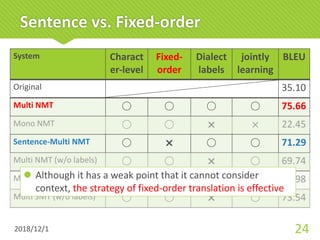
Multi NMT 75.66
Mono NMT 22.45
Sentence-Multi NMT 71.29
Multi NMT (w/o labels) 69.74
Mono SMT 52.98
Multi SMT (w/o labels) 73.54
l Although it has a weak point that it cannot consider
context, the strategy of fixed-order translation is effective
With labels vs. Without labels
2018/12/1 25
System Charact
er-level
Fixed-
order
Dialect
labels
jointly
learning
BLEU
Original 35.10
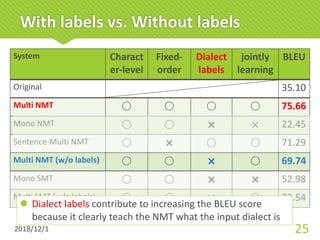
Multi NMT 75.66
Mono NMT 22.45
Sentence-Multi NMT 71.29
Multi NMT (w/o labels) 69.74
Mono SMT 52.98
Multi SMT (w/o labels) 73.54
l Dialect labels contribute to increasing the BLEU score
because it clearly teach the NMT what the input dialect is
SMT vs. NMT
2018/12/1 26
System Charact
er-level
Fixed-
order
Dialect
labels
jointly
learning
BLEU
Original 35.10
Multi NMT 75.66
Mono NMT 22.45
Sentence-Multi NMT 71.29
Multi NMT (w/o labels) 69.74
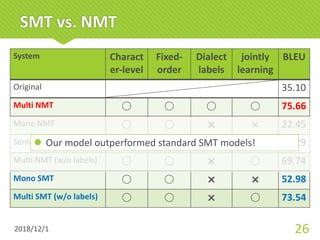
Mono SMT 52.98
Multi SMT (w/o labels) 73.54
l Our model outperformed standard SMT models!
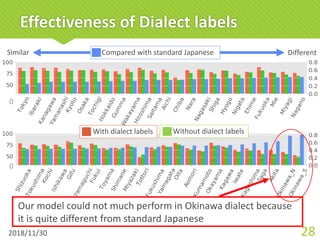
Effectiveness of Dialect labels
2018/11/30 27
DifferentSimilar Compared with standard Japanese
0
0
Dialect labels which teach what the dialect is contribute
to increasing BLEU scores in most of the dialects
With dialect labels Without dialect labels
Effectiveness of Dialect labels
2018/11/30 28
DifferentSimilar Compared with standard Japanese
0
0
With dialect labels Without dialect labels
Our model could not much perform in Okinawa dialect because
it is quite different from standard Japanese
Analysis
2018/11/30 29
Effect of Nearby Dialects
šAssumption: the data of nearby dialects might contribute to
the high performance under the multilingual architecture
šSetting
2018/
11/30 30
Data2: Removed the farthest 5 dialects
Data1: Removed the nearest 5 dialects
For ”Gifu” dialect …
Analysis (Effect of Nearby Dialects)
šEvaluating whether neighbor dialect data improves
a BLEU score
2018/12/1 31
Dataset Avg. Δ #Regions BLEU
decreased
All -nearest 5 -0.94 34/48(71%)
All -farthest 5 -0.22 31/48(65%)
šThe data of near areas are more effective
for multilingual NMT
šThe lack of 5 dialects in supervision data affect
translation accuracy in a low-resource setting
Analysis (Visualize dialect embeddings)
2018/11/30 32
šA t-SNE projection of dialect embeddings follows
dialectological typology
šThe nearer the distance between two areas is, the more similar
dialects are used (background colors)
Analysis (Visualize dialect embeddings)
2018/12/1 33
šA t-SNE projection of dialect embeddings follows
dialectological typology
šThe nearer the distance between two areas is, the more similar
dialects are used (background colors)
Japanese dialectal typology
šDialectological researcher said that dialects spread
from an ancient capital city to remote areas
concentrically [Yanagida, 1980]
2018/12/1 34
Analysis (Visualize dialect embeddings)
2018/12/1 35
šA t-SNE projection of dialect embeddings follows
dialectological typology
šThough the distance between D and E is far away,
similar dialects are used
Conclusions
š We presented Multi-dialect NMT system
šcharacter-level + fixed-order + multilingual
šThe unified model that learns similar multiple
dialects jointly is effective for multi-dialect
translation
šWe can observe similar relationships to the existing
dialect typology in some dialects by analyzing
similarity of the dialect embeddings
2018/11/30 36
References
š[Johnson+, 2017] Google’s Multilingual Neural
Machine Translation System: Enabling Zero-Shot
Translation, ACL2017
š[Yanagida, 1980] Kunio Yanagida. 1980. “Kagyuko”.
Iwanami Shoten, Publishers.
2018/12/1 37
Appendix
2018/11/30 38
FAQ
šCan you construct standard-to-dialect Multi NMT
with the same model?
šYes (But the translation accuracy dropped)
šDue to a weak language model in each target dialect
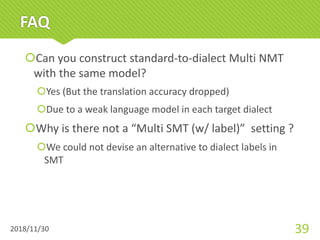
šWhy is there not a “Multi SMT (w/ label)” setting ?
šWe could not devise an alternative to dialect labels in
SMT
2018/11/30 39
Is Word Order really unchanged?
š We checked 100 dialect-standard sentence pairs in
all 48 dialects
→ All the pairs are unchanged
2018/11/30 40
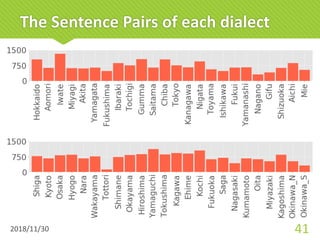
The Sentence Pairs of each dialect
2018/11/30 41
Analysis (Translation Examples: Good)
šThe output of Multi NMT completely agree with the reference
2018/11/30 42
Source
(Aomori dialect)
shi ke - to / no ri su ta de ba -
/
Reference su ke - to / no tsu ta de ha na i de su ka
/
Multi NMT su ke - to / no tsu ta de ha na i de su ka
/
Sentence-Multi NMT u ke i to / no ri shi ta de ha na i de su ka
/
Multi NMT
(w/o labels)
shi ke - to / no tsu ta de ha na i de su ka
/
Multi SMT
(w/o labels)
su ke - to / no tsu ta de ha na i de su
/
Example : “(We) had skated, aren’t we?”
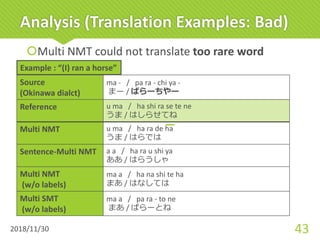
Analysis (Translation Examples: Bad)
2018/11/30 43
šMulti NMT could not translate too rare word
Source
(Okinawa dialct)
ma - / pa ra - chi ya -
/
Reference u ma / ha shi ra se te ne
/
Multi NMT u ma / ha ra de ha
/
Sentence-Multi NMT a a / ha ra u shi ya
/
Multi NMT
(w/o labels)
ma a / ha na shi te ha
/
Multi SMT
(w/o labels)
ma a / pa ra - to ne
/
Example : “(I) ran a horse”

Multi-dialect Neural Machine Translation and Dialectometry

  • 1.
    Multi-dialect Neural Machine Translationand Dialectometry Kaori Abe1 Yuichiroh Matsubayashi2, Naoaki Okazaki3, Kentaro Inui1,2 1. Graduate School of Information Sciences, Tohoku University 2. RIKEN Center for Advanced Intelligence Project (AIP) 3. School of Computing, Tokyo Institute of Technology 2018/12/1 1
  • 2.
    Background šRecently, smart speakers(e.g.Siri) can understand standard languages in the world 2018/11/30 2 dialect gap šHowever, (especially in Japan,) humans sometimes use regional dialects to talk Standard language …
  • 3.
    Motivation šDialect translation enablessmart speakers to understand a request in a dialect 2018/11/30 3 dialect translate Standard language OK! I understood!
  • 4.
    Problem: A varietyof Japanese Dialects 2018/11/30 4 Kochi hiyai Yamagata hyakkoi Hokkaido syakkoi Okinawa hijuru- Standard Japanese tsumetai (It’s cold !!) šJapanese has a large variety of dialects
  • 5.
    šJapanese has alarge variety of dialects → We want smart speakers to understand all the dialects Problem: A variety of Japanese Dialects 2018/11/30 5 Kochi hiyai Yamagata hyakkoi Hokkaido syakkoi Okinawa hijuru- OK! OK! OK! OK!
  • 6.
    Problem: Lack ofDialect Corpus šJapanese Dialect Corpus: š48 dialects 30 minutes dialog → 34,117 sentence pairs of Transcript (718 sentence pairs per dialect) 2018/12/1 6 It’s too small !!! Dialects are spoken rather than written
  • 7.
    Problem: Lack ofDialect Corpus šJapanese Dialect Corpus: š48 dialects 30 minutes dialog → 34,117 sentence pairs of Transcript (718 sentence pairs per dialect) šWe should consider how to make the best use of this small language resource 2018/12/1 7 It’s too small !!! Dialects are spoken rather than written
  • 8.
    Relation between a JapaneseDialect and Standard Japanese šFrom a Japanese dialect to standard Japanese, šChange : vocabulary and particular syllables šUnchange : word order 2018/12/1 8 Example : My mother said “It’s cold !” Standard Japanese Aomori Dialect “ ” “ ” My mother said“It’s cold” oga ga “syakkoi !” to yutta haha ga “tsumetai !” to itta
  • 9.
    Relation between a JapaneseDialect and Standard Japanese šFrom a Japanese dialect to standard Japanese, šChange : vocabulary and particular syllables šUnchange : word order 2018/12/1 9 Standard Japanese Aomori Dialect “ ” “ ” My mother said“It’s cold” Example : My mother said “It’s cold !” In our study, we use a phonetic letter system named “kana” (not “kanji”) oga ga “syakkoi !” to yutta haha ga “tsumetai !” to itta
  • 10.
    Relation between a JapaneseDialect and Standard Japanese šFrom a Japanese dialect to standard Japanese, šChange : vocabulary and particular syllables šUnchange : word order 2018/12/1 10 Example : My mother said “It’s cold !” In our study, we use a phonetic letter system named “kana” (not “kanji”) Standard Japanese Aomori Dialect “ ” “ ” My mother said“It’s cold” oga ga “syakkoi !” to yutta haha ga “tsumetai !” to itta
  • 11.
    Relation between a JapaneseDialect and Standard Japanese šFrom a Japanese dialect to standard Japanese, šChange : vocabulary and particular syllables šUnchange : word order 2018/12/1 11 Example : My mother said “It’s cold !” In our study, we use a phonetic letter system named “kana” (not “kanji”) Standard Japanese Aomori Dialect “ ” “ ” My mother said“It’s cold” oga ga “syakkoi !” to yutta haha ga “tsumetai !” to itta
  • 12.
    Relation between a JapaneseDialect and Standard Japanese šFrom a Japanese dialect to standard Japanese, šChange : vocabulary and particular syllables šUnchange : word order 2018/12/1 12 Example : My mother said “It’s cold !” In our study, we use a phonetic letter system named “kana” (not “kanji”) Standard Japanese Aomori Dialect “ ” “ ” My mother said“It’s cold” oga ga “syakkoi !” to yutta haha ga “tsumetai !” to itta
  • 13.
    šFixed-order + CharacterNMT Model (Fixed-order + Character) 2018/11/30 13 Dialect NMT Input Attention s ya k ko i tsu me ta i “It’s cold” said Output Attention to yu t ta to i t ta Hokkaido dialect
  • 14.
    šJapanese dialects havesimilarity to some extent Japanese Dialects 2018/11/30 14 hiyai hyakkoi syakkoi hijuru- Standard Japanese tsumetai (It’s cold !!) Hokkaido Yamagata Kochi
  • 15.
    Similarity between JapaneseDialects šMost of the dialects share fundamental properties šSame or Similar Vocabulary 2018/11/30 15 Yamagata dialect Hokkaido dialect This water is cold! Same Vocabulary Similar Vocabulary Standard Japanese Different VocabularySame Vocabulary syakkoi hyakkoi
  • 16.
    notNow it is Similaritybetween Japanese Dialects šMost of the dialects share fundamental properties šPhonetic correspondence rules 2018/11/30 16 Yamagata dialect Hokkaido dialect Same rule Standard Japanese Standard Japanese Fish grilled naigedona naikedona yageda yaketa imawa soudewa imawa soudewa sakana sakana ga ga
  • 17.
    Approach (Multilingual NMT) šAmultilingual NMT[Johnson+, 2017] utilizes shared properties between dialects by way of a unified model that learns multiple languages jointly 2018/11/30 17 Multilingual NMT hiyai syakkoiHokkaido Kochi tsumetai (cold) Standard Japanese hyakkoi Yamagata Automatically learning similarity between languages
  • 18.
    Model (Character +Fixed-order + Multilingual) 2018/11/30 18 Multi-Dialect NMT Input “It’s cold” said Output Attention s ya k ko i tsu me ta i <Hokkaido> <standard> Hokkaido dialect šCharacter-level + Fixed-order + Multilingual NMT
  • 19.
  • 20.
    Setting šCorpus : š48 dialects30 minutes dialog → 34,117 sentence pairs (116,928 “bunsetsu” pairs) (718 sentence, 2436 “bunsetsu” pairs per dialect) šTrain : Validation : Test = 8 : 1 : 1 šEvaluation : BLEU (character-level) šSystem šNMT : OpenNMT-py šSMT (baseline system) : Moses 2018/11/30 20
  • 21.
    Evaluation šOur model archivedthe best performance 2018/12/1 21 System Charact er-level Fixed- order Dialect labels jointly learning BLEU Original 35.10 Multi NMT 75.66 Mono NMT 22.45 Sentence-Multi NMT 71.29 Multi NMT (w/o labels) 69.74 Mono SMT 52.98 Multi SMT (w/o labels) 73.54
  • 22.
    Mono NMT vs.Multi NMT 2018/12/1 22 System Charact er-level Fixed- order Dialect labels jointly learning BLEU Original 35.10 Multi NMT 75.66 Mono NMT 22.45 Sentence-Multi NMT 71.29 Multi NMT (w/o labels) 69.74 Mono SMT 52.98 Multi SMT (w/o labels) 73.54l Multilingual NMT performs significantly better than monolingual NMT
  • 23.
    Original vs. MonoNMT 2018/12/1 23 System Charact er-level Fixed- order Dialect labels jointly learning BLEU Original 35.10 Multi NMT 75.66 Mono NMT 22.45 Sentence-Multi NMT 71.29 Multi NMT (w/o labels) 69.74 Mono SMT 52.98 Multi SMT (w/o labels) 73.54l Mono NMT could not learn translation rules because each monolingual dialect-to-standard corpus is too small
  • 24.
    Sentence vs. Fixed-order 2018/12/124 System Charact er-level Fixed- order Dialect labels jointly learning BLEU Original 35.10 Multi NMT 75.66 Mono NMT 22.45 Sentence-Multi NMT 71.29 Multi NMT (w/o labels) 69.74 Mono SMT 52.98 Multi SMT (w/o labels) 73.54 l Although it has a weak point that it cannot consider context, the strategy of fixed-order translation is effective
  • 25.
    With labels vs.Without labels 2018/12/1 25 System Charact er-level Fixed- order Dialect labels jointly learning BLEU Original 35.10 Multi NMT 75.66 Mono NMT 22.45 Sentence-Multi NMT 71.29 Multi NMT (w/o labels) 69.74 Mono SMT 52.98 Multi SMT (w/o labels) 73.54 l Dialect labels contribute to increasing the BLEU score because it clearly teach the NMT what the input dialect is
  • 26.
    SMT vs. NMT 2018/12/126 System Charact er-level Fixed- order Dialect labels jointly learning BLEU Original 35.10 Multi NMT 75.66 Mono NMT 22.45 Sentence-Multi NMT 71.29 Multi NMT (w/o labels) 69.74 Mono SMT 52.98 Multi SMT (w/o labels) 73.54 l Our model outperformed standard SMT models!
  • 27.
    Effectiveness of Dialectlabels 2018/11/30 27 DifferentSimilar Compared with standard Japanese 0 0 Dialect labels which teach what the dialect is contribute to increasing BLEU scores in most of the dialects With dialect labels Without dialect labels
  • 28.
    Effectiveness of Dialectlabels 2018/11/30 28 DifferentSimilar Compared with standard Japanese 0 0 With dialect labels Without dialect labels Our model could not much perform in Okinawa dialect because it is quite different from standard Japanese
  • 29.
  • 30.
    Effect of NearbyDialects šAssumption: the data of nearby dialects might contribute to the high performance under the multilingual architecture šSetting 2018/ 11/30 30 Data2: Removed the farthest 5 dialects Data1: Removed the nearest 5 dialects For ”Gifu” dialect …
  • 31.
    Analysis (Effect ofNearby Dialects) šEvaluating whether neighbor dialect data improves a BLEU score 2018/12/1 31 Dataset Avg. Δ #Regions BLEU decreased All -nearest 5 -0.94 34/48(71%) All -farthest 5 -0.22 31/48(65%) šThe data of near areas are more effective for multilingual NMT šThe lack of 5 dialects in supervision data affect translation accuracy in a low-resource setting
  • 32.
    Analysis (Visualize dialectembeddings) 2018/11/30 32 šA t-SNE projection of dialect embeddings follows dialectological typology šThe nearer the distance between two areas is, the more similar dialects are used (background colors)
  • 33.
    Analysis (Visualize dialectembeddings) 2018/12/1 33 šA t-SNE projection of dialect embeddings follows dialectological typology šThe nearer the distance between two areas is, the more similar dialects are used (background colors)
  • 34.
    Japanese dialectal typology šDialectologicalresearcher said that dialects spread from an ancient capital city to remote areas concentrically [Yanagida, 1980] 2018/12/1 34
  • 35.
    Analysis (Visualize dialectembeddings) 2018/12/1 35 šA t-SNE projection of dialect embeddings follows dialectological typology šThough the distance between D and E is far away, similar dialects are used
  • 36.
    Conclusions š We presentedMulti-dialect NMT system šcharacter-level + fixed-order + multilingual šThe unified model that learns similar multiple dialects jointly is effective for multi-dialect translation šWe can observe similar relationships to the existing dialect typology in some dialects by analyzing similarity of the dialect embeddings 2018/11/30 36
  • 37.
    References š[Johnson+, 2017] Google’sMultilingual Neural Machine Translation System: Enabling Zero-Shot Translation, ACL2017 š[Yanagida, 1980] Kunio Yanagida. 1980. “Kagyuko”. Iwanami Shoten, Publishers. 2018/12/1 37
  • 38.
  • 39.
    FAQ šCan you constructstandard-to-dialect Multi NMT with the same model? šYes (But the translation accuracy dropped) šDue to a weak language model in each target dialect šWhy is there not a “Multi SMT (w/ label)” setting ? šWe could not devise an alternative to dialect labels in SMT 2018/11/30 39
  • 40.
    Is Word Orderreally unchanged? š We checked 100 dialect-standard sentence pairs in all 48 dialects → All the pairs are unchanged 2018/11/30 40
  • 41.
    The Sentence Pairsof each dialect 2018/11/30 41
  • 42.
    Analysis (Translation Examples:Good) šThe output of Multi NMT completely agree with the reference 2018/11/30 42 Source (Aomori dialect) shi ke - to / no ri su ta de ba - / Reference su ke - to / no tsu ta de ha na i de su ka / Multi NMT su ke - to / no tsu ta de ha na i de su ka / Sentence-Multi NMT u ke i to / no ri shi ta de ha na i de su ka / Multi NMT (w/o labels) shi ke - to / no tsu ta de ha na i de su ka / Multi SMT (w/o labels) su ke - to / no tsu ta de ha na i de su / Example : “(We) had skated, aren’t we?”
  • 43.
    Analysis (Translation Examples:Bad) 2018/11/30 43 šMulti NMT could not translate too rare word Source (Okinawa dialct) ma - / pa ra - chi ya - / Reference u ma / ha shi ra se te ne / Multi NMT u ma / ha ra de ha / Sentence-Multi NMT a a / ha ra u shi ya / Multi NMT (w/o labels) ma a / ha na shi te ha / Multi SMT (w/o labels) ma a / pa ra - to ne / Example : “(I) ran a horse”