








Break your event chains
MuCon, November 6th 2017, London
mail@bernd-ruecker.com
martin.schimak@plexiti.com
With thoughts from http://flowing.io
@berndruecker | @martinschimak
Bernd Rücker
Consultant & Dev. Advocate
10+ years workflow
Co-founder Camunda
http://bernd-ruecker.com/
Martin Schimak
Developer & Trainer, 10+ years
(de-)coding domain knowledge
DDDesign, TDD/BDD, EDA
http://plexiti.com/
http://flowing.io/
3 common hypotheses we check today:
# Events decrease coupling
# Central control needs to be avoided
# Workflow engines are painful
Simplified example:
dash button
Photo by 0xF2, available under Creative Commons BY-ND 2.0
license. https://www.flickr.com/photos/0xf2/29873149904/
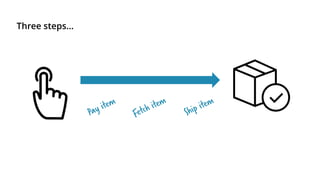
Three steps…
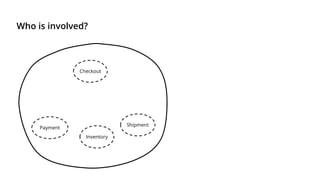
Who is involved?
Checkout
Payment
Inventory
Shipment
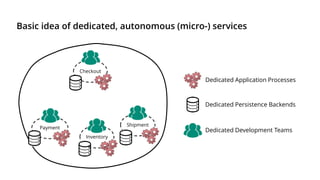
Basic idea of dedicated, autonomous (micro-) services
Checkout
Payment
Inventory
Shipment
Dedicated Application Processes
Dedicated Persistence Backends
Dedicated Development Teams
Events decrease coupling
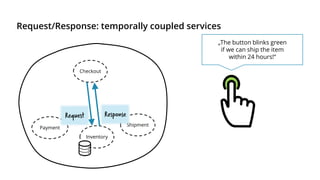
Request/Response: temporally coupled services
Checkout
Payment
Inventory
Shipment
„The button blinks green
if we can ship the item
within 24 hours!“
Request Response
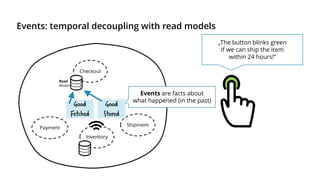
Events: temporal decoupling with read models
Checkout
Payment
Inventory
Shipment
„The button blinks green
if we can ship the item
within 24 hours!“
Events are facts about
what happened (in the past)
Good
Fetched
Good
Stored
Read
Model
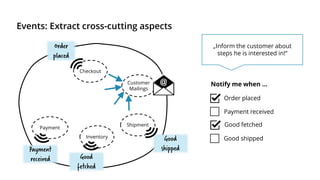
Events: Extract cross-cutting aspects
Checkout
Payment
Inventory
Shipment
„Inform the customer about
steps he is interested in!“
Order
placed
Payment
received
Good
shipped
Notify me when …
Order placed
Payment received
Good fetched
Good shipped
Customer
Mailings
Good
fetched
Events can decrease coupling*
*e.g. decentral data-management, read models,
extract cross-cutting aspects
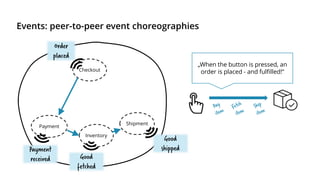
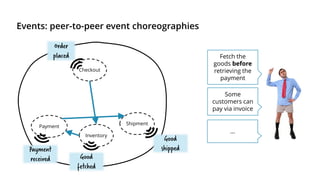
Events: peer-to-peer event choreographies
Checkout
Payment
Inventory
Shipment
Order
placed
Payment
received
Good
shipped
„When the button is pressed, an
order is placed - and fulfilled!“
Good
fetched
Events: peer-to-peer event choreographies
Fetch the
goods before
retrieving the
payment
Some
customers can
pay via invoice
…
Checkout
Payment
Inventory
Shipment
Good
fetched
Order
placed
Payment
received
Good
shipped
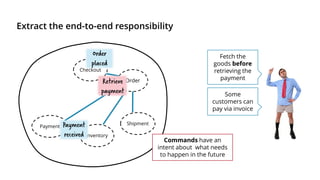
Extract the end-to-end responsibility
Order
Checkout
Payment
Inventory
Shipment
Order
placed
Retrieve
payment
Commands have an
intent about what needs
to happen in the future
Fetch the
goods before
retrieving the
payment
Some
customers can
pay via invoice
Payment
received
Retrieve
payment
Events can increase coupling*
*e.g. complex peer-to-peer event chains
Commands can decrease coupling*
*e.g. to avoid complex peer-to-peer event chains
Central control needs to be avoided
Checkout
Payment
Inventory
Shipment
Order
Order
placed
Payment
received
Good
fetched
Good
shipped
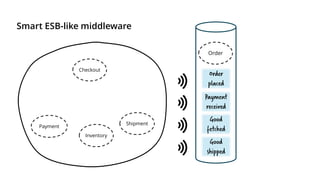
Smart ESB-like middleware
Checkout
Payment
Inventory
Shipment
Order
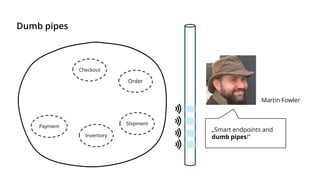
Dumb pipes
„Smart endpoints and
dumb pipes!”
Martin Fowler
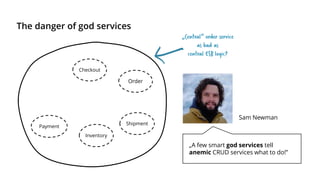
The danger of god services
Checkout
Payment
Inventory
Shipment
Order
„A few smart god services tell
anemic CRUD services what to do!”
Sam Newman
„Central“ order service
as bad as
central ESB logic?
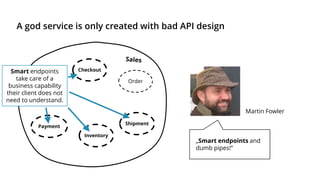
A god service is only created with bad API design
Checkout
Payment
Inventory
Shipment
Order
„Smart endpoints and
dumb pipes!”
Martin Fowler
Smart endpoints
take care of a
business capability
their client does not
need to understand.
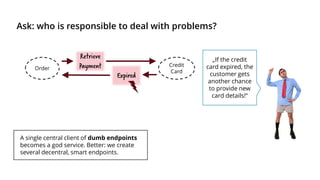
Ask: who is responsible to deal with problems?
Order
Credit
Card
Retrieve
Payment
Expired
A single central client of dumb endpoints
becomes a god service. Better: we create
several decentral, smart endpoints.
„If the credit
card expired, the
customer gets
another chance
to provide new
card details!“
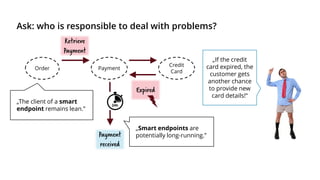
Ask: who is responsible to deal with problems?
Order
Credit
Card
„If the credit
card expired, the
customer gets
another chance
to provide new
card details!“
Expired
„Smart endpoints are
potentially long-running.”
Payment
Retrieve
Payment
Payment
received
„The client of a smart
endpoint remains lean.”
Be sceptical about central control!*
*e.g. centralized ESB-like components or
god services which heavily interact with dumb endpoints
But don‘t give up control!*
*e.g. miss to extract and control important
potentially long-running business capabilities
The problem is not to command
services!
The problem is bad API design.
Workflow engines are painful
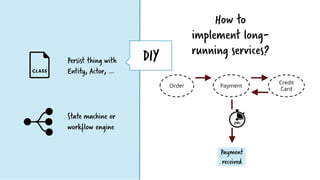
Persist thing with
Entity, Actor, …
State machine or
workflow engine
DIY
Order
Credit
Card
Payment
Payment
received
How to
implement long-
running services?
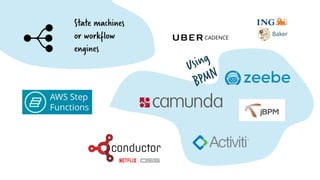
State machines
or workflow
engines
CADENCE
Baker
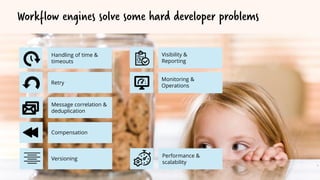
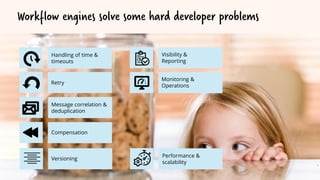
Workflow engines solve some hard developer problems
Monitoring &
Operations
Handling of time &
timeouts
Retry
Visibility &
Reporting
Versioning
Compensation
Message correlation &
deduplication
Performance &
scalability
Distributed systems
Workflow engines solve some hard developer problems
Monitoring &
Operations
Handling of time &
timeouts
Retry
Visibility &
Reporting
Versioning
Compensation
Message correlation &
deduplication
Performance &
scalability
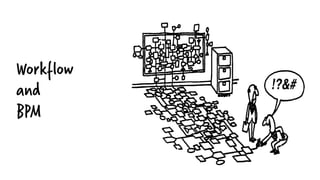
Workflow
and
BPM
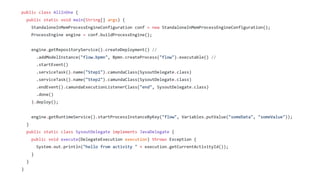
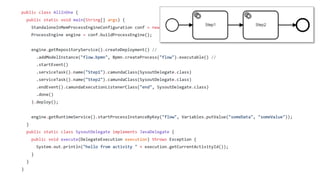
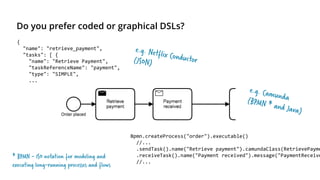
Bpmn.createProcess("order").executable()
//...
.sendTask().name("Retrieve payment").camundaClass(RetrievePayme
.receiveTask().name("Payment received").message("PaymentReceive
//...
{
"name": "retrieve_payment",
"tasks": [ {
"name": "Retrieve Payment",
"taskReferenceName": "payment",
"type": "SIMPLE",
...
Do you prefer coded or graphical DSLs?
* BPMN - ISO notation for modeling and
executing long-running processes and flows
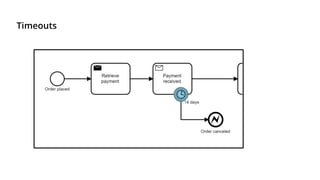
Timeouts
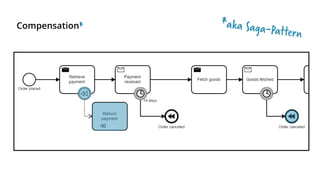
Compensation*
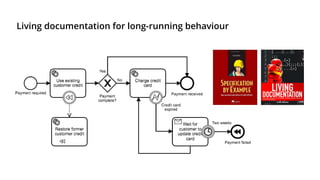
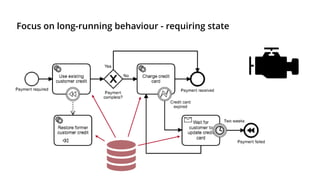
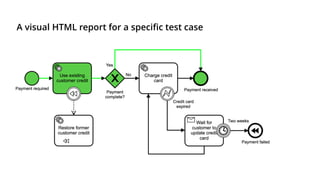
Living documentation for long-running behaviour
Focus on long-running behaviour - requiring state
A visual HTML report for a specific test case
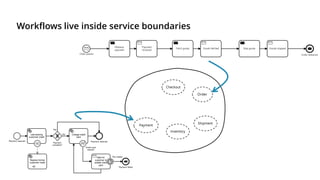
Workflows live inside service boundaries
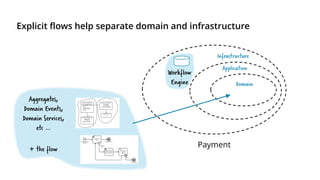
Explicit flows help separate domain and infrastructure
Infrastructure
Aggregates,
Domain Events,
Domain Services,
etc …
+ the flow
Workflow
Engine
Payment
Application
Domain
Lightweight workflow engines are
great (and much better than DIY)*
*e.g. enabling potentially long-running services, solving hard
developer problems, can run decentralized
Workflow engines can do (service)
orchestration.*
Orchestration is not about synchronous
request/response!
*We are not talking about container orchestration
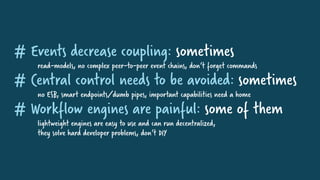
# Events decrease coupling: sometimes
read-models, no complex peer-to-peer event chains, don‘t forget commands
# Central control needs to be avoided: sometimes
no ESB, smart endpoints/dumb pipes, important capabilities need a home
# Workflow engines are painful: some of them
lightweight engines are easy to use and can run decentralized,
they solve hard developer problems, don‘t DIY
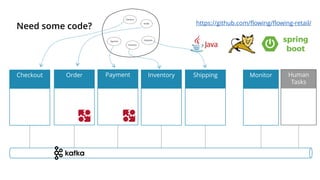
Need some code?
InventoryPaymentOrder ShippingCheckout Monitor
https://github.com/flowing/flowing-retail/
Human
Tasks
Thank you!
Code online:
https://github.com/flowing
Slides & Blog:
https://bernd-ruecker.com
https://plexiti.com
With thoughts from http://flowing.io
@berndruecker | @martinschimak
https://www.infoq.com
/articles/microservice-
event-choreographies
Images licensed from iStock
no attribution required
All icons licensed from Noun Project
no attribution required
Images licensed under Creative Commons license
Photo by 0xF2, available under
Creative Commons BY-ND 2.0 license.
https://www.flickr.com/photos/0xf2/2987
3149904/

MuCon London 2017: Break your event chains

  • 1.
    Break your eventchains MuCon, November 6th 2017, London mail@bernd-ruecker.com martin.schimak@plexiti.com With thoughts from http://flowing.io @berndruecker | @martinschimak
  • 2.
    Bernd Rücker Consultant &Dev. Advocate 10+ years workflow Co-founder Camunda http://bernd-ruecker.com/ Martin Schimak Developer & Trainer, 10+ years (de-)coding domain knowledge DDDesign, TDD/BDD, EDA http://plexiti.com/ http://flowing.io/
  • 3.
    3 common hypotheseswe check today: # Events decrease coupling # Central control needs to be avoided # Workflow engines are painful
  • 5.
    Simplified example: dash button Photoby 0xF2, available under Creative Commons BY-ND 2.0 license. https://www.flickr.com/photos/0xf2/29873149904/
  • 6.
  • 7.
  • 8.
    Basic idea ofdedicated, autonomous (micro-) services Checkout Payment Inventory Shipment Dedicated Application Processes Dedicated Persistence Backends Dedicated Development Teams
  • 9.
  • 10.
    Request/Response: temporally coupledservices Checkout Payment Inventory Shipment „The button blinks green if we can ship the item within 24 hours!“ Request Response
  • 11.
    Events: temporal decouplingwith read models Checkout Payment Inventory Shipment „The button blinks green if we can ship the item within 24 hours!“ Events are facts about what happened (in the past) Good Fetched Good Stored Read Model
  • 12.
    Events: Extract cross-cuttingaspects Checkout Payment Inventory Shipment „Inform the customer about steps he is interested in!“ Order placed Payment received Good shipped Notify me when … Order placed Payment received Good fetched Good shipped Customer Mailings Good fetched
  • 13.
    Events can decreasecoupling* *e.g. decentral data-management, read models, extract cross-cutting aspects
  • 14.
    Events: peer-to-peer eventchoreographies Checkout Payment Inventory Shipment Order placed Payment received Good shipped „When the button is pressed, an order is placed - and fulfilled!“ Good fetched
  • 15.
    Events: peer-to-peer eventchoreographies Fetch the goods before retrieving the payment Some customers can pay via invoice … Checkout Payment Inventory Shipment Good fetched Order placed Payment received Good shipped
  • 16.
    Extract the end-to-endresponsibility Order Checkout Payment Inventory Shipment Order placed Retrieve payment Commands have an intent about what needs to happen in the future Fetch the goods before retrieving the payment Some customers can pay via invoice Payment received Retrieve payment
  • 17.
    Events can increasecoupling* *e.g. complex peer-to-peer event chains
  • 18.
    Commands can decreasecoupling* *e.g. to avoid complex peer-to-peer event chains
  • 19.
    Central control needsto be avoided
  • 20.
  • 21.
  • 22.
    The danger ofgod services Checkout Payment Inventory Shipment Order „A few smart god services tell anemic CRUD services what to do!” Sam Newman „Central“ order service as bad as central ESB logic?
  • 23.
    A god serviceis only created with bad API design Checkout Payment Inventory Shipment Order „Smart endpoints and dumb pipes!” Martin Fowler Smart endpoints take care of a business capability their client does not need to understand.
  • 24.
    Ask: who isresponsible to deal with problems? Order Credit Card Retrieve Payment Expired A single central client of dumb endpoints becomes a god service. Better: we create several decentral, smart endpoints. „If the credit card expired, the customer gets another chance to provide new card details!“
  • 25.
    Ask: who isresponsible to deal with problems? Order Credit Card „If the credit card expired, the customer gets another chance to provide new card details!“ Expired „Smart endpoints are potentially long-running.” Payment Retrieve Payment Payment received „The client of a smart endpoint remains lean.”
  • 26.
    Be sceptical aboutcentral control!* *e.g. centralized ESB-like components or god services which heavily interact with dumb endpoints
  • 27.
    But don‘t giveup control!* *e.g. miss to extract and control important potentially long-running business capabilities
  • 28.
    The problem isnot to command services! The problem is bad API design.
  • 29.
  • 30.
    Persist thing with Entity,Actor, … State machine or workflow engine DIY Order Credit Card Payment Payment received How to implement long- running services?
  • 31.
  • 32.
    Workflow engines solvesome hard developer problems Monitoring & Operations Handling of time & timeouts Retry Visibility & Reporting Versioning Compensation Message correlation & deduplication Performance & scalability
  • 33.
  • 34.
    Workflow engines solvesome hard developer problems Monitoring & Operations Handling of time & timeouts Retry Visibility & Reporting Versioning Compensation Message correlation & deduplication Performance & scalability
  • 35.
  • 38.
    Bpmn.createProcess("order").executable() //... .sendTask().name("Retrieve payment").camundaClass(RetrievePayme .receiveTask().name("Payment received").message("PaymentReceive //... { "name":"retrieve_payment", "tasks": [ { "name": "Retrieve Payment", "taskReferenceName": "payment", "type": "SIMPLE", ... Do you prefer coded or graphical DSLs? * BPMN - ISO notation for modeling and executing long-running processes and flows
  • 39.
  • 40.
  • 41.
    Living documentation forlong-running behaviour
  • 42.
    Focus on long-runningbehaviour - requiring state
  • 43.
    A visual HTMLreport for a specific test case
  • 44.
    Workflows live insideservice boundaries
  • 45.
    Explicit flows helpseparate domain and infrastructure Infrastructure Aggregates, Domain Events, Domain Services, etc … + the flow Workflow Engine Payment Application Domain
  • 46.
    Lightweight workflow enginesare great (and much better than DIY)* *e.g. enabling potentially long-running services, solving hard developer problems, can run decentralized
  • 47.
    Workflow engines cando (service) orchestration.* Orchestration is not about synchronous request/response! *We are not talking about container orchestration
  • 49.
    # Events decreasecoupling: sometimes read-models, no complex peer-to-peer event chains, don‘t forget commands # Central control needs to be avoided: sometimes no ESB, smart endpoints/dumb pipes, important capabilities need a home # Workflow engines are painful: some of them lightweight engines are easy to use and can run decentralized, they solve hard developer problems, don‘t DIY
  • 50.
    Need some code? InventoryPaymentOrderShippingCheckout Monitor https://github.com/flowing/flowing-retail/ Human Tasks
  • 51.
  • 52.
    Code online: https://github.com/flowing Slides &Blog: https://bernd-ruecker.com https://plexiti.com With thoughts from http://flowing.io @berndruecker | @martinschimak https://www.infoq.com /articles/microservice- event-choreographies
  • 53.
    Images licensed fromiStock no attribution required All icons licensed from Noun Project no attribution required Images licensed under Creative Commons license Photo by 0xF2, available under Creative Commons BY-ND 2.0 license. https://www.flickr.com/photos/0xf2/2987 3149904/