Material Safety Data Sheet Version 1.1 Revision Date: 06/05/2014 Print Date: 08/06/2014 
1. PRODUCT AND COMPANY IDENTIFICATION 
Product name: COSMESOME TM (NE) 
Product Number: COS- 1001 
Brand: COSMESOME TM 
Company Address: ENCAPSULA NANOSCIENCES LLC 6 CADILLAC DRIVE SUITE 245 BRENTWOOD, TN, 37027 
Technical Phone: 615-884-4442 Fax: 615-250-8747 Emergency Phone: 615-438-8553 CHEMTREC: 1-800-424-9300 
2. COMPOSITION/INFORMATION ON INGREDIENTS 
Ingredient Name CAS# Percent 
WATER 7732-18-5 >90 GLYCERIN 56-81-5 1, 3 BUTANEDIOL 107-88-0 <5 L-α-PHOSPHATIDYLCHOLINE, hydrogenated 97281-48-6 <5 
3. HAZARDS IDENTIFCATION 
OSHA 
No known OSHA hazards 
HMIS RATING 
HEALTH HAZARDS: 0 FLAMMABILITY: 1 CHRONIC HEALTH HAZARDS: * 
PHYSICAL HAZARDS: 0 
NFPA RATING 
HEALTH HAZARD: 0 FLAMMABILTY: 1 REACTIVITY: 0
Material Safety Data Sheet Version 1.1 Revision Date: 06/05/2014 Print Date: 08/06/2014 
POTENTIAL HEALTH EFFECTS 
Inhalation May be harmful if inhaled. 
Skin May be harmful if absorbed through skin Eyes May cause eye irritation. 
Ingestion May be harmful if swallowed. 
Chronic No existing conditions have been investigated 
4. FIRST AID MEASURES 
ORAL EXPOSURE Do not induce vomiting. Never give anything by mouth to an unconscious person. Rinse mouth with water. Consult a physician 
INHALATION EXPOSURE If inhaled, remove to fresh air. If not breathing give artificial respiration. If breathing is difficult, give oxygen. Consult a physician. 
DERMAL EXPOSURE In case of contact, immediately wash skin with soap and copious amounts of water. Cover skin with an emollient. Contact a physician. 
EYE EXPOSURE In case of contact, check or remove any contact lenses; immediately flush eyes with copious amounts of water for at least 15 minutes. Contact a physician. 
5. FIRE FIGHTING MEASURES 
FLAMMABILITY Not available 
EXTINGUISHING MEDIA It is suitable to use water spray, alcohol-resistant foam, dry chemical or carbon dioxide. 
SPECIAL PROCTECTIVE EQUIPMENT FOR FIRE-FIGHTERS Wear self-contained breathing apparatus and protective clothing to prevent contact with skin and eyes. Included a positive pressure NIOSH approved self-contained breathing apparatus. 
HAZARDOUS COMBUSTION PRODUCTS Carbon oxides 
SPECIAL REMARKS N/A
Material Safety Data Sheet Version 1.1 Revision Date: 06/05/2014 Print Date: 08/06/2014 
6. ACCIDENTAL RELEASE MEASURES 
METHODS FOR CLEANING UP Soak up inert absorbent material and dispose of as waste. Keep in suitable container for disposal. Use appropriate tools to put this spilled solid in a convenient waste disposable container and finish cleaning by spreading water on the contaminated surface and dispose of according to local and region authority requirements. Allow to evacuate through the sanitary system. 
ENVIRONMENTAL PRECAUTIONS 
Do not let product enter drains. If safe to do so prevent further leakages or spills. 
PERSONAL PRECAUTIONS 
Use personal protective equipment. Avoid breathing in vapors, mist or gas. Ensure adequate ventilation. Prepare evacuation sites. 
7. HANDLING AND STORAGE 
HANDLING User Exposure: Do not breathe vapor, dust, fume, gas, mist and spray. Avoid prolonged or repeated exposure. Do not get in eyes, on skin, on clothing. Wash hands thoroughly after handling. 
STORAGE Suitable: Keep tightly container closed. Store in temperature between approximately 2-8 o C. Do not freeze keep in refrigerator. Product is sensitive to moisture and light. 
8. EXPOSURE CONTROLS/ PERSONAL PROTECTION 
ENGINEERING CONTROLS Safety shower and eye bath. Mechanical exhaust required. 
PERSONAL PROTECTIVE EQUIPMENT 
Respiratory: Use respirators and components tested and approved under appropriate government standards such as NIOSH (US) in accord with 29 CFR 1910.134, use either an atmosphere supply respirator or air purifying respirator. Also use a full-face respirator with multi-purpose combination (US) or type ABEK (EN 14387) respirator cartridges as a back up to engineering controls. If the respirator is the sole means of protection, use a full-face supplied airs respirator. Use respirators and components tested and approved under appropriate government standers such as NIOSH (US) or CEN (EU). 
Hand: Compatible chemical-resistant gloves. 
Eye: Chemical safety goggles. Safety glasses with side-shields conforming to EN 166 use equipment for eye protection listed and approved under appropriated government standards such as NIOSH (US) or EN166 (EU)
Material Safety Data Sheet Version 1.1 Revision Date: 06/05/2014 Print Date: 08/06/2014 
Skin and Body: Wear a complete suit protecting against chemicals. 
GENERAL HYGIENE MEASURES 
Wash hands thoroughly after handling. Wash contaminated clothing before reuse. Prepare all materials under the fume hood and avoid generating aerosols. 
9. PHYSICAL AND CHEMICAL PROPERTIES 
Appearance white, viscous liquid 
Safety data 
N/A 
Melting point 
N/A Boiling point N/A Flash point N/A Ignition Temperature N/A Lower explosion limit N/A Upper Explosion limit N/A Water Solubility N/A 
Density N/A 
10. STABILITY AND REACITIVITY 
STORAGE STABILITY Store under recommended conditions. 
MATERIALS TO AVIOD Strong oxidizing agents 
HAZARDOUS DECOMPOSITION PRODUCTS N/A 
CONDITIONS TO AVOID Light and exposure to moisture. Strong bases and Strong oxidizing agents.
Material Safety Data Sheet Version 1.1 Revision Date: 06/05/2014 Print Date: 08/06/2014 
11. TOXICOLOGICAL INFORMATION 
CARCINOGENICITY 
IARC: No component of this product present at levels greater than or equal to 0.1% is identified as probable, possible or confirmed human carcinogen by the IARC. 
OHSA: No component of this product present at levels greater than or equal to 0.1% is identified as probable, possible or confirmed human carcinogen by the OHSA. 
ACGIH: No component of this product present at levels greater than or equal to 0.1% is identified as probable, possible or confirmed human carcinogen by the ACGIH. 
EPA: No component of this product present at levels greater than or equal to 0.1% is identified as probable, possible or confirmed human carcinogen by the EPA. 
CHRONIC Not Available 
ACUTE TOXICITY 1,3-Butanediol: Oral LD50- mouse rat-698 mg/kg Symptoms: Sense organs and special senses (eye-lacrimation; muscle weakness; diarrhea) Dermal LD50- rabbit >20,000 mg/kg Glycerin: Oral LD50- mouse rat-698 mg/kg Symptoms: Sense organs and special senses (eye-lacrimation; muscle weakness; diarrhea) Dermal LD50- rabbit >20,000 mg/kg 
ADDITIONAL INFORMATION Prolonged or repeated exposure may result in Nausea, Headache, or Vomiting Kidney- irregularities-based on Human evidence 
ROUTE OF EXPOSURE Skin Contact: May cause skin irritation Skin Absorption: May be harmful if absorbed through the skin Eye Contact: May Cause eye irritation Inhalation: Materials may be irritating to mucous membranes and upper respiratory tract. Ingestion: May be harmful if swallowed 
SIGNS AND SYMPTOMS OF EXPOSURE Symptoms have not be thoroughly investigated
Material Safety Data Sheet Version 1.1 Revision Date: 06/05/2014 Print Date: 08/06/2014 
12. ECOLOGICAL INFORMATION 
Elimination information (persistence and degradability) N/A 
Ecotoxicity effects 
N/A 
Further information on ecology N/A 
13. DISPOSAL CONSIDERATIONS 
PRODUCT Observe all federal, state, and local environment regulations. Contact a licensed professional waste disposal service to remove this material. 
CONTAMINATED PACKAGING Observe all federal, state, and local environment regulations. 
14. TRANSPROT INFORMATION 
DOT (US) Not dangerous goods 
IMDG Not dangerous goods 
IATA Not dangerous goods 
15. REGULATORY INFORMATION OSHA HAZARDS OSHA: Hazardous by definition of Hazard Communication Standard (29 SFR 1910.1200). EINECS: this product is on the European Inventory of Existing Commercial Chemical Substances 
SARA 302 COMPONENTS SARA 302: No chemicals in this material are subject to the reporting requirements of SARA Title III, Section 302 
SARA 313 COMPONENTS SARA 313: This material does not contain any chemical components with known CAS numbers that exceed threshold (De Minimis) reporting levels established be SARA Title III, Section 313 
SARA 311/312 HAZARDS Acute health hazards, chronic health hazards, Fire hazard
Material Safety Data Sheet Version 1.1 Revision Date: 06/05/2014 Print Date: 08/06/2014 
MASSACHUSETTS RIGHT TO KNOW COMPONENTS CAS-No. Revision Date Glycerol 56-81-5 2007-03-01 
PENNSYVANIA RIGHT TO KNOW COMPONENTS CAS-No. Revision Date L-α-PHOSPHATIDYLCHOLINE, hydrogenated 97281-48-6 1989-08-11 Glycerol 56-81-5 2007-03-01 Butane-1,3-diol 107-88-0 Water 7732-18-5 
NEW JERSEY RIGHT TO KNOW COMPONENTS CAS-No. Revision Date L-α-PHOSPHATIDYLCHOLINE, hydrogenated 97281-48-6 1989-08-11 Glycerol 56-81-5 2007-03-01 Butane-1,3-diol 107-88-0 Water 7732-18-5 
CALIFORNIA PROP. 65 COMPONENTS CAS-No. Revision Date L-α-PHOSPHATIDYLCHOLINE, hydrogenated 97281-48-6 1989-08-11 
Canada CAS# 7732185 is listed on Canada's DSL List 
TSCA 
CAS# 7732185 is listed on the TSCA Inventory 
16. OTHER INFORMATION 
Copyright 2013 Encapsula NanoSciences LLC license granted to make unlimited paper copies for internal use only. 
The above information is believed to be correct but does not support to be all inclusive and shall be used only as a guide. The information in this document is based on the present state of our knowledge and is applicable to the product with regard to appropriate safety precautions. It does not represent any guarantee of the properties of the product. Encapsula NanoSciences LLC shall not be held liable for any damage resulting from handling or from contact with the above product.

MSDS Cosmesome (NE, Not containing ethanol)

  • 1.
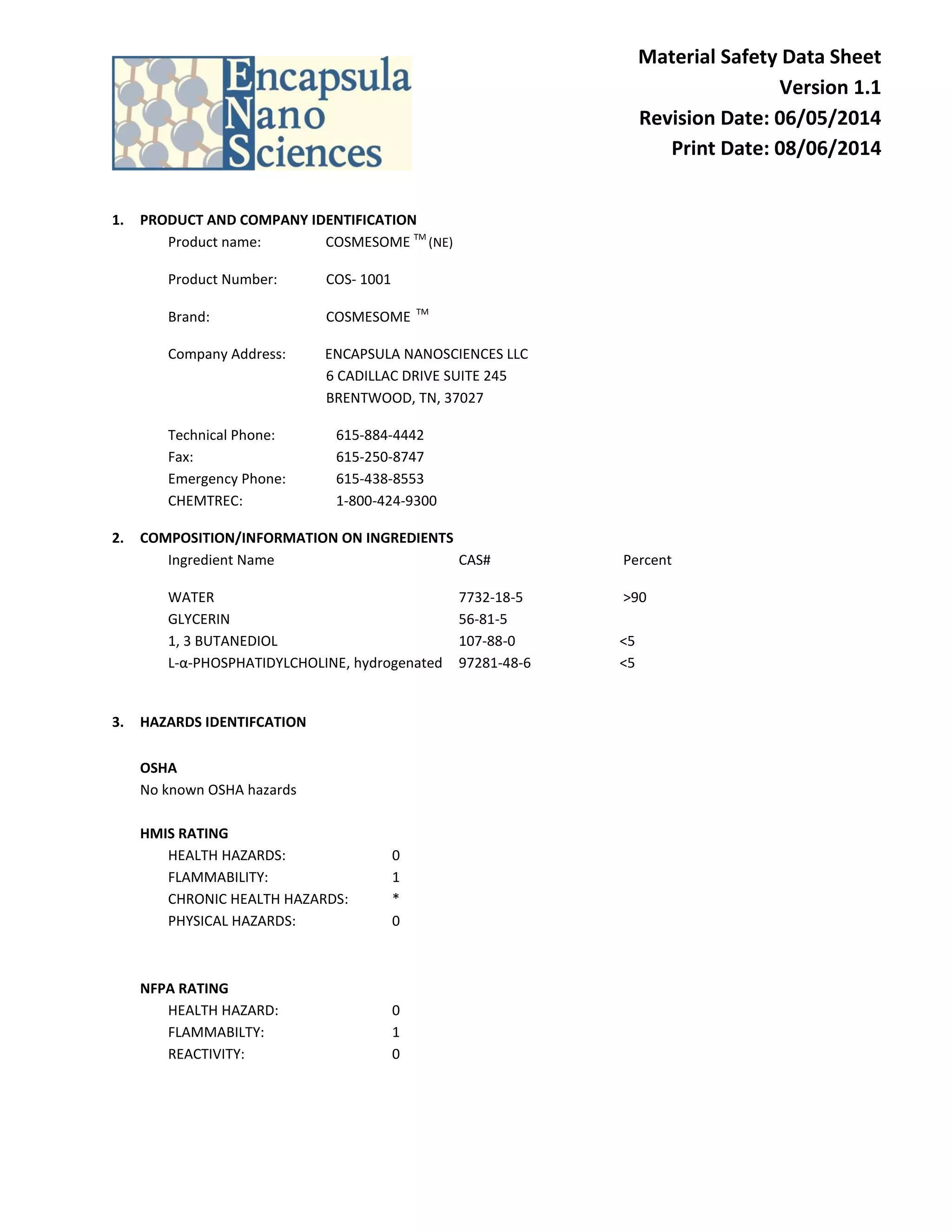
    Material Safety DataSheet Version 1.1 Revision Date: 06/05/2014 Print Date: 08/06/2014 1. PRODUCT AND COMPANY IDENTIFICATION Product name: COSMESOME TM (NE) Product Number: COS- 1001 Brand: COSMESOME TM Company Address: ENCAPSULA NANOSCIENCES LLC 6 CADILLAC DRIVE SUITE 245 BRENTWOOD, TN, 37027 Technical Phone: 615-884-4442 Fax: 615-250-8747 Emergency Phone: 615-438-8553 CHEMTREC: 1-800-424-9300 2. COMPOSITION/INFORMATION ON INGREDIENTS Ingredient Name CAS# Percent WATER 7732-18-5 >90 GLYCERIN 56-81-5 1, 3 BUTANEDIOL 107-88-0 <5 L-α-PHOSPHATIDYLCHOLINE, hydrogenated 97281-48-6 <5 3. HAZARDS IDENTIFCATION OSHA No known OSHA hazards HMIS RATING HEALTH HAZARDS: 0 FLAMMABILITY: 1 CHRONIC HEALTH HAZARDS: * PHYSICAL HAZARDS: 0 NFPA RATING HEALTH HAZARD: 0 FLAMMABILTY: 1 REACTIVITY: 0
  • 2.
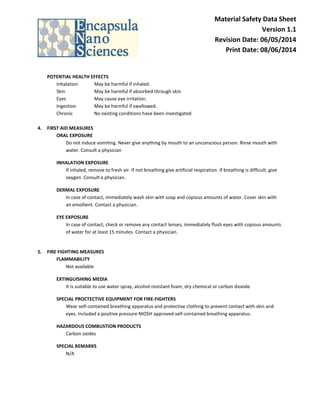
    Material Safety DataSheet Version 1.1 Revision Date: 06/05/2014 Print Date: 08/06/2014 POTENTIAL HEALTH EFFECTS Inhalation May be harmful if inhaled. Skin May be harmful if absorbed through skin Eyes May cause eye irritation. Ingestion May be harmful if swallowed. Chronic No existing conditions have been investigated 4. FIRST AID MEASURES ORAL EXPOSURE Do not induce vomiting. Never give anything by mouth to an unconscious person. Rinse mouth with water. Consult a physician INHALATION EXPOSURE If inhaled, remove to fresh air. If not breathing give artificial respiration. If breathing is difficult, give oxygen. Consult a physician. DERMAL EXPOSURE In case of contact, immediately wash skin with soap and copious amounts of water. Cover skin with an emollient. Contact a physician. EYE EXPOSURE In case of contact, check or remove any contact lenses; immediately flush eyes with copious amounts of water for at least 15 minutes. Contact a physician. 5. FIRE FIGHTING MEASURES FLAMMABILITY Not available EXTINGUISHING MEDIA It is suitable to use water spray, alcohol-resistant foam, dry chemical or carbon dioxide. SPECIAL PROCTECTIVE EQUIPMENT FOR FIRE-FIGHTERS Wear self-contained breathing apparatus and protective clothing to prevent contact with skin and eyes. Included a positive pressure NIOSH approved self-contained breathing apparatus. HAZARDOUS COMBUSTION PRODUCTS Carbon oxides SPECIAL REMARKS N/A
  • 3.
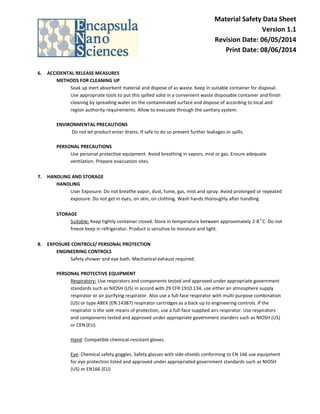
    Material Safety DataSheet Version 1.1 Revision Date: 06/05/2014 Print Date: 08/06/2014 6. ACCIDENTAL RELEASE MEASURES METHODS FOR CLEANING UP Soak up inert absorbent material and dispose of as waste. Keep in suitable container for disposal. Use appropriate tools to put this spilled solid in a convenient waste disposable container and finish cleaning by spreading water on the contaminated surface and dispose of according to local and region authority requirements. Allow to evacuate through the sanitary system. ENVIRONMENTAL PRECAUTIONS Do not let product enter drains. If safe to do so prevent further leakages or spills. PERSONAL PRECAUTIONS Use personal protective equipment. Avoid breathing in vapors, mist or gas. Ensure adequate ventilation. Prepare evacuation sites. 7. HANDLING AND STORAGE HANDLING User Exposure: Do not breathe vapor, dust, fume, gas, mist and spray. Avoid prolonged or repeated exposure. Do not get in eyes, on skin, on clothing. Wash hands thoroughly after handling. STORAGE Suitable: Keep tightly container closed. Store in temperature between approximately 2-8 o C. Do not freeze keep in refrigerator. Product is sensitive to moisture and light. 8. EXPOSURE CONTROLS/ PERSONAL PROTECTION ENGINEERING CONTROLS Safety shower and eye bath. Mechanical exhaust required. PERSONAL PROTECTIVE EQUIPMENT Respiratory: Use respirators and components tested and approved under appropriate government standards such as NIOSH (US) in accord with 29 CFR 1910.134, use either an atmosphere supply respirator or air purifying respirator. Also use a full-face respirator with multi-purpose combination (US) or type ABEK (EN 14387) respirator cartridges as a back up to engineering controls. If the respirator is the sole means of protection, use a full-face supplied airs respirator. Use respirators and components tested and approved under appropriate government standers such as NIOSH (US) or CEN (EU). Hand: Compatible chemical-resistant gloves. Eye: Chemical safety goggles. Safety glasses with side-shields conforming to EN 166 use equipment for eye protection listed and approved under appropriated government standards such as NIOSH (US) or EN166 (EU)
  • 4.
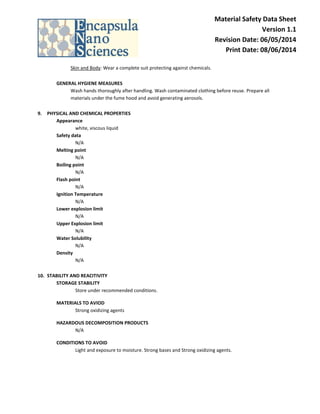
    Material Safety DataSheet Version 1.1 Revision Date: 06/05/2014 Print Date: 08/06/2014 Skin and Body: Wear a complete suit protecting against chemicals. GENERAL HYGIENE MEASURES Wash hands thoroughly after handling. Wash contaminated clothing before reuse. Prepare all materials under the fume hood and avoid generating aerosols. 9. PHYSICAL AND CHEMICAL PROPERTIES Appearance white, viscous liquid Safety data N/A Melting point N/A Boiling point N/A Flash point N/A Ignition Temperature N/A Lower explosion limit N/A Upper Explosion limit N/A Water Solubility N/A Density N/A 10. STABILITY AND REACITIVITY STORAGE STABILITY Store under recommended conditions. MATERIALS TO AVIOD Strong oxidizing agents HAZARDOUS DECOMPOSITION PRODUCTS N/A CONDITIONS TO AVOID Light and exposure to moisture. Strong bases and Strong oxidizing agents.
  • 5.
    Material Safety DataSheet Version 1.1 Revision Date: 06/05/2014 Print Date: 08/06/2014 11. TOXICOLOGICAL INFORMATION CARCINOGENICITY IARC: No component of this product present at levels greater than or equal to 0.1% is identified as probable, possible or confirmed human carcinogen by the IARC. OHSA: No component of this product present at levels greater than or equal to 0.1% is identified as probable, possible or confirmed human carcinogen by the OHSA. ACGIH: No component of this product present at levels greater than or equal to 0.1% is identified as probable, possible or confirmed human carcinogen by the ACGIH. EPA: No component of this product present at levels greater than or equal to 0.1% is identified as probable, possible or confirmed human carcinogen by the EPA. CHRONIC Not Available ACUTE TOXICITY 1,3-Butanediol: Oral LD50- mouse rat-698 mg/kg Symptoms: Sense organs and special senses (eye-lacrimation; muscle weakness; diarrhea) Dermal LD50- rabbit >20,000 mg/kg Glycerin: Oral LD50- mouse rat-698 mg/kg Symptoms: Sense organs and special senses (eye-lacrimation; muscle weakness; diarrhea) Dermal LD50- rabbit >20,000 mg/kg ADDITIONAL INFORMATION Prolonged or repeated exposure may result in Nausea, Headache, or Vomiting Kidney- irregularities-based on Human evidence ROUTE OF EXPOSURE Skin Contact: May cause skin irritation Skin Absorption: May be harmful if absorbed through the skin Eye Contact: May Cause eye irritation Inhalation: Materials may be irritating to mucous membranes and upper respiratory tract. Ingestion: May be harmful if swallowed SIGNS AND SYMPTOMS OF EXPOSURE Symptoms have not be thoroughly investigated
  • 6.
    Material Safety DataSheet Version 1.1 Revision Date: 06/05/2014 Print Date: 08/06/2014 12. ECOLOGICAL INFORMATION Elimination information (persistence and degradability) N/A Ecotoxicity effects N/A Further information on ecology N/A 13. DISPOSAL CONSIDERATIONS PRODUCT Observe all federal, state, and local environment regulations. Contact a licensed professional waste disposal service to remove this material. CONTAMINATED PACKAGING Observe all federal, state, and local environment regulations. 14. TRANSPROT INFORMATION DOT (US) Not dangerous goods IMDG Not dangerous goods IATA Not dangerous goods 15. REGULATORY INFORMATION OSHA HAZARDS OSHA: Hazardous by definition of Hazard Communication Standard (29 SFR 1910.1200). EINECS: this product is on the European Inventory of Existing Commercial Chemical Substances SARA 302 COMPONENTS SARA 302: No chemicals in this material are subject to the reporting requirements of SARA Title III, Section 302 SARA 313 COMPONENTS SARA 313: This material does not contain any chemical components with known CAS numbers that exceed threshold (De Minimis) reporting levels established be SARA Title III, Section 313 SARA 311/312 HAZARDS Acute health hazards, chronic health hazards, Fire hazard
  • 7.
    Material Safety DataSheet Version 1.1 Revision Date: 06/05/2014 Print Date: 08/06/2014 MASSACHUSETTS RIGHT TO KNOW COMPONENTS CAS-No. Revision Date Glycerol 56-81-5 2007-03-01 PENNSYVANIA RIGHT TO KNOW COMPONENTS CAS-No. Revision Date L-α-PHOSPHATIDYLCHOLINE, hydrogenated 97281-48-6 1989-08-11 Glycerol 56-81-5 2007-03-01 Butane-1,3-diol 107-88-0 Water 7732-18-5 NEW JERSEY RIGHT TO KNOW COMPONENTS CAS-No. Revision Date L-α-PHOSPHATIDYLCHOLINE, hydrogenated 97281-48-6 1989-08-11 Glycerol 56-81-5 2007-03-01 Butane-1,3-diol 107-88-0 Water 7732-18-5 CALIFORNIA PROP. 65 COMPONENTS CAS-No. Revision Date L-α-PHOSPHATIDYLCHOLINE, hydrogenated 97281-48-6 1989-08-11 Canada CAS# 7732185 is listed on Canada's DSL List TSCA CAS# 7732185 is listed on the TSCA Inventory 16. OTHER INFORMATION Copyright 2013 Encapsula NanoSciences LLC license granted to make unlimited paper copies for internal use only. The above information is believed to be correct but does not support to be all inclusive and shall be used only as a guide. The information in this document is based on the present state of our knowledge and is applicable to the product with regard to appropriate safety precautions. It does not represent any guarantee of the properties of the product. Encapsula NanoSciences LLC shall not be held liable for any damage resulting from handling or from contact with the above product.