18 Summer 2010 theInterpreter x www.iasa.org
feAture Story
A standard set of practices for complying
with the MAR has not been established yet,
but many of the new rules require or can
benefit from the type of analysis actuaries
already perform for insurance companies.
The purpose of the MAR, which went into
effect in most states for the accounting period
beginning January 1, 2010, is to facilitate
more effective surveillance by state insurance
departments of the financial condition
of insurers. The MAR accomplishes this
by requiring annual audited financial
statements, as well as reports on the
effectiveness of internal controls over the
financial reporting process.
As such, the MAR will expand the demand
for both financial statement auditing services
and internal control reporting, two functions
in which actuaries already assist insurance
companies and can provide complementary
or supplementary depth and perspective to
other audit professionals. Because of actuarial
expertise in advising and evaluating insurance
risks, actuaries are uniquely positioned to
evaluate MAR compliance while adhering
to the spirit of the MAR for independence
and disclosure.
financial Statements &
the reserving Process
The first main requirement of the MAR is an
annual audit of insurance company financial
statements. Insurance companies often
involve actuaries in the reserving process, as
loss reserves represent the most substantial
liability carried on the balance sheet of P&C
insurers, according to “The Application
of Fundamental Valuation Principles to
Property/Casualty Insurance Companies” by
Blackburn. Loss reserves are a provision for
insurers’ liability for claims, whether reported
or unreported, on coverage the company has
provided. Sound loss reserves are essential for
maintaining the healthy financial condition
of an insurance company. Although the
loss reserves represent management’s best
estimate, appropriate actuarial methods,
assumptions, and judgment weigh heavily in
deriving and supporting these estimates.
Actuarial involvement is integral in the
estimation of several financial statement items
for insurers including, for example, premium
deficiency reserves and asset valuation reserves
in addition to loss reserves.Actuaries must also
opine on the reasonability of these reserves in
the Statement of Actuarial Opinion (SAO).
A premium deficiency reserve should
be recognized when the unearned premium
reserve and any future installment premiums
on existing policies fall short of anticipated
losses, loss adjustment expenses, commissions
and other acquisition costs, and maintenance
costs of the policies. Future losses and
installment premiums are contingent cash
" ows that depend on many interrelated
factors and are often material in magnitude.
Actuaries are able to better assess these cash
" ows and develop the premium deficiency
reserve, as well as to ensure the reported
numbers are accurate and vetted.
Likewise, the asset valuation reserve is
intended to offset potential credit-related
investment losses on certain invested assets.
Credit-related investment losses can be
estimated with credit models that relate credit
loss to performance, collateral characteristics,
and economic factors like unemployment,
gross domestic product, and interest rates.
Independence in the SAo
Most P&C insurers are already required to
submit a SAO to the regulator each year. The
SAO is not part of the audited financials under
the new MAR per se, but it is supporting
material in the audit process and under the
MAR this requirement can technically be met
by the auditing firm.
Several key drivers of the recent
financial crisis were also prevalent
in the tumult leading to the creation
of the Sarbanes-Oxley Act (SOX)
eight years ago, including a lack
of corporate transparency and a
rash of high profile bankruptcies.
This year many SOX-like public
disclosure rules will take effect
for non-publicly traded insurance
companies. The National Association of Insurance Commissioners (NAIC)
is strengthening its standards for financial solvency and internal controls
through its revised Annual Financial Reporting Model Regulation, more
commonly known as the Model Audit Rule (MAR).
An Expanded Role for Actuaries in the
New Model Audit Rule
By KyLE MROTEK AND SHAuN CuLLINANE
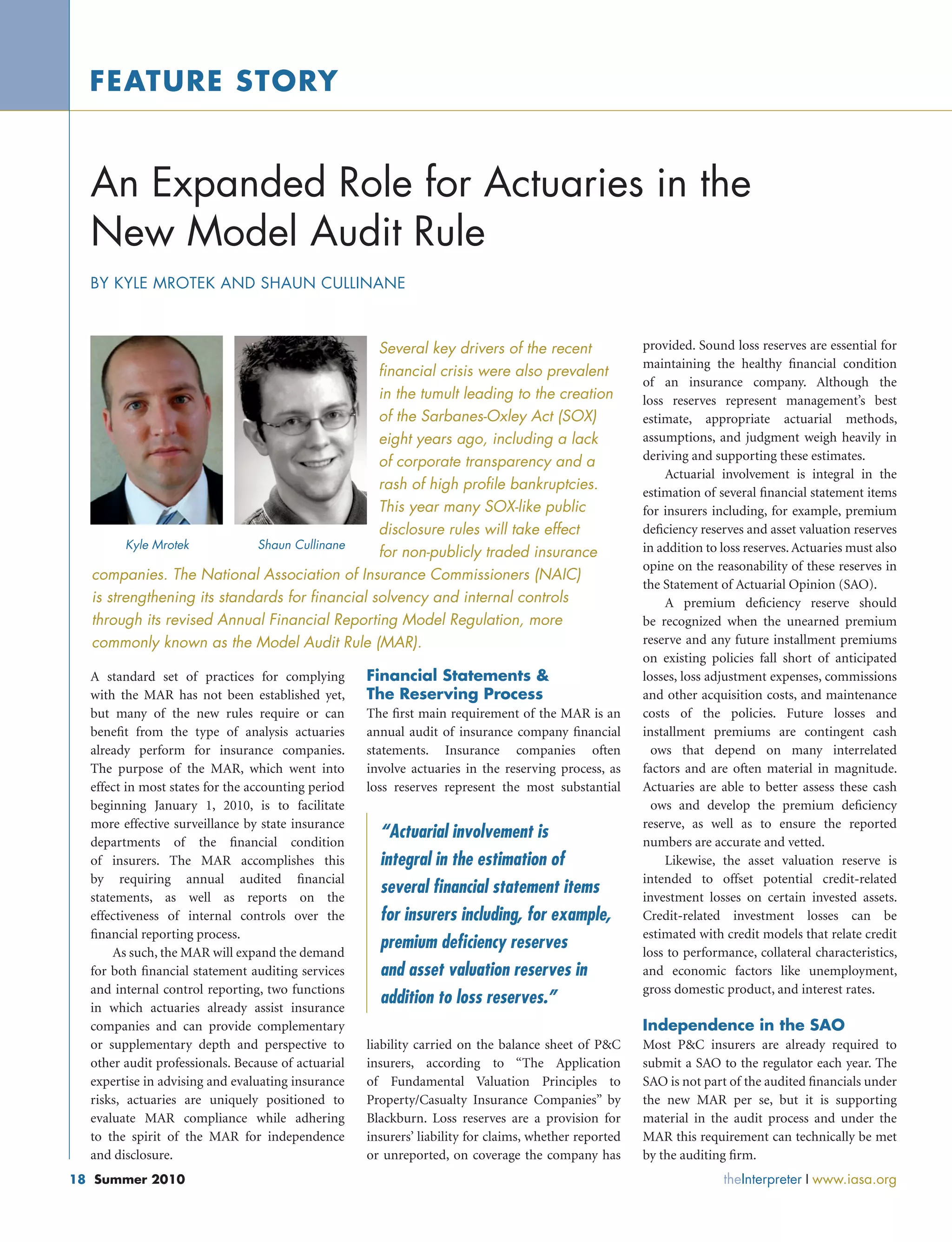
Kyle Mrotek Shaun Cullinane
“Actuarial involvement is
integral in the estimation of
several financial statement items
for insurers including, for example,
premium deficiency reserves
and asset valuation reserves in
addition to loss reserves.”
theInterpreter x www.iasa.org Summer 2010 19
However, firms interested in maintaining
real and perceived independence of the opinion
will carefully consider this decision. The SAO
is a formal attestation, made by a qualified
actuary, that the booked reserves represent
a reasonable provision for the unpaid claim
liabilities of the company. Because the purpose
of the MAR (as well as SOX) was to split the
consulting and audit functions, companies
should consider having an external actuary
provide the SAO in the spirit of independence
and of forging new best-practices.
Internal Controls: focus on
Data, Process, & reporting
An insurance company’s financial statements
can only be as good as the rigor of its
internal process for producing and verifying
the components of these statements. The
second main requirement of the MAR is an
evaluation of these internal controls to ensure
that controls exist and function properly.
Evaluators can ask whether the company uses
all available and relevant data in the reserving
process, whether the models are applied
correctly, whether the process has been peer
reviewed, and so forth.
Under the new rules, management
must assert whether its internal control
over financial reporting effectively provides
“reasonable assurance regarding the reliability
of financial statements.” This assertion requires
a diligent effort from management to evaluate
the effectiveness of its internal control systems.
One of the most essential internal controls
for an insurance company is validation of
the models and processes that feed into the
financial reporting function. In particular,
validation of the reserving process is essential
given the significance of reserves to an
insurance company’s financial position. Sound
model validation procedures should re" ect
validation of three key aspects: Data validation,
Process validation and Reporting validation.
Data Validation
Data validation considers the reasonableness
of model assumptions, including model
inputs as well as parameters that require
some judgment in estimation. For example,
two common approaches to estimating
future losses are to use data on paid losses
alone, or to use data on paid losses plus loss
adjustment expenses; the appropriate choice
depends on the context. If a company uses a
method with paid losses alone, an evaluator
who is unfamiliar with the nuances of the
two methods might simply check that the
company actually applies all the paid loss data
to the model, whereas an actuary can advise
the company on when to include the loss
adjustment expenses based on the company’s
modeling needs.
Companies must also ensure that the
inputs are from a reliable source and re" ect
the appropriate segmentation of business, loss
limitation, and other policy terms. Whenever
possible, the data used in the actuarial analysis
should be verified against the company’s
financial statements or statutory annual
statement. In fact, an actuary signing an SAO
is required to reconcile the data with Schedule
P of the statutory annual statement.
Process Validation
Process validation involves checking the
accuracy and proper application of the
mathematics, computer code, and theory
underlying a model. Many different types of
analysts, including actuaries, could conduct a
technical review of a company’s processes to
ensure that any formulas and code function
correctly and perform the intended tasks.
However, companies must also examine the
theory behind a model to assess its suitability
for the particular risk exposure, current
industry environment, and available data;
actuaries have specialized expertise in this
realm. For example, if a computer model uses
two different methods to estimate a given
value,actuaries have the specialized knowledge
to assess whether those two methods are even
relevant for the given context, or whether a
third and fourth method should supplement
or replace the existing methods.
If a given insurer provides several distinct
coverages, the reserving process must take into
account the nuances of each one. For example,
it is common for medical malpractice insurers
to provide death, disability and retirement
(DD&R) coverage as a component of their
claims-made policies. While claims-made
coverage only insures claims filed during the
policy term, DD&R will protect a qualifying
policyholder against claims filed after his or
her medical practice has ended due to death,
disability, or retirement. It is appropriate to
consider different approaches to estimating
the unpaid claim liabilities in each case.
Historical insurance data can be projected
forward to determine the claims-made
reserves, but DD&R reserves must take into
account the age distribution of policyholders,
their mortality and retirement rates, policy
retention rates, and other demographic
information.
reporting Validation
Proper reporting validation involves checking
that results fall within a range of plausible
values and are useful to the end user.
This process requires both expertise and
experience and is best performed by someone
familiar with the way the models work from
start to finish. Scanning the model outputs
for unexpected or unlikely values could help
a company identify problems missed during
a technical review of each model component.
Back-testing can also help a company monitor
the accuracy of previous assumptions and
results. In the course of this process, a
company may identify aspects of the model
that would benefit from future improvements.
Conclusion
The implementation of the MAR in 2010 will
provide a valuable opportunity for insurers
to assess the effectiveness of their internal
controls and the accuracy of their financial
reporting. Insurers must promptly develop a
strategy for compliance with the MAR if they
have not done so already. A set of corporate
norms for complying with the new MAR
has yet to develop, but actuaries have the
knowledge and skills to assist in many aspects
of the process and can help determine the set
of best practices moving forward.
Kyle Mrotek and Shaun Cullinane are
consultants for Milliman. They can be reached
via email at kyle.mrotek@milliman.com and
shaun.cullinane@milliman.com respectively.
“A set of corporate norms for
complying with the new MAR has
yet to develop, but actuaries have
the knowledge and skills to assist
in many aspects of the process and
can help determine the set of best
practices moving forward.”

Mrotek Cullinane Feature Article Iasa Interpreter Summer 2010

  • 1.
    18 Summer 2010theInterpreter x www.iasa.org feAture Story A standard set of practices for complying with the MAR has not been established yet, but many of the new rules require or can benefit from the type of analysis actuaries already perform for insurance companies. The purpose of the MAR, which went into effect in most states for the accounting period beginning January 1, 2010, is to facilitate more effective surveillance by state insurance departments of the financial condition of insurers. The MAR accomplishes this by requiring annual audited financial statements, as well as reports on the effectiveness of internal controls over the financial reporting process. As such, the MAR will expand the demand for both financial statement auditing services and internal control reporting, two functions in which actuaries already assist insurance companies and can provide complementary or supplementary depth and perspective to other audit professionals. Because of actuarial expertise in advising and evaluating insurance risks, actuaries are uniquely positioned to evaluate MAR compliance while adhering to the spirit of the MAR for independence and disclosure. financial Statements & the reserving Process The first main requirement of the MAR is an annual audit of insurance company financial statements. Insurance companies often involve actuaries in the reserving process, as loss reserves represent the most substantial liability carried on the balance sheet of P&C insurers, according to “The Application of Fundamental Valuation Principles to Property/Casualty Insurance Companies” by Blackburn. Loss reserves are a provision for insurers’ liability for claims, whether reported or unreported, on coverage the company has provided. Sound loss reserves are essential for maintaining the healthy financial condition of an insurance company. Although the loss reserves represent management’s best estimate, appropriate actuarial methods, assumptions, and judgment weigh heavily in deriving and supporting these estimates. Actuarial involvement is integral in the estimation of several financial statement items for insurers including, for example, premium deficiency reserves and asset valuation reserves in addition to loss reserves.Actuaries must also opine on the reasonability of these reserves in the Statement of Actuarial Opinion (SAO). A premium deficiency reserve should be recognized when the unearned premium reserve and any future installment premiums on existing policies fall short of anticipated losses, loss adjustment expenses, commissions and other acquisition costs, and maintenance costs of the policies. Future losses and installment premiums are contingent cash " ows that depend on many interrelated factors and are often material in magnitude. Actuaries are able to better assess these cash " ows and develop the premium deficiency reserve, as well as to ensure the reported numbers are accurate and vetted. Likewise, the asset valuation reserve is intended to offset potential credit-related investment losses on certain invested assets. Credit-related investment losses can be estimated with credit models that relate credit loss to performance, collateral characteristics, and economic factors like unemployment, gross domestic product, and interest rates. Independence in the SAo Most P&C insurers are already required to submit a SAO to the regulator each year. The SAO is not part of the audited financials under the new MAR per se, but it is supporting material in the audit process and under the MAR this requirement can technically be met by the auditing firm. Several key drivers of the recent financial crisis were also prevalent in the tumult leading to the creation of the Sarbanes-Oxley Act (SOX) eight years ago, including a lack of corporate transparency and a rash of high profile bankruptcies. This year many SOX-like public disclosure rules will take effect for non-publicly traded insurance companies. The National Association of Insurance Commissioners (NAIC) is strengthening its standards for financial solvency and internal controls through its revised Annual Financial Reporting Model Regulation, more commonly known as the Model Audit Rule (MAR). An Expanded Role for Actuaries in the New Model Audit Rule By KyLE MROTEK AND SHAuN CuLLINANE Kyle Mrotek Shaun Cullinane “Actuarial involvement is integral in the estimation of several financial statement items for insurers including, for example, premium deficiency reserves and asset valuation reserves in addition to loss reserves.”
  • 2.
    theInterpreter x www.iasa.orgSummer 2010 19 However, firms interested in maintaining real and perceived independence of the opinion will carefully consider this decision. The SAO is a formal attestation, made by a qualified actuary, that the booked reserves represent a reasonable provision for the unpaid claim liabilities of the company. Because the purpose of the MAR (as well as SOX) was to split the consulting and audit functions, companies should consider having an external actuary provide the SAO in the spirit of independence and of forging new best-practices. Internal Controls: focus on Data, Process, & reporting An insurance company’s financial statements can only be as good as the rigor of its internal process for producing and verifying the components of these statements. The second main requirement of the MAR is an evaluation of these internal controls to ensure that controls exist and function properly. Evaluators can ask whether the company uses all available and relevant data in the reserving process, whether the models are applied correctly, whether the process has been peer reviewed, and so forth. Under the new rules, management must assert whether its internal control over financial reporting effectively provides “reasonable assurance regarding the reliability of financial statements.” This assertion requires a diligent effort from management to evaluate the effectiveness of its internal control systems. One of the most essential internal controls for an insurance company is validation of the models and processes that feed into the financial reporting function. In particular, validation of the reserving process is essential given the significance of reserves to an insurance company’s financial position. Sound model validation procedures should re" ect validation of three key aspects: Data validation, Process validation and Reporting validation. Data Validation Data validation considers the reasonableness of model assumptions, including model inputs as well as parameters that require some judgment in estimation. For example, two common approaches to estimating future losses are to use data on paid losses alone, or to use data on paid losses plus loss adjustment expenses; the appropriate choice depends on the context. If a company uses a method with paid losses alone, an evaluator who is unfamiliar with the nuances of the two methods might simply check that the company actually applies all the paid loss data to the model, whereas an actuary can advise the company on when to include the loss adjustment expenses based on the company’s modeling needs. Companies must also ensure that the inputs are from a reliable source and re" ect the appropriate segmentation of business, loss limitation, and other policy terms. Whenever possible, the data used in the actuarial analysis should be verified against the company’s financial statements or statutory annual statement. In fact, an actuary signing an SAO is required to reconcile the data with Schedule P of the statutory annual statement. Process Validation Process validation involves checking the accuracy and proper application of the mathematics, computer code, and theory underlying a model. Many different types of analysts, including actuaries, could conduct a technical review of a company’s processes to ensure that any formulas and code function correctly and perform the intended tasks. However, companies must also examine the theory behind a model to assess its suitability for the particular risk exposure, current industry environment, and available data; actuaries have specialized expertise in this realm. For example, if a computer model uses two different methods to estimate a given value,actuaries have the specialized knowledge to assess whether those two methods are even relevant for the given context, or whether a third and fourth method should supplement or replace the existing methods. If a given insurer provides several distinct coverages, the reserving process must take into account the nuances of each one. For example, it is common for medical malpractice insurers to provide death, disability and retirement (DD&R) coverage as a component of their claims-made policies. While claims-made coverage only insures claims filed during the policy term, DD&R will protect a qualifying policyholder against claims filed after his or her medical practice has ended due to death, disability, or retirement. It is appropriate to consider different approaches to estimating the unpaid claim liabilities in each case. Historical insurance data can be projected forward to determine the claims-made reserves, but DD&R reserves must take into account the age distribution of policyholders, their mortality and retirement rates, policy retention rates, and other demographic information. reporting Validation Proper reporting validation involves checking that results fall within a range of plausible values and are useful to the end user. This process requires both expertise and experience and is best performed by someone familiar with the way the models work from start to finish. Scanning the model outputs for unexpected or unlikely values could help a company identify problems missed during a technical review of each model component. Back-testing can also help a company monitor the accuracy of previous assumptions and results. In the course of this process, a company may identify aspects of the model that would benefit from future improvements. Conclusion The implementation of the MAR in 2010 will provide a valuable opportunity for insurers to assess the effectiveness of their internal controls and the accuracy of their financial reporting. Insurers must promptly develop a strategy for compliance with the MAR if they have not done so already. A set of corporate norms for complying with the new MAR has yet to develop, but actuaries have the knowledge and skills to assist in many aspects of the process and can help determine the set of best practices moving forward. Kyle Mrotek and Shaun Cullinane are consultants for Milliman. They can be reached via email at kyle.mrotek@milliman.com and shaun.cullinane@milliman.com respectively. “A set of corporate norms for complying with the new MAR has yet to develop, but actuaries have the knowledge and skills to assist in many aspects of the process and can help determine the set of best practices moving forward.”