MPR Suzuki - Project
Bachelors of business admin (Maharaja Surajmal Institute of Technology)
Scan to open on Studocu
Studocu is not sponsored or endorsed by any college or university
MPR Suzuki - Project
Bachelors of business admin (Maharaja Surajmal Institute of Technology)
Scan to open on Studocu
Studocu is not sponsored or endorsed by any college or university
Downloaded by Manju Bv (manjubv0431@gmail.com)
lOMoARcPSD|44080849
MAJOR PROJECT REPORT
ON
“A study of customer preference towards
Suzuki motorcycle”
Submitted in partial fulfillment of the requirements
For the award of the degree of
BACHELOR OF BUSINESS ADMINISTRATION
to
Guru Gobind Singh Indraprastha University, Delhi
Under the Guidance of: Submitted by:
Dr. Punam Ahlawat Himanshu Chaudhary
Asst. Professor BBA-VI Sem
Enrollment No. 35714901715
Session 2015-18
DEPARTMENT OF BUSINESS ADMINISTRATION
MAHARAJA SURAJMAL INSTITUTE
RECOGNISED BY UGC u/s 2(F)
AFFILATED TO GURU GOBIND SINGH INDRAPRASTHA UNIVERSITY C-
4, JANAK PURI
Downloaded by Manju Bv (manjubv0431@gmail.com)
lOMoARcPSD|44080849
To Whom It May Concern
I Himanshu Chaudhary, Enrolment No. 35714901715 from BBA-VI Sem, of the
Maharaja Surajmal Institute, Delhi hereby declare that the major report entitle “a
study of customer satisfaction towards Suzuki motor cycle” is an original work based
on secondary data and the same has not been submitted to any other Institute for the
award of any other degree.
Signature of the Student
ii
Downloaded by Manju Bv (manjubv0431@gmail.com)
lOMoARcPSD|44080849
CERTIFICATE
Certified that the project report has been submitted in partial fulfillment of Bachelor
of Business Administration (BBA) to be awarded by G.G.S.I.P. University, Delhi by
Himanshu Chaudhary Enrollment No. 35714901715 has been completed under my
guidance and is Satisfactory.
Signature of the Guide
Dr.Punam Ahlawat
iii
Downloaded by Manju Bv (manjubv0431@gmail.com)
lOMoARcPSD|44080849
ACKNOWLEDGEMENT
It is my profound privilege and pleasure to express the over whelming sense of
gratitude, devotion and regards to my project guide Dr. Punam Ahlawat, (Faculty
Guide), for her valuable suggestions, timely guidance and words of encouragement
during the project work. Without her co-operation this project would not have been in
the form, as it is today.
Also I am very grateful to my entire faculty guide for her kind support & guidance for
the accomplishment of this project work.
Himanshu Chaudhary
Course-BBA(Genral)
iv
Downloaded by Manju Bv (manjubv0431@gmail.com)
lOMoARcPSD|44080849
EXECUTIVE SUMMARY
In today’s competitive world the practical study forms an important part in each and
every professional course. The BBA is a course in which the theoretical knowledge is
backed by the practical study. That study is in the form of project. The Major Project
is one of the important parts of the curriculum. And each and every student has to
work for the project.
The Major project enables the students to know more about the application of
theoretical knowledge. The current situation of the market is made known to the
students when they undertake the project. The project gives better insides into the
application part of the theory. The companies in an industry and their operations can
be better known by the students when they analyze the data.
This project is on the survey on customer satisfaction level of Suzuki Access 125,
Services of Suzuki dealer. We have analyzed the industry very deeply and carefully
project.
Satisfaction is a person’s feeling of pleasure or disappointment resulting from a
comparing perceived performance in relation to his or her expectation. If the
performance falls short of expectation, the consumer is dissatisfied. If the
performance matches the expectations, he consumer is satisfied. If the performance
exceeds expectation, the customer is highly satisfied or delighted.
The study widely concentrates on the level of satisfaction amongst customers for
which I did Exploratory Research to check the satisfaction level amongst the
customers of Suzuki Access 125. This research was conducted in the Delhi city. This
research was done during the months of October and November. Hence the data
displayed has been collected during the before mentioned period.
To meet the research objectives, following activities have been performed.
 An extensive search of relevant literature from news articles, internet, books.
This step guided the development of the methods and instruments for
collecting data.
v
Downloaded by Manju Bv (manjubv0431@gmail.com)
lOMoARcPSD|44080849
 Designing the questionnaire.
 Survey has been carried away by, one-on-one interviews. The Survey
included open-ended questions, dichotomous questions, and multiple-
choice question.
 To know the image of product in the mind of consumer.
 To compare the level of satisfaction before purchasing and after purchasing
the Scooter.
 To find out where people want to see the promotion schemes
 To find out suitable location preferred by consumer
 To know the most popular media for advertisement
 To check the loyalty of the consumer towards the Suzuki brand
 To know the most motivating factor for purchasing the bike
 To know the preferable price from the customer
 During this research it was found that Suzuki’s launched Access 125 has
increased its market share by attracting new customers and helped to retain its
old customers.
SMPIL, a company that is known for combining technology, quality and performance
in their two wheeler, had taken an initiative to introduce some of their performance
driven two wheeler in India this year. Suzuki has reported a growth of 47.66% in
sales in the month of December ‘13 at 14806 units compared to 9986 units same
month last year. This increase of sales is attributed to the tremendous response from
the new product GS150R and ACCESS 125.
Suzuki would have to constantly innovate and come up with new products to
maintain its dominance in the segment.
vi
Downloaded by Manju Bv (manjubv0431@gmail.com)
lOMoARcPSD|44080849
TABLE OF CONTENTS
Certificate
Acknowledgement
Executive Summary
CHAPTER -I: PLAN OF THE STUDY
1.1 Introduction of the topic
1.2 Objective of the study
1.3 Literature review And/or Theoretical Background.
CHAPTER-II: COMPANY PROFILE / INDUSTRY PROFILE OR DETAILS
CHAPTER-III: RESEARCH METHODOLOGY
3.1 Universe & Sources of data
3.2 Sample size, if any with proper justification
3.3 Methods of data collection--- testing of questionnaire
CHAPTER-IV: DATAANALYSIS & INTERPRETATION
CHAPTER-V: FINDINGS & CONCLUSIONS
CHAPTER-VI: SUGGESTION/ RECOMMENDATION
BIBLIOGRAPHY, GLOSSARY
LIST OF ANNEXURE
Questionnaire
vii
Downloaded by Manju Bv (manjubv0431@gmail.com)
lOMoARcPSD|44080849
LIST OF TABLES
Table No Title Page No
1.1 Domestic Market Share for 2016-17
1.2 Growth of two-wheeler
1.3 Emission Norms
1.4 Suzuki Motorcycle-Summary
1.5 Suzuki Motorcycle-Models
1.6 Porter’s Five Forces Model of Automobile Industry
2.1 Smpil Growth Report in ‘2014-‘2015
2.2 Suzuki Access 125 Technical Specifications
2.3 The engine uses engine balancer technology Suzuki
2.4 Vehicle Summary
2.5 Suzuki expects only a sale of around 150 units
4.1 Age-Wise Classification
4.2 Gender-Wise Classification
4.3 Marital Status Classification
4.4 Occupation-Wise Classification
4.5 Income-Wise Classification
4.6 Suzuki Automobile’s Product
4.7 Know About Suzuki
4.8 Customer of Suzuki Motorcycles
4.9 Brand according competition to Smpil in India
4.10 Price of Suzuki access 125
4.11 Suzuki access 125
4.12 Suzuki access 125 is capable to attract today’s
generations
4.13 The best Suzuki access 125
4.14 The purpose of purchasing
4.15 Satisfied with free service from the showroom
4.16 Suzuki access 125 comfortable for driving & journey
4.17 Maintenance cost of Suzuki access 125
4.18 The value of money you spent on Suzuki access 125
4.19 Satisfaction towards Suzuki access 125
LIST OF FIGURES
Figure No Title Page No
1.1 Trend in 2W Volumes by Category
1.2 Trend in 2W Sales Volumes, Domestic and Exports
1.3 Segment Wise Market Share in 2014-14
1.4 Classification of the bike according to the
displacement & start
viii
Downloaded by Manju Bv (manjubv0431@gmail.com)
lOMoARcPSD|44080849
1.5 Porter’s five forces model of automobile industry
2.1 Growth
2.2 Service procedure
4.1 Age-Wise Classification
4.2 Gender-Wise Classification
4.3 Marital Status Classification
4.4 Occupation-Wise Classification
4.5 Income-Wise Classification
4.6 Suzuki Automobile’s Product
4.7 Know About Suzuki
4.8 Customer of Suzuki Motorcycles
4.9 Brand according competition to Smpil in India
4.10 Price of Suzuki access 125
4.11 Suzuki access 125
4.12 Suzuki access 125 is capable to attract today’s
generations
4.13 The best Suzuki access 125
4.14 The purpose of purchasing
4.15 Satisfied with free service from the showroom
4.16 Suzuki access 125 comfortable for driving & journey
4.17 Maintenance cost of Suzuki access 125
4.18 The value of money you spent on Suzuki access 125
4.19 Satisfaction towards Suzuki access 125
ix
Downloaded by Manju Bv (manjubv0431@gmail.com)
lOMoARcPSD|44080849
LISTABLE OF SYMBOLS
LISTABLE OF ABBREVIATIONS
S No Abbreviated Name Full Name
1. CRM Customer Relationship Management
2. MKT Marketing Strategy
3. CS Customer Satisfaction
4. IPO Initial public offering
5. AMEX American Stock and Options Exchange
6. B-B IPO Buyout-backed IPO
7. REIT Real estate investment trust
8. MSE Bombay Stock Exchange
9. EPS Earning Per Share
10. IP Industry profile
11. OBS Objective of the study
12. RM Research methodology
13. DAI Data Analysis & Interpretation
14. FA Financial Analysis
x
S No Symbol Nomenclature & Meaning
1  Sigma (Summation)
2 @ At the rate
3 % Percentage
Downloaded by Manju Bv (manjubv0431@gmail.com)
lOMoARcPSD|44080849
CHAPTER -I
PLAN OF THE STUDY
1
Downloaded by Manju Bv (manjubv0431@gmail.com)
lOMoARcPSD|44080849
The History of the automobile actually began about 4,000 years ago when the first
wheel was used for transportation in India. Several Italians recorded designs for wind-
driven vehicles. The first was Guido da Vigevano in 1335. It was a windmill-type
drive to gears and thus to wheels. Vaturio designed a similar vehicle that was also
never built. Later Leonardo da Vinci designed clockwork-driven tricycle with tiller
steering and a differential mechanism between the rear wheels.
In the early 15th
century, the Portuguese arrived in China and the interaction of two
cultures led to a variety of new technologies, including the creation of a wheel that
turned under its own power. By the 1600s, small steam-powered engine models were
developed, but it was another century before a full-sized engine-powered vehicle was
created.
A Catholic priest named Father Ferdinan Verbiest is credited to have built a steam-
powered vehicle for the Chinese Emperor Chien Lung in about 1678. There is no
information about the vehicle, only the event. Since James Watt didn’t invent the
steam engine until 1705, we can guess that this was possibly a model vehicle powered
by a mechanism like Hero’s steam engine-a-spinning wheel with jets on the periphery.
Although by the mid-15th
century the idea of a self-propelled vehicle had been put into
practice with the development of experimental vehicles powered by means of springs,
clockworks, and the wind,
Nicolas-Joseph Cugnot of France is considered to have built the first true automobile
in 1769. Designed by Cugnot and constructed by M.Brezin, it is also the first vehicle
to move under its own power for which there is a record. Cugnot’s three-wheeled
steam-powered vehicle carried four persons and was meant to move artillery pieces. It
had a top speed of a little more than 3.2 km/h (2 mph) and had to stop every 20
minutes to build up a fresh steam.
Evans was the first American who obtained a patent for “a self-propelled carriage.”
He, in fact, attempted to create a two-in-one combination of a steam wagon and a flat-
bottomed boat, which didn’t receive any attention in those days. During the 1830’s,
the steam vehicle had made great advances. But stiff competition from railway
companies and crude legislations in Britain forced the poor steam vehicle gradually
out of use on roads.
2
Downloaded by Manju Bv (manjubv0431@gmail.com)
lOMoARcPSD|44080849
Carl Benz and Gottlieb Daimler, both Germans, share the credit of changing the
transport habits of the world, for their efforts laid the foundation of the great motor
industry, as we know it today. First, Carl Benz invented the petrol engine in 1885 and
a year later Daimler made a car driven by motor of his own design and the rest is
history.
Daimler’s engine proved to be a great success mainly because of its less weight that
could deliver 1000rpm and needed only very small and light vehicles to carry them.
France too had joined the motoring scenario by 1890 when two Frenchmen Panhard
and Levassor began producing vehicles powered by Daimler engine, and Daimler
himself, possessed by the automobile spirit, went on adding new features to his
engine. He built the first V-Twin engine with a glowing platinum tube to explode the
cylinder gas-the very earliest form of sparking plug.
Charles Duryea built a motor carriage in America with petrol engine in 1892,
followed by Elwood Haynes in 1894, thus paving the way for motorcars in that
country.
For many years after the introduction of automobiles, three kinds of power sources
were in common use: steam engines, gasoline or petrol engines, and electric motors.
In 1900, over 2,300 automobiles were registered in New York, Boston, Massachusetts,
and Chicago. Of these, 1,170 were steam cars, 800 were electric cars, and only 400
were gasoline cars.
In ten years from the invention of the petrol engine, the motorcar had evolved itself
into amazing designs and shapes. By 1898, there were 50 automobile-manufacturing
companies in the United States, a number that rose to 241 by 1908. In that year, Henry
Ford revolutionized the manufacture of automobiles with his assembly-line style of
production and brought out the Model T, a car that was inexpensive, versatile, and
easy to maintain.
Herbert Austin and William Morris, two different carmakers, introduced mass
production methods of assembly in the UK, thus paving the way for a revolution in
the automobile industry. Austin Seven was the world’s first practical four-seater ‘baby
car’ which brought the pleasures of motoring to many thousands of people who could
3
Downloaded by Manju Bv (manjubv0431@gmail.com)
lOMoARcPSD|44080849
not buy a larger, more expensive car. Even the ‘bull-nose’ Morris with front mounted
engine became the well-loved model and one of the most popular cars in the 1920s.
Automobile manufacturers in the 1930s and 1940s refined and improved on the
principles of Ford and other pioneers. Cars were generally large, and many were still
extremely expensive and luxurious; many of the most collectible cars date from this
time. The increased affluence of the United States after World War II led to the
development of large, petrol-consuming vehicles, while most companies in Europe
made smaller, more fuel-efficient cars.
1.1 Introduction of the topic
India is the second largest manufacturer and producer of two-wheelers in the world. It
stands next only to Japan and China in terms of the number of two-wheelers produced
and domestic sales respectively. The Indian two-wheeler industry made a small
beginning in the early 50s when Automobile Products of India (API) started
manufacturing scooters in the country. Until 1958, API and Enfield were the sole
producers.
In 1948, Bajaj Auto began trading in imported Vespa scooters and three-wheelers.
Finally, in 1960, it set up a shop to manufacture them in technical collaboration with
Piaggio of Italy. The agreement expired in 1971. In the initial stages, API dominated
the scooter segment; Bajaj Auto later overtook it. Although various government and
private enterprises entered the fray for scooters, the only new player that has lasted till
today is LML.
Under the regulated regime, foreign companies were not allowed to operate in India.
It was a complete seller market with the waiting period for getting a scooter from
Bajaj Auto being as high as 12 years. The motorcycles segment was no different, with
only three manufacturers viz Enfield, Ideal Jawa and Escorts. While Enfield bullet
was a four-stroke bike, Jawa and the Rajdoot were two-stroke bikes. Enfield 350cc
bikes and Escorts 175cc bike initially dominated the motorcycle segment.
The two-wheeler market was opened to foreign competition in the mid-80s. And then
market leaders - Escorts and Enfield - were caught unaware by the onslaught of the
100cc bikes of the four Indo-Japanese joint ventures. With the availability of fuel-
4
Downloaded by Manju Bv (manjubv0431@gmail.com)
lOMoARcPSD|44080849
efficient low power bikes, demand swelled, resulting in Hero Honda - then the only
producer of four stroke bikes (100cc category), gaining a top slot.
The first Japanese motorcycles were introduced in the early eighties. TVS Suzuki
and Hero Honda brought in the first two-stroke and four-stroke engine motorcycles
respectively. These two players initially started with assembly of CKD kits, and later
on progressed to indigenous manufacturing. In the 90s the major growth for
motorcycle segment was brought in by Japanese motorcycles, which grew at a rate of
nearly 25% CAGR in the last five years. The industry had a smooth ride in the 50s,
60s and 70s when the Government prohibited new entries and strictly controlled
capacity expansion. The industry saw a sudden growth in the 80s.
It was in the year 1954 that the Indian government ordered for total number of 800
motorcycles to man the Pakistani borders. In came the Bullets which were initially
launched in England as a 350cc bike and it was upgraded to 500cc a year or so later.
These bikes have remained unaltered, barring some cosmetic changes which have
undergone over the years. Thus one can say without much of a doubt that the 1955
Bullet was one of the initial hits of the Indian two-wheeler industry and till today it
continues to be a darling of the motorcycle enthusiasts. Enfield Bullet had a close
competition with another sturdy bike named Rajdoot; as the bike was strong enough
to handle the rough Indian roads. The company had roped in Indian Heman
Dharmendra for the promotion of the bike. With more than 1.6 million vehicles on the
road the Rajdoot motorcycle was one of the initial hits of the earlier years of two-
wheeler history in the country.
When heavy motorcycles were the order of the day, a relatively lighter bike had
caught on the imagination of the Indian two wheeler user. Ind- Suzuki bike launched
by the then TVS Suzuki group was an instant hit; however the bike could not sustain
it's initial success due to the high import content in the vehicle and less of
localization.
In scooters Bajaj Chetak has been hugely responsible for adding momentum to the
transport system of the country, till today it remains one of the most successful brands
to have come out of the Bajaj stable. The scooter is named after the horse of legendary
Rana Pratap Singh. These sets of two wheels have become a part of the Indian milieu
and are often considered a representative of the Indian middle class aspiration. Very
5
Downloaded by Manju Bv (manjubv0431@gmail.com)
lOMoARcPSD|44080849
few two-wheelers have been able to emulate the success, which Bajaj Chetak has
achieved over the years.
Similarly LML Motors enjoyed a reasonable success with the launch of LML Select
which came with new age technology and improved performance.
The industry witnessed a steady growth of 14% leading to a peak volume of 1.9mn
vehicles in 1990. The entry of Kinetic Honda in mid-eighties with
In 1990, the entire automobile industry saw a drastic fall in demand. This resulted
in a decline of 15% in 1991 and 8% in 1992, resulting in a production loss of 0.4mn
vehicles. Barring Hero Honda, all the major producers suffered from recession in
FY93 and FY94. Hero Honda showed a marginal decline in 1992. The reasons for
recession in the sector were the incessant rise in fuel prices, high input costs and
reduced purchasing power due to significant rise in general price level and credit
crunch in consumer financing. Factors like increased production in 1992, due to new
entrants coupled with the recession in the industry resulted in company either
reporting losses or a fall in profits.
India is one of the very few countries manufacturing three-wheelers in the world. It
is the world's largest manufacturer and seller of three-wheelers. Bajaj Auto
commands a monopoly in the domestic market with a market share of above 80%,
the rest is shared by Bajaj Tempo, Greaves Ltd and Scooters India. a variometric
scooter helped in providing ease of use to the scooter owners.
GROWTH PROSPECTS AND KEY DRIVERS OF INDIAN TWO WHEELER
INDUSTRY:
The growth witnessed by the Indian two wheeler industry indicates the growing
demand for low cost personal transportation solutions amongst the 300 million Indian
middle class consumers. Despite this spectacular growth rate, the two-wheeler
penetration (number of two wheelers per 1000 inhabitants) in India remains lower
than other Asian countries. This fact provides an opportunity for continued growth in
the market. India has the lowest Penetration of two wheelers as compared to countries
like Taiwan, Thailand, Malaysia, Vietnam, Indonesia and China. In the present
scenario, growth in the two wheelers Industry will be driven by several factors
6
Downloaded by Manju Bv (manjubv0431@gmail.com)
lOMoARcPSD|44080849
Rise in India’s Young Working Population:
With the rising levels of per capita income of people, the Indian two wheeler market
offers a huge potential for Growth. This growth is relevant in the light of the fact that
70 per cent of India’s population is below the age of 35 Years and 150 million people
will be added to the working Population in the next five years. The number of women
in the urban work force is also increasing; this will lead to the Growth of gearless
scooters.
Rise of India’s Rural Economy and Growth in Middle Income Households:
The growth prospects of the Indian rural economy offer a significant opportunity for
the motorcycle industry in India. The penetration of motorcycles amongst rural
households with income levels greater than US$ 2,200 per annum has already
increased to over 50 per cent. The current target Segment for two wheelers, i.e.,
households belonging to the Income category of US$ 2,200–12,000 is expected to
grow at a CAGR of 10 per cent.
Greater Affordability of Vehicles:
The growth in two-wheeler sales in India has been driven by an increase in
affordability of these vehicles. An analysis of the price trends indicates that prices
have more or less stagnated in the past. This has been part of the marketing strategy
adopted by the manufacturers to gain volume, as well as conscious efforts adopted to
bring down costs. The operating expenses of leading manufacturers have declined by
around 15 per cent in the last five years. With greater avenues of financing, the
customer’s capacity to own a two wheeler has improved.
Rapid Product Introduction and Shorter Product Life Cycle:
The last five years have witnessed a sharp increase in new product launches in the
two-wheeler industry. It is estimated that close to 50 new products have been
launched by manufacturers during this period, filling up all price points and targeted
at various consumer segments.
Inadequate Public Transport Systems in most Urban Areas:
7
Downloaded by Manju Bv (manjubv0431@gmail.com)
lOMoARcPSD|44080849
The economic boom witnessed in the country and the increased migration to urban
areas have increased the traffic congestion in Indian cities and worsened the existing
infrastructure bottlenecks. Inadequate urban planning has meant that transport systems
have not kept pace with the economic boom and the growing urban population. This
has increased the dependence on personal modes of transport and the two wheelers
market has benefited from this infrastructure gap.
FACTORS AFFECTING THE MARKET:
Post 1991, the Indian two-wheeler industry comprising of motorcycles, scooters and
scooterettes opened up tremendously. The Indian motorcycle industry has expanded at
a 24% CAGR over the last five years, It Captured almost 80% of the market primarily
at the cost of the scooter and Moped segment. The scooter segment though has
witnessed a revival with the launch of scooterettes aimed at young women and
adolescents.
The two-wheeler market can be segmented into three categories on the basis of price –
Entry segment (<35000), Executive segment (between 35000 and 45000) Deluxe
(between 45000 and 65000) and Premium segment (above 65000). Motorcycles are
now sold as a passion, experience rather than a product. New products are being
introduced at a rapid pace and brands are gaining prominence. Thus there is an
increased focus on the premium segment, which has an increased scope for
differentiation.
Purchasing Power is relatively high with buyers becoming more discriminating.
Reliability and economy have become more of a hygiene factor. Buyers now demand
two-wheelers that fit their personality thus increasing the scope for differentiation and
branding. Provision of financing through EMI’s has provided a means to satisfy the
need of possess a convenient and stylish mode of transport in the form of a two-
wheeler. This has resulted in higher growth in the 125-150cc segment.
With the introduction of Government policies such as reduction in excise duty from
16% to 12% and allowing for 100% FDI Barriers to entry has reduced. However, the
investment required for setting up large distribution channels and service stations can
be a major entry barrier. Another significant entry barrier is the brand building
required. Thus, initially foreign players set up Joint Ventures with indigenous
8
Downloaded by Manju Bv (manjubv0431@gmail.com)
lOMoARcPSD|44080849
companies. After establishing their brand they have launched their own line of
products. E.g. Honda with Hero Group and Yamaha with Escorts.
Rising Customer Expectations:
The growth witnessed by the Indian two wheeler industry has attracted a number of
new entrants to the market and it is expected that the Indian industry will become
more competitive in the future. The excess of products introduced in the past has also
raised customer expectations with respect to reliability, styling, performance and
economy.
Inflation is a big factor that may play a part in moving the loyalties and aspirations of
people away from the four to the much cheaper and economical two-wheeler segment.
Moreover, the constantly increasing prices of oil and increasing interest rates on
finance are not helping the cause either. Environmental Concerns are also quite big on
the agenda these days and do play a part in the preference of consumer’s choices. The
rising global temperatures along with daily snippets in the national and international
media about the thinning of ozone and imminent environmental disaster have all
contributed to the making of a present day environmentally conscious consumer.
Environmental and Safety Concerns:
The increasing demand for two wheelers will need to be managed to address issues
relating to overcrowding of roads. Another problem is the insufficient infrastructure
for inspection to ensure adherence to emission norms. As the industry grows, it is
important to regulate the sale of used two wheelers in a more organized manner for
which a mechanism needs to be evolved. Unregulated sale of two wheelers, especially
in the rural areas, are likely to create issues related to emissions and safety of
vehicles.
The History of the automobile actually began about 4,000 years ago when the first
wheel was used for transportation in India. Several Italians recorded designs for wind-
driven vehicles. The first was Guido da Vigevano in 1335. It was a windmill-type
drive to gears and thus to wheels. Vaturio designed a similar vehicle that was also
never built. Later Leonardo da Vinci designed clockwork-driven tricycle with tiller
steering and a differential mechanism between the rear wheels.
9
Downloaded by Manju Bv (manjubv0431@gmail.com)
lOMoARcPSD|44080849
In the early 15th
century, the Portuguese arrived in China and the interaction of two
cultures led to a variety of new technologies, including the creation of a wheel that
turned under its own power. By the 1600s, small steam-powered engine models were
developed, but it was another century before a full-sized engine-powered vehicle was
created.
A Catholic priest named Father Ferdinan Verbiest is credited to have built a steam-
powered vehicle for the Chinese Emperor Chien Lung in about 1678. There is no
information about the vehicle, only the event. Since James Watt didn’t invent the
steam engine until 1705, we can guess that this was possibly a model vehicle powered
by a mechanism like Hero’s steam engine-a-spinning wheel with jets on the periphery.
Although by the mid-15th
century the idea of a self-propelled vehicle had been put into
practice with the development of experimental vehicles powered by means of springs,
clockworks, and the wind,
Nicolas-Joseph Cugnot of France is considered to have built the first true automobile
in 1769. Designed by Cugnot and constructed by M.Brezin, it is also the first vehicle
to move under its own power for which there is a record. Cugnot’s three-wheeled
steam-powered vehicle carried four persons and was meant to move artillery pieces. It
had a top speed of a little more than 3.2 km/h (2 mph) and had to stop every 20
minutes to build up a fresh steam.
Evans was the first American who obtained a patent for “a self-propelled carriage.”
He, in fact, attempted to create a two-in-one combination of a steam wagon and a flat-
bottomed boat, which didn’t receive any attention in those days. During the 1830’s,
the steam vehicle had made great advances. But stiff competition from railway
companies and crude legislations in Britain forced the poor steam vehicle gradually
out of use on roads.
Carl Benz and Gottlieb Daimler, both Germans, share the credit of changing the
transport habits of the world, for their efforts laid the foundation of the great motor
industry, as we know it today. First, Carl Benz invented the petrol engine in 1885 and
a year later Daimler made a car driven by motor of his own design and the rest is
history.
10
Downloaded by Manju Bv (manjubv0431@gmail.com)
lOMoARcPSD|44080849
Daimler’s engine proved to be a great success mainly because of its less weight that
could deliver 1000rpm and needed only very small and light vehicles to carry them.
France too had joined the motoring scenario by 1890 when two Frenchmen Panhard
and Levassor began producing vehicles powered by Daimler engine, and Daimler
himself, possessed by the automobile spirit, went on adding new features to his
engine. He built the first V-Twin engine with a glowing platinum tube to explode the
cylinder gas-the very earliest form of sparking plug.
Charles Duryea built a motor carriage in America with petrol engine in 1892,
followed by Elwood Haynes in 1894, thus paving the way for motorcars in that
country.
For many years after the introduction of automobiles, three kinds of power sources
were in common use: steam engines, gasoline or petrol engines, and electric motors.
In 1900, over 2,300 automobiles were registered in New York, Boston, Massachusetts,
and Chicago. Of these, 1,170 were steam cars, 800 were electric cars, and only 400
were gasoline cars.
In ten years from the invention of the petrol engine, the motorcar had evolved itself
into amazing designs and shapes. By 1898, there were 50 automobile-manufacturing
companies in the United States, a number that rose to 241 by 1908. In that year, Henry
Ford revolutionized the manufacture of automobiles with his assembly-line style of
production and brought out the Model T, a car that was inexpensive, versatile, and
easy to maintain.
Herbert Austin and William Morris, two different carmakers, introduced mass
production methods of assembly in the UK, thus paving the way for a revolution in
the automobile industry. Austin Seven was the world’s first practical four-seater ‘baby
car’ which brought the pleasures of motoring to many thousands of people who could
not buy a larger, more expensive car. Even the ‘bull-nose’ Morris with front mounted
engine became the well-loved model and one of the most popular cars in the 1920s.
11
Downloaded by Manju Bv (manjubv0431@gmail.com)
lOMoARcPSD|44080849
SEGMENTATION OF TWO WHEELER:
A Two Wheeler Sector Sub-Segmenting in the three Segments.
 Motorcycle
 Scooter
 Mopeds
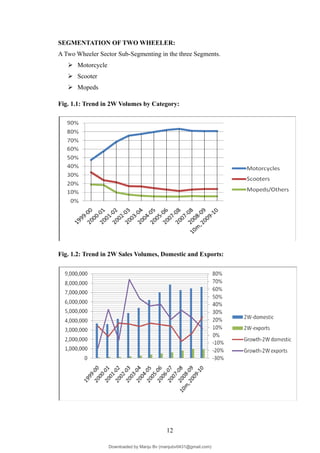
Fig. 1.1: Trend in 2W Volumes by Category:
Fig. 1.2: Trend in 2W Sales Volumes, Domestic and Exports:
12
Downloaded by Manju Bv (manjubv0431@gmail.com)
lOMoARcPSD|44080849
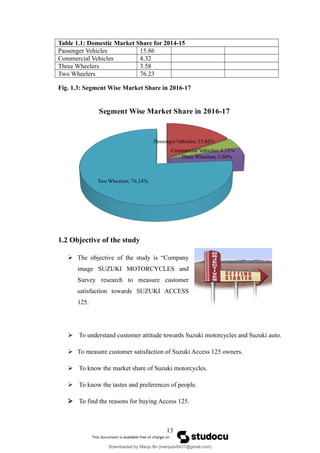
Table 1.1: Domestic Market Share for 2014-15
Passenger Vehicles 15.86
Commercial Vehicles 4.32
Three Wheelers 3.58
Two Wheelers 76.23
Fig. 1.3: Segment Wise Market Share in 2016-17
Passenger Vehicles; 15.86%
Commercial Vehicles; 4.32%
Three Wheelers; 3.58%
Two Wheelers; 76.24%
Segment Wise Market Share in 2016-17
1.2 Objective of the study
 The objective of the study is “Company
image SUZUKI MOTORCYCLES and
Survey research to measure customer
satisfaction towards SUZUKI ACCESS
125.
 To understand customer attitude towards Suzuki motorcycles and Suzuki auto.
 To measure customer satisfaction of Suzuki Access 125 owners.
 To know the market share of Suzuki motorcycles.
 To know the tastes and preferences of people.
 To find the reasons for buying Access 125.
13
Downloaded by Manju Bv (manjubv0431@gmail.com)
lOMoARcPSD|44080849
 To determine the customer’s satisfaction regarding two-wheeler and after sales
service.
SCOPE OF STUDY
This study is aimed at providing SUZUKI MOTORCYCLES INDIA PVT. LTD. with
an insight on the consumer satisfaction pattern of Suzuki Access 125cc as well as the
customer’s response and awareness towards the brand, products and services of
Suzuki.
The data has been analyzed and presented in a simple and precise way on the basis of
which pertinent recommendations have been made to the company to better the
services, policies and strategies of the company in India. Companies also want the
Suggestion for improvement from users of Suzuki Vehicle & get Feedback from
customer.
1.3 Literature review And/or Theoretical Background.
Motorcycles are the most expensive of all two-wheelers. They are more powerful than
scooters and mopeds, have the highest load carrying capacity (which is essential for
rural areas), are fuel-efficient, have better road grip, and are the most expensive.
Besides, motorcycles are viewed as “trendy” in the urban areas as compared with
scooters and mopeds.
Motorcycle production in India began in 1952, when Enfield India Limited
commenced manufacture at its plant in Tamil Nadu. It was the only motorcycle
producer in the country until the early 1960s when Ideal Jawa (India) Private Limited
and Escorts Limited entered the market. By 1970-71, production of motorcycles had
reached 39,000 units per annum.
The fortunes of the motorcycle industry changed after the announcement of the liberal
licensing policy in 1982 whereby foreign collaboration was allowed. In 1982, the
Government allowed foreign players to enter the industry through joint ventures.
Within four years, the TVS Group tied up with Suzuki, the Hero Group with Honda,
the Escorts Group with Yamaha, and Bajaj Auto Limited (Bajaj Auto) with Kawasaki.
TVS Suzuki introduced Ind-Suzuki in 1984, Hero Honda Motors Limited (HHML)
14
Downloaded by Manju Bv (manjubv0431@gmail.com)
lOMoARcPSD|44080849
launched CD100 in 1985, and both Escorts and Bajaj Auto launched their models in
1986-87. These models catered for the upwardly mobile, middle-to-upper income
group consumers who preferred a stylish, powerful vehicle that could be used as an
urban personal transportation vehicle. The principal brands that competed in the
1980s were the HHML CD100 (a four-stroke 100cc), the Ind-Suzuki AX100 (from
TVS, two-stroke, 100cc) and the Escorts-
Yamaha RX100 (two-stroke, 100cc). While the CD100 was positioned primarily on
the efficiency plank, giving riders an unprecedented mileage of 80 kms per litre
(kmpl), the RX100 became popular with young buyers because of its high power. The
AX100 took the middle path, balancing power with reasonable fuel efficiency. To
reinforce its image of being a maker of powerful motorcycles, Escorts launched the
350cc twin-carb, twin-cylinder Yamaha RD350, a vehicle that soon gained cult status.
It offered 36bhp, but was plagued by problems—very few mechanics could tune the
engine and the average fuel consumption was as low as 15 kmpl. Subsequently, the
product had to be discontinued. The launch of the 100cc motorcycles was path
breaking, as till then the existing big models like the Yezdi, Rajdoot and Bullet could
not compete with scooters.
A significant development in the motorcycle industry during the late 1990s was the
shift from two-stroke to four-stroke technology. The attraction of the four-stroke
technology was earlier limited to fuel efficiency, while two-stroke held its own by
offering better performance and easier maintenance. But, following the enforcement
of India 2000 emission norms beginning April 1, 2000, the less polluting four-stroke
has become the preferred technology. The two-stroke technology can also meet the
existing environment norms, but only when supplemented by catalytic converters—an
option that is both costly and shortsighted. The high temperature of the exhaust,
combustion irregularities, the problem of lubricating oil contamination with metallic
additives, and finally, fuel adulteration can poison the catalyst and render it
completely ineffective. Further, the use of catalytic converter affects the initial pick-
up of two-stroke engines, which is one of their main attractions. Given these
shortcomings, most motorcycle manufacturers have offered four-stroke vehicles.
While the four-stroke motorcycle segment is the fastest growing, it is also highly
competitive. Competition has intensified in this segment since CY2001 when players
introduced new products at a relatively fast pace. Also, new entrants have entered the
15
Downloaded by Manju Bv (manjubv0431@gmail.com)
lOMoARcPSD|44080849
market by introducing their products at lower price points, while the existing players
have announced price cuts. This has led to price competition in the domestic market.
At the lower end of the segment, Bajaj Auto has its Boxer range of motorcycles and
Byk; HHML has Dawn as well as CD Dawn and KEL Boss. Above this segment,
there are strong brands such as Victor (TVS), Passion and Splendor (HHML), Caliber
115 and Aspire (Bajaj Auto), Freedom, Adreno and Energy (LML), and Crux R
(Yamaha). Through its CBZ model, HHML had tapped the premium segment of the
market in 1999.
Since then, however, quite a few models such as Pulsar 180 by Bajaj Auto and Fiero
by TVS have been launched in this segment. Royal Enfield is the market leader in the
lifestyle segment. This segment has also attracted new model launches such as
Eliminator by Bajaj Auto, Aquila by KEL and Karizma by HHML.
NEED FOR FOUR-STROKES BIKES
Growth of Bikes
Significant growth has been witnessed in the motor cycle segment and the company is
fully aware of the need to enter in this segment for maintaining growth and optimizing
product mix the growth in motor cycle is attributed largely to the opening up the rural
markets and also to its wider acceptance in the youth market. It is growing at any
average rates of 20% over the last three years. Another high legal is that the
motorcycle sales have surpassed the scooter sales for the first time in 1998-1999 until
then motorcycle was always trailing behind.
The two-wheeler industry has been rather slow in taking advantages of the board
bandings introduced in Rajeev Gandhi time way back in 1994.
Even today, there are manufactures such as Escort, Hero Honda, Bajaj, Yamaha and
LML, which later to only a single segment like motorcycle or scooter. Any variation
of demand in a particular segment hits them hands it is therefore a product policy to
have presence in each segment.
Table 1.2: Growth of two-wheeler
2014-2016 2016-2017 GROWTH %
16
Downloaded by Manju Bv (manjubv0431@gmail.com)
lOMoARcPSD|44080849
BIKE 2.95 3.81 +29
SCOOTER 3.32 2.95 -11
MOPEDS 1.54 1.58 +2.8
TOTAL IN LACS 7.9 8.35 +16.8
SOURCE: Survey of Indian industries in Jan. 2018
Table 1.3: Emission Norms
The years 2004 emission norms are more stringent than stringent norms as may be
seen from table:
GRAMES /K.M. CO HC+NOX
2014 4.5 3.6
2015 2.0 1.5
The industry need to adopt suitable technology so that it can conveniently meet these
horns in time since the production largely of two stroke engines figment of catalytic
converter will become necessary. But it will lead some in case in prices. The life of
these converter is limited to 25/30 thousand hence consumer will prefer something
durable and longer lasting.
Some manufacture is therefore planning to switch over to stroke technology to
comply with the emission norms. It has an additional advantage of more complete
combustion of hydrocarbons in petrol, which gives higher mileage and better fuel
economy. The 4 strokes bike are currently giving of fuel 70 to 80 km/hr. this will
important from consumers point of view because of high price level of petrol in India.
It is therefore not surprising that every major player is trying to get into the motor
cycle market to have a piece of cake.
Amazing……… but true!
Just when the market of scooter is shrinking in India residents London seem to be
switching to scooter. The number of scooter on Britons road rise 40 %over the part 12
months. As roads get alleged with traffic and average speed of traffic is London has
dropped to 19.2 km/hr more and more people are buying scooter to get around traffic
shares.
Motorcycle association has released figures acknowledging the new popularity of 4-
strokes bikes.
17
Downloaded by Manju Bv (manjubv0431@gmail.com)
lOMoARcPSD|44080849
It is also this basic condition that entices new players to introduce small or/and lately
mini cars into the Indian market. Cases in point are the Tata Nano, and yet another
mini car, Renault and Bajaj are planning to introduce in cooperation by 2011 (e.g.
Lamparter, 2012). Especially the mini-car projects are likely to have a substantial
impact on the Indian automobile sector. As Baig (2012) states: “Impact on the auto
market: Priced at nearly half the price of the cheapest Indian car but three times the
price of an average motorcycle, the Tata Nano will create a new market niche. It may
just end up attracting some 5% of the 7 million annual buyers of two-wheelers and
define a new entry level for cars. Indians bought 1.2 million cars last year and the Tata
Nano will probably add some 3, 00,000 – 4, 00, 000 new buyers to this. Bigger cars
however are likely to remain unaffected and motorcycles and scooters will continue to
sell.” (Baig 2012: p. 2) Following table provides a comparative insight about Maruti
viz.-a-viz. Tata Nano-
However, another 56.8m household was considered to be ‘well off’ able to afford
motorcycles and scooters, but not cars. Some of those aspiring consumer households
will have already moved into the ‘affluent’ group during the current economic boom.
If only 10% of these ‘well-off’ households can move to the next level in the next five
years, the number of carowning households could rise by nearly 6m, nearly doubling
current levels. Although this structural shift seems eminently achievable, economic
shocks – such as a drought or a fiscal crisis that leads to much higher interest rates –
could stem demand for a period of time. (The Economist Intelligence Unit Limited,
2006: p. 38).
Pawan Chabra (2011) Nowadays every second bike sold in the premium segment is a
pulsar and this shows the dominance of Bajaj in the Indian market place, this was
possible because the company has been regularly making the alterations to make the
motorbike look fresh at all times and Bajaj today holds over 50% market in the
premium segment (for FY 2016-2017) followed by a distant second largest player
Honda Motorcycle & scooter India with a 19% market share.
V.G. Ramakrishnan (2003) The two-wheeler market that has seen an explosive rise in
sales over the last few years which created an opportunity for various companies to
enter the after sales business of two wheeler, Castrol, a company well known for its
lubricants, has entered into the motorcycle servicing business with the roll out of its
first workshop 'Castrol PrimaZona' and have plans to have pan India presence.
18
Downloaded by Manju Bv (manjubv0431@gmail.com)
lOMoARcPSD|44080849
Pawan Chabra (2011) has mentioned that the death knell off Bajaj’s scooters business
was sounded when the company officially stopped the production of its flagship
Chetak in December 2002, to get cracking on its ambition of becoming a credible
motorcycle brand manufacturer, the company invested big in R&D and product
development, but the company faced challenges in the sales and distribution because
their dealers had little idea how to sell motorcycles, so the entire dealership network
was trained to sell motorcycles.
Breno and David , (2015) conducted research on title „Green Operations Initiatives in
the Automotive Industry The purpose of this study is to focus on investigating and
‟
benchmarking green operations initiatives in the automotive industry documented in
the environmental reports of selected companies. The investigation roadmaps the
main environmental initiatives taken by the world s three major car manufacturers
‟
and benchmarks them against each other. The categorization of green operations
initiatives that is provided in the paper can also help companies in other sectors to
evaluate their green practices. The findings show that the world s three major car
‟
manufacturers are pursuing various environmental initiatives like following green
operations practices: green buildings, eco-design, green supply chains, green
manufacturing, reverse logistics and innovation.
Patrali, (2014) carried out research on „Green brand extension strategy and online
communities The purpose of this study was to examine current and prospective
‟
consumer perceptions, purchase intent and parent brand evaluation due to green brand
– line and category extensions by marketers of established (non-green) brands for
products with high versus low perceived environmental impact. The results suggest
that consumers are more likely to purchase green extensions of products with high
perceived environmental impact and that current consumers prefer green line
extensions to green category extensions. Both have similar reciprocal impact on
parent brand evaluation among current consumers. Gian and Deborah (2015)
conducted research on „Green labels and sustainability reporting , The paper aims to
‟
contribute to the understanding of corporate sustainability reporting strategies and
communication tools that are increasingly being adopted to foster green market
outlets, with focus on the building materials supply chain. Focusing on the present
Italian situation and with emphasis on ornamental stones, ceramic tiles, cement and
19
Downloaded by Manju Bv (manjubv0431@gmail.com)
lOMoARcPSD|44080849
concrete products, the interest and the response in the building materials supply chain
are highlighted, pointing out strengths, weaknesses and future perspectives.
20
Downloaded by Manju Bv (manjubv0431@gmail.com)
lOMoARcPSD|44080849
THEORETICAL BACKGROUND
Customer satisfaction of Suzuki Motorcycle Ltd.
Satisfaction is a person’s feelings of pleasure or disappointment resulting from
comparing a product’s perceived
performance (or outcome) in relation to
his or her expectations. Whether the
buyer is satisfied after purchase
depends on the offer’s performance in
relation to the buyer’s expectations. If
the performance falls short of the
expectations, the customer is
dissatisfied. If the performance matches the expectations, the customer is satisfied. If
the performance exceeds expectations the customer is highly satisfied or delighted.
A company would be wise to measure customer satisfaction regularly because one key
to customer retention is customer satisfaction. A highly satisfied customer generally
stays loyal longer, buys more as the company introduces new products and upgrades
existing products, talks favorably about the company and its products, pays less
attention to competing brands and is less sensitive to price, offers product or service
ideas to the company, and costs less to serve than new customers because transactions
are routine.
When customers rate their satisfaction with an element of the company’s performance
- say, delivery. It could mean early delivery, on-time delivery, order completeness, and
so on. The company must also realize that two customers can report being “highly
satisfied” for different reasons. One may be easily satisfied most of the time and the
other might be hard to please but was pleased on this occasion. A number of methods
exist to measure customer satisfaction.
Periodic surveys can track customer satisfaction directly. Respondents can also be
asked additional questions to measure repurchase intention and the likelihood or
willingness to recommend the company and brand to others. Companies that do
achieve high customer satisfaction ratings make sure their target market knows it. For
21
Downloaded by Manju Bv (manjubv0431@gmail.com)
lOMoARcPSD|44080849
customer centered companies, customer satisfaction is both a goal and a marketing
tool. Although the customer-centered firm seeks to create high customer satisfaction,
that is not its ultimate goal.
If the company increases customer satisfaction by lowering its price or increasing its
services, the result may be lower profits. The company might be able to increase its
profitability by means other than increased satisfaction (for example, by improving
manufacturing processes or investing more on R&D). Also, the company has many
stakeholders, including employees, dealers, suppliers and stock holders.
Spending more to increase customer satisfaction might divert funds from increasing
the satisfaction of other “partners”. Ultimately, the company must operate on the
philosophy that it is trying to deliver a high level of customer satisfaction subject to
delivering acceptable levels of satisfaction to the other stakeholders, given its total
resources.
Customer Satisfaction in 7 Steps
It's a well known fact that no business can exist without customers. In the business of
Website design, it's important to work closely with your customers to make sure the
site or system you create for them is as close to their requirements as you can manage.
Because it's critical that you form a close working relationship with your client,
customer service is of vital importance. What follows are a selection of tips that will
make your clients feel valued, wanted and loved.
1. Encourage Face-to-Face Dealings:
This is the most daunting and downright scary part of interacting with a customer. If
you're not used to this sort of thing it can be a pretty nerve-wracking experience. Rest
assured, though, it does get easier over time. It's important to meet your customers
face to face at least once or even twice during the course of a project. Suzuki believes
that if a potential client spends over half the meeting doing the talking, you're well on
your way to a sale. In SMPIL always face to face dealing with customer
22
Downloaded by Manju Bv (manjubv0431@gmail.com)
lOMoARcPSD|44080849
2. Respond to Messages Promptly & Keep Your Clients Informed:
This goes without saying really. We all know how annoying it is to wait message and
you'll contact them about it as soon as possible. Even if days for a response to an
email or phone call. It might not always be practical to deal with all customers'
queries within the space of a few hours, but at least email or call them back and let
them know you've received their you're not able to solve a problem right away, let the
customer know you're working on it.
Suzuki always listen customer problem and solve his queries and always have
communication with customer.
3. Be Friendly and Approachable:
It's very important to be friendly, courteous and to make your clients feel like you're
their friend and you're there to help them out. There will be times when you want to
beat your clients over the head repeatedly with a blunt object - it happens to all of us.
It's vital that you keep a clear head, respond to your clients' wishes as best you can,
and at all times remain polite and courteous.
In Suzuki showroom all workers are trained and well behave with customer. Suzuki
showroom’s staff very friendly with clients.
4. Have a Clearly-Defined Customer Service Policy:
This may not be too important when you're just starting out, but a clearly defined
customer service policy is going to save you a lot of time and effort in the long run. If
a customer has a problem, what should they do? If the first option doesn't work, then
what? Should they contact different people for billing and technical enquiries? If
they're not satisfied with any aspect of your customer service, who should they tell?
There's nothing more annoying for a client than being passed from person to person,
or not knowing who to turn to. Making sure they know exactly what to do at each
stage of their enquiry should be of utmost importance. So make sure your customer
service policy is present on your site -- and anywhere else it may be useful.
In Suzuki all terms & conditions are clearly mentioned so that no doubt in customer
mind
23
Downloaded by Manju Bv (manjubv0431@gmail.com)
lOMoARcPSD|44080849
5. Attention to Detail (also known as 'The Little Niceties'):
Have you ever received a Happy Birthday email or card from a company you were a
client of? Have you ever had a personalized sign-up confirmation email for a service
that you could tell was typed from scratch? These little niceties can be time
consuming and aren't always cost effective, but remember to do them.
Even if it's as small as sending a Happy Holidays email to all your customers, it's
something. It shows you care; it shows there are real people on the other end of that
screen or telephone; and most importantly, it makes the customer feel welcomed,
wanted and valued.
Suzuki has keep detail of all customers and make them happy on specific occasion.
6. Anticipate Your Client's Needs & Go Out Of Your Way to Help Them Out:
Sometimes this is easier said than done! However, achieving this supreme level of
understanding with your clients will do wonders for your working relationship.
Suzuki always tries to know about customer needs and make the product according to
them.
7. Honour Your Promises:
It's possible this is the most important point in this article. The simple message: when
you promise something, deliver. The most common example here is project delivery
dates.Clients don't like to be disappointed. Sometimes, something may not get done,
or you might miss a deadline through no fault of your own. Projects can be late,
technology can fail and sub-contractors don't always deliver on time.
Product Strategies – The product is one of the most important components of a
marketing program.
Suzuki has two products in India market. One is HEAT and ZEUS bike:
24
Downloaded by Manju Bv (manjubv0431@gmail.com)
lOMoARcPSD|44080849
TABLE 1.4: SUZUKI MOTORCYCLE
HEAT
*Drum Brake *Kick Start
Dimensions And Dry Mass
Overall length 2040 mm
Overall width 770 mm
Wheelbase 1240 mm
Ground clearance 155 mm
Overall height 1085 mm
Dry mass 110 kgs
Engine
Type Four-stroke, Air-cooled,OHC
Number of cylinders 1
Bore x Stroke 53.5 mm x 55.2 mm
Displacement 124 cm3
(cc)
Compression ratio 9.6:1
Carburettor VM18
Air cleaner Non-woven fabric element
Starter system Kick
Lubrication system Wet sump
Transmission
Clutch Wet multi-plate type
Transmission 5-speed constant mesh
Gearshift patterm 1-down, 4-up
Chassis
Front suspension Telescopic, Coil spring, Oil damped
Rear suspension Swing-arm type, Coil spring, Oil damped
Front brake Drum brake (130 mm)
Rear brake Drum brake (130 mm)
Front tyre size 2.75 -18.4PR
Rear tyre size 3.00-18.6PR
Electrical
Ignition type Electronic Ignition (CDI)
Spark plug NGK
Battery 12V 9.0kC (2.5 Ah)/10HR
Headlight 12V 35/35W
Brake light/Tail-Light 12V 21/5W
Fuel Tank : Capacities
Including reserve 12.0 L
Reserve 2.1 L
Introducing the new Heat 125. Packed with genuine Suzuki technology, it delivers
instant pickup, smoother performance and superb fuel-efficiency unmatched by any
other motorcycle in its class. So, the riders get more from life, every moment, mile
after mile.
25
Downloaded by Manju Bv (manjubv0431@gmail.com)
lOMoARcPSD|44080849
TABLE 1.5: SUZUKI MOTORCYCLE
ZEUS 125X
*Drum/Disc Brakes *Kick Start
Dimensions And Dry Mass
Overall length 2040 mm
Overall width 770 mm
Wheelbase 1240 mm
Ground clearance 155 mm
Overall height 1125 mm
Dry mass 114 kgs
Engine
Type Four-stroke, Air-cooled,OHC
Number of cylinders 1
Bore x Stroke 53.5 mm x 55.2 mm
Displacement 124 cm3
(cc)
Compression ratio 9.6:1
Carburettor VM18
Air cleaner Non-woven fabric element
Starter system Kick
Lubrication system Wet sump
Transmission
Clutch Wet multi-plate type
Transmission 5-speed constant mesh
Gearshift patterm 1-down, 4-up
Chassis
Front suspension Telescopic, Coil spring, Oil damped
Rear suspension Swing-arm type, Coil spring, Oil
damped
Front brake Disc brake
Rear brake Drum brake (130 mm)
Front tyre size 2.75 -18.42P
Rear tyre size 3.00-18.52P
Electrical
Ignition type Electronic Ignition (CDI)
Spark plug NGK
Battery 12V 9.0kC (2.5 Ah)/10HR
Headlight 12V 35/35W
Brake light/Tail-Light 12V 21/5W
Fuel Tank : Capacities
Including reserve 12.0 L
Reserve 2.1 L
Introducing the new Zeus 125X. Packed with genuine Suzuki technology and
incredible style. Delivering instant pickup, smoother performance and superb fuel-
26
Downloaded by Manju Bv (manjubv0431@gmail.com)
lOMoARcPSD|44080849
efficiency unmatched by any other motorcycle in its class. Giving its riders the best of
both worlds.
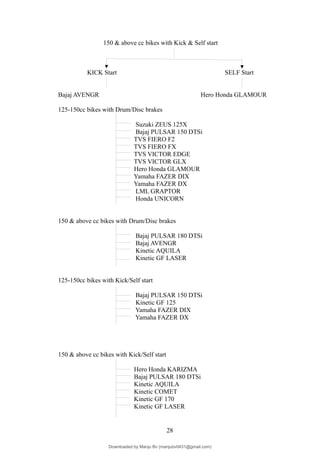
Fig. 1.4: CLASSIFICATION OF THE BIKE ACCORDING TO THE
DISPLACEMENT & START
Bikes with Disc & Drum brakes
DISC Brake DRUM Brake
Bajaj WIND Bajaj DISCOVER
Hero Honda ACHIVER Hero Honda GLAMOUR
Hero Honda SUPER SPLENDOR ES Hero Honda ACHIVER
Hero Honda SUPER SPLENDOR KS TVS VICTOR EDGE
Kinetic GF Kinetic GF
LML FREEDOM PRIMA Yamaha FAZER
Yamaha FAZER LX
Yamaha R X 135
SUZUKI HEAT
LML FREEDOM PRIMA
Above cc bikes with Disc & Drum brakes
DISC Brake DRUM Brake
Hero Honda KARIZMA Kinetic GF
Kinetic COMET
Kinetic GF
125-150cc bikes with Kick & Self start
KICK Start SELF Start
Bajaj DISCOVER 125 Bajaj DISCOVER 125
Bajaj WIND 125 Hero Honda GLAMOUR
TVS FIERO F2 Kinetic GF 125
TVS FIERO FX Honda UNICORN
TVS VICTOR EDGE
TVS VICTOR GLX
Hero Honda ACHIVER
Hero Honda GLAMOUR
Yamaha FAZER
Yamaha FAZER LX
Yamaha R X 135
LML GRAPTOR
Honda UNICORN
SUZUKI ZUES 125
SUZUKI HEAT
27
Downloaded by Manju Bv (manjubv0431@gmail.com)
lOMoARcPSD|44080849
150 & above cc bikes with Kick & Self start
KICK Start SELF Start
Bajaj AVENGR Hero Honda GLAMOUR
125-150cc bikes with Drum/Disc brakes
Suzuki ZEUS 125X
Bajaj PULSAR 150 DTSi
TVS FIERO F2
TVS FIERO FX
TVS VICTOR EDGE
TVS VICTOR GLX
Hero Honda GLAMOUR
Yamaha FAZER DIX
Yamaha FAZER DX
LML GRAPTOR
Honda UNICORN
150 & above cc bikes with Drum/Disc brakes
Bajaj PULSAR 180 DTSi
Bajaj AVENGR
Kinetic AQUILA
Kinetic GF LASER
125-150cc bikes with Kick/Self start
Bajaj PULSAR 150 DTSi
Kinetic GF 125
Yamaha FAZER DIX
Yamaha FAZER DX
150 & above cc bikes with Kick/Self start
Hero Honda KARIZMA
Bajaj PULSAR 180 DTSi
Kinetic AQUILA
Kinetic COMET
Kinetic GF 170
Kinetic GF LASER
28
Downloaded by Manju Bv (manjubv0431@gmail.com)
lOMoARcPSD|44080849
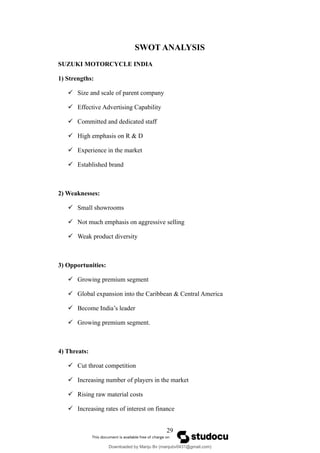
SWOT ANALYSIS
SUZUKI MOTORCYCLE INDIA
1) Strengths:
 Size and scale of parent company
 Effective Advertising Capability
 Committed and dedicated staff
 High emphasis on R & D
 Experience in the market
 Established brand
2) Weaknesses:
 Small showrooms
 Not much emphasis on aggressive selling
 Weak product diversity
3) Opportunities:
 Growing premium segment
 Global expansion into the Caribbean & Central America
 Become India’s leader
 Growing premium segment.
4) Threats:
 Cut throat competition
 Increasing number of players in the market
 Rising raw material costs
 Increasing rates of interest on finance
29
Downloaded by Manju Bv (manjubv0431@gmail.com)
lOMoARcPSD|44080849
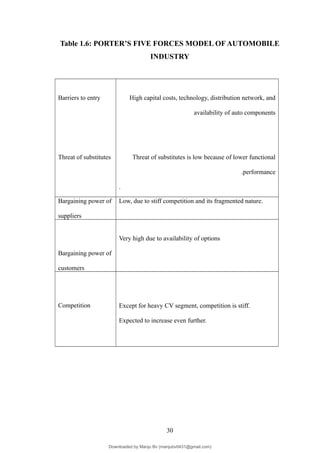
Table 1.6: PORTER’S FIVE FORCES MODEL OF AUTOMOBILE
INDUSTRY
Barriers to entry
Threat of substitutes
High capital costs, technology, distribution network, and
availability of auto components
Threat of substitutes is low because of lower functional
performance
.
.
Bargaining power of
suppliers
Low, due to stiff competition and its fragmented nature.
Bargaining power of
customers
Very high due to availability of options
Competition Except for heavy CV segment, competition is stiff.
Expected to increase even further.
30
Downloaded by Manju Bv (manjubv0431@gmail.com)
lOMoARcPSD|44080849
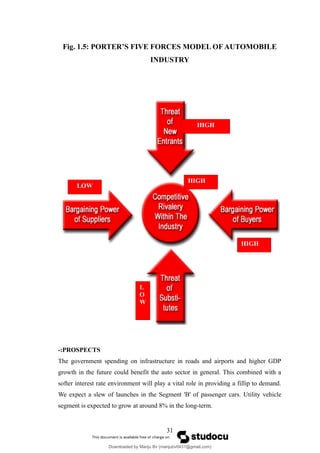
Fig. 1.5: PORTER’S FIVE FORCES MODEL OF AUTOMOBILE
INDUSTRY
PROSPECTS
-:
The government spending on infrastructure in roads and airports and higher GDP
growth in the future could benefit the auto sector in general. This combined with a
softer interest rate environment will play a vital role in providing a fillip to demand.
We expect a slew of launches in the Segment 'B' of passenger cars. Utility vehicle
segment is expected to grow at around 8% in the long-term.
31
HIGH
HIGH
L
O
W
LOW
HIGH
Downloaded by Manju Bv (manjubv0431@gmail.com)
lOMoARcPSD|44080849
In the two-wheeler sector, motorcycle segment is expected to witness a flurry of new
model launches. Though the market size is expected to grow by 12% -15%,
competitive pressure could keep prices and margins under control. While geared
scooter and moped segments could see a fall in volumes, TVS, Honda and Kinetic
Motors are poised to benefit from higher demand for unguarded scooters in the urban
and rural market. However, Bajaj and Hero Honda are also planning to enter in this
segment and to that extent, competition is likely to increase
The reduction in peak customs duty from 25% to 20% in the budget will result in
savings on the raw material front as well. Since raw material costs account for almost
50% of operating costs of auto companies in general, this is a positive. Also, steel
prices have shown some signs of softening and this is likely to have a positive impact
on the margins
32
Downloaded by Manju Bv (manjubv0431@gmail.com)
lOMoARcPSD|44080849
CHAPTER-II
COMPANY PROFILE / INDUSTRY PROFILE OR
DETAILS
SUZUKI MOTORCYCLES GLOBAL HISTORY
33
Downloaded by Manju Bv (manjubv0431@gmail.com)
lOMoARcPSD|44080849
In 1909 Michio Suzuki founds the Suzuki Loom Company in Hamamatsu, Japan. He
builds industrial looms for the thriving Japanese silk industry. 1937 To diversify
activities, the company experiments with several interesting small car prototypes, but
none go into production because the Japanese government declares civilian
automobiles “non-essential commodities” at the onset of WWII.
In 1952 when due to financial problems Suzuki ventured into developing clip on
engines to bicycle frames. The first model was called the Power Free (36cc) and the
follow-up model was the Diamond Free (60cc). Suzuki produced its first motorcycle
in 1954 called the Colleda (90cc). Suzuki built small capacity bikes during the 50s
and 60s and had only small export success until the introduction of the X6 (T20 super
six), which gave Suzuki much name credibility. In 1962 Using MZ’s technology,
Suzuki wins the newly created 50cc class in the World Championship.
The company will win the class every year until ’67, and win the 125cc class twice in
that period, too. With a well-established name Suzuki dared enter the big bike market
and in 1967 Suzuki introduced T500. Which was known as the Titan in America and
the Cobra in England? The name changed over the years to GT500 due to many
improvements but it was purely the sharp price and good reliability, which kept the
GT in production until 1977.
In 1971 The GT7The Water Buffalo was introduced in 1971 in America and the
Kettle in Britain - both the same GT750 bike and the start for Suzuki to enter the
super bike market. The GT750 wasn't a very impressive machine and also couldn't
match the other bikes in the market at the time. Once again the production kept going
based on its demand for good price and reliability.
In 1974 The RE5 is the first Japanese motorcycle with a rotary engine. It cost a
fortune to develop and, while not bad, it’s a commercial disaster. After two years, the
company abandons the project, and there are rumors the tooling was dumped into the
sea so that Suzuki managers would never have to see it again. Most bikes produced
around the middle 70s had enough power but lacked a steady frame. The introduction
of the Suzuki GS1000 in 1978 changed this problem once and for all. The GS out
preformed every other bike in its category and had a frame to match its power. The
34
Downloaded by Manju Bv (manjubv0431@gmail.com)
lOMoARcPSD|44080849
only thing, which could be said against the very popular and successful GS1000, was
its dull looks.
The GS1000 was redesigned and new models based on the same original success bike
were introduced. The GSX1000 in 1980 and the GSX1100S Katana in 1982. The later
bike was a huge success due to it powerful performance, funky style, low weight and
good pricing. In 1983 The RG250 is Suzuki’s first ever race replica. This bike features
the AL-BOX, square aluminum frame, 16-inch tire and Anti Nose Dive Forks
(ANDF) at the front. In 1985 The RG500 “Gamma” features the same square-Four
cylinder layout as the as the factory Grand Prix bikes. Other racy features are the
square-tube aluminum frame and the removable cassette-type transmission.
Suzuki pulled a stunt within the motorcycle market by introducing the GSX-R750,
which was such a direct copy of their formula race bike with the only difference that
this GSX was, road legal. It turned the super sport motorcycle market upside down
and dominated the way super bikes would look for the future. The GSX-R750 was
super fast, which wasn't hard to understand since there were hardly any changes to its
racetrack design. Both on the street and in the race track the bike was a huge success.
In 1986 the GSX-R1100 was also added to the line.
In 1996 Suzuki calls the new GSX-R750 the ‘turning-point model’ thanks to its twin-
spar frame instead of the older double-cradle frame. The engine is also redesigned and
featured 3-piece crankcases, chrome-plated cylinders and a side-mount cam chain as
well as Suzuki Ram Air Direct (SRAD) system.
In 1997 The TL1000S is the first Suzuki sport bike with a V-Twin engine. It will be
followed a year later by a racier R version, with a dodgy rotary vane damping system
in the rear shock. Suzuki equipped the TL1000R with a steering damper, but it was
still prone to headshake and customers approached it with caution, if at all.
In 1999 Mat Mladin wins the AMA Super bike Championship, beginning a run of
unprecedented dominance. Mladin will win five more times, and Suzuki will win 8 of
the next 9 titles. With sport bikes getting more and more sharp edged, the company is
one of the first to recognize what might be called the ‘semi-sport’ market, as opposed
35
Downloaded by Manju Bv (manjubv0431@gmail.com)
lOMoARcPSD|44080849
to the super sport market. The SV650 features an aluminum-alloy truss frame and a
liquid-cooled 90° V-Twin DOHC 4-valve engine. Suzuki calls the Hayabusa the
ultimate aerodynamic sportbike. It’s powered by a 1298cc liquid-cooled DOHC in-
line 4-cylinder engine that becomes the darling of land-speed racers. The name means
“peregrine falcon” in Japanese.
The GSX style and line didn't change much over all the years with improvements
being made to the bike. A small fluke in design made Suzuki lose its performance lead
with the GSX-R1100. But the GSX-R750 has remained a hit up until today. Maybe
still hurt by losing the performance edge with the GSX-R1100 redesign in the 1990s
Suzuki introduced the GSX-1300R (Hayabusa) in 1999. This sent the Honda
Blackbird packing and became the world's fastest production bike at a whopping 190
mph (307 km/h).
In 2001 Suzuki introduced an upgrade GSX-R750 engine and created the GSX-R1000
(998cc), which is a super bike with outstanding performance. In 2003 the GSX-R1000
was restyled but still kept its position as a super class bike.
In 2005 Suzuki’s original 4-stroke motocross, the RM-Z450, is equipped with a 4-
stroke 449cc engine, which features the Suzuki Advanced Sump System (SASS). Troy
Corser gives Suzuki its first and only (so far) World Super bike Championship.
In 2006 The M109R, Suzuki’s flagship V-Twin cruiser is powered by a 1783cc V-
Twin engine with 112mm bore and 90.5mm stroke. It has the largest reciprocating
pistons in any production passenger car or motorcycle.
In 2012 The B-King is launched, powered by the 1340cc Hayabusa engine; the B-
King is Suzuki’s flagship big ‘Naked’ bike. Suzuki says it has the top-ranked power
output in the naked category.
SUZUKI MOTORCYCLES INDIA HISTORY
Suzuki Motorcycle India Pvt., Ltd. engages in manufacturing two wheelers. The
company’s products include motorcycles and scooters. It offers its products through a
36
Downloaded by Manju Bv (manjubv0431@gmail.com)
lOMoARcPSD|44080849
network of dealers. The company was incorporated in 1997 and is based in Gurgaon,
India. Suzuki Motorcycle India Pvt., Ltd. operates as the subsidiary of Suzuki Motor
Corp.
Suzuki Motor Corporation (SMC), a global giant of motorcycle manufacturing is
headquartered in Japan. It holds major stake in its Indian subsidiary, Suzuki
Motorcycle India Private Limited (SMIL). SMIL was set up after Suzuki's re-entry
into the Indian two-wheeler market after it severed ties with partner TVS in 2000-01.
Suzuki was then the technology provider in the erstwhile joint venture company TVS
Suzuki.
Suzuki Motorcycle India Pvt Ltd (SMIPL) is the latest entry into the already crowded
Indian two-wheeler segment with players like Hero Honda, Bajaj Auto, Honda, and
TVS. SMIPL have started their Indian operations with a 125-cc mass-market
motorcycle. It has made an initial investment of Rs. 200 crores to start their Indian
operations.
Company sources have revealed that Suzuki would follow up this 125cc bike with a
high performance 150-cc sibling sometime next year. And for the budget segment,
another 100cc bike is expected in the first quarter of 2006. Mass market is the initial
aim with plans to enter all the segments rapidly. They have their facilities located in
Gurgaon.
Suzuki had launched bike by diwali, which is the auspicious time for buying a new
vehicle in Indian families. Their setup in Gurgaon has the capabilities of
manufacturing one lakh motorcycles and they are ready to step that up massively if
the situation arises. They already have setup 40 dealerships around the country and
are going to establish 4,000-5,000 sq.ft showroom and service stations to provide
services to the customers.
The parent company happens to be one of the largest manufacturers of two wheelers
in the world with more than 20 lakh bikes sold per annum. They are popular for their
range of high performance road machines, lightweight super bikes, dirt bikes, street
bikes, and motocross and fun bikes globally.
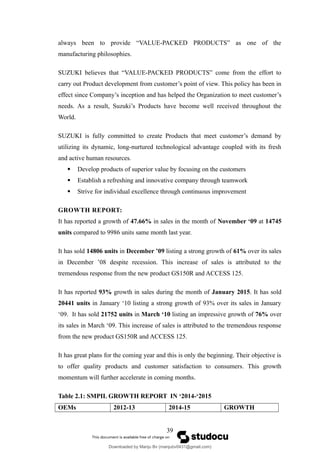
37
Downloaded by Manju Bv (manjubv0431@gmail.com)
lOMoARcPSD|44080849
COMPANY PROFILE
Plant area and production capacity:
They have installed their manufacturing plant in Gurgaon (Haryana) having the
annual capacity of 2,50,000 units. Total land area of the facility at Gurgaon is 37 acres
out of which the present plant is constructed in an area of 6.5 acres of land. The
remaining area of 30.5 acres is left for land development and future expansion.
Chairman:
Mr. Katsumi Takata
Personnel over the years
Year 2012-13
Total number of employees 490
Main Products
Motorcycles and scooters
Head Office, Plants & Facilities
Name Address Operations
Suzuki Motorcycle India Pvt
Ltd
Factory Office
Village Kherki
Dhaula, Badshahapur,
N.H.-8, Link Road,
Gurgaon.
Fax No. - 0124-4170
701
Regd. Office Sales &
Marketing Office
2nd Floor, Plot No. 1,
Nelson Mandela
Road, Vasant Kunj,
New Delhi -110 070
Fax No. - 011-4607
5418
Head office affairs
Motorcycle engines assembling and
machining
Spare parts administration
Education, training and
Public relations
Research and development
Testing and development of motorcycles
MISSION OF SUZUKI
The core philosophy of SUZUKI is to provide “VALUE-PACKED PRODUCTS”.
Since the founding of SUZUKI Motor Corporation, the Organization’s Endeavour has
38
Downloaded by Manju Bv (manjubv0431@gmail.com)
lOMoARcPSD|44080849
always been to provide “VALUE-PACKED PRODUCTS” as one of the
manufacturing philosophies.
SUZUKI believes that “VALUE-PACKED PRODUCTS” come from the effort to
carry out Product development from customer’s point of view. This policy has been in
effect since Company’s inception and has helped the Organization to meet customer’s
needs. As a result, Suzuki’s Products have become well received throughout the
World.
SUZUKI is fully committed to create Products that meet customer’s demand by
utilizing its dynamic, long-nurtured technological advantage coupled with its fresh
and active human resources.
 Develop products of superior value by focusing on the customers
 Establish a refreshing and innovative company through teamwork
 Strive for individual excellence through continuous improvement
GROWTH REPORT:
It has reported a growth of 47.66% in sales in the month of November ‘09 at 14745
units compared to 9986 units same month last year.
It has sold 14806 units in December ’09 listing a strong growth of 61% over its sales
in December ’08 despite recession. This increase of sales is attributed to the
tremendous response from the new product GS150R and ACCESS 125.
It has reported 93% growth in sales during the month of January 2015. It has sold
20441 units in January ‘10 listing a strong growth of 93% over its sales in January
‘09. It has sold 21752 units in March ‘10 listing an impressive growth of 76% over
its sales in March ‘09. This increase of sales is attributed to the tremendous response
from the new product GS150R and ACCESS 125.
It has great plans for the coming year and this is only the beginning. Their objective is
to offer quality products and customer satisfaction to consumers. This growth
momentum will further accelerate in coming months.
Table 2.1: SMPIL GROWTH REPORT IN ‘2014-‘2015
OEMs 2012-13 2014-15 GROWTH
39
Downloaded by Manju Bv (manjubv0431@gmail.com)
lOMoARcPSD|44080849
BAL 9,692 3,759 -61.22%
HHML 1,53,193 2,08,440 36.06%
HMSI 6,54,319 7,39,947 13.09%
KINETIC 5,522 - -100.00%
M&M 2W - 70,008 0.00%
SMIL 85,782 1,40,983 64.35%
TVS 2,39,469 2,99,370 25.01%
TOTLE 11,48,007 14,62,507 27.40%
Fig. 2.1: Growth
FACILITIES
1 ) ENVIRONMENT:
The philosophy of keeping “environment first” is properly percolated downwards. To
comply with all applicable legislations and setting standards thereof remains only a
beginning. Company thrives to discover and invent mechanisms for better
environment management systems and it’s a continuous process which is managed by
a separate wing of experts and specialist in the field.
The biggest testimony of Suzuki’s commitments towards “environment first” is seen
at Gurgaon which is built to be a Zero discharge plant.
SMIPL have embraced Natural light optimization system and water harvesting
systems besides several other measures to create better and cleaner environment
40
Downloaded by Manju Bv (manjubv0431@gmail.com)
lOMoARcPSD|44080849
around us. All packaging material used by Suzuki is re-cycleable. A constant flow of
internal communication on environment related issues not only creates awareness
amongst employees but also helps in inculcating ‘an environment friendly’ value
system.
2) SHOP FLOOR SAFETY MEASURES:
SMIPL have safety guards/safety curtains to ensure Operator safety on machines.
Company has also installed robots through out the facilities to reduce the ergonomic
stress on workers. There are gas detection systems installed to eliminate any gas
related accident and fire detection system for immediate information about any fire
related incident.
SMIPL have fire fighting system (manual & automatic) for immediate handling of
any fire related accident. They have a fire tender (capacity 4500 liters water and 500
liters capacity foam).
Company try to maintain zero accident record through regular safety audit, frequent
training for staff, line associates and contractors. They organize different safety
programs and competitions to encourage employee awareness and involvement.
3) ENVIRONMENTAL UTILITY:
To take care of the health of all our employees, they maintain all international
parameters and standards for drinking water, treated water, ambient air shop floor,
office and the outside. They keep updating all these standards of health and welfare of
employees through a team of well qualified personnel in the R & D laboratory.
4) QUALITY CONTROL :
It has four main sections as follows:
 Tested by SMC Japan with their international quality standards
 Final (Vehicle) Inspection
 Market Quality
5) PARTS INSPECTION:
41
Downloaded by Manju Bv (manjubv0431@gmail.com)
lOMoARcPSD|44080849
 The non conformities in the parts being procured may lead to production loss
& degradation of the quality of the final output and life of the product. To
ensure the product, the dimensional, material, aesthetic & performance
inspection for the special processes are carried out on the individual parts
before they are declared fit for the assembly
 For carrying out the inspection activities effectively, we have the latest &
sophisticated machines installed in the inspection area
6) FINAL (VEHICLE) INSPECTION:
 Safety related parameters such as braking; clutch operation and other
functional defects of the vehicle
 Emission related parameters for checking the conformance of the exhaust
gases with the emission rules
 Functional & aesthetic parameters are also checked
7) MARKET QUALITY:
 To act upon the customer’s feedback received from the service department for
the up gradation of the product
 To resolve the quality issues being received from the market by visiting the
suppliers & taking the corrective & preventive measures for the same
 Monitoring for the effectiveness of the measures taken for the particular
problems through the cut off engine/ frame numbers.
8) WORK CULTURE:
 They believe that future growth and prosperity of every employee depends
on the company’s growth and prosperity
 Organizational and individual discipline
 Continual improvement in quality and productivity
 Cost consciousness
 Customer satisfaction ( both internal and external )
 Long term goals
 Respect for laws, human beings and society
9) EMPLOYEE DEVELOPMENT:
42
Downloaded by Manju Bv (manjubv0431@gmail.com)
lOMoARcPSD|44080849
Company's growth is based on enhancement of technical and behavioral skills of the
employees. They continually identify the performance gaps and new skills required
keeping into the company's growth in focus. They believe that Employees are the
most important assets of an organization. For enhancement of technical and
behavioral skills of the employees they organize regular training programmers. Teams
from Japan often come to the organization to impart training. Their focus is to create a
healthy Environment where individual employee can achieve maximum satisfaction.
PRODUCTS OF SUZUKI MOTORCYCLES
 SUZUKI ACCESS 125CC
Suzuki launched the Access 125cc in the month of September 2011. In those days,
Access 125 was the third product from Suzuki’s stable in India. Prior to this, Heat and
Zeus motorcycles were ruling the Suzuki showrooms PAN India.
Suzuki Access 125 is the third product from the Suzuki stable in India after Heat and
Zeus motorcycles. 125cc Access is powered by a 125-cc air-cooled four-stroke engine
with Continuous Variable Transmission (CVT), which develops 8.5bhp at
7000rpm with 1.0kgm of torque at 5000rpm. The design is typically Japanese, almost
flat aprons where large turn indicators are embedded. Though it has a longer
wheelbase access looks compact because of this design. No body colored mirrors for
this access. Paint quality is of top notch.
SUZUKI ACCESS 125 FEATURES:
 Xtra Torque Performance (XTP) for more power and faster pick-up
 Telescopic front fork suspensions for comfortable riding
43
Downloaded by Manju Bv (manjubv0431@gmail.com)
lOMoARcPSD|44080849
 Tail lights that are trendy and attractive
 Wider seat for comfort riding
 Large size underseat compartment
 Centralized ignition key switch, with shutter
 Smart built-in signal
 Multi-reflector lights for better visibility
 Stylish, Chrome-plated silencer cover
TABLE 2.2: SUZUKI ACCESS 125 TECHNICAL SPECIFICATIONS:
Dimensions And Dry Mass
Overall length 1780 mm
Overall width 650 mm
Overall height 1125 mm
Wheelbase 1250 mm
Ground clearance 160 mm
Seat height 780 mm
Dry mass 109 kgs
Engine
Type Four-stroke, Air-cooled,OHC
Number of cylinders 1
Displacement 124 cm3
(cc)
Max Power 6.4 Kw@7000rpm (8.58hp@7000rpm)
Max Torque 9.8Nm@5000rpm (1.0kg-m@5500rpm)
Air cleaner Non-woven fabric element
Transmission CVT
Starter system Self & Kick Self
Suspension
Front Telescopic
Rear Swing-arm
Brake
Front Drum brake (130 mm)
Rear Drum brake (130 mm)
Tyre Size
Front 90/100-10
Rear 90/100-10
Electrical
Spark plug CHAMPION P-RZ9HC
Battery 12V, 5Ah
Headlamp 12V 35/35W
44
Downloaded by Manju Bv (manjubv0431@gmail.com)
lOMoARcPSD|44080849
Fuel Tank : Capacities
Tank capacity 6.4 L
Underseat space 20 L
 SUZUKI GS150R
The 150cc Segment is picking up in India. Suzuki has been a little conservative till
now with its bike models. Zeus and Heat and not extra ordinary, but it sells enough to
be seen here and there a while. The company took another step ahead with the Access
125 Scooter. Suzuki’s foray into this segment is expected to be create similar impact
in the segment with the GS150R.
The engine of the Suzuki GS150R is said to be convenient for riding in the city. The
150cc engine respires through a BS26 carburetter. It comes with Throttle Positioning
Sensor (TPS). GS150R's 149cc engine develops 13.8bhp of peak power at 8500rpm
and 13.4Nm of peak torque 6000rpm. According to Suzuki, GS150R will return a
mileage of 48kmpl in City and 55kmpl in Highway.
Table 2.3: The engine uses engine balancer technology to minimise vibration and
comes with a rubber damper and a balancer shaft. It has a digital speedometer which
shows gear position, fuel level, speed, odometer, tripmeter and the tachometer is a
neat dial adjacent to the digital console.
Name: GS150R
Type: Commuter
Top Speed: 120kph
Fuel
Consumption:
City
48.00
OTHER SPECIFICATIONS
Weight: 134.00 kg
Ground Clearance: 160.00 mm
Fuel Tank: 15.50 ltrs
Wheelbase: 1340.00 mm
Headlamp: Multi Reflector
45
Downloaded by Manju Bv (manjubv0431@gmail.com)
lOMoARcPSD|44080849
Fuel
Consumption:
Highway
55.00
ENGINE SPECIFICATIONS
Displacement: 149cc
Engine: Four Stroke, Single
Cylinder, SOHC
Maximum Power: 13.8 Bhp @ 8500 rpm
Maximum Torque: 13.4 Nm @ 6000 rpm
Gears: 6 Manual
Bore: 57
Stroke: 58.6
No. of Cylinders: 1
Cylinder
Configuration:
SOHC
Valve Per
Cylinder:
2
Cooling Type: Air Cooling
Carburetor: BS26 - Throttle
Positioning Sensor
DIMENSIONS
Length: 2095.00 mm
Width: 775.00 mm
Height: 1120.00 mm
Halogen Bulb
Wheel Type: Die Cast Alloys
Wheel Size: 2.75x18 - 100/90-18
mm
Tubeless: NO
Colors: Pearl nebular black,
Metallic flint gray,
Candy max orange
& Candy dark
greenish blue.
ACTIVE AND PASSIVE SAFETY
Suspension(Front): Telescopic, Coil
Springs, Oil
Damped
Suspension(Rear): Swing Arm Type
Coil Spring, Oil &
Gas Damped
Brakes: Hydraulic Single
Disc
Brakes(Rear): 130mm Drum
Stand Alarm: NO
COMFORT AND CONVENIENCE
Fuel Guage: Digital
Self Start: YES
Tacho Meter: Analogue
Trip Meter: Digital-1
Alloys: YES
Speedometer: Digital
Passenger Footrest: YES
Passenger Backrest: NO
Step-up Seat: YES
Pass-light: YES
Low Fuel Indicator: YES
 SUZUKI
ZEUS
125CC
46
Downloaded by Manju Bv (manjubv0431@gmail.com)
lOMoARcPSD|44080849
Suzuki Zeus, the latest bike from Suzuki Motorcycles India Pvt Ltd has been
launched. The 125cc single cylinder Suzuki Zeus comes at a price of f Rs 46,084. The
bike had a soft launch earlier this year.
Besides Suzuki Zeus, Suzuki India has another motorcycle in the Indian market,
called Suzuki Heat. Both Zeus and Heat are part of Suzuki's attempts to come back to
the Indian market, which it had left in the late 90s. During its earlier Indian coming,
Suzuki partnered TVS for its two-wheeler business.
Suzuki Zeus, packed with latest technology and styling, is an entry level bike from
Suzuki Motor Corporation. Zeus has a unique cut-line front cowl for a much
stylished, dynamic look. The bike is available in Zeus 125X and 125XU models.
Suzuki Zeus will be available in three colors, the company said. These are Candy
Antares Red (19A), Metallic Titanium Gold (YM3) and Pearl Nebular Black (YAY).
To manufacture Suzuki Zeus and Suzuki Heat, the company has invested Rs 200 crore
at its Gurgaon manufacturing plant. The production capacity of the plant is 100,000
bikes per annum.
SUZUKI ZEUS 125CC FEATURES:
 Powerful Disc Brakes (front, asbestos-free)
 Bright and Big multi-reflector Halogen Head Lamp for better visibility at
night and make a dashing style statement.
 Convenient Shift indicator for adjusting fuel efficiency on different gears.
 Advanced and Stylish Instrument Panel with Tachometer
 Uniquely styled front cowl for a dynamic look.
Stylish Under Cowl for engine protection and making a style statement.
 Advanced 5-speed Gearbox for a smoother and comfortable ride.
47
Downloaded by Manju Bv (manjubv0431@gmail.com)
lOMoARcPSD|44080849
 Robust all Aluminium Engine with large fins and upright cylinder for superb
cooling and style.
 Primary Kick & Auto Decompression System for effortlessly starting the
engine in any gear.
 Stylish and large fuel tank.
 Ergonomic seat design for easy ground access and minimum knee bending.
 Helmet Holder to take the load off your head after you park the bike.
TABLE 2.4 VEHICLE SUMMARY
Name: Zeus 125
Model: XCD
Type: Commuter
Top Speed: 101kph
ENGINE SPECIFICATIONS
Displacement: 124cc
Engine: Four-stroke, Air-cooled,
OHC
Maximum Power: 8.5 Bhp @ 7500 rpm
Maximum Torque: 10 Nm @ 3500 rpm
Gears: 5 Speed
Clutch: Wet Multiplate type
Bore: 53.5
Stroke: 55.2
Cylinder
Configuration:
NA
Engine Block
Material:
NA
Chassis Type: NA
Cooling Type: Air Cooling
Carburetor: NA
DIMENSIONS
Length: 2040.00 mm
Width: 770.00 mm
Height: 1125.00 mm
OTHER SPECIFICATIONS
Weight: 114.00 kg
Ground Clearance: 155.00 mm
Fuel Tank: 12.00 ltrs
Wheelbase: 1240.00 mm
Electrical System: NA
Headlamp: NA
Battery Type: 9.0 KC 10HR
Battery Voltage: 12V
Battery Capacity: 2.5 Ah
Horn: NA
Wheel Type: Alloys
Wheel Size: 2.75x18 - 3.00x-18
mm
Tubeless:
Colors: NA
ACTIVE AND PASSIVE SAFETY
Suspension(Front)
:
Telescopic, Coil
spring, Oil damped
Suspension(Rear): Swing-arm type,
Coil spring, Oil
damped
Brakes: Disc
Brakes(Rear): Drum 130mm
Stand Alarm:
COMFORT AND CONVENIENCE
Fuel Guage: Analogue
Self Start:
Tacho Meter: Analogue
Trip Meter: Analogue-1
Alloys:
Warranty: NA
Speedometer: Analogue
Passenger
Footrest:
Passenger
48
Downloaded by Manju Bv (manjubv0431@gmail.com)
lOMoARcPSD|44080849
Backrest:
Step-up Seat:
Pass-light:
 SUZUKI HAYABUSA
Suzuki bring the Hayabusa motorcycle to India. The Hayabusa – official
nomenclature is GSX 1300R – will pave the way for Suzuki’s foray into the superbike
segment in India. Competition, however, has already arrived in the shape of Yamaha
and Ducati motorcycles in India.
Powered by a 1340cc in line 4 cylinder engine, the Suzuki Hayabusa is likely to sport
a price tag of Rs 11 lakh. The bike was launched in the first week of September 2012.
Suzuki also launched a second superbike, the GSX-R 1000 in November.
Although boasting of a top speed of 397 km per hour as per recorded figures, the bike
that will come to India will have a speed limit of 299 km per hour. Company think
that the higher figure here is from some world record attempts, while 299 km ph
would be the official top speed. Do keep in though that superbike or not, speed limits
in most parts of India are at 60 kmph, and may go up to 100 km ph on some of the
expressways.
Table 2.5: Suzuki expects only a sale of around 150 units of the Hayabusa in India
per annum.
49
Downloaded by Manju Bv (manjubv0431@gmail.com)
lOMoARcPSD|44080849
VEHICLE SUMMARY
Name: Hayabusa
Type: Sports
Top Speed: 332kph
ENGINE SPECIFICATIONS
Displacement: 1340cc
Engine: 4-stroke, 4-cylinder DOHC,rse
Maximum Power: 170 Bhp @ 9500 rpm
Maximum Torque: 127 Nm @ 6750 rpm
Gears: 6 Speed
Clutch: 120
Bore: 81
Stroke: 63
Cylinder Configuration: NA
Engine Block Material: NA
Chassis Type: NA
Cooling Type: Liquid Cooling
Carburetor: NA
DIMENSIONS
Length: 2195.00 mm
Width: 740.00 mm
Height: 1170.00 mm
OTHER SPECIFICATIONS
Weight: 220.00 kg
Ground Clearance: 120.00 mm
Fuel Tank: 22.00 ltrs
Wheelbase: 1480.00 mm
Electrical System: NA
Headlamp: NA
Horn: NA
Wheel Type: Alloys
Wheel Size: 120/70 ZR17 - 190/50Z R17, tubeless
mm
Tubeless:
Colors: NA
ACTIVE AND PASSIVE SAFETY
Suspension(Front): Inverted telescopic, 43mm inner
Suspension(Rear): Progressive linkage, fully adjustable
Brakes: 6-piston caliper 320mm dual disc
Brakes(Rear): Twin piston caliper, 240mm disc
Stand Alarm:
COMFORT AND CONVENIENCE
Fuel Guage: Digital
Self Start:
50
Downloaded by Manju Bv (manjubv0431@gmail.com)
lOMoARcPSD|44080849
Tacho Meter: Analogue
Trip Meter: Digital-2
Alloys:
Warranty: NA
Speedometer: Digital
Passenger Footrest:
Passenger Backrest:
Step-up Seat:
Pass-light:
Low Fuel Indicator:
Low Oil Indicator:
Low Battery Indicator:
High Oil Temp. Indicator:
Choked Air Filter Indicator:
SUZUKI WARRANTY POLICY
Suzuki Motorcycle India Private Limited, (SMIPL) offers warranty for all models
manufactured in its Gurgaon plant and sold through its authorized dealers. Suzuki
Motorcycle India Private Limited reserves the right either to replace or repair, at their
authorized dealer, free of cost, those parts which may be found on examination to
have manufacturing defect within 2 years from the date of sale (or) first 30,000 kms
whichever occurs earlier of its operation.
If any of the free or paid service is not done as per schedule, the warranty tends to
stand void. Parts of the vehicle have been subjected to misuse, accident, and negligent
treatment, use of bad quality parts which are not manufactured (or) not recommended
for use by SMIPL on their motorcycles. Parts of the motorcycle getting rusted or their
plating or painting coming off due to atmospheric condition like Sea Breeze and
Industrial Pollution.
Motorcycle used for any Competition (i.e.) Rallies (or) Races, if it is used for any
commercial purposes like Hiring etc. SMIPL undertakes no liability in the matter of
any consequential loss (or) damage caused due to failure of the parts. Parts repaired
(or) replaced under this warranty are warranted only for the original warranty period
of Suzuki motorcycles. Consumables like Engine Oil, TFF Oil, Grease, used for the
warranty repair are not covered under the application of the warranty.
51
Downloaded by Manju Bv (manjubv0431@gmail.com)
lOMoARcPSD|44080849
FIG. 2.2: SERVICE PROCEDURE
SHIVALIK SUZUKI
The SHIVALIK Show room has its separate service center, Here SHIVALIK SUZUKI
also have a latest service center with all semi-automatic instruments. It maintain a
unique and regular checking of each and every bike to increase a satisfaction level of
the customers.
SHIVALIK SUZUKI strictly watch and try to lesser the time of a customer while they
give bike in to service. Mostly Customer when come to give his bikes in service, the
service procedure of the showroom is very less and smallest so that customer will free
within 5 Minutes.
52
WASHING THE BIKE
MECHANICS / ENGINEER
(BIKE WISE)
SPARPART REQUICISION (IF
REQUIRED)
SPAREPART
DEPART.
FITTING OF SPARPARTS &
COMPLETE FORTHER
PROCESS
TESTING ON
ROAD
SUPERVISOR
DELIVERY TO THE
CUSTOMER
Downloaded by Manju Bv (manjubv0431@gmail.com)
lOMoARcPSD|44080849
Gate Entry
Receive by Service Advisor
Job Card Entry (Opening)
Estimation of Exp.
This Procedure will take just only 5 Minute then after Service of the
Bike is done.
SHIVALIK SELLING SCHEME & RESULT:
Selling scheme is a Dealers Scheme that is useful to attract the
customer towards the showroom to purchase new bike. This all selling
scheme provided to the customer is within Rs.2000. Such Selling
Scheme are:
 RTO Free
 Insurance Free
 Petrol Free Up to some K.M or some Rupees.
 Reference Sales
 DSS (Door Sales Service)
 Exchange (It is a Major tool of Scheme/Conversion)
SELLING OF SHOW ROOM:
Every showroom’s goal is to increase the sales. The “SHIVALIK
SUZUKI” has a great sales of bike through providing different scheme,
facility and services to the customer. The Following figures are
approximate:
 Daily 6 vehicles
 Monthly 160 Vehicles
 Yearly 1920 Vehicles.
53
Downloaded by Manju Bv (manjubv0431@gmail.com)
lOMoARcPSD|44080849
MAJOR COMPETITORS
1) HERO HONDA MOTORS LIMITED
Hero Honda Motors Limited was established in 1984, as a joint venture between
India's Hero Group (world's largest bicycle manufacturers) and Japan's Honda Motor
Company. In 1985 production began with the launch of its first motorcycle, the
CD100, which gave 80 km to the liter. In 1987 the engine plant was started and in
1989 the Company produced its 3,00,000th motorcycle. In 2001 Hero Honda
manufactured its 50,00,000th motorbike. Hero Honda has a reputation of being the
most fuel-efficient and the world's single largest two wheeler Company. Shri
Brijmohan Lall Munjal is the chairman and managing director of this Company.
During 80s, Hero Honda became the first company in India to prove that it was
possible to drive a vehicle without polluting the roads.
The unique features like fuel conservation, safety riding courses and mobile
workshops helped the group reach in the interiors of the country. Well-entrenched in
the domestic market, Hero Honda Motors Ltd. turned its attention overseas, and
exports have been steadily on the rise.
2) Honda Motorcycles & Scooters India Private Limited
Honda motors of Japan is not a new name in the two wheeler scenario in the country,
they were in a tie up with the Firodias owned Kinetic group. However in the late 90s
they parted ways after problems arose over issues like introduction of new models,
advertising expenditure, marketing strategies and other related issues.
54
Downloaded by Manju Bv (manjubv0431@gmail.com)
lOMoARcPSD|44080849
In the mid 80 Honda motors of Japan joined hands with the largest bicycle maker of
India the Hero cycles to create Hero Honda which in a couple of decades or so have
gone on to become the single largest motorcycle company in the world. Though
Honda has come on its own on the Indian market yet it will be providing
technological support to Hero Honda for the next ten years.
Thus presenting a unique situation in which the company will be in direct
competition with the company which it has been associated for nearly two
decades. Honda Motorcycles and Scooters India limited, a 100% subsidiary of Honda
motor company Japan eventually entered the Indian market with Honda Unicorn in
2004.
3) BAJAJ AUTO LTD.
Since 1986, there is a technical tie-up of Bajaj Auto Ltd. with Kawasaki Heavy
Industries of Japan to manufacture state-of-art range of latest two-wheelers in India.
The JV has already given the Indian market the KB series, 4S and 4S Champion,
Boxer, the Caliber series, and Wind125
Kawasaki Heavy Industries is a Fortune 500 company with a turnover of USD 10
billion (Rs. 45,840 crore). It has crafted new technologies for more than hundred
years.
The technologies of KHI have redefined space systems, aircrafts, jet engines,
ships,locomotive, energy plants, automation system, construction machinery, and of
course high reliability two-wheelers KHI has given the world its legendary series of
600-1200cc Ninja and 1600 Vulcan bikes. Straight from its design boards, the
Kawasaki Bajaj Eliminator, India's first real cruiser bike, redefines the pleasure of
"biking" in looks as well as performance.
55
Downloaded by Manju Bv (manjubv0431@gmail.com)
lOMoARcPSD|44080849
Bajaj is the first Indian two wheeler automobile company in the market since 1945
with the name M/s Bacharj trading corporation private limited. In 1959 M/s Bacharj
trading corporation private limited change its name as Bajaj Auto Ltd. Bajaj Auto
obtains license from the Government of India to manufacture two- and three-wheelers
vehicles in 1959.
4) TVS MOTORS LTD.
TVS Motor is a leading and trusted two wheeler company began with the vision of
TVS Scooty the founder of the Sundaram Clayton Group, the late T.S. Srinivasan - 'to
design, develop and produce an affordable moped for the Indian family.' This vision
was realized in 1980 when TVS 50, India's first two-seater moped rolled out of the
factory at Hosur in Tamil Nadu, Southern India. The company has been known for its
ruggedness and reliability.
TVS Motor has continually worked on innovation of the motorcycle segment along
with two wheeler range. The Suzuki Shaolin, developed by TVS Suzuki is India's first
5-speed, 140 cc motorcycle. Another example of the company success is TVS Scooty,
a 60 cc Scooterette which keep one step ahead of its time in India. The company is the
third largest two-wheeler manufacturer in India and ranks among the top ten globally.
The company was the first in India to launch 2-seater 50cc moped and 100cc Indo-
Japanese motorcycles. At present TVS Apache, TVS Victor, TVS Scooty, TVS Centra
and TVS Fiero are the popular bikes in Indian market.
5) YAMAHA MOTOR INDIA (YMI)
Yamaha made its initial foray into India in 1985. Subsequently, it entered into a 50:50
joint venture with the Escorts Group in 1996. However, in August 2001, Yamaha
acquired its remaining stake as well, bringing the Indian operations under its complete
control as a 100% subsidiary of Yamaha Motor Co., Ltd, Japan. India Yamaha Motor
operates from its state-of-the-art-manufacturing units at Faridabad in Haryana and
56
Downloaded by Manju Bv (manjubv0431@gmail.com)
lOMoARcPSD|44080849
Surajpur in Uttar Pradesh and produces motorcycles both for domestic and export
markets. With a strong workforce of 2000 employees, India Yamaha Motor is highly
customer-driven and has a countrywide network of over 400 dealers.
The company pioneered the volume bike segment with the launch of its 100 cc 2-
stroke motorcycle RX 100. Since then, it has introduced an entire range of 2-stroke
and 4- stroke bikes in India. Presently, its product portfolio includes Crux (100cc),
Alba (106cc) and Gladiator (125cc).
6) ROYAL ENFIELD MOTORS LTD.
Established in 1955, Royal Enfield was the brand of the Enfield Cycle Company.
Royal Enfield is one the oldest bike on the road. The company is well known for
producing motorcycles, but they also produce bicycle, stationary engines,
lawnmowers and rifle small parts for the Royal Small Arms Factory in Enfield. Royal
Enfield Motors Ltd. has its headquarter situated at Thiruvottiyur, Chennai, Tamil
Nadu, India.
In 1990, Royal Enfield entered into a strategic alliance with the Eicher Group, and
later merged with it in 1994. The annual turnover of the company is Rs.10 billion.
The corporate philosophy of Royal Enfield Motors Ltd. is built around quality and
unflinching loyalty to the customer. The ruggedness and reliability of the bike is
endorsed by the army, the police, the paramilitary forces and over 500 institutions
which form part of the die-hard customer base of the Bullet, dubbed the "Rajagadi",
or royal vehicle.
Royal Enfield Motors Ltd. operates out of 12 area offices, 16 depots, over 250 dealers
and 150 authorized service centers in India. The company also exports its products to
over 20 countries including Canada, France, Japan, USA, Germany and UK.
57
Downloaded by Manju Bv (manjubv0431@gmail.com)
lOMoARcPSD|44080849
CHAPTER-III
RESEARCH METHODOLOGY
3.1 Universe & Sources of data
Survey research is the systematic gathering of information from respondents for the
purpose of understanding and/or predicting some aspects of the behaviors of the
58
Downloaded by Manju Bv (manjubv0431@gmail.com)
lOMoARcPSD|44080849
population of interest. It is the most common method of collecting primary data for
marketing decisions. Survey can provide data on attitudes, feelings, beliefs, past and
intended behaviors, knowledge, ownership, personal characteristics and other
descriptive items.
Survey research is concerned with administration of questionnaires (interviewing).
The survey research must be concerned with sampling, questionnaire design,
questionnaire administration and data analysis. The administration of questionnaire to
an individual or group of individuals is called an interview. A questionnaire is simply
a formalized set of questions for eliciting information. As such, its function is
measurement and it represents the most common form of measurement in marketing
research.
The report has been prepared on the basis of information collected from different
sources. In order to achieve the objective of the project proper research method was
applied. After giving through brain storming session, objectives were selected and the
set on the base of these objectives, A questionnaire was designed major emphasis of
which was gathering new ideas or insight so as to determine and bind out solution to
the problems.
3.2 Sample size, if any with proper justification
RESEARCH DESIGN
This study is a mix of explorative and formal methodologies adopting monitoring and
observing to study the dealerships in Delhi and communication to elicit responses
from customers. This is a cross sectional study done during the months October-
november.
The study also aims at findings out the customer satisfaction level of SUZUKI
ACCESS 125cc.For the customer satisfaction study a questionnaire was formulated
containing 15 questions which were sent out for response mainly through personal
interviews of customers. Results of this step formed the basis of the
recommendations given to the company.
Sampling Methodology
59
Downloaded by Manju Bv (manjubv0431@gmail.com)
lOMoARcPSD|44080849
1. SAMPLING UNIT :- Customer and Retailers
2. SAMPLING TECHNIQUE: Simple random sampling
3. SAMPLING AREA: All over Delhi:
North: Rohini, Peeragarhi
West: Rajouri Garden, Tagore Garden
South: Lajpat Nagar, Green Park, Nehru Place
East: Laxmi Nagar, Jheel, Dilshad Garden
4. SAMPLE SIZE: 100
3.3 Methods of data collection--- testing of questionnaire
SOURCE OF DATA
The report has been prepared as per the information obtained from two sources. They
are:
 Primary data
 Secondary data
1. PRIMARY DATA :
The primary data is that which details we collect first time from the market and also
used first time in the research. To collect the primary data structured non disguise
questionnaire is prepared. Primary Data was very crucial to collect so as to know
various past & present consumer views about bikes/scooter and to calculate the
market share of this brand in regards to other brands. Fresh primary data was
collected by taking direct filling of a questionnaire from customer which involved
face to face, all the Suzuki customer who visited the dealership showroom for the
service of their bikes/scooters were questioned in order to find out the behavior of
customer.
2. SECONDARY DATA:
Secondary data are those which has been collected by some one else and which
already have been passed through statistical process. When the secondary data are
sufficient, the researcher has to be satisfied with the primary sources of data.
Secondary data can be used as bases for comparison with primary data have been
collected by questionnaire. Secondary data has been taken from internet, newspaper,
magazines and companies web sites.
60
Downloaded by Manju Bv (manjubv0431@gmail.com)
lOMoARcPSD|44080849
DATA COLLECTION METHOD
Researcher instruments is the tool by which the researcher can do research on specific
problems or objective. The most popular researcher instrument for collection data is
“Questionnaire” for a particular investigation. It is simple for a moiled set of
questions presented to respondents for their answers. Due to this flexibility, it is most
common instrument used to collect the primary data. During the pre- testing of
questionnaire, I seen the reaction of respondents and suggestions required to make
change in research instrument.
The questionnaire contains three types of questions.
1) Open-ended questions:- It is helpful in knowing what is uppermost in the mind
of the respondents. It gives complete freedom to the
respondent.
2) Dichotomous QUESTIONS:-It has only two answers in form ‘yes’ or ‘no’, ‘true’
or ‘false’, ‘use’ or ‘do not use’. So the respondent is
offered two or more choice.
3) Multiple-choice question:-In this, the respondent is offered two or more choice.
SAMPLE DESIGN
Sampling is a process of obtaining. The information about the entire population by
examine a part of it .The effectiveness of the research depends on the sample size
selected for the survey purpose. For the customer satisfaction study a sample of 100
persons was chosen from the Suzuki’s dealership in over all Delhi.
Sampling plan:
Data collected has been analyzed and interpreted by using simple percentage method
and finally the data is presented in graphs and charts.
Sampling FRAME:
 Customers visiting showrooms for servicing their motorcycles
 Shopping malls, Supermarket, Markets, College parking etc
Sample Site:-
61
Downloaded by Manju Bv (manjubv0431@gmail.com)
lOMoARcPSD|44080849
The survey was conducted in Delhi city.
Sampling Unit:-
It means “Who is to be surveyed”. Here target population is decided and it is who are
interested to purchase “Scooter” and sampling frame is developed so that every one in
the target population has known chance of being sampled. So the survey is conducted
particularly in over all Delhi.
Sample Size:-
For the purpose of proper survey, there is need of perfect research instruments to find
out sample size for more accurate result about buying behavior of scooter. The sample
size is 100 respondents.
Sampling Method :-
A Stratified random sample is one where the population is divided in to mutually
exhaustive strata or sub-group and then a simple random is selected within each of
strata on age groups, occupation etc. It may be noted that stratification does not means
absence of randomness. I use a simple random sampling method.
Limitation of the study
1. The sample was very large
1) Lack of understanding of English Language among customer and retailer
2) The customers are sometimes bias towards the product and moreover the
customer lacks the information about insurance. So the accurate conclusions
may not be drawn on the basis of information collected.
3) Some of the customers due to time constraints and availabilsity of documents
with them filled up the data sheet in a hurry, which meant that the provided
data might not be 100% true.
4) The project (report) so made is a compilation based on the data collected by
various team members during project period.
62
Downloaded by Manju Bv (manjubv0431@gmail.com)
lOMoARcPSD|44080849
CHAPTER-IV
DATAANALYSIS & INTERPRETATION
1) AGE-WISE CLASSIFICATION
AGE (IN YEARS) NO. OF RESPONDENTS PERCENTAGE (%)
18-25 49 49
26-35 26 26
36-45 19 19
63
Downloaded by Manju Bv (manjubv0431@gmail.com)
lOMoARcPSD|44080849
46 & ABOVE 6 6
Table & Graphs 4.1: Age-Wise Classification
18-25
26-35
36-45
46 & above
ANALYSIS:
 The above pie chart is showing that the customers of Access 125 are mainly
coming from the age group of 18-25 that is around 49% because that people of
this age group are passionate and are style freaks,
 we can say that Popularity of Access 125 is available in the age of 26-35
(around 26%) also because of its reputation in the world market.
2) GENDER-WISE CLASSIFICATION
MALE FEMALE
GENDER 71 29
PERCENTAGE (%) 71 29
Table & Graphs 4.2: Gender-Wise Classification
64
Downloaded by Manju Bv (manjubv0431@gmail.com)
lOMoARcPSD|44080849
MALE
ANALYSIS:
 Above Graph shows that 71% of respondent are Male and 29%of respondent
are Female.
3) MARITAL STATUS CLASSIFICATION
MARRIED UNMARRIED
MARITAL STATUS 51 49
PERCENTAGE (%) 51 49
Table & Graphs 4.3: Marital Status Classification
MARRIED; 51%
UNMARRIED; 49%
MARRIED
UN-
MAR-
RIED
Analysis:
 In this pie chart it is very much clear that 51% of the Access 125
 Customer is mainly married & 49% unmarried, so Suzuki launch Access 125
is mostly being accepted by the family oriented people.
4) OCCUPATION-WISE CLASSIFICATION
OFFICIALS STUDENTS RETIRED OTHERS
OCCUPATION 37 55 3 5
PERCENTAGE
(%)
37 55 3 5
Table & Graphs 4.4: Occupation-Wise Classification
65
Downloaded by Manju Bv (manjubv0431@gmail.com)
lOMoARcPSD|44080849
OFFICIALS; 37%
STUDENTS; 55%
RETIRED; 3% OTHERS; 5%
OFFICIALS
STUDENTS
RETIRED
OTHERS
Analysis:
 Once again we found that Suzuki’s major customers are the students of colleges
and schools which consists 55%, as they want something special, new, stylish,
masculine and attractive and Suzuki is providing that in the form of Access 125.
5) INCOME-WISE CLASSIFICATION
INCOME (P.A) (IN ‘000) NO. OF RESPONDENTS PERCENTAGE (%)
75-100 2 2
100-125 18 18
125-150 49 49
150 & ABOVE 31 31
Table & Graphs 4.5: Income-Wise Classification
75-100; 2%
100-125;
18%
125-150;
49%
150 & above;
31%
75-100
100-125
125-150
150 &
above
Analysis:
 In the income group distribution we can analyze those customers of Access 125
are coming from the Middle income group people which is around 49% by
including 125-150 slab of income group. It shows that Suzuki is placing their
products in the appropriate price range. As the people of this income bracket can
easily afford this two wheeler.
6) WHAT IS YOUR PRECEPTION ABOUT SUZUKI AUTOMOBILE’S
PRODUCT?
VERY GOOD GOOD AVERAGE BAD
NO, RESPONDENT 14 28 56 2
PERCENTAGE (%) 14 28 56 2
Table & Graphs 4.6: Suzuki Automobile’s Product
66
Downloaded by Manju Bv (manjubv0431@gmail.com)
lOMoARcPSD|44080849
VERY GOOD; 14%
GOOD; 28%
AVERAGE; 56%
BAD; 2%
VERY GOOD
GOOD
AVERAGE
BAD
Analysis:
 In this pie chart it is very much clear that customer perception about Suzuki
automobile’s product is average 56% and 28% are good.
7) HOW DID YOU GET KNOW ABOUT SUZUKI?
ADVERTISEMEN
T
FAMILY FRIEND’
S
DEALER’S
RESPONDENT
S
44 22 18 6
PERCENTAGE
(%)
44 22 18 6
Table & Graphs 4.7: Know About Suzuki
ADVERTISEMANT; 49%
FAMILY; 24%
FRIEND'S; 20%
DEALER'S; 7%
ADVER-
TISEMANT
FAMILY
FRIEND'S
DEALER'S
Analysis:
 As we can see here the major promotional tool which is influencing the
customers is advertisements which is around 49%, after that the major source
of awareness among customers, is Family 24% & friend’s 20%.
 So here we can say that Suzuki should produce better advertisements like
Access 125 and they should link their ads with the emotions of the customers
so that the brand recognition by the customers will be for long time. The
customers can still recall the punch lines of Bajaj and Hero Honda such as
HAMARA BAJAJ or HERO HONDA DESH KI DHADKAN. such should
also use such kind of heart loving lines.
8) If you are going to be a customer of Suzuki Motorcycles, what will be your
expectation?
67
Downloaded by Manju Bv (manjubv0431@gmail.com)
lOMoARcPSD|44080849
More variety More value for
money
Improved
quality
Better
sales
service
Respondents 14 49 29 8
Percentage (%) 14 49 29 8
Table & Graphs 4.8: Customer of Suzuki Motorcycles
MORE VARIETYMORE VALUE FOR MONEY
IMPROVED QUALITY
BETTER SALES SERVICE
0
10
20
30
40
50
60
14
49
29
8
Analysis:
 As we can see that most of customer expectation after going to be Suzuki
motorcycles product is 49% ask more value for money & 29% ask improved
quality so company should provided according to the needs and quality to the
customer.
68
Downloaded by Manju Bv (manjubv0431@gmail.com)
lOMoARcPSD|44080849
9) Which brand according to you is giving the most competition to Smpil in
India?
Hero Honda TVS Honda Bajaj
Respondents 34 9 36 21
Percentage (%) 34 9 36 21
Table & Graphs 4.9: Brand according competition to Smpil in India?
HERO HONDA; 34%
TVS; 9%
HONDA; 36%
BAJAJ; 21%
HERO
HONDA
TVS
HONDA
BAJAJ
Analysis:
 In this pie chart we can see that in India most competition brand against
Suzuki motorcycles is Honda 36% & Hero Honda 34% so to increase market
share and fight with competition SMIPL has to give customer wide range of
product with better quality.
69
Downloaded by Manju Bv (manjubv0431@gmail.com)
lOMoARcPSD|44080849
10) Do you like Suzuki access 125?
Very much Average Not so much
Respondents 54 43 3
Percentage (%) 54 43 3
Table & Graphs 4.10: Suzuki access 125
VERY MUCH; 54%
AVERAGE; 43%
NOT SO MUCH; 3%
VERY MUCH
AVERAGE
NOT SO
MUCH
Analysis:
 As we can see that 69% customer are very much like Suzuki Access 125 but
43% customer are average like Suzuki Access 125 so company has to more
improve his product.
11) What about the price of Suzuki access 125?
Highly priced Average price Low price
Respondents 22 76 2
Percentage (%) 22 76 2
Table & Graphs 4.11: Price of Suzuki access 125
HIGHLY PRICED; 22%
AVERAGE PRICE; 76%
LOW PRICE; 2%
HIGHLY
PRICED
AVERAGE
PRICE
LOW PRICE
Analysis:
 In this pie chart 76% customer are think that Suzuki Access 125 price is
average and 22% customer are think that Suzuki Access 125% price is high so
company maintain this price.
70
Downloaded by Manju Bv (manjubv0431@gmail.com)
lOMoARcPSD|44080849
12) Do you think that the Suzuki access 125 is capable to attract today’s
generations?
Yes No Cannot say
Respondents 69 22 9
Percentage (%) 69 22 9
Table & Graphs 4.12: Suzuki access 125 is capable to attract today’s generations
YES; 69%
NO; 22%
CAN'T SAY; 9%
YES
NO
CAN'T SAY
Analysis:
 In this pie chart we can se that 69% customer are think that Access 125 is
attract today’s generation and 22% are think that no so company should more
focus on today’s generation.
13) What is the best thing in Suzuki access 125?
Quality Style/design Service Price
Respondents 43 33 13 11
Percentage (%) 43 33 13 11
Table & Graphs 4.13: The best Suzuki access 125
QUALITY; 43%
STYLE/DESIGN; 33%
SERVICE; 13%
PRICE; 11%
QUALITY
STYLE/DESIG
N
SERVICE
PRICE
Analysis:
 Above graph show that in Suzuki Access 125 the best thing is quality 43%,
style/design 33% so company should maintain his quality & style and
improved his service & price to increase satisfaction level.
71
Downloaded by Manju Bv (manjubv0431@gmail.com)
lOMoARcPSD|44080849
14) Has it served the purpose of purpose of purchasing?
Yes No Average Can’t say
Respondents 53 12 29 6
Percentage (%) 53 12 29 6
Table & Graphs 4.14: The purpose of purchasing
YES; 53%
NO; 12%
AVEARAGE; 29% CAN'T SAY; 6%
YES
NO
AVEAR
AGE
CAN'T SAY
Analysis:
 We can see that 53% are satisfied 29% are average satisfied and thinks that it
is worth purchasing so it is good for company.
15) Satisfied with free service from the showroom?
Yes No
Respondent 82 18
Percentage (%) 82 18
Table & Graphs 4.15: Satisfied with free service from the showroom
YES; 82%
NO; 18%
YES
NO
Analysis:
 In this pie chart we can see that 82% customer is satisfied with free service
from the showroom so the company showrooms maintain his service &
customer relationship.
72
Downloaded by Manju Bv (manjubv0431@gmail.com)
lOMoARcPSD|44080849
16) Is Suzuki access 125 comfortable for driving & journey?
Yes No Average
Respondents 73 3 24
Percentage (%) 73 3 24
Table & Graphs 4.16: Suzuki access 125 comfortable for driving & journey
YES; 73%
NO; 3%
AVERAGE; 24%
YES
NO
AV-
ER-
AGE
Analysis:
 Above pie chart shoe that 73% customer think that Suzuki Access 125 is
comfortable for driving & journey so company should maintain quality of
Access 125 and provide safety measures to the customer.
17) Maintenance cost of Suzuki access 125?
High Average Low
Respondents 6 39 55
Percentage (%) 6 39 55
Table & Graphs 4.17: Maintenance cost of Suzuki access 125
HIGH; 6%
AVERAGE; 39%
LOW; 55%
HIGH
AVERAGE
LOW
Analysis:
 In this pie chart we can that the maintenance of Suzuki Access 125 is 55% low
and 39% average so it is good for company and company should maintain his
product quality.
73
Downloaded by Manju Bv (manjubv0431@gmail.com)
lOMoARcPSD|44080849
18) Do you think the value of money you spent on Suzuki access 125?
Yes No Average
Respondents 69 3 28
Percentage (%) 69 3 28
Table & Graphs 4.18: The value of money you spent on Suzuki access 125
YES; 69%
NO; 3%
AVERAGE; 28%
YES
NO
AVERAGE
Analysis:
 Above pie chart show that after purchasing Suzuki Access 125 69% customer
are thinks that it is good value for money and 28% think that it is average for
money.
19) What is your level of satisfaction towards Suzuki access 125?
0-25 25-50 50-75 75-100
Respondents 9 13 26 52
Percentage (%) 9 13 26 52
Table & Graphs 4.17: Satisfaction towards Suzuki access 125
0-25; 3%
25-50; 5%
50-75; 18%
75-100; 74%
0-25
25-50
50-75
Analysis:
 In this pie chart we can see that customer belongs to 75-100 satisfaction level,
18% customer belongs to 50-75 satisfaction level so it is good for company
that people like Suzuki Acess125.
74
Downloaded by Manju Bv (manjubv0431@gmail.com)
lOMoARcPSD|44080849
CHAPTER-V
FINDINGS & CONCLUSIONS
75
Downloaded by Manju Bv (manjubv0431@gmail.com)
lOMoARcPSD|44080849
The finding & Suggestion that are given by customers and us give conclusion as a
market researcher for Improving in a service, advertisements. Indian 2-wheeler
industry is the second largest in Asia after China. After the separation with Tvs
Motors the main focus of Suzuki has been to capture the Indian Market through its
Product which are Best In terms Of Style & Design and is trying to achieve more
target of which it has laid down for the coming years its Recent Launched Bikes like
Suzuki Zeus, GS150R, Hayabusa and Scooter Suzuki Access have shaken the market
leader Like Bajaj, Hero Honda & Honda is giving them a tough competition & soon
going Launch Few More Bikes in the market. But in a country like India where
customer generally appreciates mileage it becomes necessary for a company like
Suzuki which produces Bikes whose prices are towards the higher end to focus on
other factors to which influence the consumer choice of Product like Prices, after sale
services and many more.
After deep research, analysis and getting information about customer of Suzuki
Access 125 as formulated that Suzuki Access has success in the market and people
satisfied this product.
The survey show that 56% customer are average & 28% customer are good
perception about Suzuki automobile product
 The study show that 44% respondents come to know from “advertisement and
22% respondents purchase two wheeler from family’s recommendation.
 The survey show that 49% customer are going to be Suzuki motorcycles because
they expectation is more value for his money and 29% are going to be improve
quality product.
 The survey show that in India the most compare brand against SMPIL is Honda
36%, Hero Honda 34% and Bajaj 21%.
 The survey shows that 54% customers are like Suzuki Access 125 and 43% are
average like.
 The survey show that in the customer mind price of Suzuki Access 125 is average
76%, and 22% highly price.
 The survey show that 69% customer think that Suzuki Access is capable to attract
today’s generation.
 The survey shows those 43% customers are believed that quality is the best thing
is Suzuki Access 125.
76
Downloaded by Manju Bv (manjubv0431@gmail.com)
lOMoARcPSD|44080849
Customer’s Review
 The style of scooter not much impressive, I am waiting for the how the market
responds but main key is priced comparative with Honda activa and mileage.
 Suzuki is globally known for quality, value for money & customer
satisfaction. They have taken care of every aspect. It’s a family vehicle. Have
style, comfort, safety, space & price I am sure will be at par with competition.
 I am very much impressed by the looks, style of Access. It is likely to be much
dearer than Activa.
 Suzuki-Access-125. Its looks very nice I am sure price of scooter will be
defiantly competitive with Honda-Activa.
 I have liked the scooter. It is what I had expected to own.
 I am impressed with the finish, style and quality.
LIMITATIONS
 This research is geographically restricted to Delhi only. Hence the result
cannot be extrapolated to other places.
 The study is restricted only to the organized sector
of two wheeler industry
 The seriousness of the respondents and their ability
to justify their answers may also be a limitation.
 The sample size is small due to the specified reasons.
 Findings are based on sample survey.
 All interview questions are undisguised or direct. Hence there is a scope
for the respondents to be biased or pretentious.
 During the survey most of the respondents contacted had newly purchased
the motorcycle thus they could not respond accurately i.e. their satisfaction
level and defects in the motorcycles.
 The research is directly concerned with the study of human preference and
behavior and achieving absolute mathematical accuracy towards this was
not possible.
77
Downloaded by Manju Bv (manjubv0431@gmail.com)
lOMoARcPSD|44080849
CHAPTER-VI
SUGGESTION/ RECOMMENDATION
78
Downloaded by Manju Bv (manjubv0431@gmail.com)
lOMoARcPSD|44080849
The Suggestions that are given by customers and we give suggestions as a market
researcher for Improving in a service, advertisements. Because after selling of a
vehicle customer may has some of the problem and customer come for solve their
problem through service and company should try to give proper service to satisfy
customer by solving their problem. The suggestions are as followed:
 As people expect more mileage per kilometer, company should increase the
mileage of the Suzuki Vehicles.
 SMIPL should increase the production capacity as the customers have to wait
for 3-4 months for delivery of the Suzuki Access.
 Company showroom should take less time for service the vehicle.
 Company should facilitate a Scheme for servicing Old Vehicles so that the
entire customer services their vehicle at company’s service station.
 Suzuki should introduce a low price moped.
 All parts should be available at service station. Because sometime customer
face the problem that parts are not available.
 Company should facilitate a Scheme for servicing Old Vehicles so that the
entire customer services their vehicle at company’s service station.
 Suzuki increase in advertising in mass media to promote its sales.
 Company should manufacture motorcycles which can withstand for long time
on Indian roads.
 Company should appoint a brand ambassador and also sponsor entertainment
and sports events so that the name of the company remains in the minds of the
people.
 SMPIL should implement new marketing strategies to compete with Indian
competitor
 Suzuki at the moment has a very weak product portfolio and its products are
not that visible in the market.
 Suzuki should maintain and produce the bikes in quarterly or half yearly so
that customers can avail options.
79
Downloaded by Manju Bv (manjubv0431@gmail.com)
lOMoARcPSD|44080849
BIBLIOGRAPHY, GLOSSARY
BOOKS & JOURNALS
 Marketing Management by Phillip Kotler- Marketing Management, pp. 470 – 502
 Brand positioning by Subroto sengupta
 Positioning: The Battle for your mind by Al Ries & Jack Trout- The Economic
Times, 25th March 2006.
 Ahluwalia, I.J. (1988). "Industrial Policy and Performance in India" in Lucas,
R.E.B. and G.F. Papanek (eds.) (1988). The Indian Economy: Recent
Development and Future Prospects. Delhi: Oxford University Press, pp. 151-
162
 Ahluwalia, I.J. (1996). "India's Opening up to Trade and Investment" in I.J.
Ahluwalia, Rakesh Mohan and Omkar Goswami, Policy Reform in India.
Edited by Charles Oman. Paris: OECD, pp. 17-41
 AIAM (1999). Recommendations for Developing Indian Automotive Policy.
Association of Indian Automobile Manufacturers, New Delhi
MAGAZINES:
 Auto India - Car & Bike Magazine
NEWSPAPERS:
 Economic Times
 Business Standard
WEBSITES:
 www.suzukimotorcycles.co.in
 www.autowebindia.com
 www.sitepoint.com
 www.automonitor.com
 www.siamindia.com
 Various Search Engines
80
Downloaded by Manju Bv (manjubv0431@gmail.com)
lOMoARcPSD|44080849
GLOSSARY
TWO WHEELER INDUSTRIES: In two wheeler markets India has the world
second largest Market (after China). In India every month sold nearly 3-lakh motor
cycle. The two- wheeler industry is among the few that have Managed to face the
industrial slow down. The industry's impressive growth of over 10% for four year till
2012-13. But in 2014-15 there was a drop in agricultural output. But a boost comes in
the 6 th Pay commission recommendation. After year of cursing along at fairly
relaxed pace, twowheeler industry has finally stepped on the acceleator & swayed its
way timely in to the first lane. All the major players in the market including BAJAJ
AUTO, HERO HONDA,TVS ,SUZUKI, ESCORT YAMAHA, KINETIC & LML,
work over time to grab slice of two-wheeler pie as possible, the market is suddenly
roaring for action. Most of them like BAJAJ AUTO, HERO HONDA, TVS, LML,
KINETIC, YAMAHA are adding of their existing range by launching new state of art
product to meet competition head on.
REVIEWOFLITERATURE&PROBLEMSTATEMENT: On this problem a little
work is done till now. Researcher could consult only limited literature, Which is
available in library i.e. Indian journal of marketing, Business world & Business today,
Business India. In spite of these above mentioned journal & magazines, various
website of Company's are also consulted.
Objective of the study
 The objective of the study is “Company image SUZUKI MOTORCYCLES
and Survey research to measure customer satisfaction towards SUZUKI
ACCESS 125.
 To determine the effects of the company image on the sales.
 To understand customer attitude towards Suzuki motorcycles and Suzuki auto.
 To measure customer satisfaction of Suzuki Access 125 owners.
 To know the market share of Suzuki motorcycles.
 To predict the boom of automobile industry.
 To know the tastes and preferences of people.
 To find the reasons for buying Access 125.
 To determine the customer’s satisfaction regarding two-wheeler and after sales
service.
81
Downloaded by Manju Bv (manjubv0431@gmail.com)
lOMoARcPSD|44080849
SCOPE OF STUDY: This study is aimed at providing SUZUKI MOTORCYCLES
INDIA PVT. LTD. with an insight on the consumer satisfaction pattern of Suzuki
Access 125cc as well as the customer’s response and awareness towards the brand,
products and services of Suzuki.
The data has been analyzed and presented in a simple and precise way on the basis of
which pertinent recommendations have been made to the company to better the
services, policies and strategies of the company in India. Companies also want the
Suggestion for improvement from users of Suzuki Vehicle & get Feedback from
customer.
RESEARCH METHODOLOGY: Survey research is concerned with administration
of questionnaires (interviewing). The survey research must be concerned with
sampling, questionnaire design, questionnaire administration and data analysis. The
administration of questionnaire to an individual or group of individuals is called an
interview. A questionnaire is simply a formalized set of questions for eliciting
information. As such, its function is measurement and it represents the most common
form of measurement in marketing research.
The report has been prepared on the basis of information collected from different
sources. In order to achieve the objective of the project proper research method was
applied. After giving through brain storming session, objectives were selected and the
set on the base of these objectives, A questionnaire was designed major emphasis of
which was gathering new ideas or insight so as to determine and bind out solution to
the problems.
RESEARCH DESIGN
A research design is the arrangement of conditions for collections and analysis of data
in a manner that aims to combine relevance to the research problem with economics
in a procedure.I have used descriptive cum explorartory research design for my
research.
 Descriptive Research- includes surveys and fact findings enquiries of different
kinds. It basically gives a description of the state of affairs as it exists at
present.A researcher has no control over the variables so they can only report
what has happened or what is happening.We can also use survey method for
this.
82
Downloaded by Manju Bv (manjubv0431@gmail.com)
lOMoARcPSD|44080849
 Exploratory Reearch- Exploratory research is research conducted for a
problem that has not been clearly defined..It often occurs before we know
enough to make conceptual distinctions..
The study also aims at findings out the customer satisfaction level of SUZUKI
ACCESS 125cc.For the customer satisfaction study a questionnaire was formulated
containing 15 questions which were sent out for response mainly through personal
interviews of customers. Results of this step formed the basis of the
recommendations given to the company.
Sampling Methodology
5. SAMPLING UNIT :- Customer and Retailers
6. SAMPLING TECHNIQUE: Simple random sampling
7. SAMPLING AREA: All over Delhi:
North: Rohini, Peeragarhi
West: Rajouri Garden, Tagore Garden
South: Lajpat Nagar, Green Park, Nehru Place
East: Laxmi Nagar, Jheel, Dilshad Garden
3.4 Methods of data collection--- testing of questionnaire
SOURCE OF DATA
The report has been prepared as per the information obtained from two sources. They
are:
 Primary data
 Secondary data
 PRIMARY DATA :
The primary data is that which details we collect first time from the market and also
used first time in the research. To collect the primary data structured non disguise
questionnaire is prepared. Primary Data was very crucial to collect so as to know
various past & present consumer views about bikes/scooter and to calculate the
market share of this brand in regards to other brands. Fresh primary data was
collected by taking direct filling of a questionnaire from customer which involved
face to face, all the Suzuki customer who visited the dealership showroom for the
83
Downloaded by Manju Bv (manjubv0431@gmail.com)
lOMoARcPSD|44080849
service of their bikes/scooters were questioned in order to find out the behavior of
customer.
 SECONDARY DATA:
Secondary data are those which has been collected by some one else and which
already have been passed through statistical process. When the secondary data are
sufficient, the researcher has to be satisfied with the primary sources of data.
Secondary data can be used as bases for comparison with primary data have been
collected by questionnaire. Secondary data has been taken from internet, newspaper,
magazines and companies web sites.
DATA COLLECTION METHOD
Researcher instruments is the tool by which the researcher can do research on specific
problems or objective. The most popular researcher instrument for collection data is
“Questionnaire” for a particular investigation. It is simple for a moiled set of
questions presented to respondents for their answers. Due to this flexibility, it is most
common instrument used to collect the primary data. During the pre- testing of
questionnaire, I seen the reaction of respondents and suggestions required to make
change in research instrument.
The questionnaire contains three types of questions.
1) Open-ended questions:- It is helpful in knowing what is uppermost in the mind
of the respondents. It gives complete freedom to the
respondent.
2) Dichotomous QUESTIONS:-It has only two answers in form ‘yes’ or ‘no’, ‘true’
or ‘false’, ‘use’ or ‘do not use’. So the respondent is
offered two or more choice.
3) Multiple-choice question:-In this, the respondent is offered two or more choice.
84
Downloaded by Manju Bv (manjubv0431@gmail.com)
lOMoARcPSD|44080849
SAMPLE DESIGN
Sampling is a process of obtaining. The information about the entire population by
examine a part of it .The effectiveness of the research depends on the sample size
selected for the survey purpose. For the customer satisfaction study a sample of 100
persons was chosen from the Suzuki’s dealership in over all Delhi.
Sampling plan:
Data collected has been analyzed and interpreted by using simple percentage method
and finally the data is presented in graphs and charts.
Sampling FRAME:
 Customers visiting showrooms for servicing their motorcycles
 Shopping malls, Supermarket, Markets, College parking etc
Sample Site:-
The survey was conducted in Delhi city.
Sampling Unit:-
It means “Who is to be surveyed”. Here target population is decided and it is who are
interested to purchase “Scooter” and sampling frame is developed so that every one in
the target population has known chance of being sampled. So the survey is conducted
particularly in over all Delhi.
Sample Size:-
For the purpose of proper survey, there is need of perfect research instruments to find
out sample size for more accurate result about buying behavior of scooter. The sample
size is 100 respondents.
Sampling Method :-
A Stratified random sample is one where the population is divided in to mutually
exhaustive strata or sub-group and then a simple random is selected within each of
strata on age groups, occupation etc. It may be noted that stratification does not means
absence of randomness. I use a simple random sampling method.
Limitation of the study
85
Downloaded by Manju Bv (manjubv0431@gmail.com)
lOMoARcPSD|44080849
1. The sample was very large
5) Lack of understanding of English Language among customer and retailer
6) The customers are sometimes bias towards the product and moreover the
customer lacks the information about insurance. So the accurate conclusions
may not be drawn on the basis of information collected.
7) Some of the customers due to time constraints and availabilsity of documents
with them filled up the data sheet in a hurry, which meant that the provided
data might not be 100% true.
8) The project (report) so made is a compilation based on the data collected by
various team members during project period.
86
Downloaded by Manju Bv (manjubv0431@gmail.com)
lOMoARcPSD|44080849
LIST OF ANNEXURE
Questionnaire
1. Name -________________________________________
2. Age – 18-25 26-35 36-45 46 and above
3. Gender- Male Female
4. Marital Status- Married Unmarried
5. Occupation-
Officials Students
Retired Others
6. Your income (per annum) (in thousands)?
Rs. 75-100 Rs. 100-125
Rs. 125-150 Rs. 150 above
7. What is your perception about Suzuki automobile’s product?
Very good Good Average Bad
8. How did you get to know about Suzuki?
Advertisement Family information
Friend’s recommendation Dealer’s recommendation
9. If you are going to be a customer of Suzuki motorcycles, what will be your
expectation?
More variety more value for money
Improved quality Better after-sales service
10. Which brand according to you is giving the most competition to SMIPL in
India?
Hero Honda Tvs Honda Bajaj
11. Do you like the Suzuki Access 125?
Very much Average Not so much
12. What about the Price of Suzuki Access 125?
Highly priced Moderate/Avg price Low price
87
Downloaded by Manju Bv (manjubv0431@gmail.com)
lOMoARcPSD|44080849
13. Do you think that the Suzuki Access 125 is capable to attract today’s
generations?
Yes No cannot say
14. What is the best thing in Suzuki Access 125?
Quality Style/design Service Price
15. Has it served the purpose of purchasing?
Yes No Average Cannot say
16. Are you satisfied with free service from the showroom?
Yes No
17. Is Suzuki Access 125 comfortable for driving and journey?
Yes No Average
18. Maintenance cost of Suzuki Access 125?
High Moderate/Avg Low
19. Do you think worth the value of money you spent on Suzuki Access 125?
Yes No Average
20. What is your level of satisfaction towards Suzuki access?
0-25% 25-50% 50-75% 75-100%
21. Suggestions/Feedback, if any
__________________________________________________
88
Downloaded by Manju Bv (manjubv0431@gmail.com)
lOMoARcPSD|44080849
Balance Sheet of Suzuki Motorcycles Ltd.
Balance Sheet of Suzuki Motorcycles Ltd. India ------------------- in Rs. Cr.
-------------------
Mar '15 Mar '14 Mar '13 Mar '12 Mar '11
12 mths 12 mths 12 mths 12 mths 12 mths
Sources Of Funds
Total Share Capital 151.00 151.00 151.00 144.50 144.50
Equity Share
Capital
151.00 151.00 151.00 144.50 144.50
Share Application
Money
0.00 0.00 0.00 0.00 0.00
Preference Share
Capital
0.00 0.00 0.00 0.00 0.00
Reserves 23,553.20 20,827.00 18,427.90 15,042.90 13,723.00
Networth 23,704.20 20,978.00 18,578.90 15,187.40 13,867.50
Secured Loans 0.00 0.00 0.00 0.00 0.00
Unsecured Loans 180.20 1,685.10 1,389.20 1,078.30 170.20
Total Debt 180.20 1,685.10 1,389.20 1,078.30 170.20
Total Liabilities 23,884.40 22,663.10 19,968.10 16,265.70 14,037.70
Mar '15 Mar '14 Mar '13 Mar '12 Mar '11
12 mths 12 mths 12 mths 12 mths 12 mths
Application Of Funds
Gross Block 26,076.90 22,435.00 19,633.90 14,678.30 11,718.60
Less: Revaluation
Reserves
0.00 0.00 0.00 0.00 0.00
Less: Accum.
Depreciation
13,817.60 11,644.60 9,834.70 7,157.60 6,189.20
Net Block 12,259.30 10,790.40 9,799.20 7,520.70 5,529.40
Capital Work in
Progress
1,882.80 2,621.40 1,940.90 611.40 862.50
Investments 12,814.00 10,117.90 7,078.30 6,147.40 5,106.80
Inventories 2,615.00 1,705.90 1,840.70 1,796.50 1,415.00
Sundry Debtors 1,069.80 1,413.70 1,469.90 937.60 824.50
Cash and Bank
Balance
18.30 629.70 775.00 2,436.10 2,508.50
Total Current
Assets
3,703.10 3,749.30 4,085.60 5,170.20 4,748.00
Loans and
Advances
2,891.80 3,256.70 3,830.20 2,852.50 2,178.40
Fixed Deposits 0.00 0.00 0.00 0.00 0.00
Total CA, Loans &
Advances
6,594.90 7,006.00 7,915.80 8,022.70 6,926.40
Deferred Credit 0.00 0.00 0.00 0.00 0.00
Current Liabilities 8,013.60 6,996.90 5,892.00 5,338.00 3,861.60
Provisions 1,653.00 875.70 874.10 698.50 525.80
Total CL &
Provisions
9,666.60 7,872.60 6,766.10 6,036.50 4,387.40
Net Current
Assets
-3,071.70 -866.60 1,149.70 1,986.20 2,539.00
Miscellaneous
Expenses
0.00 0.00 0.00 0.00 0.00
Total Assets 23,884.40 22,663.10 19,968.10 16,265.70 14,037.70
Contingent
Liabilities
9,228.60 7,210.20 8,193.30 6,108.00 6,384.80
Book Value (Rs) 784.70 694.45 615.03 525.68 479.99
89
Downloaded by Manju Bv (manjubv0431@gmail.com)
lOMoARcPSD|44080849
Profit & Loss account of Suzuki India ------- in Rs. Cr. -----------------
Mar '15 Mar '14 Mar '13 Mar '12 Mar '11
12 mths 12 mths 12 mths 12 mths 12 mths
Income
Sales Turnover 55,133.60 48,878.60 49,090.00 35,587.10 36,618.40
Excise Duty 5,163.00 5,178.00 5,502.10 0.00 0.00
Net Sales 49,970.60 43,700.60 43,587.90 35,587.10 36,618.40
Other Income 831.60 822.90 812.40 826.80 508.80
Stock Adjustments 455.90 -18.50 -23.40 131.20 56.00
Total Income 51,258.10 44,505.00 44,376.90 36,545.10 37,183.20
Expenditure
Raw Materials 35,713.10 31,495.00 32,722.00 28,330.60 28,490.10
Power & Fuel Cost 712.30 594.10 493.70 229.50 210.20
Employee Cost 1,606.60 1,368.10 1,069.60 843.80 703.60
Other Manufacturing
Expenses
0.00 0.00 0.00 0.00 0.00
Selling and Admin
Expenses
0.00 0.00 0.00 0.00 0.00
Miscellaneous
Expenses
5,681.60 5,129.00 5,049.60 3,801.40 3,632.00
Preoperative Exp
Capitalised
0.00 0.00 0.00 0.00 0.00
Total Expenses 43,713.60 38,586.20 39,334.90 33,205.30 33,035.90
Mar '15 Mar '14 Mar '13 Mar '12 Mar '11
12 mths 12 mths 12 mths 12 mths 12 mths
Operating Profit 6,712.90 5,095.90 4,229.60 2,513.00 3,638.50
PBDIT 7,544.50 5,918.80 5,042.00 3,339.80 4,147.30
Interest 206.00 175.90 189.80 55.20 25.00
PBDT 7,338.50 5,742.90 4,852.20 3,284.60 4,122.30
Depreciation 2,470.30 2,084.40 1,861.20 1,138.40 1,013.50
Other Written Off 0.00 0.00 0.00 0.00 0.00
Profit Before Tax 4,868.20 3,658.50 2,991.00 2,146.20 3,108.80
Extra-ordinary items 0.00 0.00 0.00 0.00 0.00
PBT (Post Extra-ord
Items)
4,868.20 3,658.50 2,991.00 2,146.20 3,108.80
Tax 1,157.00 875.50 598.90 511.00 820.20
Reported Net Profit 3,711.20 2,783.00 2,392.10 1,635.20 2,288.60
Total Value Addition 8,000.50 7,091.20 6,612.90 4,874.70 4,545.80
Preference Dividend 0.00 0.00 0.00 0.00 0.00
Equity Dividend 755.20 362.50 241.70 216.70 216.70
Corporate Dividend
Tax
153.80 61.60 41.10 35.10 35.10
Per share data (annualised)
Shares in issue
(lakhs)
3,020.80 3,020.80 3,020.80 2,889.10 2,889.10
Earning Per Share
(Rs)
122.85 92.13 79.19 56.60 79.21
Equity Dividend (%) 500.00 240.00 160.00 150.00 150.00
Book Value (Rs) 784.70 694.45 615.03 525.68 479.99
90
Downloaded by Manju Bv (manjubv0431@gmail.com)
lOMoARcPSD|44080849
Cash Flow of Suzuki India ------------- in Rs. Cr. ----------
Mar '15 Mar '14 Mar '13 Mar '12 Mar '11
12 mths 12 mths 12 mths 12 mths 12 mths
Net Profit Before Tax 4868.20 3658.50 2991.00 2146.20 3108.80
Net Cash From Operating Activities 6410.60 4903.50 4301.10 2229.40 2819.40
Net Cash (used in)/from
Investing Activities
-4499.90 -4892.90 -3491.00 -2918.30 343.00
Net Cash (used in)/from Financing
Activities
-1962.10 -65.90 -966.30 616.50 -752.10
Net (decrease)/increase In Cash and Cash
Equivalents
-51.40 -55.30 -156.20 -72.40 2410.30
Opening Cash & Cash Equivalents 69.70 125.00 281.20 2508.50 98.20
Closing Cash & Cash Equivalents 18.30 69.70 125.00 2436.10 2508.50
Key Financial Ratios of Suzuki India
Mar '15 Mar '14 Mar '13 Mar '12 Mar '11
Investment Valuation Ratios
Face Value 5.00 5.00 5.00 5.00 5.00
Dividend Per Share 25.00 12.00 8.00 7.50 7.50
Operating Profit Per Share (Rs) 222.22 168.69 140.02 86.98 125.94
Net Operating Profit Per Share (Rs) 1,654.22 1,446.66 1,442.93 1,231.77 1,267.47
Free Reserves Per Share (Rs) -- -- -- -- --
Bonus in Equity Capital -- -- -- -- --
Profitability Ratios
Operating Profit Margin(%) 13.43 11.66 9.70 7.06 9.93
Profit Before Interest And Tax Margin(%) 8.35 6.76 5.33 3.77 7.07
Gross Profit Margin(%) 8.49 6.89 5.43 3.86 7.16
Cash Profit Margin(%) 12.16 10.93 9.57 7.61 8.89
Adjusted Cash Margin(%) 12.16 10.93 9.57 7.61 8.89
Net Profit Margin(%) 7.42 6.36 5.48 4.59 6.24
Adjusted Net Profit Margin(%) 7.30 6.25 5.38 4.49 6.16
Return On Capital Employed(%) 21.24 16.91 15.92 13.53 22.32
Return On Net Worth(%) 15.65 13.26 12.87 10.76 16.50
Adjusted Return on Net Worth(%) 15.65 13.26 12.87 10.76 16.50
Return on Assets Excluding Revaluations 784.70 694.45 615.03 525.68 479.99
Return on Assets Including Revaluations 784.70 694.45 615.03 525.68 479.99
Return on Long Term Funds(%) 21.27 17.88 16.63 14.49 22.37
Liquidity And Solvency Ratios
Current Ratio 0.68 0.77 1.04 1.13 1.57
Quick Ratio 0.41 0.67 0.90 1.03 1.26
Debt Equity Ratio 0.01 0.08 0.07 0.07 0.01
Long Term Debt Equity Ratio 0.01 0.02 0.03 -- 0.01
Debt Coverage Ratios
Interest Cover 24.63 21.80 16.76 39.88 125.35
Total Debt to Owners Fund 0.01 0.08 0.07 0.07 0.01
Financial Charges Coverage Ratio 36.62 33.65 26.56 60.50 165.89
Financial Charges Coverage Ratio Post Tax 31.01 28.67 23.41 51.25 133.08
Management Efficiency Ratios
Inventory Turnover Ratio 21.08 28.65 26.67 19.81 25.88
Debtors Turnover Ratio 40.24 30.31 36.21 40.39 44.81
Investments Turnover Ratio 21.08 28.65 26.67 19.81 25.88
Fixed Assets Turnover Ratio 1.94 1.96 2.25 2.46 3.14
Total Assets Turnover Ratio 2.12 1.94 2.21 2.22 2.62
Asset Turnover Ratio 2.15 2.05 2.41 2.35 2.74
Average Raw Material Holding -- -- -- -- --
Average Finished Goods Held -- -- -- -- --
Number of Days In Working Capital -21.61 -5.40 1.02 19.31 24.53
Profit & Loss Account Ratios
Material Cost Composition 71.46 72.06 75.07 79.60 77.80
Imported Composition of Raw Materials
Consumed
7.28 9.19 12.11 10.60 10.79
Selling Distribution Cost Composition -- -- -- -- --
Expenses as Composition of Total Sales 9.27 9.47 10.46 10.37 9.55
Cash Flow Indicator Ratios
Dividend Payout Ratio Net Profit 20.34 13.02 10.10 13.25 9.46
Dividend Payout Ratio Cash Profit 12.21 7.44 5.68 7.81 6.56
Earning Retention Ratio 79.66 86.98 89.90 86.75 90.54
Cash Earning Retention Ratio 87.79 92.56 94.32 92.19 93.44
AdjustedCash Flow Times 0.03 0.35 0.33 0.39 0.05
Mar '15 Mar '14 Mar '13 Mar '12 Mar '11
Earnings Per Share 122.85 92.13 79.19 56.60 79.21
Book Value 784.70 694.45 615.03 525.68 479.99
91
Downloaded by Manju Bv (manjubv0431@gmail.com)
lOMoARcPSD|44080849

mpr-suzuki-project.pdf marketing strategy

  • 1.
    MPR Suzuki -Project Bachelors of business admin (Maharaja Surajmal Institute of Technology) Scan to open on Studocu Studocu is not sponsored or endorsed by any college or university MPR Suzuki - Project Bachelors of business admin (Maharaja Surajmal Institute of Technology) Scan to open on Studocu Studocu is not sponsored or endorsed by any college or university Downloaded by Manju Bv (manjubv0431@gmail.com) lOMoARcPSD|44080849
  • 2.
    MAJOR PROJECT REPORT ON “Astudy of customer preference towards Suzuki motorcycle” Submitted in partial fulfillment of the requirements For the award of the degree of BACHELOR OF BUSINESS ADMINISTRATION to Guru Gobind Singh Indraprastha University, Delhi Under the Guidance of: Submitted by: Dr. Punam Ahlawat Himanshu Chaudhary Asst. Professor BBA-VI Sem Enrollment No. 35714901715 Session 2015-18 DEPARTMENT OF BUSINESS ADMINISTRATION MAHARAJA SURAJMAL INSTITUTE RECOGNISED BY UGC u/s 2(F) AFFILATED TO GURU GOBIND SINGH INDRAPRASTHA UNIVERSITY C- 4, JANAK PURI Downloaded by Manju Bv (manjubv0431@gmail.com) lOMoARcPSD|44080849
  • 3.
    To Whom ItMay Concern I Himanshu Chaudhary, Enrolment No. 35714901715 from BBA-VI Sem, of the Maharaja Surajmal Institute, Delhi hereby declare that the major report entitle “a study of customer satisfaction towards Suzuki motor cycle” is an original work based on secondary data and the same has not been submitted to any other Institute for the award of any other degree. Signature of the Student ii Downloaded by Manju Bv (manjubv0431@gmail.com) lOMoARcPSD|44080849
  • 4.
    CERTIFICATE Certified that theproject report has been submitted in partial fulfillment of Bachelor of Business Administration (BBA) to be awarded by G.G.S.I.P. University, Delhi by Himanshu Chaudhary Enrollment No. 35714901715 has been completed under my guidance and is Satisfactory. Signature of the Guide Dr.Punam Ahlawat iii Downloaded by Manju Bv (manjubv0431@gmail.com) lOMoARcPSD|44080849
  • 5.
    ACKNOWLEDGEMENT It is myprofound privilege and pleasure to express the over whelming sense of gratitude, devotion and regards to my project guide Dr. Punam Ahlawat, (Faculty Guide), for her valuable suggestions, timely guidance and words of encouragement during the project work. Without her co-operation this project would not have been in the form, as it is today. Also I am very grateful to my entire faculty guide for her kind support & guidance for the accomplishment of this project work. Himanshu Chaudhary Course-BBA(Genral) iv Downloaded by Manju Bv (manjubv0431@gmail.com) lOMoARcPSD|44080849
  • 6.
    EXECUTIVE SUMMARY In today’scompetitive world the practical study forms an important part in each and every professional course. The BBA is a course in which the theoretical knowledge is backed by the practical study. That study is in the form of project. The Major Project is one of the important parts of the curriculum. And each and every student has to work for the project. The Major project enables the students to know more about the application of theoretical knowledge. The current situation of the market is made known to the students when they undertake the project. The project gives better insides into the application part of the theory. The companies in an industry and their operations can be better known by the students when they analyze the data. This project is on the survey on customer satisfaction level of Suzuki Access 125, Services of Suzuki dealer. We have analyzed the industry very deeply and carefully project. Satisfaction is a person’s feeling of pleasure or disappointment resulting from a comparing perceived performance in relation to his or her expectation. If the performance falls short of expectation, the consumer is dissatisfied. If the performance matches the expectations, he consumer is satisfied. If the performance exceeds expectation, the customer is highly satisfied or delighted. The study widely concentrates on the level of satisfaction amongst customers for which I did Exploratory Research to check the satisfaction level amongst the customers of Suzuki Access 125. This research was conducted in the Delhi city. This research was done during the months of October and November. Hence the data displayed has been collected during the before mentioned period. To meet the research objectives, following activities have been performed.  An extensive search of relevant literature from news articles, internet, books. This step guided the development of the methods and instruments for collecting data. v Downloaded by Manju Bv (manjubv0431@gmail.com) lOMoARcPSD|44080849
  • 7.
     Designing thequestionnaire.  Survey has been carried away by, one-on-one interviews. The Survey included open-ended questions, dichotomous questions, and multiple- choice question.  To know the image of product in the mind of consumer.  To compare the level of satisfaction before purchasing and after purchasing the Scooter.  To find out where people want to see the promotion schemes  To find out suitable location preferred by consumer  To know the most popular media for advertisement  To check the loyalty of the consumer towards the Suzuki brand  To know the most motivating factor for purchasing the bike  To know the preferable price from the customer  During this research it was found that Suzuki’s launched Access 125 has increased its market share by attracting new customers and helped to retain its old customers. SMPIL, a company that is known for combining technology, quality and performance in their two wheeler, had taken an initiative to introduce some of their performance driven two wheeler in India this year. Suzuki has reported a growth of 47.66% in sales in the month of December ‘13 at 14806 units compared to 9986 units same month last year. This increase of sales is attributed to the tremendous response from the new product GS150R and ACCESS 125. Suzuki would have to constantly innovate and come up with new products to maintain its dominance in the segment. vi Downloaded by Manju Bv (manjubv0431@gmail.com) lOMoARcPSD|44080849
  • 8.
    TABLE OF CONTENTS Certificate Acknowledgement ExecutiveSummary CHAPTER -I: PLAN OF THE STUDY 1.1 Introduction of the topic 1.2 Objective of the study 1.3 Literature review And/or Theoretical Background. CHAPTER-II: COMPANY PROFILE / INDUSTRY PROFILE OR DETAILS CHAPTER-III: RESEARCH METHODOLOGY 3.1 Universe & Sources of data 3.2 Sample size, if any with proper justification 3.3 Methods of data collection--- testing of questionnaire CHAPTER-IV: DATAANALYSIS & INTERPRETATION CHAPTER-V: FINDINGS & CONCLUSIONS CHAPTER-VI: SUGGESTION/ RECOMMENDATION BIBLIOGRAPHY, GLOSSARY LIST OF ANNEXURE Questionnaire vii Downloaded by Manju Bv (manjubv0431@gmail.com) lOMoARcPSD|44080849
  • 9.
    LIST OF TABLES TableNo Title Page No 1.1 Domestic Market Share for 2016-17 1.2 Growth of two-wheeler 1.3 Emission Norms 1.4 Suzuki Motorcycle-Summary 1.5 Suzuki Motorcycle-Models 1.6 Porter’s Five Forces Model of Automobile Industry 2.1 Smpil Growth Report in ‘2014-‘2015 2.2 Suzuki Access 125 Technical Specifications 2.3 The engine uses engine balancer technology Suzuki 2.4 Vehicle Summary 2.5 Suzuki expects only a sale of around 150 units 4.1 Age-Wise Classification 4.2 Gender-Wise Classification 4.3 Marital Status Classification 4.4 Occupation-Wise Classification 4.5 Income-Wise Classification 4.6 Suzuki Automobile’s Product 4.7 Know About Suzuki 4.8 Customer of Suzuki Motorcycles 4.9 Brand according competition to Smpil in India 4.10 Price of Suzuki access 125 4.11 Suzuki access 125 4.12 Suzuki access 125 is capable to attract today’s generations 4.13 The best Suzuki access 125 4.14 The purpose of purchasing 4.15 Satisfied with free service from the showroom 4.16 Suzuki access 125 comfortable for driving & journey 4.17 Maintenance cost of Suzuki access 125 4.18 The value of money you spent on Suzuki access 125 4.19 Satisfaction towards Suzuki access 125 LIST OF FIGURES Figure No Title Page No 1.1 Trend in 2W Volumes by Category 1.2 Trend in 2W Sales Volumes, Domestic and Exports 1.3 Segment Wise Market Share in 2014-14 1.4 Classification of the bike according to the displacement & start viii Downloaded by Manju Bv (manjubv0431@gmail.com) lOMoARcPSD|44080849
  • 10.
    1.5 Porter’s fiveforces model of automobile industry 2.1 Growth 2.2 Service procedure 4.1 Age-Wise Classification 4.2 Gender-Wise Classification 4.3 Marital Status Classification 4.4 Occupation-Wise Classification 4.5 Income-Wise Classification 4.6 Suzuki Automobile’s Product 4.7 Know About Suzuki 4.8 Customer of Suzuki Motorcycles 4.9 Brand according competition to Smpil in India 4.10 Price of Suzuki access 125 4.11 Suzuki access 125 4.12 Suzuki access 125 is capable to attract today’s generations 4.13 The best Suzuki access 125 4.14 The purpose of purchasing 4.15 Satisfied with free service from the showroom 4.16 Suzuki access 125 comfortable for driving & journey 4.17 Maintenance cost of Suzuki access 125 4.18 The value of money you spent on Suzuki access 125 4.19 Satisfaction towards Suzuki access 125 ix Downloaded by Manju Bv (manjubv0431@gmail.com) lOMoARcPSD|44080849
  • 11.
    LISTABLE OF SYMBOLS LISTABLEOF ABBREVIATIONS S No Abbreviated Name Full Name 1. CRM Customer Relationship Management 2. MKT Marketing Strategy 3. CS Customer Satisfaction 4. IPO Initial public offering 5. AMEX American Stock and Options Exchange 6. B-B IPO Buyout-backed IPO 7. REIT Real estate investment trust 8. MSE Bombay Stock Exchange 9. EPS Earning Per Share 10. IP Industry profile 11. OBS Objective of the study 12. RM Research methodology 13. DAI Data Analysis & Interpretation 14. FA Financial Analysis x S No Symbol Nomenclature & Meaning 1  Sigma (Summation) 2 @ At the rate 3 % Percentage Downloaded by Manju Bv (manjubv0431@gmail.com) lOMoARcPSD|44080849
  • 12.
    CHAPTER -I PLAN OFTHE STUDY 1 Downloaded by Manju Bv (manjubv0431@gmail.com) lOMoARcPSD|44080849
  • 13.
    The History ofthe automobile actually began about 4,000 years ago when the first wheel was used for transportation in India. Several Italians recorded designs for wind- driven vehicles. The first was Guido da Vigevano in 1335. It was a windmill-type drive to gears and thus to wheels. Vaturio designed a similar vehicle that was also never built. Later Leonardo da Vinci designed clockwork-driven tricycle with tiller steering and a differential mechanism between the rear wheels. In the early 15th century, the Portuguese arrived in China and the interaction of two cultures led to a variety of new technologies, including the creation of a wheel that turned under its own power. By the 1600s, small steam-powered engine models were developed, but it was another century before a full-sized engine-powered vehicle was created. A Catholic priest named Father Ferdinan Verbiest is credited to have built a steam- powered vehicle for the Chinese Emperor Chien Lung in about 1678. There is no information about the vehicle, only the event. Since James Watt didn’t invent the steam engine until 1705, we can guess that this was possibly a model vehicle powered by a mechanism like Hero’s steam engine-a-spinning wheel with jets on the periphery. Although by the mid-15th century the idea of a self-propelled vehicle had been put into practice with the development of experimental vehicles powered by means of springs, clockworks, and the wind, Nicolas-Joseph Cugnot of France is considered to have built the first true automobile in 1769. Designed by Cugnot and constructed by M.Brezin, it is also the first vehicle to move under its own power for which there is a record. Cugnot’s three-wheeled steam-powered vehicle carried four persons and was meant to move artillery pieces. It had a top speed of a little more than 3.2 km/h (2 mph) and had to stop every 20 minutes to build up a fresh steam. Evans was the first American who obtained a patent for “a self-propelled carriage.” He, in fact, attempted to create a two-in-one combination of a steam wagon and a flat- bottomed boat, which didn’t receive any attention in those days. During the 1830’s, the steam vehicle had made great advances. But stiff competition from railway companies and crude legislations in Britain forced the poor steam vehicle gradually out of use on roads. 2 Downloaded by Manju Bv (manjubv0431@gmail.com) lOMoARcPSD|44080849
  • 14.
    Carl Benz andGottlieb Daimler, both Germans, share the credit of changing the transport habits of the world, for their efforts laid the foundation of the great motor industry, as we know it today. First, Carl Benz invented the petrol engine in 1885 and a year later Daimler made a car driven by motor of his own design and the rest is history. Daimler’s engine proved to be a great success mainly because of its less weight that could deliver 1000rpm and needed only very small and light vehicles to carry them. France too had joined the motoring scenario by 1890 when two Frenchmen Panhard and Levassor began producing vehicles powered by Daimler engine, and Daimler himself, possessed by the automobile spirit, went on adding new features to his engine. He built the first V-Twin engine with a glowing platinum tube to explode the cylinder gas-the very earliest form of sparking plug. Charles Duryea built a motor carriage in America with petrol engine in 1892, followed by Elwood Haynes in 1894, thus paving the way for motorcars in that country. For many years after the introduction of automobiles, three kinds of power sources were in common use: steam engines, gasoline or petrol engines, and electric motors. In 1900, over 2,300 automobiles were registered in New York, Boston, Massachusetts, and Chicago. Of these, 1,170 were steam cars, 800 were electric cars, and only 400 were gasoline cars. In ten years from the invention of the petrol engine, the motorcar had evolved itself into amazing designs and shapes. By 1898, there were 50 automobile-manufacturing companies in the United States, a number that rose to 241 by 1908. In that year, Henry Ford revolutionized the manufacture of automobiles with his assembly-line style of production and brought out the Model T, a car that was inexpensive, versatile, and easy to maintain. Herbert Austin and William Morris, two different carmakers, introduced mass production methods of assembly in the UK, thus paving the way for a revolution in the automobile industry. Austin Seven was the world’s first practical four-seater ‘baby car’ which brought the pleasures of motoring to many thousands of people who could 3 Downloaded by Manju Bv (manjubv0431@gmail.com) lOMoARcPSD|44080849
  • 15.
    not buy alarger, more expensive car. Even the ‘bull-nose’ Morris with front mounted engine became the well-loved model and one of the most popular cars in the 1920s. Automobile manufacturers in the 1930s and 1940s refined and improved on the principles of Ford and other pioneers. Cars were generally large, and many were still extremely expensive and luxurious; many of the most collectible cars date from this time. The increased affluence of the United States after World War II led to the development of large, petrol-consuming vehicles, while most companies in Europe made smaller, more fuel-efficient cars. 1.1 Introduction of the topic India is the second largest manufacturer and producer of two-wheelers in the world. It stands next only to Japan and China in terms of the number of two-wheelers produced and domestic sales respectively. The Indian two-wheeler industry made a small beginning in the early 50s when Automobile Products of India (API) started manufacturing scooters in the country. Until 1958, API and Enfield were the sole producers. In 1948, Bajaj Auto began trading in imported Vespa scooters and three-wheelers. Finally, in 1960, it set up a shop to manufacture them in technical collaboration with Piaggio of Italy. The agreement expired in 1971. In the initial stages, API dominated the scooter segment; Bajaj Auto later overtook it. Although various government and private enterprises entered the fray for scooters, the only new player that has lasted till today is LML. Under the regulated regime, foreign companies were not allowed to operate in India. It was a complete seller market with the waiting period for getting a scooter from Bajaj Auto being as high as 12 years. The motorcycles segment was no different, with only three manufacturers viz Enfield, Ideal Jawa and Escorts. While Enfield bullet was a four-stroke bike, Jawa and the Rajdoot were two-stroke bikes. Enfield 350cc bikes and Escorts 175cc bike initially dominated the motorcycle segment. The two-wheeler market was opened to foreign competition in the mid-80s. And then market leaders - Escorts and Enfield - were caught unaware by the onslaught of the 100cc bikes of the four Indo-Japanese joint ventures. With the availability of fuel- 4 Downloaded by Manju Bv (manjubv0431@gmail.com) lOMoARcPSD|44080849
  • 16.
    efficient low powerbikes, demand swelled, resulting in Hero Honda - then the only producer of four stroke bikes (100cc category), gaining a top slot. The first Japanese motorcycles were introduced in the early eighties. TVS Suzuki and Hero Honda brought in the first two-stroke and four-stroke engine motorcycles respectively. These two players initially started with assembly of CKD kits, and later on progressed to indigenous manufacturing. In the 90s the major growth for motorcycle segment was brought in by Japanese motorcycles, which grew at a rate of nearly 25% CAGR in the last five years. The industry had a smooth ride in the 50s, 60s and 70s when the Government prohibited new entries and strictly controlled capacity expansion. The industry saw a sudden growth in the 80s. It was in the year 1954 that the Indian government ordered for total number of 800 motorcycles to man the Pakistani borders. In came the Bullets which were initially launched in England as a 350cc bike and it was upgraded to 500cc a year or so later. These bikes have remained unaltered, barring some cosmetic changes which have undergone over the years. Thus one can say without much of a doubt that the 1955 Bullet was one of the initial hits of the Indian two-wheeler industry and till today it continues to be a darling of the motorcycle enthusiasts. Enfield Bullet had a close competition with another sturdy bike named Rajdoot; as the bike was strong enough to handle the rough Indian roads. The company had roped in Indian Heman Dharmendra for the promotion of the bike. With more than 1.6 million vehicles on the road the Rajdoot motorcycle was one of the initial hits of the earlier years of two- wheeler history in the country. When heavy motorcycles were the order of the day, a relatively lighter bike had caught on the imagination of the Indian two wheeler user. Ind- Suzuki bike launched by the then TVS Suzuki group was an instant hit; however the bike could not sustain it's initial success due to the high import content in the vehicle and less of localization. In scooters Bajaj Chetak has been hugely responsible for adding momentum to the transport system of the country, till today it remains one of the most successful brands to have come out of the Bajaj stable. The scooter is named after the horse of legendary Rana Pratap Singh. These sets of two wheels have become a part of the Indian milieu and are often considered a representative of the Indian middle class aspiration. Very 5 Downloaded by Manju Bv (manjubv0431@gmail.com) lOMoARcPSD|44080849
  • 17.
    few two-wheelers havebeen able to emulate the success, which Bajaj Chetak has achieved over the years. Similarly LML Motors enjoyed a reasonable success with the launch of LML Select which came with new age technology and improved performance. The industry witnessed a steady growth of 14% leading to a peak volume of 1.9mn vehicles in 1990. The entry of Kinetic Honda in mid-eighties with In 1990, the entire automobile industry saw a drastic fall in demand. This resulted in a decline of 15% in 1991 and 8% in 1992, resulting in a production loss of 0.4mn vehicles. Barring Hero Honda, all the major producers suffered from recession in FY93 and FY94. Hero Honda showed a marginal decline in 1992. The reasons for recession in the sector were the incessant rise in fuel prices, high input costs and reduced purchasing power due to significant rise in general price level and credit crunch in consumer financing. Factors like increased production in 1992, due to new entrants coupled with the recession in the industry resulted in company either reporting losses or a fall in profits. India is one of the very few countries manufacturing three-wheelers in the world. It is the world's largest manufacturer and seller of three-wheelers. Bajaj Auto commands a monopoly in the domestic market with a market share of above 80%, the rest is shared by Bajaj Tempo, Greaves Ltd and Scooters India. a variometric scooter helped in providing ease of use to the scooter owners. GROWTH PROSPECTS AND KEY DRIVERS OF INDIAN TWO WHEELER INDUSTRY: The growth witnessed by the Indian two wheeler industry indicates the growing demand for low cost personal transportation solutions amongst the 300 million Indian middle class consumers. Despite this spectacular growth rate, the two-wheeler penetration (number of two wheelers per 1000 inhabitants) in India remains lower than other Asian countries. This fact provides an opportunity for continued growth in the market. India has the lowest Penetration of two wheelers as compared to countries like Taiwan, Thailand, Malaysia, Vietnam, Indonesia and China. In the present scenario, growth in the two wheelers Industry will be driven by several factors 6 Downloaded by Manju Bv (manjubv0431@gmail.com) lOMoARcPSD|44080849
  • 18.
    Rise in India’sYoung Working Population: With the rising levels of per capita income of people, the Indian two wheeler market offers a huge potential for Growth. This growth is relevant in the light of the fact that 70 per cent of India’s population is below the age of 35 Years and 150 million people will be added to the working Population in the next five years. The number of women in the urban work force is also increasing; this will lead to the Growth of gearless scooters. Rise of India’s Rural Economy and Growth in Middle Income Households: The growth prospects of the Indian rural economy offer a significant opportunity for the motorcycle industry in India. The penetration of motorcycles amongst rural households with income levels greater than US$ 2,200 per annum has already increased to over 50 per cent. The current target Segment for two wheelers, i.e., households belonging to the Income category of US$ 2,200–12,000 is expected to grow at a CAGR of 10 per cent. Greater Affordability of Vehicles: The growth in two-wheeler sales in India has been driven by an increase in affordability of these vehicles. An analysis of the price trends indicates that prices have more or less stagnated in the past. This has been part of the marketing strategy adopted by the manufacturers to gain volume, as well as conscious efforts adopted to bring down costs. The operating expenses of leading manufacturers have declined by around 15 per cent in the last five years. With greater avenues of financing, the customer’s capacity to own a two wheeler has improved. Rapid Product Introduction and Shorter Product Life Cycle: The last five years have witnessed a sharp increase in new product launches in the two-wheeler industry. It is estimated that close to 50 new products have been launched by manufacturers during this period, filling up all price points and targeted at various consumer segments. Inadequate Public Transport Systems in most Urban Areas: 7 Downloaded by Manju Bv (manjubv0431@gmail.com) lOMoARcPSD|44080849
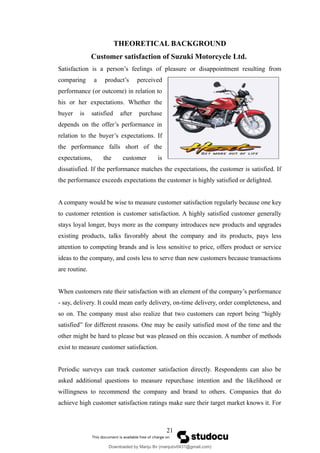
  • 19.
    The economic boomwitnessed in the country and the increased migration to urban areas have increased the traffic congestion in Indian cities and worsened the existing infrastructure bottlenecks. Inadequate urban planning has meant that transport systems have not kept pace with the economic boom and the growing urban population. This has increased the dependence on personal modes of transport and the two wheelers market has benefited from this infrastructure gap. FACTORS AFFECTING THE MARKET: Post 1991, the Indian two-wheeler industry comprising of motorcycles, scooters and scooterettes opened up tremendously. The Indian motorcycle industry has expanded at a 24% CAGR over the last five years, It Captured almost 80% of the market primarily at the cost of the scooter and Moped segment. The scooter segment though has witnessed a revival with the launch of scooterettes aimed at young women and adolescents. The two-wheeler market can be segmented into three categories on the basis of price – Entry segment (<35000), Executive segment (between 35000 and 45000) Deluxe (between 45000 and 65000) and Premium segment (above 65000). Motorcycles are now sold as a passion, experience rather than a product. New products are being introduced at a rapid pace and brands are gaining prominence. Thus there is an increased focus on the premium segment, which has an increased scope for differentiation. Purchasing Power is relatively high with buyers becoming more discriminating. Reliability and economy have become more of a hygiene factor. Buyers now demand two-wheelers that fit their personality thus increasing the scope for differentiation and branding. Provision of financing through EMI’s has provided a means to satisfy the need of possess a convenient and stylish mode of transport in the form of a two- wheeler. This has resulted in higher growth in the 125-150cc segment. With the introduction of Government policies such as reduction in excise duty from 16% to 12% and allowing for 100% FDI Barriers to entry has reduced. However, the investment required for setting up large distribution channels and service stations can be a major entry barrier. Another significant entry barrier is the brand building required. Thus, initially foreign players set up Joint Ventures with indigenous 8 Downloaded by Manju Bv (manjubv0431@gmail.com) lOMoARcPSD|44080849
  • 20.
    companies. After establishingtheir brand they have launched their own line of products. E.g. Honda with Hero Group and Yamaha with Escorts. Rising Customer Expectations: The growth witnessed by the Indian two wheeler industry has attracted a number of new entrants to the market and it is expected that the Indian industry will become more competitive in the future. The excess of products introduced in the past has also raised customer expectations with respect to reliability, styling, performance and economy. Inflation is a big factor that may play a part in moving the loyalties and aspirations of people away from the four to the much cheaper and economical two-wheeler segment. Moreover, the constantly increasing prices of oil and increasing interest rates on finance are not helping the cause either. Environmental Concerns are also quite big on the agenda these days and do play a part in the preference of consumer’s choices. The rising global temperatures along with daily snippets in the national and international media about the thinning of ozone and imminent environmental disaster have all contributed to the making of a present day environmentally conscious consumer. Environmental and Safety Concerns: The increasing demand for two wheelers will need to be managed to address issues relating to overcrowding of roads. Another problem is the insufficient infrastructure for inspection to ensure adherence to emission norms. As the industry grows, it is important to regulate the sale of used two wheelers in a more organized manner for which a mechanism needs to be evolved. Unregulated sale of two wheelers, especially in the rural areas, are likely to create issues related to emissions and safety of vehicles. The History of the automobile actually began about 4,000 years ago when the first wheel was used for transportation in India. Several Italians recorded designs for wind- driven vehicles. The first was Guido da Vigevano in 1335. It was a windmill-type drive to gears and thus to wheels. Vaturio designed a similar vehicle that was also never built. Later Leonardo da Vinci designed clockwork-driven tricycle with tiller steering and a differential mechanism between the rear wheels. 9 Downloaded by Manju Bv (manjubv0431@gmail.com) lOMoARcPSD|44080849
  • 21.
    In the early15th century, the Portuguese arrived in China and the interaction of two cultures led to a variety of new technologies, including the creation of a wheel that turned under its own power. By the 1600s, small steam-powered engine models were developed, but it was another century before a full-sized engine-powered vehicle was created. A Catholic priest named Father Ferdinan Verbiest is credited to have built a steam- powered vehicle for the Chinese Emperor Chien Lung in about 1678. There is no information about the vehicle, only the event. Since James Watt didn’t invent the steam engine until 1705, we can guess that this was possibly a model vehicle powered by a mechanism like Hero’s steam engine-a-spinning wheel with jets on the periphery. Although by the mid-15th century the idea of a self-propelled vehicle had been put into practice with the development of experimental vehicles powered by means of springs, clockworks, and the wind, Nicolas-Joseph Cugnot of France is considered to have built the first true automobile in 1769. Designed by Cugnot and constructed by M.Brezin, it is also the first vehicle to move under its own power for which there is a record. Cugnot’s three-wheeled steam-powered vehicle carried four persons and was meant to move artillery pieces. It had a top speed of a little more than 3.2 km/h (2 mph) and had to stop every 20 minutes to build up a fresh steam. Evans was the first American who obtained a patent for “a self-propelled carriage.” He, in fact, attempted to create a two-in-one combination of a steam wagon and a flat- bottomed boat, which didn’t receive any attention in those days. During the 1830’s, the steam vehicle had made great advances. But stiff competition from railway companies and crude legislations in Britain forced the poor steam vehicle gradually out of use on roads. Carl Benz and Gottlieb Daimler, both Germans, share the credit of changing the transport habits of the world, for their efforts laid the foundation of the great motor industry, as we know it today. First, Carl Benz invented the petrol engine in 1885 and a year later Daimler made a car driven by motor of his own design and the rest is history. 10 Downloaded by Manju Bv (manjubv0431@gmail.com) lOMoARcPSD|44080849
  • 22.
    Daimler’s engine provedto be a great success mainly because of its less weight that could deliver 1000rpm and needed only very small and light vehicles to carry them. France too had joined the motoring scenario by 1890 when two Frenchmen Panhard and Levassor began producing vehicles powered by Daimler engine, and Daimler himself, possessed by the automobile spirit, went on adding new features to his engine. He built the first V-Twin engine with a glowing platinum tube to explode the cylinder gas-the very earliest form of sparking plug. Charles Duryea built a motor carriage in America with petrol engine in 1892, followed by Elwood Haynes in 1894, thus paving the way for motorcars in that country. For many years after the introduction of automobiles, three kinds of power sources were in common use: steam engines, gasoline or petrol engines, and electric motors. In 1900, over 2,300 automobiles were registered in New York, Boston, Massachusetts, and Chicago. Of these, 1,170 were steam cars, 800 were electric cars, and only 400 were gasoline cars. In ten years from the invention of the petrol engine, the motorcar had evolved itself into amazing designs and shapes. By 1898, there were 50 automobile-manufacturing companies in the United States, a number that rose to 241 by 1908. In that year, Henry Ford revolutionized the manufacture of automobiles with his assembly-line style of production and brought out the Model T, a car that was inexpensive, versatile, and easy to maintain. Herbert Austin and William Morris, two different carmakers, introduced mass production methods of assembly in the UK, thus paving the way for a revolution in the automobile industry. Austin Seven was the world’s first practical four-seater ‘baby car’ which brought the pleasures of motoring to many thousands of people who could not buy a larger, more expensive car. Even the ‘bull-nose’ Morris with front mounted engine became the well-loved model and one of the most popular cars in the 1920s. 11 Downloaded by Manju Bv (manjubv0431@gmail.com) lOMoARcPSD|44080849
  • 23.
    SEGMENTATION OF TWOWHEELER: A Two Wheeler Sector Sub-Segmenting in the three Segments.  Motorcycle  Scooter  Mopeds Fig. 1.1: Trend in 2W Volumes by Category: Fig. 1.2: Trend in 2W Sales Volumes, Domestic and Exports: 12 Downloaded by Manju Bv (manjubv0431@gmail.com) lOMoARcPSD|44080849
  • 24.
    Table 1.1: DomesticMarket Share for 2014-15 Passenger Vehicles 15.86 Commercial Vehicles 4.32 Three Wheelers 3.58 Two Wheelers 76.23 Fig. 1.3: Segment Wise Market Share in 2016-17 Passenger Vehicles; 15.86% Commercial Vehicles; 4.32% Three Wheelers; 3.58% Two Wheelers; 76.24% Segment Wise Market Share in 2016-17 1.2 Objective of the study  The objective of the study is “Company image SUZUKI MOTORCYCLES and Survey research to measure customer satisfaction towards SUZUKI ACCESS 125.  To understand customer attitude towards Suzuki motorcycles and Suzuki auto.  To measure customer satisfaction of Suzuki Access 125 owners.  To know the market share of Suzuki motorcycles.  To know the tastes and preferences of people.  To find the reasons for buying Access 125. 13 Downloaded by Manju Bv (manjubv0431@gmail.com) lOMoARcPSD|44080849
  • 25.
     To determinethe customer’s satisfaction regarding two-wheeler and after sales service. SCOPE OF STUDY This study is aimed at providing SUZUKI MOTORCYCLES INDIA PVT. LTD. with an insight on the consumer satisfaction pattern of Suzuki Access 125cc as well as the customer’s response and awareness towards the brand, products and services of Suzuki. The data has been analyzed and presented in a simple and precise way on the basis of which pertinent recommendations have been made to the company to better the services, policies and strategies of the company in India. Companies also want the Suggestion for improvement from users of Suzuki Vehicle & get Feedback from customer. 1.3 Literature review And/or Theoretical Background. Motorcycles are the most expensive of all two-wheelers. They are more powerful than scooters and mopeds, have the highest load carrying capacity (which is essential for rural areas), are fuel-efficient, have better road grip, and are the most expensive. Besides, motorcycles are viewed as “trendy” in the urban areas as compared with scooters and mopeds. Motorcycle production in India began in 1952, when Enfield India Limited commenced manufacture at its plant in Tamil Nadu. It was the only motorcycle producer in the country until the early 1960s when Ideal Jawa (India) Private Limited and Escorts Limited entered the market. By 1970-71, production of motorcycles had reached 39,000 units per annum. The fortunes of the motorcycle industry changed after the announcement of the liberal licensing policy in 1982 whereby foreign collaboration was allowed. In 1982, the Government allowed foreign players to enter the industry through joint ventures. Within four years, the TVS Group tied up with Suzuki, the Hero Group with Honda, the Escorts Group with Yamaha, and Bajaj Auto Limited (Bajaj Auto) with Kawasaki. TVS Suzuki introduced Ind-Suzuki in 1984, Hero Honda Motors Limited (HHML) 14 Downloaded by Manju Bv (manjubv0431@gmail.com) lOMoARcPSD|44080849
  • 26.
    launched CD100 in1985, and both Escorts and Bajaj Auto launched their models in 1986-87. These models catered for the upwardly mobile, middle-to-upper income group consumers who preferred a stylish, powerful vehicle that could be used as an urban personal transportation vehicle. The principal brands that competed in the 1980s were the HHML CD100 (a four-stroke 100cc), the Ind-Suzuki AX100 (from TVS, two-stroke, 100cc) and the Escorts- Yamaha RX100 (two-stroke, 100cc). While the CD100 was positioned primarily on the efficiency plank, giving riders an unprecedented mileage of 80 kms per litre (kmpl), the RX100 became popular with young buyers because of its high power. The AX100 took the middle path, balancing power with reasonable fuel efficiency. To reinforce its image of being a maker of powerful motorcycles, Escorts launched the 350cc twin-carb, twin-cylinder Yamaha RD350, a vehicle that soon gained cult status. It offered 36bhp, but was plagued by problems—very few mechanics could tune the engine and the average fuel consumption was as low as 15 kmpl. Subsequently, the product had to be discontinued. The launch of the 100cc motorcycles was path breaking, as till then the existing big models like the Yezdi, Rajdoot and Bullet could not compete with scooters. A significant development in the motorcycle industry during the late 1990s was the shift from two-stroke to four-stroke technology. The attraction of the four-stroke technology was earlier limited to fuel efficiency, while two-stroke held its own by offering better performance and easier maintenance. But, following the enforcement of India 2000 emission norms beginning April 1, 2000, the less polluting four-stroke has become the preferred technology. The two-stroke technology can also meet the existing environment norms, but only when supplemented by catalytic converters—an option that is both costly and shortsighted. The high temperature of the exhaust, combustion irregularities, the problem of lubricating oil contamination with metallic additives, and finally, fuel adulteration can poison the catalyst and render it completely ineffective. Further, the use of catalytic converter affects the initial pick- up of two-stroke engines, which is one of their main attractions. Given these shortcomings, most motorcycle manufacturers have offered four-stroke vehicles. While the four-stroke motorcycle segment is the fastest growing, it is also highly competitive. Competition has intensified in this segment since CY2001 when players introduced new products at a relatively fast pace. Also, new entrants have entered the 15 Downloaded by Manju Bv (manjubv0431@gmail.com) lOMoARcPSD|44080849
  • 27.
    market by introducingtheir products at lower price points, while the existing players have announced price cuts. This has led to price competition in the domestic market. At the lower end of the segment, Bajaj Auto has its Boxer range of motorcycles and Byk; HHML has Dawn as well as CD Dawn and KEL Boss. Above this segment, there are strong brands such as Victor (TVS), Passion and Splendor (HHML), Caliber 115 and Aspire (Bajaj Auto), Freedom, Adreno and Energy (LML), and Crux R (Yamaha). Through its CBZ model, HHML had tapped the premium segment of the market in 1999. Since then, however, quite a few models such as Pulsar 180 by Bajaj Auto and Fiero by TVS have been launched in this segment. Royal Enfield is the market leader in the lifestyle segment. This segment has also attracted new model launches such as Eliminator by Bajaj Auto, Aquila by KEL and Karizma by HHML. NEED FOR FOUR-STROKES BIKES Growth of Bikes Significant growth has been witnessed in the motor cycle segment and the company is fully aware of the need to enter in this segment for maintaining growth and optimizing product mix the growth in motor cycle is attributed largely to the opening up the rural markets and also to its wider acceptance in the youth market. It is growing at any average rates of 20% over the last three years. Another high legal is that the motorcycle sales have surpassed the scooter sales for the first time in 1998-1999 until then motorcycle was always trailing behind. The two-wheeler industry has been rather slow in taking advantages of the board bandings introduced in Rajeev Gandhi time way back in 1994. Even today, there are manufactures such as Escort, Hero Honda, Bajaj, Yamaha and LML, which later to only a single segment like motorcycle or scooter. Any variation of demand in a particular segment hits them hands it is therefore a product policy to have presence in each segment. Table 1.2: Growth of two-wheeler 2014-2016 2016-2017 GROWTH % 16 Downloaded by Manju Bv (manjubv0431@gmail.com) lOMoARcPSD|44080849
  • 28.
    BIKE 2.95 3.81+29 SCOOTER 3.32 2.95 -11 MOPEDS 1.54 1.58 +2.8 TOTAL IN LACS 7.9 8.35 +16.8 SOURCE: Survey of Indian industries in Jan. 2018 Table 1.3: Emission Norms The years 2004 emission norms are more stringent than stringent norms as may be seen from table: GRAMES /K.M. CO HC+NOX 2014 4.5 3.6 2015 2.0 1.5 The industry need to adopt suitable technology so that it can conveniently meet these horns in time since the production largely of two stroke engines figment of catalytic converter will become necessary. But it will lead some in case in prices. The life of these converter is limited to 25/30 thousand hence consumer will prefer something durable and longer lasting. Some manufacture is therefore planning to switch over to stroke technology to comply with the emission norms. It has an additional advantage of more complete combustion of hydrocarbons in petrol, which gives higher mileage and better fuel economy. The 4 strokes bike are currently giving of fuel 70 to 80 km/hr. this will important from consumers point of view because of high price level of petrol in India. It is therefore not surprising that every major player is trying to get into the motor cycle market to have a piece of cake. Amazing……… but true! Just when the market of scooter is shrinking in India residents London seem to be switching to scooter. The number of scooter on Britons road rise 40 %over the part 12 months. As roads get alleged with traffic and average speed of traffic is London has dropped to 19.2 km/hr more and more people are buying scooter to get around traffic shares. Motorcycle association has released figures acknowledging the new popularity of 4- strokes bikes. 17 Downloaded by Manju Bv (manjubv0431@gmail.com) lOMoARcPSD|44080849
  • 29.
    It is alsothis basic condition that entices new players to introduce small or/and lately mini cars into the Indian market. Cases in point are the Tata Nano, and yet another mini car, Renault and Bajaj are planning to introduce in cooperation by 2011 (e.g. Lamparter, 2012). Especially the mini-car projects are likely to have a substantial impact on the Indian automobile sector. As Baig (2012) states: “Impact on the auto market: Priced at nearly half the price of the cheapest Indian car but three times the price of an average motorcycle, the Tata Nano will create a new market niche. It may just end up attracting some 5% of the 7 million annual buyers of two-wheelers and define a new entry level for cars. Indians bought 1.2 million cars last year and the Tata Nano will probably add some 3, 00,000 – 4, 00, 000 new buyers to this. Bigger cars however are likely to remain unaffected and motorcycles and scooters will continue to sell.” (Baig 2012: p. 2) Following table provides a comparative insight about Maruti viz.-a-viz. Tata Nano- However, another 56.8m household was considered to be ‘well off’ able to afford motorcycles and scooters, but not cars. Some of those aspiring consumer households will have already moved into the ‘affluent’ group during the current economic boom. If only 10% of these ‘well-off’ households can move to the next level in the next five years, the number of carowning households could rise by nearly 6m, nearly doubling current levels. Although this structural shift seems eminently achievable, economic shocks – such as a drought or a fiscal crisis that leads to much higher interest rates – could stem demand for a period of time. (The Economist Intelligence Unit Limited, 2006: p. 38). Pawan Chabra (2011) Nowadays every second bike sold in the premium segment is a pulsar and this shows the dominance of Bajaj in the Indian market place, this was possible because the company has been regularly making the alterations to make the motorbike look fresh at all times and Bajaj today holds over 50% market in the premium segment (for FY 2016-2017) followed by a distant second largest player Honda Motorcycle & scooter India with a 19% market share. V.G. Ramakrishnan (2003) The two-wheeler market that has seen an explosive rise in sales over the last few years which created an opportunity for various companies to enter the after sales business of two wheeler, Castrol, a company well known for its lubricants, has entered into the motorcycle servicing business with the roll out of its first workshop 'Castrol PrimaZona' and have plans to have pan India presence. 18 Downloaded by Manju Bv (manjubv0431@gmail.com) lOMoARcPSD|44080849
  • 30.
    Pawan Chabra (2011)has mentioned that the death knell off Bajaj’s scooters business was sounded when the company officially stopped the production of its flagship Chetak in December 2002, to get cracking on its ambition of becoming a credible motorcycle brand manufacturer, the company invested big in R&D and product development, but the company faced challenges in the sales and distribution because their dealers had little idea how to sell motorcycles, so the entire dealership network was trained to sell motorcycles. Breno and David , (2015) conducted research on title „Green Operations Initiatives in the Automotive Industry The purpose of this study is to focus on investigating and ‟ benchmarking green operations initiatives in the automotive industry documented in the environmental reports of selected companies. The investigation roadmaps the main environmental initiatives taken by the world s three major car manufacturers ‟ and benchmarks them against each other. The categorization of green operations initiatives that is provided in the paper can also help companies in other sectors to evaluate their green practices. The findings show that the world s three major car ‟ manufacturers are pursuing various environmental initiatives like following green operations practices: green buildings, eco-design, green supply chains, green manufacturing, reverse logistics and innovation. Patrali, (2014) carried out research on „Green brand extension strategy and online communities The purpose of this study was to examine current and prospective ‟ consumer perceptions, purchase intent and parent brand evaluation due to green brand – line and category extensions by marketers of established (non-green) brands for products with high versus low perceived environmental impact. The results suggest that consumers are more likely to purchase green extensions of products with high perceived environmental impact and that current consumers prefer green line extensions to green category extensions. Both have similar reciprocal impact on parent brand evaluation among current consumers. Gian and Deborah (2015) conducted research on „Green labels and sustainability reporting , The paper aims to ‟ contribute to the understanding of corporate sustainability reporting strategies and communication tools that are increasingly being adopted to foster green market outlets, with focus on the building materials supply chain. Focusing on the present Italian situation and with emphasis on ornamental stones, ceramic tiles, cement and 19 Downloaded by Manju Bv (manjubv0431@gmail.com) lOMoARcPSD|44080849
  • 31.
    concrete products, theinterest and the response in the building materials supply chain are highlighted, pointing out strengths, weaknesses and future perspectives. 20 Downloaded by Manju Bv (manjubv0431@gmail.com) lOMoARcPSD|44080849
  • 32.
    THEORETICAL BACKGROUND Customer satisfactionof Suzuki Motorcycle Ltd. Satisfaction is a person’s feelings of pleasure or disappointment resulting from comparing a product’s perceived performance (or outcome) in relation to his or her expectations. Whether the buyer is satisfied after purchase depends on the offer’s performance in relation to the buyer’s expectations. If the performance falls short of the expectations, the customer is dissatisfied. If the performance matches the expectations, the customer is satisfied. If the performance exceeds expectations the customer is highly satisfied or delighted. A company would be wise to measure customer satisfaction regularly because one key to customer retention is customer satisfaction. A highly satisfied customer generally stays loyal longer, buys more as the company introduces new products and upgrades existing products, talks favorably about the company and its products, pays less attention to competing brands and is less sensitive to price, offers product or service ideas to the company, and costs less to serve than new customers because transactions are routine. When customers rate their satisfaction with an element of the company’s performance - say, delivery. It could mean early delivery, on-time delivery, order completeness, and so on. The company must also realize that two customers can report being “highly satisfied” for different reasons. One may be easily satisfied most of the time and the other might be hard to please but was pleased on this occasion. A number of methods exist to measure customer satisfaction. Periodic surveys can track customer satisfaction directly. Respondents can also be asked additional questions to measure repurchase intention and the likelihood or willingness to recommend the company and brand to others. Companies that do achieve high customer satisfaction ratings make sure their target market knows it. For 21 Downloaded by Manju Bv (manjubv0431@gmail.com) lOMoARcPSD|44080849
  • 33.
    customer centered companies,customer satisfaction is both a goal and a marketing tool. Although the customer-centered firm seeks to create high customer satisfaction, that is not its ultimate goal. If the company increases customer satisfaction by lowering its price or increasing its services, the result may be lower profits. The company might be able to increase its profitability by means other than increased satisfaction (for example, by improving manufacturing processes or investing more on R&D). Also, the company has many stakeholders, including employees, dealers, suppliers and stock holders. Spending more to increase customer satisfaction might divert funds from increasing the satisfaction of other “partners”. Ultimately, the company must operate on the philosophy that it is trying to deliver a high level of customer satisfaction subject to delivering acceptable levels of satisfaction to the other stakeholders, given its total resources. Customer Satisfaction in 7 Steps It's a well known fact that no business can exist without customers. In the business of Website design, it's important to work closely with your customers to make sure the site or system you create for them is as close to their requirements as you can manage. Because it's critical that you form a close working relationship with your client, customer service is of vital importance. What follows are a selection of tips that will make your clients feel valued, wanted and loved. 1. Encourage Face-to-Face Dealings: This is the most daunting and downright scary part of interacting with a customer. If you're not used to this sort of thing it can be a pretty nerve-wracking experience. Rest assured, though, it does get easier over time. It's important to meet your customers face to face at least once or even twice during the course of a project. Suzuki believes that if a potential client spends over half the meeting doing the talking, you're well on your way to a sale. In SMPIL always face to face dealing with customer 22 Downloaded by Manju Bv (manjubv0431@gmail.com) lOMoARcPSD|44080849
  • 34.
    2. Respond toMessages Promptly & Keep Your Clients Informed: This goes without saying really. We all know how annoying it is to wait message and you'll contact them about it as soon as possible. Even if days for a response to an email or phone call. It might not always be practical to deal with all customers' queries within the space of a few hours, but at least email or call them back and let them know you've received their you're not able to solve a problem right away, let the customer know you're working on it. Suzuki always listen customer problem and solve his queries and always have communication with customer. 3. Be Friendly and Approachable: It's very important to be friendly, courteous and to make your clients feel like you're their friend and you're there to help them out. There will be times when you want to beat your clients over the head repeatedly with a blunt object - it happens to all of us. It's vital that you keep a clear head, respond to your clients' wishes as best you can, and at all times remain polite and courteous. In Suzuki showroom all workers are trained and well behave with customer. Suzuki showroom’s staff very friendly with clients. 4. Have a Clearly-Defined Customer Service Policy: This may not be too important when you're just starting out, but a clearly defined customer service policy is going to save you a lot of time and effort in the long run. If a customer has a problem, what should they do? If the first option doesn't work, then what? Should they contact different people for billing and technical enquiries? If they're not satisfied with any aspect of your customer service, who should they tell? There's nothing more annoying for a client than being passed from person to person, or not knowing who to turn to. Making sure they know exactly what to do at each stage of their enquiry should be of utmost importance. So make sure your customer service policy is present on your site -- and anywhere else it may be useful. In Suzuki all terms & conditions are clearly mentioned so that no doubt in customer mind 23 Downloaded by Manju Bv (manjubv0431@gmail.com) lOMoARcPSD|44080849
  • 35.
    5. Attention toDetail (also known as 'The Little Niceties'): Have you ever received a Happy Birthday email or card from a company you were a client of? Have you ever had a personalized sign-up confirmation email for a service that you could tell was typed from scratch? These little niceties can be time consuming and aren't always cost effective, but remember to do them. Even if it's as small as sending a Happy Holidays email to all your customers, it's something. It shows you care; it shows there are real people on the other end of that screen or telephone; and most importantly, it makes the customer feel welcomed, wanted and valued. Suzuki has keep detail of all customers and make them happy on specific occasion. 6. Anticipate Your Client's Needs & Go Out Of Your Way to Help Them Out: Sometimes this is easier said than done! However, achieving this supreme level of understanding with your clients will do wonders for your working relationship. Suzuki always tries to know about customer needs and make the product according to them. 7. Honour Your Promises: It's possible this is the most important point in this article. The simple message: when you promise something, deliver. The most common example here is project delivery dates.Clients don't like to be disappointed. Sometimes, something may not get done, or you might miss a deadline through no fault of your own. Projects can be late, technology can fail and sub-contractors don't always deliver on time. Product Strategies – The product is one of the most important components of a marketing program. Suzuki has two products in India market. One is HEAT and ZEUS bike: 24 Downloaded by Manju Bv (manjubv0431@gmail.com) lOMoARcPSD|44080849
  • 36.
    TABLE 1.4: SUZUKIMOTORCYCLE HEAT *Drum Brake *Kick Start Dimensions And Dry Mass Overall length 2040 mm Overall width 770 mm Wheelbase 1240 mm Ground clearance 155 mm Overall height 1085 mm Dry mass 110 kgs Engine Type Four-stroke, Air-cooled,OHC Number of cylinders 1 Bore x Stroke 53.5 mm x 55.2 mm Displacement 124 cm3 (cc) Compression ratio 9.6:1 Carburettor VM18 Air cleaner Non-woven fabric element Starter system Kick Lubrication system Wet sump Transmission Clutch Wet multi-plate type Transmission 5-speed constant mesh Gearshift patterm 1-down, 4-up Chassis Front suspension Telescopic, Coil spring, Oil damped Rear suspension Swing-arm type, Coil spring, Oil damped Front brake Drum brake (130 mm) Rear brake Drum brake (130 mm) Front tyre size 2.75 -18.4PR Rear tyre size 3.00-18.6PR Electrical Ignition type Electronic Ignition (CDI) Spark plug NGK Battery 12V 9.0kC (2.5 Ah)/10HR Headlight 12V 35/35W Brake light/Tail-Light 12V 21/5W Fuel Tank : Capacities Including reserve 12.0 L Reserve 2.1 L Introducing the new Heat 125. Packed with genuine Suzuki technology, it delivers instant pickup, smoother performance and superb fuel-efficiency unmatched by any other motorcycle in its class. So, the riders get more from life, every moment, mile after mile. 25 Downloaded by Manju Bv (manjubv0431@gmail.com) lOMoARcPSD|44080849
  • 37.
    TABLE 1.5: SUZUKIMOTORCYCLE ZEUS 125X *Drum/Disc Brakes *Kick Start Dimensions And Dry Mass Overall length 2040 mm Overall width 770 mm Wheelbase 1240 mm Ground clearance 155 mm Overall height 1125 mm Dry mass 114 kgs Engine Type Four-stroke, Air-cooled,OHC Number of cylinders 1 Bore x Stroke 53.5 mm x 55.2 mm Displacement 124 cm3 (cc) Compression ratio 9.6:1 Carburettor VM18 Air cleaner Non-woven fabric element Starter system Kick Lubrication system Wet sump Transmission Clutch Wet multi-plate type Transmission 5-speed constant mesh Gearshift patterm 1-down, 4-up Chassis Front suspension Telescopic, Coil spring, Oil damped Rear suspension Swing-arm type, Coil spring, Oil damped Front brake Disc brake Rear brake Drum brake (130 mm) Front tyre size 2.75 -18.42P Rear tyre size 3.00-18.52P Electrical Ignition type Electronic Ignition (CDI) Spark plug NGK Battery 12V 9.0kC (2.5 Ah)/10HR Headlight 12V 35/35W Brake light/Tail-Light 12V 21/5W Fuel Tank : Capacities Including reserve 12.0 L Reserve 2.1 L Introducing the new Zeus 125X. Packed with genuine Suzuki technology and incredible style. Delivering instant pickup, smoother performance and superb fuel- 26 Downloaded by Manju Bv (manjubv0431@gmail.com) lOMoARcPSD|44080849
  • 38.
    efficiency unmatched byany other motorcycle in its class. Giving its riders the best of both worlds. Fig. 1.4: CLASSIFICATION OF THE BIKE ACCORDING TO THE DISPLACEMENT & START Bikes with Disc & Drum brakes DISC Brake DRUM Brake Bajaj WIND Bajaj DISCOVER Hero Honda ACHIVER Hero Honda GLAMOUR Hero Honda SUPER SPLENDOR ES Hero Honda ACHIVER Hero Honda SUPER SPLENDOR KS TVS VICTOR EDGE Kinetic GF Kinetic GF LML FREEDOM PRIMA Yamaha FAZER Yamaha FAZER LX Yamaha R X 135 SUZUKI HEAT LML FREEDOM PRIMA Above cc bikes with Disc & Drum brakes DISC Brake DRUM Brake Hero Honda KARIZMA Kinetic GF Kinetic COMET Kinetic GF 125-150cc bikes with Kick & Self start KICK Start SELF Start Bajaj DISCOVER 125 Bajaj DISCOVER 125 Bajaj WIND 125 Hero Honda GLAMOUR TVS FIERO F2 Kinetic GF 125 TVS FIERO FX Honda UNICORN TVS VICTOR EDGE TVS VICTOR GLX Hero Honda ACHIVER Hero Honda GLAMOUR Yamaha FAZER Yamaha FAZER LX Yamaha R X 135 LML GRAPTOR Honda UNICORN SUZUKI ZUES 125 SUZUKI HEAT 27 Downloaded by Manju Bv (manjubv0431@gmail.com) lOMoARcPSD|44080849
  • 39.
    150 & abovecc bikes with Kick & Self start KICK Start SELF Start Bajaj AVENGR Hero Honda GLAMOUR 125-150cc bikes with Drum/Disc brakes Suzuki ZEUS 125X Bajaj PULSAR 150 DTSi TVS FIERO F2 TVS FIERO FX TVS VICTOR EDGE TVS VICTOR GLX Hero Honda GLAMOUR Yamaha FAZER DIX Yamaha FAZER DX LML GRAPTOR Honda UNICORN 150 & above cc bikes with Drum/Disc brakes Bajaj PULSAR 180 DTSi Bajaj AVENGR Kinetic AQUILA Kinetic GF LASER 125-150cc bikes with Kick/Self start Bajaj PULSAR 150 DTSi Kinetic GF 125 Yamaha FAZER DIX Yamaha FAZER DX 150 & above cc bikes with Kick/Self start Hero Honda KARIZMA Bajaj PULSAR 180 DTSi Kinetic AQUILA Kinetic COMET Kinetic GF 170 Kinetic GF LASER 28 Downloaded by Manju Bv (manjubv0431@gmail.com) lOMoARcPSD|44080849
  • 40.
    SWOT ANALYSIS SUZUKI MOTORCYCLEINDIA 1) Strengths:  Size and scale of parent company  Effective Advertising Capability  Committed and dedicated staff  High emphasis on R & D  Experience in the market  Established brand 2) Weaknesses:  Small showrooms  Not much emphasis on aggressive selling  Weak product diversity 3) Opportunities:  Growing premium segment  Global expansion into the Caribbean & Central America  Become India’s leader  Growing premium segment. 4) Threats:  Cut throat competition  Increasing number of players in the market  Rising raw material costs  Increasing rates of interest on finance 29 Downloaded by Manju Bv (manjubv0431@gmail.com) lOMoARcPSD|44080849
  • 41.
    Table 1.6: PORTER’SFIVE FORCES MODEL OF AUTOMOBILE INDUSTRY Barriers to entry Threat of substitutes High capital costs, technology, distribution network, and availability of auto components Threat of substitutes is low because of lower functional performance . . Bargaining power of suppliers Low, due to stiff competition and its fragmented nature. Bargaining power of customers Very high due to availability of options Competition Except for heavy CV segment, competition is stiff. Expected to increase even further. 30 Downloaded by Manju Bv (manjubv0431@gmail.com) lOMoARcPSD|44080849
  • 42.
    Fig. 1.5: PORTER’SFIVE FORCES MODEL OF AUTOMOBILE INDUSTRY PROSPECTS -: The government spending on infrastructure in roads and airports and higher GDP growth in the future could benefit the auto sector in general. This combined with a softer interest rate environment will play a vital role in providing a fillip to demand. We expect a slew of launches in the Segment 'B' of passenger cars. Utility vehicle segment is expected to grow at around 8% in the long-term. 31 HIGH HIGH L O W LOW HIGH Downloaded by Manju Bv (manjubv0431@gmail.com) lOMoARcPSD|44080849
  • 43.
    In the two-wheelersector, motorcycle segment is expected to witness a flurry of new model launches. Though the market size is expected to grow by 12% -15%, competitive pressure could keep prices and margins under control. While geared scooter and moped segments could see a fall in volumes, TVS, Honda and Kinetic Motors are poised to benefit from higher demand for unguarded scooters in the urban and rural market. However, Bajaj and Hero Honda are also planning to enter in this segment and to that extent, competition is likely to increase The reduction in peak customs duty from 25% to 20% in the budget will result in savings on the raw material front as well. Since raw material costs account for almost 50% of operating costs of auto companies in general, this is a positive. Also, steel prices have shown some signs of softening and this is likely to have a positive impact on the margins 32 Downloaded by Manju Bv (manjubv0431@gmail.com) lOMoARcPSD|44080849
  • 44.
    CHAPTER-II COMPANY PROFILE /INDUSTRY PROFILE OR DETAILS SUZUKI MOTORCYCLES GLOBAL HISTORY 33 Downloaded by Manju Bv (manjubv0431@gmail.com) lOMoARcPSD|44080849
  • 45.
    In 1909 MichioSuzuki founds the Suzuki Loom Company in Hamamatsu, Japan. He builds industrial looms for the thriving Japanese silk industry. 1937 To diversify activities, the company experiments with several interesting small car prototypes, but none go into production because the Japanese government declares civilian automobiles “non-essential commodities” at the onset of WWII. In 1952 when due to financial problems Suzuki ventured into developing clip on engines to bicycle frames. The first model was called the Power Free (36cc) and the follow-up model was the Diamond Free (60cc). Suzuki produced its first motorcycle in 1954 called the Colleda (90cc). Suzuki built small capacity bikes during the 50s and 60s and had only small export success until the introduction of the X6 (T20 super six), which gave Suzuki much name credibility. In 1962 Using MZ’s technology, Suzuki wins the newly created 50cc class in the World Championship. The company will win the class every year until ’67, and win the 125cc class twice in that period, too. With a well-established name Suzuki dared enter the big bike market and in 1967 Suzuki introduced T500. Which was known as the Titan in America and the Cobra in England? The name changed over the years to GT500 due to many improvements but it was purely the sharp price and good reliability, which kept the GT in production until 1977. In 1971 The GT7The Water Buffalo was introduced in 1971 in America and the Kettle in Britain - both the same GT750 bike and the start for Suzuki to enter the super bike market. The GT750 wasn't a very impressive machine and also couldn't match the other bikes in the market at the time. Once again the production kept going based on its demand for good price and reliability. In 1974 The RE5 is the first Japanese motorcycle with a rotary engine. It cost a fortune to develop and, while not bad, it’s a commercial disaster. After two years, the company abandons the project, and there are rumors the tooling was dumped into the sea so that Suzuki managers would never have to see it again. Most bikes produced around the middle 70s had enough power but lacked a steady frame. The introduction of the Suzuki GS1000 in 1978 changed this problem once and for all. The GS out preformed every other bike in its category and had a frame to match its power. The 34 Downloaded by Manju Bv (manjubv0431@gmail.com) lOMoARcPSD|44080849
  • 46.
    only thing, whichcould be said against the very popular and successful GS1000, was its dull looks. The GS1000 was redesigned and new models based on the same original success bike were introduced. The GSX1000 in 1980 and the GSX1100S Katana in 1982. The later bike was a huge success due to it powerful performance, funky style, low weight and good pricing. In 1983 The RG250 is Suzuki’s first ever race replica. This bike features the AL-BOX, square aluminum frame, 16-inch tire and Anti Nose Dive Forks (ANDF) at the front. In 1985 The RG500 “Gamma” features the same square-Four cylinder layout as the as the factory Grand Prix bikes. Other racy features are the square-tube aluminum frame and the removable cassette-type transmission. Suzuki pulled a stunt within the motorcycle market by introducing the GSX-R750, which was such a direct copy of their formula race bike with the only difference that this GSX was, road legal. It turned the super sport motorcycle market upside down and dominated the way super bikes would look for the future. The GSX-R750 was super fast, which wasn't hard to understand since there were hardly any changes to its racetrack design. Both on the street and in the race track the bike was a huge success. In 1986 the GSX-R1100 was also added to the line. In 1996 Suzuki calls the new GSX-R750 the ‘turning-point model’ thanks to its twin- spar frame instead of the older double-cradle frame. The engine is also redesigned and featured 3-piece crankcases, chrome-plated cylinders and a side-mount cam chain as well as Suzuki Ram Air Direct (SRAD) system. In 1997 The TL1000S is the first Suzuki sport bike with a V-Twin engine. It will be followed a year later by a racier R version, with a dodgy rotary vane damping system in the rear shock. Suzuki equipped the TL1000R with a steering damper, but it was still prone to headshake and customers approached it with caution, if at all. In 1999 Mat Mladin wins the AMA Super bike Championship, beginning a run of unprecedented dominance. Mladin will win five more times, and Suzuki will win 8 of the next 9 titles. With sport bikes getting more and more sharp edged, the company is one of the first to recognize what might be called the ‘semi-sport’ market, as opposed 35 Downloaded by Manju Bv (manjubv0431@gmail.com) lOMoARcPSD|44080849
  • 47.
    to the supersport market. The SV650 features an aluminum-alloy truss frame and a liquid-cooled 90° V-Twin DOHC 4-valve engine. Suzuki calls the Hayabusa the ultimate aerodynamic sportbike. It’s powered by a 1298cc liquid-cooled DOHC in- line 4-cylinder engine that becomes the darling of land-speed racers. The name means “peregrine falcon” in Japanese. The GSX style and line didn't change much over all the years with improvements being made to the bike. A small fluke in design made Suzuki lose its performance lead with the GSX-R1100. But the GSX-R750 has remained a hit up until today. Maybe still hurt by losing the performance edge with the GSX-R1100 redesign in the 1990s Suzuki introduced the GSX-1300R (Hayabusa) in 1999. This sent the Honda Blackbird packing and became the world's fastest production bike at a whopping 190 mph (307 km/h). In 2001 Suzuki introduced an upgrade GSX-R750 engine and created the GSX-R1000 (998cc), which is a super bike with outstanding performance. In 2003 the GSX-R1000 was restyled but still kept its position as a super class bike. In 2005 Suzuki’s original 4-stroke motocross, the RM-Z450, is equipped with a 4- stroke 449cc engine, which features the Suzuki Advanced Sump System (SASS). Troy Corser gives Suzuki its first and only (so far) World Super bike Championship. In 2006 The M109R, Suzuki’s flagship V-Twin cruiser is powered by a 1783cc V- Twin engine with 112mm bore and 90.5mm stroke. It has the largest reciprocating pistons in any production passenger car or motorcycle. In 2012 The B-King is launched, powered by the 1340cc Hayabusa engine; the B- King is Suzuki’s flagship big ‘Naked’ bike. Suzuki says it has the top-ranked power output in the naked category. SUZUKI MOTORCYCLES INDIA HISTORY Suzuki Motorcycle India Pvt., Ltd. engages in manufacturing two wheelers. The company’s products include motorcycles and scooters. It offers its products through a 36 Downloaded by Manju Bv (manjubv0431@gmail.com) lOMoARcPSD|44080849
  • 48.
    network of dealers.The company was incorporated in 1997 and is based in Gurgaon, India. Suzuki Motorcycle India Pvt., Ltd. operates as the subsidiary of Suzuki Motor Corp. Suzuki Motor Corporation (SMC), a global giant of motorcycle manufacturing is headquartered in Japan. It holds major stake in its Indian subsidiary, Suzuki Motorcycle India Private Limited (SMIL). SMIL was set up after Suzuki's re-entry into the Indian two-wheeler market after it severed ties with partner TVS in 2000-01. Suzuki was then the technology provider in the erstwhile joint venture company TVS Suzuki. Suzuki Motorcycle India Pvt Ltd (SMIPL) is the latest entry into the already crowded Indian two-wheeler segment with players like Hero Honda, Bajaj Auto, Honda, and TVS. SMIPL have started their Indian operations with a 125-cc mass-market motorcycle. It has made an initial investment of Rs. 200 crores to start their Indian operations. Company sources have revealed that Suzuki would follow up this 125cc bike with a high performance 150-cc sibling sometime next year. And for the budget segment, another 100cc bike is expected in the first quarter of 2006. Mass market is the initial aim with plans to enter all the segments rapidly. They have their facilities located in Gurgaon. Suzuki had launched bike by diwali, which is the auspicious time for buying a new vehicle in Indian families. Their setup in Gurgaon has the capabilities of manufacturing one lakh motorcycles and they are ready to step that up massively if the situation arises. They already have setup 40 dealerships around the country and are going to establish 4,000-5,000 sq.ft showroom and service stations to provide services to the customers. The parent company happens to be one of the largest manufacturers of two wheelers in the world with more than 20 lakh bikes sold per annum. They are popular for their range of high performance road machines, lightweight super bikes, dirt bikes, street bikes, and motocross and fun bikes globally. 37 Downloaded by Manju Bv (manjubv0431@gmail.com) lOMoARcPSD|44080849
  • 49.
    COMPANY PROFILE Plant areaand production capacity: They have installed their manufacturing plant in Gurgaon (Haryana) having the annual capacity of 2,50,000 units. Total land area of the facility at Gurgaon is 37 acres out of which the present plant is constructed in an area of 6.5 acres of land. The remaining area of 30.5 acres is left for land development and future expansion. Chairman: Mr. Katsumi Takata Personnel over the years Year 2012-13 Total number of employees 490 Main Products Motorcycles and scooters Head Office, Plants & Facilities Name Address Operations Suzuki Motorcycle India Pvt Ltd Factory Office Village Kherki Dhaula, Badshahapur, N.H.-8, Link Road, Gurgaon. Fax No. - 0124-4170 701 Regd. Office Sales & Marketing Office 2nd Floor, Plot No. 1, Nelson Mandela Road, Vasant Kunj, New Delhi -110 070 Fax No. - 011-4607 5418 Head office affairs Motorcycle engines assembling and machining Spare parts administration Education, training and Public relations Research and development Testing and development of motorcycles MISSION OF SUZUKI The core philosophy of SUZUKI is to provide “VALUE-PACKED PRODUCTS”. Since the founding of SUZUKI Motor Corporation, the Organization’s Endeavour has 38 Downloaded by Manju Bv (manjubv0431@gmail.com) lOMoARcPSD|44080849
  • 50.
    always been toprovide “VALUE-PACKED PRODUCTS” as one of the manufacturing philosophies. SUZUKI believes that “VALUE-PACKED PRODUCTS” come from the effort to carry out Product development from customer’s point of view. This policy has been in effect since Company’s inception and has helped the Organization to meet customer’s needs. As a result, Suzuki’s Products have become well received throughout the World. SUZUKI is fully committed to create Products that meet customer’s demand by utilizing its dynamic, long-nurtured technological advantage coupled with its fresh and active human resources.  Develop products of superior value by focusing on the customers  Establish a refreshing and innovative company through teamwork  Strive for individual excellence through continuous improvement GROWTH REPORT: It has reported a growth of 47.66% in sales in the month of November ‘09 at 14745 units compared to 9986 units same month last year. It has sold 14806 units in December ’09 listing a strong growth of 61% over its sales in December ’08 despite recession. This increase of sales is attributed to the tremendous response from the new product GS150R and ACCESS 125. It has reported 93% growth in sales during the month of January 2015. It has sold 20441 units in January ‘10 listing a strong growth of 93% over its sales in January ‘09. It has sold 21752 units in March ‘10 listing an impressive growth of 76% over its sales in March ‘09. This increase of sales is attributed to the tremendous response from the new product GS150R and ACCESS 125. It has great plans for the coming year and this is only the beginning. Their objective is to offer quality products and customer satisfaction to consumers. This growth momentum will further accelerate in coming months. Table 2.1: SMPIL GROWTH REPORT IN ‘2014-‘2015 OEMs 2012-13 2014-15 GROWTH 39 Downloaded by Manju Bv (manjubv0431@gmail.com) lOMoARcPSD|44080849
  • 51.
    BAL 9,692 3,759-61.22% HHML 1,53,193 2,08,440 36.06% HMSI 6,54,319 7,39,947 13.09% KINETIC 5,522 - -100.00% M&M 2W - 70,008 0.00% SMIL 85,782 1,40,983 64.35% TVS 2,39,469 2,99,370 25.01% TOTLE 11,48,007 14,62,507 27.40% Fig. 2.1: Growth FACILITIES 1 ) ENVIRONMENT: The philosophy of keeping “environment first” is properly percolated downwards. To comply with all applicable legislations and setting standards thereof remains only a beginning. Company thrives to discover and invent mechanisms for better environment management systems and it’s a continuous process which is managed by a separate wing of experts and specialist in the field. The biggest testimony of Suzuki’s commitments towards “environment first” is seen at Gurgaon which is built to be a Zero discharge plant. SMIPL have embraced Natural light optimization system and water harvesting systems besides several other measures to create better and cleaner environment 40 Downloaded by Manju Bv (manjubv0431@gmail.com) lOMoARcPSD|44080849
  • 52.
    around us. Allpackaging material used by Suzuki is re-cycleable. A constant flow of internal communication on environment related issues not only creates awareness amongst employees but also helps in inculcating ‘an environment friendly’ value system. 2) SHOP FLOOR SAFETY MEASURES: SMIPL have safety guards/safety curtains to ensure Operator safety on machines. Company has also installed robots through out the facilities to reduce the ergonomic stress on workers. There are gas detection systems installed to eliminate any gas related accident and fire detection system for immediate information about any fire related incident. SMIPL have fire fighting system (manual & automatic) for immediate handling of any fire related accident. They have a fire tender (capacity 4500 liters water and 500 liters capacity foam). Company try to maintain zero accident record through regular safety audit, frequent training for staff, line associates and contractors. They organize different safety programs and competitions to encourage employee awareness and involvement. 3) ENVIRONMENTAL UTILITY: To take care of the health of all our employees, they maintain all international parameters and standards for drinking water, treated water, ambient air shop floor, office and the outside. They keep updating all these standards of health and welfare of employees through a team of well qualified personnel in the R & D laboratory. 4) QUALITY CONTROL : It has four main sections as follows:  Tested by SMC Japan with their international quality standards  Final (Vehicle) Inspection  Market Quality 5) PARTS INSPECTION: 41 Downloaded by Manju Bv (manjubv0431@gmail.com) lOMoARcPSD|44080849
  • 53.
     The nonconformities in the parts being procured may lead to production loss & degradation of the quality of the final output and life of the product. To ensure the product, the dimensional, material, aesthetic & performance inspection for the special processes are carried out on the individual parts before they are declared fit for the assembly  For carrying out the inspection activities effectively, we have the latest & sophisticated machines installed in the inspection area 6) FINAL (VEHICLE) INSPECTION:  Safety related parameters such as braking; clutch operation and other functional defects of the vehicle  Emission related parameters for checking the conformance of the exhaust gases with the emission rules  Functional & aesthetic parameters are also checked 7) MARKET QUALITY:  To act upon the customer’s feedback received from the service department for the up gradation of the product  To resolve the quality issues being received from the market by visiting the suppliers & taking the corrective & preventive measures for the same  Monitoring for the effectiveness of the measures taken for the particular problems through the cut off engine/ frame numbers. 8) WORK CULTURE:  They believe that future growth and prosperity of every employee depends on the company’s growth and prosperity  Organizational and individual discipline  Continual improvement in quality and productivity  Cost consciousness  Customer satisfaction ( both internal and external )  Long term goals  Respect for laws, human beings and society 9) EMPLOYEE DEVELOPMENT: 42 Downloaded by Manju Bv (manjubv0431@gmail.com) lOMoARcPSD|44080849
  • 54.
    Company's growth isbased on enhancement of technical and behavioral skills of the employees. They continually identify the performance gaps and new skills required keeping into the company's growth in focus. They believe that Employees are the most important assets of an organization. For enhancement of technical and behavioral skills of the employees they organize regular training programmers. Teams from Japan often come to the organization to impart training. Their focus is to create a healthy Environment where individual employee can achieve maximum satisfaction. PRODUCTS OF SUZUKI MOTORCYCLES  SUZUKI ACCESS 125CC Suzuki launched the Access 125cc in the month of September 2011. In those days, Access 125 was the third product from Suzuki’s stable in India. Prior to this, Heat and Zeus motorcycles were ruling the Suzuki showrooms PAN India. Suzuki Access 125 is the third product from the Suzuki stable in India after Heat and Zeus motorcycles. 125cc Access is powered by a 125-cc air-cooled four-stroke engine with Continuous Variable Transmission (CVT), which develops 8.5bhp at 7000rpm with 1.0kgm of torque at 5000rpm. The design is typically Japanese, almost flat aprons where large turn indicators are embedded. Though it has a longer wheelbase access looks compact because of this design. No body colored mirrors for this access. Paint quality is of top notch. SUZUKI ACCESS 125 FEATURES:  Xtra Torque Performance (XTP) for more power and faster pick-up  Telescopic front fork suspensions for comfortable riding 43 Downloaded by Manju Bv (manjubv0431@gmail.com) lOMoARcPSD|44080849
  • 55.
     Tail lightsthat are trendy and attractive  Wider seat for comfort riding  Large size underseat compartment  Centralized ignition key switch, with shutter  Smart built-in signal  Multi-reflector lights for better visibility  Stylish, Chrome-plated silencer cover TABLE 2.2: SUZUKI ACCESS 125 TECHNICAL SPECIFICATIONS: Dimensions And Dry Mass Overall length 1780 mm Overall width 650 mm Overall height 1125 mm Wheelbase 1250 mm Ground clearance 160 mm Seat height 780 mm Dry mass 109 kgs Engine Type Four-stroke, Air-cooled,OHC Number of cylinders 1 Displacement 124 cm3 (cc) Max Power 6.4 Kw@7000rpm (8.58hp@7000rpm) Max Torque 9.8Nm@5000rpm (1.0kg-m@5500rpm) Air cleaner Non-woven fabric element Transmission CVT Starter system Self & Kick Self Suspension Front Telescopic Rear Swing-arm Brake Front Drum brake (130 mm) Rear Drum brake (130 mm) Tyre Size Front 90/100-10 Rear 90/100-10 Electrical Spark plug CHAMPION P-RZ9HC Battery 12V, 5Ah Headlamp 12V 35/35W 44 Downloaded by Manju Bv (manjubv0431@gmail.com) lOMoARcPSD|44080849
  • 56.
    Fuel Tank :Capacities Tank capacity 6.4 L Underseat space 20 L  SUZUKI GS150R The 150cc Segment is picking up in India. Suzuki has been a little conservative till now with its bike models. Zeus and Heat and not extra ordinary, but it sells enough to be seen here and there a while. The company took another step ahead with the Access 125 Scooter. Suzuki’s foray into this segment is expected to be create similar impact in the segment with the GS150R. The engine of the Suzuki GS150R is said to be convenient for riding in the city. The 150cc engine respires through a BS26 carburetter. It comes with Throttle Positioning Sensor (TPS). GS150R's 149cc engine develops 13.8bhp of peak power at 8500rpm and 13.4Nm of peak torque 6000rpm. According to Suzuki, GS150R will return a mileage of 48kmpl in City and 55kmpl in Highway. Table 2.3: The engine uses engine balancer technology to minimise vibration and comes with a rubber damper and a balancer shaft. It has a digital speedometer which shows gear position, fuel level, speed, odometer, tripmeter and the tachometer is a neat dial adjacent to the digital console. Name: GS150R Type: Commuter Top Speed: 120kph Fuel Consumption: City 48.00 OTHER SPECIFICATIONS Weight: 134.00 kg Ground Clearance: 160.00 mm Fuel Tank: 15.50 ltrs Wheelbase: 1340.00 mm Headlamp: Multi Reflector 45 Downloaded by Manju Bv (manjubv0431@gmail.com) lOMoARcPSD|44080849
  • 57.
    Fuel Consumption: Highway 55.00 ENGINE SPECIFICATIONS Displacement: 149cc Engine:Four Stroke, Single Cylinder, SOHC Maximum Power: 13.8 Bhp @ 8500 rpm Maximum Torque: 13.4 Nm @ 6000 rpm Gears: 6 Manual Bore: 57 Stroke: 58.6 No. of Cylinders: 1 Cylinder Configuration: SOHC Valve Per Cylinder: 2 Cooling Type: Air Cooling Carburetor: BS26 - Throttle Positioning Sensor DIMENSIONS Length: 2095.00 mm Width: 775.00 mm Height: 1120.00 mm Halogen Bulb Wheel Type: Die Cast Alloys Wheel Size: 2.75x18 - 100/90-18 mm Tubeless: NO Colors: Pearl nebular black, Metallic flint gray, Candy max orange & Candy dark greenish blue. ACTIVE AND PASSIVE SAFETY Suspension(Front): Telescopic, Coil Springs, Oil Damped Suspension(Rear): Swing Arm Type Coil Spring, Oil & Gas Damped Brakes: Hydraulic Single Disc Brakes(Rear): 130mm Drum Stand Alarm: NO COMFORT AND CONVENIENCE Fuel Guage: Digital Self Start: YES Tacho Meter: Analogue Trip Meter: Digital-1 Alloys: YES Speedometer: Digital Passenger Footrest: YES Passenger Backrest: NO Step-up Seat: YES Pass-light: YES Low Fuel Indicator: YES  SUZUKI ZEUS 125CC 46 Downloaded by Manju Bv (manjubv0431@gmail.com) lOMoARcPSD|44080849
  • 58.
    Suzuki Zeus, thelatest bike from Suzuki Motorcycles India Pvt Ltd has been launched. The 125cc single cylinder Suzuki Zeus comes at a price of f Rs 46,084. The bike had a soft launch earlier this year. Besides Suzuki Zeus, Suzuki India has another motorcycle in the Indian market, called Suzuki Heat. Both Zeus and Heat are part of Suzuki's attempts to come back to the Indian market, which it had left in the late 90s. During its earlier Indian coming, Suzuki partnered TVS for its two-wheeler business. Suzuki Zeus, packed with latest technology and styling, is an entry level bike from Suzuki Motor Corporation. Zeus has a unique cut-line front cowl for a much stylished, dynamic look. The bike is available in Zeus 125X and 125XU models. Suzuki Zeus will be available in three colors, the company said. These are Candy Antares Red (19A), Metallic Titanium Gold (YM3) and Pearl Nebular Black (YAY). To manufacture Suzuki Zeus and Suzuki Heat, the company has invested Rs 200 crore at its Gurgaon manufacturing plant. The production capacity of the plant is 100,000 bikes per annum. SUZUKI ZEUS 125CC FEATURES:  Powerful Disc Brakes (front, asbestos-free)  Bright and Big multi-reflector Halogen Head Lamp for better visibility at night and make a dashing style statement.  Convenient Shift indicator for adjusting fuel efficiency on different gears.  Advanced and Stylish Instrument Panel with Tachometer  Uniquely styled front cowl for a dynamic look. Stylish Under Cowl for engine protection and making a style statement.  Advanced 5-speed Gearbox for a smoother and comfortable ride. 47 Downloaded by Manju Bv (manjubv0431@gmail.com) lOMoARcPSD|44080849
  • 59.
     Robust allAluminium Engine with large fins and upright cylinder for superb cooling and style.  Primary Kick & Auto Decompression System for effortlessly starting the engine in any gear.  Stylish and large fuel tank.  Ergonomic seat design for easy ground access and minimum knee bending.  Helmet Holder to take the load off your head after you park the bike. TABLE 2.4 VEHICLE SUMMARY Name: Zeus 125 Model: XCD Type: Commuter Top Speed: 101kph ENGINE SPECIFICATIONS Displacement: 124cc Engine: Four-stroke, Air-cooled, OHC Maximum Power: 8.5 Bhp @ 7500 rpm Maximum Torque: 10 Nm @ 3500 rpm Gears: 5 Speed Clutch: Wet Multiplate type Bore: 53.5 Stroke: 55.2 Cylinder Configuration: NA Engine Block Material: NA Chassis Type: NA Cooling Type: Air Cooling Carburetor: NA DIMENSIONS Length: 2040.00 mm Width: 770.00 mm Height: 1125.00 mm OTHER SPECIFICATIONS Weight: 114.00 kg Ground Clearance: 155.00 mm Fuel Tank: 12.00 ltrs Wheelbase: 1240.00 mm Electrical System: NA Headlamp: NA Battery Type: 9.0 KC 10HR Battery Voltage: 12V Battery Capacity: 2.5 Ah Horn: NA Wheel Type: Alloys Wheel Size: 2.75x18 - 3.00x-18 mm Tubeless: Colors: NA ACTIVE AND PASSIVE SAFETY Suspension(Front) : Telescopic, Coil spring, Oil damped Suspension(Rear): Swing-arm type, Coil spring, Oil damped Brakes: Disc Brakes(Rear): Drum 130mm Stand Alarm: COMFORT AND CONVENIENCE Fuel Guage: Analogue Self Start: Tacho Meter: Analogue Trip Meter: Analogue-1 Alloys: Warranty: NA Speedometer: Analogue Passenger Footrest: Passenger 48 Downloaded by Manju Bv (manjubv0431@gmail.com) lOMoARcPSD|44080849
  • 60.
    Backrest: Step-up Seat: Pass-light:  SUZUKIHAYABUSA Suzuki bring the Hayabusa motorcycle to India. The Hayabusa – official nomenclature is GSX 1300R – will pave the way for Suzuki’s foray into the superbike segment in India. Competition, however, has already arrived in the shape of Yamaha and Ducati motorcycles in India. Powered by a 1340cc in line 4 cylinder engine, the Suzuki Hayabusa is likely to sport a price tag of Rs 11 lakh. The bike was launched in the first week of September 2012. Suzuki also launched a second superbike, the GSX-R 1000 in November. Although boasting of a top speed of 397 km per hour as per recorded figures, the bike that will come to India will have a speed limit of 299 km per hour. Company think that the higher figure here is from some world record attempts, while 299 km ph would be the official top speed. Do keep in though that superbike or not, speed limits in most parts of India are at 60 kmph, and may go up to 100 km ph on some of the expressways. Table 2.5: Suzuki expects only a sale of around 150 units of the Hayabusa in India per annum. 49 Downloaded by Manju Bv (manjubv0431@gmail.com) lOMoARcPSD|44080849
  • 61.
    VEHICLE SUMMARY Name: Hayabusa Type:Sports Top Speed: 332kph ENGINE SPECIFICATIONS Displacement: 1340cc Engine: 4-stroke, 4-cylinder DOHC,rse Maximum Power: 170 Bhp @ 9500 rpm Maximum Torque: 127 Nm @ 6750 rpm Gears: 6 Speed Clutch: 120 Bore: 81 Stroke: 63 Cylinder Configuration: NA Engine Block Material: NA Chassis Type: NA Cooling Type: Liquid Cooling Carburetor: NA DIMENSIONS Length: 2195.00 mm Width: 740.00 mm Height: 1170.00 mm OTHER SPECIFICATIONS Weight: 220.00 kg Ground Clearance: 120.00 mm Fuel Tank: 22.00 ltrs Wheelbase: 1480.00 mm Electrical System: NA Headlamp: NA Horn: NA Wheel Type: Alloys Wheel Size: 120/70 ZR17 - 190/50Z R17, tubeless mm Tubeless: Colors: NA ACTIVE AND PASSIVE SAFETY Suspension(Front): Inverted telescopic, 43mm inner Suspension(Rear): Progressive linkage, fully adjustable Brakes: 6-piston caliper 320mm dual disc Brakes(Rear): Twin piston caliper, 240mm disc Stand Alarm: COMFORT AND CONVENIENCE Fuel Guage: Digital Self Start: 50 Downloaded by Manju Bv (manjubv0431@gmail.com) lOMoARcPSD|44080849
  • 62.
    Tacho Meter: Analogue TripMeter: Digital-2 Alloys: Warranty: NA Speedometer: Digital Passenger Footrest: Passenger Backrest: Step-up Seat: Pass-light: Low Fuel Indicator: Low Oil Indicator: Low Battery Indicator: High Oil Temp. Indicator: Choked Air Filter Indicator: SUZUKI WARRANTY POLICY Suzuki Motorcycle India Private Limited, (SMIPL) offers warranty for all models manufactured in its Gurgaon plant and sold through its authorized dealers. Suzuki Motorcycle India Private Limited reserves the right either to replace or repair, at their authorized dealer, free of cost, those parts which may be found on examination to have manufacturing defect within 2 years from the date of sale (or) first 30,000 kms whichever occurs earlier of its operation. If any of the free or paid service is not done as per schedule, the warranty tends to stand void. Parts of the vehicle have been subjected to misuse, accident, and negligent treatment, use of bad quality parts which are not manufactured (or) not recommended for use by SMIPL on their motorcycles. Parts of the motorcycle getting rusted or their plating or painting coming off due to atmospheric condition like Sea Breeze and Industrial Pollution. Motorcycle used for any Competition (i.e.) Rallies (or) Races, if it is used for any commercial purposes like Hiring etc. SMIPL undertakes no liability in the matter of any consequential loss (or) damage caused due to failure of the parts. Parts repaired (or) replaced under this warranty are warranted only for the original warranty period of Suzuki motorcycles. Consumables like Engine Oil, TFF Oil, Grease, used for the warranty repair are not covered under the application of the warranty. 51 Downloaded by Manju Bv (manjubv0431@gmail.com) lOMoARcPSD|44080849
  • 63.
    FIG. 2.2: SERVICEPROCEDURE SHIVALIK SUZUKI The SHIVALIK Show room has its separate service center, Here SHIVALIK SUZUKI also have a latest service center with all semi-automatic instruments. It maintain a unique and regular checking of each and every bike to increase a satisfaction level of the customers. SHIVALIK SUZUKI strictly watch and try to lesser the time of a customer while they give bike in to service. Mostly Customer when come to give his bikes in service, the service procedure of the showroom is very less and smallest so that customer will free within 5 Minutes. 52 WASHING THE BIKE MECHANICS / ENGINEER (BIKE WISE) SPARPART REQUICISION (IF REQUIRED) SPAREPART DEPART. FITTING OF SPARPARTS & COMPLETE FORTHER PROCESS TESTING ON ROAD SUPERVISOR DELIVERY TO THE CUSTOMER Downloaded by Manju Bv (manjubv0431@gmail.com) lOMoARcPSD|44080849
  • 64.
    Gate Entry Receive byService Advisor Job Card Entry (Opening) Estimation of Exp. This Procedure will take just only 5 Minute then after Service of the Bike is done. SHIVALIK SELLING SCHEME & RESULT: Selling scheme is a Dealers Scheme that is useful to attract the customer towards the showroom to purchase new bike. This all selling scheme provided to the customer is within Rs.2000. Such Selling Scheme are:  RTO Free  Insurance Free  Petrol Free Up to some K.M or some Rupees.  Reference Sales  DSS (Door Sales Service)  Exchange (It is a Major tool of Scheme/Conversion) SELLING OF SHOW ROOM: Every showroom’s goal is to increase the sales. The “SHIVALIK SUZUKI” has a great sales of bike through providing different scheme, facility and services to the customer. The Following figures are approximate:  Daily 6 vehicles  Monthly 160 Vehicles  Yearly 1920 Vehicles. 53 Downloaded by Manju Bv (manjubv0431@gmail.com) lOMoARcPSD|44080849
  • 65.
    MAJOR COMPETITORS 1) HEROHONDA MOTORS LIMITED Hero Honda Motors Limited was established in 1984, as a joint venture between India's Hero Group (world's largest bicycle manufacturers) and Japan's Honda Motor Company. In 1985 production began with the launch of its first motorcycle, the CD100, which gave 80 km to the liter. In 1987 the engine plant was started and in 1989 the Company produced its 3,00,000th motorcycle. In 2001 Hero Honda manufactured its 50,00,000th motorbike. Hero Honda has a reputation of being the most fuel-efficient and the world's single largest two wheeler Company. Shri Brijmohan Lall Munjal is the chairman and managing director of this Company. During 80s, Hero Honda became the first company in India to prove that it was possible to drive a vehicle without polluting the roads. The unique features like fuel conservation, safety riding courses and mobile workshops helped the group reach in the interiors of the country. Well-entrenched in the domestic market, Hero Honda Motors Ltd. turned its attention overseas, and exports have been steadily on the rise. 2) Honda Motorcycles & Scooters India Private Limited Honda motors of Japan is not a new name in the two wheeler scenario in the country, they were in a tie up with the Firodias owned Kinetic group. However in the late 90s they parted ways after problems arose over issues like introduction of new models, advertising expenditure, marketing strategies and other related issues. 54 Downloaded by Manju Bv (manjubv0431@gmail.com) lOMoARcPSD|44080849
  • 66.
    In the mid80 Honda motors of Japan joined hands with the largest bicycle maker of India the Hero cycles to create Hero Honda which in a couple of decades or so have gone on to become the single largest motorcycle company in the world. Though Honda has come on its own on the Indian market yet it will be providing technological support to Hero Honda for the next ten years. Thus presenting a unique situation in which the company will be in direct competition with the company which it has been associated for nearly two decades. Honda Motorcycles and Scooters India limited, a 100% subsidiary of Honda motor company Japan eventually entered the Indian market with Honda Unicorn in 2004. 3) BAJAJ AUTO LTD. Since 1986, there is a technical tie-up of Bajaj Auto Ltd. with Kawasaki Heavy Industries of Japan to manufacture state-of-art range of latest two-wheelers in India. The JV has already given the Indian market the KB series, 4S and 4S Champion, Boxer, the Caliber series, and Wind125 Kawasaki Heavy Industries is a Fortune 500 company with a turnover of USD 10 billion (Rs. 45,840 crore). It has crafted new technologies for more than hundred years. The technologies of KHI have redefined space systems, aircrafts, jet engines, ships,locomotive, energy plants, automation system, construction machinery, and of course high reliability two-wheelers KHI has given the world its legendary series of 600-1200cc Ninja and 1600 Vulcan bikes. Straight from its design boards, the Kawasaki Bajaj Eliminator, India's first real cruiser bike, redefines the pleasure of "biking" in looks as well as performance. 55 Downloaded by Manju Bv (manjubv0431@gmail.com) lOMoARcPSD|44080849
  • 67.
    Bajaj is thefirst Indian two wheeler automobile company in the market since 1945 with the name M/s Bacharj trading corporation private limited. In 1959 M/s Bacharj trading corporation private limited change its name as Bajaj Auto Ltd. Bajaj Auto obtains license from the Government of India to manufacture two- and three-wheelers vehicles in 1959. 4) TVS MOTORS LTD. TVS Motor is a leading and trusted two wheeler company began with the vision of TVS Scooty the founder of the Sundaram Clayton Group, the late T.S. Srinivasan - 'to design, develop and produce an affordable moped for the Indian family.' This vision was realized in 1980 when TVS 50, India's first two-seater moped rolled out of the factory at Hosur in Tamil Nadu, Southern India. The company has been known for its ruggedness and reliability. TVS Motor has continually worked on innovation of the motorcycle segment along with two wheeler range. The Suzuki Shaolin, developed by TVS Suzuki is India's first 5-speed, 140 cc motorcycle. Another example of the company success is TVS Scooty, a 60 cc Scooterette which keep one step ahead of its time in India. The company is the third largest two-wheeler manufacturer in India and ranks among the top ten globally. The company was the first in India to launch 2-seater 50cc moped and 100cc Indo- Japanese motorcycles. At present TVS Apache, TVS Victor, TVS Scooty, TVS Centra and TVS Fiero are the popular bikes in Indian market. 5) YAMAHA MOTOR INDIA (YMI) Yamaha made its initial foray into India in 1985. Subsequently, it entered into a 50:50 joint venture with the Escorts Group in 1996. However, in August 2001, Yamaha acquired its remaining stake as well, bringing the Indian operations under its complete control as a 100% subsidiary of Yamaha Motor Co., Ltd, Japan. India Yamaha Motor operates from its state-of-the-art-manufacturing units at Faridabad in Haryana and 56 Downloaded by Manju Bv (manjubv0431@gmail.com) lOMoARcPSD|44080849
  • 68.
    Surajpur in UttarPradesh and produces motorcycles both for domestic and export markets. With a strong workforce of 2000 employees, India Yamaha Motor is highly customer-driven and has a countrywide network of over 400 dealers. The company pioneered the volume bike segment with the launch of its 100 cc 2- stroke motorcycle RX 100. Since then, it has introduced an entire range of 2-stroke and 4- stroke bikes in India. Presently, its product portfolio includes Crux (100cc), Alba (106cc) and Gladiator (125cc). 6) ROYAL ENFIELD MOTORS LTD. Established in 1955, Royal Enfield was the brand of the Enfield Cycle Company. Royal Enfield is one the oldest bike on the road. The company is well known for producing motorcycles, but they also produce bicycle, stationary engines, lawnmowers and rifle small parts for the Royal Small Arms Factory in Enfield. Royal Enfield Motors Ltd. has its headquarter situated at Thiruvottiyur, Chennai, Tamil Nadu, India. In 1990, Royal Enfield entered into a strategic alliance with the Eicher Group, and later merged with it in 1994. The annual turnover of the company is Rs.10 billion. The corporate philosophy of Royal Enfield Motors Ltd. is built around quality and unflinching loyalty to the customer. The ruggedness and reliability of the bike is endorsed by the army, the police, the paramilitary forces and over 500 institutions which form part of the die-hard customer base of the Bullet, dubbed the "Rajagadi", or royal vehicle. Royal Enfield Motors Ltd. operates out of 12 area offices, 16 depots, over 250 dealers and 150 authorized service centers in India. The company also exports its products to over 20 countries including Canada, France, Japan, USA, Germany and UK. 57 Downloaded by Manju Bv (manjubv0431@gmail.com) lOMoARcPSD|44080849
  • 69.
    CHAPTER-III RESEARCH METHODOLOGY 3.1 Universe& Sources of data Survey research is the systematic gathering of information from respondents for the purpose of understanding and/or predicting some aspects of the behaviors of the 58 Downloaded by Manju Bv (manjubv0431@gmail.com) lOMoARcPSD|44080849
  • 70.
    population of interest.It is the most common method of collecting primary data for marketing decisions. Survey can provide data on attitudes, feelings, beliefs, past and intended behaviors, knowledge, ownership, personal characteristics and other descriptive items. Survey research is concerned with administration of questionnaires (interviewing). The survey research must be concerned with sampling, questionnaire design, questionnaire administration and data analysis. The administration of questionnaire to an individual or group of individuals is called an interview. A questionnaire is simply a formalized set of questions for eliciting information. As such, its function is measurement and it represents the most common form of measurement in marketing research. The report has been prepared on the basis of information collected from different sources. In order to achieve the objective of the project proper research method was applied. After giving through brain storming session, objectives were selected and the set on the base of these objectives, A questionnaire was designed major emphasis of which was gathering new ideas or insight so as to determine and bind out solution to the problems. 3.2 Sample size, if any with proper justification RESEARCH DESIGN This study is a mix of explorative and formal methodologies adopting monitoring and observing to study the dealerships in Delhi and communication to elicit responses from customers. This is a cross sectional study done during the months October- november. The study also aims at findings out the customer satisfaction level of SUZUKI ACCESS 125cc.For the customer satisfaction study a questionnaire was formulated containing 15 questions which were sent out for response mainly through personal interviews of customers. Results of this step formed the basis of the recommendations given to the company. Sampling Methodology 59 Downloaded by Manju Bv (manjubv0431@gmail.com) lOMoARcPSD|44080849
  • 71.
    1. SAMPLING UNIT:- Customer and Retailers 2. SAMPLING TECHNIQUE: Simple random sampling 3. SAMPLING AREA: All over Delhi: North: Rohini, Peeragarhi West: Rajouri Garden, Tagore Garden South: Lajpat Nagar, Green Park, Nehru Place East: Laxmi Nagar, Jheel, Dilshad Garden 4. SAMPLE SIZE: 100 3.3 Methods of data collection--- testing of questionnaire SOURCE OF DATA The report has been prepared as per the information obtained from two sources. They are:  Primary data  Secondary data 1. PRIMARY DATA : The primary data is that which details we collect first time from the market and also used first time in the research. To collect the primary data structured non disguise questionnaire is prepared. Primary Data was very crucial to collect so as to know various past & present consumer views about bikes/scooter and to calculate the market share of this brand in regards to other brands. Fresh primary data was collected by taking direct filling of a questionnaire from customer which involved face to face, all the Suzuki customer who visited the dealership showroom for the service of their bikes/scooters were questioned in order to find out the behavior of customer. 2. SECONDARY DATA: Secondary data are those which has been collected by some one else and which already have been passed through statistical process. When the secondary data are sufficient, the researcher has to be satisfied with the primary sources of data. Secondary data can be used as bases for comparison with primary data have been collected by questionnaire. Secondary data has been taken from internet, newspaper, magazines and companies web sites. 60 Downloaded by Manju Bv (manjubv0431@gmail.com) lOMoARcPSD|44080849
  • 72.
    DATA COLLECTION METHOD Researcherinstruments is the tool by which the researcher can do research on specific problems or objective. The most popular researcher instrument for collection data is “Questionnaire” for a particular investigation. It is simple for a moiled set of questions presented to respondents for their answers. Due to this flexibility, it is most common instrument used to collect the primary data. During the pre- testing of questionnaire, I seen the reaction of respondents and suggestions required to make change in research instrument. The questionnaire contains three types of questions. 1) Open-ended questions:- It is helpful in knowing what is uppermost in the mind of the respondents. It gives complete freedom to the respondent. 2) Dichotomous QUESTIONS:-It has only two answers in form ‘yes’ or ‘no’, ‘true’ or ‘false’, ‘use’ or ‘do not use’. So the respondent is offered two or more choice. 3) Multiple-choice question:-In this, the respondent is offered two or more choice. SAMPLE DESIGN Sampling is a process of obtaining. The information about the entire population by examine a part of it .The effectiveness of the research depends on the sample size selected for the survey purpose. For the customer satisfaction study a sample of 100 persons was chosen from the Suzuki’s dealership in over all Delhi. Sampling plan: Data collected has been analyzed and interpreted by using simple percentage method and finally the data is presented in graphs and charts. Sampling FRAME:  Customers visiting showrooms for servicing their motorcycles  Shopping malls, Supermarket, Markets, College parking etc Sample Site:- 61 Downloaded by Manju Bv (manjubv0431@gmail.com) lOMoARcPSD|44080849
  • 73.
    The survey wasconducted in Delhi city. Sampling Unit:- It means “Who is to be surveyed”. Here target population is decided and it is who are interested to purchase “Scooter” and sampling frame is developed so that every one in the target population has known chance of being sampled. So the survey is conducted particularly in over all Delhi. Sample Size:- For the purpose of proper survey, there is need of perfect research instruments to find out sample size for more accurate result about buying behavior of scooter. The sample size is 100 respondents. Sampling Method :- A Stratified random sample is one where the population is divided in to mutually exhaustive strata or sub-group and then a simple random is selected within each of strata on age groups, occupation etc. It may be noted that stratification does not means absence of randomness. I use a simple random sampling method. Limitation of the study 1. The sample was very large 1) Lack of understanding of English Language among customer and retailer 2) The customers are sometimes bias towards the product and moreover the customer lacks the information about insurance. So the accurate conclusions may not be drawn on the basis of information collected. 3) Some of the customers due to time constraints and availabilsity of documents with them filled up the data sheet in a hurry, which meant that the provided data might not be 100% true. 4) The project (report) so made is a compilation based on the data collected by various team members during project period. 62 Downloaded by Manju Bv (manjubv0431@gmail.com) lOMoARcPSD|44080849
  • 74.
    CHAPTER-IV DATAANALYSIS & INTERPRETATION 1)AGE-WISE CLASSIFICATION AGE (IN YEARS) NO. OF RESPONDENTS PERCENTAGE (%) 18-25 49 49 26-35 26 26 36-45 19 19 63 Downloaded by Manju Bv (manjubv0431@gmail.com) lOMoARcPSD|44080849
  • 75.
    46 & ABOVE6 6 Table & Graphs 4.1: Age-Wise Classification 18-25 26-35 36-45 46 & above ANALYSIS:  The above pie chart is showing that the customers of Access 125 are mainly coming from the age group of 18-25 that is around 49% because that people of this age group are passionate and are style freaks,  we can say that Popularity of Access 125 is available in the age of 26-35 (around 26%) also because of its reputation in the world market. 2) GENDER-WISE CLASSIFICATION MALE FEMALE GENDER 71 29 PERCENTAGE (%) 71 29 Table & Graphs 4.2: Gender-Wise Classification 64 Downloaded by Manju Bv (manjubv0431@gmail.com) lOMoARcPSD|44080849
  • 76.
    MALE ANALYSIS:  Above Graphshows that 71% of respondent are Male and 29%of respondent are Female. 3) MARITAL STATUS CLASSIFICATION MARRIED UNMARRIED MARITAL STATUS 51 49 PERCENTAGE (%) 51 49 Table & Graphs 4.3: Marital Status Classification MARRIED; 51% UNMARRIED; 49% MARRIED UN- MAR- RIED Analysis:  In this pie chart it is very much clear that 51% of the Access 125  Customer is mainly married & 49% unmarried, so Suzuki launch Access 125 is mostly being accepted by the family oriented people. 4) OCCUPATION-WISE CLASSIFICATION OFFICIALS STUDENTS RETIRED OTHERS OCCUPATION 37 55 3 5 PERCENTAGE (%) 37 55 3 5 Table & Graphs 4.4: Occupation-Wise Classification 65 Downloaded by Manju Bv (manjubv0431@gmail.com) lOMoARcPSD|44080849
  • 77.
    OFFICIALS; 37% STUDENTS; 55% RETIRED;3% OTHERS; 5% OFFICIALS STUDENTS RETIRED OTHERS Analysis:  Once again we found that Suzuki’s major customers are the students of colleges and schools which consists 55%, as they want something special, new, stylish, masculine and attractive and Suzuki is providing that in the form of Access 125. 5) INCOME-WISE CLASSIFICATION INCOME (P.A) (IN ‘000) NO. OF RESPONDENTS PERCENTAGE (%) 75-100 2 2 100-125 18 18 125-150 49 49 150 & ABOVE 31 31 Table & Graphs 4.5: Income-Wise Classification 75-100; 2% 100-125; 18% 125-150; 49% 150 & above; 31% 75-100 100-125 125-150 150 & above Analysis:  In the income group distribution we can analyze those customers of Access 125 are coming from the Middle income group people which is around 49% by including 125-150 slab of income group. It shows that Suzuki is placing their products in the appropriate price range. As the people of this income bracket can easily afford this two wheeler. 6) WHAT IS YOUR PRECEPTION ABOUT SUZUKI AUTOMOBILE’S PRODUCT? VERY GOOD GOOD AVERAGE BAD NO, RESPONDENT 14 28 56 2 PERCENTAGE (%) 14 28 56 2 Table & Graphs 4.6: Suzuki Automobile’s Product 66 Downloaded by Manju Bv (manjubv0431@gmail.com) lOMoARcPSD|44080849
  • 78.
    VERY GOOD; 14% GOOD;28% AVERAGE; 56% BAD; 2% VERY GOOD GOOD AVERAGE BAD Analysis:  In this pie chart it is very much clear that customer perception about Suzuki automobile’s product is average 56% and 28% are good. 7) HOW DID YOU GET KNOW ABOUT SUZUKI? ADVERTISEMEN T FAMILY FRIEND’ S DEALER’S RESPONDENT S 44 22 18 6 PERCENTAGE (%) 44 22 18 6 Table & Graphs 4.7: Know About Suzuki ADVERTISEMANT; 49% FAMILY; 24% FRIEND'S; 20% DEALER'S; 7% ADVER- TISEMANT FAMILY FRIEND'S DEALER'S Analysis:  As we can see here the major promotional tool which is influencing the customers is advertisements which is around 49%, after that the major source of awareness among customers, is Family 24% & friend’s 20%.  So here we can say that Suzuki should produce better advertisements like Access 125 and they should link their ads with the emotions of the customers so that the brand recognition by the customers will be for long time. The customers can still recall the punch lines of Bajaj and Hero Honda such as HAMARA BAJAJ or HERO HONDA DESH KI DHADKAN. such should also use such kind of heart loving lines. 8) If you are going to be a customer of Suzuki Motorcycles, what will be your expectation? 67 Downloaded by Manju Bv (manjubv0431@gmail.com) lOMoARcPSD|44080849
  • 79.
    More variety Morevalue for money Improved quality Better sales service Respondents 14 49 29 8 Percentage (%) 14 49 29 8 Table & Graphs 4.8: Customer of Suzuki Motorcycles MORE VARIETYMORE VALUE FOR MONEY IMPROVED QUALITY BETTER SALES SERVICE 0 10 20 30 40 50 60 14 49 29 8 Analysis:  As we can see that most of customer expectation after going to be Suzuki motorcycles product is 49% ask more value for money & 29% ask improved quality so company should provided according to the needs and quality to the customer. 68 Downloaded by Manju Bv (manjubv0431@gmail.com) lOMoARcPSD|44080849
  • 80.
    9) Which brandaccording to you is giving the most competition to Smpil in India? Hero Honda TVS Honda Bajaj Respondents 34 9 36 21 Percentage (%) 34 9 36 21 Table & Graphs 4.9: Brand according competition to Smpil in India? HERO HONDA; 34% TVS; 9% HONDA; 36% BAJAJ; 21% HERO HONDA TVS HONDA BAJAJ Analysis:  In this pie chart we can see that in India most competition brand against Suzuki motorcycles is Honda 36% & Hero Honda 34% so to increase market share and fight with competition SMIPL has to give customer wide range of product with better quality. 69 Downloaded by Manju Bv (manjubv0431@gmail.com) lOMoARcPSD|44080849
  • 81.
    10) Do youlike Suzuki access 125? Very much Average Not so much Respondents 54 43 3 Percentage (%) 54 43 3 Table & Graphs 4.10: Suzuki access 125 VERY MUCH; 54% AVERAGE; 43% NOT SO MUCH; 3% VERY MUCH AVERAGE NOT SO MUCH Analysis:  As we can see that 69% customer are very much like Suzuki Access 125 but 43% customer are average like Suzuki Access 125 so company has to more improve his product. 11) What about the price of Suzuki access 125? Highly priced Average price Low price Respondents 22 76 2 Percentage (%) 22 76 2 Table & Graphs 4.11: Price of Suzuki access 125 HIGHLY PRICED; 22% AVERAGE PRICE; 76% LOW PRICE; 2% HIGHLY PRICED AVERAGE PRICE LOW PRICE Analysis:  In this pie chart 76% customer are think that Suzuki Access 125 price is average and 22% customer are think that Suzuki Access 125% price is high so company maintain this price. 70 Downloaded by Manju Bv (manjubv0431@gmail.com) lOMoARcPSD|44080849
  • 82.
    12) Do youthink that the Suzuki access 125 is capable to attract today’s generations? Yes No Cannot say Respondents 69 22 9 Percentage (%) 69 22 9 Table & Graphs 4.12: Suzuki access 125 is capable to attract today’s generations YES; 69% NO; 22% CAN'T SAY; 9% YES NO CAN'T SAY Analysis:  In this pie chart we can se that 69% customer are think that Access 125 is attract today’s generation and 22% are think that no so company should more focus on today’s generation. 13) What is the best thing in Suzuki access 125? Quality Style/design Service Price Respondents 43 33 13 11 Percentage (%) 43 33 13 11 Table & Graphs 4.13: The best Suzuki access 125 QUALITY; 43% STYLE/DESIGN; 33% SERVICE; 13% PRICE; 11% QUALITY STYLE/DESIG N SERVICE PRICE Analysis:  Above graph show that in Suzuki Access 125 the best thing is quality 43%, style/design 33% so company should maintain his quality & style and improved his service & price to increase satisfaction level. 71 Downloaded by Manju Bv (manjubv0431@gmail.com) lOMoARcPSD|44080849
  • 83.
    14) Has itserved the purpose of purpose of purchasing? Yes No Average Can’t say Respondents 53 12 29 6 Percentage (%) 53 12 29 6 Table & Graphs 4.14: The purpose of purchasing YES; 53% NO; 12% AVEARAGE; 29% CAN'T SAY; 6% YES NO AVEAR AGE CAN'T SAY Analysis:  We can see that 53% are satisfied 29% are average satisfied and thinks that it is worth purchasing so it is good for company. 15) Satisfied with free service from the showroom? Yes No Respondent 82 18 Percentage (%) 82 18 Table & Graphs 4.15: Satisfied with free service from the showroom YES; 82% NO; 18% YES NO Analysis:  In this pie chart we can see that 82% customer is satisfied with free service from the showroom so the company showrooms maintain his service & customer relationship. 72 Downloaded by Manju Bv (manjubv0431@gmail.com) lOMoARcPSD|44080849
  • 84.
    16) Is Suzukiaccess 125 comfortable for driving & journey? Yes No Average Respondents 73 3 24 Percentage (%) 73 3 24 Table & Graphs 4.16: Suzuki access 125 comfortable for driving & journey YES; 73% NO; 3% AVERAGE; 24% YES NO AV- ER- AGE Analysis:  Above pie chart shoe that 73% customer think that Suzuki Access 125 is comfortable for driving & journey so company should maintain quality of Access 125 and provide safety measures to the customer. 17) Maintenance cost of Suzuki access 125? High Average Low Respondents 6 39 55 Percentage (%) 6 39 55 Table & Graphs 4.17: Maintenance cost of Suzuki access 125 HIGH; 6% AVERAGE; 39% LOW; 55% HIGH AVERAGE LOW Analysis:  In this pie chart we can that the maintenance of Suzuki Access 125 is 55% low and 39% average so it is good for company and company should maintain his product quality. 73 Downloaded by Manju Bv (manjubv0431@gmail.com) lOMoARcPSD|44080849
  • 85.
    18) Do youthink the value of money you spent on Suzuki access 125? Yes No Average Respondents 69 3 28 Percentage (%) 69 3 28 Table & Graphs 4.18: The value of money you spent on Suzuki access 125 YES; 69% NO; 3% AVERAGE; 28% YES NO AVERAGE Analysis:  Above pie chart show that after purchasing Suzuki Access 125 69% customer are thinks that it is good value for money and 28% think that it is average for money. 19) What is your level of satisfaction towards Suzuki access 125? 0-25 25-50 50-75 75-100 Respondents 9 13 26 52 Percentage (%) 9 13 26 52 Table & Graphs 4.17: Satisfaction towards Suzuki access 125 0-25; 3% 25-50; 5% 50-75; 18% 75-100; 74% 0-25 25-50 50-75 Analysis:  In this pie chart we can see that customer belongs to 75-100 satisfaction level, 18% customer belongs to 50-75 satisfaction level so it is good for company that people like Suzuki Acess125. 74 Downloaded by Manju Bv (manjubv0431@gmail.com) lOMoARcPSD|44080849
  • 86.
    CHAPTER-V FINDINGS & CONCLUSIONS 75 Downloadedby Manju Bv (manjubv0431@gmail.com) lOMoARcPSD|44080849
  • 87.
    The finding &Suggestion that are given by customers and us give conclusion as a market researcher for Improving in a service, advertisements. Indian 2-wheeler industry is the second largest in Asia after China. After the separation with Tvs Motors the main focus of Suzuki has been to capture the Indian Market through its Product which are Best In terms Of Style & Design and is trying to achieve more target of which it has laid down for the coming years its Recent Launched Bikes like Suzuki Zeus, GS150R, Hayabusa and Scooter Suzuki Access have shaken the market leader Like Bajaj, Hero Honda & Honda is giving them a tough competition & soon going Launch Few More Bikes in the market. But in a country like India where customer generally appreciates mileage it becomes necessary for a company like Suzuki which produces Bikes whose prices are towards the higher end to focus on other factors to which influence the consumer choice of Product like Prices, after sale services and many more. After deep research, analysis and getting information about customer of Suzuki Access 125 as formulated that Suzuki Access has success in the market and people satisfied this product. The survey show that 56% customer are average & 28% customer are good perception about Suzuki automobile product  The study show that 44% respondents come to know from “advertisement and 22% respondents purchase two wheeler from family’s recommendation.  The survey show that 49% customer are going to be Suzuki motorcycles because they expectation is more value for his money and 29% are going to be improve quality product.  The survey show that in India the most compare brand against SMPIL is Honda 36%, Hero Honda 34% and Bajaj 21%.  The survey shows that 54% customers are like Suzuki Access 125 and 43% are average like.  The survey show that in the customer mind price of Suzuki Access 125 is average 76%, and 22% highly price.  The survey show that 69% customer think that Suzuki Access is capable to attract today’s generation.  The survey shows those 43% customers are believed that quality is the best thing is Suzuki Access 125. 76 Downloaded by Manju Bv (manjubv0431@gmail.com) lOMoARcPSD|44080849
  • 88.
    Customer’s Review  Thestyle of scooter not much impressive, I am waiting for the how the market responds but main key is priced comparative with Honda activa and mileage.  Suzuki is globally known for quality, value for money & customer satisfaction. They have taken care of every aspect. It’s a family vehicle. Have style, comfort, safety, space & price I am sure will be at par with competition.  I am very much impressed by the looks, style of Access. It is likely to be much dearer than Activa.  Suzuki-Access-125. Its looks very nice I am sure price of scooter will be defiantly competitive with Honda-Activa.  I have liked the scooter. It is what I had expected to own.  I am impressed with the finish, style and quality. LIMITATIONS  This research is geographically restricted to Delhi only. Hence the result cannot be extrapolated to other places.  The study is restricted only to the organized sector of two wheeler industry  The seriousness of the respondents and their ability to justify their answers may also be a limitation.  The sample size is small due to the specified reasons.  Findings are based on sample survey.  All interview questions are undisguised or direct. Hence there is a scope for the respondents to be biased or pretentious.  During the survey most of the respondents contacted had newly purchased the motorcycle thus they could not respond accurately i.e. their satisfaction level and defects in the motorcycles.  The research is directly concerned with the study of human preference and behavior and achieving absolute mathematical accuracy towards this was not possible. 77 Downloaded by Manju Bv (manjubv0431@gmail.com) lOMoARcPSD|44080849
  • 89.
    CHAPTER-VI SUGGESTION/ RECOMMENDATION 78 Downloaded byManju Bv (manjubv0431@gmail.com) lOMoARcPSD|44080849
  • 90.
    The Suggestions thatare given by customers and we give suggestions as a market researcher for Improving in a service, advertisements. Because after selling of a vehicle customer may has some of the problem and customer come for solve their problem through service and company should try to give proper service to satisfy customer by solving their problem. The suggestions are as followed:  As people expect more mileage per kilometer, company should increase the mileage of the Suzuki Vehicles.  SMIPL should increase the production capacity as the customers have to wait for 3-4 months for delivery of the Suzuki Access.  Company showroom should take less time for service the vehicle.  Company should facilitate a Scheme for servicing Old Vehicles so that the entire customer services their vehicle at company’s service station.  Suzuki should introduce a low price moped.  All parts should be available at service station. Because sometime customer face the problem that parts are not available.  Company should facilitate a Scheme for servicing Old Vehicles so that the entire customer services their vehicle at company’s service station.  Suzuki increase in advertising in mass media to promote its sales.  Company should manufacture motorcycles which can withstand for long time on Indian roads.  Company should appoint a brand ambassador and also sponsor entertainment and sports events so that the name of the company remains in the minds of the people.  SMPIL should implement new marketing strategies to compete with Indian competitor  Suzuki at the moment has a very weak product portfolio and its products are not that visible in the market.  Suzuki should maintain and produce the bikes in quarterly or half yearly so that customers can avail options. 79 Downloaded by Manju Bv (manjubv0431@gmail.com) lOMoARcPSD|44080849
  • 91.
    BIBLIOGRAPHY, GLOSSARY BOOKS &JOURNALS  Marketing Management by Phillip Kotler- Marketing Management, pp. 470 – 502  Brand positioning by Subroto sengupta  Positioning: The Battle for your mind by Al Ries & Jack Trout- The Economic Times, 25th March 2006.  Ahluwalia, I.J. (1988). "Industrial Policy and Performance in India" in Lucas, R.E.B. and G.F. Papanek (eds.) (1988). The Indian Economy: Recent Development and Future Prospects. Delhi: Oxford University Press, pp. 151- 162  Ahluwalia, I.J. (1996). "India's Opening up to Trade and Investment" in I.J. Ahluwalia, Rakesh Mohan and Omkar Goswami, Policy Reform in India. Edited by Charles Oman. Paris: OECD, pp. 17-41  AIAM (1999). Recommendations for Developing Indian Automotive Policy. Association of Indian Automobile Manufacturers, New Delhi MAGAZINES:  Auto India - Car & Bike Magazine NEWSPAPERS:  Economic Times  Business Standard WEBSITES:  www.suzukimotorcycles.co.in  www.autowebindia.com  www.sitepoint.com  www.automonitor.com  www.siamindia.com  Various Search Engines 80 Downloaded by Manju Bv (manjubv0431@gmail.com) lOMoARcPSD|44080849
  • 92.
    GLOSSARY TWO WHEELER INDUSTRIES:In two wheeler markets India has the world second largest Market (after China). In India every month sold nearly 3-lakh motor cycle. The two- wheeler industry is among the few that have Managed to face the industrial slow down. The industry's impressive growth of over 10% for four year till 2012-13. But in 2014-15 there was a drop in agricultural output. But a boost comes in the 6 th Pay commission recommendation. After year of cursing along at fairly relaxed pace, twowheeler industry has finally stepped on the acceleator & swayed its way timely in to the first lane. All the major players in the market including BAJAJ AUTO, HERO HONDA,TVS ,SUZUKI, ESCORT YAMAHA, KINETIC & LML, work over time to grab slice of two-wheeler pie as possible, the market is suddenly roaring for action. Most of them like BAJAJ AUTO, HERO HONDA, TVS, LML, KINETIC, YAMAHA are adding of their existing range by launching new state of art product to meet competition head on. REVIEWOFLITERATURE&PROBLEMSTATEMENT: On this problem a little work is done till now. Researcher could consult only limited literature, Which is available in library i.e. Indian journal of marketing, Business world & Business today, Business India. In spite of these above mentioned journal & magazines, various website of Company's are also consulted. Objective of the study  The objective of the study is “Company image SUZUKI MOTORCYCLES and Survey research to measure customer satisfaction towards SUZUKI ACCESS 125.  To determine the effects of the company image on the sales.  To understand customer attitude towards Suzuki motorcycles and Suzuki auto.  To measure customer satisfaction of Suzuki Access 125 owners.  To know the market share of Suzuki motorcycles.  To predict the boom of automobile industry.  To know the tastes and preferences of people.  To find the reasons for buying Access 125.  To determine the customer’s satisfaction regarding two-wheeler and after sales service. 81 Downloaded by Manju Bv (manjubv0431@gmail.com) lOMoARcPSD|44080849
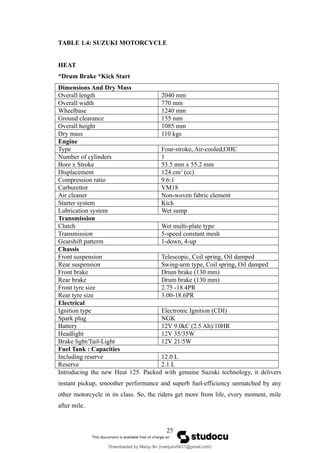
  • 93.
    SCOPE OF STUDY:This study is aimed at providing SUZUKI MOTORCYCLES INDIA PVT. LTD. with an insight on the consumer satisfaction pattern of Suzuki Access 125cc as well as the customer’s response and awareness towards the brand, products and services of Suzuki. The data has been analyzed and presented in a simple and precise way on the basis of which pertinent recommendations have been made to the company to better the services, policies and strategies of the company in India. Companies also want the Suggestion for improvement from users of Suzuki Vehicle & get Feedback from customer. RESEARCH METHODOLOGY: Survey research is concerned with administration of questionnaires (interviewing). The survey research must be concerned with sampling, questionnaire design, questionnaire administration and data analysis. The administration of questionnaire to an individual or group of individuals is called an interview. A questionnaire is simply a formalized set of questions for eliciting information. As such, its function is measurement and it represents the most common form of measurement in marketing research. The report has been prepared on the basis of information collected from different sources. In order to achieve the objective of the project proper research method was applied. After giving through brain storming session, objectives were selected and the set on the base of these objectives, A questionnaire was designed major emphasis of which was gathering new ideas or insight so as to determine and bind out solution to the problems. RESEARCH DESIGN A research design is the arrangement of conditions for collections and analysis of data in a manner that aims to combine relevance to the research problem with economics in a procedure.I have used descriptive cum explorartory research design for my research.  Descriptive Research- includes surveys and fact findings enquiries of different kinds. It basically gives a description of the state of affairs as it exists at present.A researcher has no control over the variables so they can only report what has happened or what is happening.We can also use survey method for this. 82 Downloaded by Manju Bv (manjubv0431@gmail.com) lOMoARcPSD|44080849
  • 94.
     Exploratory Reearch-Exploratory research is research conducted for a problem that has not been clearly defined..It often occurs before we know enough to make conceptual distinctions.. The study also aims at findings out the customer satisfaction level of SUZUKI ACCESS 125cc.For the customer satisfaction study a questionnaire was formulated containing 15 questions which were sent out for response mainly through personal interviews of customers. Results of this step formed the basis of the recommendations given to the company. Sampling Methodology 5. SAMPLING UNIT :- Customer and Retailers 6. SAMPLING TECHNIQUE: Simple random sampling 7. SAMPLING AREA: All over Delhi: North: Rohini, Peeragarhi West: Rajouri Garden, Tagore Garden South: Lajpat Nagar, Green Park, Nehru Place East: Laxmi Nagar, Jheel, Dilshad Garden 3.4 Methods of data collection--- testing of questionnaire SOURCE OF DATA The report has been prepared as per the information obtained from two sources. They are:  Primary data  Secondary data  PRIMARY DATA : The primary data is that which details we collect first time from the market and also used first time in the research. To collect the primary data structured non disguise questionnaire is prepared. Primary Data was very crucial to collect so as to know various past & present consumer views about bikes/scooter and to calculate the market share of this brand in regards to other brands. Fresh primary data was collected by taking direct filling of a questionnaire from customer which involved face to face, all the Suzuki customer who visited the dealership showroom for the 83 Downloaded by Manju Bv (manjubv0431@gmail.com) lOMoARcPSD|44080849
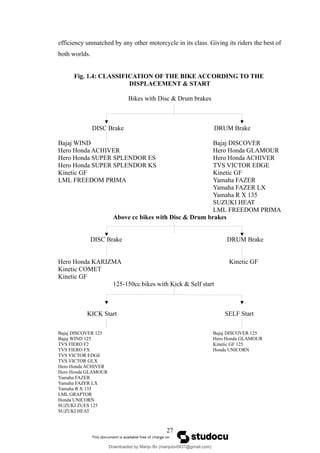
  • 95.
    service of theirbikes/scooters were questioned in order to find out the behavior of customer.  SECONDARY DATA: Secondary data are those which has been collected by some one else and which already have been passed through statistical process. When the secondary data are sufficient, the researcher has to be satisfied with the primary sources of data. Secondary data can be used as bases for comparison with primary data have been collected by questionnaire. Secondary data has been taken from internet, newspaper, magazines and companies web sites. DATA COLLECTION METHOD Researcher instruments is the tool by which the researcher can do research on specific problems or objective. The most popular researcher instrument for collection data is “Questionnaire” for a particular investigation. It is simple for a moiled set of questions presented to respondents for their answers. Due to this flexibility, it is most common instrument used to collect the primary data. During the pre- testing of questionnaire, I seen the reaction of respondents and suggestions required to make change in research instrument. The questionnaire contains three types of questions. 1) Open-ended questions:- It is helpful in knowing what is uppermost in the mind of the respondents. It gives complete freedom to the respondent. 2) Dichotomous QUESTIONS:-It has only two answers in form ‘yes’ or ‘no’, ‘true’ or ‘false’, ‘use’ or ‘do not use’. So the respondent is offered two or more choice. 3) Multiple-choice question:-In this, the respondent is offered two or more choice. 84 Downloaded by Manju Bv (manjubv0431@gmail.com) lOMoARcPSD|44080849
  • 96.
    SAMPLE DESIGN Sampling isa process of obtaining. The information about the entire population by examine a part of it .The effectiveness of the research depends on the sample size selected for the survey purpose. For the customer satisfaction study a sample of 100 persons was chosen from the Suzuki’s dealership in over all Delhi. Sampling plan: Data collected has been analyzed and interpreted by using simple percentage method and finally the data is presented in graphs and charts. Sampling FRAME:  Customers visiting showrooms for servicing their motorcycles  Shopping malls, Supermarket, Markets, College parking etc Sample Site:- The survey was conducted in Delhi city. Sampling Unit:- It means “Who is to be surveyed”. Here target population is decided and it is who are interested to purchase “Scooter” and sampling frame is developed so that every one in the target population has known chance of being sampled. So the survey is conducted particularly in over all Delhi. Sample Size:- For the purpose of proper survey, there is need of perfect research instruments to find out sample size for more accurate result about buying behavior of scooter. The sample size is 100 respondents. Sampling Method :- A Stratified random sample is one where the population is divided in to mutually exhaustive strata or sub-group and then a simple random is selected within each of strata on age groups, occupation etc. It may be noted that stratification does not means absence of randomness. I use a simple random sampling method. Limitation of the study 85 Downloaded by Manju Bv (manjubv0431@gmail.com) lOMoARcPSD|44080849
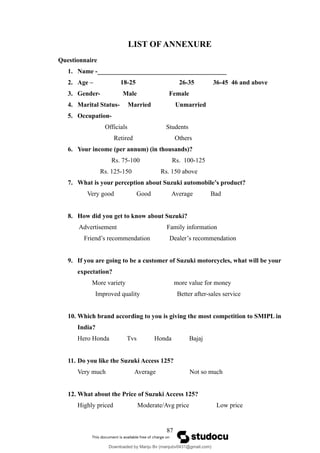
  • 97.
    1. The samplewas very large 5) Lack of understanding of English Language among customer and retailer 6) The customers are sometimes bias towards the product and moreover the customer lacks the information about insurance. So the accurate conclusions may not be drawn on the basis of information collected. 7) Some of the customers due to time constraints and availabilsity of documents with them filled up the data sheet in a hurry, which meant that the provided data might not be 100% true. 8) The project (report) so made is a compilation based on the data collected by various team members during project period. 86 Downloaded by Manju Bv (manjubv0431@gmail.com) lOMoARcPSD|44080849
  • 98.
    LIST OF ANNEXURE Questionnaire 1.Name -________________________________________ 2. Age – 18-25 26-35 36-45 46 and above 3. Gender- Male Female 4. Marital Status- Married Unmarried 5. Occupation- Officials Students Retired Others 6. Your income (per annum) (in thousands)? Rs. 75-100 Rs. 100-125 Rs. 125-150 Rs. 150 above 7. What is your perception about Suzuki automobile’s product? Very good Good Average Bad 8. How did you get to know about Suzuki? Advertisement Family information Friend’s recommendation Dealer’s recommendation 9. If you are going to be a customer of Suzuki motorcycles, what will be your expectation? More variety more value for money Improved quality Better after-sales service 10. Which brand according to you is giving the most competition to SMIPL in India? Hero Honda Tvs Honda Bajaj 11. Do you like the Suzuki Access 125? Very much Average Not so much 12. What about the Price of Suzuki Access 125? Highly priced Moderate/Avg price Low price 87 Downloaded by Manju Bv (manjubv0431@gmail.com) lOMoARcPSD|44080849
  • 99.
    13. Do youthink that the Suzuki Access 125 is capable to attract today’s generations? Yes No cannot say 14. What is the best thing in Suzuki Access 125? Quality Style/design Service Price 15. Has it served the purpose of purchasing? Yes No Average Cannot say 16. Are you satisfied with free service from the showroom? Yes No 17. Is Suzuki Access 125 comfortable for driving and journey? Yes No Average 18. Maintenance cost of Suzuki Access 125? High Moderate/Avg Low 19. Do you think worth the value of money you spent on Suzuki Access 125? Yes No Average 20. What is your level of satisfaction towards Suzuki access? 0-25% 25-50% 50-75% 75-100% 21. Suggestions/Feedback, if any __________________________________________________ 88 Downloaded by Manju Bv (manjubv0431@gmail.com) lOMoARcPSD|44080849
  • 100.
    Balance Sheet ofSuzuki Motorcycles Ltd. Balance Sheet of Suzuki Motorcycles Ltd. India ------------------- in Rs. Cr. ------------------- Mar '15 Mar '14 Mar '13 Mar '12 Mar '11 12 mths 12 mths 12 mths 12 mths 12 mths Sources Of Funds Total Share Capital 151.00 151.00 151.00 144.50 144.50 Equity Share Capital 151.00 151.00 151.00 144.50 144.50 Share Application Money 0.00 0.00 0.00 0.00 0.00 Preference Share Capital 0.00 0.00 0.00 0.00 0.00 Reserves 23,553.20 20,827.00 18,427.90 15,042.90 13,723.00 Networth 23,704.20 20,978.00 18,578.90 15,187.40 13,867.50 Secured Loans 0.00 0.00 0.00 0.00 0.00 Unsecured Loans 180.20 1,685.10 1,389.20 1,078.30 170.20 Total Debt 180.20 1,685.10 1,389.20 1,078.30 170.20 Total Liabilities 23,884.40 22,663.10 19,968.10 16,265.70 14,037.70 Mar '15 Mar '14 Mar '13 Mar '12 Mar '11 12 mths 12 mths 12 mths 12 mths 12 mths Application Of Funds Gross Block 26,076.90 22,435.00 19,633.90 14,678.30 11,718.60 Less: Revaluation Reserves 0.00 0.00 0.00 0.00 0.00 Less: Accum. Depreciation 13,817.60 11,644.60 9,834.70 7,157.60 6,189.20 Net Block 12,259.30 10,790.40 9,799.20 7,520.70 5,529.40 Capital Work in Progress 1,882.80 2,621.40 1,940.90 611.40 862.50 Investments 12,814.00 10,117.90 7,078.30 6,147.40 5,106.80 Inventories 2,615.00 1,705.90 1,840.70 1,796.50 1,415.00 Sundry Debtors 1,069.80 1,413.70 1,469.90 937.60 824.50 Cash and Bank Balance 18.30 629.70 775.00 2,436.10 2,508.50 Total Current Assets 3,703.10 3,749.30 4,085.60 5,170.20 4,748.00 Loans and Advances 2,891.80 3,256.70 3,830.20 2,852.50 2,178.40 Fixed Deposits 0.00 0.00 0.00 0.00 0.00 Total CA, Loans & Advances 6,594.90 7,006.00 7,915.80 8,022.70 6,926.40 Deferred Credit 0.00 0.00 0.00 0.00 0.00 Current Liabilities 8,013.60 6,996.90 5,892.00 5,338.00 3,861.60 Provisions 1,653.00 875.70 874.10 698.50 525.80 Total CL & Provisions 9,666.60 7,872.60 6,766.10 6,036.50 4,387.40 Net Current Assets -3,071.70 -866.60 1,149.70 1,986.20 2,539.00 Miscellaneous Expenses 0.00 0.00 0.00 0.00 0.00 Total Assets 23,884.40 22,663.10 19,968.10 16,265.70 14,037.70 Contingent Liabilities 9,228.60 7,210.20 8,193.30 6,108.00 6,384.80 Book Value (Rs) 784.70 694.45 615.03 525.68 479.99 89 Downloaded by Manju Bv (manjubv0431@gmail.com) lOMoARcPSD|44080849
  • 101.
    Profit & Lossaccount of Suzuki India ------- in Rs. Cr. ----------------- Mar '15 Mar '14 Mar '13 Mar '12 Mar '11 12 mths 12 mths 12 mths 12 mths 12 mths Income Sales Turnover 55,133.60 48,878.60 49,090.00 35,587.10 36,618.40 Excise Duty 5,163.00 5,178.00 5,502.10 0.00 0.00 Net Sales 49,970.60 43,700.60 43,587.90 35,587.10 36,618.40 Other Income 831.60 822.90 812.40 826.80 508.80 Stock Adjustments 455.90 -18.50 -23.40 131.20 56.00 Total Income 51,258.10 44,505.00 44,376.90 36,545.10 37,183.20 Expenditure Raw Materials 35,713.10 31,495.00 32,722.00 28,330.60 28,490.10 Power & Fuel Cost 712.30 594.10 493.70 229.50 210.20 Employee Cost 1,606.60 1,368.10 1,069.60 843.80 703.60 Other Manufacturing Expenses 0.00 0.00 0.00 0.00 0.00 Selling and Admin Expenses 0.00 0.00 0.00 0.00 0.00 Miscellaneous Expenses 5,681.60 5,129.00 5,049.60 3,801.40 3,632.00 Preoperative Exp Capitalised 0.00 0.00 0.00 0.00 0.00 Total Expenses 43,713.60 38,586.20 39,334.90 33,205.30 33,035.90 Mar '15 Mar '14 Mar '13 Mar '12 Mar '11 12 mths 12 mths 12 mths 12 mths 12 mths Operating Profit 6,712.90 5,095.90 4,229.60 2,513.00 3,638.50 PBDIT 7,544.50 5,918.80 5,042.00 3,339.80 4,147.30 Interest 206.00 175.90 189.80 55.20 25.00 PBDT 7,338.50 5,742.90 4,852.20 3,284.60 4,122.30 Depreciation 2,470.30 2,084.40 1,861.20 1,138.40 1,013.50 Other Written Off 0.00 0.00 0.00 0.00 0.00 Profit Before Tax 4,868.20 3,658.50 2,991.00 2,146.20 3,108.80 Extra-ordinary items 0.00 0.00 0.00 0.00 0.00 PBT (Post Extra-ord Items) 4,868.20 3,658.50 2,991.00 2,146.20 3,108.80 Tax 1,157.00 875.50 598.90 511.00 820.20 Reported Net Profit 3,711.20 2,783.00 2,392.10 1,635.20 2,288.60 Total Value Addition 8,000.50 7,091.20 6,612.90 4,874.70 4,545.80 Preference Dividend 0.00 0.00 0.00 0.00 0.00 Equity Dividend 755.20 362.50 241.70 216.70 216.70 Corporate Dividend Tax 153.80 61.60 41.10 35.10 35.10 Per share data (annualised) Shares in issue (lakhs) 3,020.80 3,020.80 3,020.80 2,889.10 2,889.10 Earning Per Share (Rs) 122.85 92.13 79.19 56.60 79.21 Equity Dividend (%) 500.00 240.00 160.00 150.00 150.00 Book Value (Rs) 784.70 694.45 615.03 525.68 479.99 90 Downloaded by Manju Bv (manjubv0431@gmail.com) lOMoARcPSD|44080849
  • 102.
    Cash Flow ofSuzuki India ------------- in Rs. Cr. ---------- Mar '15 Mar '14 Mar '13 Mar '12 Mar '11 12 mths 12 mths 12 mths 12 mths 12 mths Net Profit Before Tax 4868.20 3658.50 2991.00 2146.20 3108.80 Net Cash From Operating Activities 6410.60 4903.50 4301.10 2229.40 2819.40 Net Cash (used in)/from Investing Activities -4499.90 -4892.90 -3491.00 -2918.30 343.00 Net Cash (used in)/from Financing Activities -1962.10 -65.90 -966.30 616.50 -752.10 Net (decrease)/increase In Cash and Cash Equivalents -51.40 -55.30 -156.20 -72.40 2410.30 Opening Cash & Cash Equivalents 69.70 125.00 281.20 2508.50 98.20 Closing Cash & Cash Equivalents 18.30 69.70 125.00 2436.10 2508.50 Key Financial Ratios of Suzuki India Mar '15 Mar '14 Mar '13 Mar '12 Mar '11 Investment Valuation Ratios Face Value 5.00 5.00 5.00 5.00 5.00 Dividend Per Share 25.00 12.00 8.00 7.50 7.50 Operating Profit Per Share (Rs) 222.22 168.69 140.02 86.98 125.94 Net Operating Profit Per Share (Rs) 1,654.22 1,446.66 1,442.93 1,231.77 1,267.47 Free Reserves Per Share (Rs) -- -- -- -- -- Bonus in Equity Capital -- -- -- -- -- Profitability Ratios Operating Profit Margin(%) 13.43 11.66 9.70 7.06 9.93 Profit Before Interest And Tax Margin(%) 8.35 6.76 5.33 3.77 7.07 Gross Profit Margin(%) 8.49 6.89 5.43 3.86 7.16 Cash Profit Margin(%) 12.16 10.93 9.57 7.61 8.89 Adjusted Cash Margin(%) 12.16 10.93 9.57 7.61 8.89 Net Profit Margin(%) 7.42 6.36 5.48 4.59 6.24 Adjusted Net Profit Margin(%) 7.30 6.25 5.38 4.49 6.16 Return On Capital Employed(%) 21.24 16.91 15.92 13.53 22.32 Return On Net Worth(%) 15.65 13.26 12.87 10.76 16.50 Adjusted Return on Net Worth(%) 15.65 13.26 12.87 10.76 16.50 Return on Assets Excluding Revaluations 784.70 694.45 615.03 525.68 479.99 Return on Assets Including Revaluations 784.70 694.45 615.03 525.68 479.99 Return on Long Term Funds(%) 21.27 17.88 16.63 14.49 22.37 Liquidity And Solvency Ratios Current Ratio 0.68 0.77 1.04 1.13 1.57 Quick Ratio 0.41 0.67 0.90 1.03 1.26 Debt Equity Ratio 0.01 0.08 0.07 0.07 0.01 Long Term Debt Equity Ratio 0.01 0.02 0.03 -- 0.01 Debt Coverage Ratios Interest Cover 24.63 21.80 16.76 39.88 125.35 Total Debt to Owners Fund 0.01 0.08 0.07 0.07 0.01 Financial Charges Coverage Ratio 36.62 33.65 26.56 60.50 165.89 Financial Charges Coverage Ratio Post Tax 31.01 28.67 23.41 51.25 133.08 Management Efficiency Ratios Inventory Turnover Ratio 21.08 28.65 26.67 19.81 25.88 Debtors Turnover Ratio 40.24 30.31 36.21 40.39 44.81 Investments Turnover Ratio 21.08 28.65 26.67 19.81 25.88 Fixed Assets Turnover Ratio 1.94 1.96 2.25 2.46 3.14 Total Assets Turnover Ratio 2.12 1.94 2.21 2.22 2.62 Asset Turnover Ratio 2.15 2.05 2.41 2.35 2.74 Average Raw Material Holding -- -- -- -- -- Average Finished Goods Held -- -- -- -- -- Number of Days In Working Capital -21.61 -5.40 1.02 19.31 24.53 Profit & Loss Account Ratios Material Cost Composition 71.46 72.06 75.07 79.60 77.80 Imported Composition of Raw Materials Consumed 7.28 9.19 12.11 10.60 10.79 Selling Distribution Cost Composition -- -- -- -- -- Expenses as Composition of Total Sales 9.27 9.47 10.46 10.37 9.55 Cash Flow Indicator Ratios Dividend Payout Ratio Net Profit 20.34 13.02 10.10 13.25 9.46 Dividend Payout Ratio Cash Profit 12.21 7.44 5.68 7.81 6.56 Earning Retention Ratio 79.66 86.98 89.90 86.75 90.54 Cash Earning Retention Ratio 87.79 92.56 94.32 92.19 93.44 AdjustedCash Flow Times 0.03 0.35 0.33 0.39 0.05 Mar '15 Mar '14 Mar '13 Mar '12 Mar '11 Earnings Per Share 122.85 92.13 79.19 56.60 79.21 Book Value 784.70 694.45 615.03 525.68 479.99 91 Downloaded by Manju Bv (manjubv0431@gmail.com) lOMoARcPSD|44080849