1
CHAMBER OF MINES OF SOUTH AFRICA
Putting South Africa First
L E A R N I N G H U B
MULTI-STAGE
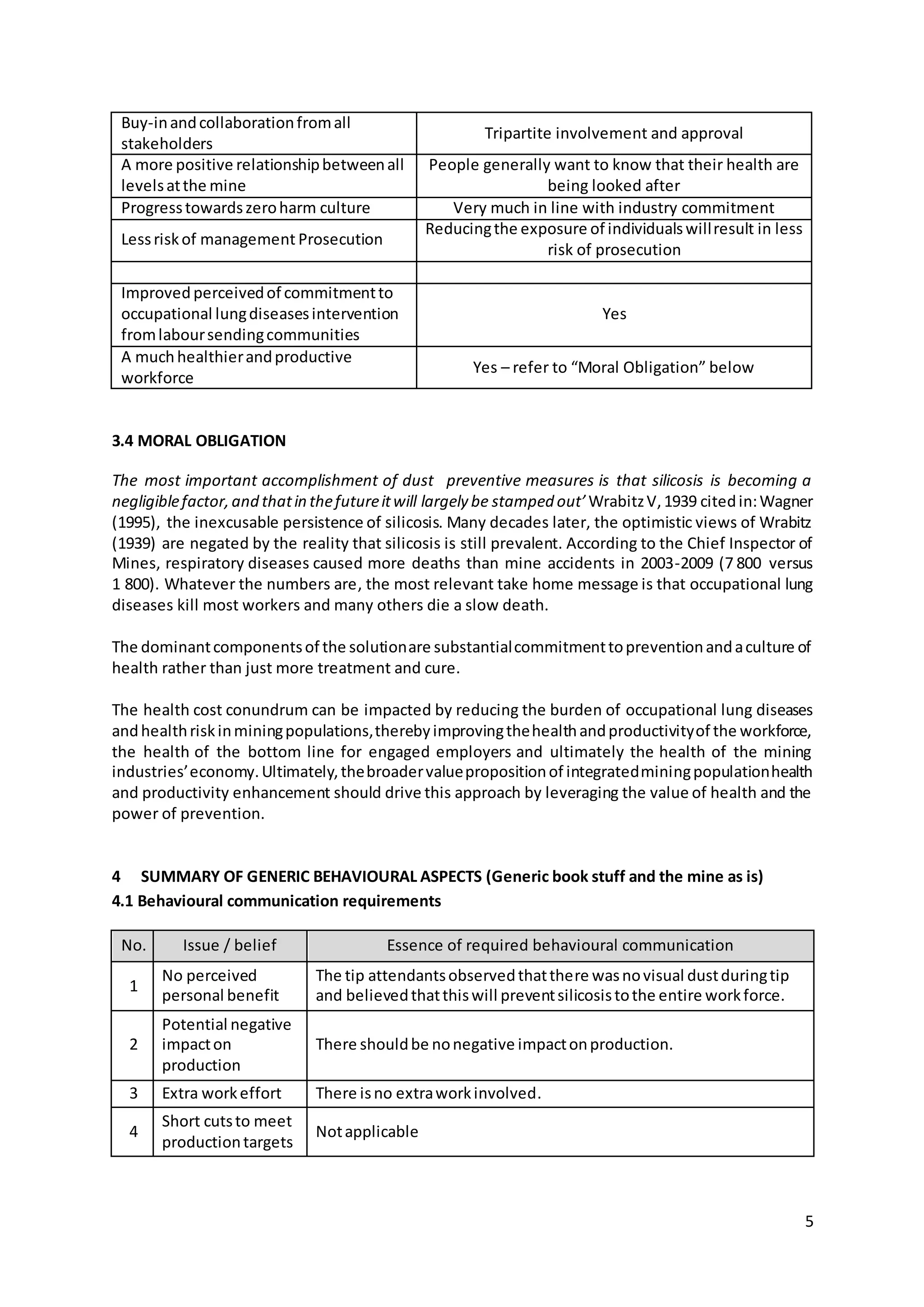
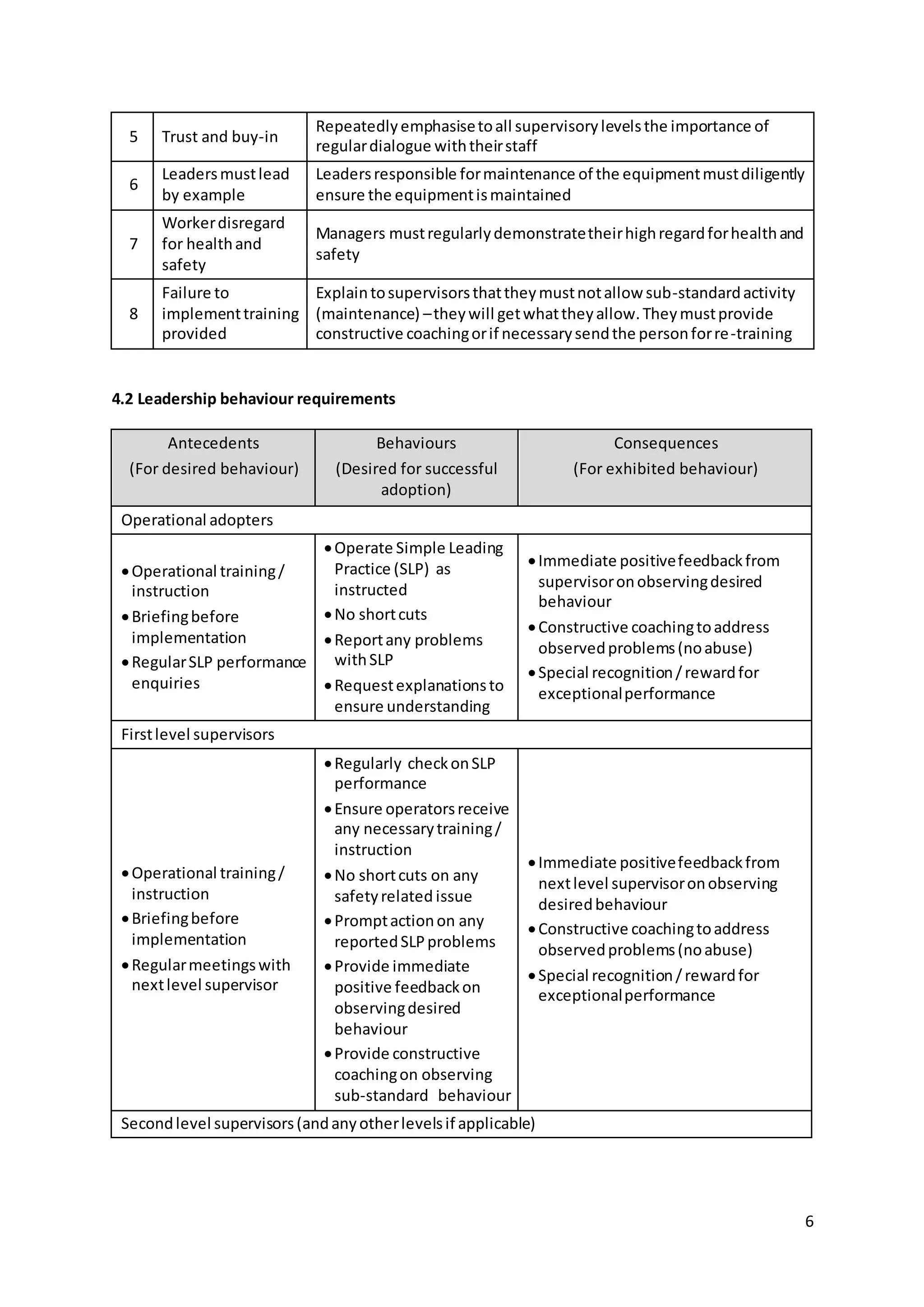
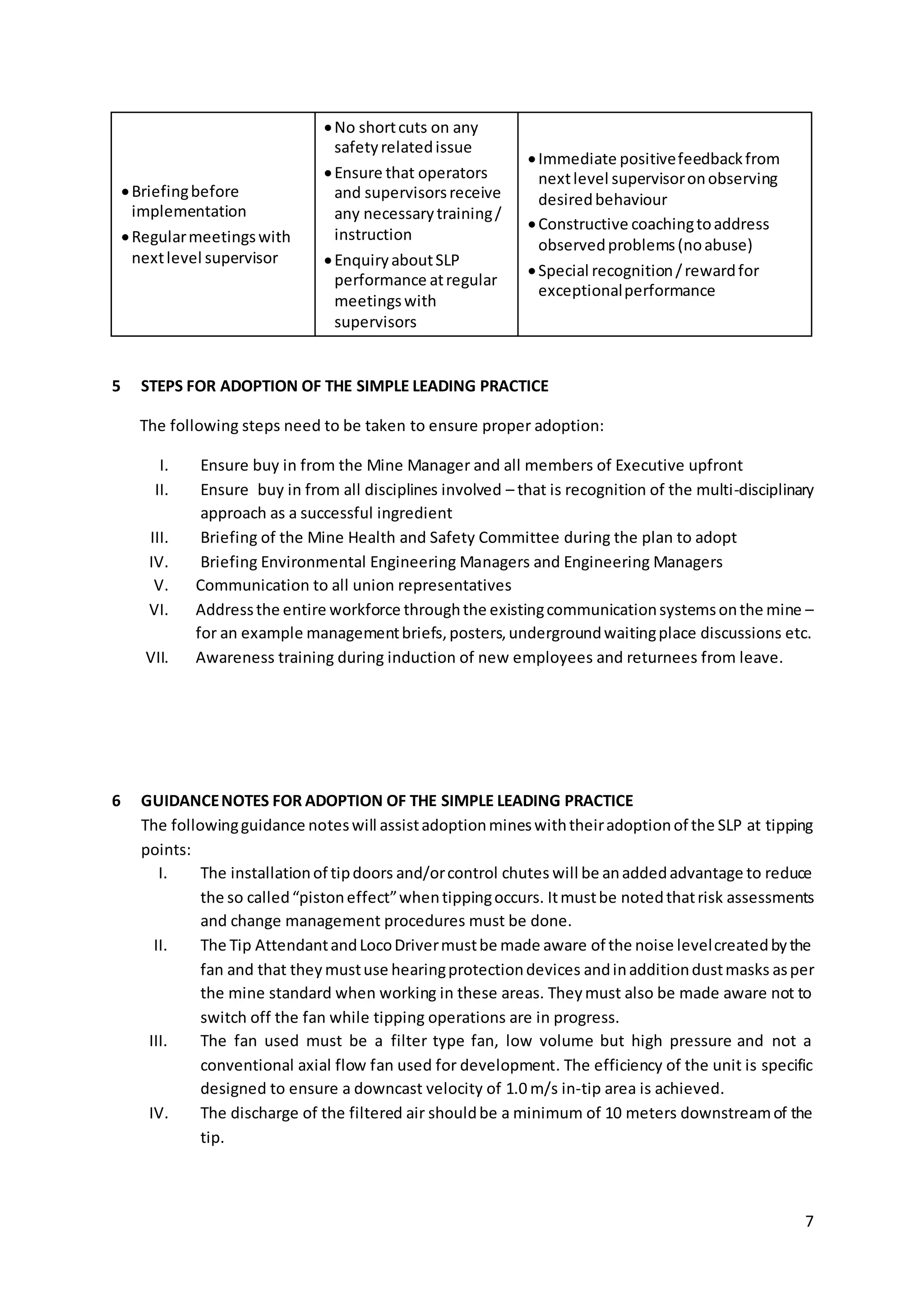
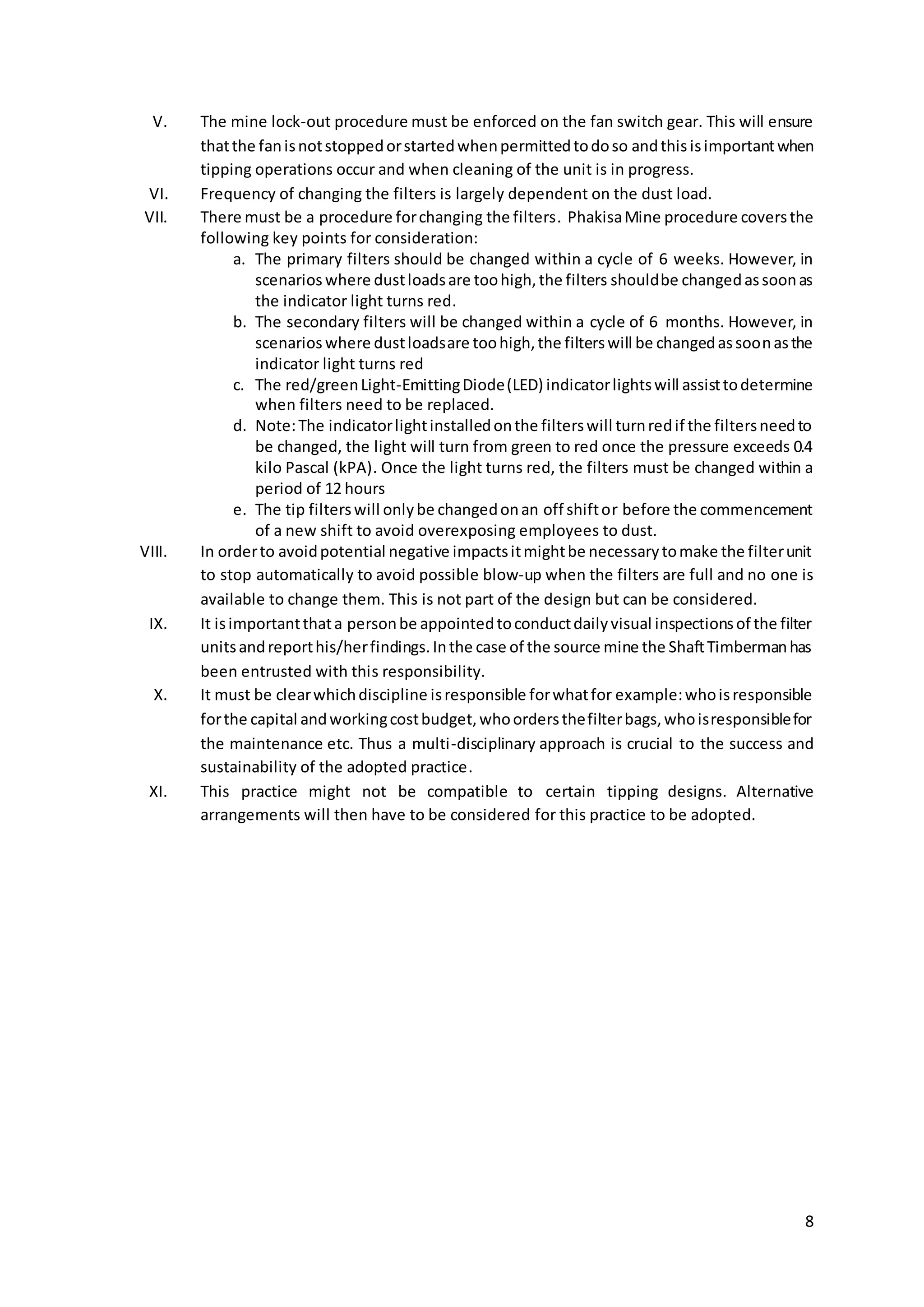
FILTRATION
SYSTEMS
ADOPTION
BRIEF
Draft one June 2013
2
1 DESCRIPTION OF THE SIMPLE LEADING PRACTICE
The Multi-stage Filtration System offers final filtration
efficiencies of ≥98.5% at 0.5 micron (μ) and larger size
particlesdischargedintothe returnairsideof the system.The
system assists in alleviating the problem by filtering
contaminated air (respirable dust) to an acceptable level
before it enters the fresh air system.
The Multi-Stage Filtration System was demonstrated at
Phakisa mine where it was identified as a primary
preventativepractice attipping pointsandentailsexhausting
contaminated airthrough variousstagesof filtrationsystems
that remove dust and release clean air into the intake air
system, since most of the dust is produced on the main tips
during tipping activities.
The multistage filtrationsystematPhakisamine offersafinal
efficiencyof ≥98.5% at 0.5 micron(μ) and largersize particles
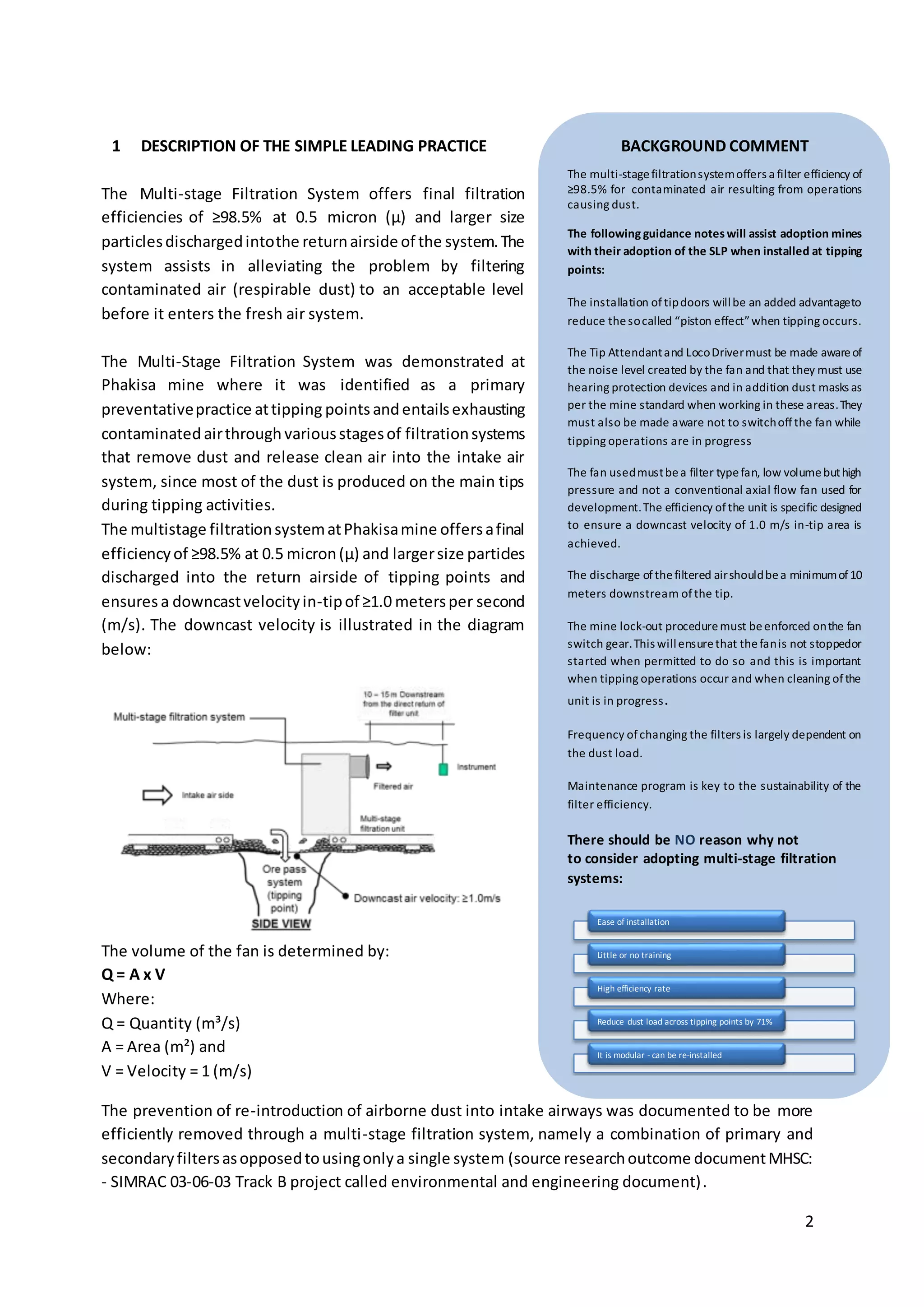
discharged into the return airside of tipping points and
ensures a downcastvelocityin-tipof ≥1.0 metersper second
(m/s). The downcast velocity is illustrated in the diagram
below:
The volume of the fan is determined by:
Q = A x V
Where:
Q = Quantity (m³/s)
A = Area (m²) and
V = Velocity = 1 (m/s)
The prevention of re-introduction of airborne dust into intake airways was documented to be more
efficiently removed through a multi-stage filtration system, namely a combination of primary and
secondaryfiltersasopposedtousingonlya single system (source researchoutcome documentMHSC:
- SIMRAC 03-06-03 Track B project called environmental and engineering document).
BACKGROUND COMMENT
The multi-stagefiltrationsystemoffers a filter efficiency of
≥98.5% for contaminated air resulting from operations
causing dust.
The following guidance noteswill assist adoption mines
with their adoption of the SLP when installed at tipping
points:
The installation oftipdoors willbe an added advantageto
reduce thesocalled “piston effect”when tipping occurs.
The Tip Attendantand LocoDrivermust be made awareof
the noise level created by the fan and that they must use
hearing protection devices and in addition dust masks as
per the mine standard when working in these areas.They
must also be made aware not to switchoffthe fan while
tipping operations are in progress
The fan usedmustbea filter typefan, low volumebuthigh
pressure and not a conventional axial flow fan used for
development.The efficiency ofthe unit is specific designed
to ensure a downcast velocity of 1.0 m/s in-tip area is
achieved.
The discharge ofthefiltered airshouldbea minimumof10
meters downstream ofthe tip.
The mine lock-out proceduremust beenforced onthe fan
switch gear.This willensurethat thefanis not stoppedor
started when permitted to do so and this is important
when tipping operations occur and when cleaning ofthe
unit is in progress.
Frequency ofchanging the filters is largely dependent on
the dust load.
Maintenance program is key to the sustainability of the
filter efficiency.
There should be NO reason why not
to consider adopting multi-stage filtration
systems:
Ease of installation
Little or no training
High efficiency rate
Reduce dust load across tipping points by 71%
It is modular - can be re-installed
3
In situations where the volume displacement in the ore pass exceeds the capacity of the filtration
system due to the so called “piston effect” during tipping operations, secondary systems such as
foggers/dry mist sprays can be considered in addition.
To minimisethe dependencyof anindividualontimingthe
necessity to change the filters and the frequency, the
multi-stage filtrationsystemisequippedwithanindicator
redand greenlightautomation whichflashesredonce the
operatingpressureexceedsnormal,indicatingtheneedfor
the filterstobe changed.However,undernormal pressure
the light will remain green. This is referred to as a
predictive / preventative maintenance system.
-Robot system-
2 DOCUMENTED BENEFITS TO DATE
Followingthe installationof themulti-stage
filtration unitsan average improvement of
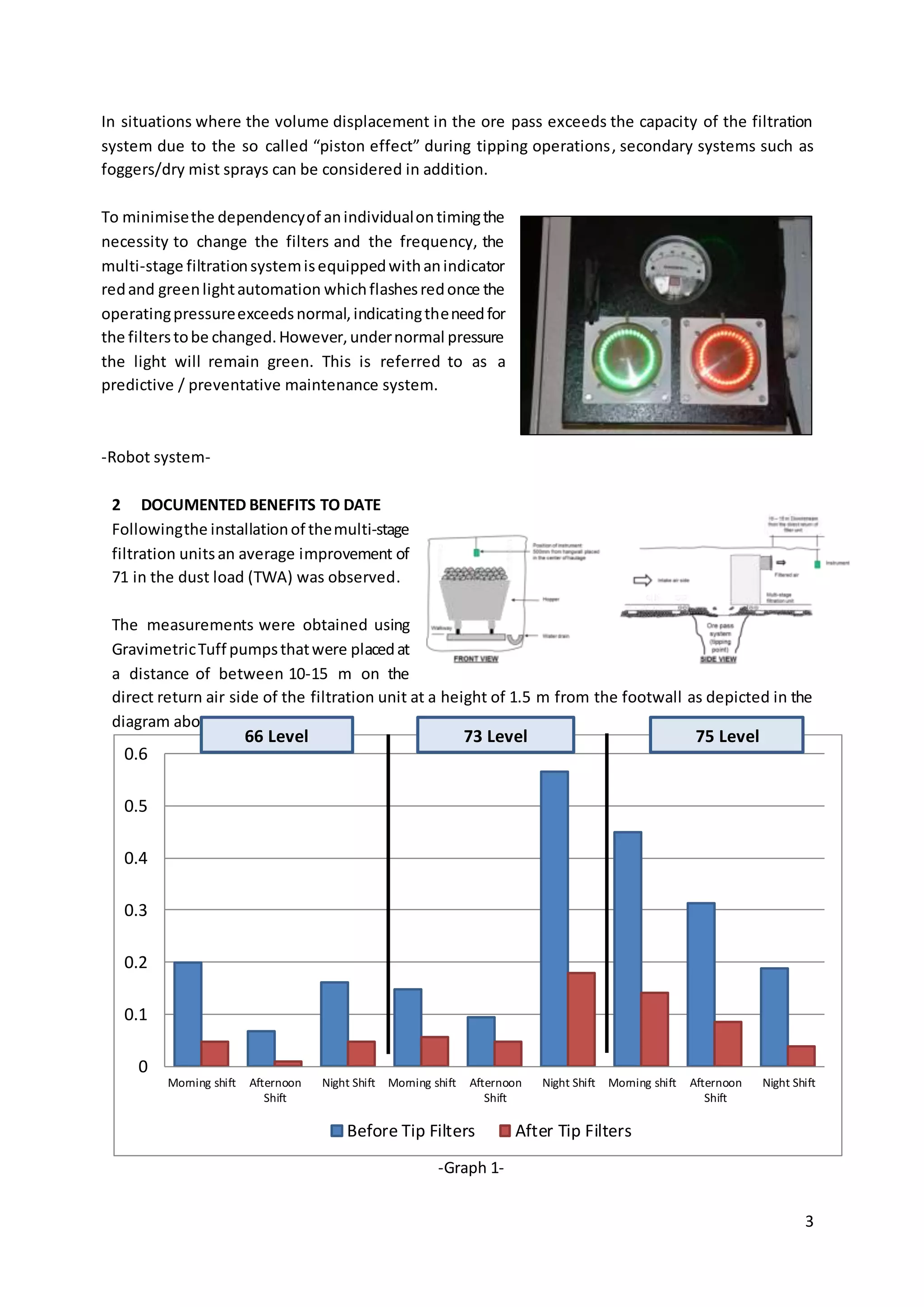
71 in the dust load (TWA) was observed.
The measurements were obtained using
GravimetricTuff pumpsthatwere placedat
a distance of between 10-15 m on the
direct return air side of the filtration unit at a height of 1.5 m from the footwall as depicted in the
diagram above.
0
0.1
0.2
0.3
0.4
0.5
0.6
Morning shift Afternoon
Shift
Night Shift Morning shift Afternoon
Shift
Night Shift Morning shift Afternoon
Shift
Night Shift
Before Tip Filters After Tip Filters
66 Level 73 Level 75 Level
-Graph 1-
4
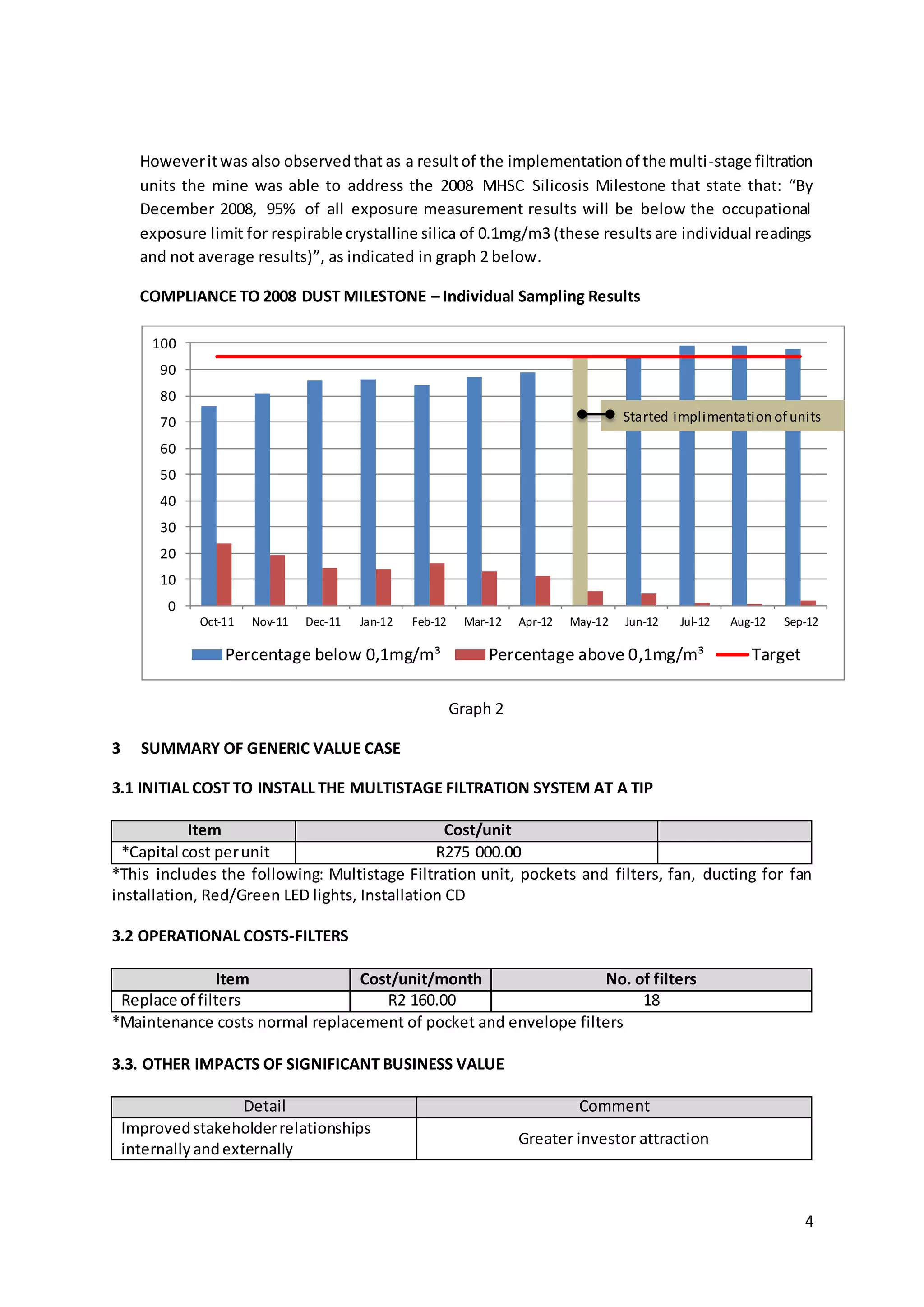
Howeveritwas also observedthat as a resultof the implementationof the multi-stage filtration
units the mine was able to address the 2008 MHSC Silicosis Milestone that state that: “By
December 2008, 95% of all exposure measurement results will be below the occupational
exposure limit for respirable crystalline silica of 0.1mg/m3 (these resultsare individual readings
and not average results)”, as indicated in graph 2 below.
COMPLIANCE TO 2008 DUST MILESTONE – Individual Sampling Results
Graph 2
3 SUMMARY OF GENERIC VALUE CASE
3.1 INITIAL COST TO INSTALL THE MULTISTAGE FILTRATION SYSTEM AT A TIP
Item Cost/unit
*Capital cost perunit R275 000.00
*This includes the following: Multistage Filtration unit, pockets and filters, fan, ducting for fan
installation, Red/Green LED lights, Installation CD
3.2 OPERATIONAL COSTS-FILTERS
Item Cost/unit/month No. of filters
Replace of filters R2 160.00 18
*Maintenance costs normal replacement of pocket and envelope filters
3.3. OTHER IMPACTS OF SIGNIFICANT BUSINESS VALUE
Detail Comment
Improvedstakeholderrelationships
internallyandexternally
Greater investor attraction
0
10
20
30
40
50
60
70
80
90
100
Oct-11 Nov-11 Dec-11 Jan-12 Feb-12 Mar-12 Apr-12 May-12 Jun-12 Jul-12 Aug-12 Sep-12
Percentage below 0,1mg/m³ Percentage above 0,1mg/m³ Target
Started implimentation of units
5
Buy-inandcollaborationfromall
stakeholders
Tripartite involvement and approval
A more positive relationshipbetweenall
levelsatthe mine
People generally want to know that their health are
being looked after
Progresstowardszeroharm culture Very much in line with industry commitment
Lessriskof management Prosecution
Reducingthe exposure of individualswillresult in less
risk of prosecution
Improved perceivedof commitmentto
occupational lungdiseasesintervention
fromlaboursendingcommunities
Yes
A muchhealthierandproductive
workforce
Yes – refer to “Moral Obligation” below
3.4 MORAL OBLIGATION
The most important accomplishment of dust preventive measures is that silicosis is becoming a
negligiblefactor,and thatin thefutureitwill largely be stamped out’ WrabitzV,1939 citedin:Wagner
(1995), the inexcusable persistence of silicosis. Many decades later, the optimistic views of Wrabitz
(1939) are negated by the reality that silicosis is still prevalent. According to the Chief Inspector of
Mines, respiratory diseases caused more deaths than mine accidents in 2003-2009 (7 800 versus
1 800). Whatever the numbers are, the most relevant take home message is that occupational lung
diseases kill most workers and many others die a slow death.
The dominantcomponentsof the solutionare substantialcommitmenttopreventionandaculture of
health rather than just more treatment and cure.
The health cost conundrum can be impacted by reducing the burden of occupational lung diseases
andhealthriskinminingpopulations,therebyimprovingthehealthandproductivityof the workforce,
the health of the bottom line for engaged employers and ultimately the health of the mining
industries’economy.Ultimately,thebroadervaluepropositionof integratedminingpopulationhealth
and productivity enhancement should drive this approach by leveraging the value of health and the
power of prevention.
4 SUMMARY OF GENERIC BEHAVIOURAL ASPECTS (Generic book stuff and the mine as is)
4.1 Behavioural communication requirements
No. Issue / belief Essence of required behavioural communication
1
No perceived
personal benefit
The tip attendantsobservedthatthere wasnovisual dustduringtip
and believedthatthiswill preventsilicosistothe entire workforce.
2
Potential negative
impacton
production
There shouldbe nonegative impactonproduction.
3 Extra workeffort There isno extraworkinvolved.
4
Short cutsto meet
productiontargets
Notapplicable
6
5 Trust and buy-in
Repeatedlyemphasisetoall supervisorylevelsthe importance of
regulardialogue withtheirstaff
6
Leadersmustlead
by example
Leadersresponsible formaintenance of the equipmentmustdiligently
ensure the equipmentismaintained
7
Workerdisregard
for healthand
safety
Managers mustregularlydemonstratetheirhighregardforhealthand
safety
8
Failure to
implementtraining
provided
Explaintosupervisorsthattheymustnotallow sub-standardactivity
(maintenance) –theywill getwhattheyallow.Theymustprovide
constructive coachingorif necessarysendthe personforre-training
4.2 Leadership behaviour requirements
Antecedents
(For desired behaviour)
Behaviours
(Desired for successful
adoption)
Consequences
(For exhibited behaviour)
Operational adopters
Operational training/
instruction
Briefingbefore
implementation
RegularSLP performance
enquiries
Operate Simple Leading
Practice (SLP) as
instructed
No shortcuts
Reportany problems
withSLP
Requestexplanationsto
ensure understanding
Immediate positivefeedbackfrom
supervisoronobservingdesired
behaviour
Constructive coachingtoaddress
observedproblems(noabuse)
Special recognition/rewardfor
exceptionalperformance
Firstlevel supervisors
Operational training/
instruction
Briefingbefore
implementation
Regularmeetingswith
nextlevel supervisor
Regularly checkonSLP
performance
Ensure operatorsreceive
any necessarytraining/
instruction
No shortcuts on any
safetyrelated issue
Promptactionon any
reportedSLPproblems
Provide immediate
positive feedbackon
observingdesired
behaviour
Provide constructive
coachingon observing
sub-standard behaviour
Immediate positivefeedbackfrom
nextlevel supervisoronobserving
desiredbehaviour
Constructive coachingtoaddress
observedproblems(noabuse)
Special recognition/rewardfor
exceptionalperformance
Secondlevel supervisors(andanyotherlevelsif applicable)
7
Briefingbefore
implementation
Regularmeetingswith
nextlevel supervisor
No shortcuts on any
safetyrelatedissue
Ensure that operators
and supervisorsreceive
any necessarytraining/
instruction
EnquiryaboutSLP
performance atregular
meetingswith
supervisors
Immediate positivefeedbackfrom
nextlevel supervisoronobserving
desiredbehaviour
Constructive coachingtoaddress
observedproblems(noabuse)
Special recognition/rewardfor
exceptionalperformance
5 STEPS FOR ADOPTION OF THE SIMPLE LEADING PRACTICE
The following steps need to be taken to ensure proper adoption:
I. Ensure buy in from the Mine Manager and all members of Executive upfront
II. Ensure buy in from all disciplines involved – that is recognition of the multi-disciplinary
approach as a successful ingredient
III. Briefing of the Mine Health and Safety Committee during the plan to adopt
IV. Briefing Environmental Engineering Managers and Engineering Managers
V. Communication to all union representatives
VI. Addressthe entire workforce throughthe existingcommunicationsystemsonthe mine –
for an example managementbriefs,posters,undergroundwaitingplace discussions etc.
VII. Awareness training during induction of new employees and returnees from leave.
6 GUIDANCENOTES FOR ADOPTION OF THE SIMPLE LEADING PRACTICE
The followingguidance noteswill assistadoptionmineswiththeiradoptionof the SLP at tipping
points:
I. The installationof tipdoors and/orcontrol chutes will be anaddedadvantage to reduce
the so called“pistoneffect”whentippingoccurs. Itmustbe notedthatrisk assessments
and change management procedures must be done.
II. The Tip AttendantandLocoDrivermustbe made aware of the noise levelcreatedbythe
fan and that they mustuse hearingprotectiondevices andinadditiondustmasks asper
the mine standard when working in these areas. Theymust also be made aware not to
switch off the fan while tipping operations are in progress.
III. The fan used must be a filter type fan, low volume but high pressure and not a
conventional axial flow fan used for development. The efficiency of the unit is specific
designed to ensure a downcast velocity of 1.0 m/s in-tip area is achieved.
IV. The discharge of the filtered air shouldbe a minimum of 10 meters downstreamof the
tip.
8
V. The mine lock-out procedure must be enforced on the fan switch gear. This will ensure
thatthe fanisnotstoppedorstartedwhenpermittedtodoso andthis isimportantwhen
tipping operations occur and when cleaning of the unit is in progress.
VI. Frequency of changing the filters is largely dependent on the dust load.
VII. There must be a procedure forchanging the filters. PhakisaMine procedure coversthe
following key points for consideration:
a. The primary filters should be changed within a cycle of 6 weeks. However, in
scenarios where dustloadsare toohigh,the filters shouldbe changedassoonas
the indicator light turns red.
b. The secondary filters will be changed within a cycle of 6 months. However, in
scenarios where dustloadsare toohigh,the filterswill be changedassoonasthe
indicator light turns red
c. The red/greenLight-EmittingDiode(LED) indicatorlightswill assisttodetermine
when filters need to be replaced.
d. Note:The indicatorlightinstalledonthe filterswill turnredif the filtersneedto
be changed, the light will turn from green to red once the pressure exceeds 0.4
kilo Pascal (kPA). Once the light turns red, the filters must be changed within a
period of 12 hours
e. The tip filterswill onlybe changedonan off shiftor before the commencement
of a new shift to avoid overexposing employees to dust.
VIII. In orderto avoidpotential negative impactsitmightbe necessarytomake the filterunit
to stop automatically to avoid possible blow-up when the filters are full and no one is
available to change them. This is not part of the design but can be considered.
IX. It isimportantthata personbe appointedtoconductdailyvisual inspectionsof the filter
unitsandreporthis/herfindings.Inthe case of the source mine the ShaftTimbermanhas
been entrusted with this responsibility.
X. It must be clearwhichdiscipline isresponsible forwhatfor example:whoisresponsible
forthe capital andworkingcostbudget,whoordersthefilterbags,whoisresponsiblefor
the maintenance etc. Thus a multi-disciplinary approach is crucial to the success and
sustainability of the adopted practice.
XI. This practice might not be compatible to certain tipping designs. Alternative
arrangements will then have to be considered for this practice to be adopted.

Mosh simple leading practise - multistage filtration systems AIRCURE

  • 1.
    1 CHAMBER OF MINESOF SOUTH AFRICA Putting South Africa First L E A R N I N G H U B MULTI-STAGE FILTRATION SYSTEMS ADOPTION BRIEF Draft one June 2013
  • 2.
    2 1 DESCRIPTION OFTHE SIMPLE LEADING PRACTICE The Multi-stage Filtration System offers final filtration efficiencies of ≥98.5% at 0.5 micron (μ) and larger size particlesdischargedintothe returnairsideof the system.The system assists in alleviating the problem by filtering contaminated air (respirable dust) to an acceptable level before it enters the fresh air system. The Multi-Stage Filtration System was demonstrated at Phakisa mine where it was identified as a primary preventativepractice attipping pointsandentailsexhausting contaminated airthrough variousstagesof filtrationsystems that remove dust and release clean air into the intake air system, since most of the dust is produced on the main tips during tipping activities. The multistage filtrationsystematPhakisamine offersafinal efficiencyof ≥98.5% at 0.5 micron(μ) and largersize particles discharged into the return airside of tipping points and ensures a downcastvelocityin-tipof ≥1.0 metersper second (m/s). The downcast velocity is illustrated in the diagram below: The volume of the fan is determined by: Q = A x V Where: Q = Quantity (m³/s) A = Area (m²) and V = Velocity = 1 (m/s) The prevention of re-introduction of airborne dust into intake airways was documented to be more efficiently removed through a multi-stage filtration system, namely a combination of primary and secondaryfiltersasopposedtousingonlya single system (source researchoutcome documentMHSC: - SIMRAC 03-06-03 Track B project called environmental and engineering document). BACKGROUND COMMENT The multi-stagefiltrationsystemoffers a filter efficiency of ≥98.5% for contaminated air resulting from operations causing dust. The following guidance noteswill assist adoption mines with their adoption of the SLP when installed at tipping points: The installation oftipdoors willbe an added advantageto reduce thesocalled “piston effect”when tipping occurs. The Tip Attendantand LocoDrivermust be made awareof the noise level created by the fan and that they must use hearing protection devices and in addition dust masks as per the mine standard when working in these areas.They must also be made aware not to switchoffthe fan while tipping operations are in progress The fan usedmustbea filter typefan, low volumebuthigh pressure and not a conventional axial flow fan used for development.The efficiency ofthe unit is specific designed to ensure a downcast velocity of 1.0 m/s in-tip area is achieved. The discharge ofthefiltered airshouldbea minimumof10 meters downstream ofthe tip. The mine lock-out proceduremust beenforced onthe fan switch gear.This willensurethat thefanis not stoppedor started when permitted to do so and this is important when tipping operations occur and when cleaning ofthe unit is in progress. Frequency ofchanging the filters is largely dependent on the dust load. Maintenance program is key to the sustainability of the filter efficiency. There should be NO reason why not to consider adopting multi-stage filtration systems: Ease of installation Little or no training High efficiency rate Reduce dust load across tipping points by 71% It is modular - can be re-installed
  • 3.
    3 In situations wherethe volume displacement in the ore pass exceeds the capacity of the filtration system due to the so called “piston effect” during tipping operations, secondary systems such as foggers/dry mist sprays can be considered in addition. To minimisethe dependencyof anindividualontimingthe necessity to change the filters and the frequency, the multi-stage filtrationsystemisequippedwithanindicator redand greenlightautomation whichflashesredonce the operatingpressureexceedsnormal,indicatingtheneedfor the filterstobe changed.However,undernormal pressure the light will remain green. This is referred to as a predictive / preventative maintenance system. -Robot system- 2 DOCUMENTED BENEFITS TO DATE Followingthe installationof themulti-stage filtration unitsan average improvement of 71 in the dust load (TWA) was observed. The measurements were obtained using GravimetricTuff pumpsthatwere placedat a distance of between 10-15 m on the direct return air side of the filtration unit at a height of 1.5 m from the footwall as depicted in the diagram above. 0 0.1 0.2 0.3 0.4 0.5 0.6 Morning shift Afternoon Shift Night Shift Morning shift Afternoon Shift Night Shift Morning shift Afternoon Shift Night Shift Before Tip Filters After Tip Filters 66 Level 73 Level 75 Level -Graph 1-
  • 4.
    4 Howeveritwas also observedthatas a resultof the implementationof the multi-stage filtration units the mine was able to address the 2008 MHSC Silicosis Milestone that state that: “By December 2008, 95% of all exposure measurement results will be below the occupational exposure limit for respirable crystalline silica of 0.1mg/m3 (these resultsare individual readings and not average results)”, as indicated in graph 2 below. COMPLIANCE TO 2008 DUST MILESTONE – Individual Sampling Results Graph 2 3 SUMMARY OF GENERIC VALUE CASE 3.1 INITIAL COST TO INSTALL THE MULTISTAGE FILTRATION SYSTEM AT A TIP Item Cost/unit *Capital cost perunit R275 000.00 *This includes the following: Multistage Filtration unit, pockets and filters, fan, ducting for fan installation, Red/Green LED lights, Installation CD 3.2 OPERATIONAL COSTS-FILTERS Item Cost/unit/month No. of filters Replace of filters R2 160.00 18 *Maintenance costs normal replacement of pocket and envelope filters 3.3. OTHER IMPACTS OF SIGNIFICANT BUSINESS VALUE Detail Comment Improvedstakeholderrelationships internallyandexternally Greater investor attraction 0 10 20 30 40 50 60 70 80 90 100 Oct-11 Nov-11 Dec-11 Jan-12 Feb-12 Mar-12 Apr-12 May-12 Jun-12 Jul-12 Aug-12 Sep-12 Percentage below 0,1mg/m³ Percentage above 0,1mg/m³ Target Started implimentation of units
  • 5.
    5 Buy-inandcollaborationfromall stakeholders Tripartite involvement andapproval A more positive relationshipbetweenall levelsatthe mine People generally want to know that their health are being looked after Progresstowardszeroharm culture Very much in line with industry commitment Lessriskof management Prosecution Reducingthe exposure of individualswillresult in less risk of prosecution Improved perceivedof commitmentto occupational lungdiseasesintervention fromlaboursendingcommunities Yes A muchhealthierandproductive workforce Yes – refer to “Moral Obligation” below 3.4 MORAL OBLIGATION The most important accomplishment of dust preventive measures is that silicosis is becoming a negligiblefactor,and thatin thefutureitwill largely be stamped out’ WrabitzV,1939 citedin:Wagner (1995), the inexcusable persistence of silicosis. Many decades later, the optimistic views of Wrabitz (1939) are negated by the reality that silicosis is still prevalent. According to the Chief Inspector of Mines, respiratory diseases caused more deaths than mine accidents in 2003-2009 (7 800 versus 1 800). Whatever the numbers are, the most relevant take home message is that occupational lung diseases kill most workers and many others die a slow death. The dominantcomponentsof the solutionare substantialcommitmenttopreventionandaculture of health rather than just more treatment and cure. The health cost conundrum can be impacted by reducing the burden of occupational lung diseases andhealthriskinminingpopulations,therebyimprovingthehealthandproductivityof the workforce, the health of the bottom line for engaged employers and ultimately the health of the mining industries’economy.Ultimately,thebroadervaluepropositionof integratedminingpopulationhealth and productivity enhancement should drive this approach by leveraging the value of health and the power of prevention. 4 SUMMARY OF GENERIC BEHAVIOURAL ASPECTS (Generic book stuff and the mine as is) 4.1 Behavioural communication requirements No. Issue / belief Essence of required behavioural communication 1 No perceived personal benefit The tip attendantsobservedthatthere wasnovisual dustduringtip and believedthatthiswill preventsilicosistothe entire workforce. 2 Potential negative impacton production There shouldbe nonegative impactonproduction. 3 Extra workeffort There isno extraworkinvolved. 4 Short cutsto meet productiontargets Notapplicable
  • 6.
    6 5 Trust andbuy-in Repeatedlyemphasisetoall supervisorylevelsthe importance of regulardialogue withtheirstaff 6 Leadersmustlead by example Leadersresponsible formaintenance of the equipmentmustdiligently ensure the equipmentismaintained 7 Workerdisregard for healthand safety Managers mustregularlydemonstratetheirhighregardforhealthand safety 8 Failure to implementtraining provided Explaintosupervisorsthattheymustnotallow sub-standardactivity (maintenance) –theywill getwhattheyallow.Theymustprovide constructive coachingorif necessarysendthe personforre-training 4.2 Leadership behaviour requirements Antecedents (For desired behaviour) Behaviours (Desired for successful adoption) Consequences (For exhibited behaviour) Operational adopters Operational training/ instruction Briefingbefore implementation RegularSLP performance enquiries Operate Simple Leading Practice (SLP) as instructed No shortcuts Reportany problems withSLP Requestexplanationsto ensure understanding Immediate positivefeedbackfrom supervisoronobservingdesired behaviour Constructive coachingtoaddress observedproblems(noabuse) Special recognition/rewardfor exceptionalperformance Firstlevel supervisors Operational training/ instruction Briefingbefore implementation Regularmeetingswith nextlevel supervisor Regularly checkonSLP performance Ensure operatorsreceive any necessarytraining/ instruction No shortcuts on any safetyrelated issue Promptactionon any reportedSLPproblems Provide immediate positive feedbackon observingdesired behaviour Provide constructive coachingon observing sub-standard behaviour Immediate positivefeedbackfrom nextlevel supervisoronobserving desiredbehaviour Constructive coachingtoaddress observedproblems(noabuse) Special recognition/rewardfor exceptionalperformance Secondlevel supervisors(andanyotherlevelsif applicable)
  • 7.
    7 Briefingbefore implementation Regularmeetingswith nextlevel supervisor No shortcutson any safetyrelatedissue Ensure that operators and supervisorsreceive any necessarytraining/ instruction EnquiryaboutSLP performance atregular meetingswith supervisors Immediate positivefeedbackfrom nextlevel supervisoronobserving desiredbehaviour Constructive coachingtoaddress observedproblems(noabuse) Special recognition/rewardfor exceptionalperformance 5 STEPS FOR ADOPTION OF THE SIMPLE LEADING PRACTICE The following steps need to be taken to ensure proper adoption: I. Ensure buy in from the Mine Manager and all members of Executive upfront II. Ensure buy in from all disciplines involved – that is recognition of the multi-disciplinary approach as a successful ingredient III. Briefing of the Mine Health and Safety Committee during the plan to adopt IV. Briefing Environmental Engineering Managers and Engineering Managers V. Communication to all union representatives VI. Addressthe entire workforce throughthe existingcommunicationsystemsonthe mine – for an example managementbriefs,posters,undergroundwaitingplace discussions etc. VII. Awareness training during induction of new employees and returnees from leave. 6 GUIDANCENOTES FOR ADOPTION OF THE SIMPLE LEADING PRACTICE The followingguidance noteswill assistadoptionmineswiththeiradoptionof the SLP at tipping points: I. The installationof tipdoors and/orcontrol chutes will be anaddedadvantage to reduce the so called“pistoneffect”whentippingoccurs. Itmustbe notedthatrisk assessments and change management procedures must be done. II. The Tip AttendantandLocoDrivermustbe made aware of the noise levelcreatedbythe fan and that they mustuse hearingprotectiondevices andinadditiondustmasks asper the mine standard when working in these areas. Theymust also be made aware not to switch off the fan while tipping operations are in progress. III. The fan used must be a filter type fan, low volume but high pressure and not a conventional axial flow fan used for development. The efficiency of the unit is specific designed to ensure a downcast velocity of 1.0 m/s in-tip area is achieved. IV. The discharge of the filtered air shouldbe a minimum of 10 meters downstreamof the tip.
  • 8.
    8 V. The minelock-out procedure must be enforced on the fan switch gear. This will ensure thatthe fanisnotstoppedorstartedwhenpermittedtodoso andthis isimportantwhen tipping operations occur and when cleaning of the unit is in progress. VI. Frequency of changing the filters is largely dependent on the dust load. VII. There must be a procedure forchanging the filters. PhakisaMine procedure coversthe following key points for consideration: a. The primary filters should be changed within a cycle of 6 weeks. However, in scenarios where dustloadsare toohigh,the filters shouldbe changedassoonas the indicator light turns red. b. The secondary filters will be changed within a cycle of 6 months. However, in scenarios where dustloadsare toohigh,the filterswill be changedassoonasthe indicator light turns red c. The red/greenLight-EmittingDiode(LED) indicatorlightswill assisttodetermine when filters need to be replaced. d. Note:The indicatorlightinstalledonthe filterswill turnredif the filtersneedto be changed, the light will turn from green to red once the pressure exceeds 0.4 kilo Pascal (kPA). Once the light turns red, the filters must be changed within a period of 12 hours e. The tip filterswill onlybe changedonan off shiftor before the commencement of a new shift to avoid overexposing employees to dust. VIII. In orderto avoidpotential negative impactsitmightbe necessarytomake the filterunit to stop automatically to avoid possible blow-up when the filters are full and no one is available to change them. This is not part of the design but can be considered. IX. It isimportantthata personbe appointedtoconductdailyvisual inspectionsof the filter unitsandreporthis/herfindings.Inthe case of the source mine the ShaftTimbermanhas been entrusted with this responsibility. X. It must be clearwhichdiscipline isresponsible forwhatfor example:whoisresponsible forthe capital andworkingcostbudget,whoordersthefilterbags,whoisresponsiblefor the maintenance etc. Thus a multi-disciplinary approach is crucial to the success and sustainability of the adopted practice. XI. This practice might not be compatible to certain tipping designs. Alternative arrangements will then have to be considered for this practice to be adopted.