
155

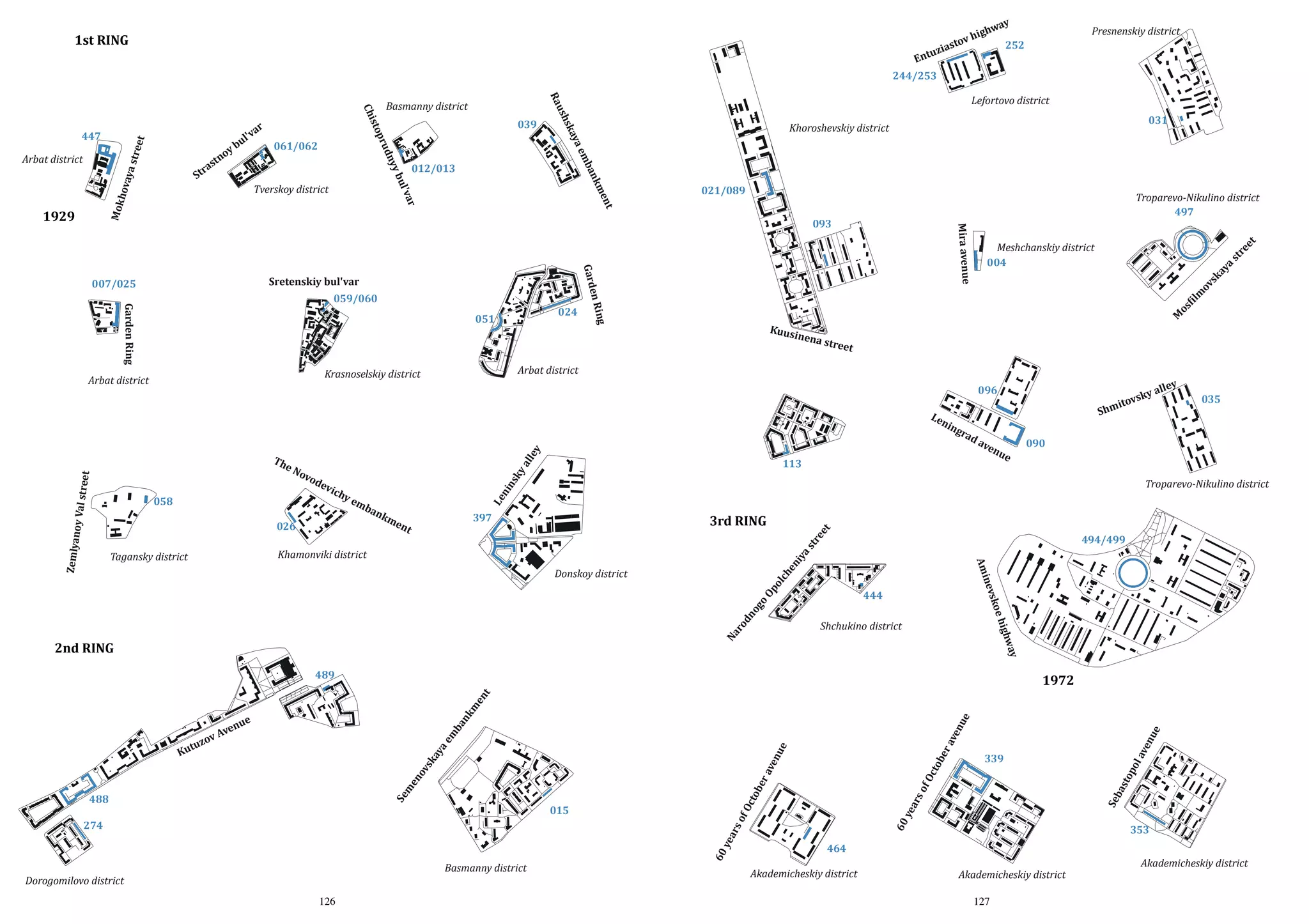
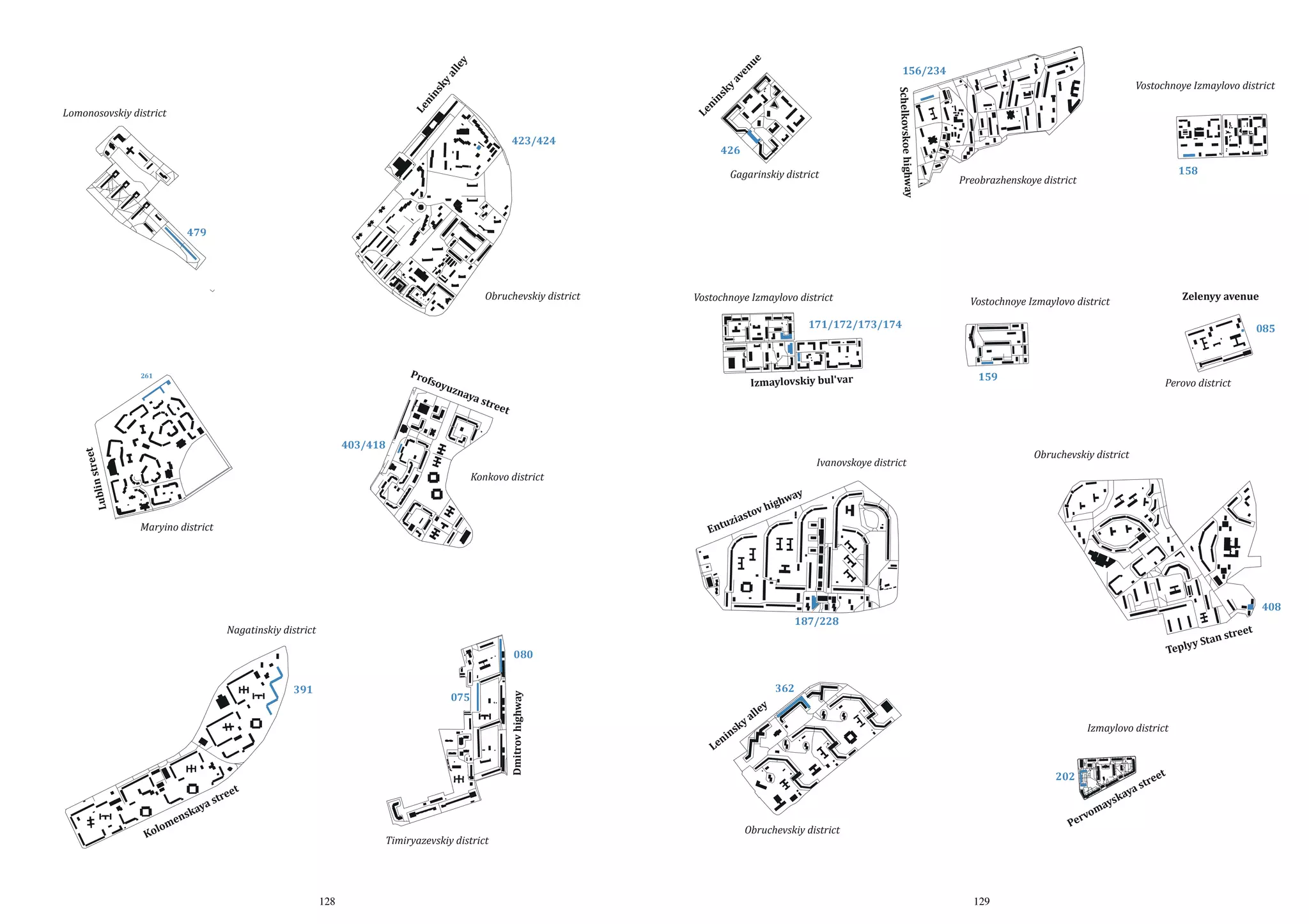
0

338

230

422

1

21

228

22

46

89
145

194

104

86

356

187

359

93
481

21
483

25

16
374

476

114

254
504

200

258

1

442

376

238

372

265

49

498

82

24
100

331
41

282

175

111

18

270
436

451

435

208
520

62

357

94
136
452

350

172

198
179

243

421

427

34

144

MOSCOW’S
LIBRARIES
180

312

384

361

135

171

255

395

216

153

272

55

181

413
457

311
373

35
313

354

71

235

500

467

ATLAS
14

425

351
380

259

291

131

507

444

348

450

334

365

438
391

38

299

448 ROOMS WITH A VIEW

97

99

146

342

371

330

513
217

42

289
236

79

308

307

370

106

160
242

73

218

475

80

332

102

76

333

318

251

95

263

57

389

61

116

516

287

212

51
494

130

449

115
110

31
249

309

75

290

128

366

37

288

197

68

203

168

81

159

485
19

397

0

140

52

463

349

285

295

119

166

277

403

328

321

53
418

15

85

117

219

428

11
294

496

469

26

4

454

489
47

325

189

185

234
244

88

381
3

505
7

510

65

67
133

225

379

281

91

276

430

383
169

490

386

345

156

253

394

317

252

283

360

247
439

429

390

401

237

4

139

120
518

479

158

32

215

271

426

448

58

453

319

257

419
25

447
127

105
327

392

519
MOSCOW’S
LIBRARIES

ATLAS

448 ROOMS WITH A VIEW

project by:
Paolo Ruaro
Giovanni Bellotti

tutors:
Paola Viganò
Alexander Sverdlov
Index
• Introduction

• Chronology of Events

pg.
x
x

• History of Moscow’s Library System

xx

• The 448 Rooms of Moscow’s Library

xxx

• The Zero Degree of the Library
	
	
Scandinavian Experiences
	
Libraries as Places, Books as Objects
	
The Neutral Library
	
• A New Library Geography

xxx

	
Spatial Equality and the role of the libraries
	
From Free-time to Leisure
	Heritage
	
Current Issues
	
Round House n°1
	K7
	P-44
	Kvartal	
	
Construction time-line and styles


“Gardens, parks of leisure and culture, water 	
basins and fountains”
Kvartals and Microrayons
Underground Rooms and Lines

• Moscow Views

• Bibliographic References

xxx

xxx
xx
Introduction
The library system of Moscow stands today as a piece of a wider cultural
infrastructure that no longer exists. The 448 municipal libraries within the
city’s boundaries belong to the list of soviet welfare infrastructures, along with
hospitals, schools, clubs and sport centres, a complex social machine of which
they are a fragment. Their present connotation, distribution, and function largely
depends on this past, although the history of the libraries stretches beyond and
before the 75 years of soviet regime. Its architecture can be seen as an element of
continuity in Moscow’s XX century history, having survived through the change
of three different regimes over one century. This continuity is expressed in their
physical presence of the city, in their interiors, their collections, and especially
in their direct link to political power; under each regime the libraries expressed
the political message of the time.
The present condition of the libraries, in this perspective, is that of a large system
in transition where the lack of political and economical interests have slowed the
changes that affected other institutions. The libraries constitute a huge resource
of public space -their rooms alone would cover 25 hectares, an area three times
that of the red square. This monumentality, however is expressed in a long list
of small interiors, worn out collections and minor histories. Recognizing the
library system as a whole, before considering its circumstantial situations, is a
way to understand how the network was designed and maintained.

The system embodies principles of soviet urbanism; libraries were related to
the number of inhabitants and geographical distance from other services, they
occupy the ground floors of the buildings and are evenly spread throughout the
city. This quantitative approach in the planning faces today a variety of issues;
bringing back the libraries to their present condition, studying their contexts
and seeing which of these relations still exist, which don’t and which could be
formed gives directions on how the network could be reorganized and on what
it could accomplish. Such connections are often hidden behind a curtain of low
fences, rows of garages, and blurred by the different management systems of
the city’s grounds. The Atlas proposes three ecologies and a series of public
elements to which the rooms can relate both on the scale of architecture and
of management. Establishing a common language among the diversity of
circumstances and building an atlas of relations between the libraries and their
contexts is a first step towards the new cycle of the system and in recognizing
the new geography of the libraries.
Chronology of events
This time line is based on Irina Kharkov’s research “Management structure of the territorial network of public libraries in super big cities. Current trends and prospects for improvement”, and on Evgeny Kuzmin’s
“From totalitarianism to democracy: Russian libraries in transition”

Timeline of the most significant events in XX cenbtury Moscow

•1862: “Regulations on public management of Moscow”, chapter on
censorship and press (186), institutes “rooms for reading” under the
control of the ministry of Interior affairs.

•1881 Alexander II assassinated

•1884: new regulations institute penalties for librarians guilty of
displaying censored books.

•1890: new regulations state that public libraries could only acquire
books approved by the Synod or the Scientific Committee of the Ministry of Education.

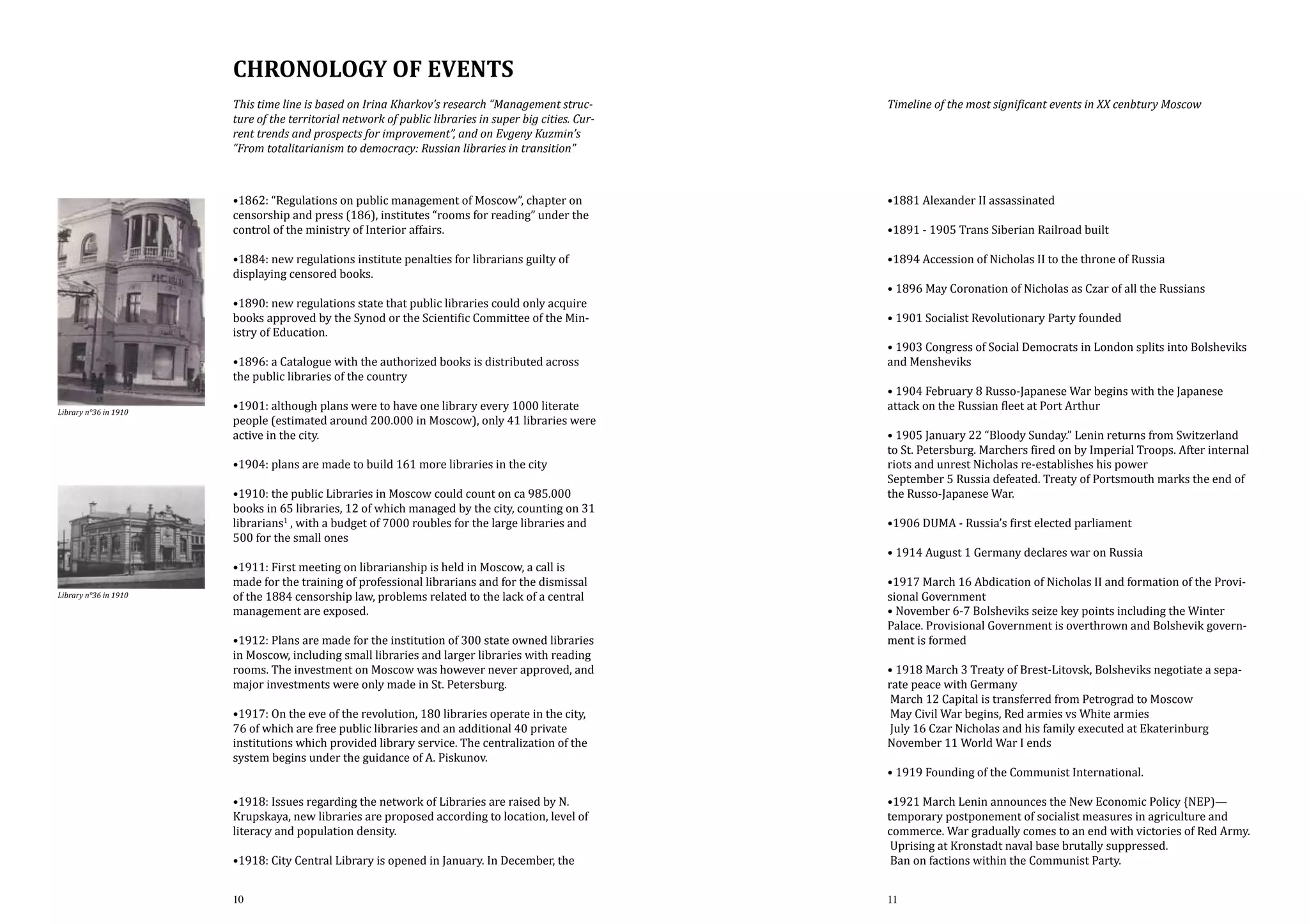
Library n°36 in 1910

•1896: a Catalogue with the authorized books is distributed across
the public libraries of the country

•1901: although plans were to have one library every 1000 literate
people (estimated around 200.000 in Moscow), only 41 libraries were
active in the city.
•1904: plans are made to build 161 more libraries in the city

•1910: the public Libraries in Moscow could count on ca 985.000
books in 65 libraries, 12 of which managed by the city, counting on 31
librarians1 , with a budget of 7000 roubles for the large libraries and
500 for the small ones
Library n°36 in 1910

•1911: First meeting on librarianship is held in Moscow, a call is
made for the training of professional librarians and for the dismissal
of the 1884 censorship law, problems related to the lack of a central
management are exposed.

•1912: Plans are made for the institution of 300 state owned libraries
in Moscow, including small libraries and larger libraries with reading
rooms. The investment on Moscow was however never approved, and
major investments were only made in St. Petersburg.
•1917: On the eve of the revolution, 180 libraries operate in the city,
76 of which are free public libraries and an additional 40 private
institutions which provided library service. The centralization of the
system begins under the guidance of A. Piskunov.

•1918: Issues regarding the network of Libraries are raised by N.
Krupskaya, new libraries are proposed according to location, level of
literacy and population density.
•1918: City Central Library is opened in January. In December, the
10

•1891 - 1905 Trans Siberian Railroad built

•1894 Accession of Nicholas II to the throne of Russia

• 1896 May Coronation of Nicholas as Czar of all the Russians
• 1901 Socialist Revolutionary Party founded

• 1903 Congress of Social Democrats in London splits into Bolsheviks
and Mensheviks
• 1904 February 8 Russo-Japanese War begins with the Japanese
attack on the Russian fleet at Port Arthur

• 1905 January 22 “Bloody Sunday.” Lenin returns from Switzerland
to St. Petersburg. Marchers fired on by Imperial Troops. After internal
riots and unrest Nicholas re-establishes his power
September 5 Russia defeated. Treaty of Portsmouth marks the end of
the Russo-Japanese War.
•1906 DUMA - Russia’s first elected parliament

• 1914 August 1 Germany declares war on Russia

•1917 March 16 Abdication of Nicholas II and formation of the Provisional Government
• November 6-7 Bolsheviks seize key points including the Winter
Palace. Provisional Government is overthrown and Bolshevik government is formed
• 1918 March 3 Treaty of Brest-Litovsk, Bolsheviks negotiate a separate peace with Germany
March 12 Capital is transferred from Petrograd to Moscow
May Civil War begins, Red armies vs White armies
July 16 Czar Nicholas and his family executed at Ekaterinburg
November 11 World War I ends
• 1919 Founding of the Communist International.

•1921 March Lenin announces the New Economic Policy {NEP)—
temporary postponement of socialist measures in agriculture and
commerce. War gradually comes to an end with victories of Red Army.
Uprising at Kronstadt naval base brutally suppressed.
Ban on factions within the Communist Party.
11
centralization of the libraries becomes effective. St. Petersburg and
Moscow work as independent branches of the same organism. The
system is supervised by Lenin’s wife, Nedezhda Krupskaia

• 1919: The principle of centralization proves to be unrealistic during
the years of the NEP. The central system continues to operate 88
libraries, reduced to 80 by 1924, while 448 total libraries operate in
the city.
• 1921: Dewey classification system is introduced in all Russian
libraries
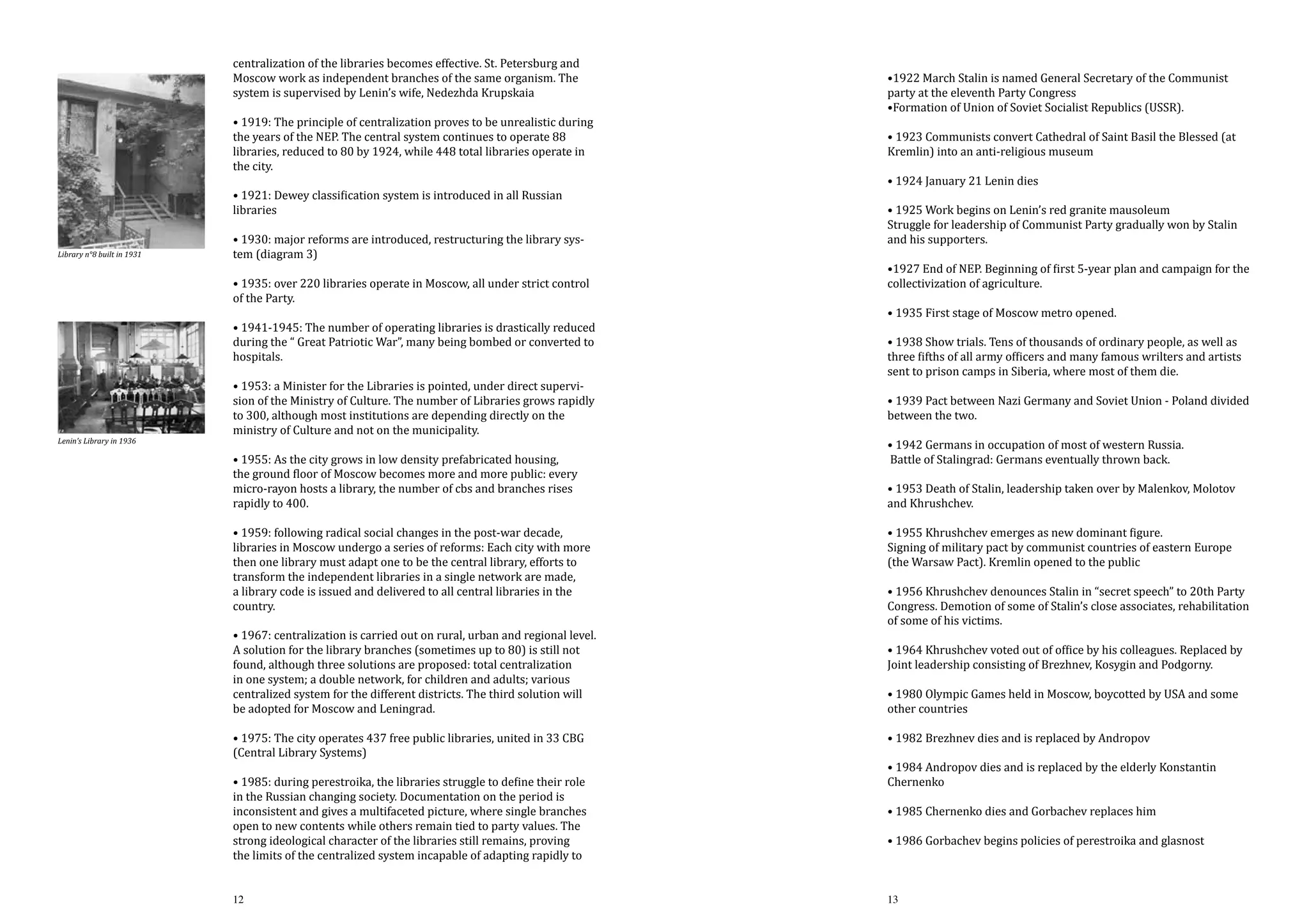
Library n°8 built in 1931

• 1930: major reforms are introduced, restructuring the library system (diagram 3)
• 1935: over 220 libraries operate in Moscow, all under strict control
of the Party.

• 1941-1945: The number of operating libraries is drastically reduced
during the “ Great Patriotic War”, many being bombed or converted to
hospitals.

Lenin’s Library in 1936

• 1953: a Minister for the Libraries is pointed, under direct supervision of the Ministry of Culture. The number of Libraries grows rapidly
to 300, although most institutions are depending directly on the
ministry of Culture and not on the municipality.
• 1955: As the city grows in low density prefabricated housing,
the ground floor of Moscow becomes more and more public: every
micro-rayon hosts a library, the number of cbs and branches rises
rapidly to 400.

• 1959: following radical social changes in the post-war decade,
libraries in Moscow undergo a series of reforms: Each city with more
then one library must adapt one to be the central library, efforts to
transform the independent libraries in a single network are made,
a library code is issued and delivered to all central libraries in the
country.

• 1967: centralization is carried out on rural, urban and regional level.
A solution for the library branches (sometimes up to 80) is still not
found, although three solutions are proposed: total centralization
in one system; a double network, for children and adults; various
centralized system for the different districts. The third solution will
be adopted for Moscow and Leningrad.
• 1975: The city operates 437 free public libraries, united in 33 CBG
(Central Library Systems)

• 1985: during perestroika, the libraries struggle to define their role
in the Russian changing society. Documentation on the period is
inconsistent and gives a multifaceted picture, where single branches
open to new contents while others remain tied to party values. The
strong ideological character of the libraries still remains, proving
the limits of the centralized system incapable of adapting rapidly to
12

•1922 March Stalin is named General Secretary of the Communist
party at the eleventh Party Congress
•Formation of Union of Soviet Socialist Republics (USSR).

• 1923 Communists convert Cathedral of Saint Basil the Blessed (at
Kremlin) into an anti-religious museum
• 1924 January 21 Lenin dies

• 1925 Work begins on Lenin’s red granite mausoleum
Struggle for leadership of Communist Party gradually won by Stalin
and his supporters.

•1927 End of NEP. Beginning of first 5-year plan and campaign for the
collectivization of agriculture.
• 1935 First stage of Moscow metro opened.

• 1938 Show trials. Tens of thousands of ordinary people, as well as
three fifths of all army officers and many famous wrilters and artists
sent to prison camps in Siberia, where most of them die.

• 1939 Pact between Nazi Germany and Soviet Union - Poland divided
between the two.
• 1942 Germans in occupation of most of western Russia.
Battle of Stalingrad: Germans eventually thrown back.

• 1953 Death of Stalin, leadership taken over by Malenkov, Molotov
and Khrushchev.
• 1955 Khrushchev emerges as new dominant figure.
Signing of military pact by communist countries of eastern Europe
(the Warsaw Pact). Kremlin opened to the public

• 1956 Khrushchev denounces Stalin in “secret speech” to 20th Party
Congress. Demotion of some of Stalin’s close associates, rehabilitation
of some of his victims.
• 1964 Khrushchev voted out of office by his colleagues. Replaced by
Joint leadership consisting of Brezhnev, Kosygin and Podgorny.
• 1980 Olympic Games held in Moscow, boycotted by USA and some
other countries
• 1982 Brezhnev dies and is replaced by Andropov

• 1984 Andropov dies and is replaced by the elderly Konstantin
Chernenko
• 1985 Chernenko dies and Gorbachev replaces him

• 1986 Gorbachev begins policies of perestroika and glasnost
13
changing conditions, although there is a greater availability of foreign
newspapers within the libraries.

Library n°75 in 1959

• 1988: A new re-organization is implemented, trying to introduce
specialization in the library system (leisure, literary history, news,
video, computers, local history etc.) and an aim for each library (development of creative abilities, assistance to the elderly et cetera)

• 1991: As the Soviet Union falls, the three principles that restrained
the 453 libraries existing at the time (partiinost, spetskhran and censorship) fall with it.

• 1994: Bill on libraries is approved, tying all city libraries to the
DUMA authority, meanwhile a process of de-centralization is started.

Library n°79 in 1979

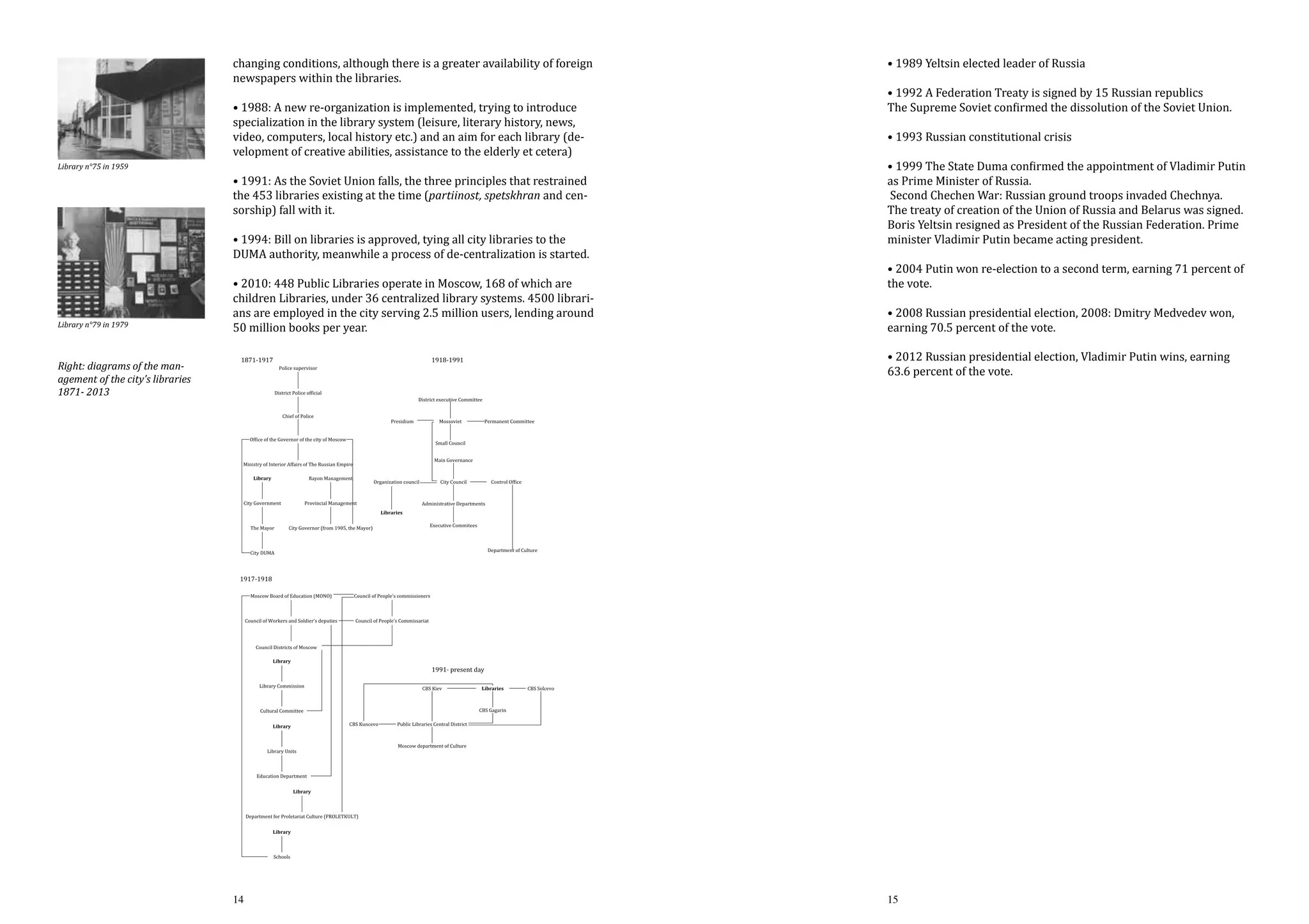
Right: diagrams of the management of the city’s libraries
1871- 2013

• 2010: 448 Public Libraries operate in Moscow, 168 of which are
children Libraries, under 36 centralized library systems. 4500 librarians are employed in the city serving 2.5 million users, lending around
50 million books per year.

14

• 1989 Yeltsin elected leader of Russia

• 1992 A Federation Treaty is signed by 15 Russian republics
The Supreme Soviet confirmed the dissolution of the Soviet Union.
• 1993 Russian constitutional crisis

• 1999 The State Duma confirmed the appointment of Vladimir Putin
as Prime Minister of Russia.
Second Chechen War: Russian ground troops invaded Chechnya.
The treaty of creation of the Union of Russia and Belarus was signed.
Boris Yeltsin resigned as President of the Russian Federation. Prime
minister Vladimir Putin became acting president.
• 2004 Putin won re-election to a second term, earning 71 percent of
the vote.
• 2008 Russian presidential election, 2008: Dmitry Medvedev won,
earning 70.5 percent of the vote.
• 2012 Russian presidential election, Vladimir Putin wins, earning
63.6 percent of the vote.

15
15

10

5
History OF MOSCOW’S LIBRARY SYSTEM
The History of Moscow’s libraries over the last 100 years is as complex and rich as
that of the city itself. The core of the system stands today as a monument of soviet
network planning, being the only surviving cultural infrastructure of the communist
city spared from the privatizations that have reshaped most of the nation’s welfare
networks1.

As a heritage of the tsarist period - pre-revolutionary Moscow could already count
on 180 collections of books2 - the changes within the libraries management and their
spaces reflect the evolving tendencies of Russian politics under the soviet regime,
just as their difficulty to adapt to contemporary Russian society. The soviet library
system was instituted in 1922 by Lenin and his wife, Nedezhda Krupskaia, librarian
by profession3: “[Libraries] were to serve as instruments for eradicating illiteracy and
for educating the population; an important element was moral education, one which
would make for good Marxist/Leninist citizens. Thus, the role of the librarian was not
to facilitate access to material which the reader demanded, but rather to guide the
reader to material that was considered appropriate and to keep away from the reader
material which was considered inappropriate or harmful.” Since then, partiinost,
spetskhran4 and censorship informed soviet librarianship for almost 75 years.
1. Privatization in Moscow,James H. Bater, Geographical Review, Vol. 84, No. 2 (April, 1994), pp. 201-215

2.Those Libraries were not accessible, however, by the entire population, but reserved to specific classes of workers belonging to trade unions or reserved
to clergy or nobility.
2. From totalitarianism to democracy: Russian libraries in transition. Kuzmin, E. (1993). American Libraries, 24, 568-570.
3. Raymond, B. (1979). Krupskaia and Soviet Russian librarianship, 1917-1939. Metuchen, NJ: Scarecrow Press.

4. Under “Спецхран”, abbreviation for “special storage sections”, were listed all the books that were not accessible to the public without authorization.
Those prohibited archives, opened only for researches of undoubted comunist beliefs became at one point so vast that became a storage problem for the
libraries. Over 60% of the books in the libraries were censored in the year 1930 alone, when their stock had already being purged at least three times. By
1935 only few copies of the censored books were to be kept in a special section of the Lenin library, while the rest was to be destroyed. (Rogers, 1973)
4. N. K. Krupskaya, Part two : Krupskaia
on libraries, ed Sylva Simsova (Hamden :
Archon Books, 1968) 45–51.

5. Thomas, C. (1999). Changes in Russian
libraries in the 1990s. Focus on International and Comparative Librarianship,
30(3), 112-12.
6. Greening, J. M. (1995). Ten years in the
life of Russian libraries. International Information & Library Review, 27, 113-127

Krupskaia started her activity directing underground
libraries in pre-revolutionary Moscow, when libraries
were either reserved for specific trade unions or exclusively for higher classes. After the revolution, Krupskaia
initiated a census of the libraries, revealing the inadequacy of the system4: “We have a laughable number of
libraries, and their book stocks are even more inadequate.
Their quality is terrible, the majority of the population
does not know how to use them and does not even know
what a library is.” In the 1920s the education of a class
of professional librarians was being formed for the first
time in Russia. E.I. Samurin, one of the chief ideologists
of soviet librarianship described in the 1940s the duties
of the Russian librarian:
(1) Indicate for each subject its ‘politically acceptable’
place in the classification scheme;
(2) Grant first place in every division and subdivision to
the opinions of the ‘classics of Marxism-Leninism’, as well
as to party directives;
(3) Grant priority to materials relating the Soviet Union as
the country of ‘victorious socialism’, with the provision that
these materials must be clearly separated from those of
foreign (‘capitalist’) countries;
(4) Grant fist place to ‘advanced’ (communist) theories
and practices and literature about them;
(5) Provide class, division, and subdivision names in ‘politically acute and distinct terms”

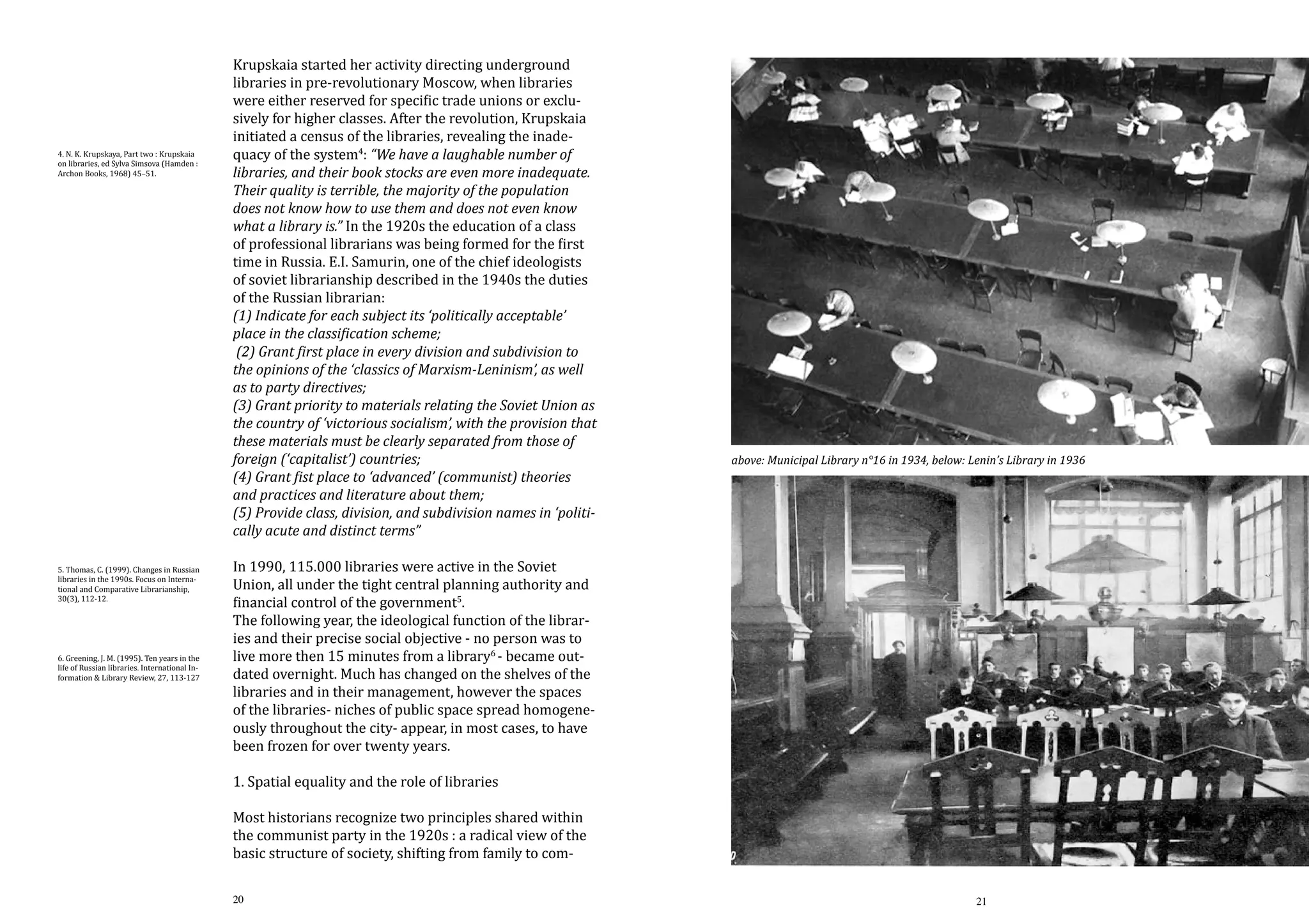
above: Municipal Library n°16 in 1934, below: Lenin’s Library in 1936

In 1990, 115.000 libraries were active in the Soviet
Union, all under the tight central planning authority and
financial control of the government5.
The following year, the ideological function of the libraries and their precise social objective - no person was to
live more then 15 minutes from a library6 - became outdated overnight. Much has changed on the shelves of the
libraries and in their management, however the spaces
of the libraries- niches of public space spread homogeneously throughout the city- appear, in most cases, to have
been frozen for over twenty years.
1. Spatial equality and the role of libraries

Most historians recognize two principles shared within
the communist party in the 1920s : a radical view of the
basic structure of society, shifting from family to com20

21
1. Planning the City of Socialist Man, Jack
C. Fisher, Journal of the American Institute
of Planners, Vol. 28, Iss. 4, 1962
2. The first edition of Tomorrow: a
peaceful path to real reform (1898) was
translated into Russian in 1901. In 1913
St. Petersburg already hosted a branch of
the International Garden City Society.

3. Governing the Socialist Metropolis,
Timothy Colton, 1995

3. “leisure” is taken here to define the part
of the day not spent working, sleeping or
travelling, although in communist Russia
- “the nation of workers”- leisure was ill
regarded as a concept, and free time had a
more active connotation.
4. Idee per la città comunista, A. Baburov,
1966, pg 94

munity, and the abolition of “bourgeois” distinctions
between city and countryside1. Both points are rooted
in Marxist theory, and the latter, under the influence of
Howard’s garden cities2, was to become a major theme
of discussion among soviet urbanists from the 1920s.
Although the academic positions that lead the urban discourse - Leonid Sabsovich’s City Urbanists and Mikhail
Okitovic’s Disurbanists - were not taken into account in
the 1935 plan, those Marxist principles influenced greatly the ideas for the communist capital.

As early as 1918 the 17 tchasti of Moscow, the tsarist
shell-like division of the city, were replaced by 11 rayoni, a radial system that was to ensure the inhabitant of
the periphery, at least by definition, the same district of
those living in the centre3. Parks, museums, playgrounds
and libraries, as well as most of the cities free-time facilities revolved along the same principles of spatial equality, contributing to the image of a society where everyone
had access to the same knowledge, therefore to the same
possibilities. Cultural institutions were to build a bridge
between cities and villages, the distance of which constituted a source of social inequality.

As communism eroded more and more every aspect of
private life - “Communism destroyed private life”, Benjamin wrote in the 20s - and as the working hours were
progressively reduced, the problem of infrastructure for
“leisure3” became more and more pressing.
The issue of free time was addressed as an aspect of the
communist lifestyle, “ in the interest of everyone and
each one”, and as such required “a well defined place in
space and time, equally accessible to everyone”4. Free
time thus became an extension of communal living,
where each individual could invest his energies on himself in order to better accomplish his individual aspirations. Facilities were heavily subsidized, and ideologically marked; “cultured” use of free time was seen as a
mean for the transition from the “realm of necessities” to
“the realm of freedom”:“ For a further, greater, growth of
material culture, the following will be guaranteed: Increment of the network of Libraries, reading rooms, clubs and
culture houses, cinemas (...) The Party retains necessary to
distribute homogeneously throughout the nation cultural
institutions to elevate gradually the cultural level of the
22

5. Program of the Communist Party of The
Soviet Union, 1960

6. Time budget studies were conducted in
Russia already between 1922 and 1923,
however, for political reasons, no further
research was conducted again until the
early 60s. Free time and Leisure Participations: International Perspectives, chapter
14, Moscow. I. A. Butenko, 2006

7. Moscou: Portrait de Ville, E. Essaian,
2007, pg. 43

village to that of the city.5” Libraries and cultural institutions played a major role in fulfilling this purpose, and
their history is a reflection of wider phenomena within
the Soviet Union.
2. From free-time to leisure

There are little information on time-use patterns before
the early sixties6, when reading was reported to be the
most common free time activity, averaging almost 6
hours per person each week in 1961 (Murray, 1967). In
the eighties, during perestroika, libraries enjoyed their
peak of success, mainly for the availability of international news. Books were at the time widely considered to
be a good investment and a privileged free-time activity - 19% of Russians read “ regularly”, 25% read 2-3
books per month, 21% read 2-3 books per year (Butenko, 1997). Political changes in the 1990s, when cultural
activities were no longer tied to ideological constraints,
brought government subsidies to be drastically reduced,
and many facilities were forced to close. At the same
time private enterprise was on the rise, and many of the
services became available only to the affluent few, a process accelerated by the 1998 financial crisis that has not
reverted since. The artificial homogeneity of the communist city then became evident; within a few years, a new
class of wealthy Muscovites re-occupied the most central
parts of the city, and a handful of agencies bought, parcel
by parcel, the city’s center7, while most of the cities welfare networks were privatized (Bater, 1994). The Libraries are an exception within this panorama; being a hardly
economically exploitable resource they have remained
public and represent the last social “machine” still active
in the city (Zaitsev, 2001).

3. Physical Heritage

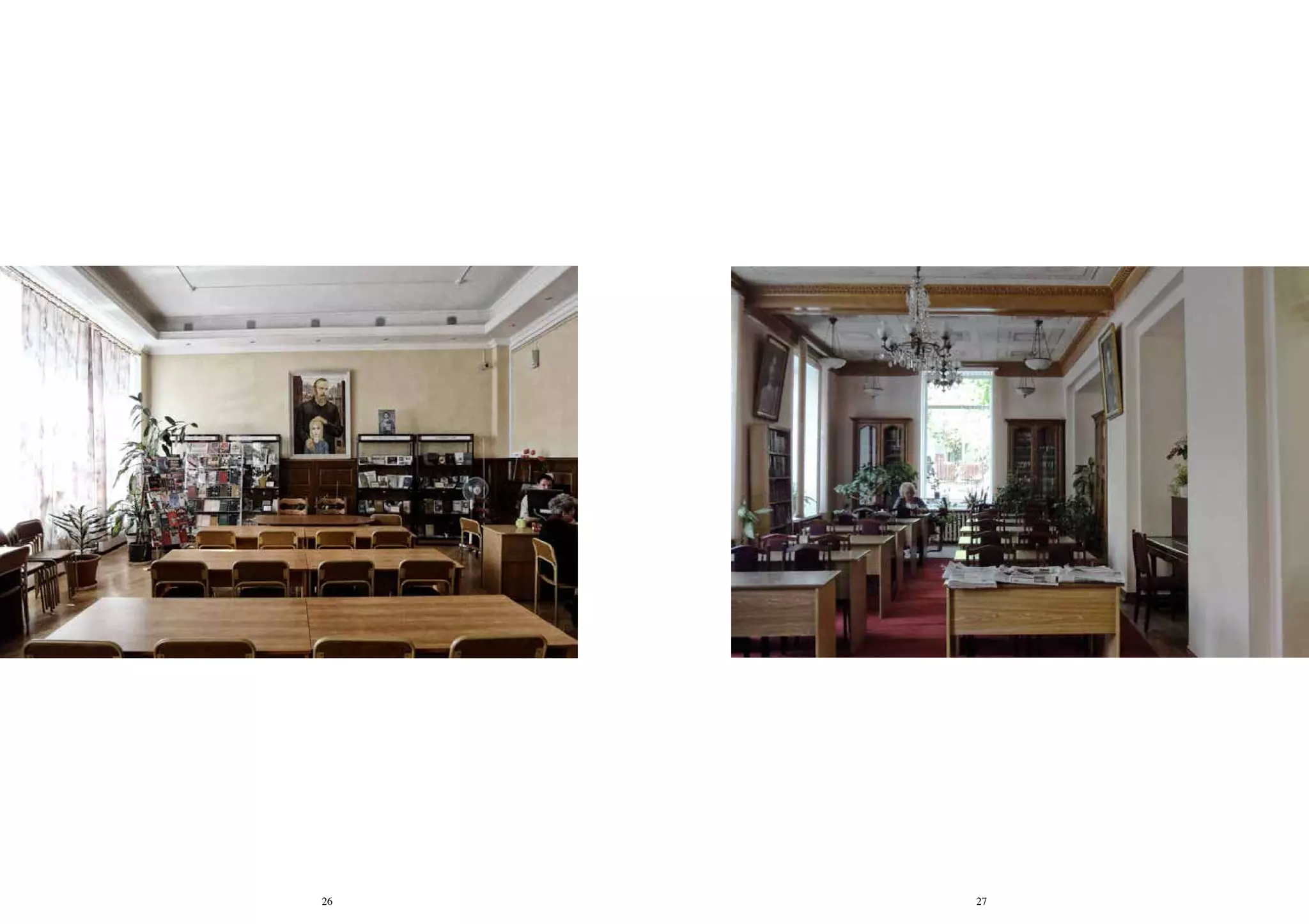
As a heritage of the old regime, libraries still carry spatial
principles of the time, being part of a diversified infrastructure of “use” built of canteens, club rooms, music
halls, sport centres and other facilities, for a society
where possession was reduced to a minimum and
private space eroded, sometimes to the size of a small
bedroom.
23
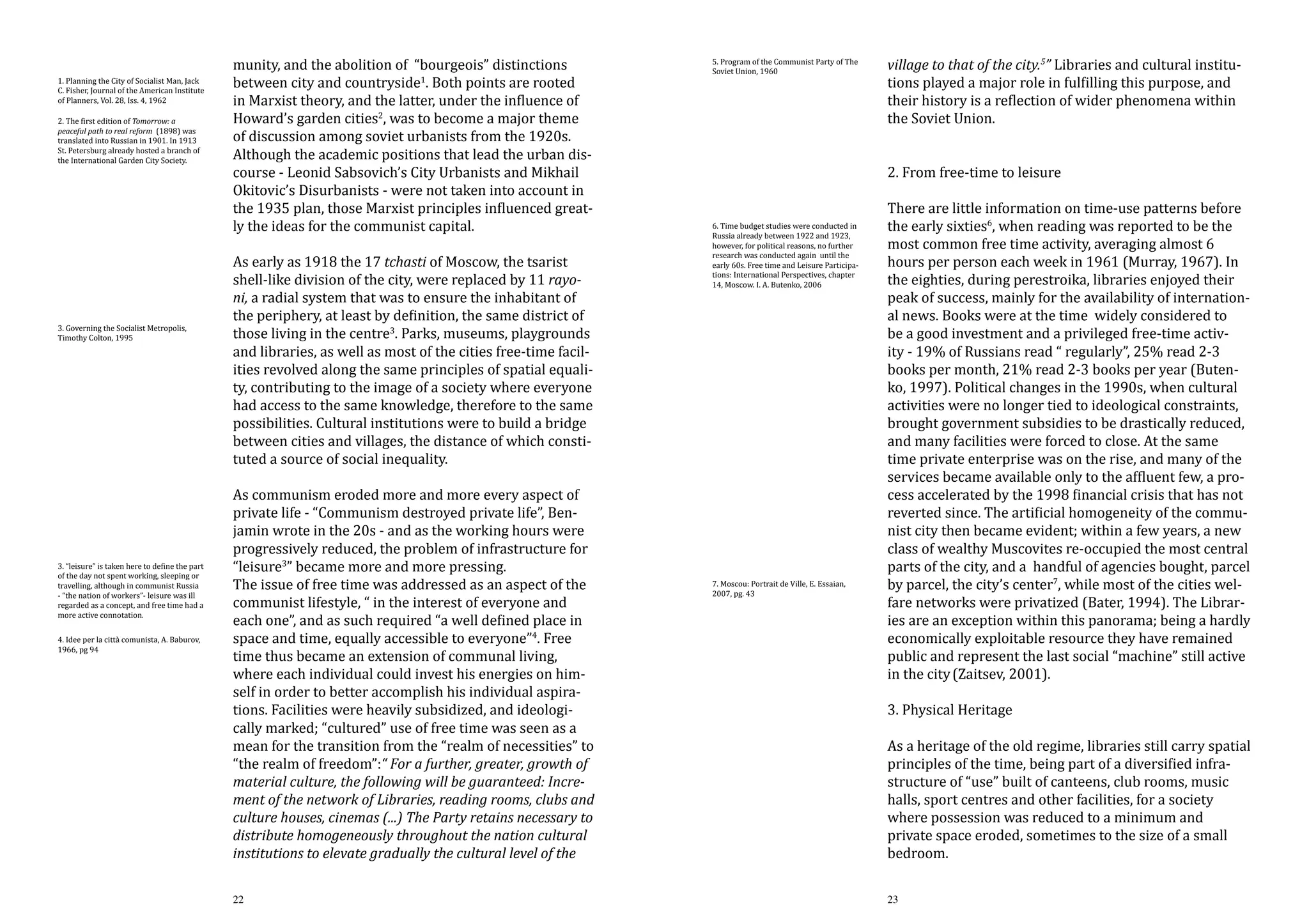
In a lounge of a house-hold cooperative (Admiralteyskaya embankment), 1927-28

24

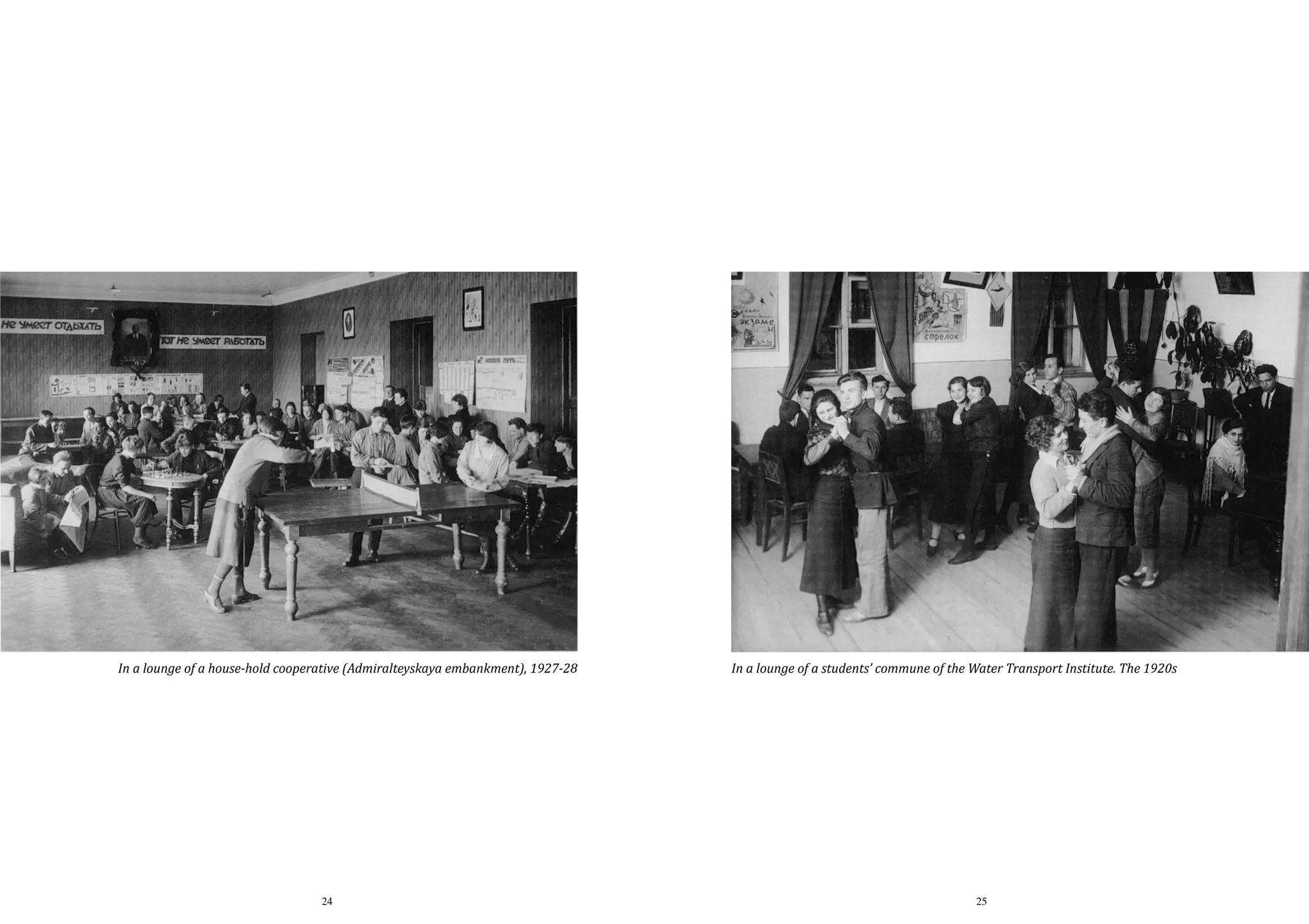
In a lounge of a students’ commune of the Water Transport Institute. The 1920s

25
26

27
28

29
9. The Theology Of Tabula Rasa: Walter
Benjamin And Architecture in The Age
of Precarity, Pier Vittorio Aureli, Log 27,
2013

10. OMA / Rem Koolhaas, El Croquis,
Issues 53 + 79, 2006

“Use” was rapidly substituted by ownership and as
investment was diverted from communal facilities
free time activities became more private, fragmented
and wealth-related. The dispersion of leisure, its “liquid” condition is in this regard not dissimilar to that of
labor9, a dispersion which is not only in space, but in
time as well. The “well defined place in space and time”
(Baburov, 1968) for free-time marks today the change
that took place; leisure can now be everywhere, at any
time. Already in 1989 Rem Koohlaas, when describing
the project for the “Trés Grande Biblioteque” was stressing the irony of designing a temple for books and other
media in a moment when culture was becoming less and
less tied to material boundaries10, addressing the issue
of the role of public cultural spaces in the age of digital
information. Being designed as a machine engineered to
serve a known amount of people in a very controlled environment, Moscow’s libraries face today a double issue:
the problem of defining their role within a society very
different from that which originated them, and a global
change of the role of public libraries. As a stratified system that grew for over a century libraries occupy today
places so diverse that each requires to be recognized as
a specific element, the most evident feature that unites
them being precisely their appearing “out of context” and
“frozen”; elements of a former continuity in a fragmented
city.
4. Current Issues

Moscow’s library network compares very poorly with
most library systems in the world. A comparison between the networks is possible with systems that share
a similar condition - geographical or historical. Considering the Swedish , or Norwegian network, similar for
historical reasons, shows the potential of a dispersed library network, while considering a quantitatively similar
network - like the library system of Los Angeles - shows
how a different management of the network could bring
large improvements without substantial changes to the
funding.
Currently, the city budget for the library network is of
87.5 million Euro per year, 65% of which is spent on

30

personnel and only 2.2% is spent on the collections. The
average of funding for collections in Europe is 15%,;
considering that 10 to 15% of the collection should be
replaced each year and that new acquisitions are vital for
the success of a library, the situation of Moscow’s libraries media collections, although official data are unavailable, is very likely to be bad.

11. SVESMI research on Public Libraries,
2012

Paradoxically, the expenses per library in Moscow are
in average with those of most European cities, but the
results achieved are very poor; Amsterdam, for example
invests on each user 4,5€, in Moscow, proportionally,
each visitor costs to the city 43€. A research conducted
in 201311 on a sample of 133 libraries reveals that at
least one title among the top thirty best sellers of 2011
and 2013 was available in only half of the libraries and
70% of the libraries shares three distributors for the
books paying the books at the shelf price. Problems
extend to the accessibility of the network; not only it is
not possible to borrow books and register at the library
without a residence permit, but using the reading rooms
is also forbidden for non residents in the city. Building a
digital catalogue of the libraries media has been on the
agenda for years, but since four different coding systems
are in use, this operation involves the complete remaking
of each library’s catalogue.

The “local” dimension of the libraries, their small size,
their even distribution in the city and their resistance
to change - largely due to insufficient funding - constitutes a unique feature of Moscow’s library network,
and a chance to address issues raised by two decades
of development that have revolved almost entirely on
housing and office space. Hosted in the ground floor of
almost every architectural type the city has to offer, from
beaux art complexes to early prefabricated structures,
Stalinist kvartaly, 1950s kruschevky, and 1970’s towers, the 448 public “rooms” of the libraries are niches
of heated public space waiting to be recognized, the
strength of which lies beyond the circumstantial facts
that make each library different, but in the repetition
and equal distribution of functions throughout the city’s
boundaries. This continuity, however, has evolved over
the years in the sterile repetition of interiors, of activities
31
7. Specialization in Moscow’s libraries
began in the late 1980s, in the meantime
the most advanced library systems in the
world were abandoning them in favour
of a “generalist” approach to the library
program

dictated with an agenda far from that of the population
and with an anachronistic specialization that was out
of date long before its application7. The lack of interest
in the libraries since the fall of the Soviet Union, both of
the municipality and of the market, where it has preserved for future use their physical space, has marked a
distance between the citizens and one of the traditional
public spaces of the metropolis. The suspension of the
library system between its abstract monumentality and
its decaying elements is a challenge that involves a vision
for the services offered to the citizens and a perspective
on the city’s public dimension.

32
the 448 rooms of Moscow’s library

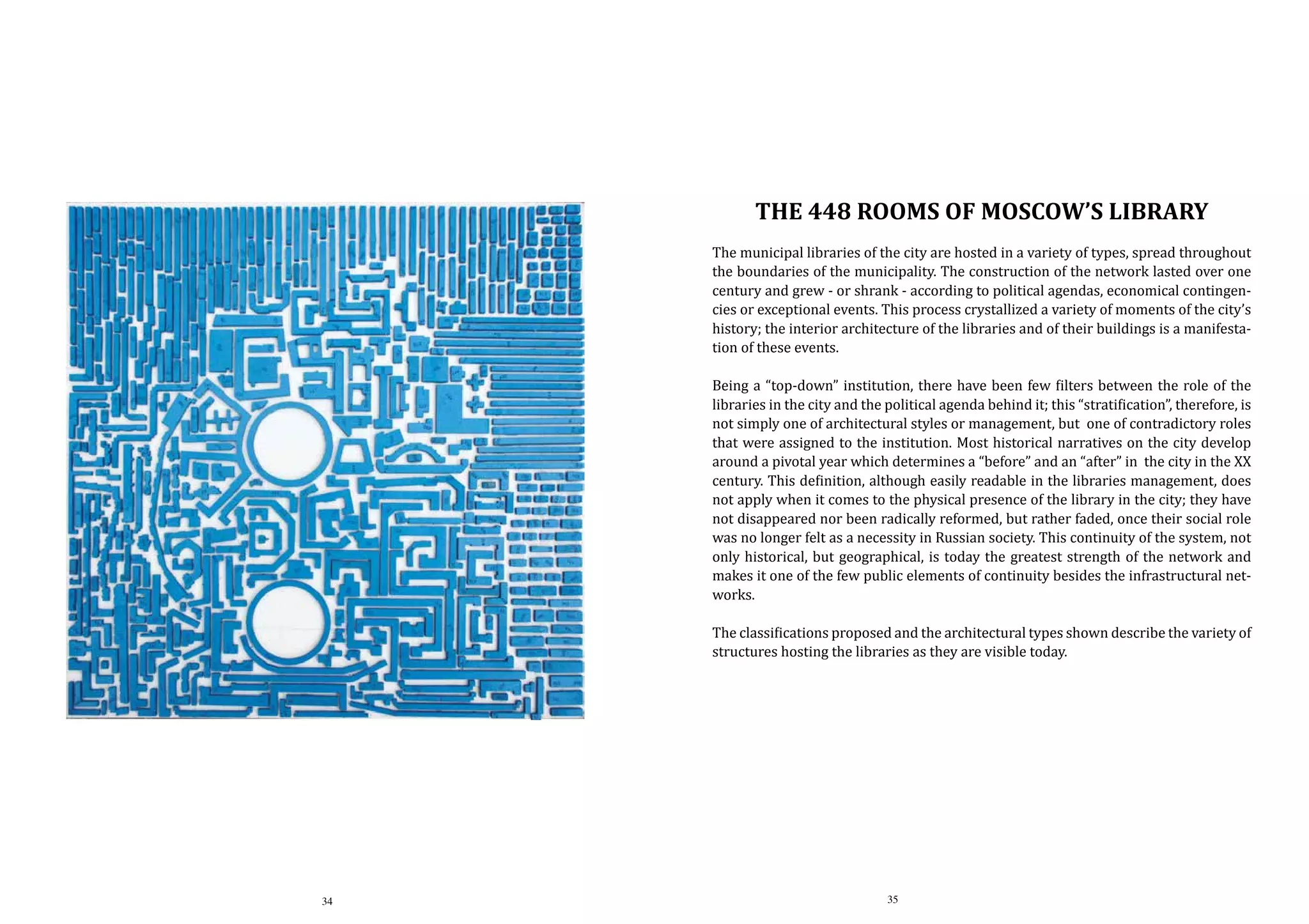
The municipal libraries of the city are hosted in a variety of types, spread throughout
the boundaries of the municipality. The construction of the network lasted over one
century and grew - or shrank - according to political agendas, economical contingencies or exceptional events. This process crystallized a variety of moments of the city’s
history; the interior architecture of the libraries and of their buildings is a manifestation of these events.

Being a “top-down” institution, there have been few filters between the role of the
libraries in the city and the political agenda behind it; this “stratification”, therefore, is
not simply one of architectural styles or management, but one of contradictory roles
that were assigned to the institution. Most historical narratives on the city develop
around a pivotal year which determines a “before” and an “after” in the city in the XX
century. This definition, although easily readable in the libraries management, does
not apply when it comes to the physical presence of the library in the city; they have
not disappeared nor been radically reformed, but rather faded, once their social role
was no longer felt as a necessity in Russian society. This continuity of the system, not
only historical, but geographical, is today the greatest strength of the network and
makes it one of the few public elements of continuity besides the infrastructural networks.
The classifications proposed and the architectural types shown describe the variety of
structures hosting the libraries as they are visible today.

34

35
36

37
38

39
40

41
42

43
44

45
46

47
48

49
50

51
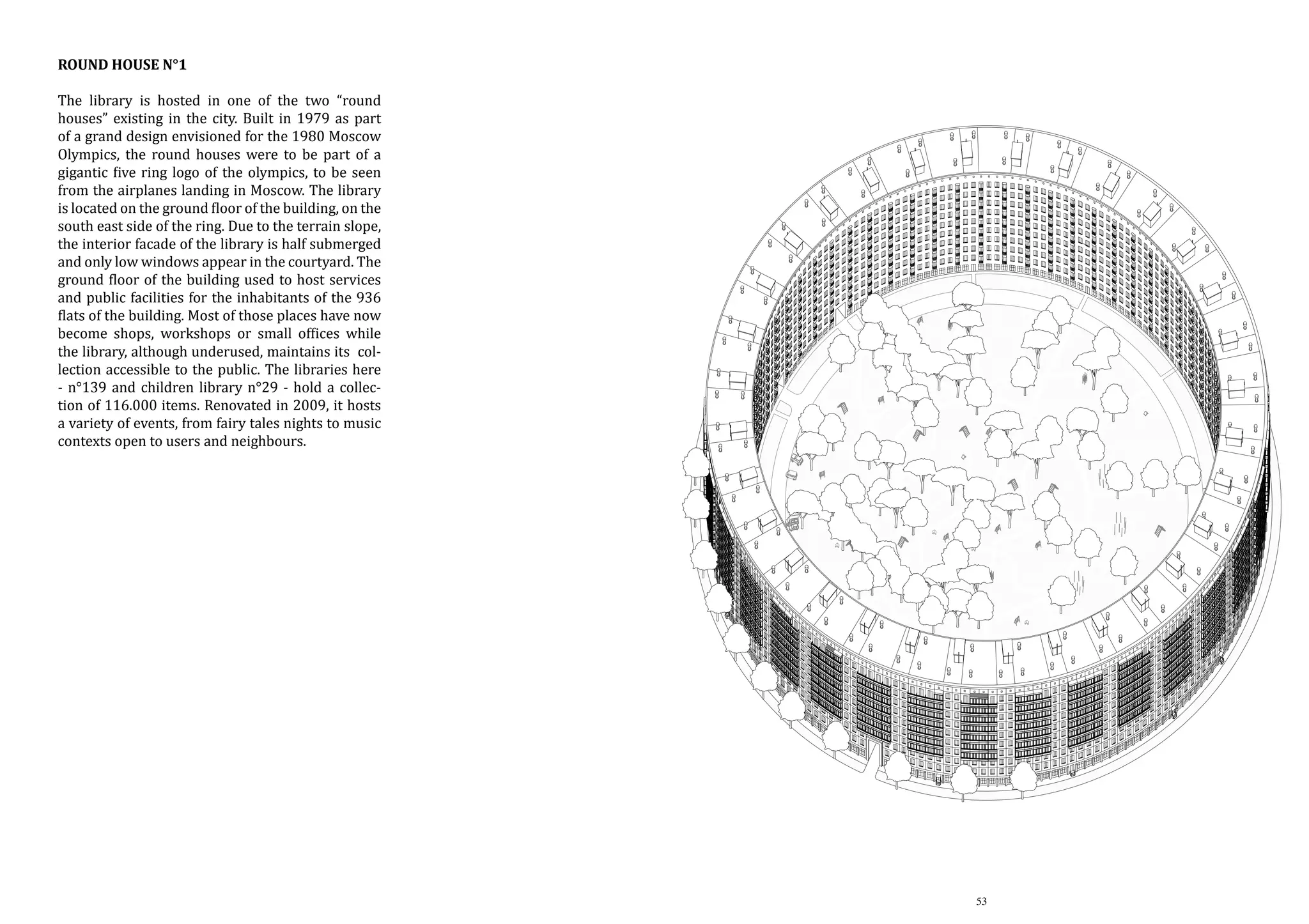
Round House n°1

The library is hosted in one of the two “round
houses” existing in the city. Built in 1979 as part
of a grand design envisioned for the 1980 Moscow
Olympics, the round houses were to be part of a
gigantic five ring logo of the olympics, to be seen
from the airplanes landing in Moscow. The library
is located on the ground floor of the building, on the
south east side of the ring. Due to the terrain slope,
the interior facade of the library is half submerged
and only low windows appear in the courtyard. The
ground floor of the building used to host services
and public facilities for the inhabitants of the 936
flats of the building. Most of those places have now
become shops, workshops or small offices while
the library, although underused, maintains its collection accessible to the public. The libraries here
- n°139 and children library n°29 - hold a collection of 116.000 items. Renovated in 2009, it hosts
a variety of events, from fairy tales nights to music
contexts open to users and neighbours.

53
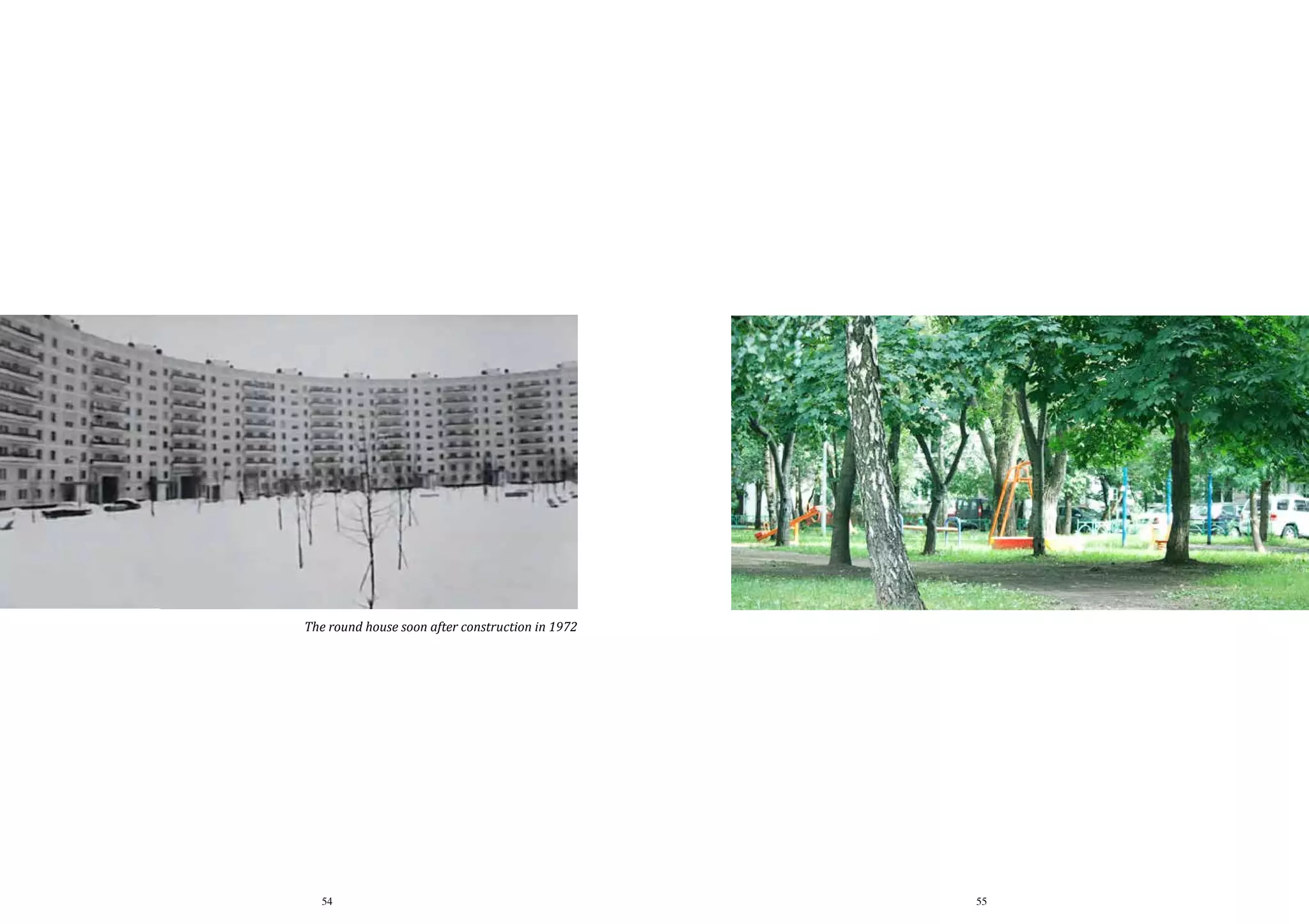
The round house soon after construction in 1972

54

55
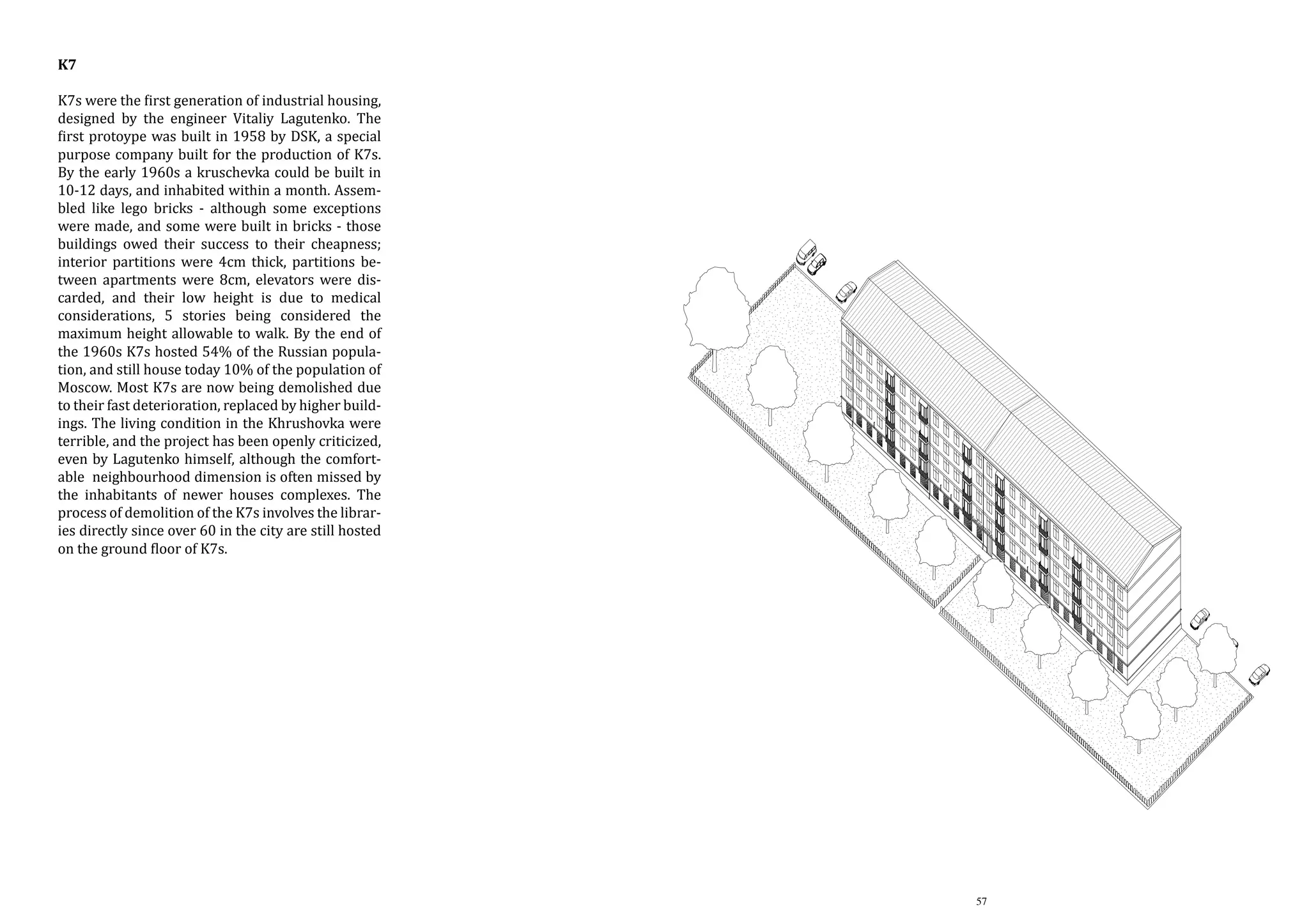
K7

K7s were the first generation of industrial housing,
designed by the engineer Vitaliy Lagutenko. The
first protoype was built in 1958 by DSK, a special
purpose company built for the production of K7s.
By the early 1960s a kruschevka could be built in
10-12 days, and inhabited within a month. Assembled like lego bricks - although some exceptions
were made, and some were built in bricks - those
buildings owed their success to their cheapness;
interior partitions were 4cm thick, partitions between apartments were 8cm, elevators were discarded, and their low height is due to medical
considerations, 5 stories being considered the
maximum height allowable to walk. By the end of
the 1960s K7s hosted 54% of the Russian population, and still house today 10% of the population of
Moscow. Most K7s are now being demolished due
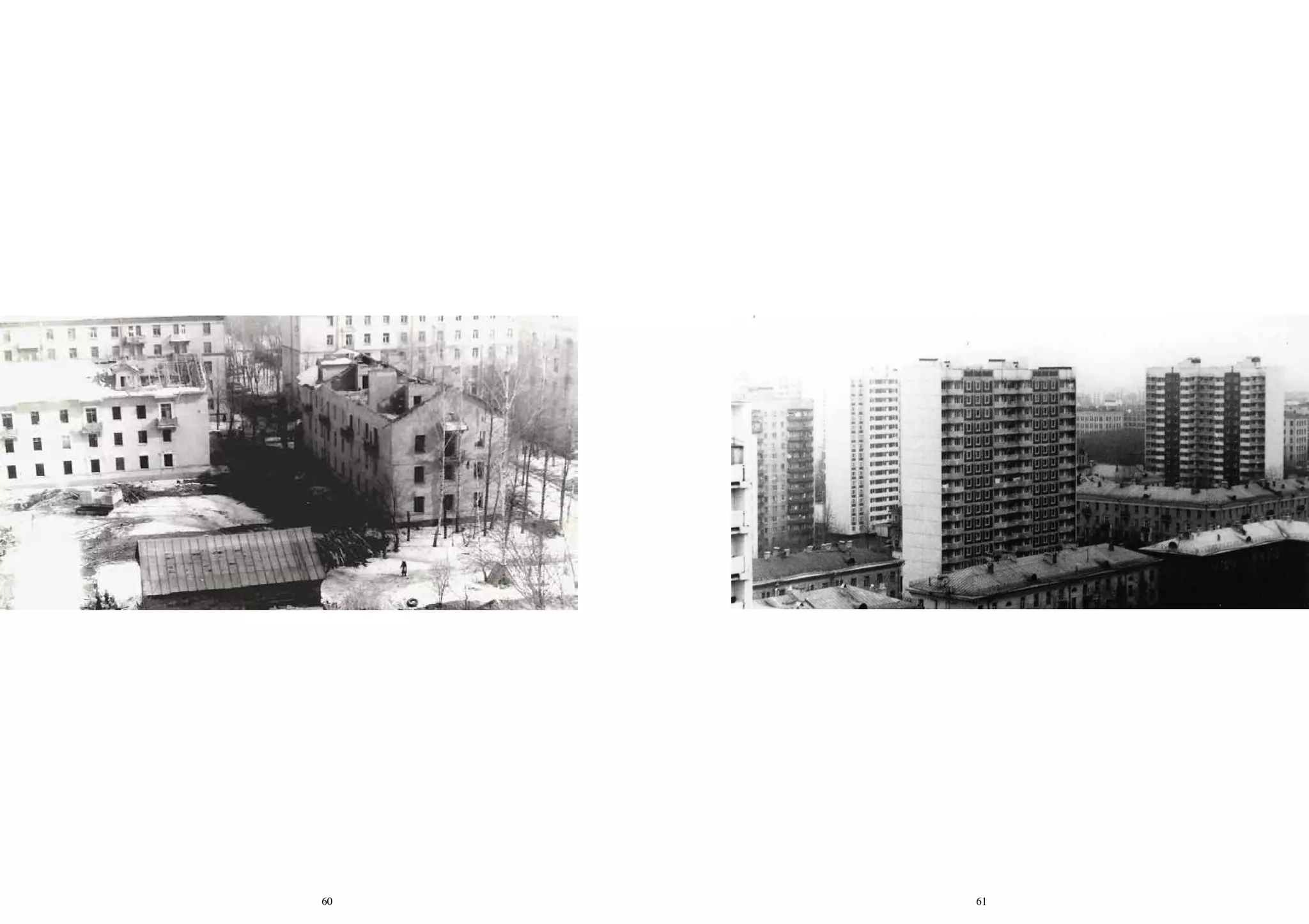
to their fast deterioration, replaced by higher buildings. The living condition in the Khrushovka were
terrible, and the project has been openly criticized,
even by Lagutenko himself, although the comfortable neighbourhood dimension is often missed by
the inhabitants of newer houses complexes. The
process of demolition of the K7s involves the libraries directly since over 60 in the city are still hosted
on the ground floor of K7s.

K7

K7s were the �irst gene
ing, designed by the en
The �irst protoype was
special purpose compa
tion of K7s. By the ea
could be built in 10within a month. Asse
although some exceptio
were built in bricks - th
success to their cheap
were 4cm thick, partiti
were 8cm, elevators w
low height is due to m
stories being consider
allowable to walk. By t
hosted 54% of the rus
house today 10% of th
Most K7s are now bein
fast deterioration, repl
The living condition i
terrible, and the pr
criticized, even by Lag
the comfortable neig
often missed by the inh
complexes. The proces
involves the libraries
the city are still hoste
K7s.

57
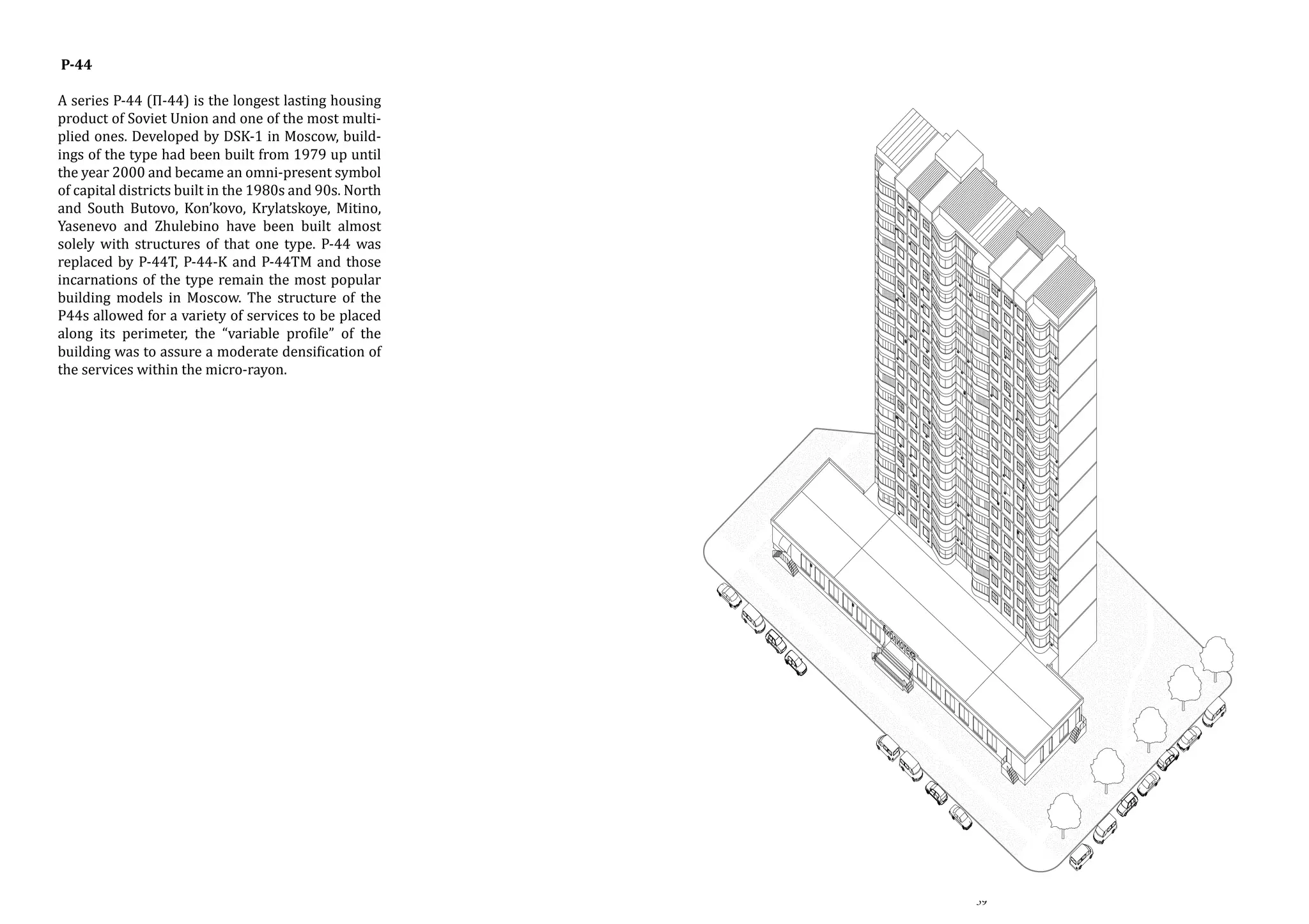
P-44

A series P-44 (П-44) is the longest lasting housing
product of Soviet Union and one of the most multiplied ones. Developed by DSK-1 in Moscow, buildings of the type had been built from 1979 up until
the year 2000 and became an omni-present symbol
of capital districts built in the 1980s and 90s. North
and South Butovo, Kon’kovo, Krylatskoye, Mitino,
Yasenevo and Zhulebino have been built almost
solely with structures of that one type. P-44 was
replaced by P-44T, P-44-K and P-44TM and those
incarnations of the type remain the most popular
building models in Moscow. The structure of the
P44s allowed for a variety of services to be placed
along its perimeter, the “variable profile” of the
building was to assure a moderate densification of
the services within the micro-rayon.

P-44

A series P-44 (П-44) is
ing product of Soviet U
multiplied ones. De
Moscow, buildings of
from 1979 up until th
an omni-present symb
in the 1980s and 90s.
Kon'kovo, Krylatskoye
Zhulebino have been
structures of that one
by P-44T, P-44-K and Ptions of the type remai
ing models in Moscow.
allowed for a variety
along its perimeter, th
building was to assure
of the services within t

59
60

61
Kvartal

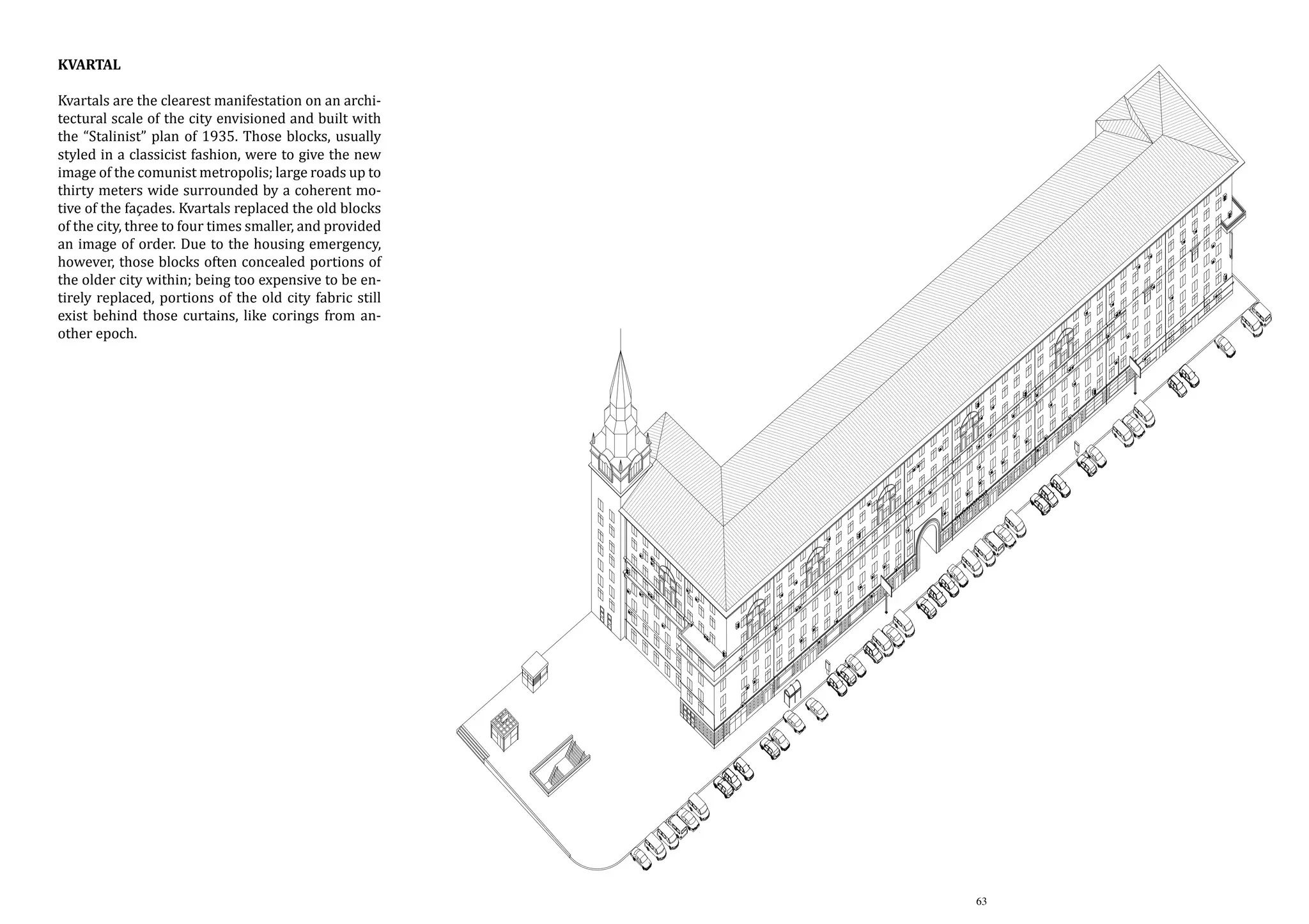
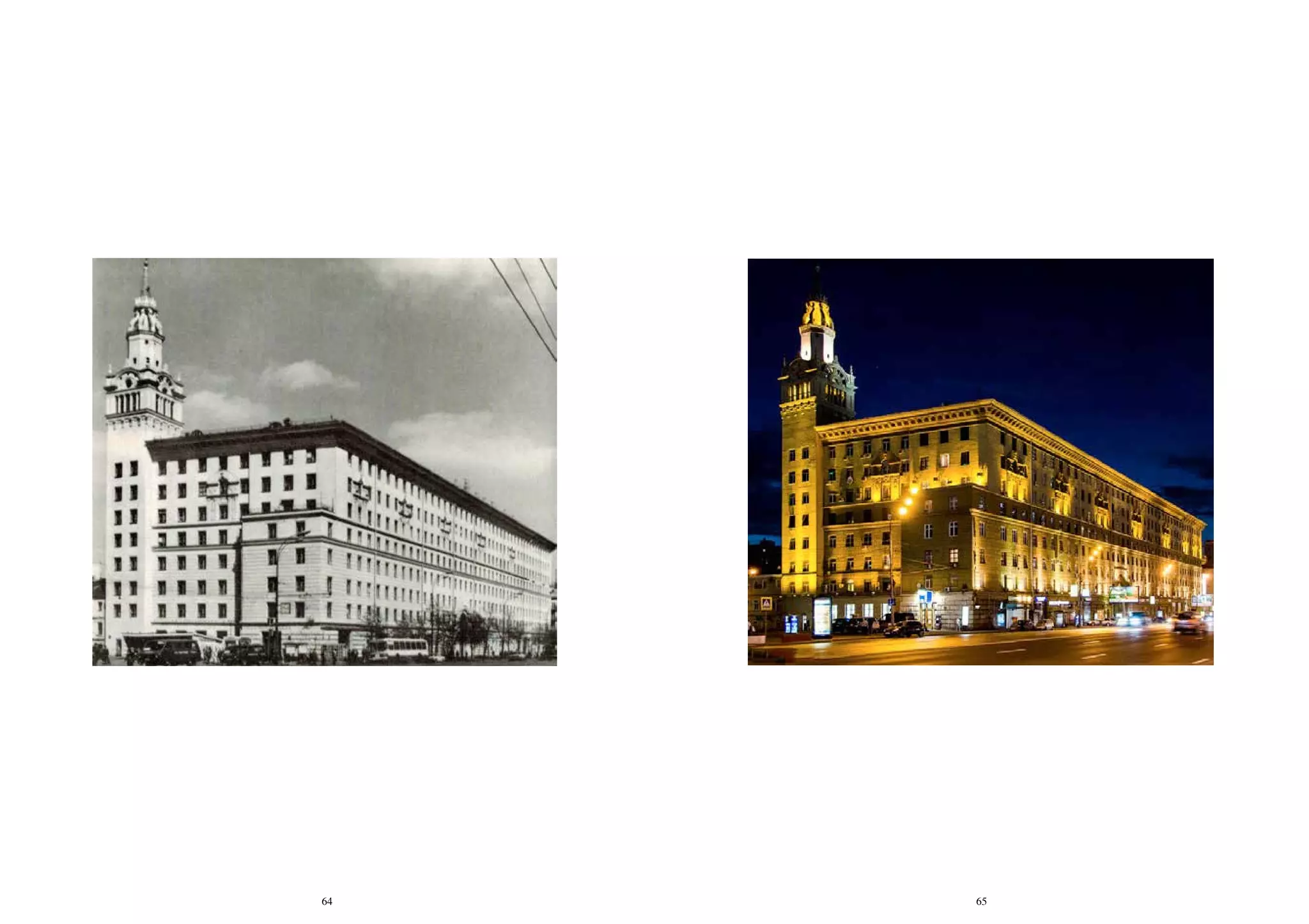
Kvartals are the clearest manifestation on an architectural scale of the city envisioned and built with
the “Stalinist” plan of 1935. Those blocks, usually
styled in a classicist fashion, were to give the new
image of the comunist metropolis; large roads up to
thirty meters wide surrounded by a coherent motive of the façades. Kvartals replaced the old blocks
of the city, three to four times smaller, and provided
an image of order. Due to the housing emergency,
however, those blocks often concealed portions of
the older city within; being too expensive to be entirely replaced, portions of the old city fabric still
exist behind those curtains, like corings from another epoch.

Kvartals are the clearest manifestation on an
architectural scale of the city envisioned and
built with the “stalinist” plan of 1935. Those
blocks, usually styled in a classicist fashion,
were to give the new image of the comunist
metropolis; large roads up to thirty meters wide
surrounded by a coherent motive of the facades.
Kvartals replaced the old blocks of the city, three
to four times smaller, and provided an image of
order. Due to the housing emergency, however,
those blocks often conceiled portions of the
older city within; being too expensive to be
entirely replaced, portions of the old city fabric
still exhist behind those curtains, like corings
from another epoch.

63
64

65
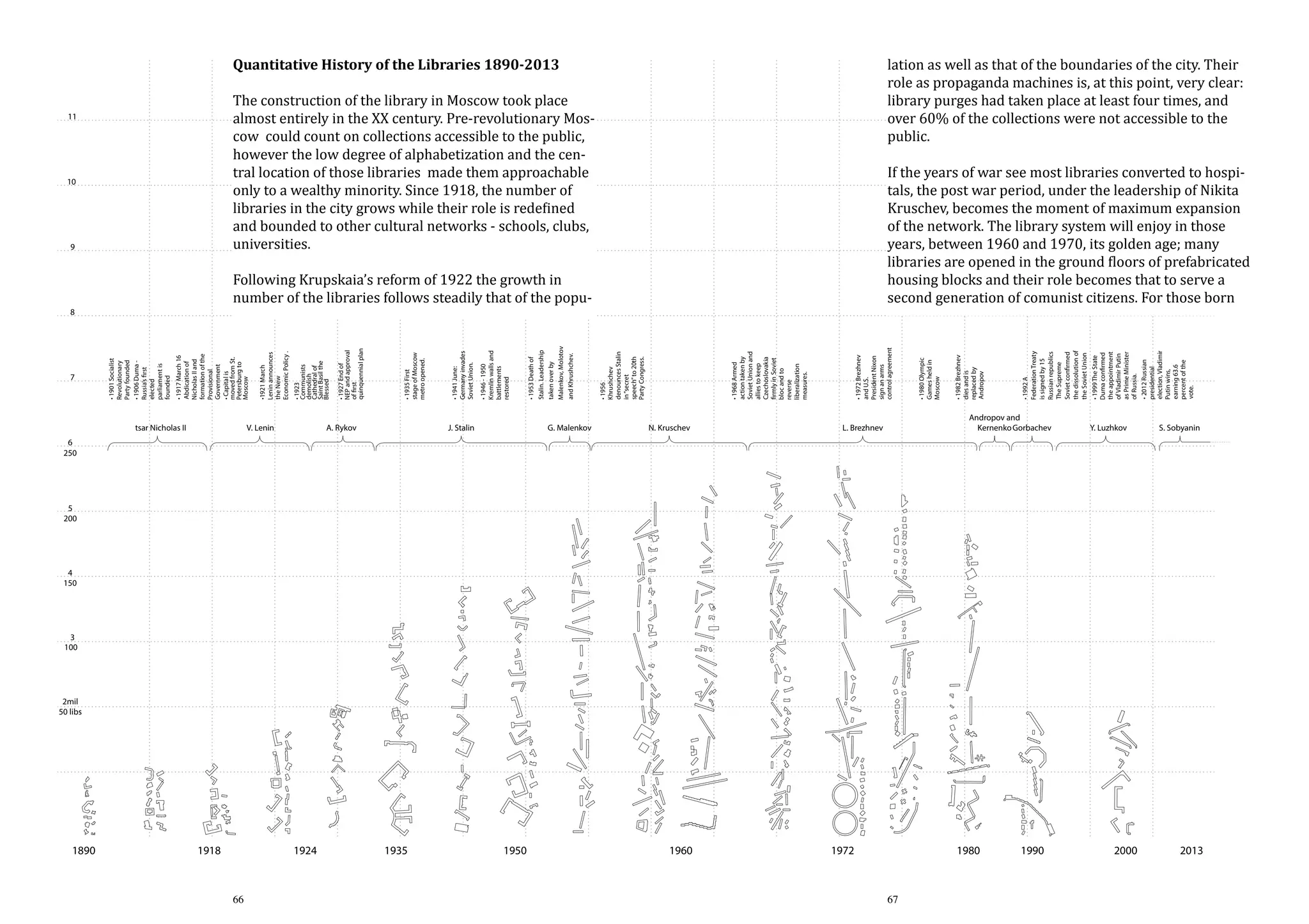
lation as well as that of the boundaries of the city. Their
role as propaganda machines is, at this point, very clear:
library purges had taken place at least four times, and
over 60% of the collections were not accessible to the
public.

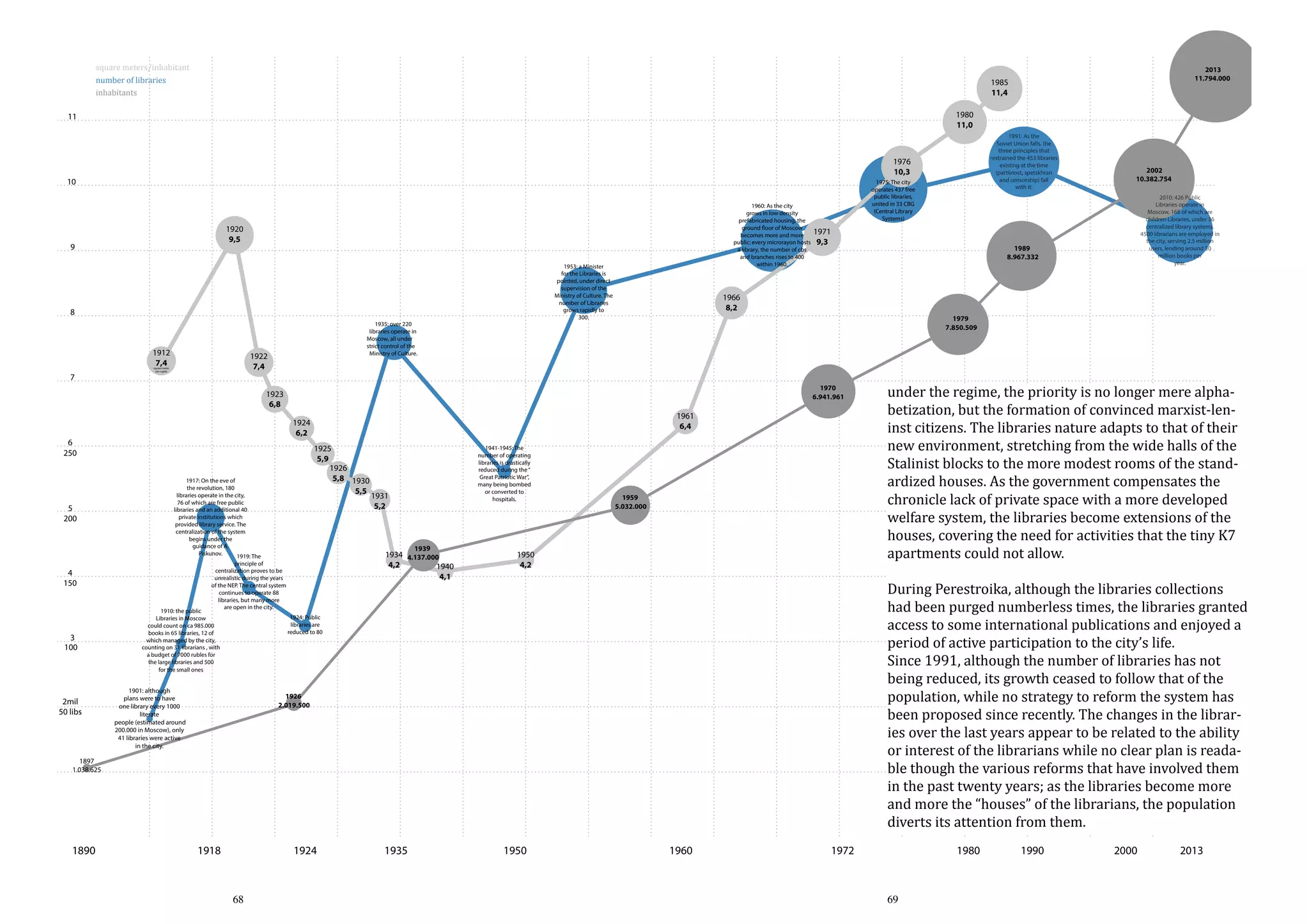
Quantitative History of the Libraries 1890-2013

The construction of the library in Moscow took place
almost entirely in the XX century. Pre-revolutionary Moscow could count on collections accessible to the public,
however the low degree of alphabetization and the central location of those libraries made them approachable
only to a wealthy minority. Since 1918, the number of
libraries in the city grows while their role is redefined
and bounded to other cultural networks - schools, clubs,
universities.

tsar Nicholas II

V. Lenin

A. Rykov

J. Stalin

G. Malenkov

N. Kruschev

Andropov and
Kernenko Gorbachev

L. Brezhnev

• 1999 The State
Duma confirmed
the appointment
of Vladimir Putin
as Prime Minister
of Russia.
• 2012 Russian
presidential
election, Vladimir
Putin wins,
earning 63.6
percent of the
vote.

• 1992 A
Federation Treaty
is signed by 15
Russian republics
The Supreme
Soviet confirmed
the dissolution of
the Soviet Union

• 1972 Brezhnev
and U.S.
President Nixon
sign an arms
control agreement

• 1968 Armed
action taken by
Soviet Union and
allies to keep
Czechoslovakia
firmly in Soviet
bloc and to
reverse
liberalization
measures.

• 1956
Khrushchev
denounces Stalin
in “secret
speech” to 20th
Party Congress.

• 1953 Death of
Stalin. Leadership
taken over by
Malenkov, Molotov
and Khrushchev.

• 1946 - 1950
Kremlin walls and
battlements
restored

• 1941 June:
Germany invades
Soviet Union.

• 1935 First
stage of Moscow
metro opened.

• 1927 End of
NEP and approval
of first
quinquennial plan

• 1923
Communists
demolish
Cathedral of
Saint Basil the
Blessed

• 1917 March 16
Abdication of
Nicholas II and
formation of the
Provisional
Government
• Capital is
moved from St.
Petersburg to
Moscow

• 1901 Socialist
Revolutionary
Party founded
• 1906 Duma Russia’s first
elected
parliament is
founded

8

•1921 March
Lenin announces
the New
Economic Policy .

Following Krupskaia’s reform of 1922 the growth in
number of the libraries follows steadily that of the popu-

9

7

If the years of war see most libraries converted to hospitals, the post war period, under the leadership of Nikita
Kruschev, becomes the moment of maximum expansion
of the network. The library system will enjoy in those
years, between 1960 and 1970, its golden age; many
libraries are opened in the ground floors of prefabricated
housing blocks and their role becomes that to serve a
second generation of comunist citizens. For those born
• 1982 Brezhnev
dies and is
replaced by
Andropov

10

• 1980 Olympic
Games held in
Moscow

11

Y. Luzhkov

S. Sobyanin

6
250

5
200

4
150

3
100

2mil
50 libs

1890

1918

1924

66

1935

1950

1960

1972

1980

67

1990

2000

2013
11

square meters/inhabitant
number of libraries
inhabitants

1980
11,0

1960: As the city
grows in low density
prefabricated housing, the
ground floor of Moscow
becomes more and more
public: every microrayon hosts
a library, the number of cbs
and branches rises to 400
within 1960.

1920
9,5

9

1953: a Minister
for the Libraries is
pointed, under direct
supervision of the
Ministry of Culture. The
number of Libraries
grows rapidly to
300.

8

1912
7,4

1935: over 220
libraries operate in
Moscow, all under
strict control of the
Ministry of Culture.

1922
7,4

square meter
per capita

3
100

2mil
50 libs

1961
6,4
1925
5,9
1926
5,8 1930
5,5

1931
5,2

1939

1934 4.137.000
4,2
1940
4,1

principle of
centralization proves to be
unrealistic during the years
of the NEP. The central system
continues to operate 88
libraries, but many more
are open in the city.

1910: the public
Libraries in Moscow
could count on ca 985.000
books in 65 libraries, 12 of
which managed by the city,
counting on 31 librarians , with
a budget of 7000 rubles for
the large libraries and 500
for the small ones

1941-1945: The
number of operating
libraries is drastically
reduced during the “
Great Patriotic War”,
many being bombed
or converted to
hospitals.

1959
5.032.000

1950
4,2

1924: Public
libraries are
reduced to 80

1901: although
plans were to have
one library every 1000
literate
people (estimated around
200.000 in Moscow), only
41 libraries were active
in the city.

1926
2.019.500

1897
1.038.625

1890

1918

1924

68

1935

1950

2010: 426 Public
Libraries operate in
Moscow, 168 of which are
children Libraries, under 36
centralized library systems.
4500 librarians are employed in
the city, serving 2.5 million
users, lending around 50
million books per
year.

1989
8.967.332

1970
6.941.961

1917: On the eve of
the revolution, 180
libraries operate in the city,
76 of which are free public
libraries and an additional 40
private institutions which
provided library service. The
centralization of the system
begins under the
guidance of A.
Piskunov.
1919: The

4
150

1971
9,3

2002
10.382.754

1979
7.850.509

1924
6,2

6
250

1975: The city
operates 437 free
public libraries,
united in 33 CBG
(Central Library
Systems)

1966
8,2

1923
6,8

5
200

1991: As the
Soviet Union falls, the
three principles that
restrained the 453 libraries
existing at the time
(partiinost, spetskhran
and censorship) fall
with it.

1976
10,3

10

7

2013
11.794.000

1985
11,4

1960

1972

under the regime, the priority is no longer mere alphabetization, but the formation of convinced marxist-leninst citizens. The libraries nature adapts to that of their
new environment, stretching from the wide halls of the
Stalinist blocks to the more modest rooms of the standardized houses. As the government compensates the
chronicle lack of private space with a more developed
welfare system, the libraries become extensions of the
houses, covering the need for activities that the tiny K7
apartments could not allow.

During Perestroika, although the libraries collections
had been purged numberless times, the libraries granted
access to some international publications and enjoyed a
period of active participation to the city’s life.
Since 1991, although the number of libraries has not
being reduced, its growth ceased to follow that of the
population, while no strategy to reform the system has
been proposed since recently. The changes in the libraries over the last years appear to be related to the ability
or interest of the librarians while no clear plan is readable though the various reforms that have involved them
in the past twenty years; as the libraries become more
and more the “houses” of the librarians, the population
diverts its attention from them.
1980

69

1990

2000

2013
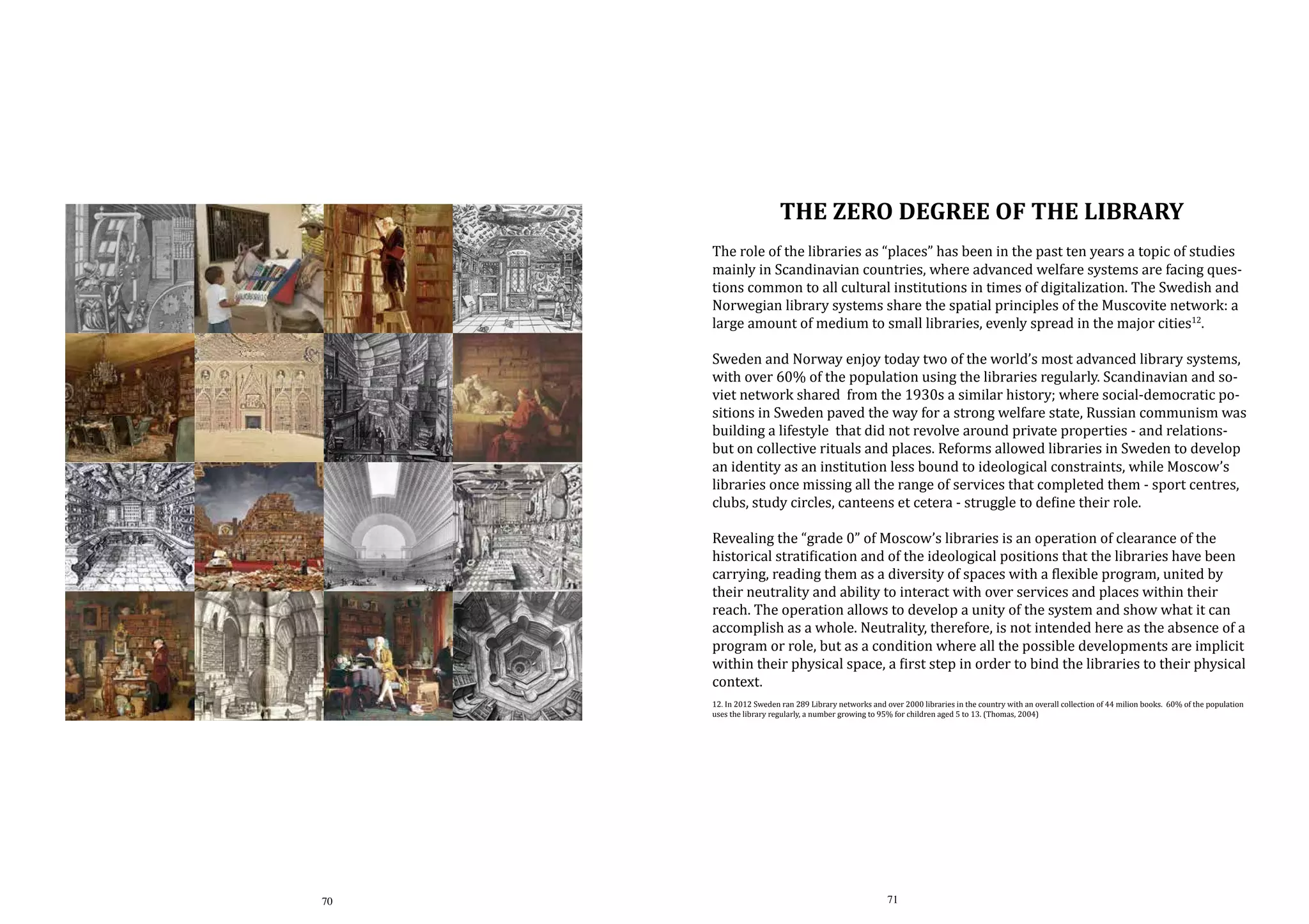
THE ZERO DEGREE OF THE LIBRARY

The role of the libraries as “places” has been in the past ten years a topic of studies
mainly in Scandinavian countries, where advanced welfare systems are facing questions common to all cultural institutions in times of digitalization. The Swedish and
Norwegian library systems share the spatial principles of the Muscovite network: a
large amount of medium to small libraries, evenly spread in the major cities12.

Sweden and Norway enjoy today two of the world’s most advanced library systems,
with over 60% of the population using the libraries regularly. Scandinavian and soviet network shared from the 1930s a similar history; where social-democratic positions in Sweden paved the way for a strong welfare state, Russian communism was
building a lifestyle that did not revolve around private properties - and relationsbut on collective rituals and places. Reforms allowed libraries in Sweden to develop
an identity as an institution less bound to ideological constraints, while Moscow’s
libraries once missing all the range of services that completed them - sport centres,
clubs, study circles, canteens et cetera - struggle to define their role.
Revealing the “grade 0” of Moscow’s libraries is an operation of clearance of the
historical stratification and of the ideological positions that the libraries have been
carrying, reading them as a diversity of spaces with a flexible program, united by
their neutrality and ability to interact with over services and places within their
reach. The operation allows to develop a unity of the system and show what it can
accomplish as a whole. Neutrality, therefore, is not intended here as the absence of a
program or role, but as a condition where all the possible developments are implicit
within their physical space, a first step in order to bind the libraries to their physical
context.
12. In 2012 Sweden ran 289 Library networks and over 2000 libraries in the country with an overall collection of 44 milion books. 60% of the population
uses the library regularly, a number growing to 95% for children aged 5 to 13. (Thomas, 2004)

70

71
1. Scandinavian Experiences

13. Global Librarianship. Public Libraries
in Developed countries: a success story
from Scandinavia, by Barbro Thomas,
2004

15. PLACE - Public Libraries Arenas for
Citizenship studies the libraries role in
promoting community and building social
capital.

The origin of the library network lay, in Sweden, in the
parish libraries,t born as an enforcement of the church
law of 1686, according to which the clergy was responsible to teach reading “so that the children may with
their own eyes see God’s holy laws and commands”. By
the end of the XIX century parish libraries, incapable or
unwilling to cope with the challenges of a new time, were
being gradually substituted. The new actors in the development of the library network became then popular
movements -labour and peasentry organizations- often
animated by a left-wing agenda, which introduced new
contents in their “study circle libraries”. These groups
established and for a long time ran a nationwide network
that played an important role in the democratic process.
The study circle library movement promoted contents
beyond the religious restrains of their parish predecessors; by the 1930s 3000 libraries proposed to their
public philosophy, literature, politics, fiction and poetry,
ranging from Marx to Jack London. In the 1950s these
libraries were gradually absorbed by local authorities,
paving the way for the present public library landscape13.
Between the 1950s and the 1970s the growth of the
libraries was huge; the overall media collection passed
from 1.5 milion to 24 millions and circulation almost
doubled. In the meantime, the architecture of the libraries was undergoing structural changings; the number of
libraries was reduced from the over 3000 study circle
libraries to around 1000, until a new left reformist wave
in the 1970s, lead by young librarians, inverted, once
again, the trend; libraries were to be the medium of a
culture for all, and education was regarded as the mean
for the lower classes to raise their social condition. The
number of libraries in Sweden is today above 2500 for a
population of less the 10 milion. The country is considered to have one of the most advanced library systems,
which, although touched by cuts in the early nineties, still
functions as a fundamental social tool for its citizens.
In Norway the role of libraries as public spaces is currently being developed through a series of projects
related to the PLACE15 program. The program studies
the role of libraries in building community values by
providing free public space, services, and a sense of
72

16. How do public libraries function as
meeting places? Svanhild Aabo, Ragnar
Audunson, Andreas Varheim, 2009

17. Use of Library space and the Library
as space, Svanhild Aabo, Ragnar Audunson, 2012

ownership from the community. Statistics show that
the libraries in Norway are used as public spaces to a
great extent and that around 60% of the users do not
visit the library to borrow books, films or other library
material during their visits, but use it as a meeting space
(ABM-utvikling, 2008). Ragnar Adunson, founder of the
place project, identifies six categories of meetings that
are held in Libraries: libraries as community squares,
where acquaintances happen randomly; libraries as places
where people are exposed to diversity; libraries as a public
sphere; libraries as places for joint activities with friends
and families; libraries as meta meeting places and libraries as virtual meeting places16. The public role of the
libraries became evident during the research as patterns
of behaviour were revealed; users would frequently bend
the rules, personalizing their space, consuming food and
frequently interacting within the premises of the libraries (McKechnie et al. 2012). The design of the libraries
physical spaces played a major role in these behaviours.
A similar study conducted in a British University (Bryant
et al., 2009) revealed that the free plan area was the most
widely used in the premise, and that diverse activities
co-existed within it.
2. Libraries as places, books as objects

19. It has been announced that funds for
public libraries will be raised by 50%
from 2014, and that digital cataloguing
of all the collections will be completed
within 2015.
http://www.mn.ru/moscow_people/20130830/355164966.html

History of librarianship shows how the focus of libraries
has been in the past mainly oriented towards the number
of media in the collections. Most of the libraries in the
world still publicize their institution with a quantitative
statement of kind; the more books, the more comprehensive the coverage. Development in information technology is influencing this standard heavily; the British
Library, in its 2020 statement reckons that within 7 years
75% of new books will be published in digital versions,
Amazon sold in the last years more kindles then Harry
Potter books.
The Scandinavian stories illustrate how book collections
and their renewal19 have been an important tool, although not the only one, in granting the libraries success.
Equal attention has been placed in studying the libraries as ecologies, their user’s habits and the patterns of
behaviour. Although most libraries in Moscow still offer
incomplete collections - authors such as Tolstoy, Kant or
73
20. Lenin’s wife, Krupskia, when asked
for reasons why Kant should be censored,
replied: ”The Masses do not read Kant”.
Robert Rogers, Censorship and Libraries
in the soviet Union A Journal of Library
History, Philosophy, and Comparative
Librarianship Vol. 8, n°1, 1973
19. Each library in Sweden receives
special funds for the government besides
ordinary grants to renew their collection.
On average each library receives 700 free
books a year to add to their collection.
(Thomas, 2009)

James still miss from some library shelves, a reminder
of censorship laws from over 70 years ago20 - Moscow’s
network is currently undergoing changes reforming their
databases, digitalizing their contents and upgrading their
collections, which have been degrading since the early
1990s19. These reforms are inevitable and open chances to work on the public functions of those spaces and
on the historical significance of their current archives.
David Pearson, director of Culture, Heritage and Libraries for the City of London foresees a future where public
libraries will share more traits in common with museums - libraries as museums of marginalia - the value of
books shifting from their pure content to their totality
as objects, where collections will not be valued solely by
their numbers but by the history of their items. Pearson
reminds how, although most librarians shudder at the
thought of libraries transformed into museums, many
museums have renewed their civic role by proposing
different ways of exploring their archives and using their
spaces. At the same time, with more and more content
being available online, the choice of users tends to be
more oriented towards the closest library rather then to
a content specific one. This choice is influencing the development of libraries in Scandinavian countries (Thomas, 2012), where specialized public libraries have now
disappeared after reforms undertaken in the 1980s, and
efforts go in the direction of unifying research libraries
with general public ones- as in the case of the towns of
Harnosand and Visby, where under the same roof municipal and University libraries coexist (Thomas 2004).

the temporary institution of “private” domains, together
with the small size of Moscow’s libraries makes them the
ideal continuation of the private space of the homes and
a service to larger and less specialized public areas.

74

75

3. The Neutral Library

Lofland (1998), studying cities and urban life, classifies
spaces in three categories; a public realm, where interaction is between strangers; a parochial realm, where the
main form of relation is communal, and private realm,
where interactions happen between people who know
each other. When observing the use of public libraries,
those three categories seem to exist within the same
building; private activities are carried out within micro
private spaces defined by the users, often personalized,
yet the institution is accessible to all, and interactions
happen as soon as people divert their attention from
their private activity. The appropriation of space and
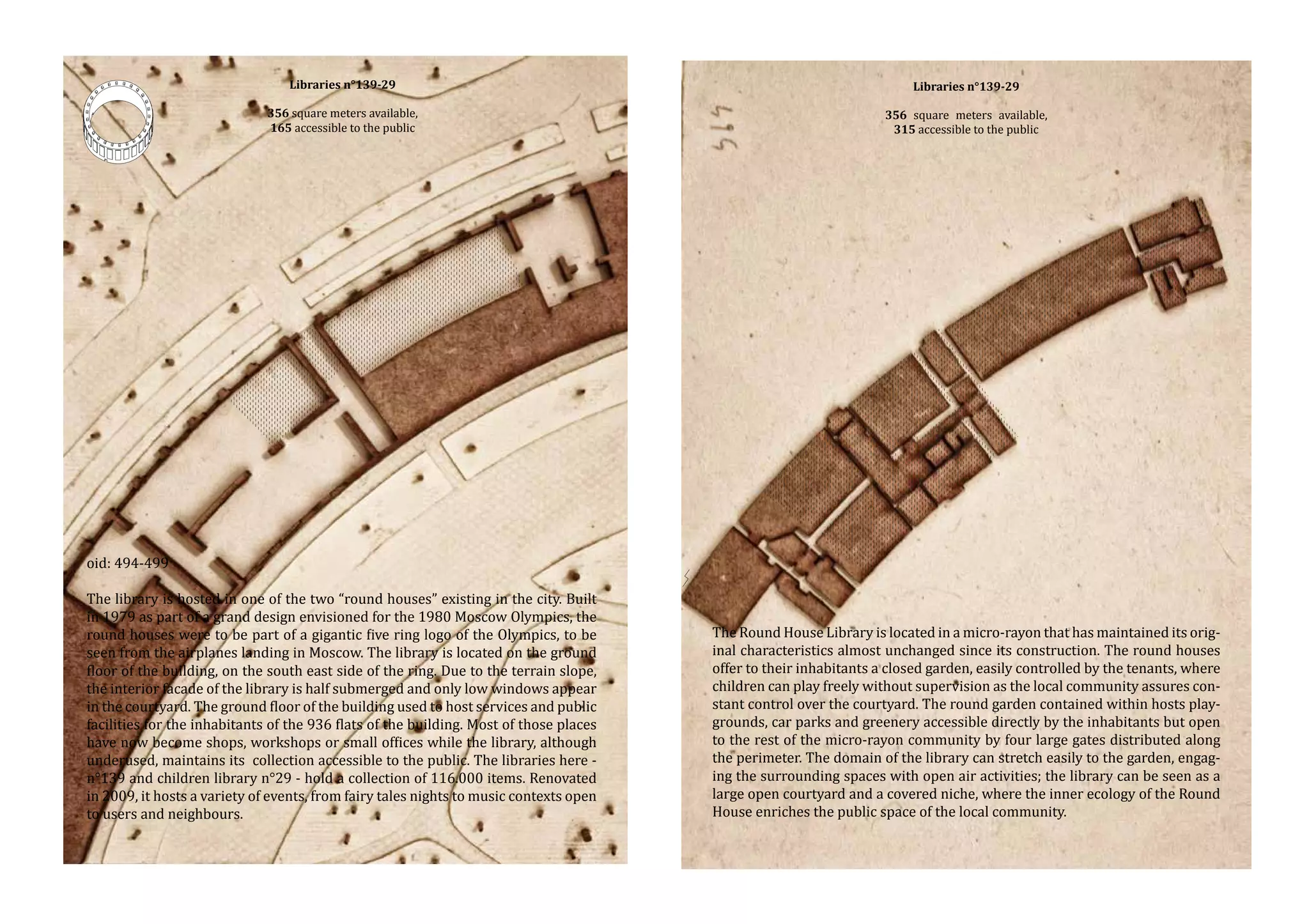
Libraries n°139-29

Libraries n°139-29

356 square meters available,
165 accessible to the public

356 square meters available,
315 accessible to the public

The library is hosted in one of the two “round houses” existing in the city. Built
in 1979 as part of a grand design envisioned for the 1980 Moscow Olympics, the
round houses were to be part of a gigantic five ring logo of the Olympics, to be
seen from the airplanes landing in Moscow. The library is located on the ground
floor of the building, on the south east side of the ring. Due to the terrain slope,
the interior facade of the library is half submerged and only low windows appear
in the courtyard. The ground floor of the building used to host services and public
facilities for the inhabitants of the 936 flats of the building. Most of those places
have now become shops, workshops or small offices while the library, although
underused, maintains its collection accessible to the public. The libraries here n°139 and children library n°29 - hold a collection of 116.000 items. Renovated
in 2009, it hosts a variety of events, from fairy tales nights to music contexts open
to users and neighbours.

The Round House Library is located in a micro-rayon that has maintained its original characteristics almost unchanged since its construction. The round houses
offer to their inhabitants a closed garden, easily controlled by the tenants, where
children can play freely without supervision as the local community assures constant control over the courtyard. The round garden contained within hosts playgrounds, car parks and greenery accessible directly by the inhabitants but open
to the rest of the micro-rayon community by four large gates distributed along
the perimeter. The domain of the library can stretch easily to the garden, engaging the surrounding spaces with open air activities; the library can be seen as a
large open courtyard and a covered niche, where the inner ecology of the Round
House enriches the public space of the local community.

oid: 494-499
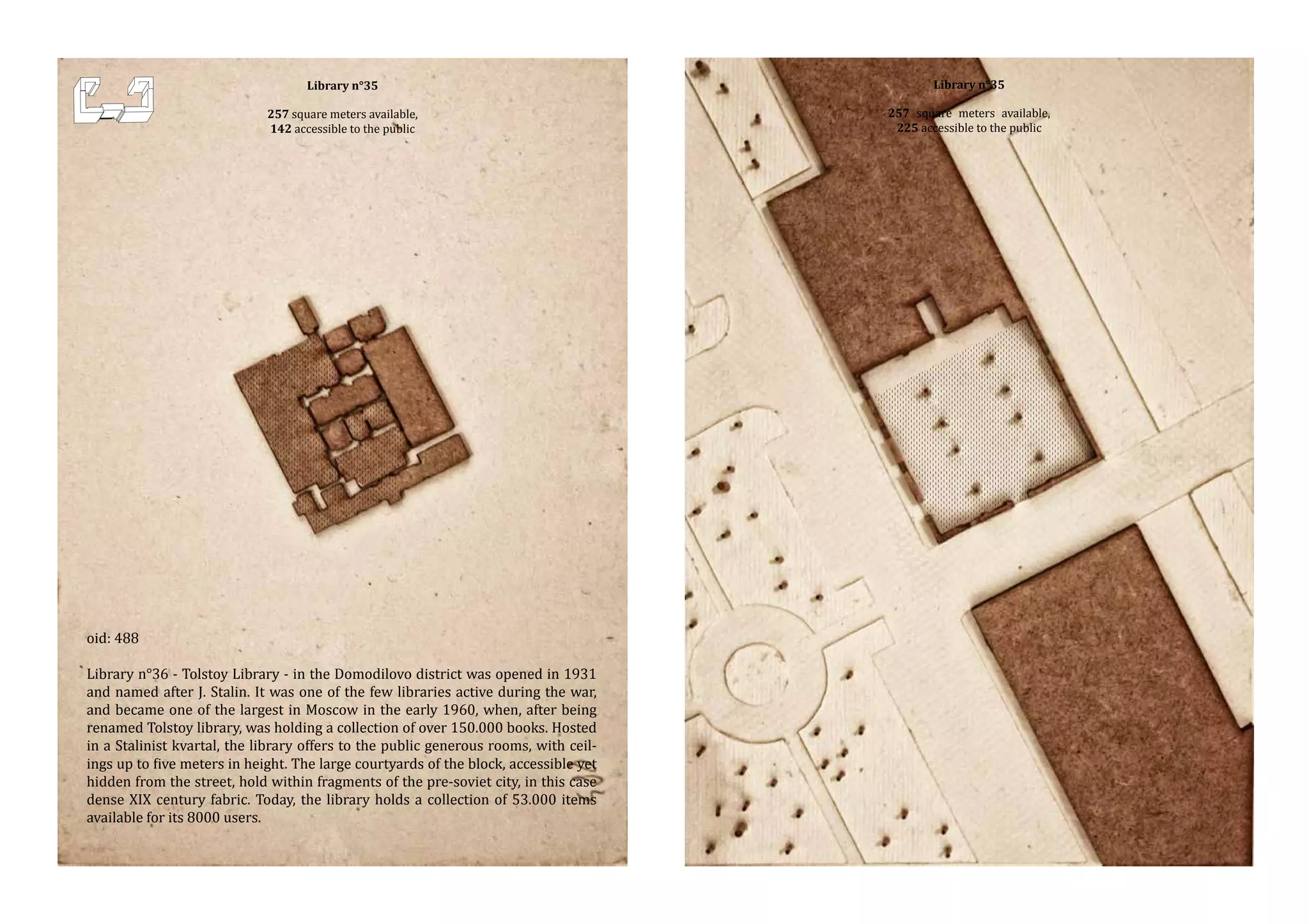
Library n°35

257 square meters available,
142 accessible to the public

oid: 488

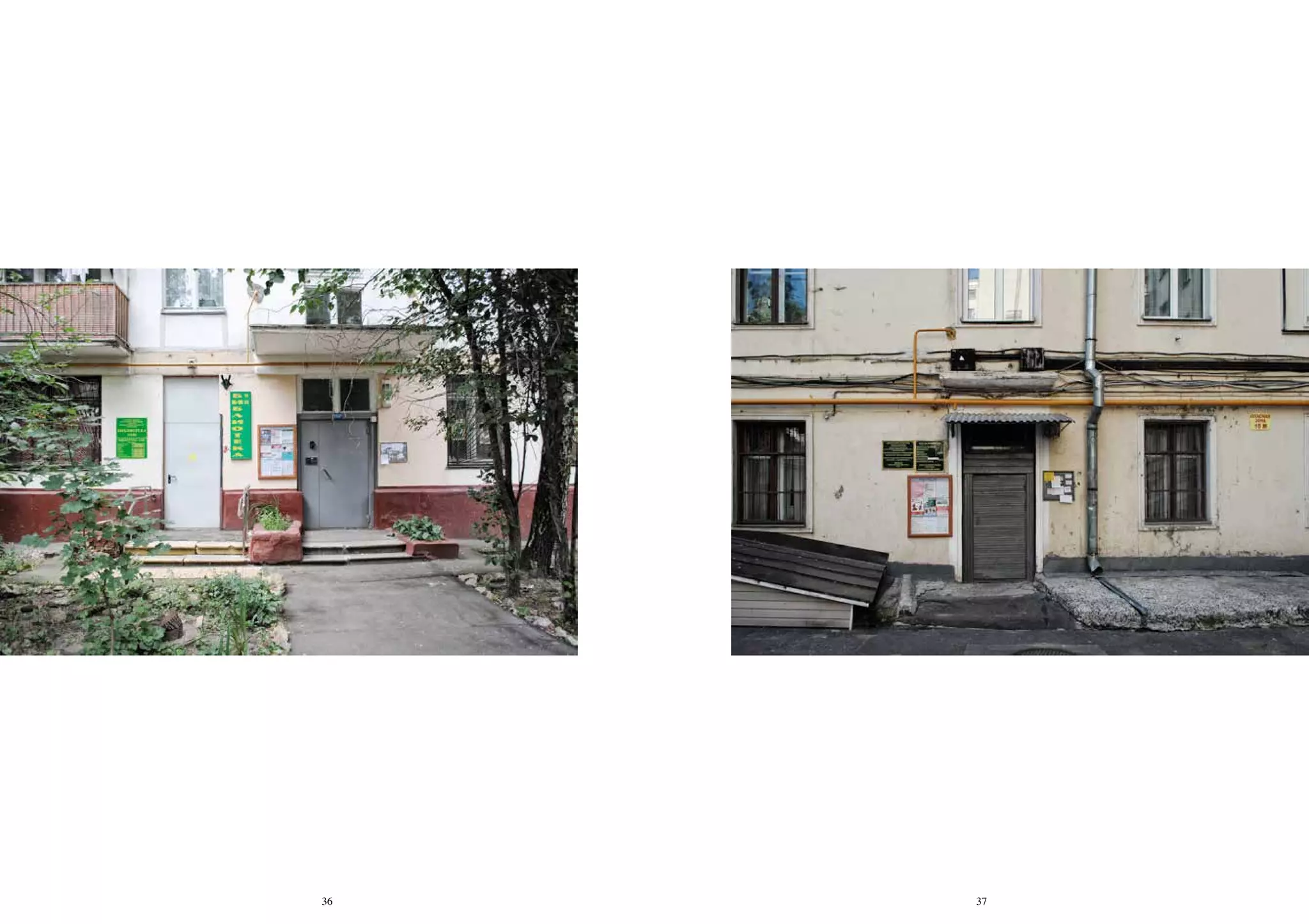
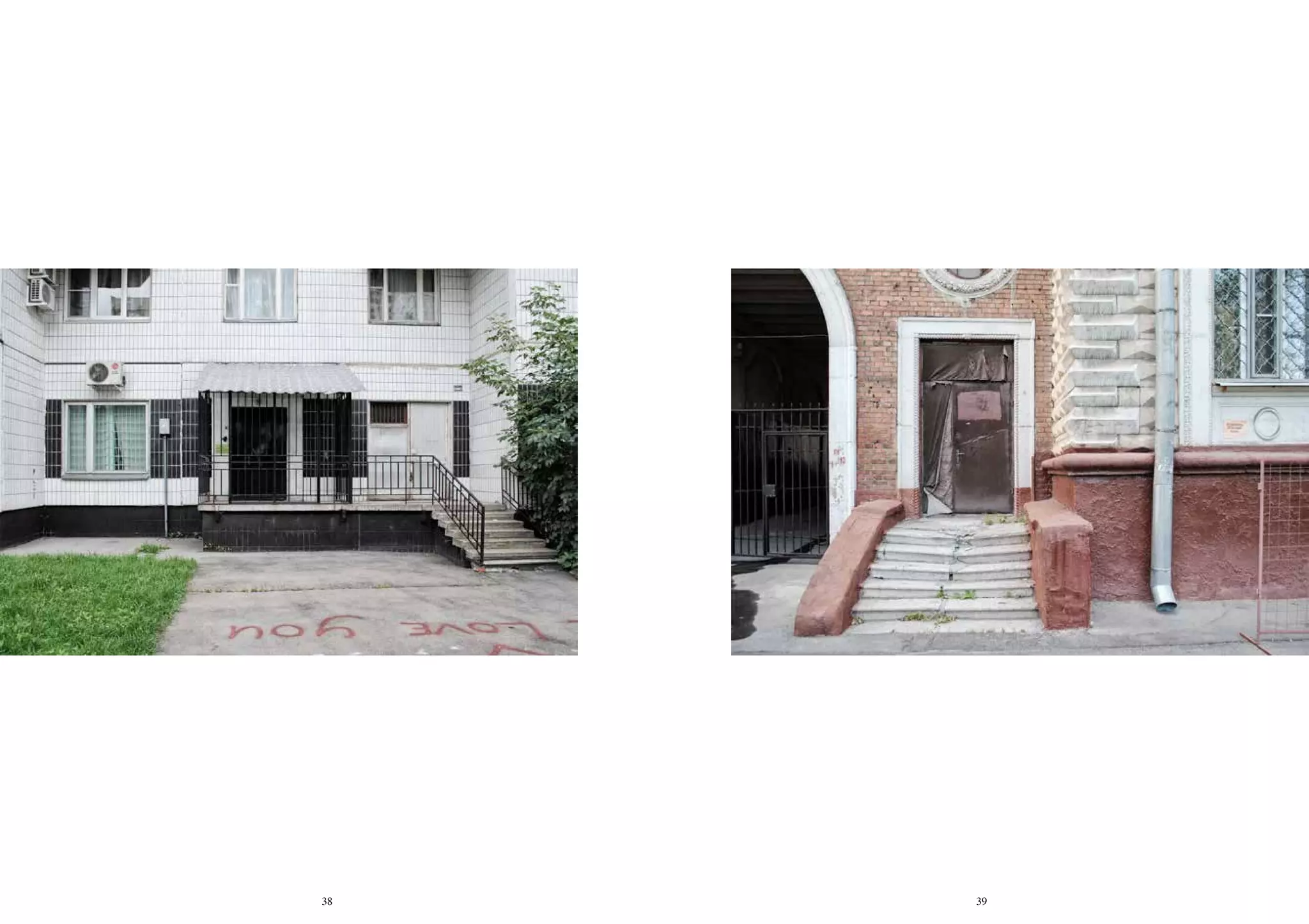
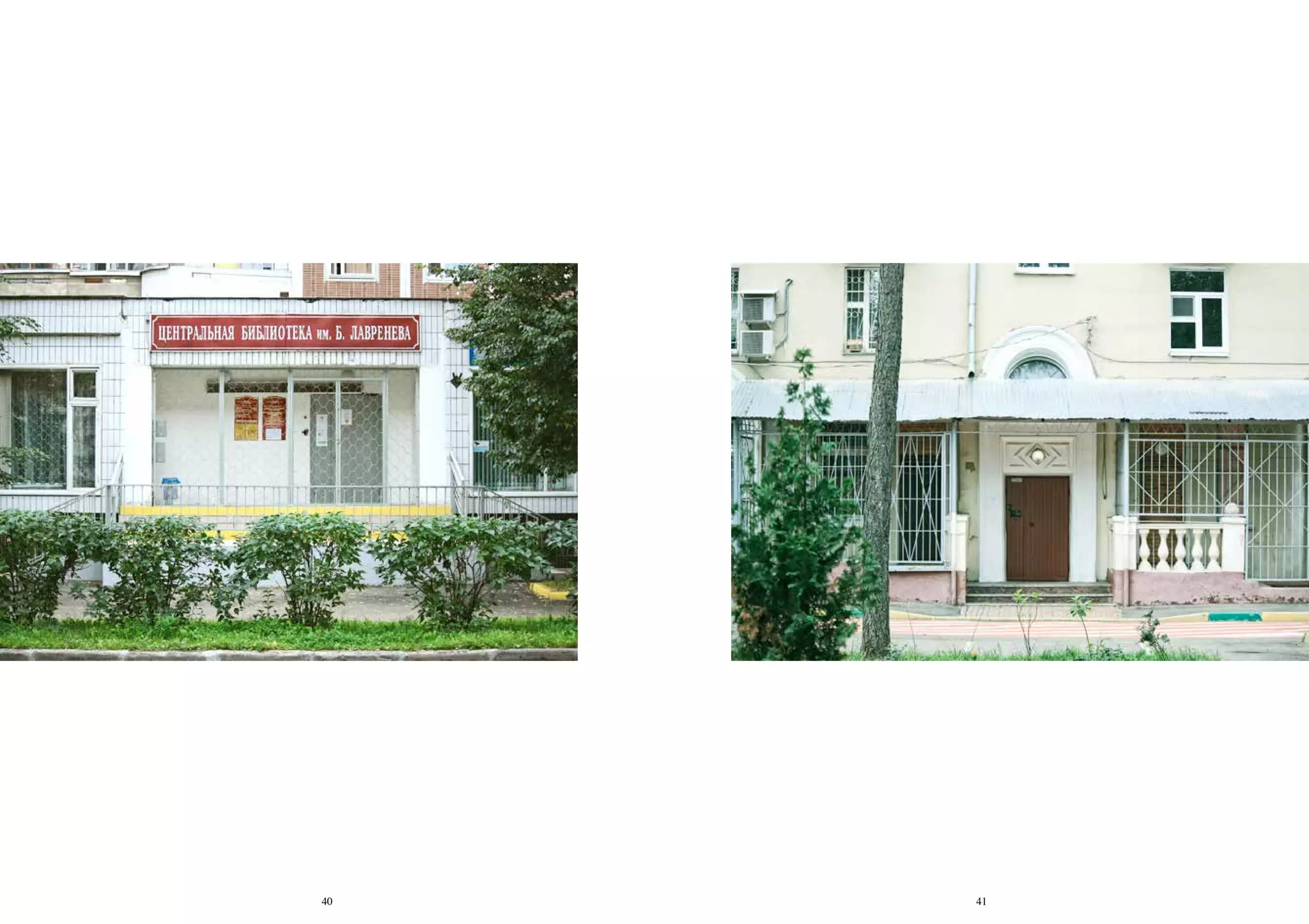
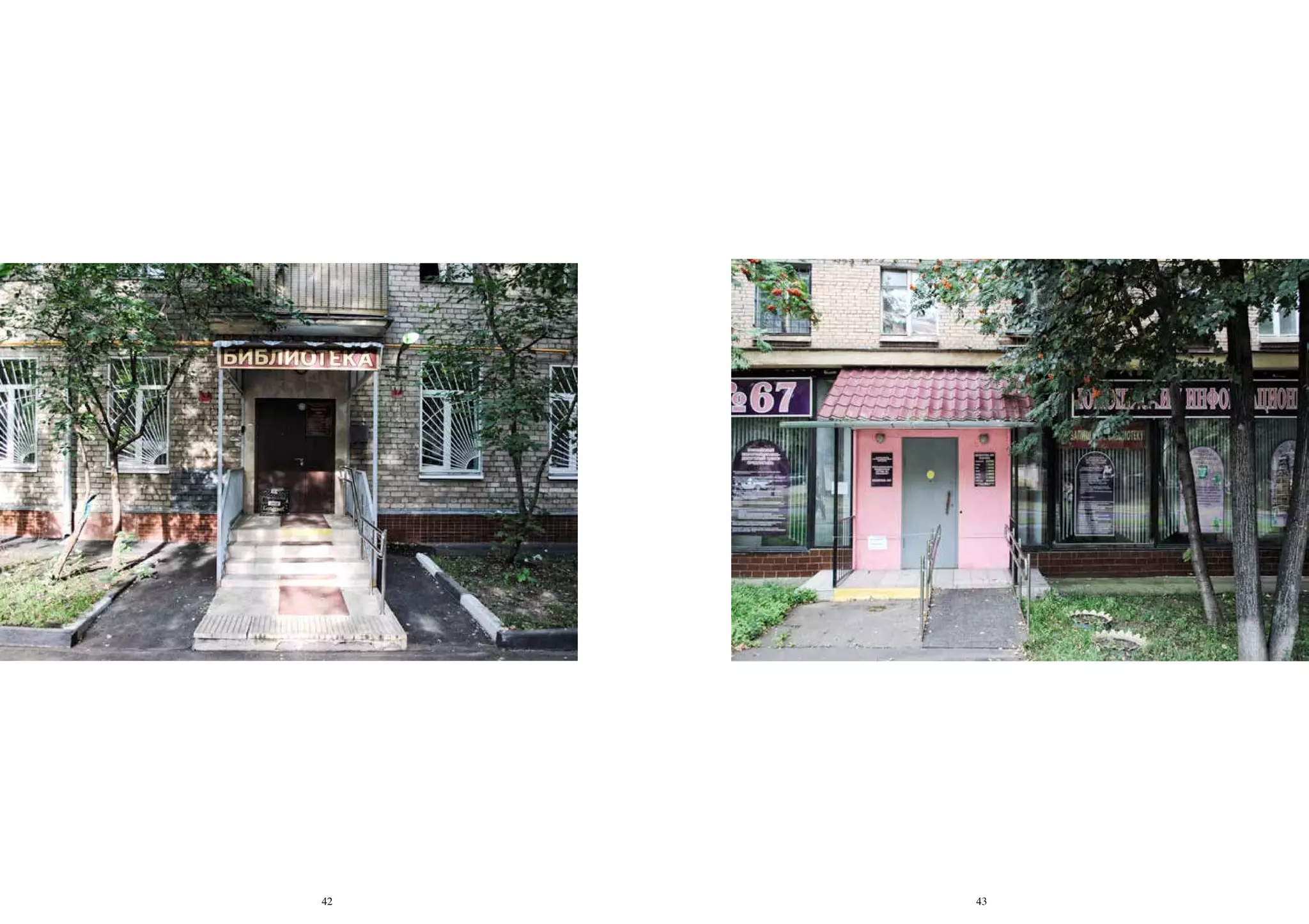
Library n°36 - Tolstoy Library - in the Domodilovo district was opened in 1931
and named after J. Stalin. It was one of the few libraries active during the war,
and became one of the largest in Moscow in the early 1960, when, after being
renamed Tolstoy library, was holding a collection of over 150.000 books. Hosted
in a Stalinist kvartal, the library offers to the public generous rooms, with ceilings up to five meters in height. The large courtyards of the block, accessible yet
hidden from the street, hold within fragments of the pre-soviet city, in this case
dense XIX century fabric. Today, the library holds a collection of 53.000 items
available for its 8000 users.

Library n°35

257 square meters available,
225 accessible to the public
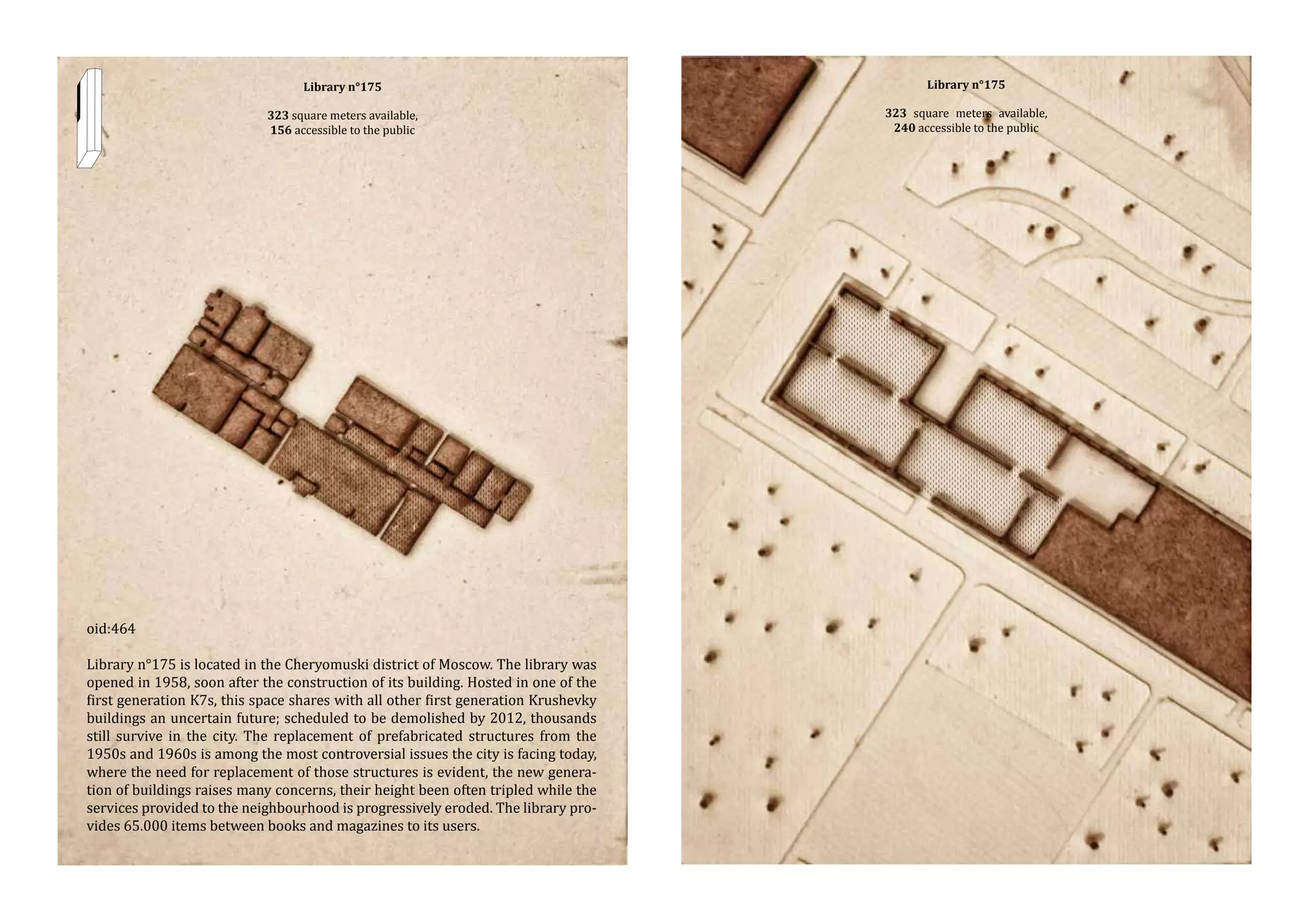
Library n°175

323 square meters available,
156 accessible to the public

oid:464

Library n°175 is located in the Cheryomuski district of Moscow. The library was
opened in 1958, soon after the construction of its building. Hosted in one of the
first generation K7s, this space shares with all other first generation Krushevky
buildings an uncertain future; scheduled to be demolished by 2012, thousands
still survive in the city. The replacement of prefabricated structures from the
1950s and 1960s is among the most controversial issues the city is facing today,
where the need for replacement of those structures is evident, the new generation of buildings raises many concerns, their height been often tripled while the
services provided to the neighbourhood is progressively eroded. The library provides 65.000 items between books and magazines to its users.

Library n°175

323 square meters available,
240 accessible to the public
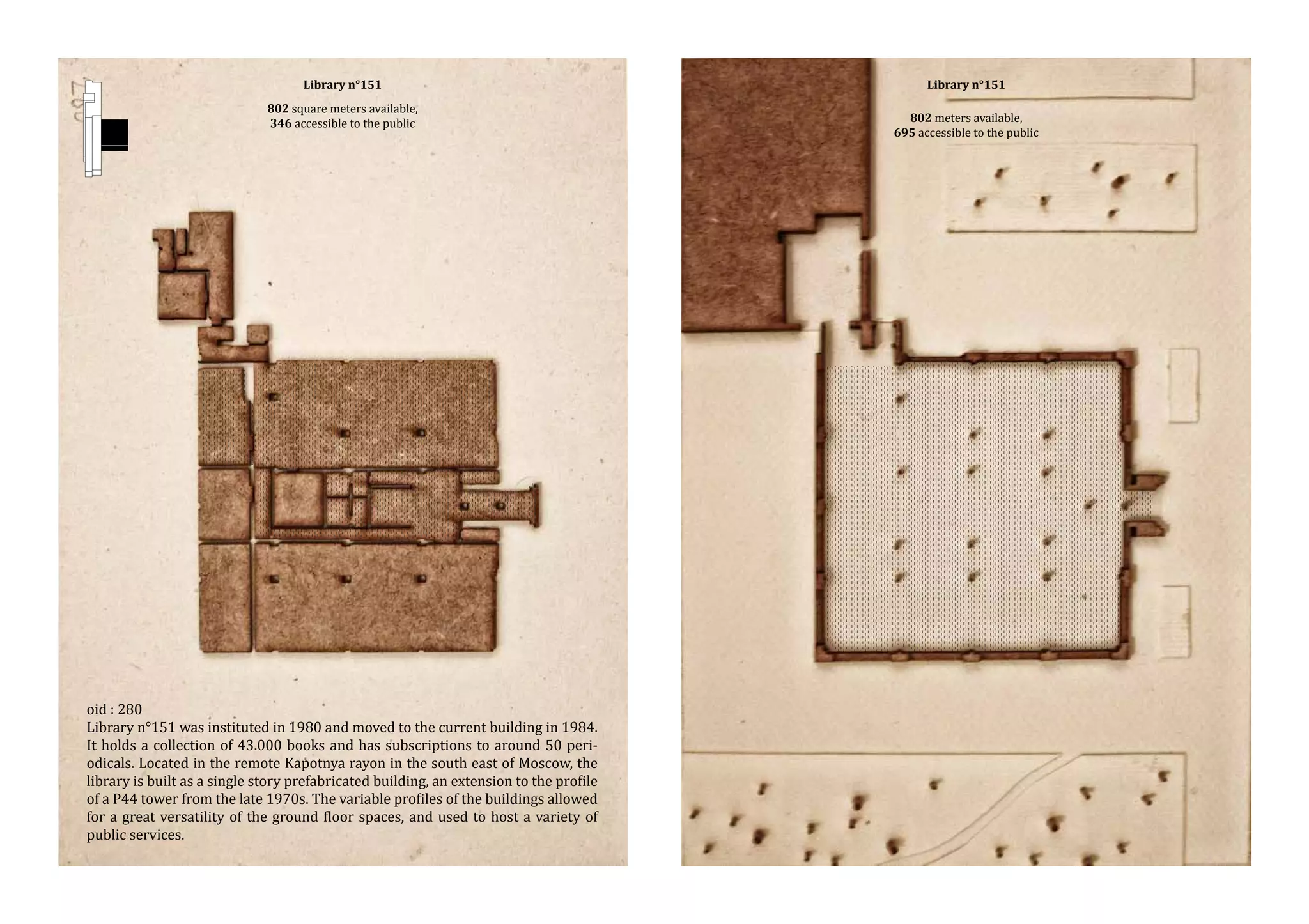
802 square meters available,
346 accessible to the public
Library n°151

oid : 280
Library n°151 was instituted in 1980 and moved to the current building in 1984.
It holds a collection of 43.000 books and has subscriptions to around 50 periodicals. Located in the remote Kapotnya rayon in the south east of Moscow, the
library is built as a single story prefabricated building, an extension to the profile
of a P44 tower from the late 1970s. The variable profiles of the buildings allowed
for a great versatility of the ground floor spaces, and used to host a variety of
public services.

Library n°151

802 meters available,
695 accessible to the public
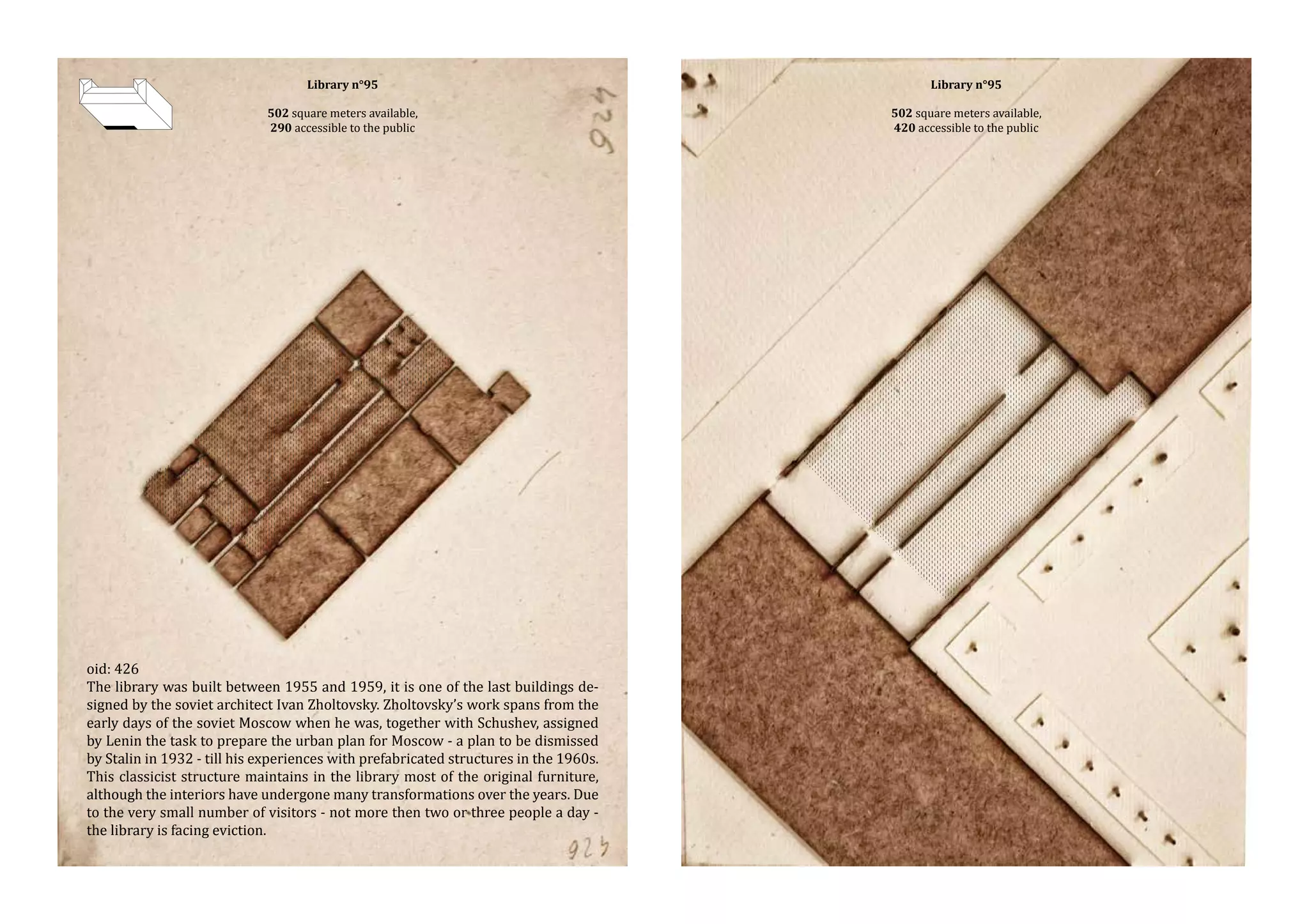
Library n°95

502 square meters available,
290 accessible to the public

oid: 426
The library was built between 1955 and 1959, it is one of the last buildings designed by the soviet architect Ivan Zholtovsky. Zholtovsky’s work spans from the
early days of the soviet Moscow when he was, together with Schushev, assigned
by Lenin the task to prepare the urban plan for Moscow - a plan to be dismissed
by Stalin in 1932 - till his experiences with prefabricated structures in the 1960s.
This classicist structure maintains in the library most of the original furniture,
although the interiors have undergone many transformations over the years. Due
to the very small number of visitors - not more then two or three people a day the library is facing eviction.

Library n°95

502 square meters available,
420 accessible to the public
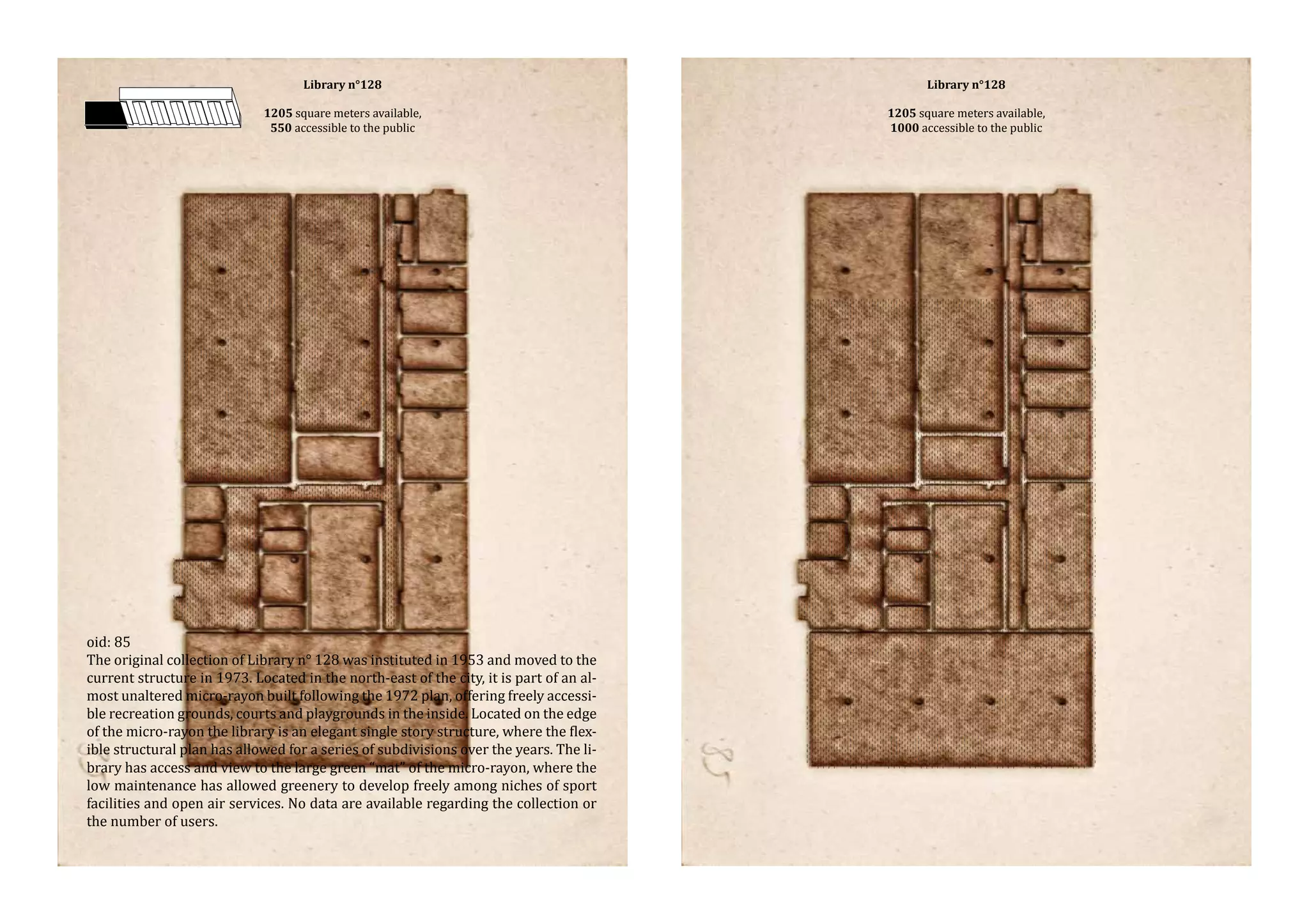
Library n°128

1205 square meters available,
550 accessible to the public

oid: 85
The original collection of Library n° 128 was instituted in 1953 and moved to the
current structure in 1973. Located in the north-east of the city, it is part of an almost unaltered micro-rayon built following the 1972 plan, offering freely accessible recreation grounds, courts and playgrounds in the inside. Located on the edge
of the micro-rayon the library is an elegant single story structure, where the flexible structural plan has allowed for a series of subdivisions over the years. The library has access and view to the large green “mat” of the micro-rayon, where the
low maintenance has allowed greenery to develop freely among niches of sport
facilities and open air services. No data are available regarding the collection or
the number of users.

Library n°128

1205 square meters available,
1000 accessible to the public
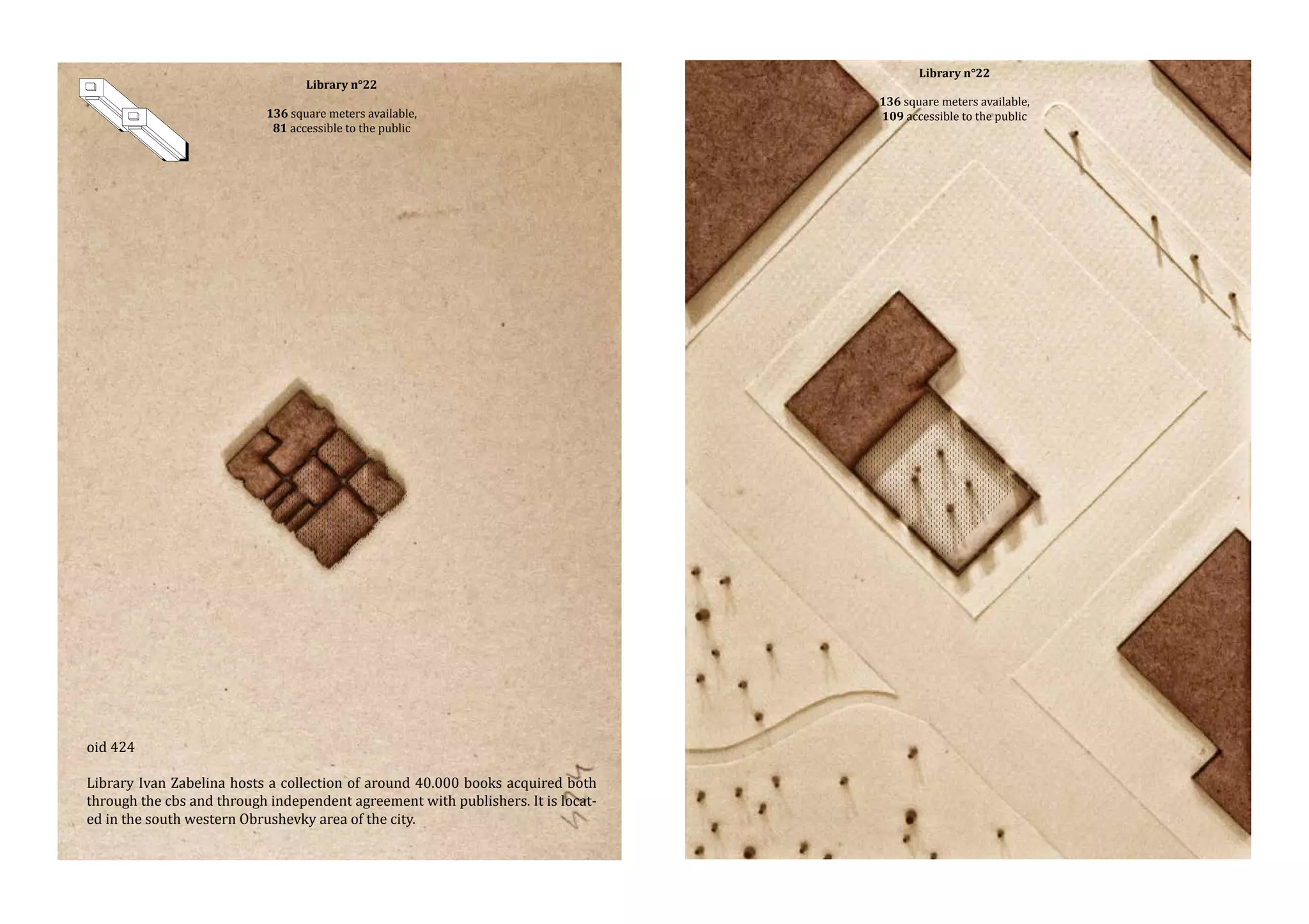
Library n°22

136 square meters available,
81 accessible to the public

oid 424

Library Ivan Zabelina hosts a collection of around 40.000 books acquired both
through the cbs and through independent agreement with publishers. It is located in the south western Obrushevky area of the city.

Library n°22

136 square meters available,
109 accessible to the public
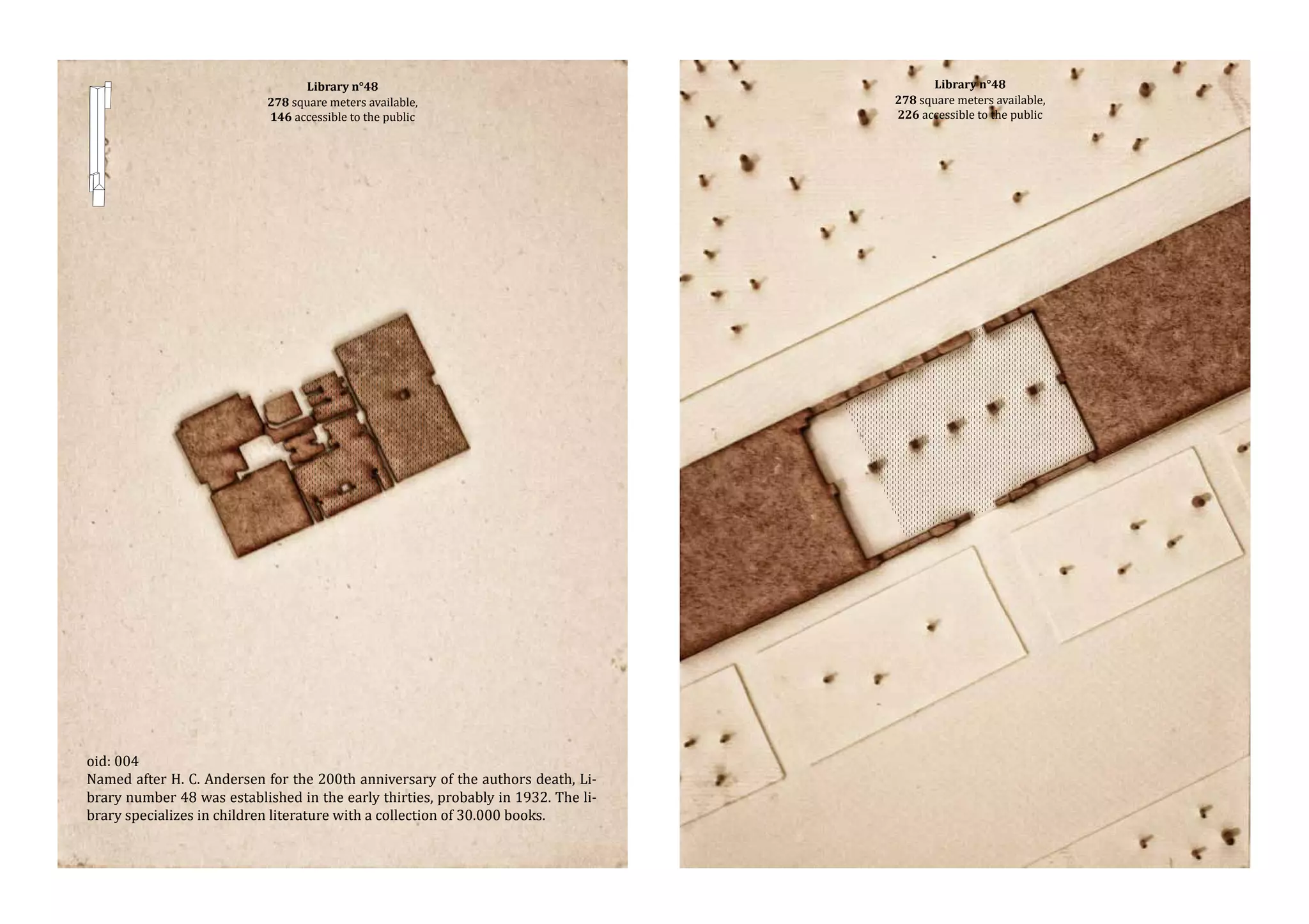
Library n°48
278 square meters available,
146 accessible to the public

oid: 004
Named after H. C. Andersen for the 200th anniversary of the authors death, Library number 48 was established in the early thirties, probably in 1932. The library specializes in children literature with a collection of 30.000 books.

Library n°48
278 square meters available,
226 accessible to the public
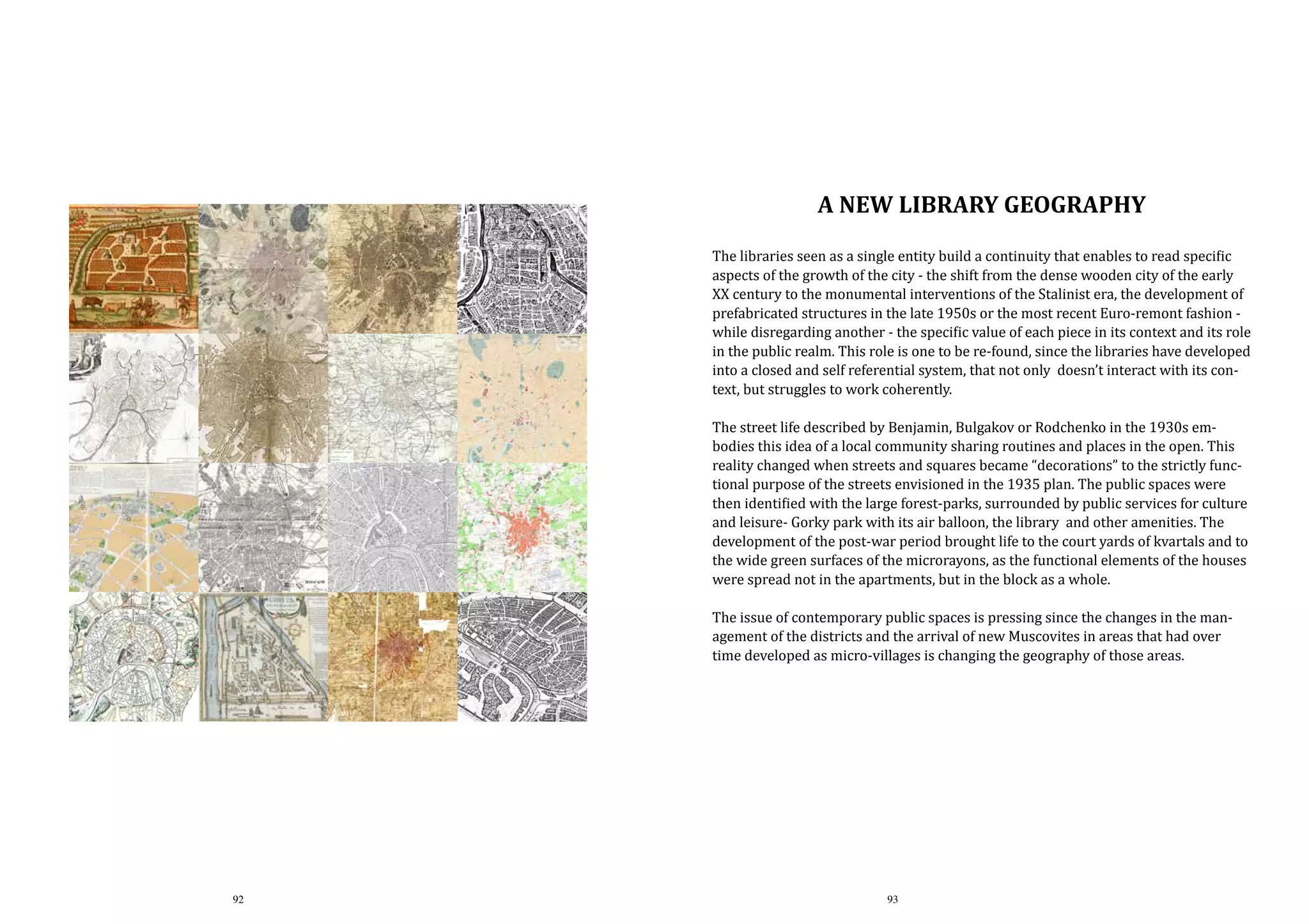
A NEW Library geography

The libraries seen as a single entity build a continuity that enables to read specific
aspects of the growth of the city - the shift from the dense wooden city of the early
XX century to the monumental interventions of the Stalinist era, the development of
prefabricated structures in the late 1950s or the most recent Euro-remont fashion while disregarding another - the specific value of each piece in its context and its role
in the public realm. This role is one to be re-found, since the libraries have developed
into a closed and self referential system, that not only doesn’t interact with its context, but struggles to work coherently.
The street life described by Benjamin, Bulgakov or Rodchenko in the 1930s embodies this idea of a local community sharing routines and places in the open. This
reality changed when streets and squares became “decorations” to the strictly functional purpose of the streets envisioned in the 1935 plan. The public spaces were
then identified with the large forest-parks, surrounded by public services for culture
and leisure- Gorky park with its air balloon, the library and other amenities. The
development of the post-war period brought life to the court yards of kvartals and to
the wide green surfaces of the microrayons, as the functional elements of the houses
were spread not in the apartments, but in the block as a whole.
The issue of contemporary public spaces is pressing since the changes in the management of the districts and the arrival of new Muscovites in areas that had over
time developed as micro-villages is changing the geography of those areas.

92

93
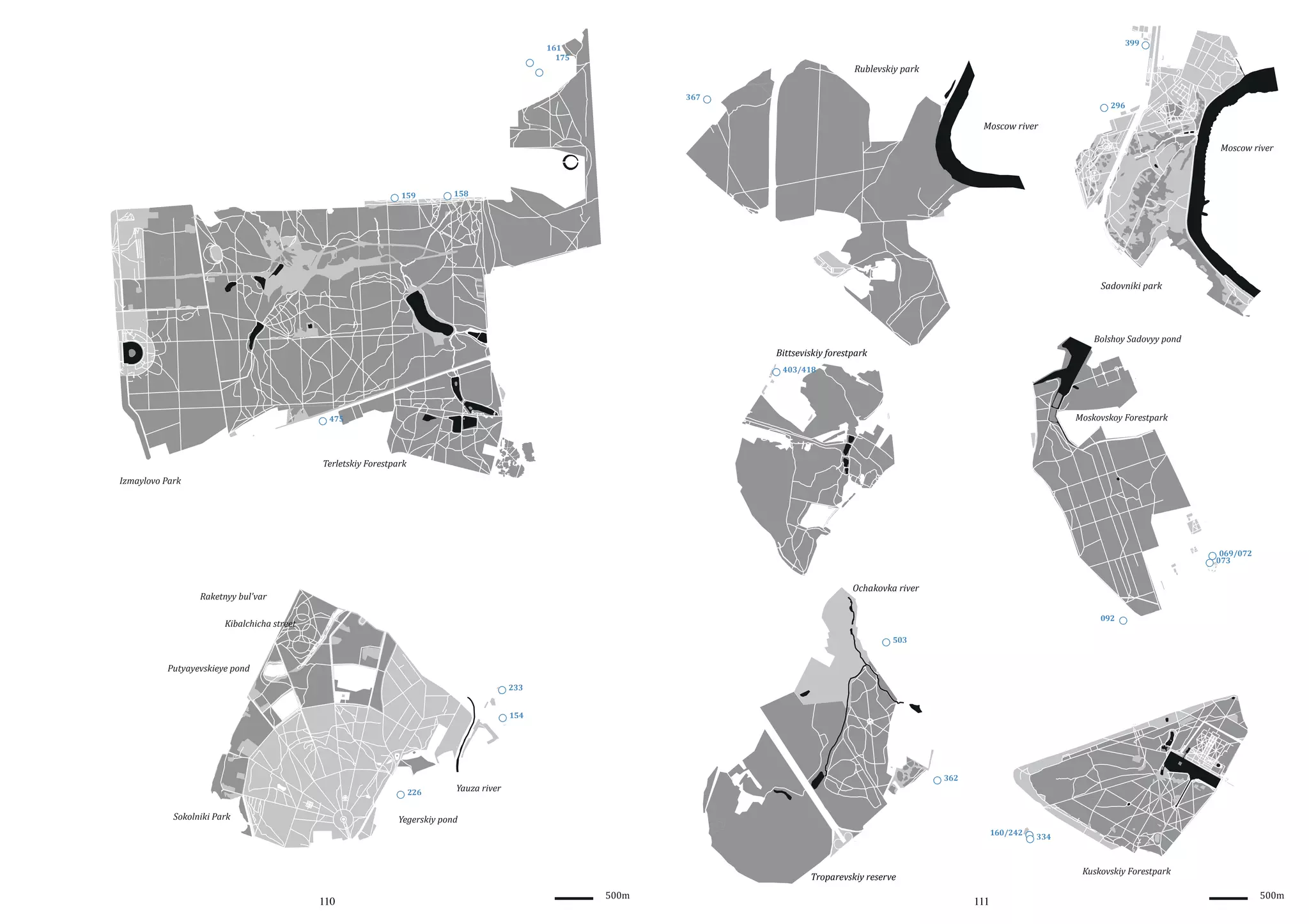
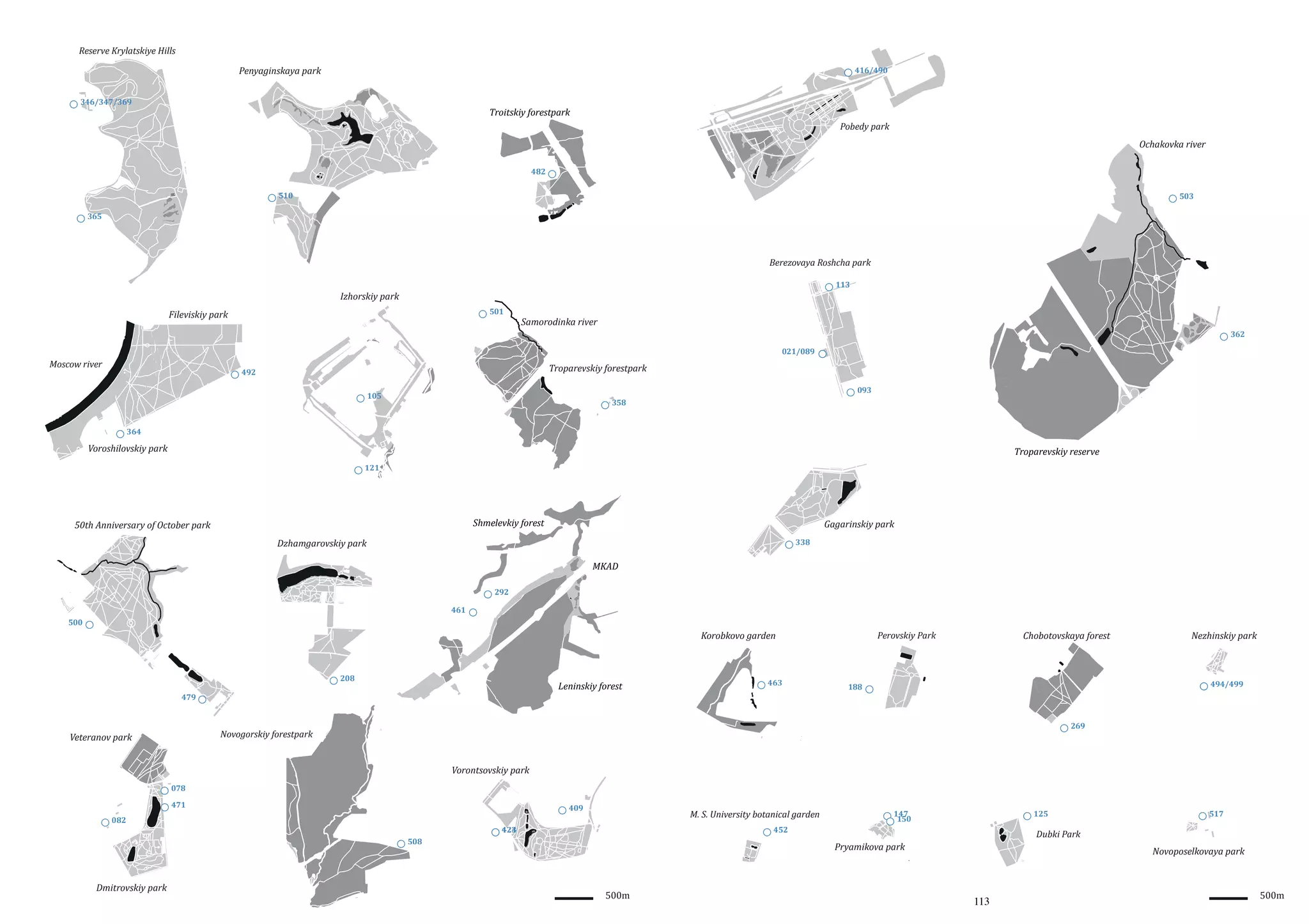
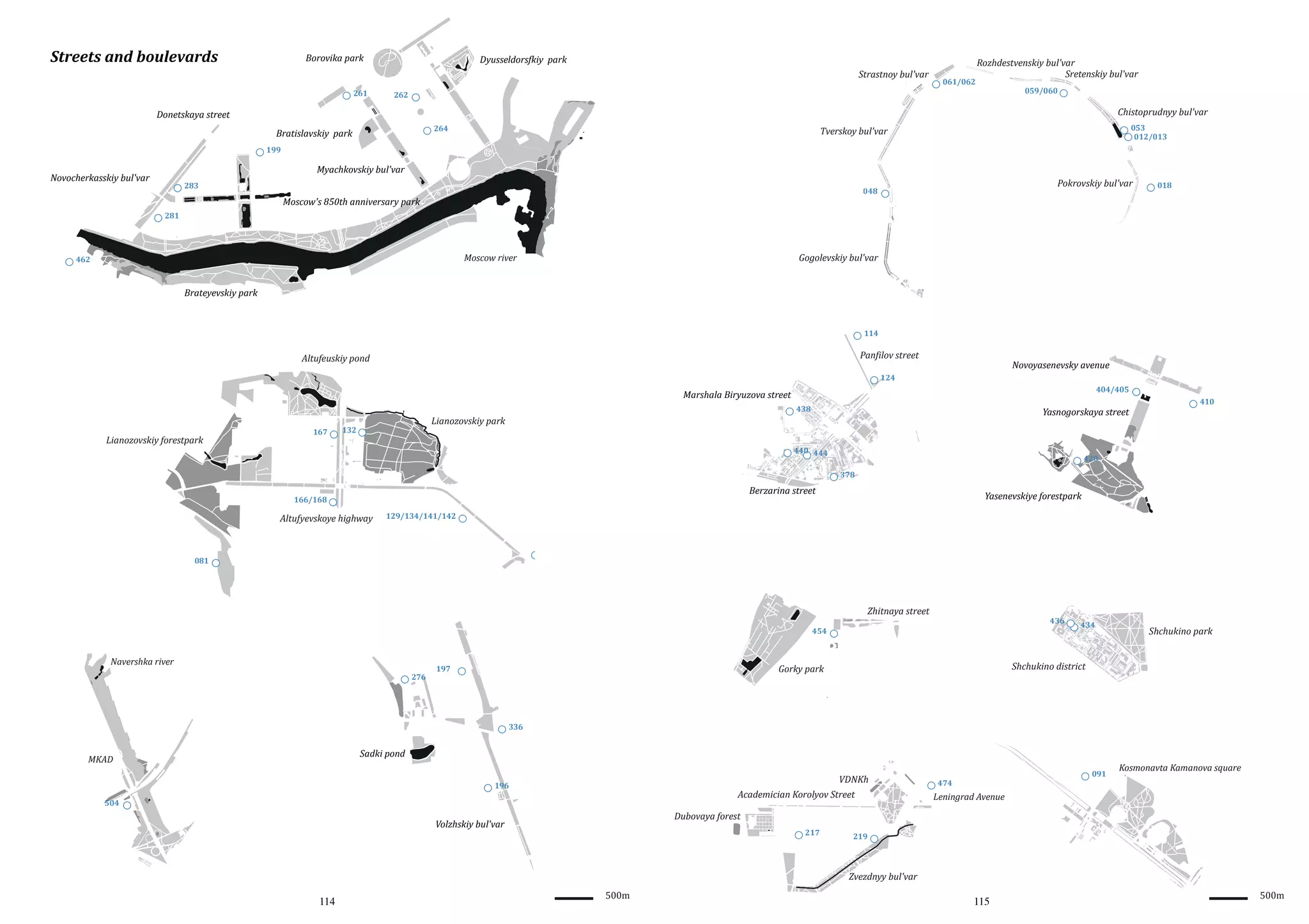
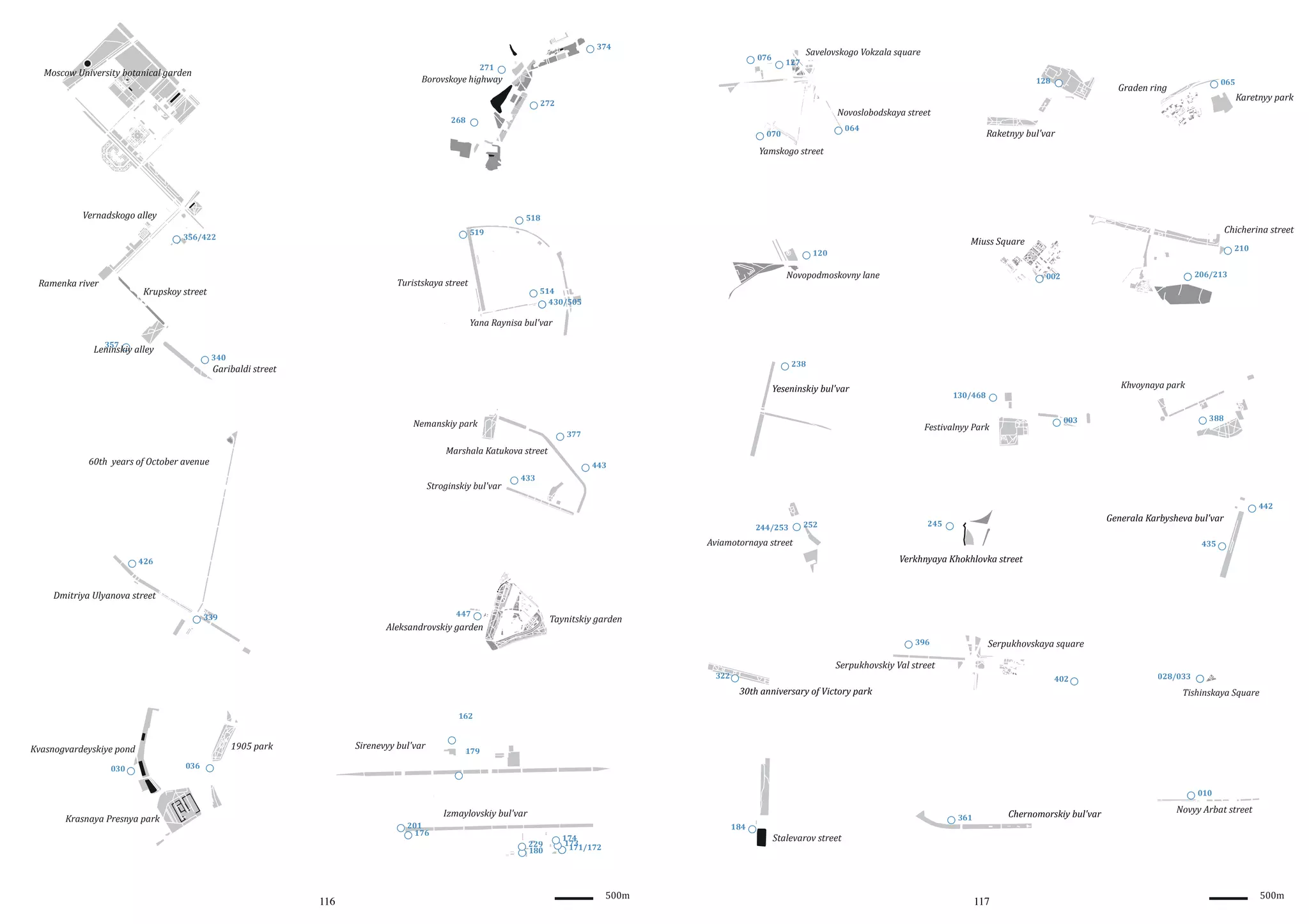
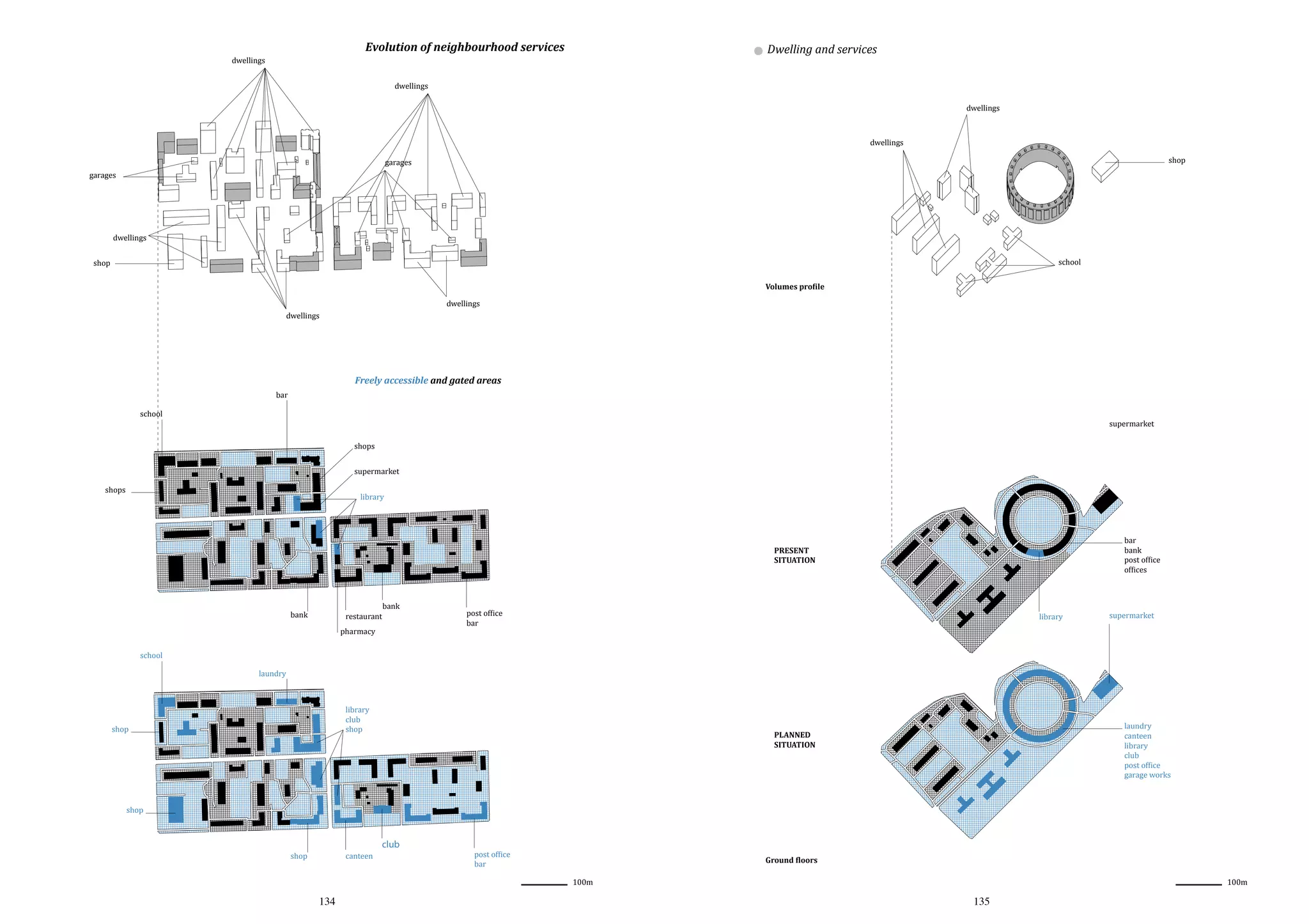
1. “Gardens, parks of leisure and culture, water basins
and fountains”

1. The text is held at the manuscript
section of the Museum of the History of
Moscow n the Barsov fund

2. In “Mosca, 1900-1950: Nascita di una
capitale”, De Magistris, 1994, extract from
a speach by J. Stalin in 1935

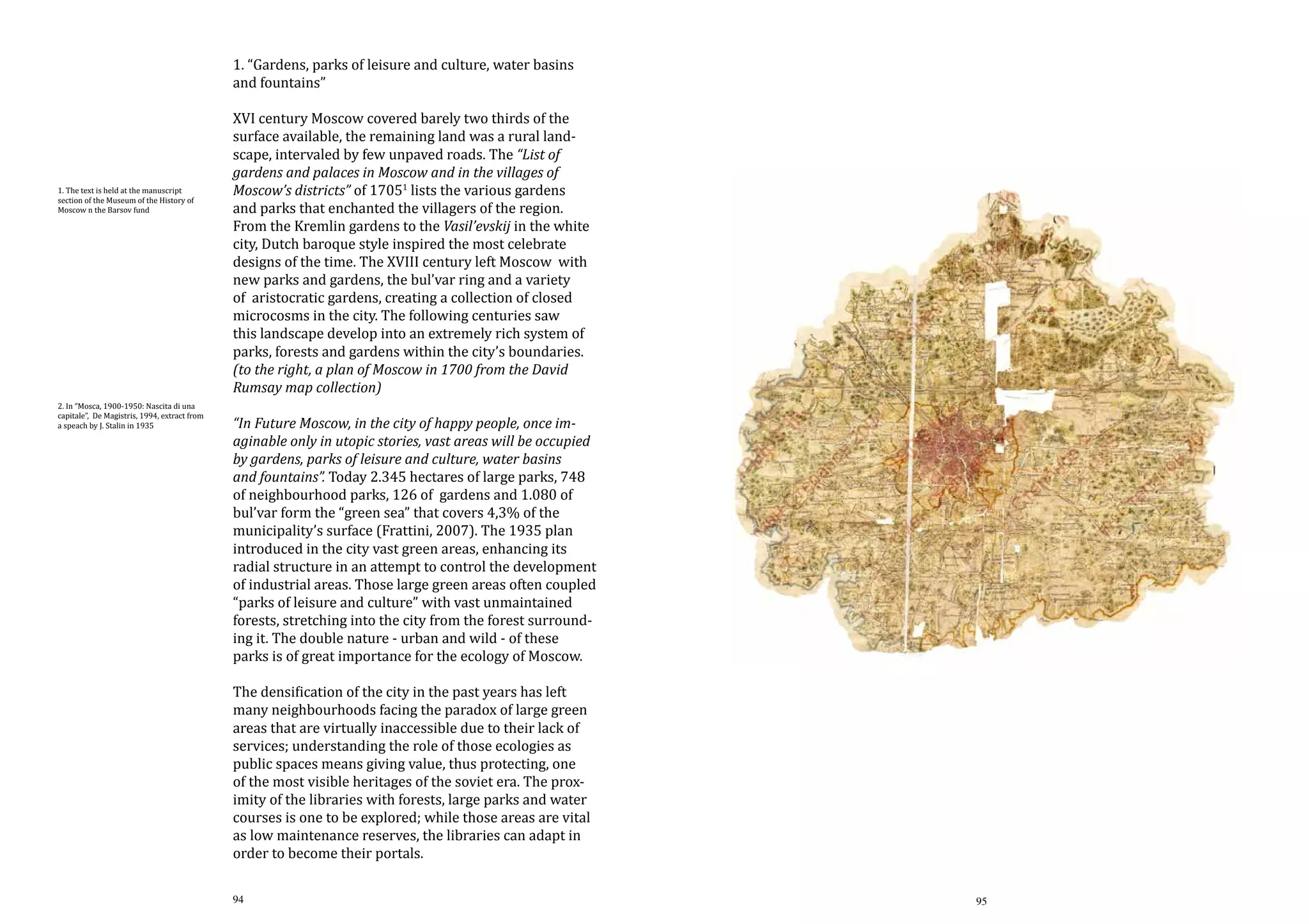
XVI century Moscow covered barely two thirds of the
surface available, the remaining land was a rural landscape, intervaled by few unpaved roads. The “List of
gardens and palaces in Moscow and in the villages of
Moscow’s districts” of 17051 lists the various gardens
and parks that enchanted the villagers of the region.
From the Kremlin gardens to the Vasil’evskij in the white
city, Dutch baroque style inspired the most celebrate
designs of the time. The XVIII century left Moscow with
new parks and gardens, the bul’var ring and a variety
of aristocratic gardens, creating a collection of closed
microcosms in the city. The following centuries saw
this landscape develop into an extremely rich system of
parks, forests and gardens within the city’s boundaries.
(to the right, a plan of Moscow in 1700 from the David
Rumsay map collection)
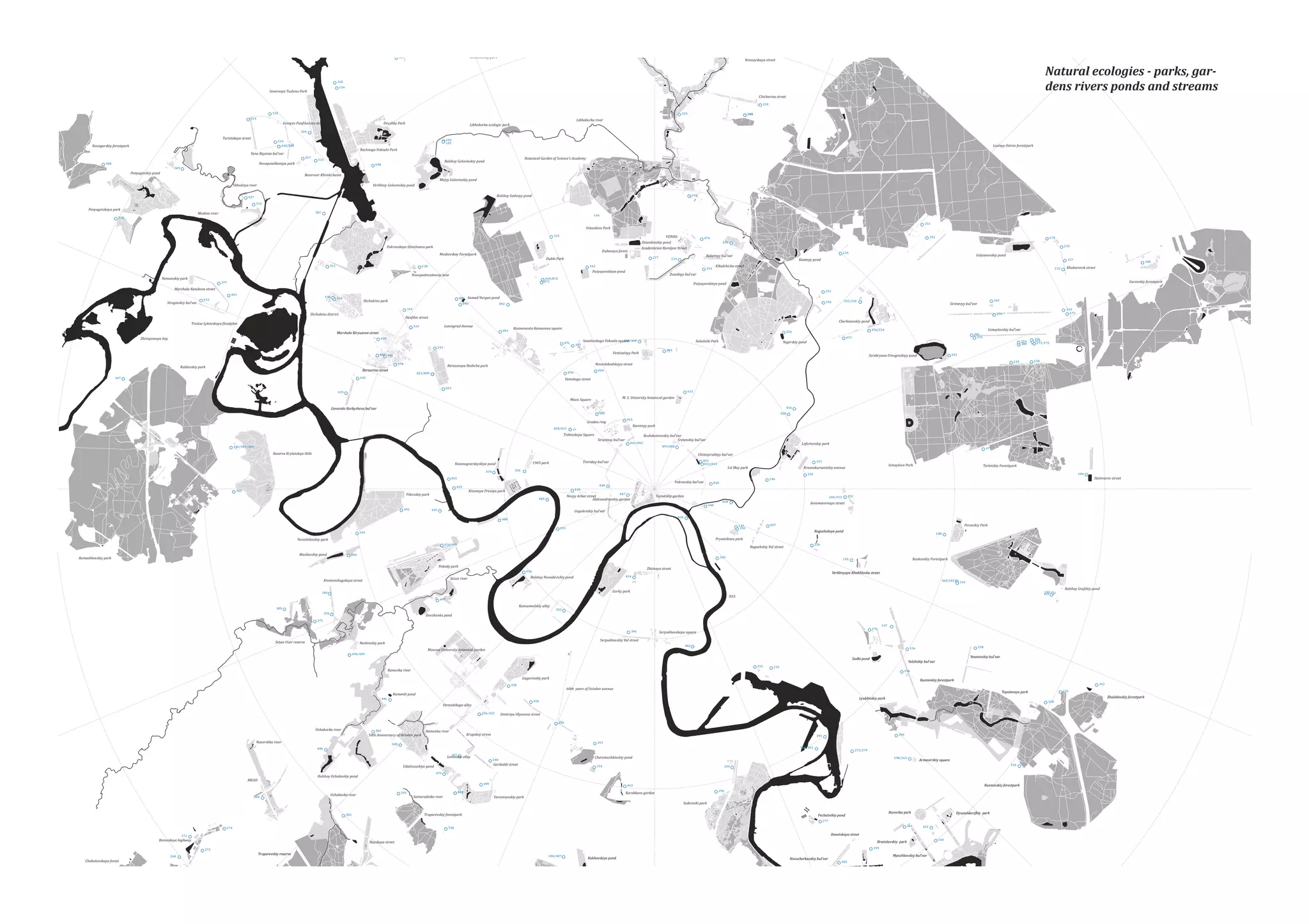
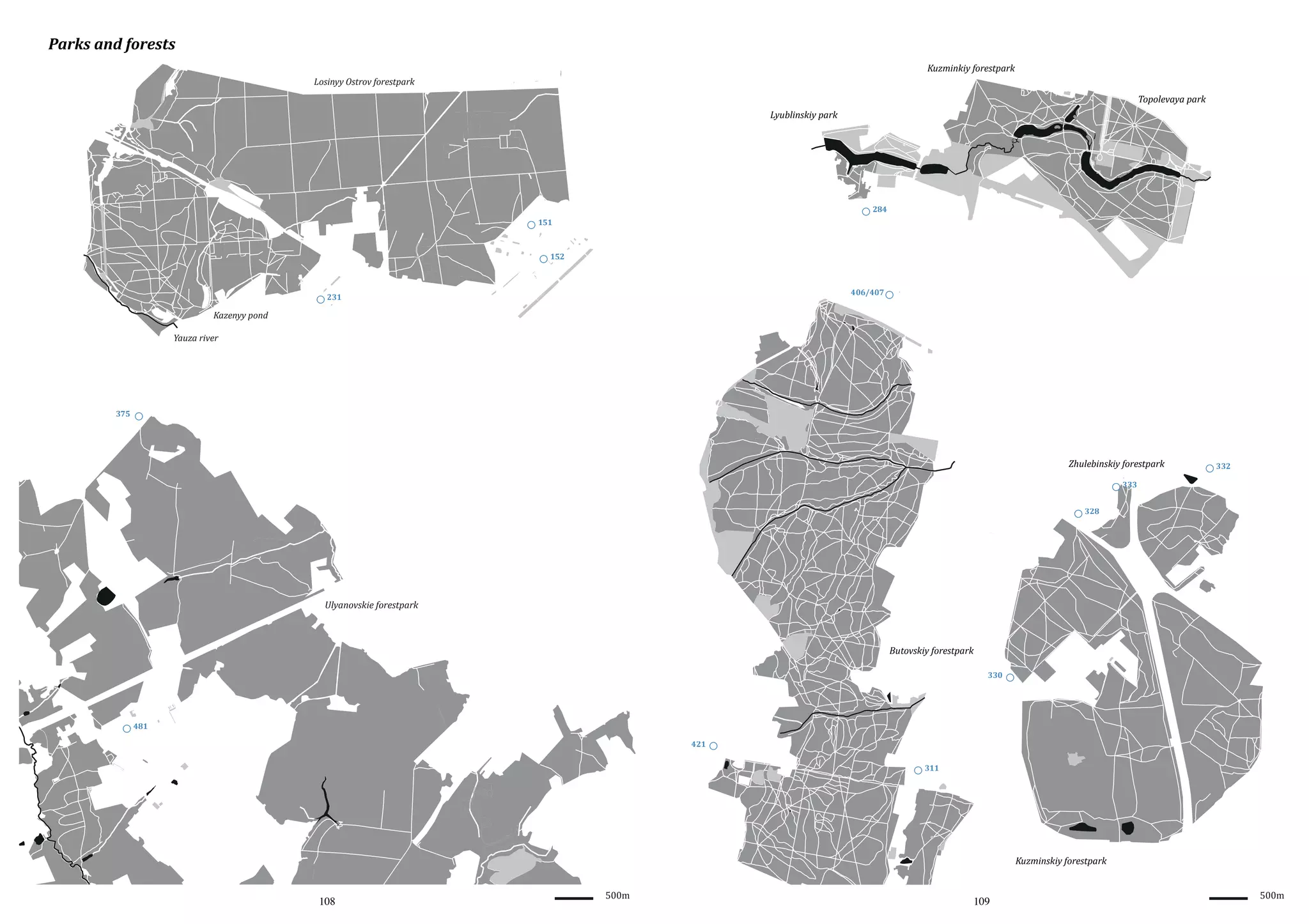
“In Future Moscow, in the city of happy people, once imaginable only in utopic stories, vast areas will be occupied
by gardens, parks of leisure and culture, water basins
and fountains”. Today 2.345 hectares of large parks, 748
of neighbourhood parks, 126 of gardens and 1.080 of
bul’var form the “green sea” that covers 4,3% of the
municipality’s surface (Frattini, 2007). The 1935 plan
introduced in the city vast green areas, enhancing its
radial structure in an attempt to control the development
of industrial areas. Those large green areas often coupled
“parks of leisure and culture” with vast unmaintained
forests, stretching into the city from the forest surrounding it. The double nature - urban and wild - of these
parks is of great importance for the ecology of Moscow.
The densification of the city in the past years has left
many neighbourhoods facing the paradox of large green
areas that are virtually inaccessible due to their lack of
services; understanding the role of those ecologies as
public spaces means giving value, thus protecting, one
of the most visible heritages of the soviet era. The proximity of the libraries with forests, large parks and water
courses is one to be explored; while those areas are vital
as low maintenance reserves, the libraries can adapt in
order to become their portals.
94

95
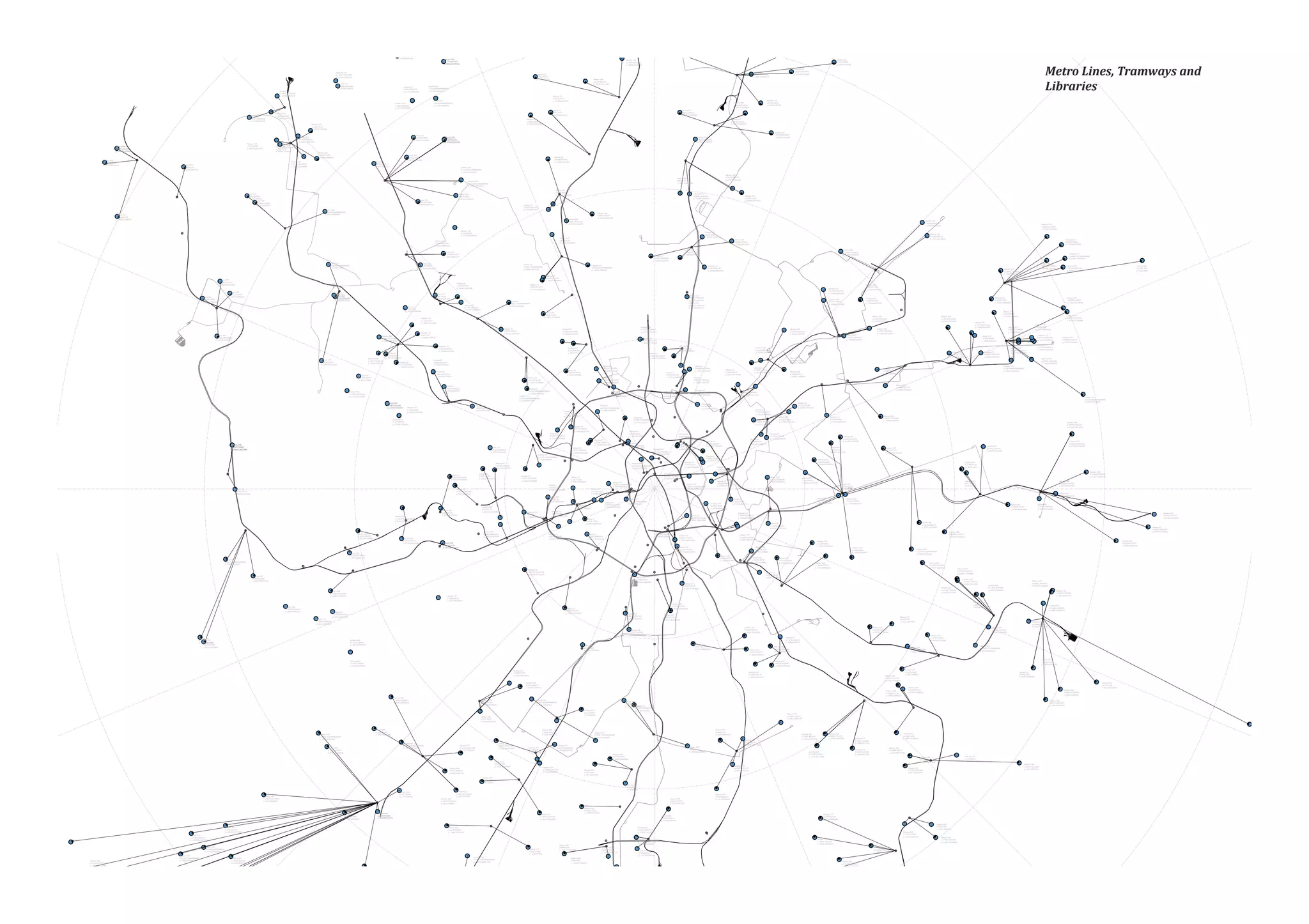
2. Moscow’s metro

The connection of the libraries with the metro lines is
one that works on a temporal basis. The social geography
of the city with its artificially maintained diversity was
dismantled very rapidly in the early 1990s; this meant
a change not only in the social panorama, but in the use
that the public transport was to bear. The hours spent in
the metro lines have almost doubled only in the past five
years, as workers cover more and more miles on a daily
basis. Libraries can offer a service for this time, if the
different branches of the network were to be understood
on the basis of transport; a cbs based on abstract municipality boundaries can hardly embrace a community that
is built not only on residents, but changes throughout
the day. The liveliness of the libraries, depends largely on
their ability to serve this wider public. The recognizability of the libraries as systems such as this, in terms both
of architecture and service is necessary if the libraries
are to be truly open.
3. Blocks and super blocks

Microrayons and kvartals were built as a system where
each part was necessary for the functioning of the whole;
canteens and laundries, club rooms and sport facilities,
libraries and museums, cinemas and theatres were
highly specialized public rooms built for a purpose and
functioning as one entity. As those connections fade, new
can be found. The maps proposed are a draft for a series
of local systems that can bring together the existing
facilities.
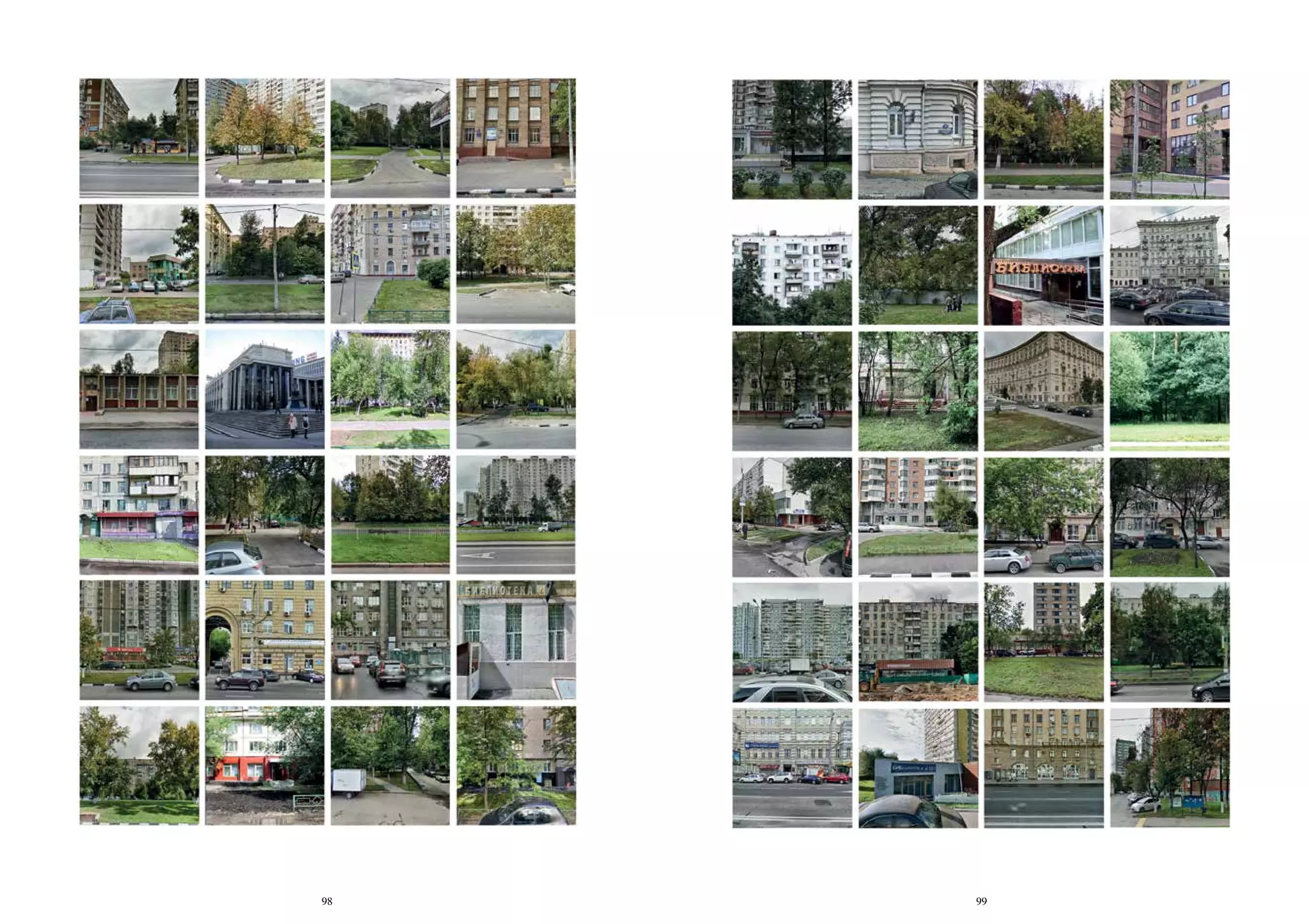
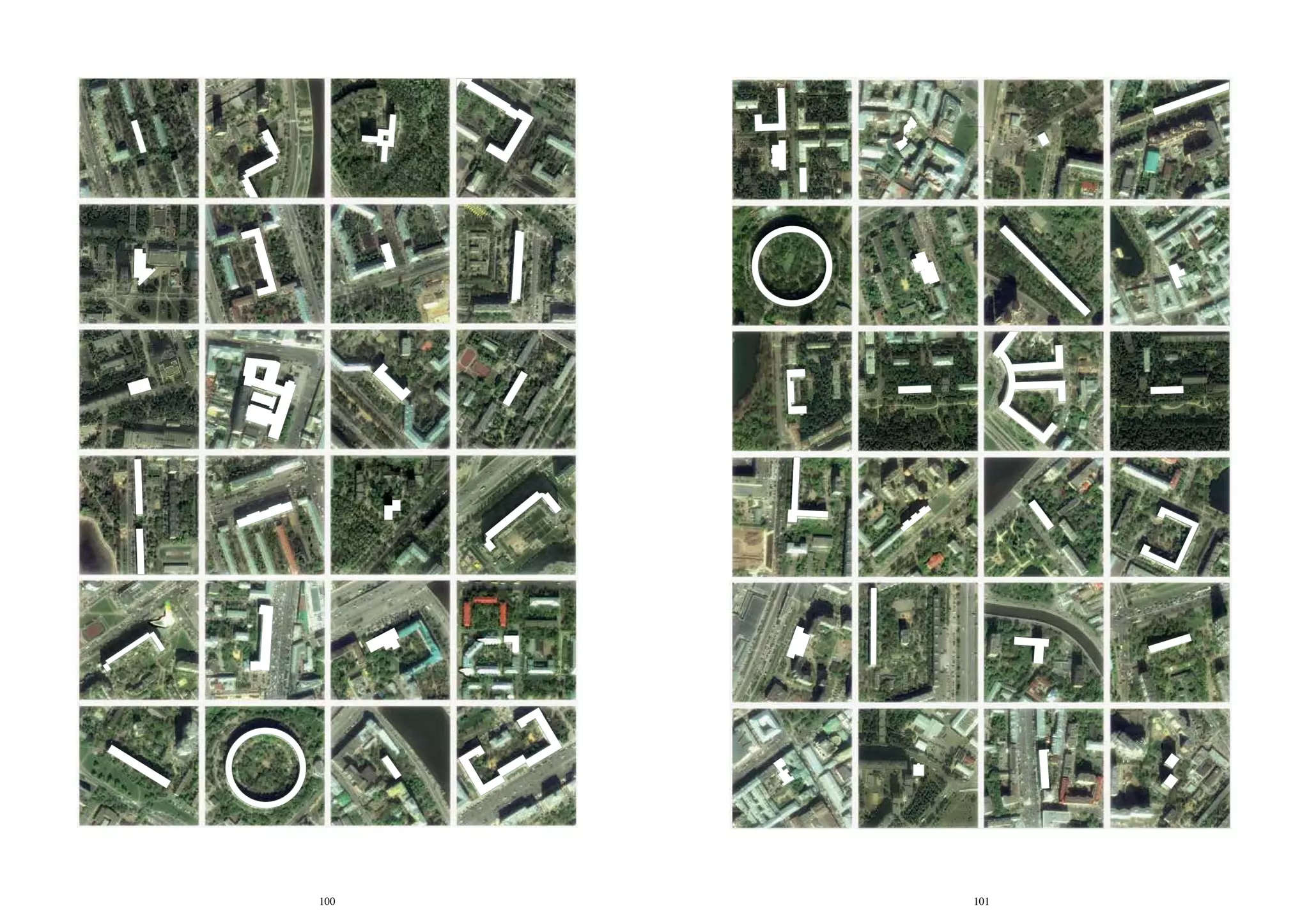
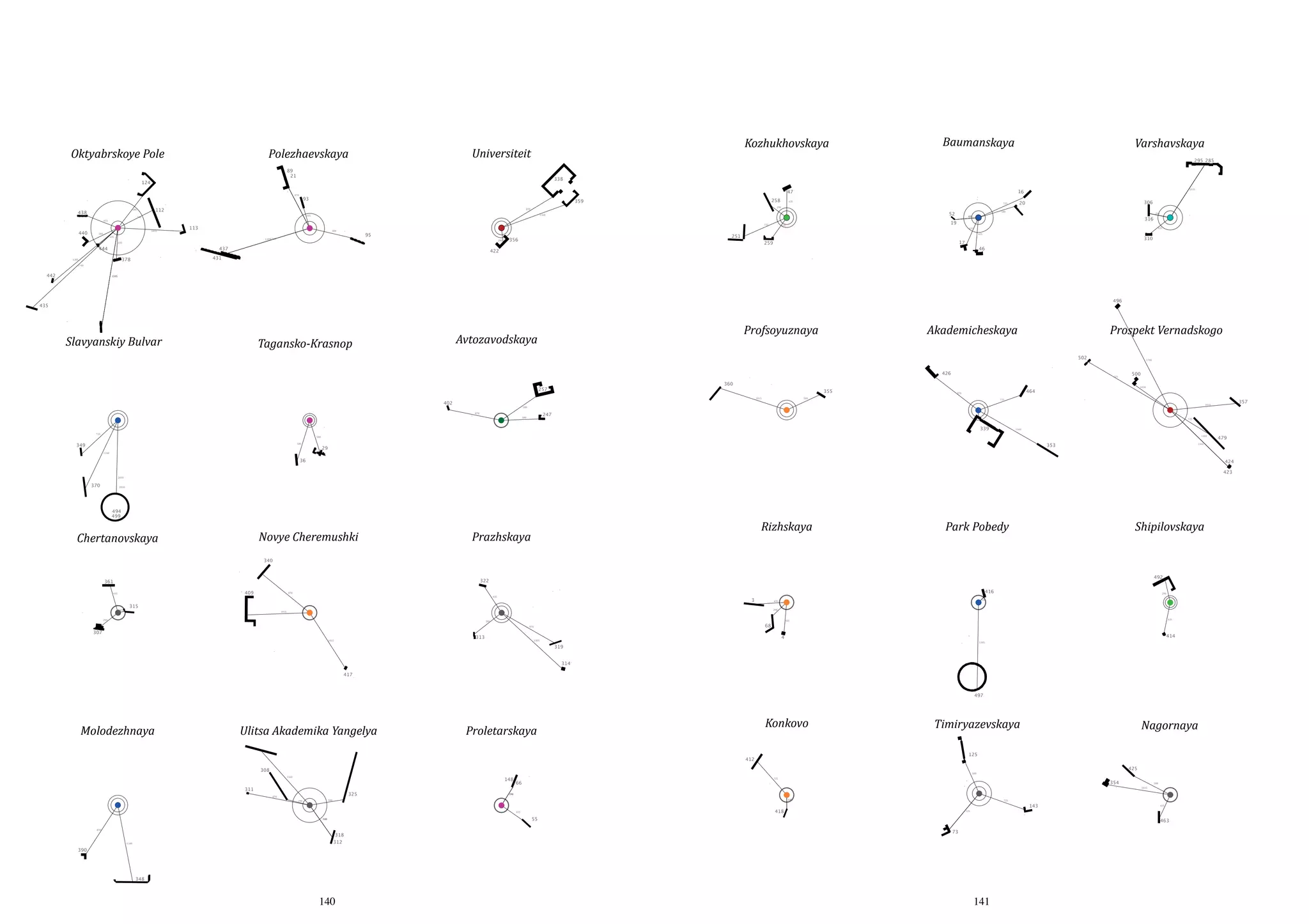
4. New Geographies

Large scale networks, such as the metro lines, local
services- police stations, hospitals, schools - and vast
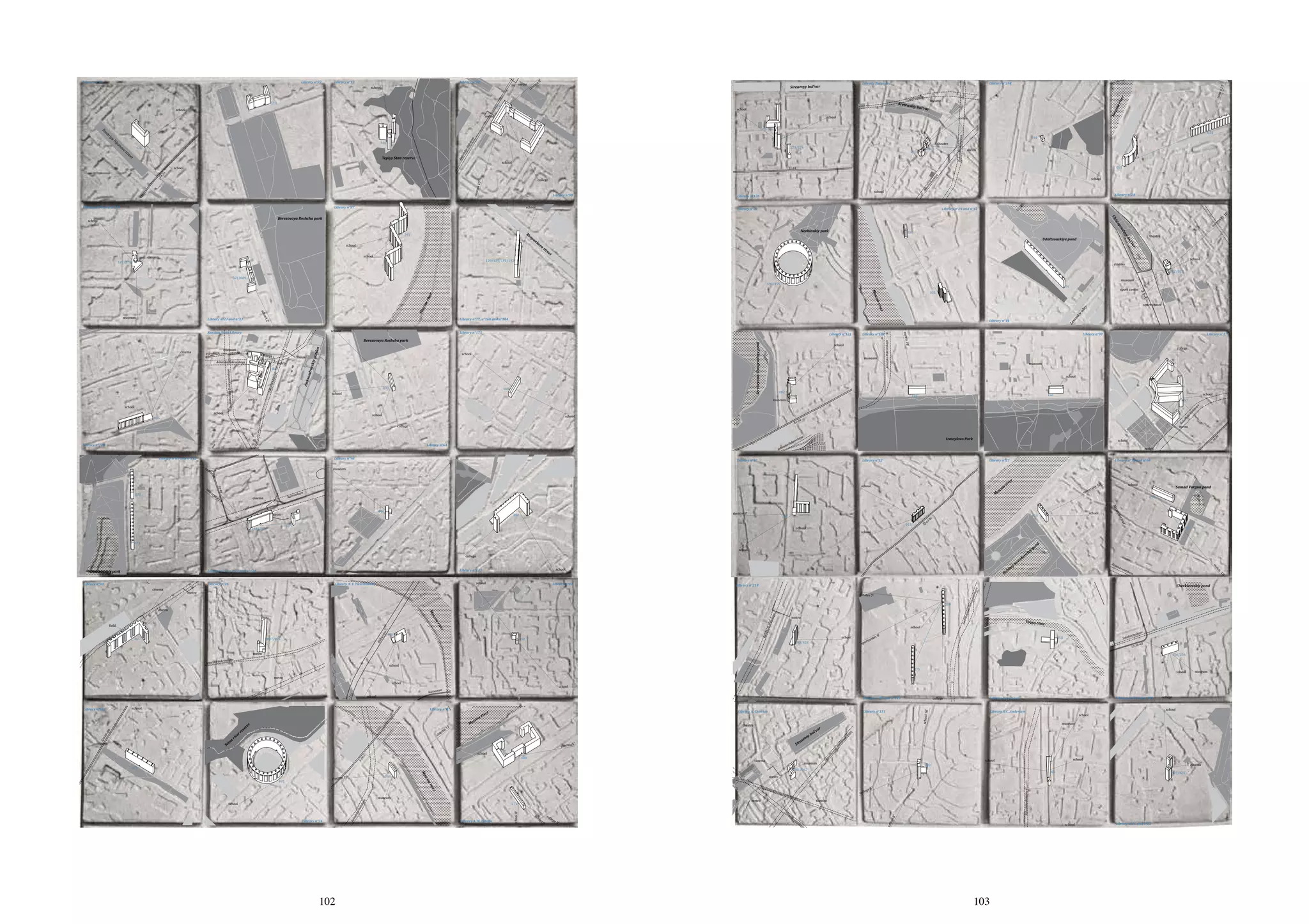
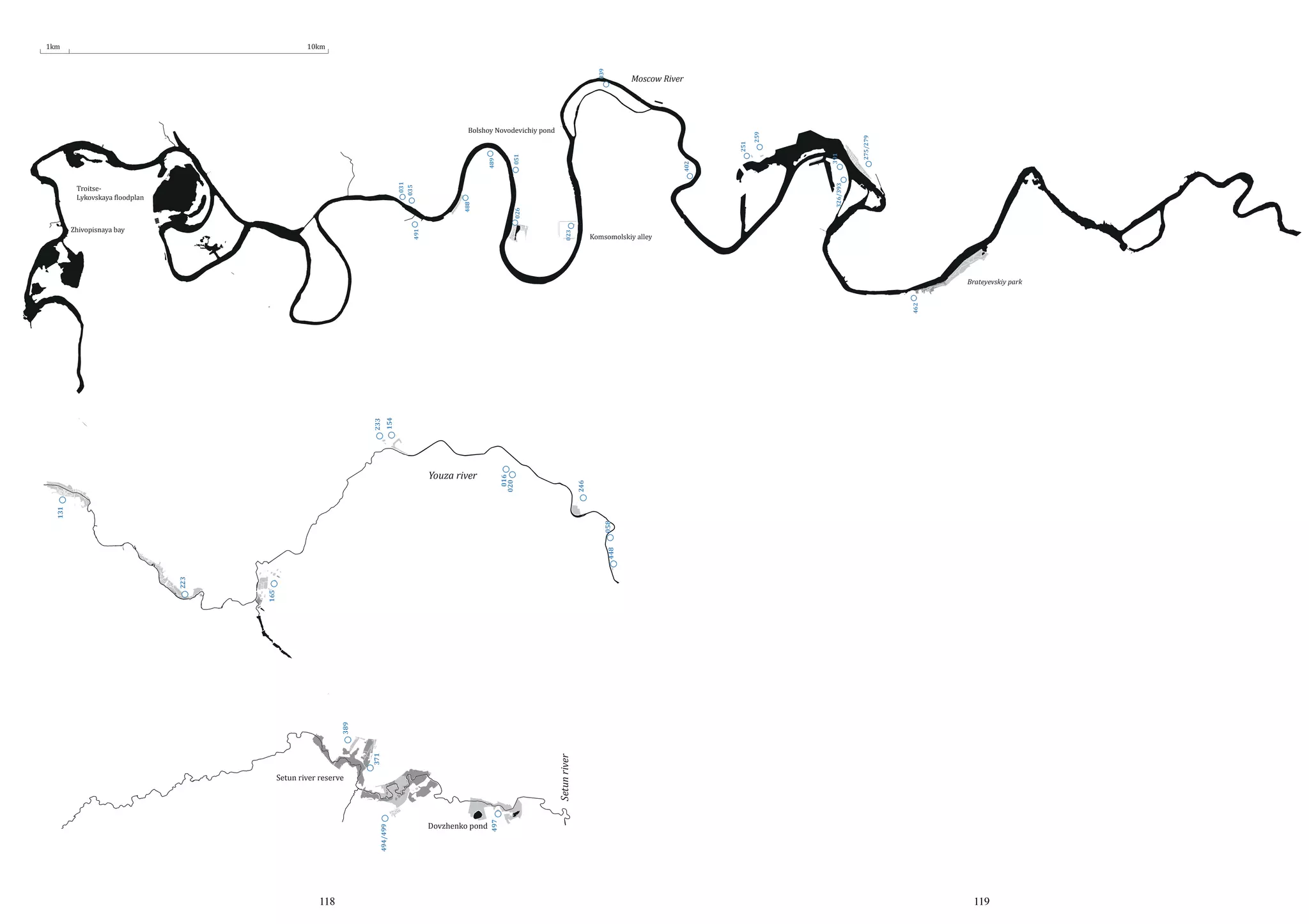
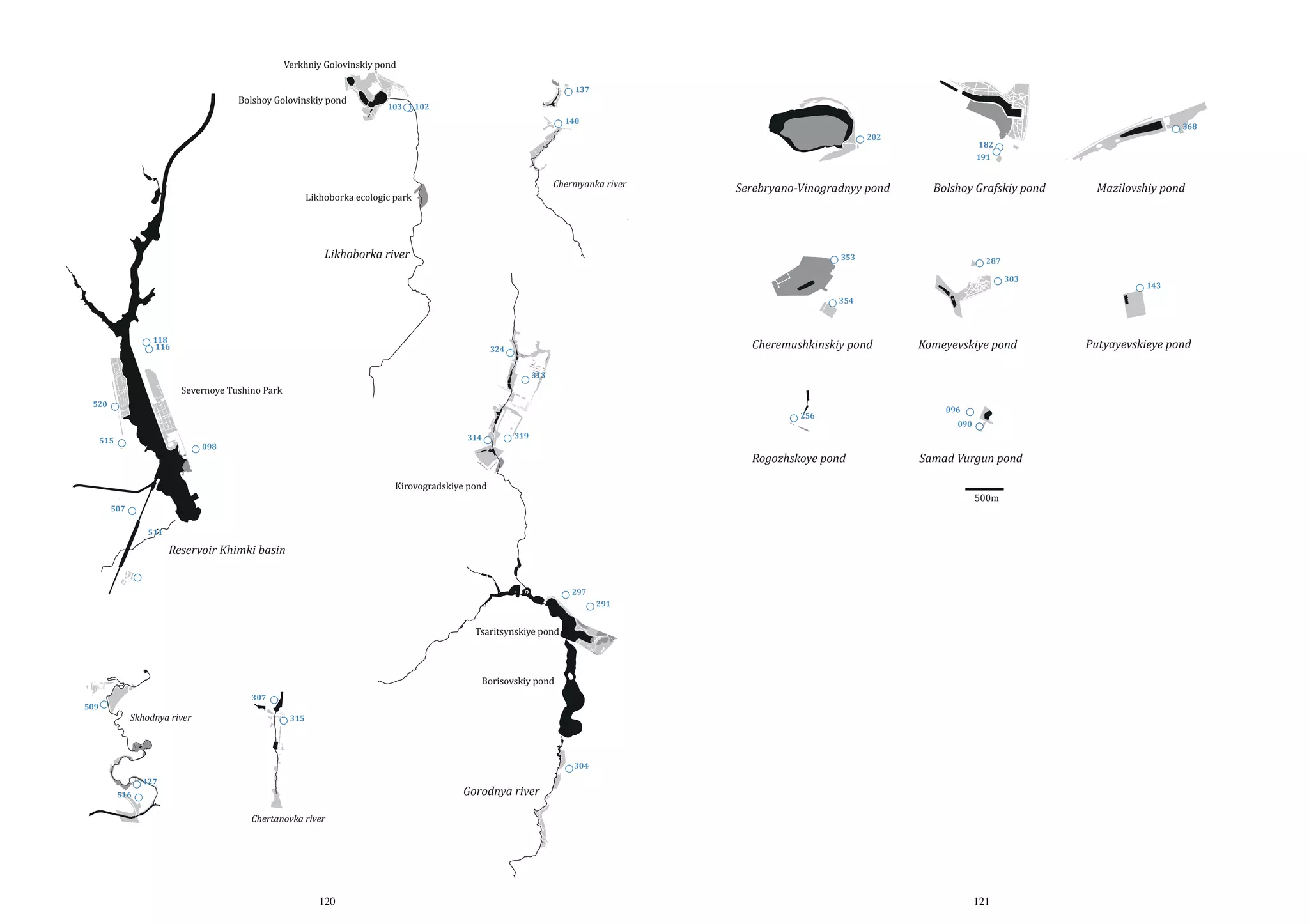
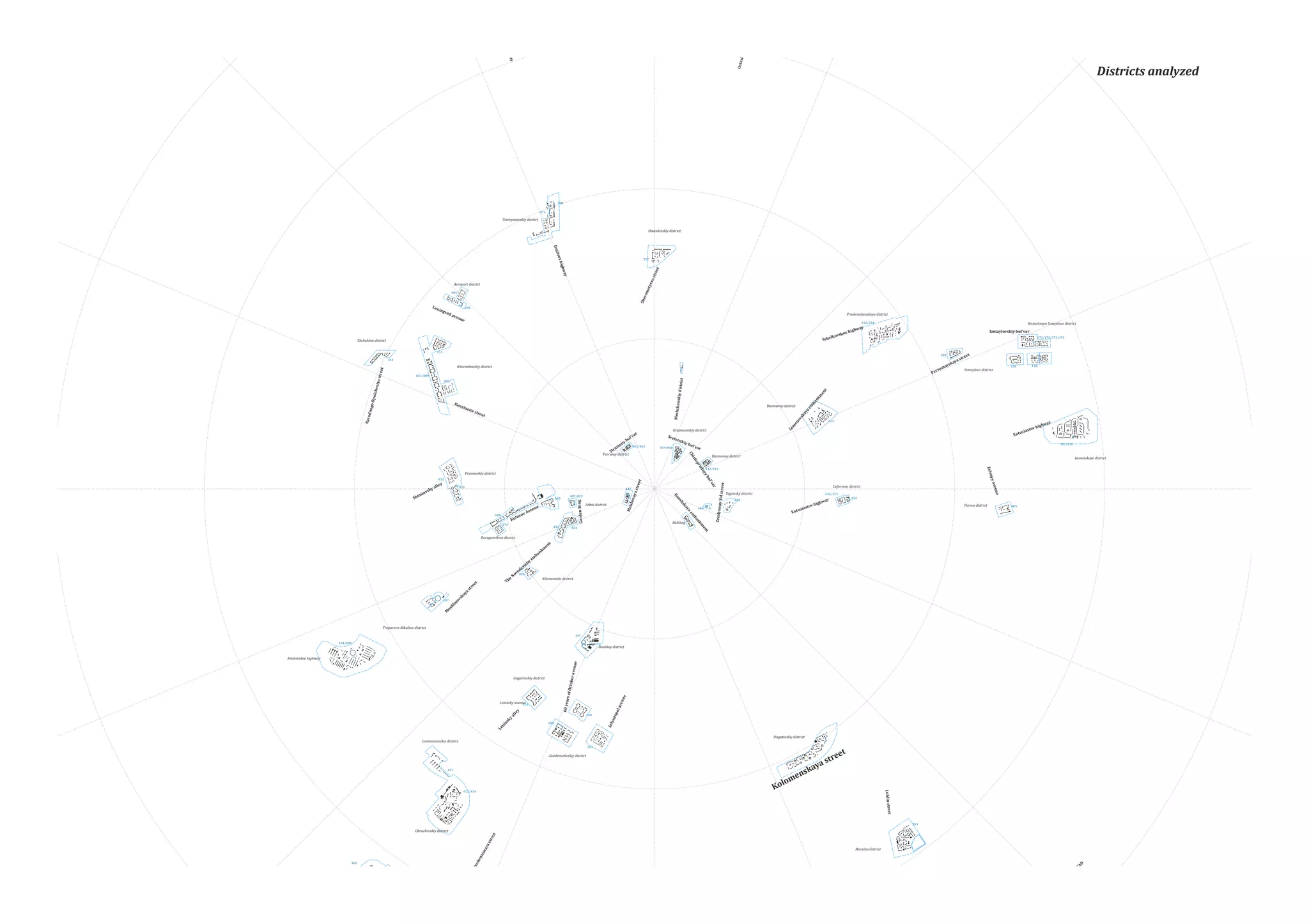
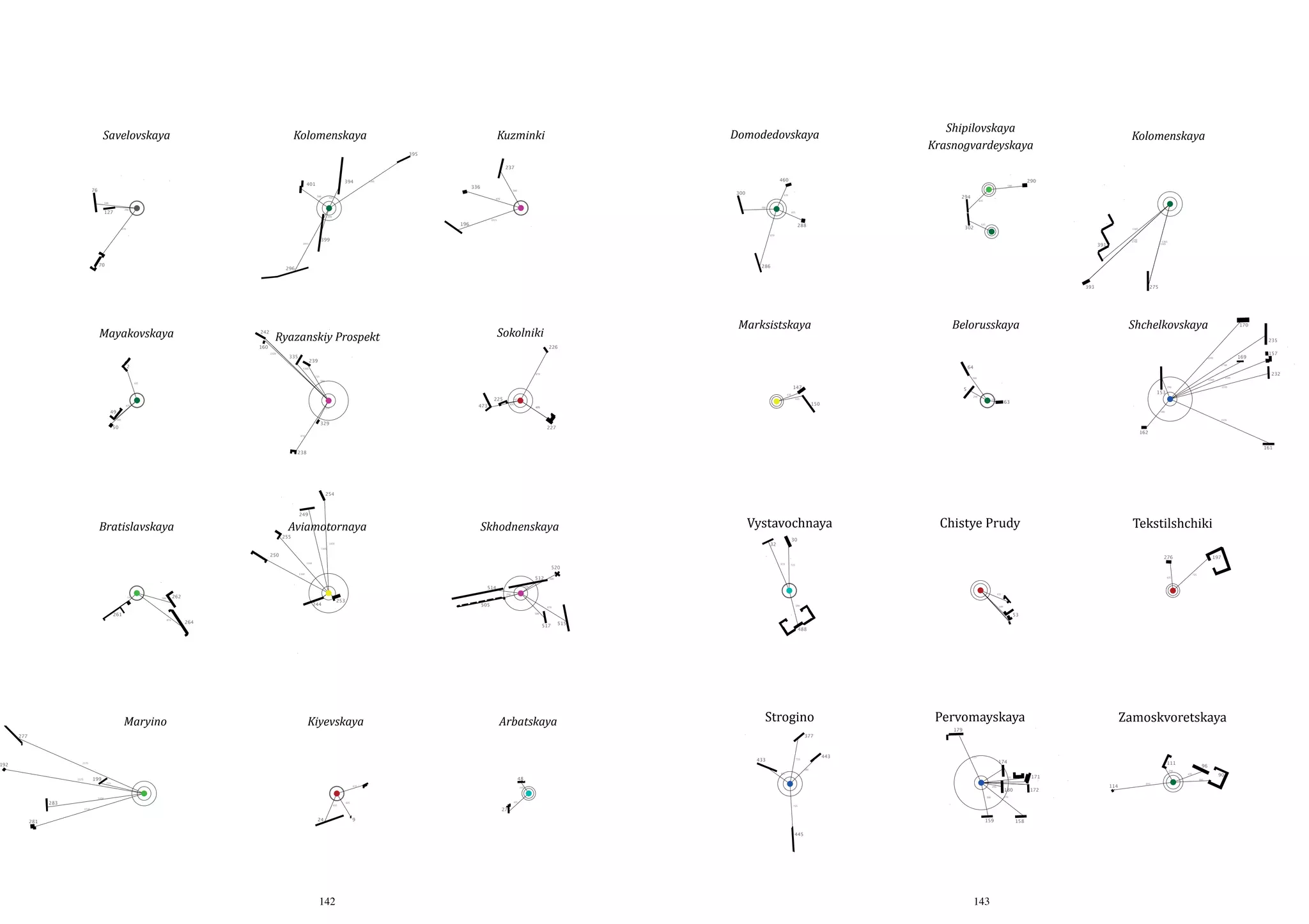
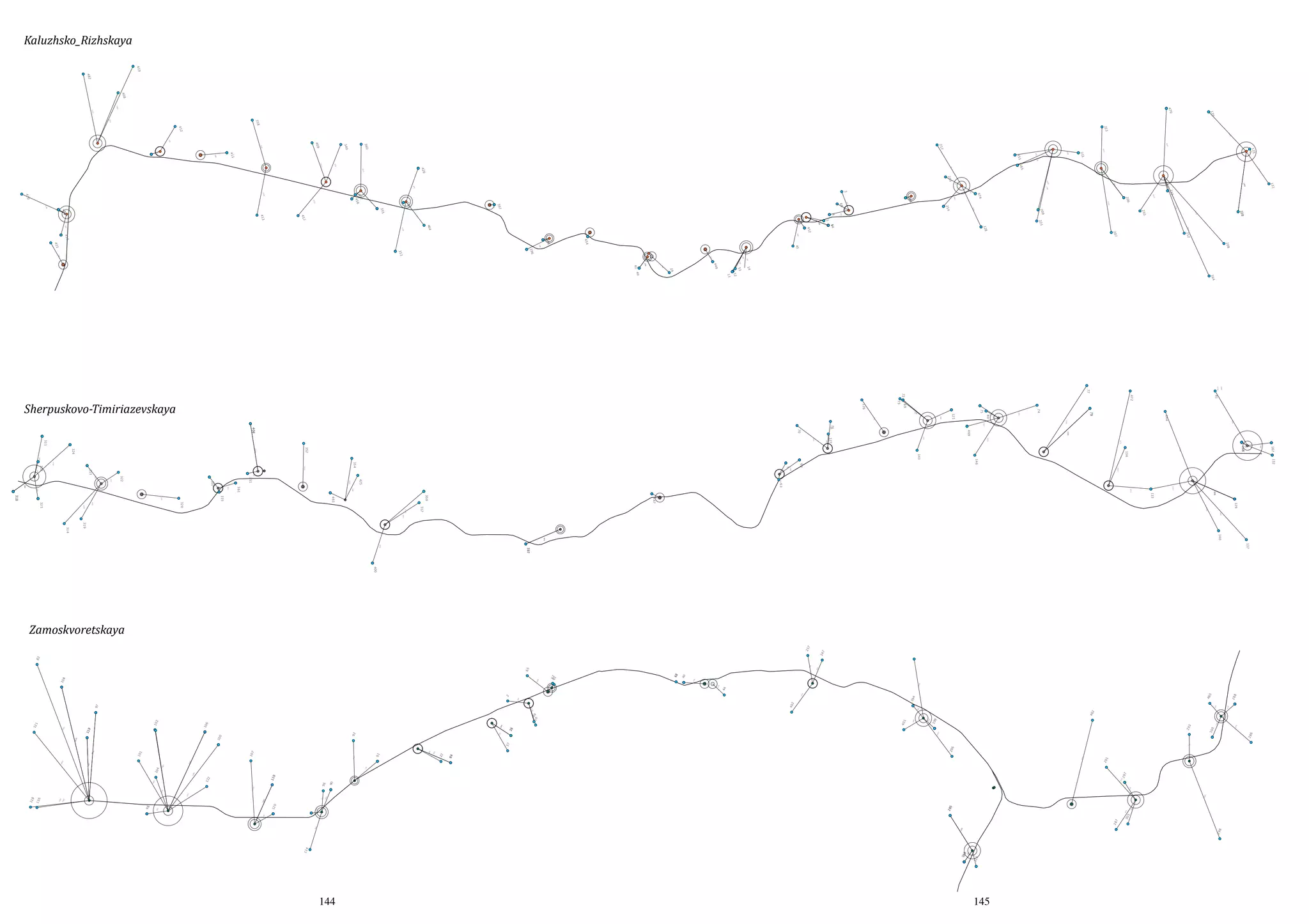
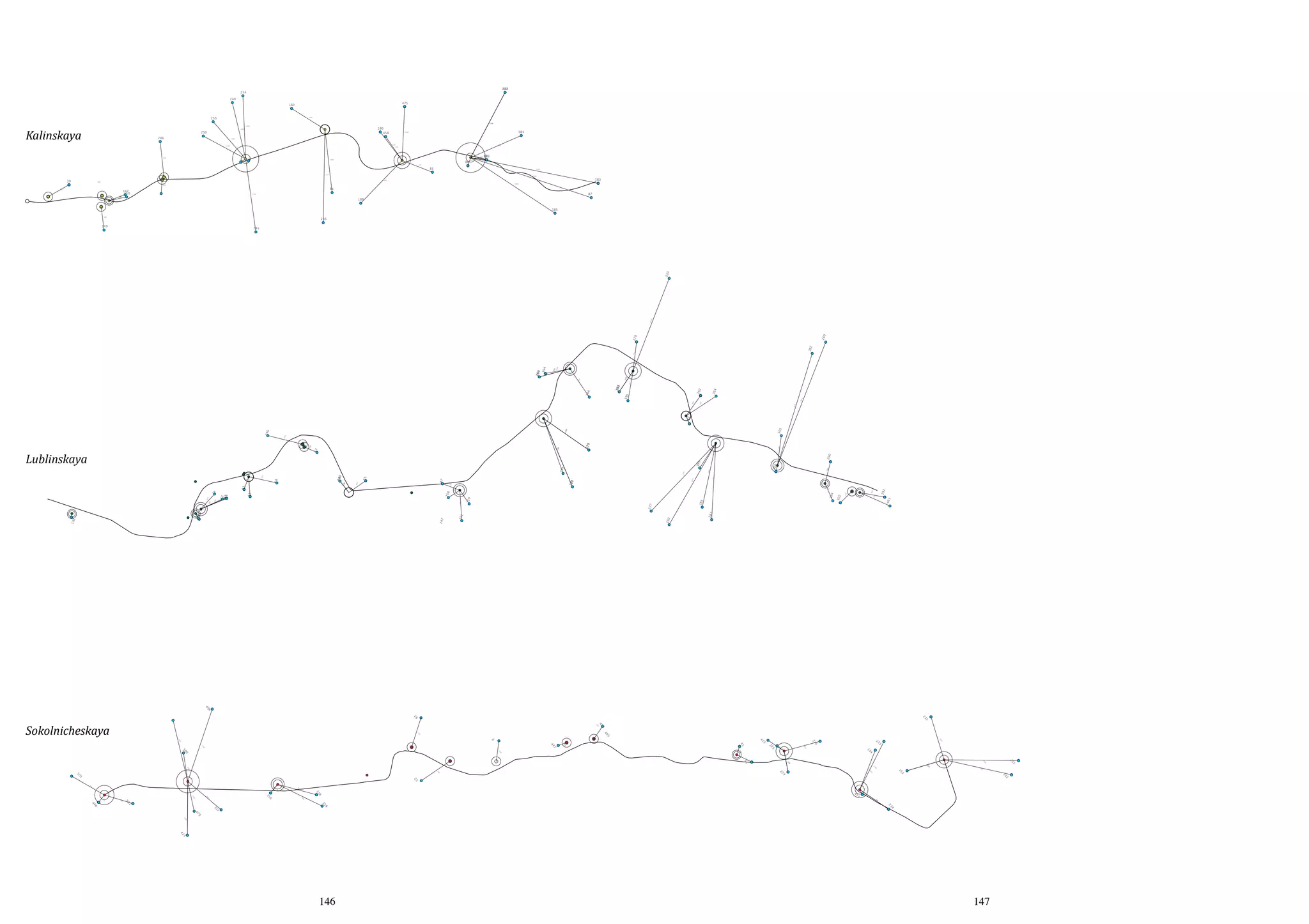
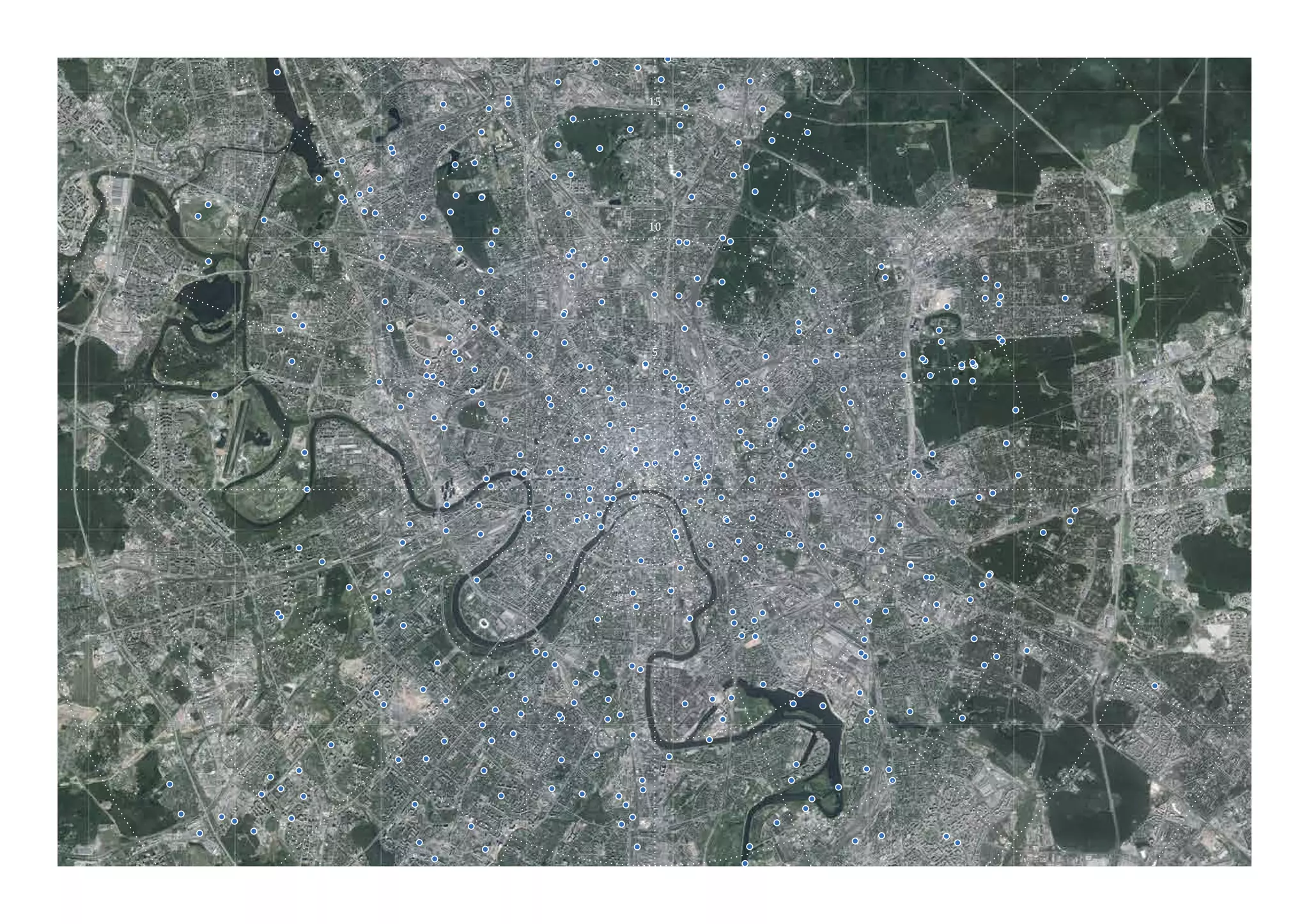
natural ecologies were discovered through the mapping of the libraries surroundings. Forty-eight 500m by
500m corings were used as a sample unit to measure the
potential connections between those three ecologies,
revealing a hidden web of opportunities.
96
98

99
100

101
cinem
sp

school

075

ol

8’

co

lle

ge

8’

nsko

opre
snen

skay
aaa

Za

m

os

kv
or
ets

ka
ya

theatre

ege

coll

156/234

school

met
ro 1
3’

Mo
sco
wr
ive
r

zevs
irya
-Tim

102

103
museum

y
lle

ni
ns

zhsk
o-R
izh
ska
ya
Ka
lu

ka
ya

ko
-R
izh
s

zh
s

Ka
lu

ya

8’

ya

6-4Л

13-3

co

lle

ge

vska

school

eska

lnich

8’

yaze
ukho
vsko
-Tim
ir

school 10’
280

Youza riv
er
Soko

Library n°59 and n°101

museum

Cherkizovskiy pond

058

Le

sev
aya
Ko
lt
9-A
3-3

-Kra
sn

ol

ya

6-4Л

13-3

Library H.C. Andersen

004
Kaluzhsko-Rizhskaya

ho

Taga

metro

museum

061/062

metro

ho

eska

lnich

Soko

Library Jurgenson

ool
8’

sc

college

ko
-T

cinema

sc

Youza riv
er

Serp

zhsk
o-Ri

zhsk
aya

Library A. N. Tolstoy

school 8’

6-2

zhsk
o-R
izh
ska
ya
Ka
lu

274

r
va

ul'

b
oy

stn

a
Str

ma 3’

kaya

8’

ki
ya

ive
8k

ter

cen
ort

Kalu

sev
aya
Ko
lt
9-A
3-3

school

080

ukho
vsko

metro

Serp

zhsk
o-Ri

zhsk
aya

theatre 7’

museum

5’

cine

er
riv

Library n°34

488

w
sco

school

Kalu

school

Mo

497

Library n°219

039

cinema 10’

theatre

Mo

school 8’

6-2
8-2
8k
S2

353

Library n°151

ma 3’

cine

8’

Cherkizovskiy pond

156/234

school

Library n°80 and n°149
Library A. Chekhov

cinema

274

oskv
oret

ska
Library A. N. Tolstoy
ya

075

er
riv

school

school

school

5’

090

Zam

058

cinema

488

museum

college

school

423/424

Library n°11 and n°22

cinema

’

w
sco

school

’

r8

te
cen
ort

sp

Samad Vurgun pond

096

10

a1

em

cin

5’

403/418

school

ev

N
oy

lsh

Bo

school

ro

r
ve
ri

e
rv
se
re

080

metro
school

nd
museum
po
iy
ich

od
ov

theatre 7’

039

er
riv

et

n

tu
Se

403/418

Library n°219

school

Library n°8

026

cinema 10’

497

school

Mo

m

a
Koltsevay

6

3-4

-4

32

w
sco

’

school

14

r
ive

Moscow river

school

ya

vska

File

school

school

015

school

school

390

school

metro

Library n°161

489

w
co

9
school
-3

metro

Library n°34 and n°68

5
a1
em ’
cin y 10
it
ers
univ

er
riv

os

M

Library n°34

Library n°41

Library n°8

metro

school

wr
sco

metro

kaya

-Pokrovs

Arbatsko

007/025

ve
ri

school

397

er
riv

261

ve
er
es
rr

n

390

a
Koltsevay

Library n°27

tu
Se

Library n°171
Library n°41
college

w
sco

Ly

metro

school

Library A. T. Twardowski

er
riv

a
ay
nsk

metro

metro

Library n°36

school

school

school

vs

school

school

school

Library n°127

217
353

w
sco
Mo

�ield

theatre 8’

362

college

cinema

li
ub

444

Izmaylovo Park

Library n°12

Izmaylovo Park

aya
insk

Library n°87, n°122 and n°124

Library n°30

school

school

158

school

kaya

File

489

Mo

471

007/025

metro

vs
okro
Academician Korolyov Street
o-P
tsk

Library n°161
Library n°47

252

Arbatsko-Pokrovskaya

Serebryano-Vinogradnyy pond

Arbatsko

Kalin

metro

metro

kaya
-Pokrovs

8-2

6

244/253

Dmitrovskiy park

159

S2

cinema

0’

museum

4

a
Arb

school

Library n°97

Mo

y1

Kaluzhsko-Rizhskaya

ya

Mo
sco
wr
ive
r
en
gard
drov
skiy

Soko

lnich

eska

Aleks
an

ya

aya
Serpukhovsko-Timiryazevsk

32-4

sit

Library A. T. Twardowski

11-3

museum

ive
r

museum

261

kaya

sport center

-A

college

Library n°101
Library n°36

Moscow river

school

museum

metro
school

sport center

�ield

school

012/013

museum

479

035

Koltse
vaya

3-9

202

bli

u
Ly

Library n°98

un

r
va

a
ay
nsk

Library n°64

078

cinema

metro

Library n°121

metro

metro

ul'

�ield

theatre

0’

y1

sit

r
ive

un

er
riv

464

Library n°128

cinema

Library n°30

school

school

Library n°81 and n°112

Udaltsouskiye pond

Library n°14

Library n°175

093

Library n°28

d

w
sco

metro

494/499

Berezovaya Roshcha park

school

051

school

Mo

metro

metro

447

kiy
ep

’

school

085

metro

es
ka
ya
metro

re
et

10
metro

Arbatsko-Pokrovskaya

ich

st

ver
w ri
sco

a
Filevskay

us

031

ko
ln

Mo

2’
ool

school

museum

metro

on

Library n°77, n°160 and n°184

school

Russian State Library
cinema

So

129/134/141/142

sch

Library n°23 and n°33

so

a 3’

cinem

Library n°29 and n°43

Nezhinskiy park
ko
va

021/089

museum

school

Library n°120
Library n°29

Ko
ny
on

school

alt

b
yy
dn

cinema

187/228

391

school

Ud

ru
op
ist

Berezovaya Roshcha park

metro

024

Ch

school

un

Set

Library n°99
school

Library n°87

344

sch

Library n°74 and n°214

theatre

060

11-34

rve
ese
rr

e
riv

059

ich
es
ka

college

a 10’

school

school

173/174

r

9

-3

14

Teplyy Stan reserve

metro

sk
ay
a

t

172

bul'var

ko
ln

408

426

re
e

171

Sreten
skiy

school

iry
az
ev

st

school

theatre

im

ov
a

Library n°248

nskaya

Lyubli

rp
uk
ho
vs

Ul
ya
n

Library Turgenev

Sirenevyy bul'var

Se

iy
a

339

’

a8

em

cin

metro

Ka
luz
hsk
o-R
izh
ska
ya

itr

metro

Library n°28

So

113

school

Dm

school

Library n°12

za
r

Library n°59

Ya
u

Library n°95
Veteranov park

140

081

131

Dzhamgarovskiy park
078
105

471

Izhorskiy park

082

220/222
208

Chermyanka river
Dmitrovskiy park

121

Yeniseyskaya street

Natural ecologies - parks, gardens rivers ponds and streams

118
116

Severnoye Tushino Park

Chicherina street
210
518
519

223

Geroyev Pan�ilovtsev street

Druzhby Park

213
206

Likhoborka river

Likhoborka ecologic park

520

Turistskaya street

102
103

514
430/505

Novogorskiy forestpark

517

Novoposelkovaya park

508
509

Penyaginskiy pond

Losinyy Ostrov forestpark

Rechnogo Vokzala Park

Yana Raynisa bul'var

515

Botanical Garden of Science’s Academy

Bolshoy Golovinskiy pond

098

Reservoir Khimki basin

Malyy Golovinskiy pond
Verkhniy Golovinskiy pond

Skhodnya river

Bolshoy Sadovyy pond

427

165

516

Penyaginskaya park

507

Moskva river

510

146
151

Ostankino Park
125

VDNKh
Ostankinskiy pond

Pokrovskoye-Streshnevo park

511

Nemanskiy park

217

Dubki Park

120

157

Kibalchicha street

214

Putyayevskieye pond

232

388

Khabarovsk street

Zvezdnyy bul'var

069/072
073

377

235

Golyanovskiy pond

Kazenyy pond

Gorenskiy forestpark

Putyayevskieye pond

Marshala Katukova street

233

443

Stroginskiy bul'var

170

231

Raketnyy bul'var

219

143

Novopodmoskovny lane

152
128

Academician Korolyov Street

Dubovaya forest

Moskovskoy Forestpark

474

436

433

434

096

Shchukino park

Samad Vurgun pond

090

155/230

154

092

162

Sirenevyy bul'var

114

Shchukino district

Cherkizovskiy pond

Leningrad Avenue

124

091

Marshala Biryuzova street
Zhivopisnaya bay

Kosmonavta Kamanova square

076

127

113

130/468
Savelovskogo Vokzala square

378

174
173
171/172

159

158

064

070

021/089

442

Yamskogo street
093

435

452

M. S. University botanical garden

Miuss Square

016

Generala Karbysheva bul'var
002

020
065

Graden ring

Karetnyy park

028/033

Tishinskaya Square
Strastnoy bul'var

061/062

346/347/369

Rozhdestvenskiy bul'var
Sretenskiy bul'var

Lefortovskiy park

059/060

Reserve Krylatskiye Hills

475

Chistoprudnyy bul'var
053
012/013

Tverskoy bul'var

1905 park

Kvasnogvardeyskiye pond

365

184

246

018

447

Taynitskiy garden

Novyy Arbat street
Aleksandrovskiy garden

Stalevarov street

489
491

252

244/253
448

492

Krasnokursantskiy avenue

Terletskiy Forestpark

010

Krasnaya Presnya park

Fileviskiy park

1st May park

Izmaylovo Park

250

Pokrovskiy bul'var

048

035

255

036

030
031

058

Aviamotornaya street

Gogolevskiy bul'var
039

488

Perovskiy Park

057

147
150

051

Rogozhskoye pond

364

188

Pryamikova park

Voroshilovskiy park
416/490

Mazilovshiy pond

Romashkovskiy park

229
180
202

Serebryano-Vinogradnyy pond

Novoslobodskaya street

Berezovaya Roshcha park

Berzarina street

201
176

453

Yegerskiy pond

003

Festivalnyy Park

440 444

Rublevskiy park

Sokolniki Park

Izmaylovskiy bul'var

156/234

226

438

367

161
175

179

Pan�ilov street

Troitse-Lykovskaya �loodplan

256

Rogozhskiy Val street

368

149

Pobedy park
Kremenchugskaya street

Verkhnyaya Khokhlovka street

454

Bolshoy Novodevichiy pond

160/242

497

Komsomolskiy alley

389
370

334

033

Gorky park

349

Kuskovskiy Forestpark

245

Zhitnaya street

026

Setun river

182
191

Bolshoy Grafskiy pond

023

Dovzhenko pond

371
396

Setun river reserve

276

Serpukhovskaya square

197

Serpukhovskiy Val street

Nezhinskiy park

402

Moscow University botanical garden

494/499

238

336

Sadki pond
251

Ramenka river

259

196

Gagarinskiy park

Kuzminkiy forestpark

338

356/422

502

50th Anniversary of October park

Ramenka river

Dmitriya Ulyanova street

Krupskoy street
326/393
357

Leninskiy alley

Garibaldi street

198/263

354

Armavirskiy square
330

399

479

Bolshoy Ochakovkiy pond

409

504

275/279

Cheremushkinskiy pond

340

Udaltsouskiye pond
MKAD

284

391
353

500
498

501

Ochakovka river

Kuzminskiy forestpark

463

424
423

Samorodinka river

296

Korobkovo garden

Vorontsovskiy park

Sadovniki park
Troparevskiy forestpark

503

Borovika park

Pechatnikiy pond

Dyusseldors�kiy park

277
374

261

358

Chobotovskaya forest

264

Bratislavskiy park

Ruzskaya street
272

268

262

Donetskaya street

271

Borovskoye highway

199

Troparevskiy reserve

406/407

Kakhovskiye pond

362

Myachkovskiy bul'var

Novocherkasskiy bul'var

283

Chernomorskiy bul'var

361

Moscow's 850th anniversary park
281

Chertanovkiye pond

269

315

Chertanovka river
462

307

412

Klyuchevaya basin

Brateyevskiy park

375
419

305
304

Teplyy Stan reserve
403/418

291

Zhulebinskiy forestpark
328

339

Ochakovka river
Navershka river

333

Topolevaya park
Lyublinskiy park

426

Vernadskogo alley

332

60th years of October avenue

Ramenki pond
496

Yeseninskiy bul'var

Volzhskiy bul'var

282

kapotniskiy forest
The main lane of the Kirov Park, August 1937

106

Swimmers on the Moscow rivers, 1920s

107
Parks and forests
Kuzminkiy forestpark
Losinyy Ostrov forestpark

Topolevaya park
Lyublinskiy park

284
151

152

406/407

231

Kazenyy pond
Yauza river

375

Zhulebinskiy forestpark

332

333
328

Ulyanovskie forestpark

Butovskiy forestpark
330

481
421
311

Kuzminskiy forestpark

108

500m

109

500m
399

161
175

Rublevskiy park
367

296

Moscow river
Moscow river

159

158

Sadovniki park

Bolshoy Sadovyy pond

Bittseviskiy forestpark
403/418

Moskovskoy Forestpark

475

Terletskiy Forestpark
Izmaylovo Park

069/072
073

Ochakovka river

Raketnyy bul'var

092

Kibalchicha street
503

Putyayevskieye pond
233
154

226

Sokolniki Park

362

Yauza river

Yegerskiy pond
160/242

110

500m

334

Kuskovskiy Forestpark

Troparevskiy reserve

111

500m
Reserve Krylatskiye Hills

Penyaginskaya park

416/490

346/347/369

Troitskiy forestpark
Pobedy park

Ochakovka river
482
510

503

365

Berezovaya Roshcha park
113

Izhorskiy park
501

Fileviskiy park

Samorodinka river
362
021/089

Moscow river

Troparevskiy forestpark

492

093

105

358

364

Voroshilovskiy park

Troparevskiy reserve
121

Shmelevkiy forest

50th Anniversary of October park

Gagarinskiy park

Dzhamgarovskiy park

338

MKAD
292
461
500

Korobkovo garden

208

Leninskiy forest

479

463

Chobotovskaya forest

Perovskiy Park

494/499

188

269

Novogorskiy forestpark

Veteranov park

Nezhinskiy park

Vorontsovskiy park
078
471

409

082

M. S. University botanical garden
452

424
423
508

Dmitrovskiy park

147
150

125

Dubki Park

Pryamikova park
500m

517

Novoposelkovaya park

113

500m
Streets and boulevards

Borovika park

Dyusseldors�kiy park
Strastnoy bul'var

261

061/062

Rozhdestvenskiy bul'var
Sretenskiy bul'var
059/060

262

Chistoprudnyy bul'var

Donetskaya street
264

Bratislavskiy park

053
012/013

Tverskoy bul'var

199

Myachkovskiy bul'var

Novocherkasskiy bul'var

283

Pokrovskiy bul'var

048

Moscow's 850th anniversary park

018

281

Gogolevskiy bul'var

Moscow river

462

Brateyevskiy park

114

Pan�ilov street

Altufeuskiy pond

Novoyasenevsky avenue

124
404/405

Marshala Biryuzova street

Lianozovskiy forestpark

167

438

Lianozovskiy park

132

Yasnogorskaya street

440 444

410

420
378

Berzarina street

166/168

Altufyevskoye highway

Yasenevskiye forestpark

129/134/141/142

081

Zhitnaya street

436

454

Navershka river
276

Shchukino park

Shchukino district

Gorky park

197

434

336

Sadki pond

MKAD

VDNKh

196

Academician Korolyov Street

504

Kosmonavta Kamanova square

Leningrad Avenue

Dubovaya forest

Volzhskiy bul'var

114

091

474

217

500m

219

Zvezdnyy bul'var

115

500m
374

076

271

Moscow University botanical garden

127

Savelovskogo Vokzala square

Borovskoye highway

128
272

065

Graden ring

Karetnyy park

Novoslobodskaya street

268

064

070

Raketnyy bul'var

Yamskogo street

Vernadskogo alley

518
519

356/422

120

Ramenka river

Novopodmoskovny lane

Turistskaya street

Krupskoy street

Chicherina street

Miuss Square

210
206/213

002

514
430/505

Yana Raynisa bul'var
357

Leninskiy alley

340

238

Garibaldi street

Yeseninskiy bul'var
Nemanskiy park

Khvoynaya park

130/468

388

003

Festivalnyy Park

377

Marshala Katukova street

60th years of October avenue

443

Stroginskiy bul'var

433

244/253

Generala Karbysheva bul'var

245

252

Aviamotornaya street

442

435

Verkhnyaya Khokhlovka street

426

Dmitriya Ulyanova street
447

339

Taynitskiy garden

Aleksandrovskiy garden

396

Serpukhovskaya square

Serpukhovskiy Val street

322

402

30th anniversary of Victory park

028/033

Tishinskaya Square

162

030

Sirenevyy bul'var

1905 park

Kvasnogvardeyskiye pond

179

036
010

Izmaylovskiy bul'var

Krasnaya Presnya park

201
176

184
229
180

116

174
173
171/172

500m

Chernomorskiy bul'var

361

Novyy Arbat street

Stalevarov street

117

500m
10km
039

326/393
026

488

Komsomolskiy alley

023

491

Zhivopisnaya bay

391

251
402

031
035

TroitseLykovskaya �loodplan

051

489

Bolshoy Novodevichiy pond

275/279

Moscow River

259

1km

154

016
020

Youza river

118

Setun river
Dovzhenko pond

497

494/499

Setun river reserve

371

389

165

223

448

058

131

246

233

462

Brateyevskiy park

119
Verkhniy Golovinskiy pond

Bolshoy Golovinskiy pond

103

137
102
140

368

202

182
191

Likhoborka ecologic park

Chermyanka river

Serebryano-Vinogradnyy pond

Likhoborka river

Bolshoy Grafskiy pond

353

Mazilovshiy pond

287
303

143

354

118
116

Cheremushkinskiy pond

324

Severnoye Tushino Park

520

515

Komeyevskiye pond

313

256
314

098

090

319

Rogozhskoye pond

Kirovogradskiye pond

507

096

Samad Vurgun pond
500m

511

Reservoir Khimki basin
297
291

Tsaritsynskiye pond

509

Borisovskiy pond

307

Skhodnya river

315

304
427

Gorodnya river

516

Chertanovka river

120

121

Putyayevskieye pond
Altu�ievskoe highway

131

Dmitrovskiy district

Bibirevo district

ghway

way
high
rov
Dmit

78

Severnoye Medvedkovo district

Ostas
hkov
skoe
hi

471

D

A
MK

Districts analyzed

080
075

Timiryazevskiy district
Ostankinskiy district

y
hwa
v hig
itro
Dm

ety
evo
s

tre
et

217

rem

Aeroport district

She

096

Len

ing

rad

090

Preobrazhenskoye district

ave
nu

e

156/234

Vostochnoye Izmaylovo district

hway
e hig

Izmaylovskiy bul'var

vsko
elko

171/172/173/174

Sch

Shchukino district
113

202

a
kay
ays

Khoroshevskiy district

vom
Per

021/089

et

en
m
nk
ba
m

Basmanny district

ay
ae

stre

t

s
ra

St

yb
no

061/062

Krasnoselskiy district

Sre

ten

skiy

059/060

187/228

var
Basmanny district

ru

op
ist

Zele

t

Val street

ree

Zemlyanoy

Mok

Garden Ring

244/253

252

y
hwa
v hig
asto

058

Perovo district

zi

Entu

085

t

en

m

024

nk

Balchug

ba

m

ae
ay

448

Lefortovo district
Tagansky district

e

sk

051

sh

t
Ku

274

Arbat district

u
Ra

ue

ven
vA
uzo

488

hov
aya
st

447
007/025

489

ar
l'v

035

Sh

u
aven
nyy

bu

031

ey

Ivanovskoye district

012/013

yy
dn

Presnenskiy district

all

ay
ighw
ov h
ziast

Entu

bul'

Ch

Tverskoy district

015

Se

r
'va
ul

m

en

Narod

na

t

skiy distric
ine

ov
sk

nogo

Kuu
s

Meshchan

Opolc

093

ky
ovs
mit

158

159

Izmaylovo district

t

heni
ya st

reet

444

eet
str

Dorogomilovo district

m

nk

ba

m

ye
ch

t

en

vi
de

ya
ka

497

Khamonviki district

s
ov

m

�il

os

M

o
ov 026

eN

Th

t

e
re

st

Troparevo-Nikulino district
397
494/499

Donskoy district

r aven

ue

Aminevskoe highway

464
339

po
l av
enu

y
le

al

Seb
asto

ky

ns

ni

Le

60 ye

Leninsky avenue
426

e

ars of

Octobe

Gagarinskiy district

Nagatinskiy district

Lomonosovskiy district
353

s
ya
ska

n

me

et
Lublin stre

lo
Ko

423/424

et

tre

Akademicheskiy district

457

261

Maryino district

Pr
ofs
oy
u

zn

ay
as

tre
et

Obruchevskiy district

362

D

KA

M
Passage number 5467

Obruchevskiy district

Kapotnya district
280
403/418
Microdistrict life in 1972

124

Winter jim class in the micro-district, 2007

125
1st RING

way
igh
252

Presnenskiy district

vh
sto

ia
tuz

En

244/253

e
km
an

Troparevo-Nikulino district
497

Kuus
in

t

treet

Arbat district

Krasnoselskiy district

096

Le
lle
y

113

ky
a

Troparevo-Nikulino district

an

km

397

en

t

3rd RING

t

mb

035

090

tr
ee

hy
e

026

494/499

en

Am

Khamonviki district

Tagansky district

ue

ns

evi
c

da
ven

iy
as

058

ovo
d

gra

ni

eN

y
alle

Le

Th

ky
ovs
mit

Sh

nin

oy Val s
treet

st
re
e

ena s

Arbat district

Zemlyan

ay
a
�il
m
os
M

024

051

ng

Garden Ring

059/060

Meshchanskiy district
004

en Ri

Gard

Sretenskiy bul'var

007/025

Mira avenue

093

ov
sk

Mok

021/089

nt

hova
ya s
tree
t

mb

Tverskoy district

031

Khoroshevskiy district

e
ya
ska

1929

012/013

ar
ul'v

yb

S

u sh

061/062

Lefortovo district

Ra

yb
no

st
tra

dny

Arbat district

039

pr u

r
'va
ul

sto
Ch i

447

Basmanny district

Op
ol
Na

ro
d

no

go

444
Shchukino district

ay
ighw

2nd RING

eh
sko
inev

ch

Donskoy district

489

rs
ye
a
126

60

Basmanny district

Dorogomilovo district

sto
ba
Se
353

464
Akademicheskiy district

la
ve
nu
e

er
tob
Oc
of
rs
ye
a

of

015

274

339

60

Se

488

Oc
tob

m

er

en
ov
sk

ave
nu
e

ay
ae

t
Ku

po

m

av
en

e

nu
Ave
ov
uz

ue

ba
nk
m

en
t

1972

Akademicheskiy district
127

Akademicheskiy district
av
en
ue

lle
y

Le
ni
ns
ky

ky
a
Le
ni
ns

423/424

426
Gagarinskiy district

Schelkovskoe highway

Lomonosovskiy district

156/234

Vostochnoye Izmaylovo district

158

Preobrazhenskoye district

479

Obruchevskiy district

Vostochnoye Izmaylovo district

Zelenyy avenue

Vostochnoye Izmaylovo district

171/172/173/174

Pro

261

fsoy

uzn

Izmaylovskiy bul'var

aya
st

085

159

et

403/418

n stre

Perovo district

ree
t

Obruchevskiy district

Ivanovskoye district

Lubli

Konkovo district
way
igh

ov h
iast

uz

Ent

Maryino district

408

187/228

Nagatinskiy district

y
Teply

391

aya
nsk

075

362

y
lle

a
ky

n
Le

Izmaylovo district

s
in

202

eet
str
Timiryazevskiy district

128

m
rvo
Pe

Obruchevskiy district

129

et

tre

s
ya
ka

ays

me

lo
Ko

Dmitrov highway

080

Stan

t

stree
Passage number 5467

Dmitrov highway

Dmitrovskiy district

78

280

471

Kapotnya district
Bibirevo district

Altu�ievskoe highway

141

130

131
dwellings

Evolution of neighbourhood services

dwellings

Dwelling and services

garages

garages

church

dwellings

hospital

kiosks

Volumes pro�ile

Freely accessible and gated areas

post of�ice
bar

school

museum

bank
pharmacy

library

PRESENT
SITUATION

bar
bank
post of�ice
shops

shops

kindergarten

post of�ice
loundry

school

museum

canteen
pharmacy

library

library

services:
bank
of�ices
shops
restaurant
pharmacy

kindergarten

132

PLANNED
SITUATION

100m

club
canteen
pharmacy

bar
library
shop
laundry
post of�ice

Ground �loors

133

50m
dwellings

Evolution of neighbourhood services
dwellings

dwellings

garages

garages

shop

Dwelling and services
dwellings
shop

dwellings
dwellings

dwellings

school

bar

school

Volumes pro�ile

Freely accessible and gated areas
supermarket

shops

supermarket

shops

library

bar
bank
post of�ice
of�ices

PRESENT
SITUATION

school

bank

restaurant

pharmacy

laundry

bank

post of�ice
bar

library

library
club
shop

shop

shop

canteen

134

laundry
canteen
library
club
post of�ice
garage works

PLANNED
SITUATION

shop

club

post of�ice
bar

100m

supermarket

Ground �loors

135

100m
Library 105
x:-257.14626904
y: 23980.465364

Library 121
x:-283.41085
y: 23109.6045518
Library 118
x:-2212.70143705
y: 22336.7820118

Library 116
x:-2148.42092286
y: 22170.2140125

Library 513
x:-4054.97362425
y: 21860.8025169

Library 519
x:-4927.39013342
y: 21190.9582459

Library 430
x:-3967.8227
Library 505
y: 20344.5346478
x:-3967.8227
y: 20344.5346478

Library 514
x:-4073.0583
y: 20477.6475782

Library 506
429
x:-9087.461125
y: 20227.2433902

Library 508
x:-9470.653225
y: 19790.2916538

Library 517
x:-3216.43267031
y: 19964.3243868

Library 509
x:-6989.6984
y: 19646.6097724

Library 515
x:-2810.75395
y: 19899.6468148

Library 104
x:9.54761275
y: 19937.5741426

Library 98
x:-1016.343625
y: 19743.1211115

Library 511
x:-2445.5811000000003
y: 16577.6153596
Library 377
x:-5853.755775
y: 16054.9144608
Library 433
x:-6412.418725
y: 15524.1794541

Library 443
x:-5545.522075
y: 15677.9083197

Library 120
x:446.039975
y: 16563.6799457

Library 436
Library 434
x:-2274.6867
y:x:-2231.71062821
15612.0992707
y: 15563.9590135

Library 114
x:-31.01355
y: 15221.2098469

Library 112
x:347.5117
y: 14404.7901615

Library 438
x:-854.97611048
y: 14301.9812576

Library 440
x:-952.73758712
y: 13844.0770576

Library 439
x:-2665.63275
y: 13561.6291035

Library 444
x:-644.09845
y: 13768.9231611

Library 378
x:-317.7629106
y: 13505.5717243

Library 442
x:-1500.00115
y: 13075.7896

Library 75
x:4462.93167255
y: 18305.997365

Library 96
x:1606.03615
y: 15566.5537369

Library 72
x:4306.514675
y: 16173.9830587
Library 92
x:3221.7661000000003
y: 15387.604785

Library 90
x:1720.764975
y: 15391.1639923

441
Library 432
x:-598.3454185
y: 12213.2204291

Library 89
x:846.94255794
y: 13209.5779541

Library 95
x:2076.890525
y: 12129.19631

Library 431
x:-228.28395
y: 11834.3355306

Library 346
347
369
x:-5477.53865
y: 10913.3637399

Library 32
x:2407.6939
y: 10168.1393695

Library 31
x:1366.05419666
y: 9920.39591598

Library 365
x:-5391.20715
y: 9524.41622354

Library 35
x:1529.18124916
y: 9642.4699623

Library 492
x:-123.27810000000001
y: 8940.76249917
Library 364
x:-1520.832975
y: 8219.09197855

Library 414
x:-148.632925
y: 7970.42106546

Library 368
x:-1789.57108267
y: 7523.08606175

Library 390
x:-5691.2089000000005
y: 7324.91921375

Library 389
x:-3803.93481667
y: 5839.09802551

Library 349
x:-2386.69664082
y: 6328.47929631

Library 371
x:-2846.05508285
y: 5454.28984545

Library 415
x:3704.9
y: 8803.05288001

Library 274
x:2962.96845591
y: 8413.54327427

Library 490
416
x:1144.71675
y: 7840.39391622

Library 422
x:2325.3625
y: 2540.82326463

Library 376
x:-7416.593800000001
y: -3341.39691434

Library 448
x:9433.0376
y: 9081.85942808

Library 38
x:8457.375475
y: 7941.66193196

Library 500
x:-158.69400000000002
y: 1568.70874304

493
Library 446
x:-904.876325
y: -619.23142722

Library 503
x:-1950.93475
y: -652.30666905

Library 360
x:2833.83367889
y: 1617.40912949

Library 357
x:1709.71697438
y: 1227.2527118

Library 424
x:1567.69764332
y: 60.11529959

Library 423
x:1567.69764332
y: 60.11529959

Library 340
x:2670.1995
y: 1075.17644796

Library 150
x:10429.6942013
y: 8367.4881383

Library 149
x:9806.70545
y: 7446.83537067

Library 413
x:3842.71485
y: -1740.47905

Library 327
x:8323.912775
y: 5715.81494944

Library 257
x:10657.03595
y: 4926.32203226
Library 402
x:9037.0124
y: 4674.99899029

Library 247
x:10711.00775
y: 4508.34989677

Library 407
x:4984.464
y: -1942.17210879

Library 406
x:4984.464
y: -1942.17210879

Library 351
x:6372.711425
y: -2023.23083111

Library 412
x:793.64475249
y: -3165.74685428
Library 419
x:-1162.452
y: -3773.36240035

Library 418
x:1331.15333358
y: -4031.77336971

Library 403

Library 185
x:22350.512875
y: 7959.20632709

Library 197
x:15297.575
y: 5317.15077877

Library 276
x:14603.581075
y: 5219.97336459

Library 336
x:15790.1895189
y: 4612.39679415

Library 237
x:16422.41855
y: 4976.73274288

Library 334
x:17355.5130215
y: 6690.27920698

Library 160
x:17346.7796173
y: 6738.83173367

Library 239
x:18150.75
y: 6238.5815573
Library 243
x:19608.995471
y: 5415.74323779

Library 238
x:17930.325100000002
y: 4653.86434152

Library 337
x:19762.275
y: 3948.95647089

Library 193
x:15503.65115
y: 3393.51409513

Library 391
x:13207.176975
y: 1846.25273659

Library 326
x:12947.834675
y: 1474.23377808
Library 393
x:12947.834675
y: 1474.23377808

Library 279
x:14067.362381
y: 1399.0571558

Library 275
x:14067.362381
y: 1399.0571558

Library 328
x:20155.0811097
y: 2954.01320603

Library 278
x:17354.075
y: 1192.96543043

Library 198
x:15882.49015
y: 1165.58773698

Library 195
x:15733.2397096
y: 851.20121824

Library 330
x:19331.5613185
y: 954.36050316

Library 296
x:9787.600125
y: 114.24953826
Library 277
x:13070.69145
y: -812.62855003

Library 285
x:8269.272275
y: -529.15471197

Library 306
x:7257.16981977
y: -1425.47426868

Library 192
x:12887.4523181
y: -1414.18952378

Library 310
x:7283.62925
y: -1780.76329189

Library 283
x:13663.8931809
y: -2109.81247827

Library 199
x:14665.8055616
y: -1667.06333172

Library 261
x:15723.07405
y: -976.11544925

Library 262
x:16567.951
y: -993.79887313

Library 264
x:16703.8290359
y: -1403.47605618

Library 281
x:13427.65755
y: -2475.04589954

Library 315
x:6891.10323081
y: -2814.62551666

Library 462
x:37.694271
y: 55.6398

Library 291
x:11315.745977

Library 304
x:15304.4793326
y: -3692.29294454

Library 241
x:19762.275
y: 3948.95647089

Library 333
x:20614.6158599
y: 3281.4963865

Library 284
x:15455.6767
y: 1895.36658211

Library 263
x:15882.49015
y: 1165.58773698

Library 182
x:20356.0728169
y: 6391.06401564

Library 186
x:20066.2038299
y: 5982.10185701

Library 329
x:18341.155178
y: 5229.65569791

Library 196
x:15621.1583
y: 3897.4809321

Library 194
x:15651.225775
y: 3266.10798847

Library 191
x:20321.3024501
y: 6337.81788384

Library 335
x:17955.4579588
y: 6255.16058334

Library 395
x:11809.720575
y: 2201.65814191

Library 295
x:8269.272275
y: -529.15471197

Library 320
x:7068.223225

Library 188
x:16945.1195977
y: 8214.47263664

Library 331
x:16253.7148086
y: 7244.34207014

Library 258
x:11472.5943698
y: 4606.44236133

Library 394
x:10612.2363
y: 1685.21017438

Library 183
x:23545.975175
y: 8796.75363021

Library 236
x:15904.125100000001
y: 7670.59335168

Library 242
x:17346.7796173
y: 6738.83173367

Library 259
x:11510.395825
y: 4004.62796464

Library 184
x:21400.8599918
y: 10112.2932544

Library 88
x:20438.3506795
y: 9434.03473685

Library 86
x:19921.9841841
y: 9267.93460842

Library 85
x:18936.25795
y: 9081.81089186

Library 245
x:14030.625
y: 7404.47847917

Library 248
x:13209.437525
y: 7441.40998591

Library 361
x:6639.749900000001
y: -2354.09177513

Library 307
x:6474.07453862
y: -3083.02276272

Library 252
x:13817.85005
y: 9379.90943433

Library 47
x:11780.400275
y: 4896.4747979

Library 399
x:10291.656125
y: 877.23006711

Library 316
x:7257.16981977
y: -1425.47426868

Library 189
x:20438.3506795
y: 9434.03473685

Library 458
x:37.779016
y: 55.757148

Library 260
x:15503.65115
y: 3393.51409513

Library 401
x:9900.1375
y: 1639.49891371

Library 352
x:5532.17575
y: -459.41116274

Library 190
x:17480.5251
y: 10193.2249

Library 253
x:13606.76565
y: 9344.90236313

Library 256
x:12779.5751
y: 7857.71586202
Library 56
x:11671.27495
y: 7381.04925564

Library 187
x:20944.6452276
y: 11306.5831229

Library 475
x:18155.360725
y: 10899.2125436

Library 84
x:16148.288175
y: 8505.7631004

Library 55
x:11122.8501
y: 6922.49041498

Library 400
x:8864.679
y: 1458.82166823

Library 463
x:37.608034
y: 55.669493

Library 362
x:-1326.9601
y: -2335.19861249

Library 265
x:-5992.182875
y: -2861.87087763

Library 66
x:10866.4001
y: 7591.108866

Library 158
x:19661.3616109
y: 13640.2054153

Library 159
x:19018.899400000002
y: 13616.4697165

Library 228
x:20944.6452276
y: 11306.5831229

Library 57
x:11393.812525
y: 8462.96221208

Library 148
x:10866.4001
y: 7591.108866

Library 173
x:19684.9610653
y: 14263.2758432

Library 172
x:19738.3097863
y: 14212.0434253

Library 180
x:19253.0101513
y: 14174.5222802

Library 163
x:21289.400849999998
y: 12552.9213459

Library 181
x:15012.9751
y: 10835.1136149

Library 392
x:8323.912775
y: 5715.81494944

Library 425
x:6421.86775
y: 1045.65880985

Library 354
x:5947.058
y: 879.16345787

Library 417
x:4199.96126341
y: -655.35762284

Library 411
x:1927.5065000000002
y: -2015.92095706

Library 147
x:10393.5862973
y: 8432.82766843

Library 44
x:8685.1662
y: 6573.04066753

Library 353
x:5966.1756000000005
y: 1623.51458089

Library 355
x:4677.08452834
y: 1498.43357257

Library 456
x:4206.57977738
y: 910.04863828

Library 409
x:2383.25795
y: 327.56545

Library 358
x:1276.100475
y: -1066.14739913

Library 267
x:-5535.965875
y: -2029.29380691

Library 339
x:4740.3905
y: 2246.18418721
Library 457
x:4125.1065
y: 1035.51102367

Library 250
x:12559.8939
y: 10063.7033078
Library 244
x:13606.76565
y: 9344.90236313

Library 309
x:6862.8485
Library
y: 2881.95619277 317
x:7179.90998075
y: 2750.2272832

Library 464
x:37.585977
y: 55.690373

Library 249
x:13364.5126
y: 10994.5666401

Library 58
x:10213.5001
y: 9217.82655771

Library 251
x:11000.38125
y: 4036.80501347

Library 426
x:3952.0696000000003
y: 2926.14469563

Library 356
x:2325.3625
y: 2540.82326463

Library 501
x:-217.99165
y: 43.79907771

Library 504
x:-4496.05760915
y: -87.49896937

Library 375
x:-9458.9403
y: -3417.01158923

Library 396
x:7017.432875
y: 5119.05525038

Library 254
x:13658.112675
y: 11182.7894356

Library 246
x:11362.8880646
y: 9907.99840217

Library 18
x:9600.4844995
y: 9783.51373676

Library 171
x:19738.3097863
y: 14212.0434253

Library 204
x:14925.2317688
y: 11834.7210596

Library 15
x:13226.3991
y: 11862.2665129

Library 17
x:11164.875075
y: 11260.0704469

Library 11
x:9727.42609252
y: 10008.5838952

Library 338
x:3247.080075
y: 3424.71369643

Library 479
x:1216.983628
y: 658.37661747

Library 270
x:-8142.670725
y: -2964.89061593

Library 398
x:6899.66361129
y: 5630.68962822

Library 16
x:12216.0766
y: 12142.6992225

Library 255
x:12833.9001
y: 10462.9099596

Library 42
x:8457.375475
y: 7941.66193196

Library 454
x:7190.57485
y: 6842.14003992

Library 20
x:12035.0876
y: 11968.6584333

Library 177
x:18067.3020723
y: 13840.5835174

Library 175
x:20771.0375297
y: 15144.7720988

Library 174
x:19662.9425
y: 14327.8892323

Library 229
x:19250.7080491
y: 14248.6462262

Library 176
x:17866.04485
y: 14386.9091277

Library 200
x:15068.611725
y: 12802.2253635

Library 12
x:9324.5368068
y: 10397.7735442

Library 39
x:8829.69327368
y: 8701.23652288
Library 40
x:8528.35731969
y: 7739.47260663

Library 19
x:10925.450075
y: 11711.3988945
Library 46
x:11333.4376
y: 11160.2218473

Library 14
x:9340.043275
y: 10384.3748712

Library 449
x:8901.675000000001
y: 9941.28786431

Library 447
x:6921.712600000001
y: 9213.8376229

Library 8
x:5687.28885015
y: 8114.96564012

Library 51
x:4791.050025
y: 8357.79777814

Library 53
x:9274.7126
y: 10479.839921

Library 52
x:10925.450075
y: 11711.3988945

Library 359
x:3586.51675
y: 3319.93444472

Library 498
x:-2505.420725
y: 1426.12150368

Library 372
x:-5992.182875
y: -2861.87087763

Library 67
x:5910.57561058
y: 9190.33747246

Library 59
x:8537.5751
y: 10928.8270687

Library 13
x:9332.21578907
y: 10372.5956957

Library 48
x:6366.212600000001
y: 9704.38320219

Library 397
x:5556.0001
y: 4634.96296864

Library 502
x:-1015.95975
y: 1992.18054006

Library 495
x:-2771.4010000000003
y: 1853.90503649

Library 269
x:-8631.1132
y: -2797.95822618

Library 27
x:6139.12505
y: 9182.02997803

Library 43
x:9159.3582
y: 12194.7127078

Library 201
x:17776.4477226
y: 14468.8930205

Library 388
x:37.867162
y: 55.817049

Library 161
x:20655.138625
y: 15261.9149842

Library 179
x:18478.5197
y: 15107.6394347

Library 178
x:14805.9499
y: 13308.045646

Library 224
x:11880.0751
y: 13301.7986298

Library 45
x:10981.000075
y: 12765.6121166

Library 203
x:17030.9430563
y: 14634.5219993

Library 156
x:14557.0914904
y: 14598.4212848

Library 202
x:17071.7236
y: 13829.3365302

Library 227
x:11880.0751
y: 13301.7986298

Library 473
x:10857.49515
y: 13509.1801014

Library 41
x:10433.0376
y: 12822.4748448

Library 452
x:8777.97525457
y: 12651.3643506

Library 60
x:8522.8501
y: 10892.6536584

Library 455
x:7724.24901085
y: 10509.8732741

Library 9
x:5620.49005
y: 8597.44497833

Library 499
x:-1761.198475
y: 4402.25295971

Library 374
x:-5703.95555
y: -1054.57555159

Library 61
x:6971.40485348
y: 10985.9968913

Library 23
x:4989.537525
y: 5795.52045274

Library 496
x:-482.29206411
y: 2992.18358545

Library 266
x:-10162.06985
y: -2689.40760186

Library 25
x:5254.6125
y: 9134.93558309

Library 24
x:5146.1251
y: 8508.09939723

Library 497
x:1008.02625
y: 6112.78639697

Library 494
x:-1761.198475
y: 4402.25295971

Library 272
x:-6394.241800000001
y: -1740.95351651

Library 489
x:4458.3251
y: 9276.88190843

Library 370
x:-2320.99122212
y: 5676.30897393

Library 366
x:-6499.0715
Library 350
y: 4872.4543725
x:-6383.49295
y: 4727.82041897

Library 268
x:-7122.113200000001
y: -1946.64966436

Library 7
x:5254.6125
y: 9134.93558309

Library 49
x:5798.14745
y: 11058.9716472

Library 450
x:7394.045300000001
y: 10465.4785877

Library 10
x:5247.7126
y: 9563.70635857

Library 4
x:8630.86673624
y: 13421.9230169

Library 65
x:6880.0470000000005
y: 11762.3351127

Library 62
x:6983.7819
y: 11034.3878542

Library 26
x:3722.73740773
y: 6998.98317546

Library 348
x:-4823.60845
y: 6801.96467442

Library 271
x:-6785.9639152
y: -1304.33617818

Library 36
x:3742.39619385
y: 10165.3482804

Library 488
x:2954.6133
y: 8632.51414398

Library 491
x:1084.8752
y: 8926.87515534

Library 50
x:5731.2286905
y: 10978.9366085

Library 225
x:11144.883928
y: 13583.6415891

Library 6
x:8905.47435191
y: 13301.3093752

Library 54
x:8905.47435191
y: 13301.3093752

Library 2
x:6014.699500000001
y: 11962.2624639

Library 28
x:5177.705025
y: 11480.5387181

Library 68
x:8412.786225
y: 13714.6486046

Library 1
x:8743.299125
y: 13222.2839308

Library 5
x:6058.61516793
y: 12930.0682931

Library 33
x:5177.705025
y: 11480.5387181

Library 29
x:4179.100100000001
y: 10283.660344

Library 30
x:2781.6103281
y: 10129.8155152

Library 64
x:5974.15877034
y: 13308.0232233

Library 234
x:14557.0914904
y: 14598.4212848
Library 453
x:13757.9956339
y: 14358.8941076

Library 157
x:20695.137600000002
y: 16817.9543133

Library 232
x:20638.2857913
y: 16540.8368955

Library 162
x:18392.4294
y: 15536.3605003

Library 155
x:14274.9154
y: 15498.8651556

Library 154
x:13117.70975
y: 15468.8719208

Library 235
x:20587.0568
y: 17244.6149946

Library 169
x:20124.1885495
y: 16750.7687026

Library 153
x:18682.2303277
y: 16427.8335553

Library 230
x:14274.9154
y: 15498.8651556

Library 233
x:13109.2484405
y: 15807.6051736

Library 226
x:11878.9510566
y: 14533.195398

Library 3
x:8126.96461555
y: 13937.8915356

Library 63
x:6526.54635
y: 12735.7034096

Library 37
x:4756.10320329
y: 11384.8341109

Library 34
x:2638.62382986
y: 10826.3320152

Library 214
x:9365.825125
y: 16505.8060245

Library 130
x:7351.95010135
y: 14239.9749763

Library 70
x:5019.7290246
y: 13239.140836

Library 22
x:3711.516125
y: 12941.4110696

Library 170
x:20127.317975
y: 17502.2780762

Library 152
x:16360.80715
y: 17511.4570572

Library 231
x:13652.0141475
y: 17010.2960935

Library 468
x:7351.95010135
y: 14239.9749763

Library 76
x:4904.85765789
y: 14164.2910622
Library 127
x:5253.81265
y: 14105.5917393

Library 437
x:-228.28395
y: 11834.3355306

Library 128
x:10224.272232
y: 17325.8952451

Library 216
x:8823.37250674
y: 15575.8591551
Library 218
x:8823.37250674
y: 15575.8591551

Library 126
x:4305.37155
y: 15035.2734991

Library 83
x:3792.8450000000003
y: 12684.8539506
Library 94
x:3792.8450000000003
y: 12684.8539506

Library 151
x:16210.0047991
y: 17924.0362243

Library 219
x:8604.13373804
y: 16803.69731

Library 217
x:7686.33183948
y: 16847.5484271

Library 143
x:5702.3339000000005
y: 16566.9900344

Library 113
x:922.39287583
y: 14020.0242336

Library 21
x:846.94255794
y: 13209.5779541

Library 221
x:10533.1671
y: 18845.3279078

Library 474
x:9297.0501
y: 17452.1339123

Library 69
x:4306.514675
y: 16173.9830587

Library 91
x:2979.745675
y: 14543.1844983

Library 93
x:1188.91910123
y: 12742.0339337

Library 435
x:-1865.23154426
y: 12617.4256203

Library 469
x:5033.79179196
y: 17949.3102673

Library 73
x:4272.775900000001
y: 16089.7865151

Library 209
x:10246.862375
y: 18974.9849262
Library 165
x:8896.1267216
y: 18798.7863187

Library 146
x:5837.922275
y: 18164.4644509

Library 125
x:4578.1516
y: 17518.0625853

Library 110
x:1166.86973611
y: 16921.8817473

Library 124
x:173.101125
y: 14681.7231895

Library 445
x:-5952.40342804
y: 14333.1454585

Library 451
x:8602.13225
y: 18821.1509838

Library 80
x:4608.8539
y: 18478.2049954

Library 107
x:1525.5418
y: 17735.6526184

Library 111
x:906.43115
y: 15612.091497

Library 207
x:11458.3635594
y: 20718.3756648

Library 74
x:4448.897425
y: 19887.3075857

Library 100
x:1556.5802
y: 18740.8526921

Library 115
x:1166.86973611
y: 16921.8817473

Library 213
x:10640.786525
y: 21337.2602553
Library 211
x:9075.09948319
y: 20512.3544157

Library 467
x:1721.8627000000001
y: 19227.8516344

Library 122
x:366.14558564
y: 18550.4567912

Library 507
x:-2555.5633000000003
y: 18242.9004876

Metro Lines, Tramways and
Libraries

Library 210
x:11126.6829
y: 21654.304915

Library 206
x:10640.786525
y: 21337.2602553

Library 223
x:8586.369175
y: 21351.8238208

Library 164
x:13423.8226
y: 22938.103401

Library 212
x:12085.9987924
y: 22636.6521082

Library 215
x:10824.7855644
y: 22554.1094319

Library 102
Library 103
x:1199.36535
x:1187.7093172
y: 20508.9220013
y: 20486.2234028

Library 106
x:1721.8627000000001
y: 19227.8516344

Library 427
x:-5002.302825
y: 18734.7494818
Library 516
x:-4756.64272605
y: 18526.1041037

Library 510
x:-9081.98735
y: 18094.1240756

Library 101
x:224.76057481
y: 20560.2126246

Library 133
x:6768.27255714
y: 23040.6370149

Library 208
x:12687.98945
y: 23598.9690945

Library 220
x:11739.799075
y: 23813.9044096

Library 136
x:5619.486725
y: 22326.7611388

Library 71
x:4533.7877
y: 21350.4265572

Library 77
x:3900.50835
y: 21263.5353962

Library 520
x:-3005.7947
y: 20775.7533058

Library 512
x:-3399.988325
y: 20606.5562674

Library 222
x:11739.799075
y: 23813.9044096

Library 470
x:8633.6443092
y: 23205.8819822

Library 79
x:4533.7877
y: 21350.4265572

Library 97
x:924.6868000000001
y: 21785.9660992

x:11258.8843942
y: 24859.016275

Library 135
x:10176.4354
y: 24638.8785863

Library 139
x:8852.93974627
y: 23869.6572042

Library 472
x:4050.37515
y: 22465.36903

Library 99
x:924.6868000000001
y: 21785.9660992

Library 117
x:191.69066091
y: 21714.3846035

y: 24913.2903359

Library 144
x:4616.85516927
y: 23432.8763358

Library 108
109
x:1173.5877617
y: 22938.5299256

Library 119
x:191.69066091
y: 21714.3846035

Library 518
x:-4244.008475
y: 21362.5625756

Library 471
x:2181.96729971
y: 24002.8150989

Library 82
x:1459.18441438
y: 23817.3714502

y: 25355.1321823

x:4049.01286779
y: 24812.9831501

Library 78
x:2179.20129526
y: 24203.8730708

Library 305
x:16299.02505
y: -3486.28530757

Library 282
x:18749.237399999998
y: -3501.02918028

Library 280
x:19173.8152973
y: -3745.11228832

Library 332
x:21755.348
y: 3512.55582476

Library 87
x:23355.7069259
y: 8397.73948602
Moscow Metro in 1935

138

Concert in the Myakovskaya station, 2011

139
440

435

444

1305

442

580

435

580

435

435

113

580

1305
1305

437

95

290

435

290

1160

725

251

356

47

258

359

870

19

306

20

580

435

1015

16

725

435

52

435

316

435

17

259

422

431

378

1740

93

112
1015

Varshavskaya

338

870

438

Baumanskaya

295 285

89
21

124

580

Kozhukhovskaya

Universiteit

Polezhaevskaya

Oktyabrskoye Pole

310

290
435

46

1595

496

435

Slavyanskiy Bulvar

Profsoyuznaya

Avtozavodskaya

Tagansko-Krasnop

Akademicheskaya

Prospekt Vernadskogo
1740

502
426
360

257
402

349

725

580

1160

580

580

870

580

1015

580

355

725
870

1450

464

725

0

247

500

1015

1160

339

1160

1160

353

29

36

424

2030

494
499

Novye Cheremushki

Chertanovskaya

Rizhskaya

Prazhskaya

Park Pobedy

Shipilovskaya

340

435

290

492

322

361

870

409
145

315

435

1015

870

313

1015

145

290

435

435

68
1305

290

416

435

3

580

307

4

414

1305

319
314

417
497

Molodezhnaya

Ulitsa Akademika Yangelya

Konkovo

Proletarskaya

Timiryazevskaya

311

390

1160
870

148
325

580

290

435

580

318
312

1160

290

145

55

725

418

354
725

143

1015

580

435

463

73

348

140

425

580

725

66

Nagornaya

125

412
308

870

479

423

2030

370

357

725

141
Savelovskaya

Kolomenskaya

Shipilovskaya
Krasnogvardeyskaya

Domodedovskaya

Kuzminki
395

Kolomenskaya

237
394

401

76
580

580

290

127

1305

435
290

870

460

580

870

580

1015

196

290

580

435

300

294

435

435

288

870

399

1015

70

336

302

435

1305

1740
1740

391

1305
1305

286

296

393

Mayakovskaya

242
160

2320

335

2

1305

580

725

473

145

225

435

435

435

329

50

1595

64

870

290

580

147

5

435

150

290

153

145

63

1740

1595

1160

290

580

227

870

170
235

226

580

435

Shchelkovskaya

Belorusskaya

239

435

49

Marksistskaya

Sokolniki

Ryazanskiy Prospekt

275

1595

161

249

Aviamotornaya

255

1305

1160

145

261

580

870

Maryino

Skhodnenskaya

1450

Vystavochnaya

1160

870

520

253

244

30

32

514

262

505

290

290

512

580

264

580

Kiyevskaya

Arbatskaya

725

2175

283
281

1740

725

48

435

1450

435

24

435

145

27

435

580

197

725

53

488

Strogino
725

435

725

9

580

Pervomayskaya

Zamoskvoretskaya

179

443

725

174

580

290

159
445

142

276
435

515

433
199

Tekstilshchiki

435

377

2175

Chistye Prudy

580

870

517

277

192

232

162

254

250

157

1595

238

Bratislavskaya

169

143

111

725
725

171

180

172

870

158

114

870

290

435

96
580

90
435

0
31

290

30
16

4

11

8
29

1015
870

7
28

3
30

435

870

580

28
95
290

0

12

1885
580

435
1015

435
1450

90
96

1015

29
7
11
5
0

725

29
1
2030

83
94

6
29
580

870

22
91
870

10
7

580

37

6
28

870
580

9
290

580

39

2

435
435

40
2

435
58435
0

46
5049

40
1
580

6

10

33
28

29
3

30
0
1015
725

92
0

10

28
8
46
0
870

2

4
39

435

1305
435

44

145

435

38
42

40
62
61
580

580

580

65

25
7

24
7

137

2

140

12

1885

2030

129

1305

1885

1015

1015

1015

133

1015

10
2

132

1015

1885

167
580

168
166

580

145

1740

136

146

4

2175

1015

143

870

1450

1450

469

725

63

10
1

81

725

1740

144

79
71

74

870

290

80

435

75

580

125

725
870

64

145

10

3190

3045

472

69
73

870

290

127

870

290

580

5

1305

164

77

72

126

76
580

70

98

208

13

12

392
327

435

212

14
53

447

145

870

97

5

580

449

40

870

400

11
9
7

0

2
220

203
246

435

580

290

39
580

42

290

1160

317

870

2030

0

43

396

309

463

1450

145

210

207

454

580

580

10
8

5

0

6
54

128

221

1

452
580

145

145
398

353

425
1015

351

3335

0
0

215

101

206

145

5

4

435

209

101

214

290

290

580
435

0

464

116

354

1015

290

Zamoskvoretskaya

131

145

0

474
435

580

145 8
216

68

435

725

352

1160

315

320

2610

870

290

174

870

0

435

145

219

3

145

397

339

0

355

417

407
406

145

870

870

314

319

2030

145

135

165

5

870

580

5

457
456

145
290

101

413

435

361

290

307

435

322

580

1305

325

1305
1160

5

5

5

211
580

870

451

870

101

5

426

101

0

313

580

82

130

159

101

217

5

870

101

116

324

290

308

1160

145
144

360

340

0

409

116

411

580

145

410

870

12
1

223

412
725

435

580

Sherpuskovo-Timiriazevskaya

139

5

358

130

5
145
404

421

311

8

5

470

188

5

0

312
318

6

408

159

116

580

11

419

482

420

11

Kaluzhsko_Rizhskaya
145

49

6
1

29

0

0

45

45

5
72

5

294

461

725

292

580

435

302

435

0

174

0

145

304

580

145

199

290

725

725

305

145
261

0

261

5

304

580
870

262

264

282
280

2900

2900

281

5

330

188

217

0

232

2320

283

278

1305

5

725

84

580

435

217

725

145

198
263

725

86

195

284

85

580

870
725

10
15

0
87

5
43

4

15

5

5

14

5

43

0

50
14

5

7
22
3

6

23

22

5

14

44

40

17

41
3

47

8

50

14

1

0

87

5

15

15

10
95

15

60

11

15

4

22

5

72

2

23

0

0

0

29
87

29

0

87

8
45
5

14

33

3
5

72

60

11

6

35

15

10

5

72

44

6
35
4

23

9

35

1

50

5

72

5

14

7

9

47

60

11

3

42

147

15

40

5

43

45
17

5

43

5

72

3

50

146
23

26

Sokolnicheskaya
1160

725

254

275
9

5

130

193
260
194

870

192

277

391

5

130

2175

326
393

0

580

174

1740
725

435

1450

47

190
458

435

1160

259

290

145 145

55

149

148
66

290

1450

435

Lublinskaya
57

246

147
150

870

435
435
290

290

725

870

258

290

580
1160

58

435

39
1305

725

11

255

18

14

580

53
12
13

435

580

580

246
250
181

251

145

Kalinskaya

247

59
60

130

249
475
187
228

1740

1305

184

189
88

87
183

236
185

245
148

149
150

151
Main Bibliography and Filmography
Baburov, A., and A. Ė. Gutnov. The Ideal Communist City,. New York: G. Braziller, 1971.
Baker, Adele Marie. Consuming Russia: Popular Culture, Sex, and Society,
since Gorbacev. N.p.: Duke UP, 1999.

James H. Bater, Privatization in Moscow, Geographical Review, Vol. 84, No. 2
(April, 1994), pp. 201-215
Benjamin, Walter, Enrico Ganni, Claudio Magris, Peter Szondi, and Giorgio
Backhaus. Immagini Di Città. Torino: Einaudi, 2011. N. pag. Print.

Benjamin, Walter. Illuminations: Essays and Reflections, Unpacking my Library, Schoken, 1969.

Berry, Ellen E., and Anesa Miller-Pogacar. Re-Entering the Sign: Articulating
New Russian Culture. N.p.: University of Michigan, 1995.

Borges, Jorge Luis. Labyrinths: Selected Stories and Other Writings. N.p.: New
Directions, 1988.
Butenko, Irene A. “Russia.” Free Time and Leisure Participation. Ontario:
Cabi, 2004. 221-32.

Colton, Timothy J. Moscow: Governing the Socialist Metropolis. Cambridge,
MA: Belknap of Harvard UP, 1995.

De Magistris, Alessandro. Mosca, 1900-1950: Nascita Di Una Capitale. Milano:
CLUP, 1994.
Eco, Umberto. The Infinity of Lists: An Illustrated Essay. N.p.: Rizzoli, 2009.

Essaïan, Elisabeth. Moscou Portrait De Ville [numéro Spécial D’Archiscopie].
Paris: Cité De L’architecture Et Du Patrimoine, 2009.
Farinelli, Franco. Geografia: Un’introduzione Ai Modelli Del Mondo. N.p.:
Einaudi, 2003.
Farinelli, Franco. L’invenzione Della Terra. N.p.: Sellerio, 2007. Print.

Fratini, Fabiola. Arcipelago Mosca: Dal Palazzo Dei Soviet a Ikea. Firenze: Le
Lettere, 2007.

Greening, J. M. (1995). Ten years in the life of Russian libraries. International
Information & Library Review, 27, 113-127

I Step Through Moscow. Dir. Georgiy Daneliya. 1964.
Kontroll. Dir. Nimród Antal. 2003.

Kuzmin, Evgeny, From totalitarianism to democracy: Russian libraries in
transition. (1993). American Libraries, 24, 568-570.
Luna Park. Dir. Pavel Lungin. 1992.

Manguel, Alberto. A History of Reading. N.p.: Penguin, 1997.
Manguel, Alberto. The Library at Night. N.p.: Yale UP, 2008.

Moscow Does Not Believe in Tears. Dir. Vladimir Menshov. 1980.

Moscow Institute of Architecture, Yuri Grigorian, and Alexander Pavlov. “The
Inventory, Supplement to the Draft RUSSIA (№ 62, 4/2011).” N.p., n.d. Web.

O’Loughlin, John, and Vladimir Kolossov. “Moscow – Post-Soviet Developments and Challenges.” Moscow – Post-Soviet Developments and Challenges.
Web. 01 May 2013. <http://www.colorado.edu/ibs/pec/johno/pub/introduction.html>.

Raymond, B. (1979). Krupskaia and Soviet Russian librarianship, 1917-1939.
Metuchen, NJ: Scarecrow Press.
Stalker. Dir. Andrei Tarkovsky. 1979.
Taxy Blues. Dir. Pavel Lungin. 1990.

Virilio, Paul. Open Sky. N.p.: Verso, 1997. Print.
245

492

178

209

126

440

90

302

248

501

103

367

486

184
27

92

410

205

488

314

320

239
362

149

315

316

445

186

341

220
358

152

188

472

363

39

221

12

192

404

165

17

306

335

495

170
222

352

161

301

269
143
412

405
74

408

84

339

3

173
398

59

432
129

424
423

174

458

346

113

364

491

150

29

154

300

77

512

256

461

399

347

369

284

279

78

122

278

441

310

482

96

43

340

508

162

246
63

462

207

13

443

199

26

176

223

275

87

274

343

98

66

297

45
60
502

148

132

229

50

273

147

464

4

40

387
296

241

47

478

138

286

337

324

433

83

293

35
48

101

8
456

298

417

231

414

193
260
112

30

191

233

266

72

497

329

125

69

167

514

304

268

303

262
36

121

226

322

267
2

393

375

455

326

377
406

44

400

206

336

5

473

124

280

431

201

368

232

33

4

43

509

70

460
402

385

23

162

353
4

16

64

409

210

323
437

56

204

151
157

227

118

261

396

224

292

305

378

517

9

183

28

484

407

182

471

190

214

20
411

137

470

459

10

388
477

515

415

355

503

109
108

446

195

54
202

177

493

420

163

6

107

6

19

Moscow's Libraries Atlas. 448 Rooms with a View.

  • 1.
    155 0 338 230 422 1 21 228 22 46 89 145 194 104 86 356 187 359 93 481 21 483 25 16 374 476 114 254 504 200 258 1 442 376 238 372 265 49 498 82 24 100 331 41 282 175 111 18 270 436 451 435 208 520 62 357 94 136 452 350 172 198 179 243 421 427 34 144 MOSCOW’S LIBRARIES 180 312 384 361 135 171 255 395 216 153 272 55 181 413 457 311 373 35 313 354 71 235 500 467 ATLAS 14 425 351 380 259 291 131 507 444 348 450 334 365 438 391 38 299 448 ROOMS WITHA VIEW 97 99 146 342 371 330 513 217 42 289 236 79 308 307 370 106 160 242 73 218 475 80 332 102 76 333 318 251 95 263 57 389 61 116 516 287 212 51 494 130 449 115 110 31 249 309 75 290 128 366 37 288 197 68 203 168 81 159 485 19 397 0 140 52 463 349 285 295 119 166 277 403 328 321 53 418 15 85 117 219 428 11 294 496 469 26 4 454 489 47 325 189 185 234 244 88 381 3 505 7 510 65 67 133 225 379 281 91 276 430 383 169 490 386 345 156 253 394 317 252 283 360 247 439 429 390 401 237 4 139 120 518 479 158 32 215 271 426 448 58 453 319 257 419 25 447 127 105 327 392 519
  • 2.
    MOSCOW’S LIBRARIES ATLAS 448 ROOMS WITHA VIEW project by: Paolo Ruaro Giovanni Bellotti tutors: Paola Viganò Alexander Sverdlov
  • 4.
    Index • Introduction • Chronologyof Events pg. x x • History of Moscow’s Library System xx • The 448 Rooms of Moscow’s Library xxx • The Zero Degree of the Library Scandinavian Experiences Libraries as Places, Books as Objects The Neutral Library • A New Library Geography xxx Spatial Equality and the role of the libraries From Free-time to Leisure Heritage Current Issues Round House n°1 K7 P-44 Kvartal Construction time-line and styles “Gardens, parks of leisure and culture, water basins and fountains” Kvartals and Microrayons Underground Rooms and Lines • Moscow Views • Bibliographic References xxx xxx xx
  • 5.
    Introduction The library systemof Moscow stands today as a piece of a wider cultural infrastructure that no longer exists. The 448 municipal libraries within the city’s boundaries belong to the list of soviet welfare infrastructures, along with hospitals, schools, clubs and sport centres, a complex social machine of which they are a fragment. Their present connotation, distribution, and function largely depends on this past, although the history of the libraries stretches beyond and before the 75 years of soviet regime. Its architecture can be seen as an element of continuity in Moscow’s XX century history, having survived through the change of three different regimes over one century. This continuity is expressed in their physical presence of the city, in their interiors, their collections, and especially in their direct link to political power; under each regime the libraries expressed the political message of the time. The present condition of the libraries, in this perspective, is that of a large system in transition where the lack of political and economical interests have slowed the changes that affected other institutions. The libraries constitute a huge resource of public space -their rooms alone would cover 25 hectares, an area three times that of the red square. This monumentality, however is expressed in a long list of small interiors, worn out collections and minor histories. Recognizing the library system as a whole, before considering its circumstantial situations, is a way to understand how the network was designed and maintained. The system embodies principles of soviet urbanism; libraries were related to the number of inhabitants and geographical distance from other services, they occupy the ground floors of the buildings and are evenly spread throughout the city. This quantitative approach in the planning faces today a variety of issues; bringing back the libraries to their present condition, studying their contexts and seeing which of these relations still exist, which don’t and which could be formed gives directions on how the network could be reorganized and on what it could accomplish. Such connections are often hidden behind a curtain of low fences, rows of garages, and blurred by the different management systems of the city’s grounds. The Atlas proposes three ecologies and a series of public elements to which the rooms can relate both on the scale of architecture and of management. Establishing a common language among the diversity of circumstances and building an atlas of relations between the libraries and their contexts is a first step towards the new cycle of the system and in recognizing the new geography of the libraries.
  • 6.
    Chronology of events Thistime line is based on Irina Kharkov’s research “Management structure of the territorial network of public libraries in super big cities. Current trends and prospects for improvement”, and on Evgeny Kuzmin’s “From totalitarianism to democracy: Russian libraries in transition” Timeline of the most significant events in XX cenbtury Moscow •1862: “Regulations on public management of Moscow”, chapter on censorship and press (186), institutes “rooms for reading” under the control of the ministry of Interior affairs. •1881 Alexander II assassinated •1884: new regulations institute penalties for librarians guilty of displaying censored books. •1890: new regulations state that public libraries could only acquire books approved by the Synod or the Scientific Committee of the Ministry of Education. Library n°36 in 1910 •1896: a Catalogue with the authorized books is distributed across the public libraries of the country •1901: although plans were to have one library every 1000 literate people (estimated around 200.000 in Moscow), only 41 libraries were active in the city. •1904: plans are made to build 161 more libraries in the city •1910: the public Libraries in Moscow could count on ca 985.000 books in 65 libraries, 12 of which managed by the city, counting on 31 librarians1 , with a budget of 7000 roubles for the large libraries and 500 for the small ones Library n°36 in 1910 •1911: First meeting on librarianship is held in Moscow, a call is made for the training of professional librarians and for the dismissal of the 1884 censorship law, problems related to the lack of a central management are exposed. •1912: Plans are made for the institution of 300 state owned libraries in Moscow, including small libraries and larger libraries with reading rooms. The investment on Moscow was however never approved, and major investments were only made in St. Petersburg. •1917: On the eve of the revolution, 180 libraries operate in the city, 76 of which are free public libraries and an additional 40 private institutions which provided library service. The centralization of the system begins under the guidance of A. Piskunov. •1918: Issues regarding the network of Libraries are raised by N. Krupskaya, new libraries are proposed according to location, level of literacy and population density. •1918: City Central Library is opened in January. In December, the 10 •1891 - 1905 Trans Siberian Railroad built •1894 Accession of Nicholas II to the throne of Russia • 1896 May Coronation of Nicholas as Czar of all the Russians • 1901 Socialist Revolutionary Party founded • 1903 Congress of Social Democrats in London splits into Bolsheviks and Mensheviks • 1904 February 8 Russo-Japanese War begins with the Japanese attack on the Russian fleet at Port Arthur • 1905 January 22 “Bloody Sunday.” Lenin returns from Switzerland to St. Petersburg. Marchers fired on by Imperial Troops. After internal riots and unrest Nicholas re-establishes his power September 5 Russia defeated. Treaty of Portsmouth marks the end of the Russo-Japanese War. •1906 DUMA - Russia’s first elected parliament • 1914 August 1 Germany declares war on Russia •1917 March 16 Abdication of Nicholas II and formation of the Provisional Government • November 6-7 Bolsheviks seize key points including the Winter Palace. Provisional Government is overthrown and Bolshevik government is formed • 1918 March 3 Treaty of Brest-Litovsk, Bolsheviks negotiate a separate peace with Germany March 12 Capital is transferred from Petrograd to Moscow May Civil War begins, Red armies vs White armies July 16 Czar Nicholas and his family executed at Ekaterinburg November 11 World War I ends • 1919 Founding of the Communist International. •1921 March Lenin announces the New Economic Policy {NEP)— temporary postponement of socialist measures in agriculture and commerce. War gradually comes to an end with victories of Red Army. Uprising at Kronstadt naval base brutally suppressed. Ban on factions within the Communist Party. 11
  • 7.
    centralization of thelibraries becomes effective. St. Petersburg and Moscow work as independent branches of the same organism. The system is supervised by Lenin’s wife, Nedezhda Krupskaia • 1919: The principle of centralization proves to be unrealistic during the years of the NEP. The central system continues to operate 88 libraries, reduced to 80 by 1924, while 448 total libraries operate in the city. • 1921: Dewey classification system is introduced in all Russian libraries Library n°8 built in 1931 • 1930: major reforms are introduced, restructuring the library system (diagram 3) • 1935: over 220 libraries operate in Moscow, all under strict control of the Party. • 1941-1945: The number of operating libraries is drastically reduced during the “ Great Patriotic War”, many being bombed or converted to hospitals. Lenin’s Library in 1936 • 1953: a Minister for the Libraries is pointed, under direct supervision of the Ministry of Culture. The number of Libraries grows rapidly to 300, although most institutions are depending directly on the ministry of Culture and not on the municipality. • 1955: As the city grows in low density prefabricated housing, the ground floor of Moscow becomes more and more public: every micro-rayon hosts a library, the number of cbs and branches rises rapidly to 400. • 1959: following radical social changes in the post-war decade, libraries in Moscow undergo a series of reforms: Each city with more then one library must adapt one to be the central library, efforts to transform the independent libraries in a single network are made, a library code is issued and delivered to all central libraries in the country. • 1967: centralization is carried out on rural, urban and regional level. A solution for the library branches (sometimes up to 80) is still not found, although three solutions are proposed: total centralization in one system; a double network, for children and adults; various centralized system for the different districts. The third solution will be adopted for Moscow and Leningrad. • 1975: The city operates 437 free public libraries, united in 33 CBG (Central Library Systems) • 1985: during perestroika, the libraries struggle to define their role in the Russian changing society. Documentation on the period is inconsistent and gives a multifaceted picture, where single branches open to new contents while others remain tied to party values. The strong ideological character of the libraries still remains, proving the limits of the centralized system incapable of adapting rapidly to 12 •1922 March Stalin is named General Secretary of the Communist party at the eleventh Party Congress •Formation of Union of Soviet Socialist Republics (USSR). • 1923 Communists convert Cathedral of Saint Basil the Blessed (at Kremlin) into an anti-religious museum • 1924 January 21 Lenin dies • 1925 Work begins on Lenin’s red granite mausoleum Struggle for leadership of Communist Party gradually won by Stalin and his supporters. •1927 End of NEP. Beginning of first 5-year plan and campaign for the collectivization of agriculture. • 1935 First stage of Moscow metro opened. • 1938 Show trials. Tens of thousands of ordinary people, as well as three fifths of all army officers and many famous wrilters and artists sent to prison camps in Siberia, where most of them die. • 1939 Pact between Nazi Germany and Soviet Union - Poland divided between the two. • 1942 Germans in occupation of most of western Russia. Battle of Stalingrad: Germans eventually thrown back. • 1953 Death of Stalin, leadership taken over by Malenkov, Molotov and Khrushchev. • 1955 Khrushchev emerges as new dominant figure. Signing of military pact by communist countries of eastern Europe (the Warsaw Pact). Kremlin opened to the public • 1956 Khrushchev denounces Stalin in “secret speech” to 20th Party Congress. Demotion of some of Stalin’s close associates, rehabilitation of some of his victims. • 1964 Khrushchev voted out of office by his colleagues. Replaced by Joint leadership consisting of Brezhnev, Kosygin and Podgorny. • 1980 Olympic Games held in Moscow, boycotted by USA and some other countries • 1982 Brezhnev dies and is replaced by Andropov • 1984 Andropov dies and is replaced by the elderly Konstantin Chernenko • 1985 Chernenko dies and Gorbachev replaces him • 1986 Gorbachev begins policies of perestroika and glasnost 13
  • 8.
    changing conditions, althoughthere is a greater availability of foreign newspapers within the libraries. Library n°75 in 1959 • 1988: A new re-organization is implemented, trying to introduce specialization in the library system (leisure, literary history, news, video, computers, local history etc.) and an aim for each library (development of creative abilities, assistance to the elderly et cetera) • 1991: As the Soviet Union falls, the three principles that restrained the 453 libraries existing at the time (partiinost, spetskhran and censorship) fall with it. • 1994: Bill on libraries is approved, tying all city libraries to the DUMA authority, meanwhile a process of de-centralization is started. Library n°79 in 1979 Right: diagrams of the management of the city’s libraries 1871- 2013 • 2010: 448 Public Libraries operate in Moscow, 168 of which are children Libraries, under 36 centralized library systems. 4500 librarians are employed in the city serving 2.5 million users, lending around 50 million books per year. 14 • 1989 Yeltsin elected leader of Russia • 1992 A Federation Treaty is signed by 15 Russian republics The Supreme Soviet confirmed the dissolution of the Soviet Union. • 1993 Russian constitutional crisis • 1999 The State Duma confirmed the appointment of Vladimir Putin as Prime Minister of Russia. Second Chechen War: Russian ground troops invaded Chechnya. The treaty of creation of the Union of Russia and Belarus was signed. Boris Yeltsin resigned as President of the Russian Federation. Prime minister Vladimir Putin became acting president. • 2004 Putin won re-election to a second term, earning 71 percent of the vote. • 2008 Russian presidential election, 2008: Dmitry Medvedev won, earning 70.5 percent of the vote. • 2012 Russian presidential election, Vladimir Putin wins, earning 63.6 percent of the vote. 15
  • 9.
  • 10.
    History OF MOSCOW’SLIBRARY SYSTEM The History of Moscow’s libraries over the last 100 years is as complex and rich as that of the city itself. The core of the system stands today as a monument of soviet network planning, being the only surviving cultural infrastructure of the communist city spared from the privatizations that have reshaped most of the nation’s welfare networks1. As a heritage of the tsarist period - pre-revolutionary Moscow could already count on 180 collections of books2 - the changes within the libraries management and their spaces reflect the evolving tendencies of Russian politics under the soviet regime, just as their difficulty to adapt to contemporary Russian society. The soviet library system was instituted in 1922 by Lenin and his wife, Nedezhda Krupskaia, librarian by profession3: “[Libraries] were to serve as instruments for eradicating illiteracy and for educating the population; an important element was moral education, one which would make for good Marxist/Leninist citizens. Thus, the role of the librarian was not to facilitate access to material which the reader demanded, but rather to guide the reader to material that was considered appropriate and to keep away from the reader material which was considered inappropriate or harmful.” Since then, partiinost, spetskhran4 and censorship informed soviet librarianship for almost 75 years. 1. Privatization in Moscow,James H. Bater, Geographical Review, Vol. 84, No. 2 (April, 1994), pp. 201-215 2.Those Libraries were not accessible, however, by the entire population, but reserved to specific classes of workers belonging to trade unions or reserved to clergy or nobility. 2. From totalitarianism to democracy: Russian libraries in transition. Kuzmin, E. (1993). American Libraries, 24, 568-570. 3. Raymond, B. (1979). Krupskaia and Soviet Russian librarianship, 1917-1939. Metuchen, NJ: Scarecrow Press. 4. Under “Спецхран”, abbreviation for “special storage sections”, were listed all the books that were not accessible to the public without authorization. Those prohibited archives, opened only for researches of undoubted comunist beliefs became at one point so vast that became a storage problem for the libraries. Over 60% of the books in the libraries were censored in the year 1930 alone, when their stock had already being purged at least three times. By 1935 only few copies of the censored books were to be kept in a special section of the Lenin library, while the rest was to be destroyed. (Rogers, 1973)
  • 11.
    4. N. K.Krupskaya, Part two : Krupskaia on libraries, ed Sylva Simsova (Hamden : Archon Books, 1968) 45–51. 5. Thomas, C. (1999). Changes in Russian libraries in the 1990s. Focus on International and Comparative Librarianship, 30(3), 112-12. 6. Greening, J. M. (1995). Ten years in the life of Russian libraries. International Information & Library Review, 27, 113-127 Krupskaia started her activity directing underground libraries in pre-revolutionary Moscow, when libraries were either reserved for specific trade unions or exclusively for higher classes. After the revolution, Krupskaia initiated a census of the libraries, revealing the inadequacy of the system4: “We have a laughable number of libraries, and their book stocks are even more inadequate. Their quality is terrible, the majority of the population does not know how to use them and does not even know what a library is.” In the 1920s the education of a class of professional librarians was being formed for the first time in Russia. E.I. Samurin, one of the chief ideologists of soviet librarianship described in the 1940s the duties of the Russian librarian: (1) Indicate for each subject its ‘politically acceptable’ place in the classification scheme; (2) Grant first place in every division and subdivision to the opinions of the ‘classics of Marxism-Leninism’, as well as to party directives; (3) Grant priority to materials relating the Soviet Union as the country of ‘victorious socialism’, with the provision that these materials must be clearly separated from those of foreign (‘capitalist’) countries; (4) Grant fist place to ‘advanced’ (communist) theories and practices and literature about them; (5) Provide class, division, and subdivision names in ‘politically acute and distinct terms” above: Municipal Library n°16 in 1934, below: Lenin’s Library in 1936 In 1990, 115.000 libraries were active in the Soviet Union, all under the tight central planning authority and financial control of the government5. The following year, the ideological function of the libraries and their precise social objective - no person was to live more then 15 minutes from a library6 - became outdated overnight. Much has changed on the shelves of the libraries and in their management, however the spaces of the libraries- niches of public space spread homogeneously throughout the city- appear, in most cases, to have been frozen for over twenty years. 1. Spatial equality and the role of libraries Most historians recognize two principles shared within the communist party in the 1920s : a radical view of the basic structure of society, shifting from family to com20 21
  • 12.
    1. Planning theCity of Socialist Man, Jack C. Fisher, Journal of the American Institute of Planners, Vol. 28, Iss. 4, 1962 2. The first edition of Tomorrow: a peaceful path to real reform (1898) was translated into Russian in 1901. In 1913 St. Petersburg already hosted a branch of the International Garden City Society. 3. Governing the Socialist Metropolis, Timothy Colton, 1995 3. “leisure” is taken here to define the part of the day not spent working, sleeping or travelling, although in communist Russia - “the nation of workers”- leisure was ill regarded as a concept, and free time had a more active connotation. 4. Idee per la città comunista, A. Baburov, 1966, pg 94 munity, and the abolition of “bourgeois” distinctions between city and countryside1. Both points are rooted in Marxist theory, and the latter, under the influence of Howard’s garden cities2, was to become a major theme of discussion among soviet urbanists from the 1920s. Although the academic positions that lead the urban discourse - Leonid Sabsovich’s City Urbanists and Mikhail Okitovic’s Disurbanists - were not taken into account in the 1935 plan, those Marxist principles influenced greatly the ideas for the communist capital. As early as 1918 the 17 tchasti of Moscow, the tsarist shell-like division of the city, were replaced by 11 rayoni, a radial system that was to ensure the inhabitant of the periphery, at least by definition, the same district of those living in the centre3. Parks, museums, playgrounds and libraries, as well as most of the cities free-time facilities revolved along the same principles of spatial equality, contributing to the image of a society where everyone had access to the same knowledge, therefore to the same possibilities. Cultural institutions were to build a bridge between cities and villages, the distance of which constituted a source of social inequality. As communism eroded more and more every aspect of private life - “Communism destroyed private life”, Benjamin wrote in the 20s - and as the working hours were progressively reduced, the problem of infrastructure for “leisure3” became more and more pressing. The issue of free time was addressed as an aspect of the communist lifestyle, “ in the interest of everyone and each one”, and as such required “a well defined place in space and time, equally accessible to everyone”4. Free time thus became an extension of communal living, where each individual could invest his energies on himself in order to better accomplish his individual aspirations. Facilities were heavily subsidized, and ideologically marked; “cultured” use of free time was seen as a mean for the transition from the “realm of necessities” to “the realm of freedom”:“ For a further, greater, growth of material culture, the following will be guaranteed: Increment of the network of Libraries, reading rooms, clubs and culture houses, cinemas (...) The Party retains necessary to distribute homogeneously throughout the nation cultural institutions to elevate gradually the cultural level of the 22 5. Program of the Communist Party of The Soviet Union, 1960 6. Time budget studies were conducted in Russia already between 1922 and 1923, however, for political reasons, no further research was conducted again until the early 60s. Free time and Leisure Participations: International Perspectives, chapter 14, Moscow. I. A. Butenko, 2006 7. Moscou: Portrait de Ville, E. Essaian, 2007, pg. 43 village to that of the city.5” Libraries and cultural institutions played a major role in fulfilling this purpose, and their history is a reflection of wider phenomena within the Soviet Union. 2. From free-time to leisure There are little information on time-use patterns before the early sixties6, when reading was reported to be the most common free time activity, averaging almost 6 hours per person each week in 1961 (Murray, 1967). In the eighties, during perestroika, libraries enjoyed their peak of success, mainly for the availability of international news. Books were at the time widely considered to be a good investment and a privileged free-time activity - 19% of Russians read “ regularly”, 25% read 2-3 books per month, 21% read 2-3 books per year (Butenko, 1997). Political changes in the 1990s, when cultural activities were no longer tied to ideological constraints, brought government subsidies to be drastically reduced, and many facilities were forced to close. At the same time private enterprise was on the rise, and many of the services became available only to the affluent few, a process accelerated by the 1998 financial crisis that has not reverted since. The artificial homogeneity of the communist city then became evident; within a few years, a new class of wealthy Muscovites re-occupied the most central parts of the city, and a handful of agencies bought, parcel by parcel, the city’s center7, while most of the cities welfare networks were privatized (Bater, 1994). The Libraries are an exception within this panorama; being a hardly economically exploitable resource they have remained public and represent the last social “machine” still active in the city (Zaitsev, 2001). 3. Physical Heritage As a heritage of the old regime, libraries still carry spatial principles of the time, being part of a diversified infrastructure of “use” built of canteens, club rooms, music halls, sport centres and other facilities, for a society where possession was reduced to a minimum and private space eroded, sometimes to the size of a small bedroom. 23
  • 13.
    In a loungeof a house-hold cooperative (Admiralteyskaya embankment), 1927-28 24 In a lounge of a students’ commune of the Water Transport Institute. The 1920s 25
  • 14.
  • 15.
  • 16.
    9. The TheologyOf Tabula Rasa: Walter Benjamin And Architecture in The Age of Precarity, Pier Vittorio Aureli, Log 27, 2013 10. OMA / Rem Koolhaas, El Croquis, Issues 53 + 79, 2006 “Use” was rapidly substituted by ownership and as investment was diverted from communal facilities free time activities became more private, fragmented and wealth-related. The dispersion of leisure, its “liquid” condition is in this regard not dissimilar to that of labor9, a dispersion which is not only in space, but in time as well. The “well defined place in space and time” (Baburov, 1968) for free-time marks today the change that took place; leisure can now be everywhere, at any time. Already in 1989 Rem Koohlaas, when describing the project for the “Trés Grande Biblioteque” was stressing the irony of designing a temple for books and other media in a moment when culture was becoming less and less tied to material boundaries10, addressing the issue of the role of public cultural spaces in the age of digital information. Being designed as a machine engineered to serve a known amount of people in a very controlled environment, Moscow’s libraries face today a double issue: the problem of defining their role within a society very different from that which originated them, and a global change of the role of public libraries. As a stratified system that grew for over a century libraries occupy today places so diverse that each requires to be recognized as a specific element, the most evident feature that unites them being precisely their appearing “out of context” and “frozen”; elements of a former continuity in a fragmented city. 4. Current Issues Moscow’s library network compares very poorly with most library systems in the world. A comparison between the networks is possible with systems that share a similar condition - geographical or historical. Considering the Swedish , or Norwegian network, similar for historical reasons, shows the potential of a dispersed library network, while considering a quantitatively similar network - like the library system of Los Angeles - shows how a different management of the network could bring large improvements without substantial changes to the funding. Currently, the city budget for the library network is of 87.5 million Euro per year, 65% of which is spent on 30 personnel and only 2.2% is spent on the collections. The average of funding for collections in Europe is 15%,; considering that 10 to 15% of the collection should be replaced each year and that new acquisitions are vital for the success of a library, the situation of Moscow’s libraries media collections, although official data are unavailable, is very likely to be bad. 11. SVESMI research on Public Libraries, 2012 Paradoxically, the expenses per library in Moscow are in average with those of most European cities, but the results achieved are very poor; Amsterdam, for example invests on each user 4,5€, in Moscow, proportionally, each visitor costs to the city 43€. A research conducted in 201311 on a sample of 133 libraries reveals that at least one title among the top thirty best sellers of 2011 and 2013 was available in only half of the libraries and 70% of the libraries shares three distributors for the books paying the books at the shelf price. Problems extend to the accessibility of the network; not only it is not possible to borrow books and register at the library without a residence permit, but using the reading rooms is also forbidden for non residents in the city. Building a digital catalogue of the libraries media has been on the agenda for years, but since four different coding systems are in use, this operation involves the complete remaking of each library’s catalogue. The “local” dimension of the libraries, their small size, their even distribution in the city and their resistance to change - largely due to insufficient funding - constitutes a unique feature of Moscow’s library network, and a chance to address issues raised by two decades of development that have revolved almost entirely on housing and office space. Hosted in the ground floor of almost every architectural type the city has to offer, from beaux art complexes to early prefabricated structures, Stalinist kvartaly, 1950s kruschevky, and 1970’s towers, the 448 public “rooms” of the libraries are niches of heated public space waiting to be recognized, the strength of which lies beyond the circumstantial facts that make each library different, but in the repetition and equal distribution of functions throughout the city’s boundaries. This continuity, however, has evolved over the years in the sterile repetition of interiors, of activities 31
  • 17.
    7. Specialization inMoscow’s libraries began in the late 1980s, in the meantime the most advanced library systems in the world were abandoning them in favour of a “generalist” approach to the library program dictated with an agenda far from that of the population and with an anachronistic specialization that was out of date long before its application7. The lack of interest in the libraries since the fall of the Soviet Union, both of the municipality and of the market, where it has preserved for future use their physical space, has marked a distance between the citizens and one of the traditional public spaces of the metropolis. The suspension of the library system between its abstract monumentality and its decaying elements is a challenge that involves a vision for the services offered to the citizens and a perspective on the city’s public dimension. 32
  • 18.
    the 448 roomsof Moscow’s library The municipal libraries of the city are hosted in a variety of types, spread throughout the boundaries of the municipality. The construction of the network lasted over one century and grew - or shrank - according to political agendas, economical contingencies or exceptional events. This process crystallized a variety of moments of the city’s history; the interior architecture of the libraries and of their buildings is a manifestation of these events. Being a “top-down” institution, there have been few filters between the role of the libraries in the city and the political agenda behind it; this “stratification”, therefore, is not simply one of architectural styles or management, but one of contradictory roles that were assigned to the institution. Most historical narratives on the city develop around a pivotal year which determines a “before” and an “after” in the city in the XX century. This definition, although easily readable in the libraries management, does not apply when it comes to the physical presence of the library in the city; they have not disappeared nor been radically reformed, but rather faded, once their social role was no longer felt as a necessity in Russian society. This continuity of the system, not only historical, but geographical, is today the greatest strength of the network and makes it one of the few public elements of continuity besides the infrastructural networks. The classifications proposed and the architectural types shown describe the variety of structures hosting the libraries as they are visible today. 34 35
  • 19.
  • 20.
  • 21.
  • 22.
  • 23.
  • 24.
  • 25.
  • 26.
  • 27.
    Round House n°1 Thelibrary is hosted in one of the two “round houses” existing in the city. Built in 1979 as part of a grand design envisioned for the 1980 Moscow Olympics, the round houses were to be part of a gigantic five ring logo of the olympics, to be seen from the airplanes landing in Moscow. The library is located on the ground floor of the building, on the south east side of the ring. Due to the terrain slope, the interior facade of the library is half submerged and only low windows appear in the courtyard. The ground floor of the building used to host services and public facilities for the inhabitants of the 936 flats of the building. Most of those places have now become shops, workshops or small offices while the library, although underused, maintains its collection accessible to the public. The libraries here - n°139 and children library n°29 - hold a collection of 116.000 items. Renovated in 2009, it hosts a variety of events, from fairy tales nights to music contexts open to users and neighbours. 53
  • 28.
    The round housesoon after construction in 1972 54 55
  • 29.
    K7 K7s were thefirst generation of industrial housing, designed by the engineer Vitaliy Lagutenko. The first protoype was built in 1958 by DSK, a special purpose company built for the production of K7s. By the early 1960s a kruschevka could be built in 10-12 days, and inhabited within a month. Assembled like lego bricks - although some exceptions were made, and some were built in bricks - those buildings owed their success to their cheapness; interior partitions were 4cm thick, partitions between apartments were 8cm, elevators were discarded, and their low height is due to medical considerations, 5 stories being considered the maximum height allowable to walk. By the end of the 1960s K7s hosted 54% of the Russian population, and still house today 10% of the population of Moscow. Most K7s are now being demolished due to their fast deterioration, replaced by higher buildings. The living condition in the Khrushovka were terrible, and the project has been openly criticized, even by Lagutenko himself, although the comfortable neighbourhood dimension is often missed by the inhabitants of newer houses complexes. The process of demolition of the K7s involves the libraries directly since over 60 in the city are still hosted on the ground floor of K7s. K7 K7s were the �irst gene ing, designed by the en The �irst protoype was special purpose compa tion of K7s. By the ea could be built in 10within a month. Asse although some exceptio were built in bricks - th success to their cheap were 4cm thick, partiti were 8cm, elevators w low height is due to m stories being consider allowable to walk. By t hosted 54% of the rus house today 10% of th Most K7s are now bein fast deterioration, repl The living condition i terrible, and the pr criticized, even by Lag the comfortable neig often missed by the inh complexes. The proces involves the libraries the city are still hoste K7s. 57
  • 30.
    P-44 A series P-44(П-44) is the longest lasting housing product of Soviet Union and one of the most multiplied ones. Developed by DSK-1 in Moscow, buildings of the type had been built from 1979 up until the year 2000 and became an omni-present symbol of capital districts built in the 1980s and 90s. North and South Butovo, Kon’kovo, Krylatskoye, Mitino, Yasenevo and Zhulebino have been built almost solely with structures of that one type. P-44 was replaced by P-44T, P-44-K and P-44TM and those incarnations of the type remain the most popular building models in Moscow. The structure of the P44s allowed for a variety of services to be placed along its perimeter, the “variable profile” of the building was to assure a moderate densification of the services within the micro-rayon. P-44 A series P-44 (П-44) is ing product of Soviet U multiplied ones. De Moscow, buildings of from 1979 up until th an omni-present symb in the 1980s and 90s. Kon'kovo, Krylatskoye Zhulebino have been structures of that one by P-44T, P-44-K and Ptions of the type remai ing models in Moscow. allowed for a variety along its perimeter, th building was to assure of the services within t 59
  • 31.
  • 32.
    Kvartal Kvartals are theclearest manifestation on an architectural scale of the city envisioned and built with the “Stalinist” plan of 1935. Those blocks, usually styled in a classicist fashion, were to give the new image of the comunist metropolis; large roads up to thirty meters wide surrounded by a coherent motive of the façades. Kvartals replaced the old blocks of the city, three to four times smaller, and provided an image of order. Due to the housing emergency, however, those blocks often concealed portions of the older city within; being too expensive to be entirely replaced, portions of the old city fabric still exist behind those curtains, like corings from another epoch. Kvartals are the clearest manifestation on an architectural scale of the city envisioned and built with the “stalinist” plan of 1935. Those blocks, usually styled in a classicist fashion, were to give the new image of the comunist metropolis; large roads up to thirty meters wide surrounded by a coherent motive of the facades. Kvartals replaced the old blocks of the city, three to four times smaller, and provided an image of order. Due to the housing emergency, however, those blocks often conceiled portions of the older city within; being too expensive to be entirely replaced, portions of the old city fabric still exhist behind those curtains, like corings from another epoch. 63
  • 33.
  • 34.
    lation as wellas that of the boundaries of the city. Their role as propaganda machines is, at this point, very clear: library purges had taken place at least four times, and over 60% of the collections were not accessible to the public. Quantitative History of the Libraries 1890-2013 The construction of the library in Moscow took place almost entirely in the XX century. Pre-revolutionary Moscow could count on collections accessible to the public, however the low degree of alphabetization and the central location of those libraries made them approachable only to a wealthy minority. Since 1918, the number of libraries in the city grows while their role is redefined and bounded to other cultural networks - schools, clubs, universities. tsar Nicholas II V. Lenin A. Rykov J. Stalin G. Malenkov N. Kruschev Andropov and Kernenko Gorbachev L. Brezhnev • 1999 The State Duma confirmed the appointment of Vladimir Putin as Prime Minister of Russia. • 2012 Russian presidential election, Vladimir Putin wins, earning 63.6 percent of the vote. • 1992 A Federation Treaty is signed by 15 Russian republics The Supreme Soviet confirmed the dissolution of the Soviet Union • 1972 Brezhnev and U.S. President Nixon sign an arms control agreement • 1968 Armed action taken by Soviet Union and allies to keep Czechoslovakia firmly in Soviet bloc and to reverse liberalization measures. • 1956 Khrushchev denounces Stalin in “secret speech” to 20th Party Congress. • 1953 Death of Stalin. Leadership taken over by Malenkov, Molotov and Khrushchev. • 1946 - 1950 Kremlin walls and battlements restored • 1941 June: Germany invades Soviet Union. • 1935 First stage of Moscow metro opened. • 1927 End of NEP and approval of first quinquennial plan • 1923 Communists demolish Cathedral of Saint Basil the Blessed • 1917 March 16 Abdication of Nicholas II and formation of the Provisional Government • Capital is moved from St. Petersburg to Moscow • 1901 Socialist Revolutionary Party founded • 1906 Duma Russia’s first elected parliament is founded 8 •1921 March Lenin announces the New Economic Policy . Following Krupskaia’s reform of 1922 the growth in number of the libraries follows steadily that of the popu- 9 7 If the years of war see most libraries converted to hospitals, the post war period, under the leadership of Nikita Kruschev, becomes the moment of maximum expansion of the network. The library system will enjoy in those years, between 1960 and 1970, its golden age; many libraries are opened in the ground floors of prefabricated housing blocks and their role becomes that to serve a second generation of comunist citizens. For those born • 1982 Brezhnev dies and is replaced by Andropov 10 • 1980 Olympic Games held in Moscow 11 Y. Luzhkov S. Sobyanin 6 250 5 200 4 150 3 100 2mil 50 libs 1890 1918 1924 66 1935 1950 1960 1972 1980 67 1990 2000 2013
  • 35.
    11 square meters/inhabitant number oflibraries inhabitants 1980 11,0 1960: As the city grows in low density prefabricated housing, the ground floor of Moscow becomes more and more public: every microrayon hosts a library, the number of cbs and branches rises to 400 within 1960. 1920 9,5 9 1953: a Minister for the Libraries is pointed, under direct supervision of the Ministry of Culture. The number of Libraries grows rapidly to 300. 8 1912 7,4 1935: over 220 libraries operate in Moscow, all under strict control of the Ministry of Culture. 1922 7,4 square meter per capita 3 100 2mil 50 libs 1961 6,4 1925 5,9 1926 5,8 1930 5,5 1931 5,2 1939 1934 4.137.000 4,2 1940 4,1 principle of centralization proves to be unrealistic during the years of the NEP. The central system continues to operate 88 libraries, but many more are open in the city. 1910: the public Libraries in Moscow could count on ca 985.000 books in 65 libraries, 12 of which managed by the city, counting on 31 librarians , with a budget of 7000 rubles for the large libraries and 500 for the small ones 1941-1945: The number of operating libraries is drastically reduced during the “ Great Patriotic War”, many being bombed or converted to hospitals. 1959 5.032.000 1950 4,2 1924: Public libraries are reduced to 80 1901: although plans were to have one library every 1000 literate people (estimated around 200.000 in Moscow), only 41 libraries were active in the city. 1926 2.019.500 1897 1.038.625 1890 1918 1924 68 1935 1950 2010: 426 Public Libraries operate in Moscow, 168 of which are children Libraries, under 36 centralized library systems. 4500 librarians are employed in the city, serving 2.5 million users, lending around 50 million books per year. 1989 8.967.332 1970 6.941.961 1917: On the eve of the revolution, 180 libraries operate in the city, 76 of which are free public libraries and an additional 40 private institutions which provided library service. The centralization of the system begins under the guidance of A. Piskunov. 1919: The 4 150 1971 9,3 2002 10.382.754 1979 7.850.509 1924 6,2 6 250 1975: The city operates 437 free public libraries, united in 33 CBG (Central Library Systems) 1966 8,2 1923 6,8 5 200 1991: As the Soviet Union falls, the three principles that restrained the 453 libraries existing at the time (partiinost, spetskhran and censorship) fall with it. 1976 10,3 10 7 2013 11.794.000 1985 11,4 1960 1972 under the regime, the priority is no longer mere alphabetization, but the formation of convinced marxist-leninst citizens. The libraries nature adapts to that of their new environment, stretching from the wide halls of the Stalinist blocks to the more modest rooms of the standardized houses. As the government compensates the chronicle lack of private space with a more developed welfare system, the libraries become extensions of the houses, covering the need for activities that the tiny K7 apartments could not allow. During Perestroika, although the libraries collections had been purged numberless times, the libraries granted access to some international publications and enjoyed a period of active participation to the city’s life. Since 1991, although the number of libraries has not being reduced, its growth ceased to follow that of the population, while no strategy to reform the system has been proposed since recently. The changes in the libraries over the last years appear to be related to the ability or interest of the librarians while no clear plan is readable though the various reforms that have involved them in the past twenty years; as the libraries become more and more the “houses” of the librarians, the population diverts its attention from them. 1980 69 1990 2000 2013
  • 36.
    THE ZERO DEGREEOF THE LIBRARY The role of the libraries as “places” has been in the past ten years a topic of studies mainly in Scandinavian countries, where advanced welfare systems are facing questions common to all cultural institutions in times of digitalization. The Swedish and Norwegian library systems share the spatial principles of the Muscovite network: a large amount of medium to small libraries, evenly spread in the major cities12. Sweden and Norway enjoy today two of the world’s most advanced library systems, with over 60% of the population using the libraries regularly. Scandinavian and soviet network shared from the 1930s a similar history; where social-democratic positions in Sweden paved the way for a strong welfare state, Russian communism was building a lifestyle that did not revolve around private properties - and relationsbut on collective rituals and places. Reforms allowed libraries in Sweden to develop an identity as an institution less bound to ideological constraints, while Moscow’s libraries once missing all the range of services that completed them - sport centres, clubs, study circles, canteens et cetera - struggle to define their role. Revealing the “grade 0” of Moscow’s libraries is an operation of clearance of the historical stratification and of the ideological positions that the libraries have been carrying, reading them as a diversity of spaces with a flexible program, united by their neutrality and ability to interact with over services and places within their reach. The operation allows to develop a unity of the system and show what it can accomplish as a whole. Neutrality, therefore, is not intended here as the absence of a program or role, but as a condition where all the possible developments are implicit within their physical space, a first step in order to bind the libraries to their physical context. 12. In 2012 Sweden ran 289 Library networks and over 2000 libraries in the country with an overall collection of 44 milion books. 60% of the population uses the library regularly, a number growing to 95% for children aged 5 to 13. (Thomas, 2004) 70 71
  • 37.
    1. Scandinavian Experiences 13.Global Librarianship. Public Libraries in Developed countries: a success story from Scandinavia, by Barbro Thomas, 2004 15. PLACE - Public Libraries Arenas for Citizenship studies the libraries role in promoting community and building social capital. The origin of the library network lay, in Sweden, in the parish libraries,t born as an enforcement of the church law of 1686, according to which the clergy was responsible to teach reading “so that the children may with their own eyes see God’s holy laws and commands”. By the end of the XIX century parish libraries, incapable or unwilling to cope with the challenges of a new time, were being gradually substituted. The new actors in the development of the library network became then popular movements -labour and peasentry organizations- often animated by a left-wing agenda, which introduced new contents in their “study circle libraries”. These groups established and for a long time ran a nationwide network that played an important role in the democratic process. The study circle library movement promoted contents beyond the religious restrains of their parish predecessors; by the 1930s 3000 libraries proposed to their public philosophy, literature, politics, fiction and poetry, ranging from Marx to Jack London. In the 1950s these libraries were gradually absorbed by local authorities, paving the way for the present public library landscape13. Between the 1950s and the 1970s the growth of the libraries was huge; the overall media collection passed from 1.5 milion to 24 millions and circulation almost doubled. In the meantime, the architecture of the libraries was undergoing structural changings; the number of libraries was reduced from the over 3000 study circle libraries to around 1000, until a new left reformist wave in the 1970s, lead by young librarians, inverted, once again, the trend; libraries were to be the medium of a culture for all, and education was regarded as the mean for the lower classes to raise their social condition. The number of libraries in Sweden is today above 2500 for a population of less the 10 milion. The country is considered to have one of the most advanced library systems, which, although touched by cuts in the early nineties, still functions as a fundamental social tool for its citizens. In Norway the role of libraries as public spaces is currently being developed through a series of projects related to the PLACE15 program. The program studies the role of libraries in building community values by providing free public space, services, and a sense of 72 16. How do public libraries function as meeting places? Svanhild Aabo, Ragnar Audunson, Andreas Varheim, 2009 17. Use of Library space and the Library as space, Svanhild Aabo, Ragnar Audunson, 2012 ownership from the community. Statistics show that the libraries in Norway are used as public spaces to a great extent and that around 60% of the users do not visit the library to borrow books, films or other library material during their visits, but use it as a meeting space (ABM-utvikling, 2008). Ragnar Adunson, founder of the place project, identifies six categories of meetings that are held in Libraries: libraries as community squares, where acquaintances happen randomly; libraries as places where people are exposed to diversity; libraries as a public sphere; libraries as places for joint activities with friends and families; libraries as meta meeting places and libraries as virtual meeting places16. The public role of the libraries became evident during the research as patterns of behaviour were revealed; users would frequently bend the rules, personalizing their space, consuming food and frequently interacting within the premises of the libraries (McKechnie et al. 2012). The design of the libraries physical spaces played a major role in these behaviours. A similar study conducted in a British University (Bryant et al., 2009) revealed that the free plan area was the most widely used in the premise, and that diverse activities co-existed within it. 2. Libraries as places, books as objects 19. It has been announced that funds for public libraries will be raised by 50% from 2014, and that digital cataloguing of all the collections will be completed within 2015. http://www.mn.ru/moscow_people/20130830/355164966.html History of librarianship shows how the focus of libraries has been in the past mainly oriented towards the number of media in the collections. Most of the libraries in the world still publicize their institution with a quantitative statement of kind; the more books, the more comprehensive the coverage. Development in information technology is influencing this standard heavily; the British Library, in its 2020 statement reckons that within 7 years 75% of new books will be published in digital versions, Amazon sold in the last years more kindles then Harry Potter books. The Scandinavian stories illustrate how book collections and their renewal19 have been an important tool, although not the only one, in granting the libraries success. Equal attention has been placed in studying the libraries as ecologies, their user’s habits and the patterns of behaviour. Although most libraries in Moscow still offer incomplete collections - authors such as Tolstoy, Kant or 73
  • 38.
    20. Lenin’s wife,Krupskia, when asked for reasons why Kant should be censored, replied: ”The Masses do not read Kant”. Robert Rogers, Censorship and Libraries in the soviet Union A Journal of Library History, Philosophy, and Comparative Librarianship Vol. 8, n°1, 1973 19. Each library in Sweden receives special funds for the government besides ordinary grants to renew their collection. On average each library receives 700 free books a year to add to their collection. (Thomas, 2009) James still miss from some library shelves, a reminder of censorship laws from over 70 years ago20 - Moscow’s network is currently undergoing changes reforming their databases, digitalizing their contents and upgrading their collections, which have been degrading since the early 1990s19. These reforms are inevitable and open chances to work on the public functions of those spaces and on the historical significance of their current archives. David Pearson, director of Culture, Heritage and Libraries for the City of London foresees a future where public libraries will share more traits in common with museums - libraries as museums of marginalia - the value of books shifting from their pure content to their totality as objects, where collections will not be valued solely by their numbers but by the history of their items. Pearson reminds how, although most librarians shudder at the thought of libraries transformed into museums, many museums have renewed their civic role by proposing different ways of exploring their archives and using their spaces. At the same time, with more and more content being available online, the choice of users tends to be more oriented towards the closest library rather then to a content specific one. This choice is influencing the development of libraries in Scandinavian countries (Thomas, 2012), where specialized public libraries have now disappeared after reforms undertaken in the 1980s, and efforts go in the direction of unifying research libraries with general public ones- as in the case of the towns of Harnosand and Visby, where under the same roof municipal and University libraries coexist (Thomas 2004). the temporary institution of “private” domains, together with the small size of Moscow’s libraries makes them the ideal continuation of the private space of the homes and a service to larger and less specialized public areas. 74 75 3. The Neutral Library Lofland (1998), studying cities and urban life, classifies spaces in three categories; a public realm, where interaction is between strangers; a parochial realm, where the main form of relation is communal, and private realm, where interactions happen between people who know each other. When observing the use of public libraries, those three categories seem to exist within the same building; private activities are carried out within micro private spaces defined by the users, often personalized, yet the institution is accessible to all, and interactions happen as soon as people divert their attention from their private activity. The appropriation of space and
  • 39.
    Libraries n°139-29 Libraries n°139-29 356square meters available, 165 accessible to the public 356 square meters available, 315 accessible to the public The library is hosted in one of the two “round houses” existing in the city. Built in 1979 as part of a grand design envisioned for the 1980 Moscow Olympics, the round houses were to be part of a gigantic five ring logo of the Olympics, to be seen from the airplanes landing in Moscow. The library is located on the ground floor of the building, on the south east side of the ring. Due to the terrain slope, the interior facade of the library is half submerged and only low windows appear in the courtyard. The ground floor of the building used to host services and public facilities for the inhabitants of the 936 flats of the building. Most of those places have now become shops, workshops or small offices while the library, although underused, maintains its collection accessible to the public. The libraries here n°139 and children library n°29 - hold a collection of 116.000 items. Renovated in 2009, it hosts a variety of events, from fairy tales nights to music contexts open to users and neighbours. The Round House Library is located in a micro-rayon that has maintained its original characteristics almost unchanged since its construction. The round houses offer to their inhabitants a closed garden, easily controlled by the tenants, where children can play freely without supervision as the local community assures constant control over the courtyard. The round garden contained within hosts playgrounds, car parks and greenery accessible directly by the inhabitants but open to the rest of the micro-rayon community by four large gates distributed along the perimeter. The domain of the library can stretch easily to the garden, engaging the surrounding spaces with open air activities; the library can be seen as a large open courtyard and a covered niche, where the inner ecology of the Round House enriches the public space of the local community. oid: 494-499
  • 40.
    Library n°35 257 squaremeters available, 142 accessible to the public oid: 488 Library n°36 - Tolstoy Library - in the Domodilovo district was opened in 1931 and named after J. Stalin. It was one of the few libraries active during the war, and became one of the largest in Moscow in the early 1960, when, after being renamed Tolstoy library, was holding a collection of over 150.000 books. Hosted in a Stalinist kvartal, the library offers to the public generous rooms, with ceilings up to five meters in height. The large courtyards of the block, accessible yet hidden from the street, hold within fragments of the pre-soviet city, in this case dense XIX century fabric. Today, the library holds a collection of 53.000 items available for its 8000 users. Library n°35 257 square meters available, 225 accessible to the public
  • 41.
    Library n°175 323 squaremeters available, 156 accessible to the public oid:464 Library n°175 is located in the Cheryomuski district of Moscow. The library was opened in 1958, soon after the construction of its building. Hosted in one of the first generation K7s, this space shares with all other first generation Krushevky buildings an uncertain future; scheduled to be demolished by 2012, thousands still survive in the city. The replacement of prefabricated structures from the 1950s and 1960s is among the most controversial issues the city is facing today, where the need for replacement of those structures is evident, the new generation of buildings raises many concerns, their height been often tripled while the services provided to the neighbourhood is progressively eroded. The library provides 65.000 items between books and magazines to its users. Library n°175 323 square meters available, 240 accessible to the public
  • 42.
    802 square metersavailable, 346 accessible to the public Library n°151 oid : 280 Library n°151 was instituted in 1980 and moved to the current building in 1984. It holds a collection of 43.000 books and has subscriptions to around 50 periodicals. Located in the remote Kapotnya rayon in the south east of Moscow, the library is built as a single story prefabricated building, an extension to the profile of a P44 tower from the late 1970s. The variable profiles of the buildings allowed for a great versatility of the ground floor spaces, and used to host a variety of public services. Library n°151 802 meters available, 695 accessible to the public
  • 43.
    Library n°95 502 squaremeters available, 290 accessible to the public oid: 426 The library was built between 1955 and 1959, it is one of the last buildings designed by the soviet architect Ivan Zholtovsky. Zholtovsky’s work spans from the early days of the soviet Moscow when he was, together with Schushev, assigned by Lenin the task to prepare the urban plan for Moscow - a plan to be dismissed by Stalin in 1932 - till his experiences with prefabricated structures in the 1960s. This classicist structure maintains in the library most of the original furniture, although the interiors have undergone many transformations over the years. Due to the very small number of visitors - not more then two or three people a day the library is facing eviction. Library n°95 502 square meters available, 420 accessible to the public
  • 44.
    Library n°128 1205 squaremeters available, 550 accessible to the public oid: 85 The original collection of Library n° 128 was instituted in 1953 and moved to the current structure in 1973. Located in the north-east of the city, it is part of an almost unaltered micro-rayon built following the 1972 plan, offering freely accessible recreation grounds, courts and playgrounds in the inside. Located on the edge of the micro-rayon the library is an elegant single story structure, where the flexible structural plan has allowed for a series of subdivisions over the years. The library has access and view to the large green “mat” of the micro-rayon, where the low maintenance has allowed greenery to develop freely among niches of sport facilities and open air services. No data are available regarding the collection or the number of users. Library n°128 1205 square meters available, 1000 accessible to the public
  • 45.
    Library n°22 136 squaremeters available, 81 accessible to the public oid 424 Library Ivan Zabelina hosts a collection of around 40.000 books acquired both through the cbs and through independent agreement with publishers. It is located in the south western Obrushevky area of the city. Library n°22 136 square meters available, 109 accessible to the public
  • 46.
    Library n°48 278 squaremeters available, 146 accessible to the public oid: 004 Named after H. C. Andersen for the 200th anniversary of the authors death, Library number 48 was established in the early thirties, probably in 1932. The library specializes in children literature with a collection of 30.000 books. Library n°48 278 square meters available, 226 accessible to the public
  • 47.
    A NEW Librarygeography The libraries seen as a single entity build a continuity that enables to read specific aspects of the growth of the city - the shift from the dense wooden city of the early XX century to the monumental interventions of the Stalinist era, the development of prefabricated structures in the late 1950s or the most recent Euro-remont fashion while disregarding another - the specific value of each piece in its context and its role in the public realm. This role is one to be re-found, since the libraries have developed into a closed and self referential system, that not only doesn’t interact with its context, but struggles to work coherently. The street life described by Benjamin, Bulgakov or Rodchenko in the 1930s embodies this idea of a local community sharing routines and places in the open. This reality changed when streets and squares became “decorations” to the strictly functional purpose of the streets envisioned in the 1935 plan. The public spaces were then identified with the large forest-parks, surrounded by public services for culture and leisure- Gorky park with its air balloon, the library and other amenities. The development of the post-war period brought life to the court yards of kvartals and to the wide green surfaces of the microrayons, as the functional elements of the houses were spread not in the apartments, but in the block as a whole. The issue of contemporary public spaces is pressing since the changes in the management of the districts and the arrival of new Muscovites in areas that had over time developed as micro-villages is changing the geography of those areas. 92 93
  • 48.
    1. “Gardens, parksof leisure and culture, water basins and fountains” 1. The text is held at the manuscript section of the Museum of the History of Moscow n the Barsov fund 2. In “Mosca, 1900-1950: Nascita di una capitale”, De Magistris, 1994, extract from a speach by J. Stalin in 1935 XVI century Moscow covered barely two thirds of the surface available, the remaining land was a rural landscape, intervaled by few unpaved roads. The “List of gardens and palaces in Moscow and in the villages of Moscow’s districts” of 17051 lists the various gardens and parks that enchanted the villagers of the region. From the Kremlin gardens to the Vasil’evskij in the white city, Dutch baroque style inspired the most celebrate designs of the time. The XVIII century left Moscow with new parks and gardens, the bul’var ring and a variety of aristocratic gardens, creating a collection of closed microcosms in the city. The following centuries saw this landscape develop into an extremely rich system of parks, forests and gardens within the city’s boundaries. (to the right, a plan of Moscow in 1700 from the David Rumsay map collection) “In Future Moscow, in the city of happy people, once imaginable only in utopic stories, vast areas will be occupied by gardens, parks of leisure and culture, water basins and fountains”. Today 2.345 hectares of large parks, 748 of neighbourhood parks, 126 of gardens and 1.080 of bul’var form the “green sea” that covers 4,3% of the municipality’s surface (Frattini, 2007). The 1935 plan introduced in the city vast green areas, enhancing its radial structure in an attempt to control the development of industrial areas. Those large green areas often coupled “parks of leisure and culture” with vast unmaintained forests, stretching into the city from the forest surrounding it. The double nature - urban and wild - of these parks is of great importance for the ecology of Moscow. The densification of the city in the past years has left many neighbourhoods facing the paradox of large green areas that are virtually inaccessible due to their lack of services; understanding the role of those ecologies as public spaces means giving value, thus protecting, one of the most visible heritages of the soviet era. The proximity of the libraries with forests, large parks and water courses is one to be explored; while those areas are vital as low maintenance reserves, the libraries can adapt in order to become their portals. 94 95
  • 49.
    2. Moscow’s metro Theconnection of the libraries with the metro lines is one that works on a temporal basis. The social geography of the city with its artificially maintained diversity was dismantled very rapidly in the early 1990s; this meant a change not only in the social panorama, but in the use that the public transport was to bear. The hours spent in the metro lines have almost doubled only in the past five years, as workers cover more and more miles on a daily basis. Libraries can offer a service for this time, if the different branches of the network were to be understood on the basis of transport; a cbs based on abstract municipality boundaries can hardly embrace a community that is built not only on residents, but changes throughout the day. The liveliness of the libraries, depends largely on their ability to serve this wider public. The recognizability of the libraries as systems such as this, in terms both of architecture and service is necessary if the libraries are to be truly open. 3. Blocks and super blocks Microrayons and kvartals were built as a system where each part was necessary for the functioning of the whole; canteens and laundries, club rooms and sport facilities, libraries and museums, cinemas and theatres were highly specialized public rooms built for a purpose and functioning as one entity. As those connections fade, new can be found. The maps proposed are a draft for a series of local systems that can bring together the existing facilities. 4. New Geographies Large scale networks, such as the metro lines, local services- police stations, hospitals, schools - and vast natural ecologies were discovered through the mapping of the libraries surroundings. Forty-eight 500m by 500m corings were used as a sample unit to measure the potential connections between those three ecologies, revealing a hidden web of opportunities. 96
  • 50.
  • 51.
  • 52.
    cinem sp school 075 ol 8’ co lle ge 8’ nsko opre snen skay aaa Za m os kv or ets ka ya theatre ege coll 156/234 school met ro 1 3’ Mo sco wr ive r zevs irya -Tim 102 103 museum y lle ni ns zhsk o-R izh ska ya Ka lu ka ya ko -R izh s zh s Ka lu ya 8’ ya 6-4Л 13-3 co lle ge vska school eska lnich 8’ yaze ukho vsko -Tim ir school 10’ 280 Youzariv er Soko Library n°59 and n°101 museum Cherkizovskiy pond 058 Le sev aya Ko lt 9-A 3-3 -Kra sn ol ya 6-4Л 13-3 Library H.C. Andersen 004 Kaluzhsko-Rizhskaya ho Taga metro museum 061/062 metro ho eska lnich Soko Library Jurgenson ool 8’ sc college ko -T cinema sc Youza riv er Serp zhsk o-Ri zhsk aya Library A. N. Tolstoy school 8’ 6-2 zhsk o-R izh ska ya Ka lu 274 r va ul' b oy stn a Str ma 3’ kaya 8’ ki ya ive 8k ter cen ort Kalu sev aya Ko lt 9-A 3-3 school 080 ukho vsko metro Serp zhsk o-Ri zhsk aya theatre 7’ museum 5’ cine er riv Library n°34 488 w sco school Kalu school Mo 497 Library n°219 039 cinema 10’ theatre Mo school 8’ 6-2 8-2 8k S2 353 Library n°151 ma 3’ cine 8’ Cherkizovskiy pond 156/234 school Library n°80 and n°149 Library A. Chekhov cinema 274 oskv oret ska Library A. N. Tolstoy ya 075 er riv school school school 5’ 090 Zam 058 cinema 488 museum college school 423/424 Library n°11 and n°22 cinema ’ w sco school ’ r8 te cen ort sp Samad Vurgun pond 096 10 a1 em cin 5’ 403/418 school ev N oy lsh Bo school ro r ve ri e rv se re 080 metro school nd museum po iy ich od ov theatre 7’ 039 er riv et n tu Se 403/418 Library n°219 school Library n°8 026 cinema 10’ 497 school Mo m a Koltsevay 6 3-4 -4 32 w sco ’ school 14 r ive Moscow river school ya vska File school school 015 school school 390 school metro Library n°161 489 w co 9 school -3 metro Library n°34 and n°68 5 a1 em ’ cin y 10 it ers univ er riv os M Library n°34 Library n°41 Library n°8 metro school wr sco metro kaya -Pokrovs Arbatsko 007/025 ve ri school 397 er riv 261 ve er es rr n 390 a Koltsevay Library n°27 tu Se Library n°171 Library n°41 college w sco Ly metro school Library A. T. Twardowski er riv a ay nsk metro metro Library n°36 school school school vs school school school Library n°127 217 353 w sco Mo �ield theatre 8’ 362 college cinema li ub 444 Izmaylovo Park Library n°12 Izmaylovo Park aya insk Library n°87, n°122 and n°124 Library n°30 school school 158 school kaya File 489 Mo 471 007/025 metro vs okro Academician Korolyov Street o-P tsk Library n°161 Library n°47 252 Arbatsko-Pokrovskaya Serebryano-Vinogradnyy pond Arbatsko Kalin metro metro kaya -Pokrovs 8-2 6 244/253 Dmitrovskiy park 159 S2 cinema 0’ museum 4 a Arb school Library n°97 Mo y1 Kaluzhsko-Rizhskaya ya Mo sco wr ive r en gard drov skiy Soko lnich eska Aleks an ya aya Serpukhovsko-Timiryazevsk 32-4 sit Library A. T. Twardowski 11-3 museum ive r museum 261 kaya sport center -A college Library n°101 Library n°36 Moscow river school museum metro school sport center �ield school 012/013 museum 479 035 Koltse vaya 3-9 202 bli u Ly Library n°98 un r va a ay nsk Library n°64 078 cinema metro Library n°121 metro metro ul' �ield theatre 0’ y1 sit r ive un er riv 464 Library n°128 cinema Library n°30 school school Library n°81 and n°112 Udaltsouskiye pond Library n°14 Library n°175 093 Library n°28 d w sco metro 494/499 Berezovaya Roshcha park school 051 school Mo metro metro 447 kiy ep ’ school 085 metro es ka ya metro re et 10 metro Arbatsko-Pokrovskaya ich st ver w ri sco a Filevskay us 031 ko ln Mo 2’ ool school museum metro on Library n°77, n°160 and n°184 school Russian State Library cinema So 129/134/141/142 sch Library n°23 and n°33 so a 3’ cinem Library n°29 and n°43 Nezhinskiy park ko va 021/089 museum school Library n°120 Library n°29 Ko ny on school alt b yy dn cinema 187/228 391 school Ud ru op ist Berezovaya Roshcha park metro 024 Ch school un Set Library n°99 school Library n°87 344 sch Library n°74 and n°214 theatre 060 11-34 rve ese rr e riv 059 ich es ka college a 10’ school school 173/174 r 9 -3 14 Teplyy Stan reserve metro sk ay a t 172 bul'var ko ln 408 426 re e 171 Sreten skiy school iry az ev st school theatre im ov a Library n°248 nskaya Lyubli rp uk ho vs Ul ya n Library Turgenev Sirenevyy bul'var Se iy a 339 ’ a8 em cin metro Ka luz hsk o-R izh ska ya itr metro Library n°28 So 113 school Dm school Library n°12 za r Library n°59 Ya u Library n°95
  • 53.
    Veteranov park 140 081 131 Dzhamgarovskiy park 078 105 471 Izhorskiypark 082 220/222 208 Chermyanka river Dmitrovskiy park 121 Yeniseyskaya street Natural ecologies - parks, gardens rivers ponds and streams 118 116 Severnoye Tushino Park Chicherina street 210 518 519 223 Geroyev Pan�ilovtsev street Druzhby Park 213 206 Likhoborka river Likhoborka ecologic park 520 Turistskaya street 102 103 514 430/505 Novogorskiy forestpark 517 Novoposelkovaya park 508 509 Penyaginskiy pond Losinyy Ostrov forestpark Rechnogo Vokzala Park Yana Raynisa bul'var 515 Botanical Garden of Science’s Academy Bolshoy Golovinskiy pond 098 Reservoir Khimki basin Malyy Golovinskiy pond Verkhniy Golovinskiy pond Skhodnya river Bolshoy Sadovyy pond 427 165 516 Penyaginskaya park 507 Moskva river 510 146 151 Ostankino Park 125 VDNKh Ostankinskiy pond Pokrovskoye-Streshnevo park 511 Nemanskiy park 217 Dubki Park 120 157 Kibalchicha street 214 Putyayevskieye pond 232 388 Khabarovsk street Zvezdnyy bul'var 069/072 073 377 235 Golyanovskiy pond Kazenyy pond Gorenskiy forestpark Putyayevskieye pond Marshala Katukova street 233 443 Stroginskiy bul'var 170 231 Raketnyy bul'var 219 143 Novopodmoskovny lane 152 128 Academician Korolyov Street Dubovaya forest Moskovskoy Forestpark 474 436 433 434 096 Shchukino park Samad Vurgun pond 090 155/230 154 092 162 Sirenevyy bul'var 114 Shchukino district Cherkizovskiy pond Leningrad Avenue 124 091 Marshala Biryuzova street Zhivopisnaya bay Kosmonavta Kamanova square 076 127 113 130/468 Savelovskogo Vokzala square 378 174 173 171/172 159 158 064 070 021/089 442 Yamskogo street 093 435 452 M. S. University botanical garden Miuss Square 016 Generala Karbysheva bul'var 002 020 065 Graden ring Karetnyy park 028/033 Tishinskaya Square Strastnoy bul'var 061/062 346/347/369 Rozhdestvenskiy bul'var Sretenskiy bul'var Lefortovskiy park 059/060 Reserve Krylatskiye Hills 475 Chistoprudnyy bul'var 053 012/013 Tverskoy bul'var 1905 park Kvasnogvardeyskiye pond 365 184 246 018 447 Taynitskiy garden Novyy Arbat street Aleksandrovskiy garden Stalevarov street 489 491 252 244/253 448 492 Krasnokursantskiy avenue Terletskiy Forestpark 010 Krasnaya Presnya park Fileviskiy park 1st May park Izmaylovo Park 250 Pokrovskiy bul'var 048 035 255 036 030 031 058 Aviamotornaya street Gogolevskiy bul'var 039 488 Perovskiy Park 057 147 150 051 Rogozhskoye pond 364 188 Pryamikova park Voroshilovskiy park 416/490 Mazilovshiy pond Romashkovskiy park 229 180 202 Serebryano-Vinogradnyy pond Novoslobodskaya street Berezovaya Roshcha park Berzarina street 201 176 453 Yegerskiy pond 003 Festivalnyy Park 440 444 Rublevskiy park Sokolniki Park Izmaylovskiy bul'var 156/234 226 438 367 161 175 179 Pan�ilov street Troitse-Lykovskaya �loodplan 256 Rogozhskiy Val street 368 149 Pobedy park Kremenchugskaya street Verkhnyaya Khokhlovka street 454 Bolshoy Novodevichiy pond 160/242 497 Komsomolskiy alley 389 370 334 033 Gorky park 349 Kuskovskiy Forestpark 245 Zhitnaya street 026 Setun river 182 191 Bolshoy Grafskiy pond 023 Dovzhenko pond 371 396 Setun river reserve 276 Serpukhovskaya square 197 Serpukhovskiy Val street Nezhinskiy park 402 Moscow University botanical garden 494/499 238 336 Sadki pond 251 Ramenka river 259 196 Gagarinskiy park Kuzminkiy forestpark 338 356/422 502 50th Anniversary of October park Ramenka river Dmitriya Ulyanova street Krupskoy street 326/393 357 Leninskiy alley Garibaldi street 198/263 354 Armavirskiy square 330 399 479 Bolshoy Ochakovkiy pond 409 504 275/279 Cheremushkinskiy pond 340 Udaltsouskiye pond MKAD 284 391 353 500 498 501 Ochakovka river Kuzminskiy forestpark 463 424 423 Samorodinka river 296 Korobkovo garden Vorontsovskiy park Sadovniki park Troparevskiy forestpark 503 Borovika park Pechatnikiy pond Dyusseldors�kiy park 277 374 261 358 Chobotovskaya forest 264 Bratislavskiy park Ruzskaya street 272 268 262 Donetskaya street 271 Borovskoye highway 199 Troparevskiy reserve 406/407 Kakhovskiye pond 362 Myachkovskiy bul'var Novocherkasskiy bul'var 283 Chernomorskiy bul'var 361 Moscow's 850th anniversary park 281 Chertanovkiye pond 269 315 Chertanovka river 462 307 412 Klyuchevaya basin Brateyevskiy park 375 419 305 304 Teplyy Stan reserve 403/418 291 Zhulebinskiy forestpark 328 339 Ochakovka river Navershka river 333 Topolevaya park Lyublinskiy park 426 Vernadskogo alley 332 60th years of October avenue Ramenki pond 496 Yeseninskiy bul'var Volzhskiy bul'var 282 kapotniskiy forest
  • 54.
    The main laneof the Kirov Park, August 1937 106 Swimmers on the Moscow rivers, 1920s 107
  • 55.
    Parks and forests Kuzminkiyforestpark Losinyy Ostrov forestpark Topolevaya park Lyublinskiy park 284 151 152 406/407 231 Kazenyy pond Yauza river 375 Zhulebinskiy forestpark 332 333 328 Ulyanovskie forestpark Butovskiy forestpark 330 481 421 311 Kuzminskiy forestpark 108 500m 109 500m
  • 56.
    399 161 175 Rublevskiy park 367 296 Moscow river Moscowriver 159 158 Sadovniki park Bolshoy Sadovyy pond Bittseviskiy forestpark 403/418 Moskovskoy Forestpark 475 Terletskiy Forestpark Izmaylovo Park 069/072 073 Ochakovka river Raketnyy bul'var 092 Kibalchicha street 503 Putyayevskieye pond 233 154 226 Sokolniki Park 362 Yauza river Yegerskiy pond 160/242 110 500m 334 Kuskovskiy Forestpark Troparevskiy reserve 111 500m
  • 57.
    Reserve Krylatskiye Hills Penyaginskayapark 416/490 346/347/369 Troitskiy forestpark Pobedy park Ochakovka river 482 510 503 365 Berezovaya Roshcha park 113 Izhorskiy park 501 Fileviskiy park Samorodinka river 362 021/089 Moscow river Troparevskiy forestpark 492 093 105 358 364 Voroshilovskiy park Troparevskiy reserve 121 Shmelevkiy forest 50th Anniversary of October park Gagarinskiy park Dzhamgarovskiy park 338 MKAD 292 461 500 Korobkovo garden 208 Leninskiy forest 479 463 Chobotovskaya forest Perovskiy Park 494/499 188 269 Novogorskiy forestpark Veteranov park Nezhinskiy park Vorontsovskiy park 078 471 409 082 M. S. University botanical garden 452 424 423 508 Dmitrovskiy park 147 150 125 Dubki Park Pryamikova park 500m 517 Novoposelkovaya park 113 500m
  • 58.
    Streets and boulevards Borovikapark Dyusseldors�kiy park Strastnoy bul'var 261 061/062 Rozhdestvenskiy bul'var Sretenskiy bul'var 059/060 262 Chistoprudnyy bul'var Donetskaya street 264 Bratislavskiy park 053 012/013 Tverskoy bul'var 199 Myachkovskiy bul'var Novocherkasskiy bul'var 283 Pokrovskiy bul'var 048 Moscow's 850th anniversary park 018 281 Gogolevskiy bul'var Moscow river 462 Brateyevskiy park 114 Pan�ilov street Altufeuskiy pond Novoyasenevsky avenue 124 404/405 Marshala Biryuzova street Lianozovskiy forestpark 167 438 Lianozovskiy park 132 Yasnogorskaya street 440 444 410 420 378 Berzarina street 166/168 Altufyevskoye highway Yasenevskiye forestpark 129/134/141/142 081 Zhitnaya street 436 454 Navershka river 276 Shchukino park Shchukino district Gorky park 197 434 336 Sadki pond MKAD VDNKh 196 Academician Korolyov Street 504 Kosmonavta Kamanova square Leningrad Avenue Dubovaya forest Volzhskiy bul'var 114 091 474 217 500m 219 Zvezdnyy bul'var 115 500m
  • 59.
    374 076 271 Moscow University botanicalgarden 127 Savelovskogo Vokzala square Borovskoye highway 128 272 065 Graden ring Karetnyy park Novoslobodskaya street 268 064 070 Raketnyy bul'var Yamskogo street Vernadskogo alley 518 519 356/422 120 Ramenka river Novopodmoskovny lane Turistskaya street Krupskoy street Chicherina street Miuss Square 210 206/213 002 514 430/505 Yana Raynisa bul'var 357 Leninskiy alley 340 238 Garibaldi street Yeseninskiy bul'var Nemanskiy park Khvoynaya park 130/468 388 003 Festivalnyy Park 377 Marshala Katukova street 60th years of October avenue 443 Stroginskiy bul'var 433 244/253 Generala Karbysheva bul'var 245 252 Aviamotornaya street 442 435 Verkhnyaya Khokhlovka street 426 Dmitriya Ulyanova street 447 339 Taynitskiy garden Aleksandrovskiy garden 396 Serpukhovskaya square Serpukhovskiy Val street 322 402 30th anniversary of Victory park 028/033 Tishinskaya Square 162 030 Sirenevyy bul'var 1905 park Kvasnogvardeyskiye pond 179 036 010 Izmaylovskiy bul'var Krasnaya Presnya park 201 176 184 229 180 116 174 173 171/172 500m Chernomorskiy bul'var 361 Novyy Arbat street Stalevarov street 117 500m
  • 60.
    10km 039 326/393 026 488 Komsomolskiy alley 023 491 Zhivopisnaya bay 391 251 402 031 035 TroitseLykovskaya�loodplan 051 489 Bolshoy Novodevichiy pond 275/279 Moscow River 259 1km 154 016 020 Youza river 118 Setun river Dovzhenko pond 497 494/499 Setun river reserve 371 389 165 223 448 058 131 246 233 462 Brateyevskiy park 119
  • 61.
    Verkhniy Golovinskiy pond BolshoyGolovinskiy pond 103 137 102 140 368 202 182 191 Likhoborka ecologic park Chermyanka river Serebryano-Vinogradnyy pond Likhoborka river Bolshoy Grafskiy pond 353 Mazilovshiy pond 287 303 143 354 118 116 Cheremushkinskiy pond 324 Severnoye Tushino Park 520 515 Komeyevskiye pond 313 256 314 098 090 319 Rogozhskoye pond Kirovogradskiye pond 507 096 Samad Vurgun pond 500m 511 Reservoir Khimki basin 297 291 Tsaritsynskiye pond 509 Borisovskiy pond 307 Skhodnya river 315 304 427 Gorodnya river 516 Chertanovka river 120 121 Putyayevskieye pond
  • 62.
    Altu�ievskoe highway 131 Dmitrovskiy district Bibirevodistrict ghway way high rov Dmit 78 Severnoye Medvedkovo district Ostas hkov skoe hi 471 D A MK Districts analyzed 080 075 Timiryazevskiy district Ostankinskiy district y hwa v hig itro Dm ety evo s tre et 217 rem Aeroport district She 096 Len ing rad 090 Preobrazhenskoye district ave nu e 156/234 Vostochnoye Izmaylovo district hway e hig Izmaylovskiy bul'var vsko elko 171/172/173/174 Sch Shchukino district 113 202 a kay ays Khoroshevskiy district vom Per 021/089 et en m nk ba m Basmanny district ay ae stre t s ra St yb no 061/062 Krasnoselskiy district Sre ten skiy 059/060 187/228 var Basmanny district ru op ist Zele t Val street ree Zemlyanoy Mok Garden Ring 244/253 252 y hwa v hig asto 058 Perovo district zi Entu 085 t en m 024 nk Balchug ba m ae ay 448 Lefortovo district Tagansky district e sk 051 sh t Ku 274 Arbat district u Ra ue ven vA uzo 488 hov aya st 447 007/025 489 ar l'v 035 Sh u aven nyy bu 031 ey Ivanovskoye district 012/013 yy dn Presnenskiy district all ay ighw ov h ziast Entu bul' Ch Tverskoy district 015 Se r 'va ul m en Narod na t skiy distric ine ov sk nogo Kuu s Meshchan Opolc 093 ky ovs mit 158 159 Izmaylovo district t heni ya st reet 444 eet str Dorogomilovo district m nk ba m ye ch t en vi de ya ka 497 Khamonviki district s ov m �il os M o ov 026 eN Th t e re st Troparevo-Nikulino district 397 494/499 Donskoy district r aven ue Aminevskoe highway 464 339 po l av enu y le al Seb asto ky ns ni Le 60 ye Leninsky avenue 426 e ars of Octobe Gagarinskiy district Nagatinskiy district Lomonosovskiy district 353 s ya ska n me et Lublin stre lo Ko 423/424 et tre Akademicheskiy district 457 261 Maryino district Pr ofs oy u zn ay as tre et Obruchevskiy district 362 D KA M Passage number 5467 Obruchevskiy district Kapotnya district 280 403/418
  • 63.
    Microdistrict life in1972 124 Winter jim class in the micro-district, 2007 125
  • 64.
    1st RING way igh 252 Presnenskiy district vh sto ia tuz En 244/253 e km an Troparevo-Nikulinodistrict 497 Kuus in t treet Arbat district Krasnoselskiy district 096 Le lle y 113 ky a Troparevo-Nikulino district an km 397 en t 3rd RING t mb 035 090 tr ee hy e 026 494/499 en Am Khamonviki district Tagansky district ue ns evi c da ven iy as 058 ovo d gra ni eN y alle Le Th ky ovs mit Sh nin oy Val s treet st re e ena s Arbat district Zemlyan ay a �il m os M 024 051 ng Garden Ring 059/060 Meshchanskiy district 004 en Ri Gard Sretenskiy bul'var 007/025 Mira avenue 093 ov sk Mok 021/089 nt hova ya s tree t mb Tverskoy district 031 Khoroshevskiy district e ya ska 1929 012/013 ar ul'v yb S u sh 061/062 Lefortovo district Ra yb no st tra dny Arbat district 039 pr u r 'va ul sto Ch i 447 Basmanny district Op ol Na ro d no go 444 Shchukino district ay ighw 2nd RING eh sko inev ch Donskoy district 489 rs ye a 126 60 Basmanny district Dorogomilovo district sto ba Se 353 464 Akademicheskiy district la ve nu e er tob Oc of rs ye a of 015 274 339 60 Se 488 Oc tob m er en ov sk ave nu e ay ae t Ku po m av en e nu Ave ov uz ue ba nk m en t 1972 Akademicheskiy district 127 Akademicheskiy district
  • 65.
    av en ue lle y Le ni ns ky ky a Le ni ns 423/424 426 Gagarinskiy district Schelkovskoe highway Lomonosovskiydistrict 156/234 Vostochnoye Izmaylovo district 158 Preobrazhenskoye district 479 Obruchevskiy district Vostochnoye Izmaylovo district Zelenyy avenue Vostochnoye Izmaylovo district 171/172/173/174 Pro 261 fsoy uzn Izmaylovskiy bul'var aya st 085 159 et 403/418 n stre Perovo district ree t Obruchevskiy district Ivanovskoye district Lubli Konkovo district way igh ov h iast uz Ent Maryino district 408 187/228 Nagatinskiy district y Teply 391 aya nsk 075 362 y lle a ky n Le Izmaylovo district s in 202 eet str Timiryazevskiy district 128 m rvo Pe Obruchevskiy district 129 et tre s ya ka ays me lo Ko Dmitrov highway 080 Stan t stree
  • 66.
    Passage number 5467 Dmitrovhighway Dmitrovskiy district 78 280 471 Kapotnya district Bibirevo district Altu�ievskoe highway 141 130 131
  • 67.
    dwellings Evolution of neighbourhoodservices dwellings Dwelling and services garages garages church dwellings hospital kiosks Volumes pro�ile Freely accessible and gated areas post of�ice bar school museum bank pharmacy library PRESENT SITUATION bar bank post of�ice shops shops kindergarten post of�ice loundry school museum canteen pharmacy library library services: bank of�ices shops restaurant pharmacy kindergarten 132 PLANNED SITUATION 100m club canteen pharmacy bar library shop laundry post of�ice Ground �loors 133 50m
  • 68.
    dwellings Evolution of neighbourhoodservices dwellings dwellings garages garages shop Dwelling and services dwellings shop dwellings dwellings dwellings school bar school Volumes pro�ile Freely accessible and gated areas supermarket shops supermarket shops library bar bank post of�ice of�ices PRESENT SITUATION school bank restaurant pharmacy laundry bank post of�ice bar library library club shop shop shop canteen 134 laundry canteen library club post of�ice garage works PLANNED SITUATION shop club post of�ice bar 100m supermarket Ground �loors 135 100m
  • 69.
    Library 105 x:-257.14626904 y: 23980.465364 Library121 x:-283.41085 y: 23109.6045518 Library 118 x:-2212.70143705 y: 22336.7820118 Library 116 x:-2148.42092286 y: 22170.2140125 Library 513 x:-4054.97362425 y: 21860.8025169 Library 519 x:-4927.39013342 y: 21190.9582459 Library 430 x:-3967.8227 Library 505 y: 20344.5346478 x:-3967.8227 y: 20344.5346478 Library 514 x:-4073.0583 y: 20477.6475782 Library 506 429 x:-9087.461125 y: 20227.2433902 Library 508 x:-9470.653225 y: 19790.2916538 Library 517 x:-3216.43267031 y: 19964.3243868 Library 509 x:-6989.6984 y: 19646.6097724 Library 515 x:-2810.75395 y: 19899.6468148 Library 104 x:9.54761275 y: 19937.5741426 Library 98 x:-1016.343625 y: 19743.1211115 Library 511 x:-2445.5811000000003 y: 16577.6153596 Library 377 x:-5853.755775 y: 16054.9144608 Library 433 x:-6412.418725 y: 15524.1794541 Library 443 x:-5545.522075 y: 15677.9083197 Library 120 x:446.039975 y: 16563.6799457 Library 436 Library 434 x:-2274.6867 y:x:-2231.71062821 15612.0992707 y: 15563.9590135 Library 114 x:-31.01355 y: 15221.2098469 Library 112 x:347.5117 y: 14404.7901615 Library 438 x:-854.97611048 y: 14301.9812576 Library 440 x:-952.73758712 y: 13844.0770576 Library 439 x:-2665.63275 y: 13561.6291035 Library 444 x:-644.09845 y: 13768.9231611 Library 378 x:-317.7629106 y: 13505.5717243 Library 442 x:-1500.00115 y: 13075.7896 Library 75 x:4462.93167255 y: 18305.997365 Library 96 x:1606.03615 y: 15566.5537369 Library 72 x:4306.514675 y: 16173.9830587 Library 92 x:3221.7661000000003 y: 15387.604785 Library 90 x:1720.764975 y: 15391.1639923 441 Library 432 x:-598.3454185 y: 12213.2204291 Library 89 x:846.94255794 y: 13209.5779541 Library 95 x:2076.890525 y: 12129.19631 Library 431 x:-228.28395 y: 11834.3355306 Library 346 347 369 x:-5477.53865 y: 10913.3637399 Library 32 x:2407.6939 y: 10168.1393695 Library 31 x:1366.05419666 y: 9920.39591598 Library 365 x:-5391.20715 y: 9524.41622354 Library 35 x:1529.18124916 y: 9642.4699623 Library 492 x:-123.27810000000001 y: 8940.76249917 Library 364 x:-1520.832975 y: 8219.09197855 Library 414 x:-148.632925 y: 7970.42106546 Library 368 x:-1789.57108267 y: 7523.08606175 Library 390 x:-5691.2089000000005 y: 7324.91921375 Library 389 x:-3803.93481667 y: 5839.09802551 Library 349 x:-2386.69664082 y: 6328.47929631 Library 371 x:-2846.05508285 y: 5454.28984545 Library 415 x:3704.9 y: 8803.05288001 Library 274 x:2962.96845591 y: 8413.54327427 Library 490 416 x:1144.71675 y: 7840.39391622 Library 422 x:2325.3625 y: 2540.82326463 Library 376 x:-7416.593800000001 y: -3341.39691434 Library 448 x:9433.0376 y: 9081.85942808 Library 38 x:8457.375475 y: 7941.66193196 Library 500 x:-158.69400000000002 y: 1568.70874304 493 Library 446 x:-904.876325 y: -619.23142722 Library 503 x:-1950.93475 y: -652.30666905 Library 360 x:2833.83367889 y: 1617.40912949 Library 357 x:1709.71697438 y: 1227.2527118 Library 424 x:1567.69764332 y: 60.11529959 Library 423 x:1567.69764332 y: 60.11529959 Library 340 x:2670.1995 y: 1075.17644796 Library 150 x:10429.6942013 y: 8367.4881383 Library 149 x:9806.70545 y: 7446.83537067 Library 413 x:3842.71485 y: -1740.47905 Library 327 x:8323.912775 y: 5715.81494944 Library 257 x:10657.03595 y: 4926.32203226 Library 402 x:9037.0124 y: 4674.99899029 Library 247 x:10711.00775 y: 4508.34989677 Library 407 x:4984.464 y: -1942.17210879 Library 406 x:4984.464 y: -1942.17210879 Library 351 x:6372.711425 y: -2023.23083111 Library 412 x:793.64475249 y: -3165.74685428 Library 419 x:-1162.452 y: -3773.36240035 Library 418 x:1331.15333358 y: -4031.77336971 Library 403 Library 185 x:22350.512875 y: 7959.20632709 Library 197 x:15297.575 y: 5317.15077877 Library 276 x:14603.581075 y: 5219.97336459 Library 336 x:15790.1895189 y: 4612.39679415 Library 237 x:16422.41855 y: 4976.73274288 Library 334 x:17355.5130215 y: 6690.27920698 Library 160 x:17346.7796173 y: 6738.83173367 Library 239 x:18150.75 y: 6238.5815573 Library 243 x:19608.995471 y: 5415.74323779 Library 238 x:17930.325100000002 y: 4653.86434152 Library 337 x:19762.275 y: 3948.95647089 Library 193 x:15503.65115 y: 3393.51409513 Library 391 x:13207.176975 y: 1846.25273659 Library 326 x:12947.834675 y: 1474.23377808 Library 393 x:12947.834675 y: 1474.23377808 Library 279 x:14067.362381 y: 1399.0571558 Library 275 x:14067.362381 y: 1399.0571558 Library 328 x:20155.0811097 y: 2954.01320603 Library 278 x:17354.075 y: 1192.96543043 Library 198 x:15882.49015 y: 1165.58773698 Library 195 x:15733.2397096 y: 851.20121824 Library 330 x:19331.5613185 y: 954.36050316 Library 296 x:9787.600125 y: 114.24953826 Library 277 x:13070.69145 y: -812.62855003 Library 285 x:8269.272275 y: -529.15471197 Library 306 x:7257.16981977 y: -1425.47426868 Library 192 x:12887.4523181 y: -1414.18952378 Library 310 x:7283.62925 y: -1780.76329189 Library 283 x:13663.8931809 y: -2109.81247827 Library 199 x:14665.8055616 y: -1667.06333172 Library 261 x:15723.07405 y: -976.11544925 Library 262 x:16567.951 y: -993.79887313 Library 264 x:16703.8290359 y: -1403.47605618 Library 281 x:13427.65755 y: -2475.04589954 Library 315 x:6891.10323081 y: -2814.62551666 Library 462 x:37.694271 y: 55.6398 Library 291 x:11315.745977 Library 304 x:15304.4793326 y: -3692.29294454 Library 241 x:19762.275 y: 3948.95647089 Library 333 x:20614.6158599 y: 3281.4963865 Library 284 x:15455.6767 y: 1895.36658211 Library 263 x:15882.49015 y: 1165.58773698 Library 182 x:20356.0728169 y: 6391.06401564 Library 186 x:20066.2038299 y: 5982.10185701 Library 329 x:18341.155178 y: 5229.65569791 Library 196 x:15621.1583 y: 3897.4809321 Library 194 x:15651.225775 y: 3266.10798847 Library 191 x:20321.3024501 y: 6337.81788384 Library 335 x:17955.4579588 y: 6255.16058334 Library 395 x:11809.720575 y: 2201.65814191 Library 295 x:8269.272275 y: -529.15471197 Library 320 x:7068.223225 Library 188 x:16945.1195977 y: 8214.47263664 Library 331 x:16253.7148086 y: 7244.34207014 Library 258 x:11472.5943698 y: 4606.44236133 Library 394 x:10612.2363 y: 1685.21017438 Library 183 x:23545.975175 y: 8796.75363021 Library 236 x:15904.125100000001 y: 7670.59335168 Library 242 x:17346.7796173 y: 6738.83173367 Library 259 x:11510.395825 y: 4004.62796464 Library 184 x:21400.8599918 y: 10112.2932544 Library 88 x:20438.3506795 y: 9434.03473685 Library 86 x:19921.9841841 y: 9267.93460842 Library 85 x:18936.25795 y: 9081.81089186 Library 245 x:14030.625 y: 7404.47847917 Library 248 x:13209.437525 y: 7441.40998591 Library 361 x:6639.749900000001 y: -2354.09177513 Library 307 x:6474.07453862 y: -3083.02276272 Library 252 x:13817.85005 y: 9379.90943433 Library 47 x:11780.400275 y: 4896.4747979 Library 399 x:10291.656125 y: 877.23006711 Library 316 x:7257.16981977 y: -1425.47426868 Library 189 x:20438.3506795 y: 9434.03473685 Library 458 x:37.779016 y: 55.757148 Library 260 x:15503.65115 y: 3393.51409513 Library 401 x:9900.1375 y: 1639.49891371 Library 352 x:5532.17575 y: -459.41116274 Library 190 x:17480.5251 y: 10193.2249 Library 253 x:13606.76565 y: 9344.90236313 Library 256 x:12779.5751 y: 7857.71586202 Library 56 x:11671.27495 y: 7381.04925564 Library 187 x:20944.6452276 y: 11306.5831229 Library 475 x:18155.360725 y: 10899.2125436 Library 84 x:16148.288175 y: 8505.7631004 Library 55 x:11122.8501 y: 6922.49041498 Library 400 x:8864.679 y: 1458.82166823 Library 463 x:37.608034 y: 55.669493 Library 362 x:-1326.9601 y: -2335.19861249 Library 265 x:-5992.182875 y: -2861.87087763 Library 66 x:10866.4001 y: 7591.108866 Library 158 x:19661.3616109 y: 13640.2054153 Library 159 x:19018.899400000002 y: 13616.4697165 Library 228 x:20944.6452276 y: 11306.5831229 Library 57 x:11393.812525 y: 8462.96221208 Library 148 x:10866.4001 y: 7591.108866 Library 173 x:19684.9610653 y: 14263.2758432 Library 172 x:19738.3097863 y: 14212.0434253 Library 180 x:19253.0101513 y: 14174.5222802 Library 163 x:21289.400849999998 y: 12552.9213459 Library 181 x:15012.9751 y: 10835.1136149 Library 392 x:8323.912775 y: 5715.81494944 Library 425 x:6421.86775 y: 1045.65880985 Library 354 x:5947.058 y: 879.16345787 Library 417 x:4199.96126341 y: -655.35762284 Library 411 x:1927.5065000000002 y: -2015.92095706 Library 147 x:10393.5862973 y: 8432.82766843 Library 44 x:8685.1662 y: 6573.04066753 Library 353 x:5966.1756000000005 y: 1623.51458089 Library 355 x:4677.08452834 y: 1498.43357257 Library 456 x:4206.57977738 y: 910.04863828 Library 409 x:2383.25795 y: 327.56545 Library 358 x:1276.100475 y: -1066.14739913 Library 267 x:-5535.965875 y: -2029.29380691 Library 339 x:4740.3905 y: 2246.18418721 Library 457 x:4125.1065 y: 1035.51102367 Library 250 x:12559.8939 y: 10063.7033078 Library 244 x:13606.76565 y: 9344.90236313 Library 309 x:6862.8485 Library y: 2881.95619277 317 x:7179.90998075 y: 2750.2272832 Library 464 x:37.585977 y: 55.690373 Library 249 x:13364.5126 y: 10994.5666401 Library 58 x:10213.5001 y: 9217.82655771 Library 251 x:11000.38125 y: 4036.80501347 Library 426 x:3952.0696000000003 y: 2926.14469563 Library 356 x:2325.3625 y: 2540.82326463 Library 501 x:-217.99165 y: 43.79907771 Library 504 x:-4496.05760915 y: -87.49896937 Library 375 x:-9458.9403 y: -3417.01158923 Library 396 x:7017.432875 y: 5119.05525038 Library 254 x:13658.112675 y: 11182.7894356 Library 246 x:11362.8880646 y: 9907.99840217 Library 18 x:9600.4844995 y: 9783.51373676 Library 171 x:19738.3097863 y: 14212.0434253 Library 204 x:14925.2317688 y: 11834.7210596 Library 15 x:13226.3991 y: 11862.2665129 Library 17 x:11164.875075 y: 11260.0704469 Library 11 x:9727.42609252 y: 10008.5838952 Library 338 x:3247.080075 y: 3424.71369643 Library 479 x:1216.983628 y: 658.37661747 Library 270 x:-8142.670725 y: -2964.89061593 Library 398 x:6899.66361129 y: 5630.68962822 Library 16 x:12216.0766 y: 12142.6992225 Library 255 x:12833.9001 y: 10462.9099596 Library 42 x:8457.375475 y: 7941.66193196 Library 454 x:7190.57485 y: 6842.14003992 Library 20 x:12035.0876 y: 11968.6584333 Library 177 x:18067.3020723 y: 13840.5835174 Library 175 x:20771.0375297 y: 15144.7720988 Library 174 x:19662.9425 y: 14327.8892323 Library 229 x:19250.7080491 y: 14248.6462262 Library 176 x:17866.04485 y: 14386.9091277 Library 200 x:15068.611725 y: 12802.2253635 Library 12 x:9324.5368068 y: 10397.7735442 Library 39 x:8829.69327368 y: 8701.23652288 Library 40 x:8528.35731969 y: 7739.47260663 Library 19 x:10925.450075 y: 11711.3988945 Library 46 x:11333.4376 y: 11160.2218473 Library 14 x:9340.043275 y: 10384.3748712 Library 449 x:8901.675000000001 y: 9941.28786431 Library 447 x:6921.712600000001 y: 9213.8376229 Library 8 x:5687.28885015 y: 8114.96564012 Library 51 x:4791.050025 y: 8357.79777814 Library 53 x:9274.7126 y: 10479.839921 Library 52 x:10925.450075 y: 11711.3988945 Library 359 x:3586.51675 y: 3319.93444472 Library 498 x:-2505.420725 y: 1426.12150368 Library 372 x:-5992.182875 y: -2861.87087763 Library 67 x:5910.57561058 y: 9190.33747246 Library 59 x:8537.5751 y: 10928.8270687 Library 13 x:9332.21578907 y: 10372.5956957 Library 48 x:6366.212600000001 y: 9704.38320219 Library 397 x:5556.0001 y: 4634.96296864 Library 502 x:-1015.95975 y: 1992.18054006 Library 495 x:-2771.4010000000003 y: 1853.90503649 Library 269 x:-8631.1132 y: -2797.95822618 Library 27 x:6139.12505 y: 9182.02997803 Library 43 x:9159.3582 y: 12194.7127078 Library 201 x:17776.4477226 y: 14468.8930205 Library 388 x:37.867162 y: 55.817049 Library 161 x:20655.138625 y: 15261.9149842 Library 179 x:18478.5197 y: 15107.6394347 Library 178 x:14805.9499 y: 13308.045646 Library 224 x:11880.0751 y: 13301.7986298 Library 45 x:10981.000075 y: 12765.6121166 Library 203 x:17030.9430563 y: 14634.5219993 Library 156 x:14557.0914904 y: 14598.4212848 Library 202 x:17071.7236 y: 13829.3365302 Library 227 x:11880.0751 y: 13301.7986298 Library 473 x:10857.49515 y: 13509.1801014 Library 41 x:10433.0376 y: 12822.4748448 Library 452 x:8777.97525457 y: 12651.3643506 Library 60 x:8522.8501 y: 10892.6536584 Library 455 x:7724.24901085 y: 10509.8732741 Library 9 x:5620.49005 y: 8597.44497833 Library 499 x:-1761.198475 y: 4402.25295971 Library 374 x:-5703.95555 y: -1054.57555159 Library 61 x:6971.40485348 y: 10985.9968913 Library 23 x:4989.537525 y: 5795.52045274 Library 496 x:-482.29206411 y: 2992.18358545 Library 266 x:-10162.06985 y: -2689.40760186 Library 25 x:5254.6125 y: 9134.93558309 Library 24 x:5146.1251 y: 8508.09939723 Library 497 x:1008.02625 y: 6112.78639697 Library 494 x:-1761.198475 y: 4402.25295971 Library 272 x:-6394.241800000001 y: -1740.95351651 Library 489 x:4458.3251 y: 9276.88190843 Library 370 x:-2320.99122212 y: 5676.30897393 Library 366 x:-6499.0715 Library 350 y: 4872.4543725 x:-6383.49295 y: 4727.82041897 Library 268 x:-7122.113200000001 y: -1946.64966436 Library 7 x:5254.6125 y: 9134.93558309 Library 49 x:5798.14745 y: 11058.9716472 Library 450 x:7394.045300000001 y: 10465.4785877 Library 10 x:5247.7126 y: 9563.70635857 Library 4 x:8630.86673624 y: 13421.9230169 Library 65 x:6880.0470000000005 y: 11762.3351127 Library 62 x:6983.7819 y: 11034.3878542 Library 26 x:3722.73740773 y: 6998.98317546 Library 348 x:-4823.60845 y: 6801.96467442 Library 271 x:-6785.9639152 y: -1304.33617818 Library 36 x:3742.39619385 y: 10165.3482804 Library 488 x:2954.6133 y: 8632.51414398 Library 491 x:1084.8752 y: 8926.87515534 Library 50 x:5731.2286905 y: 10978.9366085 Library 225 x:11144.883928 y: 13583.6415891 Library 6 x:8905.47435191 y: 13301.3093752 Library 54 x:8905.47435191 y: 13301.3093752 Library 2 x:6014.699500000001 y: 11962.2624639 Library 28 x:5177.705025 y: 11480.5387181 Library 68 x:8412.786225 y: 13714.6486046 Library 1 x:8743.299125 y: 13222.2839308 Library 5 x:6058.61516793 y: 12930.0682931 Library 33 x:5177.705025 y: 11480.5387181 Library 29 x:4179.100100000001 y: 10283.660344 Library 30 x:2781.6103281 y: 10129.8155152 Library 64 x:5974.15877034 y: 13308.0232233 Library 234 x:14557.0914904 y: 14598.4212848 Library 453 x:13757.9956339 y: 14358.8941076 Library 157 x:20695.137600000002 y: 16817.9543133 Library 232 x:20638.2857913 y: 16540.8368955 Library 162 x:18392.4294 y: 15536.3605003 Library 155 x:14274.9154 y: 15498.8651556 Library 154 x:13117.70975 y: 15468.8719208 Library 235 x:20587.0568 y: 17244.6149946 Library 169 x:20124.1885495 y: 16750.7687026 Library 153 x:18682.2303277 y: 16427.8335553 Library 230 x:14274.9154 y: 15498.8651556 Library 233 x:13109.2484405 y: 15807.6051736 Library 226 x:11878.9510566 y: 14533.195398 Library 3 x:8126.96461555 y: 13937.8915356 Library 63 x:6526.54635 y: 12735.7034096 Library 37 x:4756.10320329 y: 11384.8341109 Library 34 x:2638.62382986 y: 10826.3320152 Library 214 x:9365.825125 y: 16505.8060245 Library 130 x:7351.95010135 y: 14239.9749763 Library 70 x:5019.7290246 y: 13239.140836 Library 22 x:3711.516125 y: 12941.4110696 Library 170 x:20127.317975 y: 17502.2780762 Library 152 x:16360.80715 y: 17511.4570572 Library 231 x:13652.0141475 y: 17010.2960935 Library 468 x:7351.95010135 y: 14239.9749763 Library 76 x:4904.85765789 y: 14164.2910622 Library 127 x:5253.81265 y: 14105.5917393 Library 437 x:-228.28395 y: 11834.3355306 Library 128 x:10224.272232 y: 17325.8952451 Library 216 x:8823.37250674 y: 15575.8591551 Library 218 x:8823.37250674 y: 15575.8591551 Library 126 x:4305.37155 y: 15035.2734991 Library 83 x:3792.8450000000003 y: 12684.8539506 Library 94 x:3792.8450000000003 y: 12684.8539506 Library 151 x:16210.0047991 y: 17924.0362243 Library 219 x:8604.13373804 y: 16803.69731 Library 217 x:7686.33183948 y: 16847.5484271 Library 143 x:5702.3339000000005 y: 16566.9900344 Library 113 x:922.39287583 y: 14020.0242336 Library 21 x:846.94255794 y: 13209.5779541 Library 221 x:10533.1671 y: 18845.3279078 Library 474 x:9297.0501 y: 17452.1339123 Library 69 x:4306.514675 y: 16173.9830587 Library 91 x:2979.745675 y: 14543.1844983 Library 93 x:1188.91910123 y: 12742.0339337 Library 435 x:-1865.23154426 y: 12617.4256203 Library 469 x:5033.79179196 y: 17949.3102673 Library 73 x:4272.775900000001 y: 16089.7865151 Library 209 x:10246.862375 y: 18974.9849262 Library 165 x:8896.1267216 y: 18798.7863187 Library 146 x:5837.922275 y: 18164.4644509 Library 125 x:4578.1516 y: 17518.0625853 Library 110 x:1166.86973611 y: 16921.8817473 Library 124 x:173.101125 y: 14681.7231895 Library 445 x:-5952.40342804 y: 14333.1454585 Library 451 x:8602.13225 y: 18821.1509838 Library 80 x:4608.8539 y: 18478.2049954 Library 107 x:1525.5418 y: 17735.6526184 Library 111 x:906.43115 y: 15612.091497 Library 207 x:11458.3635594 y: 20718.3756648 Library 74 x:4448.897425 y: 19887.3075857 Library 100 x:1556.5802 y: 18740.8526921 Library 115 x:1166.86973611 y: 16921.8817473 Library 213 x:10640.786525 y: 21337.2602553 Library 211 x:9075.09948319 y: 20512.3544157 Library 467 x:1721.8627000000001 y: 19227.8516344 Library 122 x:366.14558564 y: 18550.4567912 Library 507 x:-2555.5633000000003 y: 18242.9004876 Metro Lines, Tramways and Libraries Library 210 x:11126.6829 y: 21654.304915 Library 206 x:10640.786525 y: 21337.2602553 Library 223 x:8586.369175 y: 21351.8238208 Library 164 x:13423.8226 y: 22938.103401 Library 212 x:12085.9987924 y: 22636.6521082 Library 215 x:10824.7855644 y: 22554.1094319 Library 102 Library 103 x:1199.36535 x:1187.7093172 y: 20508.9220013 y: 20486.2234028 Library 106 x:1721.8627000000001 y: 19227.8516344 Library 427 x:-5002.302825 y: 18734.7494818 Library 516 x:-4756.64272605 y: 18526.1041037 Library 510 x:-9081.98735 y: 18094.1240756 Library 101 x:224.76057481 y: 20560.2126246 Library 133 x:6768.27255714 y: 23040.6370149 Library 208 x:12687.98945 y: 23598.9690945 Library 220 x:11739.799075 y: 23813.9044096 Library 136 x:5619.486725 y: 22326.7611388 Library 71 x:4533.7877 y: 21350.4265572 Library 77 x:3900.50835 y: 21263.5353962 Library 520 x:-3005.7947 y: 20775.7533058 Library 512 x:-3399.988325 y: 20606.5562674 Library 222 x:11739.799075 y: 23813.9044096 Library 470 x:8633.6443092 y: 23205.8819822 Library 79 x:4533.7877 y: 21350.4265572 Library 97 x:924.6868000000001 y: 21785.9660992 x:11258.8843942 y: 24859.016275 Library 135 x:10176.4354 y: 24638.8785863 Library 139 x:8852.93974627 y: 23869.6572042 Library 472 x:4050.37515 y: 22465.36903 Library 99 x:924.6868000000001 y: 21785.9660992 Library 117 x:191.69066091 y: 21714.3846035 y: 24913.2903359 Library 144 x:4616.85516927 y: 23432.8763358 Library 108 109 x:1173.5877617 y: 22938.5299256 Library 119 x:191.69066091 y: 21714.3846035 Library 518 x:-4244.008475 y: 21362.5625756 Library 471 x:2181.96729971 y: 24002.8150989 Library 82 x:1459.18441438 y: 23817.3714502 y: 25355.1321823 x:4049.01286779 y: 24812.9831501 Library 78 x:2179.20129526 y: 24203.8730708 Library 305 x:16299.02505 y: -3486.28530757 Library 282 x:18749.237399999998 y: -3501.02918028 Library 280 x:19173.8152973 y: -3745.11228832 Library 332 x:21755.348 y: 3512.55582476 Library 87 x:23355.7069259 y: 8397.73948602
  • 70.
    Moscow Metro in1935 138 Concert in the Myakovskaya station, 2011 139
  • 71.
    440 435 444 1305 442 580 435 580 435 435 113 580 1305 1305 437 95 290 435 290 1160 725 251 356 47 258 359 870 19 306 20 580 435 1015 16 725 435 52 435 316 435 17 259 422 431 378 1740 93 112 1015 Varshavskaya 338 870 438 Baumanskaya 295 285 89 21 124 580 Kozhukhovskaya Universiteit Polezhaevskaya Oktyabrskoye Pole 310 290 435 46 1595 496 435 SlavyanskiyBulvar Profsoyuznaya Avtozavodskaya Tagansko-Krasnop Akademicheskaya Prospekt Vernadskogo 1740 502 426 360 257 402 349 725 580 1160 580 580 870 580 1015 580 355 725 870 1450 464 725 0 247 500 1015 1160 339 1160 1160 353 29 36 424 2030 494 499 Novye Cheremushki Chertanovskaya Rizhskaya Prazhskaya Park Pobedy Shipilovskaya 340 435 290 492 322 361 870 409 145 315 435 1015 870 313 1015 145 290 435 435 68 1305 290 416 435 3 580 307 4 414 1305 319 314 417 497 Molodezhnaya Ulitsa Akademika Yangelya Konkovo Proletarskaya Timiryazevskaya 311 390 1160 870 148 325 580 290 435 580 318 312 1160 290 145 55 725 418 354 725 143 1015 580 435 463 73 348 140 425 580 725 66 Nagornaya 125 412 308 870 479 423 2030 370 357 725 141
  • 72.
    Savelovskaya Kolomenskaya Shipilovskaya Krasnogvardeyskaya Domodedovskaya Kuzminki 395 Kolomenskaya 237 394 401 76 580 580 290 127 1305 435 290 870 460 580 870 580 1015 196 290 580 435 300 294 435 435 288 870 399 1015 70 336 302 435 1305 1740 1740 391 1305 1305 286 296 393 Mayakovskaya 242 160 2320 335 2 1305 580 725 473 145 225 435 435 435 329 50 1595 64 870 290 580 147 5 435 150 290 153 145 63 1740 1595 1160 290 580 227 870 170 235 226 580 435 Shchelkovskaya Belorusskaya 239 435 49 Marksistskaya Sokolniki Ryazanskiy Prospekt 275 1595 161 249 Aviamotornaya 255 1305 1160 145 261 580 870 Maryino Skhodnenskaya 1450 Vystavochnaya 1160 870 520 253 244 30 32 514 262 505 290 290 512 580 264 580 Kiyevskaya Arbatskaya 725 2175 283 281 1740 725 48 435 1450 435 24 435 145 27 435 580 197 725 53 488 Strogino 725 435 725 9 580 Pervomayskaya Zamoskvoretskaya 179 443 725 174 580 290 159 445 142 276 435 515 433 199 Tekstilshchiki 435 377 2175 Chistye Prudy 580 870 517 277 192 232 162 254 250 157 1595 238 Bratislavskaya 169 143 111 725 725 171 180 172 870 158 114 870 290 435 96 580 90
  • 73.
    435 0 31 290 30 16 4 11 8 29 1015 870 7 28 3 30 435 870 580 28 95 290 0 12 1885 580 435 1015 435 1450 90 96 1015 29 7 11 5 0 725 29 1 2030 83 94 6 29 580 870 22 91 870 10 7 580 37 6 28 870 580 9 290 580 39 2 435 435 40 2 435 58435 0 46 5049 40 1 580 6 10 33 28 29 3 30 0 1015 725 92 0 10 28 8 46 0 870 2 4 39 435 1305 435 44 145 435 38 42 40 62 61 580 580 580 65 25 7 24 7 137 2 140 12 1885 2030 129 1305 1885 1015 1015 1015 133 1015 10 2 132 1015 1885 167 580 168 166 580 145 1740 136 146 4 2175 1015 143 870 1450 1450 469 725 63 10 1 81 725 1740 144 79 71 74 870 290 80 435 75 580 125 725 870 64 145 10 3190 3045 472 69 73 870 290 127 870 290 580 5 1305 164 77 72 126 76 580 70 98 208 13 12 392 327 435 212 14 53 447 145 870 97 5 580 449 40 870 400 11 9 7 0 2 220 203 246 435 580 290 39 580 42 290 1160 317 870 2030 0 43 396 309 463 1450 145 210 207 454 580 580 10 8 5 0 6 54 128 221 1 452 580 145 145 398 353 425 1015 351 3335 0 0 215 101 206 145 5 4 435 209 101 214 290 290 580 435 0 464 116 354 1015 290 Zamoskvoretskaya 131 145 0 474 435 580 145 8 216 68 435 725 352 1160 315 320 2610 870 290 174 870 0 435 145 219 3 145 397 339 0 355 417 407 406 145 870 870 314 319 2030 145 135 165 5 870 580 5 457 456 145 290 101 413 435 361 290 307 435 322 580 1305 325 1305 1160 5 5 5 211 580 870 451 870 101 5 426 101 0 313 580 82 130 159 101 217 5 870 101 116 324 290 308 1160 145 144 360 340 0 409 116 411 580 145 410 870 12 1 223 412 725 435 580 Sherpuskovo-Timiriazevskaya 139 5 358 130 5 145 404 421 311 8 5 470 188 5 0 312 318 6 408 159 116 580 11 419 482 420 11 Kaluzhsko_Rizhskaya
  • 74.
    145 49 6 1 29 0 0 45 45 5 72 5 294 461 725 292 580 435 302 435 0 174 0 145 304 580 145 199 290 725 725 305 145 261 0 261 5 304 580 870 262 264 282 280 2900 2900 281 5 330 188 217 0 232 2320 283 278 1305 5 725 84 580 435 217 725 145 198 263 725 86 195 284 85 580 870 725 10 15 0 87 5 43 4 15 5 5 14 5 43 0 50 14 5 7 22 3 6 23 22 5 14 44 40 17 41 3 47 8 50 14 1 0 87 5 15 15 10 95 15 60 11 15 4 22 5 72 2 23 0 0 0 29 87 29 0 87 8 45 5 14 33 3 5 72 60 11 6 35 15 10 5 72 44 6 35 4 23 9 35 1 50 5 72 5 14 7 9 47 60 11 3 42 147 15 40 5 43 45 17 5 43 5 72 3 50 146 23 26 Sokolnicheskaya 1160 725 254 275 9 5 130 193 260 194 870 192 277 391 5 130 2175 326 393 0 580 174 1740 725 435 1450 47 190 458 435 1160 259 290 145 145 55 149 148 66 290 1450 435 Lublinskaya 57 246 147 150 870 435 435 290 290 725 870 258 290 580 1160 58 435 39 1305 725 11 255 18 14 580 53 12 13 435 580 580 246 250 181 251 145 Kalinskaya 247 59 60 130 249 475 187 228 1740 1305 184 189 88 87 183 236 185 245
  • 75.
  • 76.
  • 80.
    Main Bibliography andFilmography Baburov, A., and A. Ė. Gutnov. The Ideal Communist City,. New York: G. Braziller, 1971. Baker, Adele Marie. Consuming Russia: Popular Culture, Sex, and Society, since Gorbacev. N.p.: Duke UP, 1999. James H. Bater, Privatization in Moscow, Geographical Review, Vol. 84, No. 2 (April, 1994), pp. 201-215 Benjamin, Walter, Enrico Ganni, Claudio Magris, Peter Szondi, and Giorgio Backhaus. Immagini Di Città. Torino: Einaudi, 2011. N. pag. Print. Benjamin, Walter. Illuminations: Essays and Reflections, Unpacking my Library, Schoken, 1969. Berry, Ellen E., and Anesa Miller-Pogacar. Re-Entering the Sign: Articulating New Russian Culture. N.p.: University of Michigan, 1995. Borges, Jorge Luis. Labyrinths: Selected Stories and Other Writings. N.p.: New Directions, 1988. Butenko, Irene A. “Russia.” Free Time and Leisure Participation. Ontario: Cabi, 2004. 221-32. Colton, Timothy J. Moscow: Governing the Socialist Metropolis. Cambridge, MA: Belknap of Harvard UP, 1995. De Magistris, Alessandro. Mosca, 1900-1950: Nascita Di Una Capitale. Milano: CLUP, 1994. Eco, Umberto. The Infinity of Lists: An Illustrated Essay. N.p.: Rizzoli, 2009. Essaïan, Elisabeth. Moscou Portrait De Ville [numéro Spécial D’Archiscopie]. Paris: Cité De L’architecture Et Du Patrimoine, 2009. Farinelli, Franco. Geografia: Un’introduzione Ai Modelli Del Mondo. N.p.: Einaudi, 2003. Farinelli, Franco. L’invenzione Della Terra. N.p.: Sellerio, 2007. Print. Fratini, Fabiola. Arcipelago Mosca: Dal Palazzo Dei Soviet a Ikea. Firenze: Le Lettere, 2007. Greening, J. M. (1995). Ten years in the life of Russian libraries. International Information & Library Review, 27, 113-127 I Step Through Moscow. Dir. Georgiy Daneliya. 1964. Kontroll. Dir. Nimród Antal. 2003. Kuzmin, Evgeny, From totalitarianism to democracy: Russian libraries in transition. (1993). American Libraries, 24, 568-570. Luna Park. Dir. Pavel Lungin. 1992. Manguel, Alberto. A History of Reading. N.p.: Penguin, 1997. Manguel, Alberto. The Library at Night. N.p.: Yale UP, 2008. Moscow Does Not Believe in Tears. Dir. Vladimir Menshov. 1980. Moscow Institute of Architecture, Yuri Grigorian, and Alexander Pavlov. “The Inventory, Supplement to the Draft RUSSIA (№ 62, 4/2011).” N.p., n.d. Web. O’Loughlin, John, and Vladimir Kolossov. “Moscow – Post-Soviet Developments and Challenges.” Moscow – Post-Soviet Developments and Challenges. Web. 01 May 2013. <http://www.colorado.edu/ibs/pec/johno/pub/introduction.html>. Raymond, B. (1979). Krupskaia and Soviet Russian librarianship, 1917-1939. Metuchen, NJ: Scarecrow Press. Stalker. Dir. Andrei Tarkovsky. 1979. Taxy Blues. Dir. Pavel Lungin. 1990. Virilio, Paul. Open Sky. N.p.: Verso, 1997. Print.
  • 82.
    245 492 178 209 126 440 90 302 248 501 103 367 486 184 27 92 410 205 488 314 320 239 362 149 315 316 445 186 341 220 358 152 188 472 363 39 221 12 192 404 165 17 306 335 495 170 222 352 161 301 269 143 412 405 74 408 84 339 3 173 398 59 432 129 424 423 174 458 346 113 364 491 150 29 154 300 77 512 256 461 399 347 369 284 279 78 122 278 441 310 482 96 43 340 508 162 246 63 462 207 13 443 199 26 176 223 275 87 274 343 98 66 297 45 60 502 148 132 229 50 273 147 464 4 40 387 296 241 47 478 138 286 337 324 433 83 293 35 48 101 8 456 298 417 231 414 193 260 112 30 191 233 266 72 497 329 125 69 167 514 304 268 303 262 36 121 226 322 267 2 393 375 455 326 377 406 44 400 206 336 5 473 124 280 431 201 368 232 33 4 43 509 70 460 402 385 23 162 353 4 16 64 409 210 323 437 56 204 151 157 227 118 261 396 224 292 305 378 517 9 183 28 484 407 182 471 190 214 20 411 137 470 459 10 388 477 515 415 355 503 109 108 446 195 54 202 177 493 420 163 6 107 6 19