Moral Injury and Veteran
Suicides
University of San Francisco
September 15, 2015
Kathleen S. Pierce, PsyD
kathleen.pierce@va.gov
510-495-4450
Moral Injury: Definition
“The lasting psychological, biological,
spiritual, behavioral and social impact of
perpetuating, failing to prevent, or bearing
witness to acts that transgress deeply
held moral beliefs and expectations.”
Litz, Stein, Delany, Lebowitz, Nash, Silva
& Maguen 2009
A Military Definition of Moral
Injury
“A profound sense of alienation
and abject shame.”
Source: Battleland, Military Mental Health Ritchie,
2013
Pre-War Belief Systems
The world is benevolent
The world is safe
People are generally good
Bad things happen to bad people
People get what they deserve
If someone behaves badly, they should be punished
Witnessing of extreme human
suffering can call into question all of
these beliefs
Coming Home
Moral injury feeds on despair. When the narcotic
emotional intensity and tight camaraderie of war
are gone, withdrawal can be intense. As memory
and reflection deepen, negative self-judgments
can torment a soul for a lifetime. Moral injury
destroys meaning and forsakes noble cause. It
sinks warriors into state of silent, solitary
suffering, where bonds of intimacy and care
seem impossible. Its torments to the soul can
make death a mercy.
Soul Repair, Nakashima & Lettini, 2012
Readjustment Challenges
No longer have daily support of Military culture,
peers
Concerns about being judged by others
Resumption of civilian life, larger social values
Exposure to loved ones (spouse, children,
elders)
Internal Consequences of
Moral Injury
Feeling “broken” or “weak”
Concept of self as a monster
Extreme Guilt and Shame
Fundamental Mistrust –
Belief that the world is a dangerous place
People cannot be trusted or counted on
Belief that “I” cannot be trusted – a fundamental
shift in self perception
Guilt, Shame and Self
Condemnation are the
Hallmarks of Moral Injury
Guilt, Shame and Self
Condemnation are also
precipitating factors for
Suicide
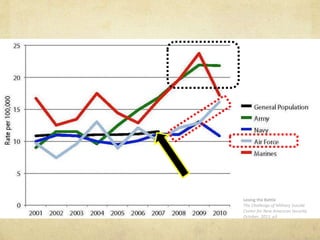
Losing the Battle
The Challenge of Military Suicide
Center for New American Security
October, 2011, p3
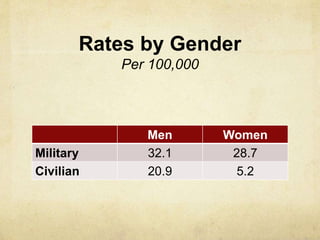
Rates by Gender
Per 100,000
Men Women
Military 32.1 28.7
Civilian 20.9 5.2
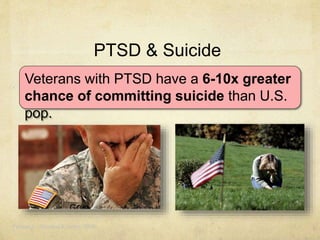
PTSD & Suicide
Veterans with PTSD have a 6-10x greater
chance of committing suicide than U.S.
pop.
Panagioti , Gooding & Tarrier, 2009
PTSD & Suicide
Panagioti , Gooding & Tarrier, 2009
• VA reports 22 suicides per day among
the entire veteran population and 1,000
suicide attempts per month.
• Female veterans are 2-3x more likely
to commit suicide than nonveteran
women.
PTSD & Suicide
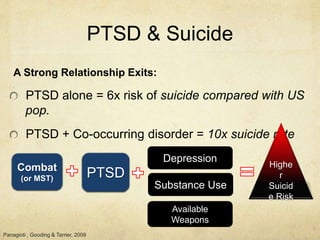
A Strong Relationship Exits:
PTSD alone = 6x risk of suicide compared with US
pop.
PTSD + Co-occurring disorder = 10x suicide rate
Combat
(or MST) PTSD
Substance Use
Depression
Available
Weapons
Highe
r
Suicid
e Risk
Panagioti , Gooding & Tarrier, 2009
Facts about Veteran
suicide
20 percent of U.S. deaths from suicide are Veterans (National Violent
Death Reporting System)
Veterans are more likely than the general population to use firearms as a
means for suicide (National Violent Death Reporting System)
Decreased suicide rates in Veterans aged 18-29 who use VA health care
services (National Violent Death Reporting System and VA Serious Mental
Illness Treatment Resource and Evaluation Center)
33 percent of recent Veteran suicides have a history of previous attempts
(VA National Suicide Prevention Coordinator reports, October 1, 2008 –
December 31, 2010 )
Resources
Veterans Crisis Line/Chat/Text
1-800-273-8255 and Press 1
http://www.veteranscrisisline.net/
Text to 838255
VA Suicide Prevention Coordinators
Each VA Medical Center has a suicide prevention
coordinator to make sure Veterans receive needed
counseling and services
Resource locator - http://www.veteranscrisisline.net/

Moral Injury_Perspectives Panel

  • 1.
    Moral Injury andVeteran Suicides University of San Francisco September 15, 2015 Kathleen S. Pierce, PsyD kathleen.pierce@va.gov 510-495-4450
  • 2.
    Moral Injury: Definition “Thelasting psychological, biological, spiritual, behavioral and social impact of perpetuating, failing to prevent, or bearing witness to acts that transgress deeply held moral beliefs and expectations.” Litz, Stein, Delany, Lebowitz, Nash, Silva & Maguen 2009
  • 3.
    A Military Definitionof Moral Injury “A profound sense of alienation and abject shame.” Source: Battleland, Military Mental Health Ritchie, 2013
  • 4.
    Pre-War Belief Systems Theworld is benevolent The world is safe People are generally good Bad things happen to bad people People get what they deserve If someone behaves badly, they should be punished Witnessing of extreme human suffering can call into question all of these beliefs
  • 5.
    Coming Home Moral injuryfeeds on despair. When the narcotic emotional intensity and tight camaraderie of war are gone, withdrawal can be intense. As memory and reflection deepen, negative self-judgments can torment a soul for a lifetime. Moral injury destroys meaning and forsakes noble cause. It sinks warriors into state of silent, solitary suffering, where bonds of intimacy and care seem impossible. Its torments to the soul can make death a mercy. Soul Repair, Nakashima & Lettini, 2012
  • 6.
    Readjustment Challenges No longerhave daily support of Military culture, peers Concerns about being judged by others Resumption of civilian life, larger social values Exposure to loved ones (spouse, children, elders)
  • 7.
    Internal Consequences of MoralInjury Feeling “broken” or “weak” Concept of self as a monster Extreme Guilt and Shame Fundamental Mistrust – Belief that the world is a dangerous place People cannot be trusted or counted on Belief that “I” cannot be trusted – a fundamental shift in self perception
  • 8.
    Guilt, Shame andSelf Condemnation are the Hallmarks of Moral Injury Guilt, Shame and Self Condemnation are also precipitating factors for Suicide
  • 9.
    Losing the Battle TheChallenge of Military Suicide Center for New American Security October, 2011, p3
  • 10.
    Rates by Gender Per100,000 Men Women Military 32.1 28.7 Civilian 20.9 5.2
  • 11.
    PTSD & Suicide Veteranswith PTSD have a 6-10x greater chance of committing suicide than U.S. pop. Panagioti , Gooding & Tarrier, 2009
  • 12.
    PTSD & Suicide Panagioti, Gooding & Tarrier, 2009 • VA reports 22 suicides per day among the entire veteran population and 1,000 suicide attempts per month. • Female veterans are 2-3x more likely to commit suicide than nonveteran women.
  • 13.
    PTSD & Suicide AStrong Relationship Exits: PTSD alone = 6x risk of suicide compared with US pop. PTSD + Co-occurring disorder = 10x suicide rate Combat (or MST) PTSD Substance Use Depression Available Weapons Highe r Suicid e Risk Panagioti , Gooding & Tarrier, 2009
  • 14.
    Facts about Veteran suicide 20percent of U.S. deaths from suicide are Veterans (National Violent Death Reporting System) Veterans are more likely than the general population to use firearms as a means for suicide (National Violent Death Reporting System) Decreased suicide rates in Veterans aged 18-29 who use VA health care services (National Violent Death Reporting System and VA Serious Mental Illness Treatment Resource and Evaluation Center) 33 percent of recent Veteran suicides have a history of previous attempts (VA National Suicide Prevention Coordinator reports, October 1, 2008 – December 31, 2010 )
  • 15.
    Resources Veterans Crisis Line/Chat/Text 1-800-273-8255and Press 1 http://www.veteranscrisisline.net/ Text to 838255 VA Suicide Prevention Coordinators Each VA Medical Center has a suicide prevention coordinator to make sure Veterans receive needed counseling and services Resource locator - http://www.veteranscrisisline.net/

Editor's Notes

  • #10 Main Point: Note how suicide in veterans differs from general population. Main Point #2: Note how while other forces’ rate going down, for some reason AF rate went up.
  • #12 Main Point: Suicide in veterans is a tremendous problem. Staff should be aware of this, and pay attention to warning signs.