ETHICS Defined
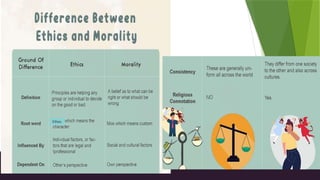
thephilosophical study of morality
moral principles that govern a person's behavior or
the conducting of an activity
based on well-founded standards of right and
wrong that prescribe what humans ought to do,
usually in terms of rights, obligations, benefits to
society, fairness, or specific virtues
MORALITY Defined
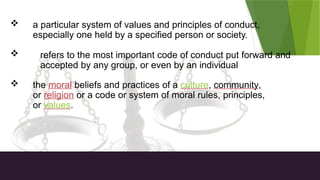
aparticular system of values and principles of conduct,
especially one held by a specified person or society.
refers to the most important code of conduct put forward and
accepted by any group, or even by an individual
the moral beliefs and practices of a culture, community,
or religion or a code or system of moral rules, principles,
or values.
Ethics in Education
Ethicsare very important which helps to run the education
system smoothly.
Ethics in education is a very broad term that gives learning
experiences to students which is fruitful for them to grow
ethically.
9.
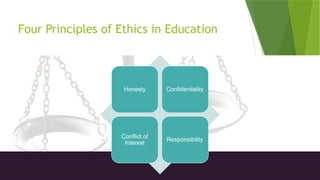
Four Principles ofEthics in Education
Honesty Confidentiality
Conflict of
Interest
Responsibility
10.
Professional Code ofEthics for Teachers
•A teacher should always be aware about his own roles and
responsibilities and must respect the privacy of other members of
their own school.
•They must have proper knowledge about student’s needs and
a deep vision of fulfilling the present needs, requirements and
aspirations of the learners.
•He / she should always show due respect to various spiritual and
cultural values, diversity, social justice, democracy, freedom and the
environment.
11.
Professional Code ofEthics for Teachers
•Teachers should show affection, care and
love to students and build good pious and
respectful relationship with students.
•Teachers should be honest, dedicated
and reliable towards school and students.
12.
Professional Code ofEthics for Teachers
•Teachers should maintain cordial and reverential
relationships with all the stakeholders of school. They must
try to win trust of his pupils, colleagues, parents, school
management and the public as well.
•They should always keep them away from the conflict
between their professional work and private work which may
affect students’ perception towards the school and teachers.
13.
Morality in Teaching
“Theessential thing is not knowledge, but character,” said Joseph
Le Conte.
The significance of the impact educators have on shaping the
impressionable young minds of students is more than the most
detailed lesson plans or the prescription of a curriculum map.
The teachable moments an educator injects into the moral fiber
of students are the lessons that become a ripple that impacts
others for a lifetime.
14.
Connecting Morality toAcademics
Be a role
model.
Connect to your content.
Encourage positive behaviors.
Building grit.