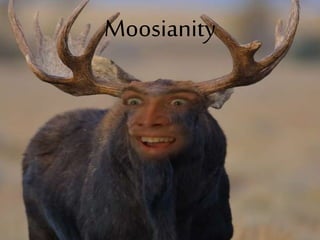
Moosianity
In the beginning there was The Great Moose and 
the infinite emptiness. The Great Moose became 
aware and thus the Great Moose’s first creation 
came into existence (his thoughts) He then 
formed of the concept of existence and realized 
there was nothing but him and upon realizing 
this emotions were born in the Great Moose’s 
mind and thus his second creation (emotion) 
came into being but still within and a part of The 
Great Moose.
The Great Moose then grew wary of the 
emptiness and longed for something outside of 
his self but he knew only of himself as thoughts 
and emotions were created by The Great Moose 
but still a part of him. So he took the idea of self 
and from that created beings in his image. He 
called these beings Moose and they were his 
children, as they were not the original being and 
physically separate The Great Moose’s children 
were imperfect but despite this he was pleased 
with what he had created.
However his children were also displeased with 
the sea of the emptiness and demanded of their 
father, The Great Moose, something more. So the 
Great Moose took the emotion of love for his 
children and from it created Time and Space. 
From Anger he created the Sun and the stars. 
From Joy he created the planets. From Sadness 
he created the great bodies of water found on 
Earth and Canada. And from the waters of both 
planets arose life not in the image of The Great 
Moose.
From these life sprang many forms of life and the 
two planets were eventually filled with these 
creatures. Great Moose’s children then 
descended onto the two planets and inhabited 
them. On the planet Canada no beasts ever 
evolved beyond small creatures similar to 
salamanders and frogs found on Earth. Plant-like 
lifeforms also grew and became abundant on the 
planet Canada and grow to enormous size.
On Earth however the beasts grew large and 
fierce. Some of these beasts began hunting the 
Moose and so The Great Moose created a beast 
to rule over all the other creatures of Earth and 
gave them a set of rules by which they should 
live. These rules are referred to as the Moose 
Commandments.
The Moose Commandments 
• Thou shall protect the Moose. 
• Praise The Great Moose in everything you do. 
• Thou shall not lay with a Moose as you would a human. 
• Watch over the beasts and plants as their guardians.
Aside from the Moose Commandments we were also 
given some minor rules and rituals for daily life. 
• Upon the death of a Moose you are not to lay a hand on the 
corpse. It must return back into the land in the way nature 
intended. 
• Upon the death of a human they are to be placed in a box made of 
cedar face down and that box put in the ground 7 feet below the 
surface and then covered back with the soil dug out. 
• Disputes between humans are to be decided by way of syrup 
chugging contests. 
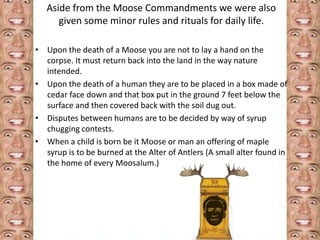
• When a child is born be it Moose or man an offering of maple 
syrup is to be burned at the Alter of Antlers (A small alter found in 
the home of every Moosalum.)
The Moosalums lived by these rules for many generations 
until the teachings of Leroy Jenkins which taught us that 
there are now more commandments put forth by the 
Great Moose after witnessing the acts of Cling Clang. 
• Love and protect your fellow man. 
• Thou shall not cut down maple trees. 
• 20 gallons of Maple syrup are to be collected and burned as an 
offering to The Great Moose every day at the Great Alter of Cage 
by the Head Moose Priest.
If we remain faithful to our duties to the 
Moose and abide by the rules set forth by 
The Great Moose we will be reborn as 
Moose on the Planet Canada and live in 
harmony with nature alongside The Great 
Moose’s children.
Daily Ritual 
Every day followers of Moosianity are to 
go out into the forest and collect sap from 
a maple tree and bring it back to their 
home where it is burned on a Moose alter 
as an offering to The Great Moose. 
Besides this there are no specific daily 
rituals and followers are to simply do what 
is best for the herd of Moose they watch 
over and do it to the best of their ability.
Weekly Ritual 
Once a week on Friday Moosalums go to 
the local Moose Temple and report to the 
Keeper of Records on the status of their 
herd. After everyone has reported their 
status they come together for a feast of 
Maple Syrup and Salad.
Bi-yearly Ritual 
Twice a year, once on April 20th and once 
on August 20th all the Moosalums gather 
at their regional temple and take part in 
the Festival of Antlers and drink 
fermented Maple Syrup and dance naked 
around a large mound of beaver pelts 
which they then light on fire and burn as 
an offering to The Great Moose.
Symbols
Positions in Moosianity 
Mother: This position is appointed by the Grand Mother 
of the region and is responsible for helping and advising 
new and/or troubled parents, helping with moose births 
if there are complications and overseeing Coming of Age 
rituals. This position is held with high regard. 
Grand Mother: This is a position appointed by the Head 
Priest of the regional temples. She is assigned to care for 
and raise orphaned Moosalums. She lives in the temple 
and acts as a Mother for the orphans who are raised 
there. This position is held with very high regard and is 
usually held by a fairly old woman who has raised many 
children of her own who have grown to be model 
Moosalums though it is not unheard of for younger 
women who have had no children of their own to be 
selected if they are deemed fit to take the position.
Positions in Moosianity 
Temple Head: This person acts as the head priest of 
temples and is elected by the members of that temple 
once every two years. They advise followers who are 
troubled or have questions and give sermons once a 
week before the feast. 
Keeper of Records: A young Moosalum, after their 
coming of age, is appointed as Keeper’s Apprentice by 
the current Keeper. When they are appointed they act as 
an apprentice to the current Keeper until he dies at 
which they take over as The Keeper of Records until their 
own death and are responsible for the appointing of 
their apprentice, Keeping records for the local temples, 
assigning herds, keeping a record of the weekly reports 
and advising the Temple Head.
Positions in Moosianity 
Overseer: This position is appointed by the head priest at the 
Regional temple and includes duties such as planning and 
orchestrating large regional events such as the bi-yearly ritual. 
Counsel of Moose: This is a group of 20 men and women who 
are comprised of the leaders of the 20 largest temples. This 
group acts as a sort of court and their duty is to determine the 
guilt of individuals and groups and to determine what action 
should be taken. Other duties include advising the Rack 
Master. 
Rack Master: Title held by the head priest of the Temple of 
Racks which is the largest Moosianity temple. He can 
overturn decisions made by the Counsel of Moose but mostly 
functions as a figurehead.
Temples 
Local: Usually comprising of no more than 200 people these 
temples normally comprise of a simple building with a large 
room for worship and the feast and several smaller rooms 
which acts as offices. 
Regional: A large temple which is comprised of a large 
building with a huge room used for various gatherings, various 
small rooms used for offices, a big room used as the Records 
Library which acts as a the storage house for all the region’s 
Keepers of Records and a big field where the bi-yearly 
ceremonies are held and a mansion which houses the 
Mother and the children which she cares for. 
Temple of Racks: The international temple and largest 
temple. It is where the Rack Master lives, the Counsel of 
Moose meet and holds a similar function to that of the 
Vatican in Catholicism.
END

Moosianity jlh full

  • 1.
  • 2.
    In the beginningthere was The Great Moose and the infinite emptiness. The Great Moose became aware and thus the Great Moose’s first creation came into existence (his thoughts) He then formed of the concept of existence and realized there was nothing but him and upon realizing this emotions were born in the Great Moose’s mind and thus his second creation (emotion) came into being but still within and a part of The Great Moose.
  • 3.
    The Great Moosethen grew wary of the emptiness and longed for something outside of his self but he knew only of himself as thoughts and emotions were created by The Great Moose but still a part of him. So he took the idea of self and from that created beings in his image. He called these beings Moose and they were his children, as they were not the original being and physically separate The Great Moose’s children were imperfect but despite this he was pleased with what he had created.
  • 4.
    However his childrenwere also displeased with the sea of the emptiness and demanded of their father, The Great Moose, something more. So the Great Moose took the emotion of love for his children and from it created Time and Space. From Anger he created the Sun and the stars. From Joy he created the planets. From Sadness he created the great bodies of water found on Earth and Canada. And from the waters of both planets arose life not in the image of The Great Moose.
  • 5.
    From these lifesprang many forms of life and the two planets were eventually filled with these creatures. Great Moose’s children then descended onto the two planets and inhabited them. On the planet Canada no beasts ever evolved beyond small creatures similar to salamanders and frogs found on Earth. Plant-like lifeforms also grew and became abundant on the planet Canada and grow to enormous size.
  • 6.
    On Earth howeverthe beasts grew large and fierce. Some of these beasts began hunting the Moose and so The Great Moose created a beast to rule over all the other creatures of Earth and gave them a set of rules by which they should live. These rules are referred to as the Moose Commandments.
  • 7.
    The Moose Commandments • Thou shall protect the Moose. • Praise The Great Moose in everything you do. • Thou shall not lay with a Moose as you would a human. • Watch over the beasts and plants as their guardians.
  • 8.
    Aside from theMoose Commandments we were also given some minor rules and rituals for daily life. • Upon the death of a Moose you are not to lay a hand on the corpse. It must return back into the land in the way nature intended. • Upon the death of a human they are to be placed in a box made of cedar face down and that box put in the ground 7 feet below the surface and then covered back with the soil dug out. • Disputes between humans are to be decided by way of syrup chugging contests. • When a child is born be it Moose or man an offering of maple syrup is to be burned at the Alter of Antlers (A small alter found in the home of every Moosalum.)
  • 9.
    The Moosalums livedby these rules for many generations until the teachings of Leroy Jenkins which taught us that there are now more commandments put forth by the Great Moose after witnessing the acts of Cling Clang. • Love and protect your fellow man. • Thou shall not cut down maple trees. • 20 gallons of Maple syrup are to be collected and burned as an offering to The Great Moose every day at the Great Alter of Cage by the Head Moose Priest.
  • 10.
    If we remainfaithful to our duties to the Moose and abide by the rules set forth by The Great Moose we will be reborn as Moose on the Planet Canada and live in harmony with nature alongside The Great Moose’s children.
  • 11.
    Daily Ritual Everyday followers of Moosianity are to go out into the forest and collect sap from a maple tree and bring it back to their home where it is burned on a Moose alter as an offering to The Great Moose. Besides this there are no specific daily rituals and followers are to simply do what is best for the herd of Moose they watch over and do it to the best of their ability.
  • 12.
    Weekly Ritual Oncea week on Friday Moosalums go to the local Moose Temple and report to the Keeper of Records on the status of their herd. After everyone has reported their status they come together for a feast of Maple Syrup and Salad.
  • 13.
    Bi-yearly Ritual Twicea year, once on April 20th and once on August 20th all the Moosalums gather at their regional temple and take part in the Festival of Antlers and drink fermented Maple Syrup and dance naked around a large mound of beaver pelts which they then light on fire and burn as an offering to The Great Moose.
  • 14.
  • 15.
    Positions in Moosianity Mother: This position is appointed by the Grand Mother of the region and is responsible for helping and advising new and/or troubled parents, helping with moose births if there are complications and overseeing Coming of Age rituals. This position is held with high regard. Grand Mother: This is a position appointed by the Head Priest of the regional temples. She is assigned to care for and raise orphaned Moosalums. She lives in the temple and acts as a Mother for the orphans who are raised there. This position is held with very high regard and is usually held by a fairly old woman who has raised many children of her own who have grown to be model Moosalums though it is not unheard of for younger women who have had no children of their own to be selected if they are deemed fit to take the position.
  • 16.
    Positions in Moosianity Temple Head: This person acts as the head priest of temples and is elected by the members of that temple once every two years. They advise followers who are troubled or have questions and give sermons once a week before the feast. Keeper of Records: A young Moosalum, after their coming of age, is appointed as Keeper’s Apprentice by the current Keeper. When they are appointed they act as an apprentice to the current Keeper until he dies at which they take over as The Keeper of Records until their own death and are responsible for the appointing of their apprentice, Keeping records for the local temples, assigning herds, keeping a record of the weekly reports and advising the Temple Head.
  • 17.
    Positions in Moosianity Overseer: This position is appointed by the head priest at the Regional temple and includes duties such as planning and orchestrating large regional events such as the bi-yearly ritual. Counsel of Moose: This is a group of 20 men and women who are comprised of the leaders of the 20 largest temples. This group acts as a sort of court and their duty is to determine the guilt of individuals and groups and to determine what action should be taken. Other duties include advising the Rack Master. Rack Master: Title held by the head priest of the Temple of Racks which is the largest Moosianity temple. He can overturn decisions made by the Counsel of Moose but mostly functions as a figurehead.
  • 18.
    Temples Local: Usuallycomprising of no more than 200 people these temples normally comprise of a simple building with a large room for worship and the feast and several smaller rooms which acts as offices. Regional: A large temple which is comprised of a large building with a huge room used for various gatherings, various small rooms used for offices, a big room used as the Records Library which acts as a the storage house for all the region’s Keepers of Records and a big field where the bi-yearly ceremonies are held and a mansion which houses the Mother and the children which she cares for. Temple of Racks: The international temple and largest temple. It is where the Rack Master lives, the Counsel of Moose meet and holds a similar function to that of the Vatican in Catholicism.
  • 19.