Human Rights Monitoring, Fact-Finding and Documentation
MONITORING, FACT-FINDING & DOCUMENTATION MONITORING  -- the close observation of a situation or individual case carried out so as to determine what further action needs to be taken. FACT-FINDING  -- identifying the violations in one event, and establishing the facts relevant to these violations. Fact-finding and investigation are terms that are used interchangeably.  DOCUMENTATION   -- the systematic recording of the results of the investigation of an event Monitoring usually involves the investigation and documentation of a large number of events
The cooking analogy
 
 
Monitoring The close observation of a situation or individual case Carried out to determine what further action is needed
Elements of Monitoring: Carried out over an  extended period of time Involves collecting or receiving a  large quantity of data Requires constant or periodic  investigation and documentation  of developments Uses  standards or norms  to assess the situation Results in a  report , which provides a basis for  further action
Example of a Norm RIGHT:  Right to Life INTERNATIONAL STANDARD:  “No one shall be arbitrarily deprived of his life.”  (Article 6 (1) of the International Covenant on Civil and Political Rights)
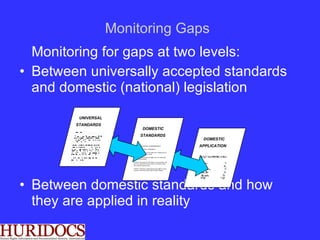
Monitoring for gaps at two levels: Between universally accepted standards and domestic (national) legislation Between domestic standards and how they are applied in reality Monitoring Gaps DOMESTIC  STANDARDS DOMESTIC  APPLICATION UNIVERSAL  STANDARDS
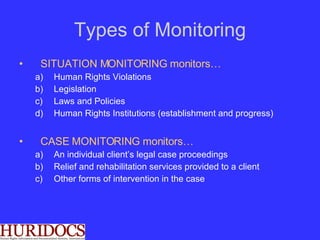
Types of Monitoring SITUATION MONITORING monitors… Human Rights Violations Legislation Laws and Policies Human Rights Institutions (establishment and progress) CASE MONITORING monitors… An individual client’s legal case proceedings Relief and rehabilitation services provided to a client Other forms of intervention in the case
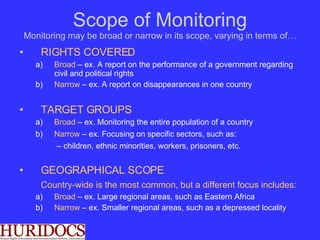
Scope of Monitoring Monitoring may be broad or narrow in its scope, varying in terms of… RIGHTS COVERED Broad  – ex. A report on the performance of a government regarding civil and political rights Narrow  – ex. A report on disappearances in one country TARGET GROUPS Broad  – ex. Monitoring the entire population of a country Narrow  – ex. Focusing on specific sectors, such as :   –   children, ethnic minorities, workers, prisoners, etc. GEOGRAPHICAL SCOPE  Country-wide is the most common, but a different focus includes: Broad  – ex. Large regional areas, such as Eastern Africa Narrow  – ex. Smaller regional areas, such as a depressed locality
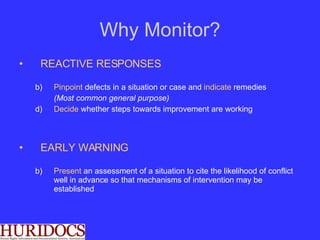
Why Monitor? REACTIVE RESPONSES Pinpoint  defects in a situation or case and  indicate  remedies (Most common general purpose) Decide  whether steps towards improvement are working  EARLY WARNING Present  an assessment of a situation to cite the likelihood of conflict well in advance so that mechanisms of intervention may be established
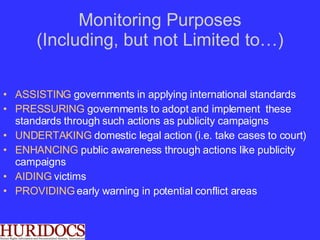
Monitoring Purposes (Including, but not Limited to…) ASSISTING  governments in applying international standards PRESSURING  governments to adopt and implement  these standards through such actions as publicity campaigns UNDERTAKING  domestic legal action (i.e. take cases to court) ENHANCING  public awareness through   actions like publicity campaigns AIDING  victims PROVIDING  early warning in potential conflict areas
Primary Monitoring Methodologies   Indicators-Based Methodology Acts-Based Methodology  (“Events Methodology”)
Indicators-Based Methodology An  INDICATOR  demonstrates where something is, what direction it is headed, and how far it is from the objective.  May be: Result  (Ex. – mortality rate) Process  (Ex. – Proportion of children immunized against  childhood diseases) A  BENCHMARK  refers to the level to be met when using a certain indicator (Ex. 90% of all children under 5 years immunized )
Events-Based Methodology “A single case of killing is one too many.” Has been used by human rights groups and NGOs for decades for  visible types of violations , such as:  killings, abductions, torture, and detention Involves  investigating  events and  determining  which acts within the event may be or lead up to violations. These include acts of: Commission  (ex. – beating a detainee; executing a labour    leader) Omission  (ex. – failing to protect a labour leader from being    killed)
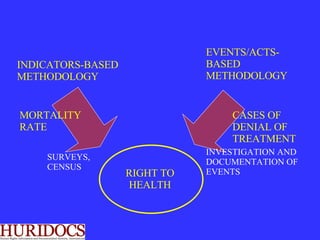
INDICATORS-BASED METHODOLOGY EVENTS/ACTS-BASED METHODOLOGY RIGHT TO HEALTH MORTALITY RATE CASES OF DENIAL OF TREATMENT SURVEYS, CENSUS INVESTIGATION AND DOCUMENTATION OF EVENTS
Events Methodology’s Main Problems Monitoring body may miss some events due to (amongst other reasons): Lack of local contacts “ Private matter” (thus unreported) Inability to investigate and document all events a monitoring body learns about due to (for example):  An ongoing military operation Unwillingness of actors to be interviewed
What are human rights violations? The failure of the state to meet three kinds of obligations: Respect Protect Fulfil
Obligation to Respect To abstain from doing anything that violates the integrity of an individual, or group, or infringes on their freedom. This may include such acts as: Extra-judicial killing (violates the obligation to respect an individual’s right to life) Arbitrary arrest (violates the obligation to respect an individual’s right to liberty) Banning a trade union (violates the obligation to respect a group’s right to freedom of association) Restricting the practice of a specific religion (violates the obligation to respect an individual’s freedom of religion)
Obligation to Protect To take the necessary measures necessary to prevent others from violating the rights of an individual or group. This may include acts of omission, such as: Failure to acts when a specific group, such as an ethnic group, attacks another Failure to compel companies to pay decent wages
Obligation to Fulfil To ensure opportunities for each person to obtain satisfaction of needs recognized by human rights instruments that cannot be secured through personal efforts alone. These include acts of omission, such as: Failure to adopt a basic health care system Failure to implement a free education system at the primary level
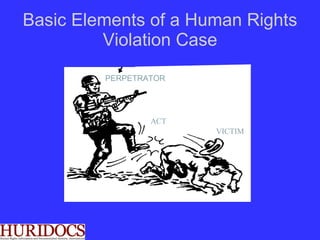
Basic Elements of a Human Rights Violation Case PERPETRATOR ACT VICTIM
An event may consist of: A  single act , such as killing a labour leader   or bombing an office A  series of acts , such as  ARREST  TORTURE  EXECUTION Simultaneous acts , such as beating several protestors during a demonstration
Names of Types of Acts Universally accepted names of violations include: Extra-judicial execution Disappearance Torture Displacement Others may be categorized according to the rights they violate, such as: Restriction of the right to movement Denial of the right to bail
Varying Durations of Events Instantaneous (ex. – killing) Endure for some time (ex. – torture) Take years from start to end (ex. – the case of an accused person) This demonstrates the need for follow-up documentation.
Rights of Arrested/Accused: Release in case of unlawful arrest Presumption of innocence Adequate time and facilities to prepare defence Trial by an impartial and independent jury Fair and public trial Free assistance of an interpreter Equality of arms Prompt and detailed information Speedy trial Legal assistance Freedom from double jeopardy
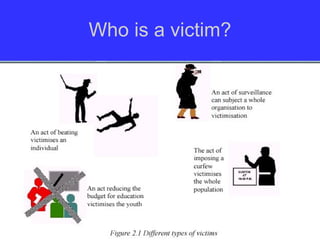
Who is a victim?
Perpetrator Characteristics May be an individual or a group May have varying levels of involvement, such as: Directly carried out the act Gave orders that lead to the act Was present but did not participate in the act

Monitoring Intro Huridocs

  • 1.
    Human Rights Monitoring,Fact-Finding and Documentation
  • 2.
    MONITORING, FACT-FINDING &DOCUMENTATION MONITORING -- the close observation of a situation or individual case carried out so as to determine what further action needs to be taken. FACT-FINDING -- identifying the violations in one event, and establishing the facts relevant to these violations. Fact-finding and investigation are terms that are used interchangeably. DOCUMENTATION -- the systematic recording of the results of the investigation of an event Monitoring usually involves the investigation and documentation of a large number of events
  • 3.
  • 4.
  • 5.
  • 6.
    Monitoring The closeobservation of a situation or individual case Carried out to determine what further action is needed
  • 7.
    Elements of Monitoring:Carried out over an extended period of time Involves collecting or receiving a large quantity of data Requires constant or periodic investigation and documentation of developments Uses standards or norms to assess the situation Results in a report , which provides a basis for further action
  • 8.
    Example of aNorm RIGHT: Right to Life INTERNATIONAL STANDARD: “No one shall be arbitrarily deprived of his life.” (Article 6 (1) of the International Covenant on Civil and Political Rights)
  • 9.
    Monitoring for gapsat two levels: Between universally accepted standards and domestic (national) legislation Between domestic standards and how they are applied in reality Monitoring Gaps DOMESTIC STANDARDS DOMESTIC APPLICATION UNIVERSAL STANDARDS
  • 10.
    Types of MonitoringSITUATION MONITORING monitors… Human Rights Violations Legislation Laws and Policies Human Rights Institutions (establishment and progress) CASE MONITORING monitors… An individual client’s legal case proceedings Relief and rehabilitation services provided to a client Other forms of intervention in the case
  • 11.
    Scope of MonitoringMonitoring may be broad or narrow in its scope, varying in terms of… RIGHTS COVERED Broad – ex. A report on the performance of a government regarding civil and political rights Narrow – ex. A report on disappearances in one country TARGET GROUPS Broad – ex. Monitoring the entire population of a country Narrow – ex. Focusing on specific sectors, such as : – children, ethnic minorities, workers, prisoners, etc. GEOGRAPHICAL SCOPE Country-wide is the most common, but a different focus includes: Broad – ex. Large regional areas, such as Eastern Africa Narrow – ex. Smaller regional areas, such as a depressed locality
  • 12.
    Why Monitor? REACTIVERESPONSES Pinpoint defects in a situation or case and indicate remedies (Most common general purpose) Decide whether steps towards improvement are working EARLY WARNING Present an assessment of a situation to cite the likelihood of conflict well in advance so that mechanisms of intervention may be established
  • 13.
    Monitoring Purposes (Including,but not Limited to…) ASSISTING governments in applying international standards PRESSURING governments to adopt and implement these standards through such actions as publicity campaigns UNDERTAKING domestic legal action (i.e. take cases to court) ENHANCING public awareness through actions like publicity campaigns AIDING victims PROVIDING early warning in potential conflict areas
  • 14.
    Primary Monitoring Methodologies Indicators-Based Methodology Acts-Based Methodology (“Events Methodology”)
  • 15.
    Indicators-Based Methodology An INDICATOR demonstrates where something is, what direction it is headed, and how far it is from the objective. May be: Result (Ex. – mortality rate) Process (Ex. – Proportion of children immunized against childhood diseases) A BENCHMARK refers to the level to be met when using a certain indicator (Ex. 90% of all children under 5 years immunized )
  • 16.
    Events-Based Methodology “Asingle case of killing is one too many.” Has been used by human rights groups and NGOs for decades for visible types of violations , such as: killings, abductions, torture, and detention Involves investigating events and determining which acts within the event may be or lead up to violations. These include acts of: Commission (ex. – beating a detainee; executing a labour leader) Omission (ex. – failing to protect a labour leader from being killed)
  • 17.
    INDICATORS-BASED METHODOLOGY EVENTS/ACTS-BASEDMETHODOLOGY RIGHT TO HEALTH MORTALITY RATE CASES OF DENIAL OF TREATMENT SURVEYS, CENSUS INVESTIGATION AND DOCUMENTATION OF EVENTS
  • 18.
    Events Methodology’s MainProblems Monitoring body may miss some events due to (amongst other reasons): Lack of local contacts “ Private matter” (thus unreported) Inability to investigate and document all events a monitoring body learns about due to (for example): An ongoing military operation Unwillingness of actors to be interviewed
  • 19.
    What are humanrights violations? The failure of the state to meet three kinds of obligations: Respect Protect Fulfil
  • 20.
    Obligation to RespectTo abstain from doing anything that violates the integrity of an individual, or group, or infringes on their freedom. This may include such acts as: Extra-judicial killing (violates the obligation to respect an individual’s right to life) Arbitrary arrest (violates the obligation to respect an individual’s right to liberty) Banning a trade union (violates the obligation to respect a group’s right to freedom of association) Restricting the practice of a specific religion (violates the obligation to respect an individual’s freedom of religion)
  • 21.
    Obligation to ProtectTo take the necessary measures necessary to prevent others from violating the rights of an individual or group. This may include acts of omission, such as: Failure to acts when a specific group, such as an ethnic group, attacks another Failure to compel companies to pay decent wages
  • 22.
    Obligation to FulfilTo ensure opportunities for each person to obtain satisfaction of needs recognized by human rights instruments that cannot be secured through personal efforts alone. These include acts of omission, such as: Failure to adopt a basic health care system Failure to implement a free education system at the primary level
  • 23.
    Basic Elements ofa Human Rights Violation Case PERPETRATOR ACT VICTIM
  • 24.
    An event mayconsist of: A single act , such as killing a labour leader or bombing an office A series of acts , such as ARREST TORTURE EXECUTION Simultaneous acts , such as beating several protestors during a demonstration
  • 25.
    Names of Typesof Acts Universally accepted names of violations include: Extra-judicial execution Disappearance Torture Displacement Others may be categorized according to the rights they violate, such as: Restriction of the right to movement Denial of the right to bail
  • 26.
    Varying Durations ofEvents Instantaneous (ex. – killing) Endure for some time (ex. – torture) Take years from start to end (ex. – the case of an accused person) This demonstrates the need for follow-up documentation.
  • 27.
    Rights of Arrested/Accused:Release in case of unlawful arrest Presumption of innocence Adequate time and facilities to prepare defence Trial by an impartial and independent jury Fair and public trial Free assistance of an interpreter Equality of arms Prompt and detailed information Speedy trial Legal assistance Freedom from double jeopardy
  • 28.
    Who is avictim?
  • 29.
    Perpetrator Characteristics Maybe an individual or a group May have varying levels of involvement, such as: Directly carried out the act Gave orders that lead to the act Was present but did not participate in the act